







Abstract
This article investigates the implications that theater role-taking has on identity transformation for individuals recently released from prison in the United States. Drawing upon 15 in-depth and semistructured interviews with individuals recently released from prison involved in a theater program, this study finds that theater role-taking provides the gateway to personal identity role-taking at three levels: the self, the family, and the broader society. At each level individuals are simultaneously accessing the roles of the “agentic self,” “the responsible family member,” and “the productive citizen.” These personal identity role-taking opportunities have implications for how individuals engage in “performing rehabilitation” or the presentation of self, which identifies reentering individuals as “changed.” As individuals engage in a presentation of self that are aligned with the rehabilitative ideas of the state, the theater program extends notions of rehabilitation that mirror those found across the reentry landscape.
Introduction
For the one million individuals currently incarcerated, 90% of whom will return home, the landscape of reentry could not be more complex (Petersilia, 2005; Sawyer and Wagner, 2023). Formerly incarcerated individuals must often conform to the standards of rehabilitation set by the U.S. criminal legal system when released from incarceration through reintegrative programs (Miller, 2021). Many of these organizations direct the behavior of individuals across multiple domains of their lives as a means of controlling “at risk” individuals (Turnbull and Hannah-Moffat, 2009). For example, parole often requires individuals to be gainfully employed, have stable housing, maintain an active status in rehabilitation programs, and pass parenting courses (Corbett, 2015). Should individuals fail to achieve these goals, the threat of reincarceration looms large (Werth, 2011). Thus, to be “rehabilitated” is to be “in compliance” with justice system policies.
Understanding the process of rehabilitation beyond compliance, however, is less understood. Identity shifts may be key to uncovering how individuals desist from crime. Identity shifts may be especially likely to occur during the reentry context, as it is a transitional life stage where behaviors are predicated on how people view themselves and how others view them. Identity literature has theorized the mechanisms of desistance, citing cognitive shifts and role-taking (Giordano et al., 2002; Heimer and Matsueda, 1994). Role-taking, where individuals engage in a social role and internalize that role as part of their identity, is a central feature of the construction of the self and provides the mechanism of analysis needed to further delve into how identity matters for changing criminal behavior.
To explore this process, I examine a setting in which formerly incarcerated people are literally taking on roles through participation in a theater program. Through analysis of in-depth interviews with 15 formerly incarcerated people involved in a theater program, I argue that individuals “perform rehabilitation” with the intention of putting forth a presentation of self (Goffman, 1956) that conforms to normative understandings of what it means to be a reentering or reformed person. Specifically, I find that individuals “perform rehabilitation” at three levels: the self, the family, and the larger society. Thus, individuals are simultaneously embodying idealized subjects of the state including the agentic self, the responsible family member, and the productive citizen. Moreover, I argue the theater program provides an extension of the rehabilitative ideas of the state, encouraging rehabilitative ideals and selfhoods found in coercive rehabilitation, such as the “recovering addict,” or “responsible parent” (Opsal, 2011; Werth, 2011).
This paper makes several contributions to the literature. While much research has explored diseased selves (McCorkel, 2013; Turnbull and Hannah-Moffat, 2009; Werth, 2012), I build on this scholarship to explore how individuals perform full and rehabilitated selves, the ways individuals maximize their limited role-taking opportunities to do so, and its impacts on identity. Halushka (2016) provides insight into how people display themselves as rehabilitated, but insinuates that role-taking and representations of the self are precursors to identity transformation and are not necessarily implicated in that process. Instead, I argue that role-taking has important implications for identity and understandings of the self which dialectally inform the desistance process. Opsal (2011) and Maruna (2001) have detailed how individuals narrate their lives to indicate a rehabilitated self, though they focus on narrative tools and less on the social roles a person embodies to display rehabilitation. This article expands knowledge on the presentation of a rehabilitated self by examining how individuals use their role in a theater program to display a self which is competent across social roles.
Further, this article adds to a broader literature on court-mandated treatment (e.g. Hannah-Moffat and Maurutto, 2012; Turnbull and Hannah-Moffat, 2009) by exploring the tensions of rehabilitation and punishment in nonmandated, nontraditional spaces: that of an arts program. One exception to this may be Halushka (2016), where the work-based reentry program is voluntary, but works with government agencies to resettle individuals in the community. Although nonmandated programs may not explicitly carry the punitive consequences that mandated programs do, I argue that they replicate the punitive arm of the criminal legal system through encouraging a rehabilitated self that aligns with the ideals of the state, thus extending the “fuzzy edge” of the criminal legal system into voluntary programming (Gowan and Whetstone, 2012).
The self and rehabilitation
Symbolic interactionists are occupied with the study of the self; how it comes to exist and be understood. The most fundamental mechanism to construct a self is role-taking, or the knowledge and language of how others see us, which we then use to construct the self as an object. Literature has discussed how role-taking may matter for system-impacted individuals (for theoretical understandings see De Coster, 2017; Giordano et al., 2002; Heimer and Matsueda, 1994; Matsueda et al., 2020; Paternoster and Bushway, 2009; for concrete examples see Bubolz and Lee, 2021, 2018; Opsal, 2011, 2012). Ultimately, this work argues that selves are continuously constructed and reconstructed through role transitions and newfound role commitments that people have across the lifespan (Giordano et al., 2002; Massoglia and Uggen, 2010; Rocque et al., 2016; Uggen et al., 2004). This article broadens this literature as it explores how role-taking in a theater program facilitates the identity work and role transitions of people who are formerly incarcerated. Participating in theater productions provides access to roles as a character or creative in a play, further referred to as theater role-taking. Theater role-taking allows for role-taking in other parts of individuals’ lives, coined as personal identity role-taking. The processes between the two kinds of role-taking facilitate identity work in meaningful ways that have implications for what it means to be “rehabilitated.”
In the same way that individuals perform other roles, reentering individuals must dress, speak, and behave as “rehabilitated persons” to avoid further system contact and prove to others that they are rehabilitated. Recent dramaturgical work has highlighted the performativity necessary for system-impacted individuals, including employment opportunities (Ali et al., 2017; Durnescu, 2019; Halushka, 2016). Similarly, I argue that through systematic management of a presentation of self (Goffman, 1956), reentering individuals engage in the “face work” of performing what it means to be “desisted” from crime. Thus, this article is primarily concerned with the implications of dramaturgical performances in the context of a prison theater troupe both literally as a part of a theater production, and figuratively as part of the performances that people who are formerly incarcerated put on to display their selves.
The complex notion of rehabilitation in corrections has implications for understanding the self. Literature suggests that rehabilitation is often defined as a set of rules to which individuals must conform. These rules constrict the kinds of identities individuals may access. McCorkel (2013) finds that women in a drug abuse program while incarcerated are framed as having an incomplete or diseased self. She advances the notion of “habilitation” which relies upon social technologies of control, like surveillance, confrontation, humiliation, and discipline, with the purpose of “breaking down” a self (p. 11). Habilitation implies that individuals who commit crimes have an unruly self, incapable of self-regulation or self-governance. The women observed by McCorkel (2013) are ultimately considered unable to be rehabilitated and instead must be managed. To manage an unruly self, individuals must surrender to the ideals of the program and construct their sense of self around institutional and programmatic narratives. Thus, the distinction between treatment and punishment became nonexistent as both treatment and punishment aim to hold people accountable for their actions by reducing individuals’ identities to one or two stigmatized categories.
Similarly, McKim (2008) examines the therapeutic techniques used to measure women's success in a community-based treatment center, noting that the focus of these centers disconnected participants from other meaningful roles (e.g. employment, motherhood) that could shape identity formation and inform desistance. Though other roles outside of therapeutic programs may provide individuals with a “rehabilitated” self, Gurusami (2017, 2019) reveals that employment related roles and mothering roles are consistently surveilled by the state and must be navigated in specific ways to display successful “rehabilitation.” The discussion of self and rehabilitation has surrounded the “fractured subject” (Turnbull and Hannah-Moffat, 2009; Werth, 2012) that criminal legal system contact connotes for individuals. Thus, the system forces individuals into performances like the “criminal addict” or “criminalblackman” (Gowan and Whetstone, 2012; Riley, 2000; Russell-Brown, 1998) and encourages the notion that criminalized individuals suffer from “diseases of the self” ultimately limiting their role-taking opportunities (Gurusami, 2017, 2019; McCorkel, 2013; McKim, 2008).
Building from this literature, I argue that individuals “perform rehabilitation” where they attempt to meet the ideals of the state by managing impressions of the self. They display the self with the goal of reducing state intervention in their lives, rebuilding relationships, and preserving their selfhood as “whole.” This work highlights how individuals involved in a community-based theater program “perform rehabilitation” across multiple levels (self, family, and society) simultaneously. Moreover, unlike many rehabilitative programs in prior research, individuals in this study voluntarily engage in this community-based theater program as another way formerly incarcerated people may perform rehabilitation. Through voluntary engagement, this program provides an extension of the rehabilitative ideas of the state as it encourages specific selfhoods that mirror criminal justice interventions.
Data and methods
Setting and sample
Prison-based arts programs focusing on a variety of arts including written, visual, and performance arts, have been identified in 48 states in the United States and are facilitated in various ways including by volunteers, nonprofit organizations, universities, or prison staff (Justice Arts Coalition, 2025). This study took place in a mid-sized, midwestern city of the United States, which has an incarceration rate of over 600 per 100,000 individuals (Widra, 2024) and is host to a prison-based arts program. With university Institutional Review Board approval (No. 2031682), 1 I conducted 15 in-depth interviews with formerly incarcerated people who are involved in the Prison Play Program (PPP). 2 PPP is a community-based nonprofit theater program located in the Midwest region of the United States that provides performance art involvement for incarcerated and formerly incarcerated people. The program is production based, where program participants are cast in roles, and have rehearsals culminating in a final performance. This program is ideal for examining role-taking because participants literally take on a role of the character they are performing, as well as an artist. All participants initially engaged with PPP while incarcerated and continued participating in the program after their release. Productions are chosen by PPP and the director of the show, both are nonincarcerated community staff.
Recruitment and interviews
Recruitment occurred using a purposive sampling strategy (Spradley, 1979) with the help of the program's art director. The 15 participants were interviewed for this research constitute two-thirds of the total number of individuals actively involved in the program. Interviews continued until theoretical saturation was reached. In return for their time, the program compensated each interviewee with $20. Interviews were in-depth and semistructured in nature. They were conducted over a two-year period (2020–2022), mostly using the online platform Zoom and were audiorecorded and transcribed. Each interview lasted between 45 min to one hour. Questions were asked about how playing certain characters impact the actor themselves, identities as an actor, and whether individuals want to become more artistic since their participation in the theater program.
Table 1 provides demographic information of participants. The majority of individuals identify as white, although a substantial portion identify as other racial or ethnic groups. All participants are between the ages of 31 and 60. These individuals are under a variety of correctional supervision such as probation, parole, or no correctional supervision.
Sample characteristics of PPP participants (N = 15).
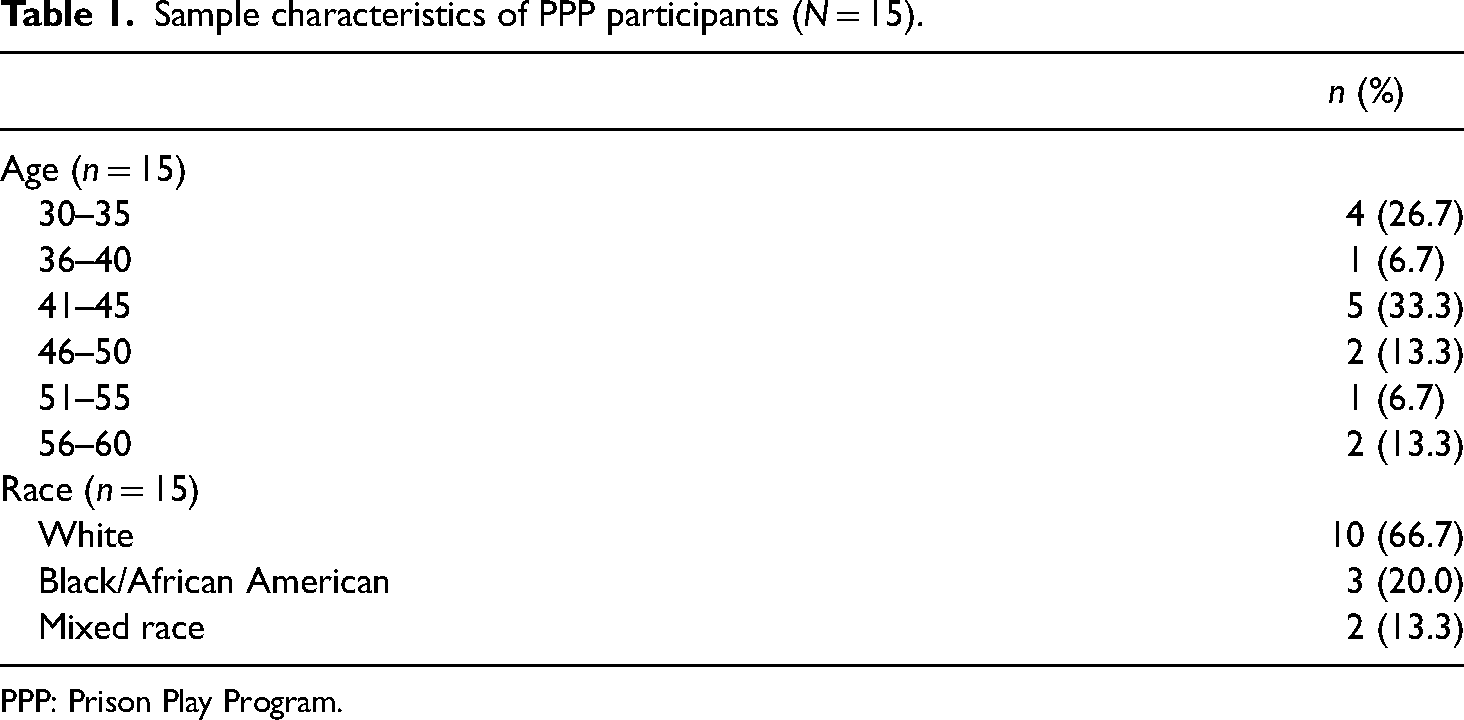
PPP: Prison Play Program.
Analytic strategy
The analytic approach draws on grounded theory (Charmaz, 2014; Glaser and Strauss, 1967). The author was the only person who coded the data. The analytical process began with line-by-line coding using gerunds to code for words that reflect actions. Using aspects of both grounded theory and abductive research, the sensitizing concepts of identity, self, process, and meaning were used as starting points for initiating the analysis (Charmaz, 2014; Miles and Huberman, 1984; Timmermans and Tavory, 2012). Secondary coding processes revealed themes related to agency, family, and audience members. Coding was performed with simultaneous memo-writing to analyze data early in the research process (Charmaz, 2014; Glaser and Strauss, 1967; Miles and Huberman, 1984). This process emphasizes the constant comparative method of grounded theory, whereby data is compared within and across interviews (Charmaz, 2014; Glaser and Strauss, 1967; Lingard et al., 2008; Miles and Huberman, 1984; Spradley, 1979).
Findings
Formerly incarcerated individuals “perform” rehabilitation at three levels: the self, family, and larger society. Figure 1 illustrates the roles in which individuals engage across each level (self, family, and society) and the dimensions of performing rehabilitation. I differentiate between theater-role taking and personal identity role-taking. Theater-role taking is when individuals access a role as a character in a play, and personal identity role-taking is when individuals access roles in other domains of their lives, such as family and work related-roles. I find that theater role-taking facilitates transitions into personal identity roles.
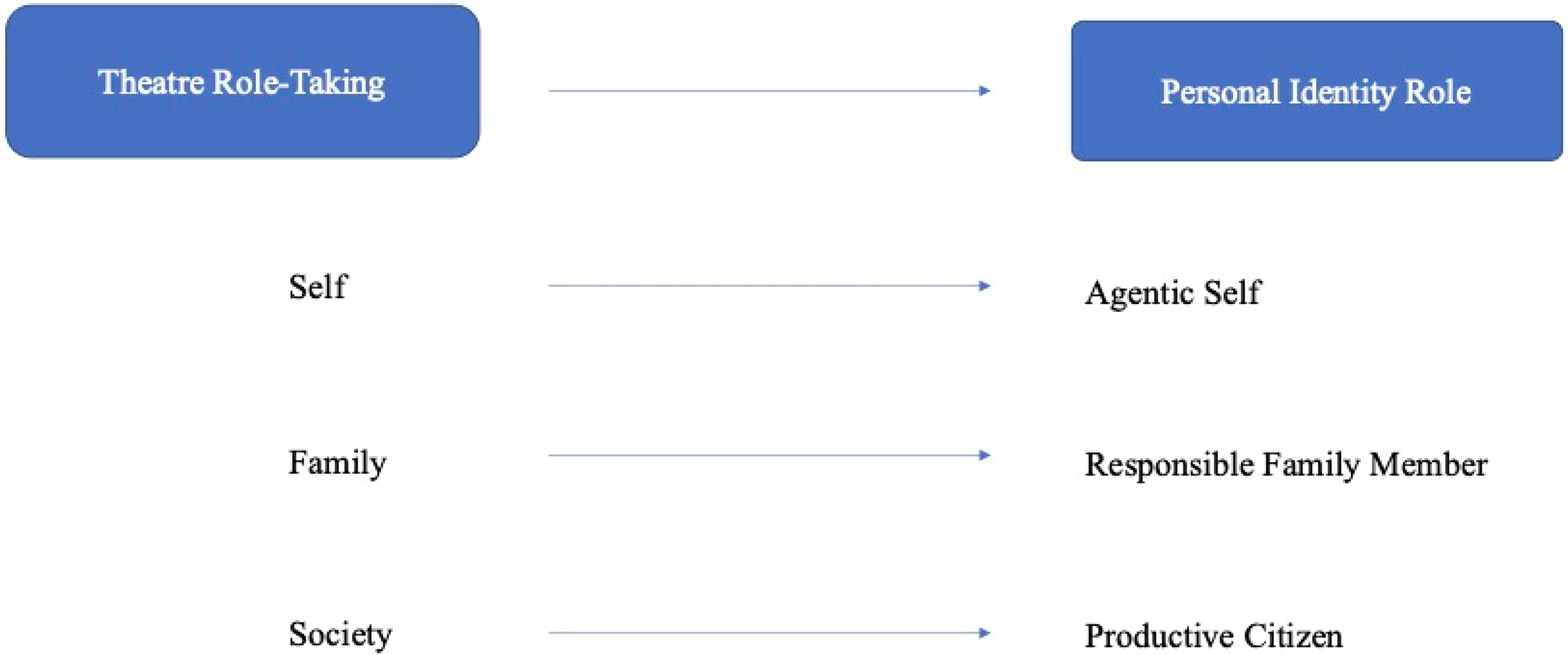
Dimensions of performing rehabilitation.
Participants express a redefined role related to the self by describing how theater role-taking acted as a conduit to adopt the role of an agentic individual. At the family level, theater role-taking provided participants with new avenues to represent themselves as responsible family members. Finally, as nonincarcerated audiences provide their approval of the performance, individuals regain a connection to the public and reconstruct their sense of value to society as productive citizens. I argue that participants engage in these performances, though these are not mere dramaturgical displays. By enacting these roles, individuals I interviewed also experience identity shifts related to those roles. Thus, they are both performing rehabilitation and becoming rehabilitated.
Relationship to the self: The agentic self
Theater role-taking allowed individuals to embody the role of a character central to the plot of a theater performance piece. Theater-role-taking allows individuals to adopt the “performer/artist” identity as their own personal identity role, blurring the lines between theater and personal identity role-taking. More specifically though, individuals entered the role of the “agentic self,” whereby they displayed themselves in control of self-stories, actions, and emotions. In so doing, they “perform rehabilitation” by reinforcing state-defined notions of rehabilitation defined by individual responsibility and accountability.
Participants used the theater program as a means of accessing personal identity roles to regain their agency, which is often constrained by the social structures of the prison and reentry settings. Some roles that traditionally confer agency upon an individual, such as employment, are often inaccessible or limited for those formerly incarcerated. These limitations placed on individuals’ autonomy has implications for their identity construction; specifically, individuals reported internalizing a “criminal” identity and having little opportunities to demonstrate other identities. The role of the agentic self arises as individuals express regaining agency through the adoption of the “artist identity,” and narrate this agency as control over their behaviors.
Redeveloping agency allows individuals to actively construct an identity that they feel best represents who they are, rather than internalizing the identities or labels placed upon them by others. EJ, a white man in his mid-40s, felt “confidence” in performing as Lady Macbeth in a men's prison, “I was comfortable enough playing a female, you know, and wearing a dress in a prison setting.” EJ believes that this confidence gave him agency over his personal identity construction, replacing an old identity with a new one, “I'm pretty open about (my crime) now … as opposed to try to hide it or worry about them finding out because that's something I did, I'm not proud of and it's not who I am today.” As a result of his experience with theater role-taking, EJ narrates a sense of control over his self-narrative and identity construction as an artist.
Similarly, Moses, a black man in his late 50s described learning “self-worth” and confidence through overcoming feelings of failure: I felt as though I was not a failure. I don't care if I have a criminal background, I was able to get home, by the grace of God and some good health and support from people from PPP … I was able to pick myself up.
In addition to commenting on a renewed sense of control over their self-narratives and present behaviors, participants also talked about the temporal experience of “moving forward,” representing a form of control over the future. Honey, a white woman in her early 30s describes being lifeless, limp, and “so lackluster,” ultimately as a passive passenger to her own life prior to theater role-taking: “I did nothing right like … I didn’t necessarily have a schedule or an accountability or a reason.” However, through theater role-taking, Honey found purpose, “[B]ut with PPP I was like, ‘Oh shit, I gotta get up. Where's my shoes?’ … It gave me a reason to like stand and move forward.” Her redeveloped a sense of control over her future filled her with initiative. Through these conversations, Honey and others describe their control over the future, believing that their participation in in theater role-taking allowed them purpose in their lives such that they felt they could shape their own futures.
Participants continuously spoke about feeling confident and empowered through discourses of self-control, and through the adoption of the “artist” identity experienced increased agency over their behaviors and futures. Internalizing the artist identity enabled theater role-taking and personal identity role-taking to inform each other. By internalizing this identity, individuals are also performing and internalizing the role of the “agentic self,” a notion of rehabilitation wherein individuals are in control of current and future actions and should be accountable for all behaviors. In performing the role of the “agentic self,” individuals ultimately reinforce the state's notion of being “rehabilitated” as they present a version of the self as aligned with definitions of reformation as in control of one's actions and futures.
Relationship to family: Responsible family member
Theater role-taking also shapes relationships to the family by opening avenues to engage in personal identity role-taking as responsible, trustworthy, and active family members. While some literature suggests that individuals who are incarcerated discourage visitation because it cements an “offender identity” in the eyes of their loved ones (Pleggenkuhle et al., 2018), I argue that theater provides the opportunity for people incarcerated to display other identities. As a total institution, prison constricts the ability of individuals to engage in social roles, including familial roles such as parent/caretaker, sibling, or husband/wife/partner (e.g. Haney, 2013; Kennedy et al., 2020). Theater role-taking facilitates opportunities for individuals to engage in personal roles otherwise inaccessible to them, specifically the role of a responsible family member. Participants described using the theater performance as a medium for another kind of performance, one which distances participants from the stigma of a criminal role and allows them to display themselves in other personal identity roles: as a trustworthy son, caring daughter, and present parent, among others.
Participants reported that theater-role-taking allows family members and other loved ones to observe someone enacting a new social role, ultimately redefining familial bonds. For example, Eeyore, a white woman in her mid-40s describes a previous personal identity role as the failed daughter, “I'm like, everyone in my family is incredibly successful. They're very, very good, successful people. And then there's me.” Here Eeyore implies that she was recognized as a “fractured subject” (Turnbull and Hannah-Moffat, 2009; Werth, 2012) before engaging with the theater program and mentions a history of stigmatized identities which connote an incomplete self. However, engaging in theater-role-taking reshaped her familial relationship with her father: (M)y dad who always intimidated me, he's always kind of shut me down. He was (at the performance). … And he walked up to me after the play and said, ‘I've never seen you act like that before. Like I've never seen you be happy,’ … (T)hat definitely showed him that I can be a happy, carefree person, you know, like not, not the person he's slammed every day, so he was able to see me and not be critical of me just like saw me like a normal human being I guess rather than being his daughter.
Swerve, a white man in his mid-40s talked about the difficulty of maintaining his familial role due to incarceration, “Like I really couldn’t be a husband or even a family member like you know, when my brothers killed themselves I was incarcerated, both events, and like I couldn’t be there for my mother … and my sister. It was, it was hard on me.” He describes using theater role-taking to access the personal identity role of role-model and father figure to his nephew, “I know it makes my nephew not just see his Uncle Swerve as a criminal, it's Uncle Swerve the maintenance man and actor … it's better than burglarizing homes or, or selling drugs.” Swerve described other personal identity roles that he currently has upon reentry, specifically his employment. For Swerve and other participants, theater role-taking provides avenues to familial roles, in Swerve's case, as a paragon for his nephew, “I’m trying to be a good role model for him as well and having him come up and see a play … it's helping me be a better role model for my family.”
The experiences of Eeyore and Swerve represent how the theater role-taking experience provided them with new avenues to persuade their families that they had changed and reclaim personal identity roles. This trust was predicated on the notion of embodying the experience of being a rehabilitated person, displayed through performance. The ability to repair family relationships was discussed through the process of role-changing from a stigmatized role such as a criminal, as Swerve puts it, “doing drugs or committing crimes in his free time,” to a role marked by responsibility and trust. Importantly individuals in this study are transforming incomplete “habilitated” selves (McCorkel, 2013) to responsible, self-sufficient, and capable selves. However, unlike previously theorized mechanisms for the transformation, individuals are voluntarily engaging in this role transformation through a process promoted by the criminal legal system and the state, as seen through internalized definitions of rehabilitation.
One of the major avenues individuals described becoming accessible to them is parenthood. It is likely that parenthood emerged as such a notable theme among participants because of the positive status parenthood confers unto people in society. Moreover, parenthood is one of the ways in which the criminal legal system evaluates successful rehabilitation (Garcia-Hallett, 2022; Gurusami, 2019). Thus, participants consistently told of wanting to enter a personal identity role of the responsible parent, characterized by being a good role model to their children. Moses had the opportunity for his son to view a performance in prison, he smiled as he recalled how his son was able to view him in a new light, When I was incarcerated, my youngest son, I went to prison when he was four, and so by the time we did the first act of Hamlet, he came to see the performance, he saw me dressed up as a king and he says, ‘Dad are you a king?’ And I said, ‘No, this is part of a play that I’m doing.’ And (the director of the program) grabbed him and looked at him and said, ‘Your dad is a king.’
Mary, a white woman in her early 50s, had the unique opportunity to perform with her daughter who was incarcerated with her at the same institution. She describes her daughter's experience with incarceration as cyclical, “She got released. Now she's back, but she got released … over and over again. She's … been in and out (since she was 19 years old).” Mary recalled feeling “so proud” as her daughter allocated time for her cosmetology license and the play, and described these feelings as mutual, narrating how her daughter supported her during performances, “You know, it makes my eyes well up because I think about it now, ‘cuz I could count on (her) … whatever spot she could find, (where) the audience couldn’t see her, you know what I mean, to be able to see my scenes, you know, good stuff.” She continued describing how their previously bad relationship had melted away, “I think it helped us to grow. The past, whatever bad parenting I may have done or whatever faults, we feel each other had and be truly proud of each other, to watch each other shine out there.” For Mary and her daughter, their participation in a theater family served as a model for role-taking as members of a biological family, such that they were able to demonstrate forgiveness toward one another and their commitment to being present in their developing relationship. Moreover, the ability to role-take through performance distanced themselves from the role of “criminal,” “addicted daughter,” and “absentee mother” while displaying to one another new, non-stigmatizing roles.
Despite these findings, there are cases where theater role-taking may not act to open avenues for personal identity role-taking. Several interviewees mentioned that they did not have family members attend their performances or describe an unchanged relationship with their families. For example, Leslie believes her family thinks her participation is just a “hobby.” In this way, Leslie's parents do not view her performance as a vehicle for demonstrating her ability to excel in social roles unrelated to deviance. However, Leslie describes her family as “unhealthy,” which could contribute to blocked avenues to resume the role of a rehabilitated person. It is possible that while performance art works as an avenue for participants to move into new social roles, this is contingent upon a family unit who has preexisting relationships they want to mend. For example, although Lucy described a family that was “supportive,” when asked about their attendance at performances she demurred, “I'm not real close with my family, so I didn't even get visits when I was in prison.” Similarly, several interviewees mentioned that they did not have family members attend their performances for other reasons including visitation restrictions and distance to the prison. Therefore, institutional blockages to this role-taking exist also.
Overall, though, participants used performance to demonstrate their desire to distance oneself from the “criminal” role and to embody new personal identity roles as family members. Specifically, participants spoke about their ability to show loved ones that they were rehabilitated, responsible, and present family members, such as capable parents. The prominence of this role may be due to a societal emphasis on the role of parenthood and the concomitant emphasis of the criminal legal system to use parenthood as one of the yardsticks by which to measure successful rehabilitation. Additionally, the negative cases place importance on family dynamics, such that this role transition has success only when family dynamics are amenable to change.
Relationship to society: Productive citizen
Finally, theater role-taking allows participants to reshape their relationship to society by reconstructing their sense of value. For participants, the broader society was represented by the nonincarcerated individuals who attended the show. These audience members were largely white, middle-class, and educated persons. Thus, “performing rehabilitation” operates through power: nonincarcerated, white, middle class, educated audiences cause participants to reconstruct their understanding of value through the lens of this group. Specific kinds of audiences—including gender, racial, class, and incarceration status of the audience—have implications for reconstructing specific kinds of value. Such reconstructions allow individuals to “perform rehabilitation” in realigning their identities as individuals who provide some worth to society, as performers, artists, and creatives.
Participants perform for both the general public and for incarcerated audiences. General public audiences are nonincarcerated individuals who are generally white, middle-class donors to the program. Incarcerated audiences consist of residents at the facility who volunteer to attend the show and given the demographics of incarcerated populations (Wang et al., 2022), are often people of color and poor. Participants expressed how the nonincarcerated audience members particularly mattered for reconstructing their identities, defining their value and meaning as associated with the nonincarcerated white, middle class, educated audience members who attended their performances. This contrasts with incarcerated audiences, which participants described as unfamiliar with the material and present only to pass the time.
Participants noted the various ways in which the power of white, middle class, and educated groups were the general arbiters of “American values.” It is using these norms that participants attempt to display themselves as rehabilitated. Both Eeyore and Moses reconstructed their sense of value through the approval of this group. For Eeyore, the demographic composition of the audience who came to view performances was both jarring and yet, important, It did really seem to bother me that the crowd was always [an]educated group of white people and just kind of like you feel kind of like a zoo animal cause basically people who have never been in our situation, never been (in prison are), primarily the ones who are like, ‘Oh I wanna go see PPP!’ and you know it's like well I don’t understand why they wanna go see PPP… I think the people who do love and support PPP, they are the ones that know how important it is that that art can change your life. Because they probably have experienced it themselves. And so, that's pretty important, people knowing. But to have an influential person in the community say that this is an important program because I know how much art can change someone's life because it personally happened to me. So, they can say that to help us. (T)he majority of the people that came to our plays were white, but like I said, this person to sit up here and drive 30, 40 miles, 50 miles off to this prison to come watch me do something and then donate I don’t know, 1,000, 10,000, whatever amount of money they donate, to this nonprofit just to see that I succeed.
Moses describes himself here as reconstructing the monetary value he has for the program. Reflecting on this, Moses identified the value in himself and the reciprocal relationship between performer and audience member, I say, I could do something. You know, I can give back somehow, some way, even if it's just doing my best, you know, they didn't do this, they didn’t do it for nothing, they have purpose when they gave that money, they had a purpose when they came out and saw us, they had a purpose when it came to support us. So, I didn't have that much of a purpose for myself. And someone else believed in me enough to do all that I should be able to believe in myself.
Performers cited marked differences between nonincarcerated audiences and incarcerated audiences, particularly noting familiarity with the performance material. The lack of familiarity by incarcerated audiences reduces the value and identity work participants engage in during role-taking. The theater program often produces Shakespearean plays or plays of similar cultural capital to white middle-class audiences, and incarcerated audience members often have little to no familiarity with these works. Of incarcerated audiences, Mary noted they often did not understand the plotlines of the performances, though they did understand the recreation plays, generally described as musicals and lighthearted entertainment pieces, (T)he Shakespeare thing I had trouble with. As far as an audience, and this is a difference between recreation plays and PPP plays. Nobody knows what's going on inside the prison when we did most of the (PPP plays) … they would sit there like this.
These comments denote the importance of the kind of audience as necessary for reconstructing one's value in society. Performing for nonincarcerated audiences allowed individuals to reconstruct their value around the merit associated with performing a Shakespearean piece: as a dedicated, serious artist capable of performing material that is both legible to and has cultural value to white, middle to upper class audiences. Additionally, they reconstruct value as someone who respects arts representative of upper- and middle-class society, gaining cultural capital through the knowledge and appreciation of these arts. Performing for incarcerated audiences does not connote the same kind of value, and notably no participants mentioned providing entertainment value or escape from the pains of imprisonment when performing for incarcerated audiences. Individuals redefine their relationship to society by reconstructing their sense of value around nonincarcerated audiences, noting that as powerful groups conferred value onto them, they internalized this to build their own sense of value in society.
Discussion
I find that theater-role taking shaped individual's relationships on three levels: the self, the family, and society. Individual's relationship to the self changed through the adoption of the personal identity role of artist, allowing them to regain agency. Their relationship to family changed as theater role-taking opened avenues to act as responsible and present family members. Finally, relationships to society changed as individuals reconstructed their sense of value. Important to this finding is the central nature of the white, middle-class nonincarcerated audience to confer value.
While my argument is based in performativity, there is no mistake that the experiences of the participants in this study reflect an internal change resulting from the opportunity to enact social roles. There is some work to indicate that performing rehabilitation occurs without internal identity changes (e.g. McCorkel, 2013; Zhang, 2020). However, through this dramaturgical argument, I propose that performance does not always happen coercively and instead can spur internal identity changes. As participants performed the roles of the agentic self, responsible family member, and productive citizen, they also internalized these identities.
Though personal identity role-taking is limited in carceral spaces, the need to engage in a presentation of self as rehabilitated is especially heightened for reentering individuals, which is often overlooked in previous research (McCorkel, 2013; Turnbull and Hannah-Moffat, 2009; Werth, 2012). Theater role-taking provides the opportunity for individuals to “perform rehabilitation” and thus combat the notion of the “habilitated self” applied by family members and society (McCorkel, 2013). Multiple people defined being a “rehabilitated person” as no longer engaging in deviance or being sent to prison, despite the conflation, these two concepts are not necessarily the same. In fact, Robinson (2008) notes that late-modern rehabilitation is justified in utilitarian terms, as a technology of producing crime reduction and as a tool for risk management. It could be that individuals are recognizing these institutional definitions and applying them to their personal identity roles to demonstrate to themselves and others that they are changed.
How individuals engage in performances of rehabilitation may vary as definitions of rehabilitation may vary based on context. Context shapes the operationalization, programmatic deployment, and ideological underpinnings of rehabilitation (Meijer, 2017). The U.S. culture is focused on individualism and individual responsibility; which is reflected in role-taking opportunities structured around control over one's actions and one's stories (agentic self), and responsibility for one's family (responsible family member). Similarly, the United States is focused on economic superiority and emphasizes hard work, reflected in rehabilitative program's focus on education, life skills, and employment opportunities (Bureau of Justice Statistics, 2016; Gorga, 2019; Phelps, 2011; Wang, 2022), ultimately structuring role-taking opportunities related to providing value for the broader society (productive citizen) (e.g. Gurusami, 2017; Opsal, 2012). Cultures focused on alternative societal definitions of rehabilitation rooted in egalitarianism and welfare models may see these values reflected in alternative practices (Humphreys, 2023; Pratt, 2008).
Relatedly, rehabilitation inherently implies desistance processes. As roles and opportunities for roles are structured by societal and contextual norms, considering the duty society has in shaping those opportunities as it relates to rehabilitation is necessary. The United States has historically been concerned with primary desistance, the behavioral act of cessation from crime, and secondary desistance, where noncriminal identities are shaped and sustained (Maruna and Farrall, 2004; Rocque, 2021). Yet, colleagues in other cultural contexts, namely the United Kingdom, have described tertiary desistance, or a “shift in one's sense of belonging to a moral and political community” (McNeil, 2015: 201). In this article, the audience serves to cultivate a sense of belonging, such that role-taking and identity changes may not have been as successful for participants without them. However, the kind of belonging developed throughout this program reinforces U.S.-based definitions of rehabilitation and is cultivated according to a specific nexus of power (white, middle class, American values), thus making belonging in these spaces more likely to occur. Other programmatic efforts to carve out belonging and encourage tertiary desistance may not be as successful if they do not find similar connections to context-specific rehabilitative goals.
This article extends the work on symbolic interactionism as previous literature focuses on how a singular role, such as employment or marriage, becomes pivotal for changing behavior (Giordano et al., 2002; Laub and Sampson, 2003). This work builds on the notion of role-taking to argue that role-taking is fluid, and that some roles (theater role-taking) can lead to other others (personal role-taking). Moreover, this work further pushes the singular notion of role-taking by finding the multiple ways in which theater role-taking leads to personal role-taking. These findings suggest role-taking can occur in more abstract ways and at different levels, thus increasing the need for research into how roles matter for constructing selfhoods. Finally, this article notes how the gender, class, and racial identities of those observing performances matter for meaning-making.
Future work can extend the notion of “performing rehabilitation,” and examine the dramaturgical tools needed to upkeep this performance and the kinds of institutional contexts that require such a performance. Additionally, the experience of role-taking as an artist may not be unique in providing individuals with the means to perform rehabilitation. Future scholarship could examine other kinds of alternative roles people with system contact may have, both creative and otherwise, that can act as conduits for personal identity role-taking. Further teasing out the kinds of roles which offer opportunities to perform rehabilitation is important for reducing stigma associated with the criminal justice system. Finally, future work might consider how alternative, non-U.S. contexts, shape definitions of rehabilitation and the societal norms around belonging, both of which may impact role-taking opportunities and the resulting identity changes individuals experience.
In performing a play, individuals become equipped with dramaturgical tools and learn to cultivate a presentation of self as “rehabilitated.” Buying into the “hegemonic cultural characters” (Opsal, 2011) of what it means to be a rehabilitated citizen, the program provides an extension of the rehabilitative ideas of the state, encouraging certain selfhoods (e.g. “responsible parent”) that mirror those found across correctional treatments and reentry landscapes. However, unlike coercive rehabilitation programs, the Prison Play Program is voluntary, suggesting that individuals recognize the need and importance of a “rehabilitated” presentation of self, and more specifically to present a self that aligns with state definitions of rehabilitation. To the extent that individuals have opportunities to present themselves as rehabilitated, they may have more of a chance to successfully avoid future state surveillance and control. However, the need to critically examine what selfhoods we understand as “rehabilitated” and what roles provide such opportunities to enact those selfhoods is ripe for future research.
Footnotes
Acknowledgments
The author would like to acknowledge Marisa Omori, Adam Boessen, Beth Huebner, and Janet Garcia-Hallett for their comments on previous versions of this article. Without their help it would not be what it is today.
Consent to participate
Informed consent for participation was written.
Consent for publication
Informed consent for participation was provided by the participants.
Data availability statement
Data will be disseminated through presentations at academic conferences and will be available through academic publications in peer-reviewed articles. These products will contribute to the existing knowledge on social roles, identity work, and desistance. Gaining access to people who are formerly incarcerated is notoriously difficult. Protecting the privacy and confidentiality of study participants was a key part of my ability to secure access and build rapport. As such, to protect privacy and confidentiality, data derived from interviews will not be shared. However, metadata of the project will be available upon request. This metadata may include information on how the data were produced, such that the study can be replicated by future scholars.
Declaration of conflicting interests
The author declared no potential conflicts of interest with respect to the research, authorship, and/or publication of this article.
Ethical considerations
The project was approved by the Institutional Review Board at the University of Missouri-Saint Louis (Approval No. 2031682) on 5 March 2020.
Funding
The author received no financial support for the research, authorship, and/or publication of this article.
