







Abstract
Rehabilitation is a central but contested objective of contemporary punishment. Drawing on rehabilitation, labelling, and life course theories, this study examines the lived experiences of formerly incarcerated young people from Ghana's Senior Correctional Centre. The research investigates whether the centre reforms or hardens individuals. The findings challenge the binary framing of punishment as either rehabilitative or punitive, demonstrating that carceral spaces produce contingent and divergent outcomes. Three interrelated experiential patterns are identified: rehabilitative or transformative experiences, associated with education, vocational training, reflection, and supportive staff relationships; punitive or criminogenic experiences, characterised by survivalism, mistrust, emotional hardening, and informal peer-based criminal learning; and ambivalent experiences, where rehabilitative opportunities coexist with criminogenic institutional cultures. By analysing post-release narratives from a Global South context, this article advances critical punishment scholarship on carceral power, subjectivity, and identity change. 1
Keywords
Introduction
While correctional facilities aim to rehabilitate, educate, and reintegrate young people into society (Ame, 2017; Lipsey, 2009; Segalo and Sihlobo, 2021; Skelton and Tshehla, 2008), critics contend that the actual conditions of institutional life marked by overcrowding, limited resources, and punitive routines may in fact perpetuate criminal identities and lead to recidivism (Becker, 1963; Clemmer, 1958; Ezeihuoma and Ebulum, 2023; Kajawo and Johnson, 2023; Lemert, 1951; Mears et al., 2011; Nkosi and Maweni, 2020). The dual potential inherent in correctional centres is shaped by an intricate interplay of factors, including the quality of rehabilitation programmes, staff members’ attitudes and training, peer influences within the institution, and the availability of post-release support (Boakye and Akoensi, 2021; Mears et al., 2011).
In Ghana, the juvenile justice system has undergone substantial reforms over the past two decades, emphasising rehabilitation over punitive orientations. For example, the recent Juvenile Justice Act (JJA) of 2003 prohibits placing juveniles in adult prisons and mandates that they be treated differently from adults and sets limits on detention based on the offender's age and the severity of the offence. Those under 18 are generally placed in junior centres, while those aged 18–21 (and juveniles convicted of serious crimes such as murder or rape) are placed in senior centres (Government of Ghana, 2015). Additionally, the Act classifies anyone under 18 who violates the law as a juvenile and stipulates that correctional facilities must offer vocational training, moral and religious instruction, and educational opportunities to support successful reintegration into society (Boakye and Akoensi, 2021; Government of Ghana, 2015).
Although Ghana's 2003 Juvenile Justice Act was designed to advance child rights and rehabilitation (Government of Ghana, 2015), there have been implementation challenges across all major institutions, including the police, courts, the correctional centres, and social welfare (Ame et al., 2020; Ame, 2017; Ayete-Nyampong, 2014; Boakye and Akoensi, 2021). Due to substantial resource limitations and insufficient psychosocial interventions, researchers caution that these institutions may unintentionally contribute to increased criminal behaviour and social exclusion, rather than achieving effective rehabilitation (Abrah, 2019; Ayete-Nyampong, 2014; Frimpong-Manso and Bosomprah, 2025; Mantey and Dzetor, 2018).
The objective of this study is to examine the experiences of formerly incarcerated young people from Ghana's Senior Correctional Centre (SCC). Drawing on rehabilitation, life course, and labelling theories, and in-depth interviews with formerly incarcerated young individuals, this study addresses a key question: Does the Senior Correctional Centre in Ghana reform or harden young people held within it, and under what circumstances does each outcome occur? Rehabilitation theory holds that criminal behaviour is correctable through interventions that address the criminogenic needs, such as antisocial attitudes, limited education, or lack of employable skills (Andrews and Bonta, 2016; Cullen and Jonson, 2017). From this perspective, correctional centres can serve a reformative function, for example, when they include education, vocational training, counselling and reintegration support
The concept of structured rehabilitation draws from correctional scholarship, emphasising planned interventions/programmes designed to reduce recidivism and support social reintegration (Andrews and Bonta, 2016; Welsh and Lipsey, 2024). In this article, such interventions are defined as formally organised educational and vocational interventions characterised by defined curricula, regular instruction, and institutional oversight. At Ghana's SCC, these programmes include basic education and vocational training (e.g. carpentry, auto mechanics, tailoring) delivered through partnerships with state and non-state actors (Asomah, 2025; Boateng et al., 2025).
However, Ghana's juvenile justice system faces serious resource constraints, including shortages in personnel, infrastructure, logistics, and funding (Ame et al., 2020; Ame, 2017; Ayete-Nyampong, 2014; Boakye and Akoensi, 2021; Bosomprah, 2023; Frimpong-Manso and Bosomprah, 2025; Mantey and Dzetor, 2018; Mensa-Bonsu, 2017). According to Mantey and Dzetor (2018), for instance, these limitations impede individualised treatment and constrain the juvenile system's capacity to promote sustained reform. In this study, reform is therefore not assumed to be a standard institutional outcome but is conceptualised as a fragile, uneven process shaped by young people's own agency and the resources available to them after release, and it refers to participants’ perceptions or assessments of how incarceration – often only partially and conditionally – supported self-reflection or the acquisition of skills seen as conducive to a law-abiding life. This article examines the theoretical and empirical evidence on correctional centres for formerly incarcerated young people in Ghana. It advances criminological literature by highlighting voices from the Global South and providing context-specific evidence.
Juvenile correctional centres: reformative potential and criminogenic risks
The effectiveness of correctional centres in reforming young people in conflict with the law has been widely debated in empirical research, with studies offering mixed findings on whether these institutions contribute to rehabilitation or inadvertently reinforce criminal behaviour. Some studies show that when correctional centres are well-structured, humane, and focused on education and skill development, they support positive change among young offenders (Abrams, 2022; Ame, 2017; Lipsey, 2009; Segalo and Sihlobo, 2021; Skelton and Tshehla, 2008). Evidence from Sub-Saharan Africa suggests that well-designed rehabilitation programmes – especially vocational training, education, and counselling – reduce juvenile reoffending (Skelton and Tshehla, 2008; Kithaka and Kariuki, 2018; Segalo and Sihlobo, 2021). Studies from Kenya, Eswatini, and South Africa show that humane institutional conditions and programmes tailored to individual needs promote discipline, reduce gang involvement, and support disengagement from criminal behaviour after release (Skelton and Tshehla, 2008; Kithaka and Kariuki, 2018; Segalo and Sihlobo, 2021).
Similarly, as in adult prisons in Ghana (Boateng et al., 2025), research indicates that vocational training programmes in youth correctional facilities – such as carpentry and dressmaking – can foster positive attitudes towards lawful employment and reintegration (Asomah, 2025; Boakye and Akoensi, 2021). However, these benefits are often short-lived due to limited post-release support, unemployment, family rejection, and social stigma (Abrah, 2019; Bosomprah, 2023). Thus, if given the necessary support, young people in conflict with the law have the potential to turn away from crime towards conventional activities such as education and employment (Asomah, 2025; Frimpong-Manso and Bosomprah, 2025).
Despite rehabilitative intentions, research suggests that correctional centres can have criminogenic effects – meaning they foster more crime – particularly when facilities are punitive, overcrowded, and lack genuine rehabilitation programmes (Clemmer, 1958; Ezeihuoma and Ebulum, 2023; Kajawo and Johnson, 2023; Mears et al., 2011; Nkosi and Maweni, 2020). As the notion of ‘prisonisation’ (Clemmer, 1958; Mears et al., 2011) suggests, confinement itself leads incarcerated youth to internalise a more deeply criminal identity
Across multiple African countries – including Ghana, South Africa, Nigeria, Kenya, and Malawi – correctional centres are characterised by overcrowding, abuse, and poor living conditions that undermine rehabilitation (Boakye and Akoensi, 2021; Nkosi and Maweni, 2020; Ezeihuoma and Ebulum, 2023; Kajawo and Johnson, 2023). In Malawi, for example, Kajawo and Johnson (2023) describe correctional centres as ‘punitive warehouses’ with incarcerated youth subject to forced labour, denied access to education, and frequently experiencing physical abuse and psychological trauma.
The transition from correctional centres to community life is crucial in determining whether formerly incarcerated individuals maintain desistance from crime. Several reintegration challenges are known to push released offenders towards reoffending. These obstacles commonly include stigmatisation, unemployment, family rejection, housing insecurity, and inadequate financial or emotional assistance (Abrah, 2019; Abrams, 2022; Bosomprah, 2023; Chikadzi, 2017; Markina, 2019; Muleya, 2022; Sharma, 2024). Ghana's youth correctional system struggles to fulfil its rehabilitative mandate (Boakye and Akoensi, 2021; Bosomprah, 2023). Although the SCC provides vocational and educational programmes (Asomah, 2025), these attempts at reform are seriously hampered by overcrowding, scarce resources, and poor aftercare (Ansah et al., 2022; Ame et al., 2020; Ame, 2017; Ayete-Nyampong, 2014; Boakye and Akoensi, 2021; Boakye, Akoensi and Baffour, 2022; Bosomprah, 2023; Mantey and Dzetor, 2018; Mensa-Bonsu, 2017). Overall, research highlights that when juvenile correctional centres provide quality education, vocational training, supportive relationships, and reintegration services, they can foster rehabilitation – but in their absence, they tend to perpetuate punishment, exclusion, and reoffending.
Theoretical background
The current work draws on rehabilitation, labelling, and life-course theories to explain the correctional experiences of formerly incarcerated young people. The rehabilitation theory holds that criminal conduct can be corrected through interventions designed to address criminogenic factors such as antisocial thinking, educational deficits, and skill deficiencies (Andrews and Bonta, 2016; Cullen and Jonson, 2017). Effective rehabilitation hinges on three pillars: programme integrity, individualised treatment, and a supportive institutional culture. When correctional settings prioritise humane treatment, predictability, and robust education/vocational training, they actively encourage the cognitive and behavioural shifts necessary to lower reoffending rates (Andrews and Bonta, 2016; Cullen and Jonson, 2017; Lipsey, 2009; Pappas and Dent, 2023). Contemporary rehabilitation theory is most clearly articulated through the risk–need–responsivity (RNR) framework, developed by Andrews and Bonta (2016). The RNR model holds that effective correctional interventions should (1) match the intensity of treatment to an individual's risk of reoffending (risk principle), (2) target criminogenic needs such as antisocial peers, unemployment, and poor self-regulation (need principle), and (3) be delivered in ways responsive to individuals’ learning styles, motivation, and socio-cultural context (responsivity principle).
While rehabilitation theory focuses on institutional interventions, labelling theory shifts attention to the social consequences of being officially defined as deviant (Becker, 1963; Lemert, 1951; Tannenbaum, 1938). According to labelling theory, incarceration can reinforce criminal identities through mechanisms such as stigma and exposure to hardened offenders (Boakye and Akoensi, 2021; Ezeihuoma and Ebulum, 2023). It thus emphasises deinstitutionalisation (or decarceration).
LCT situates offending and reform within broader developmental trajectories. Originating from the longitudinal work of Sampson and Laub (1995, 1997) and expanded by Laub and Sampson (2003), LCT posits that crime patterns are influenced by the timing of life events and the quality of social bonds. Institutions like correctional centres can act as turning points – either reinforcing criminal trajectories or redirecting them towards conformity. In Ghana's context, some youths benefit from the structure, discipline, and skills training provided in correctional facilities, which can promote self-reflection and desistance (Asomah, 2025; Boakye et al., 2022). Yet for others, incarceration interrupts education, weakens family ties, and exposes them to violence and stigma – factors that generate cumulative disadvantage and increase recidivism risks (Abrah, 2019; Ansah et al., 2022). The theory underscores the significance of throughcare – continuity of support from custody to community reintegration – as a means of transforming confinement into a positive turning point.
The three theories explain whether Ghana's senior correctional centre reforms or hardens young people. Where correctional regimes uphold human dignity, provide skills, and facilitate prosocial reintegration, they can serve as transformative institutions aligned with rehabilitation and desistance. Conversely, when they reproduce stigma, isolation, and weak post-release support, they perpetuate deviance through labelling and cumulative disadvantage. Based on rehabilitation and life course theories, creating and reinforcing positive turning points, particularly through educational/vocational and employment opportunities, family, counselling, and community-based support systems, can help promote desistance from criminal activities.
Methods
Given the study's focus on understanding formerly incarcerated young people's perspectives on their correctional experience, a qualitative method was chosen for its ability to prioritise insiders’ subjective experiences and provide contextual understanding of social phenomena (Braun and Clarke, 2019; Creswell, 2013). The research participants were young men who had previously been incarcerated between 18 and 21 years old at the time of their incarceration. They had served sentences of up to 3 years for theft-related offences at the senior correctional centre in Accra (Ghana). They had remained without subsequent arrest or conviction following their release.
Recruiting young people convicted of theft-related offences for this study was not a deliberate sampling decision but reflects the population of formerly incarcerated individuals the researcher was able to access during fieldwork. The study sample, therefore, emerged through practical access and availability rather than offence-based selection. Notably, during fieldwork, theft-related offences accounted for the most common pathway into juvenile custody in Ghana.
This study draws on 41 in-depth semi-structured interviews with formerly incarcerated individuals. Table 1 presents the demographic and custodial characteristics of participants.
Demographic and custodial characteristics of interview participants (N = 41).
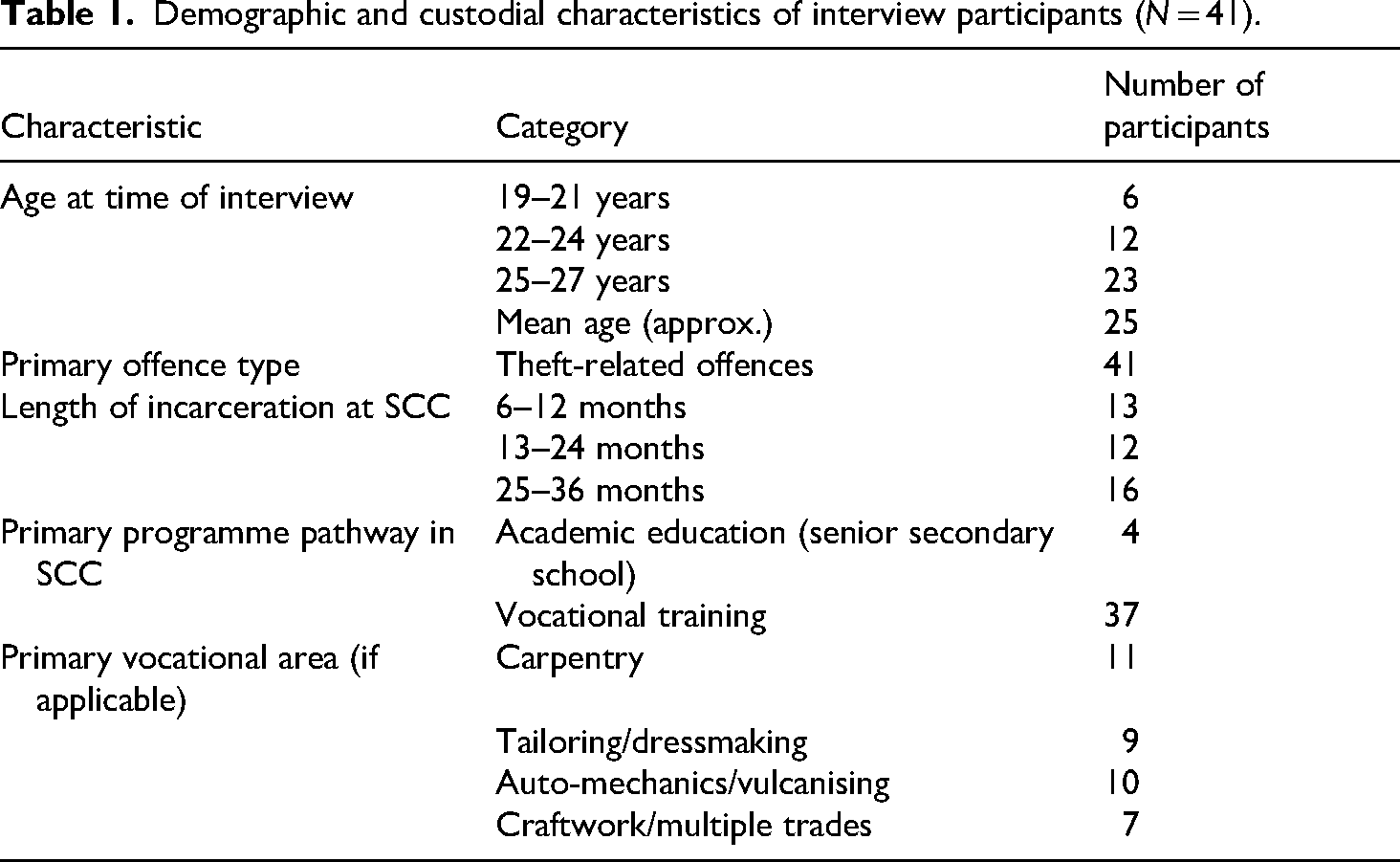
Age reflects participants’ age at the time of the interview, not at the time of incarceration. All participants were male and had been released from the Senior Correctional Centre at the time of the interview. Participants followed either an academic or a vocational pathway. At the correctional centre, only four had pursued academic education (i.e. senior secondary school), while the remaining 37 had opted for vocational training in tailoring, craftwork, automotive mechanics, and vulcanising.
Given the challenge of reaching formerly incarcerated individuals in Ghana, particularly those experiencing housing instability and social stigma, this study employed purposive and snowball sampling. To mitigate potential homogeneity bias in snowball/referral sampling, participants were recruited from several sources, including community networks, non-profit organisations, and correctional contacts. Although these strategies may over-represent individuals with stronger social ties or access to support services, the study prioritises analytical depth over representativeness or statistical generalisation. Purposive and snowball sampling are, therefore, methodologically appropriate for engaging hard-to-reach populations and generating rich, contextually grounded qualitative data central to the study's objectives (Onwuegbuzie and Leech, 2007).
Semi-structured interviews conducted in Ghana between July and August 2023 explored participants’ backgrounds, experiences during incarceration, and post-release reintegration. All interviews were conducted with participants after their release from Ghana's Senior Correctional Centre, ensuring that no data was collected during their period of incarceration. Key interview questions focused on the circumstances leading to their conflict with the law, the nature and impact of correctional programmes (e.g. vocational training, education, staff relationships), perceptions of change or harm during incarceration, and the challenges faced after release. These questions were guided by rehabilitation, labelling, and life course theoretical frameworks.
Three interviews were conducted in English, while the rest were in Twi, a widely spoken Ghanaian language, and later translated into English. Except for one phone interview, all were conducted in person at a mutually agreed time and place by the researcher and participants. The interviews were conducted by a single researcher to maintain consistency in interview style, questioning, and rapport-building. Six interviews were audio-recorded with participants’ consent. The remaining interviews were not recorded due to participants’ privacy concerns, discomfort with recording devices, or contextual constraints. Contemporaneous field notes were taken for all interviews, including those that were audio-recorded. Audio-recorded interviews were transcribed verbatim, and field notes were expanded immediately after each interview to preserve detail and accuracy. This approach maintained methodological consistency across all 41 interviews. Interview transcripts and field notes were managed using NVivo 12. Although not used for statistical analysis, the software enabled systematic mapping of themes. The NVivo enabled the researchers to identify how many participants reported rehabilitative, criminogenic, or mixed outcomes. Ethics approval was obtained from the University of Manitoba Research Ethics Board prior to data collection, and all procedures were conducted in accordance with institutional ethical guidelines.
A thematic analysis was conducted using a hybrid inductive–deductive approach (Saldaña, 2021) informed by reflexive thematic analysis (Braun and Clarke, 2019). The analysis followed defined stages. First, all interview transcripts were read multiple times to ensure familiarisation. Second, initial codes were generated through line-by-line open coding to capture participants’ meanings and language. Third, these codes were iteratively refined and grouped into broader thematic patterns. Fourth, themes were reviewed, defined, and finalised in relation to the study's research questions and theoretical framework (see Braun and Clarke, 2019; Saldaña, 2021). Deductive ‘sensitising’ concepts from rehabilitation, labelling, and prisonisation scholarship guided early coding, while inductive coding enabled the identification of unanticipated patterns within the data. NVivo 12 was used to support data organisation and analytic traceability rather than to automate interpretation.
Thematic analysis yielded three distinct experiential categories: (1) rehabilitative/reformative, (2) punitive/criminogenic, and (3) mixed/ambivalent. Participants’ accounts were classified as rehabilitative or transformative when custodial environments were perceived to facilitate prosocial change through educational attainment, skill development, or supportive staff-resident dynamics. In contrast, punitive or criminogenic experiences were characterised by institutional cultures centred on survival, mistrust, and the reinforcement of criminal identities via informal peer networks. A third category, mixed or ambivalent, encompassed instances in which rehabilitative opportunities and criminogenic pressures coexisted. Stepwise qualitative coding approaches have been widely applied in corrections and incarceration research to develop themes from interview and focus group data (e.g. Boppre et al., 2022; Christian and Kennedy, 2011). The present study employed a similar protocol, combining systematic coding with iterative theme refinement to maintain analytic rigour and sensitivity to participants’ meaning-making.
Findings
As Table 2 shows, the analysis of 41 interviews identified three distinct experiential trajectories concerning the impact of the Senior Correctional Centre: rehabilitative or transformative experiences, punitive or criminogenic experiences, and mixed or ambivalent experiences.
Results summary.
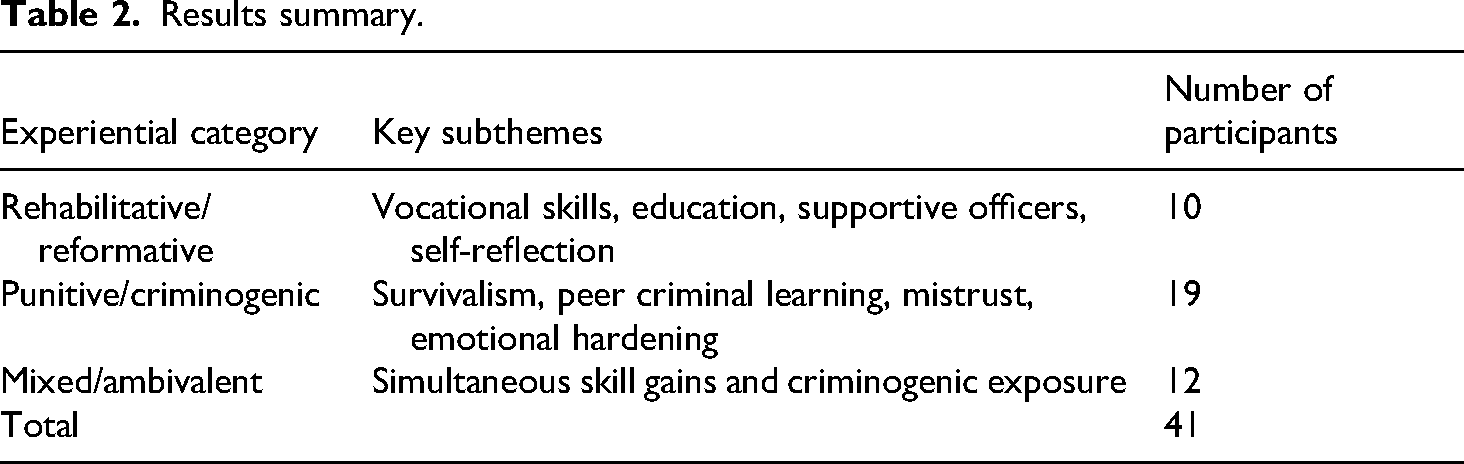
Among the 41 participants, 10 characterised their SCC experience as predominantly rehabilitative, emphasising vocational training, education, religious engagement, and supportive relationships with certain correctional officers as central to personal change. Nineteen participants described their experience as primarily punitive or criminogenic, highlighting survivalism, peer criminal learning, mistrust, emotional hardening, and perceiving incarceration as largely punitive. The remaining 12 participants reported mixed or ambivalent views, indicating the coexistence of both within the correctional centre.
Rehabilitative/reformative experiences
Participants’ accounts highlighted the opportunities they had to learn valuable skills, build self-confidence, and experience limited personal growth. They described a range of programmes offered to them, including carpentry, masonry, tailoring, welding, auto mechanics, dressmaking, and formal schooling. These, they said, equip young people in custody with employable skills that can reduce idleness and provide lawful means of livelihood. For instance, one said, ‘Even though I could not complete school, I would say I learnt handicraft [t]here. Something that I would do to better my life, I have acquired one now’. Similarly, skill acquisition was seen by others as a turning point: ‘The work I learned there is what I am using now. Without that skill, I don’t know how I would survive outside’, said one participant. Another stated, ‘I learned skills there, like carpentry and sewing, which I didn’t know before. It makes me think I can do something good’. In reflecting on the correctional centre's experience, a participant stated, ‘It helped me a hundred percent after going there [the senior correctional centre], because I was able to learn two things: vulcanising work and auto mechanics’.
Formal education also emerged as an essential part of the rehabilitation programme, with participants highlighting its positive impact on their personal development by providing a path to reform and hope for the future. One participant noted, ‘I had the opportunity to join JSS [Junior High School]. I completed the JSS at that place’. Another shared, ‘When I went, my problem was school—I hadn’t completed. But they quickly enrolled me, and I completed B.E.C.E. [Basic Education Certificate Examination] that same year and then went on to SHS (Senior High School]’. These participants described their daily routines as being organised around learning and self-improvement. One reflected, ‘When I was there, I wrote the B.E.C.E and I passed’. Others highlighted education as a form of cognitive and moral reorientation. A participant recalled his experience: ‘Before, I could not continue school. Inside, they put me back in class, and I finished my exams. That alone changed how I see my life’.
The routines also supported self-regulation and behavioural restraint among some participants. One participant described his experience: ‘I spent my time reading, praying, and learning my trade. That routine helped me control myself and avoid trouble’. Religious engagement provided a meaningful part of the rehabilitative experience. The Bible was particularly important in this framework, serving as a source for daily reflection and moral grounding. One participant reflected, ‘Sometimes I would be reading—they gave us some books, like the Bible. So, I would read. When it was time for reading, I would go and take my book [the Bible] and read’. As a consistent part of their routine, the scripture in this case helped instil values such as forgiveness, responsibility, discipline, and moral accountability. In a context where many of the boys had experienced instability, neglect, or harmful peer influences, the Bible functioned as a stabilising and redemptive influence – reinforcing the broader rehabilitative goals of character development and ethical reflection.
Alongside access to religious texts, some religious organisations visited the correctional centre and supported the moral and spiritual education of formerly incarcerated people. One participant said, ‘Apart from reading the Bible on my own, some church people used to come and talk to us. They prayed with us and encouraged us to change our lives’. Another similarly recalled: ‘Sometimes pastors came to the centre. They spoke to us about life after the place and not going back to crime’.
Participants repeatedly identified supportive correctional staff as a key factor in promoting meaningful behavioural change and rehabilitation. Staff who showed empathy, respect, and genuine concern were seen as catalysts for transformation: ‘The officers who really care made a difference’. Another participant said, ‘Some treated us with respect, and that made me want to change and do better’. The quotes highlight the powerful role that relational dynamics – particularly those grounded in dignity and mutual respect – can play in motivating personal reform.
Participants expressed a strong determination to prove their worth and redefine their identities post-release – an attitude they attributed directly to their experiences at the correctional centre. In his reflections, a participant stated, ‘People think we have no use anymore, but while we are outside, we want to prove them wrong—that this is not our end’. This sentiment was echoed by others, who viewed their time in the centre not as a conclusion, but as the beginning of a new chapter in their lives after release: ‘If we go there, that does not mean it is the end for us. We want to prove them wrong—that what they thought about us is not true’.
Through the support and training they received, many came to see the correctional centre as a space for personal growth and transformation. One participant described it as ‘a school where I am being trained’, while others shared concrete achievements that bolstered their self-worth: ‘When I was there, I learnt mechanics and I was driving a car…. My master, who taught me work, I drove his car’. The sense of pride and accomplishment was clear: I always say I am happy; I am proud because of it—it has helped me. If it did not help me, I would then have said I am going to be worried. It does not worry me at all.
The participants’ accounts show that, despite being difficult, the correctional centre experience was a turning point.
Other participants shared insights from their time in prison. One participant shared the following: ‘Being there has shown me what I don’t want to go back to. I think about life differently now, and I know I must make better choices if I want to stay out’. Another participant reflecting on his correctional experience articulated: ‘But if by God's grace you are released, you learn a big lesson from that…’. A third participant said, ‘I don’t want to go back there. I want to work and be on my own. That place taught me that freedom is important’. The quotes reveal that incarceration can lead to deep self-reflection that later enables individuals to appreciate their release into society, viewing it as a return to society and a moment of moral or spiritual reckoning.
For many participants, the presence of a support system – comprising individuals, churches, and NGOs – was a crucial turning point. This support fostered a deep sense of reciprocal responsibility. Participants shared that knowing others were genuinely invested in their well-being made them ‘think twice’ about their actions, showing that emotional and moral encouragement can be just as impactful as material aid in preventing a return to crime. One former offender reflected on his experience after release: ‘Some people stood by me after I came out—church people and others who helped me. I didn’t want to disappoint them, so I had to change’. Another participant expressed a similar sentiment: ‘When you see that people are concerned about you and helping you, you think twice before going back to bad things
Overall, participants’ frame rehabilitation/reform is not an automatic institutional outcome, but as a conditional process mediated by individual discipline, access to skills, selective staff support and post-release support.
Punitive/criminogenic experiences
Participants’ accounts aligning with punitive trajectories depict custodial experiences as primarily harmful and criminogenic, emphasising survivalism, emotional hardening, negative peer influence, and the reinforcement of marginalisation rather than meaningful rehabilitation. Several participants described how daily life inside the centre required emotional hardening and vigilance. A participant explained, ‘Inside, you learn how to survive. If you are too calm, people will take advantage of you. That place can make you tougher, not better’. Another said, ‘They teach skills, yes, but most of the time you are just trying to survive the day. Changing yourself is not easy there’. These narratives suggest that the institutional culture fostered defensive behaviours and emotional restraint, limiting opportunities for introspection and sustained behavioural change.
The atmosphere of suspicion and mistrust was also highlighted as undermining rehabilitation/change. One participant recalled, When they see you sitting quietly or not mingling with others, they say we wanted to escape … so they would not give you the chance to do anything, but maybe you are thinking about what to do when you go outside.
This sense of being constantly misunderstood or unjustly scrutinised erodes opportunities for introspection, reinforces alienation, and restricts the capacity for healthy emotional growth.
The institution's punitive culture often fosters a pervasive sense of frustration and futility. Reflecting on his correctional centre experience, one participant put it this way: ‘You go in hoping to get better, but sometimes it feels like you're just getting punished, not really reformed. It's hard to stay positive’. This takeaway statement illustrates the emotional strain of a correctional system that frequently alienates the very individuals it is meant to reform. Staff treatment was a key factor shaping experiences. Another participant recalled, ‘some officers just treat you like a criminal’, which actively undermines individuals’ belief in their potential for change and reform.
Participants described the correctional centre as harsh, with material deprivation functioning as a form of experiential deterrence. In reference to the punitive environment of the correctional centre, one participant summarised it this way: When you are put there [the senior correctional centre], it is not easy – for example, what to eat and where to lay your head. But if, by God's grace, you are released, you learn a big lesson from that.
Inadequate food and living conditions were framed as a ‘lesson’ learned through hardship, suggesting that deterrence operates via fear of reincarceration rather than rehabilitative support.
However, the emphasis on suffering raises questions about whether such punitive experiences foster durable behavioural change or merely short-term compliance aimed at avoiding further punishment. The correctional centre's criminogenic effects linger beyond custody, fuelled by societal rejection and a lack of resources. One participant described this reality: ‘When you come back, people don’t forget. They look at you like you will spoil the others. Sometimes it is better to stay away’. This persistent ‘criminal’ label weakens the individual's community ties and can lead to self-imposed isolation and the erosion of personal support systems, ultimately deepening the cycle of post-release marginalisation.
Negative peer influence was highlighted with several describing the centre as a site of informal criminal learning. One participant cautioned, ‘Some boys come out worse because they learn new bad things from others inside. You have to be very careful who you move with over there’. Rather than interrupting criminogenic networks, the custodial setting sometimes intensified them, exposing young people to more experienced peers and reinforcing deviant identities and practices. In sum, participants’ narratives show how incarceration can reinforce punitive and criminogenic effects through survival-oriented institutional cultures, harmful peer dynamics, stigma, and persistent structural deprivation.
Mixed/ambivalent experiences: between reform and hardening
Ambivalent trajectories or experiences refer to accounts in which participants reported both positive and negative outcomes, recognising limited rehabilitative progress while also encountering criminogenic dynamics and structural barriers that impeded lasting positive change. Twelve participants out of 41 characterised the Senior Correctional Centre as an environment that provided opportunities for self-improvement but also exposed them to criminogenic influences. A participant reflected on his experience as follows: Over there, when you go, if you want good, you would get; if you want bad, you would get—because some come with different skills in robbery … some would come and learn how to break doors or rob with a gun. So, it depends on your mindset…. When you follow them, you will learn new things to add to what brought you there.
This participant described the correctional environment as characterised by dual peer cultures, in which positive change and criminal learning coexisted. Reflecting on his experience after release, another participant explained: ‘For me, I won’t say the correctional centre did not help me because at least I acquired a vocational training, but I would not wish that experience on anyone because conditions there were harsh’. This statement reflects the ambivalent trajectory identified in this study as participants acknowledged limited personal gains while simultaneously rejecting incarceration as a desirable or humane intervention.
Participants also acknowledged meaningful skill acquisition during incarceration, particularly through vocational training, but they simultaneously stressed that these gains were fragile and easily undermined by institutional and post-release realities. One participant said, ‘The vocational work helped me control myself and focus. If I didn’t go there, my mind would be on bad things. But if you mixed with the wrong people, everything positive you learned could be spoiled’. His account suggests that sustained progress requires continuous vigilance to counteract negative peer influence. Another expressed a more cautious assessment of these rehabilitative efforts: ‘They taught us skills, which is good, but without real support or people who believe in us, it can feel pointless’.
Officer behaviour emerged as a critical mediating factor in participants’ ambivalent narratives, with many consistently reporting that their treatment was contingent upon perceived behaviour and compliance. One participant reflected, ‘Truth is always one—if you behave well, they will treat you well’. However, several participants indicated that quiet or withdrawn behaviour was often interpreted as suspicious rather than self-protective, which led to increased surveillance rather than support and reinforced feelings of alienation. As one participant stated, ‘When you kept to yourself, they didn’t see it as you trying to stay out of trouble. They started watching you more. If you were quiet, they thought you were planning something’. Another participant similarly noted, ‘I didn’t talk much because I wanted peace, but that made them mark me as dangerous, so they kept their eyes on me’.
Ambivalence was particularly evident in participants’ reflections on reintegration. Many expressed strong motivation to desist from crime and make use of skills acquired in custody, but they faced immediate structural barriers upon release: ‘I have the skill, but not the things to start’, said a participant. Several participants emphasised that even minimal post-release assistance – such as transport money, tools, or temporary accommodation – could determine whether custodial gains were sustained or eroded. Reflecting on his situation after release, a participant explained: ‘Sometimes it's just a small help you need. If someone gives you transport money or tools to start, you can manage. Without that, everything you learned inside can just stop’. Another commented, ‘You come out with hope because you learned something, but when there is no follow-up or support, the hope turns to frustration. You feel like you are on your own’. The absence of systematic aftercare left many oscillating between hope and frustration, reinforcing the perception that incarceration alone neither guarantees rehabilitation nor inevitably produces harm. Overall, participants emphasised conditional change, shaped by individual mindset, peer associations, staff relationships, and post-release constraints.
Post-release overview
Participants’ post-release outcomes were uneven, shaped by economic insecurity, housing instability, and stigma. Although none had returned to custody at the time of the interview, structural barriers frequently limited the effective use of acquired skills. As one participant observed, ‘When you come back, people don’t forget’, highlighting the enduring impact of stigma on reintegration trajectories.
Table 3 summarises the post-release circumstances of participants. Twenty-six individuals engaged in informal or casual employment, including carpentry, tailoring, welding, vulcanising, and mechanical assistance. Eleven participants experienced prolonged unemployment or unstable livelihoods, while four sought to continue their education.
Post-release circumstances of participants (N = 41).
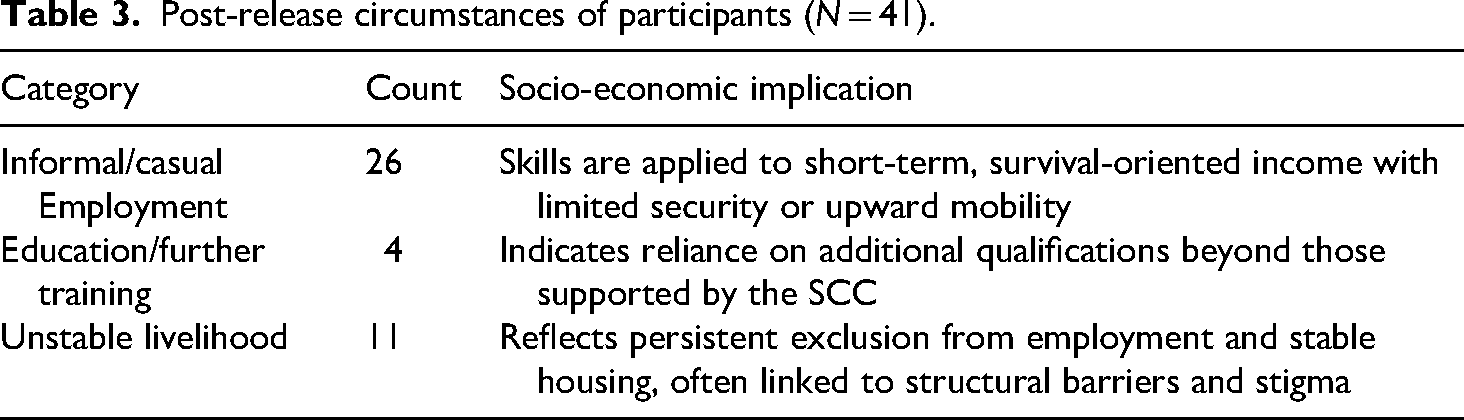
These distributions indicate that most participants remained economically precarious, even when engaged in work or training.
Despite completing vocational training in trades such as carpentry, dressmaking, and masonry, 11 participants remain unemployed due to a lack of job opportunities and consistent financial support. One participant said, ‘I learned carpentry there, and I want to work … but without support, it's hard to prove I’ve changed’. Another emphasised inadequate start-up resources: ‘When I came out, I learned a trade, but there was no place for me to set up … no money to buy tools or even a space to work’. These findings illustrate how the absence of post-release support not only limits the application of rehabilitation efforts but also risks reinforcing the very criminal behaviours such interventions aim to prevent.
Participants described unemployment as a catalyst for reoffending, noting that it triggers both financial desperation and psychological pressure. This vulnerability is captured in this narrative by one participant: ‘If you wake up and there is no work, that is when bad thoughts come’. Without basic necessities such as housing and a steady income, many feel they are being pushed back towards the justice system: ‘I have no work and no place to stay, so what do I do? If I don’t find a way to survive, I’ll end up back there again’. These quotes provide the ‘human face’ to the statistics from Table 3. While 11 participants are currently in that ‘unstable livelihood’ category, these quotes explain the specific mechanism – 'bad thoughts’ and the ‘need to survive’ – that turns unemployment into a criminogenic risk.
Participants’ post-release situations were primarily differentiated by their employment status and access to support (including transitional accommodation, start-up tools, financial assistance, or ongoing monitoring) from concerned individuals and some limited NGOs such as Child Research and Resource Centre (CRRECENT) and the Young Men's Christian Association (YMCA). For example, one participant described receiving help: ‘I went and registered for remedial. Unfortunately, I passed six of the subjects and failed two – science and elective maths. I got help from the YMCA and CRRECENT’. Another participant also emphasised the importance of sustained relational support, recounting the regular advice and monitoring he received from a correctional officer: ‘Every day he calls me. When he calls, he keeps telling me to be careful … so there is no way I will disappoint them by reoffending’. Overall, post-release outcomes were shaped more by access to stable employment, housing, and sustained external support than by skills acquired during custody, resulting in uneven reintegration trajectories among former SCC participants.
Discussion
This study investigated the impact of Ghana's SCC through the lived experiences of formerly incarcerated young people. Three main experiential trajectories/themes were identified: rehabilitative or reformative, punitive, and ambivalent. The predominance of punitive and mixed trajectories suggests that, although rehabilitative practices exist within the SCC, they are inconsistently implemented and often overshadowed by punitive institutional logics that perpetuate criminogenic conditions for many young people in conflict with the law. Thus, reform is not a systematic institutional outcome but a limited and fragile process occurring in a minority of cases, driven primarily by individual agency and selective support, and vulnerable in the absence of sustained post-release resources.
Although vocational training and mentoring support rehabilitation theory (Andrews and Bonta, 2016; Cullen and Jonson, 2017) by fostering hope and employable skills, these benefits are often undermined by the prevailing survivalist environment in correctional centres. In accordance with labelling theory (Becker, 1963; Lemert, 1951; Tannenbaum, 1938), the study demonstrates that punitive institutional cultures and the stigma associated with being labelled a ‘criminal’ by staff frequently impede reform. This duality reflects broader regional trends: while some interventions encourage reform, the persistent militarised or abusive structures in many facilities reinforce, rather than diminish, criminal identities (Boakye and Akoensi, 2021; Ezeihuoma and Ebulum, 2023; Kajawo and Johnson, 2023; Segalo and Sihlobo, 2021). Both punitive and rehabilitative accounts from participants support life course theory (Laub and Sampson, 2003; Sampson and Laub, 1995, 1997), showing that incarceration functioned as both a disruptive and transformative turning point. The participants’ mixed/ambivalent narratives position the SCC as a contested institutional environment in which both rehabilitation and criminogenic exposure are present.
While the SCC incorporates limited elements of the RNR model (Andrews and Bonta, 2016), particularly through vocational and educational programmes, it lacks the institutional infrastructure necessary for full implementation. The lack of standardised risk assessment, individualised treatment planning, and specialised therapeutic expertise contributes to fragmented rehabilitation, reinforcing the finding that reform is neither systematic nor guaranteed, but instead conditional and uneven across participants.
This study advances scholarship on punishment and rehabilitation by providing an empirically grounded perspective from the Global South. Using post-release interviews with former residents of Ghana's Senior Correctional Centre, the analysis challenges the conventional dichotomy between rehabilitative and punitive institutions. Findings indicate that custodial environments produce uneven and contingent outcomes, influenced by institutional culture, peer networks, staff interactions, and the availability of sustained post-release support. By categorising experiences as transformative, criminogenic, or mixed, this research contributes to debates on prisonisation and labelling theory, demonstrating that survival-oriented practices coexist with, and often undermine, formal reform initiatives.
Regarding policy implications, the current work indicates that effective penal policy should move beyond programmatic expansion and instead pursue comprehensive reform of institutional governance. Rehabilitation should be conceptualised as a contingent process; policies that disregard underlying punitive logics and survival-oriented institutional cultures may inadvertently reinforce criminogenic identities. Interventions ought to prioritise a relational climate characterised by dignity, agency, and reduced coercion, as these experiential factors are more influential in promoting desistance than the mere provision of vocational services. Furthermore, the research demonstrates that custodial reform remains fundamentally constrained without robust support for reintegration. For penal policy to be effective, it must be integrated within broader social welfare frameworks that address housing instability and stigma as systemic, rather than individual, challenges.
This research has some limitations. Because the sample did not include young people incarcerated for violent or sexual offences, the findings should not be assumed to be generalisable to all forms of juvenile offending. Also, as a qualitative study, the findings are specific to male youth involved in theft-related cases and are therefore not generalisable to other correctional settings. The use of non-probability sampling strategies (purposive and snowball in this case) emphasised depth rather than breadth, underscoring the need for future research to broaden these insights through comparative, quantitative institutional analysis. A longitudinal study using mixed methods in subsequent studies may further elucidate the complex relationship between institutional culture and the long-term hardening of incarcerated individuals.
Footnotes
Acknowledgements
I am deeply grateful to all the research participants for generously sharing their time and insights. I also thank the Editor, Professor Keramet Reiter, and the anonymous reviewers for their careful, constructive, and insightful engagement with this manuscript.

Funding
The author received no financial support for the research, authorship, and/or publication of this article.
Declaration of conflicting interests
The author declared no potential conflicts of interest with respect to the research, authorship, and/or publication of this article.