






Abstract
Prison education programs shape the interactions that incarcerated students have not only with faculty and fellow students, but also with prison staff. Research on college-in-prison, however, has focused on post-release outcomes such as recidivism, with less attention to how college-in-prison shapes everyday prison life. In this paper, we ask: How does college-in-prison participation influence incarcerated students’ perceptions of relationships with correctional staff? We draw on a longitudinal mixed-methods survey of 56 applicants to a college-in-prison program, half of whom were ultimately admitted. This design allows for comparisons between admitted and non-admitted applicants over time. Before admission, most participants described their relationships with staff as positive and expressed optimism that college-in-prison would humanize them in the eyes of staff, foster mutual understanding, and alleviate stress for staff. After a year, admitted students’ positive perceptions declined and negative perceptions increased. Many described staff resistance toward higher education. Others felt education posed a threat to the prison system's long-term viability. Overall, admitted students became less positive about staff relationships, while non-admitted students showed little change. The findings suggest the importance of fostering a shared investment in college-in-prison programs in order to ensure success.
Introduction
College-in-prison has received widespread media attention as programs expand across the United States, especially following the restoration of Pell Grant eligibility for incarcerated individuals in 2023 (Brown, 2025; Kanala, 2025; Phillips, 2024). Academic research, however, has focused almost entirely on how college-in-prison impacts post-release outcomes such as recidivism and employment (Davis, 2019; Stickle and Schuster, 2023). Much less attention has been given to how college-in-prison shapes everyday life inside prison (for exceptions, see Binda et al., 2020; Royer, Castro and Aguilar Padilla, 2023). Yet, like all aspects of prison's “enforced intimacy” (Sykes, 1958), prison education programs are fundamentally social, with the potential to influence relationships among incarcerated people and between incarcerated students and correctional staff (Flynn and Higdon, 2022). These interactions take place within carceral settings with strained, coercive, and complicated social climates (Friedman, 2025; Powell, 2025; Sykes, 1958; Vieraitis et al., 2018). We know very little about how participation in prison programs, and particularly college-in-prison, affects relationships between incarcerated students and correctional staff. This question is important for policy because college-in-prison programs cannot run without staff time, effort, and involvement. Beyond just functioning, the success of such programs depends on the nature of staff involvement—from supportive to obstructive (Royer et al., 2023).
Existing research on relationships between correctional officers and incarcerated people is mixed. Some studies find that incarcerated people report positive relationships with the officers they interact with daily (Crewe, 2011), while others emphasize the “us vs. them” dynamic that can characterize staff-incarcerated person relationships (Friedman, 2025; Goffman, 1961; Powell, 2025). With regards to prison programming, some work suggests that correctional staff are skeptical, viewing the goals of prison as largely punitive rather than rehabilitative (Kifer et al., 2003; Tewksbury and Mustaine, 2008). Additionally, some studies indicate that staff may pose significant obstacles to the successful implementation of program initiatives (Binda et al., 2020; Royer et al., 2023). A small body of work, however, suggests that officers tend to support prison programming, sometimes viewing it as easing their jobs (Ellis, 2023; Farkas, 1999). Taken together, this body of evidence presents a mixed picture on whether correctional officers obstruct, facilitate, or are indifferent to the implementation of prison programs. Missing from this literature is a focus on incarcerated peoples’ perceptions of their relationships with officers before and after participation in a prison program, leaving open the question of how programs might shape student-staff dynamics.
This paper addresses that gap by focusing on one type of program and one set of prison staff, college-in-prison and frontline correctional officers (whom we also refer to as correctional staff), respectively. We ask: How does participation in a college-in-prison program influence incarcerated students’ perceptions of relationships with correctional officers? To answer this, we draw on a longitudinal mixed-methods survey of 56 applicants to the Northwestern Prison Education Program (NPEP). Surveys were administered in two waves: once prior to admission, when applicants had reached the interview stage of the process, and again 1 year later. Half of the participants were admitted to NPEP after the first survey, allowing us to compare the experiences of admitted and non-admitted applicants over time.
We find that before participating in NPEP, respondents expressed optimism that attending college-in-prison would humanize them in the eyes of correctional officers, foster mutual understanding, and reduce misconduct, thereby alleviating stress for staff. Yet, a year later, we found that admitted students’ views about their relationships with correctional officers shifted; their positive perceptions dropped, and their negative perceptions rose. While non-admitted students also reported some decline in positivity, their change was much less pronounced. Qualitative responses offer several explanations for this shift, which we explore in more depth in this article. Overall, admitted students became more critical of relationships with correctional officers after participation in NPEP, whereas non-admitted students showed little change. Given that staff are essential to the successful operation of prison education (Royer et al., 2023) and hold immense discretion over incarcerated people's lives and opportunities for release (Crewe, 2012), our findings have significant policy implications. While they are specific to one college-in-prison program in one facility, they pilot a set of questions about student-staff relationships that warrant larger studies in additional prisons, programs, and states. We discuss these implications in the conclusion.
Background
Relationships between correctional officers and incarcerated people
Relationships between correctional officers and incarcerated people are nuanced, marked by both closeness and distance. Because officers and incarcerated people spend a lot of time together, these relationships involve a form of “intimacy” rooted in daily interaction (Crawley, 2004). Many incarcerated people report positive relationships with the officers they interact with daily, even while expressing frustration with the more distant “institutional world above them” (Crewe, 2011, 459). At the same time, incarcerated people form a sense of solidarity in opposition to correctional officers, which may help offset the pains and deprivations of imprisonment (Liebling and Arnold, 2012). Other scholars, too, have documented the “us vs. them” of incarcerated people and staff relationships (Goffman, 1961; Halsey and Deegan, 2017; Tait, 2011). For incarcerated people, these divisions are not only social/ideological, but material, with officers sometimes physically and sexually violating incarcerated people (Friedman, 2025; Powell, 2025). Nonetheless, incarcerated people and correctional officers are bound together in systems of interdependence; as incarcerated people depend on correctional officers for survival, correctional officers also depend on incarceration for employment, benefits, and security (Sufrin, 2017).
It is important to view relationships between officers and incarcerated people within a broader institutional context. As a “total institution” (Goffman, 1961) and “miniatures of the larger society” (Sykes, 1958), prisons are characterized by unique, institution-specific cultures that shape relationship development and quality. Every prison facility is distinct in this respect, based on the demographic composition and backgrounds of their officers and incarcerated populations, as well as institutional factors, like work assignment and program opportunities, administrative philosophies, crowding, and security level(s) (Wooldredge, 2020). These distinctions shape interactions between officers and incarcerated people and perceptions of relationship quality, both for incarcerated people (Wooldredge, 2020) and staff (Lerman and Page, 2012).
Overall, incarcerated people's perceptions of correctional officer behavior directly affect how they adapt to prison life, as well as the climate of their prisons (Wooldredge, 2020). Relationships perceived as unpredictable, overly strict, or disrespectful can produce stress, frustration, and conflict (Vieraitis et al., 2018; Vuolo and Kruttschnitt, 2008). Meanwhile, incarcerated people report that staff relationships they perceive as positive, respectful, and understanding inspire them to pursue positive change and add stability to their daily life (Crewe, 2012; Vieraitis et al., 2018). For example, studies report a negative shift in incarcerated people's perceptions and behaviors when they move from facilities with more privileges and supportive officers to more restrictive ones with less tolerant officers (Toch, 1977)—a trend that is shown in the reverse, when moves to less restrictive prisons come with better experiences for incarcerated people (Crewe, 2012). Lastly, staff have material implications for incarcerated people's reentry; in prison systems with the opportunity for parole or “good time” credits, staff relationships can both facilitate access to early release or, alternatively, serve as a barrier to it.
Correctional officers and reception to prison programming
Correctional officers’ amenability and reception to programming in prison is largely dependent on how they view the goals of prison. Criminological research suggests that officers frequently frame their role in mostly punitive terms, as incapacitation, retribution, and deterrence rather than rehabilitation (Kifer et al., 2003; Tewksbury and Mustaine, 2008). On the other hand, some work suggests that even as support for punitiveness rises among the public and policymakers, correctional officers largely maintain support for rehabilitative programming in prison (Farkas, 1999). They believe rehabilitative programming improves prison life for both staff and incarcerated people, often because they view such programs as an “inmate management strategy” that eases their ability to supervise large populations by structuring time (Farkas, 1999, 503). In some cases, officers view programs as occupying and calming the incarcerated population (Ellis, 2023; Farkas, 1999; Gibson-Light, 2020) and as distinguishing incarcerated people “deserving” of their care (i.e., program participants) from their “undeserving” peers (Tait, 2011).
When it comes to specific programming in prison, research paints a picture of both officer facilitation and obstruction; either way, they are pivotal to the success or failure of programs, given their control over daily routines and access (Abdel-Salam et al., 2023; Halsey and Deegan, 2017; Kjelsberg et al., 2007). In therapeutic communities for substance use, for example, incarcerated people describe correctional officers as custodial “outsiders,” mostly uninvolved or unaware of program specifics (Abdel-Salam et al., 2023). In religious programming, officers have sometimes obstructed access, though they are also often indifferent, providing wide latitude to program leaders (Ellis, 2023). Professionals who lead programs, like health providers working in jails, describe feeling as though their professional conduct was on display to correctional officers, with officers even threatening to revoke security clearances (Sufrin, 2017). In other cases, officers advocated for incarcerated people in relation to programming and program administrators (Sufrin, 2017).
Overall, the existing research has concentrated on officer attitudes toward rehabilitation and their role in facilitating or obstructing programming. Far less is known about how incarcerated people experience changes in their relationships with officers in relation to program participation.
College-in-prison
Evaluations of prison education programs have overwhelmingly emphasized post-release outcomes, like recidivism and post-release employment and wages (Nally et al., 2012; Stickle and Schuster, 2023). This focus is often tied to funding, as governments and other funders frequently require programs to cut overall public costs to justify their existence (Flynn and Higdon, 2022). On this outcome, college-in-prison performs well: participants are consistently less likely to recidivate and more likely to have higher earnings than those who do not enroll in any such program (Nally et al., 2012; Stickle and Schuster, 2023). But this recidivism focus overlooks other important effects of education during incarceration. Indeed, as Flynn and Higdon (2022: 203) argue, “[prison] education as a social experience, with the furtherance of positive relationships at its core, has struggled for legitimation.”
Despite this dearth, some research has examined students’ motivations for participation and finds that enrolling in academic programs contributes to feelings of self-worth and self-esteem, whereas vocational program motivations are more pragmatic in nature (Tewksbury and Stengel, 2006). In terms of relationships, some work suggests that learning social science material (such as history or sociology) enables participants to relate to their families differently and reinterpret their own upbringing through different lenses (Binda et al., 2020). At the institutional level, violent misconduct rates are often lower for incarcerated people who completed college classes compared to those who did not participate in any reentry-approved programs (Pompoco et al., 2017).
We found very few studies that examine the relationship between correctional staff and incarcerated people as mediated by enrollment in college-in-prison. In interviews with prison education stakeholders, Royer et al. (2023) find that prison staff wield immense power over the success of college-in-prison programs: disciplinary tickets restrict who can attend class, the presence of officers in classrooms can lead students to self-censor, material reviews impact what is allowed inside, and administrative oversight dictates which instructors are permitted. These processes are all highly discretionary. Further, their findings suggest that college-in-prison may result in more negative staff interactions, with students sometimes being punished for the very behaviors encouraged in the classroom like “speaking their minds, expressing emotion, [and] advocating for themselves both inside and outside the classroom” (Royer et al., 2023: 252). Program participation also raises the stakes of disciplinary tickets. As one participant explained, “Prison is such a space of intentional deprivation, and when you’re in the college program, suddenly you are more vulnerable because you have something to lose” (Binda et al., 2020: 255).
Just as the growing cost of higher education has led some policymakers and members of the public to be hostile to “free” prison education (Nally et al., 2012), some correctional officers perceive college-in-prison as unfair, resenting that incarcerated students can attend without cost while they have to take out loans to send their children to college (Binda et al., 2020; Royer et al., 2023). This perception might contribute to hostility toward students, despite research showing that incarcerated people distinguish “good” officers as those who encourage them to pursue educational opportunities (Vieraitis et al., 2018).
This limited literature suggests that relationships between officers and incarcerated people may be affected by prison education and, in turn, have sizeable implications for program success, a prison's institutional culture, and incarcerated people's day-to-day and long-term wellbeing. Some studies suggest that correctional officers might resent prison education or create barriers for its implementation, while others describe how officers support and encourage programs or are indifferent to them. In all, we still don’t know how incarcerated people describe their relationships with correctional officers before and after participating in college-in-prison—a gap this study helps address.
Data and methods
Northwestern Prison Education Program
This paper uses original survey data collected as part of a larger project that aims to provide a holistic review of the Northwestern Prison Education Program (NPEP) and its impact on incarcerated people's health, relationship quality, civic participation, and more. Founded in 2018, NPEP is a full-time liberal arts program that operates in one men's and one women's prison within the Illinois Department of Corrections (IDOC). While it is housed in only two IDOC facilities, students can apply from any IDOC facility across the state and if admitted, they are transferred to the institution that offers the program. In contrast to programs that limit entry to people with upcoming release dates, NPEP is open to participants regardless of release date. Many students have lengthy sentences and/or have been incarcerated for several years prior to enrollment. At the same time, however, IDOC controls eligibility for admission to NPEP based mainly on a person's disciplinary history. Once enrolled, all NPEP students study towards a Bachelor of Science in the Social Sciences. This study focuses on NPEP's program at Stateville Correctional Center, a maximum-security men's prison approximately 1 hour southwest of the City of Chicago. 1
Data and methods
This research was conducted after full review and approval by the Institutional Review Board of Northwestern University (ID: STU00217582), and approval from the Planning & Research Department of IDOC. IDOC policy requires review of all research products before publication, but the final product does not reflect the views or opinions of IDOC.
Data for this project was collected in two waves. Wave 1 surveys were conducted to coincide with NPEP's admissions process for a new cohort of students. We do not disclose the year of data collection because this would reveal the NPEP cohort under study. Open applications were advertised through the internal television station at each prison. Applicants could write to the Educational Facility Administrator (EFA) at their institution to request an application, which they could complete and return to the EFA, who would forward to NPEP. The application included demographic information, a list of previous courses taken inside or outside of prison, two short essays, and other materials. NPEP received roughly 400 applications from across the state. NPEP faculty read them and selected a group of nearly 80 finalists for interviews. Anyone who received an in-person interview was eligible to participate in our study, but some admissions interviews were conducted over Zoom, which was outside of the approved research protocol. In the end, 100% of the applicants who received in-person interviews with NPEP agreed to participate in the research.
In Wave 1, we surveyed 56 incarcerated men who had reached the in-person interview stage. Immediately following their admissions interview, participants were asked if they would be willing to complete the research survey in a separate room within the educational facility at their institution. The recruitment script and consent form emphasized that participation in the research would not affect the likelihood of admission; additionally, the admissions interviews and research surveys were conducted by separate teams. The survey was conducted on paper, with the researcher present, and it took approximately 40 minutes to complete. Correctional staff were rarely present and were primarily involved in guiding entry and exit from rooms. Participants were offered $10 added to their commissary accounts for their participation, which we offered again for the second wave.
Wave 2 of data collection took place roughly 16 months after Wave 1. By that time, 28 of the 56 original survey participants were admitted into NPEP and had been enrolled for roughly four quarters of study. Wave 2 was a follow-up survey with nearly identical questions; 47 of the 56 participants from Wave 1 participated. This design allowed us, first, to differentiate survey responses between admitted and non-admitted students in both waves (with these classifications applied retrospectively to Wave 1), revealing interesting within-group variation over time, and, second, to compare admitted students to a comparable quasi-control group to study program impacts. This study is not a randomized experiment. Applicants to NPEP who made it to the interview stage participated in real interviews with NPEP faculty and had real opportunities to show off their skills and interests. Neither NPEP nor IDOC judged a randomized admission or research process to be ethical. Still, the non-admitted group offers a strong and highly qualified quasi-control group given the competitiveness of reaching the interview stage.
The survey included the following sections: (1) Demographic and background information (age, race, gender, number of children, education, employment); (2) Quality-of-life questions (anxiety, depression, anger); (3) Meaningful life measures; (4) Interpersonal relationship questions; (5) Political empowerment questions (news consumption, political dialogue, political interest); (6) Sociopolitical belief questions (attitudes about government, multiculturalism, race). The survey concluded with long-answer questions asking participants to reflect on the following: (1) What are you most proud of about yourself? What would you like to improve? (2) In what ways do you believe higher education would benefit you personally? (3) How do you think higher education would benefit this institution (prison)? (4) In what ways do you think higher education would benefit your relationships with friends and family? At each wave, we manually entered the multiple-choice and open-ended answers from the paper surveys into a digital format. Each participant was assigned a Participant ID to link their responses across the two time periods. For this paper, we focus on survey items pertaining to participants’ perceptions of their relationships with correctional staff, looking at both the overall quality of these relationships and changes observed over time by group. To analyze this data, we merged survey results from Waves 1 and 2 using the Participant IDs, allowing for longitudinal comparisons. Data was cleaned and recoded as needed.
In the next phase of analysis, the first two authors developed memos that explored the theme of perceptions of relationships with correctional officers in more depth. This included pulling descriptive tables of key survey questions, returning to the qualitative responses to select representative quotes, and comparing the qualitative responses across admitted and not-admitted students. In the final phase of analysis, the research team reviewed this preliminary analysis and developed a systematic coding scheme for the topic of staff relationships. Codes included, for example, “staff viewing education as a management tool,” “education supporting staff job stability,” “reduced institutional violence,” and “shift in student perceptions of staff.” The first author returned to the qualitative responses and recoded them using this systematic scheme. All names included in this paper are pseudonyms.
For our quantitative analysis, the research team produced tables of descriptive statistics and ran Fisher's exact tests to compute the statistical significance of changes over time. The Fisher's exact test is often used to test associations between categorical variables, particularly when cell counts are small (<5) or event frequencies are low. Fisher's exact test calculates exact probabilities. For these reasons, it is used in sociological and criminological research involving rare events or small subgroups (e.g., Gillespie et al., 2024; Manninen et al., 2017). Fisher's exact test results should be interpreted as descriptive pre-post comparisons rather than causal estimates. Throughout the analysis, all tables are calculated based on the total respondents for that wave (n = 56 in Wave 1 and n = 47 in Wave 2).
Participant demographics
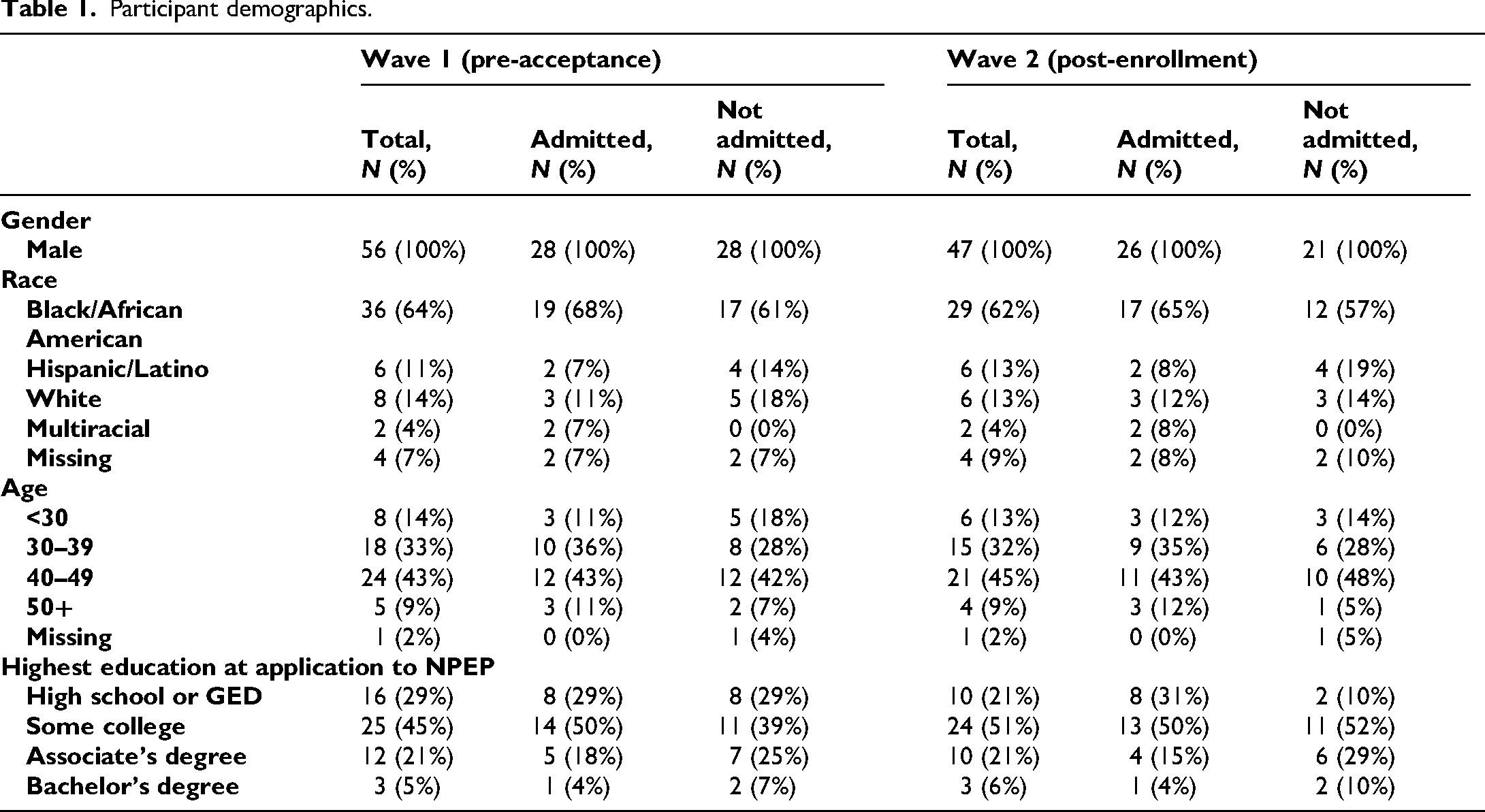
Table 1 presents characteristics of the research sample. All participants in both waves of the survey identified as men. The majority of NPEP interviewed applicants at Wave 1 were Black (64%), followed by white (14%), and Hispanic/Latino (11%). One third of NPEP applicants were in their 30s, and 43% were in their 40s. By the time they applied to NPEP, 45% had completed some college courses (without earning a degree), and 21% had an associate's degree. About 3 in 10 (29%) had only a GED or high school diploma at the time of their application. Fisher's exact tests (for categorical variables) and t-tests (for continuous variables) indicated no statistically significant demographic differences between admitted and non-admitted students at Wave 1 (all ps > .05).
Participant demographics.
Results
Quantitative responses
In Wave 1, when none of the participants had been admitted to the prison education program yet, we asked respondents how they would rate their relationships with correctional staff in the past month (n = 56). Response options ranged from very negative, somewhat negative, neither negative nor positive, somewhat positive, and very positive. For interpretability, we collapsed these into three categories: negative, neutral, and positive. Overall, 52% described their relationships with correctional staff as positive, while only 14% described them as negative. Roughly one-third of responses fell in the neutral category. In Wave 2, these patterns change. The number of participants reporting positive relationships with correctional staff dropped to 28%, while those reporting negative relationships rose to 32%.
As Table 2 shows, the contrasts are notable when disaggregated by admission status. In Wave 1, participants who were later admitted to the prison education program reported a largely positive baseline for their relationships with correctional staff: 71% described their experiences as positive, while only 4% described them as negative. However, in Wave 2, this trend reversed. Among admitted students, positive perceptions dropped to 27%, and negative perceptions rose to 39%. Non-admitted participants also showed a decline in positivity over time, though the shift was much less pronounced. In Wave 1, 32% of non-admitted participants described their relationships with correctional staff as positive, and 25% described them as negative. In Wave 2, 29% described their relationships as positive, while negative responses also declined slightly to 24%.
Changes in perceived relationship quality with correctional staff by admission status and survey wave.
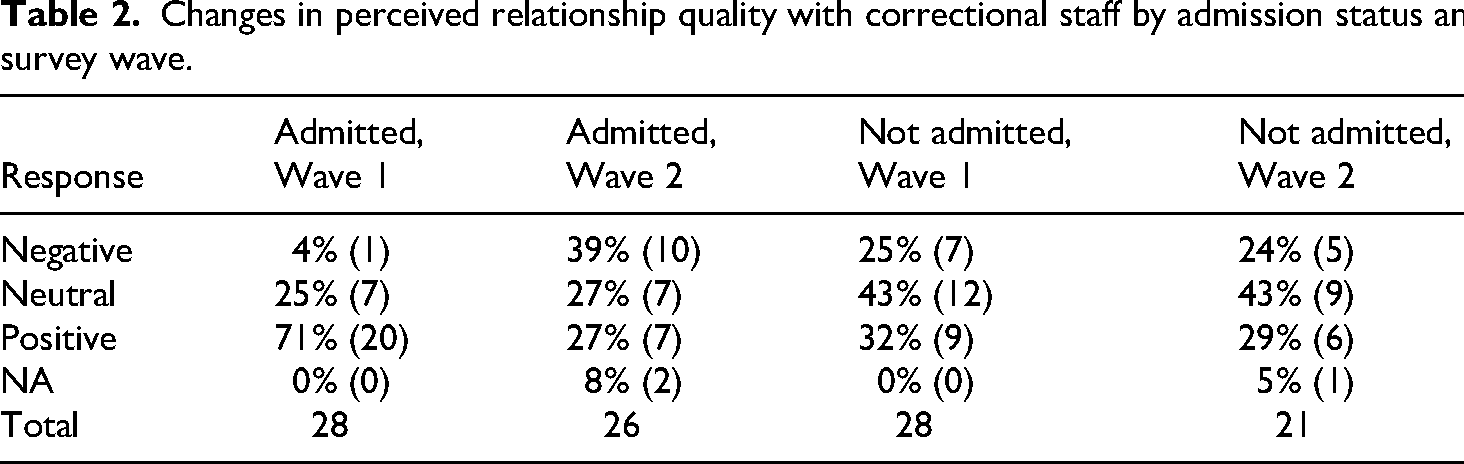
At baseline, participants who were later admitted to NPEP reported more positive experiences with correctional staff than those not admitted. This may reflect a selection effect, as interviewers could have responded more positively to applicants perceived to have better overall relationship quality, including with staff, which may have influenced admission decisions. This selection, however, cannot explain the decline in perceived relationship quality with staff among admitted applicants from Wave 1 to Wave 2, which we interpret as an effect of enrollment.
To assess whether the observed differences in relationship shifts were statistically significant, we used a Fisher's exact test to examine the association between admission to the prison education program and the likelihood of developing more negative perceived relationships with correctional staff between Wave 1 and Wave 2. Specifically, we tested whether admitted participants were more likely than non-admitted participants to develop more negative views over time. We restricted the analytic sample to participants for whom change could be meaningfully assessed, excluding the nine participants who did not complete the Wave 2 survey and three who did not respond to the relevant survey question. The final sample consisted of 44 individuals (24 admitted, 20 not admitted). We coded change in perception as a binary outcome. Participants were categorized as “became negative” if they shifted from a neutral or positive perception in Wave 1 to a negative perception in Wave 2. All others, including those who remained neutral or positive, those who were negative at both waves, and those whose perceptions improved, were classified as “did not become negative” (see Table 3).
Contingency table: shift toward negative perceptions of correctional staff by admission status.
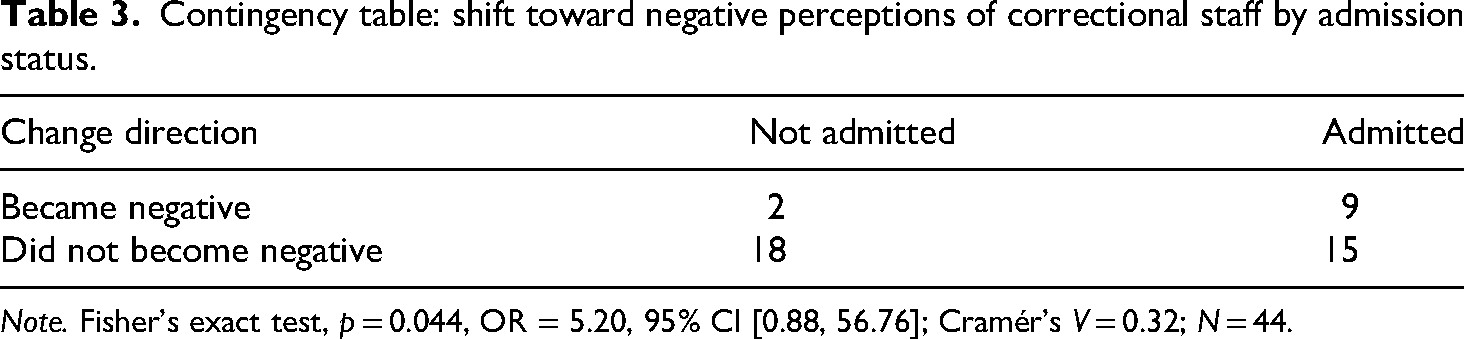
Note. Fisher's exact test, p = 0.044, OR = 5.20, 95% CI [0.88, 56.76]; Cramér's V = 0.32; N = 44.
There was a statistically significant association between program admission and likelihood of developing negative perceptions of correctional staff (p = 0.044). Participants who were admitted to the program were more likely to shift toward negative perceptions than those who were not admitted (OR = 5.20, 95% CI [0.88, 56.76], p = 0.044). The strength of this association was moderate (Cramér's V = 0.32). While based on a small sample, these findings suggest a potential shift in participants’ relationships with correctional staff following involvement in the prison education program.
Qualitative responses
Wave 1: Aspirational perspectives
The qualitative findings, gleaned from respondents’ answers to the open-ended questions on the survey, elaborate on the quantitative patterns. Most participants’ reflections on their relationships with officers emerged in responses to the following question, asked in both Wave 1 and Wave 2: In what ways do you think higher education would benefit/is benefitting this institution (prison)? In Wave 1, when respondents were asked how higher education might benefit their prison, responses were largely aspirational. At that point, no one had been admitted into the program, so answers, regardless of admission status, tended to be hopeful and positive. Many participants focused on how prison education might change correctional staff's perceptions of incarcerated individuals. For example, Derrick noted that, “[Education] has the ability to soften the heart and mind of some of the more biased staff” (Admitted, W1). Sean also emphasized how education could challenge narratives they believed officers had learned in training, Allowing for more prospects will give the staff and security here something to change their perspectives when viewing us. When the correctional officers are trained, they are told we are the worst of the worst and need to be treated as such. But we are showing a different “us.” This is what education provides us, a way to change ideologies. The more they see us in an educational light the more they are forced to treat us like men instead of animals. (Not Admitted, W1)
Maurice expressed a similar sentiment stating, When people in oppressive circumstances are given the tools to critically examine themselves and the environment that they live in, they will automatically begin to make important changes to both. This would also affect the staff also, because they will begin to see people in prison differently. Ultimately, it would completely change the institution. (Admitted, W1)
Overall, there was consistent mention of prison education as allowing for correctional staff to see incarcerated people “differently” or “to change their perspectives on us.” All 56 respondents in Wave 1 expressed aspirational sentiments about the potential benefits of college-in-prison for their institution, likely reflecting, in part, the framing of the survey question. Of these, approximately 15% specifically mentioned potential improvements in relationships with correctional officers. No responses discussed anticipating college-in-prison participation would worsen their relationships with officers.
Reciprocally, some participants described a shift where people in prison may change their perspectives on correctional staff with more education. Andrew states, When someone becomes educated, their perception of life changes for the better. Individuals in custody would no longer see their institutions of confinement as prisons, rather as places of learning; and staff members as helpers whose sole purpose would be to help them become better human beings, not to punish them. (Admitted, W1)
Overall, participants described education as fostering mutual understanding between students and correctional staff.
In a similarly aspirational manner, participants linked the possibility of admission into the prison education program to better use of time in the institution, leading to increased safety and reduced violence, which would also benefit their relationships with staff. Eric suggested, “Getting the opportunity to gain higher education will give guys something other to do than getting into trouble, making the prison environment better for everyone as a whole, including the staff” (Admitted, W1). Harold similarly stated that, Being that this particular prison doesn’t really have such a program, the men here have less positivity to focus on and more time to engage in negative behaviors. That causes more stress and work for the staff. A higher education program could ease stress for both the resident population and staff. (Not Admitted, W1)
Participants often described a “chain reaction” in which educational opportunities led to less misconduct, fewer disciplinary actions, and ultimately, less stress or work for correctional officers.
Wave 2: Skeptical and disillusioned perspectives
In Wave 2, responses to the same question showed a shift, with many becoming more skeptical about the benefits of college-in-prison regarding relationships with correctional staff. This skepticism was particularly prevalent among admitted students, who expressed most of these changed sentiments.
In contrast to the aspirational comments from Wave 1, admitted participants noted resistance to NPEP among correctional staff. Many highlighted a lack of support for educational programs: It could benefit but the majority of the staff is resistant to this program and talk down, act unwelcoming. So, I think the prison is trying to turn programs like this and others away. Specifically, amongst the older staff (10 years and over). (Admitted, W2)
Others echoed this sentiment, highlighting an environment of disrespect toward students: “I think it is making this prison worse, and that this prison doesn’t appreciate the program nor does it deserve it here” (Admitted, W2) or “In this institution the lack of respect for those of us who are getting our education plays a huge part in how we are looked at as a person” (Admitted, W2). While the latter quotes reference the “institution” and the “prison,” not specifically the correctional officers or staff, people in prison do not interact regularly, if at all, with prison administration (Crewe, 2011). Thus, any direct evidence of “a lack of respect” for incarcerated people and their quests for higher education is most likely coming from correctional officers.
While in Wave 1, participants had expressed hope that education might humanize them in the eyes of staff, many in Wave 2 described resistance. It is especially notable that they relayed these critical perspectives in response to a question about benefits (“In what ways do you think higher education would benefit/is benefitting this institution (prison)?”); many diverged from the structure of the survey question to share concerns about negative staff relationships.
Interestingly, some participants attempted to explain the roots of some of the hostility they felt from staff. A few believed that education posed a threat to the prison system's long-term viability, and by extension, to staff's job security. David, for example, wrote: The reality is that the prison would not benefit because it is part of a system led business. If individuals receive a higher education, it means that they see themselves in a better light. They are no longer living or engaging things that are destructive. Recidivism would be low. The prison would not benefit because there would be no need for internal affairs or other jobs. Jobs themselves will begin to eliminate because less people will come while more are getting out. The prison would become obsolete. It is part of a business and nobody wants to go out of business. (Admitted, W2)
Finally, some participants in Wave 2 suggested that offering post-secondary education to correctional officers could alleviate some of the hostility they felt from staff, which they often perceived as resulting from envy regarding their participation in the education program. Glenn describes, Higher education could benefit this facility if the correctional officers were offered the same education as the individuals in custody, because I feel there's some discord on us being offered free education versus them having to pay for theirs and their children's education (Not Admitted, W2)
I believe that the C.O.s would also benefit from higher education, it is a silent hostility between them and us, as if we don’t know our place. If they were also being educated along with us, they would see that we are the same and we could work together to better one another. If the C.O.s were honest, the students give them almost no problems. (Admitted, W2)
Taken together, responses across the two waves reveal a clear shift in how participants, and particularly admitted participants, understand the role of higher education within the prison. While Wave 1 responses were largely aspirational and emphasized the potential for education to foster mutual understanding, reduce violence in prison, and transform how staff perceive incarcerated individuals, Wave 2 responses reflect a more complex and, at times, disillusioned perspective. Participants who had entered the program began to articulate frustration with what they described as staff resistance and disrespectful treatment.
Discussion and conclusion
Since the heyday of prison sociology, scholars have thought of prison as not only a site of punishment and state power, but also a unique social space (Goffman, 1961; Kreager and Kruttschnitt, 2017; Sykes, 1958). Much of this foundational work highlights the central role of correctional officers in shaping daily life and incarcerated peoples’ adjustment. But very little research has examined how participation in particular programs might shift incarcerated people's perceptions of staff. Our study addressed this gap by examining how participation in a college-in-prison program influences students’ views of their relationships with correctional staff.
Using a longitudinal mixed-methods design, we find that before admission, participants who were later admitted to the program reported largely positive relationships with correctional staff. After participation, however, positive perceptions dropped, while negative perceptions rose. Non-admitted participants also showed a decline in positivity over time, but the shift was far less pronounced. We found a statistically significant association between program admission and the likelihood of developing negative perceptions of correctional staff relationships.
The qualitative data offers several explanations for the numerical findings. Before participation in the college-in-prison program, students were aspirational and hopeful about the transformative potential of education for their relationships with correctional staff. They anticipated that education would humanize them in the eyes of staff, foster mutual understanding, and reduce misconduct and stress in the prison environment. After participation, however, admitted students reported resistance or hostility from correctional officers toward educated students, a dual framing of college-in-prison programs as either undermining or reinforcing institutional viability, and tensions around equity between officers and students. In this sense, our findings are in line with recent work showing that staff may resist or sometimes undermine educational initiatives (Binda et al., 2020; Royer et al., 2023).
We cannot answer the question of why perceptions of correctional officers changed after admission and exposure to college classes. Our data suggest two primary hypotheses that merit exploration in future research. First, the root of these changes may lie in the behavior of correctional staff. As some respondents noted, and as previously identified in Royer et al. (2023), staff may begrudge incarcerated people the opportunity to obtain a college degree. Hence, officer behaviors may become more skeptical, punitive, or watchful for infractions, and thus be perceived more negatively by students. Shifts in officer behavior are especially high stakes given the extraordinary amount of material power correctional staff hold over incarcerated people's futures, influencing access to programming, housing, and release decisions. Alternatively, students’ perspectives may have changed regardless of staff behavior and may be particularly impacted by the content of college classes. While NPEP offers a broad liberal arts curriculum (including literature, science, math, etc.), the students major in the social sciences and thus may be exposed to critical perspectives on power and inequality. They may interpret staff presence and practices more negatively with these new ideas. As with most social phenomena, it is likely a combination of these forces, and others.
Two key limitations affect the interpretation of our findings on correctional officer relationships. First, many admitted participants were transferred from a variety of Illinois prisons to Stateville to participate in the prison education program. While this relocation is integral to the program structure, it introduces potential site-specific effects. In particular, the decline in reported positive relationships with correctional staff may partly reflect the institutional culture of Stateville. As Vuolo and Kruttschnitt (2008) find, even when rules are applied consistently across institutions, incarcerated peoples’ perceptions of correctional officers and institutional life varies between facilities. Such variation is an inherent feature of prison research. 2 Second, although our design aimed to compare admitted versus non-admitted students, it became clear through qualitative responses that some non-admitted participants were enrolled in other educational programs. While these programs differ significantly from NPEP in structure and credentials, this overlap complicates our ability to make clean comparisons between “college participants” and “non-participants.” Our findings should therefore be interpreted specifically as reflecting participation in NPEP. Some scholars have urged against the inappropriate generalizing of particular college-in-prison programs as “education” writ large, and we are conscious of our inability to do so (Tewksbury and Stengel, 2006). Future research should build on this work by looking at student-staff relationships within and across other programs, facilities, and states to assess whether the patterns we identify hold more broadly.
Given the extensive evidence demonstrating the success of prison education across multiple dimensions (Binda et al., 2020; Nally et al., 2012; Pompoco et al., 2017; Tewksbury and Stengel, 2006), the focus should now turn toward refining and improving the operations of such programs. To this end, our findings carry several important policy implications. We find that college-in-prison programs can unintentionally create new lines of division between staff and students, even though their successful implementation depends on staff buy-in. Future work should examine not only student perceptions but also how correctional staff understand and respond to college-in-prison programs, as well as other externally run prison programs, from parenting classes to religious services. Opportunities for officers to be engaged in dialogue about programming could help reduce some of these tensions. Direct forms of involvement, such as joint professional development or tuition assistance for staff, might also foster shared investment in college-in-prison. This is especially relevant given that many officers may not have college experience, as their position requires only a high school diploma or GED (Illinois Department of Corrections, 2025). Also, explicit discussion of the role and experience of correctional officers within relevant college-in-prison courses among incarcerated students might foster an additional layer of insight and regard. Finally, funding agencies and policymakers should evaluate college-in-prison programs not only on post-release outcomes like recidivism but also on in-prison relational outcomes such as student-staff relationships. Future research, likewise, should consider the impacts of changed relationships on incarcerated people's program outcomes, well-being, and long-term success.
Footnotes
Acknowledgments
We thank Terese Sommer, Nicole Legate, Alexander Lundberg, Lauren Tighe, and Annika Pinch for their support with data preparation. We are grateful to Jennifer Lackey for feedback and support throughout the research process and on various versions of this work. We thank the Illinois Department of Corrections (IDOC) for the research agreement. This work represents the research findings of the authors and in no way reflects the views of the IDOC.

Ethical considerations
This research was approved by the Institutional Review Board of Northwestern University (Approval No. STU00217582). It was also approved by the Planning & Research Department of the Illinois Department of Corrections.
Consent to participate
All respondents gave written informed consent and signature prior to starting any surveys.
Consent for publication
Not applicable.
Funding
The authors disclosed receipt of the following financial support for the research, authorship, and/or publication of this article: This work was supported by the Andrew W. Mellon Foundation.
Declaration of conflicting interests
The authors declared no potential conflicts of interest with respect to the research, authorship, and/or publication of this article.