






Abstract
Clemency is a popular yet controversial mechanism in many modern democracies, often described as standing in tension with the rule of law. Drawing on phenomenological literature, we conceptualize clemency as a mechanism that gives humanity back to the law's impersonal machinery. Building on a qualitative analysis of 75 presidential clemency cases in Israel consisting of the president's handwritten annotations, we suggest that the president's decision-making communicates dual messages: (a) reaffirming the law “from above,” by externally validating the work of the criminal justice system; and (b) personalizing the legal machine “from below,” by transforming the abstract legal subject into the vulnerable Other. Through such dual messages, the work of clemency decision-making is legitimized as a bridge between the rule of law and the ethics of care.
Introduction
The blind goddess of justice, Themis, became a symbol of the principle of the rule of law, reflecting equality before the law, and the law's position that “would like not to know” about the sentenced individual (de Ville, 2011: 354). This principle echoes the message that all humans are born equal and entitled to dignity and rights. However, literary works (e.g. “Les Misérables”) and scholarship demonstrate the dangers of law's blindness becoming an automated mechanism, operating without regard for individual distress, suffering, or mercy (de Ville, 2011). Kafka's “Before the Law,” for example, explores the tension between the law's universality and the individuality of the persons who stand before it. Such writings resist the blind imposition of the right/wrong binary law, separated from individual narratives (Levinas, 1993). The tension between the ideal of the rule of law and the manifestation of individualized mercy is particularly significant in criminal law, where the state imposes punishments on citizens. Resolving this tension without compromising the principle of equality requires complementary systems that can provide parallel considerations.
In this article, building on qualitative findings from 75 presidential clemency cases in Israel, in which President Isaac Herzog provided handwritten annotations to the clemency decisions prepared by the staff of the President's Office, we explored how clemency is justified in the shadow of the rule of law. These cases offer a direct perspective on how the president conceptualizes his normative, constitutional, and institutional role within the broader system of the criminal justice system. Our analysis suggests that the president's clemency power is intimately connected to the inherent limitations of the rule of law. The president's decision-making, as the findings suggest, communicates dual messages by (a) reaffirming the law “from above,” providing an external ratification of the law's normative validity; and (b) humanizing the legal machine “from below,” personalizing the work of the criminal justice machinery. Through such dual messages, the findings suggest, clemency decision-making is legitimized as a bridge between the rule of law and the ethics of care.
Clemency: within and outside the rule of law
Clemency—encompassing pardons, commutations, and related mechanisms of executive mercy—is a near-universal feature of modern legal systems, present in at least 183 national constitutions (Barkow and Osler, 2024; Sebba, 1977). Yet despite its prevalence, clemency remains deeply contested: It sits in fundamental tension with the rule of law's principle that like cases be treated alike (Campagna, 2021). Scholars have described it as a form of “legal lawlessness” (Sarat, 2005), free from rules, precedents, and policies, based on unconstrained will and outside the scope of judicial review (Brown and Adler, 1989), and have questioned whether it is anything more than a “relic” from pre-modern monarchical times (Kobil, 1991: 575). Policy-makers push toward abolishing the use of clemency (Sarat, 2005), or at best, use it as a “safety valve” on a criminal justice system that does not work as it ideally should (Flanders, 2013: 1559). At the same time, others argue that clemency performs an indispensable function that the criminal justice system cannot perform for itself: returning a human face to the impersonal machinery of the law (Bibas, 2012). It is this tension—between the rule of law's demand for blindness and equality, and clemency's capacity for individualized mercy—that our study seeks to examine empirically.
The connection between clemency and the rule of law was debated for years. Some philosophers saw clemency as a “virtue” standing within the realm of the majesty of the spirit rather than the realm of justice (Murphy and Hampton, 1988). Legal scholars have attempted to bridge the tension between clemency and the rule of law, arguing that such authority is compatible with the modern understanding of “checks and balances” and serves as a further “quasi-judicial” check on judicial punishments, or that such authority serves to mark the boundaries of the rule of law in exceptional states (Pascoe and Novak, 2021; Sarat, 2005). Along these lines, the practice of clemency in many systems is less an “extraordinary, charismatic act by the omnipotent sovereign” and more a bureaucratized-legalized act through different “secondary-decision-makers” (e.g. advisory committee) or the input of judicial (e.g. Argentina) or rehabilitation bodies (e.g. Japan) (Pascoe and Novak, 2021; Sebba, 1977).
Socio-legal scholars expand the debate when focusing on the relations between clemency and law's overall legitimacy and power. Such scholars have suggested that clemency decision-making serves openly and less openly to maintain and reinforce existing social-penal hierarchies (Foucault, 2012; Hanan, 2023). Using historical and more recent cases, scholars argue that clemency maintains an illusion that the law is distributed fairly and mercifully (Hay, 1975), that it is used to ensure the public legitimacy of the law (Spierenburg, 1984), or to increase the power of the sovereign (Garland, 2011). This scholarship tends to depict clemency as an often hierarchical, arbitrary, racialized, and politicized tool that is subject to the whim of a powerful sovereign rather than a remedy to the law's limits (Barkow and Osler, 2024; Foucault, 2012; Sarat, 2005).
However, scholars and policy-makers have suggested that clemency, even in modern democracies, is the key to promoting legal values and judicial legitimacy: promoting rehabilitation and redemption; reducing mass imprisonment; correcting unduly harsh sentences or procedural errors; restoring national unity during or after divisive conflicts (Acker et al., 2010; Pascoe, 2023; Sarat, 2005). Beyond the US/UK context, clemency motivations may also include co-opting political opponents and rewarding loyalists (e.g. China) (Kobil, 1991), or promoting religious values through giving the victims a preponderant role (e.g. Iran) (Pascoe and Novak, 2021). The breadth and variety of these purposes reflect a deeper normative complexity at the heart of clemency: It is simultaneously expected to serve individual justice and broader social values, to complement the rule of law and, at times, to deviate from it—a tension that existing scholarship has yet to fully examine empirically.
Existing studies have made important contributions, but tend to address adjacent questions. Current empirical research regarding clemency often relies on secondary sources—such as public speeches, interviews, press briefings—rather than on primary voices (Canossini, 2023; an exception is Brown and Adler, 1989). The few and firsthand U.S. accounts of executive clemency, dating from the 1960s, viewed it as a “fail-safe” mechanism in capital cases, seeking to ensure fairness and justice against judicial authorities and public anger (Brown and Adler, 1989). Current empirical literature suggests a variety of reasons and functions of clemency decision-making (Barkow and Osler, 2024). The reasons offered by New York governors for commuting death sentences during the mid-20th century were found to rely on justice, equality, and proportionality rather than mercy considerations (Acker et al., 2010). More recently, presidential clemency statements in the U.S., from President Reagan to President Obama, were found to be based on community benefits and justice ideals (Canossini, 2023). Clemency board members in the U.S. were found to use hearings to reinforce state control, while also minimizing social distance between the applicants and law-abiding citizens (Horowitz, 2023). Finally, rehabilitative factors emerged as necessary preconditions alongside retributive factors in commutation decisions for life-without-parole prisoners in the U.S. (Schartmueller, 2024).
Taken together, these studies illuminate what factors and functions shape clemency decisions in practice, but leave largely unexamined the deeper socio-legal and criminological question of how decision-makers understand and articulate the legitimacy of clemency as an institution—that is, how they position their exceptional authority in relation to, rather than simply alongside, the rule of law. In this study, we aimed to fill this gap via a qualitative analysis of the president of Israel's clemency decision-making in a sample of 75 clemency cases. Specifically, we explored how clemency was managed in relation to the rule of law. Although the decisions analyzed were made by a single primary decision-maker—President Herzog—we sought to illuminate how an institutional clemency authority was articulated and justified within a constitutional framework, allowing a more general theorization of how clemency power negotiates its place within a constitutional order and the rule of law.
Context, data, and method
Clemency power is attributed in several systems to the executive arm of government, subject to symbolic or practical control of the parliament (e.g. the U.S.), or vested in a collective body (e.g. Romania). In other systems, such power is entrusted to the ceremonial “head of state”: the king or queen (e.g. UK), the emperor (e.g. Japan) or Amir (e.g. Kuwait) (Pascoe and Novak, 2021; Sebba, 1977). Similar to latter systems, Israel is a parliamentary democracy and not a presidential regime; however, the president is defined as “the head of state” (The Basic Law: The President of the State, 1964: s.1) and “[the president] stands elevated above the power struggles in the state, and represents values of social morality that are not subject to political controversy” (Zohar v Minister of Justice, 2008: 10). Since 2021, President Isaac Herzog has served as Israel's 11th president (The President's Office, 2023). The president of Israel is elected by the parliament for a 7-year term, and it is the president's hand, as in many other systems, that ratifies every law in the state (s.11(a)(1)). Clemency power is a unique power held by the president, and it allows the president, among other duties, to “pardon offenders and reduce sentences by reducing or commuting them” (s.11(b)), subject to the Minister of Justice's “signature of endorsement” after the president's decision (s.12). Such power is granted to the president as part of their role as “the symbol of the state and represents its moral and democratic values” (Doe v Attorney General, 2008) and “reflects in its character and status the state itself” (Cohen, 1992: 14; Zuk-Shapir et al., 2019). Clemency power is mercy-based: “In the realm of justice and law, stand mercy and compassion, the dimensions of the heart” (Zohar v. Minister of Justice, 2008). Clemency decision-making is discretionary, enacted by a “guardian of mercy who, out of the generosity of his heart, seeks to diminish the measure of the law in favor of the measure of mercy” (Cohen, 1992: 296).
By law, clemency applications are either for sentence reduction (e.g. imprisonment, fines, suspended sentences, driving disqualifications, etc.) or the expungement of a criminal record, and undergo a similar process. The clemency process is initiated by an application, possible for anyone interested, regardless of legal representation or recommendation by any other authority. Applications are typically submitted through an online form, but may also be filed otherwise (e.g. a prisoner's letter). There is no formal time limitation for the application. However, an application filed shortly after sentencing must generally be supported by special reasons not considered by the court (The President's Office, 2023). Victims of sexual or violent crimes can express their position in writing before the president decides on an appeal to mitigate a prison sentence (Rights of Crime Victims Law, 2001: s.20). 1 In practice, President Herzog adds his comments in writing in a “substantial” but unspecified number of the overall clemency cases, specifically in cases of an applicant's special circumstances (e.g. medical or mental condition), and in a minority of the cases (in ∼10% of cases) asks in writing to conduct a further assessment or to deliver the decision via a phone call (The President's Office, 2023).
The president reaches a clemency decision based on the application, as well as on the opinions of probation, social service, risk assessment, or law enforcement authorities, including those of the Minister of Justice. The process of examining the application should be thorough and based on its merits. The process includes the collection of information about the case, along with professional opinions. The opinions are prepared by the Clemency Department in the Ministry of Justice and signed by the Minister. The opinions are then transferred to the president, who weighs all aspects of the case before making the decision (The President's Office, 2023).
The average number of clemency applications submitted to the president is approximately 1500 applications annually, and this number has increased steadily over the years. In 2024, the president made decisions with regard to 1,505 applications (Ministry of Justice, 2024; The President's Office, 2023). Expungement applications were made by the applicants on 780 applications, of which 323 (41.4%) were answered positively by the president, and 253 applications for sentence reductions, including both imprisonment and community service, were granted in 31 cases (12.25%). As for fine mitigation applications, decisions were made on 130 applications, with relief granted in 113 cases (86.9%). 2
In 2023, 1,568 overall clemency applications were submitted, 518 applications for record expungement, of which 233 (about 44%) were answered positively; 272 applications were made for mitigation of prison sentences, and mitigation was granted only in 26 cases (about 9.5%); 73 applications were made for mitigating fines, and reductions were granted in 48 cases (about 66%); and 140 applications were made to reduce driver's license disqualification sentences, and 13 were granted (about 9%). There were additional decisions as well (e.g. decisions regarding applications for setting a determinate sentence period on life imprisonment) (Ministry of Justice, 2024).
This data, consistent with trends from other jurisdictions, suggests that clemency power is more liberally applied for cases of fine mitigation or record expungement (viewed more as an ancillary to the sentence) than for prison sentence reductions (viewed more as a direct intervention in core judicial authority) (Prescott and Starr, 2020). Although our analysis encompassed all types of clemency decisions, the most normatively salient narratives were identifiable in decisions concerning prison sentence reductions.
Sample and method
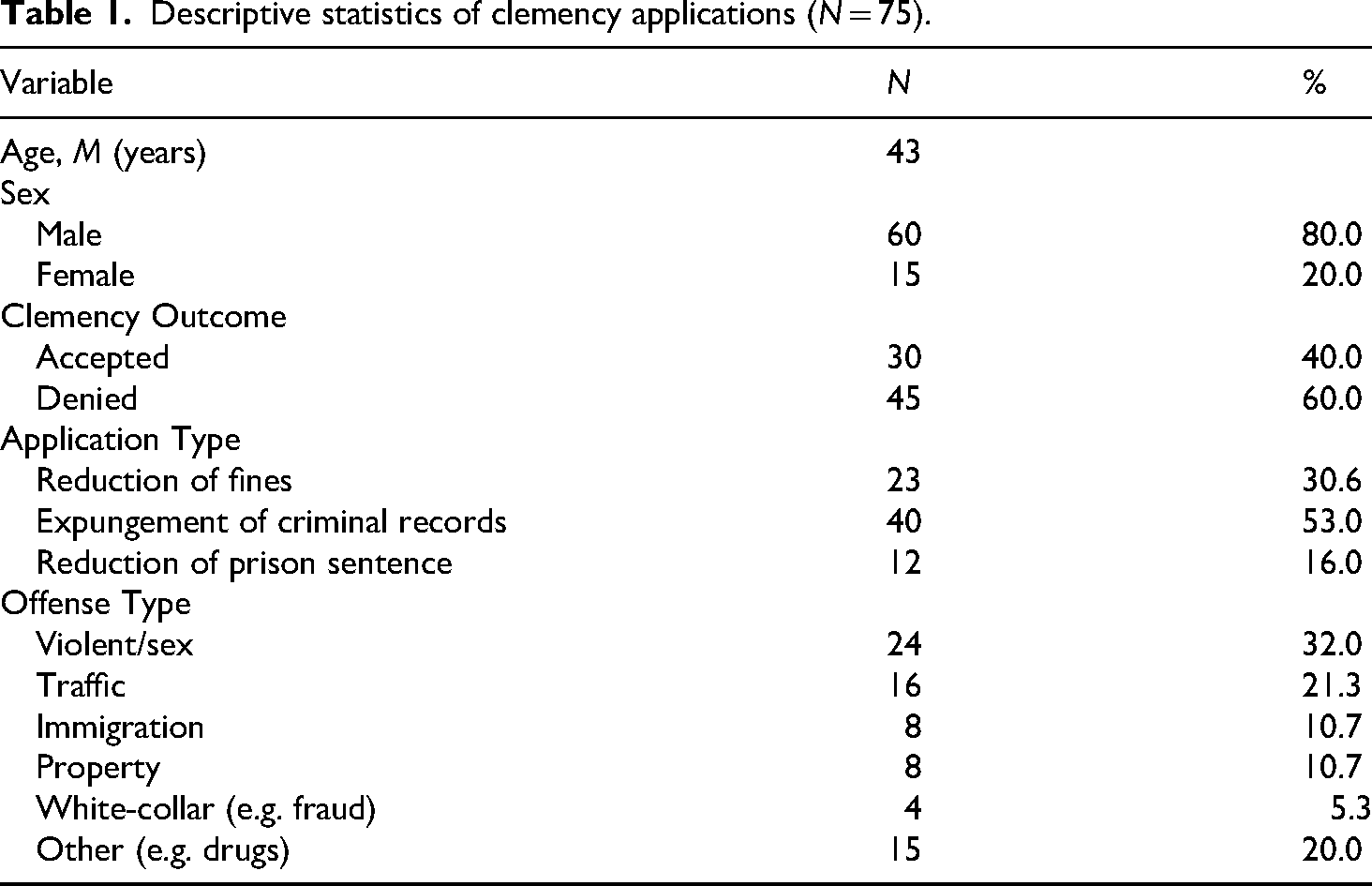
We qualitatively analyzed clemency cases made by the current president from 2022, about 6 months after he took office, until March 2024. During this period, decisions were made on approximately 3,500 clemency cases. Out of these 3,500 cases, we examined those decisions that included the president's handwritten comments (a common practice in the president's decision-making), which were expected to yield richer narratives, and the recommendations written by the staff of the president's office. We analyzed both sources of data, as the president's office acts in accordance with the “vision and values” dictated and approved by the president (The President's Office, 2023). We ultimately found 200 cases in total that contained written comments from the president. Seventy-five cases contained substantive comments by the president and the president's office, and the remaining 125 included only rather technical comments by the president (e.g. “the positive/negative recommendation is approved”) and therefore were not further analyzed. We thus qualitatively analyzed the abovementioned 75 cases, all of Israeli citizens, including the detailed letters sent to the applicants in these 75 cases after the decision was made, as well as the legal opinions that were formulated to aid the president's decision-making process for these applications. Table 1 presents the sample's characteristics.
Descriptive statistics of clemency applications (N = 75).
We applied a purposive sampling strategy, centered on clemency cases containing the president's handwritten annotations. This method was chosen to achieve rich insights regarding how the president personally understood and performed his distinctive role within the broader system of the criminal justice system. Whereas the advisory staff is composed primarily of legal professionals, the moments in which the president chose to add notes with his own handwriting offer a particularly revealing site for examining the meaning of clemency. The focus on the president's handwritten notes is consistent with the socio-legal and ethnographic focus on forms of “materially entangled” decision-making (Woolgar, 2002), employing similar methodological sensibilities for exploring legal and bureaucratic file-making, paperwork, and documentation (Latour, 2010; van Oorschot, 2014). Such annotated “traces” allow the revelation of “the mundane and moreover material activities that usually take place backstage” (van Oorschot, 2014: 444), and make visible the institutional logic that is often obscured by the formal surface of bureaucratic records (Denis and Pontille, 2012).
Given the interpretive nature of the present inquiry, we sought to identify moments of institutional “sense-making” in which lived meaning became articulated, intensified, or personalized (Smith and Osborn, 2015). Focusing on decisions bearing the president's personal handwriting, we aimed to examine instances in which clemency decision-making appeared to move beyond routinized processing and to illuminate how the president personally understood clemency's power and its social and normative dimensions.
The study was ethically approved by the researchers’ university's institutional review board (IRB) and the president's legal office. Privacy was strictly ensured throughout the research process conducted in the president's office, including the changing of case numbers. Applicants’ personal details were omitted when reporting the findings.
We used reflexive thematic analysis to explore the data. We thoroughly familiarized ourselves with these cases, generated initial codes, searched for themes, and reviewed, defined, and wrote them (Braun and Clarke, 2021). Each author applied inductive-oriented coding separately to allow for unexpected insights to emerge from the data, but also considered top-down concepts (e.g. “the rule of law”) to ensure relevance to theory and the research questions. Disagreements were discussed until consensus was reached.
Reaffirming and personalizing the rule of law through clemency
Reaffirming the rule of law from above
After its legislation, the law has an objective social reality, a positive “fact” (Kelsen, 1960: 271) that exists regardless of its moral value: “Once law emerges, it takes on a life of its own as an autonomous sphere of human activity” (Fiss, 2001: 519). Being outside the criminal justice system allows the president to reaffirm or halt the autonomy of the criminal justice system's work. The modern “machinery of criminal justice” is based on efficiency and the professional parties’ interests and “has taken on a life of its own far removed from what many people expect or want” (Bibas, 2012: xvi). Such “machinery” is focused on “dispensing impersonal punishment, not sending moral messages or healing wounded relationships” and “sees defendants as separate from the web of relationships and communities they have wounded” (Bibas, 2012: xvi).
When analyzing the data, we found that the president's decisions did not reflect upon the “law's failures” (e.g. the risk of false convictions) (Sarat, 2005), but focused firmly on reaffirming the court's authority. Here, the president was careful to demarcate his work from judicial decision-making. This institutional “boundary work” (Blok et al., 2019) was often mentioned in clemency rejection letters as a reason for denial: “The clemency is not a link in the judicial system,” and “Claims regarding your innocence should not be examined through the clemency application. The institution of clemency is not an appeal authority, and the clemency process is not the forum for assessing such claims” (case-984/23). However, although the president is not an appellate court, he does address the question of whether the legal outcome is justified, not merely as a legal question but also from the extra-legal perspective of the common citizen. The president, who is defined by law as the head of state, is often referred to as “citizen number one,” a term that reflects the fact that the president does not represent any of the three branches of government; he does not represent the “public interest” in the aggregate sense of government officials, but rather the individual ordinary citizen, who is subject to government authority (Zohar v Minister of Justice, 2008). In some cases, the president ratifies the court's verdict through referencing prison official or parole board opinions. In doing so, the president, at least implicitly, also reaffirms the work and legitimacy of “back-end” sentencing authorities rather than merely the courts. For example, the president referred to the parole board's impression of the applicant's denial of the crime (when rejecting his parole application) as a reason for also denying his application (e.g. “the overall impression of the parole board was that [you are] minimizing the seriousness of the crime”; “the parole board… held that releasing [you]… would harm you and society”).
Aside from reaffirming the fairness and reasonableness of the criminal justice system's decision-making from the viewpoint of the ordinary citizen, we found that the president reaffirmed the legitimacy of penal messages delivered by the courts to the applicant and wider society regarding crimes that were so severe they were immune to the passage of time. For example, for an applicant convicted of fatal negligent driving, the president confirmed the reasonability of the court's determinations: “the public interest of fighting deadly driving necessitates imposing severe and commensurate punishment for these offenses, specifically long [driving] suspension punishments.” (case-92364/23). In the case of an application for mitigating a criminal record for sexual harassment, the president wrote: [You, the applicant] were convicted a decade ago of sexual harassment, and this should not be taken lightly. Even though this is your only conviction, the nature of the crime, and the need to denounce this phenomenon, raises a clear public interest in continuing the record… sex crimes are still prevalent and a concerning societal phenomenon, which we must uproot through enforcement and deterrence (case-930/23).
Police over-enforcement of public disorder offenses against minorities
These cases involve mitigating sentences or criminal record periods for applicants convicted of offenses in the context of, for example, protests of individuals of Ethiopian descent against police over-enforcement: “those who suffer from an improper attitude [against them], and there is a high probability that this situation will lead these individuals to enter the circle of criminality” (case-847/22). For example, the president agreed in his own handwriting to the following recommendation from the president's office to mitigate the criminal record period of one applicant from a minority background: The official report for fighting racism found that there are significantly higher rates of criminal proceedings and indictments against people who come from the Ethiopian community; many times, a standard police action and initial encounter with the police officer leads to criminal proceedings against young people with an Ethiopian background, pushing them further into the criminal circle (1337/23).
In such cases, the president halted the general policy of enforcing public disorder crimes against minorities, by taking into consideration the issue of racism and over-enforcement by police against such people. This over-enforcement harms justice and the need to reintegrate such individuals into society.
Cases of illegal drugs for personal use
In such cases, the president showed a more lenient approach reflecting the evolving, and more lenient, societal standards toward such drug offenses, not echoed in current criminal law (which views them as serious offenses): “We should come forward toward the applicant…. Considering [our] cannabis policy and the changes that these offenses have undergone, we should shorten the criminal record's period… we should explain to the applicant that when the limitation period is over, the criminal record will be hidden from most actors in the job market” (case-2112/23).
Offenses in the context of sex work
In such cases, regarding those convicted of offenses related to sex work, the president allowed for the erasure of their criminal records and/or fines, explaining: An act of clemency, which embodies kindness and mercy, will convey to the convict and others still in the difficult cycle of prostitution a message of hope, trust, and encouragement in an attempt to extricate themselves from their situation, to rehabilitate themselves, and to earn a living in other ways that will benefit them… Her desire to advance professionally and the public interest inherent in this… it seems that there is justification for taking a special step of kindness and mercy (case-90969/21).
Such clemency should be allowed in order to “encourage an exit from prostitution, in conjunction with additional steps by government ministries to reduce prostitution consumption in Israel and provide rehabilitation and treatment for women who are part of the prostitution cycle” (case-92275/20). Here, as before, the president referred to the evolving societal standards toward such offenses, in terms of allowing the erasure of a criminal record and fines, given that “it can be assumed that the fines were imposed on her as part of the police's attempt to deal with the phenomenon of prostitution in those years” (case-89874/21). The president's suspension of the full implications of the law shows that this law is subordinate to society's values rather than an autonomous end in and of itself.
The legal system operates according to specific rules, and decisions are based on these rules and their application. When cases are appealed, the court examines how the rules were applied rather than whether they led to a fair outcome in civilian terms. The role of the president is to provide an outside perspective, focusing on justice and fairness rather than strict legal rules. The aim of this perspective is to ensure that legal rules result in fair outcomes for civilians, including the possibility for a “second chance.” In cases where the law leads to unfair results, the president has the authority to suspend the law. The extra-legal perspective aims to ensure that the legal rules lead to a fair result in common and non-legalistic terms. The law serves the citizens and does not become just an end in and of itself. The president, as the head of the State, stands outside of the political system, symbolizing that the state's authorities should serve the citizens and not vice versa.
Personalizing the faceless legal machine
The law's impersonal blindness results in the neglect of individuality for the sake of the rule of law. The president's authority returns “the human face” to the law, to provide an “ethics of care” that complements the criminal justice system's “ethics of justice” (Gilligan, 1982). Whereas the first theme captures the way in which the president reaffirms the rule of law “from above,” the second theme captures the way in which the president represents an intuitive, humane, and caring justice that humanizes the rule of law “from below.” The focus of the first theme is on the law itself, the law in the books, and whether the result of its application is reasonable from the extra-legal perspective of the ordinary citizen. In contrast, the focus of the second theme is not on the law itself but on subjectivizing the case, the law in action, in order to amend the legal blindness of the criminal justice system. In this theme, the humanization of the legal machinery is reflected through the following elements in the president's decision-making:
Ordinary” justice
The president's letters to the applicants were written in ordinary rather than in legalized language. In about a quarter of the cases analyzed, the president added, in his own handwriting, that the applicant would come to understand his decision and the underlying rationale for said decision through the President's Office: “It is important to explain everything” (case-194/23), or “We should explain to him that he must undergo treatment” (case-142/23). In some cases, the president even explained to the applicants the real effect of the mitigation. When reducing a prison sentence to community punishment, he wrote: “We should explain that community service is not a walk in the park” (case-460/23).
Such personalization also emerged from the president's positive messages of encouragement, written in his own handwriting, toward the successful applicants, such as “impressive!” (case-41/23) or “well done!” (case-50/23). The letters included messages of encouragement in largely every case of granting clemency, such as in a case authorizing the clemency of a police officer convicted of inciting racism after completing a rehabilitation process: Shortening the [criminal record] period was made after some doubt, considering the severity of the crimes, but this decision expresses trust in [you] and the substantive process that [you] made and the expectation that [you] will rehabilitate in this way—the right way.
The president's personal tone was also reflected through a language of care, empathy, and sorrow with the applicants’ challenges. In one case of an applicant convicted of fraud, and suffering from severe medical and economic conditions, the president added in his own handwriting after agreeing to clemency: “There will be no second chance [of a future clemency if he is convicted again]…. We should participate in the sorrow and mourning [for the applicant's medical condition]” (case-643/23). As part of humanizing the faceless legal machinery, the president often also directs the applicants to further social service provisions in the community and in prison, and even, in rare cases, asks for a probation report before rendering his decision.
This personalization was also expressed to the victims. Going beyond the legal duty to obtain the victims’ statements only in sex or violent crimes (e.g. seeking the victim's voice in fatal negligent driving), the president wrote in his own handwriting on one victim's request to mitigate an offender's prison sentence in a negligent car accident: “this is touching” (case-92364/23). The president also communicates the victim's position. For example, in one case, a victim of a violent crime asked the president to deny an application to reduce the applicant's prison sentence, as “my pain has no reduction, no expiration date. I only ask that at least you see me, listen to my voice, understand the daily struggle and my desire to know that all this was not in vain and that there is justice.” The president, when denying the application, wrote to his office: “You should remind him [the applicant] of the victim's position” (case-283/24).
Subjectivizing suffering
As part of personalizing the law, especially for elderly and sick prisoners serving prison time for non-violent crimes, the president applied individualized punishment. For example, in the case of a tax offender, aged 83, who suffered from a severe medical condition, the president expressed his willingness to show leniency and even to order his release from prison: “I am ready to show even greater leniency; I think that he has paid his debt to society, and considering his condition, he may be released even earlier” (case-919/23). Similarly, in the case of an applicant, aged 74, who suffered from dementia and had been sentenced to 11 months imprisonment for fatal negligence, the president reduced the sentence to community service by writing to his staff: “Is there any possibility to mitigate to community service? Prepare for me the best alternative urgently” (case-118/20). In other cases, the president's letters show an awareness of the collateral consequences of the criminal process (e.g. inability to carry a weapon or to hold public office) or the weight of the punishment combined with other life hardships (e.g. losing a job or having a family member with medical difficulties) in terms of accepting applications for clemency.
Furthermore, the personalizing approach was also extended to the applicant's broader life, especially the impact of the criminal process on innocent third parties, such as minor children. For example, in the case of an applicant who had been sentenced to a 10-month imprisonment for sex offenses, the president added a handwritten note: “Please check the matter of who will take care of his wife while he is in prison. Is the punishment severity appropriate in this situation?” (case-411/23). In another case, the president made sure that the applicant's child would not be without proper care after his father was sent to prison: [The proposed school] is a good school and dormitory, and suits the minor. Is he currently evacuated [from the home]? Make an inquiry as to where he is [now]… we should also allow some time for organization [before the applicant starts his sentence] (case-747/23).
Rewarding “virtuous” character
The criminal justice system usually allows very little room for the offender's character, to ensure the equal application of the law (Lacey, 2011). However, if an individual deviates from the social contract by acting against society, by violating the norms of criminal law, then an individual, when engaging in a virtuous act of citizenship, deviates from the social contract for society, by going above and beyond what is expected from a citizen (see Allison, 2023). Here, the president often referred in his letters to the exceptional character of the applicants, such as engaging in virtuous acts during times of war or peace. For example, in the case of shortening one applicant's criminal record period, the letter read: “The applicant saved two girls, killed a terrorist, was wounded in the act, and was hospitalized in critical condition.” Additionally, the president added in his own handwriting: “Wish him health and strength” (case-994/23).
Special importance was given to exploring the relation between the applicant's crime and the applicant's character. For example, there was a discussion reflecting the gap between the severity of the crime and the applicant's normative character in the case of an applicant, aged 75 years, who had been sentenced to 10 months of imprisonment for fatal negligent driving. The discussion was based on “common sense”: The court determined that the applicant's negligence in the accident was high, and he should serve prison time. And we must also acknowledge the fatal result, and the great sorrow for the victim's death…Aside from all of this, this is a 75-year-old man, injured in a war. He expressed post-traumatic symptoms after the accident and experienced deep hardship and difficulty containing the event… and his mental health has deteriorated… after some doubt, and based on the applicant's status, it seems that the applicant's entrance into prison, considering his status and his age, and what he underwent, [the situation] almost stands in contrast to basic common sense… and we should mitigate his sentence to community service (case-942/23). He was a very young man [at the time of the offense], faced with the weight of being independent. The sentence is also lenient as it is clear that the offense is almost just technical… we should allow him a clean slate. While there is no second chance [of another clemency if convicted again], in the opening of the new year we should give him an opportunity [he is also handicapped from his military service] (case-210/24).
The principle of the rule of law requires acting blindly concerning the concrete case, to ensure equality, and as such, its focus is on the severity of the crime (Lacey, 2011). Exceptions aside, the crime-focus of sentencing law is disembodied and neglects the meaning of the “pains of imprisonment,” which vary significantly from case to case (Garland, 2011). The justification for this narrow approach lies in the concept of equality, which demands ignoring the differences between citizens, carrying out sentencing under a veil of ignorance (Rawls, 1999). However, from an ethics-of-care perspective, it is inappropriate to ignore the circumstances of the concrete case and give normative weight to how the individual in question and the circles associated with said individual suffer from the punishment. Suffering and pain are subjective. An ethics-of-care approach seeks to balance the trial's outcome with the individual's suffering in concrete circumstances. As the findings in the second theme show, the president complements the principles of judicial justice expressed in the legal process by showing concern and compassion for the specific case in accordance with ethics-of-care principles.
Discussion
The rule of law requires that the criminal justice system apply the law equally and impersonally. In contrast, clemency allows the president to override the finality of judicial decisions (Pascoe and Novak, 2021). As an exceptional mechanism (Sarat, 2005), throughout history clemency was instrumentalized to reinforce the sovereign power (Canossini, 2023; Foucault, 2012; Hanan, 2023; Hay, 1975). As such, what could justify this “relic from the days when an all-powerful monarch possessed” such power in a modern democracy? (Kobil, 1991: 575). Our empirical analysis of a primary clemency decision-maker's (President Herzog's) handwriting on clemency cases suggests that possible justifications for the institutional place of clemency power within a constitutional framework emerge from clemency decision-making in action, rather than merely from the books.
As the findings suggest, the president's decisions reflect various and broad welfarist and justice considerations, in line with previous studies (Acker et al., 2010; Brown and Adler, 1989; Canossini, 2023). Our analysis reaffirms and extends these findings through shedding light on the role of clemency in amending the flaws that are inherent to the strict application of the rule of law. The rule of law seeks to advance equality and thus often requires a rather blind application of the law behind the “veil of ignorance” that gives the law its normative legitimacy (Rawls, 1999). Normally, the rule of law requires that the court apply the law, even when the court believes that the law is unjust. However, the blind application of the law raises two inherent dangers. First, the legislator did not consider all the broad implications of the law, and the blind application of the law will harm unequally marginalized groups in some cases. Second, the blind application of the law in specific cases will harm the sense of intuitive justice.
In the first theme, “reaffirming the law from above,” the president authorizes clemencies for special groups that should not be subject to the strict rule of law. Scholars view the persistence of clemency in a retributive society as a way to rectify injustices in hard cases in which “the predetermined sentence is wrong” (Moore, 1989: 85). The first theme continues this line, but contextualizes the function of clemency decision-making to a greater extent in the context of racially-based police over-enforcement. The conviction in these cases was lawful by strict legal standards, and such applicants have no formal criminal defense claim or post-sentencing rehabilitation. Thus, without the president's intervention, this injustice could not have been amended. The president's intervention in these cases was based on broader societal interests and a recognition of the limitations of the blind application of the law. In these categories, meaningful equality before the law requires a deviation from the guiding principle of blindly applying the law. The other examples involved the criminalization of drugs used for personal consumption, and sex workers. In these categories, the applicants were duly convicted by the law; however, the president believed there was room to grant clemency, as the social norms had changed and the law did not accurately reflect the protected social value of criminal law as viewed by the public or on the basis of personal characteristics/experiences (e.g. survivors of human trafficking) (Barkow and Osler, 2024). If the legal norm does not reflect any protected social value, it is difficult to justify that the person who committed the offense and was convicted of it should continue to serve their sentence. Although the principle of the rule of law requires one to serve their sentence in full, compelling one to do so in such cases is another example of how the autonomy of the law can lead to a situation where the law “runs up against national interest or sovereign prerogative,” detached from public values, and becomes an end rather than a means to serve the public and its values (Sarat, 2005: 626). The president's power to suspend the law provides a way of keeping the autonomous law tied to the public and to remind us all that—in contrast to tyrannical or religious law, whose purpose is not the person or society—democratic law is intended to serve the public and not the other way around.
The second theme, personalizing the legal machine “from below,” does not involve granting clemency to a category of applicants with specific characteristics, but rather cases where the subjective circumstances of the applicants are such that they cannot be ignored, mainly difficult medical situations of family members (e.g. their children's suffering), as is common in some U.S. contexts that provide “clemency as a collective remedy for their loved ones” and emphasizing “their relationships with others” (Canossini, 2023: 1345).
In these cases, there is no question of suspending the law, but rather of exempting specific individuals from the clutches of the law. In the tension between justice and equality, the rule of law generally favors the latter. Here clemency transforms the criminal justice system's abstract “ethics of justice,” emphasizing retributive justice values (Lacey, 2011), to an “ethics of care,” which emphasizes personal moral deliberation, contextualized in a specific relationship (e.g. within a family, community, or other broader social context) and being willing to see the applicant beyond the lens of the crime (Gilligan, 1982). The rule of law requires the law to be as general and broad as possible and to ignore the subjective aspects that might have influenced justice. Accordingly, the rule of law strives to focus on the crime, with minimal reference to the offenders’ character, in order to preserve equality and avoid the abuse of power (Kelsen, 1960). However, as the criminal process impacts individual offenders but also impacts wider circles (e.g. innocent family members of the offender), the results can be absurd and can severely harm the sense of justice. In this theme, the president focuses on personal and subjective aspects of wider circles (of the offender) that are not given normative weight within the criminal proceedings. The president's overall tone focuses on encouragement and warnings that are future-looking. Such a “prophetic voice” provides argumentative and interpretive normative resources to bridge the gap between what the applicants are and what they could be, and thus makes room for recognizing the potential for change, growth, and redemption (Cover, 1983). Specifically, the findings show that the president takes into consideration three subjective levels: the offender's subjective body-related factors; indications of an extraordinary social contribution; and additional circles of harm (to spouses, children, parents, etc.). These subjective elements are minimally reflected in the retributive-oriented sentencing law, due to the notion of equality before the law, but in exceptional cases, ignoring them is perceived as an unreasonable retreat from justice.
The findings suggest that clemency, in action, amends the inherent limitations of the rule of law. Establishing a clear distinction between the two messages is necessary to uphold the fundamental principle of equality before the law while promoting a humanistic message that prioritizes individuality through an institution that is external to the judicial system.
Promoting this message can be achieved through institutional separation. On one level, the president's letters demarcate his clemency work from the court's justice work. Thus, the president's letters emphasize the institutional “boundary-work” (Blok et al., 2019) from the judiciary, being external to the ethos of the legal system that is governed by the rule of law. Subjectivizing the law would put at risk the legitimacy of the criminal justice system. Thus, the clemency institution deviates from the rule of law to preserve the legitimacy of the law. This task could be undertaken only by “the most elevated personage in the land” (Sebba, 1977: 111). The legal system applies to all government bodies without exception, and only the president, who is positioned symbolically “outside” the branches of government, can convey a subjective message without undermining the principle of equality. The message is that the rule of law is binding on all the branches of the state, and deviation from it can be carried out only by one who is external to the political system that acts in a legal state of exception (Campagna, 2021). In this sense, the clemency institution performs an important social function by emphasizing the significance of interpersonal rather than purely legal relations. Clemency reintroduces the human dimension into the rule of law.
This external position allows the president not only to blur “the traditional demarcation” between clemency and judicial review (Acker et al., 2010: 189), but also to engage with more expansive “justice ideals” (Canossini, 2023). By viewing clemency as the “human face of the law” the president sends a message that the law should serve society and resist the Kafkian nightmare of law as an arbitrary, oppressive, anonymous, and blind machine (de Ville, 2011; Levinas, 1993). The human face of the law is thus viewed as a manifestation of the other person, followed by the ability of the subject to realize that the other person suffers or can suffer, is exposed and vulnerable, and holds a quality that exceeds our ability to comprehend or totalize it (Levinas, 1993). Although the rule of law requires making the law “blind,” there are great costs in terms of justice. A substantive meaning of justice requires considering the individuality-subjectivity of each person, including their unique social context, character, motivations, and life stories. Ignoring the distinction between persons, although required by the rule of law, undermines justice. Viewed in this way, the institution of clemency symbolically humanizes the faceless machinery of the criminal justice system.
It is important to note that the clemency process occurs without a hearing in the presence of both parties and without a direct meeting between the president and the applicant. This situation seemingly lies in contrast with the notion that clemency reflects the humanized spirit of the law and instead aligns with the view of clemency as a bureaucratic procedure that does not necessitate face-to-face human encounters (Pascoe and Novak, 2021). However, the findings indicate that the clemency process is far from being merely technical, encouraging future research regarding clemency systems that involve the executive arm of government. In Israel, the president's handwritten notes, the informal and personal nature of the application, and the attention paid to the applicants and their surroundings reflect a subjective, interpersonal relationship. In this context, distance can actually facilitate compassion and empathy. A face-to-face meeting, as is common in legal proceedings, could lead to a focus on characteristics derived from the offender's personality, culture, and language, potentially creating an unavoidable bias. The rule of law addresses this bias by applying the law blindly to the circumstances of the crime, whereas in the clemency process, this issue is tackled by maintaining distance from the applicant. The written word creates a necessary distance that prevents our succumbing to material, cultural, and identity-based characteristics that are reflected in appearance, enabling empathy and personal compassion for the individual's story. As Levinas (1979, 1993) argued, sometimes it is precisely the sight of the face that prevents us from seeing the self, and it is distance that allows us to perceive the person's complex presence.
This study's findings should be read with several limitations in mind. Beyond the limitations inherent to qualitative analysis, this study concentrated on cases that bore the president's handwritten annotations. Accordingly, the study does not seek to provide a representative account of clemency decisions during the relevant period. Furthermore, the absence of handwriting on a case may reflect a variety of considerations that cannot be reliably inferred from the president's handwriting “silence” (Presser, 2022). Despite these limitations, the study opens an important and rare window onto how the State's president—as an authority situated outside the ordinary criminal justice system—understands the role of clemency. Future research should examine quantitatively and qualitatively clemency decision-making using the themes found in this article, and further explore the relationship between presidential discretion and the surrounding administrative advisory logic.
Footnotes

Acknowledgments
The authors wish to express their gratitude to the President of the State of Israel, His Excellency Isaac Herzog, for his inspiration and support. The authors further extend their sincere appreciation to the Head of the Office of the President's Legal Counsel Adv. Michal Tzuk-Shafir, to Adv. Tamar Abelman and Yael Porath Hen, for their invaluable counsel and cooperation throughout this work. The authors would like to thank the anonymous reviewers for their valuable comments. The responsibility for any errors remains solely ours.
Funding
The authors disclosed receipt of the following financial support for the research, authorship, and/or publication of this article: This work was supported by the Israel Science Foundation (grant number ISF 2524/24).
Declaration of conflicting interests
The authors declared no potential conflicts of interest with respect to the research, authorship, and/or publication of this article.