







Abstract
Over the last two decades, mobility has gained new prominence within anthropology, particularly in theories of globalization, immigration, and subjectivity. At stake in all of the recent ethnographic and archaeological work on mobility is not just how anthropologists conceptualize mobility, but also how we conceptualize the political. Many discussions of mobile subjects have seemed to challenge traditional understandings of the political that are synonymous with a monolithic state and a stable, sedentary subject population. Yet, we maintain that there are still challenges to a coherent anthropological theory of mobility and its relation to the political. To address these challenges, we forward a conceptual framework of mobility that is grounded in the practices, perceptions, and conceptions of movement entwined with processes of emplacement. Illustrated by case studies from the Late Bronze Age (1500 – 1150 B.C.) South Caucasus and nineteenth-century Nova Scotia, the conceptual framework that we detail understands mobility as a mediator between political subjects and political institutions, thus making it possible to examine how subjects and institutions are continuously remade in relation to each other.
Introduction
Over the last two decades, mobility has gained new prominence within anthropology, particularly in theories of globalization, immigration, and subjectivity. 1 Indeed, mobility has emerged as a major point of discussion in several disciplines within the social sciences, with each offering different perspectives on what mobility is and why it is socially significant. Socio-cultural anthropologists have examined subjects as diverse as migrants (Gupta, 1992; Glick Schiller et al., 1995), tourists (Robertson, 1995; Salazar, 2005; Wang, 2000), pilgrims (Peña, 2011), and athletes (Frohlick, 2004), with some researchers suggesting that the ways these subjects move at different spatial and temporal scales transcend borders in ways that appear to threaten the sovereignty of the nation-state (Appadurai, 1996). Ethnographers of transnational migration have demonstrated that even the most disenfranchised subjects creatively network, wire money, and otherwise create ‘spaces of connectivity’ (Basch et al., 1994; Kearney, 1991; Kesselring, 2006; Rouse, 1992). Others have noted that globalization might aid the unimpeded flow of some people and certain capital, while simultaneously limiting the flow of others (Czeglédy, 2004). Archaeologists and historians have further demonstrated that such mobile subjects are not a product of our globalized, neoliberal, post-Fordist world. Although the temporal and spatial scales of human movement vary, the subjects of the past – like their contemporary counterparts – had both active and passive motivations for moving: from seasonal movements of hunter-gatherers and pastoralists (Barnard and Wendrich, 2008; Bonzani, 1997; Mannino et al., 2003; Quitmyer and Jones, 1997; Sellet et al., 2006) to formalized movements associated with ritual activity and the maintenance of social networks (Bauer and Stanish, 2001; Carr, 2005; Snead et al., 2009; Whallon, 2006) to ancient migrations and trade across Eurasia and the American Southwest (Anthony, 1990; Kohl, 2007; Nelson and Strawhacker, 2011; Varien, 1999) to voluntary and forced migrations across the Atlantic (Beaudry and Parno, 2013; Harms, 2002). Meanwhile, interdisciplinary scholars associated with the largely UK-based ‘mobilities’ literature have worked with ‘mobile methodologies’ to examine urban transportation, materiality, and the genderedness of past and present movements (Cresswell, 2006; Sheller and Urry, 2006; Notar, 2012; cf. Glick Schiller and Salazar, 2013). While rooted in their own particular disciplinary concerns, these studies contribute to what we view as a wider conversation on the anthropological theory of mobility and its relation to the political.
Indeed, since the 1990s many discussions of mobile subjects have seemed – by aim or implication – to challenge traditional understandings of the political that are synonymous with a monolithic state and a stable, settled – typically agricultural – subject population (Cunningham and Heyman, 2004; Gupta and Ferguson, 1997; Ong, 2005; Sassen, 1998; Scott, 1998). Mobility can be a strategy of political institutions to govern subjects and legitimate authority (Chalfin, 2004; Sinopoli, 1994; Southall, 1996; see also Geertz, 1983); to maintain economic stability and/or to discipline subject populations (Fuglerud, 2005; Hague, 2010; Mountz, 2011; Turner, 2005); a social strategy of political subjects to cope with conflict, invasion, or violence (McCabe, 1994; Wilcox, 2009); an expression of elite access and class differentiation; (Henderson, 2011; Truitt, 2008); a political and/or economic position contra the state (Braidotti, 2011[1994]; Scott, 2009); or an ethical issue contested by actors working outside subject-state politics (see Alunni, 2015; Barfield, 2001; see also Asad, 1979; Deleuze and Guattari, 1987). While each of these creative analyses certainly challenges traditional understandings of the political, together they seem to present contradictory conclusions regarding the political nature of mobility. As an instrument of the state, elites, and individual subjects alike, does mobility become a tool for everyone and hence for no one? This conundrum calls for an interrogation of the conceptual category of ‘mobility’ and its relation to the political in both the past and the present.
As a first step, we bring together socio-cultural and archaeological perspectives on mobility’s relation to the political, and highlight the strengths of these various approaches. 2 In addition, we identify three challenges to an anthropology of mobility: 1) conceptualizing subjects as mobile in both the past and the present, 2) observing mobility simultaneously at the level of the individual and the collective, and 3) overcoming through contextual analysis the enduring problem of mobility as a marked or ‘Othered’ category. We then detail a conceptual framework that addresses these challenges and moves forward the anthropological study of mobility. Throughout this discussion, we draw on examples from recent literature on ancient and modern migration, transportation, pilgrimage, and other modes of human movement, as well as our own field research from the Late Bronze Age (1500–1150 BC) South Caucasus and post-contact Nova Scotia.
We suggest that at stake in all of the recent ethnographic and archaeological work is not just how anthropologists conceptualize mobility, but also how we conceptualize the political. The conceptual framework that we detail understands mobility as a mediator between political subjects and political institutions, thus making it possible to examine how subjects and institutions are continuously remade in relation to each other through their practices, perceptions, and conceptions of movement.
Mobility and politics in anthropology
Our call for a revitalized anthropological theory of mobility stems from the epistemological limits and possibilities of the archaeological, ethnographic, and historical data used to interpret the relationships between subjects and political institutions as entwined with mobility. Despite our research areas being continents and millennia apart, we have each encountered the central and complicated role that mobility plays in the relationships between subjects and political institutions. Here, we understand political institutions to be collective bodies that exert some authority over a subject population, while political subjects include both the individuals who comprise these institutions and also those who submit some degree of will to them (Ortner, 2005; Smith, 2003: 155). Following Ortner (2005: 34), we understand subjectivity to be a historically and culturally-situated consciousness 3 of an individual’s or a collective’s ability to act on the world while being acted upon. Although broad in scope, these definitions have the advantage of providing a common lexicon for discussing the political in both ancient and modern contexts.
The roots of anthropology’s interest in the relationship between mobility and politics stretch back to the discipline’s origins, as Morgan (1877) and Hobhouse (1915) used the degree of movement required for a society’s subsistence as a measure of that society’s complexity. While both American Boasians and British structural-functionalists described the social organization of hunter-gatherers, horticulturalists, and pastoralists, the relationship between politics and movement was not explicitly analyzed (see Evans-Pritchard, 1940; Fortes and Evans-Pritchard, 1940; Lowie, 1920). Diffusionist thinkers of the early 20th century argued that the movement of peoples and ideas precipitated changes in technology and culture (see Childe, 1929; Petrie, 1939; Rivers, 1914). With an underlying focus on economy (and predominantly subsistence strategies), socio-evolutionism of the mid-20th century (see Adams, 1966; Fried, 1960; Sahlins and Service, 1960) established a particular understanding of the relationship between mobility, political subjects, and political authorities such that each of these elements was mutually determinative of the other (see Binford, 1980, 1982, 1990; Brown and Price, 1985). For example, ‘hunter-gatherers’ were generally defined by the fact that they move to procure food, and this constant movement limited them to the simplest form of socio-political organization – the ‘band’. Likewise, the informal leadership in a band was assumed to be capable of managing only certain types of movement for resource procurement and thus certain types of subjects.
Recent ethnographic, archaeological and ethno-historical studies have moved beyond these models, making mobility itself the object of study. For example, research on the ‘hybridity’ and ‘fluidity’ of nomad-sedentary relations has helped to break down the mobile/sedentary divide by demonstrating the complex ways that groups lived and interacted in the past (Barth, 1961; Cribb, 1991; Khazanov, 1994; Salzman, 1980). Ethnographic studies of refugees, global athletes, tourists and transmigrants have demonstrated that their mobility can create new subjectivities that transcend the imagined borders of a single nation-state (Clifford, 1997; Glick Schiller et al., 1995; Gupta, 1992; Mitchell, 1997; Salazar, 2005; Sassen, 1998). These studies also reveal that while the neoliberal world has created new conditions of possibility for numerous mobile subjects, these subjects can have very different experiences of mobility; that is, both tourists and migrant farm workers move across borders, but with very different practices, resources, and motivations (see Bauman, 1998; Ong, 2005; Truitt, 2008). Similarly, innovations in archaeological methods and remote sensing techniques have expanded our understandings of who was moving in the past, by what means, and even from what distances. For example, chemical isotope analyses have identified ‘locals’ and ‘foreigners’ and examined ‘residential mobility’ (Andrushko et al., 2009; Knudson and Price, 2007; Sanhueza and Falabella, 2010). Studies of seasonal camps have led to reconsiderations of pastoralism and migration, (Cameron, 1995; Chang and Tourtellotte, 1998; Frachetti, 2008; Popova, 2009) and better measurements of demographic shifts (Duff, 2002; Gilman and Whalen, 2011). Greater attention to the regional scale and use of increasingly finer-grained satellite data has allowed archaeologists to identify previously undetected features such as roads, paths, canals, and shelters. This newly revealed evidence has challenged our understandings of the ‘settled’ nature of centralized cities, allowed us to glimpse quotidian movements, and made visible mobile peoples who were previously obscured in the archaeological record (Alizadeh and Ur, 2007; Kouchoukos, 1998; Laet et al., 2015; Luo et al., 2014; Ur, 2003, 2009, 2013; Van Dyke, 2008; Wilkinson, 2003). These innovative observations of both past and present mobility deepen our understanding of the formation of political subjectivities by demonstrating how the practices, perceptions, and conceptions of movement transform subjects. Such transformations, in turn, affect how subjects view, experience, and interact with political institutions.
This mediating role that mobility plays between subjects and institutions is further complicated by the entanglement between movement and place. Approaches to the study of space, place, and landscape have focused on relationships between political institutions and subjects by exploring the spatial dynamics of political authority and claims to socio-political identity (Bender, 1998; Bender and Winer, 2001; Pauketat and Alt, 2003; Smith, 2003). While many of these studies consider mobility only implicitly, others provide rich evidence for spatial practices of movement that are historically and culturally situated (see Czeglédy, 2004; Pandya, 1990; Pawling, 2010). For example, Pandya examines Ongee myth and the sensual perceptions associated with practices of wayfinding to demonstrate how Ongee movements construct cultural space. In addition to the entanglement of movement and place, this literature demonstrates that the creation of social spaces – and the political claims these practices make – are the domain of both institutions and subjects.
This creative ethnographic, ethno-historical and archaeological literature has done much to problematize our understanding of mobility. However, three challenges remain for an anthropological theory of mobility. The first is to consider mobility as it affects socio-political relationships in the past and the present.
A second, interrelated challenge is to understand that these relationships obtain simultaneously on multiple spatial and temporal scales (Hannerz, 1992; Rockefeller, 2011). For example, ethnographic evidence of movement is often constituted at the micro-scale through observations of, and interactions with, individuals, groups, or communities. Yet the language used to describe processes like globalization, such as ‘flow’, may transform action into pure movement and thus elide small-scale acts (Rockefeller, 2011). Archaeology, meanwhile, must wrestle with distinguishing diachrony from synchrony in the material record. For example, macro-scale histories of prehistoric Eurasia may show us the development of agriculture, metallurgy, and wheeled vehicles as they spread east and west (Anthony, 2007; Kohl, 2007) but they are in some ways limited in what they can reveal about the intimate, day-to-day movements and political subjectivity of people. Both projects are confounded by the problem that subjects and political institutions may each be working on different spatial and temporal scales.
A final challenge is to overcome the implicit understanding of the mobile subject as an enduring political ‘Other’ in anthropological thought. This ‘Othered’ political status is connected, in part, to socio-evolutionary models which, in the most generalizing examples, understood mobility, political subjects, and political authorities in terms of typological categories. In such typologies the ‘state’ was considered to be the apogee of socio-political organization. By relegating subjects to hierarchical typological categories based on their mode of subsistence, these models left little room for exploring the particular contexts within which people move. Similarly, the focus of these social-evolutionary models on political complexity rarely paid attention to either the historical contexts in which political institutions are constituted or to the motivations that induce subjects to move, other than food procurement. The most recent research that critiques the tendency to typologize mobile peoples calls for deeper explorations of the diverse contexts in which people move (Barnard and Wendrich, 2008; Popova, 2009; Rockefeller, 2011). Yet, in many ways, mobility’s ‘Othered’ quality continues to remain an inherent and salient feature of mobility studies.
In some cases, the distinction of mobile subjects as the marked category has been used constructively by socio-cultural theorists actively seeking metaphors of movement, mobility, and nomads precisely because they signify an alternative political-economic position (Braidotti, 2011[1994]; Clifford, 1997; Deleuze and Guattari, 1987; Hannerz, 1992). 4 As Rockefeller observes, the theoretical basis for many reformulations that attempt to emphasize movement carry their own intellectual baggage that may reinscribe the mobile-sedentary dichotomy, thus excluding the possibilities of dialectical relationships (Rockefeller, 2011; see also Friedman, 2002; Glick Schiller and Salazar, 2013). For example, within examinations of hybrid relationships, groups of agriculturalists and nomads may interact economically and become intertwined socially and politically, but analytically the conceptual boundaries of these groups remain distinct. Likewise, ‘fluid’ models discuss the transformation from nomadism to sedentism or from sedentism to nomadism, thus retaining both the construct of mobility and sedentism as distinct poles, and also the assumption that mobility is the marked category. When subjects and political institutions are portrayed as interacting, it is too often under the guise of domination/resistance and disenfranchisement. We propose, instead, to examine the reciprocal ways in which both subjects and institutions might contribute to mobility’s conditions of possibility.
To meet these challenges, we suggest that a robust interrogation of mobility must take into account not only multiple practices of movement but also their attendant perceptions and conceptions, while keeping in mind that both subjects and institutions participate in and influence these practices, perceptions, and conceptions. We thus propose in the next section a conceptual framework for an anthropology of mobility, which helps to illustrate how mobility mediates relationships between political subjects and political institutions.
A conceptual framework for an anthropology of mobility
Our conceptual framework meets the challenges detailed above by first distinguishing between movement and mobility and defining both of these terms. Second, we further complicate the dichotomy between mobility and sedentism by considering how subjects’ movements work to create places. Third, by bringing these points together we consider mobility as a concept in which the practices, perceptions, and conceptions of movement are entwined with emplacement, or practices of embedding subjects in places. Defined thus, mobility mediates relationships between political subjects and political institutions.
We begin by distinguishing mobility from movement, as these terms are often conflated in the literature (Cresswell, 2006; Cunningham and Heyman, 2004; Ortman and Cameron, 2011). Cresswell (2006) distinguished movement from mobility by defining each analogically in relation to space and place; movement is abstract ‘contentless, apparently natural, and devoid of meaning, history, and ideology’ (Cresswell, 2006: 3) while mobility is socially constructed. Other authors have seen the difference between movement and mobility as one between the action of moving and the ability to move (Barnard and Wendrich, 2008). 5 We agree, in part, with these distinctions, particularly the understanding of mobility as a social construction. However, we suggest that, like many established concepts in anthropology, there is a tendency to confuse the ethnographic and archaeologically observable socio-political facts of movement with the analytical concept of mobility. In order to clarify the two, we distinguish movement as an object of observation and mobility as an object of study (sensu Trouillot, 2001). When analysts look at mobility, what they are in fact observing empirically ‘out there’ is movement, or the ethnographic, historic, and archaeological proxies of movement. Movement, then, is a simultaneous change in space and time that subjects or objects experience actively and/or passively. Mobility, as the analytical object of study, can only be approached by bringing into dialogue the practices, perceptions, and imagined conceptions of movement (sensu Lefevbre, 1991 [1974]). In the remainder of this section, we further develop the distinction between movement and mobility. We then examine each element of this mobility triad and illustrate how they come together using contemporary and historical examples.
Although influenced by phenomenological thinkers (see De Certeau, 1984 [1980]; Merleau-Ponty, 1962[1945]), our definition of movement allows us to think beyond human-centered conceptions to accommodate the movements not only of people but also of animals, commodities, crafts, and other objects. Moreover, we prefer to emphasize change rather than displacement in time and space because displacement implies, first, that the natural position of subjects/objects is stasis and, second, that subjects/objects only passively experience removal from this stasis. Prioritizing displacement is deeply rooted in conceptions of the nation-state and ethnic identities and may promote a ‘sedentarist bias’ that contributes to mobility’s ‘Othered’ status in much of the social sciences and humanities (Malkki, 1992; Sheller and Urry, 2006). 6
In contrast to the displacement/sedentarist approach, Bergson (2001 [1889]) offers a very different view on the relationship between movement and stasis. Rather than viewing motion merely mathematically – as an infinite series of finite positions between two points – he considers how human subjects experience motion. Motion is the space a body traverses, while mobility is the act of traversing that space, which is a mental synthesis of the different positions occupied while moving from one place to the next. Bergson described the former as a quantity and the latter as a quality (2001 [1889]: 111–12). Massumi (2002) has described this distinction as the ‘Bergsonian revolution’, which rescued motion from being secondary to position and understood positionality as ‘an emergent quality of movement’. 7 Thus, as we elaborate below, movement should be understood in relation to place, but it is not necessarily displacement.
Rather than defining movement in terms of displacement, we suggest that focusing on movement as lived, perceived, and conceived is a productive framework for exploring not only movement as an object of observation but also mobility as an object of study. 8 First introduced by Lefebvre (1991 [1974]) in his analysis of the production of space in capitalist societies, this triad has since been adapted by Harvey (1989) to understand spatial practice and by Smith (2003) in his study of political landscapes. Practices, perceptions, and conceptions should not, however, be understood as discrete categories, for they all inform each other. Nor should this triad be mistaken for an explanatory model. Rather, as a conceptual framework, the lived, perceived, and conceived is flexible enough to capture the socially and historically contingent nature of mobility.
We define lived practices of movement as repeated actions that shape and are shaped by the material and the social. For example, practices of movement may condition the ways in which people travel across land and water and these means reflexively affect the duration, motivation, and possibilities of movements themselves (Henderson, 2011; Monro, 2004; Ortman and Cameron, 2011). Practices of movement also shape and are shaped by the places that afford rest and provide supplies while on long- and short-term journeys. As a consequence of these reciprocal relationships, practices of movement manifest differently according to historical, political, and social circumstances. For example, Sheller and Urry (2006) note that particular types of movement (such as driving) are predicated upon certain material objects (automobiles) and infrastructure (paved roads, bridges, gas stations, etc.). Changes in practices of movement have gone hand-in-hand with changes in material conditions and social, economic, and political relationships, as demonstrated by scholars working in both ancient and modern settings (Anthony, 2007; Henderson, 2013; Wilcox, 2009). For example, automobiles were once used by the wealthy to escape city life for the country, but they soon became the means by which the middle-class commuted from suburban homes into the city for work.
Perceptions of movement refer to a subject’s experience of moving through its environment. Perception is at once an immediate response of the body’s senses and, at the same time, a relational accumulation of previous sensual experiences – what Lefebvre describes as the ‘the practical basis of the perception of the outside world’ (Lefebvre, 1991 [1974]: 40; see also Bonilla, 2011; Day, 2013; DeLeón, 2012; Van Dyke, 2008). Such sensual perceptions can shape the practices of movement as well as affect conceptions of movement. For example, in his description of the Ongee of the Andaman Islands, Pandya notes that their social concerns with scent might regulate an individual’s movement (Pandya, 1990: 779). And Munn reports that Australian Aborigines use vision and hearing to delimit a person’s sensual-spatial field as they move across the landscape (Munn, 1996: 452). Focusing on the sensual perceptions of movement facilitates an embodied understanding of political subjectivity as it brings together the biological and the social (see Grosz, 1995; Joyce, 2005; Meskell, 1998, 2000; Scheper-Hughes and Lock, 1987; Sofaer, 2006). Biological bodies may be inscribed with social meaning, but they also shape social experience. Perceptions of movement rooted in the sensing body also allow for an examination of movement at the micro-scale of an individual human life – a scale that is often lost in ethnographic discussions of macro-scale movements of migrants and refugees and, indeed, most archaeological discussions mobile subjects. 9
Commingled with the lived practices and sensuous perceptions of movement are its represented and imagined conceptions, which are the qualities, meanings, and values we associate with movement. For example, Munn (1986) described Gawan islanders’ conception of motion as positive because objects (e.g. canoes), rituals and people who embody lightness and speed serve to extend intersubjective spacetime. 10 Yet these conceptions are themselves dynamic, interacting with practices and perceptions of movement.
Of course, practices, perceptions, and conceptions all affect each other and are deeply interconnected with place. The connection between movement and place has been examined in the anthropological literature on landscape, space, place, and place-making (Basso, 1996; Binford, 1990; Ingold, 1993). For example, Pawling argued that Wabanaki peoples’ movements beyond the lands that had been reserved for them reinforced the Wabanaki idea of homeland, which was ‘not confined to a single place or surrounded by walls, but evoked a feeling of contentment and belonging to a network of people dispersed across the land’ (Pawling, 2010: 503). Additionally, place can also be constituted through repeated seasonal movements and through the construction of multi-sited communities (Bernbeck, 2008; Frachetti, 2008; Kennett and Voorhies, 1996; Monks, 1981; Shishlina et al., 2008). In all of these various ways, movement and place are entwined.
In order to refine these theories of place-making in relation to movement, we draw on the concept of emplacement. Following Bergson (2001[1889]) and Massumi’s (2002) theory of positionality, which understands a body’s position to be derived from movement (2002: 8), and building on the work of Englund (2002), Cobb (2005), and Reno (2011), we define emplacement as embodied and historically contextual practices of situating, positioning, and embedding subjects. Subjects may emplace themselves or be emplaced by others. While Jacka (2005) focuses on the ‘reembedding’ of social relations that have been ‘disrupted, dislocated, and deterritorialized’ (Jacka, 2005: 645), we suggest that emplacement may occur in discrete locations and/or over vast areas. Consequently, emplacement is not only concerned with establishing and enforcing territoriality, for it may transcend borders, both real and imagined. We suggest, then, that emplacement is a particularly robust concept for examining the political consequences of positioning mobile subjects in varying temporal and spatial contexts.
We understand mobility and emplacement to be entwined processes, constituted through place-making and the practices, perceptions, and conceptions of movement. This conceptual framework moves beyond those that imagine movement and sedentism as extremes on a continuum (Asad, 1979; Sellet et al., 2006). It also challenges ideas forwarded in the liberal political tradition that associate movement with natural freedom and sedentism with the state (Deleuze and Guattari, 1987; Hobbes, 1985 [1651]; Locke, 1980 [1690]). Moreover, we argue that by using this framework it is possible to observe how mobility and emplacement have mediated and been generative of political relationships between subjects and institutions in both the past and the present. The following examples demonstrate that both ancient and modern subjects can emplace themselves socio-politically through movement.
Moving the dead in the Late Bronze Age South Caucasus
In traditional, macro-scale interpretations of Near Eastern ‘state formation’, centralized political authority is understood to have developed slowly from an agrarian subsistence base predicated upon a stable, settled population (see Adams, 1966; Algaze, 1993; Childe, 1951 [1936]), which implicitly provided the necessary intensive labor, but to the archaeologists later studying them these populations typically remained a faceless mass of subjects. Ancient states and empires have played a part themselves in developing this view. For example, the Hittite Empire’s royal archives refer to their northern neighbors the Kaska, a loose tribal confederation of mountainous herders, as a continually troublesome threat, the quintessential barbarians at the gate (see Bryce, 2005), while the neo-Assyrian empire referred to its newly conquered lands as empty even though the area was inhabited by pastoralists (see Rosenzweig, 2014). While researchers have worked to make pastoralists more visible in the last several decades (Barnard and Wendrich, 2008; Chang and Koster, 1994; Cribb, 1991; Kouchukos, 1996; Stein, 2002), Porter has suggested that pastoralists are still seen as fundamentally separate and alien (Porter, 2012: 13). This situation is partly due to the influence of socio-evolutionary and Marxist theory in Near Eastern archaeology and a bias towards sedentary visibility in the archaeological record. In addition, the tenacity of the mobile/sedentary divide may also be due to the fact that it developed alongside several other long-standing dichotomous tropes; namely, pastoralist-agriculturalist, tribe-state, and desert (or steppe)-sown.
Geographically situated between the Eurasian steppe and the Near Eastern sown, the South Caucasus offers an ideal context in which to move beyond the mobile-sedentary divide in the development of socio-political complexity during the Bronze and Iron Ages. Indeed, the remains of domesticated grains and the bones of sheep, goats, and cattle suggest that populations practiced agro-pastoralism throughout the Bronze Age, but architectural remains suggest that different periods witnessed changing degrees, and perhaps forms, of movement and socio-political organization.
In the Tsaghkahovit Plain, Armenia (see Figure 1), recent excavations conducted by Project ArAGATS
11
have uncovered Early Bronze Age (3500–2400 Topographic map of the Tsaghkahovit Plain indicating Bronze Age fortresses and burial clusters. Inset of Tsaghkahovit Plain Burial Cluster 12 (TsBC12) where B10.6 was recovered. Figure by Maureen E. Marshall.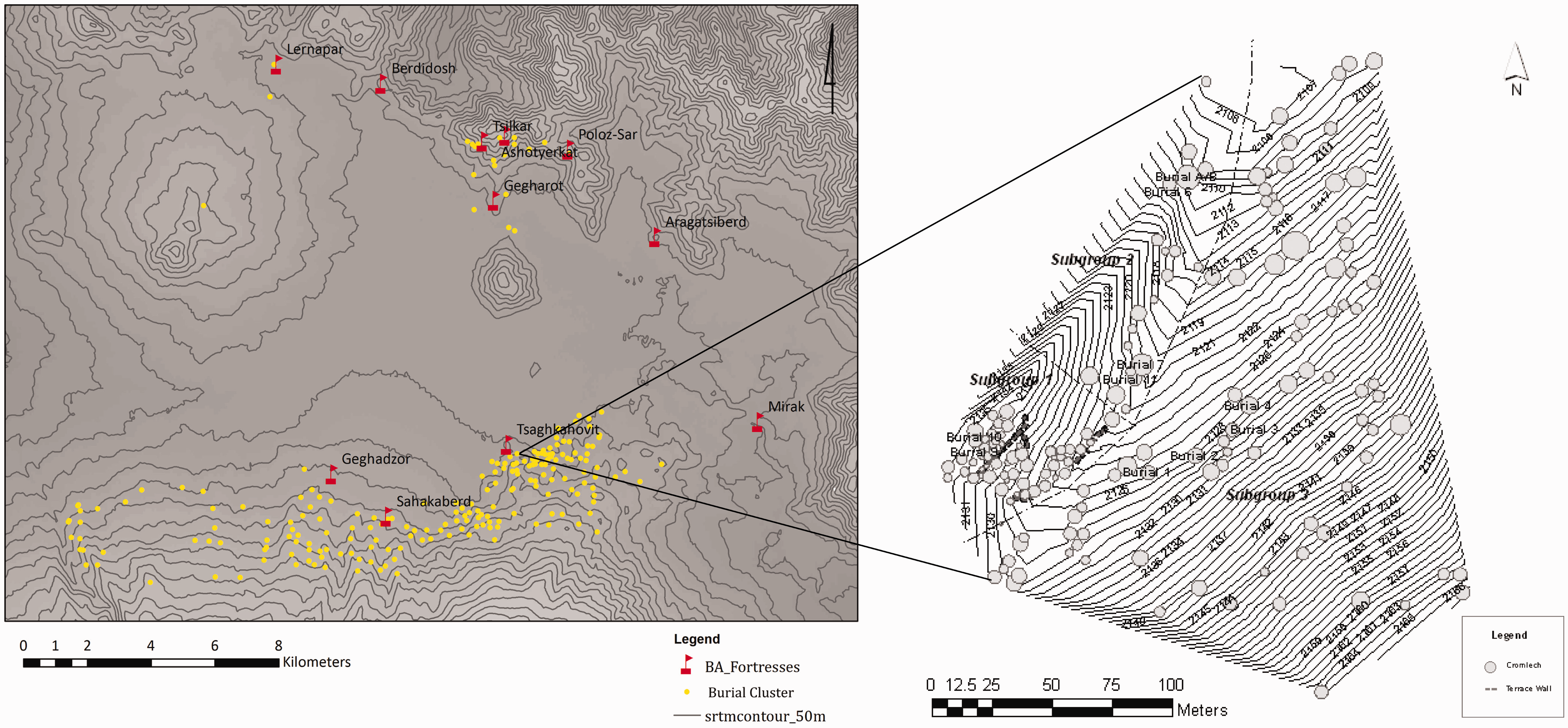
These post-mortem treatments have never been systematically and statistically analyzed in comparison with associated materials, space, and time; consequently, the socio-political factors underlying the interment variations, as well as the social identity that may correspond to any burial pattern, is not yet known. 13 In addition, there is little evidence of domestic architecture at Late Bronze Age sites, throwing into question the designation of LBA subjects as sedentary or mobile (Biscione et al., 2002; Lindsay et al., 2010; Lindsay and Greene, 2013; Smith et al., 2009).
While the materials and architectural evidence currently available in the archaeological record make it difficult to parse mobile and sedentary, changing the focus of analysis to the micro-scale – even to the individual – can provoke a rich discussion of the ways that movement and emplacement are entwined and the possible ways that institutions and subjects shape mobility. Here, we will examine the interment of ‘B10.6’, 14 a male individual interred during the Late Bronze Age II (LB II) in the 15th century BC in the Tsaghkahovit Plain, an intermontane plain in north-central Armenia measuring 133 km2 that is bordered on its northern side by the Pambak range and on its southern side by the large composite volcano of Mt Aragats (see Figure 1).
Specifically, B10.6 was interred in Tasghkahovit Burial Cluster 12 (TsBC12) on the slopes of Mt Aragats. TsBC12 is located 350 m southeast of a hilltop citadel and covers an area of approximately 5.5 hectares, with 160 cromlech tombs split between two facing slopes of a small valley. TsBC12 is one of 211 burial clusters with an estimated 5976 cromlech tombs extant on the slopes surrounding the Tsaghakhovit plain, the majority of which are located on the southern side, spread across the slopes of Mt Aragats (see Figure 1). Thus far, the excavated tombs (approximately 17) date to the Late Bronze I (LB I 1500–1400 BC) and Late Bronze II (LB II 1400–1300 BC) periods, dates which correspond to the citadel occupation levels at Tsaghkahovit, Gegharot, and Aragatsiberd. 15 The description of a single individual here is not intended to be representative of the entire LBA population; rather, within the tradition of case studies in forensic anthropology (Steadman, 2008) and recent osteobiographic approaches (Boutin, 2012; Stodder and Palkovich, 2012), a discussion of individuals’ lived experiences can act as a lens, focusing biological and social processes through a thick description that allows for an embodied understanding of individuals, their intentions, and their socially contextualized identities as fundamental to understanding the past (Marshall, 2014; Stodder and Palkovich, 2012; see also Meskell, 1998, 2000).
B10.6 appears to have spent his life living within the Tsaghkahovit Plain. Evidence for where he lived during the early years of his life comes from the strontium isotope ratio (87Sr/86Sr) in the enamel of B10.6’s second molar, which is consistent with someone who was consuming food from the northern part of the plain or the vicinity of the Aragatsiberd and Gegharot citadels. 16 While it is not yet clear how the northern and southern sides of the plain were related politically during the LBA, it seems that both goods and animals may have flowed from the southern side of the plain to the northern side (Badalyan et al., n.d.; Smith et al., 2009). 17 Based on analysis of his human remains, B10.6 lived a comparatively healthy life until his death at 22–30 years of age. At this time, it was likely that he was living – perhaps still living – on the northern side of the Tsaghkahovit Plain, as the 87Sr/86Sr and oxygen isotope (δ18O) signatures from his bone, proxies for approximately the last 10 years of life, again link him to this area. 18
Despite this continued association with the northern part of the plain, B10.6’s remains were interred on the southern side and in a position that suggests that he might have been bundled and transported after death. Leaned against the side of the burial chamber, B10.6’s body was arranged in a tightly flexed position, with his knees drawn up to his trunk and his chest resting against his thighs. His arms, slightly bent at the elbows, reached down to his feet almost as if they were hugging his legs to his chest. His chin or his cheek may have rested atop his tightly flexed knees if his cranium had been included in his interment. His mandible, however, was resting upside down at his feet. Both B10.6’s mandible and first vertebra were broken; however, the breaks were rough, and there was no evidence of cut or weapon marks. In addition to the absent cranium and upside down mandible, a few other bones were missing or out of articulation (see Marshall, 2014, for a complete description), although the rest of his body was fully articulated in anatomical order. This situation suggests that B10.6’s body was interred prior to advanced decomposition, but that either it was partially decayed or underwent a post-mortem treatment, which resulted in the loss of some elements. One possibility is that B10.6’s living mourners may have tightly ‘bundled’ his body in order to transport it.
The process of bundling would have taken place before much decay had occurred, while his body was still mostly articulated. After he was bundled, B10.6 could have then been transported in a few hours from the northern to the southern side of the plain, a distance of approximately 7–10 km. To transport B10.6’s body, his mourners would have had to move him: carrying him themselves, tying him to an animal, or placing him in a wagon or on a palanquin. While we cannot know whether the mourners moved the body as part of a designated event such as a funeral procession, they would have needed some planning and particular preparation to transport a bundled, deceased body across the plain.
As they approached the southern side of the plain, they would have been able to see the Tsaghkahovit citadel and, depending on their direction of approach, the small valley where the TsBC12 burials are situated. 19 Once his mourners had transported B10.6’s body to the southern side of the plain, they would have carried him up the lower slope of Aragats. As they walked into TsBC12, it is likely that their gazes would have taken in the cromlech tombs on the southern and northern slopes that were constructed in the LB I and in the early part of the LB II periods at TsBC12. Excavations have revealed that four cromlech tombs located on the southern slope had subterranean earthen pits containing either fully articulated primary inhumations or cenotaphs that were mainly linked to the LB I period. 20 In contrast, five cromlech tombs on the northern slope of TsBC12 consisted of subterranean stone-lined cist chambers that were all dated to the LB II period and contained remains that were fully articulated, partially articulated, and disarticulated. While the sample size of excavated tombs is currently small, they suggest a shift in practices of how to treat the body of the deceased between the LB I and LB II periods.
Thus, the practices and perceptions of moving B10.6’s body for interment are entwined with changing conceptions. Indeed, the practice of interring disarticulated remains appears to have emerged regionally during the LB II. In a recent publication of a corpus of 40 Bronze and Iron Age sites in the regions surrounding Mt. Aragats, Badalyan and Avetisyan (2007) recorded 19 LBA cemeteries. Of these, 10 had evidence of disarticulated human remains, all of which were interred in typical tomb constructions. 21 The majority of these disarticulated remains date to the LB II, with the exception of a few examples from Khojabagher, Talin, and Tsaghkalanj that are dated to the LB I. 22 Consequently, despite a few early examples during the LB I, the practice of disarticulating human remains appears to have developed in earnest and become widespread in the LB II period.
The domination of primary, fully articulated interments and cenotaphs in the LB I period suggests that bodies were not moved for burial. In contrast, the sudden appearance of disarticulated and partially articulated remains in addition to fully articulated individuals and cenotaphs in the LB II suggests a dramatic shift in the practices of treating dead bodies and moving the dead that would not only have entailed new sensuous perceptions, but also would have required a concomitant change in social conceptions of how to treat dead bodies.
At the same time, the LB II witnessed the development of elaborate ritual practices at Gegharot citadel. As mentioned above, excavations from the citadel at Gegharot have revealed materials associated with the activities of administration, divination, storage, jewelry production, and textile production. However, the evidence for these practices differs between the LB I and LB II periods. After the LB I occupation was brought to an end with a conflagration, a second construction phase marks the LB II, and it is in this period that three shrine complexes were constructed, each with a basin, clay platform, and ‘altar’. The shrines included materials suggesting practices of divination and devotion, such as astragali, statues, and stamps, as well as implements for production (quern, mortar and pestle, stone and bone tools, etc.). Smith (2015; Smith and Leon, 2014) has interpreted these practices as key to the emergence of LBA political authority. The advent of these ritual and political practices within the Gegharot citadel thus parallels the shifts in the post-mortem treatment (i.e. movement) of the deceased, signaling the rise of elaborate ritual practices in the LB II. While it is difficult to tease out directionality and influence between subjects and political authorities in the citadels, it seems likely that shared practices were entwined and facilitated, if not shaped by the practices, perceptions, and conceptions of movement. That is, at the same time that divination became fundamental to the art of governing (Smith and Leon, 2014), mourners seemed to make an effort to ensure that their dead were interred in certain locations. 23
Indeed, the area within the cemetery where B10.6’s mourners interred him was densely packed with small, overlapping cromlechs. This area was marked off from the rest of the cemetery by a series of small terracing walls, the construction of which suggests that this area was planned and intended to stand out from the other tombs spread over the slopes. It would have also created a visible association between the deceased who were buried here through both inclusion and exclusion. By interring B10.6 in this area, his mourners emplaced him within the physical and social associations of the area and of the cemetery. B10.6’s living mourners would have experienced this association, emplacing themselves as they created the conceptual terrain for parallel bonds between living mourners.
In the case of B10.6, it seems that the conditions of possibility, both practical and conceived, allowed his mourners to move his body across the plain in order to inter him in TsBC12. It is through such individual, micro-scale practices and shifts in conceptions of movement that mobility changes within historical and social contexts. Entangled with this movement of the dead were the sensuous perceptions that his mourners experienced even as their actions created and were created by changing conceptions of how to treat the deceased. Combined, these new perceptions, practices, and conceptions shaped mobility in the LB II period. Both the placement of B10.6, as well as his post-mortem movement in order to inter him in TsBC12, demonstrate how movement can create place and emplace subjects within socio-political group identities. This intimate look at one individual and his mourners provides a micro-scale analysis of the practices, perceptions, and conceptions of movement, which destabilizes the mobile/sedentary divide and highlights the ways that movement constructs place and community.
Thus, LBA cemeteries and fortresses are not merely representative of settlement; rather, practices such as moving the dead for burial emplaced subjects as they were ‘drawn to, and into, places’ (Cobb, 2005: 564). Moreover, the physical association of the deceased sedimented social relationships and created bonds of community among the living. In these ways, movement and place become entwined and, indeed, movement helps to create place and association.
Mi’kmaq, missionaries, and movement in colonial Nova Scotia
Our second case study examines the mediating role that mobility plays between political subjects and political institutions in a modern colonial setting. It focuses on the mobility inherent in Mi’kmaw 24 religious practices – and the responses of diocesan and colonial administrators to these practices – in 19th-century Nova Scotia. An analysis of the archival record demonstrates not only that the traditionally mobile Mi'kmaq engaged in Catholic rituals that required movement at various spatial and temporal scales, but also that the presumptively sedentary priests and agents of the British Crown were just as likely to move. 25 Such movements worked to transform both subjects and institutions in the waning decades of this British colony.
Although situated within the Catholic Church's history of structured movements of pilgrimages and missions, the mobile religious practices that Mi'kmaq undertook in the nineteenth century – such as making pilgrimages in honor of their patroness, St. Anne, performing the via crucis, and walking vast distances to call on priests for blessings and sacraments – were integral to the very particular traditions of Catholicism that had developed in Mi'kmaw communities since the conversion of Grand Chief Membertou and his family by French missionaries in 1610. These religious activities were part of a broader suite of mobile practices, including hunting, fishing, and gathering, which had persisted from the pre-contact period. The pre-contact and early contact “seasonal round”26 of the Mi'kmaq involved the movements of bands consisting of several extended families, each of which ranged in size from 10–12 people (see Denys 1672; Nietfeld 1981). The introduction of the fur trade and commercial fishing altered some of the social dimensions of Mi'kmaw movement in the eighteenth century.27 Yet the movement of entire communities continued after the establishment of a permanent European presence and the conversion of the Mi'kmaq to Catholicism. These movements were protected in the post-contact period by a series of treaties ratified in the second half of the eighteenth century between the Mi'kmaq and the British Crown. Yet even as more settlers came to Nova Scotia in the late eighteenth and nineteenth centuries, encroaching upon traditional hunting and fishing grounds, Mi'kmaq claimed their right to access land and water, in part, by engaging in mobile activities that emplaced them on the colonial landscape as they moved across it.
In this case study we draw on the archival record to describe Mi’kmaw religious movements as lived, perceived, and conceived and to examine how these movements worked emplace Mi’kmaq on the colonial landscape. 28 For example, in July of 1762, when the extended families that comprised the Le Have Mi’kmaq traveled to the town of Lunenburg and camped for over a month, they raised the suspicion of the British administrators in the capital of Halifax (see Figure 2). When asked by the Governor’s Council why his people had gathered in Lunenburg, the local chief, Paul Laurent, responded that they had been expecting to meet the Abbé Pierre Maillard, a missionary with the Séminaire des Missions Étrangères. Upon hearing that Maillard was ill in Halifax, they had waited in hope of his recovery (Burns, 1936–7: 22). Such a large gathering of Mi’kmaq was likely assembled to meet with the Abbé Maillard both to receive sacraments such as baptism and marriage and to hear mass spoken in the Mi’kmaw language. Indeed, according to the British records, Mi’kmaq were so devout in their Catholicism that, in the early 19th century, Nova Scotia’s Superintendent of Indian Affairs, George Henry Monk, considered the Mi’kmaq’s frequent journeys to priests to be their primary motivation for moving: ‘This Custom frequently calls them together from Considerable Distances, along the Coast, on the Rivers, and Lakes, and through the Forests … [and] is a principal Cause of their continuing their Wandering Life’ (NSA, 1808).
Monk’s comments are emblematic of the generally negative conception of Mi’kmaw movement and Catholicism that suffuses the British colonial discourse from Nova Scotia. Words like ‘wandering’, ‘vagabond’ and ‘errans’, which reappear in the letters and reports written by missionaries and colonial bureaucrats, imply that Mi’kmaw movements were aimless and without purpose. Underlying the discourse is an anxiety about Mi’kmaw movements. For example, some observers worried that Mi’kmaw excursions to places as far away as Québec signaled a mobilization for war between the newly independent United States and what remained of British North America (NSA, 1808). Settlers were concerned that the custom of extended Mi’kmaw families camping temporarily on lands where they could harvest wood for fires and craft production was depreciating property values (see NSA, 1860). Mi’kmaw movements frustrated the most basic tasks of colonial administration, including enumeration. In his 1808 report, Superintendent Monk complained of the Mi’kmaq that: ‘They are so continually moving from place to place, that it has not been practicable to ascertain their numbers’ (NSA, 1808). What seems to have most concerned the colonial administrators was the apparent unpredictability of certain Mi’kmaw movements. While some seasonal regularity might be observed in how Mi’kmaq timed their journeys for food and other resources, it was more difficult to predict when, for what purpose, in what numbers, and for what duration they would move in order to meet a priest.
The historical record from 19th-century Nova Scotia also illustrates how such movement for religious purposes was entangled with emplacement as both a passive and agentive process. Indeed, the Church and Crown worked to emplace the Mi’kmaq, not only by inducing them to settle in one place, but also by attempting to discipline the few movements that were tolerated. In selecting mission sites, the priests and missionaries identified places where Mi’kmaq had been gathering long before the arrival of Europeans (Balcom and Johnston, 2006; Chute, 1992). For example, in 1812 the Bishop of the Diocese of Québec recommended to the governor that he allow a newly established Trappist monastery in northern Nova Scotia to serve as a site of permanent Mi’kmaw settlement, where monks could instruct the Mi’kmaq in agriculture and literacy. In 1815, this same bishop wrote to a local priest in Ile St Jean (now Prince Edward Island), with directions for how to manage the Mi’kmaw populations that were across the Northumberland Strait in northeastern Nova Scotia: Since the Indians dispersed along the shores … have no fixed residence, they may go to your mission to receive instruction and approach the Sacraments … They are not to come seeking your services in every place where you happen to be, but only at Lennox Island. (quoted in Johnston, 1960: 253)
Few efforts to emplace the Mi’kmaq were successful. Mi’kmaq continued to move for religious and other purposes, seemingly at their will, throughout the 19th century. Rather than sites of permanent settlement, islands like Maligomish (Indian Island) and Potlotek (Chapel Island) became sites of pilgrimage and devotion. Indeed, movement was an essential element in the syncretic rituals that Mi’kmaq had developed since the late 18th century in the absence of Catholic priests. Many of these rituals were based on the prayer book developed by the Abbé Maillard.
According to the author of an 1867 report entitled ‘The Catholic Church in the Wilderness’, individual Mi’kmaq engaged in relatively small-scale, local rituals such as the via crucis. At larger spatial and social scales, entire communities of multiple, extended families (e.g. Chief Laurent’s Le Have Mi’kmaq) moved tens or hundreds of kilometers for the annual pilgrimage to places like Maligomish and Potlotek to honor St Anne (see Figure 2). Individuals and extended families traveled to priests for irregular occurrences such as receiving blessings to protect a loved one during an illness or at the time of death. The author writes: ‘An Indian family was living alone in the winter in the woods; the mother became sick; the boy walked over sixty miles in deep snow to get a priest for her’ (Anonymous, 1867: 244). Some of these practices of movement were gender specific. For example, Mi’kmaw women honored the long discontinued dictum of ‘churching’, during which postpartum mothers presented themselves at a chapel or church for blessing by a priest (Anonymous, 1867: 244). The author also provides some insight into the sensual perceptions Mi’kmaq would experience along these journeys, describing how Mi’kmaq would sing in the woods, ‘beautiful hymns and canticles in honour of the Blessed Virgin Mary, St. Anne, St. Joseph, or hymns for Christmas and Easter’ (Anonymous, 1867: 252).
Map of the Maritime Provinces of Canada indicating places of Mi'kmaw religious practices. Base map: Crown Copyright, Province of Nova Scotia, 2012 (CMC-661). Figure by M.A. Lelièvre.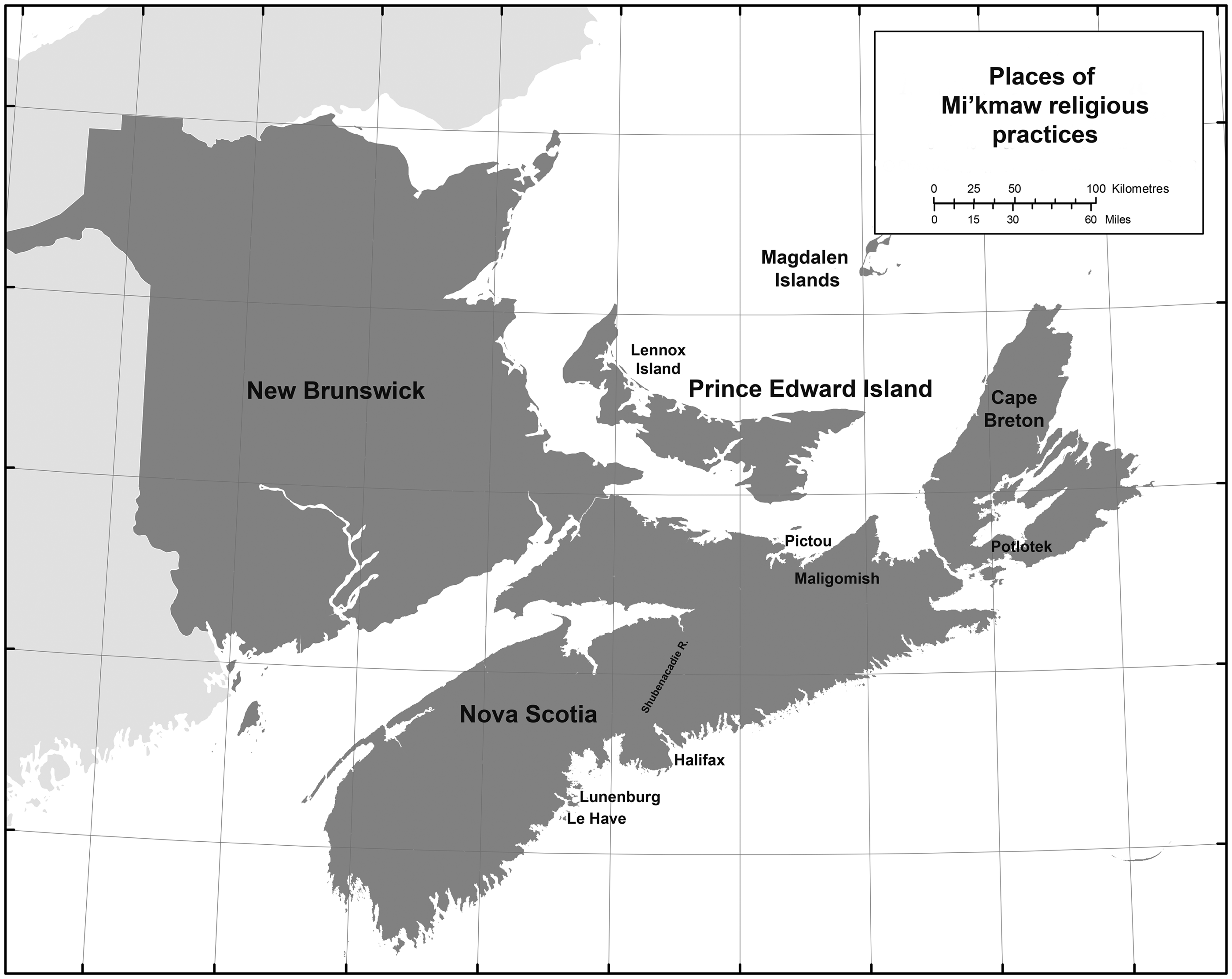
As portrayed in the archival data, Mi’kmaq are certainly the mobile ‘Other’ – disparaged by colonial bureaucrats, concerned settlers and priests alike for their ‘wandering’, which, they reasoned, implies a lack of industry and leads to licentiousness. But these documents also reveal that priests and agents of the Crown were just as likely to move. The Catholic mission to the Mi’kmaq was successful, in part, because it adapted to the Mi’kmaq’s mobile lifestyle. Even if missionaries lived in a town or village, the scarcity of priests in the 18th and 19th centuries meant they traveled to Mi’kmaq and other Catholics to perform sacraments and say mass, as described in exhausting detail in an 1813 letter from a priest in what is now Prince Edward Island. In recounting his prodigious peripateticism around the island, the priest reports that he ‘seldom spent two nights in the same bed’ in the five months between February and June of 1813 (Casgrain, 1895: 223). Some missionaries, like the Abbé Maillard, occasionally traveled with Mi’kmaq. Long after priests took up permanent residence in the mid to late 19th century in parishes with predominantly European congregations, many continued to travel to Mi’kmaw communities to say mass, hear confessions and lead spiritual missions.
The agents working for the Crown also traveled to Mi’kmaw communities to monitor their progress toward ‘civilization’. In a letter written in June of 1842, James Dawson described traveling approximately 30 km from the town of Pictou to the island of Maligomish to meet with the Mi'kmaw inhabitants, only to discover upon his arrival that all of the adult males were absent, having left to pursue the cod and herring fisheries elsewhere. Dawson had to settle for talking with an elderly man and the women who were left on the island (LAC, 1842).
While the Church and Crown’s conceptions of mobility were generally negative, their agents’ interactions with Mi’kmaq served to increase these agents’ own mobility. Thus, examining the practices, perceptions, and conceptions of both Mi’kmaw and settler movements demonstrates not only how mobility mediates socio-political relationships, but also how this mediating role works to transform political subjects and political institutions in a colonial setting. Indeed, the Mi’kmaq’s persistent and innovative mobile practices required the Catholic Church and British Crown to adjust their own methods of administration. For example, following the death of the Abbé Maillard in 1762, the Mi’kmaq were left without a priest for several years because the Lords of Trade in London had hoped that Protestant missionaries would convert all the Catholics in the province. Despite the Crown’s policy against expanding the ‘Papist’ presence, it finally yielded to the local administrators’ repeated requests, but only after they had warned the Lords of Trade in 1766 that the Mi’kmaq had threatened to destroy English settlements unless they were sent a new priest (see Lenhart, 1995 [1921]: vi). The Church’s position toward Mi’kmaw movement evolved as well, as illustrated in the example of the Bishop of Québec who, unlike his 18th-century predecessors, did not want to settle the Mi’kmaq near mission sites. Instead, he sought to control the Mi'kmaq's movements.
Thus, we see a tension between the negative conceptions that the Crown and Church representatives had of Mi’kmaw movements and these agents’ actual practices. For the colonial administrators who were determined to establish Nova Scotia as a viable colony in the British Empire, the bands of ‘aimless wanderers’ were anathema to the existence of the colonial state. Yet, despite the negative conception of Mi’kmaw movements, mobility was key to the colonial administrators’ management of the Mi’kmaq.
By observing movement and emplacement in 19th-century Nova Scotia, we begin to understand the local processes through which colonial subjects are constituted as political subjects. The multiple, overlapping, competitive, and sometimes contradictory political institutions that have been at work – in varying forms – in Mi’kmaw communities since the 19th century provide the conditions of possibility for the Mi’kmaq’s assertion of their own political subjectivity. Alongside practices such as hunting, fishing, and making crafts for sale to non-Mi'kmaw tourists, their mobile acts of devotion worked to embed the Mi’kmaq in the colonial landscape in ways very different than the sedentism intended by the Church and Crown. By continuing to move across their traditional lands and waters, which had been encroached upon by settlers, the Mi’kmaq were emplacing themselves both spatially and politically.
Not only did movements to support subsistence, faith, and kin relations honor the promises of the 18th-century treaties, they also worked to shape how Catholic priests, missionaries, and colonial administrators managed and interacted with the Mi'kmaq. The representatives of the British Crown in Nova Scotia abandoned the hope of a mass conversion to Protestantism in favor of keeping the peace, going so far as to recruit Catholic priests to become liaisons between their administrators and Mi’kmaw communities. For their part, Catholic priests reacted to the movement inherent in the Mi’kmaw Catholicism of the 19th century by moving in new ways that shaped their own experience as colonial subjects. Once allies of the Mi’kmaq against British encroachment, the Catholic Church became increasingly entangled in the management of the Mi'kmaq's welfare through the late 19th and early 20th centuries. Thus, by framing mobility as a mediator between the political subjects and political institutions of colonial Nova Scotia, we begin to see how each – the Mi’kmaq, the Church, and the Crown – was transformed through these interactions. We see that the political relationships of this time and place are characterized more by a dialogue between subjects rather than a simple imposition and erasure of one tradition by another.
Conclusion
While markedly different in time, place, and scale, the two case studies presented above complement each other by elucidating not only how mobility can be conceptualized as the practices, perceptions, and conceptions of movement entwined with both passive and agentive processes of emplacement, but also how doing so mediates the creation and transformation of relationships between political institutions and political subjects. In both ancient and historical periods, we have subjects who are neither simply mobile nor sedentary, but are dynamic, often moving in ways distinct from their contemporaries even as they modify and create new practices of movement. Both cases also illustrate how movement can be used to emplace subjects. Indeed, we maintain the construction of vast cemeteries in the Tsaghkahovit Plain, and the Mi'kmaq's reiteration of their right to access land and water by continuing to move across it, as socio-political claims – claims that affected the relationships between these mobile subjects and their respective political institutions.
Bioarchaeological analyses of B10.6’s remains – including the location and manner of his bones’ final resting positions and isotopic signatures – allow us to infer some of the possible practices of movement in this ancient society. In life, B10.6 seems to have lived locally on the northern side of the Tsaghkahovit Plain. In death, B10.6’s secondary interment suggests that his bones were likely bundled before being moved by a group of mourners from his place of death to his final resting place in the burial cluster on the southern side of the plain. These inferred practices, combined with the survey data indicating the spatial locations of burials on the Tsaghkahovit Plain, also illustrate the perceptions of movement as both an immediate response of the body’s senses – for example, the sights, feel, smells, and sounds that mourners experienced while preparing and carrying a decaying body – and also a relational accumulation of previous sensual experiences. As the mourners carried B10.6’s bundled remains the 7–10 km to his final resting place, they may have perceived the landscape of memorialization comprised of the thousands of burials that peppered the mountain slopes before them. By moving B10.6 in order to be buried in a cromlech at TsBC12, his mourners were embedding him within this community of the dead. The deliberate and purposeful way that B10.6’s mourners prepared and moved his body suggests that there was motivation to modify the post-mortem treatment of the dead in order to insure that their remains rested in certain locations. 29
There are insufficient data as yet to make definitive statements regarding the motivation of the Late Bronze Age subjects who moved B10.6. However, the data generated by the archaeological analyses of his remains provide a much-needed and productive micro-scale intervention into the study of emerging complex polities in the Near East. Rather than the ‘faceless blobs’ (Tringham, 1991) that ancient subjects are often reduced to, attention to the details of B10.6’s life and death that were embodied in his remains opens the door to an alternative understanding of political relationships in the Late Bronze Age. Focusing on the work of B10.6’s mourners to emplace him by moving him brings us closer to an engaged view of political relationships that understands practices of movement such as secondary burials to be mediating the interactions between subjects and institutions. While we do not yet have evidence to comment on the nature of that mediation, the work presented here opens new paths for thinking about the constitution of subjectivity in the Late Bronze Age Near East.
This perspective also suggests opportunities for using the conceptual framework to reimagine how mobility mediates political relationships between the institutions of colonial regimes and indigenous populations (cf. White, 1991). These religious practices – although introduced by Catholic missionaries – were adapted and developed by Mi’kmaq themselves. Individual and community movements of tens and hundreds of kilometres to receive a priest’s blessing or to confess in the Mi’kmaw language illustrate also the perceptions of movement. By the 19th century, the Mi’kmaq had over two centuries of experience practicing their Catholic faith. When they traversed by foot and canoe ‘along the Coast, on the Rivers, and Lakes, and through the Forests’ (NSA, 1808) the Mi’kmaq may have perceived their movements as the immediate responses of their body’s senses and as the accumulation of pre-contact and post-contact practices, perceptions, and conceptions. The routes Mi’kmaq followed to practice their faith were likely the same as those they had been traveling to acquire food, confer with other communities, and meet with representatives of the Crown. Thus, the religious practices of movement were sufficiently entrenched in the Mi'kmaq's mobility to have moved beyond being simply an imposition of an outside order onto a local community; it had been adapted to become a Mi’kmaw practice. Furthermore, with each journey to see a priest or venerate St Anne, which took the Mi’kmaq through lands and waters that had long been alienated by Europeans, they were emplacing themselves on the colonial landscape. Elsewhere Lelièvre (2012) has argued that the Mi'kmaq's movements across their ancestral lands and waters were political acts of sovereignty.
The Nova Scotia case study also demonstrates the need to situate the perniciousness of conceptions of movement within analyses of differential power. For the representatives of the Crown and the Catholic missionaries, their own movements across the Atlantic were highly valued because they served to propagate the empire and the faith, respectively. In contrast, these same people denigrated Mi’kmaw movements as being aimless, improvident, and unpredictable. Yet the Church and Crown also valued Mi’kmaw movements when it appeared they could be disciplined to assist the management of this indigenous population.
While the case studies presented here are both set in the past, the conceptual frame they illustrate is productive for anthropologists working in both ancient and modern contexts because it provides a common lexicon for discussing an anthropological theory of mobility. The practices, conceptions, and perceptions of movement commingled with emplacement is a productive lens through which anthropologists could study contemporary mobile subjects – whether migrant workers whose bodies are primarily and secondarily interred in failed attempts to cross borders (DeLeón, 2012; Magaña, 2011; Yi, 2015) or Cree youth walking thousands of kilometers from their home reservations to the Canadian capital of Ottawa to voice their protests against the unequal treatment of Canada’s indigenous peoples (Masty, 2013; Mollen-Dupuis, 2014).
Whether they study ancient or modern subjects, all anthropologists interested in mobility face the challenge of recognizing and accounting for multiple temporal and spatial scales. We suggest that problems of scale can be overcome by examining practices, perceptions, and conceptions of movement and how they change, become entangled, and may contradict each other. The innovation of our first case study is to introduce a micro-scale of movement to a period and region dominated by macro-scale processes. The movement of B10.6 to the south of the Tsaghkahovit Plain occurred while animals, ceramics, and possibly other goods were circulating to the north, suggesting a complex interaction and integration of these two sides of the plain that begs for further study.
Indeed, our call for a revitalized anthropology of mobility is also a call for more focused research that takes the ‘out there’ movement of subjects as the primary object of observation. For, although some advances have made toward this goal, mobility persists as a marked or ‘Othered’ category. In order to shake mobility out of its Othered status, we have provided insight into how practices of movement may be entwined with place and may emplace subjects politically. For example, much anthropological study of Mi’kmaq and other societies who have traditionally subsisted on hunting and gathering has marked them as a people less socially and politically complex than agriculturally-based, sedentary societies. Yet the archival evidence from colonial Nova Scotia suggests that, far from an experience that marked only the Mi’kmaq, movement was key to the practices of the Mi’kmaq, the Church, and the Crown. For the latter two institutions, movement was necessary to monitor and manage the Mi’kmaq and other peoples within the colony of Nova Scotia.
In conclusion, we reiterate that the proliferation of ethnographic and archaeological observations of historically and socially situated movements in the past and the present has opened a space for anthropologists to think critically about how we conceptualize mobility as an object of anthropological study. The above examples from the Late Bronze Age South Caucasus and colonial Nova Scotia reiterate the conundrum at the heart of anthropology’s engagement with mobility and the political – that mobility is at once a tool used by political institutions to control subject populations, while at the same time a method of resistance used by subjects conscious of their ability to act on the world. Considering the various ways anthropologists and other social scientists have evoked mobility in their analyses, the concept of mobility appears to be a tool for everyone, and hence for no one. Yet by understanding mobility as a mediator between political subjects and political institutions, it becomes possible to examine how subjects and institutions are continuously remade in relation to each other through their practices, perceptions, and conceptions of movement. Viewing mobility in these ways challenges us to take seriously the myriad movements that we observe ‘out there’ and how they shape, and are shaped by, the political sphere.
Footnotes
Acknowledgements
This article emerged from a conference paper given at the 2010 meeting of the American Anthropological Association and benefited from the thoughtful comments of the discussants – Ulla Berg, Claudia Chang, and Adam T. Smith – as well as from discussion with the co-participants. We would like to thank colleagues who read and commented on later versions of the paper, including Elizabeth Fagan, Rebecca Graff, and Melissa Rosenzweig. The research presented in the case studies was supported by the Wenner-Gren Foundation, the Fulbright-Hays Doctoral Dissertation Research Abroad Program, the Social Sciences and Humanities Research Council, the Whatcom Museum, the Nova Scotia Museum, the Heritage Division of the Nova Scotia Department of Communities, Culture and Heritage, the University of Chicago Division of Social Sciences, and the University of Chicago Department of Anthropology. We are indebted to all of the people and organizations who have facilitated our projects, including the members of Project ArAGATS, particularly Adam T. Smith and Ruben S. Badalyan; the Institute of Archaeology and Ethnography in the Republic of Armenia; Kelly Knudson; staff at the Confederacy of Mainland Mi’kmaq, the Nova Scotia Museum, Library and Archives Canada, the Canadian Museum of History, the Nova Scotia Archives; the Diocese of Antigonish Archives; and the chief, council and members of the Pictou Landing First Nation. Finally, we wish to acknowledge the anonymous reviewers and the editors and editorial staff at Anthropological Theory for all of their helpful work. In particular we would like to thank Nina Glick Schiller for her careful reading and suggestions for the article.