







Abstract
Family child care professionals are a critical sector of the early care and education workforce. Utilizing critical race theory and Yosso’s Community Cultural Wealth model, the current study seeks to examine the strengths and assets that family child care professionals of color bring to their early care and education work and to the children and families in their programs. The authors identified evidence of four types of cultural capital (aspirational, familial, navigational, and resistant) in the focus group narratives of family child care professionals of color across four regions in the USA. Their narratives describe an orientation to caring for children and families that counters exclusionary and biased systems. The family child care professionals of color envision themselves as educators and supporters of community advancement in opposition to racialized stereotypes of home-based child care work as babysitting (aspirational capital); they leverage the home as a place for racial healing and sustain intergenerational connections with families through practices of othermothering and an ethic of love (familial capital). The family child care professionals of color describe the ways they enact navigational and resistant capital in their perseverance and participation in licensing and quality systems, despite inequities. The family child care professionals’ counternarratives of family child care work suggest their essential role in societal functioning and well-being. The study’s findings hold implications for (re)defining early care and education quality and (re)designing systems that celebrate and recognize the strengths, resilience, and capacity of family child care professionals of color to support equitable futures for children, families, and communities.
Introduction
Family child care (FCC), defined as non-parental child care for children from birth through age 12 in a home-based setting, comprises a significant sector of the early care and education (ECE) workforce in the USA (Datta et al., 2021) and abroad (Davis et al., 2012; Organisation for Economic Co-operation and Development, 2022). Yet, despite the many young children across the globe who are cared for in home-based child care settings, far less research attention has been focused on FCC compared to center-based and school-based programs. A recent examination of the ECE workforce across international contexts suggests that home-based child care providers bring strengths and assets to their work with children and families that are often not recognized or validated in policies and professional development systems (Organisation for Economic Co-operation and Development, 2022). Multiple layers of historical and contemporary inequities contribute to the lack of recognition of FCC in the USA, where many family child care professionals (FCCPs) are women of color caring for children from low-income families of color, reflecting the high levels of racial and socio-economic segregation in the ECE field (Whitebook et al., 2019).
Compounding racial inequities, FCCPs operate their child care programs in the USA in the context of an often uncoordinated and confusing array of publicly funded ECE systems. Some have described the US ECE policy context as an overall “non system” (Greenberg and Luetmer, 2022) that is driving educators, including FCCPs, out of the field. These systems include state licensing, state child care subsidy programs funded through the Child Care and Development Fund, the federal Child and Adult Care Food Program, and state or county quality rating and improvement systems, each of which have their own requirements, standards, and monitoring protocols. Understanding the complexity of how ECE systems are embedded in historical and contemporary systems of gendered racism (Essed, 1991) and classism (Turner and Turner, 2023) in the US context is important for examining the strengths, assets, and resilience of FCCPs of color that may be informative for examining inequitable ECE systems in other international contexts.
Current study and research questions
The current study seeks to highlight the narratives of FCCPs of color related to how they engage in caregiving work, run their FCC businesses, and navigate ECE systems. We frame the care work of FCCPs of color in opposition to mainstream ECE narratives, which have historically diminished the communal and cultural contributions of diverse educators. We use the Community Cultural Wealth model developed by Yosso (2005) to examine the intersection of FCC work with race, gender, and class among FCCPs of color working in diverse contexts across the USA. Yosso (2005) uses critical race theory to challenge how western patriarchal capitalism preferences white middle-class values and norms while disregarding the knowledge of communities of color. The Community Cultural Wealth model offers language to critically illuminate the forms of cultural capital that acknowledge the intrinsic array of cultural knowledge, skills, and abilities that FCCPs of color bring to their work with children and families (Yosso, 2005; Yosso and Garcia, 2007). Rooted in this understanding, the current study seeks to (1) examine the components of cultural capital that FCCPs of color describe bringing to their work with children and families, and (2) illuminate the ways FCCPs of color describe using their cultural capital to counter inequitable ECE systems and policies.
Background
Prevalence and characteristics of licensed FCCPs of color in the USA
Licensed FCCPs of color represent a critical component of the ECE workforce in the USA (National Survey, 2016). Data from the 2012 National Survey of Early Care and Education indicate that 40% of the ECE workforce across sectors (homes and centers) and 30% of the FCC workforce identify as women of color (Austin et al., 2019; Hill et al., 2021). Compared to center- or school-based ECE programs, FCCPs disproportionately care for children from low-income families and those who work nonstandard-hour jobs (Barnett and Li, 2021; Datta et al., 2021; National Survey, 2015). In addition, Black, Latine, immigrant, and Indigenous families often rely on FCCs for access, affordability, and cultural congruence (Bromer et al., 2021a; Henly and Adams, 2018).
Given the roots of American child care in racism and slavery (Lloyd et al., 2021), it is not surprising that child care professionals are undervalued and consistently compensated less than K–12 teachers. Across racial and ethnic groups, FCCPs experience even lower wages and receipt of benefits than their center-based counterparts. These circumstances are worse for Black FCCPs. National data suggests that 75% of Black FCCPs live in households with incomes below the national median (Austin et al., 2019).
Pre-pandemic data indicate that the number of licensed FCCPs operating in the USA has decreased sharply over the last two decades (Datta et al., 2021; National Center, 2020). Moreover, a recent analysis of the 2019 National Survey of Early Care and Education finds that between 2012 and 2019, early childhood educators of color were more likely to exit the field compared to white educators (Schochet and Caronongan, 2022). We lack national data on how the COVID-19 pandemic continues to shape overall FCC prevalence. Some research suggests that more FCC programs remained open during the pandemic compared to center- and school-based ECE programs (National Association for the Education of Young Children, 2020). FCCPs’ reports suggest resilience during the pandemic's early days as they extended care to families, took in new children, and risked their own health to keep their doors open (Nagasawa and Tarrant, 2020; Porter et al., 2020; Turner, 2022). Yet the disproportionate impact of the pandemic on the health of communities of color highlights the overlapping oppressions that Black families continue to face in the USA (Bogan et al., 2022) and the precarity faced by those who operate FCC programs. Recent national data find that one-third of FCCPs experienced multiple hardships, including hunger, in 2021 (RAPID-EC, 2022).
Intersectional and historical challenges faced by FCCPs of color
A growing body of literature has explored the challenges and constraints that the array of ECE systems and policies in the USA creates for FCCPs (Adams and Dwyer, 2021; Adams and Hernandez-Lepe, 2021; Bromer et al., 2021a; Hallam et al., 2017), and that may partially explain the decrease in FCC programs across the USA (Bromer et al., 2021c; Greenberg and Luetmer, 2022). The variability of regulations across states and inconsistencies in how local, state, and federal program requirements are monitored and enforced in FCC homes create administrative burdens and additional inequities for FCCPs, who often work alone without an administrative infrastructure and rely on these systems for compensation (Adams and Pratt, 2021; National Survey, 2016). For FCCPs of color, these bureaucratic systems are racialized (Ray et al., 2023) and further contribute to inequalities. Bromer et al.'s (2021c) exploratory study on the factors behind the FCC decline in the USA, from which the data in the current analyses are drawn, found that FCCPs of color experienced threats to the sustainability of their programs from disrespectful licensing inspectors, who searched for violations and assumed low quality in child care homes (Bromer et al., 2021c). In a study of child care workers’ experiences with their state's child care subsidy system, Barnes and Henly (2018) similarly found that Black and Latine child care providers were more likely to report negative and punitive interactions with subsidy staff.
The regulatory and quality standards and requirements in ECE that were designed for center- and school-based programs for preschool-aged children without consideration of FCC settings pose additional challenges to FCC sustainability. Prior research suggests that ECE system standards privilege practices and policies that demand a one-size-fits-all model, which rarely recognizes the strengths and values of communities of color (Turner and Turner, 2023; Dahlberg et al., 2007; Souto-Manning and Rabadi-Raol, 2018). Compounding these challenges are quality improvement systems that do not have materials available in languages other than English (Adams et al., 2008; Bromer et al., 2021a; Washington and Reed, 2008). Lo et al. (2017) found that language was a primary obstacle in obtaining the required credentials for FCCPs whose first language was Mandarin or Cantonese. Resultantly, FCC participation rates in quality rating and improvement systems (QRIS) are about half those of centers, and most FCCPs remain at the lower levels of the ratings (BUILD Initiative and Child Trends, 2019; National Center on Early Childhood Quality Assurance, 2020).
These systemic challenges are situated in the US context of the societal devaluing of care work and women of color, which is rooted in a legacy of white supremacy and enslavement (Lloyd et al., 2021; Vogtman, 2017). Some education historians suggest that enslaved African women, servants, and nanny figures represent the earliest forms of FCC (Auerbach and Woodill, 1992). While these arrangements likely took place in the child's home, they were not implemented through a negotiated relationship, and the women were not compensated. Ideologies that separate the family from the workforce are based in the era of industrialization, which focused on white middle-class families. The “workplace” was a place of paid labor, rationality, competition, and masculine, paternal, white behaviors. Contrastingly, the home or family was a place of nurturing and caregiving—“feminine” and maternal attributes (Tuominen, 2003). For FCCPs, the home-based setting and blurring of work and home debunks this idea that child care and workforce production are incompatible, and stereotypes of care work as unskilled and invisible. Yet, despite centuries of activism and education reform, these race-based and gendered ideologies still influence social perceptions of care work today, affecting the daily lives and livelihoods of FCCPs of color and the families they serve.
Strengths and assets of FCCPs of color
A small body of qualitative research has highlighted the cultural knowledge of Black and Latine FCCPs and how racial, ethnic, gender, and linguistic identities influence how they engage in their work. Prior qualitative research used Black feminist thought as a framework for understanding care work and “othermothering” among Black FCCPs as forms of activism and resistance to racist, sexist, and classist oppression (Bromer, 2006; Tuominen, 2003; Turner, 2020, 2022). The term “othermothering” has been used by Black scholars to express the sense of kinship and responsibility that manifests within the Black community through the aunties, grandmothers, family friends, and educators who share in the social and cultural responsibility of raising children. In a semi-ethnographic study of how Black FCCPs support families and communities, FCCPs described their work as a form of activism to make their communities better places for families and children to live, using their positionality as home-based caregivers to “keep watch” over their local neighborhoods (Bromer, 2006). They also drew on the historical necessity and strength of “othermothering” in Black communities to extend care to children and families beyond those formally enrolled in their programs (Bromer and Henly, 2009). Similarly, Tuominen (2003: 157) found that Black FCCPs described their FCC work as a “cultural and political” act to counter gender and racial oppression. More recently, Turner (2020, 2022) used Yosso's (2005) Community Cultural Wealth model to describe how Black FCCPs in Milwaukee used cultural capital to resist inequitable systems and institutional norms, navigate programmatic challenges, sustain themselves and their businesses, and educate young children during the uncertainty of the COVID-19 pandemic.
Fewer studies have examined the cultural assets that Latine FCCPs draw on in their work and the central value of family, home, and extended kinship that may operate for Latine FCCPs. In a study focused on Latine FCCPs, Paredes et al. (2019) identified two themes around the cultural strengths in FCC: familismo (closeness among children and families) and compadrazgo (reciprocal relationships between providers and families). In her ethnographic study of Mexican families in border communities in the USA, Valdes (1996: 187) explains the importance of familism for families in supporting their own children's education as a “vehicle for economic mobility.” She explores how reliance on the extended family serves as a buffer for Mexican immigrant families against the pressures of discriminatory educational systems. Recent research highlights how the strengths of Latine families benefit young children's developmental outcomes (including bilingualism and biculturalism), the optimistic and future-oriented emphasis on childrearing, and the strength and nurturing of the extended family (Cabrera et al., 2022).
Research design
In the current research, we rely on critical race theory (Delgado and Stefancic, 2012; Ladson-Billings and Tate, 1995) to shift the focus away from dominant narratives of ECE practice, pedagogy, and policy, and examine how racism and white supremacy cyclically foster inequities for FCCPs of color and the families they serve. Specifically, we draw on Black feminist thought (Collins, 2000), Latina feminist theory (Alcoff, 2019), and Asian critical race theory (Sun, 2014). These critical social, epistemological, and pedagogical perspectives acknowledge the complex intersections of culture, race, socio-economic status, nationality, and gender in women of color's experiences. Further, each of these frameworks acknowledges the confluence of the lived experiences of gendered and racialized individuals and groups within western society, and recognizes that while women of color are marginalized within American social history, their labor and care work are simultaneously exploited to maintain white supremacy and the social economy (Berry and Gross, 2020). Critical race theory's centering of the historical, social, and political contexts in which education practice, policy, and socio-economic power exist, and its emphasis on counternarratives aligns with our commitment to highlighting how FCCPs of color support and advance their communities through their care work. Their counternarratives challenge the dominant knowledge of mainstream societal views by providing new windows into the reality of those relegated to the margins of society (Solórzano and Yosso, 2002).
Guided by this critical perspective, we utilize Yosso's (2005) Community Cultural Wealth model to center the counternarratives of FCCPs of color. Yosso (2005: 77) presents six types of cultural capital, which collectively describe “an array of knowledge, skills, abilities and contacts possessed and utilized by Communities of Color to survive and resist macro and micro-forms of oppression.” In our adaptation of the Community Cultural Wealth model, we (re)imagine how FCCPs enact cultural capital in their support of child, family, and community well-being.
Our findings are based on a subsample from the Multi-State Study of Family Child Care Decline and Supply (Bromer et al., 2021b; Melvin, 2022; Porter et al., 2020). This study sought to explore FCCPs’ perspectives on the factors behind FCC decline across four states through interviews with former FCCPs who had closed their businesses and focus groups with currently regulated (licensed, certified, or registered) FCCPs.
Data collection procedures
In each state, the Multi-State Study of Family Child Care Decline and Supply identified trusted community partners (e.g. child care resource and referral agencies or family child care associations) where prior researcher–practitioner relationships existed. The partner organizations helped recruit affiliated FCCPs for the study through emails, calls, and a recruitment video. All but two of the focus groups were conducted virtually by Zoom from February through July 2020, averaged six participants per group, and lasted 90 minutes. A team of researchers from Erikson Institute and from one of the trusted community partner organizations led the focus groups. The team included researchers who were bilingual Spanish speakers and both Latina and white women with extensive data collection experience. The training for the research staff on focus group facilitation included strategies for ensuring that all perspectives were heard. All of the groups were recorded with the participants’ verbal consent and then transcribed. The Spanish focus groups were translated into English and checked for accuracy. Approval was received from the institutional review board of Erikson Institute.
Measures
The current analysis is based on focus group and demographic data. A demographic survey included questions about race, ethnicity, age, education, experience, and program characteristics. The Multi-State Study’s focus group protocol sought to examine (1) perceptions of quality; (2) motivations for doing FCC and for participating in publicly funded systems; (3) reflections on the factors behind the FCC decrease in the USA; (4) the rewards and challenges of FCC work, including experiences during the pandemic; and (5) suggestions for policy and practice. Data from individual focus group participants were utilized in this analysis.
Participants
The Multi-State Study included 149 FCCPs across 25 focus groups and intentionally oversampled Latine Spanish speakers and women of color because FCCPs from these groups are under-represented in research, policy, and practice considerations (Bromer et al., 2021c; Meek et al., 2020). This decision partially drove the data collection in four geographic locations with large populations of Latine and Black families: Los Angeles County, California; central Florida; Springfield, Massachusetts; and Milwaukee, Wisconsin.
The current analysis examines focus group and demographic survey data from a subsample of 19 focus groups with 92 participants who identified as FCCPs of color. We define FCCPs of color as those who self-identified in the demographic survey as any of the following: Black, African American, Latine, Hispanic, Asian American, Pacific Islander, or Indigenous. We have included participants from 12 focus groups that comprised only FCCPs of color. We have also included participants from seven focus groups that comprised FCCPs who identified as white, as well as those who did not identify as white. In these seven transcripts, we have only analyzed the data from the FCCPs of color. In addition, we excluded six focus groups from our analysis, which only included providers who identified as white or did not identify their race or ethnicity. Overall, we have excluded the focus group data from a total of 54 individual FCCPs who identified as white, and three who did not identify their race or ethnicity.
In recognition of the power of language and naming (Hooks, 1995, 2008), we intentionally use the nomenclature “women of color” and “FCCPs of color” to refer to educators who identify as Black, Latine, Asian, Pacific Islander, Indigenous, individuals of mixed heritage, and other racial-ethnic identities. We chose these terms over others such as “non-white” or “minorities,” which denote a deficit perspective and perpetuate notions of white as the standard for the dominant culture.
As Table 1 shows, half of the FCCPs in the subsample identified as Latine, 38% identified as Black or African American, and fewer identified as Black/Latine or Asian or Pacific Islander. More detailed racial and/or ethnic identity data (e.g. country/countries of origin) was not collected.
Demographic and program characteristics of the FCCPs.
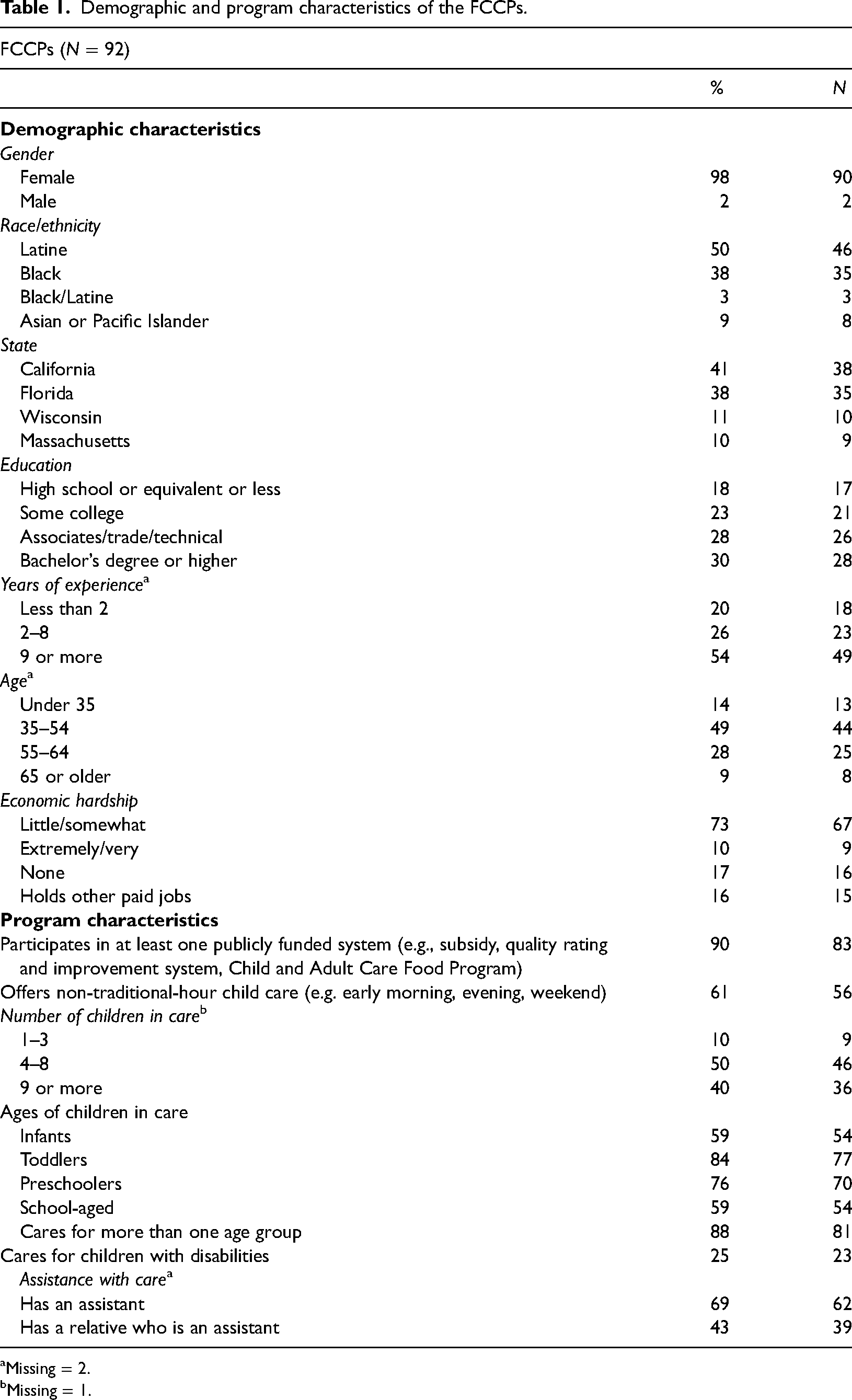
Missing = 2. bMissing = 1.
Data analysis
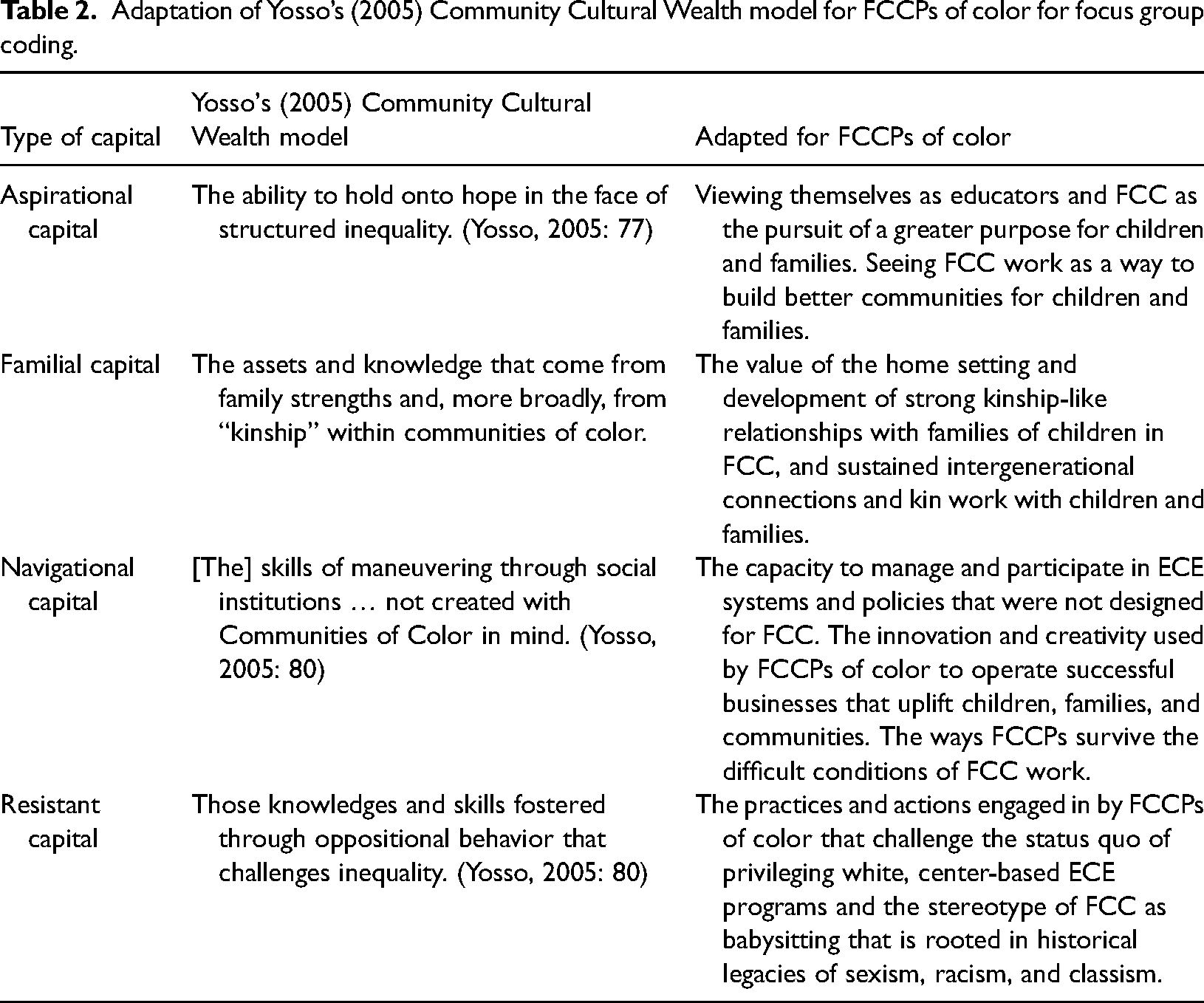
The broader Multi-State Study coded all of the focus group data by participants so that individual speakers could be connected to their narratives. Using NVivo software, we combined the deductive and inductive coding, recognizing that these approaches work together rather than being mutually exclusive (Saldaña, 2021). First, we developed a set of six a priori codes based on the six types of capital in Yosso's (2005) Community Cultural Wealth model. We made modifications to these types of capital to reflect the FCC context specifically and guide our coding of the focus group data. We have excluded coding related to social and linguistic capital in this article because we did not find sufficient data to support these codes. Table 2 shows our adaptation of Yosso's four types of cultural capital into a priori codes. We also drew on inductive approaches to data analysis, which allowed us to identify additional themes within each a priori theme that emerged from the focus group narratives.
Adaptation of Yosso’s (2005) Community Cultural Wealth model for FCCPs of color for focus group coding.
Given the influences of race, class, and power within the inquiry and analysis process, we find it important to discuss the positionalities of the two primary authors of this work. The first author is a white woman from a middle-class Jewish family whose scholarship over the past two decades has focused on the FCC sector. The second author is a cisgender Black woman from a middle-class family whose work as a scholar, bilingual preschool educator of Black and Brown children, and educator of early childhood teachers is rooted in Black feminist epistemologies and highlights the perspectives of Black women educators and their cultural knowledge. Our awareness and stance of cultural and racial humility as researchers from different racial and cultural backgrounds was critical to understanding the meanings within the FCCPs’ narratives. For this article, our team did not include any researchers who identify as Latine or Asian American, potentially limiting the validity of our analysis. Through reflective conversations, which are inherent to cross-cultural inquiry work, we reached a shared understanding of the key codes. For example, in discussions about FCCPs taking on multiple roles, Author 1 noted that this theme has been explained in prior literature as a role burden that is common across FCCPs. Author 2, however, brought her personal knowledge and scholarship on women of color to deepen the analysis by applying a critical framework to illuminate descriptions of multiple roles as counternarratives that women of color enact in order to survive in ECE systems created and maintained by white patriarchal hegemony. With these considerations in mind, we coded five of the 19 transcripts together to develop a shared understanding of each code. After reaching consensus, we completed the coding process and double-coded every fourth transcript.
Findings
The FCCPs represented in this study described four types of cultural capital—aspirational, familial, navigational, and resistant—that are connected to their care of children and families, and their enactment of professionalism within the ECE sector.
Aspirational capital
The FCCPs across the focus groups expressed optimism about the future of the children and families in their communities and viewed themselves as educators, enacting a “culture of possibility” (Yosso, 2005: 78). The FCCPs also used the ECE discourse of getting children “ready for kindergarten” when discussing the importance of supporting children's academic development (Tonyan, 2017). Some asserted their role as educators in opposition to the mainstream view of FCC as babysitting: We realize that we are not babysitters. We don’t sit on children. We are educators. Whether you have a degree or not, you are an educator.
Although a focus on children's academic achievement is not unique among this sample of FCCPs or ECE professionals more broadly, the broad view of FCC as a vehicle for building a better future for children in their community suggests a pushback against racialized and feminized stereotypes of FCC as babysitting. The FCCPs across three focus groups shared that they opened their FCC programs as a stepping stone to operating a child care center. Their commitment to being community educators motivated their aspirations to replicate their FCC programs on a larger scale with more children and families.
Similar to prior research describing how FCCPs of color see their work as community service (Armenia, 2009; Bromer, 2006; Tuominen, 2003), the FCCPs in this study described themselves as community educators with a collective vision for the future of children. A Latina FCCP in California explained how “love of my community” kept her in FCC because, “in the long run, the children that are in the community are going to be adults at some point and we want to raise and nurture those children to be good citizens in our community.” Black FCCPs from Wisconsin expanded this idea of FCC as community work that could address racial inequities for children. One professional described her motivation to help “babies out here [who] need us” and FCC work as a way to counter the racial inequities in child-serving systems: “I’ve witnessed first-hand them slipping through the cracks of the system and so, I said, you know, I need to reach every child that I can reach.” In these ways, FCCPs of color used their aspirational capital to frame FCC work as future-oriented community development.
Familial capital
The FCCPs leveraged the home-based family setting of FCC to create safe and inclusive environments, as well as loving relationships with and for children and families. Familial capital was also expressed through the ways the FCCPs used the resources of their own families to support and sustain their FCC businesses.
Home-based FCC was described across the focus groups as a place for healing and respite for children of color who may experience stress and discrimination in other ECE settings and public spaces. Black and Latine FCCPs contrasted the “homie kind of a feeling” and “the closeness and the attention” of FCC with their perceptions of the more rigid, institutionalized settings of centers and school-based ECE programs. One FCCP spoke on behalf of others when she shared: “That's why we say that in a family child care you are a little more affectionate to the child, you understand them better, it's more familiar in that sense.” Black FCCPs from Wisconsin reflected on how their home programs offered children a safe and calm place where they could experience “peace” and an opportunity to “be free”: By being in a home environment, they still getting this love … you know, during this time a lot of stuff is going on. So, the fact that when they’re here it's like a smooth place, I guess I want to call it. Somewhere where they can be themselves and love. That's when I started my daycare. If there is a child who loves me and I love him, I want to hug him, give him a kiss, tell him I love him … so that's why I started doing my own daycare. I said, “I’m going to do this and I’m going to do it my way.”
In addition to the home-based setting, the FCCPs used “kin work” to cultivate strong relationships and forge a sense of collectivism and community through engaging their own families and the families of the children enrolled in their FCC programs (Stack and Burton, 1993; Tuominen, 2003). FCCPs across cultural identities and geographic locations mentioned the loving relationships they developed with individual children and families. Many described the children in their care as if they were “relatives or family,” and expressed pride when the children and families recognized them as grandmother figures. Black, Asian American, and Latine FCCPs shared the various familial titles given to them by children—“momo,” “nana,” and “aunty”—which solidified their role as extended family in the children's lives and forged a connection that some maintained with families long after the children graduated from their programs. One FCCP from California noted that “once they grow up and are married, they bring me their own children to care for,” reflecting the generational impact the FCCPs had on both the families in their care and the community as a whole.
The close relationships with the families of the children in their care were also leveraged in reciprocal ways, especially during the early days of the COVID-19 pandemic. The FCCPs’ support for parents during communal and personal hardship was summarized by a Latina FCCP from California: “We are that resilience for the families, for the kids.” As mothers and community members themselves, the FCCPs understood what it meant to raise children while balancing work and other life responsibilities. Similarly to how many children in FCC regarded their providers as grandmother figures, the FCCPs reported that parents looked to them as maternal figures from whom they could gain perspective and wise counsel to navigate difficult life experiences. The FCCPs also exchanged material resources with families, such as providing groceries, diapers, and even cash to families who had lost their jobs. In addition, Latine, Black, and Asian American FCCPs shared stories of how families used their own resources to help FCC businesses stay afloat, suggesting the reciprocity involved in the enactment of familial capital.
Further evidence of how familial capital was leveraged in FCC settings was heard in FCCPs’ narratives about the integration of their own families into their FCC programs. Forty-three percent of the FCCPs in our sample reported that a family member was their FCC program assistant. The FCCPs described relatives who supported the financial viability of their FCC program by serving as substitute caregivers: “I always got somebody who can step in.” Others reported receiving direct financial support for their FCC business. A Latina FCCP from Florida explained that without the financial support of her family, “I wouldn’t be in this business that is now independent, being able to develop in this field, financially.” The FCCPs also shared stories of how family members provided emotional fortitude. One Latina FCCP from Massachusetts explained why she needed her spouse's emotional support: “It's being a mother, which is already a very tiresome thing to do, but it’s being a second mom to a bunch of kids.” Her words convey the emotional cost of familial capital and the ways relatives helped to support FCC work.
Navigational capital
The FCCPs’ stories indicated how they used their navigational capital to participate successfully in ECE systems such as licensing, subsidy, and QRIS. These ECE systems present opportunities for increased compensation and professionalism but also pose an array of challenges for FCCPs, as reported in prior research (Bromer et al., 2021c; Sandstrom et al., 2018). A common theme emerged around navigational creativity and having to perform at an unrealistic level to keep their businesses afloat. One Latina FCCP from California shared: “I’m telling you, we do magic with the little that we get.” The descriptions of taking on multiple roles (“we become secretaries, psychologists, record keepers, and cooks”) were related to how they were able to navigate the requirements and regulations along with delivery of care and education, and echo prior research that has documented similar themes around role burden in FCC work (Hooper, 2020). The FCCPs also described the creative strategies they had developed to “do everything the right way” and stay one step ahead of potential licensing violations or citations. For some educators, this meant performing compliance in ways that anticipated being in violation of rules. A Latina FCCP from California explained: “Just trying to do everything the right way and to be professional and just do it correctly before [licensing] fines you.” An Asian American FCCP explained how she and her colleagues installed cameras in their homes to prove they were not in violation of licensing rules: “we’ve recorded in case something happened, we can show the government and the parents what happened.”
Taking on additional jobs besides FCC was a related strategy for using navigational capital to survive the economic precarity of FCC work. An Asian American FCCP from California shared that he had to work a part-time job during the pandemic to sustain his FCC business and recover his lost income in order “to survive.” A Black FCCP from Florida described running a transportation business in addition to her FCC business. Fifteen FCCPs reported holding another paid job, nine of whom identified as Black. All but one reported participating in their state's child care subsidy program, suggesting the failure of subsidy systems and child care markets to compensate FCCPs adequately for their work, and how these systems perpetuate structural and systemic racism.
Resistant capital
The FCCPs’ narratives described how they used resistant capital to counter society's devaluing of FCC work, echoing their aspirational capital (described earlier) and prior research on activism and education (Tuominen, 2003). In a focus group with Latina FCCPs in California, the participants used military language to illustrate the gravity of their work during the COVID-19 pandemic: “We are at the front lines, like the ones that go to war” and “We are warriors, whether the agencies or the state like it or not.” A Latina FCCP explained the essential role that FCCPs played during this time: “Yes, we are very important, more than they ever thought of us, because, without us, nobody can go to work.”
Some of the FCCPs described the need for direct and collective action to change what they perceived as inequitable systems. For example, some reported the need to demand health insurance and fair compensation: “We need life insurance, we need medical insurance as a team, we need to get together, stand together, so that we can build together.” Others described taking individual action to resist unfair and discriminatory treatment. One FCCP sent a letter to her licensing agency, contesting what she felt were unfair citations after years of compliance: I haven’t had problems with any of the others that have come to inspect here like I have had with that woman; so I sent a letter to Department of Children and Families (DCF) to tell her that I don’t want her to come to inspect here again, because either I will kick her out or they can take me to jail.
Some of the FCCPs leveraged their resistant capital by opting out of voluntary ECE systems such as QRIS or subsidy that imposed inequitable policies that were not designed for FCC settings. A Latina FCCP in California talked about limiting her participation in one publicly funded program to reduce stress. FCCPs in Florida opted out of subsidy programs that required them to “jump through hoops.” Latina FCCPs in Massachusetts described changing subsidy agencies because of discriminatory practices, where required training was not offered in Spanish: “They were very disrespectful to me and, at 32 years, I had enough.” In these ways, the FCCPs enacted resistant capital through individual and often invisible actions, which were necessary to maintain their integrity and survival.
Discussion and conclusion
Our use of a critical lens to examine the types of cultural capital (Yosso, 2005) described by FCCPs offers a critical counter-perspective to a dominant narrative in US ECE research and policy that has diminished the contribution of FCCPs and positioned them at the margins of the profession. Yosso (2005: 70) describes the use of theoretical frameworks that are informed by the experiences of communities of color as an opportunity to “reenvision the margins as places empowered by transformative resistance.” Our findings illustrate the theories that FCCPs of color have about the meaning of their work, illuminate their visions for a more just future for children and families, and highlight aspects of the profession that are often undervalued or disregarded in mainstream ECE discourses.
Across the FCCPs’ diverse identities and sources of cultural knowledge in this study, similar themes around aspirational capital were described, including FCC as education and a service for the community. The future-oriented narratives around the FCCPs’ hopes for families and communities, as well as their plans to build capacity to serve more children and families, evoke a resistance to gendered racism (Essed, 1991) and classist ideologies of FCC as babysitting. Aspirational capital as described by FCCPs of color presents a counter-story to the marginalization of women of color in the workplace and educational institutions (Collins, 2000; Davis, 2018).
Our findings illustrate the critical role that FCCPs of color play in helping children of color thrive. The FCCPs’ narratives of familial capital present a model of close relationships, which are essential to child and family well-being (National Scientific Council, 2004) and may help buffer children against the inequities and injustices they face in the broader community and society (National Black Child Development Institute, 2013). These narratives include descriptions of cultural models such as “othermothering” in Black communities, which have been linked to children's psycho-educational well-being in other educational settings (Acosta, 2019; Case, 1997; Foster, 1993). The theme of home as a place for healing and respite echoes findings from emerging literature on homeschooling in Black communities, which suggests that families may turn to the home setting to address the inequities and systemic racism in public education (Fields-Smith and Kisura, 2013). Furthermore, analysis of national data shows lower preschool expulsion rates in Black-owned FCC settings compared to those run by white or Latine FCCPs (Hooper and Schweiker, 2020), suggesting the important role that Black women educators play in supporting the well-being and development of Black children. These findings suggest future avenues for research that examines how cultural, racial, ethnic, and linguistic continuity and congruence in FCC settings are related to children's positive outcomes.
The narratives of cultural capital described in this article show how FCCPs navigate and resist unjust systems to continue their care work. Some of the FCCPs resisted injustice by pushing back against dehumanizing interactions with system staff, advocating for health care, or opting out of ECE systems entirely. These and other examples of navigational and resistant capital among FCCPs of color (Melvin, 2022) provide a roadmap for transforming ECE systems to be more racially, culturally, and linguistically just for FCC professionals and the children and families who rely on these ECE settings.
Limitations
We recognize the intersectional identities of FCCPs and how their cultural models are constructed within their own familial, communal, and sociobiological environments (Bronfenbrenner, 1986). Yet the broader Multi-State Study of Family Child Care Decline and Supply did not intentionally focus on how identity intersects with the experiences of caregiving work for FCCPs of color. For example, our sample of FCCPs who identified as Asian American and Pacific Islander was small and precluded an intersectional analysis of how their cultural traditions and racialized experiences in the USA shaped their experiences in FCC. Additionally, the inclusion of FCCPs who identified as white in some of the focus groups may have resulted in the FCCPs of color in these groups adjusting their narratives. Since we did not include these narratives, we did not examine how the presence of white participants could have affected the topics raised and discussions that occurred.
Implications
The findings from this analysis suggest that there may be alternative ways to (re)design ECE policies that recognize and elevate the potential of FCC to positively shape outcomes for children, families, and their broader communities. Shifting the focus in research and policy to the strengths of these professionals can positively shape children's experiences and is critical to (re)envisioning ECE policies and systems that dismantle systemic challenges and inequities. For example, the multidimensional aspects of cultural capital described by the FCCPs in this study suggest new directions for conceptualizing ECE quality. Theories about ECE “quality” have been challenged and problematized over the past two decades as privileging white, Eurocentric visions of normative child development (Blaise and Ryan, 2019; Blank, 2010; Lent, 2016; Turner, 2022), as well as an approach to standards development rooted in center- and school-based ECE programs (Doran et al., 2022; Goodson and Layzer, 2010; Hallam et al., 2017; Melvin, 2022; Tonyan et al., 2017; Turner, 2022). FCC is rarely included in these quality frameworks, which historically have not considered the strengths and experiences of minoritized children and families (Bromer et al., 2021b; Johnson-Staub, 2018; Meek et al., 2020; Souto-Manning and Rabadi-Raol, 2018; Turner, 2022).
ECE systems and policies that acknowledge the essential roles of FCCPs in communities of color can also transform a vulnerable workforce on the decline (National Center, 2020) into a thriving workforce with increased compensation, benefits, and pathways to educational attainment. As our findings suggest, FCCPs of color bring strengths to the children, families, and communities they serve, which could inform the delivery of ECE for children of color across other ECE settings. Recent conceptualizations of equitable mixed-delivery ECE systems in the USA suggest that the authentic inclusion of FCC has the potential to transform publicly funded programs into more responsive options for children and families (Melvin et al., 2022). The findings from the current study have implications for the design of systems that celebrate the strengths of FCCPs and credit them for their tenacity to support the experiences of children and families while building sustainable businesses and professional identities.
Footnotes
Author contributions
Juliet Bromer and Crystasany Turner contributed equally to this article, including the development of the conceptual frameworks, coding, analysis, writing, and revising. Juliet Bromer was principal investigator for the broader study. Samantha Melvin is a contributing author and participated in the research and data collection and analysis team for the broader study and reviewed drafts of the current article. Aisha Ray is a contributing author and conceptualized and inspired many of the ideas that drove the analyses in the current study and reviewed earlier drafts of the article.
Author's note
Crystasany Turner, University of Wisconsin-Milwaukee, USA.
Declaration of conflicting interests
The authors declared no potential conflicts of interest with respect to the research, authorship, and/or publication of this article.
Funding
This work was supported by the Foundation for Child Development (grant number EI-02-2019).
