







Abstract
Early childhood education and research have shifted toward a more refined understanding of children's voices as evidence of their rights, participatory experiences and feelings. However, little is known of the processes and rationales of children's voices in educational placemaking. The interplay of habitus and capital in cultural fields shape children's contextualised experiential and narrative voices, through perceptions, attitudes, and language use, constituting a valuable resource for understanding bodily experiences in collaborative learning placemaking. Accordingly, research in the understanding and use of children's voices is needed for recommendations that can improve the quality of early childhood education more widely. Through qualitative interviews with 20 children ages 4–8, this study examines how children describe their learning places and interactive experiences with teachers. Findings identified experiences that activated belonging and wellness, experiences that were discomforting to children, and the desire for future-making in eco-friendly and humane learning places. This study contributes significantly to early childhood education by 1) offering insights into how analysing children's voices of learning placemaking through Bourdieu's triad of habitus, capital, and field provides transformative potential for improving the quality of children's learning and development, 2) the framework facilitates critical understandings of how and why some children's voices are valued while others are subjugated in learning placemaking, and 3) through this lens, findings challenge inequalities by informing how voices can contribute to children's habitus and capital development in ECE field.
Introduction
The voices of children in early childhood education (ECE) and research have been valued, but more recently, deeper understandings have evolved, of the sophistication by which children's voices reveal their worlds of participatory experiences and feelings. And yet, little work suggests critical attention to children's voices in educational placemaking. The aim of this paper is to explore how children's voices, shaped by their habitus, capital and field, reflect their participatory experiences and perceptions of educational placemaking, to inform and enhance the quality of early childhood education. We conceptualise children's voices as a dynamic, rights-based ‘storying’ that challenges traditional adult-centric practices by recognising children as competent sociocultural agents, whose authentic participation in educational and research contexts demands ethical engagement, and a reconfiguration of power relations to ensure their perspectives are valued and used to meaningfully shape early childhood practice and policy. We first situate children's voices within the context of collaborative learning placemaking, then theoretically explore how voice intersects with Bourdieu's triad of habitus, capital and field, thus reconceptualising voice as a contextualised, experiential, and narrative construct. Through this lens, qualitative interviews with children are analysed, and uncover the transformative potential of children's narrative and experiential voices in shaping inclusive, eco-aware, well-resourced, and emotionally supportive learning environments.
This conceptualisation is based on the notion that for decades, stories about early childhood education practice and policy come from adults, and these stories are used to determine what is considered good practice for children. According to Moss (2025), stories help us make sense of the world, and early childhood education practice and policy need new stories to advance the field. To foster children's belonging, wellbeing and becoming, new story-making requires listening to their voices, to understand the narrative assemblage of their place in collaborative learning place-making (Dixon et al., 2014; Watson and Newman, 2024).
Due to the scarcity of studies on children's voices in collaborative learning placemaking (Dixon et al., 2014; Watson and Newman, 2024), and to deepen our understanding of the complexity of voices in producing new stories that depict value for children, we used the concept of Bourdieusian habitus, capital and field (Bourdieu, 1977; Bourdieu and Passeron, 1990) to explore children's contextualised experiential and narrative voices, anchored in perceptions, attitudes, and language use; this yielded a valuable resource for understanding bodily experiences in collaborative learning placemaking. The research reported in this paper is part of a larger mixed-methods study addressing educator quality in ECE in the United Arab Emirates.
Collaborative learning placemaking
Collaborative placemaking in ECE involves a group process of co-designing and activating educational resources and practices that empower children, and value their voices, allowing for new forms of expression to create evolving shared meanings (Esser et al., 2016; Theobald et al., 2015). Educators who construct collaborative learning environments with children ‘help foster respectful regard for their experiences and concerns and promote the recognition of children as active agents’ (Carnevale, 2020: 2) to ‘take full advantage of learning opportunities’ (Marbina et al., 2015: 4) and develop identities as full members of their society (Westwood, 2018). Despite conceptual and pedagogical shifts in ECE calling for children's voices in understanding their stories in learning placemaking, exclusion of those voices persists through early education systems that exert excessive curriculum and behavioural control over children's learning (Armstrong, 2006; Pieper, 2024). Educator mindfulness of their practices can ‘foster learning environments that are integrally attentive to issues of meaning-making, critical reflection, social justice, diversity, care, collaboration, and community’ (Gardner and Kelly, 2008: 1).
Collaborative placemaking values and respects children's rights by creating opportunities for ‘experiences and ways of thinking so that students are comfortable taking intellectual risks, asking questions and posing conjectures’ (Western and Northern Canadian Protocol, 2008: 2). These perspectives align with the views of critical ECE researchers like Pacini-Ketchabaw et al. (2014) and Pacini-Ketchabaw and Moss (2020) because negating voices devalues the rights of children as active agents in their early educational space, traditional ECE practices that do not include children's voices in their learning placemaking, are unethical. They recommended that contemporary ECE learning placemaking must consider ecological complexities, engage in multiple pedagogical experimentation, ethical risk-taking, and socially just practices.
These perspectives suggest that collaborative placemaking in ECE creates thriving learning communities, as it involves educators’ transformative intentional co-construction of learning places that respect children's identity (McLaughlin, 2024), sense of belonging, enabling possibilities to emerge (Watson and Newman, 2024). Transformation in education is not only about constructing new things, but a practical and conceptual deconstruction of prevailing practices, curriculum innovation and resources to regenerate liveable learning places to improve learning and holistic development (Fullan, 1993; Pacini-Ketchabaw and Moss, 2020). However, ‘when kindergartens and preschools are thoroughly rule-governed, an atmosphere develops in which children are frequently in the wrong’ (Pieper, 2024: 68).
Studies have found that educating children in stressful environments, labelling, blaming and punishing them because they fail to conform to existing structures, often leads to emotional disconnection and exclusion (Freire, 1998; Nichols et al., 2015; Pieper, 2024; Theobald et al., 2015). A plethora of previous researchers conclude that children's voices is a powerful tool to educators can utilise to transform restricted learning places into collaborative and humane places that value children's rights and full participation (e.g., Grover, 2004; Hallett and Prout, 2003; Hohti and Karlsson, 2014; Pacini-Ketchabaw and Moss, 2020).
Theorising children's voices with Bourdieu's conceptual triad of capital, habitus and field
The theoretical framing of this paper engages deeply with how children's contextualised, experiential and narrative voices intersect with Bourdieu's conceptual triad of habitus capital and field. Children's voices intersect with Bourdieu's triad by revealing how children navigate and reshape social and institutional structures through their embodied dispositions, access to play resources, and positioning within ECE relational contexts. This form of analysis offers a critical lens for understanding how children actively participate in and challenge pedagogical reproduction in ECE settings.
Bourdieu (1984) explains habitus as our perception of and reaction to the world, shaped by socio-cultural and institutional socialisation (Bietti, 2023). Specifically, habitus represents a ‘subjective but not individual system of internalised structures, schemes of perception, conception, and action common to all members of the same group or class’ (Bourdieu, 1977: 86), it is a system of dispositions of seeing, being, and doing in the world (Bietti, 2023).
Capital on the other hand, consists of accumulated assets that manifest as economic, social, symbolic and cultural capital (Bourdieu, 1986). In ECE settings, economic capital includes structural resources (e.g., outdoor play areas, digital tools and toys), social capital (relationships with peers and educator), cultural capital (language fluency, familiarity with books or routines and knowledge), and symbolic capital as recognition and value accorded children, and their voices and rights to belong (Bourdieu, 1986). Children's ability to be heard in ECE settings often depends on how their voices are valued by educators. It is possible that children from privileged backgrounds may have more cultural capital, enabling their voices to carry greater legitimacy. Educators who value diversity of children's voices help redistribute capital, allowing marginalized children to gain visibility and influence pedagogical practice.
In Bourdieu's (1990) critical social theory, the field concept represents structured social spaces such as ECE and family, where children's voices are negotiated. Within these fields, power dynamics determine whose voices are valued, respected and amplified or marginalised. Valuing and incorporating children's voices into ECE learning placemaking as a practice reform for example, can disrupt field hierarchies and practices leading to innovative pedagogies. Habitus, capital and field thus situate voices as a sociocultural construct that reflects certain interests, beliefs, assumptions, and values of the contexts in which voices are produced (Tertoolen, 2017).
Children's voices and feelings about their learning places are critical to creating collaborative learning places (Hohti and Karlsson, 2014). Evidence suggests that children who feel positive about their teachers as supportive, kind and friendly, and are better adjusted to education environments (Pieper, 2024), whereas negative views about teachers and threats of punishment can fuel emotional tension, fear, and dislike for school (Armstrong, 2006; Gardner and Kelly, 2008; Pieper, 2024). These perspectives resonate with Bourdieu (1984) who argues that our habitus, which explains ‘the way society becomes deposited in persons in the form of lasting dispositions, or trained capacities and structured propensities to think, feel and act in determinant ways…’ (Wacquant, 2005: 16) frames our perceptions and how we organise educational places. Thus, educators’ and children's enacted habitus – reflect their embodied identities, thinking, feelings and actions, which become visible through their practice (Asimaki and Koustourakis, 2014; Bourdieu, 1984). Embodied identities - language and voices, values, beliefs and dispositions, are formed through historical and institutional socialisation (Choudhuri, 2024; Theobald et al., 2015), depicting our worldview, sense of place and placemaking, and the choices imposed on others (Bourdieu, 1984).
Placemaking in ECE depends on dispositions and embodied perceptions of self and others (Ball et al., 2002). Valuing children's voices in placemaking creates new understandings of places where children best learn and thrive (Hohti and Karlsson, 2014; Theobald et al., 2015; Watson and Newman, 2024). For example, previous studies indicate that children like open spaces for play with less adult restriction and dislike heavily supervised places and loud voices from teachers (Agbenyega, 2011; Carnevale, 2020). In another study, Aminpour (2023) found that green terraces, open hallways and neighbourhood parks offer children more relaxed learning places because of the ample play opportunities. Similarly, Watson and Newman (2024: 258) identified that ‘outdoors, along with places for hiding, safety, cleanliness and authentic rather than “fake” resources’ were appreciated by children. These studies suggest that children form their habitus of punitive and humane places when actively participating in them (Bourdieu, 1977). Therefore, children's bearing, linguistic expressions (voices) and enacted habitus (cognitive dispositions and appreciation of feelings and actions) must be taken seriously.
This calls for engaging critically with the notion of transformative practice in ECE, by challenging and disrupting traditional ECE learning placemaking, and embracing ethically and ecologically complex and sound pedagogical practices, which inscribe social justice principles at the core (Pacini-Ketchabaw and Moss, 2020). Therefore, exploring and anlysing children's voices through Bourdieu's triad of habitus, capital, and field, offers a powerful framework for children to tell their new stories about collaborative learning placemaking, and deepens our knowledge of children's needs in their learning environments, to create paths for improved future possibilities (Bourdieu, 1990; Lizardo, 2004; Wacquant, 2016).
Methodology
We investigated questions focusing on what is happening, so what do we know now and what do we have to do? What are children's experiences regarding their interactions with educators and learning places? What do children most value and/or dislike in their learning place and interaction? What do children's imagined ‘futuremaking’ learning places look like?
To glimpse what is meaningful to the child, we used a qualitative approach to explore how children's view their interaction with current learning places, teachers’ practices, and their imagined preferred learning places (Carnevale, 2020), to prioritise their agency and voices (Lulgjuraj and Maneval, 2023). The Bourdieusian concepts of habitus, capital and field help us to capture and deepen our understanding of the embodiment of children's agency and voices, in collaborative learning placemaking and lived experience in their cultural contexts (Lulgjuraj and Maneval, 2023; Tertoolen, 2017).
Participants
Twenty children, ages 4–8 years, of diverse cultural backgrounds living in Abu Dhabi, UAE, participated in this portion of the study. Recruitment was through WhatsApp groups, consisting of community or parent groups, in which the researchers were not members. The study information was sent to the group administrator to post, inviting parents/guardians to contact the research team directly for queries and/or to express interest in participation.
Ethical considerations
The research was approved by the authors’ Institutional Review Board (RP-234-2023) and the school authority; it was carried out in accordance with the WHO's Declaration of Helsinki and its amendments, with informed consent from parents/guardians and informed assent from children, including permission to audio record interviews. The research team is respectful of the UN's Convention on the Rights of the Child, especially Article 12 in research (UN Committee on the Rights of the Child, 2009; United Nations, 1989) and considers children to be partners in research. Accordingly, information about the study, answers to questions, and explanations were communicated clearly in non-technical language prior to consent and assent, and again prior to participation. Information about the study and interviews were carried out with the support of three bilingual local research assistants in either Arabic or English, according to the participant's preferred language.
Child assent was indicated by circling or pointing to a happy face. Circling or pointing to an unhappy face indicated children declining to participate even though parents/guardians agreed. Assent was active and ongoing during data collection, with the interviewer watching for verbal and non-verbal cues (Hogan, 2005) and asking regularly if it is okay to continue (even if the child did not show any signs), and the child could stop participating at any point. Audio recordings were deleted upon transcription verification.
Data collection and analysis
Children were interviewed with the support of three research assistants for an average of 25 min at an agreed-upon place where children felt relaxed and comfortable. Sample questions during the interviews included: What do you like about the centre/kindergarten/school you attend? What do you dislike about the centre/kindergarten/school you attend? What type of teachers do you want in your school? What things do you want to see in your school that are not currently available? What kind of centre/kindergarten/school do you want to go to?
Digital voice recorders were used to record interviews. Recordings were transcribed and translated (if needed) by one of the three research assistants and then verified by a second assistant who listened to the recording while reviewing the transcription/translation; the assistants met to discuss and address any inconsistencies. Employing theory-driven thematic qualitative analysis as outlined by Braun and Clarke (2022), the researchers examined how children articulated their constructed and reflexive habitus, forms of capital, and field-related practices evidenced in the transcript data. We used structured coding books to enable comparison and degree of consensus and ascertain coding reliability. Our theoretical analytic process of children's narrative voices using Bourdieu's triad concepts focus on how their interview stories reflect their social positioning by their teachers in their learning place, internalised dispositions, and access to resources to account for children's perception and judgment of teachers, their educational place and communicative actions, and the transformative envisioning (Bourdieu and Wacquant, 1992; Schirato and Webb, 2002) of the future learning places to which they would like to belong. Our analysis involved three interactive analytic categories:
First, our analysis of habitus focused on values, attitudes, language style and tone, themes and concerns or what children choose to talk about (e.g., friendship, fairness, authority and power), and perspectives of agency, such as whether they position themselves as active agents or passive learners in their learning place, and how they perceive their role in their learning placemaking.
Second, in the analysis of capital, we paid specific attention to narratives that include specific vocabulary about learning placemaking (cultural capital), stories that reflect relationships and social networks (social capital), stories that demonstrate praise, recognition, and inclusion or exclusion that invalidates their belonging to their learning place, for example being called ‘a good or naughty’ (symbolic capital), and stories that refer to resources that enrich learning experiences (economic capital).
Third, the field was analysed by focusing on how children's stories described their learning place, the norms about what was allowed or not allowed, and how power dynamics deployed by adult authority or peer hierarchies constrained learning place interactions and practices. We collaboratively discussed the coding and analysis process to ensure valid interpretations of the data and understanding of the framework. Together, we examined the data, discussed patterns, inconsistencies, and re-visited the data to clarify these inconsistencies. Table 1 shows sample analysis of the data.
Sample data analysis.
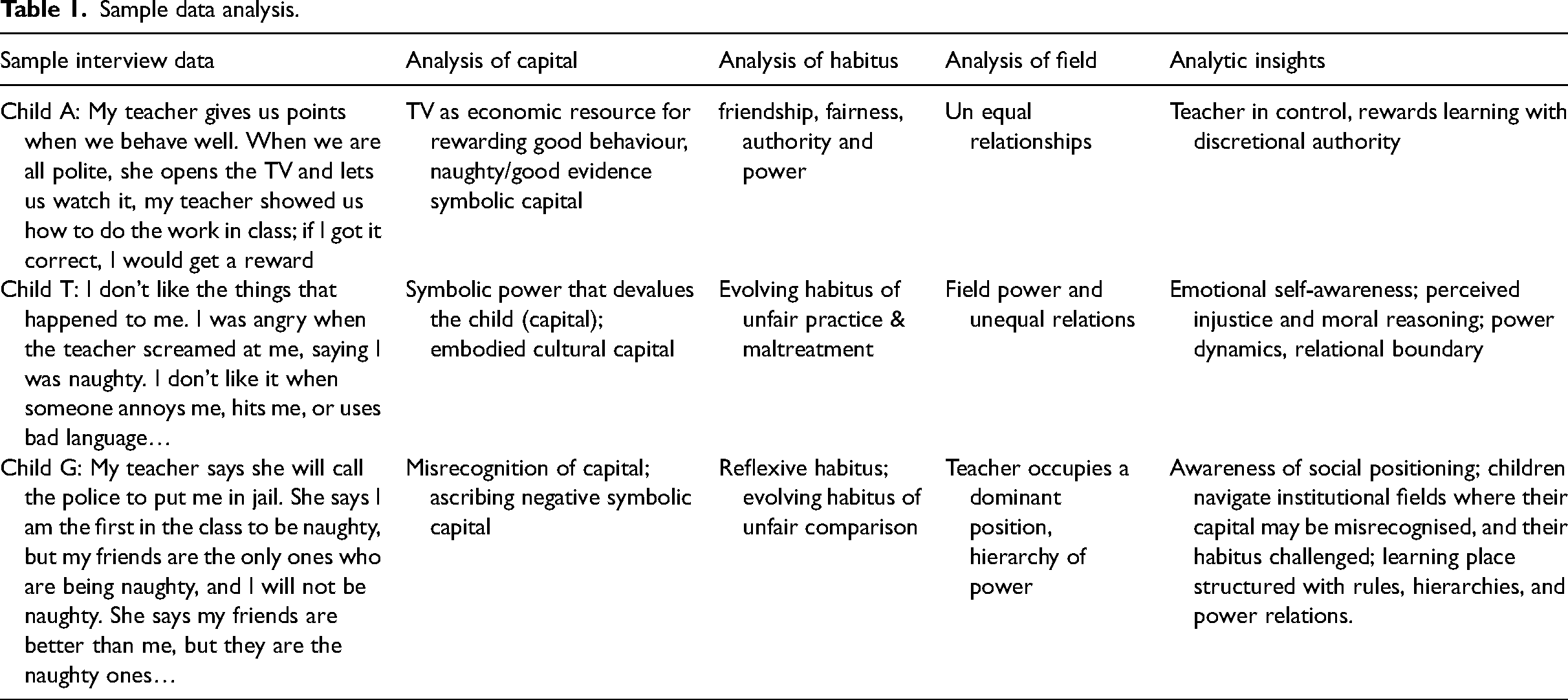
These reflective comments from children were understood as daily negotiations in which age-based relations and power positions are formed, specifically in terms of legitimising, valuing or forbidding certain ways of being and acting in early childhood educational settings (Bourdieu and Wacquant, 1992).
Findings and discussion
The main purpose of this study was to understand children's voices regarding their participatory experiences and perceptions of educational placemaking. Findings show that most children expressed fondness for their teachers based on token economies. However, the gains of rewards were superseded by children's awareness of being subservient in the educator-child relationships. Significantly, children favour learning places with less teacher intrusion and less restrictive places. Children's imagined learning places include reference to natural and non-natural materials to facilitate limitless exploration and inquiry learning through play, as well as places that are calm and endowed with natural elements, and which could offer opportunities for relaxation. These findings are discussed in light of previous research and Bourdieu's triad of habitus, capital and field concepts to bring fresh understandings that foreground the critical role of children's voices in constructing collaborative learning places, which can provide affordances for positive interactions and full participation.
Learning places and activities that activate belongingness and wellness
Children described their learning place interactions with mixed feelings. Most children indicated that they loved their teachers because they taught them, took them on field trips and rewarded them with tokens, as reflected in one of the children's voices: ‘My teacher gives us points when we behave well. When we are all polite, she opens the TV and lets us watch it.’ (Child A). Other children highlighted their learning place experiences by commenting on their teachers’ kindness and support during educational field trips outside the typical school environment. I like my teacher; she is very kind when she took us on the trip…she'd bring a big table, and she'd put the good students, and then they’d go on a trip, she lets me play and do painting when we go on the trip. (Child B). She takes me on trips on the bus to the city (Child C). She showed us how to do the work in class; if I got it correct, I would get a reward (Child B). She gives us gifts; she showed me a movie about animals in class; it was fun. I like the giraffe, it has a long, long neck. (Child C). I'm the one who owns the school because my face appears everywhere. The teacher took pictures of me and glued them to my work. It is my painting. You can see it on the classroom wall; it is also in the hallway. There is another one in the dining area. Yes, other children come to me, and I help them. I am happy; it is my home, where I cool off (Child F). Rewards, whether they are used as incentives or reinforcement, devalue the social or academic activity they are supposedly incentivising by conveying that the effort is not sufficiently important to be engaged in for itself. Rewards also create hierarchies in the classroom and can upset and discourage children who are not getting them. Also, some children learn to misbehave to be rewarded for behaving better later.
Furthermore, Child F's claim that his work was displayed on walls within the school is an indication of symbolic capital that carries prestige within the classroom field (Bourdieu, 1990). The children's learning place thus symbolises a micro-field (Bourdieu, 1977) where they compete for rewards, recognition, and proximity to the teacher. Child B's description of ‘good students’ being selected for trips shows how the teacher structures the field, creating differential class of children (Pacini-Ketchabaw et al., 2014) based on her interpretation of good behaviour and achievement. When learning spaces act as hierarchical and performative fields, where the teacher acts as a field controller, distributing capital and shaping habitus, some children may learn to navigate it by aligning with the teacher's expectations (Bourdieu, 1996), however, children who may have difficulty conforming to such field practices will be disengaged, marginalises and excluded (Pacini-Ketchabaw and Moss, 2020). On the one hand, teachers’ control over rewards and recognition replicates Bourdieu's idea of symbolic violence where the subtle imposition of dominant norms and practices shape children's developing habitus (dispositions) (Bourdieu, 1990). This may also affect children's identity formation inscribed in institutional validation, and consequently, influence their long-term sense of agency and belonging.
On the other hand, bonding in early childhood activates a sense of care, responsibility, and belongingness to one's place (Konstantoni, 2012). Children also thrive in places they co-create (Watson and Newman, 2024), which contribute to the formation of new habitus about learning places and interactions that are comforting and collaborative (Jones et al., 2023). Quality teaching and effective learning occur through respectful relationships (Pieper, 2024). The findings have implications creating learning places that nurture dispositional habitus of interdependence, a novel requirement for collaborative placemaking (Thomas, 2015). Bourdieu (1999) explains that habitus frames how we conceptualise our belongingness to what and where, and our view of place; interpretation of place and acting in a place are determined by our social positioning with others (Bourdieu, 1996).
Discomforting learning places
The findings pertaining to this theme demonstrate children's preferences for play-based learning over worksheets reflecting a habitus of environments where creativity and movement are valued. Yet, their expectations conflict with the dominant practices of their learning place. I want to draw, eat and play. I want to look at animal pictures in the book, but I can't because the teacher says these are the new laws. You are in school. She writes on the board a 5-min play, and we have to finish quickly and do the worksheet ‘I don’t want to sit for a long time and do worksheets. I want to use play dough and create things with my friends’ (Child G). I don’t like the things that happened to me. I was angry when the teacher screamed at me, saying I was naughty. I don't like it when someone annoys me, hits me, or uses bad language. I don’t work; I throw things at my friends (Child T) I don’t like it when she keeps watching me and yelling at me to be quiet. My teacher tells me to do her stuff; she gives me boring stuff. I do worksheets every day, but I want to play (Child K). I am a good student, and for good students, the teacher gave them an award. I didn’t get my award. I asked my teacher, but she got angry with me. She said I am not good today and made me stand against the wall (Child M) The naughty friends. I don’t like the things they do to me. The bad things When my friend hit me. I told my teacher, and then she shouted at my friend, don’t do it. (Child H) I don’t feel happy when my friends hit me. We were playing when he hit me on the head. I cried, and the teacher came and stopped him. (Child I) I don't like it when the teacher shouts. My teacher screams a lot, she's angry, she sits in a nice place, when she is teaching and shouting, I get scared I want to go home to my mother Home is fun; I can do fun things, draw and make some nice things. (Child R). My teacher says she will call the police to put me in jail. She says I am the first in the class to be naughty, but my friends are the only ones who are being naughty, and I will not be naughty. She says my friends are better than me, but they are the naughty ones. I don’t want to stay in class. I don’t want to do any work. Because the teacher says I am not good and that I am naughty. (Child G).
Furthermore, within the learning space (field), children's disposition (habitus) to engage in creative play, and emotional sensitivity is countered by institutional norms that prioritise obedience, quiet work, and standardised tasks symbolising enforcement of conformity through domination and discipline. The learning place also manifests uneven valuing of children, and privileges children who align with teacher expectations to gain more symbolic rewards, while marginalising those who are different (Bourdieu, 1998). According to previous researchers such practices often suppress children's agency and emotional wellbeing (Pacini-Ketchabaw et al., 2014; Pacini-Ketchabaw and Moss, 2020; Pieper, 2024). The implied tension between children's lived experiences and the school's structured demands, highlight the need for pedagogical innovation that recognises and values diverse habitus and forms of capital (Choudhuri, 2024). Hegemonic practices and unfair practices in learning place interactions have profound implications for children's identity formation, inclusion and agency (Bourdieu, 1996). To foster children's belonging and emotional wellness, positive or negative behaviour should be perceived as opportunities for furthering teacher professional competence, translating into children's learning and development (Pieper, 2024).
The findings also suggest that teacher motives and habitus (beliefs, values and dispositions) regarding children influence educational placemaking (Bourdieu, 1999). For example, it is argued that ‘caregiving motives prompt responses to children in ways that are developmentally facilitative’ (Pieper, 2024: 70). Therefore, a transformation in habitus can lead to developing new motives for ECE placemaking to serve the learning and developmental interest of all children. Allowing some autonomy to choose some activities freely and only intervening in situations that pose serious safety risks can advance children's development of responsibility and executive functioning skills (Watson and Newman, 2024).
These findings reiterate Martínez-Bello et al.'s (2021) view that, teachers’ explicit pedagogy can prompt, support and provoke the development of a secondary habitus. It must also be recognised that it is not possible for young children to yield to a teacher's every command or demand. Therefore, upsetting situations or out-of-control behaviours present opportunities for social-emotional learning and for teachers to get time with children (Pieper, 2024). When educational practices dishonour the natural dispositions that children bring to the learning places, there is often a disruption of the natural flow of children's desire to take risks and engage in impactful, playful learning (Watson and Newman, 2024). Children expressed disquiet about being part of learning places where they experience emotional and physical
The findings position the habitus, capital, and field triad, as an interactive tool for making ‘a sense of one's place, which leads one to exclude oneself from places from which one is excluded’ (Bourdieu, 1984: 471). An implication that can be glean from these findings in that excessive behavioural control and authoritarian approaches in ECE often result in exclusionary practices that stem from viewing children as incapable of co-constructing learning environments (Pacini-Ketchabaw and Moss, 2020). When children see educators as sole authorities and themselves as passive recipients, they may develop ambivalent reactions toward learning. As Bourdieu (1998) notes, institutions imprint messages on children's bodies that reinforce dependency and contribute to educational disadvantage. Bourdieu (1996: 35) further argues: Judgments meant to apply to a whole person clearly take into account not only strict physical appearance, which is always socially marked, but also …manners and behaviour, which are perceived according to socially constituted taxonomies.
Playful learning recognises how children's development of identity is entangled in their agency and social justice (Pacini-Ketchabaw and Moss, 2020). Therefore, ECE needs to make visible the ideologies that construct inferior positions for children, and work toward disrupting the ideological power dynamics that conceal, support and perpetuate these ideologies (Mac Naughton, 2005). Grundy (1998) reiterates that ideological constructions of children as a nuisance to be controlled are the products of dominant cultural and institutional ideas, which twist reality and naturalise existing orthodoxies. Thus, the ultimate call for ECE learning placemaking is a transformation in educator habitus from perceiving children as “dependent, vulnerable receivers of care and education” (Komulainen, 2007: 13), to viewing children as competent, effective communicators and contributors to their world (Australian Government Department of Education, 2022).
The desire for eco-friendly and compassionate learning places
The final theme of the findings of this study focused on children's expressions of their imagined future learning places that diverge from conventional ways of school and learning confined to classroom walls, to places that provide freedom for self-expression. Specifically, three interconnected elements emerged: first, they want to be learning in large schools endowed with different learning corners, affording varied activities. Second, they imagined being in learning places replicating the natural environment with lots of natural and non-natural materials to aid explorative and playful learning. Third, they imagined learning places with less teacher control, an environment that reflects family places where they can feel relaxed. I want my school to be like a garden, very big. I want it to have games in it, and you put trees in it, and I want it to have a lot of classes and cards with our names on the trees, and we can look after our trees. It makes learning fun; we can do many things in the garden. You can look after the animals and flowers in the garden. You can watch the plants and see if they are growing; if they need water, you can give them (Child N) I want my school to be like a park, with many animals, giraffes, elephants and birds. I want my school to have slides, a trampoline, a swing and a swimming pool and I will be like a little fish to swim in it. The animals make you laugh. We can also play in the park on the swings and slides. Yeah, you can draw the animals and find out about the food they eat (Child O) I want my school to be green with green trees. When you look at the tree, you don't know how it grows, but you can plant and water it to gro. I want it to be the same as the park near my house, with different corners and lots of stuff. I like to play in the park and the school. The playground makes me happy; I like to play and make things. Playing in the green place is very cool. Yeah, I love sports and the gym. I opened the toy, and I wanted to see what is inside. (Child A). I don’t like anyone to be bad at school. I don't want anyone to hurt their friends, and the teacher should not shout. It will make everyone happy in the school, even outside of the school and in the playground. I want them to put lots of beds and big pillows, and then we can sleep there when we are tired. I want to paint and have a kitchen where we can learn to cook (child P).
The implications of this study are that it elicits children's voices about their preferred learning places that are suggestive of what Payne (2018: 117) termed ecopedagogical sites, in which children are immersed in various ‘body-time-space’ encounters that suit the vibrant and curious nature of children (Aminpour, 2023). It also throws more light on Bourdieu's theory to reveal a transformative vision of education - one that reconfigures the field of ECE through children's habitus shaped by care, play, and nature, and seeks capital that affirms identity, creativity, and social connection. Children's voices in their imagined learning places echo a desire for freedom to interact with nature more than teachers, a pursuit for moving out of school enclosures. As Dewey (1938: 31) argues, I have said that educational plans and projects, seeing education in terms of life-experience, are thereby committed to framing and adopting an intelligent theory or, if you please, philosophy of experience. Otherwise, they are at the mercy of every intellectual breeze that happens to blow.
These accounts signify children's heightened quest to be in places that give them more freedom to experience the ‘realities of their lifeworlds’ (Payne, 2018: 149). This means that co-constructing learning places that replicate the natural worlds of children would allow them to develop ecological-centric habitus (values and dispositions) that promote love for the environment. Payne (2018: 145) argued that ‘we need to remind ourselves that children love to play, discover, explore, imagine, mimic and memorise animate and inanimate things if given the unenclosed chance of such spontaneously driven metaphysical freedom.’ The developing habitus of children, which connects to ecofriendly sites as their preferred learning places, is another significance of this study. The more our learning places incorporate nature, the fewer the behaviour issues in our learning places, and our practices will no longer apply punitive measures to lock children into existing routings.
Conclusion
In this study, we aimed to listen to and understand children's voices regarding their lived experiences in educational placemaking and unmask their aspirations for future places where they would like to co-create and learn. Through dialogic interviews with children (Freire, 1998; Grover, 2004), multiple voices emerged to indicate children's interpretive narratives of their contexts, contributing to early childhood education and research in three main areas. First, theoretically, by applying Bourdieu's concepts of habitus, capital, and field, to engage and analyse children's voices. Through this perspective, the sociocultural, historical and institutional structures shaping children's experiences, agency, and participation, particularly in the UAE context were uncovered. This highlights how power, inequality, and teacher norms influence what children do and say, how they say it, and how their doings and voices are received. Second, the application of Bourdieu's three concepts, enabled us to understand critically, how and why some children's voices are valued while others are subjugated in educational placemaking in the UAE, which may be applicable to other international contexts. Third, practical implications arise from children's deep contributions to ECE placemaking, that challenge inequalities, informing us of how voices of the threat of punishment or reward for ‘good’ deeds, can contribute to the development of children's habitus, in particularly pervasive ways. Therefore, ECE teachers, particularly in the UAE need to focus intentionally on grasping the transformative potential of children's voices in future ECE learning placemaking, to enhance children's learning and development.
To conclude, we would like to reiterate that habitus is a long-lasting disposition acquired through institutional and sociocultural (field) practices in alignment with capital (Bourdieu, 1990). Given that children learn from the practices of their environment, teachers, and peers, to form their habitus and capital, our findings provide a window into What currently exists regarding children's learning places and interactions, (So) What meanings these places create for children's learning and holistic development, and the Now What transformative efforts needed to embrace in educational placemaking with children as collaborative agents (Hallett and Prout, 2003; Hohti and Karlsson, 2014). These narratives do not offer empirical generalities into how school contexts and practices shape children's futures, however, children's accounts of their imagined learning places, reinforce the notion that nature is at the heart of quality ECE (Aminpour, 2023). As researchers, we are concerned that ECE is losing its ties with nature in educational placemaking in many contexts, and so, collaborative placemaking in ECE must look for the natural child, whose learning and development are intertwined with the ecosystem and its knowledge-inducing objects (Payne, 2018), to allow for creative interactions, and ways of saying things and doing things in ECE.
Footnotes
Disclosure statement
No potential conflict of interest was reported by the authors.
Funding
The authors disclosed receipt of the following financial support for the research, authorship, and/or publication of this article: This work was supported by a grant from Abu Dhabi's Early Childhood Authority (Grant # ECA22-095).
