







Abstract
Inclusive early childhood education and care is a widely accepted policy goal internationally, aiming to fulfil the needs of all children. However, inclusive policies and practices are highly contextual, with their conceptualization and application depending on national, regional and local environments. This comparative case study explores how the actors in two inclusive early childhood education and care practices located in underprivileged environments (the Bildungshaus Lurup in Hamburg, Germany, and the Inclusive Kindergartens project in Budapest, Hungary) relate to their socio-material environments and strive to shape the power geometries that run through them. The theoretical framework of the study is based on critical conceptions of social space and the related notions of territory and territorialization, which helps grasp the interlinked political, social, material and symbolic dimensions of the spaces under study. The authors’ analysis of qualitative data identified two categories of socio-spatial practices aiming at ‘territorial inclusivity’ in both cases: practices of territorial control (creating new territories of political action by building new alliances and imaginaries) and practices of social-space rearrangement (challenging power structures by reworking reputation and attracting the middle class). The comparison shows that despite their different national contexts and alternative tools and priorities, both projects challenged non-inclusive policy environments, targeted the whole sociopolitical structure of their territory (not only individual families) and exercised symbolic power to tackle the hierarchies embedded in their environments. Based on the analysis, the authors argue for further socio-spatial inquiry into how local inclusive practices relate to and navigate their complex environments and the challenges posed by them.
Introduction
Inclusive early childhood education and care (ECEC), with its potential for reducing social inequalities, has become a widely accepted policy goal within the European Union (Casalini, 2014) and been recently reinforced by the European Pillar of Social Rights in 2017 and the Child Guarantee in 2021. Striving for social cohesion, justice and mobility, inclusive ECEC is defined as comprehensive available, accessible, adaptable and acceptable early education and support dedicated to the diverse needs of all children and their families (Kyriazopoulou et al., 2017). This reflects the development from a disability-based understanding of inclusion towards an equity- and social-justice-oriented conceptualization, which considers intersecting inequalities and vulnerabilities (Fenech and Skattebol, 2021; Haug, 2017).
However, comparative research on inclusive education (European Commission, 2024) shows clear differences in national inclusion-oriented policy frameworks and practices across the European Union and within member states. This underlines not only controversial positions about inclusion policies and national path dependencies (Powell, 2011), but also the nature of inclusion as a ‘contingent, geographically and temporarily situated [concept], rather than representing universal, shared values’ (Barton and Armstrong, 2008: 2). ‘Inclusive ECEC’ thus cannot simply be implemented; rather, it translates into different historically and culturally developed practices conducted in specific contexts (Krischler et al., 2019).
The process of translating inclusive education into specific contexts is often conceptualized by Bronfenbrenner's (1979) ecological model (Donnelly and Kefallinou, 2017), which, however, provides little insight into the actual interaction between inclusive ECEC practices and their spatial context (Waitoller and Annamma, 2017). Research into the socio-spatial conditions of educational practice is generally scarce (Nast, 2022) and mostly concerned with so-called ‘neighbourhood effects’ (Kuyvenhoven and Boterman, 2021). These approaches highlight how spatial contexts such as residential environments and catchment areas reproduce or mitigate social inequalities beyond individual and family-level factors, aggregating those to area-level characteristics. However, as Slater (2013) points out, they mostly treat space as a static container, thereby simplifying the processes through which neighbourhoods are produced and transformed. How the spatial environment and inclusive ECEC practices mutually influence each other has not been sufficiently addressed, despite the ‘spatial turn’ in the social and educational sciences and ECEC research (Bollig and Millei, 2018), and the common understanding of inequalities, inclusion and exclusion as ontologically spatial phenomena (Rißler et al., 2023).
In this study, we take up Waitoller and Annamma's (2017) call for a spatial turn in inclusive education by comparing two case studies of inclusive ECEC from Hungary and Germany from a spatial perspective. Researching kindergartens (International Standard Classification of Education (ISCED) 0-level ECEC institutions for three-to-six-year-old children) in both countries, we ask how they counter the inequalities within their respective environments by shaping the materially, socially, symbolically and politically structured spaces in which they are located. We use a territorial perspective to show how the inclusive practices of these ECEC settings strive to change the power geometries (Massey, 1999) that permeate their environments.
The comparison of German and Hungarian cases is justified by the fact that while the two countries play different roles in the European economic and political system, their education systems display various similarities. Both national contexts are characterized by a high level of educational inequality caused by stratification, early tracking and selectivity. In Germany, the system is particularly discriminative towards children with migrant backgrounds, a so-called ‘low socio-economic status’ or special educational needs and disabilities (Powell, 2011). In Hungary, the type of school a child attends tends to correlate with their socio-economic status and (Roma) ethnicity due to the above-mentioned structural factors. Similarly to other European countries, ECEC is considered in both Hungary and Germany as the ‘great and early equalizer’, and has thus gained importance as the elementary stage of the education system. Nevertheless, ECEC and public education in general struggle in both countries due to underfunding and staff-supply issues – shortages, high stress levels, heavy workloads and low salaries (European Commission, 2023a; Lannert, 2021). A key administrative difference is that, in Hungary, kindergartens are fully integrated in the education system, whereas in Germany, ECEC is regulated and financed as a youth welfare service, embedded in complex federal governance structures and shaped by a distinctive social-pedagogical approach.
Inclusivity as an education policy concept aiming to mitigate inequalities has developed in both countries vis-à-vis wider sociopolitical conditions. The current political and economic structure in Hungary has curtailed social services, dismantled democratic institutions and spread illiberal hegemony in all aspects of life (Scheiring and Szombati, 2020; Szikra, 2020). Education policy is also affected by the domination of a conservative culture (Karlidağ-Dennis et al., 2022). The policy vocabulary has changed, signalling the ‘responsibilization’ (Papp and Neumann, 2021) of groups that are at risk of becoming undeserving citizens in a ‘work-based society’ (Szikra and Öktem, 2023). Ethnic Roma are affected by intersectional marginalization due to living in poverty, geographical segregation, ethnic discrimination and widespread societal rejection, normalized by political narratives (Rostas, 2019). In Germany, efforts towards greater equity and inclusion (Gomolla, 2022) are currently challenged by both retrenchment policies and an increasingly polarized debate over the legacy of segregated kindergartens and schools for students with disabilities, to which the notion of inclusion still primarily refers. Families living in socio-economic deprivation and those with migrant backgrounds are being heavily responsibilized for their children's poor academic performance (Richter and Andresen, 2012; Schmitt, 2019). Together with the significant increase in early prevention and intervention measures (Frindte and Mierendorff, 2017), this reflects the transition from the former family-conservative welfare state to an activating welfare state (Ostner and Stolberg, 2015). As our article shows, these political contexts are an integral part of the operation of kindergartens.
This article first sets out the theoretical foundations for our concept of territorial inclusivity, which is followed by contextual information on ECEC in general and the cases studied in both countries, as well as the research conducted. Subsequently, we present a comparative analysis of two types of practices of territorial inclusivity for both cases with a view to discussing their potential for intensifying research on the spatialization of inclusive ECEC.
Territoriality and education
To reveal how the geographical and the social are intertwined in settings of inclusive educational practices, we build on the analytical tradition that understands social space as ‘a product of control, and hence of domination, of power’ (Lefebvre, 1991: 26; see also Freytag et al., 2022; Massey, 2005; Robertson, 2009). Consequently, space is understood as processual, produced and made productive by social practices as a heterogeneity of material, imagined and experienced relations, which also plays a part in the reproduction of inequalities (Freytag et al., 2022). Moreover, by influencing agents’ positions, connections, choices and capacity to represent their interests, these relations affect individual and collective power to influence the surrounding social environment (Bourdieu, 1989). Critical approaches are utilized in the study of the geographical manifestations of power relations and social hierarchies, including their reproduction through education (Bourdieu and Passeron, 1990).
For a deeper investigation of the relationship between material, social, symbolic and political spaces and inclusive ECEC, we utilize two concepts of space and related activities. First, we build on the concept of ‘territory’ (territoire), which in French social geography (Barreteau et al., 2016; Champollion, 2015) is defined as a space that is ‘socially appropriated and represented, carries ideologies and norms … and is politically controlled’ (Giband, 2022: 155). In relation to other spatial terms like ‘place’ or ‘scale’, territory thus ‘refers to the boundaries which constitute space in particular ways’ (Robertson, 2009: 7) and focuses on the multiple dimensions of this bounded space, which mutually shape each other and produce political and social narratives, representations and identities. In the present analysis, with the help of ‘territory’ defined as a social space controlled by power, we conceptualize (a) how inclusive ECEC centres relate to their respective environments and the associated political interests and sociocultural practices and (b) how they themselves engage in (re)producing spaces of inclusivity.
Following Giband's (2019) and Lythgoe's (2022) understanding of ‘territorialization’, we focus on how the practices and strategies of local actors in ECEC create new spaces for professional or organizational action and control. Lythgoe (2022) argues that territory is actively produced through territorialization strategies – namely, the drawing of boundaries (demarcation), the categorization of spaces and individuals (classification), and the imposition of norms and enforcement measures (enforcement). These strategies are not limited to state authorities; non-governmental and international organizations, as well as local and institutional actors, also use them to constitute and control their own ‘spaces’. We apply this approach to local actors who, within already established territories, create new or altered forms of social order. Their efforts include establishing new connections and demarcations that extend the flow of resources; shaping and repurposing existing political spatial formations, like catchment areas; and symbolic reconfigurations that generate alternative imaginaries of politically structured space. We therefore speak of ‘territorial inclusivity’ to capture the complex process of space production as it is perceived, represented and controlled by the actors in the two institutions in our research while implementing inclusive ECEC. Previously, the term ‘territorial inclusivity’ has been used to describe the geographical aspects of the integration of refugees and migrants. In this sense, territorial inclusivity covers the efforts of different levels of governance to implement measures of integration, as well as the geographical specificities of inclusive practices (Organisation for Economic Co-operation and Development, 2018). In our analysis, however, ‘territorial’ refers directly to the above-mentioned theoretical concepts of territoire and territorialization.
The second spatial concept we utilize is informed by the work of Bourdieu (1989) and Wacquant (2007). While Lythgoe (2022) conceptualizes territorialization primarily as a strategy of spatial governance, their approaches place emphasis on the symbolic power of territory as a medium through which social inequalities are (re)produced. Bourdieu (1989) conceives space as a relational structure of positions, where individuals and groups are located according to their share of economic, cultural, social and symbolic capital. Social space therefore reflects and reproduces hierarchies through symbolic classifications that render distinctions between positions that appear natural and legitimate. Wacquant (2007) extends Bourdieu's framework by developing the concept of ‘territorial stigmatization’, which signifies the collective and relational marking of entire neighbourhoods or regions as dangerous or deficient. In such cases, stigma is attached not only to individuals but also to the territory itself, so that the residents – or ECEC services and schools located there – bear its mark regardless of their attributes. In this way, Wacquant translates Bourdieu's notion of symbolic power into a territorial register. On the one hand, Bourdieu’s and Wacquant's approaches draw attention to the organizational counteractivities that schools, for instance, undertake in response to their downgrading and the stigmatization of their environments (Bernelius et al., 2021; Bunar and Ambrose, 2016). On the other, they help conceptualize the broader socio-spatial strategies through which educational institutions seek to reshape the position and perception of their environments within wider social hierarchies.
We therefore propose that ‘striving for territorial inclusivity’ can be captured by two space-related practices: (1) the exercise of territorial control and (2) the work of social repositioning in stigmatized territories (i.e. the rearrangement of social space).
Early childhood education in Hungary and Germany
ECEC systems
In Hungary, kindergarten has been mandatory for children from the age of three since 2015. As of 2022, participation in ECEC among three-to-six-year-olds in Hungary (93.4%) exceeded the European Union average (European Commission, 2023b), having grown especially among the Roma (Kende, 2021). The majority of kindergartens are maintained by local municipalities. However, between 2010 and 2022, the ratio of children attending church-run/private kindergartens increased significantly due to government incentivizations for church-run institutions and increasing marketization (Lőrincz and Antal-Fekete, 2022), which has also contributed to social and ethnic segregation. There are geographical inequalities in terms of staff shortages (Keller and Szőke, 2022) and even basic access to ECEC across the country (Hajdu et al., 2022).
In German kindergartens, attendance is voluntary and universal access is guaranteed. Children with special needs can apply for extra individual assistance. While staff shortages exacerbate the number of available places (European Commission, 2023a), the overall participation rate was the European Union average as of 2021 (Autorengruppe Bildungsberichterstattung, 2022), with regional differences. Generally, children from families affected by poverty and those with a migration background show a lower participation rate and attend segregated facilities more frequently (Hogrebe et al., 2022). This is partly linked to institutional barriers in regionally diverse admission systems (Nebe, 2022) and probably also to structural discrimination against migrant families, as shown by an experimental study which found that kindergartens were less responsive to applications from families with ‘foreign-sounding’ names (Hermes et al., 2023). However, the city state of Hamburg, home to our case study, has comparatively high enrolment rates for these marginalized groups of children within the German context (Knüttel and Von Görtz, 2022: 26).
Brief description of the case studies
In Hungary, the European Commission-funded ‘Inclusive Kindergartens for the Quality Education of Roma' (short: Inclusive Kindergartens) project was implemented between 2020 and 2023 by the collaboration of the municipal government of District 8 of Budapest (Józsefváros) and two non-governmental organizations in the field of Roma inclusion and education. Józsefváros is a multicultural inner-city district with a significant population of Roma ethnicity and migrants (Központi Statisztikai Hivatal, 2022). The territorial vision of the municipal leadership elected in 2019 (and re-elected in 2024) was shaped largely by a dichotomy of historical stigmatization and gentrification – also identified in the problem definition of the project. Originally, the focus was on ethnic and social desegregation in the 12 local municipal kindergartens through measures related to administration, quality, funding and communication (response to stigmatization). However, rather than Roma desegregation, the public profile of the project focused on inclusion and professionality, proposing municipal kindergartens as an attractive option for high-achieving middle-class families (response to gentrification). This shifting problem definition was shaped by the seemingly paradoxical efforts of the municipality to serve both marginalized populations and the new local middle class on the one hand, and competing narratives on the ‘big issue’ of the territory, on the other. The diversity discourses of local teachers placed more emphasis on the challenges in their work with migrant families and children with special educational needs than the Roma.
In Germany, the Bildungshaus Lurup was founded in 2007 in a socio-economically burdened district of Hamburg as a local cross-sectoral initiative of an independent youth welfare organization (providing ECEC and other services) and a state-run primary school. Under the conceptual umbrella of a joint ‘Education House’, a closely interwoven structure has since developed, supporting children from birth to age 10 in an inclusive environment that promotes the social integration of families through local networking and community work. The Bildungshaus operates in a territory defined by a high-rise housing estate, where many families are categorized as ‘multi-problem’ due to unemployment, migration, addiction and other issues. Both parts – the school and the kindergarten – thus receive extra social-indexed funding from the city state for serving a high proportion of children from migrant and low socio-economic-status families. Contrary to the trend towards networked support structures, the Bildungshaus insists on a place-based solution. In the words of the Bildungshaus coordinator, it has created an accessible and comprehensive ‘island of peace’ in a somewhat stressed area that responds to deprivation and stigmatization by combining family and community services, promoting empowering education, and enabling the participation of civil society actors in breaking down the structural barriers between public education and families affected by intersectional vulnerabilities.
Methodology
Our study is based on qualitative field research carried out for the PIONEERED Research Project. As part of this project, policies and practices tackling educational inequalities in Europe were investigated through qualitative case studies of educational institutions that were applying innovative inclusive practices (for the methodological approach of the project, see Jobst et al., 2025). Between June and September 2022, we conducted group discussions with professionals working in the ECEC facilities (in Germany, there were two discussions with seven or eight participants in each; in Hungary, there was one discussion with seven participants) and three semi-structured expert interviews with leaders; we also had guided tours of the premises of the selected kindergartens in each country (Barbour and Morgan, 2017; Flick, 2022; Thomson, 2018). Through the chosen methods, we collected different forms of knowledge. The expert knowledge helped map the histories and conceptual background of practices; the group discussions revealed how spaces and inclusivity were collectively interpreted by practitioners; and the guided tours provided situated knowledge of the implementation and visible spatial aspects of these practices. In Hungary, as part of the 18-month research on the Inclusive Kindergartens Project, further qualitative interviews were conducted among professionals involved in the project.
The German and Hungarian case studies were initially developed within the framework of the PIONEERED Project. We then decided to conduct the present in-depth comparative analysis based on similarities identified at the initial phase, such as an explicit orientation towards social space, active engagement with spatial inequalities and local/national politics. We applied the comparative case study approach of Bartlett and Vavrus (2017) as the general methodological framework. Based on Massey's (2005) progressive understanding of place, this approach rejects nation states and other bounded entities as units of comparison. Rather, it pays attention to ‘how processes unfold, often influenced by actors and events over time in different locations and at different scales’ (Bartlett and Vavrus, 2017: 19). This process-oriented approach connects with our understanding of territory and space production, and allows for the analysis of complex, sometimes contradictory, phenomena in a contextualized manner (Bassey, 1999).
Bartlett and Vavrus’s (2017) processual orientation proposes three axes of comparison: horizontal (exploring how similar processes unfold in different locations), vertical (across multiple scales) and transversal (across time – this dimension is less relevant for the present analysis). Building the comparative analysis in this manner, we used tools from situational analysis (Clarke et al., 2022), which allow for bringing together diverse types of (ethnographic) material, interviews and group discussions. We first conducted coding and identified codes – that is, units of the data that ‘capture specific and particular meanings’ (Braun and Clarke, 2022: 52). Some of the codes included both explicit and implicit excerpts (e.g. ‘commitment to the district’), while other meanings only appeared latently (e.g. ‘racial/ethnic prejudice’) or always at the semantic level (e.g. ‘naturally integrated neighbourhood’; ‘how to “handle” local parents’). By drawing maps of the codes related to the different dimensions of the spaces, we identified situated narratives that explicitly reflect the diverse political, symbolic and material qualities of the territories where the kindergartens under study operate. These maps included, among other things, space-related problem statements, diverse concepts and dimensions of perceived inequality, interlinkages of inequality and space, and explanations of professional actions towards mitigating spatial inequalities. Figure 1 is an example of a situational map. It illustrates the analytical approach in the German case study, representing a partial excerpt related to the territorialization/alliancing practices in the Bildungshaus. It was created by placing the earlier identified situated narratives, discourses, contexts and power dynamics in relation to one another, thus helping to understand their situational complexity, interconnectivity and logic.
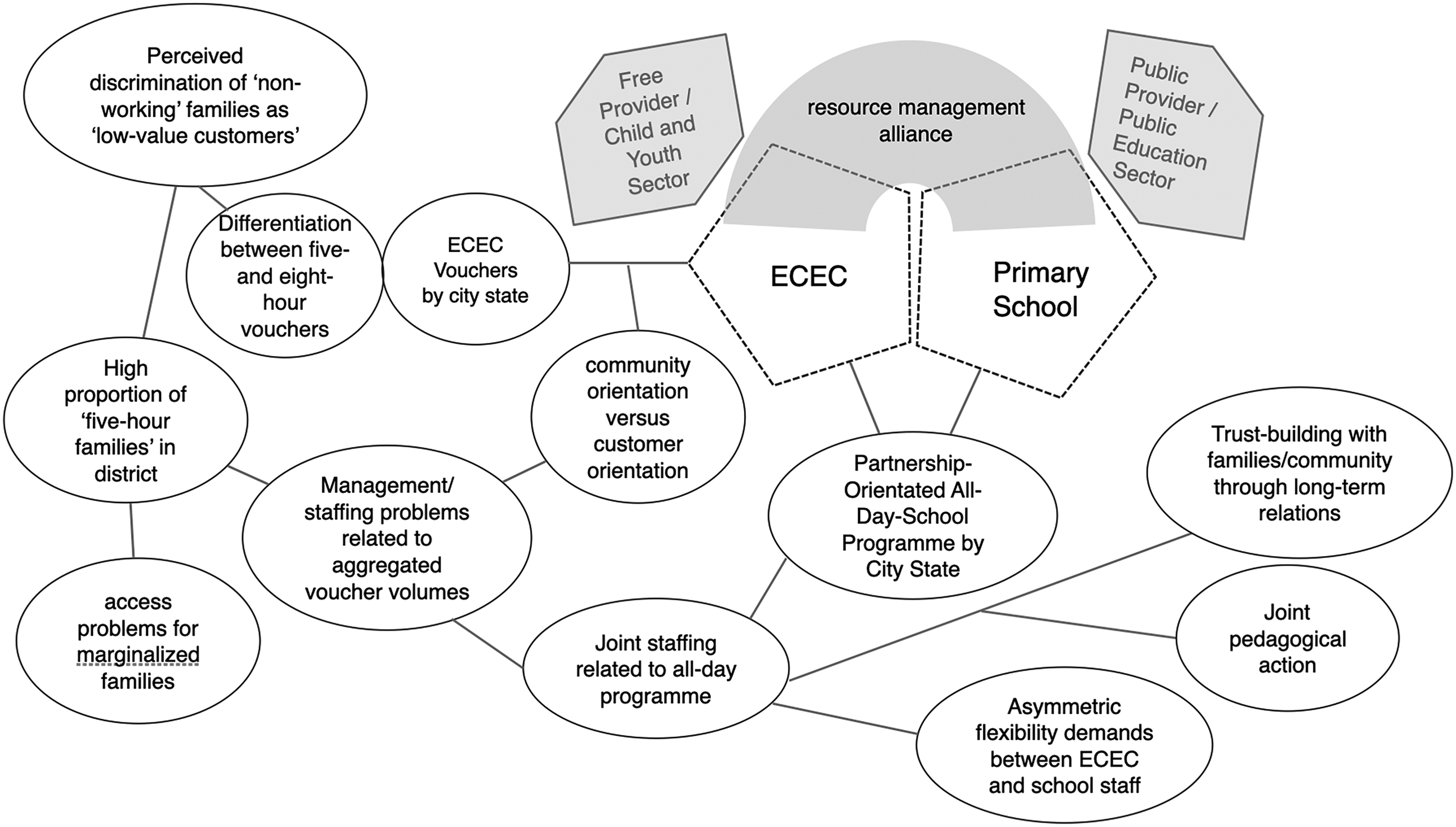
Exemplary situational map ‘inequality-related administrative territoralization through resource-based all iancing in Bildungshaus/Hamburg’, own illustration.
We then applied a nested comparative framework. Vertically embedded in the national contexts of Germany and Hungary and their respective governance structures (national, state, communal, local), we horizontally compared the inclusive practices of the individual kindergartens. This combination of horizontal and vertical analysis allowed us to understand the connection between the institutional, the local and the national by unveiling how similar practices of territorial inclusivity unfold in different contexts. All interview quotes presented here were translated from German or Hungarian by the authors.
The standards and principles outlined in the ethical guidelines of the PIONEERED Project were developed in accordance with national and international regulations, and the same recommendations were followed during the ‘Inclusive Kindergartens' Project research. All of the interviewees gave their written informed consent and decided on the level of anonymization they desired – they agreed to naming the institutions. The parents of the children attending the institutions were informed before the research began. However, the research process did not interfere with any pedagogical work, and the children themselves were not subject to any questions or observations.
Case study analysis: Practising territorial inclusivity
Analysing the two projects comparatively, we have identified two components of ‘striving for territorial inclusivity’ in the given local contexts. We argue that dissecting these categories sheds light on how inclusive ECEC practices are conceptualized and produced by multiple aspects of their ‘territory’ (Champollion, 2015) and, conversely, how education policy may be utilized by local actors to shape the political, social and physical space they control. The two categories of practices are (1) practices of territorial control and (2) practices of social-space rearrangement. In presenting the results of the analysis, built on the theoretical framework of the article, we introduce the wider context of our findings (vertical comparison), followed by local and national specificities (horizontal comparison) and conclusions connecting both dimensions of the comparative analysis.
Practices of territorial control: Creating new territories of action and control
We use the term ‘practice of territorial control’ to capture the process through which actors claim political power, (re)defining boundaries (demarcation) and the associated governance structures and practices in a given territory (Giband, 2019; Lythgoe, 2022). More specifically, they create a political space in which they claim autonomy over policies, resources and imaginaries (Paananen et al., 2023). Here, different trends in the creation of political scope for action in educational institutions become important for understanding the strategies in the two countries.
Like other European countries, Germany is undergoing a decentralization process, shifting some power from the states to individual schools and strengthening regional education structures (so-called ‘local educational landscapes’) through networking programmes and municipal education monitoring (Sendzik, 2020). ECEC services are traditionally administered by municipalities in close cooperation with their – mostly – ‘independent providers’, which are key in the German welfare system. Hamburg, however, stands out, with comparatively high school autonomy embedded in the strong political imaginary of an education market that emphasizes data-driven governance by social indexing and performance tests, as well as parental ‘free choice’ in both ECEC and schools.
In the Hungarian context, an opposing trend – centralization – has dominated different systems of governance. Schools have been renationalized from ISCED 1 upwards. However, the expansion of private (church-run) institutions has been observed (Neumann, 2023). Most of the kindergarten sector is maintained by municipalities, whereby pedagogical and administrative freedom is curtailed ‘only’ by the constraints of financial and human resources. In accordance with national tendencies, the possibilities of the municipality in our research were restricted due to centralization: lacking power to implement school programmes above ISCED 0 level, it was having to focus on the kindergarten sector, where it had retained some agency.
These contextual factors are crucial for understanding the first set of territorial practices observed in both cases – namely, attempts to foster inclusivity through the establishment of new spaces of control. Such practices can be interpreted as subversive strategies that are deeply embedded in, and responsive to, the surrounding political environment, thereby giving rise to markedly different forms of territorialization.
Hungary: Imaginary-building and new alliances
In the Hungarian case, the first practice of territorial control that we have identified is imaginary-building. Imaginaries are similar to ideologies: they help make sense of the world by providing a clear and simplified picture of what is happening, and set the goal for entire communities (Paananen et al., 2023). They are therefore also political tools, produced and used by those exercising symbolic power (Bourdieu, 1989). As Paananen et al. (2023: 165–166) point out, the dominant policy imaginary in Hungarian ECEC ‘constructs those children and families who are already marginalized … as different from Hungarians with “proper” norms and values’. The Inclusive Kindergartens project, focusing on inclusivity and desegregation, was part of an alternative policy imaginary and, as such, a ‘counter-hegemonic’ move (Karlidağ-Dennis et al., 2022). This ‘symbolic struggle over the perception of the social world’ (Bourdieu, 1989: 20) was significant as the district had gradually developed into a ‘battlefield’. After 10 years of the governing party, Fidesz, running the district (Goff, 2019), a new independent mayor was elected in 2019, who emphasized the diverse profile of the area. This clash between political cultures and policy imaginaries in the district represented the national-level culture war ‘in miniature’, with both sides relying on the territorial characteristics of the district. While government media applied stereotypical images to instil fear in local voters, the municipal leadership attempted to build an alternative imaginary of solidarity and community.
Imaginary-building was made possible by another, highly interrelated practice: the development of new alliances. In the Hungarian case, this took place between the municipality, the European Union, civil society organizations and external professionals. The municipality utilized European Union funds to regain agency in a highly centralized and regulated national environment of governance. The creation of a new territory of control by this intersectoral alliance allowed the municipality to reshape the district according to its own imaginary. This, while countering national hegemonic imaginaries, extended the territory into a transnational space, which connected the district to the European level.
However, a missing component in the ‘new alliance’ was the kindergarten staff. Our research found that communication on both the practicalities and principles of the project was initially vague. First, the concepts of desegregation and inclusion were not clearly defined; usage of the former was reduced to avoid a backlash among parents and teachers. As the communications manager of the project explained, the project management team did not want to suggest that more privileged parents, with a high socio-economic status, needed to change their behaviour and make sacrifices for the sake of social equality: The classic human-rights-based argumentation … had to be changed. You cannot convince people by … saying they are racist, or they have middle-class vanity or envy or whatever. … Even the language that we use is laden with superiority. And people hardly ever want to follow through on things dictated from above. Why should it be their child who falls victim to a social-engineering project?
Second, as our interviews showed, kindergarten staff expressed indignation at the goals of the project because they were convinced that their practices had already been inclusive enough (despite the consortium's efforts to avoid suggesting otherwise). The initial lack of reflection on the part of the municipal leadership on the perceptions of field workers confirms that the project started as political, and inclusivity was not only an end but also a means (of imaginary-building). Moreover, by missing the majority of kindergarten staff out of the ‘new alliance’, the consortium somewhat distanced itself from the locality while maintaining closer proximity to an imagined transnational space. This discrepancy between the attention paid to the transnational and the local was also mentioned by multiple respondents, who expressed the feeling of ‘being used’ for the sake of the ‘European Union project’. How this changed after the early phase of the research is discussed below.
Germany: Creating a cross-sectoral organizational territory
In the German case, it is an organizational, place-based cross-sectoral alliance between a primary school (the education sector) and an ECEC facility (the youth welfare sector) that allows actors to open new possibilities for territorial inclusivity. By defining themselves as one organizational entity despite belonging to different administrative sectors, the professionals created a new physical unit of their facilities located nearby. Most importantly, they also produced a set of cross-sectoral interlinkages, which allows for the structural boundaries of each sector to be overcome. These interlinkages include (1) structural and case-related support for children with special needs; (2) multi-professional implementation of preschool classes and inter-grade learning; (3) community-related networking; and (4) all-day schooling. To this end, the alliance has also used state programmes that foster cooperation between youth services and schools, but exceeded the idea of cooperation by sharing resources too. The partially independent ‘administrative territory’ – or organizational ‘discretionary space’ (Lipsky, 2010; Moth et al., 2025) – produced by this alliance helps in particular to combat systemic inequalities that stem from individualized funding instruments in both the education and youth services sectors in Hamburg.
One example of this new ‘administrative territory’ is the task force of inclusion specialists that spans both institutions. Through coordinated patchwork financing of permanent positions that operates in the ECEC facility and the school, this professional inclusion team helps to overcome a central problem of German inclusive policy – namely, that it is built primarily on individual-assistance subsidies for children with special needs operated by low-skilled hourly employees (Lübeck, 2019). Another example of how the organizational alliance creates a new administrative territory is the handling of the Hamburg voucher system, which allows parents to ‘purchase’ ECEC services for their children. In this individualized, market-oriented financing structure, unemployed parents only receive vouchers worth five hours of free ECEC per day for their children, while those who are employed get more for a reduced fee. The higher ratio of children with five-hour vouchers in poorer districts, however, leads to potential staffing problems, as only part-time staff are required. This voucher policy thus turns unemployed parents into less attractive customers, weakening their position in the ECEC market, as explained by one administrative employee: But there are ECEC centres, I know of them, that send parents away as soon as it is clear that they will only have five hours. And the ECEC centres that the city runs here … actually only take [families with] eight hours. And we have parents who are dismissed after the nursery period [age 0–3] if they don't bring eight hours. And then they come to us. That's why we have a lot of five-hour children, because we don't look at the number of hours first, but at the other aspects.
The autonomous flexibility to look at ‘other aspects’ that the ECEC professional mentions here is, however, only made possible through the joint implementation of all-day schooling at the Bildungshaus. Here, a city-state programme is made use of, which funds the youth welfare organization to conduct the afternoon programme in the school. In addition to its benefits as a holistic pedagogical approach and the maintenance of trusting relationships between staff and families, this shared implementation of all-day schooling allows for the prevention of the systemic exclusion of ‘five-hour children’ by enabling full-time jobs, which are divided between working in the ECEC facility in the morning and in the school in the afternoon. This set-up secures territorial equity, full-time employment and job satisfaction, although it also leads to internal power imbalances, as the ECEC staff feel that they must be more flexible than the teachers.
Comparing these two control-related practices of territorial inclusivity, the intersection of the political, social, material and symbolic dimensions of territory becomes evident. Although, when compared on the horizontal axis, the analysed practices are different in terms of their applied strategies, set goals and addressed boundaries, they share common ground. Embedded in the vertical dimension, they rely on alliances that have been developed to resist either restrictive national policy imaginaries or individualized, market-based funding instruments, which pose the threat of further exclusionary mechanisms to the communities in the respective environments. Both alliances enable new, local scopes of action and the linking of social and educational policy – be it at a political or administrative level. They are therefore also good examples of practices developing vis-à-vis particular challenges that are engrained in the actual territories – or what could be called the spatialized material, political and social textures of educational institutions.
Practices of social-space rearrangement
Practices of social-space rearrangement are identified as the second component of striving for territorial inclusivity based on Bourdieu's (1989) and Wacquant's (2007) work. In the context of education, these practices are affected by parents’ spatial capacities and decisions, which are inseparable from their own social position and how they perceive the choices of others. When other actors are seen as distant in social space, their physical proximity can invoke difficult feelings, leading to the reinforcement of social divisions (Reed-Danahay, 2020). In studies of educational inequalities from a spatial perspective, there has been a focus on gentrification and privatization in the context of school-choice policies, which in practice allow only the privileged to move freely between institutions. The status anxiety of the middle class further intensifies geographical inequalities caused by residential segregation (Bunar and Ambrose, 2016; Butler and Hamnett, 2007; Freytag and Mössner, 2022). On the other hand, the emphasis by middle-class parents on social responsibility or diversity as ‘cultural capital’ (Yoon, 2020) tends to further the retention of higher-status children in public institutions. How these divergent strategies interact is, however, influenced not only by individual convictions but also by national or local social and policy imaginaries.
For our analysis, we apply the term ‘practices of social-space rearrangement’ to describe the efforts of institutional agents to critically engage with the established power structures of the territorialized social space by activating existing hierarchies and creating a flow of social and cultural capital (Bernelius et al., 2021). In both case studies, the primary practice of social-space rearrangement was the transformation of stigmatized institutions into desirable choices for middle-class parents who were attempting to maintain their social status by looking for a wide range of possibilities for their children and/or anxious about the inclusion and development of their children with special needs.
Hungary
In the Hungarian context, it can be seen that higher-level processes in the privatization of education and school choice are also playing out at the territorial level. Similarly to Ball and Vincent's (2007) case study of two gentrifying London neighbourhoods, in Józsefváros we also see ‘inclusivist’ and ‘exclusivist’ tendencies towards social mixing among middle-class parents, in parallel with their value systems in general and attitudes towards pedagogical approaches in particular. Among those who choose local municipal kindergartens, there is an appreciation of diversity as a source of capital (Yoon, 2020) – a pedagogical tool that will prepare children for ‘real life’. Conversely, parents who ‘flee’ these institutions were described by professionals as in fear of ‘social contamination’ (Butler and Hamnett, 2007) – their children's educational trajectories being hindered by contact with underachieving peers. In the Inclusive Kindergartens project, one way to rearrange social space was the modification of catchment areas to increase diversity in the kindergartens. However, as long as more privileged families were free to choose private or out-of-district kindergartens, there had to be further ‘bait’ offered to them to decrease segregation.
A main component of the project was ‘pedagogical innovation’, which, we argue, is a proxy for a practice of social-space rearrangement. The term ‘pedagogical innovation’ covered a wide range of novel practices introduced in the kindergartens: teachers were encouraged and financially incentivized to develop their own sustainable mini-projects, and training and field visits were organized to broaden their professional vision. An even more direct call to middle-class parents was the introduction of multiple new pedagogies – most importantly, an English-language programme. The idea was to adopt a popular programme from the market that would be attractive for middle-class parents, who would otherwise have to pay for it, and appealing to (young) local professionals, who could learn and implement a new technique that was in high demand. In some of the kindergartens, German language-, Minecraft- and magic-based pedagogies (Kovács, 2023) were also introduced. While the professional development of teachers and the implementation of new pedagogies was framed by the municipality as a means to ‘keep the middle class’, the teachers most often emphasized the benefits for disadvantaged children, who would not have had the chance to receive such services had they not been provided for free – that is, they emphasized the inclusive potential of universal provision. A young kindergarten teacher who participated in the English programme explained in a focus group how the programme managed to fulfil the needs of both middle-class and somewhat marginalized families: [The project] is happening here because [the leadership] noticed that they can build on the fact that the kindergartens have a certain composition – the multiculturality, the [Roma] ethnicity, they are all there, they are part of the institutions. … For example, there are children from other countries who do not speak Hungarian, but in the English sessions, the common language is not spoken by anybody, so all the obstacles are dissolved, and it has a community-building potential. … This is unique, that we took something that could have been considered a difficulty and we turned it into something positive.
Further practices of social-space rearrangement included an increase in the municipal wage supplement provided to educational professionals, which helped decrease the staff shortages – an issue primarily perceived by families with a high socio-economic status. Nevertheless, the head of the municipal kindergartens pointed out that this temporary solution would not be able to address the national staff-supply crisis. Despite concerns about the long-term sustainability of these advances, the increased wage supplement was an appropriate response by the municipal leadership to the expressed dissatisfaction of kindergarten staff (as explained in the previous section).
Germany
The Bildungshaus Lurup also invests in social-space arrangements to navigate tensions in its territory, including those between solidarity with the community and managing its own position in Hamburg's education market. Here, the foundation that runs the ECEC facility and related services represents the community-centred, solidaristic welfare tradition of independent providers, which, according to the head, is a conceptual counterweight to the Bildungshaus’s second leg in the more neo-liberal school sector and its compensatory approach to marginalized families. Thus, the alliance also helps to sustain an emancipatory concept of education, reflected by the avoidance of responsibilizing terms such as ‘educationally disadvantaged parents’, and by aiming for a level of educational achievement that inspires ‘others [to] want to come to us and not the other way round’, as one of the founders put it.
However, the groups of children at the Bildungshaus have indeed become more socially mixed in recent years because of gentrification, which has divided the district into marginalized families in the high-rise housing estate and middle-class owners of the small houses surrounding it. Although this has led to more German-speaking children attending the Bildungshaus, the low social index of the school still contributes to territorial stigmatization and deters middle-class parents. Nonetheless, the staff also recognize how their professionalized inclusive practices for children with special needs contribute to improving the Bildungshaus’s devalued position in the education market. Word-of-mouth advertising by middle-class parents of children with special needs about their experiences is widely trusted, leading to special educational needs counselling institutions recommending the Bildungshaus as well. The staff emphasize that their radically inclusive orientation is effective: ‘Because we say we'll take everybody anyway. So, I think we're often the last lifeline. … It's really that we take care of children who somehow don't have good educational prospects elsewhere’.
Although middle-class families seem to opt for the Bildungshaus only if they are experiencing or expecting problems for their children with special educational needs in other schools, the staff report that this is also recognized as active parental choice – the ultimate mechanism for making schools competitive and attractive in Hamburg's liberal school marketplace (Breidenstein et al., 2020). Furthermore, the Bildungshaus actively targets middle-class families by advertisements, such as making the school inspectors’ evaluation report available on its website, which highlights the comparatively high-quality and particularly good individual support available at its primary school.
In the staff's view, the organizational structure of the Bildungshaus is pivotal for attracting middle-class parents because the academic success of the children is rooted in the amount of time invested in building trust and providing holistic support to their families. Moreover, they consider the ECEC centre and family services as a gateway for ‘channelling’ middle-class parents into the school: Because many of them [the parents] don't think about it. ‘Ah, that's the nearest ECEC centre. Let's go there. … No matter what they're offering’. Then we can point out our advantages. And try to get already the right mix in the ECEC centre … so that it remains for the school, and parents enrol their children there.
While the idea of social mixing seems attractive for the Bildungshaus to compete in the education market, the staff also reflect on the ambivalent consequences of such social-space rearrangements for their territory: by providing good education they are also contributing to gentrification processes. Although the head of the Bildungshaus expressed that they do not believe that the high-rise estate ‘will disappear so quickly’, it is also feared that the displacement of poor families to the outskirts of the city will prevent them from benefitting from places such as the Bildungshaus, which over the years has acquired specific territorial competences in serving these vulnerable families. According to the head, the reorganization of the social space therefore also includes the fight for the right of ‘our people to stay in this area’.
Comparing the divergent practices of social-space rearrangement identified in the two countries, several similarities may be noted in both the horizontal and the vertical dimensions. Both institutions respond to ongoing gentrification and aim to utilize the changing character of their respective territories to destigmatize their institutions. Furthermore, they contribute to gentrification through actively mixing the social space, which raises multiple questions in both locations. In the Hungarian case, becoming attractive for the middle class was seen by the project leadership as a precondition of desegregation. Measures targeting the middle class (and, as a side effect, having a positive impact on disadvantaged children and teachers as well) were also necessary for including the kindergarten staff in the new alliances. In the German case, the staff of the Bildungshaus expressed ambivalent attitudes towards the influx of middle-class children: while it is their explicit goal to dismantle the stigma around the institution and pursue relatively high achievement for all children, they reflect on the threat that the growing marketability of their services poses to their primary target group – vulnerable families. Finally, while targeting local power structures, neither of the projects challenged the neo-liberal paradigm that ‘good education’ from an extremely early age is key to survival and success in a highly competitive sociopolitical and economic environment.
Conclusion
In this article, we have explored how practices of inclusive education operate in relation to their respective physical and social environments. We have asked how these practices of ‘striving for territorial inclusivity’ are produced and how they shape their spatial environments. To answer these questions, we have comparatively analysed two ECEC projects identified as striving for territorial inclusivity – one from Germany and one from Hungary.
The first similarity we found is that both projects have developed in contexts that are somewhat repressive towards the goal of inclusion. In Hungary, dominant national imaginaries endorse traditional social hierarchies instead of inclusivity and diversity (Paananen et al., 2023). In this system, setting inclusivity objectives may be considered a symbolic counter-hegemonic move. In Germany, social and educational structures hinder inclusion in a more subtle manner: the lack of resources affects vulnerable groups disproportionately, and ‘inclusion’ often remains mere terminology (Hogrebe et al., 2022). In both contexts, local actors relied on cross-sectoral and transnational alliances, which helped them to ‘trick’ the system (in Hamburg) or raise funds and professional knowledge (in Budapest).
Second, rather than targeting vulnerable families individually, both projects aimed to shape the whole sociopolitical structure of their territory. The means and the specifics of these efforts were nonetheless different in the two cases. The Bildunghaus Lurup developed an alternative way of operation, using tools provided by the city state of Hamburg but managing to compensate for exclusionary side effects (targeting the political administration). The Inclusive Kindergartens project mobilized its new alliances to build an alternative vision based on the idea of territorial inclusivity, sometimes even losing its local focus (targeting the political imaginary).
Third, the projects shared the ideal of ‘world-making’ and, as alternative symbolic powers (Bourdieu, 1989: 22), responded to gentrification by exploring the possibilities of social-space rearrangement and social mixing. In the Bildungshaus, these new options were received with ambivalence, acknowledging the dangers of marketization in a space where vulnerable families are often left behind when competition emerges. In the case of Józsefváros, the appearance of the middle class was unreservedly desired (for both desegregation and inclusion purposes).
As we have shown, the analytical concept of territorial inclusivity enables us to deliver more than cross-national comparative case studies. It also allows an exploration of the dynamic relationships between local practices and national and global processes. While the former aim to establish inclusive ECEC, they are often up against the latter, such as inclusivity agendas or the marketization of education (Campbell-Barr and Bogatić, 2017). The case studies presented here have revealed that the tension between social justice approaches and neo-liberal imperatives, present in European inclusion policy (Liasidou and Symeou, 2018), also imbues the political, social, material and symbolic dimensions of the respective territories. With respect to these findings, we argue for the continuation of the spatial turn in inclusion (Rißler et al., 2023). An analytical focus on territory-related practices may reveal how institutions relate to and navigate their complex environments, and the inclusion challenges and ambivalence embedded in them.
The combination of two critical spatial concepts – territory (Giband, 2022) and social space (Bourdieu, 1989) – proposed by this article can be particularly helpful in informing spatial thinking in pedagogy. Our analysis shows that inclusion in ECEC institutions is hindered by a wide range of barriers that cannot be explained solely by governance structures or social environments. Complex territorial dimensions are also at play, which are not always immediately apparent to professionals but handled effectively in their daily practice. Professionals’ strategies of striving for territorial inclusivity not only evolve in relation to the underprivileged living conditions of the families they serve but are also shaped by market-oriented and political orders of recognition directed at ECEC institutions – orders they tend to reproduce in their efforts to legitimize themselves as ‘successful’ and attract middle-class families.
This reveals the paradoxes inherent in social-space-oriented pedagogical concepts in ECEC as well. If ECEC institutions refer only to ‘the’ social environment in which families live, without reflecting on the diversity of multidimensional spaces in which those and themselves are embedded, they risk implementing their efforts against inequality in highly ambivalent ways. This is apparent in the two cases presented here: despite their differences, the practices of social-space rearrangement in both the Hungarian and German cases risk the reproduction of precisely those systems of recognition they seek to challenge. In this respect, social-space-oriented pedagogies in ECEC are in urgent need of theoretical clarification grounded in critical spatial theory (Kessl and Reutlinger, 2026). On the one hand, the acknowledgement of the political, material and symbolic dimensions of space is necessary. On the other, it is essential that practitioners understand not only others within their social space but also themselves, developing a critical and reflexive stance towards the complexity of territorial inclusivity.
Footnotes
Data availability
The data sets analysed in this study are not publicly available due to the corresponding agreements with the research participants regarding the subsequent use of the data, but are available from the corresponding author on reasonable request.
Declaration of conflicting interests
The authors declare no potential conflicts of interest regarding the research, authorship and/or publication of this article.
Ethical approval and informed consent
European, national and institutional ethical regulations were followed. The approval of ethics committees was not requested. However, the ethics guidelines of the “PIONEERED – Pioneering Policies and Practices Tackling Educational Inequalities in Europe”-Project were approved by an external ethics supervisor. The same guidelines were followed by the research connected to the Inclusive Kindergartens for the Quality Education of Roma project. All of the participants provided written informed consent prior to participating.
Funding
The data collection for this study in both Hungary and Germany was conducted as part of the PIONEERED – Pioneering Policies and Practices Tackling Educational Inequalities in Europe project, funded by the European Union's H2020 Research and Innovation Programme (grant number: 101004392). In Hungary, further research was conducted within the framework of the Inclusive Kindergartens for the Quality Education of Roma project, funded by the Rights, Equality and Citizenship Programme of the European Commission (grant number: 963286).
