







Abstract
In this paper, by taking seriously the sensuous and embodied becomings of early childhood education, we make an alternative case for professionalism that foregrounds artful and divergent ways of working, attuning to affective methods of learning through sensing practices that imbricate early educators in more-than-human pedagogies. We demonstrate how developmentalism works to keep children and teachers inside a logic of ‘progression’ and ‘normalisation’, preventing differently-knowing bodies from mattering. Taking inspiration from Manning's notions of the ‘artful’ and finding ‘diversity in diversity’, we advocate for new forms of artful professionalism that become attuned to, and affected by, neurodivergent multi-modal bodyings. We explore how professional modes that co-compose with young children's alternative ways of knowing can animate expansive educational possibilities. Using a research-creation approach with software, we artfully engage with rasterised images of a wool–child–guinea pig encounter, enabling a slowing down and an attunement to sensuous moments with minor resonances. These sensing practices surface the inarticulable affects of more-than-human co-composition – frustrations, joys, curiosities – teaching us much about the potentialities in children's worldings beyond words. We propose a professionalism grounded not in judgement or comprehension but in participation, speculation and embodied experimentation. Becoming an artful, divergent professional is, we find, a generative move. It invites a sensitivity towards emergent possibilities, a resistance to talk, a yielding to what else matters and an openness to the productive differences of bodies. It is a risky but adventurous professionalism that feels at home in the non-conforming, messy and multi-sensory worlds of early childhood.
Troubling conventional approaches to early childhood education
These are precarious times for early childhood educators adhering to standardisation, regulation and accountability regimes which are often in conflict with desires to be responsive to divergent learners and affective environments. Working within frameworks shaped by linear assessments of developmental progression, we wonder how professionalisms might be re-imagined through co-created, otherwise-accountable approaches. We are troubled by the selective use of child development theories to measure progression, enforcing prescriptive, hierarchical and deterministic practices (Wood, 2020), which constrain creativity and responsiveness in educators (Nutbrown, 2021). This paper challenges the clinical model of such frameworks that compel education professionals to function like medical professionals, following pre-determined policy prescriptions as a way to fix allegedly broken bodies and minds.
We welcome the myriad embodied, sensorial, affective ways of knowing that (neuro)divergent bodyminds bring, advocating for alternative assessment approaches that recognise divergent bodies as different – not broken (Churchill Dower, 2025). As arts education professionals navigating the frictions of creative and educational policy and practice over three decades, we conceptualise an artful professionalism that reconfigures the narrow prescriptiveness of developmentalism. To help co-create a new map to guide educational journeys, we invite professionals to experiment with new creative ideas by moving subtly from following prescriptions to co-creating prescribings. These are dynamic ways of experiencing learning encounters that emerge moment by moment. What becomes real, imagined or learned in one instant can become transformed in the next before it can even become a prescriptive event. Prescribings resist being assessed within conventional knowledge boundaries because they are continually responsive to the ideas, spontaneity and creations forthcoming, continually re-scribing the stories almost before they have become known.
We offer playful visual provocations of prescribings (or (p)re-scribings) by re-imagining the paper-based prescriptions used by the National Health Service (NHS) in England. By altering the materials, doses and application processes normally prescribed for bodymind ‘fixes’, these prescribings animate an artful thinking to resist the linear, homogeneous logics of developmental curricula, and challenge prescriptive notions of what and how knowledge is created in early childhood education (ECE).
Drawing on Barad’s (2007) concept of agenting, where agencies are in continual intra-active movement, prescribings are fluid, relational and indeterminate, inviting knowledge-making that exceeds fixed outcomes. We argue that moving-with prescribings fosters a care-full, activist and responsive professionalism that unfixes the reductive assumptions of what a child should know according to developmental stages. Rather than following policy prescriptions grounded in developmentalism, we propose that artful prescribings might help reclaim educators’ capacities for creativity and responsiveness, opening space for knowledge-creation possibilities that might otherwise be missed.
Progression by another name
By taking seriously the sensuous, affective and embodied environments of ECE settings, we make a case for an alternative professionalism that foregrounds different kinds of progression. We reconceptualise artful professionalism as responsive and response-able (Haraway, 2016) ecologies of practice. Informed by posthuman feminist materialist theories which attend to becomings-with multimodal bodyings, we foreground collective, sensorial and affective knowledge-making practices (Kind, 2020; Lenz Taguchi et al., 2016) that resist normalising logics and enable differently-knowing bodies to matter (Churchill Dower, 2023; Fairchild, 2017). We think of these as ‘resistance practices’ where ‘different kinds of noticing matter’ because they serve to challenge dominant narratives (Albin-Clark et al., 2024: 347).
Exploring alternative professionalisms is vital within the context of ECE in England, where the statutory curriculum framework – the Early Years Foundation Stage (EYFS) (Department of Education, 2024) – relies on Western, colonialist and developmentalist logics to assess and measure learning progression (Burman, 2017; Murris, 2016). Drawing on international models of what is developmentally appropriate (Wood, 2020), the EYFS guidance promotes universalised standards for knowledge acquisition – including for special educational needs or disabilities (SEND) and culturally diverse contexts – that marginalise children who do not conform. As Burman (2017) argues, such linear, essentialist assumptions of biological growth risk pathologising difference, relegating divergent learners to the realms of being delayed, educationally subnormal or somehow physically or cognitively broken. We advocate for a professionalism that holds a greater sensitivity to diverse ways of learning, with particular attunement to neurodivergent modes, and suggest that artful approaches offer meaningful alternatives to normative progression frameworks, especially in non-traditional learning situations. Here are two (p)re-scribings that might support an artful professionalism in these contexts (Figure 1).
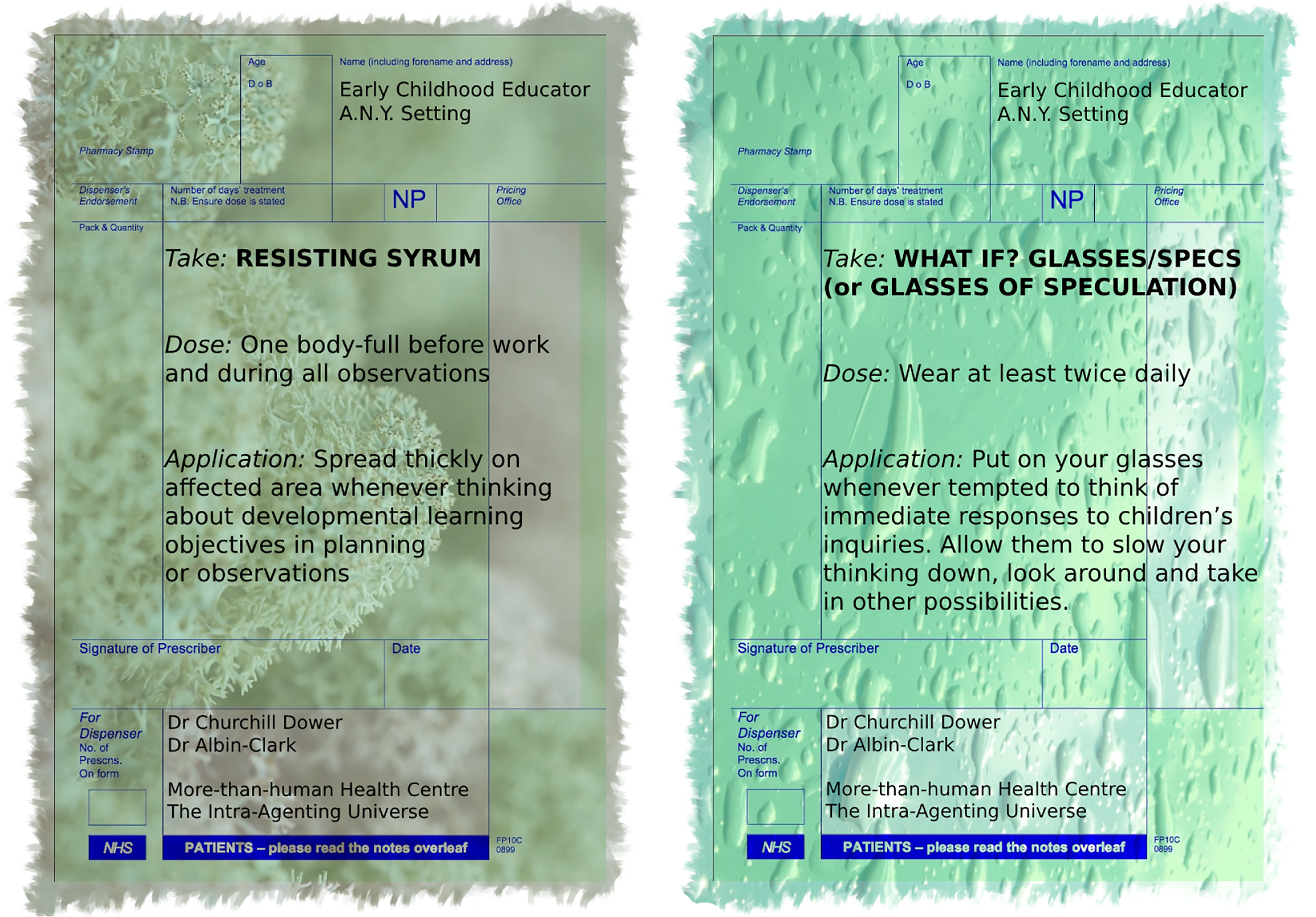
Resisting and What if? Prescribings. Source: Churchill Dower.
Artful practices that ask ‘what if?’ and ‘what else?’
Manning (2016) describes the artful as a ‘bridge towards new processes’ (2016: 47) that attune us to the more-than expressions of the world. The artful is not about an arts discipline or skill but a way of thinking and yielding imaginatively and intuitively as a collective, beginning ‘not with the object, but with what else art can do’ (2016: 46). Artful practices open space for ‘new forms of perception, accountability, experience, and collectivity’ (2016: 56), and honour the complexity of children's knowledge-creation by keeping those inquiries open as an evolving practice of research-creation (Springgay and Truman, 2018).
In teaching and learning, artfulness holds space for the more-than to emerge – ideas, relations and environments that resist singular solutions, a quick fix, a standardised measure. Rather than foreclosing how an educator should teach or a child should learn, the artful slows thinking down, sensitising teaching–learning collectives to their cultural, historical, material, political and affective dimensions, often overlooked in the traditional teaching–learning dyad (Strom et al., 2019). It recalibrates perceptions of professionalism through inclusive practices that recognise different ways of knowing, including neurodivergent bodyminds whose knowledge is often created through a keen synaesthetic sensitivity for their environments (Massumi, 2002). Artful professionalisms invite educators to be affected and sensed as much as affecting and sensing. 1 This, we argue, aligns with young children's playful, in-the-moment worlding, and has much to teach educators about new ways of knowing.
In what follows, we explore a research-creation (Manning, 2016) encounter from Churchill Dower's (2025) PhD study involving an improvised intra-action (Barad, 2007) amongst wool, movement, a guinea pig and a young child. During the spring of 2021, six families met in an art gallery in the north of England to play with the possibilities of contact improvisation – a relational dance form responding to nonlingual body languages. Over six weeks, families with children who did not talk outside of their home engaged with the haptic, sensory and kinaesthetic qualities of different materials. Their nonlingual improvisations with wool, Lycra, feathers, ribbon, paint and bubbles helped us attune to the minor, more-than-human resonances that affect teaching–learning bodies beyond words. Whilst we were not able to conduct the fieldwork inside schools due to the COVID-19 pandemic, these co-composed moments across family–material relationalities offered rich insights for educators, revealing affective dimensions of learning – frustrations, joys, curiosities – and tentative understandings that remain inarticulable (Osgood, 2024).
This piece moves beyond theorising the artful toward experimenting with its pedagogical application. We invite a sensing-conversation about artful professionalisms through what is absent or obscured, introducing a second research-creation event that offers an alternative, affective response. In a sensing dialogue with the first event, this second artwork inhabits the speculative middle – a space of ongoing inquiry, ‘where the speculative “what if” emerges as a catalyst for the event’ (Springgay and Truman, 2018: 206). In educational practice, we take this to mean resisting pressures to extract meanings or rush to outcomes and remaining ‘inside’ the learning encounter by attuning to the sensations arising and becoming-with the children, materials and relations emerging as co-participants in the agenting-prescribings.
By asking ‘what if?’ and ‘what else?’, an artful professionalism troubles the presupposition of teacher-as-expert (Fairchild, 2017), the relentless desire for meaning (Hackett and Rautio, 2019), the individualised responsibility for learning (Murris, 2016) and the classroom as merely a container for certain types of material knowing (Fairchild, 2017). It helps us map out some of the risks and implications of opening up to sensing, affective processes that move beyond curriculum-defined outcomes, and consider what this might mean for rethinking the role of ‘teacher’. Working within the speculative middle (Springgay and Truman, 2018), we resist pre-planned methods and the use of the arts as instrumental forces for learning goals, instead engaging in relational, sensing and affective research-creation encounters (Lenz Taguchi et al., 2016). We wonder what it takes to co-create spaces that don’t anticipate children's ideas or foreclose possibilities. What could artful processes open up when they mobilise unconventional relations and (knowledge) creations that exist in the interstices between conventional education and care?
Professionalism as artful
Thinking-with professionalism as artful shifts the focus from individual human subjects of child, educator or researcher to the relationalities among bodies, materials, environments and atmospheres. Manning (2016) defines artfulness as a mode of being that emphasises a relational engagement of process, emergence, resonance and affect. This reconfigures professionalism as a continually evolving entanglement of materials and discourses (Barad, 2007), positioning it as both an ethical and political imperative. For example, Somerville (2014) frames professional learning as inherently tied to planetary sustainability and ethical responsibilities. Yet artful sensing practices are still not considered part of majoritarian educational narratives due to their ephemeral nature (de Freitas and Trafí-Prats, 2023). Following Fairchild (2017) and Osgood (2019), we imagine professionalism as a more-than-human ‘little becoming’ where educational relations are affective and affected by materialities, space and place; ‘It might be that professionalism can be encountered as processes, as little becomings that manifest through entanglements that are sensed and felt (rather than as an external concept that is imposed and performed or contested)’ (Osgood, 2019: 203).
Becoming professional is an emergent, hesitant process, according to Reinertsen (2017), which brings ‘complexity and ambiguousness as strength and a force in our practices’ (2017: 277). Albin-Clark et al. (2024) describe these forces in educational spaces as more-than-human ecologies, where cracks can be made in existing practice by reshaping stories and pushing back on conventions. By sharing stories of resistance that effect change, this mode of professionalism effects change through the co-creation of knowledge that values process and product across distributed and collaborative agencies. To be artful is to attune to the unfolding experience of minor, creative acts that can transform perception and relation (Manning, 2016).
Giamminuti et al. (2024) consider artful professionalisms through the role of the pedagogista in the Italian settings of Reggio Emilia, framing them as a collective practice across multiple agencies embedded in historical, social and political dialogue. This reflects Barad's (2007) advocacy of multiplicity, conceptualising agencies not as individual ‘things’ but ‘doings’ where everything is always already agenting. In other words, nothing exists prior to its relations with other historical, social, material or discursive influences, always re-shaping each other because ‘[b]oundaries do not sit still’ (2007: 171). Leaning on such ideas, professionalism, then, emerges through these dynamic entanglements of historical and future agenting phenomena, including everything children (for example) already know or are, or have the capacity to know or become. In practice, this means noticing and responding to how children engage differently with materials and environments, allowing space for curiosity and relational becoming to unfold; to be agenting as they become-with each other.
In the agenting process we, as educators, become artful apparatuses – facilitating conditions of possibility that enable new ways of moving and relating. Barad describes apparatuses as fluid and emergent ‘boundary-making practices’ (2007: 146) that both produce and are part of phenomena. As apparatuses, pedagogues play an important role in mobilising alternative future intra-actions, challenging the ‘traditional notions of causality and agency’ (2007: 177) in dominant educational narratives and, in so doing, continually reconfiguring what is real and possible.
Central to agenting approaches is recognising, or sensing, the multiple intra-actions affecting the practices (material and discursive) of artful professionals, generating imaginative ideas, curiosities and perceptions in children's learning, examples of which we will expand on shortly. These examples unfasten the prescriptive accountability cultures that shape conventional professionalisms and impact children's lived experiences. However, we recognise that adopting the agential prescribings of an artful professional is not easy amid intensifying accountability for the early childhood education and care workforce in terms of being controlled and normalised (Osgood, 2006), gendered (Osgood and Robinson, 2019), commodified (Gibson et al., 2015; Roberts-Holmes and Moss, 2021), datafied (Roberts-Holmes and Bradbury, 2016), de-professionalised and poorly remunerated (Mikuska and Fairchild, 2020). These are stabilising forces designed to regulate and limit divergence from a prescriptive, conventional professionalism. In the face of this, we argue for re-conceptualising professionalism through little artful becomings that foster more creative, responsive and neurodivergence-affirming teaching and learning practices.
Fairchild (2017) proposes a fluid negotiation with these forms of accountability, embracing ‘a politics of possibility in which emerging early years teachers are engaged with an embodied and material world’ (2017: 294). This politics of possibility underpins artful practices, where distributed agencies generate pockets of resistance that push back against accountability cultures (Archer and Albin-Clark, 2022). In making space for alternative professional prescribings, we consider sensitivities that destabilise prescriptive practices marginalising other ways of being. We offer two possible (p)re-scribings above (Figure 2).

Artfulness and Politics-of-care prescribings. Source: Churchill Dower.
Professionalism as an ethics- and politics-of-care
It is important to recognise the challenges for professionals who pursue artful becomings but struggle with everyday cultures and standardised systems that do not allow alternative ways of knowing to flourish (Osgood, 2006). Becoming professional in ECE is challenging amid such constraints. Yet attentive engagement with more-than-human relations reveals glimpses of artful professionalism and a politics of possibility grounded in ‘the centrality of humour, emotion, empathy, compassion, intuition, love and commitment’ (Osgood, 2019: 200).
What matters in reconstructing professionalisms through artful, sensing practices is that it illuminates the unfolding storying of ECE as a site of everyday resistances, where careful, hesitant noticing becomes a catalyst for relational, more-than-human processes of agenting. These affective forces become known as felt sensations rather than as evidence of learning with hard boundaries. Professionals attuned to young children's ways of knowing the world enact these everyday resistances by putting an ethics- and politics-of-care quietly to work (Puig de la Bellacasa, 2017), subtly subverting conventional approaches. In these courageous, everyday choices, artful professionalisms grow not as a fixed method but as a dynamic, ethical and political pedagogy – in other words, a response-able practice (Strom et al., 2019).
In the following example, we explore how everyday, more-than-human resistances become agentive, opening possibilities for a collective politics-of-care and affective learning beyond the individual. Drawing on the non-classroom fieldwork encounter mentioned earlier, we apply an artful approach by rendering Go-Pro footage to foreground movement, knottiness, tangles and inarticulable struggles. Using a rasterising software filter, we shift the focus from facial features to the relational dynamics among a child, wool, a dress pocket and a guinea pig, animating the more-than-human sensings beyond what is observable and interpretable through sight and language, and revealing some of the resistance stories taking place. Next, we respond to this encounter by exploring how it might be positioned within curriculum-based languages that try to fix and focus the encounter around certain learning outcomes. We consider how this encounter might be re-encountered when perceived from the speculative middle of learning relationalities. In doing so, we aim to navigate new pathways across old territories, reshaping landscapes of precarity into a politics of possibility and hope. We conclude by offering two more artful prescribings – a practical, fluid and adventurous approach to sensing resistance stories designed to be unmeasurable, to counter the prescriptive strangleholds of developmentalist frameworks in ECE.
Woolly resistance stories
During Churchill Dower's (2025) fieldwork, families with young children (three to five years old) who don’t often speak began to create wool webs. They wrapped wool around the pillars and furniture of an art gallery until it became a woolly jungle for jumping, crawling, tugging, teasing, tangling and wriggling themselves into a knotty web of threads. They became materially and discursively entangled within the multicoloured lines.
One little girl did not join in, preferring to play with a single ball of red wool. She tried hard to find the elusive end of the yarn, unravelling more and more wool, lifting up its knotty configurations, pulling and tugging at its knots. Finally, the little girl discovered the end and, holding tight onto her fluffy toy guinea pig, stood on it, resolute that it would not get away from her again. Much had gone into finding this end, now firmly captured under her left foot as the little girl and her guinea pig surveyed the knotty conundrum.
Later, reviewing the GoPro images from this encounter revealed something not obvious during the session: the text ‘Always Be Kind’ embroidered on the little girl's dress pocket (see Figure 3). This minor gesture unleashed intense forces and a sensing of discomfort that brought forth new perspectives. ‘Always Be Kind’ seemed a huge demand of a small dress wearer, begging the question as to whether it was really that harmless a phrase. The threads started to unravel around what mattered in observing and reviewing this image, familiar sights becoming entangled with new meanings, woven with past – and not always pleasant – histories.
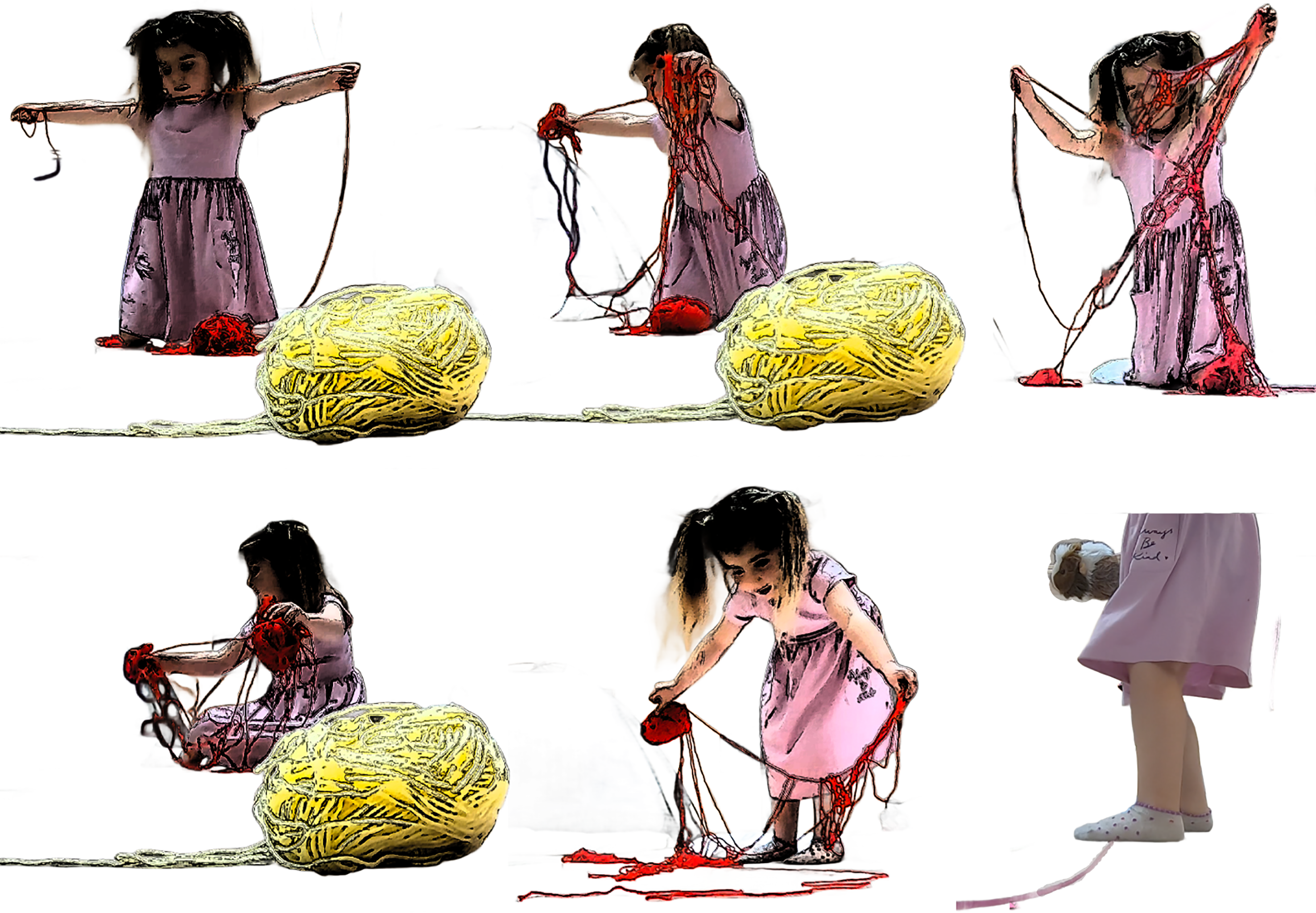
Wool–child–guinea pig entanglements, Churchill Dower (2025).
Perhaps the embroiderers of this dress worked in less-than-human conditions, or for wages that did not reward their skills. Was anyone kind to them? Or were these three words chosen to encourage a mass market towards global kindness, in which case, what would it mean to always be kind, and what would happen if the wearer ignored this instruction? ‘Suddenly, this tiny-text grew in significance towards a threat of regulation and discipline thinly veiled as a promise of rewards for good behaviour’ (Churchill Dower, 2025: 206). Nonetheless, this tiny-text also embodied acts of kindness, perhaps in the choosing of the garment for this little girl, or the skill of the embroiderer or the generative intentions behind the choice of text. Thinking-with the complex relations enfolded around this tiny-text enabled it to be viewed differently – not as an endpoint with fixed consequences to bear but as the middle, with much yet to become, of what is mattering between a little girl, her guineapig, some red wool and a spacious floor. What matters here is in the becoming of these threads, [shifting] this image from a subjective, interpretative standpoint towards revealing different scales, unravelling dominant forces and tracing alternative possibilities. (Churchill Dower, 2025: 207)
Attending to the complexities of entangled relations by noticing their affective vitalities, minor gestures and synaesthetic forces that are often beyond language is, we propose, how an artful professionalism grows. Being open to those sensations means being open to the potentialities of divergent life, taking on board the ‘what else…?’ the creativity of its differences, which helps us activate a ‘relational shape-shifting’ (Manning, 2016) towards neurodivergent teaching and learning.
Becoming professional by responding differently
Walk a familiar path repetitively. Listen to what is no longer there. (Springgay and Truman, 2018: 204)
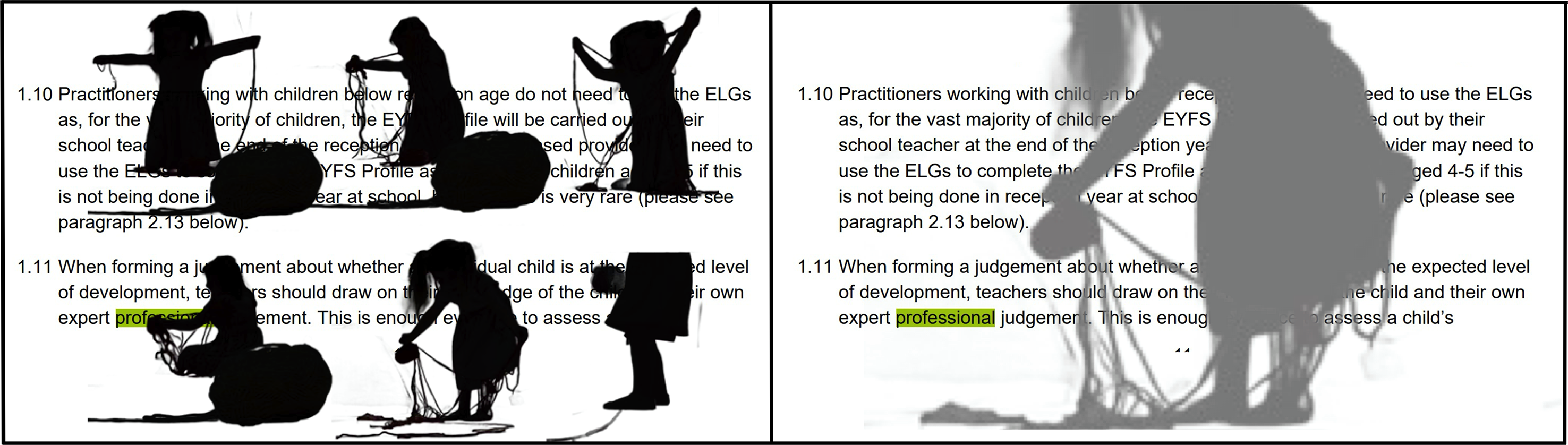
Sensing expert professional judgement. Source: Albin-Clark.
Springgay and Truman's (2018) provocation that research-creation involves walking a familiar path and listening inspires us to reimagine professionalism through these child–wool entanglings. Notably, the repeated phrase ‘expert professional judgement’ (Department of Education, 2024: 11) reveals an intriguing conflation of expertise, professionalism and authority.
Professionalism, according to the statutory guidance, is conducted by experts and involves a decisive exercising of judgement. Informed by a biological and developmentalist lens, this model assumes that children can be known, measured and progressed along a fixed trajectory, whilst the expert professional has a knowledge of each child's learning that can be predicted and shaped against expected levels (Wood, 2020). Moving and progressing children through these stages is what is prized above all. Being professional, it seems, is all about actively moving the child on (Figure 5).
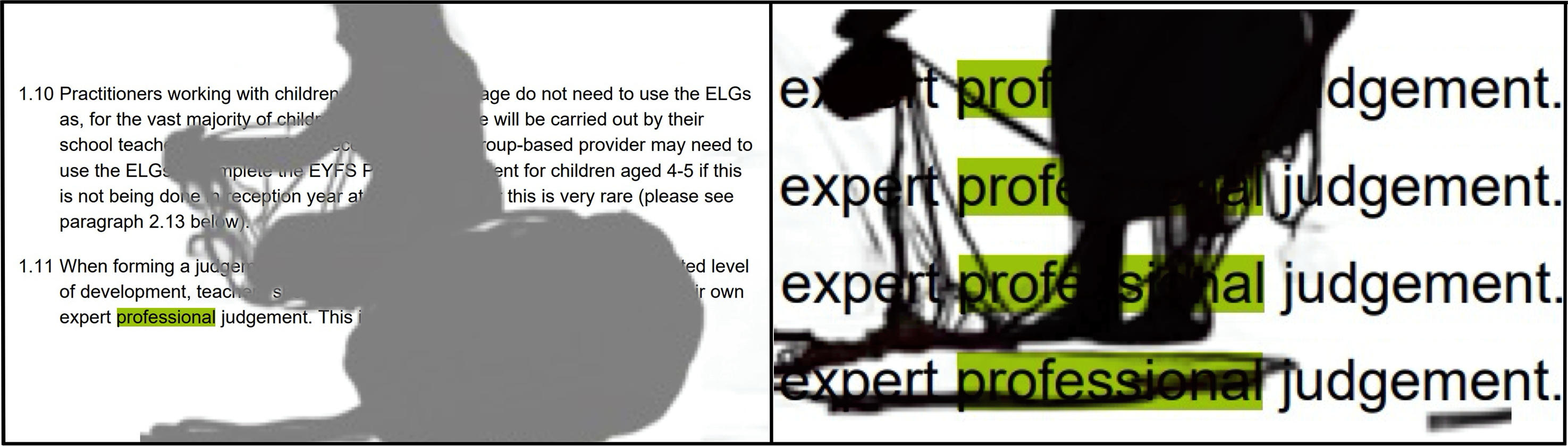
Resisting expert professional judgement. Source: Albin-Clark.
Artful professionalisms with wool–child entanglements offer a different figuration of expert professional judgement. Here, a space is created for negotiating and sharing across a rich, more-than-human assemblage (Lenz Taguchi et al., 2016), where expertise is not located solely in the teacher or child but emerges through intra-actions with nonhuman elements. Judgement is responsive rather than pre-determined, unfolding in the moment through embodied and sensed gestures, spaces, time and materialities.
This alternative model of professionalism engages with the ‘immersion, tension, friction, anxiety, strain, and quivering unease of doing research differently’ (Springgay and Truman, 2018: 204). We propose that mobilising expert judgement through child–wool–dress entanglements requires a tentative feeling-towards little becomings beyond developmentalist logics (Osgood, 2019). Here, expertise unfolds gradually, resisting the urge to forever move children on towards the foretold end points of developmental curriculum goals. Learning is understood as iterative intra-actions across multiple bodies, shifting the focus from measuring outcomes to processes. This effectively repositions the professional as becoming-with rather than presiding over learning processes, and repositions the child as a continual agenting collaborator in the learning process, rather than being ‘broken’, ‘behind’ or ‘failing’ to produce. Artful practices thus reposition learning as processes of sense-making with the world, honouring the historical identities, politics, uncertainties and sensitivities involved, allowing teaching and learning, observation and judgements to emerge through relational integrity rather than performative metrics.
In the woolly resistance stories above, it is clear that becoming-professional unfolds within a broader more-than-human ecology of ECE, where resistance to developmentalist discourses is already at work in everyday materialities (Albin-Clark et al., 2024). This kind of becoming moves beyond bounded interconnections, instead attending to the indeterminate zones between them – the hesitations, absences and quiet attunements that Fairchild (2017) describes as the ‘zone of indiscernibility’ (2017: 297).
We propose that this mode of becoming, or listening differently, requires attunement to multiple ways of knowing (synaesthetic, kinaesthetic and haptic, for instance), openness to affective and sensing environments and a willingness to remain with the tensions of learning's knotty unravellings. These little becomings require a re-crafting of the pedagogical bodymind as more-than-human, in a state of intuitive yielding and a willingness to move towards and co-create with its multiplicities. In this space, expertise and authority are not privileged but decentred in favour of situated responsiveness. In other words, the pedagogue becomes a curious, non-judgemental observer, waiting to see what might occur. They mobilise their curiosity physically (at the level of child–materials–objects), affectively (through embodied sensation), cognitively (by understanding those sensations beyond developmental logics) and intuitively (becoming-with and responding-to their situated possibilities).
Such embodied, affective time-and-space collaborations can happen anywhere, in any environment. Yet while many educators are well versed in following a child's lead or offering unusual materials as provocations for playful learning, we find there is something more to this than a conventional professionalism permits. We consider an artful sensing and intuitive responding to be vital apparatuses, or conditions, for observing and accounting differently as part of pedagogical practice. More than fulfilling learning objectives, intuitive responding repositions the pedagogue in the speculative middle of what is emerging, feeling the emerging possibilities without assumption or understanding. It transforms their purpose as educators from pre-determined boundary-setters and knowledge-imparters to uncertain boundary-re-shapers and knowledge-co-creators.
Unusual materials may spark new ideas, but the artful professional listens to those ideas with the body (Hackett et al., 2025), intuitively responding to the ‘glad eye’ inviting them in, feeling the sensations rising through every fibre of their being, becoming aware of unusual interconnections between humans and nonhumans. None of these responses are written down in curriculum frameworks or assessment regimes. But, with practice, these affective sensings are opportunities to transform learning by becoming-with the encounter and embracing the idea of not knowing where it might lead. Even in those inarticulable moments, intuitive, artful responses ensure that learning becomes situated, relevant, embodied and responds to the sensibilities of divergent learners.
Synaesthetic knowing – without separation of body and world
Crafting alternative professional identities is vital for attuning to the unconventional sensibilities of neurodivergent learners. Neurodivergent bodyminds – adult or child – are often finely attuned to the more-than-human aspects of their environments, intra-acting synaesthetically with the forces, frequencies and vibrations happening all around and within them, and from whom there is no separation that can be easily parsed (Manning, 2020). In this situation, no learning outcome can easily be assigned to (or measured by) the human element of that entanglement. In other words, neurodivergent bodyminds experience a full spectrum of sensations simultaneously – synaesthesia – whereas, for non-neurodivergent bodyminds, a dominant sense seems to arise above all others. For Massumi (2002), the synaesthete is ‘a body directly absorbing its outside’ (2002: 29, emphasis added), not a deviation from developmental norms. Synaesthetes ‘just prune the same developmental path less fully’ (Massumi, 2021: 345, original emphasis).
This has significant implications for models of developmental progression that impose a singular way of knowing on bodies that sense differently. Massumi emphasises that ‘affect is synaesthetic’ (2002: 35), therefore, the participation of senses in one another's expression is a measure of a synaesthete's deeply affective capacities. So much so that a neurodivergent synaesthete often lives without a sense of ‘where the body ends and the world begins’ (Manning, 2016: 112). According to Churchill Dower (2025), this makes it difficult to respond to developmentalist goals that measure gross and fine motor development, lingual communication, self-regulation and social integration as if these existed in isolation of the (sometimes overwhelming) forces of sensation. We call for an artfully attuned and affective pedagogy that embraces multiple modes of sensing and participating-with and helps neurodivergent learners function well. By this, we mean creating the ability to respond without having to constrain nonconforming sensory forces into ‘acceptable’ behaviours (Churchill Dower, 2025). In our view, this is what a response-able and respons-ive practice looks like – rendering the other capable of response by learning their languages of expression.
Improvisational processes that develop artful sensing practices
Churchill Dower's (2025) research found that ‘when sensory bodyminds dwelt in improvisation instead of being parsed through social or cognitive processes that perceived their incapacities, nonlingual ways were opened up to their “life-living” qualities’ (2025: 141). In thinking about what it means to be artful in these encounters, we propose that improvisational processes help educators become more attuned to the sensing practices of neurodivergent bodies. Sensing practices require a hesitation to act, a yielding, a resistance to interpretation in order to experience what might emerge beyond language. Improvisation opens minds and bodies to the unexpected, the unfamiliar, the listening to ‘what is not there’, or an otherwise figuration of the familiar curriculum framework. Lenz Taguchi et al. (2016) describe this as a process of ‘becoming-imperceptible’, in other words, opening up ‘the possibility of differing and diverging from already inscribed identities, norms, and behaviors’ (2016: 707).
In the encounter above, this might mean holding a space for the wool–child–guinea pig–knottiness to see what happens; holding off words or judgements that might interpret or pin down connections within a particular (developmentalist) perspective. It might mean resisting reason and sense-making, making space to value the richness of nonsense and remaining open to alternative synaesthetic perspectives on the world. For example, teasing out wool along the length of outstretched arms becomes an embodied, sensing practice for feeling the knotty patterns and resistances of its threads through every fibre, tendon, muscle and nerve. Such timeless spaces that enable synaesthetic sensings to matter are crucial, a timelessness that counters the fixed timings of curriculum-bounded, developmentally-progressed knowledge, and allows the overwhelming expressions of worldly sensations to become integrated into divergent bodyminds that might not perceive their separation from the world. These are bodyminds without agency or autonomy, not in the humanist sense of having reduced power but in the posthumanist sense of always becoming-with, always agenting and understanding themselves as multiple, distributed and already more-than-human.
In sensing what is coming to matter, Kind (2020) emphasises the importance of professionals ‘paying attention to the webs of relation, movements, rhythms, regions of intensity, and to that which is activated and set in motion’ (2020: 51). Therefore, we propose that the speculative middle of the wool–child–guinea pig encounter is not about professional subjectivity, but about participating in its more-than-human forces to sense the affective qualities of its interconnected material and discursive entanglements (Strom et al., 2019). Whether or not the educator inhabits a synaesthetic bodymind, becoming professional involves mobilising neurodivergent ways of knowing by ‘listening through lingering’ (Kind, 2023: 37), waiting for invitations to join in or hesitating and holding the space for dynamic intra-actions without imposing control. Keeping inquiry open and attuned to sensory registers is about feeling the vibrations that precede them, like the sensations of an oncoming subway train that can be felt through the feet before it can be seen or heard (Manning, 2016). It is a thinking-in-motion that perceives the multiple in experiences, trusting that the body knows the score and is engaging sensing practices which might otherwise be missed by a focus on developmental outcomes.
Many arts-based approaches – such as clay, painting, drawing, weaving, role play and dance – facilitate ‘affective flows, emergent knowledges, and articulations of relationalities’ (Strom et al., 2019: 22) that often elude language. These encounters invite ‘emergent, speculative ways of working, where new techniques are invented, and where new things might be noticed, felt, made, and enacted’ (2019: 22). Rather than abandoning curricula, which is rarely feasible, we propose artful practices as a divergent way of being in the middle of it. This has two key implications for professionalism. It requires first and foremost a withholding of judgement, a refusal to assume what the growth of a young human should be, recognising that development is not about the individual but about the multiplicities of more-than-human relations (Murris, 2016). Second, it requires a withholding of the ‘usual’ ways of knowing and measuring knowledge acquisition, in other words, through language. Barad (2007) argues that ‘[l]anguage has been granted too much power’ (2007: 132) in shaping the articulation of experience, representing it through fixed perspectives tethered to particular gendered, racialised, encultured and socialised normalities. These exclusionary configurations of childhood determine non-normative bodies as already deficient, in need of ‘fixing’ to become ‘successful’ in their educational journey and fulfil the expectations of ‘well-developing’ human beings (Hackett et al., 2025).
Furthermore, dominant developmentalist languages ignore that, particularly for young and neurodivergent bodyminds, kinaesthetic and synaesthetic practices precede words as the dominant way of sensing and knowing the world. Indeed, Sheets-Johnstone (2011) contends that ‘rather than speak of the period before language as the pre-linguistic, we should speak of the advent of language as the post-kinetic’ (2011: xxxi, original emphasis). However, what cannot be ignored is how a non-lingual, multi-sensing approach to knowledge creation seems so counterintuitive to the developmentalist logic of curricula's neat, linear sequences of learning progression (Hackett et al., 2025).
Artful professionalisms create environments, times and spaces for post-kinetic relationalities to follow emerging ideas that are sensed and, therefore, often inarticulable through language. By practicing an openness to becomings that are sensed instead of imposed (Osgood, 2019: 203), and a hesitancy to perform the expert-professional that rushes towards expected levels, the space opens up for yielding to the strange sense of not-knowing. In wool–child–sensing entanglements, the expert-professional is backgrounded in an artful, imaginative, collective yielding (Manning, 2016: 46) to a more-than-human, emergent pedagogy. Becoming artful disrupts the performance of individual-expert-authority and instead invites collective attunement to what and how else is learning happening here? The above (p)re-scribings invite artful professionals to expand their pedagogical gaze with an openness to multiplicities and an active refusal to limit horizons (Figure 6).
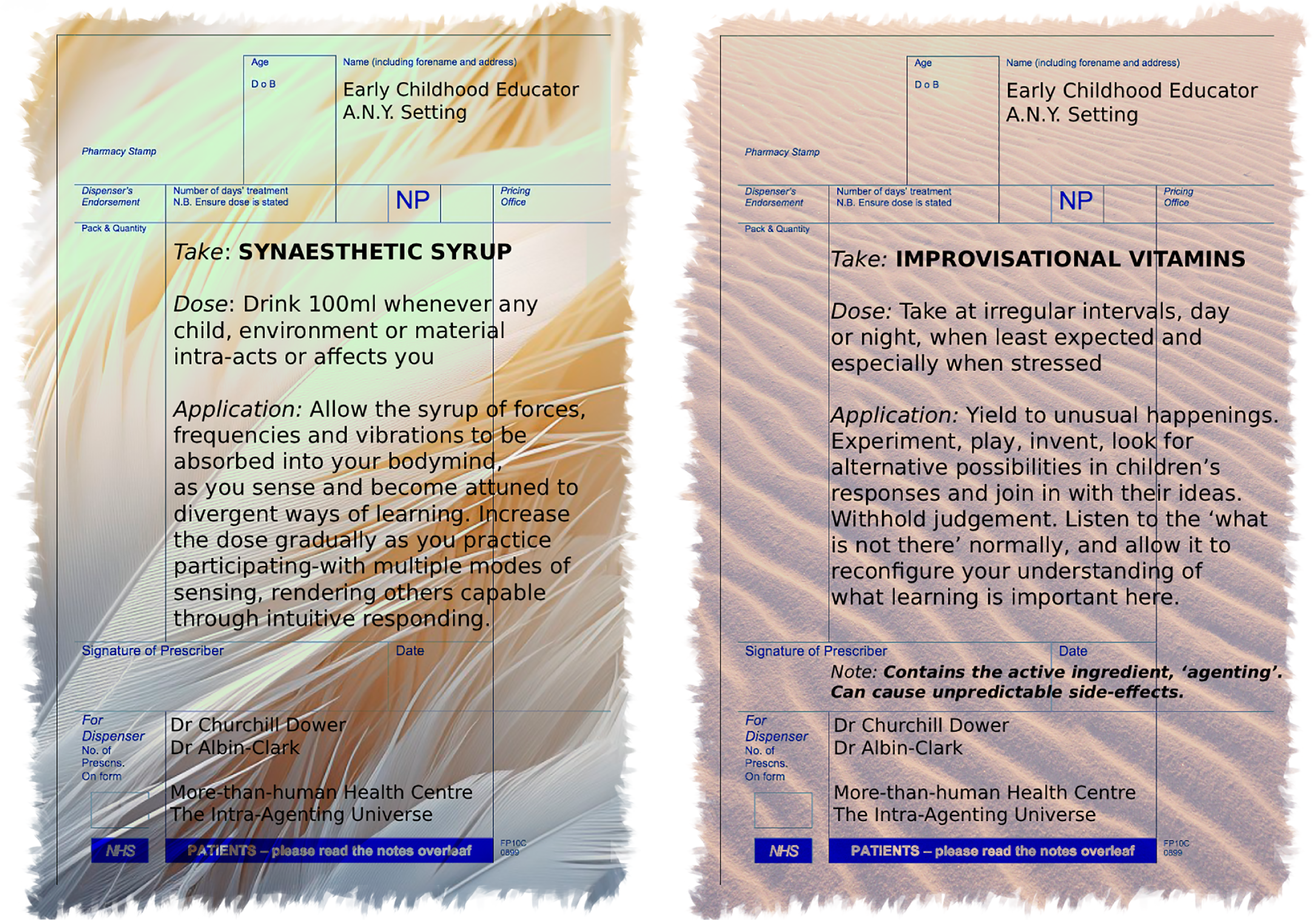
Synaesthetic and Improvisational prescribings. Source: Churchill Dower.
Exceeding expectations by resisting prescriptions
There is no doubt that meeting the expectations placed upon ECE professionals is challenging. Just as children often struggle to meet standardised benchmarks of ‘successful progression’ through developmental stages, educators face pressure to comply with universalised regulation, assessment and teaching standards. Threads of policy directives, regulatory requirements and curriculum initiatives conflict and tangle with ethical values (Roberts-Holmes and Moss, 2021). These homogeneous structures fail to serve the demands of large classes with many divergent needs, languages, abilities and cultural perspectives. And the more-than-human relations involved in teaching and learning are largely ignored by the institutionalised systems and conventional requirements of the EYFS curriculum for reaching or exceeding expectations.
That is not to say that many teachers and learners do not flourish in the education system; many do. According to Archer and Albin-Clark (2022), these are artful professionals who actively adapt their environments, teaching practices and learning cultures to encompass and enhance divergent ways of knowing, sometimes at great personal cost. These everyday, often invisible, acts of resistance matter. Artfully storying their shifts, movements and sensations of resistance makes visible a collective, relational agenting at work (Archer and Albin-Clark, 2022).
Can artful sensing or intuitive responding practices make a difference within the existing hegemonic frameworks? We argue that they can because, as we have proposed throughout, ‘successful progression’ is not about focussing on the end point but on everyday moments of relation and entanglement. While developmentalist curricula persist, artful practices bring nuance, complexity and alternative thinking to the middle of curriculum planning, disrupting assumptions about which ways of knowing are important. These middling points open surprising insights that, in our experience, often exceed expectations through processes of listening to, improvising and lingering with different ideas about the world. They also give educators confidence to have a go, respond beyond verbal languages and put their own artfulness into practice. We encourage artful prescribing as a practice that moves with the curiosities of complex relations; resists prescriptions, dead ends and conformity; and welcomes open-ended thinking and not-knowing as new modes of prescribing. Whilst they might feel therapeutic, artful prescribings will not offer a medicinal fix for unconventional learners as they don’t assume incompetence, failure or brokenness – only potential. What they do offer is a more fluid form of curriculum planning and assessment, a focus on processes and relationalities and an opportunity to become-with those exciting possibilities.
In this paper, we have proposed that artful prescribings offer accessible, everyday micro-resistances to taken-for-granted curriculum narratives such as developmentalism. They are starting points for thinking beyond curriculum prescriptions and individualist expectations, bringing into sharper focus the liminal and minor languages of synaesthetic worlds (Manning, 2016), re-imagining new futures that have been previously unimaginable. Co-creating prescribings with young, divergent learners shifts the pedagogical inquiry from ‘what can we see in this child's work?’ to ‘how can we participate alongside?’ where ‘[l]istening comes through lingering’ (Kind, 2020: 54). In other words, how can we support unpredictable ways of knowing that render a divergent body able to respond?
There is something so fundamental about the ways in which artful practices engage what matters without expectation, perhaps because they are often ignored by measures of quality. This is where artful professionalisms excel – being open to transformation by potentialising forces to what is possible beyond measure (Churchill Dower, 2025), thus countering the limitations of developmentalism by resisting the commodification and pathologisation of divergent bodies. Artful professionalisms help facilitate risky adventures into complex, more-than-human worlds, inviting children and teachers alike to become entangled in response-able, synaesthetic and exciting learning.
Footnotes
Acknowledgements
The first author would like to express her gratitude for the generous time and curious thinking offered by the children and families during her PhD fieldwork at Manchester Metropolitan University.

Ethical approval and informed consent statement
The study referred to in this article was approved by the Manchester Metropolitan University’s Education, Research, Ethics and Governance Committee (EthOS Reference No. 11937) on 7 July 2020. All participants provided written informed consent prior to participating.
Funding
The authors received no financial support for the research, authorship, and/or publication of this article.
Disclosure statement
The authors declared no potential conflicts of interest with respect to the research, authorship, and/or publication of this article.