







Abstract
The National Quality Framework – The Musical! does stuff. It is many things and does many things. In this womanuscript, the authors play with what they do with what it does in the context of professionalism in early childhood education. As a scripted piece of affective embodied pedagogy, they re-enact some of the ways it complexly, absurdly and powerfully contributes to figuring professionalism in early childhood education. They think of it as a ‘speculative fabulation’ in that it is a messy intraentwinglement of the political, philosophical, litigious, regulatory, policy, practical and technical theatrescapes that have been herstorically throwntogether to create what has come to be believed as the profession of early childhood education. The National Quality Framework – The Musical! undoes the truth of logic and reconfigures the early childhood profession as the messy intraentwinglement that it is. The authors think that it does what the call for papers asked for. If not, they hope that you enjoy it anyway, and that it does something. The show must go on …
Keywords
We need a teacher (educator) who is sometimes the director, sometimes the set designer, sometimes the curtain and the backdrop and sometimes the prompter. A teacher who is both sweet and stern, who is the electrician, who dispenses the paints and who is even the audience – the audience who watches, sometimes claps, sometimes remains silent, full of emotion, who sometimes judges with skepticism and at other times applauds with enthusiasm. (Malaguzzi, 1997, quoted in Rinaldi, 2006: 73)
About the national quality framework – The musical!
The National Quality Framework – The Musical! is a piece of professional development for early childhood professionals. It was created by us – two early childhood teachers who share a lifetime of love for, and active practice of, the performing arts (Figure 1).
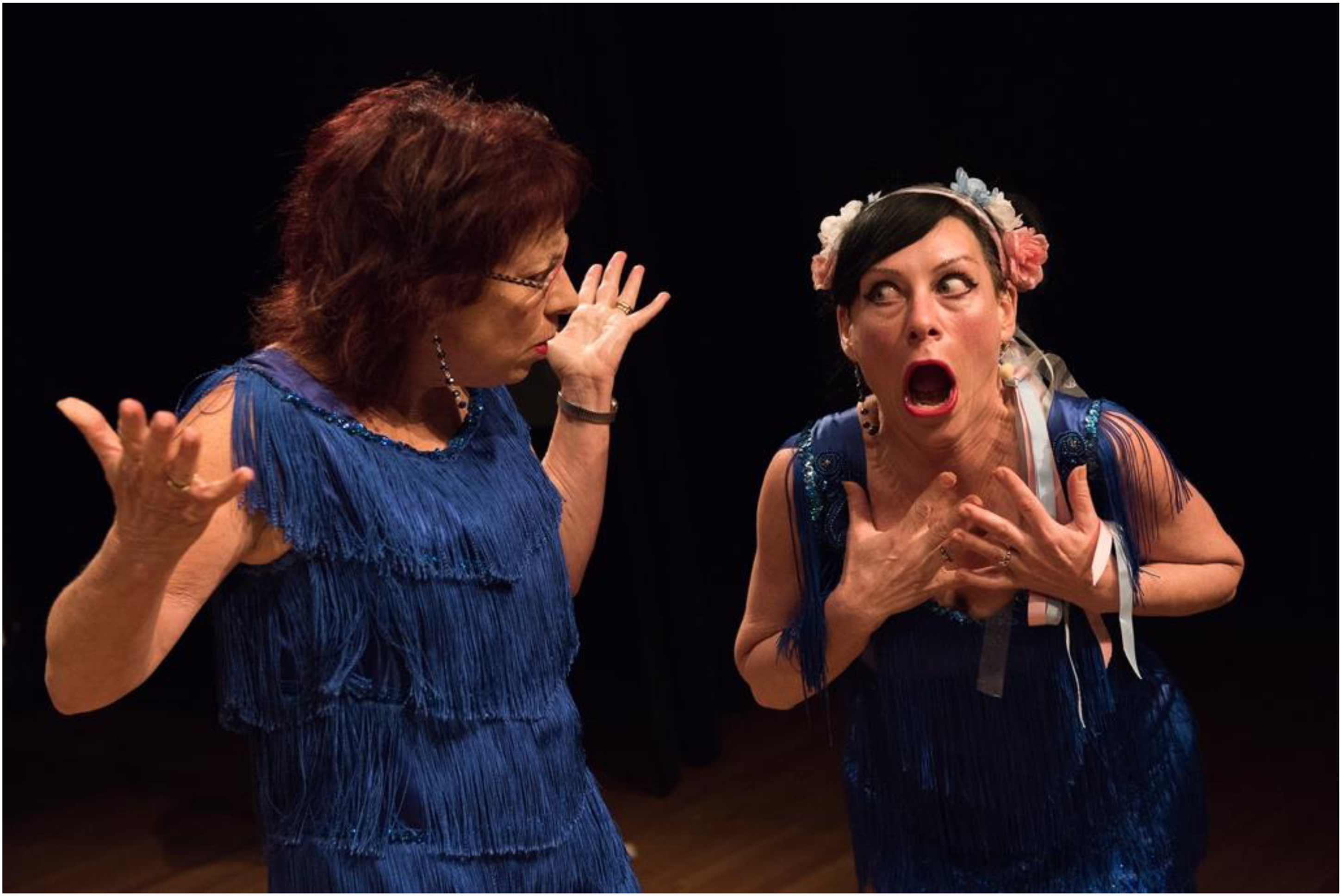
Lou and Red.
As far as we can tell, it is the only one of its kind. It began as a bit of fun, but then became one of the most serious and wildly popular forms of professional development in Australia (Figure 2).
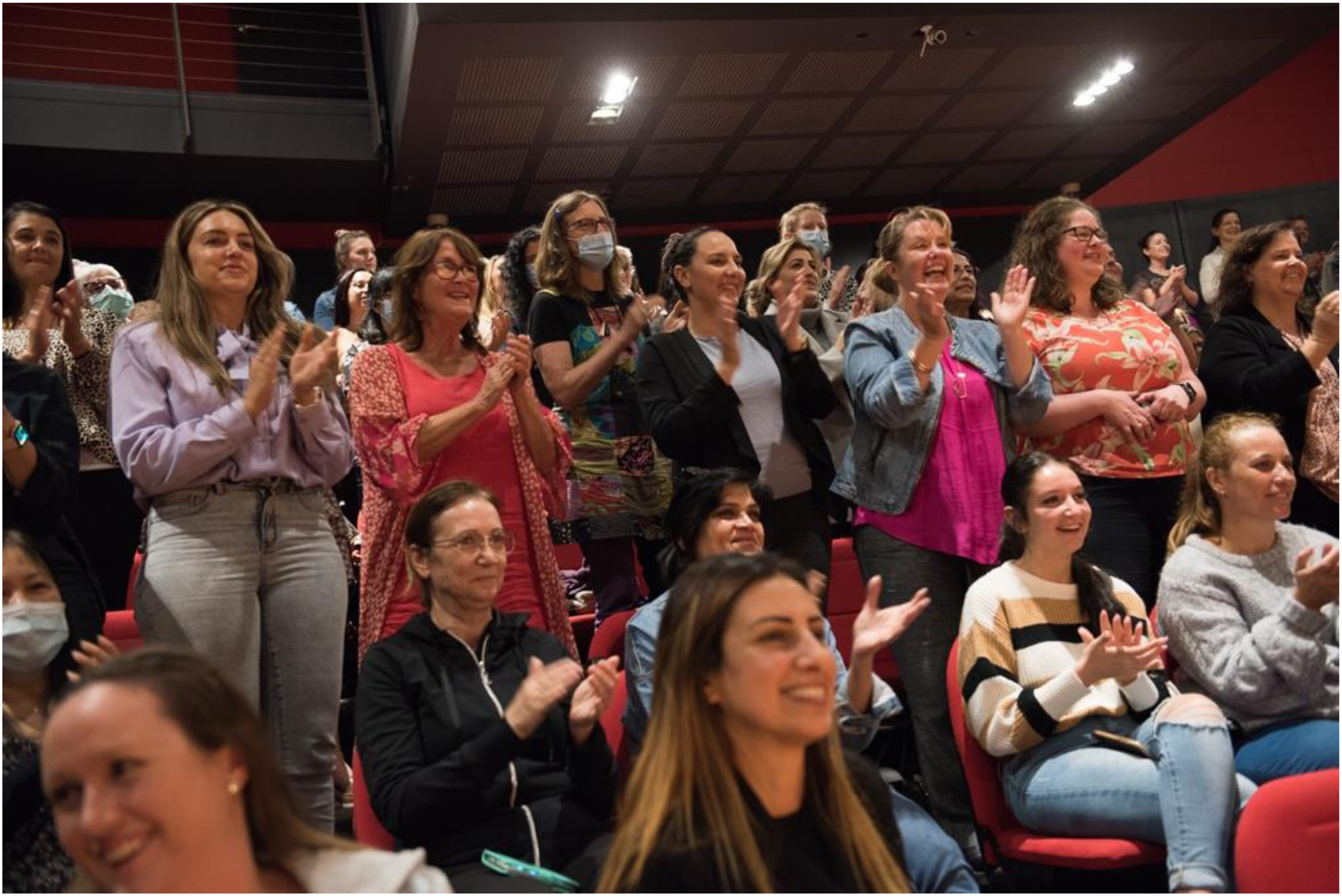
An audience.
It was developed over a number of years, including the COVID-19 years.
But first, for those of you not in Australia, what is the National Quality Framework (Australian Government Department of Education, 2022)? The National Quality Framework is supposed to be a system for regulating, assessing and ‘improving’ the quality of early childhood education and care services in Australia, including long day care, family day care, preschools, kindergartens and outside-school-hours care. It aims to set a high national standard for children's learning and development by including a national law, national regulations, the National Quality Standard, approved learning frameworks (such as the Early Years Learning Framework V1.0 and V2.0), and a quality rating and assessment process. The framework was established in 2012 through an agreement between all Australian governments to work together to improve educational and developmental outcomes for children.
Service leaders submit a Quality Improvement Plan to their various state- and territory-based departments, which gives them the illusion of participating in how they see and assess their own quality practices. For more information, see the Australian Children’s Education and Care Quality Authority website, but we guarantee that you will get bored (Figure 3).1
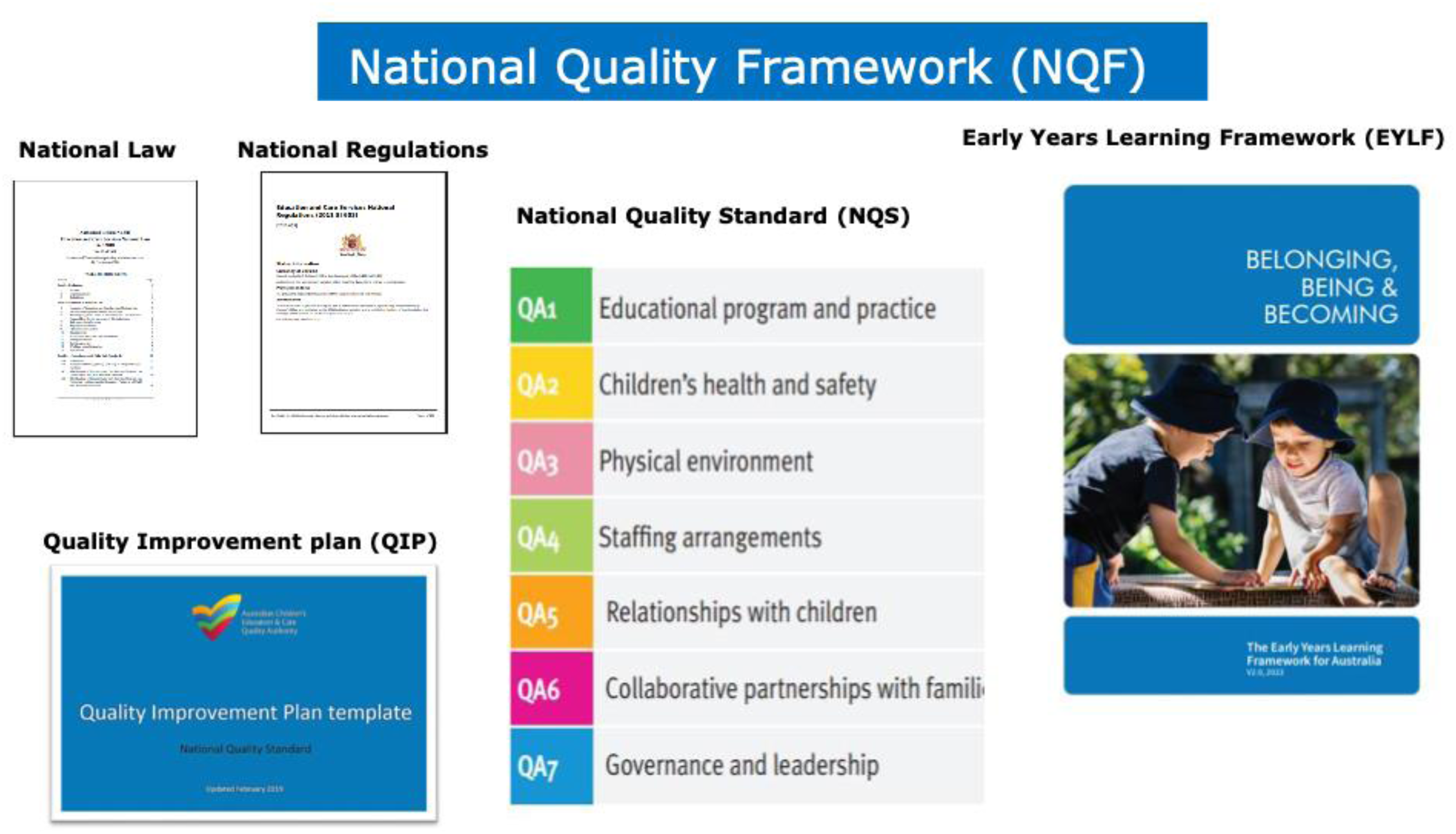
The National Quality Framework at a glance.
Opening number
What is professionalism? What does it do? What do we do with what it does?
These questions guide our musings in this womanuscript. We intraentwingle them through The National Quality Framework – The Musical! – a unique form of professional development in early childhood education written and performed by us.2
These questions have been danced with before about data and art (Osgood, 2024; Osgood and Scarlet, 2015; Scarlet, 2018), and other delights not published – or we couldn’t find them in our bursting prop suitcase (Figure 4).
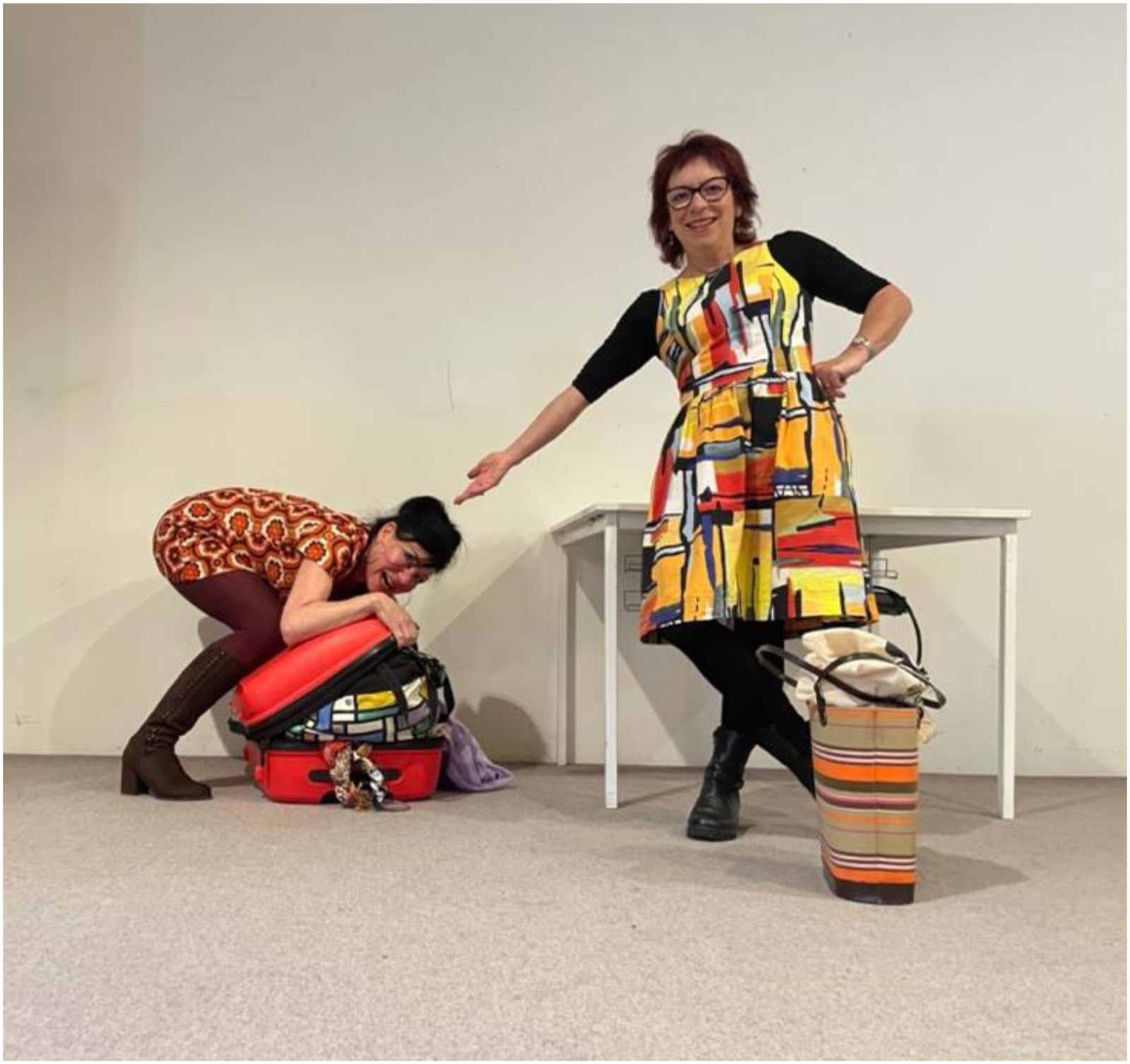
Our bursting prop case.
But they are mighty good questions to play with again, in order that we continue to expand the darkly sparkly horizons of ‘worldmaking’ (Haraway, 2011) that are not solely human-centric. Here, we do this through a musical about early childhood education and what we do with what it does.
The genius and legend Lin-Manuel Miranda, creator of the smash-hit musical Hamilton: An American Musical, described musical theatre like this: ‘Musical Theatre isn’t an art form. It's 14 art forms smashed together. And when they coalesce in exactly the right way, I believe it is more powerful than pretty much everything’ (Miranda, 2021: 1). As dynamic dramaturgical thespians, we agree. But The National Quality Framework – The Musical! has 15 art forms because we add early childhood education into the smashing mix.
Musical theatre incorporates all teaching methods to cater to different learners by watching, listening, doing and feeling. Auditory learners thrive on hearing information, while visual learners benefit from seeing it, kinaesthetic learners flourish with the movement of dance, and aesthetic learners use their voice and feel the dance (Scarlet et al., 2024).
Here, the ‘feltness’ of what can be choreographed together to ‘do’ something is what we are scripting. To paraphrase Lou's assertion in ‘The National Quality Framework – The Musical! The Documentary’ (2024): embodied pedagogy is actually doing something because when we do it, then we feel, and when we feel, it gets to the learning place more speedily. Embodied pedagogy is The National Quality Framework – The Musical!, given people have asked us so many times, ‘How did you know how we felt?’ (TC 22:22)
Embodied pedagogies, however, are mostly crafted in humanist discourses, which makes them a limitation to all of the things that are also there in Miranda's 14 (and more) art forms. Our 15 art forms are material, political, historical and cultural. The political, historical and cultural trajectories of the materials tend to be overlooked or deliberately omitted. While we won’t trace these here, examples of how that has been done can be found in Professor Jayne Osgood's numerous publications (e.g. Osgood, 2024). Our ‘speculative fabulousation’, then, invites in the encasements and kstringles of the political, historical and cultural trajectories of where the musical played and ‘who and what else was there’ (Scarlet, 2020: 30). It also begs the question ‘Who does the teaching?’ (Giugni, 2011), which expands embodied pedagogies from humanist enmaterialments to post-humanist ones (Figure 5).
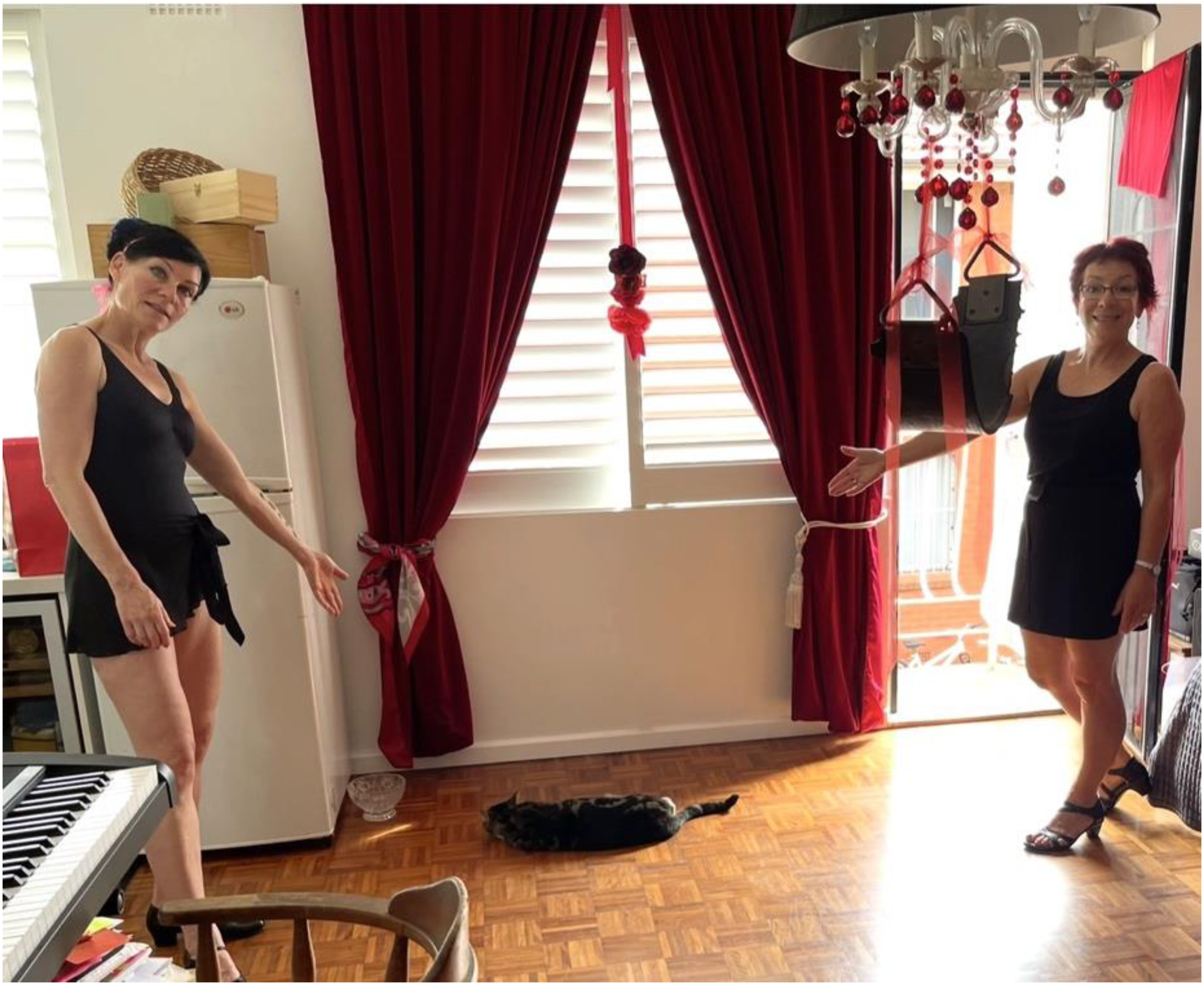
Red and Lou and Eartha Mae Griselda Rose O'Shannassy Scarlet de Clisson.
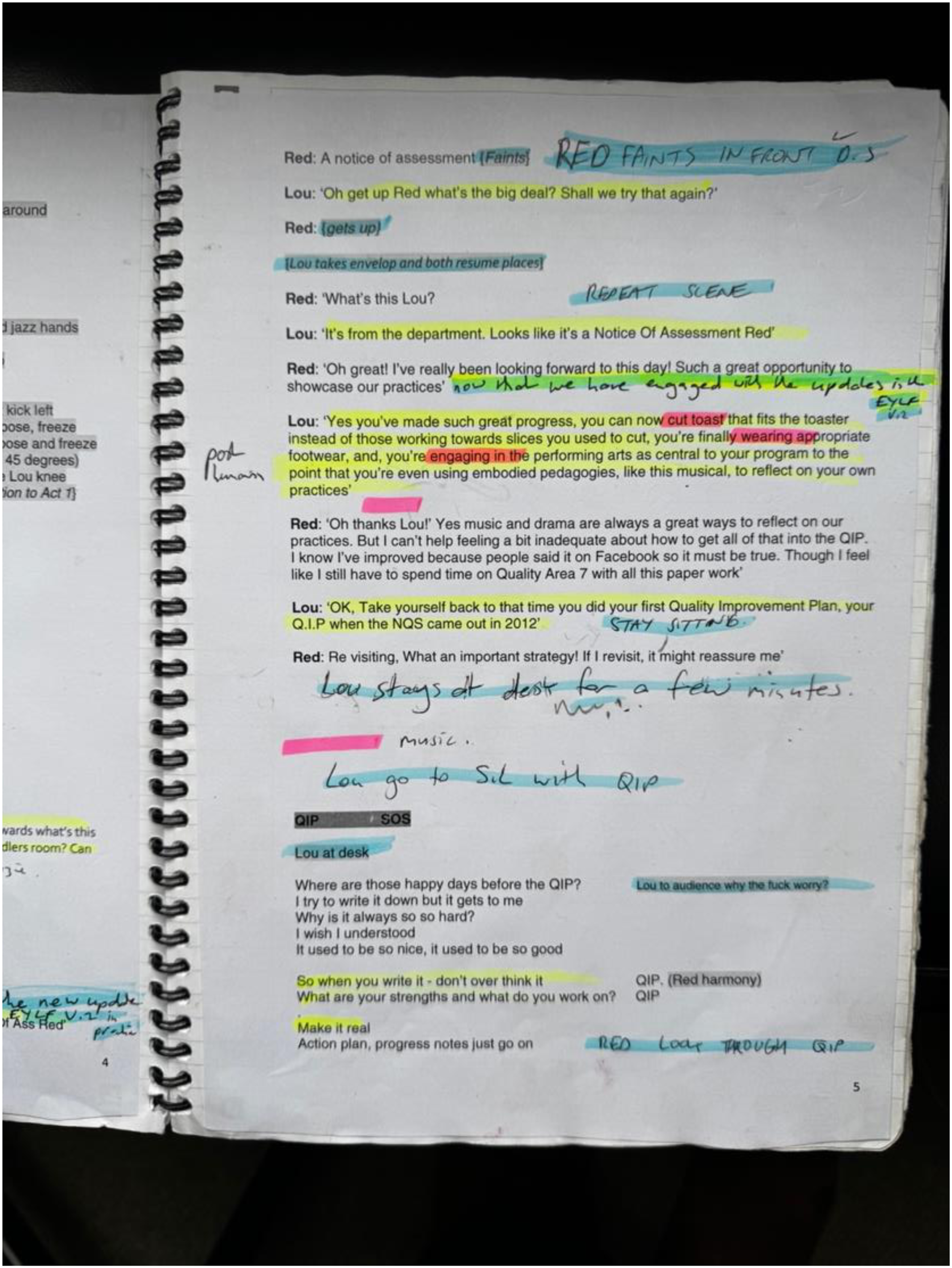
The script.
Act 1: the script
The script (Figure 6) was generated from the ‘real-life’ absurdity of how we built our relationship. Living ’twixt and ’tween Gadigal and Naarm (Figure 7), our connection consisted of Facebook encounters, visits, and then an Assessment and Rating of the visits based on Australia's National Quality Framework (introduced above). We pirouette Haraway's words to speculatively fabulousate in that we ensconce fabulous into every fabulation – fabulous is, after all (as ChatGTP reliably tells us), ‘celebrated in fable’. Fabulous is an underground fiction in both its truth and its irony. Fabulosity is hilariously dark hyperbole.
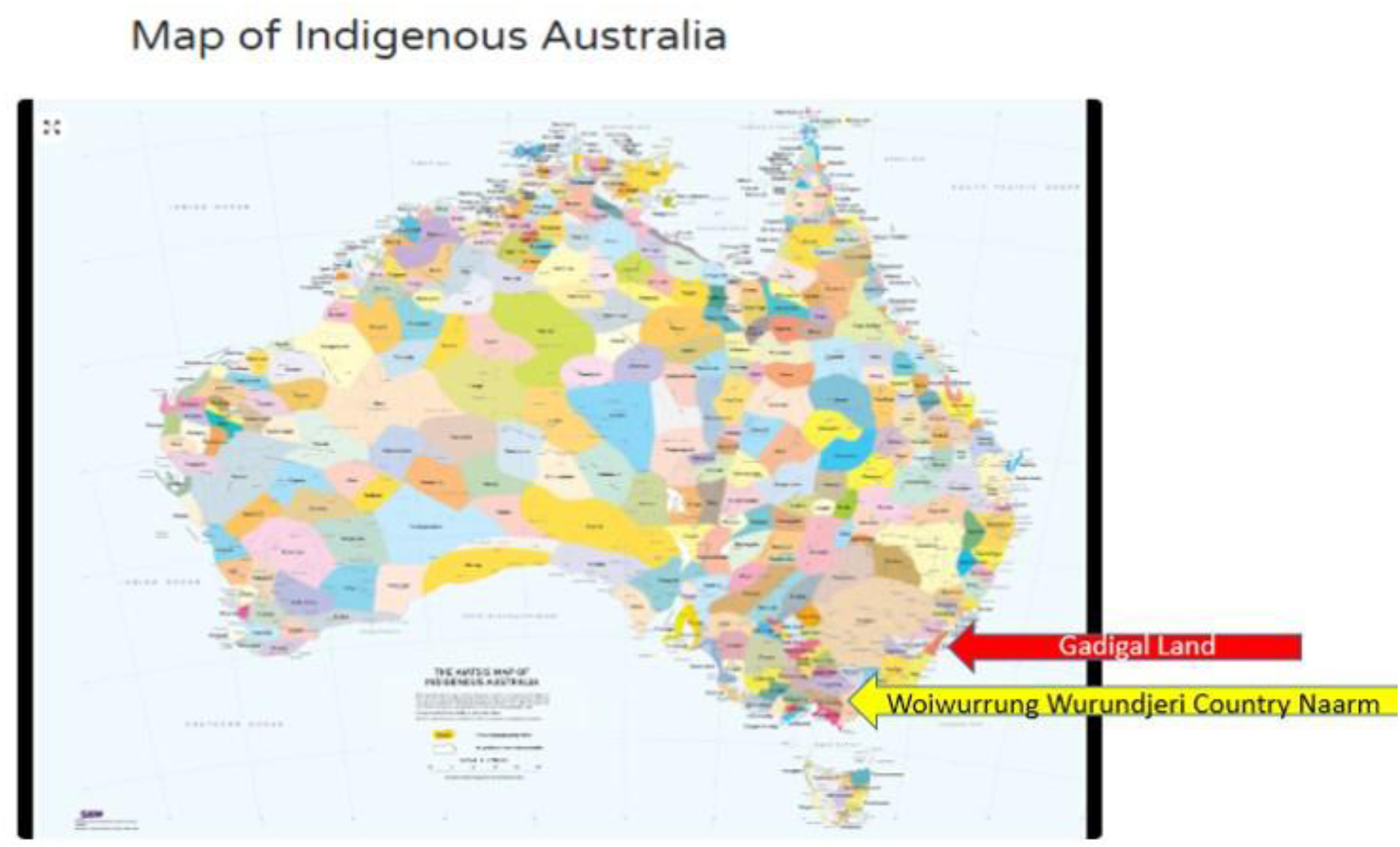
Gadigal and Wurrudjeri land.
Each visit we made to each other closed with an Assessment and Rating – the process that early childhood settings go through to determine their level of quality. The ratings include: SIR = Significant Improvement Required, WT = Working Towards, Exceeding and Excellent. There are seven Quality Areas (QAs) under which early childhood settings are assessed:
QA1 = Educational Program and Practice; QA2 = Children's Health and Safety; QA3 = Physical Environments; QA4 = Staffing Arrangements; QA5 = Relationships with Children; QA6 = Collaborative Partnerships with Families and Communities; QA7 = Governance and Leadership.3
The visits also included detailed agendas with unachievable time slots, numerous labelled items, the micromanagement of food consumption, community excursions, human relationship-building and activism (Figure 8). These encounters created the conditions for the subsequent Assessment and Rating, which most often resulted in Working Towards. Working Towards is an unfortunate rating in the system as early childhood settings can be rated Working Towards and still operate and receive taxpayer funding. The extent to which this is good and fair for children and educators is questionable at best and ridiculous at least. The National Quality Framework is itself a parody, using words like ‘quality’ to mark less-than-desirable educational encounters that we all consent to. The system needed a musical to do something to it.
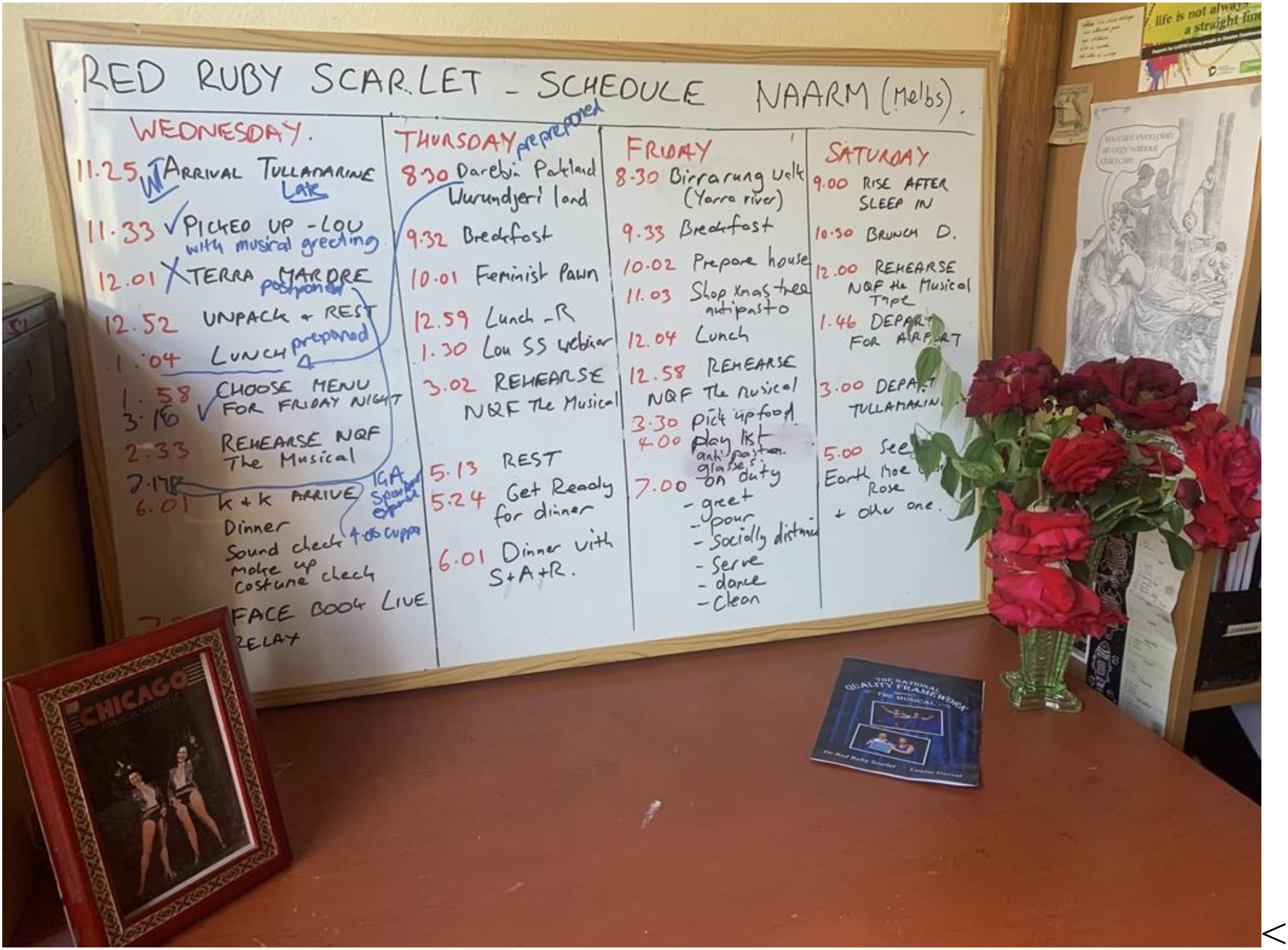
The Naarm agenda.
Each Facebook post detailing the Assessment and Rating visit then gathered the engagement of educators and teachers, mostly from Australia, but often our international friends would chime in. These comments supported, critiqued and augmented the reports, often citing research and offering diverse perspectives. Frequent discussions included the debate about shoes – whether they were appropriate or necessary at all (Figures 9, 10 and 11). They also included commentary on animals (Figure 12) and clothing (Figure 13) – all the things and what they did.
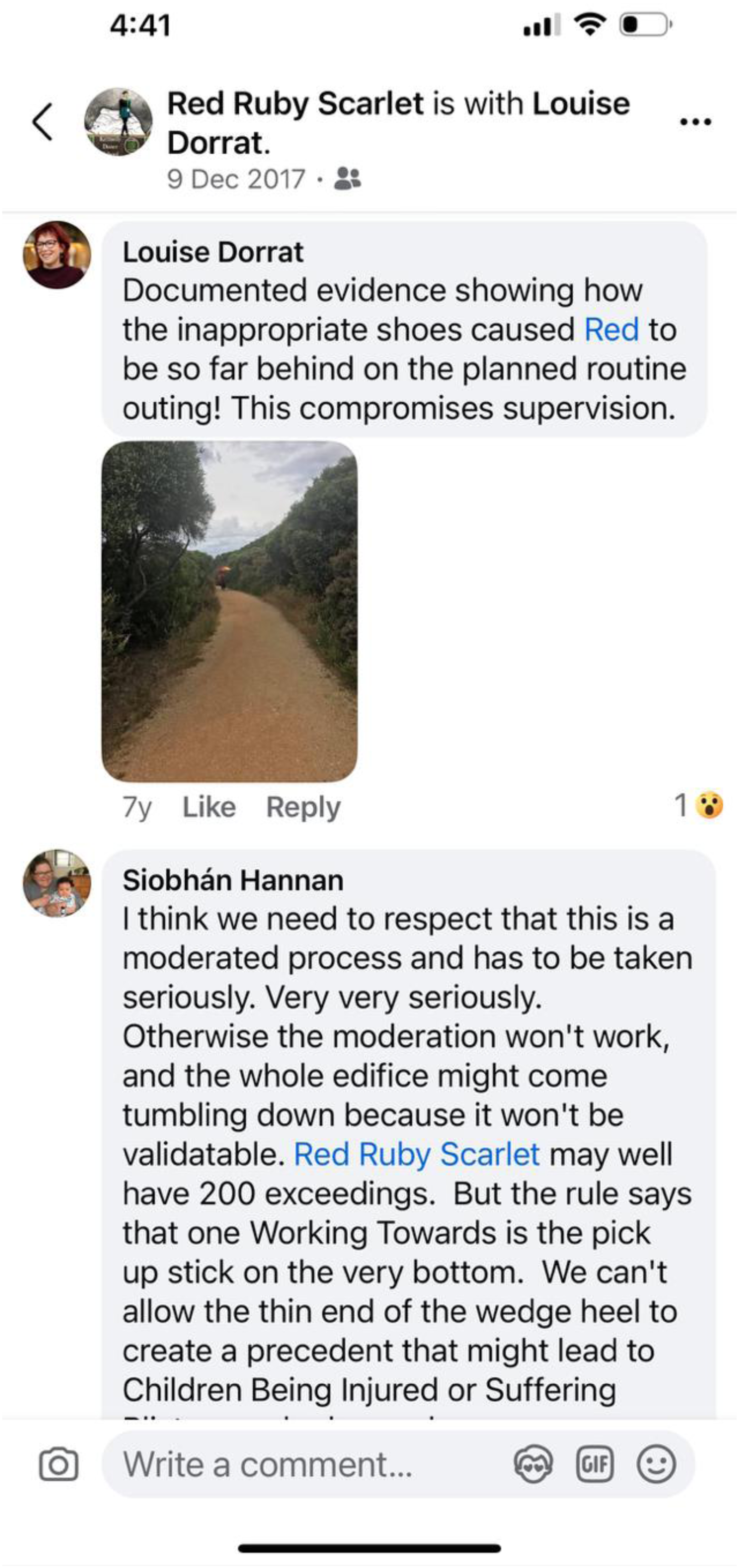
Facebook: shoes.
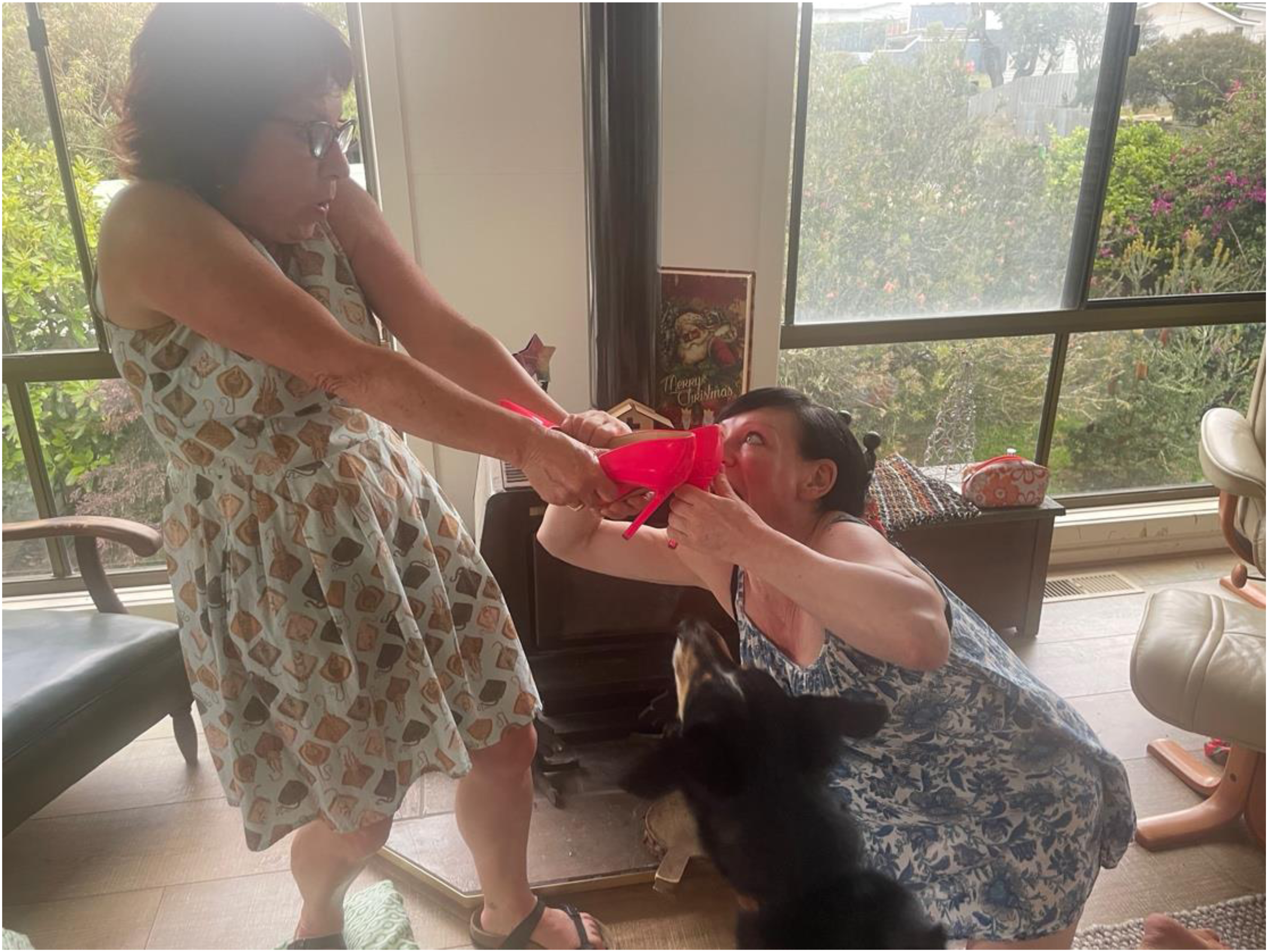
Pink shoes.
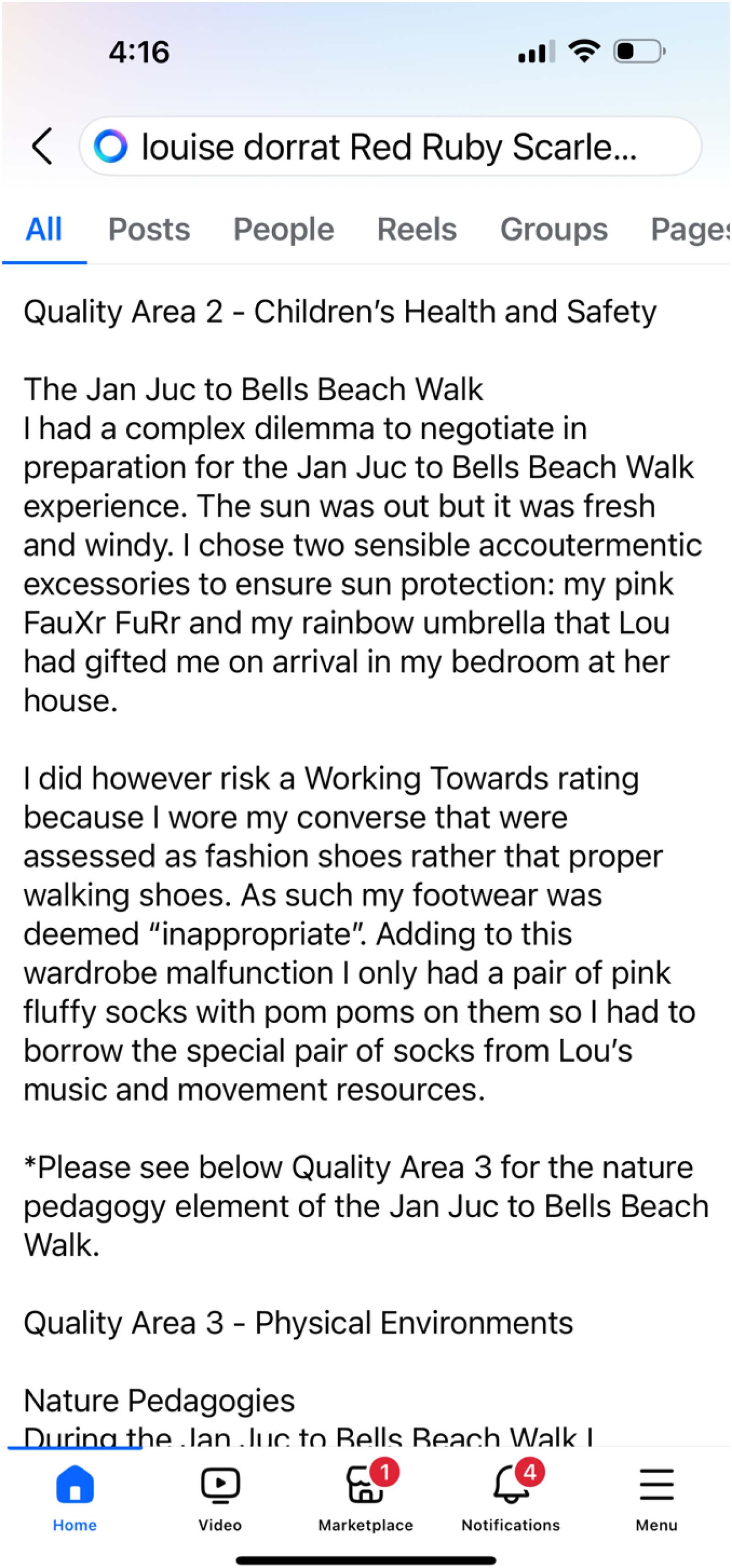
Facebook: shoes.
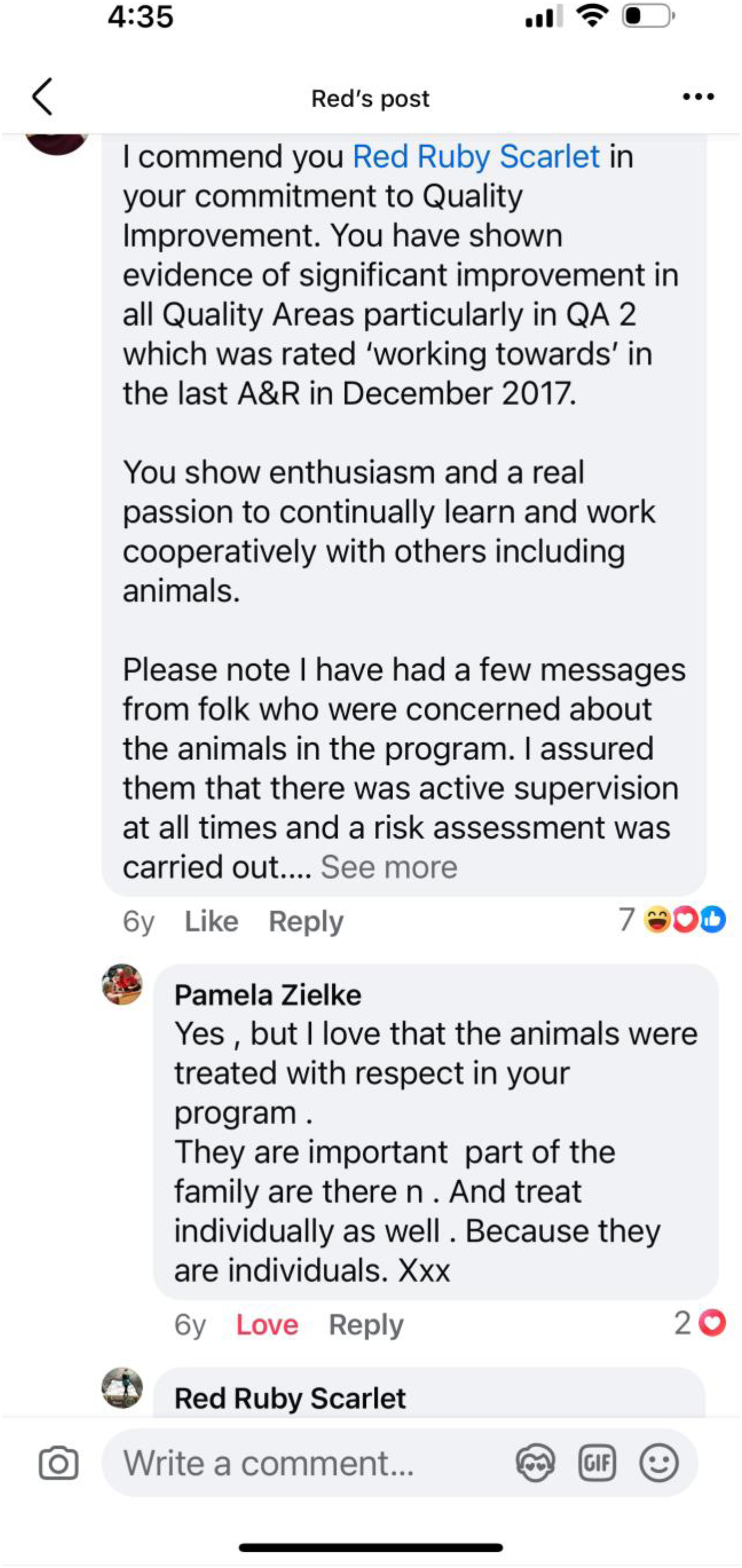
Facebook: animals.
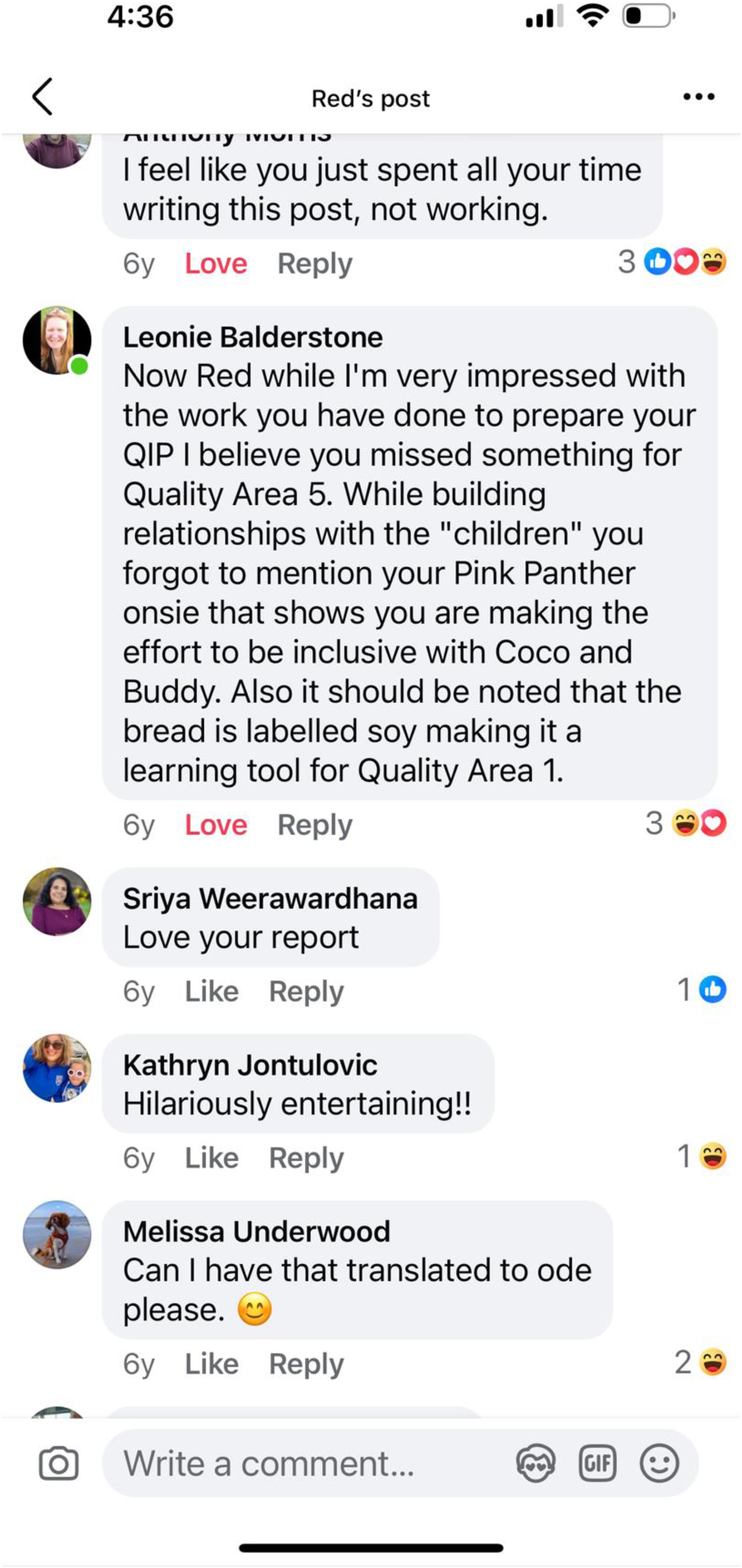
Facebook: onesie.
We were simply being our hilarious selves, but we realised that we were creating a performative online environment for people to debate and discuss their professional knowledges and experiences, and engage with each other. The digital environment became the birthplace for the script. Despite Facebook being a public space, the fingers on devices concocted commentary that might not be enabled in ‘real-life’ professional discussions, particularly when they contested the validity of the National Quality Framework.
So, that's how it came about – but then we did something with it. We used it as a springboard to create an actual script, which was the composition of the musical.
What did the script do?
The script itself gathered myriad philosophical, political, historical and cultural lived experiences from places and spaces across the world – many of those that can be tracked and traced in the becoming of early childhood education. The composition of the script is pollycritter – it is a more-than-human thing that collected and collated generations of fabulations.
In performance, the script kept us as performers (relatively) ‘on script’, as they say in showbiz. And one of Lou's famous lines to Red was ‘Stick to the script, Red’.
The script also travelled. It piqued folks’ interest as it was encountered, whether through professional politeness or curiosity. One of these encounters occurred on a plane en route to Naarm from Gadigal. A flight attendant noticed the script enfolded on the unfolding table squishing in the enseated people. She enquired about the script (perhaps recognising what one was from previous experience?) and gestured her hand towards it (Figure 14). It lifted off the tiny table into her hands through Red's to be inspected, and she began to read it out loud. The script gathered and collected readers and fellow dramaturgical thespians 30,000 feet above the ground. This airborne encounter became a digital imprint on the same multinational prolly corrupt platform on/in which the rest of the Assessments and Ratings were projected to anticipating encounterers.
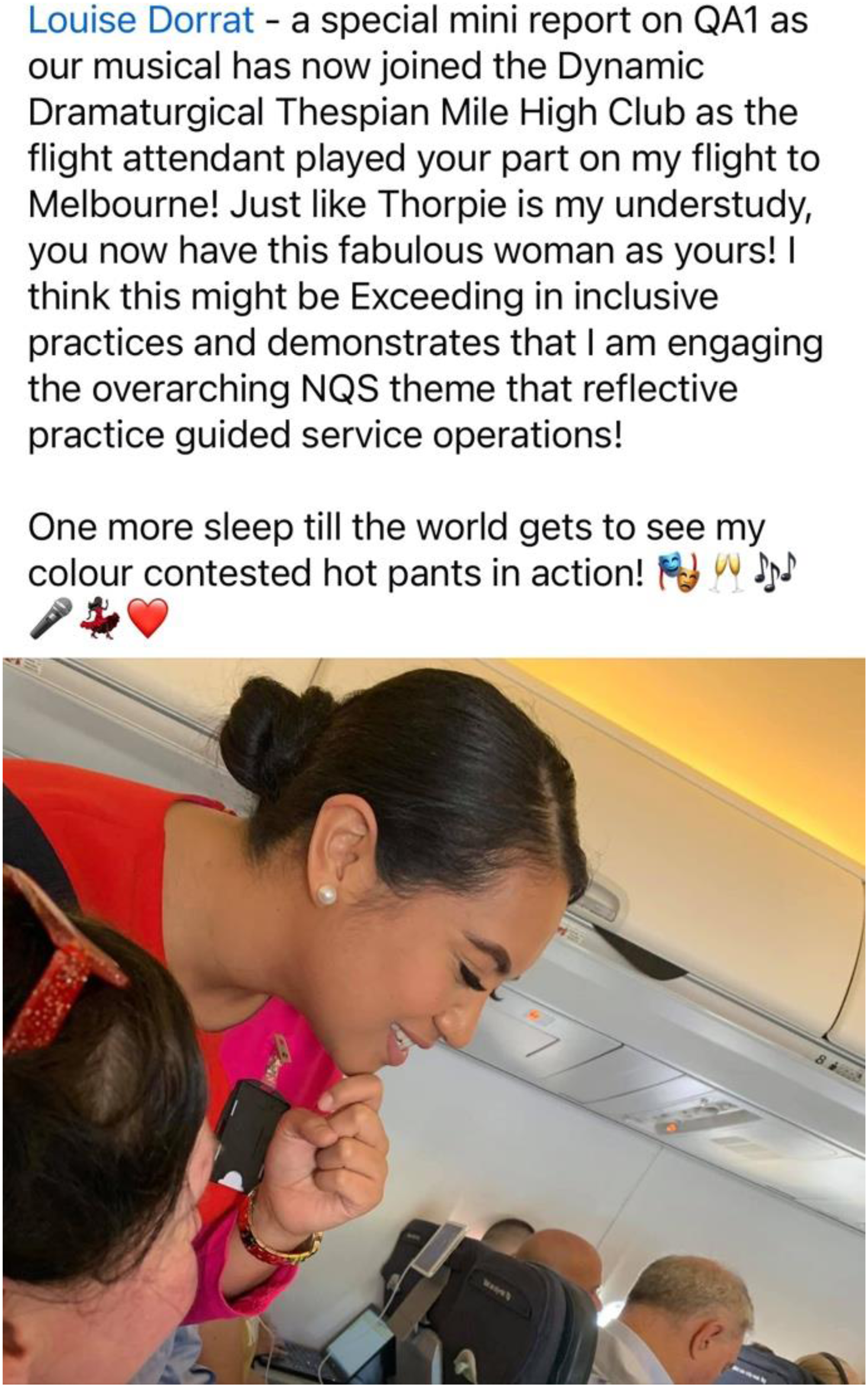
A flight attendant reviewing the script.
The script embodied multiple perspectives in paper and ink, as well as through the machines that produced it – not least the order and organisation of Lou's doggie developmental ways of working and Red's inevitable straying from the script in her catty post-everything ways of working.
These polarised perspectives literally grabbed audiences and reeled them in, as they felt the stories written on the paper in their blood pressure and seated bodies, tightly ensconced in often uncomfortable seating. Our evidence of this was their tears, their laughter, and their participation in the familiar circumstances and music.
The script boldly held irreverence in its satirical, sometimes dark and underground affect. As all-singing, all-dancing vessels, the script reassured, guided and prompted us. It conjured all the feels and transmogrified those who it reflected and touched.
Haraway (2008: 3) once asked: ‘Who do I touch when I touch my dog?’ She then scruffles her way through the furry terrain of the political, historical and cultural trajectories of who, where, when, how and why, with the simultaneous disaster–hope–damage–justice–worlding multiplicities. In the same way, the script was affective – it generated conversation, action, change, transformation, creativity, relief, grief, connection and relationality as each time it led our performance, it travelled somewhere else. With each new movement through space and time, something else happened.
We don’t perform scripts; they transmogrify through us. Scripts don’t need humans; humans need scripts. Scripts have knowledge and purpose; humans don’t.
Act 2: animals and technology
Page 13 of Belonging, Being and Becoming: The Early Years Learning Framework for Australia (Australian Government Department of Education, 2022), affectionately known as the EYLF, encases numerous ‘theoretical’ perspectives. In the first iteration of the EYLF (2009), it was page 11 for which we wrote an original recitative for the musical that addressed the theories and those who have been ovarian in developing them and emplacing them in early childhood. This was a way we traced the political, historical and cultural trajectories of who shaped practice when and how (Figure 15).
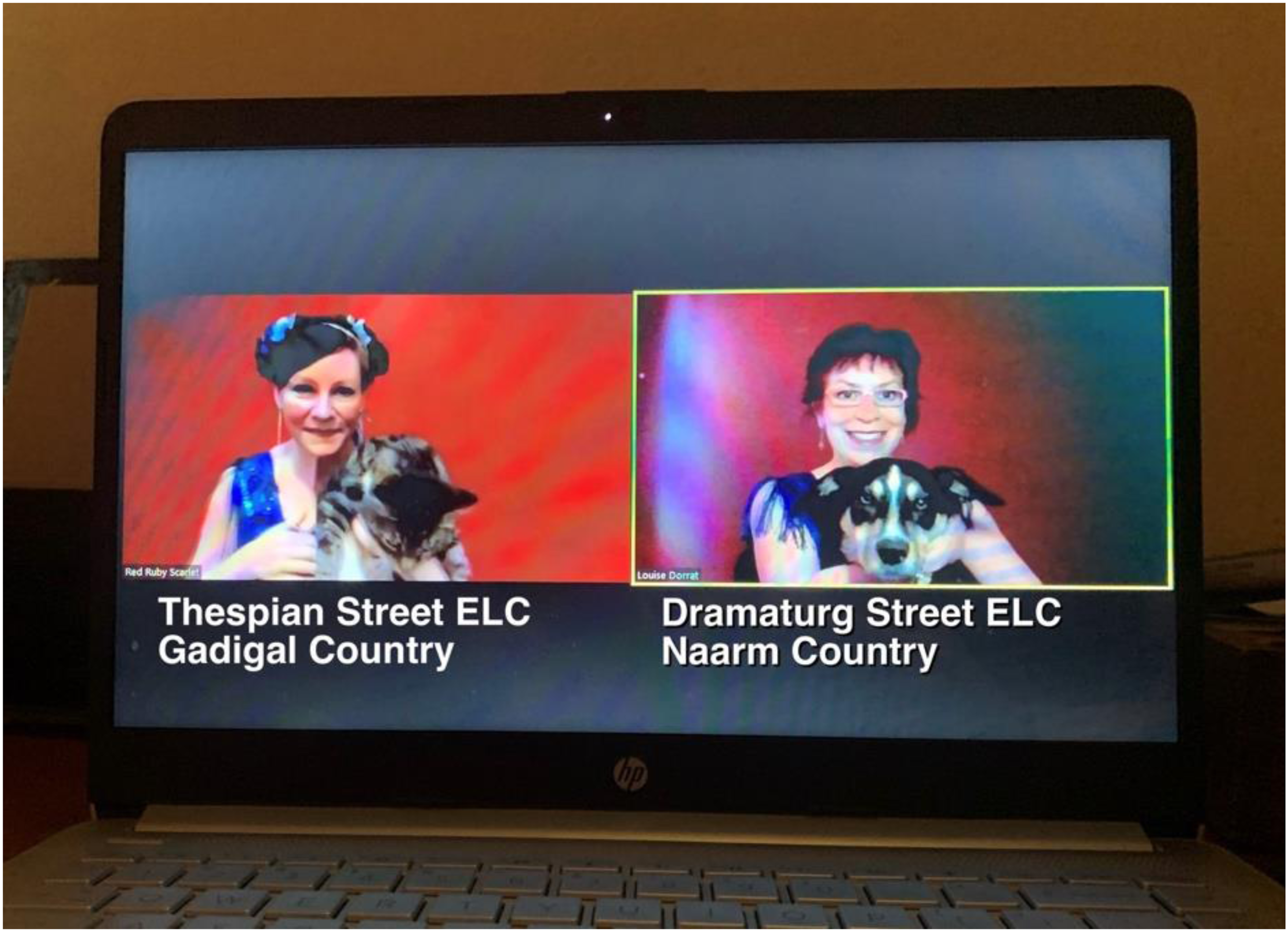
Animals and technology.
We joked that Lou, as the developmentalist, had the dog theories (trainable and reliable) and Red, as the post-everythingist, had the cat theories (ungovernable and always surprising), as problematic as that binary is.
In the process of the musical travelling from place to place, COVID-19 played a role in arrestingly halting not only performances but also rehearsals, which were already sparse between states.
Zoom became our studio and stage manager as a virus took control of when, where and how rehearsals took place. For us, it happened in front of our computers, over the Internet, through an online program. The scheduling of these rehearsals was determined by nature and technology, not humans.
In terms of our ‘professionalism’, we were refigured from the enfleshed live-theatre ensconced experience to a flattened screen-based encounter, relying on sometimes unreliable (cat theory) connections that were flooded as the world went online, on-screen and, for the most part, inside.
The enormous outcry for the musical to be recorded and put online was overwhelming. Early childhood educators who had seen it, talked about it and booked to see it – because of how it ‘made people feel’ – felt they would alleviate some of the stresses that we all felt during the COVID-19 years. While we were all feeling with COVID-19 on its terms, collectively we desired to feel something else on ours, but we humans had lost control of what we felt when and how and with whom and what else. COVID-19 became the scriptor, an organism that doesn’t write yet wrote upon us all from without and within. In COVID-19's script, the desire for the musical clenched at elevated heart rates, charged synapses and was present in its absence.
How could a musical do that? What do we do with what the musical does? We learned that in terms of professionalism, the musical did something – including trauma and healing – in its presence and even in its absence. It generated a desire for expression – collective expression where early childhood educators could ‘feel’ together in grief and darkly laugh their way through it. Here, ‘the something’ that the musical did reached far beyond the immediate experience of encountering it in real time. The talk about it, the longing for it and the way it created connections was far beyond what we thought an irreverent satire about an infantilised profession could ever do.
So, while technology enabled some kind of connection and purpose in the herstory of the musical and its contribution to professionalism, we did resist technology's possibilities to beam the musical out through the Internet via devices of all kinds into eyes and ears and the multi-organismic bodies that house them. It was a form of resistance to place-based relational shutdown in order that another day would come when the musical could do its professional work in dark, dingy, uncomfortable underground theatres where educators sat squished in mostly uncomfortable chairs (we extrapolate this point for you soon).
Act 3: the importance of a theatre
Face-to-face professional development usually takes place in training rooms or conference centres. While these can sometimes have the ‘feel’ of a theatre, they are not the good old-fashioned theatres of cabaret times. Here, we make our bias clear and we are content with that.
Part of our deliberate crafting of where the musical would take place privileged small, old theatres. In Australia, these small, old theatres are mostly run-down community-operated architectural relics. They hold the playbills and posters from days of old. They usually house small productions that, more often than not, tell the stories of the fringes of society and underground stories that will never make it to the Gippsland Performing Arts Centre in Victoria Australia.
Given the genre of musical we had created – a juke-box musical (using popular music and rewriting the lyrics; see Byrne and Fuchs, 2022) and an industrial musical (about a particular profession; see Goodall, 2021) – we wanted the physical experience to embody that sense of underground, misfit and politically resistant. So, being in an actual theatre did two pieces of work. First, it gave a mostly working-class community (who may well not otherwise go) access to a theatre experience and set the stage for the irreverent, contradictory, oxymoronic script that would be embodied within it – dark rooms, rickety floors, old-time box offices, art deco features and furniture, old dusty curtains, rigs, lighting, orchestra pits, wings, backdrops and the like.
The dusty chairs were old, with springs nudging their way into the bottoms of the educators. The arm rests were made of old wood, which splintered into their arms. The size and stiffness of the chairs shaped their bodies in wholly uncomfortable ways for them to encounter a musical that is built on the ridiculous nature of what we have come to take seriously as early childhood education (Figure 16).
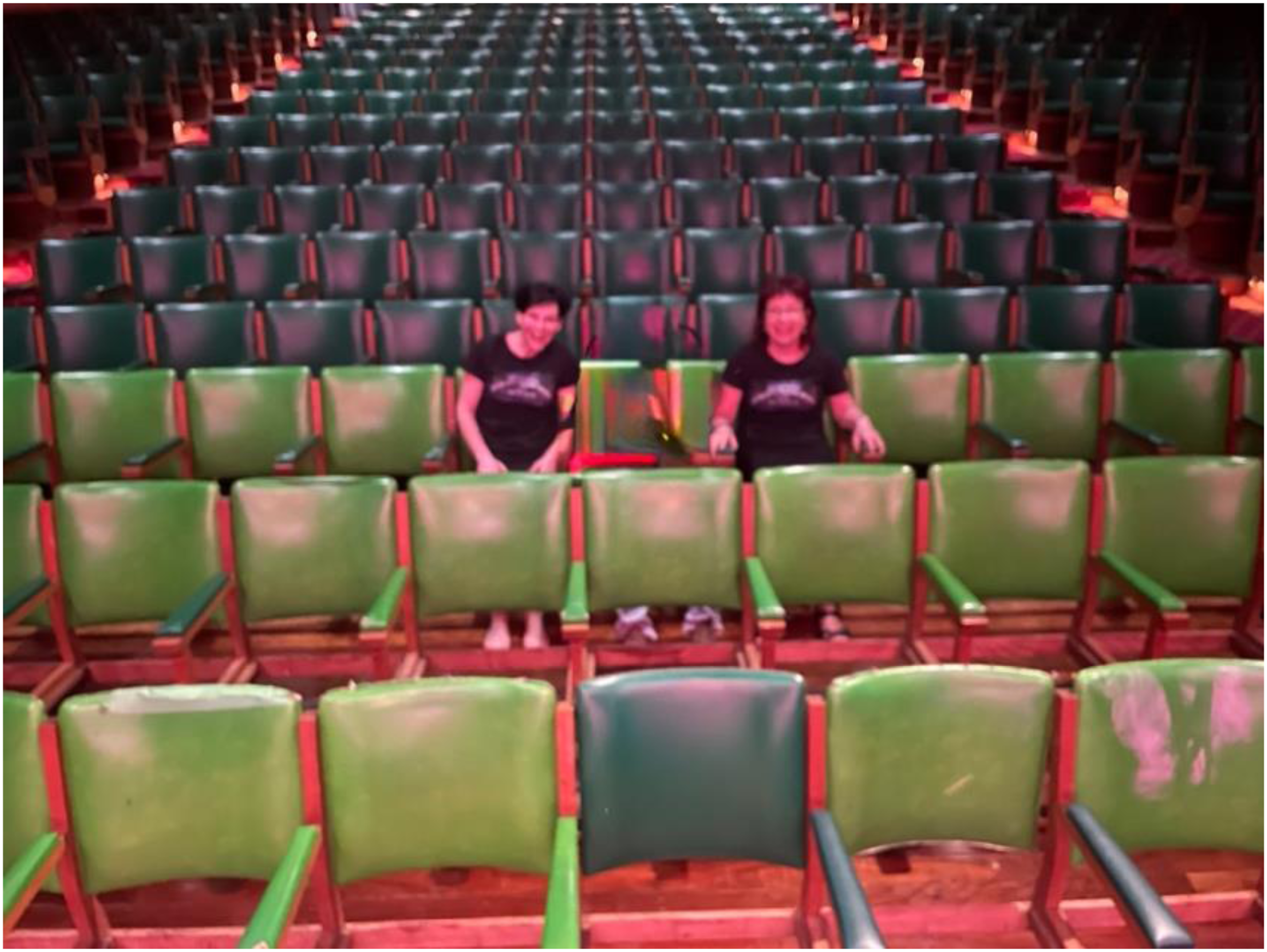
Theatre seats.
Despite the seating, which was squishily mostly conducive only to viewing as an audience member, keen theatre-goers dance to our signature song, ‘EYLF’ (co-written and choreographed with The Village People). The EYLF song raised the people and in turn raised the roof. Audience members stood in their tiny spaces and, following us, contorted their bodies into the shapes of the letters E, Y, L and F (what Steiner may have called an assault on eurythmy; Figure 17). The enthusiasm to express this ridiculous somatic spelling of the title of our national Early Years Learning Framework was a kind of resistance to the oppressive regulated space of the theatre seating, as arms and legs stretched, reached and smashed together in the upbeat lead of the music. So, together, the space, the music and the nuance of the profession encased in the rewritten lyrics conjured a place–people resistance that the entrapment of the seating arrangements attempted to hold. We resonate with Miranda's (2015) lyrics in ‘The Room Where It Happens’ from Hamilton – through the political act of theatring the audience, we ‘arranged the menu, the venue, the seating’, which simultaneously drew curt compliance and raunchy resistance.
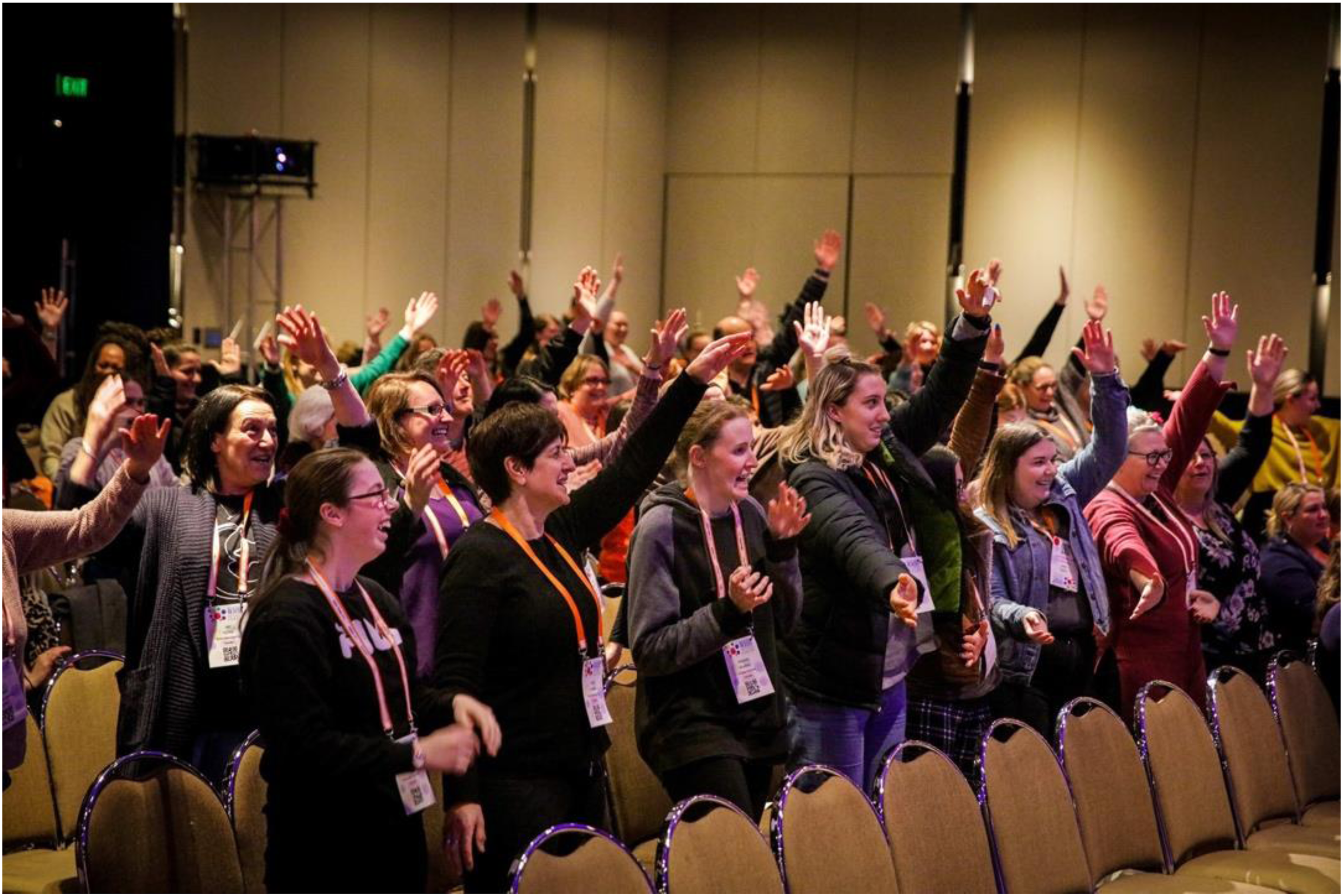
Audience senses.
We deliberately kept ticket prices low so that many people could access it, because professional development is an expensive venture and rarely government-funded. And when it is, it often lacks creativity. We wanted early childhood folks to ‘have the theatre experience’. The theatre itself could do what other regular professional development venues could not, despite much of it being physically uncomfortable and essentially colonial.
Act 4: the props
The props, costumes and our old-school PowerPoint were essentially the actors, the storytellers and the joke-makers (Figure 18). While we prefer to dance with Haraway and her contemporaries, we will give a little nod to Latour (2005) here, as we read him too, although we can also lean into Lenz-Taguchi (2009), who was one of the first early childhood scholars to bring new materialisms into broader professional discussions. If you’re reading this journal, you’ve prolly read them too, so you know where we are coming from 
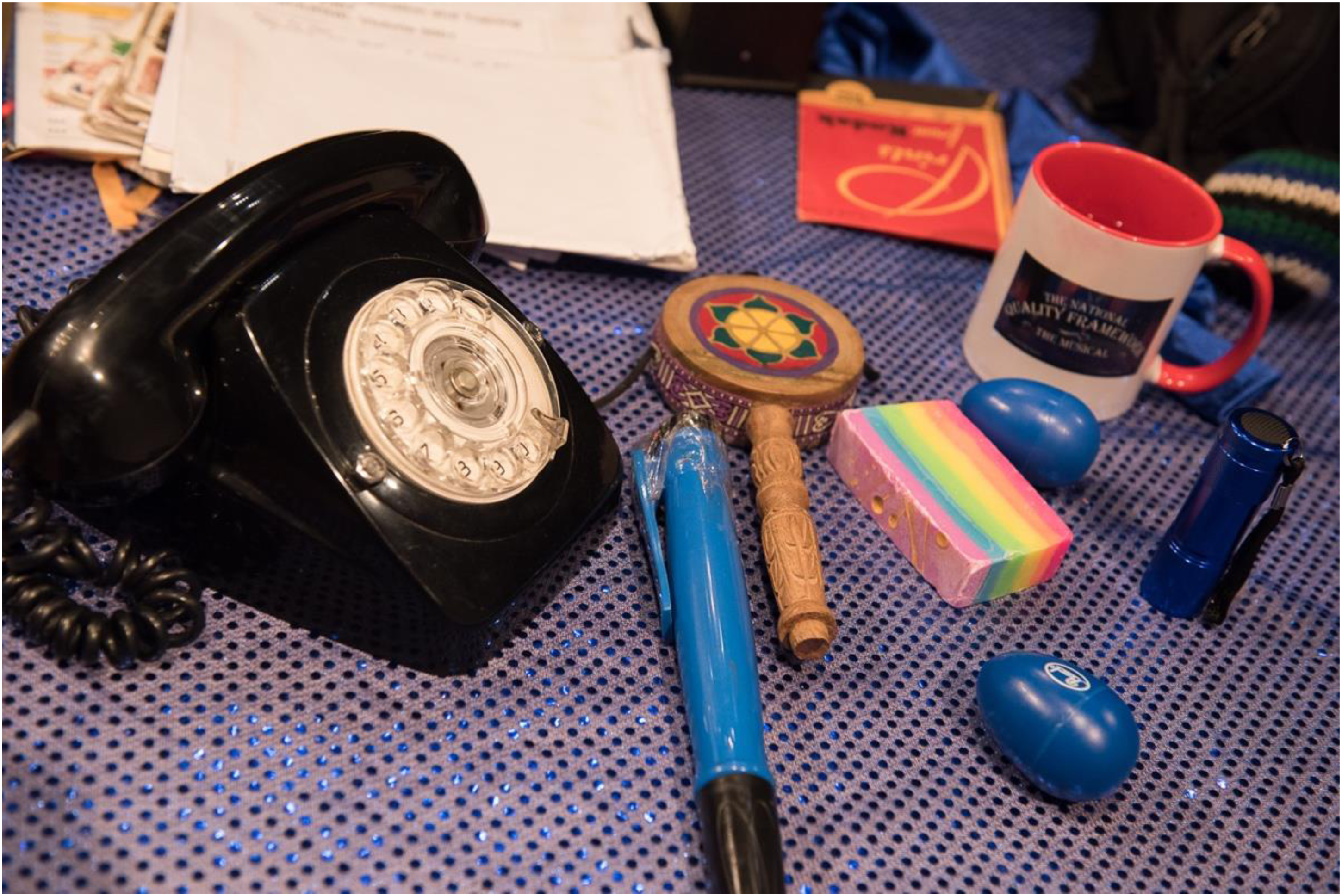
Props on a desk.
So, what did the props do?
Props have the material–non-material speculative fabulousation of enabling an intra-sensibility with the human performers. They are visual to the audience and communicate temporal trajectories – like our 19th-century camera, 1950s photo packet (Figure 19) and 1990s mobile phone (Figure 20) – along with the felt sense of either encountering them, having one yourself or having no idea what they are because you weren’t born yet. The encounter of the human-animal actors engaging with the props (mostly ridiculously) communicates and, in doing so, can conjure an enfleshed experience or curiosity about what they are and what they do and when. These props are juxtaposed with current technology that audiences are familiar with, like smartphones, which were often simultaneously being used to photograph our use of the antiquated technologies and artefacts (Figure 21) – then preserved in time and now used here to string you, the reader, into our wordy performance in this article.
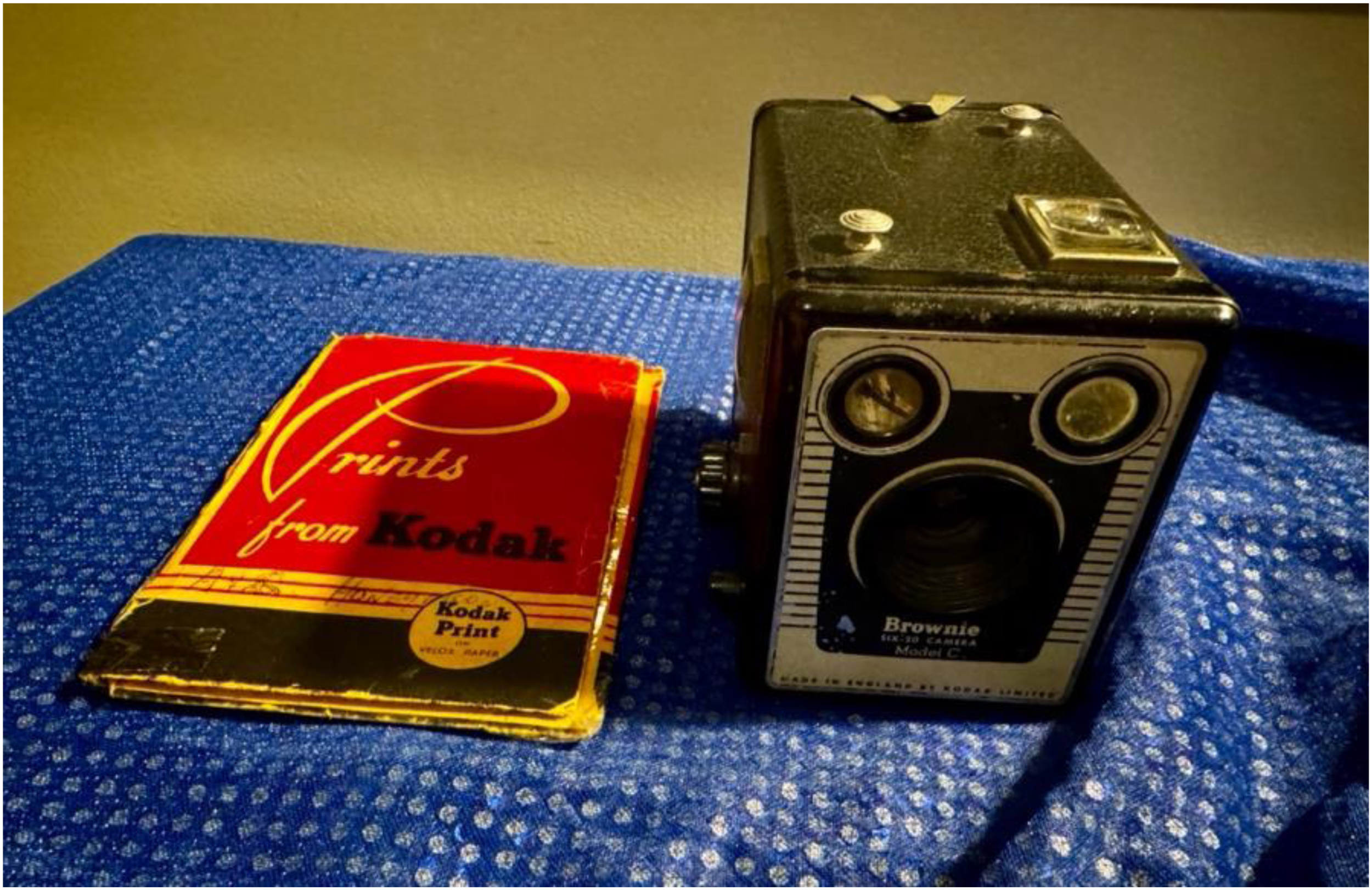
An old camera and a 1950s photo pouch.
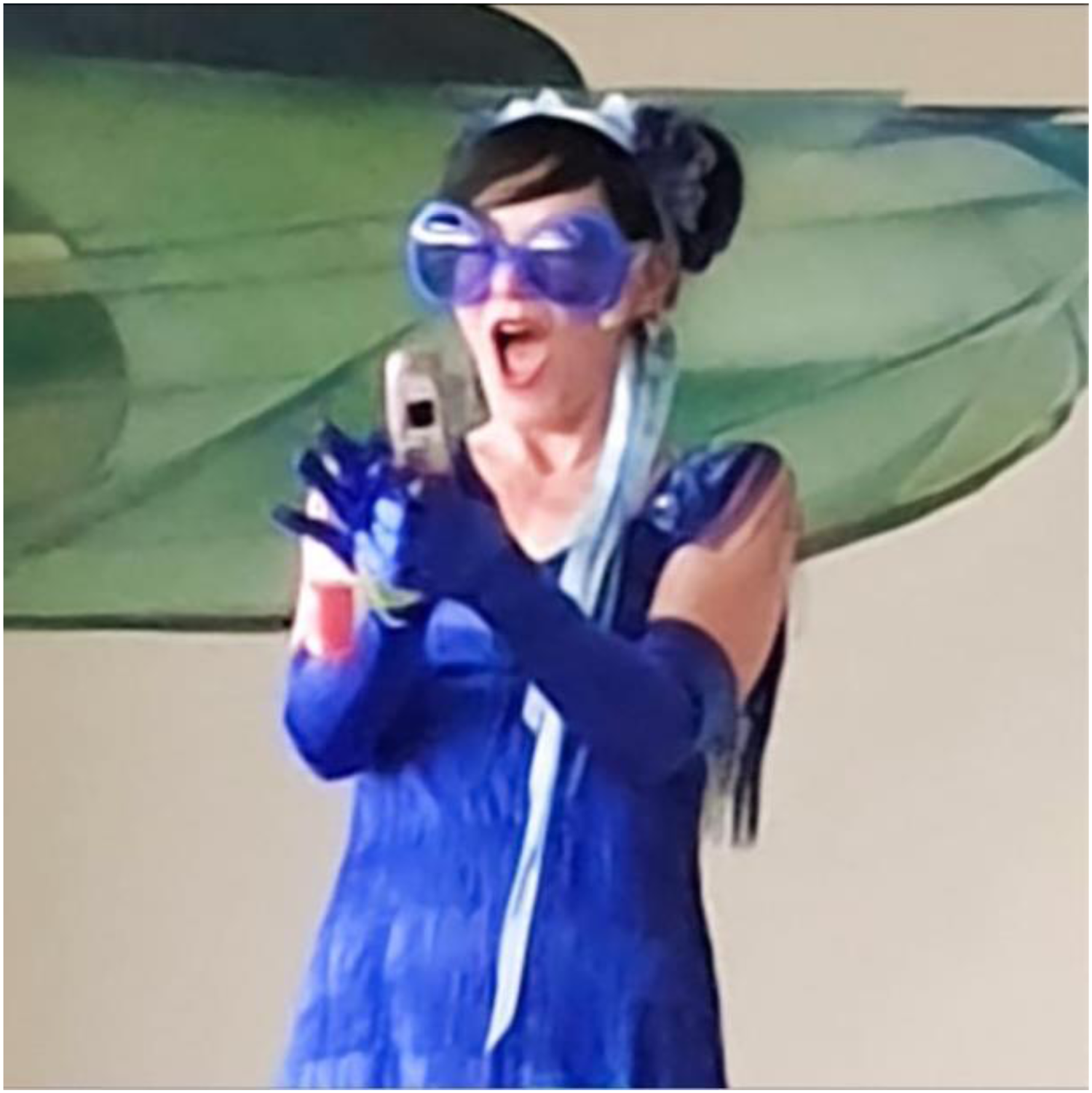
Red with a 1990s mobile phone.
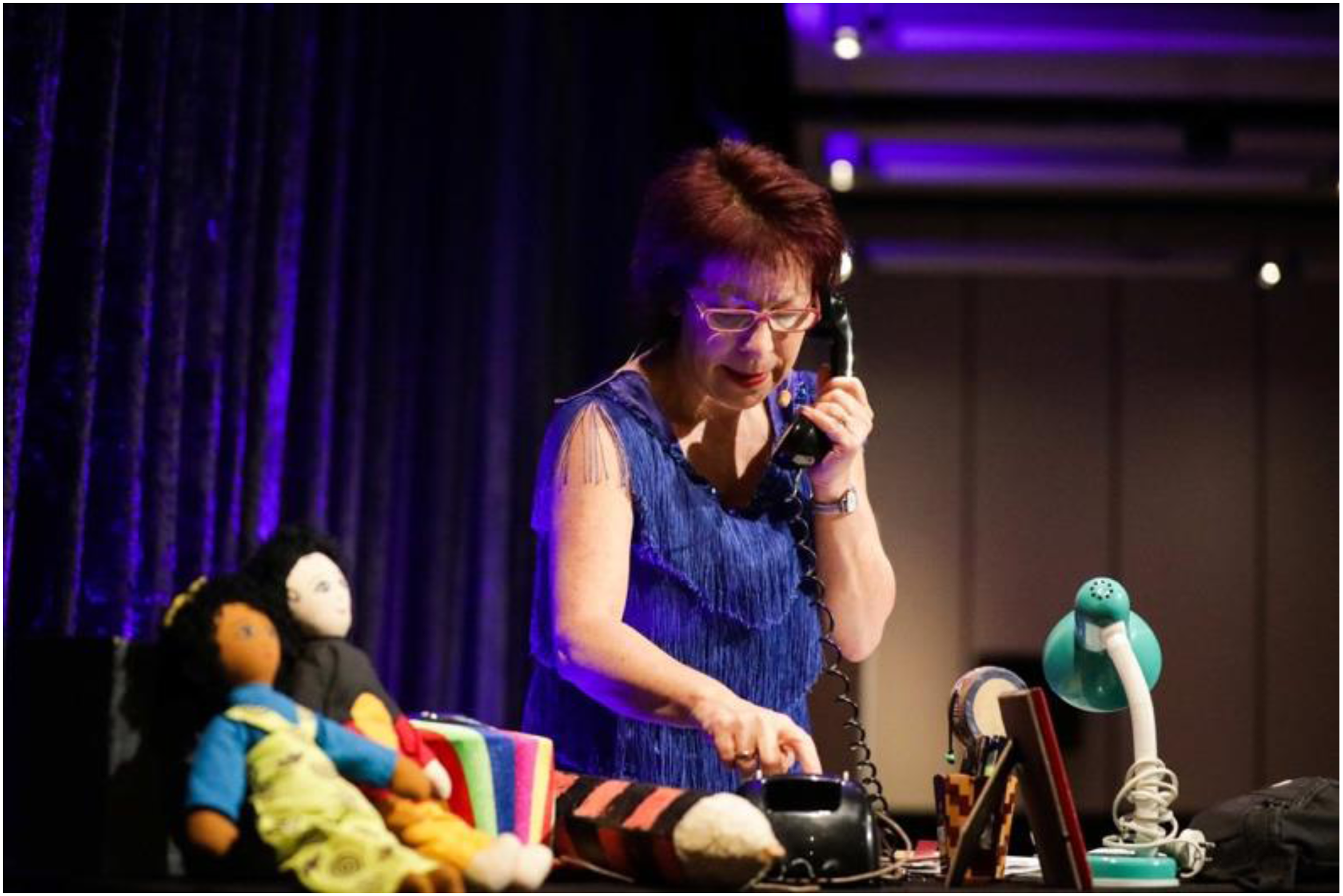
Lou with an old phone.
Liquid paper was a key player in the musical as it was the marker of where we were by what it covered and what it enabled to be rescripted on top of it. Like a palimpsest, it held the political acronyms from states and territories across the country that form policy and practice, enable funding and shape the educational experiences of children. If scratched back, the liquid paper would reveal that some states have more acronyms than others, and that translates into the amount of funding children and educators receive to experience the level of education, intervention, inclusion, regulation, attention and resources that the policy deems deserveable. When we type on a digital device, we can make these erasures more stealthily (there has been lots of this in the composition of this article!). The liquid paper exposed our edited trails as well as clumsily covering them (Figure 22). They elicited the laughter that indicated this deep problem in the distribution of resources that shape places, spaces and the lived experiences within them.
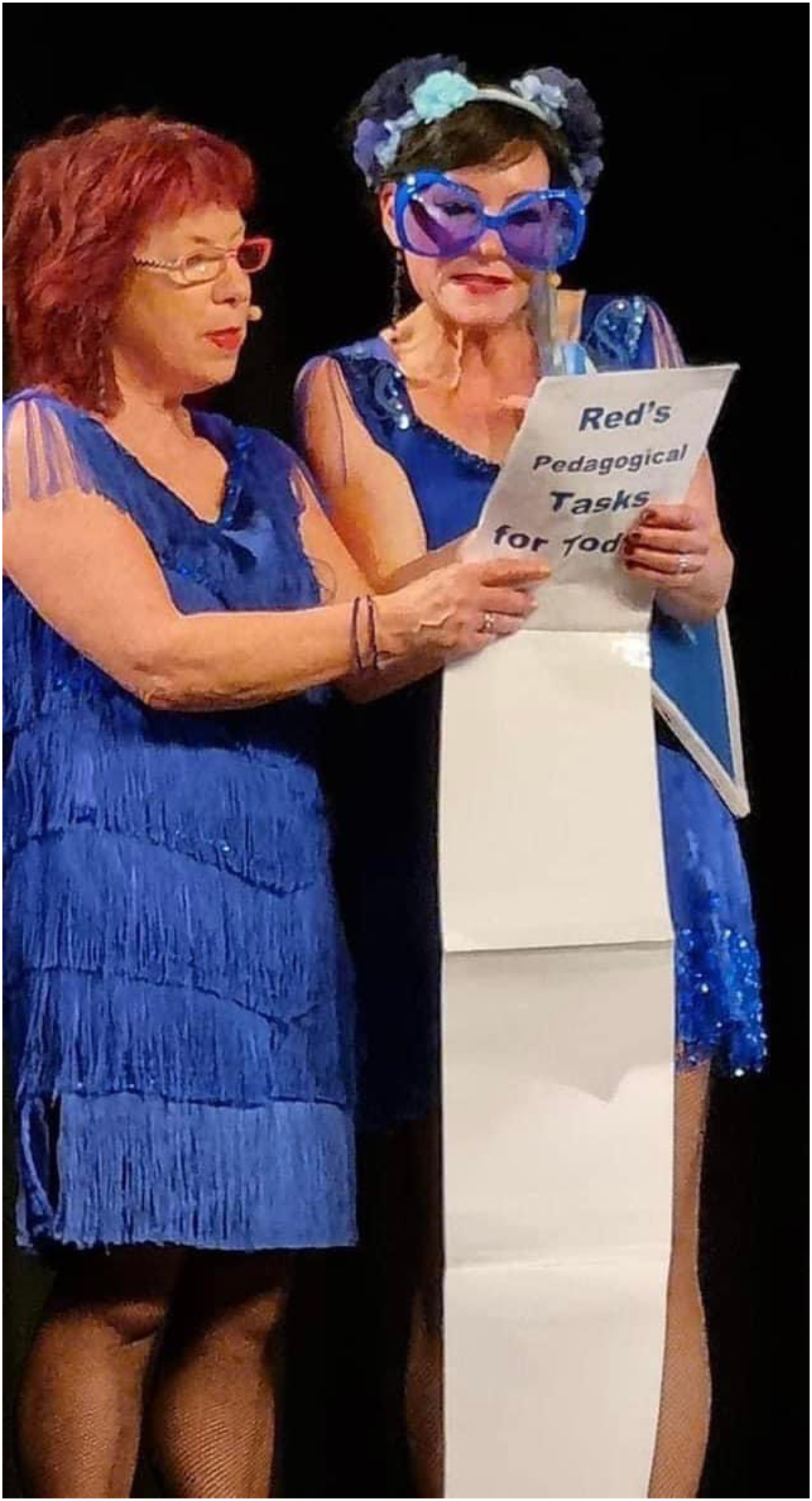
Liquid paper on acronyms.
The glasses with which Red attempts to laser-look at the acronyms don’t help (Figure 23). They were covered in dust – a fair representation of the layers we navigate to encounter policy and the embodied uncertainty the words on the paper generate.
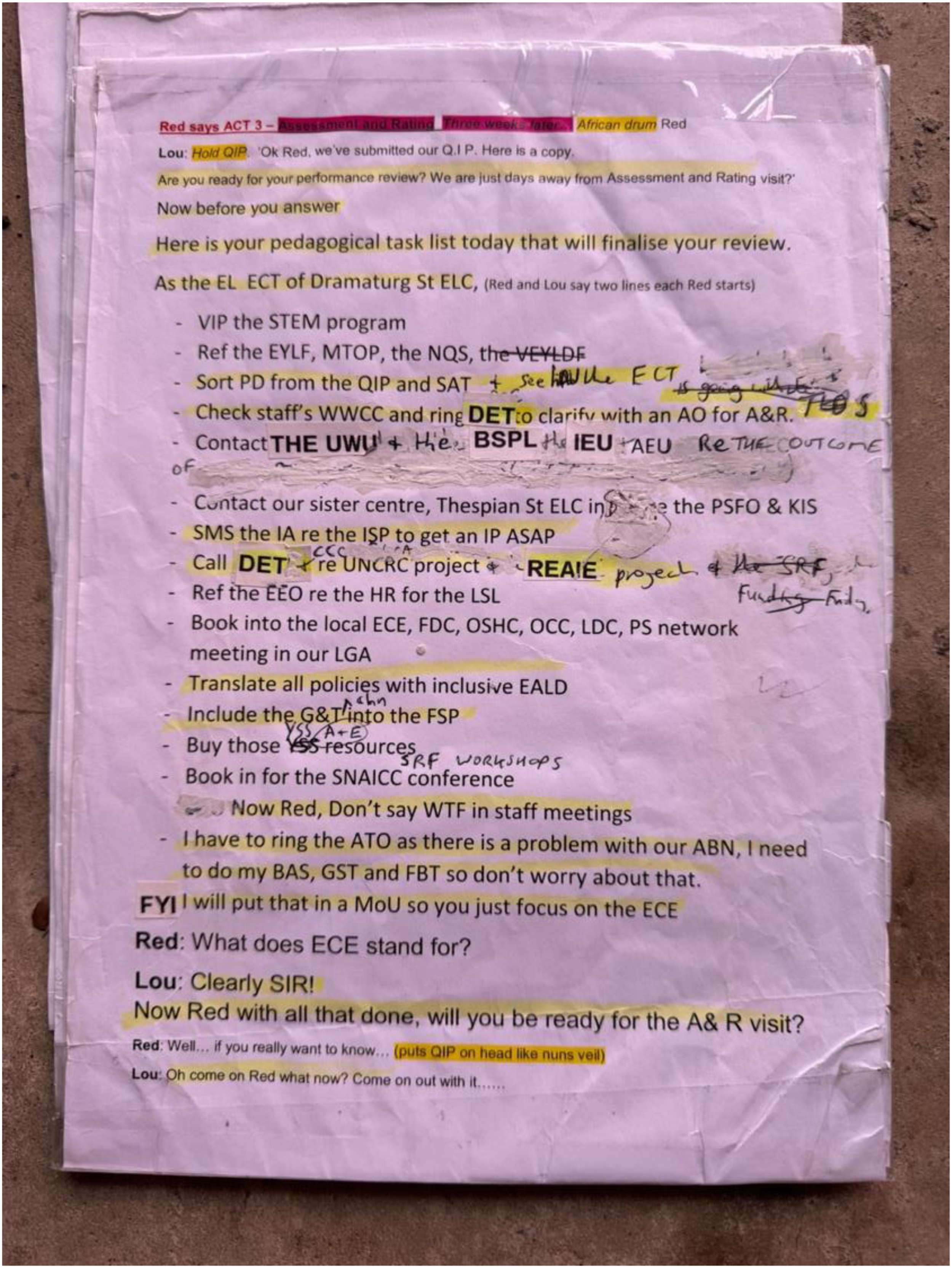
Red reading acronyms with liquid paper.
Just as a noteworthy notable note, the most rambunctious roars around acronyms and their liquid-paper layers came from the Australian Capital Territory (Canberra, Ngunnawal Country) – the ‘place’ where the federal parliament has situated itself. Policy is political and it does something, and politicians create it with or without liquid paper. They are all implicit in the inequitable distribution cross-country of what kind of worlding is possible on this damaged planet (Osgood, 2025).
Other regulatory documents such as a Notice of Assessment (Figure 24) and the Quality Improvement Plan have the capacity for physiologically reconstructing the cells of the bodies of educators. On the submission of a Quality Improvement Plan and the receiving of a Notice of Assessment, heart rates rise, nervous systems dysregulate, professional relationships can fracture, and tremendous changes can occur in the physical places and spaces of classrooms.
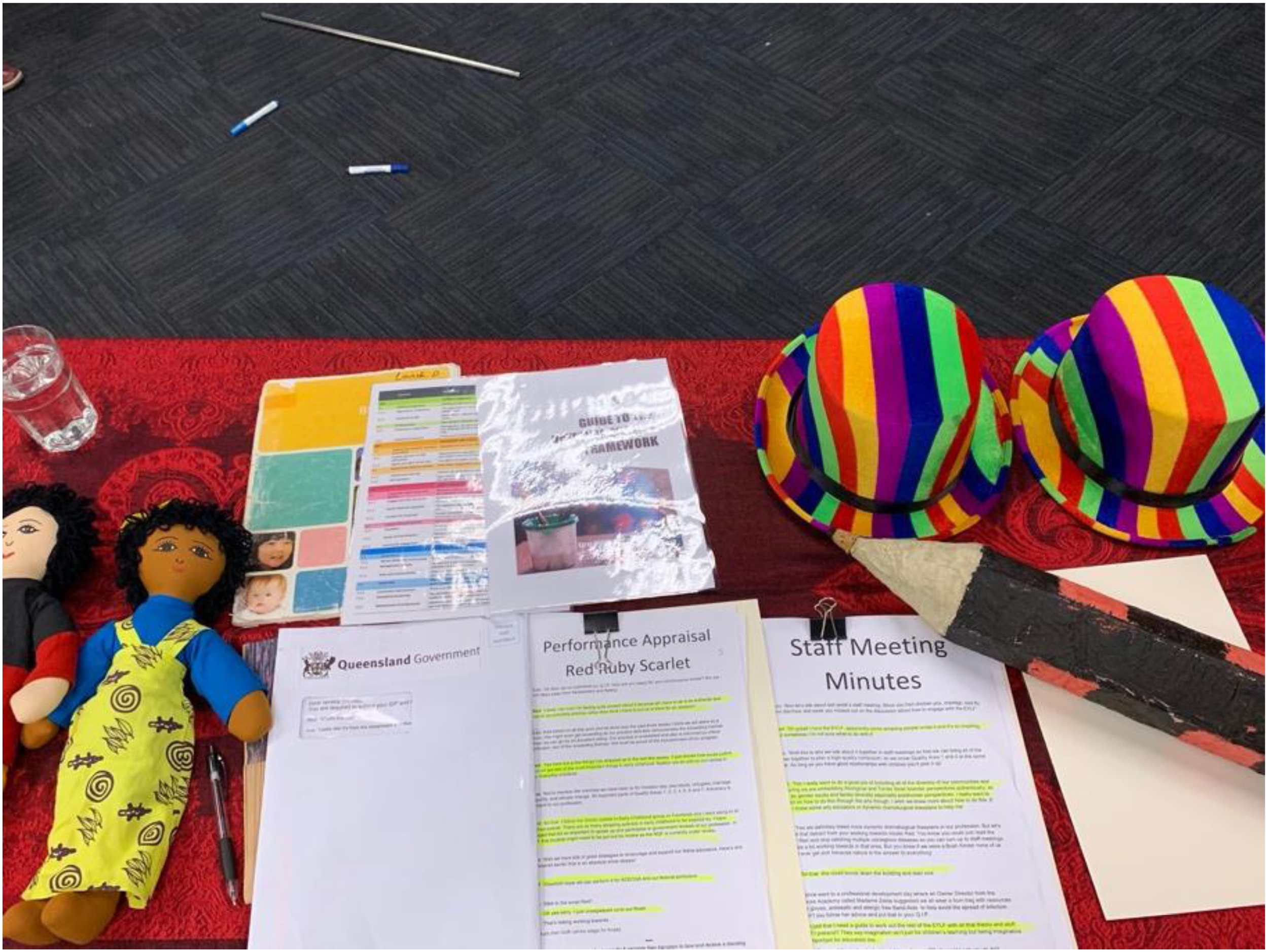
A Notice of Assessment.
A Notice of Assessment is the formal notification that your setting will be visited for Assessment and Rating. The results of an Assessment and Rating are publicly available and legislated to be displayed in each educational setting.
The human-experienced stress associated with the affordance of these two particular documents is addressed in the musical: first, with the delivery of the Notice of Assessment, where Red faints on receiving it (Figure 25), and, second, with the crafting of the Quality Improvement Plan (in a co-composed number with ABBA; Figure 26), which is a highly underdeveloped skill in the profession that educators, to this day, experience cellular damage over engaging. The musical addresses both of these visceral experiences through the props shaping the human response to their governing power. Like the acronyms, these documents shape the educator and their ‘professionalism’. In our post-musical survey, numerous educators expressed that the performance of the encounter of these two documents in particular ‘expressed how they felt’. In addition, another theme emerged, addressing the ways in which professional identities were shaped though professional development: years of non-musical professional development had less impact than the musical version of professional development about the National Quality Framework. The affectivity of the musical reached into the intensity of the feltness of the speculative fabulousation that we have consented to and come to believe as the practice of early childhood education.
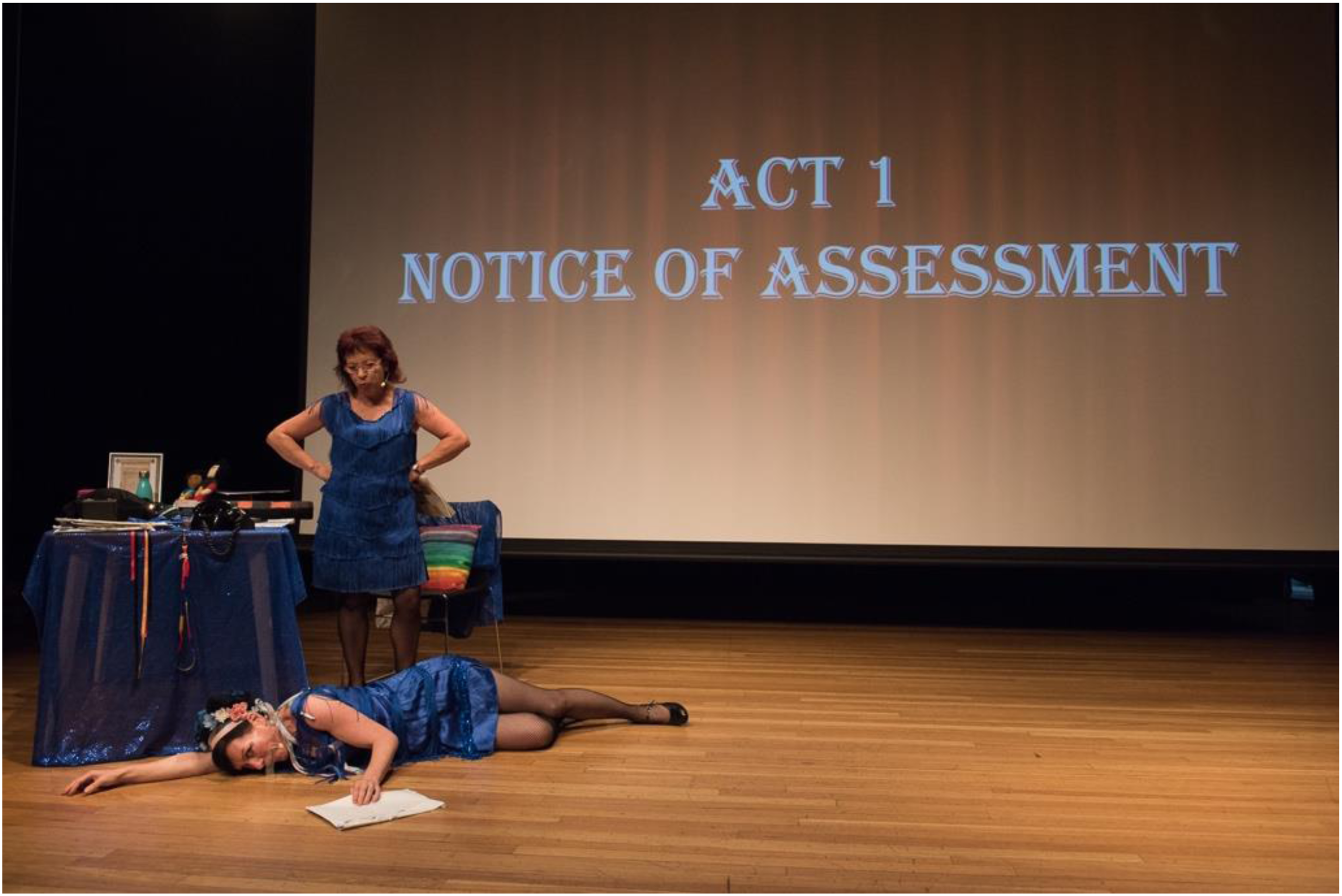
Red faints.
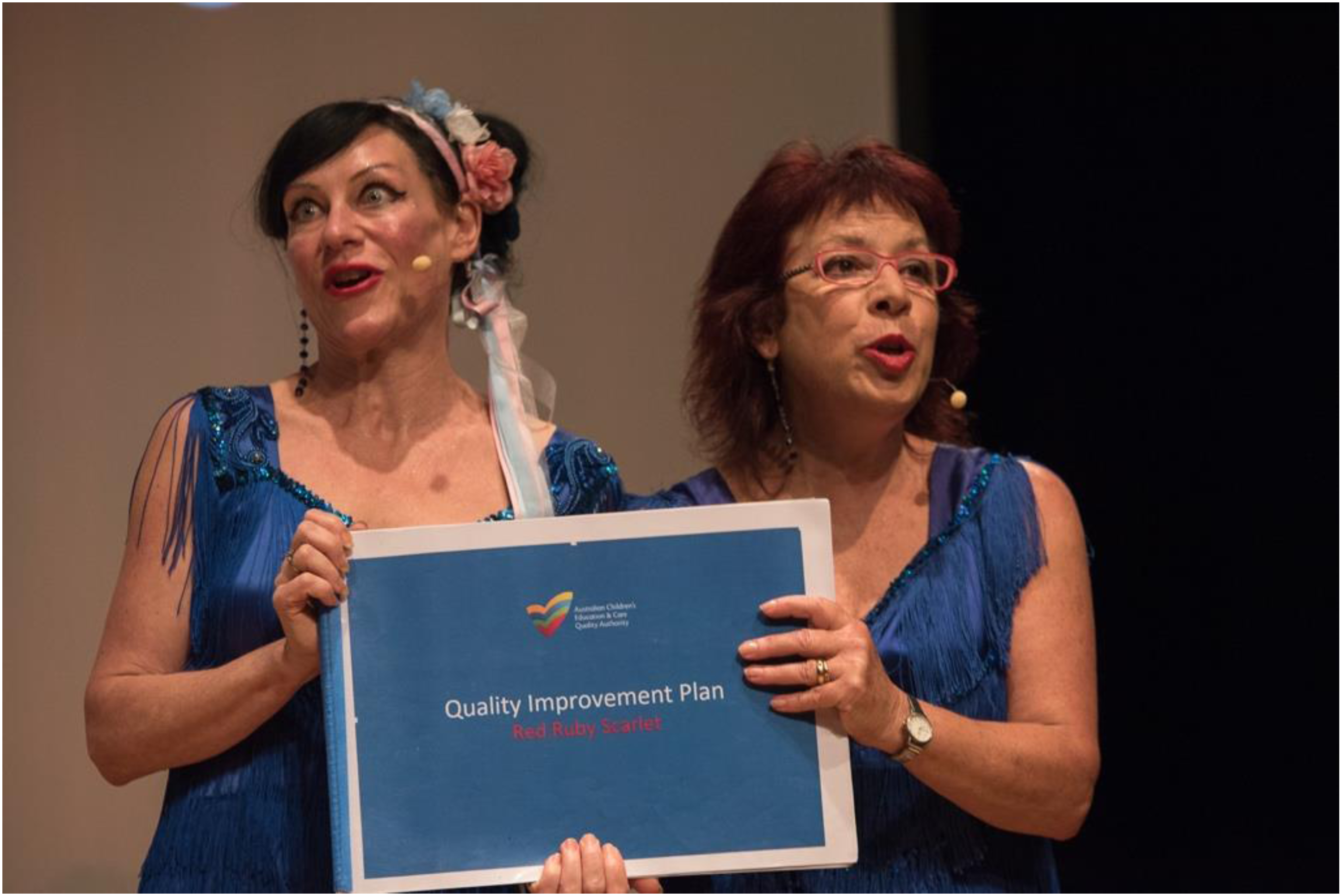
Quality Improvement Plan prop.
Closing number
What is professionalism? What does it do? What do we do with what it does?
Early childhood education is an archaic throwntogether confabulation of theories, philosophies, world views, objects, ways of working, physical constructs, regulations, laws and governing documents, all emplaced in vastly diverse contexts. It is worlding at its most musical. They exist through the exercise of enacting them as truth. They reassure, confuse, make insecure and strengthen. Early childhood professionalism is determined by the dance educators do with/in this contested terrain. Our contribution to this marvellous mess is The National Quality Framework – The Musical!, which has done something. What we do with what it has done is wiggle into all kinds of professional places and spaces with our cats and dogs, our props and songs, our computers and PowerPoints, our scripts and costumes, our Facebook posts, our music and dancing, and the fable that it both creates and is created in and through (Figure 27). For us, this is another way to figure professionalism sensorially, sensationally, sonorously and spectacularly as a ‘speculative fabulousation’. Doing an unlikely intraentwinglement like a musical about the National Quality Framework exhilarates and irritates. It has generated discussion, reflection, change, debate, resistance, oppression and decompression in both sustainable and unsustainable ways. The doings continue to do. It's what we do with them that matters (Figure 28).
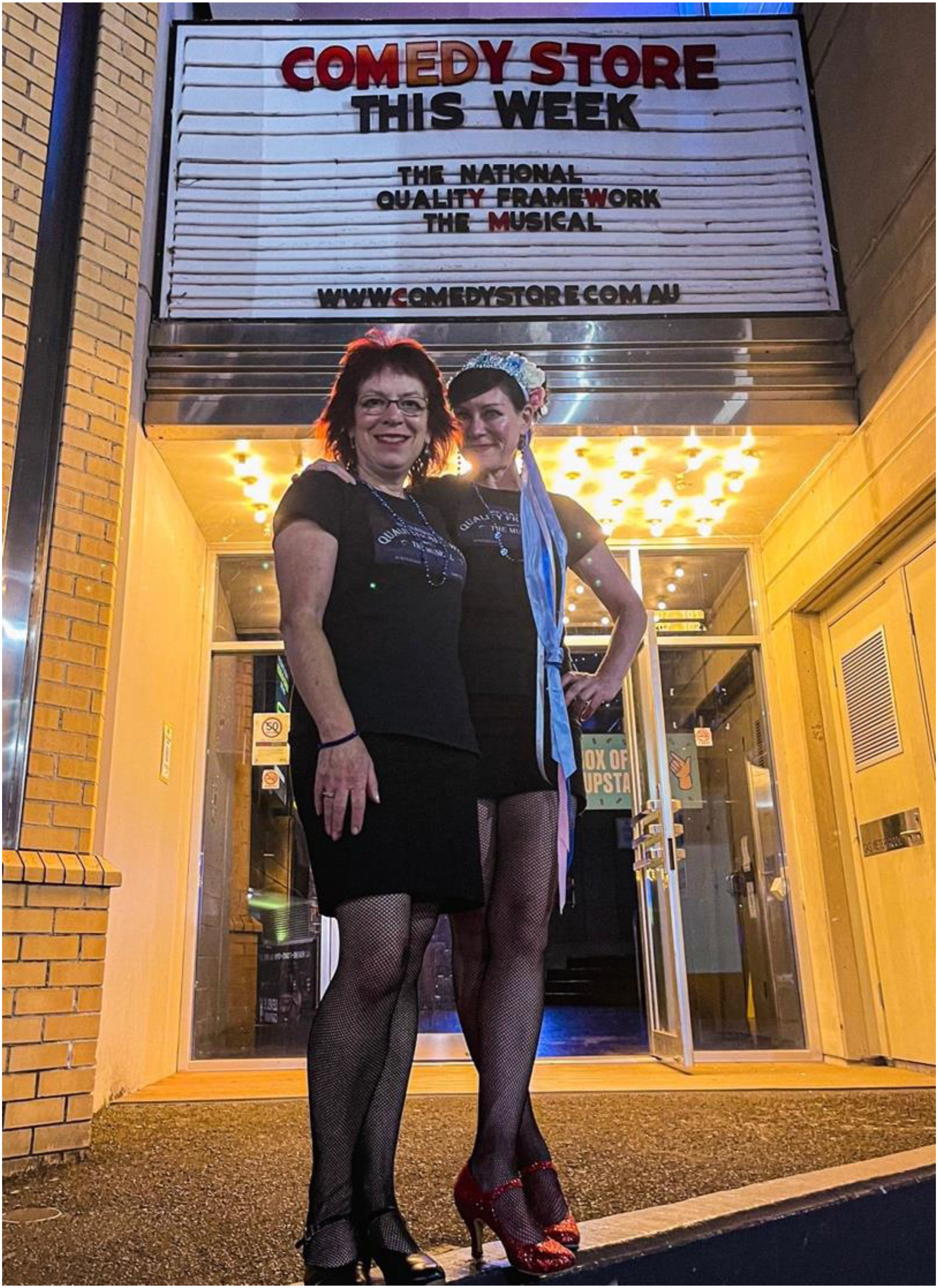
Finale.
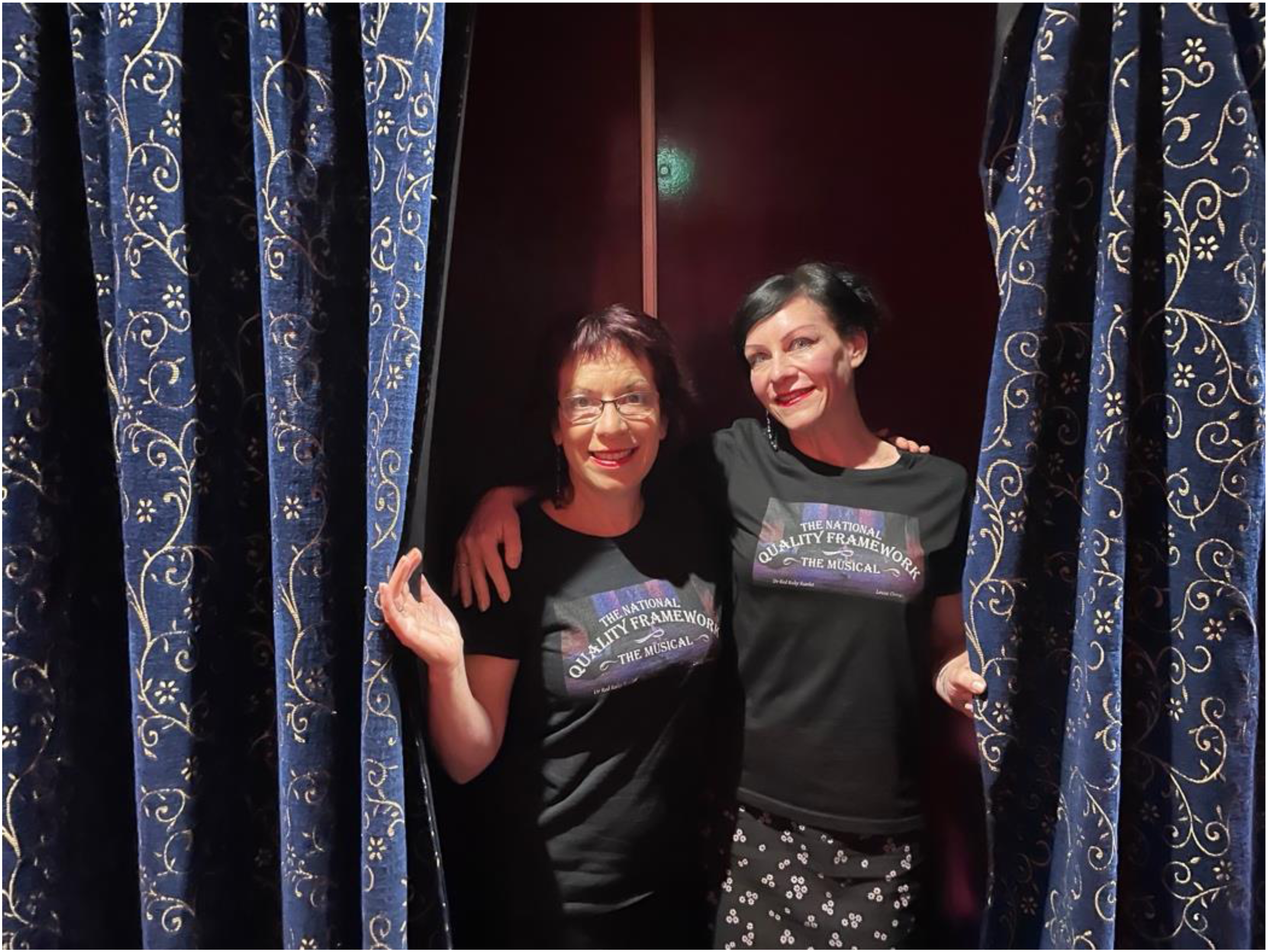
Behind the curtains.
How did we know how you felt? Because we feel it too.
We invite you to watch ‘The National Quality Framework – The Musical! The Documentary’ (Figure 29) and offer your speculative fabulousational commentary – doggie, catty and anotherwise.4

QR code for The National Quality Framework – The Musical!
Footnotes
Acknowledgements
‘The National Quality Framework – The Musical! The Documentary’ was created by the brilliant Benny Thatcher, who we are both in awe of and indebted to for marking in time the musical and what it did in early childhood education. The National Quality Framework – The Musical! and this article about it were created on Gadigal Country and on Wurundjeri Woi-wurrung Country. It has been and continues to be performed on Stolen Land across this place we have come to call Australia on colonial terms. We acknowledge Country and all it holds and has held since the first sunrise. Sovereignty was never ceded.
Funding
The authors received no financial support for the research, authorship and/or publication of this article.
Declaration of conflicting interests
The authors declared no potential conflicts of interest with respect to the research, authorship and/or publication of this article.