






Abstract
Gender narratives in Central Asia have long been shaped by Soviet modernisation projects and Western feminist paradigms, often sidelining local epistemologies and women's lived experiences. Drawing on a multigenerational family archive of handwritten diaries and oral recordings spanning the pre-Soviet, Soviet and post-independence periods, including materials from my own maternal lineage, this article traces how cultural memory and situated knowledge persist across generations. It analyses how women documented and interpreted social change through everyday practices and personal writings that remained largely outside official archives. I argue that these materials constitute important sites of feminist knowledge production, not because they articulate explicit feminist claims but because they transmit values, practices and forms of agency that shape women's lives over time. By foregrounding family archives and embodied memory as methodological tools, I introduce Suzani Feminism as an interpretive framework for understanding feminist knowledge as relational and context specific. Inspired by the Central Asian embroidered textile tradition of suzani, where patterns emerge through the gradual interweaving of threads, this framework reads women's lives as assemblages of intergenerational memory and practice. Moving beyond binaries of tradition and emancipation, I offer a situated account of agency grounded in everyday archives and locally embedded forms of feminist knowledge.
Suzani Feminism: Intergenerational knowledge and feminist epistemology
Epistemic practices of Central Asian women have long remained peripheral to both Western feminist thought and Soviet modernisation narratives. My own feminist consciousness was not born in theory but stitched together through oral traditions and everyday practices passed down by women in my family. To bring these epistemologies into view, I draw on my maternal lineage as a site of knowledge production and introduce Suzani Feminism – a metaphor, method and framework grounded in the hand-embroidered textile tradition known as suzani in Uzbekistan and widely practised across Central Asia. Here, suzani functions as both material practice and epistemic lens, through which I examine how feminist knowledge is stitched, remembered and carried across generations. I conceptualise Suzani Feminism as a mode of knowledge making rooted in intergenerational memory and cultural continuity. Given that not all forms of women's agency are inherently feminist, Saba Mahmood (2006: 31) argues that feminist scholarship often ‘accord[s] freedom a normative status’ and privileges resistance as the primary expression of agency. She instead reconceptualises agency as ‘a capacity for action that historically specific relations of subordination enable and create’ (Mahmood, 2006: 34). This article understands feminism not as synonymous with agency but as practices aimed at sustaining and improving women's lives within specific social contexts (Khader, 2019). From this perspective, the practices embedded in suzani through which women transmit knowledge, cultivate skills and support one another are approached here as feminist, insofar as they contribute to shaping and sustaining women's lives across generations.
In this sense, feminism is understood not only through resistance or rights-based claims but also through the relational practices by which women care for one another and craft meaningful lives within existing structures, recognising and respecting differences ‘as products of different histories […] and manifestations of differently structured desires’, as noted by Lila Abu-Lughod (2002: 787). It counters the persistent gender discourses in Central Asia, foregrounding the co-constitutive praxis of women's lived temporalities over abstracted, orientalist representations. Reclaiming the pluriversality, my engagement with Suzani Feminism is thus grounded in a commitment to theorising from within these contexts, rather than reproducing frameworks that speak about them from the outside. Suzani Feminism stands in contrast to universalising feminist frameworks that define emancipation with resistance to social norms. Instead, it offers forms of agency embedded in continuity, relationality and culturally specific values. Dominant representations of Central Asian women shaped by Soviet modernisation narratives and Western feminist interpretations have often reduced women's lives to binaries such as modern versus traditional or liberated versus oppressed, reflecting what Madina Tlostanova describes as the persistence of ‘Western European categories, value systems and paradigms’, in which the binary of ‘modernity versus tradition is never questioned’ (Tlostanova, 2010: 188). As Selbi Durdiyeva's reading of Audre Lorde suggests, even when exposed to a curated version of Soviet modernity during her 1976 visit to the USSR, Lorde's engagement remains marked by ambivalence and critical questioning of what remains unseen, revealing ‘the violence of initially omitted narratives’ (Durdiyeva, 2026). Such frameworks overlook the ways that women actively navigate and inhabit their social lives.
Suzani embroidery, from which this framework draws its name, is grounded in the hand-embroidered textile tradition, known as suzani, 1 widely practised in the Central Asian countries of Uzbekistan and Tajikistan (see Figure 1). More than decorative objects, these textiles served as a medium through which women transmitted skills, values and cultural knowledge across female generations (Ludington, 2018; Sukhareva, 2011). Suzani embroidery can therefore be understood as a site of intergenerational knowledge production, not only as a form of material culture. Suzani embroidery has historically served as a medium through which women transmitted knowledge and expressed cultural and social identities. As Lola Nematillayeva (2023: 156) notes, oral traditions in suzani embroidery ‘revolve around storytelling’, through which artisans transmit cultural values, beliefs and shared identities. Soviet industrialisation disrupted many of these craft traditions, dismantling systems through which artistic and cultural knowledge had been transmitted across generations (Whitlock, 2002). These transformations changed the conditions under which women's knowledge could be produced, valued and transmitted. At the same time, practices such as suzani embroidery persisted within domestic and informal economies, providing women with opportunities to contribute to the household economically while extending their roles beyond strictly private spaces. Following independence in 1991, suzani embroidery has experienced a revival after being largely abandoned during the Soviet era, re-emerging for commercial gains, financial necessity and as a symbol of resistance and cultural continuity.
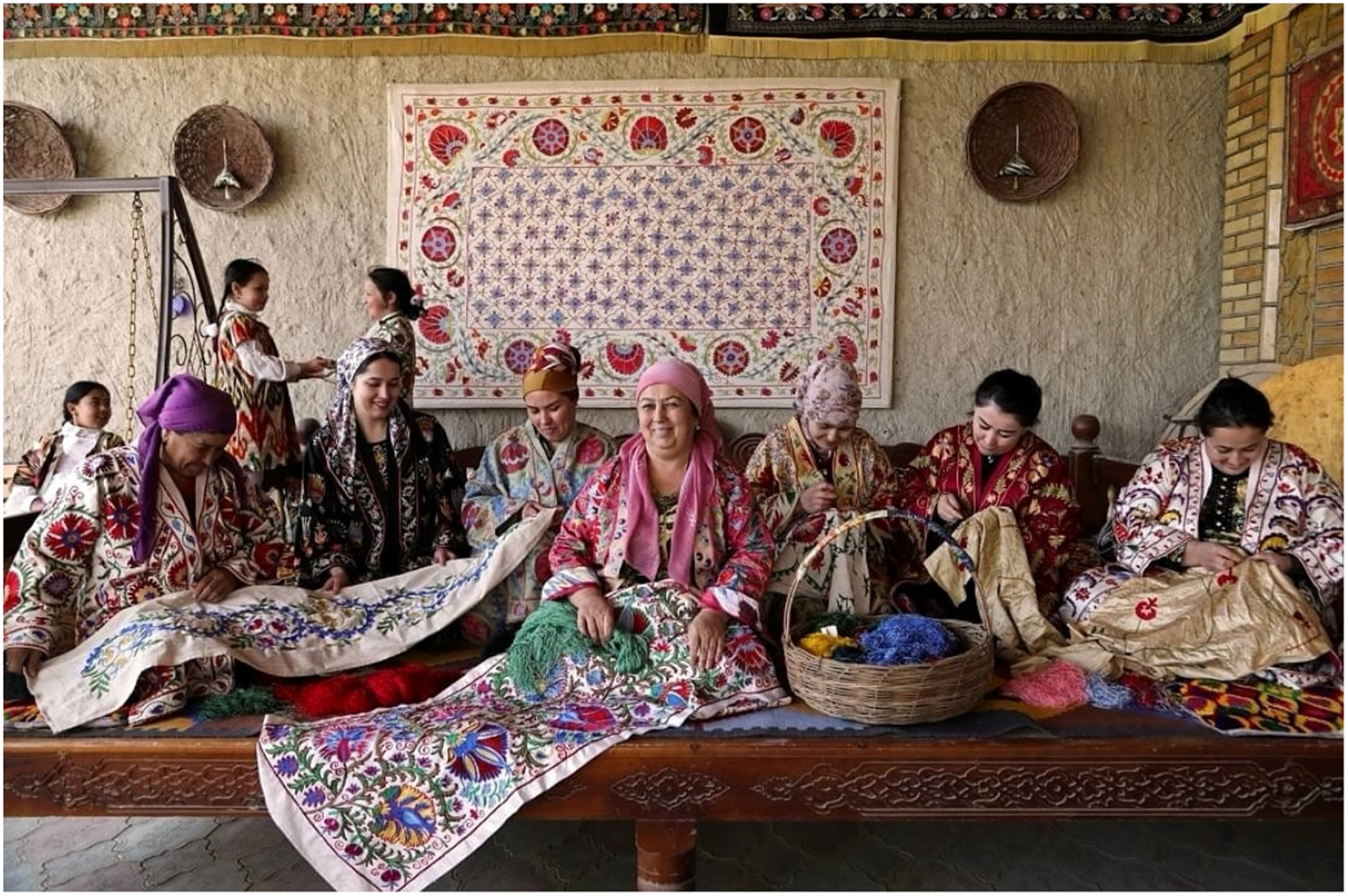
Traditional suzani embroidery in Bukhara, Uzbekistan. The process involves hand embroidery on natural fabrics with silk and cotton threads and often dyed naturally and may take months or years to complete. The photograph shows a Bukhara family with suzani embroidery being worked across the generations, with the home functioning as a living archive.
The process of making suzani through the slow, often collaborative stitching of layered motifs is closely tied to girls’ socialisation, where embroidery became a pedagogical practice through which patience, aesthetic knowledge and social responsibilities were passed on and cultivated (Nematillaeva, 2023; Sukhareva, 2011). In this sense, suzani functioned not only as material culture but also as a form of intergenerational learning that formed women's roles, relationships and possibilities within their social worlds. Suzani now appears in diverse forms of wall hangings, pillow covers and garments and keeps serving decorative, symbolic and daily fashion purposes in contemporary life (see Figure 1). In the sedentary region of Central Asia, particularly in settled societies such as Uzbekistan as distinct from neighbouring Kazakhstan and Kyrgyzstan, where nomadic lifeways afforded women greater mobility and more shared labour (Tabaeva and Durrani, 2025), speech had been restricted and archives had been dominated by patriarchal and colonial actors, such practices created spaces for forms of epistemic expression that did not rely on overt resistance. What unites these practices across generations is their persistent ethical commitment to women's flourishing through relational continuity (Khader, 2019). Suzani embroidery, family diaries and oral narratives all encode the same moral message: women nurturing capacities such as patience, skill and social knowledge that enable other women to thrive within their worlds. This is Suzani Feminism as ethical transmission and a sensibility that persists whether women name it or not.
The symbolic motifs embedded in suzani embroidery illustrate how cultural meanings and values were encoded through women's practices. For instance, pomegranate motifs are associated with fertility and continuity, while floral and garden patterns refer to Islamic cosmologies of paradise and abundance (Ludington, 2018; Sukhareva, 2011). These designs formed a visual language through which women expressed social values, aspirations and worldviews. In this way, suzani motifs can be read as material expressions of gendered knowledge. Beyond symbolism, suzani textiles also offer insight into women's labour, skill formation and social positioning. The preparation of suzani pieces was closely tied to girls’ education and marriage economies, where embroidery functioned as a space of socialisation into adulthood. Stitching was not only a technical skill but also a practice through which patience and aesthetic sensibilities were cultivated.
The empirical grounding of this framework lies in a multigenerational family archive consisting of diaries, oral narratives, garments and photographs. These materials, produced across the pre-Soviet, Soviet and post-independence periods, provide a unique lens into how women documented, interpreted and navigated social change within their everyday lives, revealing the same ethical pattern observed in suzani practices. This article reads these family artefacts as sites of knowledge production (Browne, 2014), where women articulated experiences and forms of understanding that often remained outside official archives. This reflects what Durdiyeva (2026) describes as the ‘curated visibility’ of institutional archives, where women's lives appear selectively while their everyday experiences and forms of knowledge remain obscured. Approaching these materials through the lens of Suzani Feminism allows for an analysis that attends to their layered, fragmentary and intergenerational nature. Like suzani embroidery, where meaning emerges through the accumulation of stitched fragments, the family archive brings together dispersed forms of memory into a textured narrative of women's lives. This methodological approach foregrounds how knowledge is produced not only through written texts but also through embodied practices, storytelling and material culture.
Limits of soviet gender modernity: Silences and missing voices
Gender reforms during the Soviet period are often told around what Deniz Kandiyoti (2007: 602) terms the ‘Soviet paradox’, 2 a form of paternalist modernity that positioned women simultaneously as subjects and objects of progress. The unveiling campaign Hujum (هجوم, meaning ‘assault’), launched in 1927, has been a key campaign of this contradiction. Marked symbolically on 8 March, it was framed as an act of liberation, yet it functioned as a forceful intervention into the intimate social and cultural life. This gender paradox (Kandiyoti, 2007) was evident not only in the pace of reform but in its uneven focus as well. As Uzbek historian Dilorom Alimova (1998: 149) observes, ‘The necessity of systematic agitation among men was not taken into consideration […] since it was mostly men rather than women who needed to be enlightened on this subject’. Efforts to transform women's lives were thus directed at women themselves, while leaving largely unaddressed the gendered norms and relations that structured their everyday realities. This orientation is also reflected in official Soviet discourse. Rahima Aminova's (1985, 1992, 1994) writings published in Russian on women in Soviet Uzbekistan reflect the ways in which gender was articulated within state discourse. In her work, women are praised for actively participating in labour, social progress and public life, as visible contributors to Soviet modernisation. While this framing provides insight into how women's roles were represented within institutional narratives, it also signals the limits: women are positioned largely as subjects of transformation rather than as producers of knowledge. What comes into view is a mode of documentation shaped by state priorities, one that privileges visibility in public and economic spheres while leaving less space for the everyday practices, memory work and intergenerational forms of knowing that this article seeks to foreground.
Much of what is known about Soviet gender reform in Central Asia is curated through the language of policy, reform and resistance. Gregory Massell (2015: 93), for instance, makes explicit the extent to which women were positioned within this project not simply as beneficiaries of emancipation but as instruments of it, conceptualised as a ‘surrogate proletariat’ through which broader social transformation could be achieved. Douglas Northrop (2004) similarly shows how practices such as veiling were perceived as both social problem and political obstacle by the state, focusing on the ambitions and contradictions of reform at the level of the state, while leaving largely unaddressed the forms of women's knowledge that existed, beyond institutional archives. Marianne Kamp's (2001, 2002) works unsettle this coherence by turning to the unevenness of lived experience. As she writes, Uzbek women did not simply absorb Soviet agendas but ‘developed their own synthesis’ (Kamp, 2006: 229), reshaping the figure of the ‘New Woman’ (as articulated within Uzbek reformist debates of the time and Soviet frameworks), in ways that aligned with existing social expectations while actively participating in the reworking of gendered norms.
Recent scholarship on gender reforms in Tajikistan further reinforces this shift. Zamira Abman (2024) focuses on the limits of state-led emancipation through the Zhenotdel (women's departments) by showing how local practices existed beyond official frameworks, particularly in rural contexts. Yet even her work remains partially embedded in a teleological understanding of modernity, where women's lives are assessed through formal markers such as education, labour and public visibility, leaving limited attention to the epistemologies through which women themselves interpret and sustain their worlds. Syinat Sultanalieva's (2023) work draws on Kyrgyz patchwork to symbolise mobility and multiplicity, critiquing the limitations of Western feminist theories in local contexts. She introduces the concept of ‘kurak feminism’ to examine Kyrgyz women's narratives and rights, using the term ‘kurak’ – a patchwork made from various colourful fabric pieces – as a metaphor. She argues that through kurak, ‘weaving in elements from completely different and, to a Western eye, incompatible approaches nomadity of being might pave the way towards a Central Asian reframing of non-Western feminisms’ (Sultanalieva, 2023: 137). While nomadic lifestyles predominantly characterise the experiences of Kazakh and Kyrgyz women, the sedentary cultures in Tajikistan and Uzbekistan may influence women's experiences differently. Sedentary cultures often exhibit more pronounced gender conservatism and traditional norms compared to the more adaptive and fluid nomadic societies (Tastanbekova, 2018). My aim here is not merely to differentiate between these lifestyles but rather to show how they complement each other and together pluralise our understanding of local feminist epistemologies. While kurak feminism draws on nomadic patchwork traditions, Suzani Feminism emerges from sedentary embroidery practices and foregrounds intergenerational memory and domestic knowledge.
A fundamental shift becomes visible in the works of Marfua Tokhtakhodjaeva (1997, 2001, 2008), who argues that although women were often ‘thrown overboard’ in dominant historical narratives, they carried a ‘cultural potential’ that could shape the future. Recognising this potential, however, requires more than reformist intention. As postcolonial feminist scholar Gayatri Chakravorty Spivak (2010) notes, intention alone does not shield reforms from the epistemic and structural violence they may enact. She describes this as ‘the project to constitute the colonial subject as Other […] [and] the asymmetrical obliteration of the trace of that Other in its precarious subjectivity’ (Spivak, 2010: 35), showing how dominant frameworks both produce and erase subaltern forms of knowledge. Women continued to transmit knowledge across generations through oral narratives, domestic practices and textile traditions beyond the reach of formal institutions. These vernacular epistemologies persisted, even though they remained marginal to official archives and largely under-theorised in scholarship.
Tokhtakhodjaeva's (2008) Twentieth Century Through the Eyes of Women in Uzbekistan, published in the Russian language, represents a critical intervention in this regard, in which she draws on women's oral narratives, reconstructing history from below and positioning women not as objects of reform but as subjects who produce what she terms an ‘unofficial history’. As she writes, ‘the history of the twentieth-century woman is a history of survival’ (Tokhtakhodjaeva, 2008: 10). She contends that women's stories of the Soviet period are organised not into categories of emancipation or oppression but through lived experience and memory. Each woman ‘carries within her a world of knowledge’ through which events are narrated and ‘filled with the details of their lives’ (Tokhtakhodjaeva, 2008: 299). In this sense, social change is interpreted through the textures of everyday life. Yet, despite the significance of such works, local feminist scholarship from the region remains unevenly recognised: if heard and read, it is under-acknowledged; if acknowledged, it is under-cited. This marginalisation reflects what Tlostanova (2010: 190) describes as an ‘asymmetry of knowledge production’ through which local epistemologies are positioned as supplementary rather than theoretical, and challenges the enduring ‘coloniality of knowledge’ that structures how women's lives are interpreted. Here, centring these voices is not only an analytical move but also an ethical imperative. As Madhok (2020: 395) argues, producing ‘concepts from most of the world’ requires a reflexive politics of location attentive to diverse life-worlds. It is from within these practices, family narratives, suzani, storytelling and memory that this article begins, approaching them not as residual culture but as sites of knowledge production (Browne, 2014), through which feminist epistemologies are actively produced and sustained.
Generational memory as feminist method: Weaving family stories into archive
Guided by Suzani Feminism as both metaphor and method, this section draws on intergenerational memory to explore the gendered experiences within my maternal lineage. The analysis is based on my family archive composed of written diaries, audio recordings, photographs and official documents, which are approached as sites of knowledge production. As Lieblich et al. (1998) suggest, narrative provides a means of tracing how cultural identity and historical memory are constructed over time. The analysis traces four generations of women in my family spanning pre-Soviet, Soviet and post-independence periods, using multigenerational storytelling as a feminist method of situated meaning making (Haraway, 1988). To situate these family materials within their relational and generational context, Figure 2 maps my family lineage across four generations. Such genealogical representations resonate with feminist work in family studies that has traced intergenerational continuities to understand the gendered lives and knowledge production (Allen, 2016).
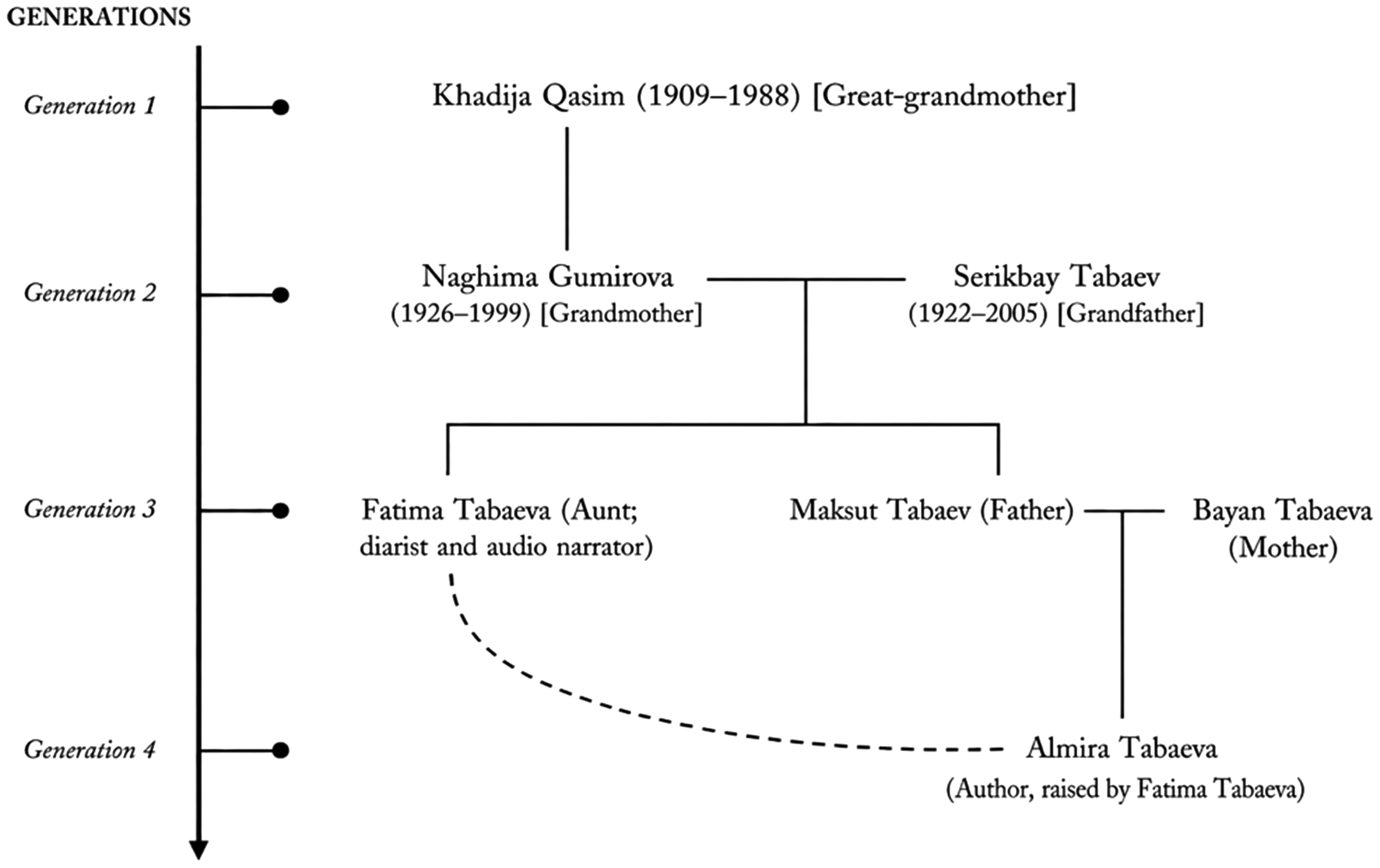
Family lineage.
Particularly significant is a written diary, which is then audio recorded in Russian by my opa 3 and available on community radio ‘Fantasia’ (Radiofantansia, 2024). Although this recording is based on written diary entries that are read aloud, the act of voicing these memories transforms the text into a mediated oral archive. These written diaries form an important part of the family archive, and they are interpreted alongside material artefacts and oral narration as part of a broader epistemic landscape through which women's knowledge and memory circulate across generations. This recording contributes to feminist research in three ways. Reading these diaries through a feminist lens allows attention to women's everyday negotiations of education, mobility, labour and family responsibilities within the gendered structures of Soviet and post-Soviet society. This contributes to feminist scholarship by foregrounding women's lived experiences and intergenerational knowledge as sites through which gendered power relations and possibilities of agency can be explored. Such an approach aligns with feminist scholarship on women's lives under state socialism, which has emphasised the importance of everyday experiences and informal practices in understanding gender relations beyond official narratives of emancipation (Ashwin, 2000; Ilic, 2001).
These materials spanned across several spaces: sacred, civic and personal domains. For the first generation, I provide a Qur’anic fragment (Qur’an, al-Baqarah 2:232), belonging to the first generation, my great-grandmother Khadija, with her interpretations and texts. For the second generation, I include a birth certificate and dresses of my grandmother Naghima. The third generation is represented by my opa Fatima's handwritten memoir-diary. Lastly, to augment the narratives as the fourth generation, my personal stories have been incorporated. The application of family narratives in this study was ethically sound, as I have primarily used secondary written material, ensuring scholarly rigour and historical accuracy. The referenced audio recording of the diary was utilised with explicit permission of the author, respecting her autonomy and upholding ethical standards in research. This intergenerational narrative method resonates with feminist commitments to reclaiming the personal as political, where memory, silence and the domestic sphere become sites of theorising (Hirsch, 1997). Table 1 presents a curated compilation of written artefacts, photographs and audio materials belonging to three female ancestors in my family archive. Much of this archive consists of personal diaries and written reflections, which are the forms of what historians describe as ‘ego-documents’ (Dekker, 2002), which have long been important sources for feminist historiography as they capture women's everyday experiences often absent from official records.
Family lineage as archive.
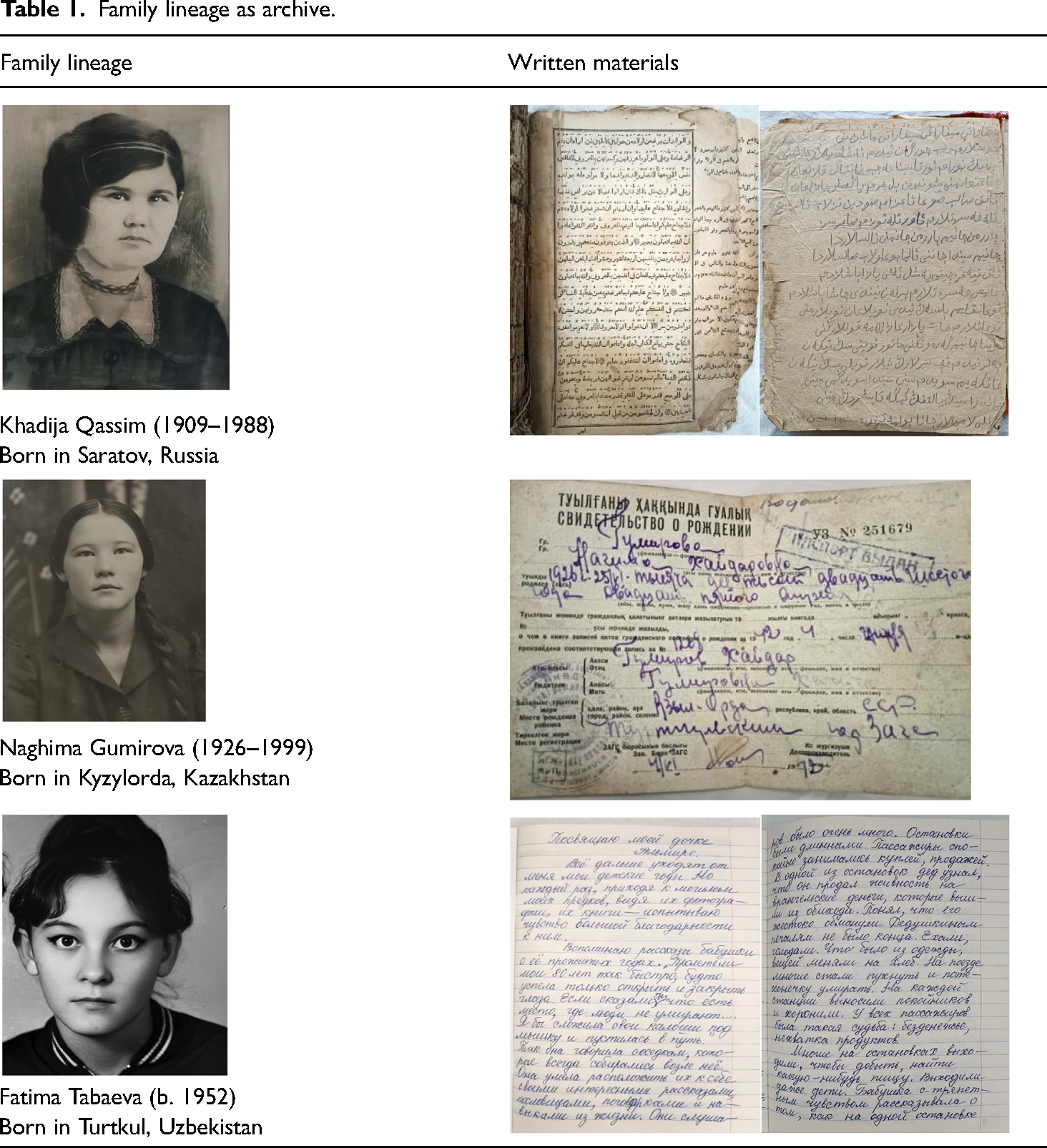
Khadija (first generation)
I remember sitting next to my blind grandmother Naghima, holding her hands and listening to her stories about her mother Khadija. My great-grandmother Khadija Qassim was born in 1909, in Altata, in the Dergachyovsky district of Saratov, Russia. She belonged to a Tatar ethnic group and received religious education in madrasah. Khadija passed away just after my birth and is said to have rocked my beshik (cradle). Khadija was the only daughter of Nizamitdin and Farida and had a younger brother, Khusain. Her mother Farida often brought Khadija to the house of her parents-in-law while helping with household work, and the grandparents played an active role in raising Khadija. It was they who sent Khadija to the madrasa in Altata, where she learnt to read fluently, memorised Qur’anic suras and became known as one of the strongest students in her class. Supporting children's access to religious literacy and schooling was common among Tatar Muslim communities of the late Russian imperial period (Kefeli, 2014; Ross, 2020), which suggests that Khadija's interaction with Qur’anic interpretation was rooted in her environment. Fatima's diary also describes the strict discipline of religious schooling at that time, where children sat on the floor and were required to memorise lessons and those who failed to recite the suras were punished by the teacher, sometimes with a switch on the hands or feet. Khadija was a lively and adventurous child who loved swimming in the river, diving and exploring nature. As written in Fatima's diary about Khadija's early years: One year there was a drought and the harvest failed. People consumed all their reserves. My grandfather saw a dream in which a large tree collapsed, and its branches scattered in different directions. He interpreted this as a sign that if they remained, they would die of hunger. He decided to leave, sold the livestock and the house and set out with his family by train.
This story situates their decision to move within conditions of drought, crop failure and imminent starvation. As Figes (2017: 740) notes, ‘the crop failure of 1920 was followed by a year of heavy frost and scorching summer drought that transformed the steppe lands into one huge dustbowl’. He noted the effects of the famine in Saratov, Russia, where ‘street orphans […] hunted for food in rubbish tips’ (Figes, 2017: 732), highlighting the extremity of conditions faced by those who remained. As Fatima writes in the diary: On the train many passengers began to collapse and slowly die. At every station the dead were carried out and buried. Everyone shared the same fate; they had no money and almost no food. At one stop Khadija recalled how she and her younger brother, Khusain, walked away from the station searching for food. She was about 11 or 12 years old, and he was two years younger. Suddenly they saw soldiers filling sacks with wheat from a large pile of grain. The children stood frozen, staring at it. One of the soldiers understood why they had come and said, ‘Hold out the hem of your dress, girl’. He filled it with wheat grains. They hurried back to the station to their parents.
The first page of the Qur’an tafsir-exegesis of Khadija Qassim.
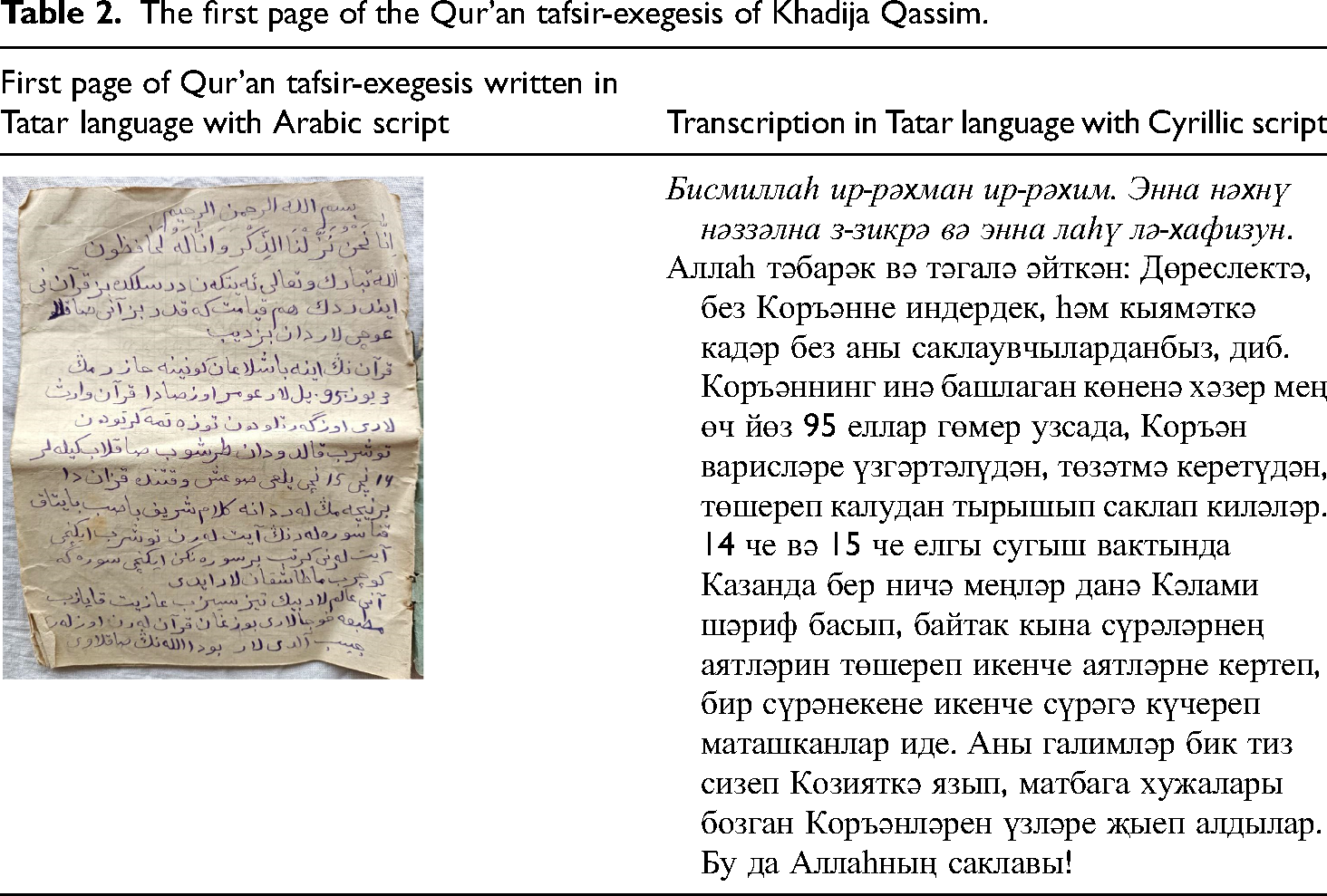
The opening lines cite the Qur’an (15:9), followed by a Tatar interpretation emphasising the divine preservation of the text. 4
Khadija shares her concerns about the accuracy of printed Qur’anic texts, particularly editions produced in Kazan. Khadija's interpretation can be read within the context of Tatar Muslim educational environments, where literacy and engagement with religious texts were central (Kefeli, 2014). As Ross (2020: 4) argues, ‘focusing on the activities of familial and scholarly networks over time enables historians to reevaluate the significance of events’. Approached in this way, Khadija's shared concern is not an isolated reflection but part of a broader network of learning, transmission and interpretation. Her later work as a caregiver in an orphanage in Uzbekistan, where she supported women and children, refers to her engagement with knowledge extended beyond the written text into practices of care and social responsibility. As one of several threads alongside oral memory, written diaries and exegesis, Khadija's experiences contribute to knowledge which is carried across generations. This interweaving of these fragments is central to what I conceptualise as Suzani Feminism.
Naghima (second generation)
I remember opening my grandmother Naghima's green sandiq (chest) and taking out her dresses she wore during her school years. I would twirl in them before giving them back, as they seemed too big and old-fashioned for me then (see Figure 2). Naghima was born in Kyzylorda, the capital of the Kazakh Autonomous Soviet Socialist Republic (ASSR) from 1925 to 1929. Due to the famine (asharshylyq) of the 1930s, many people moved ‘to neighbouring republics to work during the period 1930–33’ (Cameron, 2018: 6). Her family moved across the Aral Sea region to Turtkul, in what is now Karakalpakstan, an autonomous republic within Uzbekistan. Naghima later became a primary school teacher in the Shorakhan kolkhoz of Turtkul and married my Kazakh grandfather, Serikbay Tabaev, who was a school director. Serikbay Tabaev (1922–2005) also bore the distinction of being a Second World War veteran and sustained severe injuries during his service in Kharkov, Ukraine. My knowledge of Naghima's life comes from my own memories, as I recall some of her stories about the Second World War which she told me in Tatar language in my childhood in the 1990s, while other details are preserved in written form in Fatima's diary: In those years, Naghima completed teacher training courses and began working as a teacher in an elementary school. One day, she saw a woman wearing a paranja. These were already rare and the last remnants of past years. Women in these regions were very hardworking. They worked in the fields, sowed seeds, harvested crops, raised livestock and raised children. The majority of the population wore colourful gauzy dresses. Bread was distributed through ration cards, with a quota of 400 grams per person. Long queues formed for bread, which was black with bran. While working at the school, Naghima saved money to buy clothes, as she was a teacher. When I was in the fifth grade, my mother took out two dresses from the chest. Those were the dresses she wore to school in Turtkul. They were made of crepe fabric, one white and the other pink. I was amazed when I saw them. They were beautifully tailored. Where did she get such a design? It was simply miraculous! Did they sew clothes like this in the past too? That means there were skilled seamstresses back then as well.
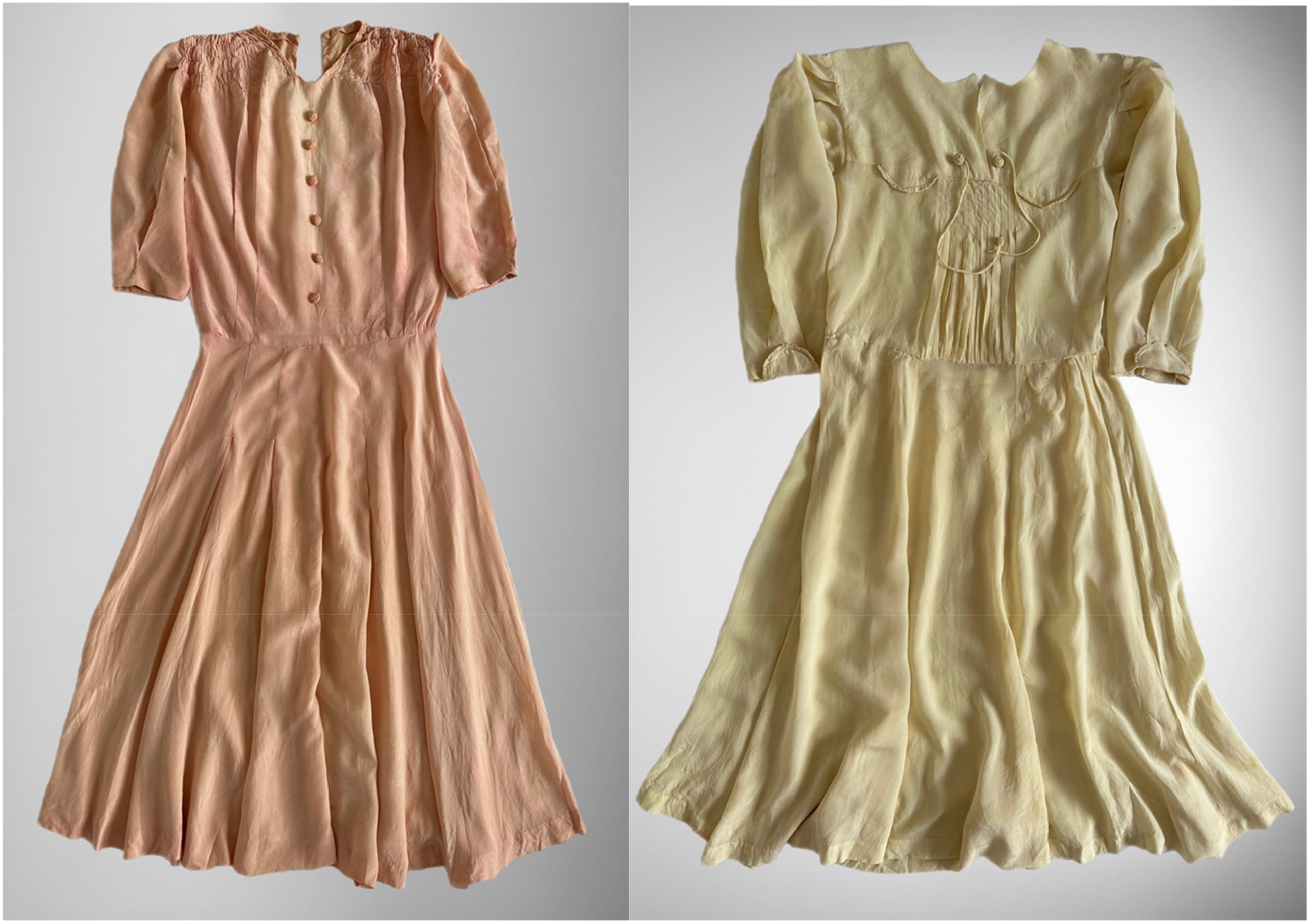
Naghima's dresses.
Fatima (third generation)
I remember holding my opa Fatima's hands as we walked to the Uzbek-language school. Following the independence in 1991, many Russian schools were abruptly closed amid a nationwide shift to Uzbek-language instruction. Fatima Tabaeva was born in 1952 in Turtkul, Karakalpakstan (Uzbekistan). When I was born as the fourth daughter in my family, and shortly after a long-awaited son was born, I was given to her to be raised as her own child. This is a common tradition embedded in local extended kinship systems, which also exemplifies gendered preferences and family expectations. Fatima played a significant role in my upbringing, as she raised me while we lived in a separate area within our extended family's house. She began her education in Russian school in Turtkul and later graduated from the Ivanovo State University in Russia (1969–1974), after which she returned to work as a teacher of Russian language and literature in Turtkul until her retirement in 2002. Her educational journey can be considered as a ‘Soviet pilgrimage’, as described by Kamp (2002: 267), or the pursuit of education beyond one's local region. Though she never married, nor had her own children, she devoted her life to teaching, caregiving and shaping both her students and my upbringing, instilling a sense of agency in me. In her later years, Fatima documented her memories in a Russian-language diary, preserving recollections of her mother Naghima and grandmother Khadija (see Table 1), a continuation of our family's archive. She writes: Dedicated to my daughter Almira, My childhood years are fading away and away from me. But every time, coming to the graves of my ancestors, seeing their photographs and their books, I feel a great gratitude to them. I remember my grandmother Khadija's stories about her lived years, ‘My 80 years flew by so quickly, as if I had only time to open and close my eyes. If they said that there is a place where people don't die, I would put my galoshes under my arm and hit the road’. She used to talk to her neighbours, who always gathered next to her. She knew how to win them over with her interesting stories, proverbs, sayings and life skills.
Fatima also writes about the demands placed on women, such as participation in cotton picking from the fifth grade, often staying overnight in the fields, describing it as her ‘socialist duty’. While framed ideologically, such labour relied heavily on the mobilisation of women and children. As Tokhtakhodjaeva (1997: 155) wrote, ‘women and children performed the un-mechanised labour involved in cultivating and picking cotton [… with] youngsters […] sacrificing valuable education to the needs of the state’. This reliance on manual labour, as Keller (2015) suggests, became structurally embedded in the Soviet cotton economy, where harvesting was largely carried out by children and women shaped by the interaction of state policy, economic incentives and gendered labour relations. Her use of the phrase ‘socialist duty’ not only suggests participation but also points to how such structures were lived and internalised. This coexistence of educational opportunity and intensive labour aligns with what Kandiyoti (2007) describes as a ‘gender paradox’, in which women's participation in public and professional life expanded alongside the persistence of demanding and often unequal labour expectations. Fatima's narratives exemplify how labour, education and memory coexisted. In this sense, her story can be read as part of Suzani Feminism, where women's lives are assembled through intergenerational practices of remembering, interpreting and care.
Almira (author – fourth generation)
I remember crossing out the phrase ‘USSR’ in my school textbooks in 1995, as instructed by my teacher. Soon after, we were given new textbooks in the Latin alphabet, a totally different script from what we had only just learnt, Cyrillic. Raised in an Uzbek mahalla (neighbourhood), and shaped by Kazakh, Uzbek, Tatar and Bashkir affiliations grounded in a shared Muslim identity, I realised that identity is fluid, layered and relational. This hybridity that I hold forms what Bhabha (1994) describes as the ‘third space’, a liminal realm where inherited values and imposed norms are constantly re-negotiated. Following Mahmood's (2005: 15) critique of liberal feminist assumptions that equate agency with resistance, I approach women's actions as forms of situated agency, expressed not only in opposition to norms but also through their inhabiting and reinterpretation. In this context, agency is shaped through ethical commitments, relational responsibilities and everyday practices, not only through acts of defiance (Crossouard et al., 2020). In this article, this perspective does not reject Soviet modernisation or Western feminist ideas but rather questions their universalising assumptions and showcases how women negotiate agency within multiple normative worlds, including locally grounded epistemologies and practices.
My first academic engagement with feminism began during my MA studies in India. While I had already sensed the structural inequalities that women faced in my society, I lacked the language to articulate them. Reading canonical texts such as Simone de Beauvoir's (1949) The Second Sex and Betty Friedan's (1963) The Feminine Mystique, I found myself engaged but also distanced. These texts, though fundamental, felt alien to the specific cultural and historical experiences of women in Central Asia. My engagement with the family archive emerged during my doctoral research, where I study women's experiences in doctoral education in Uzbekistan. In dialogue with feminist and decolonial scholarship, I began to reconsider how knowledge about women's lives in Central Asia is produced and whose voices are recognised. These led me to revisit the stories and materials preserved within my own family, including handwritten diaries and artefacts. Encountering these materials through this analytical lens led me to reflect on how personal memory and family storytelling shape one's sense of identity, belonging and feminist knowledge making. This engagement with personal and family materials aligns with approaches in autoethnographic and autotheoretical scholarship that connect personal experience with theoretical reflection in the production of knowledge – particularly as ‘the act of aligning theory and the self, discourse and life raises questions of critical legitimacy for women’ and other marginalised subjects (Fournier, 2022: 14). Over time, I realised that the stories of the women in my own family are not only stories but situated forms of knowledge.
While feminist histories of Central Asia have predominantly drawn on Soviet archives or external academic interpretations, many lived realities persist in what is transmitted informally through memory, daily rituals and oral storytelling. In my academic work, I have encountered similar patterns among women in rural and suburban regions of Uzbekistan who may not identify with the term ‘feminism’ or use the language of equality, yet describe lives structured around care for elders, extended families and communities. While feminist scholarship has long highlighted the invisibility of such labour (Folbre, 2006), these everyday practices remain under-recognised in policy-orientated frameworks that privilege measurable economic indicators over relational and embodied forms of contribution. Cultural practices, therefore, cannot be understood as either inherently oppressive or emancipatory, but must be examined in relation to the contexts in which women negotiate meaning, agency and belonging (Abu-Lughod, 2002; Mahmood, 2005). I approach feminism not as a fixed situation or as resistance to patriarchal norms but as an analytical and ethical commitment to understanding how women's lives, practices and forms of knowledge shape their possibilities within specific contexts. This perspective does not assume that women must identify as feminists; rather, it allows attention to situated forms of agency expressed through care, memory and relational responsibilities. It is in this sense that I conceptualise Suzani Feminism – not as a category claimed by the women themselves but as a way of reading how these practices are carried, connected and reworked across generations.
Conclusion: Embroidering feminist epistemologies
What forms of feminist knowledge emerge when women's lives are approached through family archives rather than institutional records or formal feminist discourse? The narratives traced across four generations in my family suggest that such knowledge is not always documented in official archives but is carried through everyday practices, memory and material objects (Hirsch and Smith, 2002). Khadija's religious education, Naghima's garments, Fatima's handwritten diaries and my own reflections trace how women within one family lived through and interpreted social transformations across late imperial, Soviet and post-independence contexts in Central Asia. These materials situate women as observers and interpreters of shifting norms, whose experiences remain largely absent from formal historical accounts. Read alongside one another, these stories complicate familiar binaries – tradition vs emancipation, oppression vs liberation – through which women's lives in Central Asia are often framed. Instead, they unravel complex processes in which multiple cultural, religious and political frameworks are inhabited and negotiated over time. While Khadija's madrasa education reflects intellectual traditions that preceded Soviet rule, Naghima's work as a teacher exemplifies forms of participation shaped within it. Fatima's diaries, written decades later, return to these experiences as remembered and reinterpreted lives. What emerges is not a linear path of progress or resistance but a pattern of adaptation, reinterpretation and reworking across generations.
Approaching these materials as sources of knowledge unsettles hierarchies that privilege institutional archives while marginalising everyday practices of remembering and recording. In this sense, the family archive can be read not only as a repository of memory but also as a space of reflexivity and knowledge production, where fragments, recollections and material traces acquire meaning in relation to one another. Situating these narratives within broader discussions of coloniality further draws our attention to how knowledge is unevenly recognised and valued (Tlostanova, 2010, 2015). While scholarship on Central Asia has increasingly examined the colonial dimensions of Russian and Soviet rule, the gendered aspects of these epistemic hierarchies remain less visible. This raises a broader question: what counts as historical knowledge when forms of memory, storytelling and material practice remain outside institutional archives? It is within this context that Suzani Feminism can be read as an interpretive approach. Drawing on the craft of suzani embroidery, where threads are gradually stitched into patterns across a piece of textile, this lens offers us a way of understanding feminist knowledge as something assembled through intergenerational practices of memory, care and interpretation. No single narrative defines this pattern; rather, meaning emerges through a slow interweaving of fragments. Feminist theory, if it is to remain truly global and inclusive, must be capacious enough to hold knowledge formed through fabric, ritual, survival, and intergenerational memory. This perspective places existing feminist frameworks in dialogue with forms of knowledge grounded in specific historical and cultural contexts, suggesting looking closer to how knowledge has already been made, remembered, transmitted and is being made within women's lives contributing to global feminist theory.
Footnotes
Acknowledgements
I express my sincere gratitude to Dr Hamidulla Aminov, Candidate of Science in History at the Academy of Science, Tashkent, Uzbekistan, for his invaluable assistance in transliterating the Qur’an exegesis from Arabic script into Uzbek script. I am also deeply thankful to Prof. Uli Schamiloglu from the School of Humanities and Social Sciences, Nazarbayev University, for his expertise in transliterating the artefacts into Tatar script and providing English translation.
Data availability statement
No new data were created or analysed in this study.
Declaration of conflicting interest
The author(s) declared no potential conflicts of interest with respect to the research, authorship, and/or publication of this article.
Ethical approval and informed consent
Ethical approval was not required for this study. This research involved reflection on family narratives and intergenerational memory and did not include medical interventions, experiments or vulnerable populations.
Funding statement
The author received no financial support for the research, authorship, and/or publication of this article.
