







Abstract
This article analyses the potential of ‘user question generated content’ related to science coverage with the aim of rethinking editorial selection in science journalism. The analysis builds partly on a previous paper which proposed a modified theory of news values for science journalism. The present article is based on a differentiated content analysis of 6528 user-generated questions 1 to science editors in three German media (print, radio and television) with different target groups with respect to age, educational background and gender. A total of 3530 questions could be assigned to different scientific categories. Comparing the most popular categories with the most popular topics found in classical content analyses of science coverage, some important differences were found. In the conclusion, the potential of such audience-oriented surveys for the further development of science journalism in the digital age is discussed.
Keywords
Introduction
‘American scientists have discovered that …’: news starting like this has been a kind of ‘mantra’ of science coverage for decades. 2 Traditionally, science journalism was often much more influenced by the world of science itself than by general journalism (Rensberger, 2009). Science reporting was mostly translating and reporting on news from the ‘knowledge production plant of science (‘Wissensfabrik Wissenschaft’; Haller, 1996) rather than responding to the real needs of media users or the daily influx of general news. Today the age of science-centred science journalism seems to be over. By using the internet and other ‘new’ forms of communication many scientists and scientific institutions are increasingly offering their information directly to the consumer. This may often not be worse than the brief news bulletin on the science page in the newspaper which was copied from press releases of scientific institutions (cf. Brumfiel, 2009). Nevertheless, such a development is also a threat to a strong, independent and critical science journalism in a democracy where journalists are traditionally seen as watchdogs for all parts of society. This role of a watchdog could be lost in the electronic age if ‘promotional writing masquerading as news on various blogs and science “news” websites’ (2009: 277) is supplanting critical but balanced reports from relatively independent mass media. On the other hand, the digital age represents a challenge for (sometimes difficult) science news which is competing with – but is also being used by - many other (sometimes more diverting) options to attract the audience.
Germany seems to be a good example for analysing the recent development of science journalism because the country has witnessed an unprecedented boom in science coverage which started in the late 1990s (cf. Elmer et al., 2008). One reason may be the exceptional intensity of the biomedical debates about stem cells, cloning and human genome projects which have to be seen also in the light of dubious scientific ideas such as the role of eugenics in German history in the period preceding the Second World War. However, even taking into account a slight downturn in the popularity of these biomedical debates, science journalism was obviously regarded as a promising growth market for many media, as demonstrated by the establishment of new popular science magazines (e.g. SZWissen, ZeitWissen, GEOkompakt, SpiegelWissen, HörzuWissen) or the emergence of new science formats in TV prime time (e.g. Wissen vor 8 in the first programme ARD). Even in times of media crisis most (albeit not all) of these products do remarkably well in comparison to those in some other countries. While CNN has decided to cut its science news staff, we may report of at least some contrasting examples in Germany where science sections were exempt from editorial cutbacks or even strengthened in comparison to other departments (e.g. at the German press agency, dpa).
At the same time, a clear change in the focus of science coverage is detectable. This process can already be seen in the concepts of the new formats or genres mentioned which tend to concentrate on well-established and timeless favourites rather than providing cutting-edge hard science news. In daily newspapers nearly one in two science reports are no longer triggered by the major scientific journals and conferences but by non-scientific events such as political debates or natural disasters (Elmer et al., 2008: 883). Finally, a noticeable amount of science reporting gets along without any identifiable motive (‘trigger’). Many media have also replaced their branding from ‘science journalism’ (‘Wissenschaftsjournalismus’) to ‘knowledge journalism’ (‘Wissensjournalismus’) which has a clear etymological connection in German, but probably sounds more positive and less complicated than ‘science’ (cf. Wormer, 2010). In its extremes this kind of journalism merges with new TV quiz shows in the trivial pursuit format hosted by celebrity science journalists.
Question and answer formats are also part of many traditional (science) journalism departments. On the one hand, it is a moot point whether these formats can be sufficiently described by classical theories of journalism (such as news values) or by established descriptions of phenomena important in science journalism (e.g. theories of risk communication). On the other hand, it is of interest to ask what science journalism and its practitioners can learn from such formats or new genres, especially when they share a participative approach with mass media users. In this article we would like to discuss the range of news values in science journalism and possible ways of gaining information about the users’ perspective.
News values or what (science) editors want
‘Why is the sky blue?’ is one of the most popular questions asked by readers, listeners and spectators in journalistic science formats (e.g. Nase, 2006). Whereas the question itself can be easily answered, the problem why precisely this question is so popular seems to be difficult. If such questions are considered as a special form of ‘letters to the editor’, it should be legitimate from the perspective of a journalist to analyse them by using the classical theory of news values (cf. Galtung and Ruge, 1965; Lippmann, 1922). For example, Nielsen (2010: 26) emphasizes the common opinion among editors ‘that good letters have news value’, mentioning novelty and originality in particular. However, readers’ questions are not completely of the same order as classical news. It remains doubtful to what extent audience demands that are not tied to the news agenda can be adequately described by using the theory of news values. At least some classical factors (such as actuality) may be less important here than for other editorial content. Furthermore, the question remains unanswered whether science topics in general can sufficiently be described with the classical theory of news values.
In the case of the special example of the blue sky, plausible explanations from classical theory may be constructed for some individual aspects (e.g. the blue sky is close to the editor and the recipient, fulfilling the news factor of ‘geographical’ closeness in a perfect way; or, the ‘range’ of a blue sky may be regarded as remarkably high). But many other news factors do not apply to such a science-related issue. Perhaps this is not a surprise because the theory of news values was developed alongside the classical newspaper sections such as politics, foreign affairs or non-specific news.
Some journalism researchers have already suggested that science journalists may also have special selection criteria or that criteria may differ from section to section (e.g. Ruhrmann, 1990, 1997). However, empirical data are rare so far. For this reason, several authors have argued in a fashion similar to Schäfer (2007: 198) that ‘a reliable empirical reconstruction of the news factors in science coverage is still missing’. Interestingly, the same impression is expressed by practitioners, such as by a leading science editor of the Süddeutsche Zeitung:
In contrast to the political section where the daily agenda is often determined by the actual events, the science editor has to dig in a rather disordered box of news if he does not want to rely completely on the agenda of the big scientific magazines; and when there is not the hurricane of the century raging along the American coast (…) (Illinger, 2005)
Badenschier and Wormer (2011) tried to bridge this gap between the established theory of news values and a more specific form modified for the science section. They evaluated news values of science coverage by combining a simple heuristic model with the established theory. By using both content analysis and guided interviews with leading science journalists, an adapted theory of news values of science coverage was proposed. News factors identified as especially important are, for example: composition (mixing different scientific fields), astonishment or surprise (different from ‘unexpectedness’, which already exists, but corresponding to the ‘fascination value’ proposed by Rensberger, 1997) and graphical material (visualisability). These constructs have to be regarded as exploratory as they were derived from a small sample. And they have been tested only for quality newspapers where scientific relevance still has importance. However, factors such as ‘astonishment’ and ‘visualisability’ may also be interpreted as another indicator for changing science coverage. In particular, ‘astonishment’ may also play a major role in understanding the questions of media users simply wondering about something in their daily life. 3
Empirical data or what (science) editors really select
Besides such a categorization of science coverage which is derived from theories of general journalism, the majority of studies dealing with science journalism focus on different scientific disciplines. As pointed out earlier, this classification also seems to play an important role for selection processes among science editors; for example, because they try to get a good ‘composition’ of different disciplines in their paper. Furthermore, a classification which follows the subcategories in the subject of reporting itself appears to be quite natural. Other editorial departments, for instance the sports department, often apply a classification following the subdisciplines such as ‘soccer reporting’, ‘tennis reporting’ and so on. Interestingly (and probably different from the sports section) the top categories of science covered overall by the media seem to follow similar patterns on an international level. Altogether, medicine/health and biology dominate science coverage worldwide (Bauer, 2000; Bucchi and Mazzolini, 2003; Van Rooyen, 2002). In a long-term study of the New York Times, medicine (including behavioural science) is always among the best-selling topics (Clark and Illman, 2006). In German broadsheets Elmer et al. (2008) found remarkably constant proportions of the total amount of science reporting in different years for the top issues of medicine (28%–29%) and biology (13%–14%), followed by environmental sciences and technology. The dominance of medical issues is also in line with estimates at the German news agency (DPA), which counts that science news deals with a medical topic in one of every two items (Mundzeck, 2006: 200).
In any case, the detailed rank order also depends on the exact definition of every discipline. Nevertheless, the differences from field to field, which are sometimes extreme, raise some puzzling questions. According to Schäfer (2007) there is as yet no convincing explanation for the different degrees of medialization of different scientific fields. However, we propose certain factors that may at least influence the degree to which different fields are considered in the mass media in different ways:
On average, some scientific fields probably meet criteria such as news factors better than others. For example, biomedical issues often have a higher range or relevance with many readers directly involved (cf. Galtung and Ruge, 1965) and contain more often political controversies than, for instance, archaeological research (cf. Badenschier and Wormer, 2011).
According to interviews with leading science editors (Badenschier and Wormer, 2011), some fields, in general, have a negative ‘interest rating’ (subjects such as chemistry being considered rather difficult and boring).
Framing effects may be significant. Studies profiling the educational background of German science journalists show that most of them are biologists by training, which may cause a preference for this field in the reporting (Blöbaum et al., 2003; see also Hansen, 1994: 114; Nelkin, 1995: 93).
Some research fields are bigger than others in terms of number of researchers and publications (e.g. Federal Ministry of Education and Research, 2004: 711; Federal Statistical Office, 2008: 152). As a consequence, there are more results, conferences and events which can be reported on.
Consistent with the idea of different ‘scientific cultures’ (cf. Knorr Cetina, 1998; Schäfer, 2007), science communication approaches and traditions should differ between disciplines. 4
Although these explanations seem to have some potential, the recipient’s perspective is still missing; at least this perspective is only indirectly included as an anticipated audience interest by an editor who is selecting news. In this work we try to approach this perspective more directly and to get a little bit closer to the personal needs of different media users sent directly to the editors. Although we have to keep in mind that what people ask is not necessarily the same as what they really want from the media, it seems plausible that their questions and interests are closely interrelated. An advantage of this approach is that it includes the part of the audience beyond the especially ‘attentive’ or ‘interested’ ones (cf. Hornig Priest, 2009: 229). In contrast to looking at the impact of existing media products (e.g. by measuring the page impressions of an online article) or by asking recipients in polls (which may be biased by a social desirability response set in a lab situation), the analysis of simple audience questions allows a deeper insight into the spontaneous interest of a media user which is articulated voluntarily.
The big question or what media users really want
As mentioned earlier, questions to the editor may be regarded as a special type of letter to the editor. In agreement with the summary of Schultz (2000) about different levels of interactivity between audiences and journalists we have to ascertain a rather limited level of interactivity here. Taking into consideration the users’ perspective as well as the editors’ perspective (e.g. described by a theory of news values) we are interested in the extent to which the most favoured scientific fields in the media are in line with the favoured topics media users ask for in online forums, emails or letters. If it is still true that ‘the old mass media produce their messages mainly independently of the audiences’ (2000: 206), there should be a chance to see different preferences from each perspective. For other fields of journalism a gap between the expectations of the audience (‘News Interest Index’) and editorial decisions (‘News Coverage Index’) has been described already (e.g. Project for Excellence in Journalism, 2009; Urban, 1999; cf. Ruß-Mohl, 2009).
We are not aware of many similar studies dealing with a possible gap between science coverage and the expectations of its recipients. 5 One exception is a study from Austria comparing explicitly the interest of media users for different scientific fields with the importance given by journalists of the same media for these fields (Johanneum Graz, 2004). As one main result of this study, the researchers state a rather good agreement for the top category ‘biology’, whereas they observed a noticeable divergence for the category ‘medicine’. According to the authors, the interest of the users was rather overestimated by the journalists. In this case the target group may be regarded as a special one because of its young average age. But also in some other cases journalists reject the widespread professional assumption that medical issues are always among the top sellers. Again, this seems to be true especially for formats addressing rather younger (and thus healthier) people and for male-dominated formats. One concrete example is the German market leader of online media, Spiegel Online (Becker, 2010). Summing up, we may say that despite the seemingly unchallenged position of medical issues as the most popular science topic in the general media, there are some doubts whether the assumption of medicine and its related fields as top sellers can be generalized.
Analysis of questions to the (science) editor as a special form of user-generated content
Although there seems to be no systematic survey of science journalistic question and answer formats in different countries these formats are quite popular. Series such as ‘Dr Karl’ (Australia; www.drkarl.com) or ‘The Imponderables’ (www.imponderables.com) are probably among the better known ones worldwide. For a first overview in Germany we have counted more than 25 science journalistic question and answer formats in print, TV, radio and internet media. 6 As we know that many regional newspapers (e.g. Rheinische Post, Düsseldorf; Kölner Stadtanzeiger, Cologne; Nürnberger Nachrichten, Nurnberg) provide such a column, the total number could be estimated even higher. Often a collection of questions and answers appears later as books (sometimes even bestsellers). 7 However, a distinction has to be made between real ‘user question generated content’ and other formats which use the question and answer format as a journalistic form with questions coming from the editors themselves but without a real demand from the audience outside the editorial office.
In this work we focus strongly on formats where questions are really asked by media users. 8 We are not interested in which questions are selected and answered by the editors but in all the questions being asked. This rather unusual approach of a content analysis has some consequences for our methodology. Although a topic is initially generated by a user question, the final content (that is, the answer given by the journalist) depends also on the editor’s interpretation of each question. This is important for the final categorization. In some cases a user may even not be aware of the fact that he or she has asked a question that is closely related to a certain scientific field (such as chemistry or statistics). Nevertheless, our content analysis always focuses on the original interest of the user and not on the content that was finally generated by the journalist and which could be approached by a conventional analysis.
Methodology
Assumptions and working hypotheses
Following the science editors’ assumptions of their recipients’ interest in different science topics and also taking into account conventional content analysis (e.g. Elmer et al., 2008), we might expect certain scientific fields to dominate among user-generated questions in all media. However, we should also expect the most popular fields of questions to vary depending on age, gender and educational background. For example, medical topics may not be on the top of the list of questions most frequently asked by younger target groups and males. Instead, we propose that a younger audience might suggest questions that refer more to psychological topics. Younger people are searching for an identity and are especially interested in partnership or, as formulated by Walker et al. (2004) for example, ‘normal adolescent development is often accompanied by transient emotional and behavioural problems’. Furthermore, we would assume that a male-dominated audience is asking more for topics such as physics and technology than the average. This is consistent with the male-dominated study courses in these fields (Statistisches Bundesamt, 2009) as well as with statements of media professionals (e.g. Albrecht, 2006).
Summing up, our basic research question can be formulated as follows. Are the scientific fields treated in conventional science coverage (with its underlying selection processes) different from the topics dominating the audience questions in popular science journalistic question and answer formats? Using the ideas and the literature mentioned above, we arrived at the following hypotheses:
Biology is the category where most questions are asked.
Medicine is not the category where most questions are asked.
In general, frequently asked questions belong to scientific domains which are also frequently covered in the media.
Young recipients are interested in psychology more than the average user.
There is an above average tendency for male media users to ask questions about computer science, physics, astronautics, technology and similar subjects.
Sample
In this study we provided a content analysis of 6428 ‘user questions’ to the editors of science journalistic formats in German media. One goal of our sample was to include three different media types (print, radio and TV) with a rather different audience with respect to average age, education and gender. Furthermore, we required either direct access to the asked questions or editors willing to provide us with the adequate data. Finally, the following three formats were selected:
The format ‘Stimmt’s?’ (‘Is it true?’) is published in the weekly newspaper Die Zeit reaching more than two million readers per week. The paper focuses on rather educated and older readers (Die Zeit, 2010: 3). Since 1997 the editor-in-charge Christoph Drösser has answered reader questions (mainly arriving via email) in his column. On request he gave us all the questions he received between 1998 and 2008.
The format ‘Die allerbeste Frage’ (‘The very best question’) is broadcasted by 1Live which is a radio station of Westdeutscher Rundfunk (WDR). This station targets younger people between the ages of 14 and 39 in particular. With an average of about one million people per hour listening on weekdays, the programme often has the widest range of all German radio stations (Media Daten Verlag, 2010). Usually once a week, one user question is answered by the science journalist ‘Professor Holger’ (who is one of the authors of this article). Our sample is taken from a web forum where users can ask their questions online. For our analysis we copied all questions asked in the forum from 2007 and 2008 on 3 October 2009.
The format ‘Kopfball’ (‘the header’) is a weekly TV show broadcast by Westdeutscher Rundfunk (WDR). The concept of the show is based on email questions which are answered in short TV clips. The target group can be defined by its gender more than by its age: most of the questions are asked by male viewers (Beißwenger et al., 2007: 17). On request the editorial staff provided an Excel list with questions asked from 2004 to 2009.
We decided to work with all user questions (regardless of whether they were finally answered or not) from the years 2007 and 2008, which represented the most recent complete years at the time of our sampling (incomplete years may cause a distortion as a noticeable amount of questions refer, for example, to seasonal conditions such as the weather). The content analysis itself was provided between November 2009 and January 2010.
Adjustment of primary data
Prior to categorizing the questions, we had to adjust the data as there are some emails or posts which didn’t fit in the definition of a ‘user question’ related to science journalism. 9 Some entries had to be rejected, because:
The media user did not ask a question but wrote a comment to the media.
The user did not ask a question belonging to the focus of classical science journalism but a question relating to a legal or economic matter (e.g. ‘Are you allowed to drive your car with your bare feet?’).
The entry could not be properly read (because of damaged or encrypted files etc.).
The question was clearly marked as a joke by a smiling face or other funny notes (e.g. ‘Do sheep count sheep if they want to sleep?’).
The entry or email was published or sent twice by the same person. In such cases it was counted just once.
About half (54.9%) of all 6428 questions had to be excluded before the final analysis because of the above criteria. Our adjusted data set was composed of N = 3530 user-generated questions (‘Stimmt’s?’: N = 690; ‘Die allerbeste Frage’: N = 1451; ‘Kopfball’: N = 1389) that could be analysed.
From a more general view on the methodology, however, we would like to note the special challenge of this process which is different from content analysis of longer articles. At least in some cases, the application of our criteria to reject certain entries might depend on the scientific background of a researcher. A question which refers to a specific scientific field might be rejected by a researcher with relatively little scientific knowledge whereas a person with a higher education is able to relate the question to a scientific category. For example, in one case a user did a Google search on the digits 0 to 9 and asked for the reason of the frequency pattern he had observed. Without a special background in statistics the question might have been interpreted as a kind of ‘junk question’ asked by somebody not expecting a serious answer. But in fact the question could be directly answered with reference to Benford’s Law in statistics.
To control such framing effects in our sample, we checked the inter-coder reliability concerning the rejected questions by assorting 594 of the 1460 rejected questions (40%) asked on the website of 1Live by two coders with different scientific background (graduate student and professor). Satisfactory reliability was obtained (0.88). However, the example may illustrate a particularity of analysing very short user questions in contrast to classical content analysis of articles or longer letters to the editor.
Categorization of data
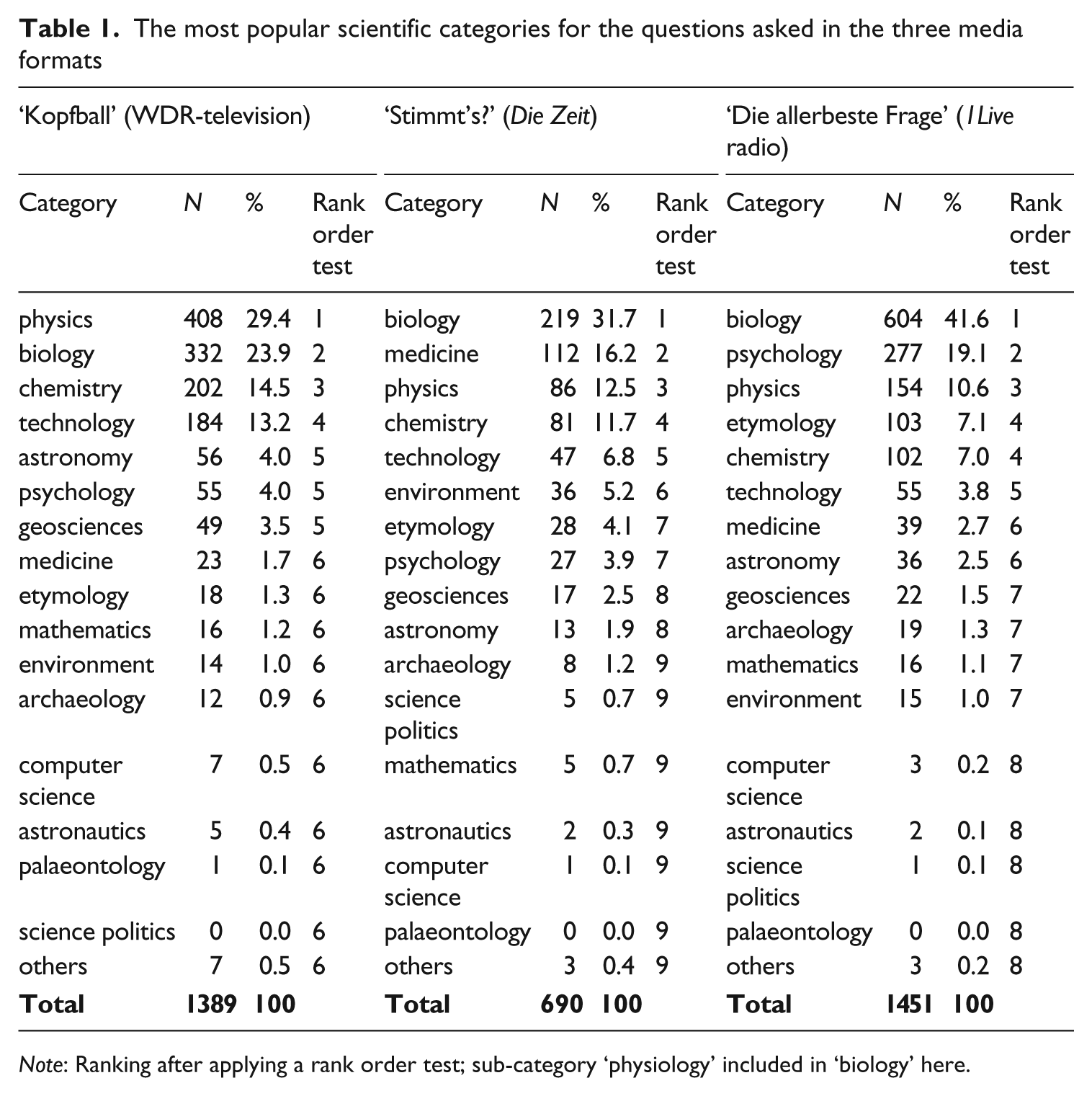
The remaining questions were categorized following a survey of codes already used for conventional content analysis of science coverage (Elmer et al., 2008). 10 A total of 17 categories were now specified for the content analysis of user questions: archaeology, astronautics, astronomy, biology, chemistry, computer science, environment, etymology, geosciences, mathematics, medicine, palaeontology, physics, psychology, science politics, technology and others. The category ‘etymology’ (usually not regarded as part of science journalism) was added to the common categories of science coverage because a first overview of the sample showed a noteworthy amount fits into this category. As shown in Table 1 only 13 questions fit in the category ‘others’.
The most popular scientific categories for the questions asked in the three media formats
Note: Ranking after applying a rank order test; sub-category ‘physiology’ included in ‘biology’ here.
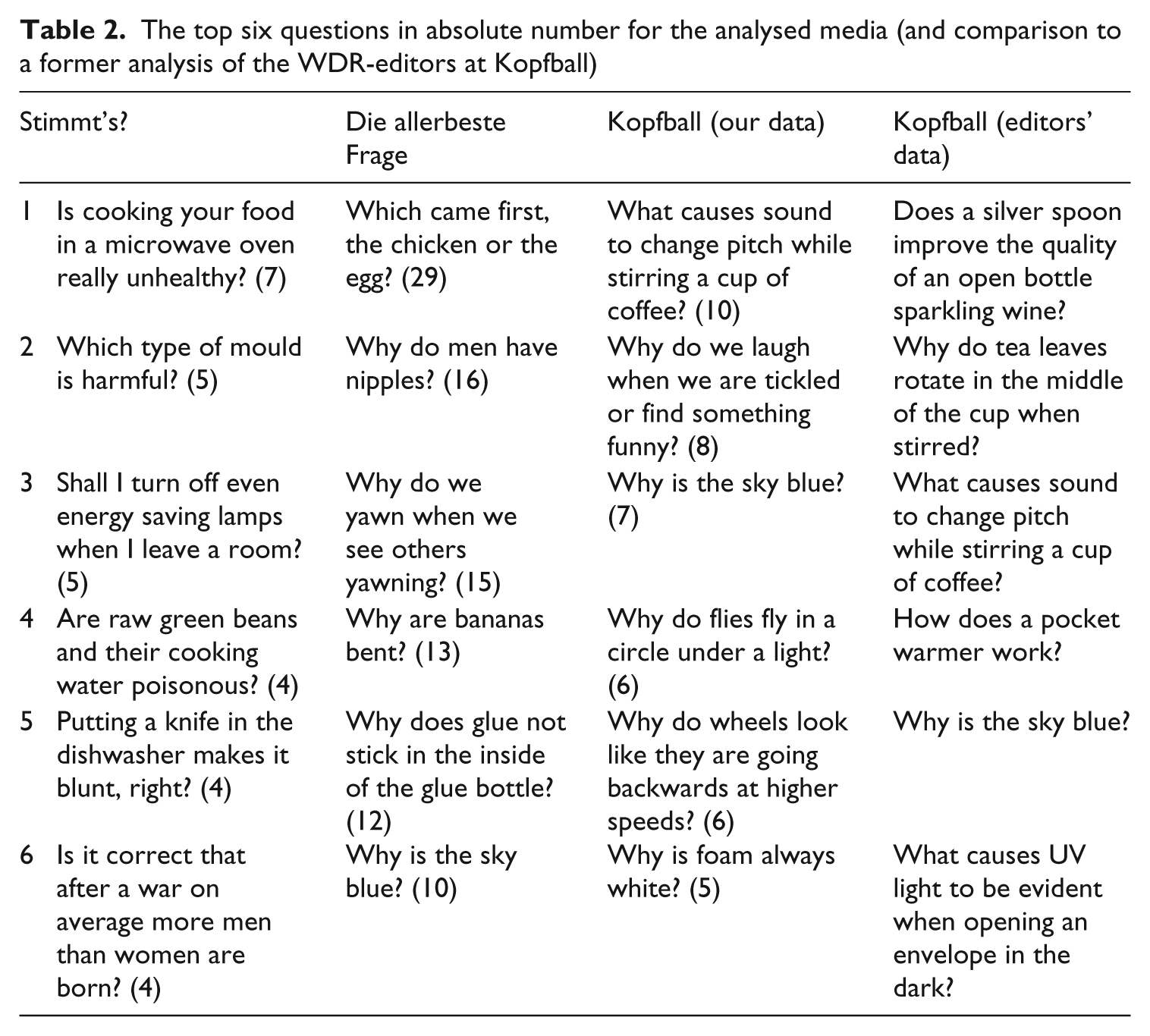
Besides analysing the distribution of questions in the different categories, we also noted the most frequently asked questions for every format (Table 2).
The top six questions in absolute number for the analysed media (and comparison to a former analysis of the WDR-editors at Kopfball)
Results
The following table shows the absolute numbers, the relative numbers and the ranking order using the experimental standard deviation of the question analysis. The rank order is just significant for numbers 1 to 5, as the differences in absolute numbers of ranking positions 6 to 18 are too small.
Reliability was tested with the coefficient of agreement. Ten percent of all questions were categorized twice by one researcher. Good intra-coder reliability was obtained for all formats (‘Stimmt’s?’: 0.96; ‘Die allerbeste Frage’: 0.94; ‘Kopfball’: 0.93).
Validity of the survey of codes was tested with a pre-test. During the pre-test it became obvious that some entries offered too much space for interpretation. In contrast to full texts that are analysed in conventional content analyses, a short question often does not deliver enough context information to separate the categories clearly. In accordance with our findings, this is especially true for biology, medicine and psychology. As the distinction between these categories is highly relevant for two of our working hypotheses, we had to classify these items more precisely. In our initial codebook the categories were defined as follows:
Biology: All questions concerning the lives and illnesses of animals and plants are allocated to ‘biology’. Questions about the function of the human body (physiology) and nutrition are also categorized here.
Medicine: Questions about the nature of human diseases and their causes, processes, development, and consequences, as well as questions about diagnosis, therapy and prophylaxis, are part of ‘medicine’.
Psychology: As this is the science of mind and behaviour, questions about mental functions in individual and social behaviour and about physiological and neurobiological processes that underlie certain functions and behaviours are counted among ‘psychology’. Matters of learning are also categorized here.
It turned out that it is especially difficult to decide accurately whether questions concerning physiology and nutrition should become parts of biology or medicine. For example, some questions could be interpreted as referring to a malfunction of a physiological process (i.e. disease in category medicine) as well as a question concerning this process itself (i.e. physiology in category biology).
To check for a possible bias we re-sorted the affiliation of the physiology and nutrition subcategories and observed the consequences for the rank order. For the ‘Kopfball’group the effect was small: as ‘Kopfball’ viewers asked 139 questions about physiology or nutrition the order changes to: 1. physics, 2. chemistry, 3. biology, 4. technology, 5. medicine. Re-sorting the ‘Stimmt’s?’ questions causes a change between the categories ‘medicine’ and ‘biology’. In this case 94 questions dealt with physiology or nutrition. The biggest effect can be seen when we transpose all 324 questions about physiology or nutrition in the analysis of ‘Die allerbeste Frage’: the category ‘medicine’ rises to the top of the ranking.
For this reason, the decision of where to allocate these subcategories has an influence on the answers concerning our hypotheses 1 and 2 (‘biology is the most frequently asked category’ and ‘medicine is not the most frequently asked category’). The exact ranking order of ‘medicine’ depends on its definition. However, it becomes obvious that most of the questions deal with the function of a sane body and its healthy nutrition (N = 557). Questions about diseases are rare (N = 174). In our sample, the younger listeners in particular of 1Live prefer to ask about the function of the body (physiology) rather than about diseases, while many male media users (see the ‘Kopfball’ user) avoid asking medical questions.
Furthermore, we may state that the general scientific categories (such as biology, medicine, physics, etc.) of the most frequently asked questions were in some cases quite different from the scientific fields that are often preferred for coverage by journalists. While ‘biology’ is indeed among the most popular questions (even if we allocate the physiology/nutrition questions to ‘medicine’), we see some differences in the following positions. Taking the content analysis of science coverage in German broadsheets mentioned earlier as the best available benchmark (Elmer et al., 2008), a marked discrepancy in the categories of ‘physics’, ‘science politics’ and ‘environment’ emerges. Our analysis shows that, for instance an average of 18 percent of all questions in our sample deal with physics (Elmer: rank 6, 5.7%). Just six questions deal with the topic ‘science politics’ (Elmer: rank 4, 5.8%). A similar discrepancy could be observed for ‘environmental topics’ with a total of 65 questions (that is 0.02%; Elmer: rank 2, 15.0%). Even taking into consideration problems in comparing these samples, such big differences may indicate at least some first evidence of a gap between science journalistic coverage and the preferred questions of media users.
With respect to our hypotheses 4 and 5 about the preferences of target groups which differ in age or gender, we can detect the influence of the main target audience on the most frequently asked questions. As we suspected, the category ‘psychology’ is one of the top three categories of ‘Die allerbeste Frage’. This suggests that there may indeed be an influence of the young listeners in this group. Similarly, we notice an above average interest in ‘physics’ of the ‘Kopfball’ users. Of all ‘Kopfball’ questions, 29.4 percent refer to this category compared with 12.5 percent of ‘Stimmt’s?’ questions and just 10.6 percent of all questions sent to ‘Die allerbeste Frage’. We found a similar ratio for the category ‘technology’. However, these findings are just a first indicator of the possible different interests of men/women and younger/older recipients in the analysed media. Other studies should explore whether there is a statistically significant relation between the interest in psychological or technical topics and age or gender in the media.
To get a first idea as to what extent the community of media users in our sample asking questions may be regarded as representative for the group of the average user, we checked the age of the questioners based on their own information, which in many cases accompanied their question (available for 1Live). In the case of Die Zeit we checked for the gender distribution.
About 60 percent of the Zeit readers are male and 40 percent female (Sentker and Drösser, 2006: 65). In our sample we could analyse the gender of the people writing a question via email to ‘Stimmt’s?’. The result is that, following their own indication, 63.9 percent of questioners are male (N = 438), 24.6 are female (N = 171). The remaining 87 (12.5%) emails could not be clearly allocated to a male or female author. In this case the gender distribution of the questioners seems to be far from representative for the average reader.
In the 1Live web forum 990 people (68%) published their age. Whether they gave their real age could not be tested. Most of the users asking questions in the 1Live web forum were between 14 and 30 years old (N = 800, 80.8%; mean age 19.5). Although the average questioner in the forum may be slightly younger than the average listener, the range fits remarkably well within the self-defined target group of 1Live radio (which is between 14 and 39, and was defined a long time before and independently of the question and answer format). We are aware of the fact that the defined target group of a medium is not necessarily identical with the real average user group. However, our data suggest pursuing the idea of analysing ‘user-generated questions’ as one indicator for the wishes and interests of a certain audience and might motivate editors to rethink their common habits of issue selection.
List of the most frequently asked questions
To give, finally, an impression of the most frequently asked questions in our sample we have put the top six list for each format in Table 2. We have also added a self-evaluation of the editors of ‘Kopfball’ for comparison. Although these top six questions are different from each other in the three formats, many of the most frequently questions asked in one format also appear in other formats, albeit less frequently. One well-known question is also in the top list of two media in our sample: ‘Why is the sky blue?’
Discussion and conclusions
One main methodological question remains to be answered as regards our approach to analysing user-generated questions referring to science issues: how representative could a group of users asking questions to the (science) editors be for the entire audience of a certain media format? Several authors give some pessimistic estimates for the extent to which media users who take part, for example, in online discussions are representative for all media users. For example, Norris (2001) shows that more people use the internet to read newspapers and magazines than to take part in a debate. However, these analyses dealt with politics and not with scientific topics. Furthermore, they do not cover the communication between users and the mass media, but generally the commitment to active participation in political discussions. A more precise view on our question comes again from research on classical ‘letters to the editor’ which is also not very optimistic with respect to the representativeness of responsive media users. Nevertheless, Nielsen (2010: 23) encourages researchers to ‘move away from the dominant discussions of the limitations of letters (distortions, etc.), and towards a discussion of what they make possible (…)’. To enhance this statement, we can list several arguments for the position that questions to the science editor may be considered as an even better indicator for the thoughts of the average user than classical letters to the editor:
The barriers to writing just a short question to the editor are lower than the barrier to writing a whole letter (which takes more time and appears to be too complicated for many recipients). For this reason, the frequently observed bias towards the participation of higher educated people could be smaller.
Classical letters to the editor are mostly a reaction to content in the media which already exists. Thus, they ‘must be seen as a co-production between editors and letter writers’ (Nielsen, 2010: 24). In contrast, questions to the science editor obviously reflect rather a general interest or an everyday event.
Questions to the (science) editors do not really depend on strongly held opinions and political commitments, which, on the other hand, do seem to be an important motivation for the author of classical letters to the editors (cf. Schultz, 2000: 212).
In the digital age it is in general becoming easier and more ‘normal’ to interact with the mass media via mail, internet and other social media (cf. Schultz, 2000). This ought to increase the chance to get more ‘normal’ (that is, on average, more representative) readers’ questions.
Many web forums already exist as a ‘natural’ and short form of communication via questions and answers in different communities not limited to highly educated people.
In view of the last two arguments in particular, we may also add the remark of other authors that the new forms of communication such as web 2.0 have not only ‘given the media an opportunity structure to connect with the public’ but put at the same time ‘pressure on them to do so’ (Brants and De Haan, 2010). The authors also note a shift from ‘a supply to a demand market in communication’, which from our point of view seems to be valid for science journalism as well. Question-generated content may be one answer to that shift in the particular field of science journalism.
An increasing accordance of the average users with the media users sending questions may be presumed, particularly for a younger audience (which would be in line with some initial evidence in our sample). Despite of the caveats of some authors that the ‘user in transition’ discourse may not be as simple as often claimed (Hujanen and Pietikäinen, 2004: 392) it becomes much easier and more common for the average recipient to interact with the mass media than it was in the ‘letter to the editor age’ of newspapers. However, earlier studies identified here a rather ‘easy-going type of participation’ (including quizzing, polls and questionnaires), in particular among young users (2004: 398). For this reason, we strongly believe that examining user-generated questions, which are also such a ‘light’ form of participation, is of growing importance for science journalism in the digital age. We are convinced that a systematic analysis of question-generated content could be a key for media houses to gain valuable insights into what (at least a big part of) their users want. The approach of resending a questionnaire to responsive media users (e.g. Schultz, 2000) could be one possible method.
Bringing in more of this users’ perspective may also help to develop the existing theories of editorial selection processes with a specific focus on science journalism. On the other hand, theories such as the theory of news values may also be a benchmark to reflect the overall relevance and importance of contents triggered by the audience. This is generally seen as a starting point for a lighter kind of journalism (Hujanen and Pietikäinen, 2004: 398), or, as stated in Schultz (2000: 207): ‘Communication and participation alone do not mean much in terms of quality and value of content.’ However, a better knowledge of the needs and wishes of media users derived from user-generated questions could also be of value to improve critical science journalism, especially the general question of how to enable hard science news to reach a broader audience.
Footnotes
Acknowledgements
We would like to thank Günther Rager for some counselling, Laurence Kane for some English editing and Birthe Dobertin for some literature searching.
1
In this article we distinguish ‘user-generated questions’ (the audience questions that are sent to the editors) and ‘user question generated content’ (the content which is or can be generated by the journalist when he or she answers a question). We have chosen this distinction in order to differentiate the underlying ‘content generating’ process from simple letters to the editor or similar which can already be regarded as substantial content in themselves.
2
The idea of a mantra was brought up by one of the most popular columns in German media: the ‘Streiflicht’ of the Süddeutsche Zeitung.
3

4
The consequence becomes visible by analysing the amount of press releases in different research fields at the media services idw (Germany) or EurekAlert! (USA), as done at the Dortmund Chair of Science Journalism by Röttger, 2010.
5
Media houses sometimes report on the interest of their consumers, too. However, the original data of such market analysis is usually not freely available (and perhaps not always free from the potential bias of their marketing departments).
6
A complete list can be provided by the authors. The regional newspaper Kölner Stadtanzeiger was also examined but we rejected a discussion here because of the small sample and the limited space.
7
One recent example is ‘Wissen vor 8’, scheduled almost daily in the prime time of the first German TV program (ARD). The questions and answers are presented by the popular science journalist Ranga Yogeshwar. The title of the bestseller is: Sonst noch Fragen? Warum Frauen kalte Füße haben und andere Rätsel [More questions? Why women have cold feet and other mysteries], Kiepenheuer and Witsch, 2010.
8
As we also used a forum for questions open for everybody, we cannot exclude every single case where an editor of the same media house might have posted a question of his own. However, we have made sure that this is not generally the case so that a systematic bias is eliminated.
9
In this article science journalism is defined as reporting on (natural) science, medicine and technology issues (including fields such as archaeology) but not including humanities and social science. This definition is in line with the structure of the science departments in German media.
10
The complete codebook can be provided by the authors.