







Abstract
The purpose of this study is to investigate whether journalists in South Korea use Twitter as a public sphere and what factors may be associated with journalists’ Twitter use. Combining a content analysis and an additional survey of Korean journalists, this study examines to what extent journalists talk about public affairs on Twitter and interact with others, and what factors influence their Twitter use. A content analysis of journalists’ tweets shows that more than half of the tweets (62%) were topics related to public affairs and more than half (56%) were related to journalists’ interaction with the public. However, journalists’ Twitter use differed depending on the political ideology of the news outlets where the journalists worked: journalists from liberal newspapers were more likely to interact with the general public on Twitter, talking about public affairs. An additional analysis of survey of Korean journalists reconfirmed that journalists’ political ideology is one factor associated with journalists’ Twitter use. This study demonstrates the possibility that Twitter can be used as an online public sphere but also that possibility can be limited by political ideology.
Social media are becoming increasingly popular as a space for news and information about current events and public affairs (Pew Research Internet Project, 2015). The main question about Twitter’s role in communication research has revolved around whether Twitter, the popular micro-blogging platform that allows people to share 140-character posts around the world (Hermida, 2012; Kwak et al., 2010; Takhteyev et al., 2011), may affect practices of the traditional media as well as public discourse. On Twitter, citizens have new opportunities to obtain information and to communicate, following others’ tweets and exchanging and discussing their thoughts and opinions. Those are the same opportunities available to information providers, news organizations, and journalists who may also use the new technology as another venue for sharing and providing information to their audiences. Journalists may tweet news and information as well as other types of content, including about their personal lives. Therefore, several scholars have argued that social media such as Twitter may reframe the role of journalists (Bruno, 2011; Hermida, 2010, 2012; Holton and Lewis, 2011; Lawrence et al., 2013; Molyneux, 2015; Newman, 2011).
Previous studies have paid special attention to the effects of new technologies on journalists’ work routines, especially journalistic norms and practices (Deuze, 2005; Holton and Lewis, 2011; Kim, 2011; Lasorsa et al., 2012; Lawrence et al., 2013; Molyneux, 2015; Papacharissi and De Fatima Oliveira, 2012; Scheffer and Schultz, 2010; Singer, 2005), while less is known about whether and to what extent Twitter is used by journalists for public discourse (i.e. tweeting news and information about current events) and interactions with the public.
Expanding this line of research, the purpose of this study is to explore whether journalists use Twitter as an online public sphere by analyzing their Twitter use. In other words, this study examines whether journalists tweet public issues or personal affairs and what factors may be related to their different tweets. Specifically, this study examines the role of political ideology as one factor that may influence journalists’ Twitter use, based on specific and unique social and political realities in the media industry of South Korea (more in Background). Furthermore, this study examines whether the interactive features of Twitter, such as ‘retweet’ and ‘in reply to’ may help journalists’ communicative interaction with the public.
This is an important issue for the media industry as well as for communication scholarship because journalists’ patterns of Twitter usage may be closely related to changes in the media landscape, particularly in democratic societies. Twitter may contribute to the formulation of public opinion if journalists use Twitter to distribute news and information, whereas Twitter may not serve as an online public sphere if journalists are more likely to use Twitter for tweeting personal life. Although journalists constitute only one group of information providers on Twitter, the journalists’ role in providing information and forming public opinion (Converse, 1964; Price, 1992) underscores the importance of examining their Twitter use. In sum, this study examines (1) what topics journalists mention in their tweets, (2) to what extent they interact with the public, and (3) whether journalists’ Twitter use varies depending on political ideology. This study contributes to the literature on the role of social media for information sharing and distribution in a digital media environment by looking at whether Twitter may serve as the public sphere for journalists by discussing public affairs and communicative reciprocity with the public.
Background: The Korean media environment and Twitter
We focus on Korean journalists’ use of Twitter. Historically, the main and dominant news outlets in South Korea have been regarded as politically conservative so that some liberal news outlets have turned to new media as a way to counter the conservative outlets (Kim and Hamilton, 2006; Song, 2007). In fact, several studies on Twitter and online news media in South Korea have shown that dominant users and content of new media outlets are liberal dominant (Han and Kim, 2013; Hwang, 2013; Hwang and Lee, 2011). A fragmentation between the dominant conservative media, which are based on offline platforms, and new media, including the Internet and social network sites, fosters people’s perceptions that the online news media are liberal friendly (Lee and Ban, 2011; Lee and Kim, 2014).
Recently, the use of online communication tools by news organizations and journalists in South Korea has expanded to utilize social media platforms in the news production process, including gathering of information and interaction with the audience (Bang and Kim, 2014; Kim, 2011). Some news organizations encourage journalists to create their own social media, such as blogs and social network sites (e.g. Kim, 2011). In addition, Twitter has been found to serve as an additional reporting tool for journalists. Based on interviews with 26 journalists in South Korea, Bang and Kim (2014) found that journalists use Twitter as a complementary tool to obtain information, opinions, and feedback from the public that extend beyond contact with traditional sources.
As a result, in South Korea, Twitter has emerged and obtained importance as a news medium among other social media. As a tool of news diffusion, Kim and Lee (2011) reconfirmed that the main issues circulated on Twitter are similar to the main news provided by traditional media. By examining Twitter’s impact on the TV debates in the presidential election in 2012, Han and Kim (2013) found that Twitter was used as a place where the public could participate in the election campaign by talking about the candidates and main issues. In that sense, it is important to investigate how journalists use Twitter, which is one of the fastest growing types of social media, in order to better understand the potential role of Twitter technology as a public sphere.
Tweeting public affairs or personal affairs?
Due to its useful affordances to disseminate news and to build relationships with audiences, many news organizations have encouraged and even forced journalists to use Twitter as a part of their professional responsibilities (Gleason, 2010; Greer and Ferguson, 2011; Lowery, 2009; Picard, 2009). With such continuous efforts, Twitter has become a vital tool for news circulation or dissemination among reporters (Lawrence et al., 2013).
Previous studies on journalists’ Twitter use have shown that many journalists voluntarily use Twitter not only in their professional work but also to engage personally with friends and colleagues, integrating their personal and professional selves on the new media (Ahmad, 2010; Farhi, 2009; Waters et al., 2010). A large amount of use of Twitter among journalists has been found to be commentary and opinion rather than objective fact-based news, including journalists’ personal stories mixed with emotion and humor (Lasorsa et al., 2012; Lawrence et al., 2013; Papacharissi and De Fatima Oliveira, 2012; Scheffer and Schultz, 2010). In that sense, Twitter not only fulfills journalistic functions but supports journalists to easily position oneself as an active citizen (Hermida, 2010).
Whether the mix of professional and personal uses of Twitter among journalists represents a positive direction is questionable. Although scholars such as Hermida (2010) have viewed this trend as leading to more interactions with the public and thereby helping to create a public sphere online, how journalists’ use of Twitter ultimately helps to form an online public sphere that scholars have hoped for has not been empirically investigated. Therefore, the purpose of this study is to fill that gap.
The concept of an online public sphere is derived from Habermas’ (1989) ‘public sphere’, which has been developed by subsequent researchers (Dahlgren, 2006; Gimmler, 2001; Papacharissi, 2009). They assert that the public sphere is a network of diverse and communicative space that facilitates individuals’ opportunities to freely discuss civil, social, and political issues. Accordingly, critical to the online sphere concept is that the communication environment setting allows for the plurality of topics to proliferate. In that sense, the plurality of topics and variety of content addressed by journalists’ tweets is an essential precondition to initiate a thread of diverse and communicative discussions.
In addition, in the academic world, debates on the function of Twitter have focused on whether it serves primarily as a socializing tool for talking about personal lives or as a medium for gathering, distributing, and sharing information and news (Hargittai and Litt, 2011; Kwak et al., 2010). Some scholars argue that Twitter functions mainly as a socializing tool (Hargittai and Litt, 2011), whereas others emphasize Twitter’s function for information seeking and distribution (Kushin and Yamamoto, 2010). This study diverges by attempting to examine the topics and content of journalists’ tweets, especially whether their use of Twitter focuses on their personal lives or professional matters. Thus, the first research question (RQ1) was raised:
RQ1. What do journalists in South Korea tweet? That is, what topics (e.g. public affairs vs personal affairs) do they tweet about?
Interaction with the public on Twitter
Even if journalists address diverse issues about public affairs in their tweets, whether the new technology actually enhances interactivity between journalists and audiences needs to be considered because from a logical perspective, the online public sphere should be expected to stimulate individuals to discuss social and political issues (Dahlgren, 2006; Gimmler, 2001; Papacharissi, 2009). Specifically, observations of various interactive tools of Twitter such as replies, retweets, and hashtags have been shown to allow people to easily exchange and share information and opinions on Twitter (Lewis et al., 2014). As a result, Twitter’s features related to interactivity may actually serve as an effective tool to help journalists interact more effectively with their audiences. At the same time, interactive features may encourage greater participation from the general public and lead to a friendlier environment for people to speak out easily and promote a sharing of others’ opinions.
Previous studies have paid much attention to this question, based on the assumption that the new media facilitate two-way communication, typically less available to the traditional media (Endres and Warnick, 2004; McMillan and Hwang, 2002; Stromer-Galley, 2000, 2004). Furthermore, historically, journalists who work at traditional media have been criticized for assuming they know what people want to know; likewise, they have been accused of not listening to audiences (Skoler, 2009). Therefore, whether Twitter’s interactivity functions help journalists to overcome criticism and facilitate audience interaction has attracted scholars’ attention.
Research on interactivity has demonstrated that ‘reciprocity’ and ‘responsiveness’ are key properties of interactivity of the new media (Endres and Warnick, 2004; Kiousis, 2002; McMillan and Hwang, 2002; Rafaeli and Sudweeks, 1997; Stromer-Galley, 2004; Trammell et al., 2006). Some studies, indeed, suggest that Twitter’s functions of ‘retweet’ and ‘in reply to’ are closely related to reciprocity and responsiveness (Artwick, 2013; Lewis et al., 2014). Several recent studies imply the need to examine separately the various interactive features of Twitter due to differences in their nature of reciprocity (Lewis et al., 2014). That is, some interactive features of Twitter are more direct and specific while others are more indirect and general. Several scholars have noted that hashtags and hyperlinks are more indirect forms of reciprocity (Lewis et al., 2014), whereas ‘in reply to’ and ‘retweet’ are more intimate and direct in their ways of interaction (Artwick, 2013; Lewis et al., 2014). In seeking to understand the different types of interactivity embedded in different interactive features, this study will examine how much journalists actually take advantage of the more direct interactive features, replies, and retweets. Therefore, the second research question is generated (RQ2):
RQ2. How do journalists in South Korea interact with others on Twitter in their use of ‘in reply to’ and ‘retweet’?
While any interaction is worthy of examination, with whom journalists interact on Twitter is also crucial because a network of diverse communication will be limited when they interact only with the same group of people who share opinions similar to their own. That is, it is generally understood that the more diverse a population in civic discourse, the greater the plurality of ideas (Dahlgren, 2006; Habermas, 2006; Mutz, 2006). Thus, it is important to examine with whom journalists interact (Granovetter, 1973, 1983; Lee and Ban, 2011).
Many scholars have emphasized the importance of an individual’s having interactions with ‘weak-tie’ others who tend to hold different opinions from one’s own (Habermas, [1962] 1989; Mutz, 2002, 2006). Scholars argue that exposure to dissimilar views helps to expand people’s understanding of others’ opinion, reduces biases, and enhances political tolerance yet, in some instances, attenuates opinion polarization (Meffert and Gschwend, 2012; Mutz, 2002, 2006). In addition to benefits that individuals gain from exposure to dissimilar views, Granovetter (1973, 1983) further found that weak-ties are more influential in motivating the distribution and sharing of information. On the other hand, other studies have shown that the reinforcement of existing attitudes when individuals are exposed to similar viewpoints may worsen opinion polarization (Knobloch-Westerwick, 2012; Knobloch-Westerwick and Meng, 2011). Based on the findings of those studies, it is critical to question whether journalists’ interactions are diverse in terms of with whom they interact on Twitter, leading to the third question (RQ3):
RQ3. To what extent do journalists in South Korea interact with the general public as compared to interaction with their acquaintances?
Political ideology and Twitter use
In addition to investigating what journalists tweet about and how they interact with the public in the Twitter sphere, whether and how their Twitter use behaviors are the same or different based on their political ideology is an important matter in understanding the potential role of Twitter as a public sphere. In the context of South Korea, it is worth taking into account the role of political ideology because perceptions about one’s own opinions and those of others may influence the way people express their ideas about important issues.
Research on the spiral of silence (SOS) provides a basis for examining the potential role of political ideology in South Korean journalists’ Twitter use behaviors. The SOS theory posits that people express their thoughts and opinions based on their perceptions of majority of opinion (Noelle-Neumann, 1974). While people tend to speak out when they perceive their opinions are in line with the majority opinion, people with a minority opinion are less willing to speak out because they feel fear of isolation. Previous research, indeed, has demonstrated that people are less likely to express their opinions about various controversial issues, such as affirmative action policies and same-sex marriage, when they perceive their opinions are in the minority compared to others’ opinions: that phenomenon has been observed in online circumstances as well as in interpersonal discussion settings (e.g. Liu and Fahmy, 2011; Matthes et al., 2010; McDevitt et al., 2003; Scheufele and Moy, 2000).
In South Korea, historically, the traditional mainstream media, especially the three dominant newspapers, which are considered to be politically conservative (Kim and Hamilton, 2006), have dominated more than half the market-share (61.2% of circulation) among the nation’s 154 daily newspapers (Korea Audit Bureau of Circulation (KABC), 2014). By comparison, people who favor liberal views currently use online media as a news alternative so that the Internet space is considered as liberal friendly by many Koreans (Lee and Ban, 2011) as well as by Korean journalists (Lee and Kim, 2014). In other words, the Twitter sphere is perceived to be more liberal compared to the mainstream print media that are regarded as politically conservative and pro-government. Thus, in the context of journalists’ Twitter use, ideology may serve as one mechanism that enhances the perception of liberal majority opinions expressed on Twitter sphere. In turn, perceptions of a liberal majority on Twitter may influence individuals’ Twitter use behaviors, especially in terms of discussions about public affairs issues or politics.
Given the liberal-oriented/dominant characteristics of the online media sphere in South Korea, we argue that political ideology, including the ideology of news organizations as well as the ideology of individual journalists, may play a key role in journalists’ posting about public affairs and their expressing thoughts about such issues. This is because people’s political ideology can play a role in perceiving the climate of opinion – whether the majority opinion of Twitter sphere is in line with an individual’s perspectives or not. Those who are liberal may be more likely to talk about public affairs or political issues on Twitter and their opinions about such topics because of their perception that the majority of users on Twitter may share their own perspectives. On the contrary, those who favor a conservative ideology may be less likely to discuss public issues on Twitter because of the perception that many other people on Twitter have different perspectives from their own conservative views, leading to perceptions they are in the minority on Twitter sphere.
Rationales that link political ideology to journalists’ Twitter use behaviors have been demonstrated by previous research. For example, Lee and Kim (2014) demonstrated that journalists’ political ideology played a significant role in expressing their opinions about politics on Twitter. Based on a survey of journalists in South Korea, they found that journalists who are liberals were more likely than conservative journalists to talk about controversial issues, such as a president’s performance and the US–Korea Free Trade Agreement (FTA) issue. Furthermore, they found that conservative journalists perceived a greater gap with majority opinions on Twitter, compared to perceptions among liberal journalists, and that this gap consequently influenced their reluctance to communicate their views on Twitter about political issues. That is, conservative journalists were less likely than liberal journalists to speak out about controversial issues on Twitter because they felt greater opinion gaps with Twitter users.
Extending findings of previous study that was based on survey data showing journalists’ political orientation plays a role in tweeting about political issues, we argue in this study that the ideology of news organizations may also influence journalists’ tweeting about political issues because journalists’ news content is often related to the ideology of the news organizations where they work (Shoemaker and Reese, 1996). 1 Therefore, based on the previous study, we expect that journalists at liberal newspapers will be more likely than journalists at conservative newspapers to interact with Twitter users, especially on public issues that involve political topics for the reason that journalists at liberal newspapers tend to view Twitter users as sharing their political ideology. In addition, journalists who work at liberal newspapers, compared to those who work for conservative newspapers, may also be more likely to interact with anonymous Twitter users. Following that logic, the following hypotheses are proposed:
H1a. Journalists who work at liberal newspapers in South Korea are more likely than journalists who work at conservative newspapers to talk about public affairs on Twitter.
H2a. Journalists who work at liberal newspapers in South Korea are more likely than journalists who work at conservative newspapers to interact with others on Twitter by using reply and retweet.
It is important to note that while content analysis is useful in determining journalists’ political leanings, content analysis alone cannot indicate whether the political leanings actually influence individual journalists’ Twitter usage behaviors until each journalist’s political ideology is ascertained. Therefore, to further validate the role of political ideology as a mechanism of journalists’ Twitter postings about public affairs and their level of interaction with the public, this study examines hypothesized relationships between ideology and Twitter use by analyzing survey data collected among journalists in South Korea. More specifically, the survey examines how journalists’ ideology is associated with their Twitter behaviors in terms of talking about public affairs and interacting with the public on Twitter. Based on rationales explained above, it is expected that liberal journalists will perceive a less ideological gap with the majority of people’s ideological leanings, compared to perceptions of conservative journalists, which in turn will lead to greater levels of tweeting about public affairs issues (H1b) and interactions with Twitter users (H2b).
Method
This study conducted a content analysis of Korean journalists’ tweets and an online survey of South Korean journalists to answer the research questions and test the hypotheses.
Content analysis
Given that the purpose of this study is to examine the relationship between journalists’ political ideology and their tweets, this study chose two major daily newspapers that are regarded as conservative (Chosunilbo and JoongAngIlbo) and two other daily newspapers that are regarded as liberal (Hankyoreh and Kyunghyang). The combined circulation of the four newspapers is more than 3.5 million, 54.46 percent of the total circulation (KABC, 2014). From a list of 543 names of journalists who work at the four newspapers, journalists who use Twitter were searched by name, email, and company on Twitter using a tool called ‘Twitter Searching’ that resulted in the identification of a total of 52 journalists who use Twitter. South Korean audiences have perceptions about differences in the political ideology of newspapers, but they lack clear perceptions about the political ideologies of broadcasting companies so that it is difficult to determine whether people regard one broadcasting company as liberal and another broadcasting company as conservative. Therefore, this study excluded journalists who work at broadcasting companies.
For each journalist, the first five tweets posted each day were coded, starting at 12:00 a.m. and ending at 11:59 p.m., for 10 days from 1 March 2012 through 10 March 2012. Because not many journalists in Korea posted more than five tweets per day and there were several extreme cases in which some journalists posted too many tweets a day, we decided to code as a maximum the first five tweets for each journalist’s Twitter account each day. The research period was chosen prior to the election of members of the National Assembly on 11 April 2012 in order to avoid unintended influences caused by the election. During the election period, journalists are considered to be more likely to tweet about political issues, which may not represent the journalists’ normal tweet patterns. A total of 494 tweets were included in a content analysis with individual tweets and individual journalists as units of analysis.
Measurement
Topics (public affairs or personal affairs)
Tweet topics were coded in two steps. First, each tweet was coded as either ‘public affairs’ or ‘personal affairs’ because the purpose of this study is to know whether and to what extent journalists talk about public affairs. After that, based on a previous study (Lasorsa et al., 2012), all tweets related to public affairs were coded as follows: politics and social issues, technology, media industry, environment and nature, economy and business, and entertainment (sports and culture). Personal tweets include information about a journalist’s personal life and socializing, which is not related to their professional work, such as what they did after work or making an appointment with friends on Twitter.
Interactivity
This study measured journalists’ interactivity on Twitter by examining whether and to what extent each tweet included ‘in reply to’ and ‘retweet’, which are responding functions unique to Twitter. That measurement was selected based on previous studies that suggest the most important characteristic of interactivity in the new media is responsiveness or reciprocity: that is, ‘the relatedness of earlier messages’ or ‘messages that refer to prior message transmissions’ (Kiousis, 2002; Rafaeli and Sudweeks, 1997). In addition, although Twitter has both direct (e.g. in reply to and retweet) and indirect (e.g. hashtags and hyperlinks) features of interactivity (Artwick, 2013; Lewis et al., 2014), this study focused on more intimate and direct interaction. Because the functions of ‘in reply to’ and ‘retweet’ are different, we coded them separately.
Targets of interaction
This study, which determined the targets of interaction, coded the targets of interaction in three categories: acquaintances (sources, friends, and colleagues, who journalists already knew), the public, and ‘unidentifiable’. The public was coded only when a tweet included any words attributable to the perception of audiences, such as the public or the people rather than their acquaintances.
Coding and reliability
Two trained coders, including the authors, coded samples of tweets with refinements to the initial codebook based on a pre-test of 114 tweets (23% of total samples) which were not included in the final sample following previous studies (Holton et al., 2014). Intercoder reliability was measured for each of the pre-test samples using Krippendorff’s (2004) alpha. Scores above .8 represent strong reliability. For all variables, reliability was at a high level of range of .89–1.0 in the pre-test for all tweets. Within articles, scores were 0.97 for the topic of tweeting, 0.90 for interactivity, and scores for target of interaction were 0.91 and 0.95, respectively, for ‘in reply to’ and ‘retweet’.
Survey data
Given that the results of content analysis are limited in explaining the influence of journalists’ ideology gap with Twitter users in their tweeting behavior, this study additionally employed an online survey of Korean journalists to test the hypotheses (H1b, H2b), which focus on the role of journalists’ perception gap with Twitter users as reflected by their tweeting behaviors. Based on a list provided by the Korea Press Foundation (KFP), which is representative of Korean journalists, journalists who work at the nine national newspapers (1229) and two major broadcasting news companies (659), which is about 1700 journalists total, were targeted as the final list of respondents after excluding invalid email addresses. The survey data were collected from 30 March 2012 to 19 April 2012 with a total of 163 journalists who responded. The response rate of 9.59 percent may be acceptable considering the low response rate of research among journalists. 2
Measurement
Tweeting public affairs
Journalists’ tweeting about public affairs issues was measured by four questions – ‘I talk about politics and social issues on Twitter’, ‘I talk about economic issues on Twitter’, ‘I actively share information about political and social issues on Twitter’, and ‘I speak up my opinion on political and social issues on Twitter’ (1 = never to 5 = very frequently). The scores in response to the four questions were summed and averaged to form an index (M = 1.94, SD = .84, Cronbach’s alpha = . 84).
Interaction among Twitter users
This variable was used to determine whether and to what extent journalists interacted with various people on Twitter. Journalists were asked to answer how frequently they interact with the following types of individuals: ‘Ordinary people or the public’, ‘People whose socioeconomic status is different from yours’, ‘People whose political ideology is different from yours’, ‘People whose political ideology is similar to yours’, and so on. Answers were rated on a 5-point scale, ranging from never to very frequently. Ten items were summed and averaged to form an index (M = 2.12, SD = .87, Cronbach’s alpha = .93).
Ideology gap
Based on previous studies (Ho and McLeod, 2008; Lee and Kim, 2014), the ideology gap was measured by comparing journalists’ political ideology with his or her perceptions of the majority political ideology of Twitter users. To determine the ideology gap, this study used two variables: individual journalists’ ideology (1 = extremely liberal to 7 = extremely conservative (M = 3.91, SD = 1.27) and individual journalists’ perception of the majority of Twitter users’ political ideology (1 = liberals are dominant to 5 = conservatives are dominant, M = 1.32, SD = .62). To gauge the ideology gap, the score of individual journalists’ perception of the majority of Twitter users’ ideology was subtracted from the score for journalists’ political ideology (M = 2.66, SD = 1.38, Range = 0–6). Higher scores indicate journalists’ greater perceived ideology gap with the majority of Twitter users.
Control variables
Two control variables were measured: age and
Results
Overview of content analysis
Of the 52 journalists in the sample, half (26) worked at liberal newspapers (Hankyoreh and Kyunghyang) and half (26) were employed by conservative newspapers (Chosunilbo and JoongAngIlbo). Of 494 tweets in the sample, 339 (68.6%) were from journalists at liberal newspapers and 115 (31.4%) from conservative newspapers. Although the number was equal among journalists who worked at liberal and conservative newspapers, the number of tweets produced by journalists at liberal newspapers was much greater than the number of tweets produced by journalists at conservative newspapers.
Public affairs or personal affairs
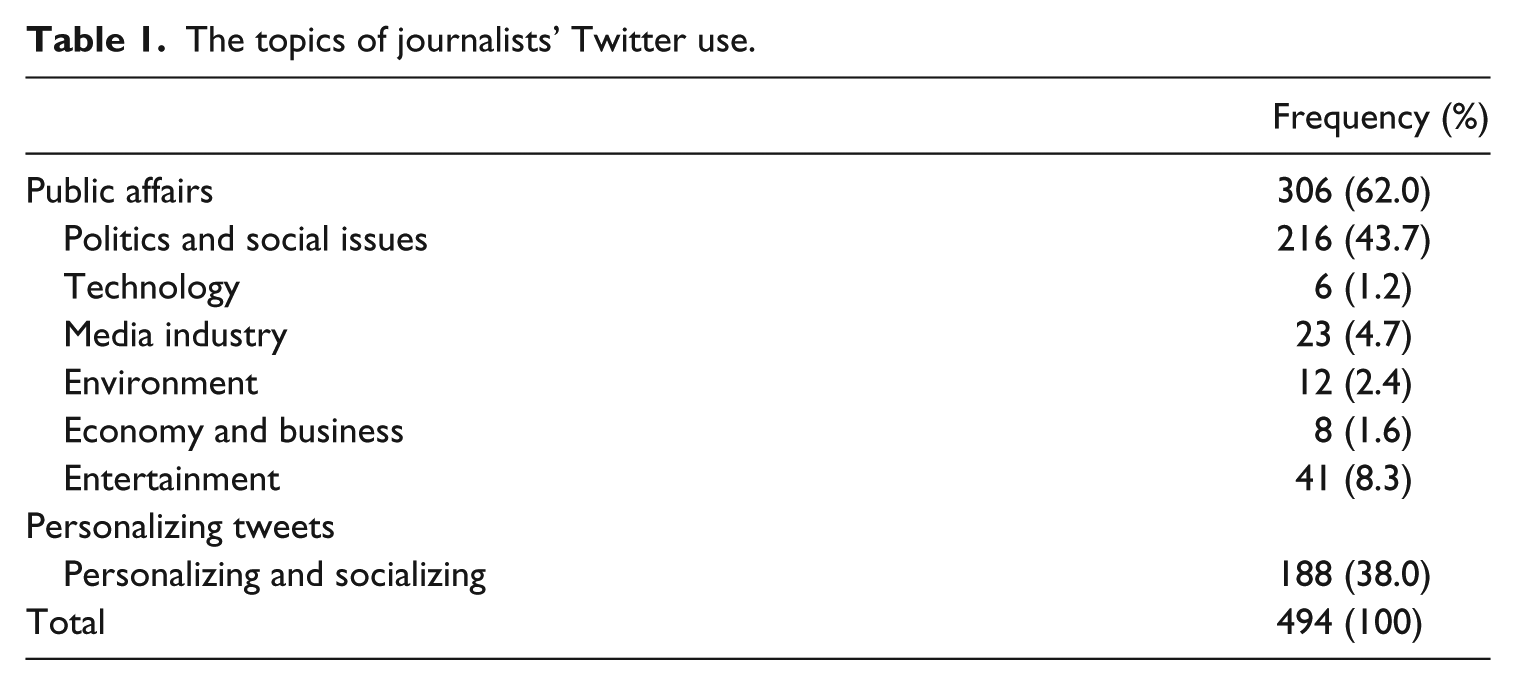
As Table 1 shows, with regard to tweeted topics (RQ1), public affairs were 62 percent (e.g. politics and social issues were 43.7%) while the personal affairs were 38.0 percent. Therefore, in answer to RQ1, journalists were more likely to talk about public affairs on Twitter compared to their personal lives.
The topics of journalists’ Twitter use.
Interactivity on Twitter: The target and the way journalists interact
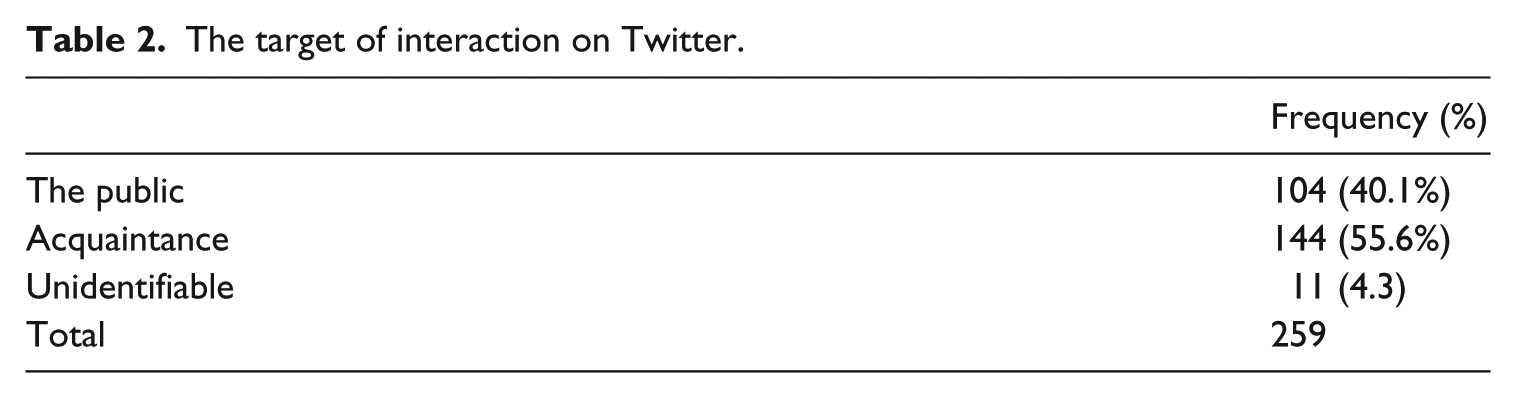
This study examined whether and to what extent journalists interact with others by measuring journalists’ use of ‘in reply to’ and ‘retweet’ (RQ2). Findings indicate that more than half the tweets (259, 52.4%) were related to ‘in reply to’ or ‘retweet’. Therefore, about half the journalists’ tweets were related to interaction with others. Next, this study examined the target of interaction (RQ3). As Table 2 shows, among 259 tweets, 104 tweets (40.1%) were in response to the public (either ‘in reply to’ or ‘retweet’) and 144 were in response to acquaintances that included sources, friends, and family members (55.6%). Therefore, journalists were found to interact not only with the public but also with their acquaintances.
The target of interaction on Twitter.
Journalists’ tweeting differs depending on ideology
The initial research questions focused on the overall tweeting of journalists while the next set of questions examined the relationship between the political ideology of news organizations (i.e. liberal vs conservative news organizations) and their usage (H1a and H2a). To further verify the results, this study conducted an online survey to examine the role of individual journalists’ ideology on their tweeting behavior (H1b and H2b).
With regard to topics (e.g. public affairs vs personal affairs), this study predicted that journalists at liberal newspapers would be more likely to talk about public affairs compared to journalists from conservative newspapers. As Table 3 shows, there was a significant difference in tweet topics between journalists at liberal newspapers and those at conservative newspapers, χ2(6, N = 494) = 68.87, p < .01. Specifically, more than two-thirds of the tweets (70.8%) from journalists at liberal newspapers were about public affairs, whereas more than half the tweets (57.4%) from journalists at conservative newspapers were about personal affairs.
Topic difference between liberal and conservative journalists.
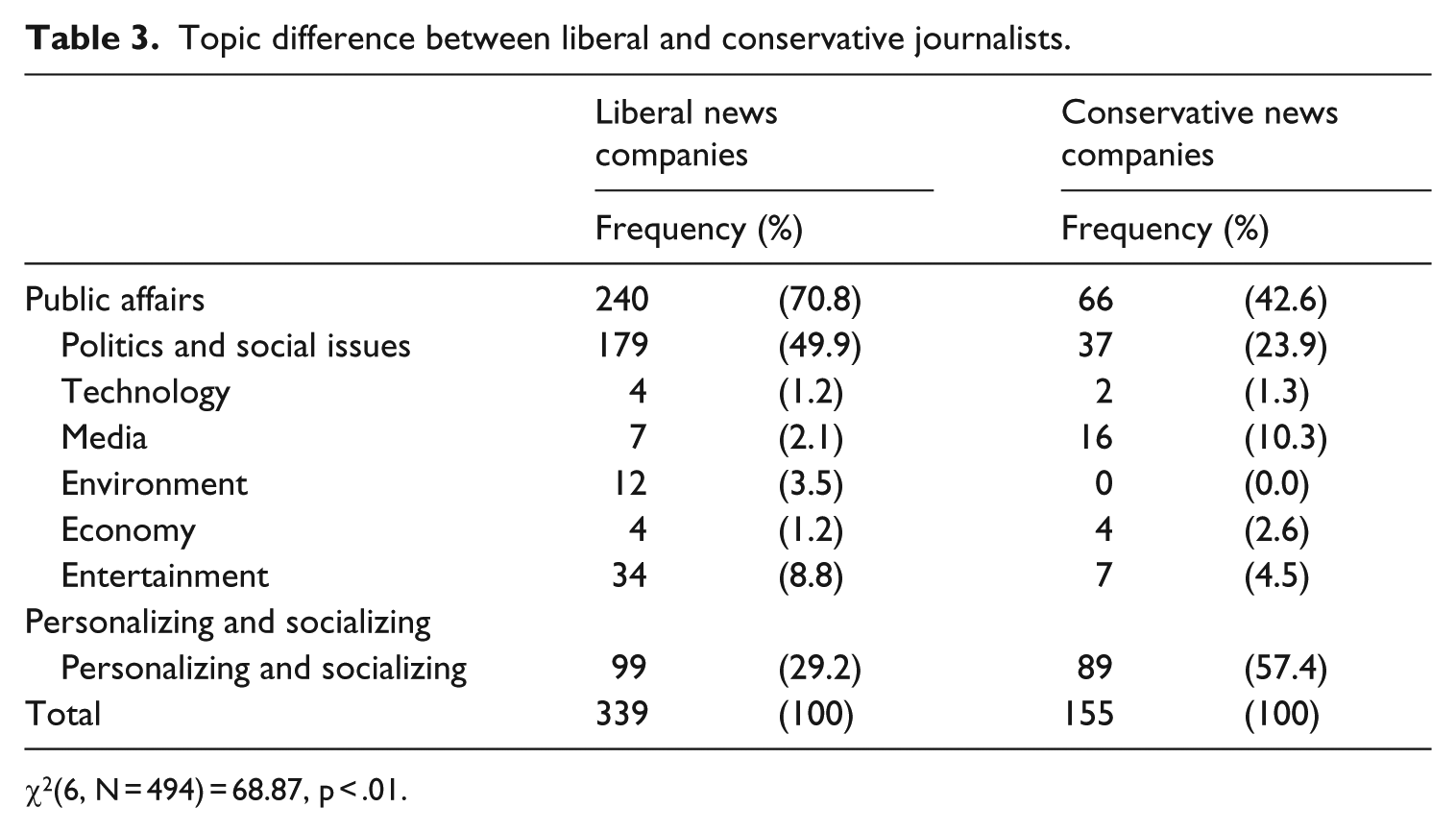
χ2(6, N = 494) = 68.87, p < .01.
With regard to interaction (H2a), there was a significant difference in the degree of interactivity on Twitter, depending on the journalists’ news organizations, χ2(2, N = 494) = 22.47, p < .01. As Table 4 shows, journalists at liberal newspapers were more likely to interact with others on Twitter (56.9%), compared to journalists at conservative newspapers (42.6%). Therefore, H1a and H2a were supported.
Interactivity difference between liberal and conservative journalists.
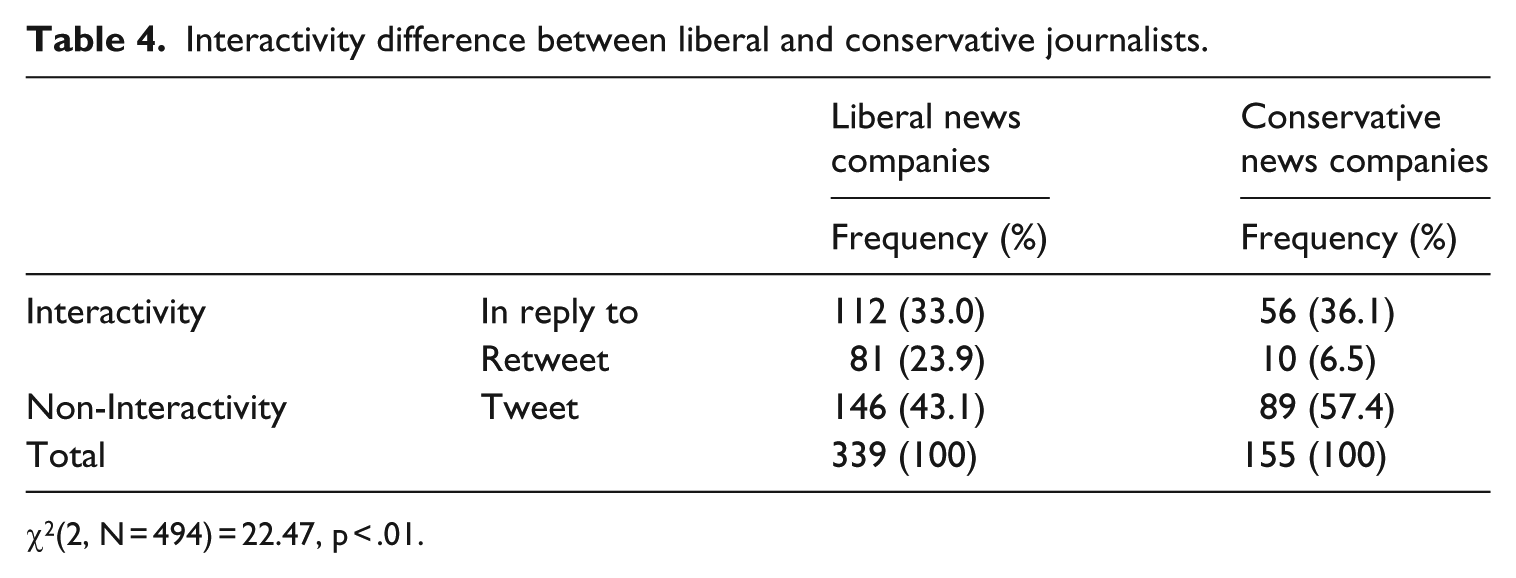
χ2(2, N = 494) = 22.47, p < .01.
In addition, the findings of an online survey reconfirmed journalists’ perceived ideology gap with Twitter users being associated with tweeting about public affairs issues (H1b) and interacting with Twitter users (H2b). 3 As Table 5 shows, journalists’ political ideology is positively correlated with their perceived ideology gap with Twitter users (r = .877, p < .001). That is, stronger conservative journalists perceived a greater ideology gap with the majority of Twitter users. Furthermore, journalists’ ideology gap was found to be significantly associated with journalists’ speaking up about public issues on Twitter (β = −.265, p < .01): the greater political ideology gap journalist perceived with Twitter users, the less he or she spoke up about public affairs on Twitter (H1b). In addition, as expected, the ideology gap was significantly and negatively associated with journalists’ interaction with the public on Twitter (β = −. 249, p < .01) (Table 6). In other words, journalists who were shown to have a greater ideology gap with Twitter users were less likely to interact with various types of users on Twitter (H2b). Therefore, H1b and H2b were supported.
Correlations between variables.
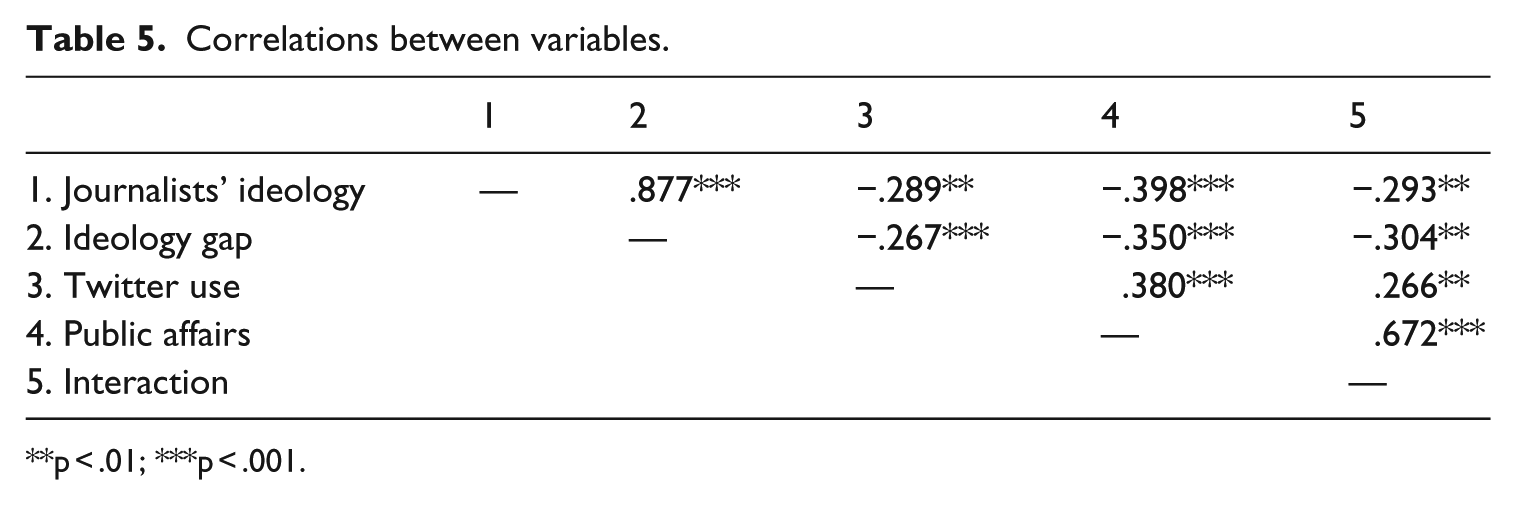
p < .01; ***p < .001.
Hierarchical regression models predicting journalists’ tweeting about the public affairs and journalists’ interactions with the public on Twitter.
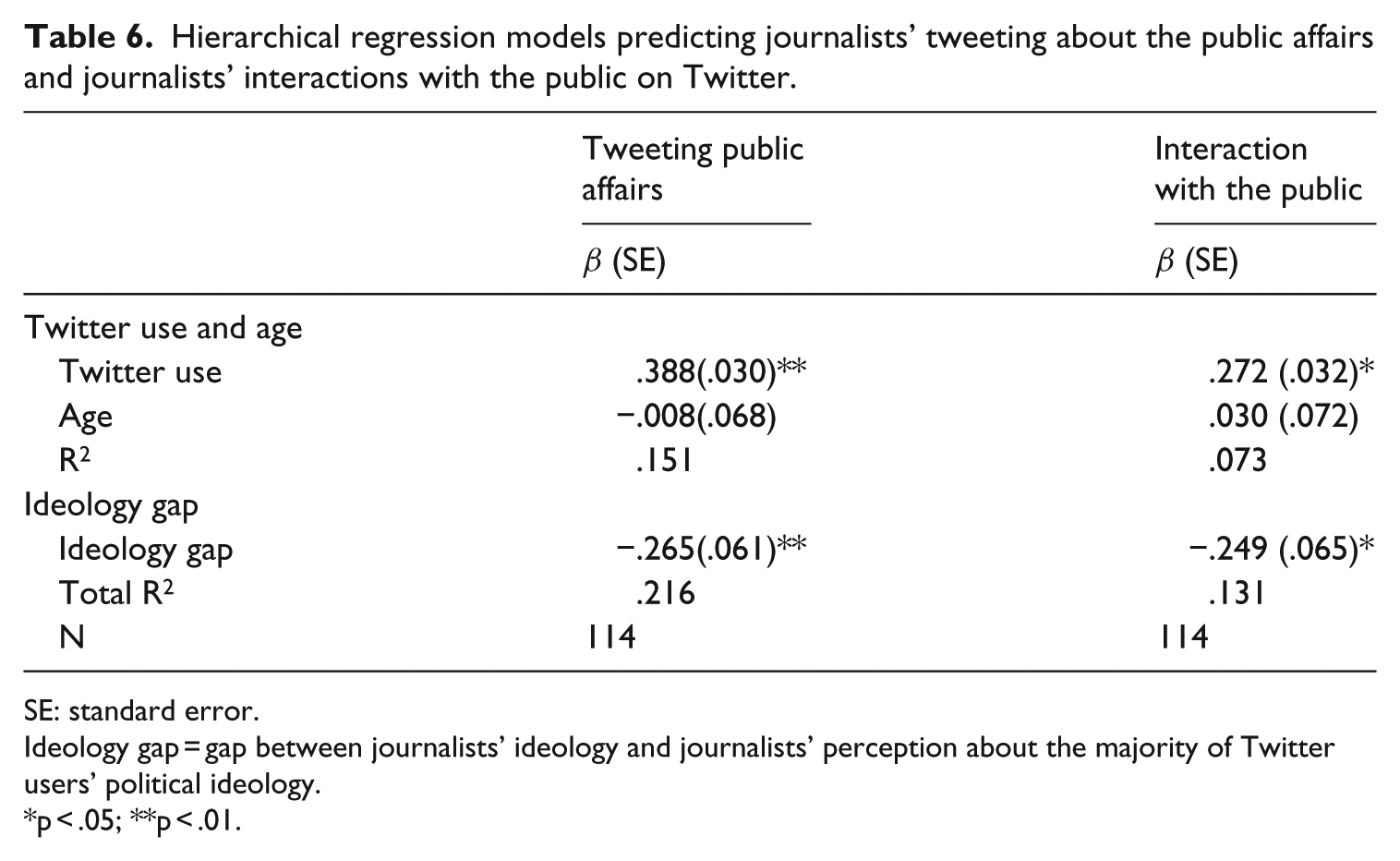
SE: standard error.
Ideology gap = gap between journalists’ ideology and journalists’ perception about the majority of Twitter users’ political ideology.
p < .05; **p < .01.
Discussion
Twitter offers new ways for the public to obtain information and communicate with other people, and in the new media context, journalists also have more opportunities to share news and information and interact with audiences. Whether and to what extent this new digital platform plays a role in contributing to the sphere of public discourse is an important issue especially in democratic societies. For example, social media, such as Twitter, may affect how individuals obtain news and information and how they discuss politics and engage in discursive activities and public affairs (Kushin and Yamamoto, 2010; Wang, 2007). Given this importance and the growing popularity of Twitter, studies have begun to examine how Twitter affects and thereby changes the roles and routines of journalists’ professional roles and duties. This study aims to contribute to the current literature by exploring what South Korean journalists tweet, to what extent they interact with the pubic via Twitter, also whether and how political ideology is related to their Twitter use activities.
Our findings show that South Korean journalists were likely to use Twitter not only to convey news and information but also to actively interact with the public. In other words, the results demonstrate that topics related to public affairs, such as politics and social issues, were frequently discussed by journalists using Twitter, while they also engaged in a large amount of tweeting about events in their personal lives. In sum, this study suggests that Twitter offers a place to discuss diverse kinds of stories, news, and information.
Furthermore, the study shows that Twitter has the potential to provide an important means to advance reciprocal journalism. Findings of this study indicate that more than half the journalists’ tweets (259, 52.4%) were related to direct interaction with other Twitter users, documenting that journalists interact with the public as well as with their friends and colleagues through Twitter. Of particular interest, these interactions were made through a richer form of reciprocity, such as the direct interactive functions of ‘retweet’ and ‘in reply to’ by which a greater sense of connectedness is achieved (Lewis et al., 2014). These findings suggest that the Twitter sphere may have some potential to play a role as a public sphere by contributing to interactions among Twitter users, including interaction between journalists and the public as found in this study. In this sense, by demonstrating how journalists interact with the public via Twitter, this study advances an area of research that has rarely been empirically examined in the current literature.
More importantly, this research explored how journalists’ patterns of usage and interactivity on Twitter vary depending on the political inclination of the media company where they work (i.e. liberal vs conservative news organizations). Findings showed that journalists who work at liberal newspapers were more likely than journalists who work at conservative newspapers to talk about public issues on Twitter (H1a) and to interact with others by using ‘in reply to’ and ‘retweet’ (H2a).
Survey data that we analyzed confirmed that journalists’ political ideology influences their Twitter use behaviors, including discussion about public affairs and interacting with the public. Results of survey data demonstrated that liberal journalists were more likely than conservative journalists to talk about public affairs issues on Twitter and interact with Twitter users because they perceived that the majority of Twitter users’ ideological leanings share their own political orientations. As suggested by the theory of SOS (Noelle-Neumann, 1974), the politically conservative journalists perceive themselves as being in the minority on Twitter, whereas liberal journalists are more likely to perceive themselves as being in the majority; as a result, liberal journalists, as compared with conservative journalists, are more likely to use Twitter to talk about public affairs issues and interact with the public. These results are consistent with a recent study which showed that journalists who perceived greater opinion gap with Twitter users were less likely to speak up controversial issues on Twitter (Lee and Kim, 2014). 4 Our results further indicate that the SOS can be the case with regard to journalists’ tweet about (general) political/social issues and interactivity behaviors with the public on Twitter sphere.
Notably, our findings, suggesting that journalists at liberal organizations may be more active in talking about politics and interacting with audiences on Twitter, are in line with previous research on Internet-based participatory activities. Those studies demonstrate that online environments are able to attract individuals who are often under-represented in the political sphere, such as minorities and women, young people, and ethnic minorities. Online environments allow them to challenge majority opinions and seek to change the political status quo (Dalton, et al., 2009; Hargittai, 2007; Hargittai and Litt, 2011). Perhaps journalists at liberal news organizations are more willing to express their opinions, engage audiences, and so forth because liberal-oriented news companies have been relatively under-represented in the media market in South Korea so that a more active engagement in the Twitter sphere may serve to increase the representation of liberal media.
In sum, the findings of the current study are mixed in terms of the potential role of Twitter as a public sphere. The results of this study indicate that Twitter has the potential to serve as a sphere of public discourse in that journalists have started to talk about public issues and engage in discussions with other users or the public within the Twitter sphere. Thus, their tweets may facilitate the process of information production, distribution, and the public’s consumption of news and information. However, at the same time, this study illustrates that the potential for Twitter to serve as a public sphere may be limited depending on other factors, such as political ideology – that is, news organizations’ ideological perspectives (as examined in content analysis) and individual journalists’ political ideology (as investigated by survey). In other words, although Twitter can provide opportunities for liberal media to discuss in an online environment under-represented views of liberal media in a predominant traditional media environment that is more of conservative, it is important to note that the asymmetry of voices may limit the role of Twitter to develop as a public sphere. If a SOS of either the liberal or the conservative opinions is created and reinforced, the minority will become more and more distanced from an online public sphere. As a consequence, the minority or diverse opinions are not voiced in that space. Particularly, if the SOS is reinforced based on political ideology, societies may become more fragmented and polarized because individuals will be less likely to be exposed to diverse perspectives (Mutz, 2002; Sunstein, 2001). In relation to this, future research investigating the potential role of Twitter as a public space can apply the current study’s finding to test, for example, what other considerations may influence journalists’ use of Twitter for discussion of public affairs as well as the public’s use of Twitter for that same purpose.
Although this study provides an early examination of journalists’ use of Twitter as a sphere of public discourse and offers insights into the role that political ideology plays in the Twitter sphere, there are limitations to this study. First, given the relatively small sample, it could be argued that the findings may not be generalizable to the population of South Korean journalists. However, concerns about generalization of the findings should be eased by the methodological approach that we used, based on a representative list of South Korean journalists coupled with a series of thorough searching steps; therefore, it cannot be said that the relatively small number of tweets does not represent South Korean journalists’ patterns of tweeting. On a similar note, searches for journalists who have Twitter accounts by name, email, and company name may have caused the researchers to overlook Twitter users who did not disclose their personal information. In those cases, it may be that journalists’ use of Twitter is more closely related to personal topics. Another limitation relates to sampling of content analysis and survey data. While content analysis included tweets only from newspaper journalists, the survey included responses from both broadcast and newspaper journalists. Ideally, the analysis of survey data would have included just the newspaper respondents, but such a measure (i.e. whether each response is from a broadcast or newspaper journalist) was not available. Therefore, this issue could be resolved in future research to provide a better comparison between the results of content analysis and survey data. Nevertheless, it is important to note that this study analyzed survey data, in addition to content analysis, in order to further validate an examination of the role of political ideology with regard to journalists’ Twitter use activities. Also, as an anonymous reviewer pointed out, this study should have differentiated retweeting with and without follow-ups given that retweeting may not necessarily follow the reciprocal process. However, while it may be difficult to claim that retweeting is an act of reciprocity, it is certainly the first step to begin the interaction. Therefore, examining retweets should be regarded as the necessary step to understand the process of interaction on Twitter.
Despite these limitations, the current study sheds light on how South Korean journalists are using Twitter, how it plays a role in public discourse, and how political ideology may influence the dynamics of this emerging technology.
Footnotes
Funding
This research received no specific grant from any funding agency in the public, commercial, or not-for-profit sectors.