






Abstract
Both within journalism and academia it is argued that citizen voices should have a greater prominence in news to counterbalance the virtual monopoly of elite sources. This study extends previous studies – showing increased presence of citizens in news – by investigating relevant but unanswered questions, namely, (1) whether there has been a change in their prominence relative to elite and civil society sources and (2) in which capacity citizens have been present in the past two-and-a-half decades. Moreover, (3) citizens’ contribution to different story topics is explored. In this study, 1425 television news stories broadcast between 1990 and 2014 (N = 2413 sources) are analyzed. Results show that citizen sources became more prominent at the cost of elite sources. However, elite sources still remain the primary definers in news. Citizens do not get a more substantive, relevant voice as they are primarily used as vox pops, regardless of story topic.
Keywords
Traditionally, elite sources have been the ‘primary definers’ in the news. Elite members, such as politicians, officials, and experts, have consistently been the most frequently selected sources (cf. Berkowitz, 2009; Manning, 2001). Consequently, they have the first opportunity to frame news events (Carlson, 2009). In pluralistic societies, the question of who gets a voice is a question of empowerment. Sources with continuing access to the media can shape long-term meanings (Berkowitz, 2009; Carlson, 2009; Manning, 2001). Having ordinary citizens present in the news defines the media’s contribution to key social and political characteristics of society such as deliberation, participation, and diversification (Gillmor, 2004; Hopmann and Shehata, 2011; Reich, 2015). Scholars therefore argue that media should not solely represent the voice of those in power but also express the views of the public (cf. McQuail, 1992; Rosen, 1999).
Within journalism, a stronger public orientation in the last decades may have resulted in a diminishing inclination of media to gauge the news to the elite in favor of non-elite members of society (Kurpius, 2002). Today, technological, economic, and ideological developments have made a stronger focus on citizens and their knowledge and interpretation of issues, problems, and events almost mandatory. In the 1990s, the journalistic reform movement of civic or public journalism committed itself to promote and improve the quality of civic life. Public journalism aims helping to reduce the growing gaps in society between citizens and government and between news organizations and their audiences by advocating a more citizen-centered approach in journalism (Haas, 2007). This awareness is subsequently carried over to more recent attempts to include citizen voices in mainstream media. By using citizen sources, journalists intend to broaden the range of voices outside the elite and also to increase the attractiveness of stories for their audience. If citizens are indeed increasingly taken seriously as sources in the news, this would mean that the virtual monopoly of elite sources on defining events is gradually broken, giving way to a more heterogeneous chorus of voices in public debate.
Research indeed seems to point to a growing awareness of the value of citizen sources. Common people are used more frequently in the news than before (De Keyser and Raeymaeckers, 2012; De Swert et al., 2008; Hendriks Vettehen et al., 2011). However, this tells us little about the degree to which citizens are truly given a serious part in public debate. Citizens can serve as active participants in public debate by providing expertise, knowledge, and agency or they can be merely used to provide illustration and emotion (Lewis, 2006). This study attempts to determine the extent to which the increase in citizens in the news since the 1990s meets the aim of providing a genuine platform for a substantive citizen voice in mainstream media.
To investigate this, three questions are central to this study: (1) How does the increased presence of citizens compare to trends in the prominence of elite and other sources: is the balance tilting in favor of citizens? (2) In which capacity are citizens used in the news? (3) Do citizens have access to the ‘serious’ and relevant public affairs news or is their presence limited to peripheral news?
As prior research does not distinguish between citizen sources that are selected for their competence and random citizens that serve as illustration, the purpose of this study is to assess changes in both the prominence and the capacity in which citizens are present as sources in the past two-and-a-half decades. It presents a content analysis of television news from 1990–2014: from the advent of public journalism and increasing competition due to the entrance of commercial television channels, through the starting years of the Internet up to the age of Web 2.0 and the major crisis in journalism. This content analysis is conducted in The Netherlands, a Western European country having a democratic corporatist media model (Hallin and Mancini, 2004). A profoundly public service broadcasting system for much of the 20th century, The Netherlands started a national public service television newscast in 1956. This newscast, NOS Journaal, was the only news program broadcast on television until 1989. In this year, the first commercial broadcaster in The Netherlands, RTL, entered the news market. From then on, The Netherlands has a mixed public–commercial media system. Today, these two broadcasters still provide the only two national news programs covering both national and international news events on the Dutch television. Both newscasts are highly popular: they are continuously present in the top 10 of most watched programs of the day (Kijkonderzoek, 2014).
Journalistic routines and source selection
This study is rooted in theories of journalistic routines (cf. Tuchman, 1978). Routines are patterned practices designed to ‘get the work done’, that is, to enable efficient, problem-free journalistic production not needing too much deliberation (Gans, 1979; Shoemaker and Reese, 1996).
News sources are selected using routines shaped by real-world constraints in availability, time (deadlines), space, and technology, by economic incentives and by perspectives on the audience (Berkowitz, 2009; Pavlik, 2000; Shoemaker and Reese, 1996). Particularly, scheduling and availability determine news sourcing: deadlines must be met, and routinizing the task of sourcing is one solution. This is accomplished by keeping a basic collection of sources (Berkowitz, 2009). Source selection is determined by a combination of these daily production routines and professional newsroom standards of credibility (Dimitrova and Strömbäck, 2009; Manning 2001; Tuchman, 1978). Sources that fit are able to play off these daily routines, and those that meet professional standards are more likely to get selected (Berkowitz, 2009; Shoemaker and Reese, 1996; Sundar, 1998; Tuchman, 1978). Prior research shows that such sources primarily include members of elite groups and institutions because of their structural position, availability, credibility, and representative status, as well as their understanding of journalistic needs and routines (Berkowitz, 2009; Davis, 2000; Helle, 2000; Manning, 2001). As a result, politicians, government officials, scientific experts, and corporate spokespersons get much more attention than alternative sources (cf. Berkowitz, 2009; Grabe et al., 1999).
Changing routines in source use: causes and consequences
However, routines may vary across different contexts and over time, as new challenges call for new semi-permanent solutions (Becker and Vlad, 2009). Three partially simultaneous and interdependent societal developments may have changed professional views over the last 25 years with respect to the public. By extension, sourcing routines may be expected to have changed in the same period as well.
First, technological innovations have been an important catalyst of an emerging focus on the public (Beam, 2003; Coulson and Lacy, 1996; McManus, 2009; Pavlik, 2000). Digital technology has enabled active audience participation in institutional mainstream news production and even production of news outside traditional media institutions (Gillmor, 2004; O’Sullivan and Heinonen, 2008). Digitalization of news production has also facilitated incorporation of story input from a variety of sources and perspectives by mainstream media (Beam, 2003; McManus, 2009). Although digital possibilities have given journalists more opportunities for purposeful interaction with and incorporation of citizens, studies on the effects of innovations on other newsroom routines indicate that many routines remain impervious to change (Domingo et al., 2008; Witschge, 2013).
Second, economic developments have had potential consequences for news sourcing. In many territories, the transition from public broadcasting systems to mixed commercial–public systems has resulted in a considerable increment in the number of media competitors. Consequently, news production has become more market oriented (Beam, 2003; McManus, 2009). Nowadays, the primary goal of news is to increase market shares. In this context, ordinary people as sources are used as storytelling devices. That is, citizens sources are used not necessarily for information input or expertise but to increase story attractiveness, concreteness, and vividness and to add a feeling of authenticity (Hendriks Vettehen et al., 2008; Hopmann and Shehata, 2011; Lefevere et al., 2012).
Third, increased attention to the public has also been promoted by ideological considerations, in which the public is not seen as consumer or passive recipient but rather as active participant in civil society. Technological and economic trends have fostered a discussion on the declining public dependency on and trust in the media. In this context, journalists and scholars have expressed the need for journalism to re-articulate its role in civic society. Public journalism started in the 1990s in the United States as one form of this ‘new’ journalism adhering to the principle of citizens as important sources of knowledge and definition power (Ahva, 2013: Rosen, 1999). This alternative journalism has spawned greater awareness in traditional media of the desirability of, and subsequent experimentation with, greater bottom-up participation of citizens in news (Ahva, 2013; De Keyser and Raeymaeckers, 2012).
Based on the idea of civic responsibility in a democratic society, journalists should reconnect with the audience, not as consumers but as citizens who are co-responsible for the democratic system. To reinvigorate the democratic process, news should be guided less by the official agenda and more by the public agenda through citizen-oriented reporting (Ahva, 2013; Brants and De Haan, 2010; Kurpius, 2002; Lewis et al., 2005; Massay, 1998; Rosen, 1999).
Together, technological, economic, and ideological developments from the past two-and-a-half decades have increased mainstream media awareness of the need to involve citizens in the news to allow their interpretation of events to resonate in the news. First, public journalism initiatives used the new technologies to involve citizens in the production of news. It advocated the need to include the perspective of citizens. This is demonstrated by the tendency of alternative forms of journalism, to the use of more alternative sources, such as ordinary people, although elites have remained the dominant source providers (Atton and Wickenden, 2005; Hermans et al., 2014; Massay, 1998). While such initiatives may have remained a fringe phenomenon, their practices regarding sourcing have had a trickle-down effect on mainstream journalism, in the sense that citizens are now regarded as higher on the hierarchy of credibility than before (Atton and Wickenden, 2005; De Keyser and Raeymaeckers, 2012; Nip, 2008).Together with the economic need to attract larger audiences, this may have changed news sourcing routines in mainstream journalism in favor of citizen sources.
Prominence of citizen sources in mainstream media
A number of recent studies indicate that news sourcing routines have indeed been changing. The most important indication is that ordinary people are increasingly used as sources in traditional news (cf. De Keyser and Raeymaeckers, 2012; De Swert et al., 2008; Hendriks Vettehen et al., 2011; Hopmann and Shehata, 2011).
To investigate whether the prominence of citizens in mainstream news has grown over the years, it is necessary to define the various types of sources that may be present in the news. Prior research on the use and effects of news sources usually employs a dichotomous distinction between citizen sources/ordinary people on the one hand and elite or official/institutional sources (e.g. politicians, medical staff, independent experts) on the other (cf. Grabe et al., 1999; Kurpius, 2002; Lefevere et al., 2012). In order to get a first grasp of which sources dominate the news, this dichotomy may suffice, but it does not do justice to the complexity and diversity of types of sources. For this reason, a limited number of authors have recently begun to distinguish a third group of sources that neither belongs to the societal elite, nor can they be defined as citizen sources (De Swert, 2011; Tiffen et al., 2013). They point to a group of sources in between these two opposites that can be defined as ‘civil society sources’. These sources represent an institutionally organized field in the public arena, such as social organizations, clubs, companies, and special interest groups. Examples of such sources are representatives of museums, schools, commercial companies, sports clubs, and musicians. Tiffen et al. (2013) compared their presence in news stories in different countries. Overall, they found that civil society sources were less present in stories than official sources, but more than citizen sources.
This study employs a similar distinction between types of sources based on their place in public debate. At one side of the spectrum are the most organized, institutionalized groups, which are able to exert the most direct and powerful active influence on society: the influentials from, for instance, politics, science, and media. Journalists regard these sources as easy accessible and credible (Berkowitz, 2009). On the opposite side of the spectrum, we find citizens who are not linked to institutional groups. This is not to say that they cannot have substantial and relevant contributions to public debate based on their knowledge and experience. It only means that they have little direct influence on policy and public debate, and traditionally, journalists regard them as less credible and accessible, and thus less relevant for the news. In between these two opposite poles are sources from civil society. They do not represent the elite, but they are organized in social institutions that try to exert as much influence as possible.
To assess whether citizens have become more prominent as sources, we compare the use of citizens as sources to the other two types of sources. As stated above, several trends in technology, economy, and journalistic ideology have resulted in a more public-centered journalistic attitude. Because of the call for a shift in attention from the institutional agenda toward the public agenda, it may be expected that the prominence of citizen sources has increased since the beginning of these historical processes relative to elite sources. As we are interested in the potential for citizens to leave a mark on news definitions, it is important to compare a possible increase to developments in use of other sources. To assess this, we formulate the following research question:
RQ1. Did citizens become more prominent as sources in television news over the past two-and-a-half decades?
Substantive contributors or inane illustration?
The mere presence of sources enables them to have a share in defining or framing a news story. However, it is not only important to be present but also to be present as substantive contributors of expertise, knowledge, or agency (Carlson, 2009; Lewis, 2006). Research indicates that citizens are often used as vox pops – randomly selected passers-by that do not have any obvious relevant on-topic expertise or representative function, whose only function is to enliven or illustrate a news story (De Swert et al., 2008; Lewis et al., 2005). In addition, ordinary people serve to exemplify an issue or to enhance proximity as they have the possibility for personal and emotional identification (Hopmann and Shehata, 2011). There are indications that an increasing number of affected citizens (e.g. victims or exemplars) are used in news stories (cf. Hendriks Vettehen et al., 2005). One can argue that these affected citizens generally do not add substantial information to a story as they are merely used as (emotional) illustration in addition to what was already reported in the story.
Although both vox pops and affected citizens as sources serve a purpose from a commercial-strategic perspective, from a civil responsibility, perspective news should enhance public debate using citizen sources to contribute on a more active, informative or cognitive level (Ahva, 2013; Brants and De Haan, 2010; Hermans et al., 2014; Miller and Kurpius, 2010). The very limited research conducted on this subject provides some first indications that things indeed may have changed: citizens are increasingly depicted as initiators (e.g. of a protest), a role associated with a sense of responsibility (De Keyser and Raeymaeckers, 2012). Thus, our second research question is as follows:
RQ2. What are the changes in the capacity in which citizen sources are present in television news over the past two-and-a-half decades?
Citizen sources and story topic
It is feasible that journalists strategically use citizen sources in different capacities in different kinds of news stories. Lewis et al. (2005) conclude that when citizens appear in political news, they tend to be represented as passive and apolitical. Citizens do not propose, initiate, or engage in debate but often provide ‘background and mood with little agency’ (Lewis, 2006: 312). Hopmann and Shehata (2011) state that despite the absence of an obvious pattern, apparently certain issues are more relevant for including citizen sources than others. Citizen sources seem to be present primarily in issues that affect people’s lives directly and are the most proximate to their personal life, such as welfare, education, and other social issues such as unemployment and children. In contrast, citizen sources are least frequently encountered in foreign, economic, and law and order news.
In addition, the perspective of routinized source selection suggests that citizen sources are less likely to be selected in hard news topics because hard news topics are more often routinely reported by journalists and consequently characterized by the selection of primarily institutional –that is, routine – sources (Miller and Kurpius, 2010). When topics fall outside the routines of journalists, it is more likely that alternative sources are sought (Berkowitz and Beach, 1993). Thus, research suggests a variance in the prominence of different types of news sources with different news topics. However, it offers few hints as to how citizen sources contribute (substantive, affective, or illustrative) to different news topics. This leads to the third research question:
RQ3. What are the relations between story topic and the capacity in which citizen sources are present in television news in the past two-and-a-half decades?
Method
Design
A longitudinal content analysis was conducted to investigate the presence of sources in Dutch television news stories. Stories were selected from the two main Dutch news bulletins, NOS Journaal (public service broadcaster) and RTL Nieuws (commercial broadcaster). Both the programs serve a nation-wide audience and cover national and international news events. Only prime-time newscasts were coded. Newscasts were selected from the years 1990, 1993, 1996, 1999, 2002, 2004, 2008, 2012 and 2014. The year 1990 was selected as starting point as this was the first complete year that two competing flagship news bulletins aired on the Dutch television, due to the entrance of commercial television on the Dutch television market. Together, the nine selected years cover major technological, economic, and ideological developments on the news market. That is, (1) increasing competitive pressure due to increasing numbers of (news) programs and channels on the Dutch television in the 1990s and beyond, (2) the rise of the Internet in terms of audience reach and as journalistic tool starting at the end of the 1990s, (3) the emergence of Web 2.0 in the 21st century, and (4) journalistic changes such as participatory journalism and changing news routines such as digital newsrooms.
Sample
A total of 1425 news stories were coded: 716 stories from NOS Journaal and 709 stories from RTL Nieuws. For NOS Journaal, 1 week in the Fall of each selected year was coded (N = 63 newscasts). Except for 1990, this was always the week that included the 1st of October. In 1990, only the week started with 20 November was available. In the same weeks and years, newscasts aired by RTL were selected (N = 61 newscasts). Two newscasts were unavailable in the archives (4 October 1996 and 5 October 2012). The selected week (including the week used for 1990) is generally regarded as a ‘normal’ week in each year. For instance, there is no national holiday in this week and there were no Dutch elections. All stories in the selected newscasts were coded, excluding the weather forecast, sports news, and bulletin previews.
Measurements
The codebook was based on codebooks used in prior research on news sources (Hermans et al., 2014; Hermans and Hietbrink, 2015). The number of sources in each news story was coded. In total, 2414 sources were coded. In all, 469 news stories (32.91%) did not include any source. In all other stories, at least one source was present on screen or explicitly paraphrased by the voice-over or reporter. Based on codebook descriptions of specific sources (see Table 1 for an overview), coders defined what kinds of sources were included in news stories. Three main types of sources were discerned: elite sources, civil society sources, and citizen sources. As only one out of the 2414 sources (‘the public’) does not fit into one of these types, it was excluded from further analyses. This means that 2413 sources were included in the analyses.
Types of sources (N=2413), short descriptions, and Krippendorff’s alphas.

The category Elite sources (N = 1250; 51.80% of the total number of sources) consisted of representatives of government agencies, politicians, media, or journalists as sources (i.e. not involved in the construction of the news story); experts; law enforcement; and emergency services.
The category Civil society sources (N = 491; 20.35% of the total number of sources) included sources representing a public organization, interest group, club, or union. It also included corporate sources and celebrities and intellectuals.
The category Citizen sources (N = 672; 27.85% of the total number of sources) consisted of ordinary people who appeared in the news without representing an institutional organization at the macro or meso level. Moreover, individual citizens organized in small groups (micro level) were coded as citizen sources (e.g. parent committees at schools or community action committees). As we were interested in the various roles citizen sources can play, a further division of this category was made (see Table 1). Three overarching roles were discerned: vox pops, agents, and affected citizens. Vox pops (N = 421) are defined as random citizens who do not have a specific representative function or expertise regarding the event that was reported in the news story. Agents (N = 74) are sources that have expertise or fulfill a representative function (i.e. active citizens, citizens as experts, and citizens as representative of a larger group of citizens). These sources can contribute to the content of the news story because of their specific knowledge. The last category consists of citizens who were affected by the news event (N = 177), that is, exemplars, eyewitnesses, and victims. These sources contribute personalized, sometimes emotional, statements.
Finally, the main topic of the news story was coded. The codebook provided a list of 15 topics from which coders had to choose the one that was most prominent in the news story. Some of the categories were merged for the analysis, resulting in five categories of topics: politics (N = 298 stories, including 763 sources), economy (N = 87 stories, 233 sources), public issues (e.g. stories about education, nature, infrastructure; N = 238 stories, 677 sources), law and order (e.g. stories about crime, law enforcement, the army, violence, accidents; N = 293 stories, including 645 sources), and gossip news (e.g. celebrity and royalty news; N = 34 stories, including 77 sources). As the number of stories on ‘religion’ was extremely low (N = 6 stories, including 18 sources), these were excluded from the analyses.
Coders and reliability
A total number of 12 coders were involved in the content analysis. Each coded two complete newscasts (approximately 11 stories per newscast) to calculate intercoder reliabilities. One of these newscasts was the same for every coder, and the other one was only coded by one to three other coders. Krippendorff’s alphas were calculated for the 12 coders together. Reliability scores showed that the coders were able to discern whether and how sources were present in the news: no source, a speaking source, or a source that was paraphrased (α = .91). Furthermore, overall codings of the types of sources were sufficient (α = .74). As shown in Table 1, intercoder reliabilities of the separate citizen source roles were sufficient to good. The alpha for the main topic of each news story was sufficient (α = .72).
Results
To investigate changes in prominence of citizen sources in television news over the past two-and-a-half decades (RQ1), we first explored trends in the presence of the three types of sources: citizen sources, civil society sources, and elite sources. For each type of source, we conducted a separate analysis of variance (ANOVA) with the frequency of presence of a source as the dependent variable and year of broadcasting as independent variable. In addition, we included type of broadcaster as an additional independent factor in the model to test whether there are differences between the public and commercial news programs.
In line with previous research, Figure 1 shows a strong increase in the presence of citizen sources in news over the years, from 9 percent in 1990 to 38 percent in 2014. This increment is significant (F(8, 2395) = 8.287; p < .001; η2 = .03). Simultaneously, the presence of elite sources has significantly decreased in the past two-and-a-half decades from over 69 percent in 1990 to 46 percent in 2014 (F(8, 2395) = 5.153; p < .001; η2 = .02). There was a significant change in the presence of civil society sources (F(8, 2395) = 2.302; p = .019; η2 = .01). The general trend shows that the presence of civil society sources slightly decreased between 1990 (22%) and 2014 (16%). There were no differences in the presence of the three types of sources between NOS Journaal and RTL Nieuws.
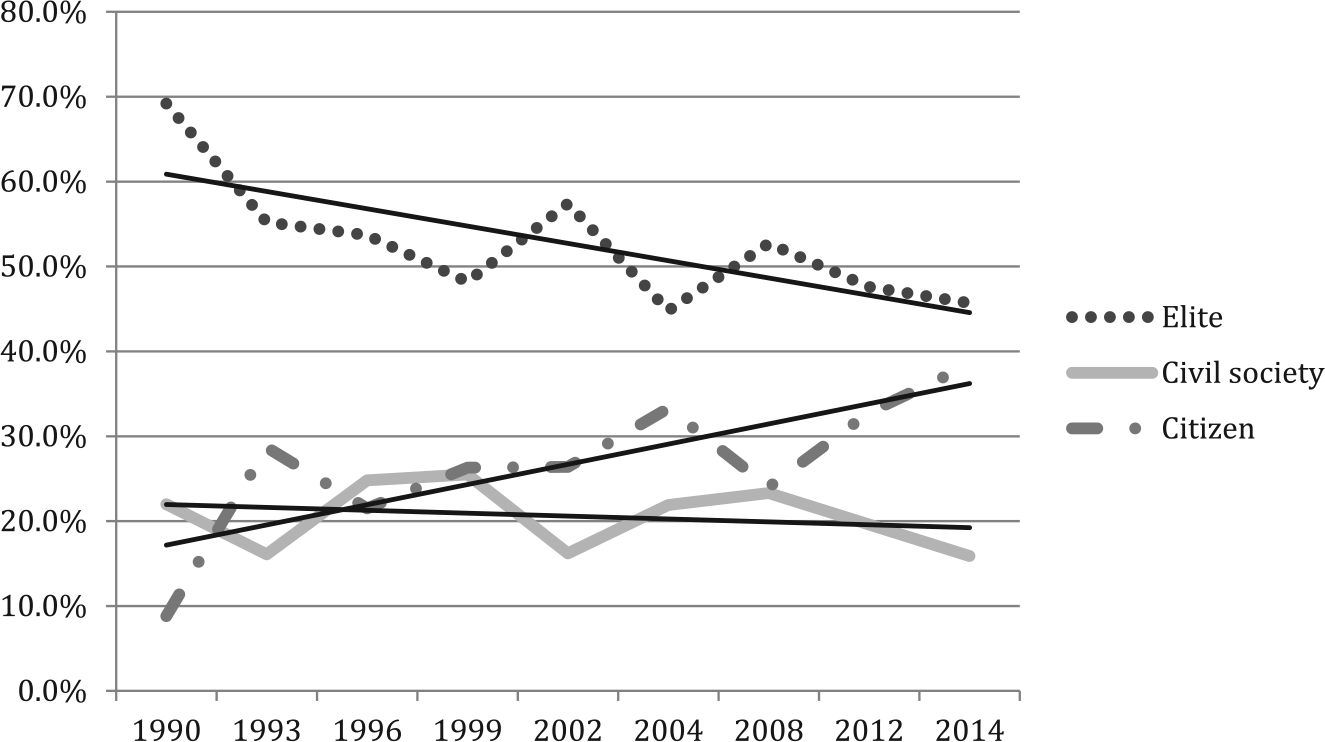
Presence of sources in the news: percentages of total amount of sources per year, including trend lines.
As we were interested in the relative prominence of citizen sources compared to other sources, a multinomial logistic regression analysis was conducted to investigate changes in the ratio between elite sources, civil society sources, and citizen sources. 1 As graphically displayed in Figure 1, B-parameters indicate that there were significantly less citizen sources and civil society sources than elite sources. However, the differences between especially the elite sources and citizen sources have decreased over the years. Thus, citizen sources became more prominent as sources in the news over the years, both in the presence and relative to elite sources and civil society sources.
The second research question (RQ2) concerned changes in the capacity in which citizen sources were present in television news over the past two-and-a-half decades. To investigate this, we analyzed the contribution that citizens made to the news over the years by focusing on their role as vox pops, agents or citizens who are affected by the event reported in the news story. To this end, separate ANOVAs were conducted with the role of the citizen sources as dependent variable and year of broadcasting and broadcaster as independent variables. The results are graphically displayed in Figure 2.
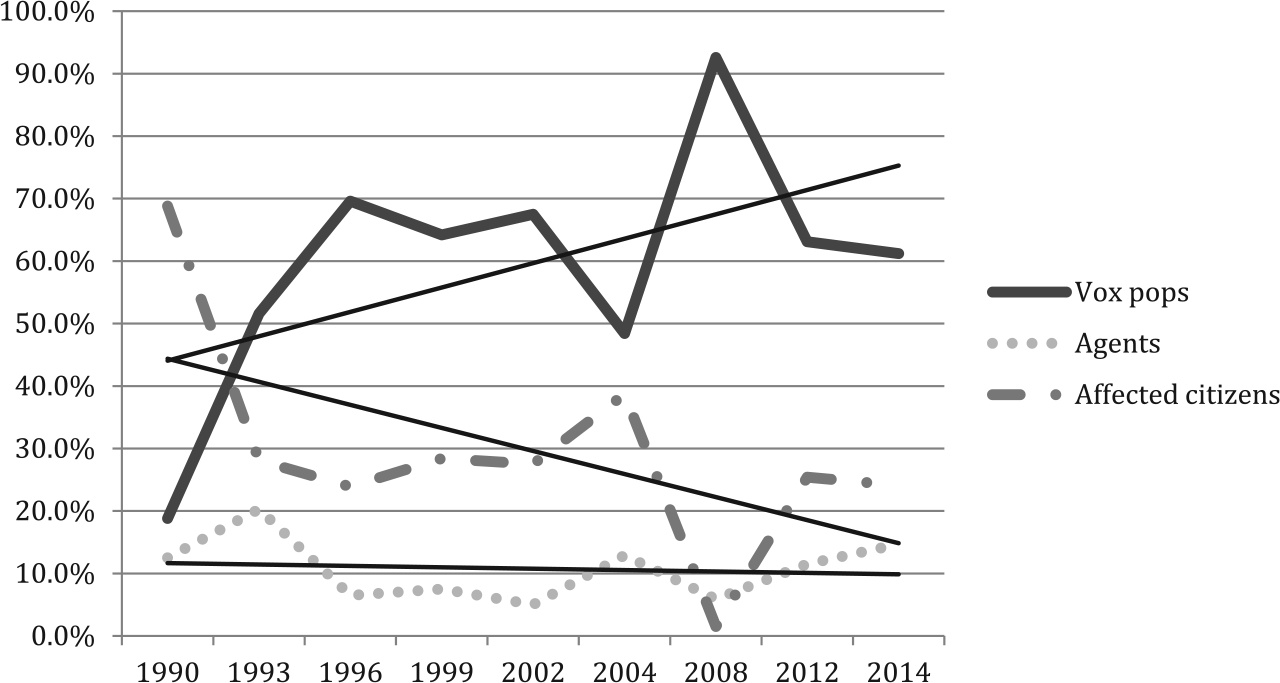
Presence of types of citizen sources in the news: percentages of total amount of citizen sources per year, including trend lines.
Regarding vox pops, the analyses first show a significant change over the years (F(8, 654) = 6.275; p < .001; η2 = .07). There was a strong increase in presence of vox pops, from 18 percent in 1990 to 61 percent in 2014, albeit via a somewhat erratic route. Second, the increase in vox pops differed between the commercial and public broadcasters (F(1, 654) = 5.744; p = .017; η2 = .01). There were more vox pops in news stories broadcast by public service broadcaster NOS (M = .66; standard error (SE) = .03) than in the commercial RTL Nieuws (M = .55; SE = .03). This main effect of broadcaster was further refined by the significant interaction between year of broadcasting and broadcaster (F(8, 654) = 3.615; p < .001; η2 = .04). Means show that until 2004, RTL news stories contained a lower amount of vox pops compared to NOS, but that the commercial broadcaster caught up in the most recent years.
The contribution that affected citizens made has declined over the years (F(8, 654) = 4.733; p < .001; η2 = .05). The effect of type of broadcaster was not significant. However, there was an interaction between type of broadcaster and year of broadcasting (F(8, 654) = 2.793; p = .005; η2 = .03). In most of the years, RTL Nieuws included more affected citizens. However, NOS Journaal presented more affected citizens in the beginning years (1990, 1993) and in 2012.
Finally, the results for citizens in the role of agents show that their contribution to the news has increased between 1990 (13%) and 2014 (15%), but the trend shows a slight decline over the years (see Figure 2). This change is marginally significant (F(8, 654) = 1.741; p = .09). Compared to vox pops, their contribution to the news was relatively low. In addition, a significant effect of type of broadcaster was found (F(1, 654) = 5.505; p = .019; η2 = .01), showing that RTL Nieuws (M = .15; SE = .02) included twice as much agents than NOS Journaal (M = .08; SE = .02). The interaction between type of broadcaster and year of broadcasting (F(8, 654) = 2.396; p = .015; η2 = .03) shows that especially in the first years, RTL included considerably more agents, whereas in the most recent years NOS Journaal included more agents.
In answer to our second research question, we can conclude that the increase in citizen sources in news is largely due to an increasing presence of vox pops. Agents and affected citizens were less prominent; in particular, the prominence of affected citizens has declined over the years. This implies that journalists do not give citizens a substantive active voice in public debate but that citizens are largely and increasingly used as mere illustrations. Although some differences were mentioned between the two broadcasters, this conclusion holds for both NOS and RTL. Only for affected citizens the pattern somewhat differed compared to the overall findings, but as only 44 (RTL) versus 30 (NOS) affected citizens were present in the story sample, we need to be reluctant in interpreting this finding. As there was also no difference in the general presence of citizen sources (see RQ1) between RTL and NOS, we argue that type of broadcaster only played a marginal role with regard to the presence of several types of citizen sources in news.
The third and last research question (RQ3) focused on the relation between story topic and the capacity in which citizen sources were present in television news in the past two-and-a-half decades. We first analyzed the presence of the three different roles that citizen sources can have for each of the five topics (see Figure 3). From Figure 3, it becomes clear that agents were the least used citizen sources for each topic, whereas vox pops were used most frequently in all topics. Only in law and order stories, affected citizens (42%) closely followed the presence of vox pops (50%). This may be explained by the fact that the law and order category concerns news stories about crimes, accidents, disasters, and so on. Sources that are relevant for such events, such as victims or eyewitnesses, are relatively easy to come by: they are often found in the immediate surroundings of the event as lookers-on or inhabitants of the affected neighborhood. However, finding relevant affected citizens for other, more abstract topics such as in the realm of economics is less easily found. In other words, they do not fit availability and scheduling routines. Agents and affected citizens were almost never used as sources in economic news.
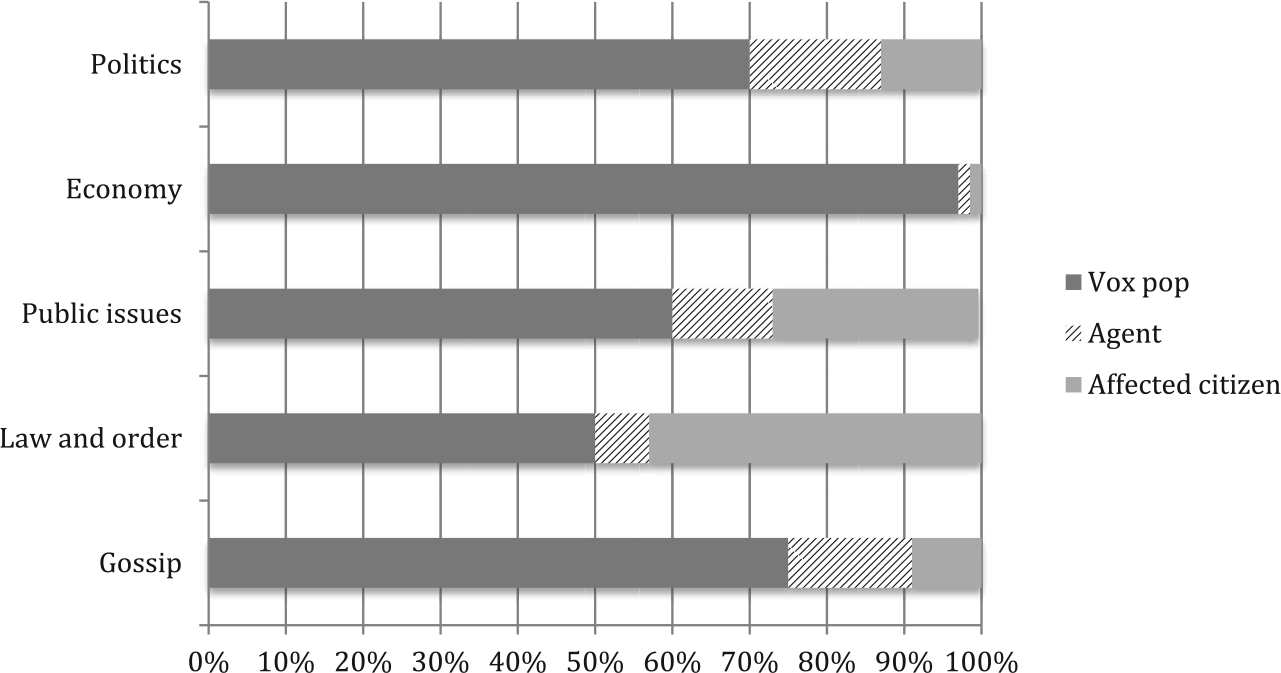
Presence of types of citizen sources per topic.
When analyzing the relation between story topics and citizen sources over the years, the dominance of vox pops in the news again comes to light. This is visible in almost each year for political news, news reporting public issues, and gossip news. In economic news, only vox pops appeared, except for 1996 and 2014, in which one source was an affected citizen and agent, respectively. In stories reporting issues regarding law and order, there was a decreasing use of affected citizens over the years, whereas the presence of vox pops gradually increased. In all, vox pops always were – or in case of law and order news became – the most prominent sources. Regardless of topic or year, citizens as active contributors are never very prominent. This again confirms that citizens are predominantly used as illustrations.
Conclusion and discussion
Both within journalism and academia it has been argued that alternative voices should have a greater prominence in the media to counterbalance the virtual monopoly of professional institutionalized sources from the societal-political establishment in the public debate. It appears as if citizens, as an important group of such voices, have already been catching up, as a number of studies show that citizens have been progressively used as sources since the 1990s. However, up to now, it has remained unclear whether citizens are truly better able to leave a mark on public debate as it was unknown whether (1) citizens as sources have obtained a greater prominence in the news relative to elite and other sources in the past two-and-a-half decade, (2) whether they are able to exert agency as substantive contributors of relevant information and expertise, and (3) whether such citizen ‘agents’ have access to the most ‘serious’ and relevant public affairs news.
By addressing these questions, this study has begun to fill an important hiatus in scholarly knowledge on how journalists deal with recent fundamental changes in their profession. As one of the few longitudinal studies on source use, it presents a detailed view of how news sourcing has developed from the start of competitive pressure, digitalization, and changing professional ideologies until today. The study allows for three main conclusions regarding the degree to which citizens have been taken seriously in the news through the years.
First, the relative prominence of elite sources and citizen sources has changed in the last two decades. Today, citizen sources have a greater presence in the news than ever in terms of frequency. Simultaneously, elite sources represent a decreasing part of the news, whereas sources representing the civil society remained almost constant between 1990 and 2014. Thus, a greater prominence of citizens relative to other sources seems good news to advocates of a stronger public voice in the media.
However, this study does not entirely warrant such optimism. The second conclusion of this study is that over the years, citizens as agents or active contributors of relevant content constitute only a very small minority of citizen sources, on average 10 percent. Moreover, this active, substantive role has not increased in the last 25 years. The most ‘passive’ source type can explain the total increase in citizen sources: vox pops. This implies that journalists do not give citizens a voice as genuine active participants in the public debate, but that citizens are mostly used as mere illustrations. Thus, although citizens are more prominent in the news than ever, it does not seem that their power to define the news in a substantive manner has increased accordingly.
It is noteworthy that, initially, the use of vox pops was considerably higher in public broadcast stories, whereas commercial news stories were using more citizens-as-agents. This has reversed in recent years, showing that from the outset, the commercial news took citizens – and thereby their civil responsibility – more seriously than public broadcaster, whereas today public news seems somewhat more attuned to their civil responsibility role.
A third conclusion from this study is that there is little evidence that the use of the various types of citizen sources varies according to story topic. In each topic, agency sources are the least frequently used sources, whereas vox pops are by far the most used. Only in law and order stories, affected citizens have a greater prominence than vox pops. However, their presence decreases at the cost of an increasing use of vox pops in the most recent years. In all, over the years, vox pops always were or have become the most prominent sources. Citizens as active contributors are never very prominent.
Traditionally, the initiative in public debate has been with actors from the political domain. From this study, it may be concluded that in the last 25 years, journalists have indeed become more conscious of the importance of alternative voices in the media. They devote more attention to the public in terms of presence of citizens in news stories. Nonetheless, elite sources, most notably political sources, remain by far the most dominant sources in the news and consequently remain the primary definers in mediated public debate.
Many of the results can be explained from the perspective of journalistic routines and journalistic norms. News sourcing routines may have changed to some degree over the last two decades, as is evidenced by the increasing number of citizens in the news (cf. Becker and Vlad, 2009). But at the same time, this change has remained very limited. Apparently, the same journalistic routines that have resulted in the traditional monopoly of elite sources are still forming barriers for access of citizens in a more relevant capacity. This is also a question of norms: official sources such as politicians, experts, law enforcement and emergency services, and other media are still seen as more trustworthy than citizens and organizations from civil society (Reich, 2015). Recent research suggests that availability is another major determinant of the results found in this study (Reich, 2015). Journalists may be genuinely aiming at lending a voice to citizens, but finding citizens possessing relevant expertise and knowledge pertaining to the news event at hand requires heavy investment of time and effort (cf. Berkowitz, 2009). In the light of deadlines and other practical restrictions, more easily accessible citizen sources are selected. Journalists opt for the easy way out: random passers-by are readily at hand; the voice of the people is thereby represented: job well done.
From a perspective of civil responsibility, one could propose that journalists should put more effort into giving the public a more substantive voice (cf. Ahva, 2013; Brants and De Haan, 2010). However, from prior research on changing journalistic routines, it may not come as a big surprise that sourcing routines are hard to change. Studies on the effects of technological innovations on other newsroom routines indicate that many routines remain impervious to change (Domingo et al., 2008; Paulussen and Ugille, 2008). The sometimes conscious resistance to change routines is rooted in routines themselves. Since journalistic professionalism is to a large degree defined by journalistic routines (e.g. objectivity, Tuchman, 1972), changing routines means changing the very core of the profession. This takes time and requires a feeling of necessity.
A few limitations of the study need to be mentioned. First, our distinction of the different roles within the civil society sources category was one of the first attempts to disentangle what kinds of sources are present in the news beyond elite sources and citizen sources. This category showed to include a wide range of sources that may deserve more nuance in future research. For example, most civil society sources were corporate sources, ranging from international corporations to small business owners. A further breakdown may provide a more detailed view on how the presence of corporate sources that are more akin to either elite sources or citizen sources changed throughout the years. Second, this study does not provide an analysis of the actual content of the contributions by various sources, as it only looks at the roles sources have (e.g. witness, politician, spokesperson) and not at what they actually say. Although there seems little reason to assume that, for instance, a police spokesperson will ventilate personal opinions instead of providing factual information, it is feasible that, for instance, the ‘human being behind the politician’ has received more attention through the years, which may have translated into less substantive contribution from elite sources. Future research may therefore focus on analyzing the extent to which the specific information provided by individual sources adds something to the news story and whether this has changed throughout the years.
Footnotes
Declaration of Conflicting Interests
The author(s) declared no potential conflicts of interest with respect to the research, authorship, and/or publication of this article.
Funding
The author(s) received no financial support for the research, authorship, and/or publication of this article.