







Abstract
This article is an attempt to offer a model for the analysis of a journalistic argument. The model of analysis applied in this research is the result of a combination of two theoretical models: Van Dijk’s model of editorials and the model of argument developed by Toulmin. Although the article – conceptualized as a comparative media study – tested the offered model of analysis on newspaper editorials, the model is designed as a master template, flexible enough to accommodate requirements for the analysis of a journalistic argument delivered via different media platforms. The proposed model of analysis is applied to editorials on the Yugoslav conflicts of the 1990s published by two newspapers, the American The New York Times and the Serbian Politika. The results of the analysis will contribute to a better understanding of how journalists conceptualize justice in times of conflicts and the role a journalistic argument plays in the wider public debate on armed conflicts.
Introduction
This article is an attempt to offer a model for the analysis of a journalistic argument. Conceptualized as a comparative media study, the model is tested on the analysis of newspaper editorials. However, it fully acknowledges rapid changes in the media environment and new developments in information and communications technologies, and for this reason the model is designed as a master template that is flexible enough to accommodate potential requirements for the analysis of a journalistic argument delivered via different media platforms.
To demonstrate its methodological potential, the model analyzes how newspaper editorials create an argument about justice in times of armed conflicts. The analysis scrutinizes editorials on the Yugoslav conflicts published between 1992 and 2008 by two newspapers, The New York Times and the main Serbian daily, Politika. To explain how this model of analysis was developed and tested, the article proceeds as follows. First, I offer a brief explanation of the importance of the editorial as a distinctive journalistic genre and justify the reasons why newspapers’ editorials about the Yugoslav conflicts were chosen as the object of this study. After that, I explain how this new model of the analysis of a journalistic argument was developed. Finally, I demonstrate how this analysis model reveals that journalists conceptualize the notion of justice differently over time.
Editorials as an argumentative and persuasive discursive form of journalism
Journalism and media studies broadly differentiate editorials from news stories as two different journalistic genres that represent facts and opinions. Traditionally, the notion of objectivity in journalism as a profession was directly linked to ‘the respect for facts’ (Hallin, 1994: 22). From their early years, newspapers, as businesses and public institutions, wanted to ‘emphasize their editorial independence from the government. The rise of the leading article was a device that allowed this claim to be demonstrated on a daily basis on the important issues of the day’ (Conboy, 2005: 7). The search for objective journalism during the 19th century was the result ‘of the sweeping intellectual movement toward scientific detachment and the culture-wide separation of fact from value’ (Gitlin, 1980: 273). By ‘the 1920s, major journalism associations in the United States had adopted formal codes that called for objectivity in reporting, independence from government and business influence, and a strict distinction between news and opinion’ (Ward, 2009: 298).
However, as Hampton (2008) argues, while objectivity was upheld within American journalism practice as the universal journalistic norm, it is problematic ‘to assume that the “objectivity” norm as the shared Anglo-American heritage’ (p. 489) also prevailed in Britain, especially in the case of print journalism. American scholarship also approached the notion of objectivity differently over time. Schudson differentiates between the profession of journalism in the 1890s with its ‘naïve empiricism’, and the early 20th century view of objectivity, characterized by ‘the disappointment of the modern gaze’ – the understanding that true objectivity is impossible (Schudson and Anderson, 2009: 93). Schudson ‘now argues that journalism he took to be “modern” is more appropriately judged “American”’ and acknowledges that ‘a commitment to objectivity still distinguishes American from European newsrooms’, while some comparative journalism researches ‘do not even include adherence to “objectivity” as a major characteristic of [non-Western] newswork’ (Schudson and Anderson, 2009: 93).
Still, regardless of the differences between journalism practices around the world, most newspapers strictly confine interpretations of facts, or arguments about issues of the day, to editorial space as an argumentative and persuasive form of journalism. Some researchers explore the importance of the newspaper editorial through ‘the marketplace of ideas metaphor’ (Hallock, 2007: 7) as the essence of freedom of expression and democracy. Other research underlines the power of the editorial genre to influence government officials and political leaders. For example, when asked, the Chief Leader Writer for The Guardian admits a strategic use of editorials: ‘My conversation is with the readers, but it’s done by addressing the government and if necessary addressing particular ministers’ (Firmstone, 2009: 153).
It could be argued that the newspaper editorial, as a newspaper’s stance on crucial social issues, represents ‘institutional’ opinion. In a broader sense, editorials could be understood as a manifestation of a newspaper owner’s social and ideological values because editorials ‘directly express dominant editorial views, which in turn are faithful mouthpieces of the owners’ (Van Dijk, 2006: 138). For example, the editorial page editor of The New York Times explains similarities between his personal worldview and the worldview of the owner of The New York Times in this way: ‘I’m a great believer in the time-honoured dictum that you should not give your boss any unpleasant surprises over breakfast’ (Rosenthal, 2007). This statement confirms that ‘ideological discourses are collective discourses of groups, and in many indirect and subtle ways, reflect the ideological positions of their organizations and their interests’ (Van Dijk, 2006: 138). This harmony of world views among a newspaper’s editors and owners confirms the view that dominant discursive formation in the press ‘includes a plurality of texts, narratives, and everyday conversations among the media and other members of the cultural, social, and political elite’ (Henry and Tator, 2002: 225). The editorial page editor of The New York Times emphasizes this ideological position by underlining that the newspaper is ‘strongly in favor of free trade and globalization. On foreign affairs […] we believe in the robust application of American power and influence’ (Rosenthal, 2007). Textual analysis of newspaper editorials on the Yugoslav conflicts reveals some aspects of these complex relationships between media, the globalizing processes of the 1990s, and the Yugoslav conflicts and confirms that it is ‘language that is globalizing and globalized’ (Fairclough, 2006: 3).
Before the article proceeds, it is necessary to acknowledge that the Internet and digital technologies positioned newspaper editorials within a new media ecology, where active audiences challenge ‘objective journalism’ or anonymous editorial writers’ intention to ‘keep an outsider’s position and avoid entrance into dialogical relationships’ (Soffer, 2009: 473). Therefore, while acknowledging that interactive media, and the dominance of visual language, open up new possibilities for analysis of newspaper editorial, I am concerned here primarily with newspaper editorial as written text and its analysis. When integrated with approaches to media analysis that address an interactive, multimedia environment, such as the multimodal analysis developed by Leeuwen (2003: 56), where media content is analyzed through the interaction of all semiotic resources (including written language), the model offered in this research can offer further possibilities for analysis of newspaper editorial.
The Yugoslav conflicts and the rise of a journalistic argument
Editorials address not only the national elite but also – especially during times of conflict – communicate their arguments across nation-state borders to the transnational community, which was very visible and intense during the Yugoslav conflicts in the 1990s. These conflicts, as the first major armed conflicts in Europe after World War II (WWII), attracted huge media attention and were extensively covered by transnational media from 1991, when they started. Atrocities committed in Bosnia or in Kosovo later become the defining news items of the transnational media content of the time, merging into a specific ‘global news agenda’ (Fairclough, 2006). The Badinter Commission, in its Opinion No. 8 issued on 4 July 1992, declared that the process of the dissolution of Yugoslavia was ‘now complete and that SFRY no longer exists’ (Ramcharan, 1997: 1286). But this was not the end of the Yugoslav conflicts, which by the time of the US-led North Atlantic Treaty Organization (NATO) war against Serbia in 1999 experienced wars in Slovenia, Croatia, Bosnia, and Kosovo, and by 2008 produced seven newborn, internationally recognized states. Some authors argue that the United Nations (UN), with the exception of the conflict in the Middle East, never experienced a similar episode that produced so many debates, documents, and use of UN forces, including ‘the establishment of a special war crimes tribunal’ (Leuterpracht, 1997: xv).
These conflicts also presented journalists with many unexpected and difficult challenges, especially when traditional standards of objectivity were applied to reports about atrocities against civilians. The intertwined roles of a witness and a reporter of atrocities repeatedly committed against civilians during the Yugoslav wars made some journalists convinced that they had become participants in these conflicts. Hence, for these journalists, their role in reporting war was not just to inform the public about the conflicts, but also to actively argue about justice for civilians. To fulfill this role, new journalism practices, including the journalism of attachment (Bell, 1998) and peace journalism (The Peace Journalism Option, 1997), were introduced, emphasizing the role of argument as the crucial element in positioning a journalist within a responsible community of citizens.
In a way, advocacy journalism is an indirect acceptance of inconsistent critiques that journalism is not objective, cannot be objective, and should not be objective (Lichtenberg, 2000). From an advocacy journalism perspective, arguing for justice is equally as important as reporting facts because ‘objectivity must go hand in hand with morality’ (Amanpour, 1996). However, for critics, this type of journalistic search for morality introduces journalism practices that – primarily guided by moral arguments – easily ‘transgressed into the world of moral philosophy’ (Berry, 2008: 112).
The clash between opposing journalistic arguments was very transparent in editorials on the Yugoslav conflicts published between 1992 and 2008 by two newspapers chosen for this research – The New York Times and Politika. These two newspapers represent not only two different journalism practices but the sides ultimately responsible for starting conflicts in the former Yugoslavia (Serbia) and bringing these conflicts to the end (the USA). The New York Times is described as ‘the most influential newspaper in the United States’ (Mermin, 1999: 12), while Politika was, during the 1990s, regarded as ‘the paper with the strongest influence on public opinion’ in Serbia (Nenadović, 2000: 537). Precisely for this reason, Politika was used by Slobodan Milosevic’s regime in the 1990s to spread chauvinistic hatred and to directly support Milosevic’s efforts to recompose the former Yugoslavia through war (Thompson, 1999). While The New York Times is available, in its digital editions, across nation-state borders, Politika, on the other hand, despite its online availability, is mainly confined to its nation state-space and its distinct national diaspora because of language barriers (during the time of this research, Politika’s web edition offered only articles in the Serbian language and in Cyrillic).
Newspapers as representatives of different media systems
While Hallin and Mancini’s (2004) media models could accommodate The New York Times within the proposed liberal media system, their models did not include the East European media environments and journalism at all. The reason for this could be simulated journalism, performed throughout the Communist regimes of Eastern Europe, as an oxymoron because, in Carey’s words (1996, quoted in Rupar, 2007: 202), ‘journalism requires the institutions of democratic life either in fact or in aspiration’. However, Carey’s dictum that ‘you cannot have journalism without democracy’, if uncritically applied, could instantly dismiss most non-Western traditions and journalistic cultures.
To avoid simplifications and schematic models in which ‘one particular type of society can claim to represent the democratic ideal’, Christians et al. (2009) suggest that journalism and the media should be conceptualized not only through tasks normatively prescribed to journalism and to the media but also through the factual role they play in society. This is particularly important for the media in ex-Communist countries such as Serbia because the transformation of post-Communist media in Eastern Europe only partially fulfilled the normative expectations (Jakubowicz and Sükösd, 2008).
The New York Times and Politika represent two distinctively different journalism practices. While The New York Times operates within a stable, liberal, capitalist society and media economy characterized by a high concentration of ownership, Politika is continuously exposed to the radical economic and political changes that affect Serbian society. Serbia was internationally recognized as an independent country by the Congress of Berlin in 1878 and, between 1875 and 1914, had already experienced six wars (Perović, 2007). These were followed by two world wars and four more wars during the dissolution of Yugoslavia in the 1990s (Glenny, 2012). Politika witnessed political changes from kingdom and parliamentarian regimes to dictatorships, to Communism, to the authoritarian regime of Slobodan Milosevic, before entering the post-Communist transformation.
American and Serbian journalistic cultures differ in their practical approach to editorials, but both highly praise editorials as a journalistic genre and as the top achievement in a journalist’s career. In The New York Times jargon, editorials present the editorial ‘bottom line’: not a balanced and dispassionate account of a particular news story, or an issue, but a strongly argued position, which does not ‘necessarily present or even take into account the opposing position’ (Rosenthal, 2009). A favorite phrase of Politika’s editors – ‘a comment is free but facts are sacred’ (the dictum usually attributed to C. P. Scott (1946), editor of The Manchester Guardian (p. 161) – was routinely quoted in Politika articles, despite the dramatic political and regime changes the newspaper witnessed.
The editorial page editor of The New York Times is directly responsible to the publisher (Rosenthal, 2007), while all editors of Politika are directly responsible to the editor-in-chief, and the editor-in chief is in turn responsible to the company’s general manager and to the managing board (Janićijević, 2008). The team that produces editorials in The New York Times is strictly separated from the paper’s news department. The New York Times layout usually demonstrates the division of editorials from news by printing Op-Ed articles on the page opposite the editorials. While editorials in American newspapers are not signed, editorials published by Serbian newspapers are often attributed to their authors. In Politika, the author of an editorial is chosen by the newspaper’s editorial board or by the editor-in-chief. The editor-in-chief usually approves Politika editorials and decides on the page where a particular editorial is going to be placed. For example, editorials analyzed in this research and published by Politika during the NATO war against Serbia in 1999 were published on pages 2, 14, 16, or 18.
The model of analysis applied to newspaper editorials in the study
The model of analysis of editorials applied in this research is the result of a combination of two theoretical models: Van Dijk’s (1992) model of editorials and the model of argument developed by Toulmin (1964). To better understand how journalists perceive justice and argue about justice in times of conflicts, it is necessary to capture multiple influences and relationships between journalism as practice and the wider social environment. Critical discourse analysis (CDA) can ‘offer interpretations of the meanings of the texts … [and] situate what is written or said in the context in which it occurs’ (Richardson, 2007: 15). Therefore, editorials published by newspapers are understood in this research not as isolated discursive products of journalistic work but as discursive events, which are influenced by a social environment and in return shape the same environment (Fairclough and Wodak, 1997: 258).
Newspaper editorials demonstrate that discourse is, at the same time, coherent on the level of propositions and on the global level of a text. This coherence rule is related not only to the lexical meaning of the words but also to the knowledge and beliefs about the wider social context and the world. The global coherence of editorials or their ‘overall semantic unity’ is organized around the hierarchy of the editorials’ main themes or topics, which summarize the editorial: ‘In news discourse, the top of this macro-structure is conventionally expressed in the headline and the lead paragraph’ (Van Dijk, 1991: 113).
Journalists organize a news story following specific news schema influenced not only by the routine of news production but also by the culturally shared basic narrative schema which usually includes categories such as Summary, Setting, Orientation, Complication, Resolution, Evaluation, and Coda (Labov, 1972). Editorials, in contrast, are organized around three main categories: Definition of the situation, where the news event is summarized, Evaluation of the news event, and Conclusion, where expectations about future events are drawn, and conclusions are made, usually by recommending different solutions to news actors (Van Dijk, 1992) (see Table 1).
Schematic structure of the editorial (Van Dijk, 1992: 224).

Among the typical semantic features of editorials are abstract arguments and summary descriptions so that ‘when details are given about situations, people, places and events, this may have argumentative, rhetorical and possibly ideological implications’ (Van Dijk, 1995: 276). A newspaper’s stance on an issue is ‘usually supported by a series of arguments, which overall are intended to contribute to the persuasive social function of the editorials’ (Van Dijk, 1992: 243–244), which includes the influence of the social cognition of the readers. In this context, editorials set up boundaries of socially acceptable values and actions. Editorials are not only (or primarily) addressing ‘the public’ but directly or indirectly addressing influential news actors by evaluating their actions and by suggesting different solutions. As Van Dijk (1992) argues, editorials also function on political levels when power is implemented, legitimated, or maintained between different groups in society.
Because an argumentative feature is crucial for editorials as a journalistic genre, this research is focused on the argumentative strategies employed in a newspaper’s editorials. Thus, the analysis looks at the organization of arguments in editorials, following their hierarchical structure, while simultaneously discussing the meanings of words, phrases, metaphors, or propositions employed in this argumentation.
To achieve this level of analysis of editorials, Van Dijk’s model of editorials is combined with the model of argument developed by Toulmin (1964) (see Table 2).
Model of argument (Toulmin, 1964: 104).
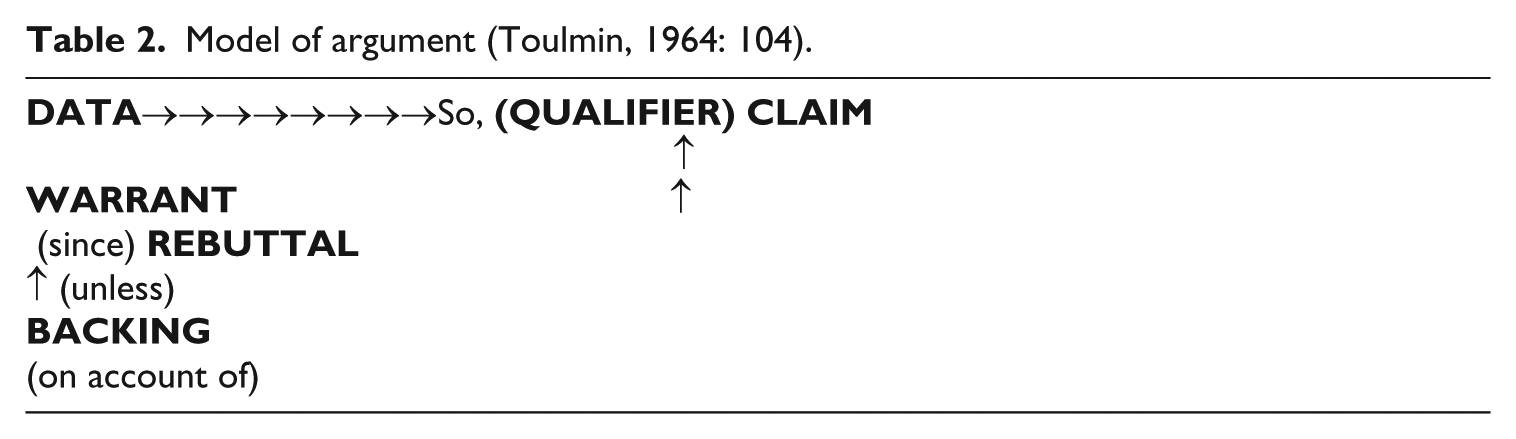
Toulmin’s model of argumentation is frequently applied ‘in analyzing argumentation in spoken discourse and written texts […] to make its structure more transparent, [and] has been widely accepted as a useful model for analyzing argumentation’ (Van Eemeren et al., 1996: 158; see also Shi-xu and Kienpointner, 2005).
In Toulmin’s model of argument, Data represent the evidence, facts, or information on which the Claim is based. For Toulmin, a Claim is the conclusion of the argument or the main point of an argument. The argumentative road between Data and the Claim goes through the Warrant, which should provide the logical link between Data and the Claim. The Warrant is essential to an argument and should be persuasive in order to make the public accept the Claim. Toulmin underlines that a direct link in an argument goes back from the Claim to Data, with the main difference between Data and the Warrant being in their persuasive role: while Data support an argument explicitly, Warrants function implicitly. In the model of analysis developed for newspaper editorials in this research, the function of Data is fulfilled with category, termed in Van Dijk’s (1992) model of editorial, as Definition, where information about news events are summarized, before the event is evaluated and particular predictions and conclusions (‘remedies’) are suggested to news actors. According to Toulmin, the Warrant could be presented as a form of authoritative sources (for this purpose, the media use ‘our experts’ or ‘our sources’), in motifs that audiences could accept (‘values of our society’ or ‘our lifestyle’), or as substantive reasoning (cause-effects, examples-generalization).
Toulmin’s model also includes Backing and Qualifiers. Backing makes the argument more credible and is usually presented in the form of testimonies, examples, or statistics. In editorials, this function is usually performed by references to other (media) reports on the same event, interviews with sources or witnesses, and so on. Qualifiers (such as ‘necessarily’ or ‘presumably’), on the other hand, support the argument through verbalization. Toulmin also introduces a Rebuttal as a possibility to make an argument stronger through the limitation of argument. A Rebuttal is usually demonstrated with the use of an example as in ‘an exception’ that makes the overall argument stronger. In editorials on the Milosevic regime on crimes committed in Bosnia or in Kosovo, this function is usually performed with an explanation that ‘because Serbia is not a major military power, at the moment, Milosevic is confined to the Balkans and is not a danger for the whole world, but … ’
Toulmin’s model of argument demands a procedure that is formally valid and, at the same time, in agreement ‘with the specific soundness conditions of the field or subject concerned’ (Van Eemeren et al., 1996: 133). For example, for discussions about the coming summer’s weather, ‘meteorological criteria need to be applied, not logical criteria’ (Van Eemeren et al., 1996). In journalistic reports, this function is secured by a robust application of journalistic principles of objectivity, fairness, and accuracy, and for this reason editorials regularly draw on previous news reports. Consequently, Warrants, Backing, and the contextual details of arguing as an activity should also depend on the field concerned in argumentation. Critics argue that, together with his unwillingness to fully endorse the role of formal logic in argumentation, Toulmin’s use of terminology is sometimes vague, which could create confusion between terms such as Data, Warrant, and Backing (Van Eemeren et al., 1996: 158).
To accommodate both these criticisms and the purpose of this research, Toulmin’s model of argument is simplified to a workable version that could be applied in analyses of newspaper editorials as follows: (because of the existing) Data→(which are supported by) Warrant→(it is reasonable to) Claim. Furthermore, Toulmin’s model of argument is blended with Van Dijk’s (1992) schematic structure of editorials, which includes categories such as Definition and Evaluation of the news event, and Conclusion (see Table 3).
Basic categories of the two models.

This adjustment of Toulmin’s model is justified for the purpose of this research because ‘argumentation is a specific form of language use and social interaction; it may be spoken or written, monological and dialogical, planned or spontaneous, globally and locally coherent, etc.’ (Van Dijk, 1992: 99). The proposed model is in line with the current discourse analysis of editorials (Le, 2010), which emphasizes that newspaper editorials within different national media systems employ different features, both in relation to editorial as genre and to their argumentation style. The proposed model acknowledges other similarities between narrative schema and hierarchical categories of argumentation from premises to conclusions.
This adjustment is also in accordance with a comparison of the rational process to the judicial process, where the charge or claim is clearly stated, and supported by evidence or testimonies, before a verdict is pronounced (Toulmin, 1964: 16). Other leading authors in argumentation theory also use comparison to the judicial process. Shi-xu and Kienpointner (2005) define argumentation as
that dimension and mode of discourse in which an argument is offered in support of a (potentially) controversial claim [where] a claim can be a statement of fact or a call for action; argument can be a set of reasons for that claim. (p. 90)
This definition draws on Van Eemeren et al. (1996) who define argumentation as a
verbal and social activity of reasoning aimed at increasing (or decreasing) the acceptability of a controversial standpoint for the listener or reader, by putting forward a constellation of propositions intended to justify (or refute) the standpoint before a rational judge. (p. 5)
Furthermore, Gadamer’s (1957) statement that legal hermeneutics could provide a paradigm for interpretation could be applied in the context of journalism practice, where it is precisely the editorial as a journalistic genre through which general principles or concepts such as justice are argumentatively interpreted and applied to particular events of the day.
While conducting media text analysis, it is necessary to recognize that the media’s influence and the meanings disseminated by the media are exercised in very complex ways. Therefore, while analyzing newspaper editorials, this research does not attempt to extract or pin down only one way of understanding these editorials and meanings they disseminate, but to offer one possible approach to the reading of different arguments and discourses employed by them.
The procedure of analysis applied to newspaper editorials in the study
The analysis of newspaper editorials in this research proceeds through several phases. First, by close reading, the global theme or macro-topic of a particular editorial is identified to establish whether that editorial is related to one of the three events under scrutiny. A global theme or macro-topic of a newspaper editorial is usually announced in the editorial’s headline or its lead (to re-appear later throughout the same editorial) and ‘is related to the notion of what the overall discourse is about’ (Tomlin et al.1977: 90). We also need to keep in mind that together with the global, unifying theme of an editorial, there are other themes that appear throughout the same editorial.
What is essential for the analysis of the newspaper editorials is that such themes and topics are not just rhetorical devices incorporated into a newspaper’s text but cognitive units, which exemplify the meanings of larger fragments of text or whole texts. This is crucially important for the analysis of editorials because themes or topics related to the concept of justice incorporated in a newspaper’s editorial help readers to understand quickly the subtle and implicit meanings of an editorial and to orient themselves in relation to the editorial’s arguments.
Second, the main argument outlined in a particular editorial is identified. In this analysis, the main argument has the same role as the Claim has in Toulmin’s model of argument, or what would be the role of the Conclusion in Van Dijk’s model of editorials. Therefore, the main argument in the model applied in this study is the position on the issue advocated by a newspaper’s editorial that puts forward an argument.
Third, supporting arguments, which are used to uphold and justify the main argument in a particular editorial, are identified. In this analysis, supporting arguments also function as semantically organized argumentative summaries and as premises that support the main argument and therefore would have the same role as the Warrant in Toulmin’s basic argument scheme. This function of supporting arguments and argumentative summaries is also in line with Freeman (1991) and his adjustment of Toulmin’s model of argument, with his introduction of (direct and indirect) premises, which support conclusions.
The next table demonstrates how the model developed for the analysis of newspaper editorials is applied in this research. The table demonstrates the pattern of an argumentation of justice in an editorial on the beginning of the NATO war against Serbia published by The New York Times in 1999. For the sake of word limits, in the example below, only the beginning of the analyzed editorial is included. Hence, the table in the left column includes only the first paragraph of the editorial, with argumentative summaries for the first paragraph provided in the right column (see Table 4).
Model of the analysis of newspaper editorials applied in this research.
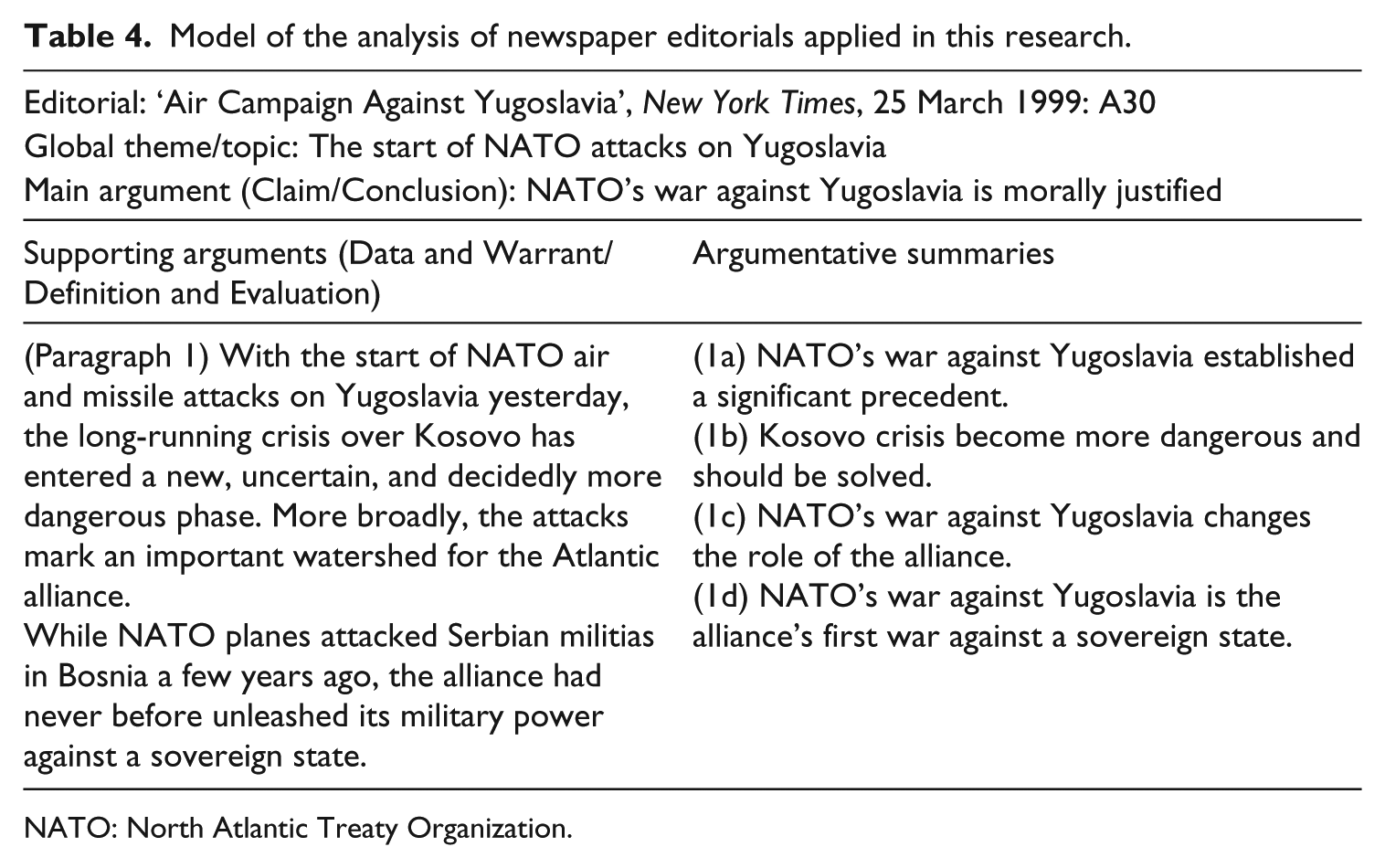
NATO: North Atlantic Treaty Organization.
The analysis emphasizes the twofold approach to editorials: while it scrutinizes the editorial’s argumentations, at the same time, it identifies which words, phrases, metaphors, and propositions employed in the editorial belong to the semantic field of justice.
The main strategy of analysis of editorials published in The New York Times and Politika, therefore, focuses on ‘the structural account of informal text logic and of discursive persuasion strategies, on the one hand, and a functional analysis of cognitive and social representations and strategies, on the other hand’ (Van Dijk, 1992: 247). As Van Dijk argues, to understand the discursive structures of argumentation, we need to make explicit their functional and communicative roles in a particular context. Hence, the analysis of the newspaper editorials should discuss their arguments and their language use against the background of the wider globalizing processes during the period within which the newspapers were published. This includes the collapse of Communism in Russia and the rest of Eastern Europe, and the rise of the United States as a single superpower, which was followed by processes known as neoliberalism.
As Shi-xu and Kienpointner (2005) underline, while bearing in mind that argument is rational, the analysis of editorials must be directly related to the context of the argumentation in question. This is because the context directly influences meanings disseminated by editorials and interpretations of these editorials. For example, in 1991, when conflicts in the former Yugoslavia began, the notion of sovereignty was understood completely differently across the transnational community than it was in 1992, 1999, or 2008. In 1991, the term ‘sovereignty’, in the context of Yugoslav conflicts, was somehow exempted as a politically sacred notion and protected by international law from possible different readings across the transnational community; in 1992, with the crimes in Bosnia exposed, that exclusive status of the notion of sovereignty started to wear away; and by 1999, in the context of Yugoslav conflicts and with NATO’s war against Serbia, the old theoretical and practical approaches to sovereignty were gone. Thus, The New York Times and Politika argued about the same conflicts that destroyed the former Yugoslavia differently through these years, both in relation to changes that affected the local (Yugoslavia’s and the United States’) context and the whole of the international community.
Hence, while the dissolution of the former Yugoslavia is understood as a consequence of the country’s inability to adjust to external and internal calls to follow the transnational changes of the 1990s, the editorials published by The New York Times and Politika are analyzed as the newspapers’ call for a commonsensical response to these events. The editorials should be understood as texts in dialogic relationships of meanings within a particular newspaper and within a social context. Consequently, the analysis understands the newspaper editorials as discursive and as semantic fields, which respond to radical changes in international relations and international law, the notions of sovereignty and human rights.
Sample and the method of analysis of editorials applied in this research
To test this model of analysis of editorials, a detailed textual analysis was executed, scrutinizing editorials published by The New York Times and Politika. To make a manageable sample, editorials related to three crucial events that happened during the Yugoslav conflicts were chosen: the publication of photographs of Serb-run concentration camps in Bosnia in August 1992 – as the event that radically changed the presentation and understanding of this conflict within the transnational community; the beginning of the American-led NATO war against Serbia in March 1999 – as the full realization of the role of the transnational community in protecting civilians; and the declaration of Kosovo as an independent state in February 2008 – as the symbolic end of these conflicts. These events subsequently left far-reaching consequences on many levels of social practices, from journalism as practice to journalism and media studies, to international relations and international law. Each of these three events is, today, considered an iconic media event that represents a compulsory reference point for other similar media events and for academic studies that discuss similar phenomena. The sample with editorials published in 1992, 1999, and 2008 will also provide an insight into eventual changes in argumentation strategies across all editorials and across the three events.
To examine how journalists conceptualize justice when they report on conflicts, the analysis is executed in two stages. In the first, the analysis scrutinizes in detail one editorial published by The New York Times and one editorial published by Politika related to each of the three events. The same pattern is then repeated for each of the three events, giving detailed analyses of 48 editorials.
The analysis includes editorials, which were published by The New York Times and Politika up to 2 weeks before and 2 weeks after the date on which each of the three events happened. Editorials (and additional articles analyzed in this research) published by The New York Times were retrieved from the LexisNexis Academic database. Editorials published by Politika were copied from hard copies of the newspaper held by the British Library Newspaper Reading Room at Colindale, London, UK, or retrieved from the Politika website, www.politika.rs.
Discussion
The analysis of newspaper editorials on the Yugoslav conflicts reveals that journalists conceptualize justice by applying two parallel argumentative processes. On one hand, journalists change their arguments about justice to adjust their argumentation to new developments in the wider social context, while, on the other hand, continuously positioning their arguments within a presumed stance of the transnational community on the same issue.
While arguing for justice in the Yugoslav conflicts, the two newspapers’ editorials consistently employed lexical choices related to specific semantic fields of three terms: ‘the Holocaust’, ‘just war’, and ‘sovereignty’. In 1992, the editorials conceptualized the notion of justice through the semantic field of the term ‘Holocaust’, because the newspapers argued that news stories about atrocities committed in so-called ‘Serb-run concentration camps’ in Bosnia were a wake-up call for the transnational community to stop the Holocaust re-emerging in Bosnia. But in 1999, the newspapers’ arguments conceptualized the notion of justice in relation to the semantic field of ‘just war’, to argue that the US-led NATO war against Serbia was the only solution left to the international community to stop atrocities committed by Serbian forces against civilians in Kosovo. Likewise, in 2008, the editorials conceptualized the notion of justice through the semantic field of ‘sovereignty’ to support the transnational community’s recognition of Kosovo’s independence as the only way to end the Yugoslav conflicts.
For example, when arguing that crimes committed by Serbian forces in Bosnia in 1992 are against the rights to life and liberty that, as basic human rights, define the transnational community, and that these crimes evoke memories of Nazi crimes against the Jews, The New York Times employed lexical choices that are related to the semantic field of the Holocaust. The newspapers’ argument that the transnational community should use military force to stop Serbs repeating the crimes of Nazis were discursively supported by descriptions of ‘Serbian atrocities [which are] parallel with Nazi Germany’, ‘ethnic cleansing’, ‘civilians transported in sealed buses and railway cars’, ‘concentration camps’, and claims that ‘chilling reports from Bosnia evoke this century’s greatest nightmare, Hitler’s genocide against Jews, Gypsies and Slavs’ (The New York Times 1992, ‘Milosevic Isn’t Hitler. But …’, 4 August, A18). The Serbian leader Milosevic was depicted in The New York Times editorials as ‘a minor-league Hitler’ who ‘implements his version of the Final Solution’ in Bosnia, to argue that military force should be used to stop a repetition of the Holocaust.
On the other side, the Politika editorials employed lexical choices that could help deconstruct the employment of the Holocaust frame as justification for possible military action against Serbs. Because the Holocaust frame resonates powerfully through both national and the transnational public space, editorials published by Politika argued that the Western media apparently abused collective memories of the Holocaust. Politika argued that the state of the prisoners held at ‘Serb-run concentration camps’ in Bosnia and their ‘Mauthausen-style starvation’ were ‘due more to the widespread poverty in Bosnia, than to organized torture’ (Stojadinović, 1992, ‘A humanitarian punitive action’, Politika, 9 August, p. 7). The Politika discourse constructed the prisoners’ starvation by arguing that the Bosnian war is a war where all sides involved ‘hold their prisoners in their own way’, therefore discursively normalizing the prisoners’ starvation as a logical consequence of war and implicitly exonerating Serbian forces of any wrongdoing. Hence, editorials published by Politika discursively position this presumed abuse of collective memories of the Holocaust within the West’s ‘politics that is thirsty for any news story, which demonizes Serbs’ and can justify actions that will ‘knock some sense into Serbs’ (Stojadinović, 1992). The Politika editorials therefore heavily rely on lexical choices that undermine the transnational media reports of ‘existing or fictional concentration camps’ as ‘fabricated stories’ and as ‘a justification for military intervention’ (Stojadinović, 1992). These lexical choices are employed by Politika to convince the transnational community that the powerful frames of the Holocaust and Nazism are used and abused by the Western media, to help ‘the final strengthening of a global militarism’ (Stojadinović, 1992). What is important to underline is that even when Politika, in its editorials, tried to refute the transnational media’s reports on ‘Serb-run concentration camps’ in Bosnia as fabricated stories, the newspaper was, again, constantly in a position to employ lexical choices that are related to the semantic field of the ‘Holocaust’. The two newspapers supported their arguments in similar ways, by employing lexical choices related to ‘just war’ in 1999 and to ‘sovereignty’ in 2008.
As the Yugoslav conflicts progressed, the newspapers’ editorials continuously employed lexical choices semantically related to previous stages of the conflicts, therefore relating these three semantic fields to each other and making the overall semantic background for the newspapers’ editorials argumentation of justice fully consistent. Therefore, the editorials’ lexical choices and arguments related to the semantic fields of the terms ‘Holocaust’ in 1992, ‘just war’ in 1999, and ‘sovereignty’ in 2008 were not separated by the editorials’ themes or their main arguments, but overlapped each other following the dynamics and progress of the Yugoslav conflicts. Hence, the editorials employed lexical choices and arguments related to the semantic field of the term ‘Holocaust’ not only in 1992 when arguing about ‘Serb-run concentration camps’ in Bosnia but also when arguing for or against NATO’s ‘just war’ in 1999 or when arguing about Kosovo’s independence in 2008. This finding confirms that the two newspapers responded to the complex dynamics and to the different phases of the Yugoslav conflicts with coherent arguments for justice by continuously employing lexical choices, which are semantically intertwined and, at the same time, related to particular issues under scrutiny.
However, while the newspapers’ editorials changed their argumentation of justice over time and adjusted their argument to new developments that affect a wider social background, the newspapers’ editorials continuously situated their argument within the presumed position of the transnational community on the same issue. Thus, when the two newspapers in their editorials on the Yugoslav conflicts changed their arguments about justice in 1992, 1999, and 2008, these changes were justified by a commonsensical adjustment of a newspaper’s point of view to the presumed point of view of the transnational community. Therefore, the presumed stance of the transnational community on the issue of the day becomes the argumentative refuge even for those media (such as Politka) that continue arguing about justice in times when a national regime (as in the case of the Milosevic regime) is ostracized because of its disrespect for the human rights and norms accepted by the rest of the transnational community.
Conclusion
The proposed model for the analysis of journalistic argumentation demonstrates its potential to capture the underlined logic of journalistic argument in newspaper editorials on armed conflicts. The analysis of editorials on the Yugoslav conflict published by The New York Times and Politika shows that despite the strong durability of a national outlook, arguments about justice put forward in editorials on armed conflicts do not appeal only to a presumed national audience, but simultaneously address members of the transnational community. This research found that newspaper editorials on armed conflicts introduce the transnational community as the independent and supreme moral authority whose judgments should be communicated and accepted across nation-state borders, to convince their readerships that the editorial arguments are in line with the viewpoints of both their national community and the transnational community. This argumentative move could be understood not as an attempt to delegitimize the powers of nation-states but as awareness that arguments about justice developed in editorials on armed conflicts should be related not only to national but also to transnational audiences. Although the offered model of analysis, applied in this research only on newspaper editorials on armed conflicts, provides some better understanding of how journalists form their arguments about justice in times of conflict, the model’s full potentials for analysis of journalistic argument should be further tested on a variety of editorials delivered not only via newspapers, but over different multimedia platforms.
Footnotes
Declaration of Conflicting Interests
The author(s) declared no potential conflicts of interest with respect to the research, authorship, and/or publication of this article.
Funding
The author(s) received no financial support for the research, authorship, and/or publication of this article.
Author biography
Slavko Gajevic works at Auckland University of Technology, New Zealand. Previously he taught at University of Canterbury, New Zealand, University of Malta, Cardiff University and Birkbeck University of London, UK. He received his PhD from the University of Melbourne, Australia. His PhD (Journalism, justice and the transnational community) examines how journalists argue about justice in times of conflict and how this argumentation of justice is related to the transnational community and collective memories. Before moving to academia he worked as a newspaper reporter, correspondent and editor.