







Abstract
Professional autonomy has usually been defined in terms of journalists’ perceptions of their control over their work vis-à-vis organizational supervisors. Using surveys of journalists in Colombia and Mexico, we identify two dimensions of perceived autonomy: first, control over story development tasks (the traditional understanding of autonomy in empirical studies); second, the ability to actually publish news on a range of subjects associated with different levels of material or cultural power. We then identify predictors of both dimensions of autonomy. Physical threats, overlapping forms of inequality, and clientelism characterize pressures on autonomy in these two democracies. Journalists can carve out more space for autonomy by gaining professional experience or by creating new organizational arrangements and supporting analytical, change-oriented norms. By examining professional autonomy empirically in a broad range of contexts, we demonstrate that autonomy is more complex, situational, and historically contingent than previously believed.
In the interests of extending theory to reflect the full variety of journalistic institutions and conditions globally, this research rethinks what we know about professional autonomy, a key component of public-interest journalism in democracy. First, we re-examine empirical operationalization. In a survey of journalists, autonomy is usually operationalized as if it were uniformly experienced regardless of (1) the actor or subject being covered and (2) the degree of autonomy experienced within different stages of production, specifically, story development versus the decision of whether or not to publish. Second, we reconsider factors that potentially influence perceived professional autonomy. While research has begun to identify the main influences on autonomy (Hanitzsch and Mellado, 2011; Nygren, 2012; Weaver and Willnat, 2012), neither physical risks nor overlapping forms of inequality and clientelism have been closely examined. Basing our work on a comparative study of Mexican and Colombian journalists, we argue that autonomy is experienced as a contextually dependent, historically contingent phenomenon that varies with the organizational structures activated at particular points in the production process. In other words, autonomy is more complex and situational than previous empirical studies have taken into account.
Viewing autonomy from the perspective of journalists who work under conditions of physical threat, sharp social inequalities, and clientelism, yet still within formally democratic systems where professionalism remains relevant, has prompted us to interrogate how we study and what we know about professional autonomy. Prior to this study, we had years of experience studying Colombian and Mexican journalism (Hughes, 2006; Márquez-Ramírez, 2012; Barrios and Arroyave, 2007; Garcés, 2013). Some actors seemed to wield greater power over media behavior, while other actors or topics were considered less newsworthy, although they were socially important. We noted that knowledge about these values and norms was transmitted through socialization. 1 This meant tacit editorial policies restricted the production of norm-challenging stories, but when they were developed, owners or top editors usually intervened to halt dissemination at the publication stage.
Previous empirical research on professional autonomy also suggested autonomy varies during different stages of news production and in different arenas of coverage. Researchers who defined autonomy as control over story development tasks sometimes found higher ranking journalists reported greater levels of perceived autonomy (Hanitzsch and Mellado, 2011; Reich and Hanitzsch, 2013). Research has also found that the negative influence of political actors on autonomy increases in countries with less-secure political liberties (Reich and Hanitzsch, 2013). This suggests journalists will treat political story development with greater caution in these contexts.
We therefore designed our study to explore two possible dimensions of autonomy: autonomy in story development and autonomy to actually publish news. If these two types emerged as separate, internally consistent dimensions of autonomy, we could then examine the ways in which the experience of autonomy varies across production stages, in relation to a range of potential influences. We also selected two democracies in which journalists face a greater variety of pressures than the typical subjects of autonomy studies, but that differ in the degree, duration, and trajectory of change in physical risk and economic vulnerability. Altogether, the design and location of our study could provide a more comprehensive understanding of the experience and determinants of professional autonomy worldwide.
Defining professional autonomy
Although critics sometimes question neutrality as a norm for journalists (McDevitt, 2003; Schudson, 2005), most analysts agree that, in a democracy, it is in the public interest for journalists to be able to make discretionary judgments based upon norms that view their role as monitoring power, informing citizens, and/or enabling positive social change (Hallin and Mancini, 2004; McQuail, 1992). However, securing autonomy over editorial decision-making has become trickier for journalists given the wider range of democracies that have emerged since 1973 (Dunham et al., 2015; Mair, 2011).
Nygren (2012) locates journalists’ professional autonomy in relationships on two levels. The first level is the autonomy of the organizationally embedded journalist or what Nygren (2012) calls ‘internal autonomy’ or ‘autonomy for journalists in their daily work in relation to the media organization’. The second level, ‘external autonomy’, is autonomy of the profession as a group in relation to actors and ideas in society (p. 78). Sjovaag (2013) develops this argument further, arguing that autonomy ‘is restricted at the political, economic and organizational levels of news production, negotiated at the editorial level and exercised at the level of practice’. Thus, autonomy is ‘a fluid concept that is continually adjusted to manage the daily task of reporting the news’ (Sjovaag, 2013: 1).
In empirical studies, professional autonomy has been operationalized as editorial discretion within the news organization, that is Nygren’s ‘internal’ autonomy (Mellado and Humanes, 2012; Reich and Hanitzsch, 2013; Skovsgaard, 2014; Weaver et al., 2006: 82–85; Weaver and Willnat, 2012). External autonomy has neither been directly measured in journalist surveys nor have journalists been asked to consider autonomy differences dependent upon area of coverage. Instead, extra-media pressures have occasionally been operationalized as potential influences on autonomy. Weaver et al. (2006: 82–84) tested individual demographic and occupational variables, characteristics of the employing news organization, and perceptions of organizational goals and practices as predictors of perceived autonomy, which were operationalized as control over story selection and emphasis. Four variables strongly predicted lower levels of perceived autonomy for their US journalist sample: working in a larger outlet, working in television or magazines rather than wire services, being on general assignment rather than specializing in a newsbeat, and identifying as an ethnic minority rather than as a member of the White majority. Their regression model was significant and explained 14 percent of variance.
Skovsgaard (2014) operationalized perceived autonomy among Danish journalists as degree of conflict with organizational supervisors, adjustment to supervisors, and independent discretion. His predictive models included demographic and occupational characteristics, media type, perception of competition and time pressures, and level of agreement with an outlets’ commercial or public-service orientation. He found that time constraints, disagreement with the outlet’s commercial orientation, and working for television rather than dailies predicted lower perceived autonomy. His models were not powerful, ranging from R2 of 0.08 for level of conflict with supervisors to 0.15 for adjustment to supervisors. 2
Surveys in 18 politically diverse countries examined influences on autonomy and news work. Beyond journalist traits, researchers identified perceived influences corresponding to six domains (Hanitzsch et al., 2010; Hanitzsch and Mellado, 2011). Reich and Hanitzsch (2013) found associations between perceived influences, support for contrasting institutional roles, and the level of perceived internal autonomy, operationalized as control over one’s work and participation in decision-making about one’s work. Among perceived influences, political, organizational, procedural, professional, and reference group influences were strongest predictors. Media ownership type, organizational rank, and years of experience were the strongest objective predictors. National democratic performance was also a strong predictor, with journalists in full democracies reporting the greatest perceived autonomy.
Few studies have explored autonomy in democracies with severe anti-press violence, despite the prevalence of such countries. In Iraq, after elections began, Relly et al. (2015) found training in liberal journalism norms and external pressures, including violence, significantly predicted conflict-of-interest avoidance, which is linked to autonomy. González de Bustamante and Relly’s (2015) qualitative study found that cross-media organizations provided support for autonomy in Northern Mexico. Much remains to be done to understand the experience and determinants of professional autonomy worldwide.
Mexico and Colombia: Similar systems with important differences
We studied two countries with similarities in their media systems and extra-media environments, compared to Western democracies. The similarities include anti-press violence, overlapping forms of inequality, clientelism, and routine interventions in news by state media directors. Both countries also have cadres of independent-minded journalists who seek to evade the organizational pressures of traditional media: either by creating online outlets or renting time on local government TV channels in the case of Colombia or by producing their own radio programs in Mexico (Barbero and Rey, 1997; González Macías, 2015; Guerrero and Márquez-Ramírez, 2014; Hughes and Lawson, 2004). The most striking similarity between the two systems is the use of violence. In Mexico, 81 journalists were murdered and 18 disappeared between 2000 and 2014, according to free expression advocate Article 19. Media headquarters have been attacked with grenades or gunfire with widespread impunity (Del Palacio, 2015). In Colombia, 56 journalists were murdered between January 2000 and September 2014, according to Reporters Without Borders. Numerous journalists were on the hit lists of paramilitary groups previously linked to government intelligence agencies. However, there are differences in the contexts of this violence that may be important to our understanding of how the countries’ respective journalists experience professional autonomy. Colombia’s violence has political origins and began much earlier. To protect themselves, Colombian journalists learned to cooperate, rather than compete, with their colleagues (Barrios and Arroyave, 2007; Duzán, 2012). In Mexico, anti-press violence is a recent phenomenon which has had mixed effects on solidarity among journalists. In some cases, press attacks have produced cross-media solidarity (see González de Bustamante and Relly, 2015), but, at other times, they have stirred up suspicion between colleagues (Del Palacio, 2015; Lemini, 2015).
The direction of change in anti-press violence also differs between the two countries. Since 2010, when Freedom House ranked both systems ‘not free’, Colombia’s press context has improved because violent actors entered negotiations with the government, while conditions in Mexico have worsened slightly. Seven journalists were murdered in Mexico the year we designed our survey and 10 more were murdered while we were in the field. In Colombia, one journalist died the year the study was designed and two more were killed while the survey was in the field. Anti-press violence in Colombia, measured in journalist deaths, had not reached the contemporary levels of Mexico since 2003.
Both societies also experience sharp social inequalities, labor precariousness, and organizational power distance, compared to Western democracies. As with the violence, these conditions also seem to be improving in Colombia, but not in Mexico. Income inequality was slightly lower in Mexico, but increasing at the time of our fieldwork, while income inequality was decreasing in Colombia. Mexican real wages were the lowest among Latin America’s large economies and more than half of the Mexicans were not earning enough to purchase the government’s basic basket of food, plus other daily essentials. Average real wages were slightly higher and increasing in Colombia, according to World Bank figures.
In both countries, clientelism pervades media-state relations (Guerrero and Márquez-Ramírez, 2014). In Mexico, this usually takes the form of exchanging advertising or regulatory privileges for positive news coverage. In Colombia, politicians also often own local media. Neither country has public broadcasters in the European sense, with structurally protected financing and editorial freedom. However, due to the countries’ differing histories, Colombia’s state broadcasters have stronger (though incomplete) editorial independence – local government channels often rent time to critical news producers – while, in Mexico, the political control of state media remains strong (Hughes and Lawson, 2004). Online media in both countries are slightly more open to journalist owner-operators, with some of the most critical Colombian coverage appearing online. In Mexico, radio show hosts with high ratings sometimes negotiate their editorial freedom before signing on with private media firms (Márquez-Ramírez, 2012).
Research questions
Since much remains unknown about professional autonomy, we ask research questions rather than test hypotheses:
RQ1. Do journalists in Mexico and Colombia perceive different dimensions of autonomy, and if so, what are those dimensions?
RQ2. Does the average level of autonomy perceived by journalists in Mexico and Colombia differ across production stages and coverage areas, and if so, how?
RQ3. What predicts perceived autonomy for journalists in Mexico and Colombia?
Method
We use national surveys of journalists defining the population as those with some editorial responsibility within domestic news organizations (Johnstone et al., 1976; Weaver et al., 2006). We added the criterion that participants receive at least half their income from journalism because low salaries often force journalists to simultaneously work in other fields (Barrios and Arroyave, 2007; Guerrero and Márquez-Ramírez, 2014). Thus, independent bloggers and community media volunteers were not included. The description of our sample design is included in Appendix 1.
Sample characteristics
Table 1 presents sample characteristics. Like the Mexican population, Mexican journalists were relatively young. The average age was 38 with 60 percent of respondents under 40. About 32 percent were female, which is comparable with national workforce estimates from the National Geography and Statistics Institute. About 2 in 10 respondents specialized in one newsbeat; 9.6 percent were senior managers holding strategic authority and 31.9 percent were junior managers with operational authority. About 55 percent had at least 10 years of experience in journalism and 83.5 percent worked on full-time contracts. Just under half (47 percent) were earning up to two official minimum wages monthly. Most respondents worked in privately owned media, 87.8 percent, while 8.5 percent worked in state-owned media and 3.7 percent worked in university-owned media.
Sample characteristics (%).
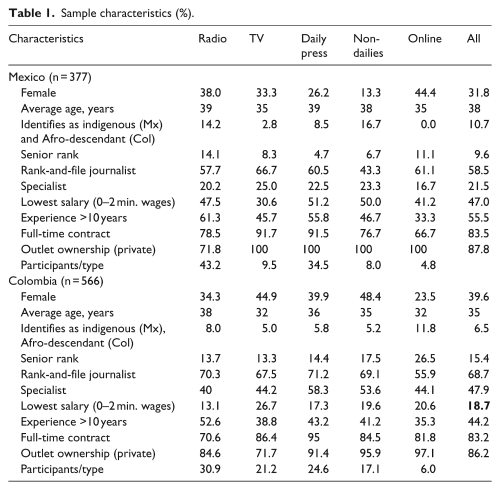
The average age of Colombian respondents was 35, and 68 percent were under 40. About 4 in 10 were female, which is comparable with the national workforce, according to the National Administrative Office of Statistics. Almost half specialized in one newsbeat. About 15 percent were senior managers and about 16 percent were junior managers. About 44 percent had more than 10 years of experience and 83.2 percent worked on full-time contracts. Colombian journalists were relatively better off than Mexican journalists. Only 18.7 percent made two official minimum wages or less monthly. As in Mexico, most respondents (86.2 percent) worked in private media. About 31 percent worked in radio, 25 percent in daily press, 22 percent in television, 17 percent in non-dailies, and 6 percent in online outlets.
Questionnaire development
A research consortium created the instrument used in both countries for the second round of the Worlds of Journalism Study. 3 Questions measure objective, demographic, occupational, and workplace characteristics and subjective perceptions of influences on work, institutional roles, and perceived autonomy, operationalized as personal control over story development. We added further exploratory items to gauge aspects of working conditions stemming from violence and inequality, as well as perceived restraints on autonomy to report and actually publish news about a range of potentially sensitive topics and actors. These potentially restricted coverage areas included news about political and economic actors widely identified as influential (Hanitzsch et al., 2010; Reich and Hanitzsch, 2013), religious authorities and churches wielding cultural power (Hughes, 2006: 88–107), criminal organizations and security forces identified as frequent sources of anti-press violence (Dunham et al., 2015; Gómez and Hernández, 2009), and topics or actors related to social marginalization and inequality (Blofield, 2011). The global items were translated from English to Spanish and back-translated into English. We wrote exploratory questions in Spanish. All questions were piloted with working journalists in each country.
Findings
RQ 1: Dimensions of perceived professional autonomy
To answer RQ1, we conducted a Principal Component Analysis (PCA) with each national dataset separately. The PCA included 10 items journalists evaluated on a Likert-type scale, where 1 was no freedom and 5 was complete freedom. Results show that journalists perceive autonomy along two dimensions, explaining 75.58 percent of total variance in Colombia and 68.13 percent in Mexico. 4 The first, which we call ‘perceived autonomy to develop news’, groups two traditional indicators of autonomy (Weaver et al., 2006; Weaver and Willnat, 2012; Mellado and Humanes, 2012): perceived freedom to select news stories to work on and to decide what aspects of a story to emphasize. This dimension displayed high internal consistency (Cronbach’s α = 0.88 in Mexico and 0.94 in Colombia) and explained 19.03 percent of variance in Mexico and 26.48 percent in Colombia. The second dimension, named ‘perceived autonomy to publish news’, groups eight items: freedom to report and actually disseminate news about political elites, economic elites, criminal groups, armed forces, clergy and churches, racial minorities, poverty, and social inequality. The actors and issues were chosen because they represent a range of levels and types of power in society (political, economic, cultural, and physical). This dimension also displayed good internal consistency (α = 0.83 in Mexico and 0.94 in Colombia) and explained 49.09 percent of variance in Mexico and 49.10 percent in Colombia. The answer to RQ1 is journalists in Mexico and Colombia experience autonomy as a two-dimensional phenomenon that operates during story development and the decision to publish.
RQ 2: Levels of perceived professional autonomy
To answer RQ2, Table 2 presents average levels of response to items grouped under the dimensions of autonomy. Journalists responded using a scale from 1 (no freedom) to 5 (complete freedom). Responses below 4 (a great deal of freedom) mean journalists do not perceive full autonomy. Data show journalists in Mexico and Colombia on average perceive they have full autonomy to develop news stories. However, the level of perceived autonomy to publish news fluctuates depending upon coverage area and journalists in both countries do not feel fully free to publish news about all societal actors and issues. Mexican journalists feel less autonomy to publish news about criminal organizations (2.63), the armed forces (3.4), political elites (3.55), and economic elites (3.89). They perceive greater autonomy to publish news about poverty (4.41), socioeconomic inequality (4.33), indigenous people and racial minorities (4.33), and clergy and churches (4.00). Colombians perceive least autonomy to publish about political and economic elites (3.7 and 3.88), followed by the armed forces and criminal organizations (3.89 and 3.90). They also perceive incomplete autonomy to publish news about the clergy and churches (3.94), although the level is similar to Mexicans. The average level of perceived autonomy to publish news differs according to the actor or topic being covered, but there are differences in the order and magnitude between the two countries.
Levels of perceived professional autonomy.
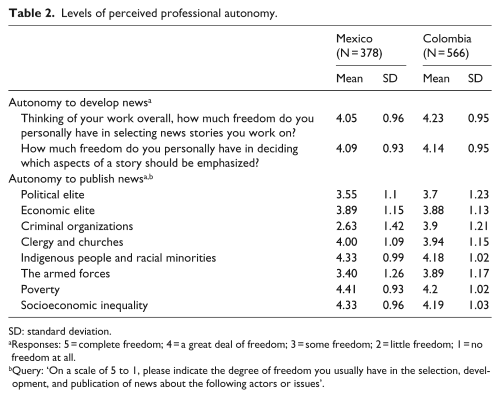
SD: standard deviation.
Responses: 5 = complete freedom; 4 = a great deal of freedom; 3 = some freedom; 2 = little freedom; 1 = no freedom at all.
Query: ‘On a scale of 5 to 1, please indicate the degree of freedom you usually have in the selection, development, and publication of news about the following actors or issues’.
RQ3. Predictors of perceived autonomy
We use multiple linear regressions to identify predictors for each type of perceived autonomy in both countries separately. Our criterion variables were two index variables created by averaging responses only to items grouping on the same PCA dimension in both countries to enhance comparability. 5 The first criterion variable was perceived autonomy to develop news, widely studied as the degree of freedom the journalist perceives when selecting stories to cover and determining emphases within stories (Mellado and Humanes, 2012; Weaver et al., 2006). The second was perceived autonomy to publish news, which is an exploratory category measuring journalists’ perceptions of their ability to report and actually disseminate news about potentially sensitive subjects.
After conducting tests for collinearity, we included 20 independent variables (IVs) in the regression models, which is a number well within recommended ratios for cases to IVs with the sample sizes in this study when expecting medium-size effects (Tabachnick and Fidell, 2001: 117). To improve comparability, we standardized salaries to minimum wages in each country, used ranks of organizational authority rather than position titles, and coded media ownership as private, university-owned, or state-owned/public hybrid since state media don’t necessarily shield news from political intervention (Gómez and Hernández, 2009; Hughes and Lawson, 2004). IVs were based on previous research and our own observations (Mellado and Humanes, 2012; Reich and Hanitzsch, 2013; Weaver et al., 2006). They were (1) indexes measuring the strength of perceived influences on work and level of agreement with contrasting roles for journalism; (2) objective participant traits including age, gender, minority status, years of experience, salary, rank, specialist or generalist assignment, and type of employment (full-time, part-time, or freelance); (3) whether the participant had been threatened due to work; and (4) media type and ownership type of the outlet employing the participant.
To measure perceived influences, we used PCA on 17 items with scaled responses ranging from 5 (extremely influential) to 1 (not influential). Names for resulting dimensions and index variables were assigned based upon item groupings, keeping in mind previous research (Hanitzsch, 2011; Hanitzsch et al., 2010; Mellado and Humanes, 2012; Reich and Hanitzsch, 2013). The items grouped into six dimensions explaining 57.30 percent of total variance in Mexico and 63.43 percent in Colombia. The ‘political influences’ dimension includes perceived influences of government officials, politicians, business owners, and censorship. It displayed good internal consistency (α = 0.85 in Mexico and 0.86 in Colombia) and explained 13.02 percent of variance in Mexico and 16.54 percent in Colombia. The presence of business owners was unsurprising given the prevalence of clientelism (Hallin and Papathanassopoulos, 2002). The second dimension, ‘organizational influences’, grouped perceived influences from direct bosses, media owners, upper management, and the company’s editorial policy, displaying good internal consistency (α = 0.87 in Mexico and 0.91 in Colombia). Organizational influences explained 11.60 percent of variance in Mexico and 6.86 percent in Colombia. The third factor, ‘economic influences’, includes perceived influences of company profit expectations and advertisers and displayed adequate internal consistency (α = 0.78 in Mexico and 0.74 in Colombia). Economic influences explained 8.41 percent of variance in Mexico and 6.86 percent of variance in Colombia.
The fourth dimension grouped influences from media laws and access to information. We named this ‘professional influences’ following Reich and Hanitzsch (2013), believing that these items grouped because of access-to-information laws. Internal consistency was low (α = 0.63 in Mexico and 0.62 in Colombia), but we used it since it grouped only two of the three items used in Reich and Hanitzsch’s (2013) professional dimension (α = 0.68) (pp. 143–44). 6 Professional influences explained 6.94 percent of the variance in Mexico and 11.29 percent of the variance in Colombia. The fifth dimension, ‘reference groups’, includes perceived influences of colleagues in other media and of friends, acquaintances, and family. It displayed adequate internal consistency (α = 0.76 in Mexico and 0.78 in Colombia) and explained 10.19 percent of the variance in Mexico and 11.09 percent in Colombia. We discarded a sixth dimension, perceived influences from time pressures, resources for investigation, and audience research because it did not display adequate internal consistency (α = 0.53 in Mexico and 0.58 in Colombia). Process influences explained 7.14 percent of the variance in Mexico and 10.79 percent in Colombia.
Role index variables were constructed from 15 items rated from 1 (not important) to 5 (extremely important), grouping on four dimensions that explained 58.82 percent of variance for Mexico and 56.66 percent for Colombia. 7 The first dimension grouped four prompts: let people express their views, tell stories about the world, educate the audience, and promote tolerance and cultural diversity. We called this role stance ‘civic educator’ because the first items evoke a public plaza to exchange views and learn about the world through journalism storytelling and the others support educational roles. The dimension was internally consistent (α = 0.713 in Mexico and 0.853 in Colombia) and explained 15.81 percent of variance in Mexico and 16.16 percent in Colombia. The second dimension grouped four prompts: provide analysis about current affairs, influence public opinion, foment social change, and promote national development. We call this an ‘analytical change agent’ stance since it combines interpretive journalism with action to improve society. The dimension presented adequate internal consistency (α = 0.73 in Mexico and 0.75 in Colombia) and explained 14.71 percent of variance in Mexico and 15.26 percent in Colombia. The third factor grouped four items: convey a positive image of political leadership, support government policy, provide the kind of news attracting the largest audience, and provide entertainment and relaxation. We call this dimension ‘propagandist’ because it promotes government interests or media companies’ economic interests. Internal consistency was relatively poor (α = 0.67 in Mexico and 0.65 in Colombia). The dimension explained 14.43 percent of variance in Mexico and 11.92 percent in Colombia. The fourth dimension, ‘watchdog’, included monitor and scrutinize political leaders, monitor and scrutinize business, and set the political agenda. It exhibited good internal consistency (α = 0.72 in Mexico and 0.83 in Colombia) and explained 13.87 percent of variance in Mexico and 13.32 percent in Colombia.
Table 3 presents predictors of perceived autonomy to develop news in full models and in reduced models containing only statistically significant predictors. Full models explain 12.9 percent of the variance in Mexico and 24.7 percent in Colombia. For Mexican journalists, when controlling for all else, earning lowest pay compared to highest (−0.343), working in state media compared to private (−0.190), and perceiving greater economic influences (−0.173) predicted lower levels of perceived autonomy to develop news. Predictors of greater perceived autonomy to develop news were greater support for analytical change agent roles (0.194) and having more than 10 years of experience (0.185). Model power remained unchanged without controls, but reduced models may mask the impact of wages or exaggerate the importance of economic influences. For Colombian journalists, holding all else constant, perceiving greater political influences predicted lower levels of perceived autonomy to develop news (−0.242) and perceiving greater influences from colleagues, family, and friends predicted higher levels (0.192). Being older (0.436) was the strongest predictor. Having little experience compared to being a long-time journalist (0.281), specializing in one beat (0.209), and working for online media compared to daily print (0.137) also predicted greater perceived autonomy to develop news. Without controls, experience was no longer significant and model power dropped.
Perceived autonomy to develop news (standardized regression coefficients).
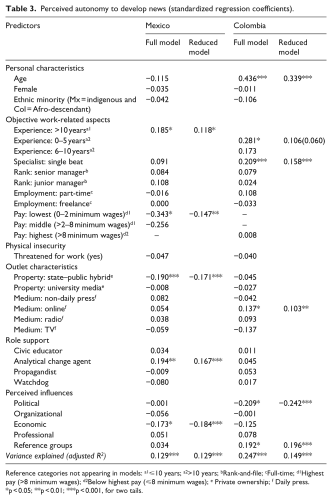
Reference categories not appearing in models: a1⩽10 years; a2>10 years; bRank-and-file; cFull-time; d1Highest pay (>8 minimum wages); d2Below highest pay (⩽8 minimum wages); e Private ownership; f Daily press.
p < 0.05; **p < 0.01; ***p < 0.001, for two tails.
Table 4 presents models of perceived autonomy to publish news explaining 21.4 percent of variation in Mexico and 19.5 percent in Colombia. In Mexico, strong predictors of lower levels of perceived autonomy to publish are having been threatened due to work (−0.154), working on a part-time contract compared to full-time (−0.142), and perceiving greater political influences (−0.129). Supporting watchdog roles (0.233) and being a junior (0.233) or senior (0.157) manager compared to rank-and-file predicted higher levels. Having been threatened became insignificant without controls (p = .071), while the power of support for watchdog roles and perceived political influences grew. Model power remained unchanged without controls. In Colombia, with controls, perceiving stronger economic (−0.279) and organizational (−0.140) influences predicted lower levels of autonomy to publish news. Perceiving greater reference group influences (0.210), being older (0.154), and supporting watchdog roles (0.098) predicted greater levels. The power of support for watchdog roles became stronger than organizational influences in the reduced model and model power dropped.
Perceived autonomy to publish news (standardized regression coefficients).
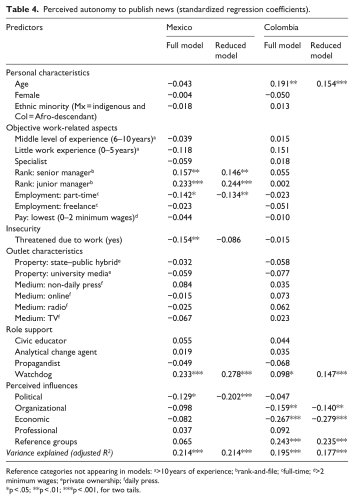
Reference categories not appearing in models: a>10 years of experience; brank-and-file; cfull-time; d>2 minimum wages; eprivate ownership; fdaily press.
p < .05; **p < .01; ***p < .001, for two tails.
The only predictor common to both countries was supporting watchdog roles in models for autonomy to publish news. Thus, while the amount of autonomy journalists perceive in both countries was similar, predictors were different.
Discussion
Comparing our findings to previous research reveals the complexity of professional autonomy for journalists, while comparing our two cases uncovers the influence of historical experience and directions of change. This study reveals that autonomy is not uniformly experienced across stages of production, as previous studies assumed. In both Mexico and Colombia, PCA identified two distinct and coherent underlying dimensions of subjective autonomy corresponding to story development and the decision to publish. This supports Sjovaag’s (2013) view of autonomy as a fluid experience that varies as journalists negotiate structures within the news organization.
The study also demonstrates that influences on autonomy are more complex and contextually dependent than previously identified. Pressures from violence and multiple forms of inequality, manifested via work-related threats, lower wages, a lack of organizational authority, and insecure (part-time) labor contracts, strongly predicted lower perceived autonomy in Mexico. Previously, organizational authority was the only factor which had been identified (Mellado and Humanes, 2012; Reich and Hanitzsch, 2013).
The supportive influence of reference groups identified for Colombian journalists also contrasts with the findings of previous studies, in which competitive pressures from peers were expected to lower autonomy (Reich and Hanitzsch, 2013: 138, 146). Other research suggests that Colombian peer group solidarity is important because, over decades, Colombian journalists learned that collaborative reporting helped prevent kidnappings and joint publication lessened the likelihood of reprisals. Solidarity among Colombian journalists remains high (Barrios and Arroyave, 2007; Duzán, 2012).
Previous studies had only identified support for watchdog norms as important for professional autonomy (Mellado and Humanes, 2012). Our findings, however, also identified the protections offered by support for analytical change agent norms in the Mexican context. A closer look at predictors for support of analytical change agent norms suggests that independent-minded radio anchors in Mexico have carved out space for autonomy within private media firms. 8 Online journalists in Colombia, many of whom had left print media, appear to have acted similarly. Working in online media increased perceived autonomy to develop news in Colombia. These findings strongly suggest that researchers should continue to explore the contractual and organizational arrangements which journalists create to enhance control over their work (Harlow, 2015).
Previous studies have identified economic and political influences as important predictors, but these factors operate differently when institutional and historical contexts change. Our study shows that journalists will abide by certain restrictions during story development, while other restrictions must be imposed. This suggests that some limitations on autonomy are internalized, whereas others result from lack of organizational power. Western-based theories often depict politicians as agents who limit autonomy through their role as sources controlling access to information during story development (Stromback and Nord, 2006; Weaver et al., 2006). Our findings challenge this perception. In Mexico, political influences affected journalists’ perception of their autonomy to publish news. Mexican journalists seem less concerned about politicians’ ability to control information for story development and more about their discretionary control over government advertising and broadcast licenses, which may prompt organizational higher-ups to stop publication of news already gathered to preserve these resources. In Colombia, on the other hand, political influences affected perceived autonomy during story development as Western-based studies predict. However, given politicians’ roles as media owners and purveyors of political violence in Colombia, it seems unlikely that politicians’ influence on story development is restricted to control over information and more likely that Colombian journalists have internalized limitations on autonomy stemming from political violence or mediated by politician owners.
Another difference is that our findings showed that working in state media, rather than private media, predicted lower levels of perceived autonomy in story development for Mexican journalists. This highlights the differences between public media with editorial independence in Northern Europe that Skovsgaard (2014) identified as important for autonomy and politically controlled state media common in Latin America (Guerrero and Márquez-Ramírez, 2014). Finally, like previous scholars, we found that experience positively influenced perceived autonomy (Mellado and Humanes, 2012; Weaver et al., 2006). In Mexico, more than 10 years of experience positively predicted perceived control over publication. Predictors in Colombia seem contradictory until we consider that inexperienced journalists are often tasked with supporting specialists in technical beats where managers infrequently intercede. This suggests expertise supports autonomy in many types of contexts.
Altogether, a comparison of our cases with Western democracies supports and extends Waisbord’s (2007) observation that democratic journalism does not work the same way in contexts in which violence challenges state capacity. The comparison empirically demonstrates not only the extent to which violence influences journalists’ experience of professional autonomy but also the influence of the structural conditions – sharp social and organizational inequalities, labor insecurity, and clientelism – that often accompany violence in a wide range of contemporary democracies (Holston, 2008; Von Holdt, 2014; Walby, 2013).
Comparing Colombian and Mexican journalists underscores the historical contingency of perceived autonomy, as the work by Milton (2000) and Voltmer (2013) suggests. The degree of pressure and direction of change are important for understanding the influence of violence and social inequalities. In our surveys, twice as many Mexican journalists as Colombians reported being threatened (40.3%–20.1%). While both countries are among the most dangerous places to practice journalism worldwide, anti-press violence in Mexico surged after 2003 and was increasing during fieldwork, while, in Colombia, decades-long violence was declining. This helps explain the finding that having been threatened due to work was a strong negative predictor of journalists’ perceived autonomy to publish news in Mexico, but not in Colombia.
Historical experiences of peer solidarity to survive anti-press violence in Colombia continued to be important, despite the decline in violence. Reference group influences were not a strong predictor in Mexico, where solidarity is mixed. In fact, half of Mexican journalists reported having hidden sensitive information from untrustworthy colleagues or other people in their newsrooms to protect themselves from potential attacks. 9
How the violence originated was also a factor in its influence on autonomy. In Colombia, political influences were a strong negative predictor of perceived autonomy during story development. This suggests that decades of political violence socialized Colombian journalists to incorporate restrictions on reporting about political actors into pre-set editorial policies (Gómez and Hernández, 2008; Gómez-Isa, 2008). In Mexico, by contrast, strong political influences appeared at the publication stage, perhaps because criticism of politicians was normatively legitimated during the country’s peaceful transition to electoral democracy after 1982 (Hughes, 2006). Mexican journalists have not internalized political limitations on autonomy, but rather perceive them as imposed through supervisors or owners who may halt publication of critical political stories.
Mexico and Colombia both have high social inequality, labor precariousness, and organizational power distance, in comparison with Western democracies. Indicators of these phenomena (differentials in income, contract security, and organizational authority) were more important for perceived autonomy in Mexico than Colombia. Again, the degree and direction of change may explain these differences. According to Hofstede et al. (2010), organizational power distance is more extreme and naturalized in Mexico than Colombia. The percentage of Mexican journalists earning the lowest salaries was 2.5 times greater than in Colombia, although the Colombian sample contained more rank-and-file journalists (see Table 1). On average, at the societal level, Mexicans’ purchasing power was lower and income inequality was increasing, while Colombian inequality was declining.
Economic influences (operationalized as the influences of advertisers and company profit expectations) were strong negative predictors in both countries, but Mexican journalists believe economic influences restrict autonomy during story development, while Colombian journalists perceive that they intervene when publication decisions are made. This suggests that Mexican journalists internalize economic restrictions and consider them when deciding which stories to cover and elements to emphasize, while Colombian journalists internalize political influences (Breed, 1955; Cook, 1998). Colombian journalists believe that top managers or owners will halt stories that threaten business interests, but they have not naturalized these restrictions. Both economic and organizational influences strongly predicted lower perceived autonomy to publish news in Colombia, further supporting the interpretation that, for Colombian journalists, it is the organizational higher-ups who are perceived as imposing economic limitations.
Conclusion
Our study demonstrates that journalists perceive autonomy differently at different stages of the production process, that extra-media forces can intervene in previously unconsidered ways, and that normative support for roles associated with public-interest journalism can protect autonomy, even in difficult circumstances. Our findings also suggest that historical pressures can shape professional autonomy beyond their originating conditions. In other words, professional autonomy is more situational, complex, and historically contingent than previously demonstrated. Our two measures of perceived professional autonomy – autonomy to develop news and autonomy to publish news – offer an approach which captures the fluidity and contingency of professional autonomy. We recommend that future researchers develop additional measures of autonomy to produce news and test a wider range of determinants of autonomy, keeping in mind organizational cultures, contextual conditions, and journalists’ protective strategies in the full range of formally democratic countries. We especially recommend paying closer attention to democracies in which journalists face sharp levels of anti-press violence, overlapping forms of inequality, and media owners enmeshed in clientelistic relationships with the state.
Footnotes
Appendix 1
Acknowledgements
The authors are grateful for the suggestions of Jeannine Relly and Silvio Waisbord, which greatly improved an earlier version of our manuscript. We are equally grateful to our Mexico research associate Marco Lara Klahr, who created the Mexico news media database, and research assistants Lucano Romero, Melissa González and José Luis Lemini at the Iberoamerican University in Mexico City. Finally, we sincerely thank all of the journalists in Colombia and Mexico who gave us their trust and time in responding to our survey.
Funding
The author(s) disclosed receipt of the following financial support for the research, authorship, and/or publication of this article: The authors acknowledge and thank the following funding bodies: University of Miami, Universidad Iberoamericana-Ciudad de México, Universidad del Norte, and the Central Committee for the Worlds of Journalism Study at the University of Munich.