







Abstract
This study explores the question of how the use of satire, as embedded within the trappings of a traditional news outlet (i.e. a reputable newspaper like the Boston Globe), could influence perceptions of the respective news organization and facets of engagement with it. An online experiment (N = 366) was conducted, offering comparisons both in terms of message features (i.e. a satirical versus conventional presentation of political information) and source attribution cues (i.e. satirical content attributed to a hard news source versus attribution to a satirical outlet). Results indicate that the use of satire may present some risks for a news outlet in terms of undermining reader trust, which can impact audience engagement. However, the results also suggest that the weight of legitimacy and credibility commonly associated with a traditional news outlet can translate into a perception of its satire having a stronger influence on individuals (compared to content from a purely satirical outlet), which can in turn influence the likelihood of sharing the satirical content. Tests of indirect effects highlight the mediating roles of source trust and perceived influence in processes of influence on facets of engagement (i.e. returning to the news source and sharing its content). On the whole, the model of relationships does not appear to be moderated by political party identification.
Keywords
From a normative perspective, both journalism and satire can be thought of as aspiring to offer a lens for understanding political and social issues as they truly are (or should be). Just as journalism is often described as a ‘first draft of history’ relative to current events, satire similarly features an ‘exploration of important cultural matters of the day’ (Kumar and Combe, 2015, 212). Moreover, both modes of public discourse can be entertaining, yet entertainment is not necessarily the central purpose of each. With such characteristics in mind, it should perhaps be unsurprising to find integrations of journalistic content and satire. This has become especially evident in recent decades with the success of news parody programming like The Daily Show. It is also evident in instances of traditional journalism outlets employing the tools of satire, for instance, in the form of newspapers featuring political cartoons (Hess and Northrop, 2011).
While recognizing that satire has long accompanied news media content, it should be noted that satire has historically not been prominently featured within most traditional journalistic output – likely due to journalistic norms hewing to values of neutrality and objectivity (Skovsgaard et al., 2013; Tuchman, 1972). Even so, it is apparent that some conventional news organizations are keen to experiment with satirical content. For instance, the Fox News Channel produced The ½ Hour News Hour for much of 2007, adopting a satirical format similar to The Daily Show (Stelter, 2007). The Washington Post also briefly experimented with a satirical video series in 2009, called ‘Mouthpiece Theater’ (Alexander, 2009).
In view of the growing potential for news outlets to make forays into satire, this research seeks to address questions about how the use of satirical news content could influence perceptions of and engagement with news. First, it examines media effects in terms of how a satirical treatment of news information – as presented by a well-established newspaper outlet – compares to a more traditional presentation of the same topics. Second, the study examines the role of source attribution cues relative to the impact of satirical content, comparing the influence of identical satirical content attributed to either a well-known satirical outlet or a traditional newspaper. Finally, these processes of influence are examined as a function of audience political party identification.
A three-condition between-subjects online experiment (N = 366) was conducted to explore the influence of these satirical message features and source attribution cues using ecologically valid stimuli. The study results indicate that the use of satire may present some risks for a news outlet in terms of undermining reader trust, which could indirectly affect aspects of audience engagement. However, the results also suggest that a conventional news outlet’s credibility can carry more weight in terms of the perceived influence of its satire (compared to content from a purely satirical outlet), which can influence a willingness to share satire. Notably, analyses suggest that these effects do not appear to be contingent upon political party identification. Below, we outline the literature that prompted our empirical examination of satire effects before presenting the findings and their implications.
Literature review
Satire’s appeal
Satire can be understood as a discursive practice that challenges an existing political or social order in a playful fashion. As a form of cultural criticism, satire’s driving impulse is one of attack and (non-violent) aggression (Knight, 2004) targeting some social or political system/issue, rather than, for instance, a benign personal trait (Caufield, 2008). While satire is playful and can elicit laughter (Test, 1991), ‘laughter is ultimately something satire may or may not produce within the audience; it is not something that resides in the artistic expression itself’ (Gray et al., 2009, 13). Satire commonly exhibits a parasitic nature (McKain, 2005), imitating the features of some genre or object as a means to mount its cultural/political criticism. In view of journalism’s role as a significant political institution, functioning as an authoritative source of public affairs information, it is unsurprising that satirists frequently exploit the journalism genre (e.g. The Daily Show; SNL’s Weekend Update). Conversely, given satire’s ability to attract attention, journalists have long used satirical conventions – even as it offers a critical judgment of some absurdity, contradiction, or folly. Political cartoons, for instance, enjoy a cherished role in the history of newspapers/magazines (Hess and Northrop, 2011).
Nonetheless, it is not commonplace to prominently feature satire in conventional news fare. This is likely due to the professional norm of objectivity, marked by qualities like neutrality and sobriety – the antithesis of satire. Yet, as the norms of journalism evolve and the popularity of satirical news programs continues to proliferate, it is reasonable to anticipate that satire may emerge more prominent in news output. For instance, the Pulitzer Prize-winning Boston Globe published an entirely satirical front page of its ‘Ideas’ section during the 2016 presidential primaries (Mullin, 2016). This April 2016 full-page spread 1 offered a satirical take on what the frontpage could look like in 2017 if Donald Trump won the presidency. The hypothetical frontpage featured headlines such as ‘President Trump call for tripling of ICE force; riots continue’, ‘US soldiers refuse orders to kill ISIS families’, and ‘New libel law targets “absolute scum” in press’. Notably, this satire generated much debate in the media itself about news media ethics and potential effects on citizens (Mullin, 2016). The incident highlights the question of how the use of satire, as embedded in a traditional news outlet (i.e. a respected newspaper), might influence perceptions of a news outlet and different facets of audience engagement.
News media trust
Evaluating the extent to which a given entity is worthy of trust and faith is a perception involving a risk judgment (Earle and Cvetkovich, 1995). When entrusting one’s time, attention, money, and other resources with a given ‘trustee’ (see Tsfati and Cappella, 2003) in hopes of receiving a certain benefit (e.g. news information), there is a potential for loss (e.g. the loss of time, energy, or social capital). Accordingly, individuals seek a basis for placing trust in other social agents–a basis from which to gauge how much confidence one has in a given trustee fulfilling one’s (desirable) expectations. In this light, news media trust represents confidence and faith in certain news media actors as based, in part, on the extent to which the news media actors fulfill expectations related to news gathering and reporting. Given that news media trust is partly contingent upon meeting expectations, it is important to consider what expectations individuals might hold. News-related expectations commonly align with values along the line of accuracy, fairness, neutrality, being unbiased, and giving full context (Gaziano and McGrath, 1986). In short, this cluster of values aligns with the objectivity norm that pervades modern journalism (Skovsgaard et al., 2013). Though the journalistic objectivity norm has long been recognized as flawed (Mindich, 2000), qualities like neutrality, detachment, withholding overt value judgments, balance, and so forth still dominate journalistic norms in the United States (Schudson, 2001; Skovsgaard et al., 2013).
Importantly, satirical news content typically does not align with traditional notions of journalistic objectivity. By its very definition, satire offers critiques and value judgments, designed to evoke mirth and/or indignation. Given that citizens commonly expect traditional news outlets to adhere to the objectivity norm, it stands to reason that when deviating from such expectations, news organizations risk undermining audience trust. An initial inquiry of this study is whether satirical content can undermine trust in a news organization. It is therefore posited that a satirical approach to presenting journalistic content will dampen trust in the content’s source.
H1: A traditional news media outlet’s use of satire will dampen trust in the outlet, compared to similar content disseminated via more traditional news reporting practices.
Future reader engagement
Questions of trust in news media outlets (or the news media as an institution) matter because low trust may contribute to political polarization (Ladd, 2012), erode civic engagement and political participation (Cappella and Jamieson, 1997), and influence patterns of media use (Tsfati and Cappella, 2003). Consider how mainstream sources of news for conservatives in the United States has become less diverse over the last decade, with Fox News serving as their most consistent news source (Mitchell et al., 2014). This seems attributable to an erosion of trust (particularly among conservatives) in mainstream news media. Indeed, selective exposure research – which pertains to the extent to which people selectively consume certain media messages – suggests that individuals tend to select/use information sources that they trust (e.g. Stroud and Lee, 2013). In short, increased media trust in a given outlet likely increases the chances of future engagement, such as returning to the outlet’s website or following its social media posts. In this light, a second prediction is offered:
H2: Trust in a traditional news media outlet will positively predict the likelihood of future engagement with that news outlet.
Thus far, this study posits that (1) the use of satire by a traditional news organization could undermine trust and that (2) trust in a news outlet may have implications in terms future engagement with that outlet. But it is worth noting that one benefit of satire is the ability to attract attention through means of novelty, pleasure, and surprise. In this regard, it is possible that – aside from perceptions of trustworthiness – the use of satire will also directly influence the likelihood of future engagement with a news outlet. This line of inquiry is explored as a research question.
RQ1: Does a traditional news outlet’s use of satire directly influences the likelihood of future engagement, compared to similar content disseminated via more traditional news reporting practices?
Examining the first two hypotheses and the first research question, this study’s line of reasoning points to a mediation-based process of influence, wherein the use of satire may indirectly influence the likelihood of future engagement with a news source via trust perceptions. That is, perceptions of trustworthiness bear the potential to explain how the use of satire may influence future engagement with a news outlet.
H3: Source trust will mediate satire exposure’s negative effect (as compared to exposure to conventional news content) on future engagement with the news outlet.
Willingness to share
Given that citizens are exposed to a great diversity of content and they have the capacity to share the content they encounter, it is also sensible to explore how the use of satire relates to the social transmission of news-related content – an outcome of interest to news outlets and scholars alike. While social media may make it easy to share news in the digital era, the act of sharing has long-standing roots in human evolution. Psychologists posit that sharing individual experiences with others can promote social bonding (Fredrickson, 1998; Goetz et al., 2010; Keltner and Haidt, 1999). In addition, Rimé (2007) argues that the sharing of emotional information fosters a sense of community.
Researchers have begun to explore the predictors of sharing mediated content. A study of the New York Times website found that content that is emotional in nature (particularly content that evoked positive emotions) is more likely to be shared; furthermore, content that evokes high-arousal emotions (like awe, anger, or anxiety) is more likely to be shared than less arousing content (Berger and Milkman, 2012). Pew public opinion surveys also indicate that younger, less affluent, and more partisan Americans are more likely to share online news (Weeks and Holbert, 2013). Taking an experimental approach, Bobkowski (2015) tested the conditions under which news consumers are likely to share news stories with others. Bobkowski found that perceived information utility was also a key predictor of news sharing. That is, if news consumers perceived the content they were viewing was important (i.e. it involved serious and likely consequences that could occur soon), then they were more likely to intend to share that news content with others via social media. In summary, this body of work suggests there are multiple motivations that individuals may have for sharing news content.
To date, there is little scholarship devoted to analyzing the social transmission of satirical content (see Young et al., 2014). Nonetheless, the theoretical underpinnings of social sharing, combined with the empirical results described above, suggest that a variety of motivations undergird why individuals may share satirical information. Based on the earlier noted observation that satire bears the ability to attract attention through novelty, surprise, and emotional responses, one might anticipate that satirical content is more likely to be shared, as compared to similar content (from the same source) that is not satirical.
H4: Satirical content presented by a conventional news outlet is more likely to be shared, compared to content disseminated via more traditional news reporting practices.
Furthermore, building on the idea that trust in a news source may serve as an explanatory mechanism for understanding audience engagement with a news outlet, we can explore whether trust also mediates the influence of satire exposure (compared to traditional news exposure) on willingness to share the content. It could be that trust in a news source will predict one’s willingness to amplify its content, yet this relationship has yet to be fully explored in the existing literature. Accordingly, a hypothesis and second research question are offered:
H5: Trust in a media outlet’s content will positively predict a willingness to share the content.
RQ2: Does trust in a conventional news outlet mediate satire exposure’s effect on a willingness to share?
Source cues and willingness to share
This study’s line of inquiry also raises the question of whether the preceding reputation of the satire message’s source influences one’s willingness to share satirical content. Willingness to share a satirical message may be contingent on more than the content alone (i.e. whether it is satirical or not); it may also depend on how the source of the satirical message conforms to expectations. Recall that journalism’s objectivity norm dictates that satirical content is generally not expected of traditional news organizations. In contrast, satirical news content is expected of a satirical media outlet like The Onion, a comedic news source that started as a print newspaper in 1988 (Waisanen, 2011). In an effort to more deeply address this study’s driving question of how satire might influence engagement with news content, it is worthwhile to also probe how a source cue (i.e. a traditionally satirical source versus a conventional hard news source) factor might contribute to a willingness to share news-related information.
RQ3: Is one more willing to share satire if the content is attributed to a purely satirical outlet, as compared to satirical content attributed to a traditional news outlet?
The influence of perceived influence
This study posits that a focus on the influence of perceptions is warranted, based on the premise that perceptions represent an important and consequential form of media effects (McLeod et al., 2017). In seeking to shed light on the influence of a satirical message’s source cue, yet another factor that can illuminate the nature of one’s engagement with satirical content (in particular, in terms of one’s willingness to share it) is perceptions of influence. A large body of research has examined the beliefs that audiences hold regarding how media will influence themselves and others. Broadly speaking, this body of work can be described as assessing the influence of presumed media influence (Gunther and Storey, 2003). That is, rather than examine the distance (i.e. perceptual gap) between the presumed influence of a message on the self versus others (i.e. the third-person and first-person effects), the influence of presumed media influence of examines audiences’ overall perception that the media can and do influence audiences, including themselves (e.g. Sherrick, 2016).
Sometimes referred to as the second-person effect, this presumption of media influence occurs when audience members react to issues in the news as if those issues will likely affect both themselves and other members of the community (Neuwirth and Frederick, 2002). Glasser (2009) defines the second-person effect as ‘an influence associated with individuals who respond to the day’s news as if everyone was paying attention to it’ (p. 326) and considers it part of the larger literature on presumed influence.
Neuwirth et al. (2002) found second-person effects were significantly associated with more systematic processing of news information and strongly predict behavioral intentions. Notably, the third-person perception is most pronounced when the perceived effects of a media message are viewed as harmful or socially undesirable (Eveland and McLeod, 1999; Perloff, 1999). Yet, there do not seem to be obvious reasons, from a theoretical standpoint, to expect that it is socially undesirable or ego-enhancing to be influenced by satire. Accordingly, examination of a third person perception (relative to satire) would seem to have limited utility. However, given the contemporary cultural prominence and popularity of political satire, it is appropriate to examine how additive perceptions of satire’s influence (i.e. self and other) may serve as mechanisms of satire’s influence. Perceptions of influence may help illuminate the role of source cues in prompting behavioral responses. Given that the work of traditional news organizations is typically seen as being held to higher professional news standards than a satirical outlet, it follows that the reputation of a traditional news source (i.e. being mainly known as a purveyor of conventional news) will impute greater weight to perceptions of satirical influence, as compared to identical satirical content attributed to an outlet known for producing satire. These considerations point to a hypothesis in which the message source affects perceptions of a “second person” influence.
H6: A traditional news media outlet’s use of satire will be perceived as having a stronger second-person effect (i.e. additive influence of self and others) than a satirical outlet presenting the same content.
As noted above, audience perceptions of news content as being important (i.e. involving serious and likely consequences) are a key predictor of news sharing (Bobkowski, 2015). As such, it is also posited that stronger perceptions of influence will render a message more likely to be shared.
H7: Perceptions of satire’s second-person influence will positively predict a willingness to share.
Incorporating H6 and H7, it follows that perceptions of a second-person influence may help to explain how source cues (as attributed to a conventional news source versus a traditional outlet for satire) can influence a willingness to share satirical content. Accordingly, an eighth hypothesis tests the proposition that perceived influence functions as a mediator between a source attribution effect and a willingness to share information.
H8: Perceptions of a second-person influence will mediate the effect of satirical source cue on willingness to share.
Finally, because political satire commonly traffics in criticism of political figures with strong partisan affiliations, it is plausible that satirical content produced by a news organization can be processed and perceived differently as a function of one’s partisan identity. For instance, those individuals opposed to Donald Trump’s candidacy in the 2016 election (i.e. those who identify as or lean toward Democrats) would seem most likely to find the satire attacking Trump to be agreeable and consequently express some degree of trust in the source of the satire, likely to share the satire, and so forth. Conversely, those with less motivation to oppose Trump (i.e. those who do not identify with Democrats) would likely be less receptive to the critiques embedded in satire targeting Trump. In short, the model of the relationships proposed above could differ as a function of identifying (or not) with the political party most clearly opposed to the target of the satire. To explore the potential for partisan differences and further illuminate the significance of the study findings, a research question is posed.
RQ4: Does the model of relationships proposed in this study differ as a function of identification (or leaning) with the Democratic party, as compared to others (i.e. Republicans/non-Democrats)?
Method
To address the research questions and hypotheses outlined here (see Figure 1), a three-condition between-subjects online experiment was conducted in June 2016.
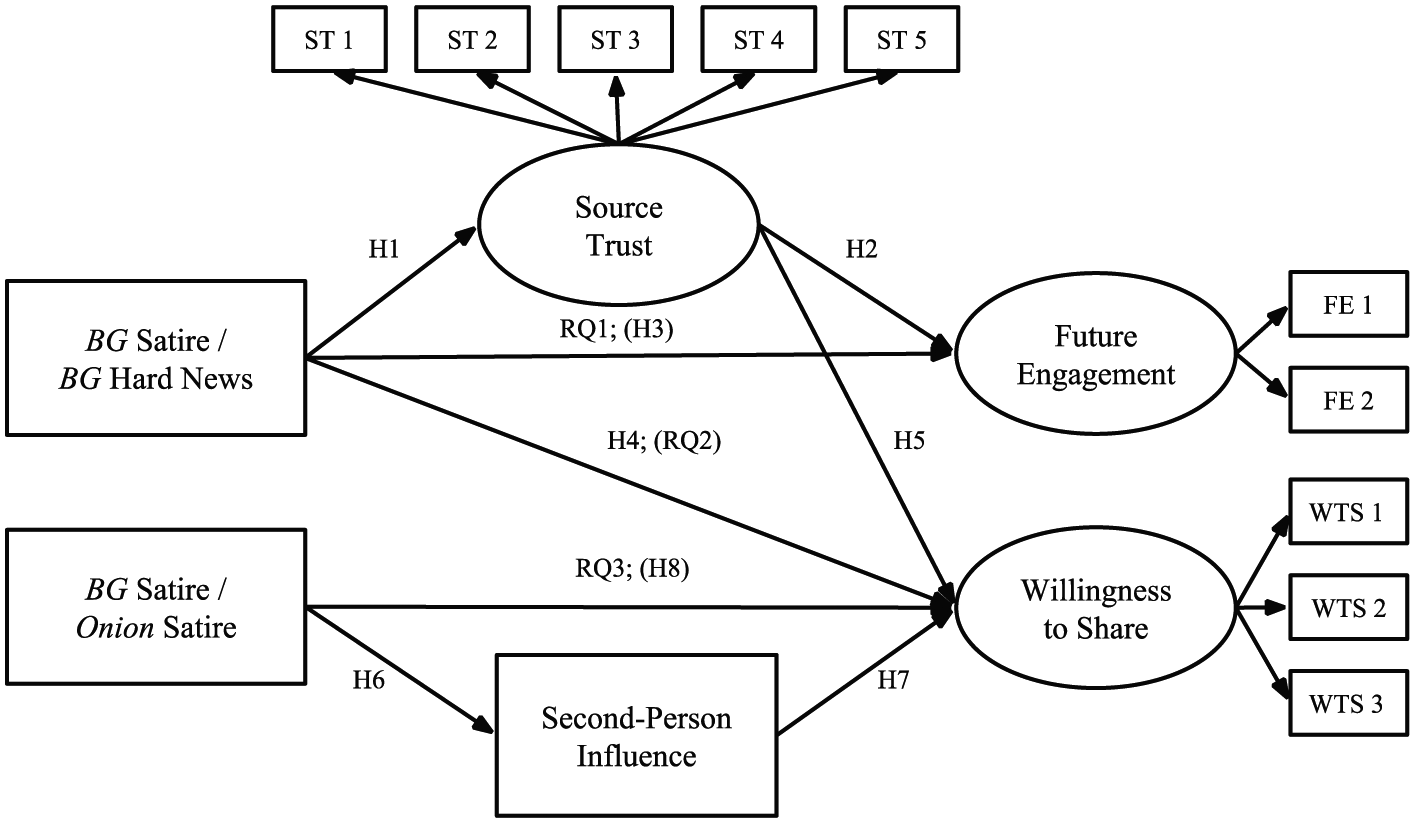
Overview of study hypotheses and research questions.
Participants
Amazon’s Mechanical Turk online platform was used to recruit participants. While 409 participants began the online questionnaire, 39 either failed to answer preliminary questions or failed an attention check and were removed from analyses; an additional four cases were omitted due to missing data. The remaining participants (N = 366) ranged in age from 19 to 73 years (M = 35.45, SD = 12.08). The sample was 47.0 percent female with a majority identifying as White (80.1%); 8.5 percent identified as Asian, 7.1 percent as African-American, 6.0 percent as Hispanic/Latino(a), 1.1 percent as Native American, and 1.7 percent as other races/ethnicities (participants could choose more than one category). More than half (52.1%) of the participants reported having a 4-year college degree or higher. As for political party identification, 58.7 percent leaned Democrat, 17.2 percent identified as ‘Independent (close to neither party)’, and 24 percent leaned Republican.
Procedures
Qualtrics online survey software was used to administer the experiment. After consenting, participants provided demographics and then viewed one of three randomly assigned messages. Participants next responded to items assessing dependent variables. The experiment took about 15 minutes to complete. The incentive to participate was US$0.76. An institutional review board approved all procedures in May 2016.
Stimuli
Participants saw one of three randomly assigned versions of text-based political information. Because the content was based on a real newspaper’s series of satirical stories regarding Donald Trump (then the Republican presidential candidate), the stories were too long to fit onto one screen in the questionnaire. Therefore, participants first saw an image of what the entire front page looked like and then on subsequent pages they viewed the text of each of the five stories on that page. The condition featuring satire content attributed to a traditional news outlet was the unaltered satirical content actually published on 9 April 2016 by the Boston Globe; it imagined a Trump presidency in 2017. The second condition featured identical source attribution (Boston Globe), but a more traditional approach to presenting the topics featured in the stimuli. Participants read five hard news 2 stories on the same topics as the satirical stories, all of which appeared to be from the Boston Globe. These hard news stories discussed Trump’s stated stances on the same topics (e.g. diplomacy, immigration, press freedom, etc.) and were based on actual news content accumulated from real news outlets to ensure ecological validity. Finally, the third exposure condition served as an additional comparison group to the Boston Globe satire, representing a source attribution manipulation. That is, the content of the stimuli exactly matched that of the first satirical condition, only participants were told it originated from The Onion, a widely known satirical website. The initial image shown to participants was manipulated so that The Onion’s logo, and not the Boston Globe’s, appeared in the masthead. (See Online Supplemental Material to view stimuli text.)
Measures
Source Trust was measured with five items presented to study participants following exposure to the experimental stimuli, prompted by the question stem, ‘Please rate how well the following terms describe the media organization that produced the stories you just read’. Using a 1 ( ‘not at all’) to 7 ( ‘very well’) scale, the following descriptors were presented in random order: accurate, fair, unbiased, tells the whole story, and can be trusted. The items were averaged together to form a source trust scale (M = 3.24, SD = 1.63; α = .94).
Perceived Influence was calculated both in terms of a second-person effect and a third-person effect. Note that while this study is principally focused on the second person effect, analyses also control for the third person effect, in accordance with the principles of the ‘diamond model’ (Neuwirth and Frederick, 2002; Whitt, 1983). This approach facilitates an assessment of the perceived media influence on self and others (i.e. the second-person effect), controlling for self-other differences (the third-person effect). The second-person effect measure was calculated by adding together scores from two questions posed upon exposure to the experimental stimuli, measured on a 1 ( ‘not at all’) to 7 ( ‘very much’) scale: ‘How much do you think that the average American would be influenced by the contents of these stories?’ and ‘How much do you think that you are influenced by the contents of these stories?’ (M = 7.64, SD = 2.63). The third-person effect measure was calculated by subtracting the perception of influence on the self from the perceived influence on the ‘average American’ (M = 1.27, SD = 1.92).
Future Engagement with the attributed source of the media content was measured with two items, prompted by the question stem, ‘Between now and the general election in November, how likely are you to take part in the following activities?’ The activities were ‘visit the website of the media organization that created the stories you read today on your own time’ and ‘pay attention to the social media pages of the media organization that created the stories you read today’. Measured on a 1 (‘not at all likely’) to 7 (‘extremely likely’) scale, responses to the two questions were averaged together (M = 3.40, SD = 1.63; r = .80).
The Willingness to Share measure was adapted from Myrick and Oliver (2015); it was calculated by averaging together responses to three questions measured on a 1 (‘not at all likely’) to 7 (‘extremely likely’) scale. Respondents were asked how likely they would be to take following actions: ‘Share the stories I read for this study with others via email’, ‘Retell the stories I read for this study to another person in a face-to-face, phone, instant messenger, or text-message conversation’, and ‘Share the stories I read for this study with others by posting them to my social media feeds’ (M = 2.75, SD = 1.72; α = .88).
Analytical procedures
Several hypotheses and research questions are examined below with analysis of variance (ANOVA) tests, while structural equation modeling (SEM) analyses address predictions of future engagement and willingness to share. SEM analyses are also used to conduct the tests of mediation. SEM is an analytical approach ideal for analyzing a system of equations simultaneously when investigating multiple dependent variables and latent constructs (Holbert and Stephenson, 2002). MPlus software was used to run the path analyses with maximum likelihood estimation.
The model included all the variables illustrated in Figure 1 (see below), as well as the control variables of age, education, sex, political party identification, political ideology (both in terms of economic matters and social issues), and third-person perceptions. The means, standard deviations, and correlations for the study’s key continuous variables are reported in Table 1. Two dummy-coded variables were used to represent the experimental exposure conditions. Those who viewed the hard news content (attributed to the Boston Globe) were coded as 1 and all others as 2. All who viewed the satire attributed to the Onion were coded as 1, while others were coded 2. This coding scheme designates those who viewed the satire attributed to the Boston Globe as the comparison group in the analyses. Moreover, by coding ‘other’ as 2 in this coding scheme, a positive coefficient in the model results (relative to the dummy-coded variables) represents the Boston Globe satire as having a greater effect relative to its respective comparisons to the Onion satire or the Boston Globe hard news content. The mediation analyses were conducted using 10,000 bootstrap samples, which generates a confidence interval (CI) (95%) for an assessment of the indirect effect.
Means, standard deviations, and correlations for study’s key continuous variables (N=366).
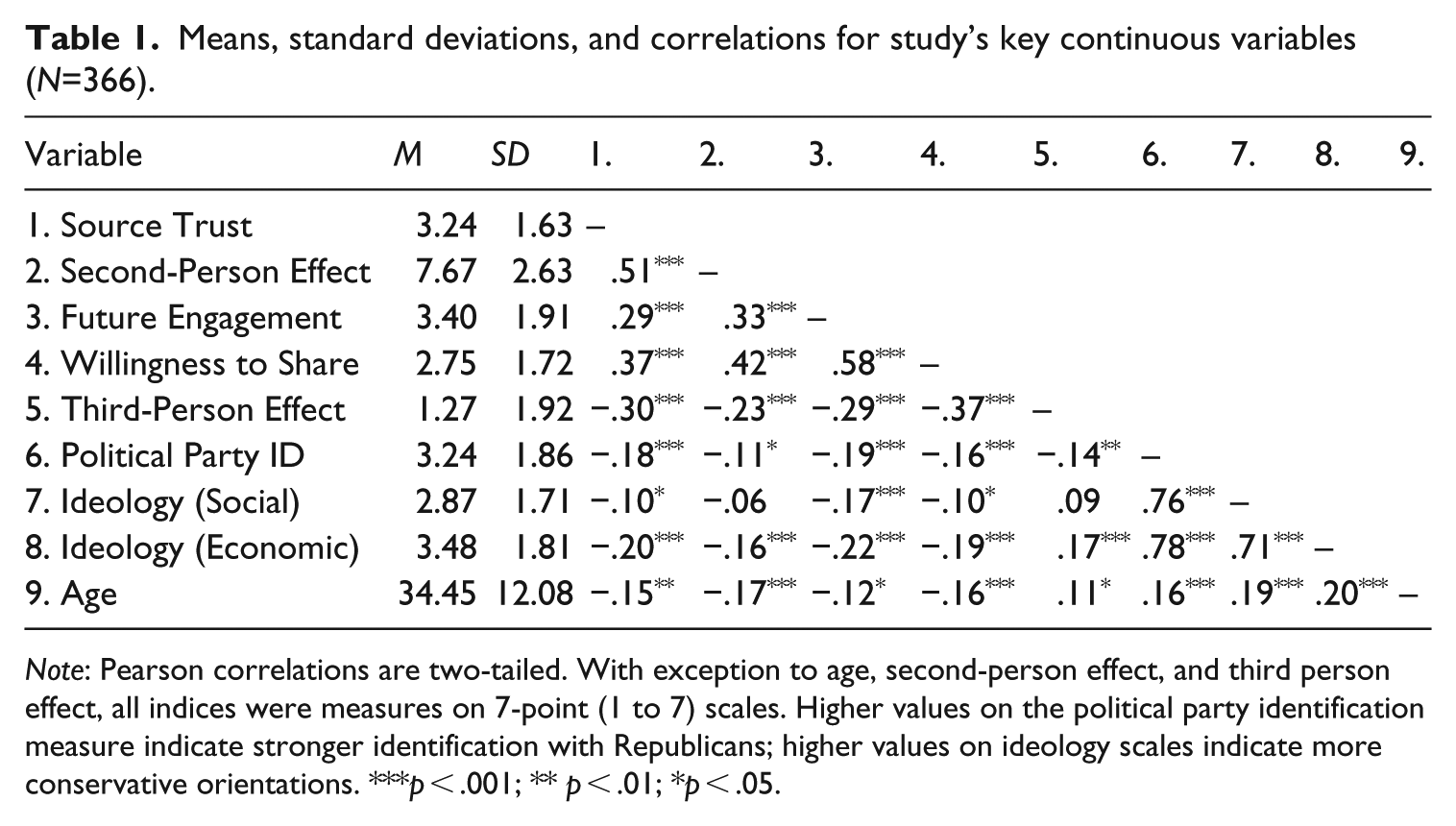
Note: Pearson correlations are two-tailed. With exception to age, second-person effect, and third person effect, all indices were measures on 7-point (1 to 7) scales. Higher values on the political party identification measure indicate stronger identification with Republicans; higher values on ideology scales indicate more conservative orientations. ***p < .001; ** p < .01; *p < .05.
Results
A one-way ANOVA with the experimental condition as the independent variable and source trust as the dependent variable was significant: F(2, 363) = 62.01, p < .001, η2 = .26. A planned contrast test compared the mean source trust index in the Boston Globe satire condition (M = 3.18, SE = .14) with that of the Boston Globe hard news condition (M = 4.28, SE = 0.12) 3 , revealing a significant difference between the conditions, t(363) = 6.03, p < .001, supporting H1. The second hypothesis (H2) predicted that trust in the respective news source presented to the participants would positively predict the likelihood of future engagement with that source. As shown in the Figure 2, source trust is a significant direct predictor of future engagement (b = .23, standard error (SE) = .10, p = .02).
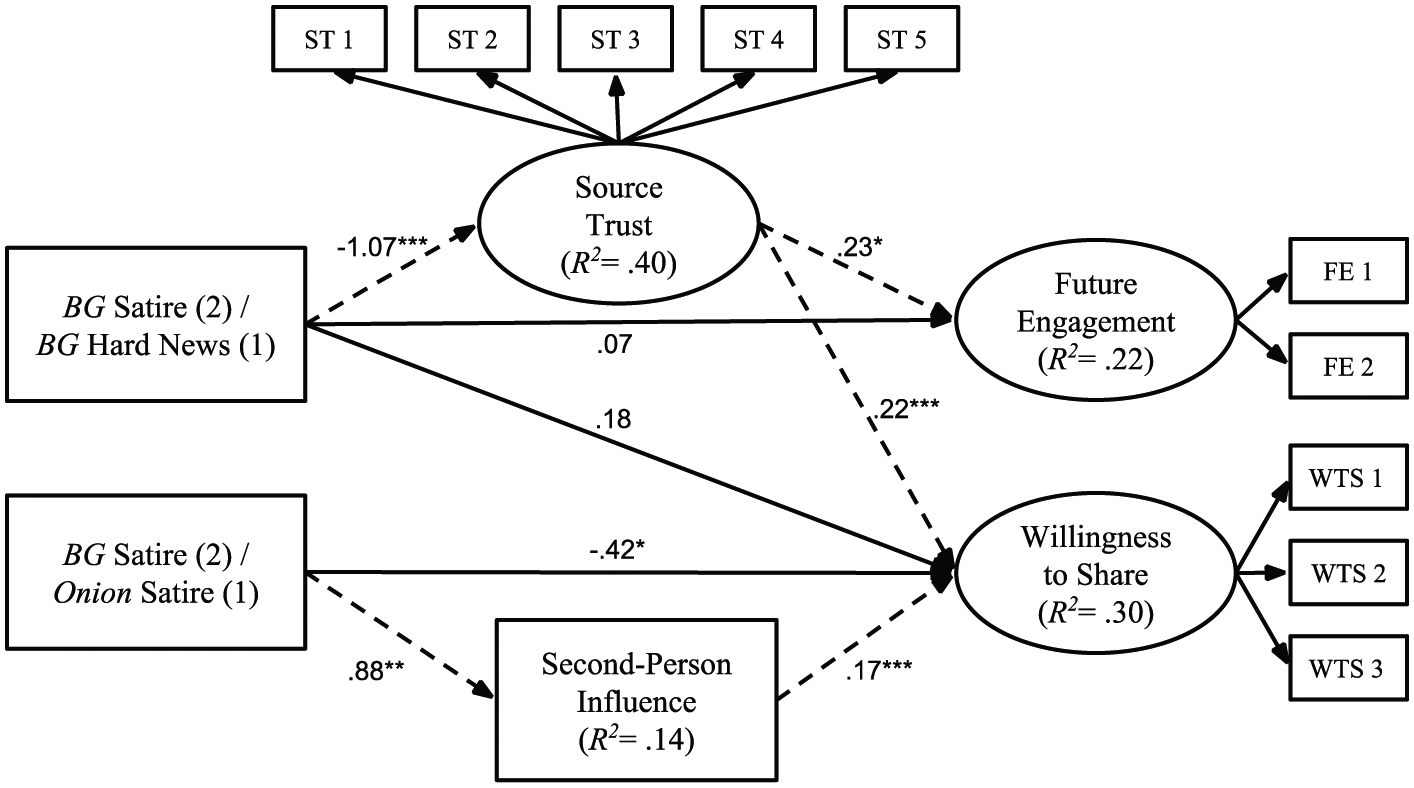
Overview of mediation-based model predicting future engagement with the information source and willingness to share content.
The first research question (RQ1) inquires whether the use of satire – compared to a more traditional hard news presentation – makes a difference in likelihood of future engagement. A one-way ANOVA with future engagement as the dependent variable indicates there was not a significant difference in the likelihood of future engagement between the satire (M = 3.17, SE = 0.18) and hard news (M = 3.52, SE = 0.17) exposure conditions, F(2, 363) = 1.31, p = .27, η2 = 01.
The third hypothesis (H3) asked whether source trust mediates the effect of the Boston Globe satirical content (compared to the Boston Globe hard news) on future engagement (i.e. Boston Globe satire
With regard to H4, the data show that the Boston Globe’s satire (M = 2.65, SE = 0.17) is not significantly more likely to be shared, compared to hard news approach (M = 2.89, SE = 0.15) to presenting the content as embedded in the Boston Globe. A one-way ANOVA with willingness to share as the dependent variable was not significant, and therefore H4 was not supported: F(2, 363) = 0.61, p = .54. Meanwhile, H5 argued that source trust would also predict a willingness to share (WTS) the news content. The SEM analyses demonstrate that source trust positively predicts WTS (b = .22, SE = .09, p = .01), as indicated in Figure 2. Addressing the question of an indirect effect from RQ2, the data also highlight the capacity of source trust to serve as a mediator between the effect of contrasting Boston Globe content (satirical v. hard news) and WTS (i.e. Boston Globe satire
Turning to examination of the perceived influence of satire based on source attribution cues (H6), a one-way ANOVA was conducted with the experimental condition as the independent variable and the second-person effect as the dependent variable. This test was significant: F(2, 363) = 9.08, p < .001, η2 = .05. A planned contrast test compared the second-person effect for the Boston Globe satire condition (M = 7.70, SE = 0.24) with that of the Onion satire exposure condition (M = 6.92, SE = 0.22), revealing a significant difference between the conditions, t(363) = 2.37, p = .02, thereby providing support for H5. The next hypothesis (H7) also finds support, as the second-person perception of influence is a significant predictor of WTS (b = .17, SE = 0.04, p < .001), even while controlling for the third-person perception (see Figure 2). With regard to H8, the findings highlight the capacity of second-person perception to function as a mediator between the effect of source attribution cue for satirical content and WTS. That is, a significant indirect is evident, based on 95 percent bootstrap CI (ab = .15, 95% CI = (.05, .30)).
Finally, to address the question of the potential for partisan differences in the proposed model (RQ4), MPlus software was used to conduct a multiple group path analysis with opposition party identification (Democrat/leaning Democrat v. Other) as the grouping variable. 4 This bifurcated grouping coded as ‘1’ those who identified as ‘strong Democrat’ (n = 83), ‘not very strong Democrat’ (n = 67), or ‘Independent, lean toward Democrat’ (n = 65). In contrast, those who identified as ‘Independent, close to neither party’ (n = 63), ‘Independent, lean toward Republican’ (n = 30), ‘not very strong Republican’ (n = 33), and ‘strong Republican’ (n = 25) were coded as ‘0’. The party identification control variable used in the previously reported analyses was omitted from this multiple group analysis due to it serving as the basis of the grouping. All other paths remained identical to the original model.
Consistent with the procedures of a multiple-group analysis (see Holbert and Grill, 2015), a constrained model, which treats the path estimates between the two groups as equal, was first calculated – producing the following model fit estimates: χ2(df = 243) = 427.896, p < .001, RMSEA = .064 (90% CI: .054, .074). A separate unconstrained model, wherein all the path estimates were freely estimated for each of the two groups, resulted in the following estimates: χ2(df = 206) = 371.215, p < .001, RMSEA = .066 (90% CI: .055, .077). A χ2 difference test comparing the two models was significant (Δχ2(df = 37) = 56.681, p = .02), suggesting that one model fits the data better than the other. 5
Examining the difference in these chi-square estimates in relation to the degrees of freedom in each model (i.e. dividing each model’s χ2 estimate by the respective degrees of freedom), there is a shift from 1.76 (the constrained model) to 1.80 (the unconstrained model). Because a lower χ2/df estimate indicates a better fit (Holbert and Grill, 2015), it is evident that disaggregating the model as a function of opposition party identification erodes the quality of the model fit; at the very least, it does not improve it. 6 That is, opposition party identification does not meaningfully explain different processes of influence in the current model. In sum, there do not appear to be statistically meaningful differences in the model of the relationships proposed by this study between those who identify in some way with Democrats and others.
Discussion
This study addresses the question of how the use of satire, as embedded in a traditional news outlet, can influence perceptions of a news outlet and facets of engagement with that outlet. To explore how the use of satire might affect perceptions and elements of engagement, the study’s analyses offer comparisons both in terms of (1) message features (satirical v. conventional presentation of news information) and (2) source attribution cues (i.e. attributing the content to hard news outlet vs a satirical outlet).
The data suggest that employing satirical message features may be ‘playing with fire’ for traditional news organizations. When comparing the presentation of satirical content to the presentation of similar hard news information from the same source, the use of satire appears to undermine trust/credibility in the source. And this loss of credibility does not seem inconsequential. Statistically significant indirect effects (as mediated by source trust) indicate that employing satire can negatively influence (H3) intentions to further engage with content from the news outlet and (RQ2) to share the content from the outlet with others.
Nonetheless, there is something attention-getting and novel about satire. This is highlighted by the significant (direct) relationship between exposure to The Onion attribution and WTS (RQ3). An outlet like The Onion is known for entertaining satire and, accordingly, is commonly shared with others, motivated by factors like amusement and a desire to share positive affect (Berger and Milkman, 2012). But the fact that the source attribution factor, relative to the satirical content (i.e. Onion v. Boston Globe), predicts a strong second person influence (H6) suggests that when satirical content comes from a traditional news source, people may be more inclined to attribute greater legitimacy and credibility to the content and its arguments – as compared to when the same content comes from a satirical outlet like The Onion. In some respects, this finding reinforces extant research, which demonstrates that the manner in which satirical information from a program like The Daily Show is processed partly depends on whether individuals perceive the program to be a source of ‘news’ – not just entertainment (Feldman, 2013). That is, viewers seem to process satire more deliberately and systematically when it is perceived – to some degree at least – as a legitimate form of ‘news’ (see also Peifer, 2018). In short, source cue heuristics related to the genre of information seem to meaningfully affect the reception of satirical content.
Another implication of this study’s findings is that in cases where satire is the preferred approach to presenting political news-based information (understanding that the use of satire could erode trust), the effect of source attribution on second-person perceptions can (indirectly) motivate sharing intentions (H8). This a notable outcome in a digital media age where traditional news outlets are experimenting with various forms of presentation and content distribution. The study findings suggest that theory and research about second person influence can benefit by analyzing the effects of message features. For instance, further considering how audience associations with different news genres shape perceptions of influence can help advance research in this domain. To date, this is an underexplored facet of second-person effects research. Furthermore, in an era when journalistic content and satire alike can be widely and quickly shared across social media platforms, integrating dependent variables like intentions to engage with the outlet in the future and intentions to share the outlet’s content is also important for advancing the applicability of theory. Integrating these types of dependent variables into research on second-person effects can help us better understand the role of political information and news content in today’s highly interconnected media landscape.
Addressing the limitations of this research effort, the study examined only one candidate and only two information sources. While these methodological choices helped ensure high ecological validity, replication work is needed across different outlets and political figures. Also, even as analyses controlled for and probed the question of potential partisan differences, it should be acknowledged that the study’s sample skewed liberal/Democrat. While the purpose of an experiment is to examine causal relationships between variables and not to provide generalizable descriptive findings, future work in this area could build upon the findings here by employing more diverse or representative samples. In addition, future work could employ longitudinal data collection to assess the potential of a sleeper effect whereby people may not remember the source of news content after a delay.
In conclusion, journalistic norms and values are not static or universal. Whether in the context of the United States or elsewhere, notions of what is normative for traditional news outlets have evolved over the course of centuries. As the journalism industry grapples with how to remain viable in the 21st century, experimentation with different approaches to presenting and disseminating news content is to be expected. Given satire’s cultural prominence in the contemporary media ecosystem, it is likely that satirical ventures like that of The Boston Globe in 2016 will continue to surface, underscoring questions of how a traditional news organization’s use of satire might affect audience perceptions about the outlet and the nature of their engagement with it. In this regard, this research highlights both opportunity and pitfalls. While satire bears potential to be a powerful vehicle for political and social critique, it presents risks and potential tradeoffs when embedded within the trappings of conventional journalism.
Supplemental Material
Risky_Satire_S1,_S2_Online_supplemental_material – Supplemental material for Risky satire: Examining how a traditional news outlet’s use of satire can affect audience perceptions and future engagement with the news source
Supplemental material, Risky_Satire_S1,_S2_Online_supplemental_material for Risky satire: Examining how a traditional news outlet’s use of satire can affect audience perceptions and future engagement with the news source by Jason T Peifer and Jessica Gall Myrick in Journalism
Footnotes
Funding
The author(s) received no financial support for the research, authorship, and/or publication of this article.
Supplemental material
Supplemental material for this article is available online.
Notes
Author biographies
References
Supplementary Material
Please find the following supplemental material available below.
For Open Access articles published under a Creative Commons License, all supplemental material carries the same license as the article it is associated with.
For non-Open Access articles published, all supplemental material carries a non-exclusive license, and permission requests for re-use of supplemental material or any part of supplemental material shall be sent directly to the copyright owner as specified in the copyright notice associated with the article.
