







Abstract
The Australian media market has fragmented with audiences accessing news from various sources (mainstream media and/or social media) on a variety of platforms. In this fragmented market, we examine the media coverage of high-profile multicultural and transnational events and issues during a 6-month period, which potentially has adverse impact on social cohesion by contributing to negative attitudes towards minority communities. The article outlines outcomes of a classical content analysis of news and commentary available on Australian mainstream news sites, and a sentiment analysis of Twitter conversations around the same topics. We use Stuart Hall’s encoding decoding model to explain the outcomes of the two content analyses and consider the news coverage and social media news conversations of these prominent events/issues from the perspective of culturally diverse Australian audiences.
Introduction: Cultural diversity and the media in Australia
Advances in media technologies and the impact of globalisation on all aspects of social, economic and political spheres have meant that transnational news and information are not only significant for Australia as a nation, but are also of immense interest to those with familial and historical ties overseas. According to the 2016 census, nearly half (49%) of Australians were born overseas or had at least one parent born overseas (ABS, 2017b). Historically, a majority of migrants have come from Europe, but an increasing number of Australian citizens are born in Asian countries and other parts of the world, and about 21 per cent, that is 3 million, Australians speak a language other than English at home (ABS, 2017a).
Despite this, there is a recognised lack of ethnic diversity in the mainstream media. An industry report (PWC Australia, 2016) notes a lack of diversity in Australian media and entertainment workforce in terms of ethnicity, gender, age and thinking, as a significant drag on the industry’s growth. Former President of the Australian Human Rights Commission (AHRC), Gillian Triggs, notes the rarity of diverse voices in the media, Australia performs very poorly when compared to similar English-speaking societies. In Britain, for example, journalists from ethnic minority backgrounds have fronted the news bulletins for decades. Here (in Australia), prominence or seniority for journalists from a non-Anglo background has been rare. (Triggs, 2017)
Broadcaster Waleed Aly, while launching a new journalism initiative Media Diversity Australia, noted the ‘snowfield’ of white faces on Australian television (Wallbank, 2017). Others agree about the ‘sameness’ in the Australia media industry, stating that ‘it seems almost as if we [the media] have signed up to a look and a feel of what is Australia and to be Australian is, and it’s very, very limited’ (Anonymous Journalist, 2017). Community leaders point out that certain stories and particular communities attract an increased level of scrutiny in the news media, causing unnecessary anxiety among those communities (Keskin, 2017). Scholars agree that television news and current affairs programmes often depict culturally and racially diverse individuals as ‘victims of the system’, used as a ‘source of scandal’ or painted as a threat to the ‘Anglo-Australian way of life’ (Bartlett, 2010: 165; Phillips, 2011: 30). In television drama, culturally diverse actors are often stereotyped or are implicated in tension or conflict with white characters (Screen Australia, 2016). Despite a growing population of inter-ethnic couples in Australia, media representations of such couples are both stereotyped and assimilationist (Tindale and Klocker, 2017).
Research shows that media representation of minority communities has an adverse impact on social cohesion and cultural diversity in society. Saleem et al. (2015) found that exposure to news portraying Muslims as terrorists is positively associated with support for military action in Muslim countries and increased support for harsh civil restrictions of Muslim Americans. The study found that exposure to counter-stereotypical portrayals of Muslims reduced support for public policies that harm Muslims (Saleem et al., 2015). Schemer (2014) found that exposure to negative and positive news portrayals of minorities affected racial attitudes. Repeated exposure to depictions of a social group that causes economic, cultural and security problems increased prejudice in the public over time. However, Schemer’s study showed that public campaigns that provided positive coverage of minorities, tempered negative attitudes among viewers. Arendt and Northup’s (2015) research found that long-term exposure to news stereotypes influenced viewers’ implicit attitudes (gut feelings) towards certain social groups, which in turn potentially had an impact on their explicit attitudes.
In this context, we examine the Australian media’s coverage of multicultural and transnational news events and issues, which have the potential to impact on some community members’ negative attitude towards people from culturally diverse backgrounds and social cohesion in society. We carried out two sets of content analyses of news and information available to Australians – on mainstream online news sites and a social networking site. Our study focussed on significant breaking news stories/issues during a 6-month period. The main research question was the following: How do current events and issues pertaining to multicultural Australia get covered in the mainstream media and discussed on social media? In this article, we present the outcomes of the two content analyses to consider whether the mainstream media represents Australia’s culturally diverse population, and the implications of the media coverages on social cohesion in the country.
Changing news media ecology
The Australian media are in the midst of a transition period where the impact of new media technologies and the changing media consumption habits of Australians is being felt by both commercial and public media groups. According to a 5-year forecast, the revenue of media companies such as News Australia Holdings, Fairfax Media and Seven West Media during 2018–2022 will continue to decline (PWC Australia, 2018). The market has already seen the merger of Fairfax Media with Channel 9, following a 50 per cent decline in Fairfax’s revenue since 2012–2013 (SBS News, 2018). Although each of these groups have seen an increase in digital consumption of news, the advertising revenue generated by digital viewership is not sufficient to replace traditional advertising revenue (MEAA, 2018). Free-to-air television networks’ revenue has been trending downwards due to competition from online media and video-on-demand subscription services, but radio has seen a resurgence in recent years due to new products and distribution channels such as podcasts, streaming, on-demand and Digital Radio Plus services (PWC Australia, 2018).
In the new media era, the pace of the news market’s fragmentation has increased. The Digital News Report (2016), which included a survey of news consumers in 26 countries including the United States, Canada, Brazil and South Korea and for the first time Australia, found that news consumption is being ‘distributed’ with consumers accessing news on mobile devices and non-traditional news platforms. Two audience surveys by Rodrigues and Paradies (2017) found that Australians from culturally diverse backgrounds, particularly those born overseas, had ‘enhanced’ distributed sources of news compared with those born in Australia. The surveys showed that in the contemporary media ecology where news is available on a variety of platforms and from a variety of sources, Australian news audiences from culturally diverse backgrounds increasingly sought news from their personal networks on social media or by searching the Internet. The cost-cutting efforts implemented by most Australian media groups over the past decade has meant that transnational news is either covered by global syndicates or on a limited scale. There have also been questions about the quality of news provided by the Australian mainstream media, which is patchy and insensitive to many minority communities (Australian Press Council, 2008; Phillips, 2011). Meanwhile, fragmentation is augmented by consumers’ access to international media such as Fox News, BBC World News, CNN, Buzzfeed, The Guardian, and The New York Times.
News communication and news consumption
Scholars have posited a number of theories around media messages and their impact on consumers. The audience reception theory, which originated from the works of Hans Robert Jauss in the late 1960s (Jauss, 1982), is based on an understanding that there is not a single reading of a text, and different audience members may understand the meaning of a text in different ways depending on their cultural background and life experiences. Stuart Hall developed the encoding/decoding model of communication in 1973 (Hall, 1980). Noting that the communication process is traditionally conceptualised in terms of a circulation loop or circuit, where scholars saw a linearity in the message exchange between sender, message and receiver, Hall (1980) argued that the meaning of a text was not inherent within the text itself, but was created within the relationship between the text and the reader.
Hall (1980) proposed that the production process or encoding of a message has its own ‘discursive’ aspect where the text may draw from society’s dominant ideologies via the routines of the production process, professional ideologies of the encoders and broader socio-cultural and political agendas and events. However, he posited, a reader might take three positions when decoding a communication message – the dominant-hegemonic position, the negotiated position and the oppositional position. Hall argued that a reader might decode the message exactly the way it was encoded (as a preferred reading); or the reader might accept the intended meaning of the text in parts while modifying it in a way reflected their own experience and interests; and finally, a reader might recognise the intended meaning of the message in the text but ultimately reject it taking an oppositional position when decoding the message.
Brunsdon and Morely applied Hall’s encoding/decoding framework to study BBC current affairs programme Nationwide in the 1970s (Brunsdon and Morley, 1999). The study analysed news content to discern the main messages encoded in the text, which then compared with interview narratives derived from a diverse group of research participants. Morley (2006) found distinct variation of readings depending upon class, race, gender and residential location, underscoring the idea that audiences are not passive. For Morley, the validation of a preferred, negotiated or oppositional reading required an analysis of both the content of the media/text and the social background and experience of the audience/reader. However, Morley noted some unresolved issues Hall’s encoding/decoding model, where there is a need to distinguish between a reader’s understanding of the text and possible interpretation of the text. Morley (2006) says that in the oppositional reading of a text, a confusion remains between rejecting the preferred meaning of the text and disagreement with the text itself.
In recent years, scholars such as Bødker (2016) have explored the encoding/decoding model and its application social media communication, particularly the dissemination of news stories and their consumption as commodities. News as a commodity on social media circulates through the interpretative strategies of readers. Bødker (2016) states that on social media platforms, processes of meaning-making (even if very superficial) are merging with the circulation of commodity form in the way that, for instance, a simple click on ‘like’ (at an article or at somebody else’s comment to the article) will make the product visible to somebody else. (p. 415)
Bødker expands on Hall’s initial theorisation, in effect decentralising ideas around how meaning and culture are circulated in society through social media. This, Bødker (2016) argues, alters ‘how content is circulated and ascribed meaning but also how raw’ events are transformed into news’ (p. 420). Bødker says that Hall’s idea of circulation is enriched by social media participants’ interventions in contemporary digital journalism – activities that partially offset the historically dominant-hegemonic voice of political establishments in news media (Sender and Decherney, 2016: 383). Woodstock (2016) has a similar focus on Stuart Hall’s encoding/decoding model. He (Woodstock 2016: 400) says that Hall’s encoding/decoding model, while originally oriented around an interpretation of media content, is flexible in its scope, and ‘[it] allows us to better recognise the multiplicity of ways that media users experience media in everyday life’. The oppositional positions of audiences are determined by both the text and the medium through which the text is represented. People can refuse to participate in the medium of social media or refuse to consume mainstream media news, therefore new oppositional positions are created.
Research methodology
This empirical study aimed to analyse how news events/issues pertaining to multicultural Australia were covered by mainstream online news sites, and how these events/issues were reflected in conversations on social media platforms such as Twitter. Our focus was on whether the news coverage and the public discussion on social media platform were positive or negative towards culturally diverse Australians. Research (Rodrigues and Paradies, 2017) has shown that Australians get their news from multiple sources including online news sites, television, radio and social media platforms. Content analysis is a systematic technique of identifying specified characteristics of messages that allow the researchers to sift through large volumes of data and make inferences based on the data (Holsti, 1969). In the first phase, we use a classical content analysis technique to collect news stories from five mainstream online news sites. We decided to focus on the Melbourne metropolitan region in the state of Victoria, which is serviced by the two Australian public service broadcasters (the Australian Broadcasting Corporation and the Special Broadcasting Service); two metropolitan legacy media (The Age, owned by Fairfax media, and the Herald Sun, a tabloid owned by News Corporation); and the nationally distributed newspaper The Australian, which is owned by News Corporation. We identified six significant breaking news events/issues between September 2016 and March 2017 that seem to instigate some level of ‘public’ controversy around the topic of multiculturalism in Australia by tapping into the consciousness of multiple segments of the Australian population.
The events/issues included in this study were the following:
(a) Section 18C of the Racial Discrimination Act 1975 1 – news stories related to Section 18C, which makes it unlawful for someone to perform an act that is reasonably likely to ‘offend, insult, humiliate or intimidate’ someone on grounds of their race or ethnicity. Some politicians and campaigners demanding a rollback of this section due to its perceived impact on free speech. Others questioned the actions of then president of the AHRC, Gillian Triggs, in relation to Section 18C.
(b) A discussion of Islam as a religion – news stories where Islam and its purported attributes became a subject of discussion in the public sphere, particularly following two high-profile events: in September 2016, when One Nation Leader, Pauline Hanson, gave her return to the Australian Parliament speech, noting the danger of Australia being swamped by Muslims; and, Immigration Minister, Peter Dutton’s comments in November 2016, arguing that past governments had erred when resettling Lebanese refugees in Australia in the 1970s.
(c) Donald Trump’s refugee ban – on 27 January 2017, the US President, Donald Trump, signed an executive order that banned nationals from seven predominantly Muslim countries from visiting the United States for 90 days. The ban was temporarily blocked by the US Federal Court on 3 March 2017. Later, President Trump signed a new order, making concessions to those with visas and green cards and removing Iraq from the banned countries list.
(d) The Bourke Street attack – news stories related to a car driven into pedestrians in the central business district of Melbourne, Victoria, killing six people and injuring another 30. Dimitrious Gargasoulas, 26, an Australian of Greek descent, was charged with this crime. Although the authorities issued statements that the incident was not terror-related, an early news video quoted a bystander indicating that the attack may have been by a person of Middle Eastern appearance. Politicians such as Pauline Hanson erroneously blamed Muslims for the attack, creating a controversy (Martinkus, 2017).
(e) Youth crime – news stories focused on youth crime in Melbourne. Although the Victorian police denied the existence of the so-called Apex or South Sudanese community gangs, African youth crime continued to make news in 2016–2017 (Farnsworth, 2017).
(f) The London (Westminster) Terror attack – news stories mentioning the terrorist attack that took place outside the Palace of Westminster in London on 22 March 2017. The attacker, 52-year-old British Muslim Khalid Masood, drove a car into pedestrians killing five people and injuring more than 50. The news story was widely reported and commented on in the Australian media.
Coverage of these topics was systematically collected from the five online news sites as news events unfolded and issues were reported between September 2016 and March 2017. No attempt was made to edit the sample of stories covered by each media outlet to allow us to gauge the true extent of coverage provided by each media site of each event and issue category.
In the second phase, we collected messages from popular microblogging platform Twitter. We downloaded tweets with various related hashtags that were popular on Twitter when discussing these topics. Launched in 2006, Twitter has gained significance as an online news and social networking platform in recent years. Although Facebook is more popular with 15 million monthly active users in Australia compared with Twitter’s 4.7 million monthly users (SocialMediaNews.com.au, 2018), scholars, businesses and governments often use Twitter data to analyse social media users’ online conversations because of the openness of its platform, which allows for access to its data for research (Ahmed, 2017). Due to the size of the data, the sentiment of the Twitter discussions was automatically analysed using sentiment detection software (Hutto and Gilbert, 2014). This evaluation was validated through human annotation of a stratified sample.
Content analysis of mainstream news
We collected 1366 news stories in total during the 6-month period between September 2016 and March 2017 (Table 1). Of these, 1089 (~80%) were news stories, reporting events/issues of the day. There were also 49 (~4%) features or longer pieces in the sample and 217 (~16%) commentary and editorials. Stories were coded to evaluate if they were ‘positive’, ‘negative’ or ‘neutral’ in nature. Interpreting sentiments in a text can be a subjective process; therefore, we used two coders to read these stories – one recent arrival to Australia with Asian heritage and the other a long-time resident of Australia with an Anglo background. For our research, we also defined the terms ‘positive’, ‘negative’ and ‘neutral’ in the context of the study. Care was taken to restrict the coding of news stories to their manifest (what you see is what you get) content rather than latent or interpretative analysis of the text, as recommended by Riff et al. (2013). A story was considered to have ‘negative’ sentiment against a community or an individual from a culturally diverse background when it cast doubts on their character or referred to their background as one of the factors enticing the negative news event or issue. A story is considered to be ‘positive’ in sentiment when it included text or expressions that indicated enthusiasm or some level of happiness towards a culturally diverse individual or community mentioned in the story. When no emotions are explicitly or implicitly mentioned in the story, it was classified as ‘neutral’. About 7 per cent of the data were used to test the common understanding of coding categories, with an intercoder reliability of about 95 per cent.
Topics of news events/issues for analysis.
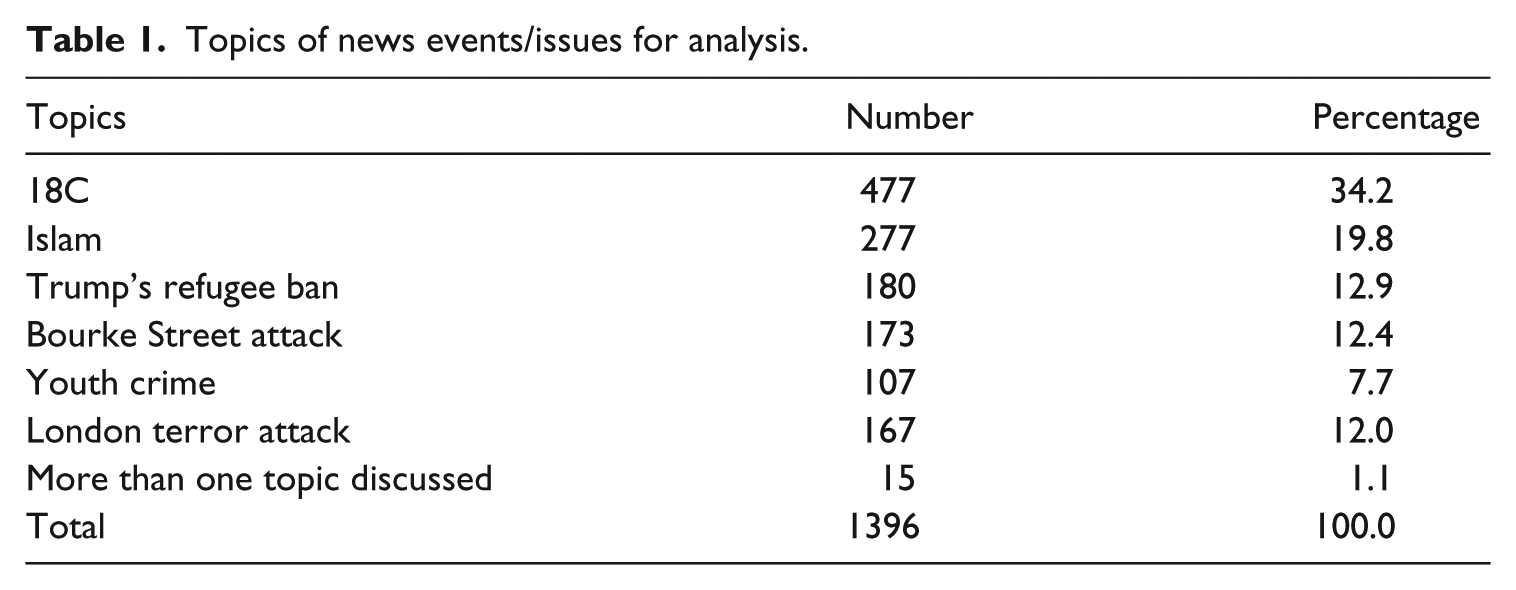
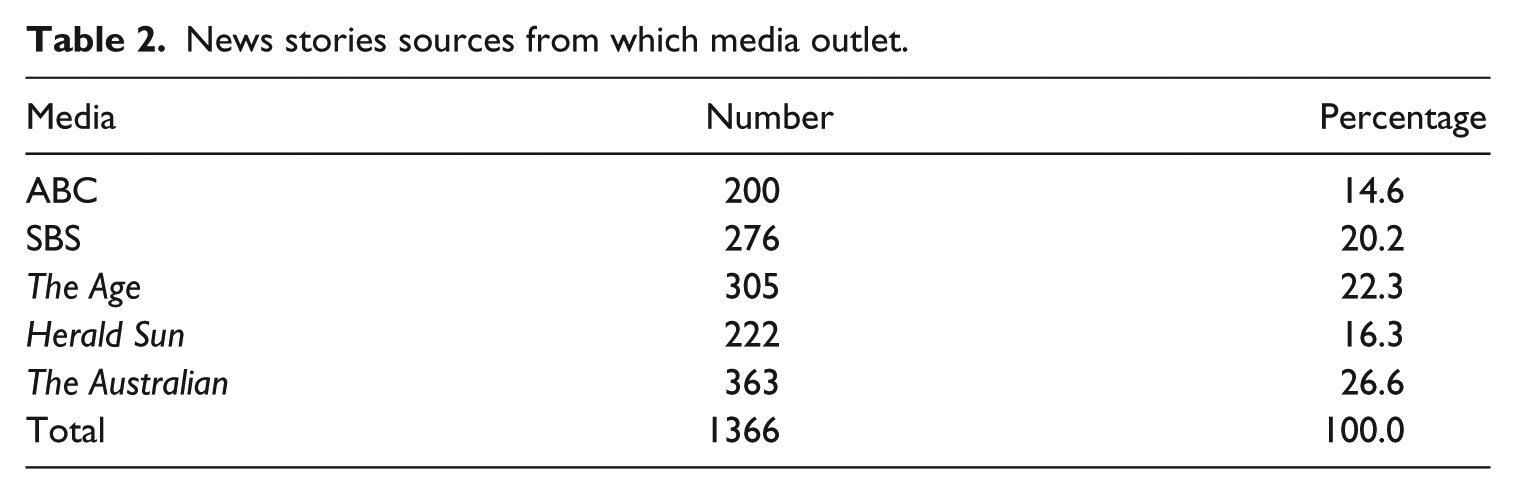
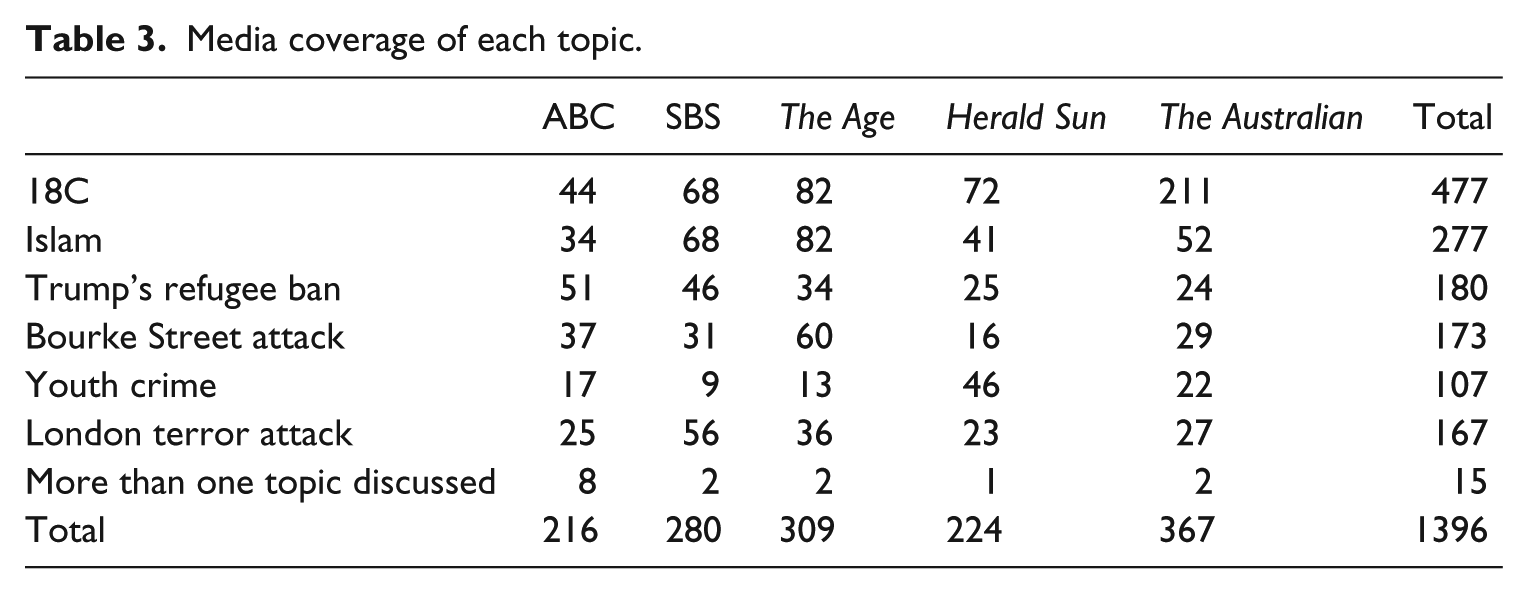
Results of the content analysis of news stories sourced from the mainstream media online sites showed (Table 2) that The Australian and The Age covered stories about our selected topics in a slightly higher number than the two public service broadcasters – the ABC and SBS. In fact, there was a saturation of coverage of the 18C and the human rights issue in relation to the then president of the AHRC Triggs (Table 1). In terms of the overall level of coverage of these events/issues, almost all five news sites covered the stories in a similar way, with The Australian’s coverage as a stand out for the number of stories it published on the topic of 18C (Table 3). The Age was the next in line publishing a news stories on 18C. The Age also published a relatively higher number of stories on Islam, whereas the Herald Sun had relatively higher number of stories on the issue of youth crime in Victoria. The SBS covered the March 2017 London terror attack event more extensively than others while the ABC had relatively higher level of focus on Trump’s refugee ban in January 2017.
News stories sources from which media outlet.
Media coverage of each topic.
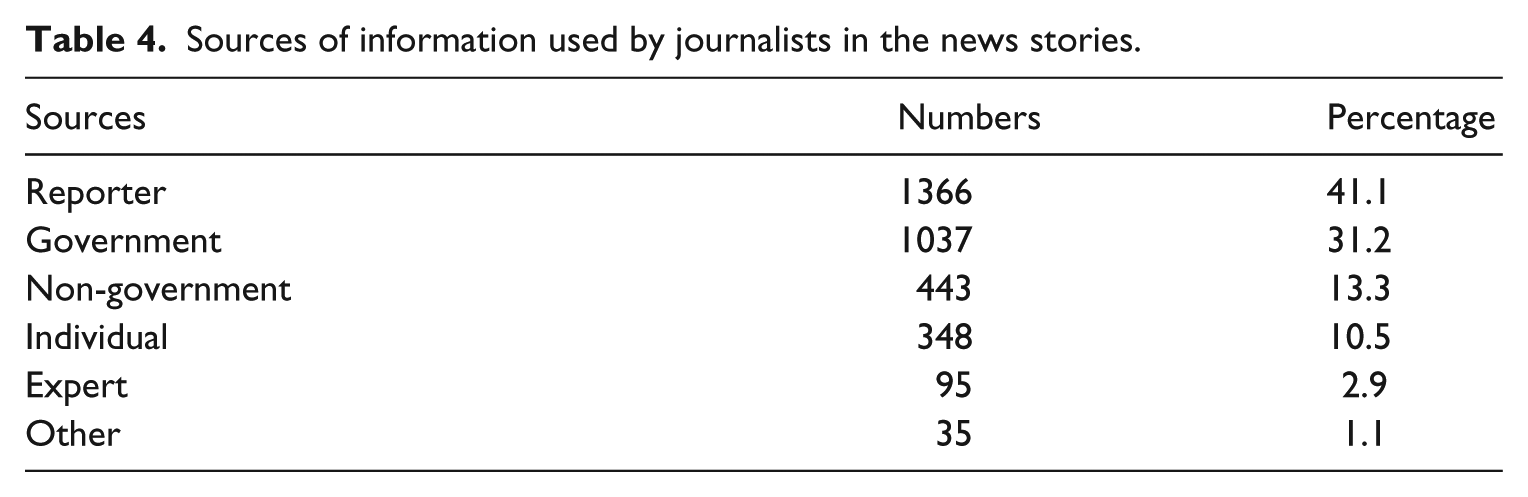
We examined the various sources quoted in each news story (Table 4). The results showed that news reporting of these events and issues that crossed cultural boundaries was predominantly based on the reporters’ observations and government sources, with only a quarter including other points-of-view – opposition political parties, multicultural groups or experts. Often reporters covered these events with no sources or only government sources quoted in the story.
Sources of information used by journalists in the news stories.
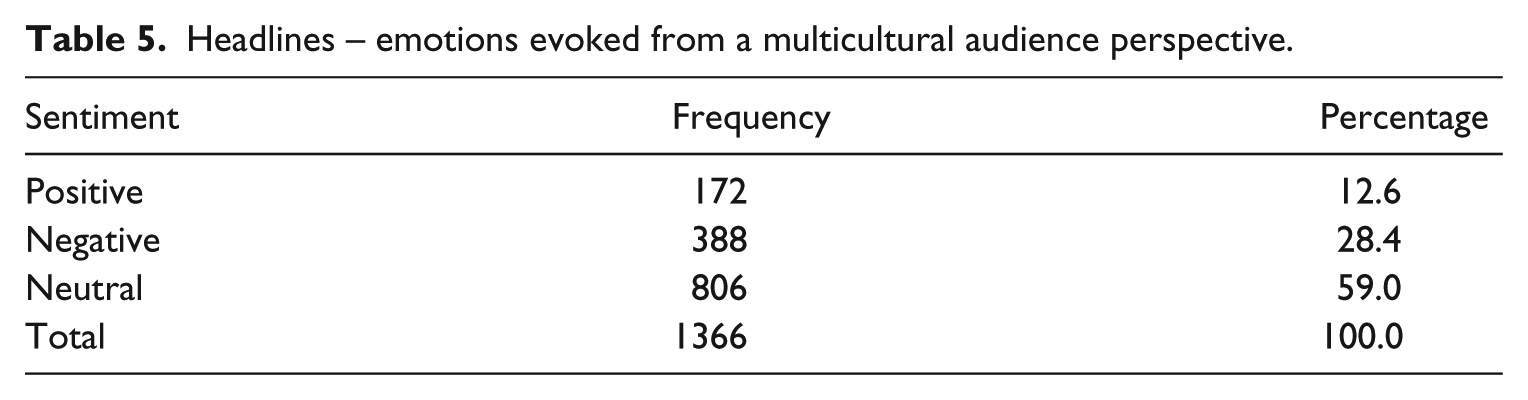
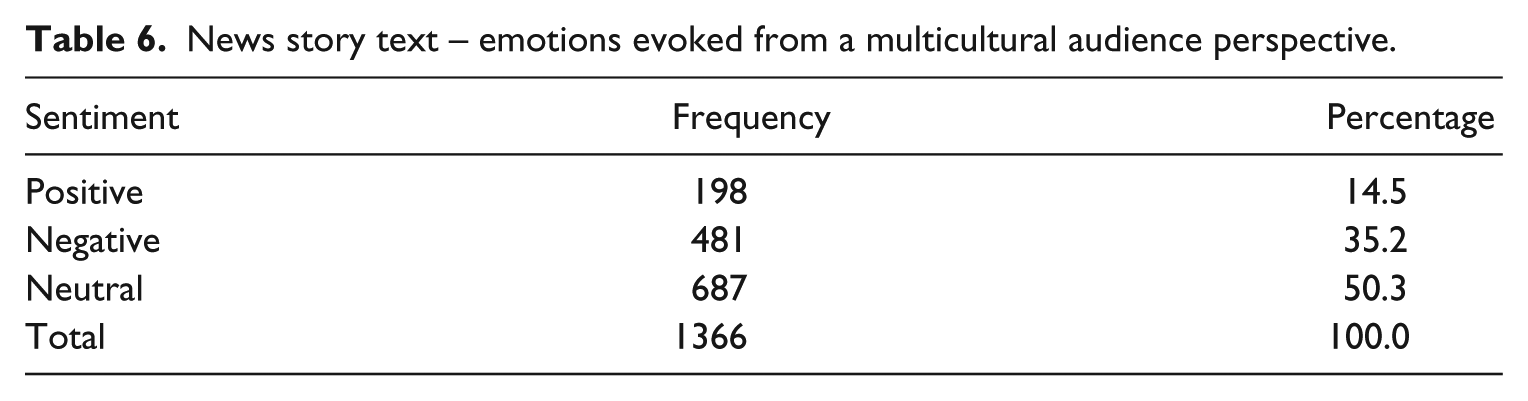
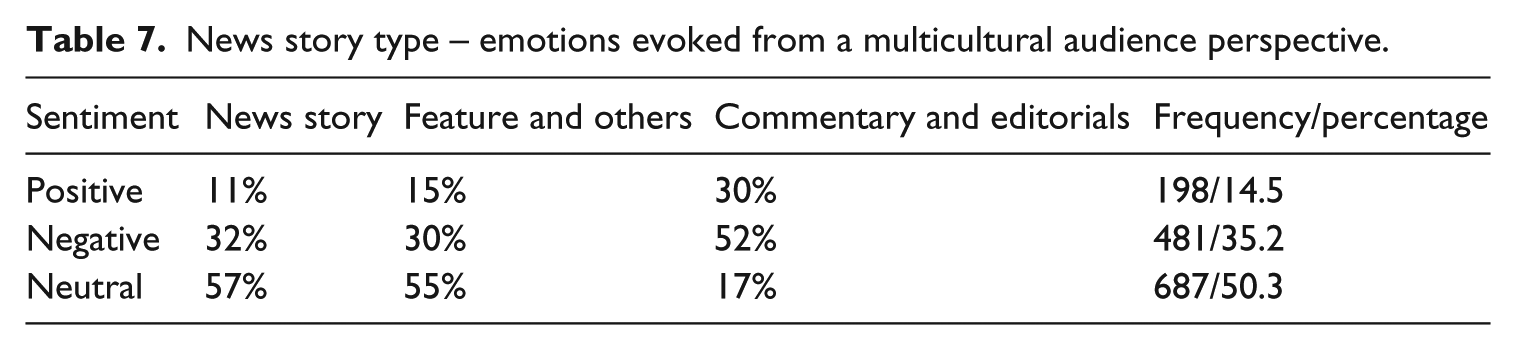
As mentioned, two coders read each story to ascertain if the story was ‘neutral’, ‘negative’ or ‘positive’. The news stories were read from the perspective of readers from culturally diverse backgrounds. We found the number of headlines evoking negative sentiments against individual/s from culturally diverse backgrounds were 28.4 per cent (Table 5), while the text of a story evoking negative sentiments against person/s of culturally diverse background increased to 35.2 per cent (Table 6). This is despite our sample containing 80 per cent of stories that were expected to be straight reporting of events or issues. Although cumulatively the news reporting of these events and issues is marginally negative and single sourced, a majority of editorials and commentary pieces seem to evoke negative emotions against people from culturally diverse backgrounds (Table 7).
Headlines – emotions evoked from a multicultural audience perspective.
News story text – emotions evoked from a multicultural audience perspective.
News story type – emotions evoked from a multicultural audience perspective.
Social media conversation analysis and discussion
A 2015–2016 survey found at least 20 per cent of audiences considered social media as their main source of news and about 40 per cent of Australians born overseas consumed news on social media platforms, along with other non-mainstream online news sources (Rodrigues and Paradies, 2017). Consequently, we investigated Australian social media conversations to gauge views when discussing the six events/issues. Using a multi-university resource for studying Australian public social media behaviour, Tracking Infrastructure for Social Media Analysis (TrISMA, 2016), we examined how Australian Twitter accounts discussed these topics publicly in the same period (September 2016–March 2017).
We collated a list of popular hashtags in tweets about the events and issues of interest. Some hashtags were event or issue specific, for example, #bourkestreet, #trumpban. Others covered general concepts, so we focussed on their use over the entire period, for example, #humanrights, #refugees. The most prominent hashtags, which had significant peaks and consistent use, were #humanrights, #immigration, #refugees, #muslim, #muslims and #racism (Figure 1). Other hashtags were not as prominent and were omitted from this graph, but they were included in our review of the discussions’ sentiments. These included #islam, #islamaphobia, #radicalislam, #reclaimaustralia and #terrorism (Figure 2). In total, we sampled 238,971 tweets from over 29,000 accounts.
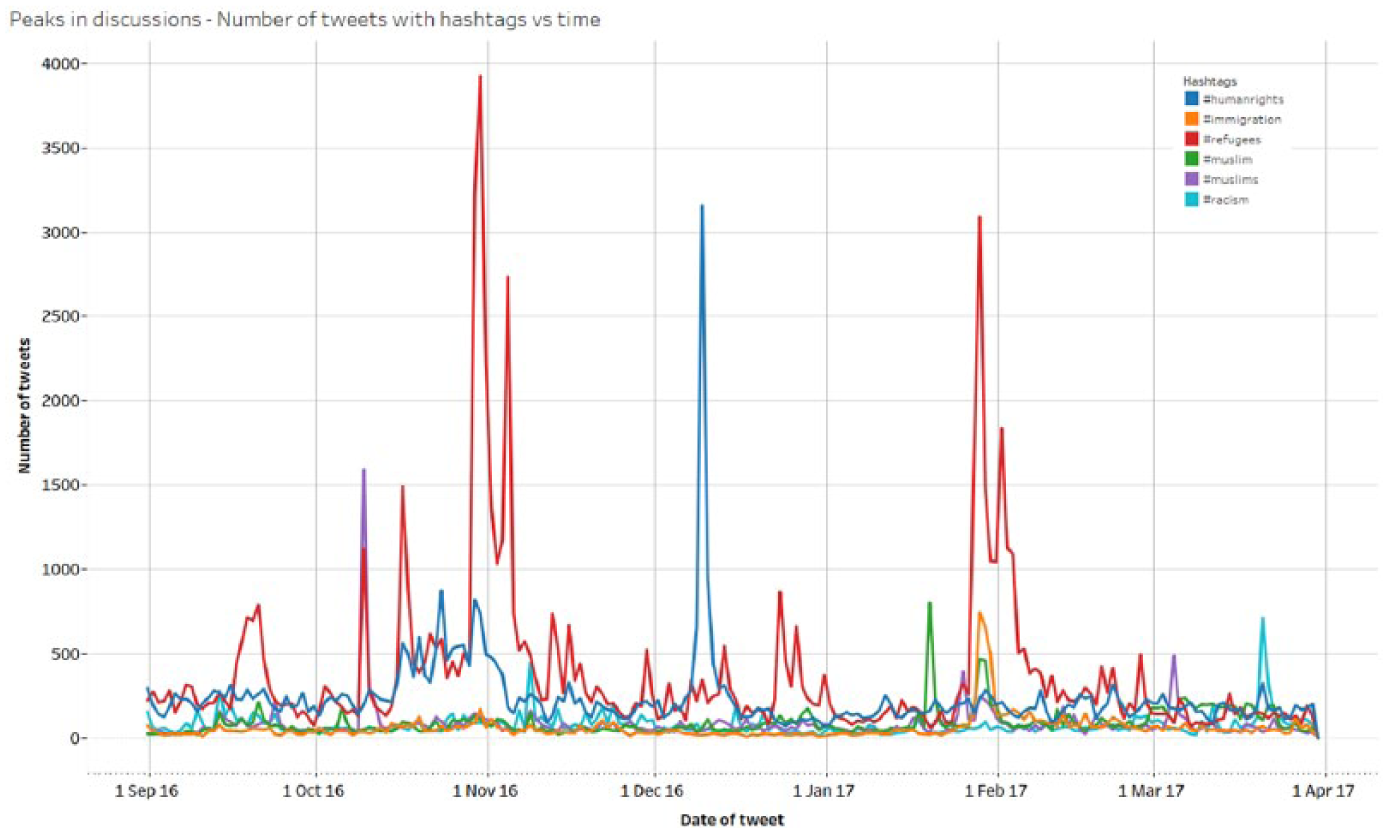
Overall data and peaks of hashtag tweets.
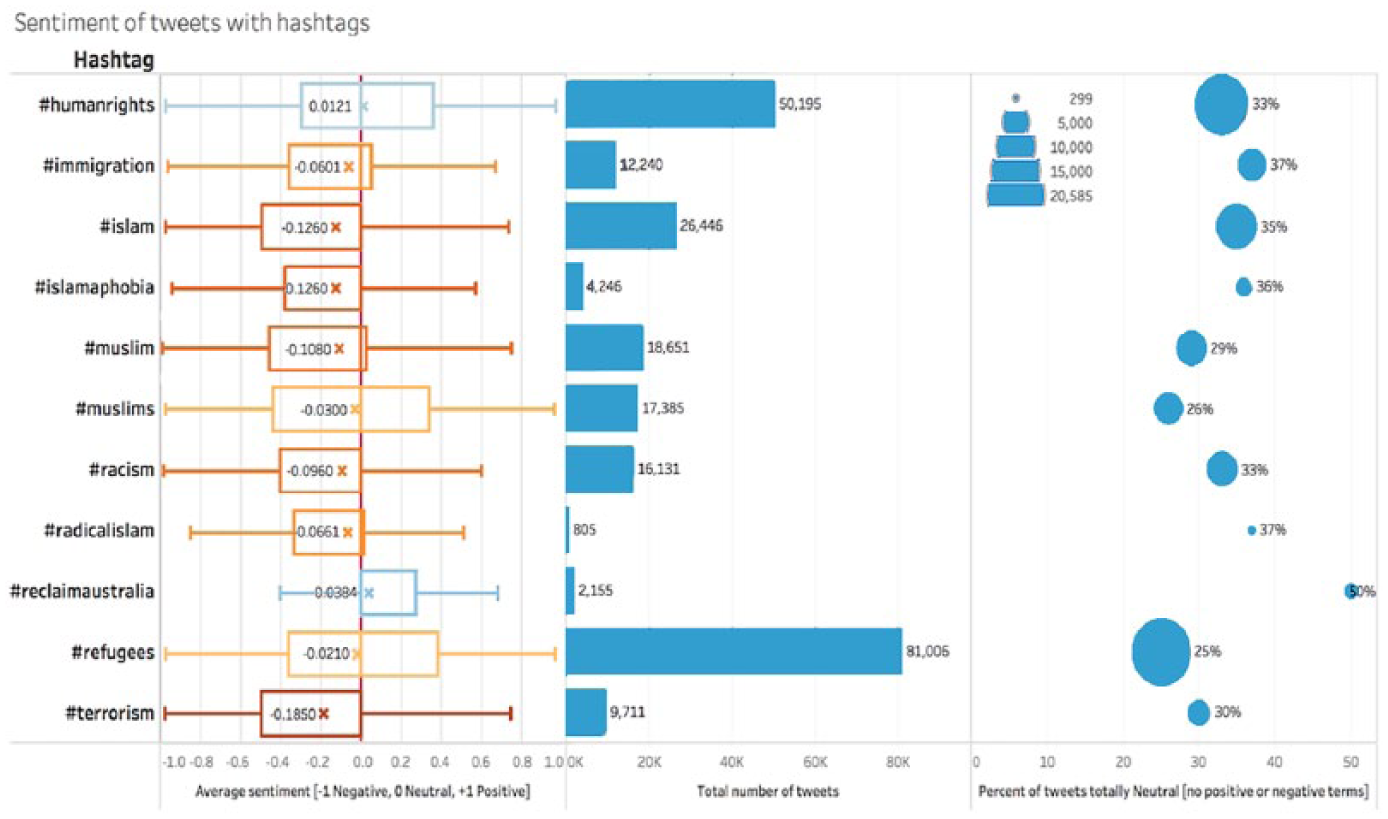
Sentiment analysis by VADER software.
The mainstream media coverage of breaking news events coincided with the conversation peaks around some hashtags of interest. For example, #refugees tweets peaked early November and early February, presumably due to related news stories. Around 30 October 2016, most media outlets, notably The Australian, reported Prime Minister Malcolm Turnbull saying asylum seekers on Manus Island and Nauru would never come to Australia. Again, the #refugees hashtag peaked around 30January when US President Trump’s refugee ban story gained currency. The #humanrights peaked when Mr Turnbull announced that Triggs’ term would not be extended beyond the end of her contract in 2017. In November, various commercial media covered stories related to 18C and human rights, including speculations about Triggs’ tenure. A low hum of conversations around #muslim, #muslims and #racism continued during the 6-month period.
We conducted a sentiment analysis of the Twitter conversations collected for the study. Using VADER (Valence Aware Dictionary and sEntiment Reasoner) sentiment detection software (Hutto and Gilbert, 2014), our quantitative study analysed how ‘positive’ or ‘negative’ the sentiments of the social media discussions were when using the popular hashtags around our selected events/issues. VADER assigns each tweet a sentiment score based on whether it included what VADER considered positive or negative terms, each score ranging between 1 and −1. A tweet without such terms has a zero score, having a ‘neutral’ sentiment. These scores may also reflect the author’s attitude towards the issue. The overall score for each hashtag discussion is the average sentiment score for all tweets included in the hashtag. Shared hashtag tweets (retweets) were treated as part of the discussion.
This showed an interesting pattern (Figure 2), where ‘positive’ and ‘negative’ emotions largely cancelled each other out. The average discussion sentiment scores (Xs in the box-and-whisker plots in Figure 2) ranged between −0.19 and 0.04 with a mean of 0.0698, a ‘slightly negative’ overall score for all discussions. Individual tweets averaged −0.0861 but 30 per cent of all hashtag tweets were ‘neutral’ or zero, regardless of the issue discussed, with the mode and median of zero. Looking at the average sentiment scores for individual discussions, the extended conversations around #humanrights and #refugees were particularly ‘neutral’. The conversations for #islam, #muslim and #racism hashtags were more ‘negative’ in nature than ‘positive’.
Approximately 81,000 tweets contained #refugees, whereas about 50,000 tweets contained #humanrights. Hashtags #radicalislam and #reclaimaustralia were not extensively used but at least one-third of their tweets were scored ‘neutral’, which is interesting because #reclaimaustralia can refer to an anti-Muslim far-right Australian nationalist group or a popular Australian indigenous hip-hop duo’s album released in November 2016. Tweets mentioning #terrorism were most ‘negative’, suggesting that people are least likely to be saying positive things when discussing that topic. However, VADER regarded 30 per cent of #terrorism tweets to be neutral.
Since the VADER software was not developed with these specific tweets as a benchmark, there was no guarantee (1) it would identify the human language nuance expressed in the discussions, and (2) the tweet’s sentiment corresponded to the author’s views towards the topics considered. To verify the accuracy of the VADER results, we compared the results provided by the software with a human annotated stratified sample of these hashtag tweets. A human annotator assigned 0.2 per cent of the total data (496 tweets) to one of six categories (very positive, slightly positive, neutral, slightly negative, very negative and ambiguous) according to their sentiment. The annotator was not aware of any tweet’s VADER scores. We similarly grouped the VADER scores into five buckets were associated with five of the annotation categories (the sixth ‘ambiguous’ category was regarded ‘neutral’).
Comparing how many tweets’ VADER buckets matched their annotation categories found that over 75 per cent of the tweets matched or were one category away from their bucket. Only 15 per cent had different polarities in their bucket and category. Looking solely at the bucket and category polarities, how many tweets were ‘positive’, ‘negative’ and ‘neutral’ was recounted (Table 8). This suggests the difference between buckets and categories is mainly because some tweets in the VADER ‘neutral’ bucket were annotated in a ‘negative’ category. While VADER seems good at recognising tweets ‘positive’ towards a topic, it may have issues recognising some nuances that indicate a tweet’s negativity towards a topic, due to its reliance on a list of terms it regards as commonly indicating ‘negative’ sentiments.
Sentiment polarity of tweets in buckets and categories.
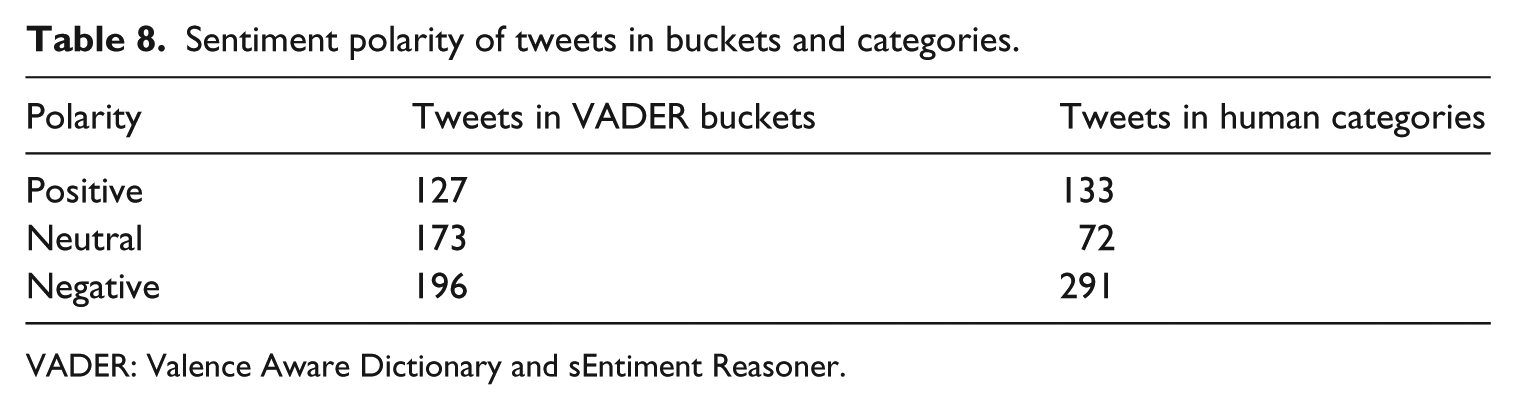
VADER: Valence Aware Dictionary and sEntiment Reasoner.
Insights from the two content analyses outcomes
Conversations around strategies to enhance social cohesion are often inhibited by the perceived role of the media. Stakeholders in the conversation either lament the media over inadequate coverage, or feel unable to influence a more diverse and balanced coverage of events and issues. For instance, a similar conversation occurred both in offline and online spheres when Channel 7 reported the case of Elaine French, twice robbed by black youths in 2017. The media reporting criticised for casting ‘unfair slur on all African Australians’ and creating ‘unnecessary fear in the broader community’ (Nyuon, 2018b). However, is this kind of generalised coverage a once-off, or is there a pattern in how the Australian media cover news events/issues involving minority communities? The sense of helplessness against the media also extends to conversations taking place on social media platforms, where the polarisation of views impacts on individuals who speak out for or against racist news coverage (Nyuon, 2018a).
The two content analyses that formed the basis for this study provide insights into the media’s messages and conversations circulating in the Australian public sphere when significant events and issues relating to minority populations become news. The study outcomes are analysed using Hall’s encoding/decoding communication model to understand why audiences from minority communities may reject mainstream media messages (Rodrigues and Paradies, 2017) for being ‘unfair’ (Nyuon, 2018b) and adversely impacting on social cohesion in Australian society (Schemer, 2014). In the content analysis, we examined news coverage of six events and issues for a 6-month period between September 2016 and March 2017. Of the 1366 stories collected from mainstream media online sites, about 80 per cent were news stories, about 4 per cent as features, and about 16 per cent were commentaries and editorials. The category most negative (nearly 52%) in portraying a culturally diverse or minority community was ‘commentaries and editorials’, followed by news (32%) and features (30%). In the news category, the majority (57%) received neutral coverage, similar to features and analysis category where 55 per cent were classified as neutral, but only 17 per cent of editorials and commentary pieces were neutral. Overall, in all three categories, about 14.5 per cent of the news content reflected a positive view of minority communities, whereas 35.2 per cent of news media content portrayed these communities in negative light. Although no attempt was made to edit the sample of prominent news stories published by each media outlet, it is not surprising the Muslim community featured in a bulk of these news stories. We contend that political articulations and discourse on some media platforms, such as talk-back radio and commentaries, linking the threat of terrorism and violence with the religion of Islam are partly responsible for the heightened coverage of these events and issues.
Journalists may assume they are merely reporting or commenting on controversial news stories, but our news analysis shows that a significant number of stories lack balance in terms of providing different view to those of government sources. For all events and issues chosen for this study – 18C, Islam, Trump’s refugee ban, Bourke Street attack, London terror attack and youth crime – a significant proportion of reporting is based on reporter observations and government sources, with only a quarter including another views of a culturally diverse representative or an expert, demonstrating an unbalanced approach. From the viewpoint of audiences from culturally diverse backgrounds, a third of the news stories seem to evoke ‘negative’ emotions with their headlines and the way stories report the relevant event/issue. In addition, some of the topics seem to receive extensive negative coverage, particularly Section 18C of the Racial Discrimination Act 1975 in The Australian. The two Australian public service broadcasters, ABC and SBS, have different milestones to achieve compared with The Age, the Herald Sun and The Australian. Table 3 shows that The Australian as the only national newspaper with right ideology leanings, focused heavily on the examination of the 18C issue, whereas the SBS as the multicultural public broadcaster focused on international news stories (Trump’s refugee ban and the London Terror attack of 22 March 2017). The ABC also provided extensive coverage to the Trump refugee ban story. The Age as the Melbourne-based masthead covered the Bourke Street attack story comprehensively, and also stories on ‘Islam’ as a religion. In contrast, the Herald Sun as a tabloid focused on the topic of youth crime.
Using Hall’s (1980) encoding/decoding model, one could explain the media coverage of these events and issues and how this coverage may be read by Australia’s multicultural population. The encoding of the news stories is influenced by the dominant ideology. We argue that this hegemonic viewpoint relates to how the dominant white Australian population perceives that their society is being impacted by the actions of minority or immigrant communities; while the minority communities may see the news as creating an ‘us’ and ‘them’ chasm in the broader community. The basic premise that underpins Hall’s model is that media content’s production and consumption are ideological processes (Calvert et al., 2007: 101). As a result, we need to read the news coverage from the audiences’ points-of-view, while considering how stories are produced. This study’s results support the commonly held belief among those sympathetic to culturally diverse populations in Australia, and the audiences from minority communities themselves, that the media is biased in reporting news events and issues that impact multicultural Australia (Nyuon, 2018a, 2018b).
When viewed from the perspective of a reader from a culturally diverse background, news stories, particularly editorials and commentaries, seem to convey a message of ‘otherness’. These stories either position members of minority groups as not following Australian norms and values, or as a threat that attack/harm the majority. A number of headlines and the text of the news commentaries continue to preference the hegemonic viewpoint in Australian society, that is, that new immigrants or residents are not Australian enough and are a burden on the country. Hall says (in Calvert et al., 2007) that journalists use society’s dominant ideologies via the routines of production process, professional ideologies of the encoder and wider socio-cultural and political agendas and events. However, a member of the audience consumes/decodes the news either exactly the way it is encoded (as the preferred reading), or in part as it is encoded, or by taking an oppositional position to the intended meaning of the message. This explains why audiences from culturally diverse backgrounds are not only seeking news through multiple sources including social media, online and personal networks, but also ignore the mainstream media because of a lack of trust (Rodrigues and Paradies, 2017).
Mainstream new media in Australia, however, is only one source of news for audiences today, with a diminishing reach. Instant messaging and communications on social media are a primary source of news for many (Rodrigues and Paradies, 2017). Social media platforms such as Twitter are tools of ‘ambient journalism’, where millions of people communicate instantly like, share and discuss news events, express their views on current events and issues and in turn produce small pieces of content that can collectively be considered journalism (Hermida, 2010). For each of the six events/issues being studied, we identified relevant hashtags in tweets discussing related news events/issues. When we examine this social media sphere, the discourse is divisive or balanced depending on how one perceives it. About 25–30 per cent of the Twitter conversations were classified as having ‘neutral’ sentiments, while the rest were divided between negative and positive sentiments. The analysis of 238,971 tweets from over 29,000 accounts showed the overall tenor of the discussions as ‘slightly negative’ to ‘negative’.
Because of the amount of Twitter data obtained, we used automated sentiment detection software to analyse tweets for ‘negative’, ‘positive’ and ‘neutral’ sentiments. For hashtags such as #refugees, the software showed that the overall negative and positive sentiments in the tweets balanced out to produce near neutral discussions, whereas discussions using hashtags such as #Islam, #terorrism and #Islamaphobia had negative sentiments. To examine the accuracy of this automated sentiment analysis, we compared the results to a sample (0.2%) of tweets that was manually coded. While most of the identified sentiments matched, about 20 per cent of the tweets compared were considered ‘negative’ by the human annotator when the software regarded them as ‘neutral’. As a result, we consider the Twitter conversations studied to be ‘slightly negative’ to ‘negative’ in nature when discussing events/issues pertaining to minority communities.
However, the Twittersphere remains a dynamic space for audiences to add their small content to what is making news. The interventionist and interpretative capacity of the Twittersphere allows audiences to decentralise the circulation of ideas and information, and offset the dominant-hegemonic voices of the political and media elites (Bødker, 2016). In addition, with the increased accessibility to a number of media platforms – mainstream news produced by journalists and social media networking apps available to whomever wishes to express themselves – audiences can decide to consume news on whichever platform they wish or become partners in the creation and distribution of news on social media. Audiences are increasingly choosing not to consume news that does not represent them and participating in news creation and dissemination on a platform where they can, thereby taking a preferred, negotiated or an oppositional position to dominant-hegemonic news messages (Bødker, 2016; Woodstock, 2016). However, the fragmentation of news audiences and their diverse news consumption platforms are increasingly producing a siloed view and understanding of other communities.
Conclusion
News is a human construction (Berkowitz, 1997). Journalists decide what makes news. They choose which events/issues to report on, how to report them, whom to interview and what to highlight in a news story. Journalists negotiate the socio-political world to find the information relevant to an event, what happened, and present the so-called verified facts in the most alluring way. The business imperative of the news-making process cannot ignore the fact that conflict-focused and personalised news is clicked on. Editors make choices on how to present the story to maximise its intrinsic news value to cater to their perceived target audience. In this article, we have presented the results of two content analyses to examine the media articulation of events and issues that intersect with the interests of majority and minority communities in Australia. Our empirical study’s main research question was as follow: How do current events and issues pertaining to multicultural Australia get covered in the mainstream media and discussed on social media? Our research found that there was a gap between how news about multicultural Australia is covered and how it may be read by audiences from culturally diverse backgrounds, particularly when over 35 per cent of the coverage was ‘negative’ and 25 per cent of coverage was based on a single source. On social media platforms, although various views are communicated and shared about these news topics, the overall tenor seems ‘slightly negative’ to ‘negative’ towards ethnic minorities.
With their editorials and commentary pieces, news editors provide their readers a glimpse into their stance on the issues such as freedom of speech and law-and-order situations in the community. However, when the weight of these opinions moves one way with 52 per cent of them being negative towards minority communities, the news editors need to take a note of the message they wish to convey to growing minority communities in Australia. Considering that over 49 per cent of Australian population has a culturally diverse background, it makes economic sense for the media to cover news events and issues pertaining to multicultural Australia in a more comprehensive and unbiased way. ‘For too long, the only interests and images the media reflected were those of middle-aged, middle-class white men’ (Spicer, 2017). Even in the public service broadcaster ABC’s board and senior executive team, the leadership positions have overwhelmingly been filled by individuals from Anglo background (Faruqi, 2016). Several international counterparts such as Sky UK have taken measures to increase cultural diversity in on-screen roles as well as in the senior management.
There have been efforts to intervene in the contemporary media landscape by offering alternative media by new immigrants to Australia. However, questions remain about the sustainability and ownership of alternative media created with the help of affordances offered by the new media technologies (Marjoribanks et al., 2018). We argue that a fairer representation of cultural diversity in the newsroom will enhance media organisations capacity to reach and understand current events/issues from the points-of-view of minority communities. This, in turn, will assist journalists to report news in a more comprehensive way by including a cultural context for a news event/an issue and seek views from a variety of sources.
Footnotes
Authors’ note
Michael Niemann is now affiliated with Monash University, Australia.
Funding
This research was supported by infrastructure provided through the Australian Research Council–funded project TrISMA: Tracking Infrastructure for Social Media Analysis (LIEF grant LE140100148). This study was also supported by a Social Cohesion Research Grant provided by the state government of Victoria, Australia; Special Broadcasting Service; and Ethnic Communities’ Council of Victoria.
