







Abstract
Foreign domestic workers from industrializing economies migrate to Singapore to feed its labor market, meeting the growing need for performing feminized labor. Although foreign domestic workers have been an integral part of Singaporean households since the 1970s, the presence of foreign domestic workers in contemporary public discourse remains eclipsed. However, the civil society landscape has witnessed increasing articulations and mobilization of civil society actors on the rights of foreign domestic workers, framing the problems experienced by foreign domestic workers in the language of rights. Given the role of mainstream media as a developmental structure in carrying out the information dissemination function of the state in predominantly economic terms that serve the pragmatic ideology of the state, how are foreign domestic workers constructed in mainstream media discourse? What do we learn from these constructions about the interplays of feminized labor, media discourse, civil society, and the state? The article examines the kinds of media frames present in the discussion and portrayal of foreign domestic workers using a mixed-methods approach.
Large-scale displacement of the poor and growing inequalities have contributed to the shifting of labor from global peripheries to high growth centers of production and exchange. This accelerated movement emerges amid the search for income, away from sources of rural livelihood to informal economies in the financial centers of the globe (Castles, 2009). Integral to neoliberal reforms in Asia is the outsourcing of domestic work, constituted in the backdrop of displacements of rural communities from their sources of livelihood. Domestic work constitutes a growing sector of the feminized neoliberal economy, often excluded from collective organizing and legal frameworks that protect worker rights and constrained within the private spaces of homes as sites of performing labor. Women from industrializing countries migrate to global growth centers in search of domestic work that is performed in the private sphere of households (Yeoh and Huang, 2007). Domestic work is constituted at the intersections of ideologies on gender and transnational labor, depicting the taken-for-granted assumptions about worker rights, and normative expectations on the division of labor. In Singapore, a key growth economy relies on the flow of foreign domestic workers (FDWs) to sustain economic production through their invisible labor in the informal and private spheres of households. In this context, empirical evidence documents the abuse of FDWs, the absence of labor rights of FDWs, and the vulnerabilities at work shaped by the invisible form of domestic labor. In the first quarter of 2014, the Humanitarian Organization for Migration Economics (HOME, 2015), a key civil society organization (CSO) that houses exploited and trafficked FDWs in Singapore, reported 405 distressed calls from FDWs to the organization’s help desk service. In 2014, Myanmar imposed a ban from recruiting their nationals for domestic work due to serious concerns regarding the mistreatment (Ghosh and Baker, 2014). Media discourses offer critical insight into the dominant public constructions of FDWs, amid the context of the vulnerabilities of domestic work, the absence of a rights-based framework, and the broader exploitative conditions experienced by FDWs (Hilsdon, 2003). These media discourses are constituted at the intersections of the competing and complementary agendas of the nation-state, civil society, employment agencies, and employers. In this article, we examine the media constructions of FDWs in The Straits Times, Singapore’s newspaper of record.
Migrant domestic work
Economic migration from the Global South to developed nations is often discussed as a globalization phenomenon benefiting the global poor with the provisions of better employment and economic opportunities (Castles, 2009). Within Asia, the movement of low-skilled/unskilled labor in the form of domestic and industrial work constitutes a key form of migration. Women from impoverished communities take up domestic work abroad in search of economic opportunities outside of their home countries. With more Singaporean women entering the waged workforce, the market for domestic workers has been thriving. Every year, there is a steady rise in domestic worker per household in the country (MOM, 2017). However, FDWs in Singapore are not covered under the employment act and this poses challenges for FDWs when working and resting within the confines of the employer’s home. Typically, the employment act guards a worker against unfair practices that include conditions and terms regarding employment, such as rest hours, days off, sick leave, and public holidays. Instead, FDWs are often hired through third-party agents that extract large debts from the workers in arranging for their arrival and employment to the country (Dutta and Kaur, 2016). Not being covered under the employment act also means that workers are not protected from exploitative practices by employers or agents during employment. Salaries fluctuate depending on the nationality of the worker (Marti, 2019). In this backdrop, we argue that the discourses around low-skilled migration are both reflective and constitutive of the practices, expectations, and demand for cheap foreign labor.
There are currently 239,700 FDWs employed in the country (MOM, 2017). Most FDWs hail from Philippines, Myanmar, Indonesia, India, Bangladesh, and Sri Lanka. The influx of FDWs to Singapore begun in the 1970s when there was a growing need for domestic work, arising from a greater number of Singaporean women entering the waged labor market (Anggraeni, 2006). Various studies have documented the insecurity of domestic work, particularly how vulnerable such labor is to dispensability (Silvey and Parreñas, 2019). Domestic work involves household-bound work that includes caregiving activities and domestic chores. The labor physically resides in the confines of the private space. In Singapore, FDWs are employed in one residential unit. There is no live out option. Therefore, not only do they work in the private space of their employer, but also they reside 24 hours in the employer’s private space, except on their day-off. Historically, such work has been viewed as unpaid work typically conducted by women. Therefore, in the formalization of the sector, the labor continues to be confined within the duties of the private sphere with little opportunity to empower wages and the profession. FDWs, therefore, are the embodiment of the subordinate position women hold as members of a family belonging to the private sphere, with little agency in negotiating equal access and treatment (Yeoh and Huang, 2007).
At a state level, these workers often receive little to no labor rights, further subordinating and erasing them from the public sphere (Parreñas, 2015). Workers are not privy to their labor rights and have little agency to articulate their voice in the public sphere, often residing within the domain of the private. An FDW negotiates an unsafe work environment, the discomfit of surveillance, and unregulated forms of punishment, sleep deprivation, undernourishment, and isolation (Dutta and Kaur-Gill, 2018). Furthermore, with the language of efficiency and productivity shaping the discourse on neoliberal labor reforms, unskilled workers residing in informal economies are often susceptible to poor protection, health, and labor. In the case of domestic work, exploitation is maintained by weak labor laws, poor remuneration, and working conditions (Dutta and Kaur, 2016).
However, in more recent literature, ‘transformative spaces’ for better rights of domestic workers have been found to emerge through the civil society agenda in Singapore (Bal, 2015). A growing focus on the welfare of FDWs is quickly starting to emerge as an entry point for dialogue in the public sphere. This is coupled with heavy criticisms from international organizations such as Human Rights Watch on the slate of abuses occurring in the city-state. This has received greater attention in the mediated public sphere, creating entry points for social change with pressures placed on the state by international actors (Yeoh and Huang, 2010).
Feminizing migrant work in Southeast Asia
The migration of workers to Southeast Asia has been taking place since the 19th century, but the feminization of migrant work began in the 1970s (Anggraeni, 2006). The emergence of gendered migrant work in Asia led to the shift in definitions of what such work entails. With the international flow of feminized work, gendered meanings intersect with the larger political, social, and economic structures. Therefore, the social concerns on domestic work have also shifted from previous understandings of female migrants. Lyons (2009) eludes that the feminization of transnational migration is associated with labor movements into the domestic service sector by women from the Global South. However, there is a significant lack of exact figures on the number of women who work globally as FDWs from various parts of the Global South. The absence of accurate figures signals the ambiguity of domestic workers as legitimate subjects of statistical knowledge, which works toward effectively erasing their collective and individual identities.
Media discourses on FDWs
The literature points to an absence of workers’ voices from dominant national discourses such as in political, media, and civil society spheres (McVittie and Goodall, 2009). Produced and run by elite and powerful actors, media discourses and representations play significant roles in the production of knowledge, and in the reification of power structures in influencing public opinion (Chomsky, 1982). Hall (1997) suggests that power is very much embedded in media representations, actively constituting itself in messages that reflect the larger power structures in society. Therefore, it is critical to examine the inclusion and exclusion of mediated narratives in the mainstream press that shape discourses for the powerful.
FDWs are rendered invisible laborers in the discursive space and are erased through representations and nonrepresentations in the sphere of the media (Macpanthong and McDaniel, 2011). Gomes (2011) critically examines the cinematic portrayal of an FDW, where the visuals symbolically depicts the FDWs arrival to Singapore as one of identity erasure, where her passport is immediately taken away from her, and only returned to her when she leaves. The prosaic object illustrated in the film symbolized the reclamation of the FDW’s identity when she returns to her home country. This experience is one of identity erasure an everyday lived reality of FDWs in Singapore.
Political leadership in Singapore through co-optive practices and auto-regulation have ‘media managed’ its citizens into behaving in accordance to what is considered appropriate practices of acquiescence in society. Mcnair (2017) coined ‘media management’ as a way in which the state operates, shapes, and pressures media organizations to align with the government’s political perspectives. Co-optive practices of the media refer to the ways authoritarian states co-opt public media institutions by adopting a variety of strategies (legal, political, and social) to retain political stronghold (Lee and Lee, 2019). This may not always entail the use of repressive laws, but through sophistry in governmentality by ‘convincing the citizenry to consent the suppression of their own socio-cultural and political freedom’ (Lee and Lee, 2019: 1). Similarly, auto-regulation of media management in Singapore is conceptualized as how power and control come to function in automated ways. The concept of automation genealogical takes roots in the work of Foucault’s (2012) Panopticon, with Lee (2010) adopting auto-regulation as ‘the art of governmentality’ (p. 88) in how information is controlled and regulated through systematic trials and steps until cultural control is successfully reached. Lee (2010) suggests these to be in the form of oblique policies and laws regulating in what might be contested spaces such as the Internet and the media, disciplining citizens into conducting themselves according to state obligations.
Hilsdon (2003) analyzed media portrayals of FDWs in Singapore and found that media and nationalist discourses were interwoven with the media functioning as a developmental press model. This model of information dissemination is justified by the state as necessary for the purposes of nation-building (Sim, 2006). Hilsdon (2003) research examined media portrayals of an FDW hung for murder in Singapore, uncovering the differences in press agenda, and media constructions between Singapore and the Philippines. Reifying the narrative constructed by the state, the Singapore media indicted her as a murderer, while the media in the Philippines projected her as an exploited and vulnerable FDW that was an unfortunate victim of Singapore’s criminal justice system. Hilsdon (2003) suggested that the journalistic agenda of Singapore’s press is shaped with an emphasis on nation-building, reifying consensus among the citizenry, preventing the erosion of any values that serve to shake the national discourse on economic development. This premise fails to interrogate alternative realities that threaten the hegemonic discourse of neoliberalism permeating the mediated public sphere. The stories of violence against FDWs were removed from mass media narratives to give way to the reinforcement of state sovereignty and legitimacy, silencing accounts of violence against FDWs in the country. Part of the problem is the lack of sustained media coverage of FDWs and their plight (Anggraeni, 2006). Hilsdon (2003) argues that despite the ‘open’ transnational space the media occupies, it is still a discursively regulated space by industries, national governments, and citizenry. Migrants and their voices are generally absent from discursive spaces where national policies are deliberated and discussed. A holistic and transparent picture from the media has been lacking in Asia.
Furthermore, the international discourse has asserted the identities of Filipina domestic workers as caregivers in the discourse on globalization and migration, where Filipina women make up a large section of FDWs globally while also conducting transnational mothering (Hilsdon, 2003). In addition, Filipina women are also vulnerable to the sexual exploitation that when conducting domestic work. This is argued to have been buttressed by global media advertising, legitimizing Filipinas as sexual servants or prostitutes, feeding into the larger narratives of the subordinate position Filipina women hold as migrant workers. Vaginal economy, referring to a segment of the Philippine’s economy was first coined by a Filipino column writer in reference to the over-sexualization of FDWs across Asia. Tolentino (2011) defines the vaginal economy as a term that refers to the female sex as the primary instrument of national development and is characterized by the massive deployment of overseas contract workers (as much as two-thirds are women), the greater sexualization of female domestic labor (sex work and trafficking as an extreme yet common feature; pigeonholed in jobs that are a domestic, degrading and demeaning. (p. 97)
Tolentino (2011) further explicates the ‘triple-feminizing’ of female labor by highlighting the dialectical tensions of having to be the breadwinning yet absent mother, having to conduct transnational mothering, and subjects of transnational economy of emotion and devotion. A worker’s national identity is embedded within a state’s economic flow, with Filipina women’s national identity constructed through the feminized economic flow of Filipina women (Mckay, 2011).
The current literature surfaces many underlying misrepresentations of FDWs working in Asia, reinforcing intersectional violence on the bodies of FDWs informing the need to examine how the mainstream media reifies consensus with the structure on FDWs. Mediated misrepresentations and erasures are publicly consumed, and more importantly, they are set in the backdrop of policies that impact the lives of migrants. There is a need for further literature to study how FDWs are first depicted in national discourses, how their voices are represented, and if the rights’ framework is reflective and represented in the mediated public sphere. Therefore, we ask what discourses are absent and present in shaping the representations of FDWs in mainstream media discourse in Singapore?
Method
We specifically examined the media discourse in The Straits Times, the mainstream press, publicly listed under the Singapore Press Holdings (SPH). Singapore’s media is a duopoly made up of the SPH and Mediacorp owned by the investment arm of the government (Wu, 2018). With the passing of the 1974 Newspaper and Printing Presses Act (NPPA), news production organizations had to transfigure to public ownership. Funding for newspapers could only be obtained based on state approval. Furthermore, only Singaporeans and corporations approved by the government were deemed eligible to hold management shares, which controlled editorial policy. A percentage of management shares was required to be held by government-controlled companies, which placed representatives on their boards of directors and at the heads of their executive committees. (Edge, 2014: 261)
The SPH chairman has both in the past and currently been managed by top civil servants including two past presidents. In 2019, Lee Boon Yang serves as Chairman who was previously Minister in various positions for the government (Singapore Press Holdings, 2019). Media scholars have long criticized the consolidation of power as strategic deployment of ‘calibrated coercion’ in the production and consumption of the news (George, 2007; Edge, 2014), where the state exerts various elements of control and power through methods that guide the news in a direction that complements state policies.
For example, by publicly listing the SPH, new production is positioned from the point of view of profits that are directly linked to the stability of the economy as a key consideration (Kaur et al., 2016). Therefore, fundamentally, the production and consumption of the news are anchored in the delivery of print media for the purposes of nation-building in relation to economic goals and discarding ideals of Western media as a central category for checks and balances of dominant groups (Bokhorst-Heng, 2002). The paper remains the key news provider on Singapore issues.
For this study, The Straits Times was searched for all articles on domestic work via the Factiva database. We used several search terms including ‘domestic work’, ‘maid’, ‘domestic help’, and ‘foreign domestic worker’ to identify the relevant articles. After running many searches, combining lists of articles, and eliminating articles that were not relevant, we collected and examined 200 news articles published in The Straits Times over a 1-year period from June 2012 to March 2013. We included all articles both in print form and those published online. These came from a variety of sections, including hard news stories, op-ed pieces, and letters, reflecting various authorial voices. During this period, there were 70 articles from the members of public to the press pertaining to FDW issues, explaining the frequency of occurrence of codes such as Voice of Employer and Local Voices (Table 1). Within this period, the day-off policy was extensively debated before finally passing the policy on the mandatory day-off in January 2013 (Koh et al., 2017). It, therefore, becomes critical to examine the portrayal of FDWs in published articles to illuminate the discursive environment in which public perceptions of FDWs are situated.
Frequency of occurrence (N) of variables in Singapore’s The Straits Times.
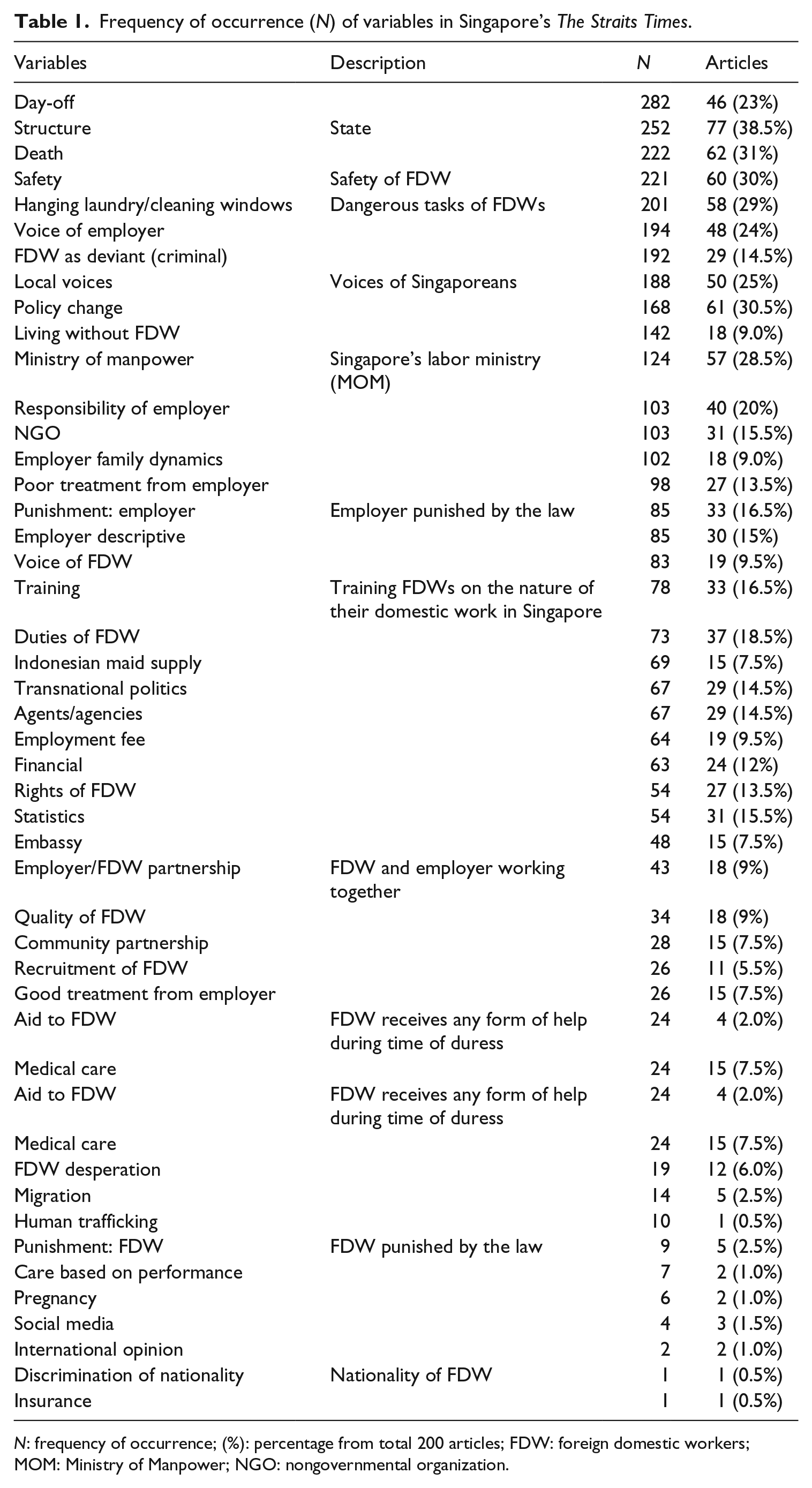
N: frequency of occurrence; (%): percentage from total 200 articles; FDW: foreign domestic workers; MOM: Ministry of Manpower; NGO: nongovernmental organization.
News consumption is unique in Singapore because it is one of the few places where traditional newspapers still have a large circulation (George, 2012). Mainstream newspapers have been critiqued by media scholars such as George (2012), Sim (2006), and Lee (2010) for the state having strong influence and control over the media to reify ideological assent among its citizenry. It was reported that readership was at an all-time high in 2013 with circulation numbers up to 389,700 including digital subscriptions (Singapore Press Holdings, 2013). In 2012, the incline toward digital subscription for The Straits Times was noted, despite a slight dip in circulation numbers from the previous year. The newspaper reaches almost 32 percent of the population through print and digital means (Lai, 2014). In addition, readers of the newspaper typically tend to make up the higher income segments; the segment that is more likely to employ domestic workers in their homes (Lai, 2014). The revenue streams of SPH in 2012 was on an incline at S$1,272,913 (operating revenue) with a profit of S$410,242. Display advertisements in print newspapers continue to be a key part of the revenue growth (property and transport sector ads; Singapore Press Holdings, 2012). On advertisements referring to FDWs in the newspaper, a database search on NewspapersSG a local repository of all newspaper collections including advertisement columns of the newspaper, indicated that there were altogether 1242 advertisements.
Data analysis
We applied a mixed-method approach to analyzing the data from the 200 news articles to first inductively identify the themes, and then to conduct a content analysis to examine the frequency of the different themes. Due to the exploratory nature of the study, the first phase involved a grounded theory approach (Strauss and Corbin, 1990) to identify themes and frames relevant to the topic. The use of a content analysis can provide significant insight into how communities are represented in the media and provide some basis for speaking about key discourses circulating in society (Lasswell and Leites, 1965). To identify key conceptual categories for content analysis, three coders used open coding to analyze all news articles. After the initial open coding of the media texts, axial coding was used to relate the codes within and among the categories. The same coders coded the remaining articles. Finally, the codes were narrowed down through selective coding for quantifiable units-by-variable measures. Through this iterative process of open, axial, and selective coding applied to the data, we came up with 45 categories. Following the development of the 45 categories through the qualitative analysis, we then coded the 200 news articles for the presence of the categories. The first 10 percent of 200 articles (20 news articles) were coded by two coders for inter-reliability, reaching consensus on an acceptability of a kappa agreement at .972 (Lombard et al., 2002).
The second phase of analysis was a quantitative approach to examine the frequency of themes that were identified in the first stage (Table 1). To decipher patterns and to examine the co-existence of variables, a hierarchical cluster analysis using Ward’s method was conducted on the 45 variables (Table 2). Four frames were emerged: safety and security; recruitment and finance; policy; and relationships. Finally, Pearson correlation was carried out for the test of significance within the cluster variables. The quantitative analysis was supported by qualitative analysis of the print content as presented below, iteratively comparing the narratives with the quantitative results.
Cluster analysis of variables.
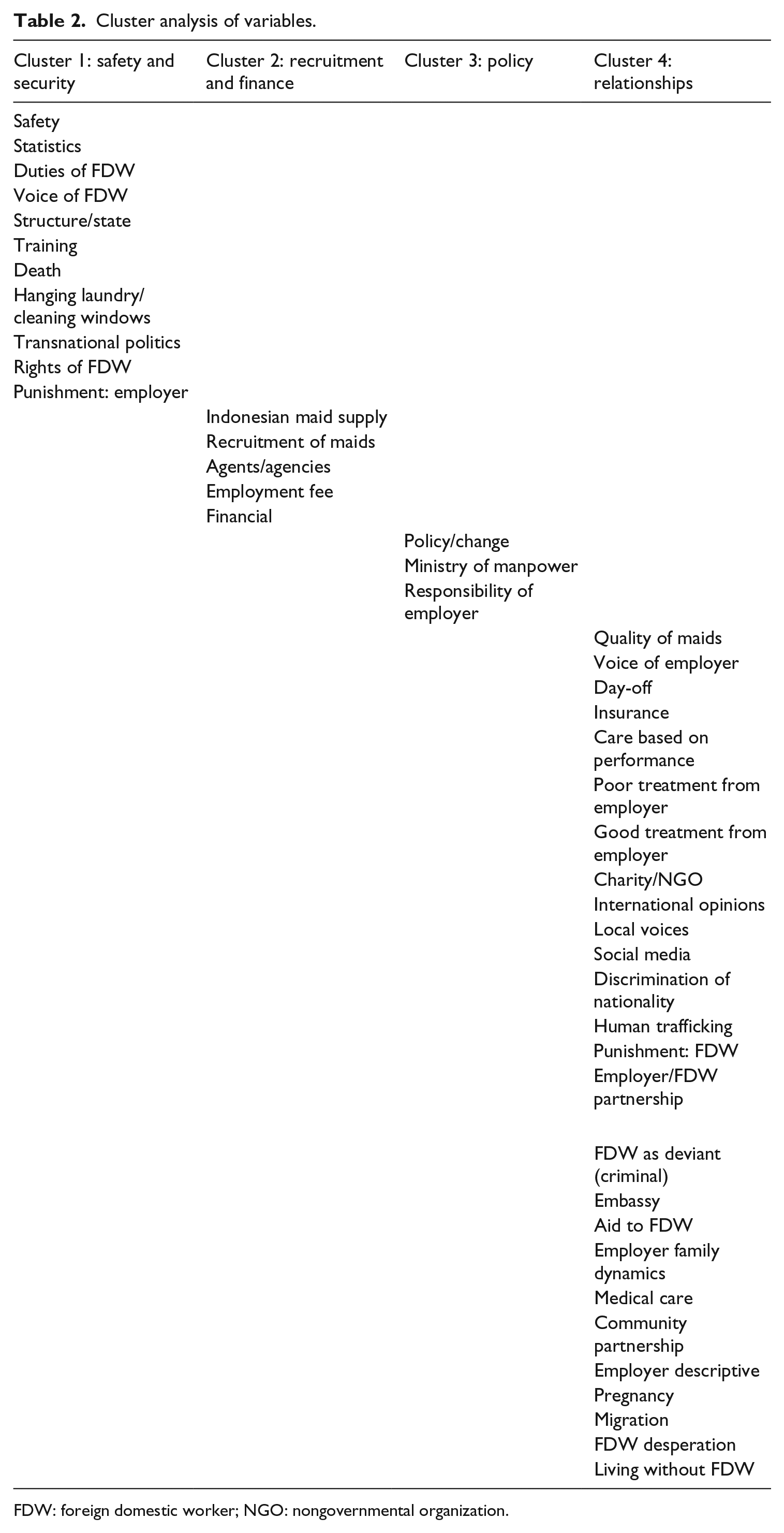
FDW: foreign domestic worker; NGO: nongovernmental organization.
Results
The frequency count of the 45 themes that appeared in The Straits Times is presented in Table 1. News stories that have frequent occurrence include day-off for domestic workers that appeared 282 times in 46 articles, structure that appeared 252 times in 77 articles, death 222 times in 62 articles, and safety issues, 221 times from 60 articles. The themes in the news discourse worked together in constructing a context for conversations that represented the goals of policy makers (Ministry of Manpower – MOM), CSOs (HOME, Transient Workers Count Too, Singapore Committee for UN Women), and employers. In almost all news stories, voices of FDWs remained erased.
For instance, deaths of FDWs are discussed in relation to FDWs that partake in dangerous chores such as hanging laundry or cleaning windows, which often result in falls from high-rise buildings, and subsequent death. These two chores are considered high-risk chores because most housing in Singapore are high-rise estates. Engaging in these types of chores have caused several deaths of FDWs in Singapore. This led to a significant discussion in the news about safety implications, banning the performance of such chores, and finally a policy implementation on the ban of FDWs from partaking in such chores. Employers were also held responsible if an FDW falls to her death while conducting these chores.
This led to significant articulations in the news by local voices and voice of employers, often in the form of forum letters to speak against the change in policy or the deliberation of such a policy. For example, numerous letters were written in complaining about the new policy on The Straits Times Forum (where public opinion is published) ‘to insist on a ban on maids cleaning windows is an emotional knee-jerk response. If safety is the consideration, then the ban should include everyone, regardless of whether they are Singaporeans or foreigners’ (‘Maids play crucial role too’, 2012, ST Forum section, para. 6). With news stories actively discussing the spate of FDW deaths from falls, it explains the higher frequency of codes discussing issues concerning the death and the implications and action required to keep such deaths to a minimum.
Composition of frames
To understand the broader discursive frameworks underlying the 45 themes identified through the grounded theory method, we conducted a hierarchical cluster analysis using Ward’s method (see Table 2). Four clusters were emerged: (a) safety and security of FDWs, (b) recruitment and financing of FDWs, (c) policy, and (d) relationships.
The safety and security cluster comprised themes relating to safety of FDWs when living in high-rise homes, statistics about FDWs, duties of FDWs, voices of FDWs, structure (relating to the state institutions and their voice on matters pertaining to FDWs), training (referring to training FDWs on their job scope), death, hanging laundry or cleaning window, transnational politics (the international political issues on FDW management between Singapore and the country of origin where these workers come from), rights of FDWs, and punishment of employers (errant employers flouting regulations). In other words, the cluster informs us that the news carried by the newspaper often reported everyday chores of FDWs such as having to hang laundry or clean windows in high-rise buildings that resulted in deaths, which significantly adds to statistical reference. The number of deaths resulting from high-rise household chores contributed to the involvement of source countries such as the Philippines in policy advocacy to ensure Singapore was taking adequate measures in ensuring such falls did not happen, hence the reference to transnational politics on domestic work.
Voices of FDWs in the reporting of the news are often rendered absent, and when they are represented, they are often quoted to reinforce FDW policies set by the state. For example, on the policies pertaining to safety, an FDW is interviewed on how she would manage to negotiate safe practices in the home, asked what she would do if her employer wanted her to do something in an unsafe way, she said: ‘I’d say sorry politely and say that I have to do it the proper way’ (Chuan, 2012). Also, important in this frame is the punishment of employers due to neglect or for allocating tasks to the domestic worker to partake in risky household chores. Training of FDWs when they arrive on such workplace hazards was the suggested solution, which fits within the safety and security frame. News stories discussed training and employer responsibility in keeping such accidents to a minimum. This theme places the employer at the forefront of keeping the FDW safe and situates the employer as having the power to do so: While Singaporeans might feel safe in their own homes, they must not take anything for granted when employing someone more used to a village setting. High-rise homes with modern conveniences are full of hazards, and maids who might be meek by nature or struggling with a new will require considerable guidance . . . But given the typical background of maids, employers ought to bear the main responsibility for ensuring that the home is accident-free. Those who think otherwise should ask themselves whether they subliminally regard the lives of maids as cheap. (‘Taking maids’ death falls personally’, 2012 April 11, Editorial section, para. 2)
Such excerpts remind employers to think about the environment the FDW originates from, so it is the employer’s responsibility in ensuring a safe and secure environment for the FDW. It also advises employers to value the lives of FDWs and not to treat them as bought commodities.
In addition, there is a call from CSOs to deal with FDW issues for the punishment of those employers who do not act on their responsibility in keeping their FDWs safe. The news, in citing civil society actors, frames this as an issue of social concern that must be addressed by all employers, and also in reinforcing government regulation on employers who flout it: Migrant workers group had pushed for a ban on cleaning windows, said MOM had ‘reacted in a positive way’. ‘But we still feel a total ban will be a more effective way to deal with the situation’, said Home president Bridget Tan. (Tan, 2012 June 5, Prime news section, para 11–12)
Further analysis showed positive correlation between safety and training (r (198) = .450, p < .01), and between safety and responsibility of employer (r (198) = .476, p < .01). Given the number of worker deaths that took place because of falls from high-rise buildings, the safety and security cluster depicts the discursive response to this context. Moreover, the emphasis on training and employer responsibility in media discourse depicts the government response as outlined in the MOM regulations.
The recruitment and finance cluster (Table 2) is focused mainly on financial obligations involved in recruiting FDWs through agents or agencies. One of the major regulation discrepancies that encapsulate the relationship between recruitment, agencies, and fees for employment is the placement fee enacted by the agency: Employers will no longer need to make a hefty upfront payment of about $3000 in placement fees, which is recovered by deducting it gradually from the maid’s salary in the first year of her contract. Instead, these fees, which pay for costs like training, will be financed by bank loans given to the maids back home. But the one-time agency fee of $400 to $600, which covers the cost of advice given to employers, will go up, with agencies estimating it to be from $1200 to $1600. The hike is linked to a lowering of the placement fee to about $1600 for maids with no experience, and about $800 for those with experience. (Tan, 2012 April 5, Singapore section, para 3–4)
Agents and agencies play an important role in the relationship between FDWs and employers because they serve as a gatekeeper regarding deductions for FDWs as well as in setting the financial obligations of the employer. Transparency on deductions is often not existent. This theme identifies the process of recruitment and placement payment and locates it in the hands of the agency. Further analysis confirmed a strong correlation between Indonesian maid supply (IMS) and recruitment of maids, r (198) = .859, p < .01, IMS and agents/agencies, r (198) = .657, p < .01, and IMS and fee for employment, r (198) = .665, p < .01. Other positive associations existed between recruitment of maids and fee for employment and recruitment of maids and agents/agencies. There are many discrepancies about the fees enacted during recruitment processes, and the recruitment and finance cluster illuminates the interplay between agencies and recruitment financial practices and depicts the agency’s control in setting those fees.
The policy cluster consists of policy or change relating to FDWs, MOM, and the responsibility of the employer. This policy-based frame is quite straightforward in the sense that it shows key stakeholders involved in the employment of FDWs. Pearson correlation showed a significant positive association between policy and MOM, r (198) = .262, p < .01, policy and responsibility of employer, r (198) = .235, p < .01, policy and punishment of employers, r (198) = .221, p < .01, and policy and medical care, r (198) = .331, p < .01. MOM and FDW employers work hand-in-hand to enact new policies or policy change, as the example shown below: First, the Ministry of Manpower (MOM) should require maid agencies not to extract upfront the thousands of dollars from employers to pay for their maids’ loans. Instead, agencies can be reimbursed via monthly deductions from the maids’ wages when they start working . . . the rights and responsibilities of maids, employers and agencies should be borne equally and fairly. (Oo, 2012 March 6, ST Forum, para. 3)
The news frame places FDWs on equal footing with employers and agencies, obfuscating the power imbalances constituted in the relationship. Placing these three groups alongside each other in the same sentence flattens the power imbalances in the relationships that FDWs navigate. The suggestion that FDWs should not have to pay large amounts of money for loans and these can be reimbursed through wages monthly, fails to identify the indentured nature of the labor that places FDWs at significant financial risk and losses. The letter here presents a false perpetuation of equality between these three stakeholders, considering the financial status of the FDW that travels from the Global South to pay for work as a low-skilled laborer with limited labor protections. Moreover, the state is projected as a neutral site of governmentality, delivering individualized solutions that mediate between the employers, agencies, and workers. The policy cluster places the individualized onus on the employer and the agency, with MOM officials ensuring policy enactment is fair for employers. In this frame, the state disappears in terms of its own complicity in establishing and protecting FDW rights that leave workers vulnerable to harm, abuse, and death. The absence of worker organizing constitutes the frame in MOM’s articulation of policy.
Finally, the relationship cluster (Table 2) not only shows a range of issues that appeared in news stories but also the complexities that involve stakeholders and partnerships, organized in a framework of relationships. The focus of this frame based on frequency of occurrence is attributed to day-off (relating to the FDW’s day-off once a week, a policy change introduced in 2013, resulting from decade-long advocacy), voice of employer (the presentation of employer voice in the news stories), criminalization of FDWs or FDW as deviant (relating to crime and criminal-related offenses of FDWs), local voices (Singaporean voices in general pertaining to domestic worker issues), and employer family dynamics and poor treatment from employers. News stories discussing FDWs day-off gained widespread attention evident in the frequency count as shown in Table 1. Many articles addressed the adjustment to the day-off policy and many articles reflected the surveillance perspectives of the employers over their FDWs and convenience of employers in managing FDWs. For example, articles discussed employers’ predicaments at having to give a mandatory day-off to their domestic workers as exhibited, ‘The ministry does not forfeit employers’ security bonds if FDWs violate their own work permit conditions, for instance, if they moonlight or get pregnant’ (The Straits Times, 2012).
Furthermore, as Lim (2012b, March 15) reported, ‘If they spend their rest days constructively or even working to earn extra cash, that is all right. But the last thing an employer wants is a maid ending up in trouble’ (The Straits Times Online, para. 3). Many articles foregrounded the voices of the employers in response to the day-off policy. Forum articles discussed and debated this issue intensely with local voices generally pushing for the MOM to reconsider its decision on a mandatory day-off for FDWs. Employers or potential employers complained of the potential pitfalls of allowing the FDWs to take a day-off, citing problems of deviance.
MOM assuaged employers about their concerns and assured employers that their voices were being heard. This was met with contention from NGOs, articulating that it was the FDW’s right to take a day-off in the week: Mr. Tan said that MOM records and feedback from non-governmental organizations showed a link between the lack of days off and maids’ injuries and suicides, and cases of runaway maids. He assured employers that in amending the regulations in the Employment of Foreign Manpower Act to require a weekly rest day, MOM will take a ‘balanced and pragmatic approach’. It will introduce flexibility as there are employers who will find it genuinely difficult to cope without a domestic worker for one day each week. Some maids also prefer to work on the rest days for extra pay. (Tan, 2012 March 6, Prime news section, para. 6)
Clearly spelled out by MOM is that the day-off is an agreement that is mutually consented between FDW and employer and should preferably be stated in writing (MOM, 2012). In the framing of the flexibility on the day-off is that an FDW must be compensated monetarily (a day’s wage) or take their day-off within the same month on another day. Subsequently, MOM issued a guide for employers on days off and compensation in lieu of days off (MOM, 2015). This flexibility on the day-off policy makes an explicit reference to FDW consent on being compensated for not taking the day-off, yet the power imbalances structured in the employer–employee relationship makes the consent difficult to govern. Absent from these discourses were the voices of FDWs in sharing their perspective on the issue. Voices were often represented to reflect the benefits of the day-off for the FDW through opinion pieces by journalists in support of the mandatory day-off. To demonstrate, Trust and giving her the latitude to plan her own schedule are the most important things to Ms Kanthi Panditha, 51, from Sri Lanka, who has remained with her employers for 17 years. They allow her to leave the house, even on working days, to settle errands such as sending money to her family (Lim, 2012a).
Note the cost-benefit frame within which the issue of a day-off is constructed, speaking to a utilitarian logic of better outcomes communicated to the employer.
It was left entirely up to employers, the state, and NGOs to share their opinions about the FDW’s right to a day-off. Discussion on FDW needs was left in the hands of employers, NGOs, and the state. It was interesting to note that in this context, the voice of other actors besides the state was well represented in this discursive space, with the voice of employers dominating much of the discussion. Also, worth noting is the contested nature of the space, with voices of civil society actors, agencies, employers, and the state challenging each other and simultaneously contributing to an overarching discourse around day-off.
Discussion
FDWs remain erased from dominant discursive spaces in the mainstream media in Singapore, although the presence of civil society voices in the discursive space created entry points for FDW advocacy (Bal, 2015). The authoritarian practices of labor management, with stringent restrictions on participation in protest and collective organizing, translate into an overarching climate of fear within which FDWs work (Chin, 2019). Moreover, the absence of strong protections, and employer’s having deportation rights of their FDWs, often dissuades workers from speaking out. This precarity of everyday lives of FDWs translates into the systematic erasures of FDW voices. The CSOs that emerge within this space negotiate the structures of the state through closed-door advocacy and dialogue (Koh et al., 2017), and on the other hand position themselves as intermediaries. Due to the absence of space for FDWs to organize, in the work of the civil society with FDWs, the paternalistic ideology is reified and reproduced, with civil society actors taking on the role of representing FDW voices. The news stories circulate the paternalistic framing of the FDWs, reproducing the paternalistic framework of managing low-skilled migrant workers. The erasure of worker voices is justified amid a technocratic discourse of labor management that sees expert civil society actors negotiating with state bureaucrats in addressing key questions of labor management. Koh et al. (2017) in their study on the day-off policy in Singapore researching documents and qualitatively interviewing key informants on the day-off policy did not include any FDW in their study on the day-off policy, but it was noted in their study that MOM officers engaged in various consultative exercises with different stakeholders that included FDWs. The workers themselves were not seen as fully self-capable persons, are unheard in news discourses that speak for/about/over them. The absence of FDW voices, therefore, limits the role of civil society in creating transformative spaces for FDWs in Singapore (Bal, 2015; Yeoh and Annadhurai, 2008), asking to what extent are these spaces transformative to the extent they continue to erase voices of FDWs.
The four key actors, state, employers, agencies, and CSOs emerge as the key voices engaged in conversation on issues related to FDWs. Our close reading of media discourse depicts the systematic erasure of FDWs from sites of meaning-making, especially in policy exercises directly impacting their labor. Articulating the effects of the policies on FDWs are employers, agencies, state, and CSOs, representing the various facets of policies in the context of FDW life. Worth noting is the presence of the different voices is the location of the discursive resources at sites of power. In this sense, the media narratives depict the broader communicative injustices experienced by FDWs in Singapore, with limited to no access to sites of articulation, suggesting that the state disappears in terms of its own complicity in establishing and protecting a migrant worker program that leaves workers vulnerable.
In contrast to earlier studies on media coverage of FDWs (Mahdavi and Sargent, 2011), our analysis demonstrates that despite the absences of voices of FDWs, there continues to be a vibrant discussion on matters that are FDW-centered. These included different actors concerned about the welfare of FDWs and FDW-related policies, employers, employment agencies, and CSOs (HOME, Transient Workers Count Too (TWC2) and the Singapore Committee of UN Women), advocating for the rights of FDWs, particularly on issues dealing with the very basic human and labor rights of workers. Thus, despite FDWs being silenced in the mediated public sphere, worker issues find their way into the mediated discourse through the ongoing advocacy work of CSOs. The issue of worker access to basic working conditions, however, is mostly framed within the utilitarian logic of benefits to the employer. Erased from the discursive space are discussions of the structural contexts of domestic work, and the questions of labor and human rights, grounded in the articulations shared by FDWs in Singapore.
In discussing FDW issues, the newspaper emerges as a site of active contestation on questions of working conditions of FDWs, representing the state’s narrative and at the same time, making calibrated space for articulations of issues by CSOs, agencies, and employers. Despite the structure of the state (MOM) having been mostly represented in media discourse, the state emerged (MOM) as a site of articulating for better working conditions of FDWs, cautioning Singaporeans from engaging in bad/unlawful practices when employing FDWs. The state emerges in this space as an actor working toward ensuring that the health, wellbeing, and rights of FDWs are protected, engaged in conversations with, employers, and agency. Moreover, civil society actors championed for better working conditions for FDWs. Yet, salient in the media frames is the calibrated management technique pursued by the state, both in managing civil society and in constituting media discourses. Civil society in Singapore worked within a dialogic framework of negotiations with the state, deploying a strategic framework of pragmatic management that works through closed-door meetings to push for change. The media contestations voiced by civil society, therefore, worked very much within the structures of the state, calibrating articulations to self-imposed limits that will not threaten the existing structures.
Policies for better working conditions of FDWs such as the day-off and minimizing deaths of FDWs were eventually passed, and the mediated public sphere acted as a platform to allow for a diversity of opinions to be heard on these matters. As noted earlier, this diversity of opinions is constituted within the realms of power, with the voices of FDWs systematically erased. Moreover, whose voice appears in the discursive space is calibrated by the discursive norms of news reporting constituted amid the structures of state control (George, 2012). The framing of policies, therefore, mirrors the state’s ideology of neoliberal management, approaching issues in primarily utilitarian terms and referring to pragmatic reasoning, such as better outcomes for employers and the broader Singapore economy. On FDW-related issues, reflecting the state’s ideology of neoliberal worker management through accommodation, the language of human rights was mostly absent. Instead, predominantly, questions were framed in terms of economic benefits for the country and moral commitments by employers. Issues such as FDW safety and working conditions were framed in terms of individual responsibility while the structural elements that constitute domestic work remain erased. In sum, despite the apparent diversity of opinions, the media framing of FDWs in Singapore reified the neoliberal model of labor management, framing FDW issues in economic terms and placing individual responsibility as the organizing framework.
Conclusion
The 2012–2013 campaigning toward the day-off policy has been a key labor reform. Studying media discourses was one aspect of unpacking how the issue was framed. Other studies can further investigate various media frames (local and international) that were produced in the 10-year advocacy efforts leading up to the passing of the policy. In 2019, another key reform was announced that prevented employers from safekeeping FDW passports and salaries. This was aimed at preventing wage theft and exploitation (Tan, 2018). Future research can study comparatively the reporting of FDW matters by both local and foreign media institutions to unpack how narratives of FDWs and their voices were positioned. By comparing media frames, the issue can be further contextualized to understand how international institutions play a role in the governance and policing of migration policies. Furthermore, a wider comparative study on the framing of FDWs both in the local context and the frames put out by sending countries can reveal insight on how FDW voices are reflected in seeking transformation for labor practices in host countries, including cases of migrant worker mistreatment that may remain unreported in local media outlets. Despite these changes, other labor reforms remain slow (Dutta and Kaur-Gill, 2018; HOME, 2019). Research on how these frames are captured by media discourses can be critical in explicating the experiences of labor faced by FDWs conducting domestic work in host countries.
Footnotes
Funding
The author(s) received no financial support for the research, authorship, and/or publication of this article.
