







Abstract
Mainstream news outlets continue to ignore Indigenous people or cover them inadequately, resulting in mistrust and alienation by the former towards the latter. Yet, ways to meet Indigenous peoples’ needs for accurate media representation is understudied and undertheorized. Based on 16 in-depth interviews with Native and Indigenous citizens, we develop a conceptual framework of situated multidimensional representation to elucidate the agentic processes for citizen journalists to empower members of various tribal affiliations. Findings reveal that citizen journalists’ situated knowledge and expertise encourages humanizing Indigenous people, engenders media trust through evoking feelings of relatability and belonging, and strengthens Indigenous identity by foregrounding the focus on complex personhood. Our analysis highlights a need for transforming conventional journalistic values and relationship building practices to incorporate marginalized Indigenous perspectives. Theoretical and practical implications are discussed.
Keywords
Despite a significant growth in Indigenous news organizations, Indigenous people are still misrepresented by mainstream media and nearly invisible in the latter’s news discourse, deepening a sense of mistrust and alienation in tribal communities (LaPoe and LaPoe, 2017; Wallace, 2019). Literature has documented the consistent and racist stereotypical depictions in news coverage. Specifically, Native Americans are disproportionately represented in crime stories and associated with criminal traits (Freng, 2007; Native American Journalists Association, 2020). Native reporters make up less than 1% of America’s newsrooms, leaving out nuanced and culturally appropriate viewpoints on issues that profoundly affect tribal members when covered by major outlets (Moore, 2019; Moore and Lanthorn, 2017). News depictions that dehumanize, ignore and trivialize Native Americans cause negative psychological consequences, including decreased self-esteem and self-worth (Alexander et al., 2005; Leavitt et al., 2015).
While digital media (e.g. YouTube) afford the potential to change marginalized portrayals (Kopacz and Lawton, 2013), research on incorporating Indigenous perspectives in shifting media representation and restoring news trust is scant, reinforcing structural inequalities and invisibility of Indigenous people. Ramasubramanian and Banjo (2020) advocate for engaging a critical cultural lens to contemplate how ‘media can serve as a tool for undoing systematic inequalities’, (p. 5). To heed this call, we explore a central but unacknowledged question: how does citizen-driven reporting empower Indigenous communities to tell their stories and retake agency over media representation?
We investigated the use of Native citizen journalists to bolster the cultural context of national issues that affect tribes as well as correct misrepresentation and build identity among communities. Guided by the concepts of Indigenization (Prins, 2004; Wilson and Stewart, 2008) and Nativization (Wheelock, 2016), we explored how marginalized Indigenous citizens adapt media technological innovations for cultural and political needs around identity and representation. Based on 16 in-depth interviews with Native and Indigenous people residing in a Southwest rural town, this study compared how viewers responded to coverage of issues on the U.S.-Mexico border that divides the land of a Southwest tribal nation. During the interviews, respondents viewed local news reports about the border from two commercial news affiliates and a Native citizen journalist; thereafter, the respondents’ comments were recorded. Most of them thought the citizen journalist provided accurate representation of Native people that brought both relatability and veracity to the issue being covered, that mainstream affiliates lacked. The citizen journalist’s reportage reaffirmed the interviewees’ sense of identity and belonging, even across various tribal affiliations.
This study contributes to journalism studies in several ways. First, scant literature explores the impact of conventional journalistic reporting among Native Americans and Indigenous people. Our empirical findings corroborated a general mistrust of the mainstream news media. Second, we developed a framework of situated multidimensional representation underpinned by three dimensions that allow Indigenous people to counter misrepresentation and reclaim valid narratives: (1) Indigenous standpoints, (2) belonging and (3) complex personhood. Together, the framework offers an intervention to challenge traditional newsgathering practices and media narratives by giving voice to Indigenous citizen journalists’ situated perspectives. We further demonstrated the impact of multidimensional representation present in the citizen journalist’s news clip on Indigenous audiences.
For mainstream news outlets, it remains challenging to transform reporting practices and develop cultural sensitivity for restoring trust with BIPOC communities amidst increased racial tensions. The benefits of embracing the framework is threefold. First, it serves as a practical guide for mainstream journalists to provide culturally sensitive coverage of Indigenous people that goes beyond episodic descriptions of tragic or conflict events. Second, long-term collaborations between mainstream reporters and citizen journalists will create opportunities and spaces for Indigenous people to tell truthful stories that benefit their own communities. Third, new organizations will eventually work towards improving public perceptions of Indigenous people through a culturally appropriate lens. The concept extends to the coverage of other marginalized communities that are underrepresented and stereotyped in the news media as well. Lastly, we offer possible avenues for future research to help create a news ecosystem of equity.
Identity and misrepresentation in mainstream media
Representation of Indigenous peoples in news and popular media has generally been understood to be negatively stereotypical on a global level – when these representations manage to even make it on to screen and in print (Merskin, 1998, 2010; Miller and Ross, 2004; Moore and Lanthorn, 2017; Stoneham et al., 2014; Wallace, 2019). Meadows (2001) found that Australian media’s coverage of Indigenous peoples was often misinterpreted, misquoted and sensationalized, and that journalists lacked ‘awareness, understanding and concern’ (p. 46). While there are numerous historically marginalized groups that experience invisibility, Native Americans 1 experience ‘absolute invisibility’ in many domains of American life (Leavitt et al., 2015). In typical news coverage, Native Americans are disproportionately represented in crime stories and tied to characteristics like drunkenness and violence that reinforce criminality (Freng, 2007; LaPoe and LaPoe, 2017). Relatedly, Native American Journalists Association (2020) showed that five Tier 1 national online news sites in the U.S. predominantly defaulted to clichéd terms – poverty, drugs, addiction, alcohol and drums – to report issues Native peoples face. Mainstream coverage also lacks specificity that recognizes the diversity and distinctions between Indigenous people. Ethnic stereotypes might cultivate majority groups’ undesirable attitudes towards Native Americans (Mastro, 2019). More importantly, these homogenized portrayals in news, movies and television shows limit the ways in which Native Americans see themselves positively and negotiate their identities within society at large (Alexander et al., 2005; Leavitt et al., 2015). The erasure of Indigenous presence is notably limiting to identity formation, especially when it is reinforced in structural problems such as newsroom staffing, news production processes and the Western paradigm of newsworthiness.
Unsurprisingly, very few Native journalists work for leading media organizations, accounting for less than 0.40% of all U.S. newsroom workforce (Marcus, 2016). Native reporters who make it into legacy press fight to cover tribal communities because editors think these stories are either too weighty or not appealing to wider audiences (Ahtone, 2017; Monet, 2019). In examining environmental justice cases in tribal communities, Moore and Lanthorn (2017) underlined the imbalance in coverage this invisibility creates when national attention intersects with tribal issues, leading to further erasure within the general public. In their study, they found that one of the most consistent frames was the omission of Native perspectives. When such perspectives aren’t acknowledged in mainstream news, Native Americans remain unseen by the public and policymakers, even in regard to national issues that affect them directly (Moore and Lanthorn, 2017). The distrust generated through this lack of coverage explains why tribal media become critically important sources for specific topics like tribal sovereignty, language preservation and health disparities (Daniels, 2006; Gearhart and Trumbly-Lamsam, 2017; Smiles, 2019).
Media trust
Stereotyping and erasure have contributed to the lack of trust Native Americans have in mainstream mass media (LaPoe and LaPoe, 2017; Leavitt et al., 2015), but it could also stem from the overall decline of trust from the public in the past decade (Ladd, 2011). This overall lack of media trust is often attributed to an increase in negativity and incivility in political news coverage (McCombs et al., 2011). Taking a positivist approach, scholars have identified content characteristics and reasons for media distrust (Williams, 2012). According to a Gallup/Knight Foundation (2020) survey, almost three-quarter of Americans (73%) believe that bias in news reporting is a major problem. Other researchers found media trust stems from expectations, experiences and evaluation of news stories (Vanacker and Belmas, 2009) and that distrust is related to media exposure patterns and media selection (e.g. Goldman and Mutz, 2011; Iyengar and Hahn, 2009; Tsfati, 2010).
While aforementioned studies are undoubtedly insightful, research on social construction of trust in news within marginalized Indigenous groups remains limited. Based on focus groups with three underserved communities, Schmidtt et al. (2019) challenged the notion that improvement in accuracy guarantees public trust in media; members of marginalized communities perceived journalism to be ‘a relationship with the people who are being covered’ (p. 266). Findings uncovered that underserved communities distrusted established media due to alienation and a lack of fair representation. Minority participants identified journalists’ ability to answer to the communities, demonstrate care and provide valid representation of diverse people as crucial preconditions for earning trust in the media. While covering Indigenous people, mainstream reporters often parachute into tribal communities, ill-informed of cultural knowledge and colonial relations searching for quick turnaround stories, resulting in mistrust of news outlets (Ahtone, 2017). Although it is promising that Americans trust their local news outlets more than national media (Pew Research Center, 2018), local reporters still find it a challenge to establish relationships with Indigenous communities.
Local news, citizen journalists and rural communities
As Deuze (2006) highlights, the wide variety of ethnic media produced by and for different underrepresented communities have relied on local and participatory elements since their inception. Often defying the business logic of large chains and corporations, these media outlets focus on local communities in a way that develops the very real potential for ‘civic engagement and cultural diversity – especially given the illustrated trend of people increasingly becoming or claiming their own media’ (Deuze, 2006). Historically, the tribal media in the United States – all the way back to its origination, generally understood to be the Cherokee Phoenix newspaper in 1828 – has served the vital purpose of meeting communities’ needs and amplifying local voices (Carstarphen and Sanchez, 2010). The community information needs that these media outlets help meet are significant to tribal citizens. From radio to digital outlets, Native-run publications and broadcast stations focus on community-centred topics like tribal sovereignty and environmental justice, typically ignored by mainstream media (Loew and Mella, 2005; Smiles, 2019).
However, Native media in the U.S. have experienced a significant downturn, leaving only eight magazines, 12 independent organizations and 54 urban and reservation weekly newspapers covering over 500 federally recognized tribes. National Native News produces 5–10 minutes of daily radio news to broadcast to 4 million Native Americans (Rave, 2018). While Native media fulfill some information gaps, tribal governments own and control 72% of print and radio stations in the U.S., thus limiting the press freedom of reporters to undertake investigative reporting and hold government leaders accountable (Rave, 2018). Tribal media also is rooted in the very rural parts of the U.S. where reservations are predominantly located. Furthermore, outlets in Indian Country face multifaceted challenges, including accessibility to reliable internet connection, affordability (subscriptions to news services, cost of running newsrooms), and agency of shaping their own narratives (LaPoe and LaPoe, 2017). Consequently, the limited number of tribal news outlets lack the resources to produce timely and accurate live coverage of diverse Native Americans’ daily lives (Pollard, 2020). While established Indigenous journalists can offer Indigenous perspectives on prominent issues (Callison and Young, 2019), it is almost impossible for small Native news organizations to provide a high level of nuanced and situated knowledge of a specific community.
We argue that citizen journalism presents exciting opportunities to grow timely, consistent, accurate and uncensored coverage on underreported issues relevant to rural Indigenous communities. Political polarization typically affects national news consumption, but residents in rural areas often use the same local media outlets (Wenzel, 2019). Wenzel (2019) argued these rural areas offer opportunities for local engagement through collaboration between journalists and citizens that could ‘strengthen the communication health of the community’ (p. 710). Scholars have focused on how citizen journalism integrates with professional news organizations (Domingo et al., 2008; Robinson, 2011) and can perform various journalistic activities through diverse platforms (Chung et al., 2018). Citizen journalists often develop news values that are significantly different from those in the professional world, focusing on culturally relevant stories and contextualizing issues that connect with the community (Paulussen and D’heer, 2013). They can capture singular issues that provide more insightful long-term regular coverage (Wall, 2015) and seek diverse story sources on the ground (Chung et al., 2013).
It is plausible that citizen journalism offers ways for Indigenous communities to tell unique stories, as each tribe has its own culture. Citizen journalists could be used to build a participatory newsroom for and by rural Indigenous communities. Specifically, Native American citizen journalists are able to form news values that are significantly different from those followed by mainstream or tribal government-owned outlets, as the former are driven by the needs of their communities. Because of their unique positioning and perspectives, Native American citizen journalists can cover stories, events and issues in their communities that ‘form the realities of Native American life’ in a way that helps ‘build and maintain community’, (Murphy, 2010, p. 341).
Nativization and indigenization
Native media help tribal communities make sense of the world and forge identities (Murphy, 2010). In a broader sociological sense, Wheelock (2016) emphasized that tribes have had to ‘work to maintain a sense of identity’ in the face of pressure and influence from mass society around them. One strategy in that maintenance of identity is Nativization: the conscious adoption or rejection of cultural innovations from surrounding societies without sacrificing Native identity (Wheelock, 2016). Applying this concept to the news media allows Native journalists or citizens to adapt traditional journalistic values and technologies to strengthen expressions of tribal identity. Grounded in ethnographic fieldwork and in-depth interviews with prominent Indigenous journalists in the U.S. and Canada, Callison and Young (2019) found evidence for Nativization. National Indigenous journalists articulated the need to meet additional responsibilities to prioritize Indigenous voices and community connections. Hence, their reporting practices emphasized communal experiences, connection to place and healing communities suffering from trauma, all of which constantly conflicted with maintaining objectivity.
While Native American communities in North America have their own distinct identities and face local issues emanating from years of colonization, they share similar struggles with the global Indigenous community, especially when it comes to representation in media. Around the world, Indigenous people and their communities are often misrepresented and excluded from mainstream news coverage. Their perspectives are excluded from societal discourse on political issues that directly affect them – perhaps most apparent in environmental issues like climate change. The exclusion and misrepresentation also leads to struggles for visibility, identity and community autonomy (Belotti, 2020; Pietikäinen, 2003; Rodríguez and El Gazi, 2007; Roosvall and Tegelberg, 2015).
It is evident that when reporting on Indigenous communities, Indigenous journalists do not simply rely on the use of traditional journalistic values and reporting techniques that promote the idea of objectivity and neutrality dominant in many European and North American news media (Callison and Yang, 2019). Instead, they have adapted these practices to develop counter narratives and bolster Indigenous identity (Hanusch, 2014). Wilson and Stewart (2008) used the term Indigenization – expanding on its use by Prins (2004) in visual anthropology – to describe the way Indigenous people have countered issues of representation in mass media in a way that has ‘appropriated the technologies of the dominant society and transformed them to their own uses in order to meet their own cultural and political needs’ (p. 3). To demonstrate this perspective, Prins (2004) showed how Native American activists used documentary film-making in the 1970s to ‘shoot back’ at dominant colonial power and reverse the ‘colonial gaze by constructing their own visual media, telling their own stories on their own terms’ (p. 518).
Considering the invisibility, misrepresentation and need to integrate excluded viewpoints into dominant narratives, Native American and Indigenous people’s participation in producing news is an obvious and critical solution for driving structural change and empowering their communities. More empirical studies are needed to explore the promising role of citizen journalism in providing contextual coverage for rural communities that helps negotiate Native American and Indigenous identity and foster media trust.
To bridge this gap, we investigate how citizen-driven reporting brings a grounded expertise that sheds more light on persistent inequities, its impact and solutions on Native people living in a border town in the United States. Funded by a nonprofit association, the citizen journalism experiment developed an innovative model of using mobile phones to generate original stories that focused on and served rural Native communities. To build news reporting capacity, the project provided interested Native citizens with complimentary mobile storytelling equipment and offered broadcast journalism training. As part of the project, trainees were paired with prominent Native reporters who, as mentors, helped them develop an appreciation for their cultural heritage in the course of reporting on their communities. 2 Citizen journalists checked in with the mentors to obtain feedback on talking to sources and structuring stories. The news innovation project aimed to nurture a diverse cohort of aspiring community reporters and provide on-the-ground reporting to sustain the information health of tribal communities. To examine if this project served the communities it reported on, we posed the following research questions:
RQ1: How does citizen-driven reporting reflect Indigenous perspectives?
RQ2: How does citizen-driven reporting influence Indigenous audiences’ media trust?
RQ3: How does citizen-driven reporting strengthen the Indigenous audiences’ sense of identity?
Method
This study sought to understand how citizen journalism could empower Indigenous people. Therefore, interviews are well poised for Indigenous participants to ‘elucidate subjectively lived experiences and viewpoints from the respondents’ perspective’, (Tracy, 2013, p. 132). The first author conducted 16 semi-structured interviews with Native Americans and Indigenous people residing in Northern Arizona during 2019–2020, after obtaining Institutional Review Board approval. Most interviews were conducted face-to-face at a private office except one interview, which was conducted virtually given the constraints of working during the COVID-19 pandemic. The interviews lasted 45–90 minutes, were audio-recorded and transcribed, generating a rich dataset containing 307 pages of responses and comments. When conducting in-depth interviews, scholars recommend stopping the process once thematic saturation is reached – usually around 12–14 interviews (Guest et al., 2006, 2020; Saunders et al., 2018). We stopped at 16 participants because we observed saturation and redundancy in respondents’ narratives.
The Native American and Indigenous adult respondents were recruited via a maximum variation sampling technique given the inherent distinct cultures of various tribes. This sampling method enabled us to capture and compare the breadth from diverse experiences. We reached out to community members by sending emails to the Indigenous Studies Department, posting printed flyers in public gathering spaces and sharing information to private local Facebook groups consisting of Indigenous people. All participants have Indigenous or Native American heritage, identification or tribal citizenship. Interviewees were compensated with $30 Amazon gift certificates for complete participation.
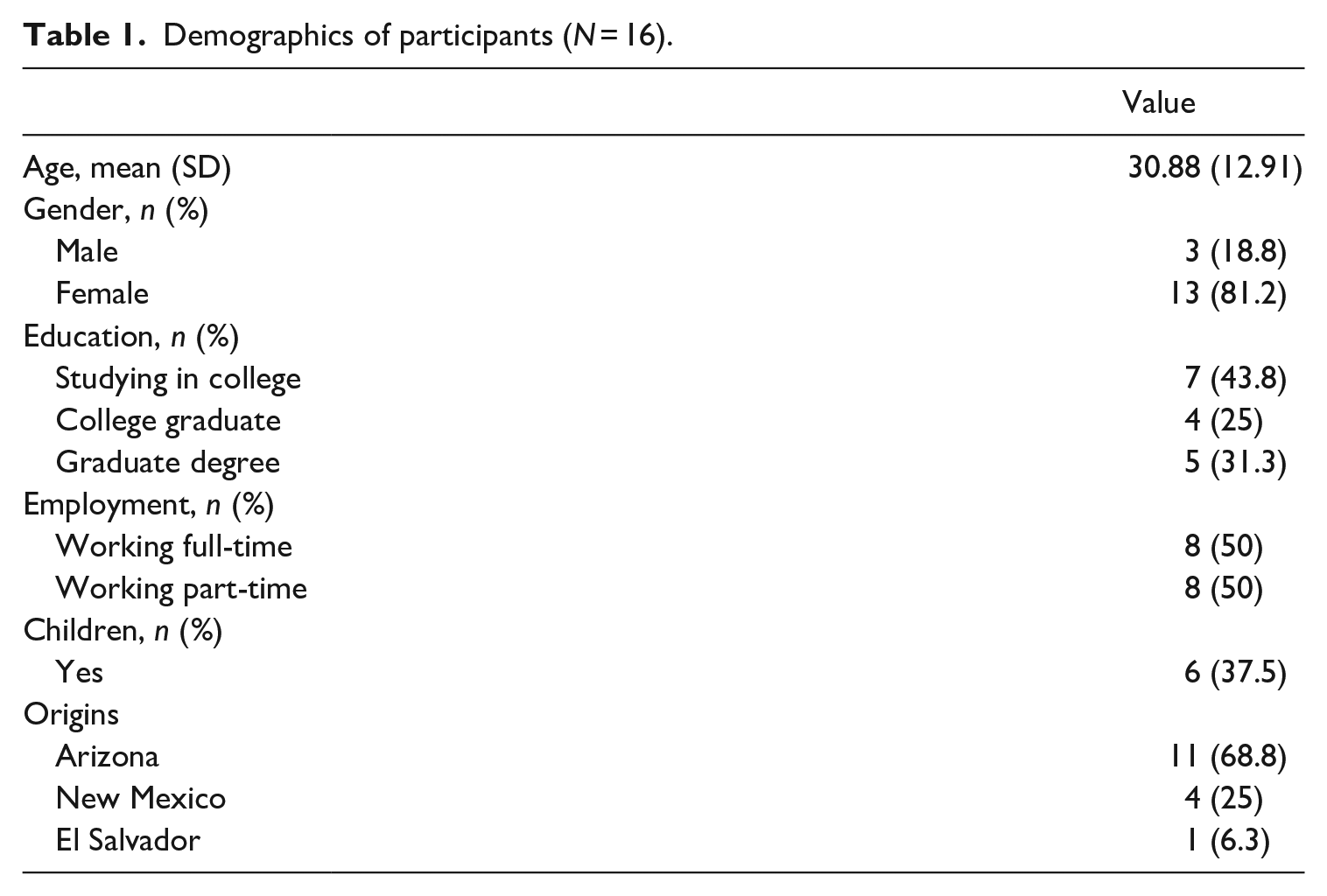
As summarized in Table 1, participants’ ages ranged from 18 to 64 years (Mean = 30.88; SD = 12.91; Median = 28.5), comparable to the median age of Indigenous residents in Northern Arizona. The sample over-represented college graduates and females. 3 Most of the participants – 94% – have strong Native or Indigenous identities because growing up on the reservation exposed them to traditional languages and cultural ceremonies. Majority of the participating students are first from their family to attend college and worked multiple jobs to support their education. Some have young children. The purposeful sampling allowed us to identify shared viewpoints of Indigenous people from diverse tribal affiliations and nations. 4
Demographics of participants (N = 16).
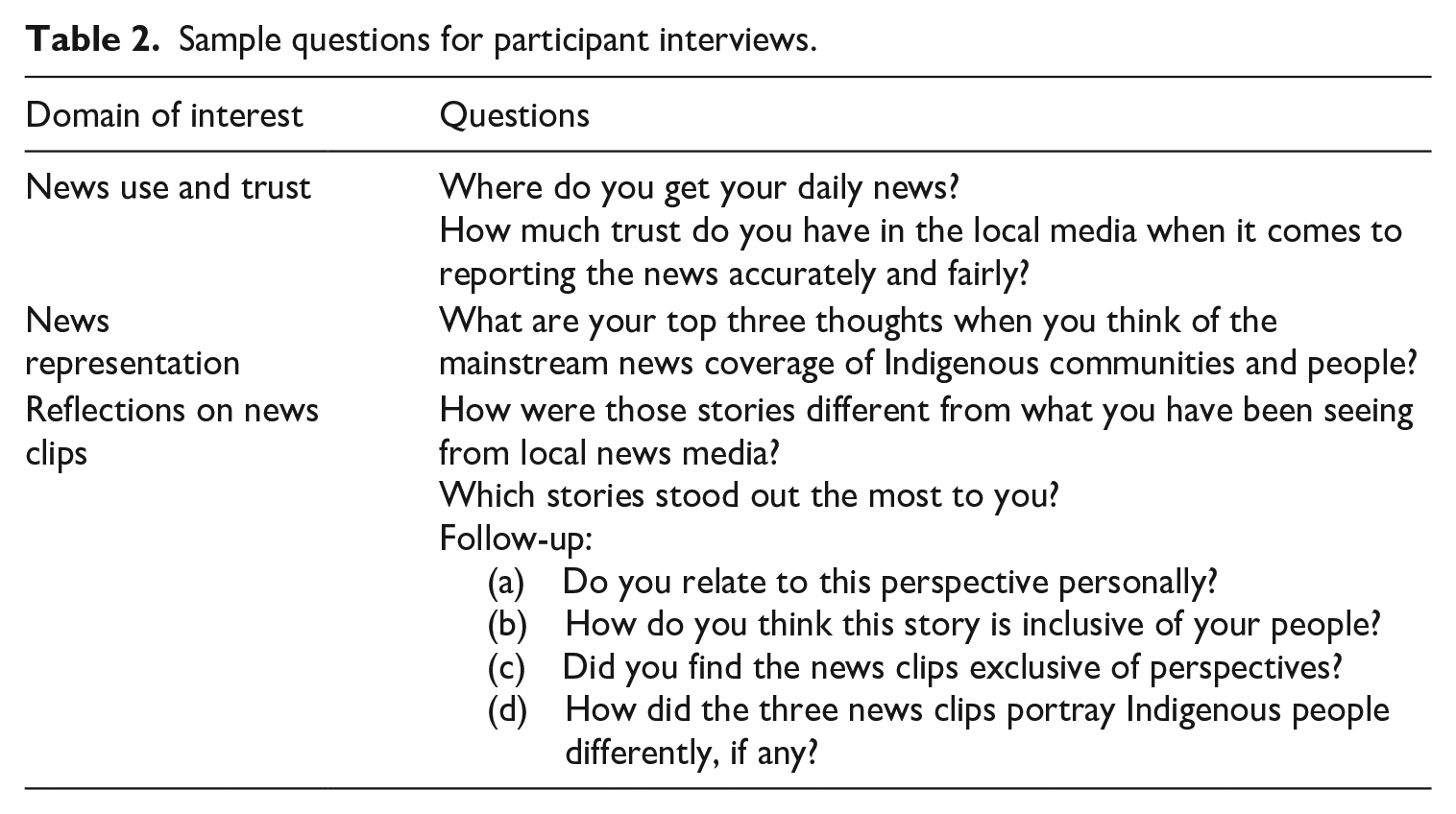
We created a standard interview guide to facilitate conversations, including follow-ups between the researcher and tribal citizens. Solicited feedback from Native America colleagues and three formal focus group sessions comprising students of color helped finalize the interview guide. Table 2 provides the sample questions used to guide the interviews. Each interview began with questions about the respondents’ background, experiences living on or off the reservation and daily news habits. Next, they were asked to watch and evaluate three news clips discussing the construction of the proposed U.S.-Mexico border wall. The outlets from which the news clips were sourced are: (a) Fox affiliate; (b) ABC affiliate; (c) citizen-driven news produced by the funded project. Each clip was about 2 minutes. Names of news organizations were not mentioned to the participants when showing them the clip to avoid priming and invoking preconceptions about the channel and by extension, the news coverage. Fox affiliate interviewed predominantly white residents living in border towns in Arizona regarding their concerns about the economic and social impacts they would suffer if cross-border movement was restricted as a result of federal government policies. ABC affiliate used conflict frames to spotlight the magnitude of illegal crossings at the border by presenting statistics related to the issue. Neither of these stories included interviews with Native people, who also live along the border, thus reflecting the mainstream news practice of excluding Native American voices.
Sample questions for participant interviews.
A citizen journalist produced the third news clip about the Annual District Day observed by the Native community, thus presenting a unique story that included live video footage of the community celebrating the event. The citizen journalist belonged to one the largest tribes in Arizona and grew up on the Southwest reservation, where the event was held. As such, they knew their community members well and were actively involved in language revitalization and youth leadership programs. The story contextualized the long-standing challenges local Native communities faced as a result of not only constant surveillance by border patrol agents on tribal lands but also the consequences of the federal government’s proposed wall, partitioning the reservation. The citizen-driven story focused on concerns over a physical border that would divide the land and disrupt their daily life. Two females and the vice chairman of the tribal Nation were interviewed as part of the report. After watching three videos, participants elaborated on what they thought and felt about each news clip.
Guided by the principles of grounded theory (Strauss and Corbin, 1990), we conducted data analysis with a critical orientation of interpreting relationships between emerging themes. The initial cycle of analysis involved analytic memos and open coding to identify codes using constant comparative methods (Charmaz, 2006). Three researchers independently coded five transcripts; we held regular meetings to compare and deliberate interpretations of the data. Codes were then organized into higher order categories with reference to aforementioned literature on identity formation, trust in news and media representation. In the second step, we carried out axial coding to specify properties of categories and link the relationships between listed categories. Third, we used theoretical coding to crystallize all categories and subcategories into an overarching framework of situated multidimensional representation (Saldaña, 2015). Last, we relied on member checks to strengthen validity and trustworthiness in qualitative research (Tracy, 2010). We checked with Indigenous colleagues outside the first researcher’s home department to ensure the identified themes were robust enough to reflect Indigenous people’s experiences and thoughts. An iterative refinement of analysis is particularly useful for theory building to grasp not only how Native and Indigenous audiences perceive citizen reporting but also whether such reporting offers a point of identification.
Results
As interviewees shared similar experiences of growing up on reservations and moving to cities for pursuing academic degrees, employment or joining the military, they identified strongly with their Indigenous heritage. However, most participants could only understand or speak the basic level of their traditional languages because their parents or grandparents intentionally chose not to teach them their native tongue due to the older generations’ traumatic experience in Indian boarding schools. 5 The gradual loss of Native languages from the elders to the following generations was described as ‘unfortunate’. One interviewee was a notable exception as she was raised without intimate knowledge of her Native American heritage until she was in her teens.
Regarding news habits, participants stayed informed about ongoing issues by following national news, listening to radio, receiving notifications from mobile news apps, skimming through local news sites and directly following Indigenous news outlets’ social media pages (e.g. Indian Country Today, Native Voices). Notably, very few mentioned tribal outlets as their top sources for getting news updates; most respondents learned about important issues and events related to their tribal communities through incidental exposure to social media posts from their friends and family members.
Overall, participants tended to distrust commercial outlets’ normalized discourse and expressed blunt disappointment (‘honestly just a joke’) in the national and local media’s negative portrayals of Indigenous people. As P13 shared, ‘I feel like it’s always negative because of the Western thought process. Most people still think the Indigenous people don’t matter. They don’t have the high authority like most people (sic) do’. Participants perceived common journalistic practices as intentional efforts to undermine Native Americans’ visibility and identity by ignoring their perspectives (‘not showing the Indigenous sides of things’), using insensitive tones and pronouns, excluding Native people in the newsgathering process, homogenizing different tribes, leaving out cultural contexts or reporting on Indigenous people against the backdrop of poverty, alcoholism and domestic violence. The consensus was that commercial outlets’ reporting practices reveal and perpetuate inherent biases against ‘anyone who is Brown’. P8 shared their feelings of being delegitimized and invalidated by the insensitive local coverage of Native Americans: There is a long tradition with the local newspaper of ignoring and delegitimizing Native people. I think it has happened so long that it’s the norm. It’s reflected in the (mainstream media) community, the way they respond to us. There’s not a lot of respect. There’s not a lot of regard. To me, it’s really obvious. It just makes me feel crazy too. You notice these things. It’s painful to bring up, but I have realized that when I do bring it up to people, they also see the same thing I do.
In response to the distinct framing of the U.S.-Mexico border wall, we found three themes related to participants’ sense-making process when interpreting news representation in the news clips. While interviewees acknowledged the information value of mainstream coverage, the following interrelated dimensions form the basis of participants’ overall preferences for situated multidimensional representation: Indigenous standpoints, sense of belonging and complex personhood.
Indigenous standpoints
In response to RQ1, the uniqueness of Indigenous standpoints that focused on the localized impact of important issues on Southwest tribal members was frequently mentioned as the crucial element that kept interviewees engaged during the news watching session. Specifically, the storytelling techniques of using b-roll images directly recorded on tribal lands accompanied by traditional dances and songs reflected the community’s resilient way of life and cultural traditions. As P3 articulated, ‘the Indigenous piece helps people to understand that there is a community flourishing there. They’ve been flourishing, protecting and utilizing that area from time immemorial and up until they are or even after they were placed on their reservation lands’. P15 also appreciated the Native perspective and said it should be covered more often: These people have lived that way for thousands of years right in that area. The singing and dancing shows that they still value and preserve the culture. This is from a Native perspective. I really appreciate it. We need more of this.
The citizen-journalist’s reporting included cultural signifiers and diverse sources, and was well received because it showed ‘the cultural aspect without appropriating it’. Most participants felt particularly excited about seeing vivid images of Native people when tribal leaders and young ambassadors shared their thoughts in front of the camera (‘enjoy seeing Native faces’). Those traditional dances, regalia and outfits are not common in the U.S. except in Indigenous cultures; therefore, vivid images captured by Native citizen journalists portrayed ‘Indigeneity that should be focused on’. Participants consistently praised how the piece drew upon tribal leaders’ knowledge in framing how the border patrols and ongoing construction of the border wall interrupted their daily life, highlighting the concern for their own communities. P5 recounted vivid details about the stories of resilience: You see their vice chairmen of the whole entire tribe speaking on this video, which is really rare, because you don’t see that support. It’s a really big community. They support just each other by doing that little interview. Of course, you see their royalty trying to be out there with their people and the whole community.
Notably, Native citizen journalists bring context to the border policy through the lens of colonialism. Several participants reflected on the contextual coverage of how a border wall disrupts land sovereignty. One participant brought up the fact that Native people are free to go wherever they want because there were no borders to separate communities before colonization. However, establishing a physical border for the sake of national security causes significant disruption to tribal people’s identity (‘that’s something they have to think about constantly’ and ‘disruption in all forms’). As P6 expressed: Their opinions about the border show how it’s not just a border. It’s gonna ruin family relationships. It’s gonna ruin the ecosystem. It’s gonna ruin their way of life because it’s a part of their people, who they are, and where they come from.
Participants could see these people specifically had a long connection to their lands and could relate to them as members from other lands and tribes. The nuanced contextualization of the citizen reporting on Native communities deeply connected with the participants and caused them to perceive the issue of building a border wall as a threat to Indigenous identity.
Sense of belonging
In response to RQ2, participants tended to trust citizen reporting more than the established outlets’ coverage because of its ability to foster a sense of belonging, a key precursor to strengthening Indigenous identity. Events on the ground were reported through Native community members’ perspectives. Participants expressed the idea of ‘being seen’ by relating to the Indigenous sense of community. As P2 summarized, ‘the one I related to the most would be the Indigenous news because it shows human connection. The Indigenous news is, like, this is our lives. This is really what’s happening’. Unity is further created by thinking of connected relationships among Native tribes. Recognizing each other as siblings or relatives was frequently mentioned; many respondents commented that the citizen-reported story created a sense of sisterhood and brotherhood. P13 explained: I connect with most Indigenous communities because we are ONE people. We are like brothers and sisters to each other. I feel like they would connect more with other issues that are happening, not just throughout their community but through other communities as well.
Female participants said the border patrol practices on tribal lands made them recall their own experiences with systemic discrimination such as being treated unfairly by the police. The sense of belonging prompted several interviewees to openly share negative experiences with local police officers because of their race. As P6 explained, ‘I felt more inclined to just believe because I’m also Indigenous. Yeah, I understand what they’re talking about, especially when border patrols police you and they harass you and they profile you. That’s something that’s common throughout the whole country’. P4 added: The reservation one relates to me due to how mistreated they are. I’ve experienced that growing up, not only on a reservation, but also trying to go to school off the reservation. I’ve experienced being mistreated due to who I am. It’s like living off the old history and continuing to do that and treat people who are a different ethnicity besides White.
Complex personhood
In response to RQ3, the complex personhood in the Indigenous piece stood out to most participants when asked about the coverage of each news clip. Complex personhood sees Indigenous people as multifaceted selves with ‘strengths, weaknesses and/or resilience’ (White et al., 2020, p. 2). Instead of putting Native people against the backdrop of politicized policy debates, personhood characterizes the overlooked approach to humanize invisible tribal communities by discussing their social relationships, family or community roles in the video. The respondents related to the citizen news clip the most because it showed human connection that allowed a better understanding of what is happening to local people’s lives, as this quote reveals: ‘For the Indigenous news, I got a feeling that it was affecting a community. It was like people talking about how it affects them, who lives there, and – yeah, community’. One participant repeatedly highlighted the importance of showing Native people’s connection within the community. Because of respondents’ Indigenous identity, they underscored that peoplehood is insightful but often ignored. The lens of complex personhood in covering Indigenous people cultivates empathic responses to the tribe’s struggles over being separated by the border wall. One participant mentioned: I bear witness to the interaction or their struggles for the wall. Instead of just having pity and moving on, I had empathy because I witnessed their struggles and I related to it or connected to it in different ways of how other tribes struggle with these issues. And personally for my tribe it’s the same, but a different context.
Likewise, another interviewee shared the insider story of other tribal communities split in half by the Canadian border: I was hearing stories about it. Before they made the (Canadian) border, they had this last celebration to see each other. They have a song about it now. The song was mostly about this is the last time I’ll see you, and this is our last interaction. Because there are different check-in points for the Alaskan-Canadian border, the village isn’t one of them because it’s too rural. It’s probably not the same. But it’s just like, why is there this separation for different communities?
P12 was heartbroken by the Indigenous piece and noted: With what the leader was saying about the youth, the future, we have to stand up for ourselves. I’ve heard that all my life, and it hit home a little bit. I just felt more open to that. I paid more attention to that in-depth and I actually wanted to hear it again.
Although the interviewees did not personally face the immediate disruption by a border wall, they wanted to support Southwest tribal people and/or learn more about supporting community actions. P10 elaborated, ‘the connection of familiarity made me want to support other Indigenous people who are doing the work’. P11 pointed out they paid close attention to Indigenous reporting because she wanted to ‘make sure we are protecting our sovereignty and our relatives’. Complex personhood stimulated empathy and motivated actions to protect tribal relatives.
Situated multidimensional representation
Trust in non-Native journalists and mainstream news narratives remains low. Traditional news norms of providing objective information and event-centred reporting not only contradict Indigenous cultures but also reinforce the power structure that privileges dominant racial groups (Callison and Young, 2019). In light of the deep sense of alienation and exclusion among Indigenous audiences, we develop a systematic framework of situated multidimensional representation to counter mainstream narratives and bolster Indigenous identity. Table 3 summarizes the three main themes that emerged from the respondents’ viewing of the news clips. To overcome invisibility and stereotypes, the framework represents agentic processes for Indigenous citizens to provide grounded reporting, thereby amplifying uncensored voices that currently lack in mainstream and tribal government run news outlets in the U.S. To this end, trained Indigenous citizen journalists could become proactive participants in contributing to the vitality of rural news ecosystems and supporting the colonial resistance. Their insider perspectives, situated knowledge, expertise and tight connections within local communities create discursive spaces for the kind of accurate representation Indigenous people desire. Citizen-driven reporting resonates with Native and Indigenous audiences because of the distinct storytelling approaches centred on Indigenous standpoints, belonging and complex personhood.
Conceptual framework of situated multidimensional representation.
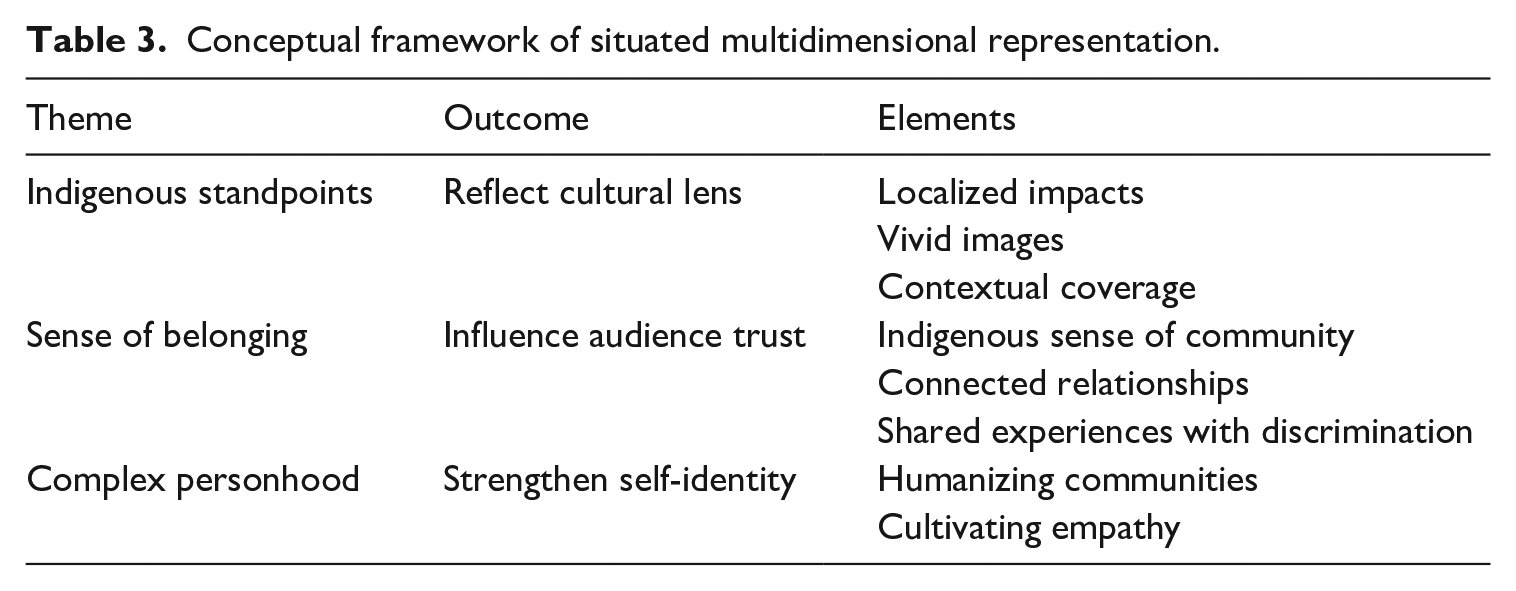
First, citizen-driven stories disrupt racialized experiences normalized by mainstream narratives. Indigenous standpoints in news reporting are valuable because this kind of reportage emphasizes localized policy impact, contextualizes tribal issues within historical and cultural realms and includes cultural signifiers that help Indigenous people see themselves accurately represented in the news. Situated perspectives demonstrate a deep context of the land, people and ways of life without appropriating Indigenous cultures. Participants eloquently highlighted the importance of knowing the situated knowledge to characterize a nuanced and comprehensive representation of policy impact on Native Americans and Indigenous people.
Second, citizen stories validate Native and Indigenous audiences’ sense of belonging to their community, the deep relationships between tribes and their experiences with systemic discrimination. Sense of belonging may positively influence audience trust in news reporting. Lastly, news coverage that emphasizes complex personhood humanizes tribal communities and cultivates empathy. Although research showed U.S. news editors’ negative perceptions of citizen produced content (Chung et al., 2018), Indigenous citizen stories embodying these three dimensions of grounded reporting are perceived positively by Indigenous audiences. Situated stories enable meaningful interpretations of Indigenous members’ perspectives, engender media trust through evoking feelings of relatability and belonging and strengthen Indigenous identity by focusing on complex peoplehood.
Discussion
This study aimed to unpack how citizen-driven reporting using mobile technologies can fill the unmet needs of rural tribal communities. Drawing on concepts from interdisciplinary literature, including identity, media trust, rural journalism and Nativization/Indigenization, we introduce the concept of ‘situated multidimensional representation’ to elucidate agentic processes for Indigenous citizen journalists to reclaim their own narratives. The multifaceted framework advances journalism studies because it moves beyond the unchanged biases of seeing Native Americans and Indigenous people as one-dimensional homogeneous subjects through the lens of mainstream media. Rather, our findings demonstrate the importance of participatory citizen journalism for Indigenous people as a way of resisting colonized narratives, providing uncensored perspectives and becoming their own visual media for their communities (Prins, 2004; Wilson and Stewart, 2008). Based on the experimental citizen journalism project, we provide empirical support to assess the impact of participatory journalism within underserved Indigenous communities.
Consistent with existing literature, findings show that mistrust of national and local news coverage is pervasive among Native and Indigenous participants with diverse personal experiences. When evaluating news clips from commercial outlets, participants perceived stereotypical framing in coverage of a U.S.-Mexico border wall to be informative but troubling. It is mostly because Westernized norms of objectivity and conflict-driven reporting further alienate Indigenous audiences. Despite efforts by mainstream news organizations to increase racial inclusion, prevalent media representation of Native and Indigenous people remains biased. Consequently, Indigenous audiences are still forced to construct their identities despite cultural invisibility and negative stereotypes.
However, we find that the social embeddedness of citizen journalism provides opportunities to reshape media representation of Indigenous people. In our study context, mobile storytelling allowed for more on-the-ground reporting in remote areas; tribal members with writing and editing training provide perspectives that help amplify their community’s truthful voices. As Robinson (2019) suggested, journalists should become co-members within a community to discover shared values for moving multiple publics towards common problems. While this suggestion is not geared towards elevating particular marginalized groups, we extend the argument to include Native citizen journalists who, with situated knowledge, expertise and cultural experiences, are members of the communities they report. Their coverage of policy issues and local events opens promising opportunities for addressing Indigenous people’s unmet needs. Our findings support these preliminary notions. Participants emphasized that citizen-journalists’ portrayal of Indigenous people’s social connection to their communities was better than linear reporting styles provided by professional mainstream journalists. Native and Indigenous audiences identified with the complex perspectives of the issue, tribal language and imagery of cultural celebrations that was present in the citizen reportage.
Theoretically, we present the framework of situated multidimensional representation to guide culturally appropriate journalistic processes and outcomes. First, the processes of relationship building are essential to restoring trust with Indigenous communities (Ahtone, 2017; Callison and Young, 2019). Being Indigenous does not automatically grant access to those communities even though it may help to some extent. Tribal citizen journalists still have to spend time listening to sources and showing care for local members. In personal communication with participating citizen journalists, they valued the cultural significance of listening and letting the community guide their news stories. Therefore, this research complements Schmidt et al.’s (2019) work that shows historically marginalized groups’ perception of media trust must depend on the reporters’ responsibility to care for their own communities, integrity and inclusiveness of ignored viewpoints.
Regarding journalism outcomes, our work refines the concepts of Nativization and Indigenization to explicate the complexity of tribal citizens’ adoption of technological innovations to strengthen expressions of tribal identity. Results suggest that Native and Indigenous audiences prefer citizen-journalist’s unique approach, centred on insider standpoints, belonging and personhood, even though shooting news videos with smartphones does not guarantee high-definition images and professional sound quality as presented by mainstream news TV stations. Native and Indigenous people’s right to their own identity is supported by multidimensional news portrayals. Thus, citizen journalists’ on-the-ground reporting constructs valid representation that humanizes Native Americans, increases media trust through validating sense of belonging, and reaffirms Indigenous identity by foregrounding the focus on multidimensional selves (White et al., 2020).
Practically, we offer implications for mainstream news organizations to engage underserved minority groups. First, the framework could guide mainstream reporters to revisit ingrained assumptions about Indigenous communities – a faceless and homogenized entity against the backdrop of national policies or conflict events. Second, sustained collaborations between mainstream reporters and Indigenous citizen journalists could be a critical solution for staying relevant and uplifting underserved Indigenous people. Cultivating a strong citizen network for bringing citizen journalists’ situated expertise in the newsgathering process overcomes issues of trust Native people have with colonized news culture (Marcus, 2016; Monet, 2019). Lastly, running contextual storytelling by Indigenous citizen journalists will lead to two beneficial outcomes: (1) educating general audiences about Indigenous perspectives and (2) supporting Indigenous people’s agency to reclaim their narratives.
This study may be limited by the lack of feedback from elders and cultural experts, both of which are highly respected members in tribal communities. In addition, the citizen news clip did not include traditional language subtitles, limiting its reach to audiences who only speak their Native languages. It would be fruitful to explore generational differences in responding to citizen-driven reporting shown in traditional language as elders may have distinct needs and opinions regarding news coverage of their communities. The limited number of male participants in our study might not allow our findings to reflect their perspectives. Admittedly, these findings also do not represent or speak to the diverse cultural perspectives of Indigenous communities in the U.S. and worldwide. Despite these limitations, participants’ willingness to share personal stories and thoughts openly contributed to the richness of the data. These interviews with key informants who keep connection to their tribal lands, languages, and cultural ceremonies helped build scholarship in the scantily researched field of Native and Indigenous audience engagement with news. It deepened our understanding of the impact of citizen journalism on trust and identity of Indigenous people.
Future research could investigate the long-term impact of citizen reporting on Indigenous members’ civic engagement, self-esteem and psychological well-being. Research examining the extent to which Indigenous citizen journalists are able to maintain their counter-narrative storytelling purposes will be insightful as studies show that systems around them such as the state, newsmakers’ and people’s ideologies are set in traditional, mainstream news practices (Ostertag and Tuchman, 2012). This research serves as a starting point to reimagine representation of Indigenous people and their communities in the media. To build a news ecosystem of equity, our study underscores the importance of nurturing a network of active citizen journalists to enable situated multidimensional representation of Indigenous cultures. From an optimistic point of view, proactive collaborations between news organizations and Indigenous citizen journalists will bring about the structural changes needed to amplify marginalized voices.
Footnotes
Funding
The author(s) disclosed receipt of the following financial support for the research, authorship, and/or publication of this article: This work was supported by the Online News Association 2018 Challenge Fund.
