







Abstract
The creation of transnational Latino media spaces is the result of the migratory flow of Latin Americans to the north. In this context, the goal of this research is to link news content in Latino print publications in Spain to the origin and destination of their readers, and to analyse the importance of this media content as a vehicle of transnational practices. As our initial hypothesis, we suggest that the content of Latino print media in Spain reinforces the maintenance of readers’ ties to their countries of origin, whilst failing to prioritize stories that encourage the incorporation of readers into their country of destination, in this case Spain. Our analysis focuses on the orientation of contents, in order to determine whether they are mainly oriented towards the readers’ origin or destination. The findings confirm the initial hypothesis, because origin-binding contents represent 62.4percent of all contents, a result that multiplies by four destination-binding contents, which represent 14.1percent of the total. The leaning of content towards origin is an important step to foster the transnational behaviour of migrants. However, the greater leaning of content towards origin could compromise the transnational role of Latino print media in Spain, because while their contents strengthen readers’ ties with their homeland, they do not sufficiently reinforce the integration of readers into their country of destination.
Introduction
Ethnic media play a fundamental role to provide information to immigrants, reaffirm their own cultural identities and facilitate their incorporation in the host country. At the start of the 20th century, Park (1922) claimed that immigrants coming from Europe to the United States wanted to read newspapers in their own language due to the lack of freedom of the press in their countries of origin. Ethnic media began to fulfil an informative role, because they told readers how to ‘adapt to their new environment, change old habits and form new opinions’ (Park, 1922: 9). Today ethnic media provide information that includes community and cultural celebrations as well as practical advice to help immigrants find employment and housing, enrol their children in school, open a bank account or apply for medical assistance and social services.
As community sentinels, ethnic media can act as early warning systems against external threats. To that end, they may present stories affecting the legal rights of the ethnic community: civil rights violations, changes in immigration laws and crimes against immigrants. Besides, an immigrant newspaper may be a community booster and convey a positive and successful image of the members of the community, with profiles and stories about their political participation in the country of destination and their solidarity projects in their countries of origin (Viswanath and Arora, 2000).
Likewise, ethnic media foster the cultural identity of their readers, expressed in the use of their own languages, customs and religious practices, their links with family, friends and neighbours and their participation in ethnic organizations (Jeffres, 2000). All these roles are interconnected and adjust to the way in which immigrants incorporate into the host society.
Ethnic media: A model for transnationalism
From the perspective of the incorporation of immigrants in the host society, the informative role of the ethnic media is connected with the model of assimilation, because the information about different aspects of the host country helps immigrants adapt to it (Dalisay, 2012). Ethnic media can also fit in a model of separation when they boost ethnic awareness and the concern of immigrants with their country of origin can undermine their ties with the local host community and slow down their adaptation to the country of destination (Ling and Song, 2006).
The role of ethnic media as a vehicle to foster their readers’ identities fits in with the model of pluralism, in so far as cultural identities are essential to understand integration as a process of exchange of information in which two groups with different cultural identities share common values without either assimilation or segregation (Arnold and Schneider, 2007). However, there are also studies which point to a dual role of ethnic media, as vehicles for both assimilation and pluralism, in regards to the incorporation of their readership into their country of destination (Subervi-Vélez, 1986). Alencar and Deuze (2017) argue that news consumption, whether of media from the country of origin or from the country of destination, contributes to strategies of acculturation or adaptation of immigrants into the host society, which are usually strategies of integration, but can also be of cultural hybridization and transnationalism.
As we have pointed out, ethnic media have a guiding function by making their readers aware of the rights and rules in the country of destination, and a connective function by offering news from the countries of origin. Thus, ethnic media could carry out a transnational function through transnational communities which can function in two or more worlds, collecting hybrid contributions from the countries of origin and destination (King and Wood, 2001).
Transnational migrations and media in Europe
To fully understand the current consumption of transnational media in Europe, we should trace its origins back to the sharp increase of labour migration from less-developed countries to the fast-expanding industrialized countries of Western Europe between 1945 and 1973. The British government brought in 90,000 mainly male workers from refugee camps and from Italy through the European Voluntary Worker programme. France established the Office National d’Immigration (ONI) in 1945 to organize recruitment of workers from Southern Europe, and by 1970 two million foreigners resided in the country. Belgium also started bringing foreign workers after the war, mainly Italian men, to the coal mines and the iron and steel industries. The Netherlands brought in ‘guestworkers’ in the 1960s and early 1970s, and Sweden employed workers from Finland and Southern European countries. But the key case for the ‘guestworker system’ was the Federal Republic of Germany, which in the mid-1950s set up a highly organized state recruitment system through bilateral agreements with the sending countries: Italy, Spain, Greece, Turkey, Morocco, Portugal, Tunisia and the former Yugoslavia. The number of foreign workers in the country rose from 95,000 in 1956 to 2.6 million in 1973 (Castles and Miller, 2003).
According to Matsaganis et al. (2011), in the 1960s and 1970s, ethnic media grew faster in countries with minority language communities like Britain (with Welsh and Scots), France (with Bretons and Alsatians), Sweden and Finland (with the Sami) and federal states like Belgium, which had Walloon, Flemish and German minorities with separate media policies. The development of media for these groups, like the Welsh-language programming in Britain, helped create an infrastructure that supported the birth and sometimes funding, of ethnic media serving new immigrants.
But radio programmes geared to Spanish and Greek immigrants had started in Germany in the early 1960s, and South Asian and Caribbean-origin immigrants entered the radio waves in the U.K. in the mid-1960s. In the Netherlands, radio broadcasting for Turkish and other minorities started with music programmes in 1963, but there were no specific television programmes for minorities until 1984 (Ogan, 2001).
In 1985, the birth of the first Turkish cable television channel TD-1 in Berlin changed the media habits of the Turkish community living in Germany, since they began to receive by satellite the same television channels seen in Turkey. In the mid-1990s, multicultural broadcasting found political support in the Berlin state parliament, and Radio Multikulti was created to give voice to ethnic minorities. Berlin’s Open Channel (OKB) was already broadcasting foreign-language programmes, mostly in Turkish (Kosnick, 2007). At the same time, the introduction of the satellite radio and television technology DBS extended the consumption of transnational media with channels such as Express Vu for the Asian community in Canada, Orbit TV for the Arabic community in Europe or Doordarshan for the Indian community in 40 countries (Karim, 1998). We are currently witnessing the popularity of Turkish soap operas which have created transnational audiences on television channels all over the world, including recent hits in Spain such as Love Is In The Air, Mujer (Woman) or Mi Hija (My Daughter).
Today, there is not a comprehensive total account of ethnic media outlets in Europe, but only in the U.K., Georgiou (2017) has mapped more than 107 newspapers and periodicals in 12 different languages, 16 radio stations in 4 languages and 42 television channels in 7 languages. A study on Media and Diversity in 33 European countries includes more than 470 media initiatives (European Commission, 2009), and the European Association of Daily Newspapers in Minority and Regional Languages (MIDAS) distributes more than 730,000 copies of 27 dailies to three million readers in 12 countries in 11 languages. 1
Latino media and transnational spaces
The creation of transnational Latino media spaces is the consequence of the Latin American migratory flow towards the United States and Europe. Since the 1980s Latin American migration has increased fourfold, with the majority emigrating to the U.S. (51%) and Spain (13%). By 2010 there were already 30 million Latin Americans living outside their countries of origin, and of these, 22 million were living outside Latin America. Social media and transnational communication and media practices have played an important role in this process of international mobility (Retis, 2019).
Although Latino media appear in the U.S. in the 19th century, the demand for radio and television in Spanish experiences a considerable growth after the 1960s, as Latinos become a rising consumer force of 59 million people (United States Census Bureau, 2018). As the Latino population settled in big cities such as Los Angeles, New York or Miami, there is a surge of new Spanish-language media projects. After five decades of history, the leading television channels in the U.S., Univisión and Telemundo, have become transnational companies with capital from Latin American media monopolies such as Mexico’s Televisa in Univisión, and U.S. companies such as NBC in Telemundo. The Spanish-language audience of some television channels even exceeds that of English-language television (Piñón, 2014).
Our study highlights the importance of media content published by Latino print media 2 in Spain as a channel to promote transnational activities. In the context of these links with origin and destination, they have more similarities with Latino media in the U.S. than with Spanish mainstream media. Although Latino print media and Spanish media share a common language, they are separated by many linguistic differences. Latino print media in Spain use the Spanish language variations written and spoken in Latin American countries, and those Spanish variations are very distinct from Castilian Spanish. Proof of this pluricentric nature of the Spanish language was the creation of the Panhispanic Dictionary in 2005 amidst the ongoing quest to unify the usage of an international Spanish for all Spanish language media (Gómez-Font, 2012). Their language incorporates Latin American slang and expressions in short texts, with a focus on immigration-related stories, and their design features big headlines, large photos and bright colours (Gómez-Escalonilla et al., 2008). Due to these language and content differences with mainstream Spanish media, Latino publications in Spain play the same orientation role towards the Latin American countries of origin of their audiences as Latino publications do in the U.S. They even show striking similarities in colour and design (see Figure 1).

October 2020 issues of Imagen Latina in Madrid and Gente Latina in Florida (left to right).
In addition to this, Spanish media often portray immigrants with stereotypes (Bañón Hernández, 2007), and they don’t offer Latino readers the type of contents they want to read with their own perspective. In contrast, Latino media contribute to normalize the media visibility of Latinos, connect them with their cultural roots and reaffirm their identity (Gómez-Escalonilla et al., 2008).
Are these Latino publications more inclined to strengthen the origin or the destination of their readers? Do Latino print media contribute to the incorporation of Latinos into the Spanish society, or do they anchor them to their countries of origin? This paper intends to answer these questions by studying the content of the most current Latino publications edited in Spain.
Latino print media in Spain
The birth of publications geared to Latin American immigrants in Spain is a response to the new consumer demands made by the first flow of immigrants arriving in the country in the beginning of the 1990s. Journalistic production as such began in 1992 with the creation of the magazine Revista Pueblo Nuevo. The number of new titles increased, reaching 17 in the year 2000. In 1995 the magazine considered the dean of the Latino print media in Spain, Ocio Latino, was created in Madrid and the magazine Mujeres del Mundo-munduko emakumeak and the newspaper Resumen Latinoamericano y del Tercer Mundo came out in the Basque Country. The rising demographics of Latinos in Spain brings on the emergence of an associative movement, and some Latin American groups begin to publish newsletters with useful information and institutional activities. The entertainment magazine Imagen Latina joins all these publications in 1998. Out of the 20 or so Latino print media outlets which came out between 1992 and 2000, only four continue publishing today.
The growing Latin American population sparked new market research and companies began to place advertising in the emerging Latino media in order to reach new consumers. The number of Latin Americans living in Spain doubled between 2000 and 2001, and some groups, such as the Ecuadorian, increased by almost 85percent from 2001 to 2002 (Instituto Nacional de Estadística, 2019). The number of Latino publications rose 53percent between 2002 and 2003, and amounted to 30 (Mendieta-Bartolomé, 2018). In 2004 and 2005 the free weekly publications Sí, Se Puede and Latino came out, marking a high point of the Latino publishing market because each one reached a weekly circulation of over 100,000 copies and had editions in Madrid, Cataluña and Levante. Some new publications were also edited in Catalan. Between 2005 and 2006 alone, 30 new publications appeared, and in 2007 the Latino press market reached its peak with a total of 105 publications in Spain. In 2007, the first daily national newspaper El Nuevo Ciudadano was born in Madrid, but it lasted only five months before becoming a weekly. Latino newspapers and magazines focus on the latest news from the immigrant’s viewpoint, and highlight practical matters such as home buying and renting, employment, health care, social benefits and administrative procedures to regularize an immigrant’s legal status. Almost 20 of these publications were geared specifically at readers from Ecuador, Bolivia or Colombia.
According to the 2008 Study of the Immigrant Media, the most read weekly publications for immigrants in Spain were Latino, with 430,900 readers, and Sí, Se Puede, with 231,600, whilst Ocio Latino was the magazine with the highest readership, 91,900. But the year 2008 represented a turning point in the evolution of Latino publications. The 105 publications edited in 2007 dropped by almost 45percent and only 58 survived. Some of the publications that had to close down had been in the market since the mid 1990s. The drastic reduction in advertising investment, both private and institutional, explains the downturn in the Latino press, both in number of pages and in circulation and distribution (Retis, 2014).
The decline of Latino media has to be placed within the crisis experienced by mainstream press. From 2008 to 2014 the print media in Spain lost half of their advertising revenue, the unemployment rate of reporters doubled, 2 out of every 10 dailies closed down, and the media habits changed due to the emergence of the new information technologies (Barrera, 2018). If in 2011 daily newspapers reached 37.4percent of the media audiences, in 2020 that percentage was cut in half to 18.4percent, according to the Association for the Research of Mass Media in Spain. In the same period, the expansion of Internet grew from 57.1percent to 85.1percent (Asociación para la Investigación de Medios de Comunicación, 2021). There are also increasing numbers of Internet users who access online news through social media, mostly Facebook and WhatsApp for adults, and Instagram, YouTube and Twitter for younger audiences (Digital News Report, 2020).
Between 2008 and 2014 Latino publications fell by over half, from 58 to 25. The most significant closures, due to both their national ranking and circulation, were those of the weeklies Latino and Sí, Se Puede in 2012 (Mendieta-Bartolomé, 2018). In 2020, a small number of Latino newspapers and magazines were still publishing in paper or print digital format in Spain. But even if their numbers are dwindling, Latino print media in Spain still have a loyal readership and a future, according to several editors interviewed in January of 2021: ‘The Latino community can be integrated into the Spanish society or adopt some of its customs, but Latino press will continue to be our voice because you never leave your home country behind, regardless of the thousands of kilometers and the big ocean that separate us (León Fernández, director of Shock Magazine in Barcelona)’. ‘I think the Latino press has a future but not with the same models from 10 or 15 years ago. There are still Latinos coming to Spain, there are still human rights violations and information needs, and the Spanish press doesn't focus on Latinos (. . .) We have to foster alliances with Latinos in Europe, build a market and a demand for reading (Edwin Pérez Uberhuaga, director of Aquí Latinos in Madrid)’.
Research design
The main goal of this research is to connect the contents of Latino publications in Spain with the origin and destination of their readers, and to analyse the importance of this media content as a vehicle of transnational practices.
As we have already pointed out, Latino publications in Spain have experienced numerous ups and downs since the creation of the first Latino magazine in 1992. This research documents the presence of 131 Latino publications edited in Spain between 1992 and 2015. We have chosen the year 2014 for our sample study because it is the first year in which there is no decrease in the number of Latino print media in Spain, following six years of continued decline. Of the 25 publications edited in Spain in 2014, we selected the 14 newspapers and magazines from that year that were available in either paper or digital format. We used a non-probabilistic and convenience sampling because only content available to the researcher was analysed (Zabaleta Urkiola, 1997). This sampling corresponds to the impossibility of obtaining a unified census of Latino publications in Spain and, therefore, of carrying out a sampling frame (Igartua, 2006), because there isn’t only one map of Latino publications edited in Spain, but accumulative approaches of different maps carried out by various academic researchers since 2006.
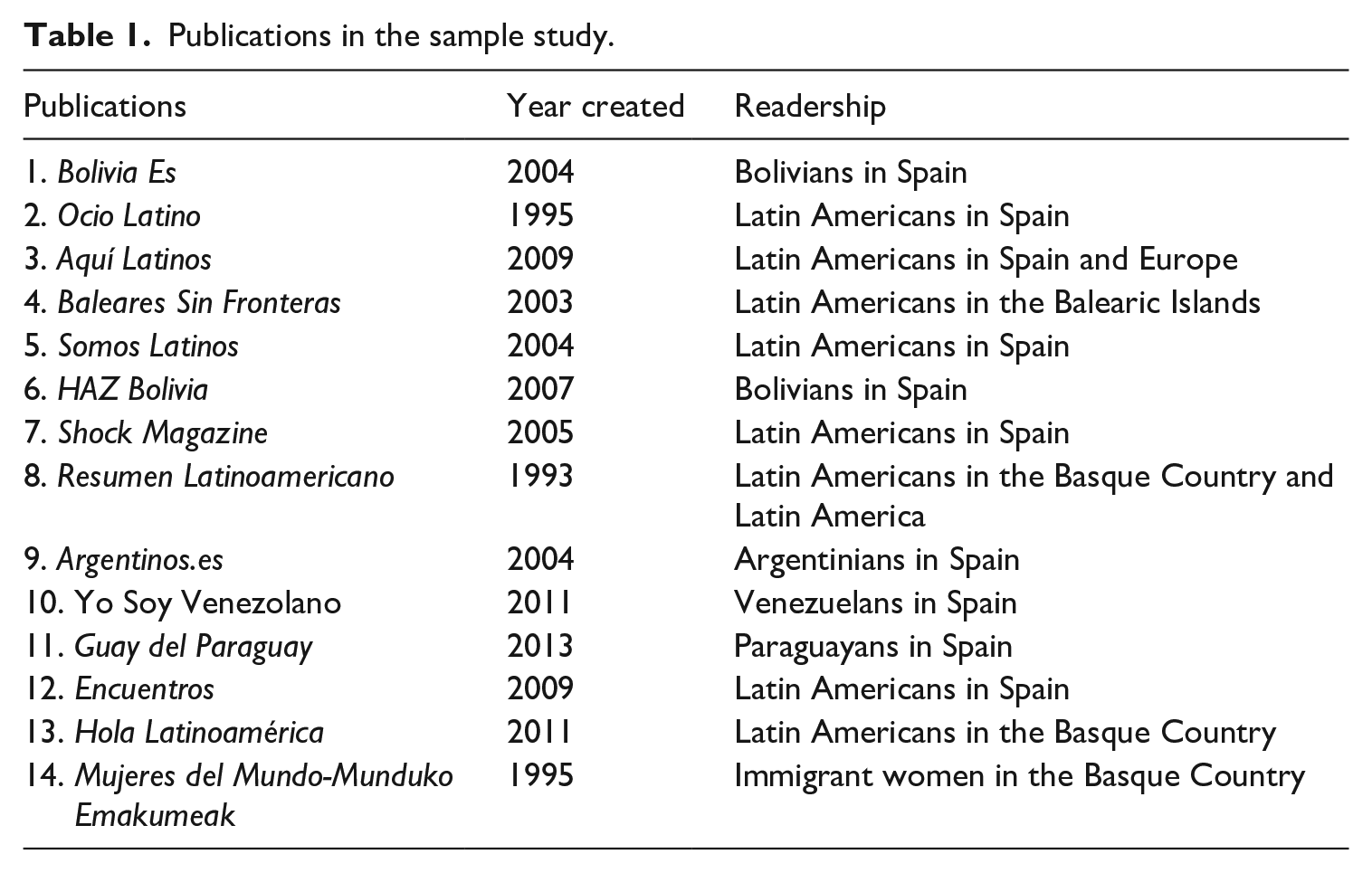
The 14 publications selected for our study had their headquarters in Spain, their management was headed by Latin Americans with one exception, their circulation took place mostly in Spain and in some cases in Europe and Latin America, and their target was comprised by the Latin Americans living in Spain in general, or the Argentinian, Bolivian, Paraguayan or Venezuelan groups in particular. See Table 1 for the names of the publications in the sample study, the year of their creation and their readership.
Publications in the sample study.
According to the convenience sampling, this study analysed four issues from each of the 14 publications corresponding to the months of March, June, September and December 2014, given that all 14 publications produced issues in these months. Therefore, we examined a total of 56 issues, and for each of them we analysed all the news items from front to back page, making a total of 1507 items. In order to categorize each and every 1 of the 1507 news items, we created a system of eight variables and their corresponding subvariables. The eight variables chosen were: Topic, Location, Genre, Author, Protagonists Origin of the protagonists, Gender of the protagonists and Orientation (origin or destination). For the purpose of this article we have focused on the results obtained in the Orientation variable, because the orientation or direction of the contents will reveal whether these publications contribute to anchor their readers to their home country, to incorporate them in their country of destination, a combination of both or whether the orientation of the contents is something other than origin or destination.
The two hypotheses that we propose in this article are:
H1: The contents of the main Latino publications in Spain strengthen their readers’ ties with their Latin American countries of origin.
H2: The contents of the main Latino publications in Spain do not prioritize topics that promote the incorporation of their readers into Spain, their country of destination.
The options that we have used to classify the orientation of the 1507 items analysed are: Origin (the purpose of the information is to direct and anchor readers to their country of origin, even if the event takes place in the country of destination), Destination (the purpose of the information is to direct and anchor readers to their country of destination, even if the event takes place in the country of origin), Mixed (the purpose of the information is to direct and anchor readers both to their country of origin and destination, regardless of the location of the event) or Others (the purpose of the information is neither to direct and anchor readers to their country of origin or destination, regardless of the location of the event). Origin-binding content includes issues such as the presidential elections in Bolivia, the visits of Paraguayan ministers to Spain or the promotion of new songs of Latino pop stars. Destination-binding content includes, among others, Spanish legislative measures that affect Latin American immigrants living in Spain or labour demands of Latina domestic workers. Under the Mixed category (content related to both origin and destination), there are events featuring both migrants and local residents, such as soccer competitions or intercultural festivals. Under the Others category (content related to neither origin nor destination) there are events about the latest technologies, sensationalist stories or beauty and health tips.
The collection and classification of data in order to evaluate the orientation of the contents was carried out in 56 individual fact sheets, one for every issue examined. The first step was to process the recorded data of the Orientation variable to determine the annual average percentage for each subvariable (Origin, Destination, Mixed and Others) in each publication. To this end, we added up the percentages obtained for each option in the four issues analysed from each publication, and we divided the total by four. The second step was to calculate the annual total average for each subvariable (Origin, Destination, Mixed and Others) for the entire set of 56 issues corresponding to the 14 publications studied. For this purpose, we counted the items published by all 14 publications in each option of the Orientation variable, and then divided each one of those four total annual results for Origin, Destination, Mixed and Others by the total of the 1507 items categorized. This way, we would find the annual total average represented by each subvariable (Origin, Destination, Mixed and Others) in connection with the total number of items studied in all 56 issues of the 14 publications. The idea was to corroborate whether there is a correlation between the annual total average obtained for each option of the Orientation variable and the hypotheses proposed in this research. The data in Table 2 show the total number of items and the annual total average percentages represented by each of the four categories in the orientation of contents.
Percentages for the orientation of contents.

Findings: Origin over destination
The examination of the orientation of contents is essential to determine the role played by these contents in connection with the origin and destination of the readers, and to establish whether the contents of the main Latino publications in Spain prioritize and maintain their readers’ ties with their countries of origin, or whether, on the contrary, they prioritize topics that promote their readers’ incorporation into their country of destination.
The predominant orientation of the content in the 14 publications studied was Origin, since 6 out of every 10 news items (62.5%) intend to connect their readers with their countries of origin, not with the country of destination, in this case Spain.
The two publications with a higher percentage of origin-related contents are those specifically geared at the Bolivian community in Spain, 3 which are the monthly magazine Haz Bolivia (98% of origin-binding content) and the monthly newspaper Bolivia Es (96%). The predominant origin-binding topics in these publications refer mostly to social celebrations and cultural activities of the Bolivian associations in Spain and news about the Bolivian government. The third publication with the highest percentage of origin-binding content (87%) is the monthly magazine Guay del Paraguay, which targets the Paraguayan community in Spain and the fourth and fifth place are occupied by the monthly magazine Somos Latinos (79%) and the bimonthly magazine Argentinos.es (77%), targeting Argentinians in Spain. In three publications (the magazines Ocio Latino and Aquí Latinos and the newspaper Resumen Latinoamericano y del Tercer Mundo), the origin-binding content represents between 65percent and 70percent. In five other publications (the newspapers Hola Latinoamérica-Kaixo Latinoamerika, the biweekly Baleares Sin Fronteras and the magazines Encuentros, Shock Magazine Mujer 4 and Yo Soy Venezolano), half their contents prioritize their readers’ ties with their home countries.
The content oriented to Others (neither related to origin or destination) represents 17.5percent, a percentage that is three points higher than the destination-related content. The publications in which the predominant orientation of the contents is Others are the magazine Shock Magazine Hombre (59%), its counterpart Shock Magazine Mujer (46%) and the monthly magazine Yo Soy Venezolano (34%), targeting Venezuelans in Spain. Content oriented to Others in Shock Magazine covers latest technology news, sensational events, beauty tips and interviews with Latino celebrities. In the case of Yo Soy Venezolano, these contents include advice on beauty, health and entrepreneurial activities.
Destination-binding content goes in third place (14.1%), and it is predominant in the quarterly feminist magazine Mujeres del mundo-munduko emakumeak, which is edited in Spanish and Basque, and in the biweekly newspaper Baleares Sin Fronteras, edited in the Balearic Islands. Seven out of every 10 destination-binding items concern labour demands in Mujeres del mundo-munduko emakumeak, whilst destination-binding content in Baleares Sin Fronteras concern local politics and immigration administrative procedures. In the following group of publications, Yo Soy Venezolano, Ocio Latino and Hola Latinoamérica-Kaixo Latinoamerika, the percentage of destination-binding news represents less than 20percent.
The content oriented to a Mixed purpose, which anchors readers to both their country of origin and destination, goes in the last place, since it only represents 6percent of the total.
It is remarkable to note that there is a considerable margin between the percentages of contents prioritizing origin and those prioritizing destination. This margin is in favour of origin-binding contents in all the analysed Latino publications except for one. In 64percent of the publications the margin between origin and destination exceeds 50 points in favour of origin. The publications with the largest margin between origin and destination-binding contents are the magazine Haz Bolivia, with 98 points (98% origin and 0% destination), and the newspaper Bolivia Es, with 94 points (96% origin and 2% destination). The margin is also significant in seven other publications, ranging from 85 to 50 points of difference between origin-binding and destination-binding contents in Guay del Paraguay (87% origin and 2% destination), Argentinos.es (77% origin and 6% destination), Somos Latinos (79% origin and 11% destination), Resumen Latinoamericano y del Tercer Mundo (67% origin and 4% destination), Aquí Latinos (64% origin and 5% destination), Ocio Latino (68% origin and 17% destination) and Encuentros (55% origin and 5% destination). The only publication in which the margin is 48 points in favour of destination-binding contents is the feminist magazine Mujeres del Mundo-munduko emakumeak (56% destination and 8% origin). As the results show in Figure 2, there is a wide margin between origin-binding and destination-binding contents.
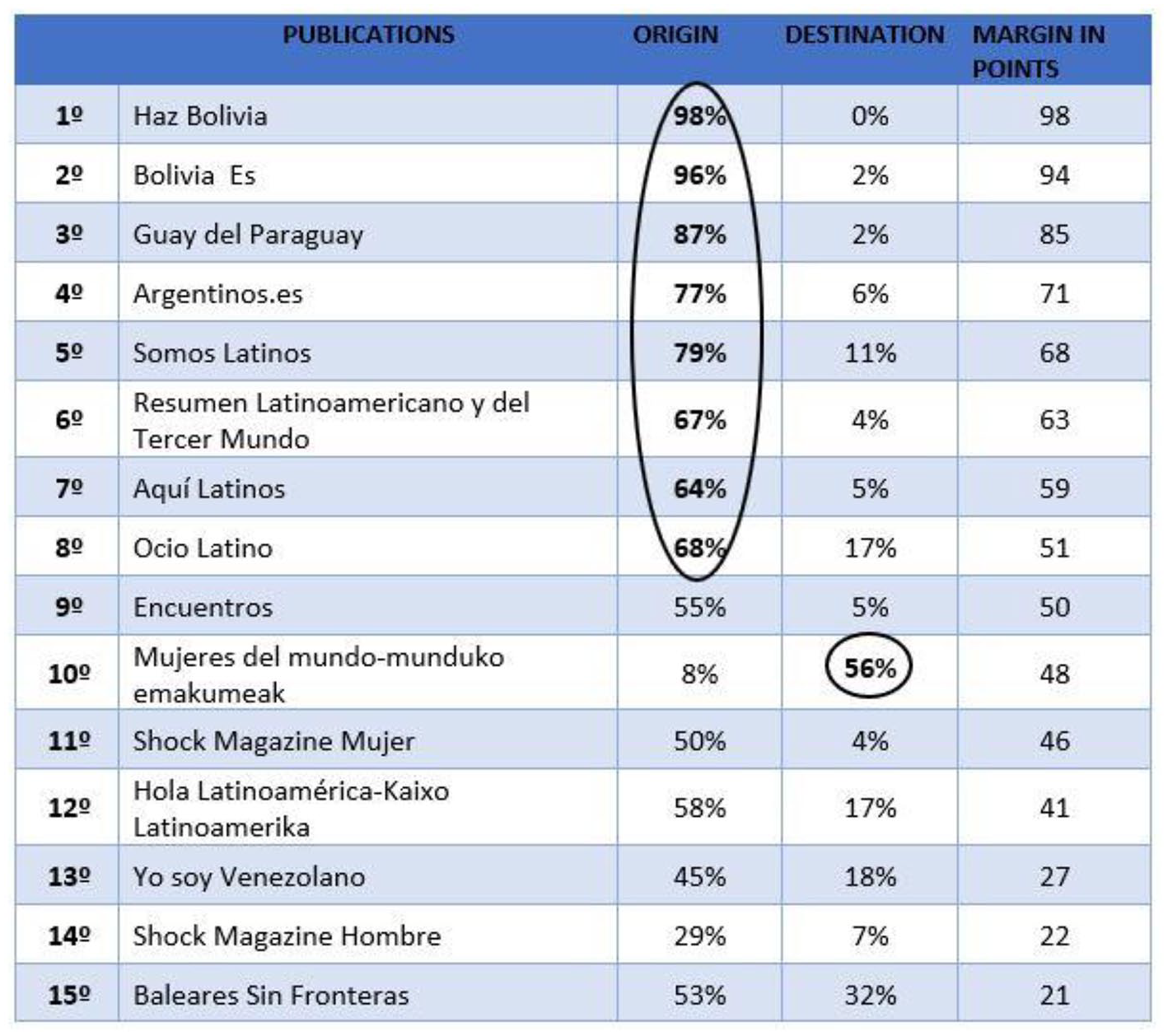
Points of margin between origin-binding and destination-binding contents.
These results appear to corroborate the two hypotheses proposed in this research, which suggest that the contents of the main Latino publications in Spain are mostly intended to anchor their readers to their countries of origin rather than promoting their incorporation into Spain, their country of destination.
H1: The contents of the main Latino publications in Spain strengthen their readers’ ties with their Latin American countries of origin.
This hypothesis is confirmed on the basis of the high percentage of contents prioritizing origin, which are 62.4percent or 6 out of every 10 items, against those prioritizing destination, which are 14.1percent or less than 2 out of every 10 items in the 14 Latino publications examined. Under the category Others, the purpose of 17.5percent of the contents, less than 2 out of every 10, isn’t to prioritize neither the countries of origin nor the country of destination but other countries, or different goals. In the last place, under the category Mixed, only 6percent of the contents prioritize both the countries of origin and the country of destination.
Furthermore, the percentages of origin-binding contents range from almost 100percent in two Bolivian publications, to percentages of between 87percent and 67percent in five publications and percentages of around 50percent in five others. That is, over half of the contents in almost 80percent of the Latino publications examined prioritizes origin over destination. The second aspect which corroborates this hypothesis is the large margin in favour of origin between the percentages of contents prioritizing origin and those prioritizing destination. This margin is larger than 50 points in favour of origin in 64percent of the analysed publications. In four publications the margin ranges from 63 to 85 points, and the origin-binding contents reach almost 100percent in the two Bolivian publications.
H2: The contents of the main Latino publications in Spain do not prioritize topics that promote the incorporation of their readers into Spain, their country of destination.
The confirmation of this hypothesis lies in the low percentage of contents prioritizing the incorporation of readers into the country of destination, which is less than 15percent of the total. Contents prioritizing destination are only predominant in the quarterly feminist magazine Mujeres del mundo-munduko emakumeak, with 56percent. Following this magazine is the biweekly newspaper Baleares Sin Fronteras, with 32percent of its contents prioritizing destination. The large margin between contents prioritizing origin over destination also corroborates the second hypothesis, since that margin exceeds 50 points in favour of origin in 64percent of the publications, and only the magazine Mujeres del Mundo-munduko emakumeak has a largest margin of contents in favour of destination.
Discussion
In this article we have shown the connections between the contents of Latino publications in Spain with origin and destination. To demonstrate this, we have analysed the contents of 1507 informative items published by 14 Latino publications edited in Spain during one year. According to our hypotheses, the contents of Latino publications in Spain prioritize topics that contribute to maintain their readers’ links with their countries of origin, but they don’t prioritize topics that encourage their readers’ incorporation in Spain.
In fact, origin-binding contents multiply by four destination-binding contents. It is worth noting that the percentages of contents prioritizing origin are almost 100percent in the two publications directed specifically at the Bolivian community, but they also represent as much as 80percent in the publication targeting Paraguayans in Spain, Guay del Paraguay, and in the magazine targeting Argentinians, Argentinos.es. However, the percentages of contents prioritizing origin also range between 55percent and 70percent in the publications geared to Latin Americans in general.
The prosperity of the Latino print media in Spain has been short-lived despite the fact that the numbers of Latin Americans in Spain did not decrease drastically during the economic crisis from 2009 to 2014, and actually started to grow again in 2015. Of the 14 Latino publications analysed in this research, six had closed down by the middle of 2019. Of the 130 Latino publications in Spain in 2007, a small number were still publishing in paper or print digital format in 2020.
For the purpose of this study, we have not quantified the impact of the transnational practices of Latino print media on the viability of their business model. Most Latino publications in Spain are today small operations, which tend to be more vulnerable in their attempt to be financially self-sufficient (Yu, 2018a). They don’t receive public subsidies and depend solely on advertising for revenues. Therefore, Latino publications in Spain have had to device different strategies for economic survival. Some publications like Shock Magazine have back-to-back covers, one featuring a male and the other a female model, in order to create more advertising spaces in a single issue. Apart from news content, other magazines such as Ocio Latino provide graphic design, printing and marketing services for extra revenue. Another approach to financial survival includes geographic expansion to neighbouring countries. An example of this is the magazine Aquí Latinos, whose owner travels every other month to France, Switzerland and Italy to distribute its issues to Latino businesses in those countries.
The challenge for ethnic media is ‘to create the appropriate conditions that favour committed, independent, and economically viable media that work to make migrants become full members of the host country society’ (Ferrández Ferrer, 2019). In this context, some authors defend the importance of government support to build an interactive media infrastructure that ensures the availability of ethnic media (Yu, 2018b).
On the other hand, this research reveals the large margin between origin and destination-binding contents, which ranges between 70 and 87 points in almost half of all publications, and even exceeds 95 points in those geared to Bolivians. This important gap between origin and destination-binding contents could question the transnational character of Latino print media in Spain, both in their content and functions, because with this imbalance it would be more difficult to argue that these media allow readers to bond with their country of destination as much as with their home countries.
While ethnic media studies generally confirm an integrative role of ethnic media, there are concerns about their leaning toward their home countries rather than the host countries, as seen in their higher coverage of news from home (Fleras, 2015). Ahadi and Murray (2009) question whether ethnic media can serve an integrative role by accommodating difference, and point out to the low number of national news covered by non-English ethnic outlets in Canada. A higher number of destination-binding contents with more news from the host country can foster the integration of immigrants in their new environment by providing Critical Information Needs, including health-related resources and plans for disaster preparedness (fires, floods and earthquakes). Ethnic media compensate for the government’s failure to make information directly accessible to newcomers (Matsaganis and Katz, 2016). In the case of the U.S., ethnic outlets can be key resources for political information about candidates and public policy initiatives, and often encourage immigrants to become citizens after they legalize their status.
Destination-binding contents also play an important role in community-based ethnic media, which often engage in advocacy journalism by defending immigrants’ rights. Their stories draw attention on the impact of the host country’s government actions, like educational budget cuts, or the lack of minority programmes in mainstream media Zazueta Martínez K (2004). Community-based ethnic outlets have the potential to create collaborative media projects with immigrants to raise collective awareness on issues such as migration and domestic violence, the problems of at-risk youth and other marginalized groups or the promotion of health initiatives and computer literacy (Miñana, 2017). The study of destination-binding contents should also be extended to online contents. With the impact of digitization on ethnic media, the use of social media and mobile news apps as transnational ethnic mediascapes (Al-Rawi, 2020) could open lines of research to analyse the weight of origin and destination-binding contents, and the intersections between them.
These intersections between origin and destination are developing today in the digital sphere. To connect with their home countries, Latinos in Spain now rely on the voice messages of WhatsApp as a cheaper alternative to international phone calls (Concepción-Sepúlveda et al., 2019). The communications in the digital sphere have accelerated the online strategies of the remaining Latino publications in Spain. However, they will have to implement many changes to adapt to the new media landscape and retain immigrant audiences, specially the young ones. The growing consumption of news on mobile devices suggests that ethnic media should invest in developing mobile-friendly versions of their websites, apps and a strong presence on social networking sites. They will have to keep up with the rise of social media platforms like TikTok, which surpassed all mobile apps by number of downloads in Spain in 2020. 5 Latino publications in Spain would also benefit from a deeper knowledge of the digital literacy of their current audiences, the targeting of new ones and the collaboration with other ethnic media to develop online content production and distribution platforms (Matsaganis and Zhou, 2019). As we have indicated earlier, Latino publications in Spain have started to diversify their sources of revenue. Additional ways to tap into new funding can include consulting services, online classes, the creation of business directories and e-commerce sites. 6 The future of Latino publications in Spain is linked to affordability and technological innovation.
Footnotes
Funding
The author received no financial support for the research, authorship, and/or publication of this article.
