







Abstract
Strategy framing is usually studied in the context of news coverage about domestic Western politics. This study expands its application to news reports on the China-US trade war—an inter-state conflict including a democratic and one-party dominant system—thereby adding an international dimension to the study of strategy framing. Through a manual content analysis of news coverage from China, the US, Singapore, and Ireland (from January 2013 to January 2020; n = 1872), we investigate whether media independence, conflict involvement, and crisis phases influence the employment of the issue framing and strategy framing. For democratic countries, the more involved they are in the conflict, the more prominent strategy framing was in their coverage of the trade conflict; the inverse was observed for one-party dominant systems. Strategy framing that considers countries as contenders is more prevalent than the sub-frame that focuses on individual politicians. The presence of national-versus-personal level strategy framing was more balanced for directly involved countries than indirectly involved countries since news from directly involved countries accords relatively more space to politicians’ personal strategy.
Keywords
Introduction
The trade war between China and the United States since 2018, has not only negatively affected the bilateral economic relationship, but brought ramifications on their political, technological, and ideological relationships. As the world’s two largest economies, this growing rivalry rendered ripple effects across the globe (Kapustina et al., 2020). In international journalism studies, there are two ways in which news media can play a critical role: either acting proactively, intensifying the inter-state tension with war-oriented discourses, or reactively—by simply reflecting government positions (Entman, 2003; Norris, 1995). By exploring news media’s role in international conflict, we aim to comprehend the conditions (political system, conflict involvement, and conflict phases) under which news media’s different roles are performed (Evans, 2010).
To investigate media’s function during the China-US trade conflict, this study analyzes the news contents along the lines of framing theory. We particularly focus on issue framing and strategy framing, as they reflect different roles that news media play (Dekavalla, 2018): The former introduces governmental policies, actions, and opinions; whilst the latter treats politics as a game and highlights political process without policies involved (Cappella and Jamieson, 1997). These two frames were previously mainly studied in Western electoral news (Aalberg et al., 2017). Our study provides a new perspective by adding an international dimension to the original frames, thereby extending the literature on these frames to the field of international journalism and embracing non-Western press in their comparative analysis.
Which frame journalists employ depends on various factors. We theorize that strategy framing may be less common in one-party dominant contexts, because news media—more controlled by political authorities—will be compelled to follow policies closely rather than highlighting clashes between politicians or ideologies. Additionally, a higher degree of conflict intensity might prompt more news attention on the conflict process to remind citizens of potential risks. Hence, a country’s own involvement in the conflict and the different phases of a conflict should be considered.
To investigate the relationships between the three antecedents (i.e., political system, conflict involvement, and conflict phases) and issue framing and strategy framing’s presence, a comparative content analysis is conducted over an extended period across countries (i.e., China, the US, Singapore, and Ireland). This comparative approach warrants the required variance of each explanatory factor, whilst offering a more comprehensive understanding on these two frames beyond the Western context.
Literature review
Strategy framing and issue framing
News framing can be defined as a process through which journalists select and emphasize certain aspects of social realities, whilst obscuring others, offering the audience a perspective to understand and evaluate social events (Entman, 2003: 5). Gamson and Modigliani (1987: 143) define a news frame as “a central organizing idea or storyline that provides meaning to an unfolding strip of events.” A fertile area of political communication focuses on strategy framing (or game framing), which originates from campaign news studies, yet can also be applied to political news more generally (Dekavalla, 2018).
As Jamieson (1993: 187) argued, coverage with strategy framing “(1) focuses on winning and losing, (2) includes the language of war, games, and competition, (3) contains ‘performers, critics and audiences’, (4) focuses on candidate style and perceptions, and (5) gives weight to polls and candidate standings.” Journalists that apply strategy framing, thus, regard campaign or policy debate as a game in which politicians compete for personal advantage (Lawrence, 2000). Issue framing, often studied as the antithesis of strategy framing, emphasizes the substantial elements, like policy contents, politicians’ opinions on policy-making, and possible solutions (Cappella and Jamieson, 1997: 35). As Entman (2003: 5) argued, issue framing helps to “define effects or conditions as problematic,” “identify causes,” “convey a moral judgment,” and “endorse remedies or improvements.” Generally, strategy framing is commonly created by journalists; whilst issue framing is often introduced by the news sources (Dekavalla, 2018).
Strategy framing has increasingly become prominent in democracies at the expense of issue-oriented reportage (Lawrence, 2000) because presenting political news in a conflictual and dramatized scheme is often considered to be more newsworthy (Boukes and Vliegenthart, 2020). Moreover, simplifying complex policy by explicitly distinguishing two clashing groups is effective for journalists to generate an engaging news story despite constraints of time and space (Aalberg et al., 2017).
Strategy framing in domestic contexts often involves battles between political ideologies (e.g., conservative vs. liberal), which contradicts the unified national ideology. Such coverage may be less expected in domestic political news from one-party dominant systems. The China-US trade conflict—a conflict between countries rather than an ideological clash within a country—provides an opportunity, however, to examine how journalists from countries with different political systems employ strategy framing on the same topic without necessarily threatening the ruling authorities. After all, Chinese journalists in this case (or journalists from non-democratic countries, more generally) can use this frame without harming the unified collectivism it is meant to portray. Conversely, strategy framing in the international conflict news might be useful in uniting and engaging domestic populations, thus promoting patriotism and support for one’s own leaders.
Notably, both the concept of strategy framing and war journalism regard politics as a zero-sum game with clear opposing sides (Galtung and Fischer, 2013: 98). The China-US trade coverage has also been analyzed within the war-and-peace framework with China and the US as two contenders (Ha et al., 2020). This study, focusing on strategy framing, not only considers countries as the competitors, but also examines the emphasis that journalists put on politicians’ personal strategy. Domestic politics are sometimes more influential than foreign environments in determining a country’s engagement in foreign conflict (Entman, 2003: 123). Politicians could even target foreign conflicts to divert public focus from domestic disputes, whilst revealing their authoritative capacities to voters (Noland et al., 2016).
Hence, we integrate the logic of war journalism (Galtung and Fischer, 2013: 98) and further disentangle strategy framing into the national-level and personal-level. The national-level emphasizes which country is ahead or behind, the tactics a country employs to win, and garnering supports from international communities (Galtung and Fischer, 2013: 98). The personal-level highlights politicians’ private motives behind foreign policies, personal styles when managing foreign issues, and domestic public opinions on politicians or their proposed policies (Lawrence, 2000). Issue framing here still emphasizes the substance of trade policies, politicians’ statements, and solutions for frictions (Lawrence, 2000).
Framing the China-US trade conflict: Involved Versus uninvolved countries
Media reports from two directly involved countries—China and the US—and two indirectly involved countries—Singapore and Ireland—are selected, which simultaneously satisfies a combination of most-similar-system design (i.e., linking frame building to one likely cause under the similar system) and most-dissimilar-system design (i.e., linking frame building to system-level factors) in comparative research (Pfetsch and Esser, 2004).
Regarding conflict involvement, China and the US have long been afflicted with trade frictions. During Obama’s presidency, the Trans-Pacific Partnership (TPP), a policy perceived as an attempt to slow China’s rise, was proposed (Campbell and Andrews, 2013). When Donald Trump took office, the two countries slapped several rounds of tit-for-tat tariff and non-tariff barriers (Kapustina et al., 2020).
Singapore and Ireland are comparable indirectly affected countries in Asia and Europe. They were consciously chosen for their explicit neutrality policy (Karsh, 2012:169): Singapore has been a member of the Non-Aligned Movement (NAM), whilst Ireland never joined North Atlantic Treaty Organization (NATO). Their neutrality in politics and indirect economic involvement makes it possible to distinguish the degree of a country’s conflict involvement, whist avoiding the influence of a country’s political bias. Importantly, Singapore and Ireland are both vulnerable to trade fluctuations because they are export-oriented: the countries are deeply integrated into the China-US supply chains. China is Singapore’s largest trading partner. Around 14% of Singapore’s exports were bound for China in 2018 (Oversea-Chinese Banking Corporation, 2018). Similarly, Ireland has long been a magnet of American global companies, some of which are known for making intermediary high-end goods, which are mainly used for final manufacturing in China before being exported to the US (Whelan, 2019).
Regarding political and media systems, the US and Ireland are comparable liberal democratic republics. Their media landscapes, accordingly, are categorized by Hallin and Mancini (2004) as two clear-cut examples of the liberal model, with relatively early developed commercial newspapers and high professional journalism independent from government intervention. The First Amendment in the US, for instance, guarantees free speech and limits state intervention in the press. Media self-regulation is also practiced to further guarantee media independence (Marron, 2019). American and Irish journalists accordingly possess relatively high autonomy and tend to play a watchdog role by being skeptical of politicians’ assertions. Notwithstanding these similarities, Ireland has relatively more governmental regulations on press than America; Irish authorities fear that otherwise a purely market-oriented press would inevitably be controlled by British media conglomerates (Hallin and Mancini, 2004: 232).
China and Singapore have a comparable one-party dominant system. Each country’s ruling party, the Chinese Communist Party (CCP) and the People’s Action Party (PAP), monopolizes decision-makings and controls over governmental branches. Therefore, their press, even the market-oriented media, is closely supervised by the state (Zhao, 2012). Journalists in this context tend to be collaborative and report issues consistent with government-approved narratives (George, 2012); this sharply contrasts with their US and Irish peers. Hence, both countries rank among the lowest in Press Freedom indices (RSF, 2020). Despite experiencing the governmental influence like China, Singaporean journalists have been heavily exposed to Western liberal ideals. Besides, unlike Chinese strict publication censorship, heterogeneous foreign publications are permitted to circulate in Singapore and fewer restrictions are posed on foreign news (Wu, 2020).
The selected countries share the same level of involvement whilst possessing opposing political and media system, or vice-versa. Hence, we can effectively disentangle the impact of conflict involvement from the differences in political system.
Determinants of issue framing and strategy framing
Media independence
Framing political conflict as a game—not just describing events regarding who, when, and where—is an important indicator of media interventionism: It reflects the degree to which political reality is actively shaped by journalists and constructed by media logic (De Vreese, 2014). The extent to which media intervention can shape news content is determined by the level of media’s independence from other institutions (Strömbäck and Esser, 2009). Press with high autonomy (here: the US and Ireland) is more inclined to apply strategy framing (De Vreese, 2014); conversely, issue framing is expected to be more prominent in press with less autonomy (here: China and Singapore).
We could imagine that the predictive effect of media independence on strategy framing’s presence also applies to international conflict news. For democracies, press freedom is a basic tenet of media’s function (Hallin and Mancini, 2004: 198). More media interventions (and strategy framing) are likely to be found in these countries. Conversely, journalists from one-party dominant countries are unsure how far they can push the envelope without facing punishment (Zhao, 2012) or they are simply restrained by their existing routines. These countries’ reportage is structured more around policy, and thus feature issue framing more prominently. Accordingly, we expect:
H1
Issue framing of the China-US trade conflict is more prominent in newspapers from one-party dominant countries (i.e., China and Singapore) than those from democratic countries (i.e., the US and Ireland).
H2a
Strategy framing of the China-US trade conflict is more prominent in newspapers from democratic countries (i.e., the US and Ireland) than those from one-party dominant countries (i.e., China and Singapore).
Personal-level strategy framing is a manifestation of news personalization (Lawrence, 2000), through which politicians’ personal traits enjoy more coverage than the parties or institutions they represent (Van Aelst et al., 2016). News personalization has been identified across different political systems, yet this phenomenon is demonstrated to be more prominent in democracies than one-party dominant countries (Šimunjak, 2017). One reason is that the increasingly electoral-professionalism of political parties in democracies tend to market ideas through public figures rather than through policy issues. More market-oriented media organizations in these countries also contribute to a higher degree of personalization (Van Aelst et al., 2016). Hence, personal-level strategy framing may be more prominent in democracies than one-party dominant countries. Contrastingly, one-party dominant countries may ascribe more to collectivism, which entails that the collective good is superior to individuals’ private pursuits; their coverage, accordingly, might highlight the national significance more and avoid exposing politicians’ personal motives compared to democracies (Šimunjak, 2017). Since the trade conflict is mainly unfolded between two countries, national-level strategy framing may be more prominent than personal-level strategy framing, in general. However, the prominence difference between these two sub-frames may thus vary under different media systems due to the focus on individual politicians in democratic countries vis-à-vis the emphasis on collectivism in one-party systems. Accordingly, we propos:
H2b
National-level strategy framing is more prominent than personal-level strategy framing in the China-US trade conflict news across countries regardless of media system and conflict involvement.
H2c
The presence of national-level and personal-level strategy framing is more balanced in news from democratic countries (i.e., the US and Ireland) than one-party dominant countries (i.e., China and Singapore).
Political environment: National conflict involvement
Besides the structural factors of the media system, news contents may be influenced by the dynamic political environments in which the press is embedded (Cottle, 2006: 6). When a country is directly involved in an international conflict, the immediate impacts on its society stimulate news media to operate as alarm systems that alert the public to emergent problems (Zaller 2003): Journalists might boil down the complicated policy to straightforward competitions between political actors. Moreover, journalists are vulnerable to the psychological effects of conflicts; they share the beliefs of the society they belong to, even when no systematic propaganda system exists (Kempf, 1998). Accordingly, news from directly involved countries is more likely to be constructed around the “in-group” and “out-group” framework and subsequent war discourses. Thereby, we propose:
H3a
Strategy framing of the China-US trade conflict is more prominent in newspapers from directly involved countries (i.e., China and the US) than from indirectly involved countries (i.e., Singapore and Ireland).
Political proximity—the level of political accordance between two countries regarding policies and actions—affects the degree of news personalization (Balmas and Sheafer, 2013): The more interests two countries share (more political proximity), the less likely their news is reduced to a focus on each other’s leaders and the more likely that national aspects are emphasized. As competitors in the trade conflict, China and the US have opposite interests (low political proximity). Ireland and Singapore are indirectly involved, and both hope to share more interests with China and the US (high political proximity). Chinese and American journalists, accordingly, may report more about each other’s leaders (personal-level) and less on national descriptions (national-level) than Irish and Singaporean counterparts. We, therefore, propose:
H3b
The prominence difference between national-level and personal-level strategy framing is smaller in news from directly involved countries (i.e., China and the US) than indirectly involved countries (i.e., Singapore and Ireland).
Crisis phases
Journalists usually analyze a recurring political conflict through a “phase structure” (Fishman, 1988: 69): events moving along a definite timeline towards identifiable outcomes—a clear winner or loser. As Lawrence (2000) argued, increasing conflict might boost more game-framed coverage, especially “when policymakers are in the most heated ‘conflict with movement’”, since politicians’ motives are revealed more apparently and public opinions are expressed more frequently as the conflict progresses.
Notably, conflicts in reality can be in incubation for years with only occasional flare-ups. Rarely has the manner of framing during the conflict outbreak period been compared to the brewing stage of the same conflict (Cottle, 2006: 74). It is unknown whether a conflict’s eruption impacts how journalists frame it. To investigate the impacts in the China-US trade conflict context, we analyzed the coverage during what the media call the “China-US trade war” since 2018, also the period before the “trade war” (20 January 2013, onwards).
Trump’s campaign announcement (16 June 2015) and policy amendments that imposed tariffs on Chinese imports (22 January 2018) are considered as two fundamental cut-off points. Trump’s campaign is significant because throughout his run for office, he provoked the Chinese government by repeatedly labeling China as a “rapist” country (Noland et al., 2016). The verbal attacks then could not be translated into actual policy (or a trade war) because he was still only a presidential candidate. Nevertheless, potentially this could already have impacted the way that journalists cover this topic. When Trump assumed office and announced tariffs on Chinese imports in 2018, the actual trade war erupted between these two countries. We therefore distinguish three phases of the China-US trade conflict: (1) pre-trade war during Obama’s term, functioning as a control condition, (2) rhetorical trade war during Trump’s campaign, and (3) actual trade war considering the imposed policies. Consistent with the suggestion that strategy framing becomes more dominant when conflict intensifies (Lawrence, 2000), we predict:
H4a
Strategy framing is more prominent after presidential candidate Trump’s campaign announcement in 2015 than before the campaign announcement across countries regardless of media system and conflict involvement.
H4b
Strategy framing is more prominent after President Trump hiked tariffs on Chinese imports in 2018 than before the tariff announcements across countries regardless of media system and conflict involvement.
Zooming in on the actual China-US trade war (from 2018 onwards), we expect strategy framing’s occurrences to interrelate positively with the conflict’s fluctuations. According to the changes in tariff rates that China and the US imposed on each other (Kapustina et al., 2020), the escalation phases include the following three time intervals: from February 2018 to April 2018 (3-month), from July 2018 to September 2018 (3-month), and from May 2019 to September 2019 (5-month), during which the Trump administration imposed a series of tariffs on Chinese imports. Chinese government also retaliated with reciprocal measures. One clear-cut de-escalation phase was from December 2018 when the two countries agreed to a temporary truce until April 2019 (5-month). We predict that strategy framing is more prominent during the three tariff hike periods, whilst less strategy framing appears when the two countries had a truce.
H4c
Strategy framing is more prominent during the escalation periods of the China-US trade conflict compared to the periods of de-escalation across countries regardless of media system and conflict involvement.
Method
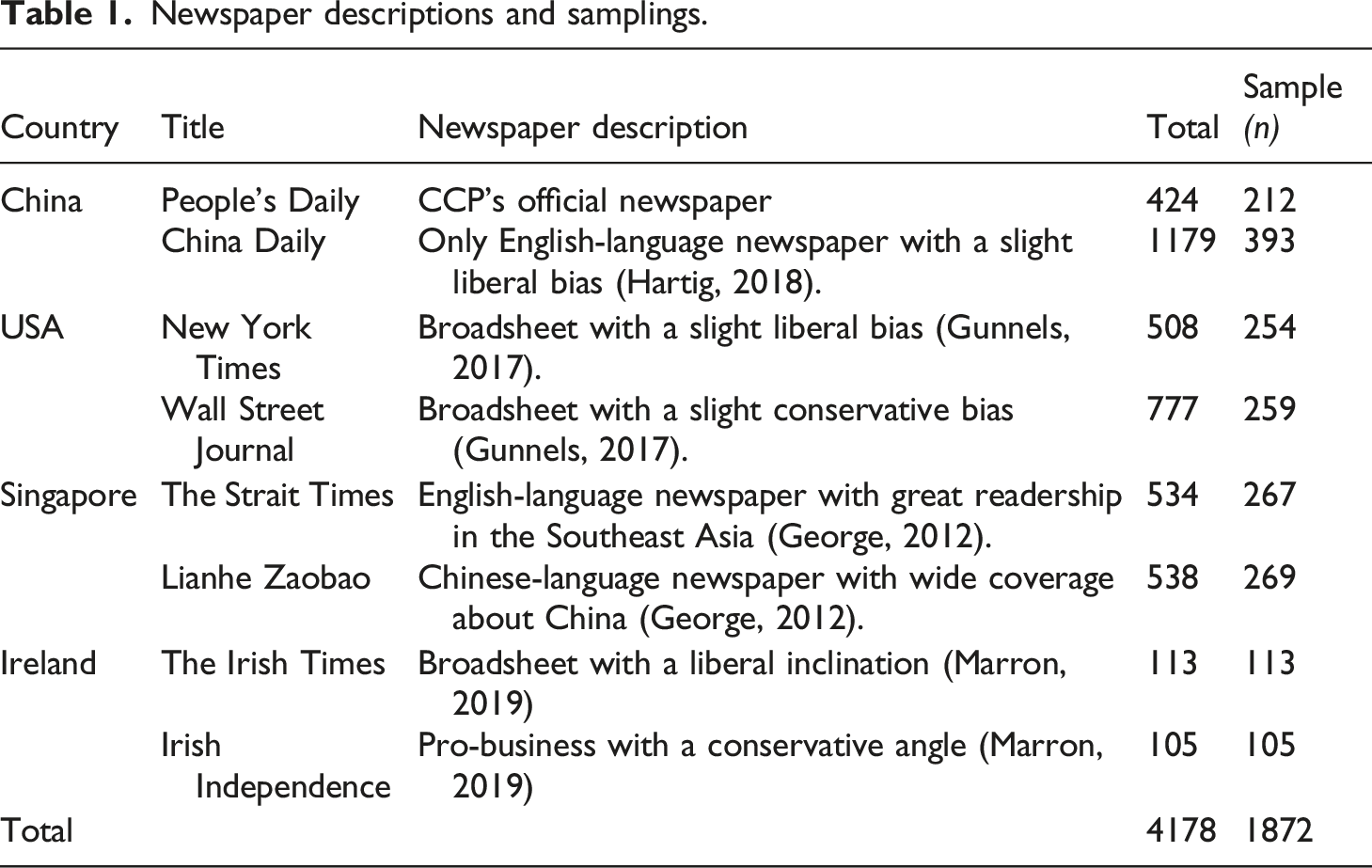
Newspaper descriptions and samplings.
Time frame
The investigated time frame commences on the 20 January 2013, Obama’s second inauguration, until 15 January 2020. We selected this starting point because during Obama’s second term the US proposed a “pivot to Asia” policy (Campbell and Andrews, 2013). This period also coincides with the beginning of Xi Jinping’s presidency, when China began to adopt a more assertive foreign policy. Thus, this factor remains stable during the researched period. The endpoint coincides with the moment when the two countries ended their 18-month trade strife by signing the Phase One trade deal.
This time frame was also strategically selected to exclude the potentially confounding influence of (a) China-US quarrels regarding the Covid-19 pandemic and (b) the 2020 US presidential election that might increase strategy framing’s prominence. Following H4a and H4b, the time frame is divided into three phases (see Figure 1). Timeline of the China-US trade conflict. Note. Phase 1: n = 157; Phase 2: n = 338; Phase 3: n = 1370.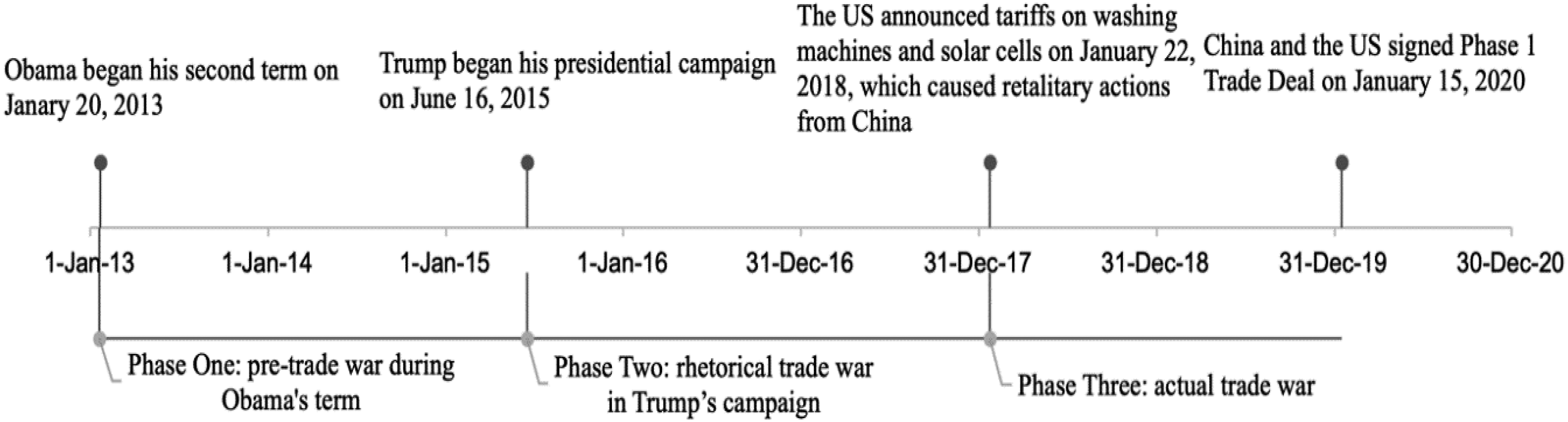
Sample selection
Analysis units are individual news articles retrieved from the databases of NexisUni (former LexisNexis), ProQuest, WiseSearch, and People’s Daily online service using a keyword searched in the title and lead: “trade AND China AND (United States OR America OR US OR USA OR U.S. OR U.S.A.)”. The China-US trade conflict is a wide-ranging topic, concerning various aspects of China-US relations. To verify news articles’ relevance, we manually selected (a) articles whose main topic was China-US trade, but also (b) articles in which this trade conflict was of secondary focus (please see Supplementary Appendix).
Articles like editorials, financial market trends were excluded: They are either purely informational or subjective evaluation, and may systematically affect issue or strategy framing’s presence. We only analyzed the news reported from a national or international perspective and excluded news only covering the state/provincial level. After eliminating irrelevant news, 4178 news articles remained (see Table 1).
A systematic sampling approach with a fixed interval was used, which guarantees that three periods are well-represented. To handle the unbalanced number of articles per newspaper, every second article was chosen from People’s Daily, the New York Times, the Strait Times, and Lianhe Zaobao. Every third article was chosen from China Daily and the Wall Street Journal. All relevant articles from Irish Independence and the Irish Times were selected. The final sample size was 1872 (see Table 1).
Measurement: Variables and reliability
Independent variables are the individual countries from which newspapers originated, together with their features of media independence (i.e., China and Singapore versus the US and Ireland) and conflict involvement (i.e., Ireland and Singapore versus China and the US). The three trade war phases (dummy coded) and the months during the actual trade war are additional independent variables. Article length was a control variable in all analyses. The presence of issue framing and strategy framing are the key dependent variables of this study.
Variables, Item wording, and inter-coder reliability.
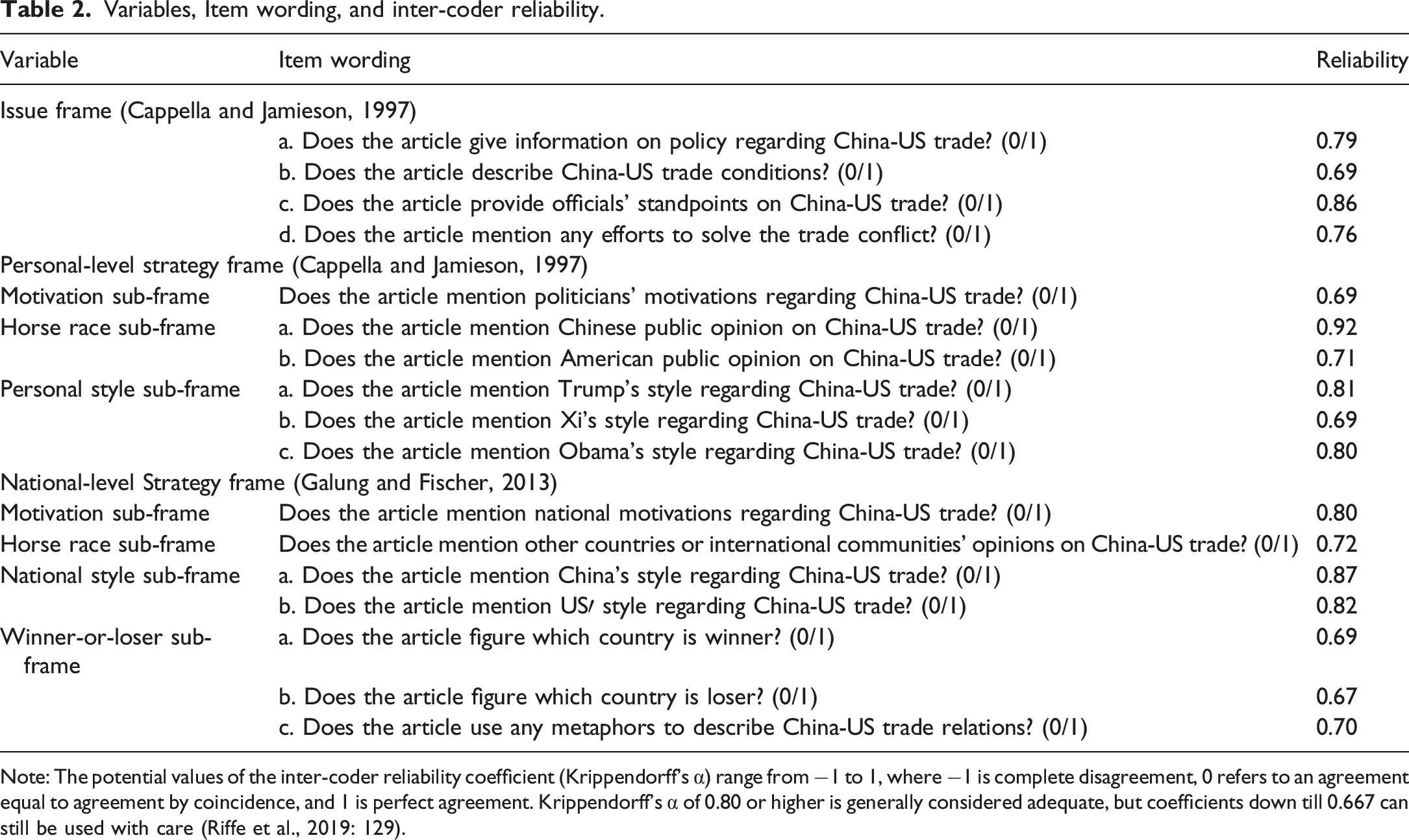
Note: The potential values of the inter-coder reliability coefficient (Krippendorff’s α) range from −1 to 1, where −1 is complete disagreement, 0 refers to an agreement equal to agreement by coincidence, and 1 is perfect agreement. Krippendorff’s α of 0.80 or higher is generally considered adequate, but coefficients down till 0.667 can still be used with care (Riffe et al., 2019: 129).
Two coders, including one of the authors, were responsible for coding the newspaper articles. They are both native Chinese speakers and fluent in English. It took 40 h training to assure the coders understood the coding scheme and employed the coding process as required. Inter-coder reliability was assessed using Krippendorff’s α based on a random sample of 102 news articles within the full sample. The results are satisfactory for all items: none scored lower than 0.67 (see Table 2). Three months were eventually taken to finish all coding (from March to May 2020).
Analysis
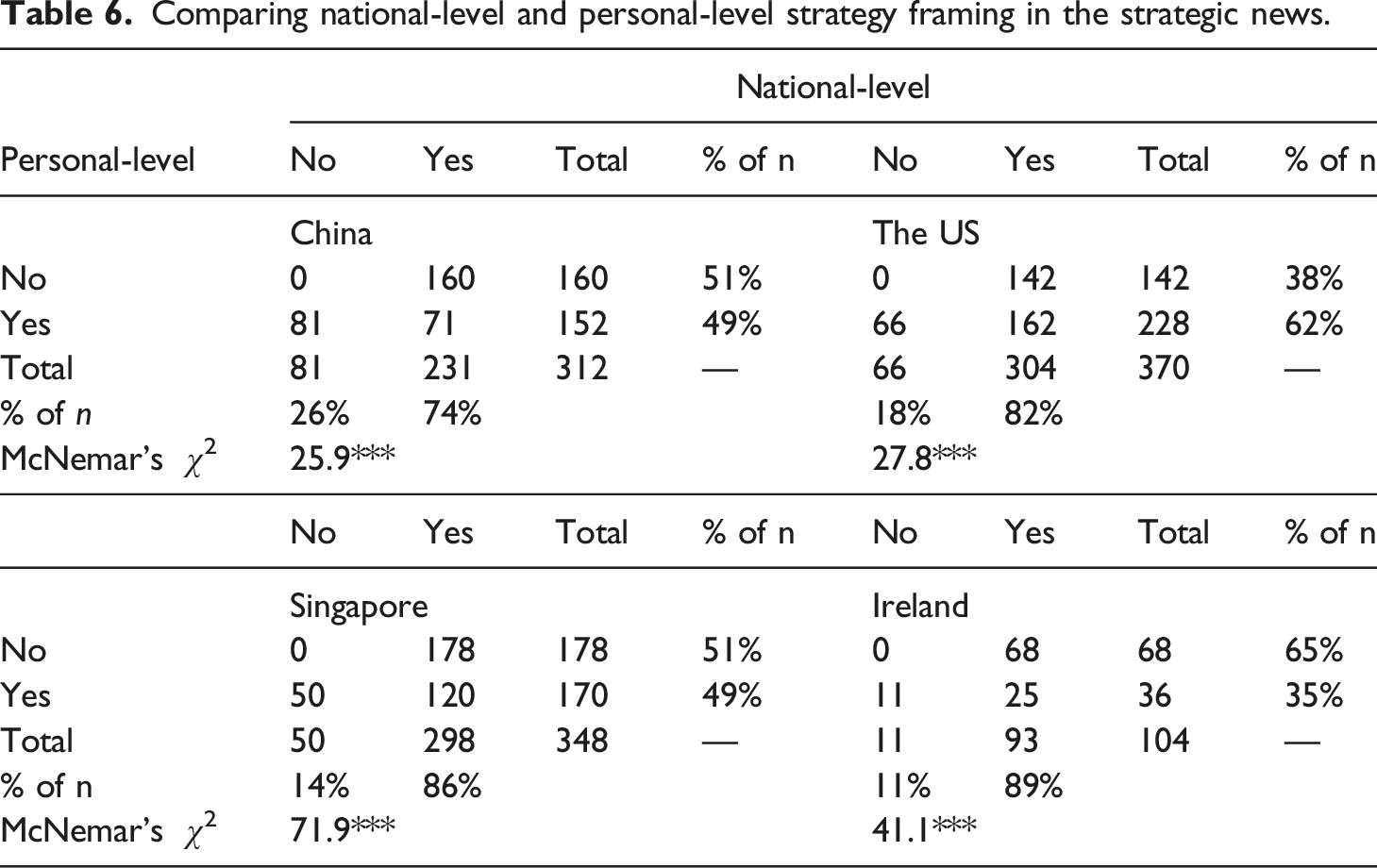
Since the dependent variables are dichotomous, logistic regression analyses were employed to assess the predictive value of (a) media independence, (b) conflict involvement, and (c) conflict phases. Logistic regression analysis does not make any assumptions about the (normal) distribution of variables; hence, group imbalance of conflict phases will not influence the result. Concurrently, an interaction term between media independence and conflict involvement was entered into the logit model to determine the effect of specific countries. We calculated the predicted probabilities of a frame to be present in an article from a certain country (presented between parentheses) to explain the coefficients of logistic regression. To address H2b, H2c, and H3b, we filtered articles that contain at least one element of strategy framing, and, respectively, recoded the subgroups of national-level and personal-level. The proportions of these two subgroups were calculated in each country, and were then compared with McNemar’s Test for paired nominal data.
Results
Presence of issue framing.
Logit models predicting issue framing.
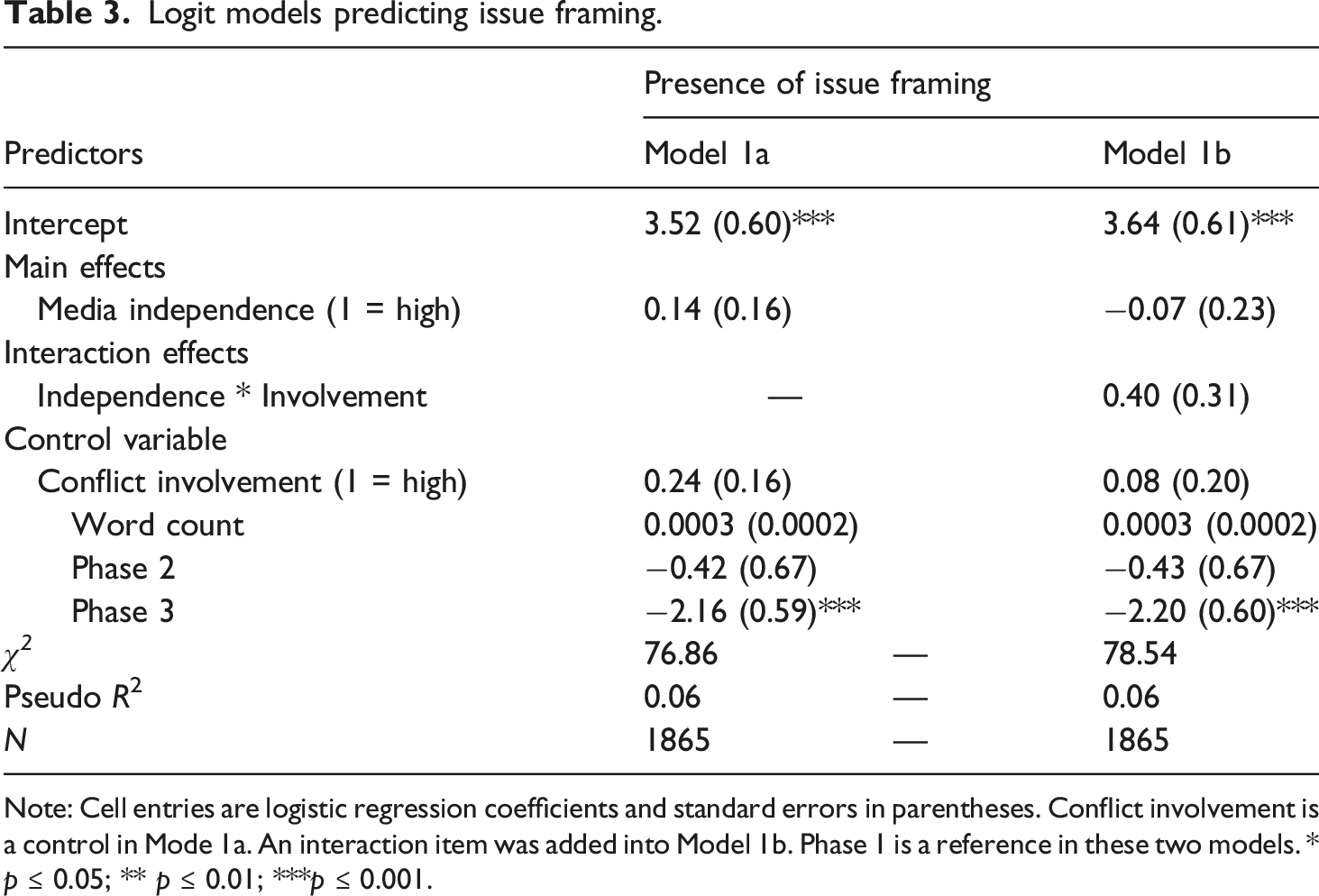
Note: Cell entries are logistic regression coefficients and standard errors in parentheses. Conflict involvement is a control in Mode 1a. An interaction item was added into Model 1b. Phase 1 is a reference in these two models. * p ≤ 0.05; ** p ≤ 0.01; ***p ≤ 0.001.
Presence of strategy framing
Logit models predicting strategy framing.
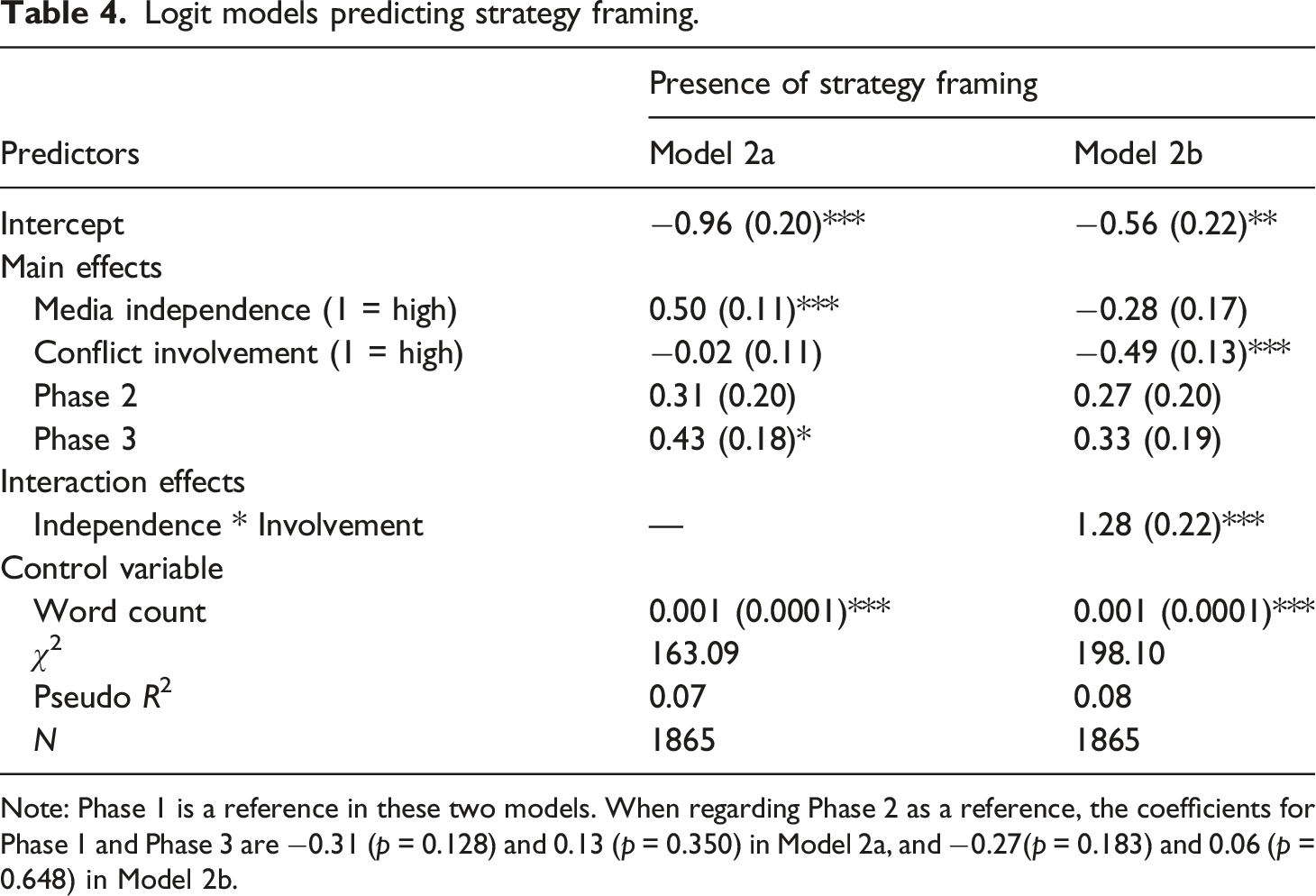
Note: Phase 1 is a reference in these two models. When regarding Phase 2 as a reference, the coefficients for Phase 1 and Phase 3 are −0.31 (p = 0.128) and 0.13 (p = 0.350) in Model 2a, and −0.27(p = 0.183) and 0.06 (p = 0.648) in Model 2b.
To narrow focus on specific countries, an interaction term was added to Model 2b. This interaction effect was significantly positive (p <0.001), implying the effect of conflict involvement was conditional upon media independence. News from a democratic country that was directly involved in the trade conflict (the US) contained more strategy framing (74.3%) than the indirectly involved country (Ireland: 51.7%). For one-party dominant countries, instead, newspapers from indirectly involved country contained more strategy framing (Singapore: 63.7%) than the directly involved one (China: 51.7%) (Figure 2). Thus, coverage may contain more strategy framing under a democratic context, but only when the country is directly involved. Predicted probabilities (with 95% confidence interval) of strategy framing taking the interaction effect into consideration.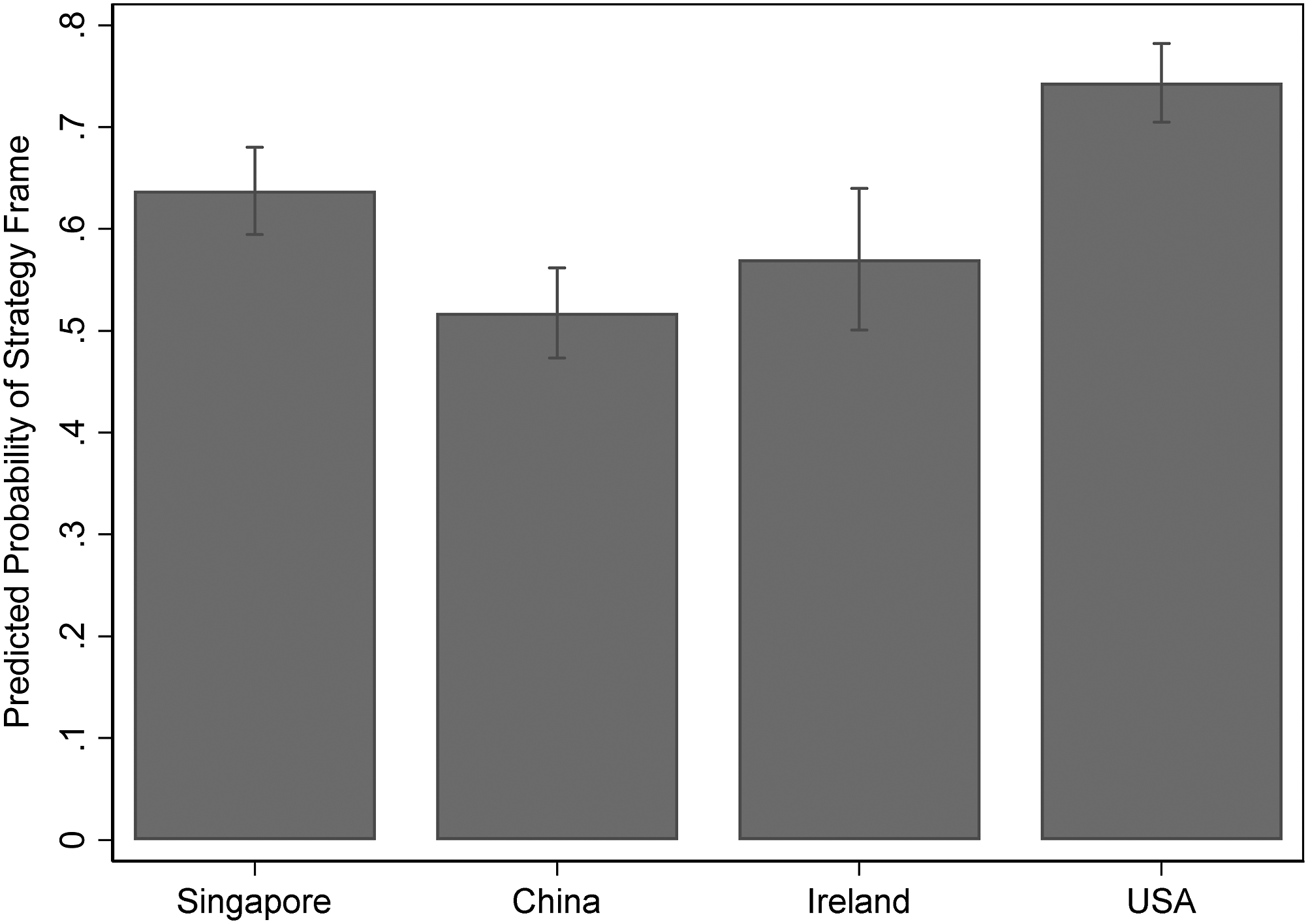
Presence of strategy framing within actual trade war
Logit model predicting strategy framing within actual trade war.
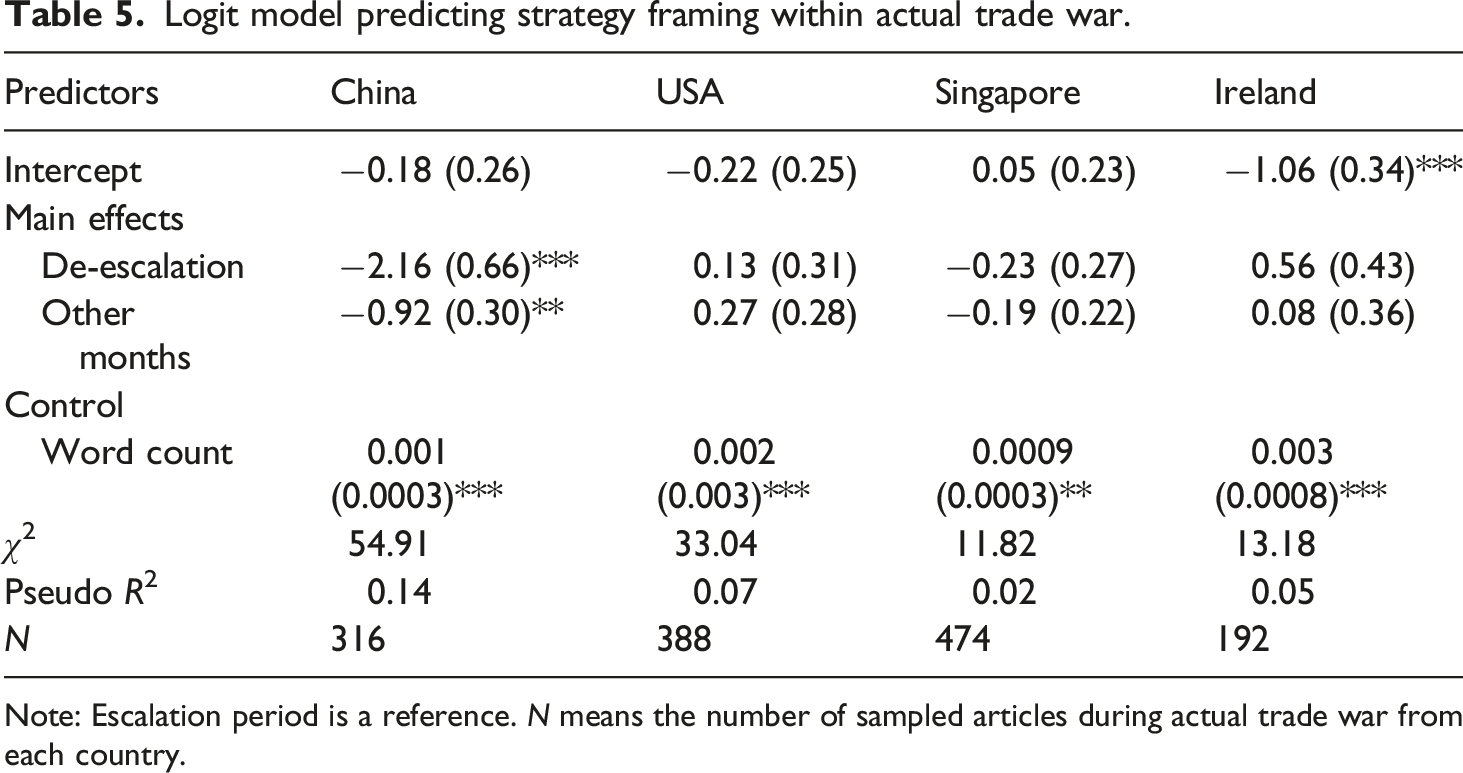
Note: Escalation period is a reference. N means the number of sampled articles during actual trade war from each country.
We further explore strategy framing’s presence in each month within the actual trade war across the four countries (see Figure 3). Qualitative interpretation of these graphs indicates that strategy framing was relatively more prominent throughout the conflict escalation phases than the ceasefire period in news from China, Singapore, and Ireland. Despite that strategy framing in Irish news was less prominent in 2019 than in 2018, a fluctuation in the framing’s prominence was still found when China and the US slapped tariffs in 2019. However, the incidences of strategy framing in US news are stably present regardless of conflict’s fluctuations. Predicted probabilities of strategy framing of four countries over time. Note: Independent variables include the order of month, country, and their interaction.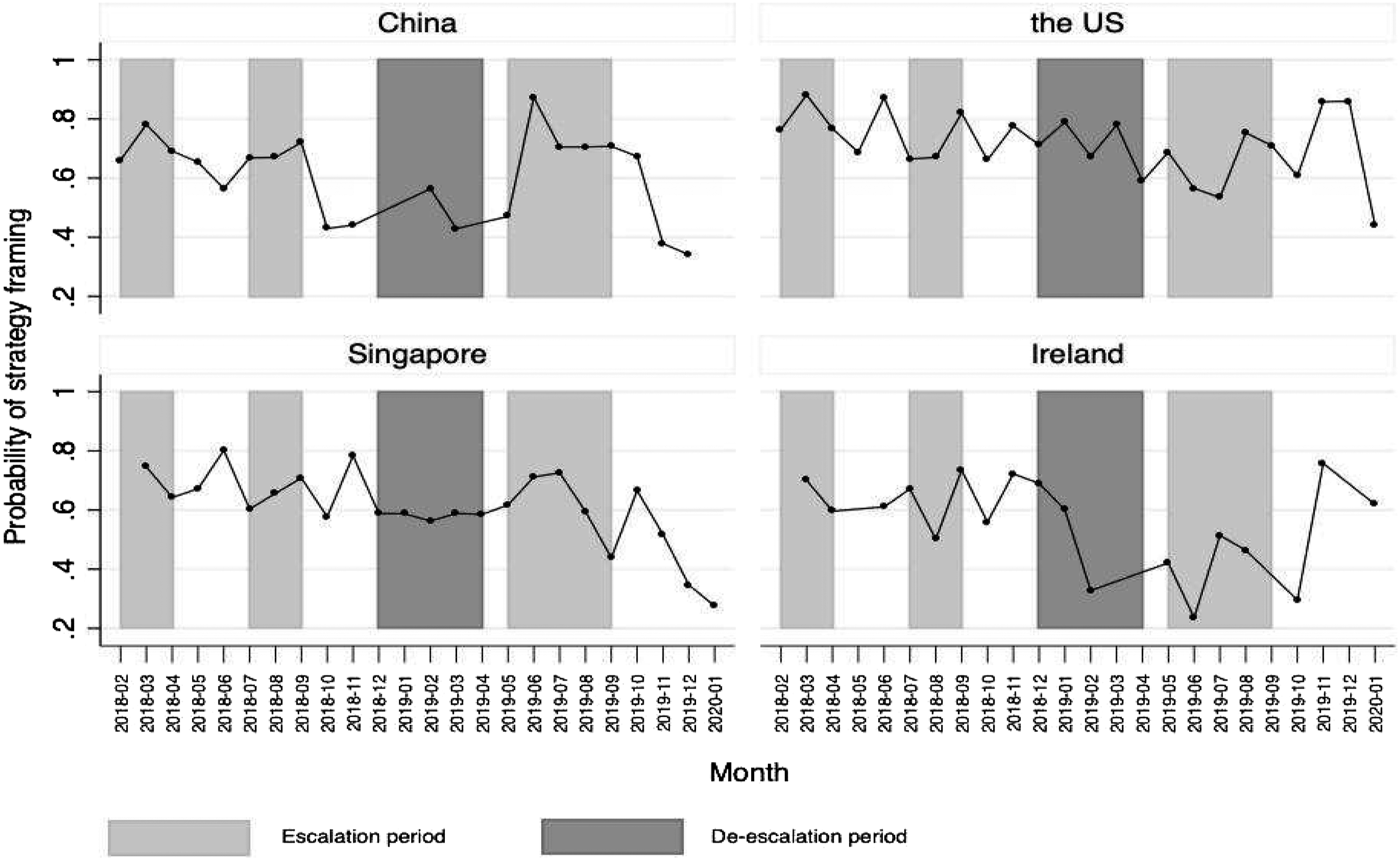
Personal-level and national-level strategy framing
Comparing national-level and personal-level strategy framing in the strategic news.
Discussion
This study revealed that issue framing and strategy framing can be identified in trade conflict news from both democratic and one-party dominant countries—but in different proportions. Differing from what is known about issue framing in Western electoral news, we found a very high level of use across contexts: 88.4% of the sampled articles carried an issue frame, with no significant differences between countries with different media/political system or conflict involvement. Compared to campaign news in which policy preferences often remain uncovered, the China-US trade conflict apparently encourages journalists to introduce more policy details to the public. Yet, issue framing’s prominence decreased across countries during the most intense stage, in sharp contrast to the increasing prominence of strategy framing as the trade war became concretized through slapped tariffs. This corroborates that the public is gradually deprived of news on substantial policies, whilst reportage about the conflict process itself becomes more prominent (Lawrence, 2000).
Regarding strategy framing, we theorized that the media independence and national conflict involvement could affect its presence independently. However, these two factors were demonstrated to be interrelated: The predictive effect of media independence depends on whether a country was directly involved in the conflict or not. For democracies, strategy framing was more prominent in the directly involved country (the US vs. Ireland); for one-party dominant countries, however, the opposite was found (China vs. Singapore). This indicates that media independence or conflict involvement on itself is not a decisive factor for strategy framing’s employment. The sampled countries’ distinct political systems partially explain the conditionality. As mentioned earlier, Singaporean hybrid media environment makes journalists maintain their roles as governmental mouthpiece in domestic news, whilst more closely following the liberal-democratic ideal when reporting international events. Instead, Chinese media function under strict governmental instruction—especially when China is involved in the conflict—and therefore may rarely present media logic. The lower volume of strategically framed news in Ireland might be explained by its stricter media regulations than America (Hallin and Mancini, 2004: 232), and the longer geographical distance to China and the US, compared to Singapore (Wilke et al., 2012).
Remarkably, strategy framing in Chinese news is significantly more prominent in escalation periods than de-escalation periods, which was not found for the other countries. Strategy framing in American news, however, consistently scores high with little fluctuation, even during the truce period. Strategy framing seems to be increasingly weaponized by Chinese media particularly as the conflict intensifies, whilst for American journalists, it seems to be a dominant routine. This partly reflects the divergence regarding international journalism practices between these two countries. With the Cold War’s end, American journalists gradually turn to cover foreign policy in an increasingly independent fashion to ensure the most advantageous policy possible (Entman, 2003); Chinese press, conversely, keeps adhering to political authorities and serving the national interests as a whole.
Notably, the prominence difference between national-level and personal-level strategy framing is smaller for directly involved countries (i.e., China and the US) than for indirectly involved countries (i.e., Singapore and Ireland); for the former, national-level was less emphasized, whilst personal-level was more prominent, than that of indirectly involved countries. This resonates with the logic of news personalization in the international arena: With less political proximity between countries (i.e., a less close relationship), their news focuses more on each other’s leaders and less on actual issues (Balmas and Sheafer, 2013).
Issue framed news is commonly perceived as advantageous for informing citizens and to evoke rational debate (Lawrence, 2000). Thus, issue framing’s prevalence found across four countries may help citizens to understand trade policy and get acquainted with possible results and solutions; this, consequently, is conducive to undermine irrational frictions. However, the escalating trade conflict combined with more strategy framing may shift away focus from policy and instead stir up hatred between countries. Additionally, the greater emphasis on individual politicians (personal-level) in directly involved countries’ news may cause citizens to reduce the conflicts’ complexity to individual politicians’ responsibilities. This reporting style may lead to (or at least reflect) more nationalist feelings, whereas the importance of rational opinion may be discounted (Van Aelst et al., 2016).
Overall, this study sheds a new light on the journalistic practice of strategy framing, one of the most commonly researched news frames in Western political communication. Through taking countries as competitors, the newly modified framing devices extend the theoretical generalization of original frames to non-democratic contexts (e.g., China, Singapore); this provides an effective approach to explore the complexity of today’s international reportage. Future studies could explore more determinants of these two frames under the international contexts. Particularly, research could be extended to the domain of social media that are a key provide of news; especially in China, social media have overtaken the traditional media as the primary information source (Zhou, 2020). Moreover, issue and strategy framing’s presence in the trade conflict news could be compared to other often-studied frames, like thematic framing and episodic framing.
Limitations of our study should be noted. First, we consciously selected an English-language newspaper (China Daily) with relative liberal tendency to obtain diversity across the Chinese ideological spectrum in our sample. This newspaper, however, mainly has a readership of expats, which may be incomparable with other Chinse newspapers that target domestic audiences. In the rather homogenous Chinese media landscape, we chose this paper to maximize diversity—although this could come at the cost of representativeness. If this has any effect on the outcomes, this would logically cause more conservative estimates. Additionally, media commercialization is arguably an impetus for strategy framing’s prominence in Western literature. We did not take it as an antecedent theoretically because Chinese outlets also face strong commercial pressures (Zhao, 2012). Nevertheless, newspapers’ market orientation could still function as a potential intervening variable and merits future research. Furthermore, comparative research faces the limits in generalizing the results beyond the studied sample. Next, it would be valuable to compare these frames in more countries; particularly those uninvolved stronger players in world affairs with varying political systems (e.g., Russia, Saudi Arabia, and Canada, United Kingdom).
Conclusion
To understand journalists’ practices from an internationally comparative perspective—with a specific focus on the China-US trade conflict—we investigated the presence of issue framing and strategy framing. Interestingly, no differences existed regarding issue framing’s presence between democratic and one-party dominant countries. Clear differences, however, emerged for strategy framing: It was particularly prominent in American context (i.e., more media independence) and relatively absent in China, whereas Singapore and Ireland ranked in the middle. This result squares well with the finding of Ha et al. (2020) that the American press tends to employ more war journalism than their Chinese counterparts in trade conflict news. Our study further attributes differences in framing to systematic and contextual factors. Media independence, in this study, seems to be a more decisive factor than conflict involvement, but these two factors clearly interact with each other. The China-US trade war’s outbreak also led to more strategy framing and less issue framing.
These findings further enrich the international journalism scholarship. Research on international news has long been centering around hegemony (Herman and Chomsky, 1988) and indexing (Bennett, 1990); two theories assuming that news reports conform to official agenda, particularly during the Cold War. With the exit of a bipolar world order, news media gradually own more autonomy beyond just passive receptacles for governmental discourses (Entman, 2003). This study further illuminates that the press’ roles (i.e., subservient or interventionist) are not mutually exclusive; they may coexist and complement with each other. News media, as indexing theorists suggest, still play a vital role in disseminating official policies in international conflict, and meanwhile also function actively to boost or hinder the governmental preferred frame. How news media’s autonomous role eventually exhibits partially depends on various conditions: political and media system, conflict involvement, and conflict phases.
Supplemental Material
sj-pdf-1-jou-10.1177_14648849211052438 – Supplemental Material for Strategy framing in the international arena: A cross-national comparative content analysis on the China-US trade conflict coverage
Supplemental Material, sj-pdf-1-jou-10.1177_14648849211052438 for Strategy framing in the international arena: A cross-national comparative content analysis on the China-US trade conflict coverage by Shujun Liu, Mark Boukes and Knut De Swert in Journalism
Footnotes
Acknowledgement
The authors would like to thank Jacqueline Tizora for her valuable advices.
Declaration of conflicting interests
The author(s) declared no potential conflicts of interest with respect to the research, authorship, and/or publication of this article.
Funding
The author(s) received no financial support for the research, authorship, and/or publication of this article.

Supplementray material
Supplemental material for this article is available online.
Author biography
References
Supplementary Material
Please find the following supplemental material available below.
For Open Access articles published under a Creative Commons License, all supplemental material carries the same license as the article it is associated with.
For non-Open Access articles published, all supplemental material carries a non-exclusive license, and permission requests for re-use of supplemental material or any part of supplemental material shall be sent directly to the copyright owner as specified in the copyright notice associated with the article.
