







Abstract
News values and newsworthiness have been central concepts of Journalism Studies since they were first introduced to the public over a hundred years ago. Seminal studies of 20th-century media examining news values and the intricately connected concept of gatekeeping have been cited, added to, and rigorously criticized. In the digital age, news travels effortlessly across the Internet, permeating the once exclusive and closed-off platforms of legacy news organizations. Audiences increasingly rely on alternative platforms for news consumption. This complicates our previous understandings of the flow of news, and it invites new gatekeepers to the table, simultaneously shaping and deciding what is considered newsworthy. This article recontextualizes the classical concept of news values by reviewing news value research of 21st-century digital legacy media resulting in three archetypical platform types through which legacy media news travels: intra-media, inter-media, and extra-media platforms. Inspired by social psychologist Kurt Lewin’s gatekeeping theory and the concept of platformization, this article presents a new conceptual framework that delineates the forces and factors that affect news flow in a digital era.
Keywords
“In this article, the general problem of factors influencing the flow of news from abroad will be discussed,” Johan Galtung and Marie Holmboe Ruge wrote in the very first line of their seminal article “The Structure of Foreign News” from 1965 (p. 64). The Norwegian peace researchers were interested in uncovering how phenomena of the real world came to deserve a spot in the news (p. 71). To do this, they examined 1,152 Norwegian news articles covering the 1960’s crises in Congo, Cuba, and Cyprus and found 12 factors explained why these events were “fit to print”: “Frequency, threshold, unambiguity, meaningfulness, consonance, unexpectedness, continuity, composition, reference to elite nations, reference to elite people, reference to persons and reference to something negative” (Galtung and Ruge, 1965: 70–71). Galtung and Ruge only attended to the first part of the flow of news: from ‘event’ to ‘media perception’ to ‘media image’, the latter being where the news “meets” the audience.
Their study influenced and challenged the collective investigation and understanding of news selection and -values tremendously (e.g., McQuail, 1994: 341; Zelizer, 2004: 54), but much has changed in the following 55+ years. In the 1965 newsroom, journalistic professionals oversaw selecting and producing news stories before finally publishing them in the legacy media outlet. That is not to say that news selection in the pre-digital era was neat, transparent, and seamless. According to the Norwegian researchers, what they termed “perception”, “selection”, and “distortion” constituted what might today be called a black box between the events that came in, and the news that finally reached the audience (ibid., p. 65). Still, in the 21st century, the comparable digital news flow looks more like an experimental travel through space and time: First, the journalist produces and publishes their story on the legacy news site, essentially making it part of the larger infrastructure of the Internet. The article hyperlink can then be distributed to social media on profiles and pages belonging to the journalist(s), audience member(s), and/or the news outlet. By way of audience engagement, individual user preferences, and interpretations of these, in conjunction with content characteristics, by the algorithms, each story can travel across social media pages, -profiles, and -feeds. All the while, the story is indexed by search engine web crawlers regularly passing through the news site, and it might be available through an API or RSS. Finally, the story can be accessed in a plethora of contexts – via search engines, news apps, or news aggregators (cf. Just and Latzer, 2016). In essence, it is platform ready (Helmond, 2015). With this multiplex journey, the question is: What do we know about values and factors involved in flow of news in the digital era, and how might we go about studying it in the future?
The platforms of the Internet are key mediators of news for an overwhelming share of the audience worldwide (Nielsen and Ganter, 2018). 73 percent of respondents in the 2021 Reuters Digital News Report said they got their news mainly through social media, search, mobile alerts, and email, in that order (Newman et al., 2021: 25). Across the globe, the most prominent ways to encounter news were through Facebook (incl. FB Messenger), Twitter, WhatsApp, Telegram, YouTube, Snapchat, Instagram, Apple News, Google News, and Google Search (ibid., Google Publisher Center 2020: 23). This dependency on platforms as an infrastructure for news flow is coined via the concept of “platformization” (Van Dijck et al., 2018).
This article recontextualizes the classical concept of news values to the complicated flow of news online.First, this article reviews news value research of 21st-century digital legacy media while focusing on the role of new actors, actants, and platforms for news. This analysis reveals three archetypical platform types through which legacy media news ‘meet’ its audience: intra-media (news site), inter-media (social media profiles), and extra-media platforms (aggregation and search). Inspired by social psychologist Kurt Lewin’s gatekeeping theory and contemporary literature of platform infrastructure and architecture, the article concludes by presenting a new conceptual model that allows us to delineate the forces and factors that affect news flow in a digital era. We note that the use of the term ‘platform’ does not reflect the computational definition or the definition from field of platform studies. The term platform in this context adheres to the perspective of each audience member encountering the news incidentally or intentionally. The platform is what the user encounters as a parallel to holding a paper newspaper – only online on the display of a mobile phone, watch, or personal computer, e.g.
The study of news values
It is now well over a century ago that what some considers to be the first textbook for American journalism schools, The Practice of Journalism: A Treatise on Newspaper Making, was published (Williams and Martin, 1911). The book contained a list of six news values which the authors, including Walter Williams, who founded the first journalism school in American at Missouri University, considered most important. They were prominence of people or places concerned, proximity to place of publication, unusualness of event, magnitude of event, human interest involved, and timeliness (p. 172). The book stresses that the ability to “classify information” and recognize the “value” of news is a skill required to be a reporter (Williams and Martin, 1911). Further underlining the centrality of this skill of recognizing “newsworthiness” to the journalistic profession, news values have been referred to as the “gut feeling” of journalists (Schultz, 2007) and the “newsman’s law of the survival of the newsworthiest” (Schlesinger, 1978: 60).
Williams’ news values bear strong resemblance to the outputs of the news value study tradition—from Galtung & Ruge in 1965 to present day. Listing only a few examples of contributions to our collective knowledge of the production of news and news values will always seem scant, but as this article later provides an overview of news values of legacy digital media, only a few influential examples are mentioned. Building on the study of Galtung & Ruge, Tony Harcup and Deirdre O’Neill compiled a list of news values based on a content analysis of British newspapers. These included “the power elite”, “celebrity”, “entertainment”, “surprise”, “bad news”, “good news”, “magnitude”, “relevance”, “follow-up”, and lastly, the news organization’s own agenda (Harcup and O’Neill 2001: 279). What is striking here is the similarity of news values observed by different scholars through different methodological approaches, an observation also made by Parks in his research into journalism textbooks (Parks 2018: 784).
By contrast, there is both criticism and differing views on the concept. News values seem to be an agreed-upon phenomenon but also a concept that lacks clarity and consistency (e.g., Caple, 2020; Palmer, 2000). For example, news values are operationalized as both professional ideals and variables that influence news work in the literature (Strömbäck et al., 2012). Here, we take an inclusive approach which rests on previous literature on news values. For this, we have found great inspiration from the extensive literature review of Bednarek and Caple (2017) who distinguish between three perspectives of news values: 1) the material perspective: news values existing in concrete events (e.g., Galtung and Ruge, 1965), 2) the cognitive perspective: news values embedded in the “minds of journalists,” (e.g., Strömbäck et al., 2012), and 3) the discursive perspective: that news values are constructed “in the discourses involved in the production of news” (Bednarek and Caple, 2017). In their work co-authored by Huang in 2020, they add a fourth dimension: The social perspective, referring to the journalistic practice of selecting news (section 1.2.1, para 1).
The understanding of news values in this article encompasses all four perspectives delineated by Bednarek and Caple (2020) and Caple et al. (2020), however realizing that the linguists themselves call for a narrower operationalization of what is usually termed news values, namely the discursive approach. We argue that in the context of journalism studies, the broader operationalization allows us to clarify the news values in terms of factors and forces, applying the framework of social psychologist Kurt Lewin (1947) – news values as factors that define which decision is finally made, and forces, which define variables influencing this. The perspectives are not necessarily mutually exclusive. An event could be inherently newsworthy (e.g., Galtung and Ruge, 1965); for example, it could revolve around a major traffic accident, but the journalist could still choose to enhance certain parts of the event to “include” more news values or legitimize newsworthiness (e.g., Bednarek and Caple, 2017): A celebrity could have been involved or could have a reaction to the story. The accident could be a “good enough” story in itself, according to professional and normative news values (e.g., Strömbäck et al., 2012), but if not, the involvement of a celebrity or elite person, could raise the newsworthiness to the point of it being selected for the news. Nonetheless, clarity of the concept has been missing in much previous work (Caple, 2020: 10).
This operationalization, in the realm of media studies, is akin to the one of Schlesinger argues that all stages of news production require the “making of value-judgments.” Most importantly, his research found that news value determines how a story is ranked—in terms of both duration and its order in the news sequence (Schlesinger, 1978: 98). In the following, this will be explained further.
The flow of news
Closely related to the concept of news values is that of gatekeeping. One of the few articles that have surpassed Galtung and Ruge´s in terms of the number of reprints and references within the field of journalism studies is that of David Manning White: “The ‘Gate Keeper’: A Case Study in the Selection of News” (White 1950). White also wanted to determine what and why news stories were “selected and rejected” (White 1950: 384), and to do so, he followed the work of a wire editor, whose job it was to “select from the daily avalanche of wire copy” (White 1950: 384). He later interviewed the wire-editor about the reasons for the decisions he made. White referred to the flow of news as a “complex process of communication” (White 1950: 390), where news can be “transmitted from one ‘gate keeper’ to another in the chain of communication,” and from “reporter to rewrite man, through bureau chief to “state” file editors at various press association offices.” (White 1950: 384). When White examined how one wire editor chose which telegrams to work with, he was inspired by one of many theories of German social psychologist Kurt Lewin, who described mechanisms of social change using the example of how a food item would make its way from the production line to the household dinner table. This entails passing through a “channel” with several “gates” wherein “gatekeepers” or “impartial rules” would, depending on the sum of negative and positive forces, decide whether an item passes through (1947, p. 145). After passing through one gate, a whole new set of forces could be at play, and new factors would influence the gatekeeper (White 1950). Lewin himself argued that his model could apply to many other realms, including communication channels (1947, p. 145). “Gatekeeping” is a rich research tradition in itself, but that does not leave it oblivious in the study of news values, especially in a digital age, where the communication model is more complicated than a one-way street from telegraph to journalist to audience (if it ever was that simple).
Contemporary research of digital media and platform politics calls for a revision of our idea of news flows. Carlson, Lewis and Westlund (2015) argue that journalism must be understood in terms of all platforms involved in news-making and consumption rather than just unconnected, separate entities or—at the other end of the spectrum—regarding “the digital” as a unified entity (2017; 2015). Likewise, Carlson (2017) and Manovich (2013) stress that the database, interface, and algorithms function as part of a whole, not separate entities.
In the digital age, the news stories are the food items of Lewin’s allegory, and they are easily shared from the once exclusive platform of the news organization to other types of sites, from which the user can access news, thus moving through channels. The dinner table, the final place of ‘serving’ the food item or news item, is today the interface on which the audience member receives and clicks on their story, and it could be the interface of several platforms, from the news site of The Guardian to The Guardian’s menu of podcasts on the ‘Apple Podcasts’ app, to the Twitter handle @guardiannews. Between every platform, there is a gate, and these are what set the digital apart. The platforms mediate the news to the audience, and on intermediary platforms, such as Google Search and Facebook Newsfeed, the mediators who perform the selection of news are “algorithms”: “a final sequence of simple operations that a computer can execute to accomplish a given task” (Manovich, 2001: 223). Thus, algorithms are only one final gatekeeper in a long process of engineering, database design and calculations based on audience behavior, individual user behavior and context, content characteristics, and a list of variables and weights finally used by the algorithms to make that decision. The algorithm is to be understood as a cultural object designed and programmed (by humans) to prioritize, classify, associate, and filter information (Bandy and Diakopoulos, 2020; Manovich, 2013: 403). DeVito argues that these algorithms are the new gatekeepers, although they first and foremost make decisions about story selection and placement (Carlson, 2017: 3). They are what Nielsen terms ‘secondary gatekeepers’ (2016, p. 82) in that they do not produce content, but function as an editor of a traditional media outlet marrying corporate interests, personal beliefs, and news values (among other) in selecting and prioritizing news made by journalists.
Looking at the flow of news through this lens will make it easier to reveal the forces influencing the selection criteria, that is, news values, of all gates and “gatekeepers” of the digital media environment. It will also shed light on how journalists and algorithmic gatekeepers might anticipate each other’s actions.
Intra-media, inter-media, and extra-media platforms
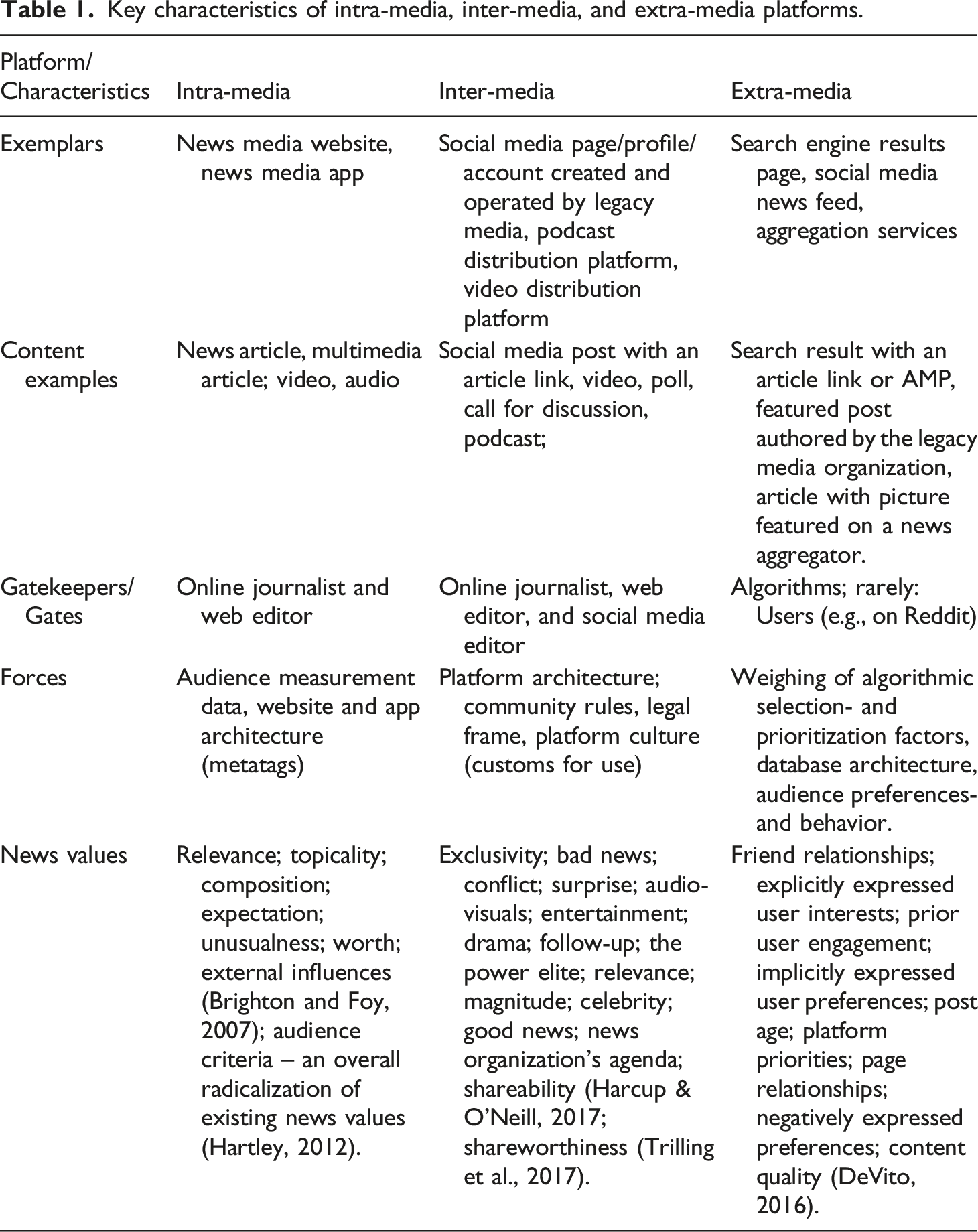
Extending Lewin’s theory of social channels to news flows of the digital age requires identification of the channels of news, the channels that lead news to the audiences. By conducting a conceptual literature review aimed at finding these channels, this research revealed three types of platforms where news is presented to the audience. These are called intra-, inter-, and extra-media platforms. The news flow primarily originates at the intra-media platform, news published on a news site or the app belonging to the media organization and moves on to be made accessible or featured on the inter-media and extra-media platforms. The inter-media platform type refers to the profiles, pages, or accounts that legacy media organizations created to share news and interact with users, for example, Facebook pages, Snapchat accounts, podcast distributing platforms, and Twitter profiles. The extra-media platform refers to feeds that feature legacy media news content but are controlled by third parties, for example, Facebook Newsfeed, Google News, Apple News, Google Search Top Stories, and Google Search. The names reflect that the perspective here is from the legacy media point of view and that they reflect the direction of the news flow: from within the legacy media (“intramural”) to a platform controlled by the legacy media but created on and functioning on the premise and with ownership of the intermediary (“between”), to a platform which is both owned and controlled by an intermediary (“outside”). The names also connotate the loss or sharing of autonomy that comes with each platform move. The allegory of the dinner table is nuanced in this respect because the audience can consume their news on either of the three platform types. This flow could apply to all sorts of content and information, but here we choose to focus on the content which legacy news organizations create and publish. We recognize that the use of the term “platform” in everyday life and academia might be controversial to some since it is said to signal neutrality or democratic affordance that does not hold up in reality (e.g., Galloway, 2004; Gillespie, 2010). However, this article takes this into account as it demonstrates the change in gatekeepers, forces, and news values that have happened in the 21st century.
The figure below delineates the flow of news in the digital age from the perspective of legacy media news, hosted on their news site (the intra-media platform). It illustrates how a news article moves through different channels while encountering gates and gatekeepers along the way (the dotted lines), each asserting their values, before potentially ending up on the screen of a member of the news audience. This could happen on any of the three platforms depicted, thus making the audience a significant force on the gatekeepers between all platforms. They are represented through audience feedback in the digital newsroom, and their individual and aggregated preferences and behaviors have significant weight in the calculations of algorithmic gatekeepers.
The three platform types will be explained in the following, with a specific focus on the gatekeepers, forces, and news selection values operating within the gate leading to each of them. For each platform, key studies will be referenced to sum up current knowledge and areas that need attention in future research
Forces and values of the intra-media platform
The websites of newspapers and radio and television stations are all intra-media platforms. In other words, the intra-media platform archetype is the digital “augmentation” of the platforms that for centuries have been the primary (and only) platform for news: newspapers and radio and television stations. This platform is owned by the legacy media company, and it alone controls the selection of news on the intra-media platform. While subscriptions are dwindling, legacy media news organizations are increasingly reaching their audiences through their digital platforms that are accessible on computers, tablets, and phones via web browsers or apps. This also goes for radio and television stations that do podcasts and on-demand programming, as well as live broadcasting on their websites.
Intra-media platforms hold two especially important characteristics relating to the flow of news. Firstly, this is where each news item is hosted and published before traveling further (e.g., is “posted” or “shared”) to other platforms of the digital realm. Secondly, on intra-media platforms, news organizations are in control of what news to select—and reject—and subsequently bring to their audiences. Thus, editors’ and journalists’ news values are what in the final publication reach the audience, thereby controlling the news flow on this type of platform. Of course, these are influenced by several forces acting simultaneously, but here we focus on the forces added to the existing forces in journalism’s digital age.
In previous research on news values on intra-media platforms, news values have been found to be very similar to analog media’s “traditional” news values, but with an emphasis on timeliness and the competition between media companies (e.g., Hartley, 2012; Johnson and Kelly, 2003). Hartley conducted an ethnographic study of a Danish digital newsroom and concluded that news values were radicalized online and that readers, that is, the audience, played a large part in news selection, pointing to a separate “reader criteria.” Johnson & Kelly surveyed 187 editors of traditional newspapers' online editions and, like Hartley, found that “getting information to the public quickly” and “concentrate on the widest audience” were ranked highly among editors. In their book News Values, Brighton and Foy (2007) underscored the changes that have happened since Galtung and Ruge’s 1965 study, and they include a greater variety of platforms in their study of news flow and values. Their updated list of news values reads: “Relevance, topicality, composition, expectation, unusualness, worth, and external influences” (ibid., p. 29).
A distinct force (new compared to analog versions of legacy media) at play when journalists and editors of intra-media platforms make decisions about news inclusion and placement is the audience. Many researchers have concluded that digital journalists balance competing interests as audience preferences are now an indirect presence in the digital newsroom in the form of the ubiquitous tools for gathering and displaying audience data (e.g., Anderson, 2011; Karlsson and Clerwall, 2013). And audience metrics do influence the choice of news content, Welbers et al. found (Welbers 2015: 1049). In their study, journalists tended to favor news subjects that related to the top five most-read articles on the web page. Vu surveyed 300 editors and similarly concluded that the audience should be considered gatekeepers of news online (Vu 2013). Knowing how the audience finds news affects the journalists’ work; they realize that the news must be relevant to the subscribers of the media organization and perform well on social media to reach the users who are not visiting the intra-media platform for news. This means that the journalists must negotiate news values based on how they expect news stories to perform: with the subscribers, the “serendipitous” audience, and the algorithms that select and rank the stories for the newsfeeds of this “serendipitous” audience.
Going forward, more news value studies might be centered around the secondary gatekeeper (cf. Nielsen, 2016); that of automation, regarding news selection, production, prioritization, and -recommendation (cf. Bastian et al., 2021). Advanced automated prioritization and recommendation of articles on legacy news sites and apps might not be in the repertoire of most news providers, but it is increasingly experimented with (Schjøtt and Hartley, 2021).
Forces and values of the inter-media platform
The inter-media platform archetype refers to the presence of first-order media platforms on intermediary platforms. Examples are the Facebook page of a legacy news provider, its Twitter account, or Snapchat profile. Audio/video examples include the presence of legacy media on the Apple Podcast app and YouTube. Gatekeepers of the inter-media platforms are online journalists of legacy media news organizations, and most often, they are the social media editors or web editors (Anderson, 2011). The second set of gatekeepers are the designers of inter-mediary platforms, those who, as outlined above, are behind the architecture, the affordances, and the rules for posting on those platforms. In essence, just as with the intra-media platform, the “gatekeeper” is not one person, although we choose to simplify them into single categories here.
Inter-media platforms do not create their own content, but they make codes of conduct, follow legal restraints, and they have different purposes and thus affordances than intra-media platforms. Thus, the cultural expectations and design limitations of posting on inter-media platforms are not in the hands of the forces inside the newsroom or the developers at news organizations (Galloway, 2004; Gillespie, 2010). Content must fit the formats, for example, not exceeding the number of allowed characters on Twitter, or accept the lack of possibilities of sharing links on Instagram. Secondly, some of the content that newspapers and radio or televisions station can publish on their own (intra-media) platforms might not be allowed on the inter-media platforms if the content runs counter to political, social, religious, sexual, or other values of the owners of the intermediary platform. Furthermore, journalists of legacy media companies must account for the social code and norms of the platforms. These factors suggest the importance of studying the news values on a platform that is an indispensable partner in reaching the audience.
Studies of news values governing news flow have focused on the force of audience preferences, and the lists of news values presented below are, therefore, results of empirical analysis of stories most interacted with by the audience. Hence, they are not representative of all stories shared by news media, only some of them. Bro and Wallberg (2014), Harcup & O’Neill (2017), and Trilling et al. (2017) all point to the force of audience selection on social media platforms in terms of which pieces of content are produced and shared by journalists. Bednarek, from a discursive approach to news value research, found that while all traditional news values were found in her corpus of most-shared news on Facebook, the most important were: eliteness, superlativeness, unexpectedness, negativity, and timeliness (Bednarek 2016). Trilling et al. seek found that the classical news values largely hold true on Facebook and Twitter: “geographical distance”, “cultural distance”, “negativity”, “positivity”, “conflict”, “human interest”, and “exclusiveness” (2017, p. 8). Thus, shareworthiness as a news value, to them, is a function of other news values. Harcup and O’Neill adopt the similar value of “shareability” that is specifically in place on Facebook in their 2017 revision of their much-quoted 2001 content analysis of news values in UK newspapers (2017). Shareability refers to “stories that are thought likely to generate sharing and comments via Facebook, Twitter, and other forms of social media” (ibid., p. 1482). In her fieldwork AUTHOR finds that the anticipation of audience reception is indeed an important news value in the digital newsroom (YYYY). Most notable in the investigation into audience measurements is the work of Edson Tandoc Jr. (cf. Tandoc 2014; Ferrer-Conill, 2018).
Forces and values of the extra-media platform
Extra-media platforms gather, aggregate, and make news accessible for audiences based on algorithmic selection and prioritization. Influential examples concerning the flow of news are Facebook Newsfeed and Google Search, but Apple News, Reddit (subreddits), and Twitter are also important gateways to news. The extra-media platform is a direct extension of the inter-media platform, the important difference being that the news featured are selected and ranked according to algorithmic calculations, depending on the model used for filtering (cf. Aggarwal, 2016). The algorithms function only on the grace of what is published and shared by news organizations and other content creators on the Internet and on the grace of user preferences, both individually and aggregated. Google Search is an example of this: The service is designed to calculate which search results are the “most helpful” to answer a query from each user. By simultaneously diving into a database of possible sites answering the question using several signals or parameters and by matching these results with what was preferred by users performing similar searches and the personal search history of the given user performing this query. Algorithmic protocols and weighted parameters for inclusion/exclusion are, of course, designed and written by humans. In the case of Google Search, pages are also quality tested by humans: The title of the page should describe the content. Exaggerated or shocking titles can entice users to click on pages in search results. If pages do not live up to the exaggerated or shocking title or images, the experience leaves users feeling surprised and confused. (Search Quality Evaluator Guidelines of Google, 2019)
Facebook Newsfeed operates similarly, but there are different values at play for prioritizing content on the newsfeed. Each has its news values for prioritizing content, and they are, for the most part, opaque (e.g., Burrell, 2016; Galloway, 2004; Gillespie, 2010). Carlson, one of the first to examine the relationship between journalism and search engines, explained how Google News challenges the purpose of traditional journalism altogether by offering a broad selection of perspectives on each news topic rather than “a singular voice across a range of topics” (Carlson, 2007: 1027). It is well worth noting that extra-media platforms are filtered differently and to different degrees.
Carlson refers to the selection values of news in the extra-media as “algorithmic news judgment” (2017, p. 9). One clear value, according to Carlson, is the personalization of the news feed and thereby the news experience: “By heralding personalization, Facebook implies that newsworthiness is a personal preference realizable through algorithmic judgment rather than a collective attribute identified by human journalistic judgment.” (Carlson, 2017: p. 8). In his research, DeVito conducted a content analysis of Facebook patents, press releases, and SEC filings (2017) and identified 9 “News Feed values”. These are: “friend relationships, explicitly expressed user interests, prior user engagement, implicitly expressed user preferences, post age, platform priorities, page relationships, negatively expressed preferences, and content quality” (DeVito, 2016: p. 14). Bandy and Diakopoulos conducted an audit on the algorithmically (Trending Stories) and editorially driven (Top Stories) sections on Apple News and found that the content on the two did indeed differ (2020, p. 44).
Key characteristics of intra-media, inter-media, and extra-media platforms.
Toward a new framework for news flow in the digital age
The approach of social psychologist Kurt Lewin is intertwined with the approach of Galtung and Ruge: The final image or perception of reality—and perhaps reality itself—is shaped by the flow leading to the final platform. If social change in the form of food habits is made by changing the food passing through the channels (Lewin, 1947: 144), then the channels—or flow—of news between platforms are a good place to look when examining journalism in the digital age.
For Lewin, the final gatekeeper operates on a mixture of “values and beliefs” and “the way they perceive the particular situation.” While values and beliefs can be ideology, “values that decide what is good or bad,” the individual situation can be different each time (ibid., p. 145). Taking a cue from Galtung and Ruge, who were interested in “inter-individual” and “inter-national” flows (1965, p. 64)—this article distinguishes between three archetypes of platforms where news flows to, from, and between in the digital era. These three platforms are termed intra-media, inter-media, and extra-media (see Figure 1), referring to the relationship that the news media organization has to the platform and the degree of influence it has on the selection of news. The term platform is riddled with political and legal connotations (e.g., Gillespie, 2010), and it can be a risky term to adopt. However, here it refers to a place online where news is distributed to and selected and prioritized by various gatekeepers. News flow between intra-, inter-, and extra-media platforms.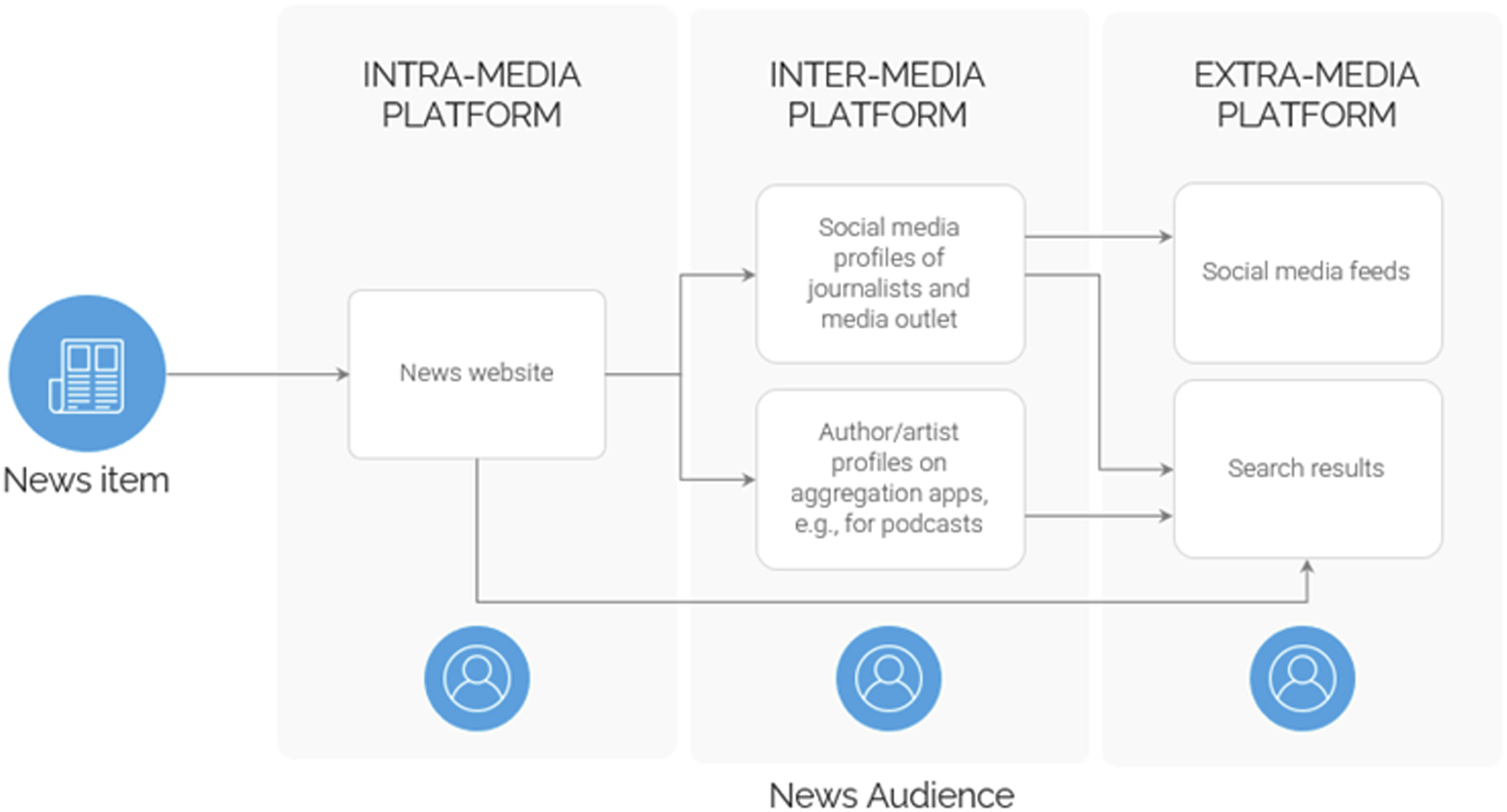
While the three main platforms for the flow of news in the digital era are distinct from each other in terms of order, control, content, and prototypical format, the three types of media platforms feed into each other—and each one constitutes a force on the values governing news selection. Intra-media platforms are the supplier of content or the “database” of available news stories that the inter- and extra-media platforms can feature. Extra-media platforms select news stories based on what the individual user “asks” for (e.g., via search) and has shown a preference for (e.g., via “likes” and other behavioral patterns). As with the inter-media platform, news is not produced by the owner or host of the platform, but they feature content from the two other platforms in a feed linked to the news website. The looped feedback mechanisms here are as complicated as they were in Kurt Lewin’s example of food traveling from the supermarket to the fridge to the dinner table.
While decades of research on news values still seem to apply, this illustrates a much more varied and complex communication process than the one-way linear process Galtung and Ruge took as their starting point in their seminal article on communication flows and news values. Their understanding of the flow of news was accentuated by their use of arrows pointing in one direction, from precipitating “world event” on one end to the “personal image” on the other end. These differences indicate that – in the digital age—what is considered newsworthy varies from platform to platform. At the same time, journalists and editors—the original gatekeepers—seem to adapt to the opportunities and constraints of these platforms, thus influencing their traditional sets of news values when making newsroom decisions.
Conclusion
With the proliferation of these platforms for news sharing and consumption, scholarly attention to news values has become more relevant than ever before. New platforms and new gatekeepers culminate in new practices and values behind news selection, production, publication choices, and prioritization. As this article sets forth, the new gatekeepers, algorithms of extra-media platforms, may operate with their own set of news values, termed “algorithmic values” by DeVito (2016). However, these values affect the news values of journalists applying their “news sense,” news values, in decisions regarding whether to select news and how to construct it. Audience measurements in the newsroom have brought about new news values: 1) The reader criteria, brought about by the ubiquity of audience measurements in the digital newsroom (Hartley, 2012), and 2) Shareability/shareworthiness (Trilling et al., 2017; Harcup & O’Neill, 2017), brought about by the journalists knowing the importance of their news being shared on social media. A third news value of the digital age is linked to the expectancy of algorithmic values: That journalistic newsworthiness is tied to the hope/goal of news stories appearing on extra-media platforms—Facebook Newsfeed, Google Search, Apple News, for example (Kristensen, 2021).
Summed up, these news values are tied to the “expected reception” of news, which can be applied to each of the three platforms suggested in the framework of this article, as follows. 1) Digital news value of intra-media platforms: expected audience experience. News expected to give the audience accessing news on the intra-media platform, especially subscribers, a good experience. 2) Digital news value of inter-media platforms: expected audience behavior: News expected to attract readers on the site and on social media; news expected to make users “like” or “subscribe” to the media account on the inter-media platform, and 3) Digital news value of the extra-media platform: expected algorithmic behavior: News expected to be prioritized by social media algorithms/search algorithms.
Furthermore, the conceptual literature review conducted for this article showed that the gatekeeper of extra-media platforms, algorithms, have their own set of news values, termed “algorithmic values” by DeVito (2016). They also have a different ideology of the value of news and information, pertaining to the organization and owners/strategists behind the algorithmic design (Carlson, 2007; Just and Latzer, 2016).
Galtung and Ruge believed that the news media of the 1960s were so important that they merited a study of their own and with a particular focus on the factors that could affect the flow of news. Although their basic premise and driving interest have been somewhat overlooked by later journalism researchers and journalists, who have mostly been interested in the list of news values they centered the empirical study on, their particular approach sensitized Galtung and Ruge to those flow of news between an event and receivers of the news around the world that they mentioned in the first line of their article. This article has demonstrated the importance of studying this flow of the news, and it has presented a conceptual model that guides future studies into the values of actors, actants, and forces that play a key part in the process of selecting, prioritizing, and ranking news in news flow of the digital age.
This model delineating the flow between platforms in the digital age is meant both to illustrate flows, but it is also meant as a future reference for researchers to pinpoint the areas where forces and values are unclear or not yet examined. Still, there is a large gap in knowledge when it comes to the force of platform values on the intra-, inter-, and extra-media platforms. This relates not only to the influence on journalistic production and journalistic choices regarding distribution across platforms, but also the influence of the overall infrastructure of the Internet (cf. Van Dijck et al., 2018). This force of Internet infrastructure underlined by a plethora of researchers in other fields of study should play a larger part in the journalism study tradition (e.g., Plantin et al., 2018; Galloway, 2004; Burrell, 2016; Manovich; 2013). As flows of news increasingly depend on the inter- and extra-media platforms, little research within journalism studies so far relates to these influential platforms. Previous generations might for good reasons be excused for not diverting their attention to arenas that first have become apparent in the digital era, but it is high time that a broader community of researchers as a collective caught up to the changes affecting the flow of news. Newspapers have since been supplemented with many other types of intra-media platforms, but few textbooks for future and current practitioners take the new types of platforms into account. Thus, regarding professional journalistic endeavors, more work about the intricate relations between news values and news flow is needed.
New empirical and methodological opportunities are available to uncover news values in the digital age, partly because computational methods are now accessible to researchers, partly because access to news media content is easier with the Internet. A renewed discussion over “platform power” gives us the opportunity to look at statements from platform owners and designers (e.g., Lichterman, 2015; Spangher, 2015), while guidelines to selection criteria are somewhat explicated by stakeholders and representatives of the platforms themselves (e.g., Brin and Page, 1998). Another opportunity for research involves guides on how to obtain a higher position in search results (Search Engine Optimization), community rules (e.g., Mosseri, 2017), legal files, files for patents, and research papers from platform designers. Thus, with our current knowledge and methods to examine news value and news flow, there are many opportunities that could—and should—contribute positively to future research.
Lewin, White, and Galtung and Ruge wrote at a time where what they termed “the flow of news” and “the chain of news communication” (1965, p. 65) were based on very different technologies than the ones affecting journalism today. Those were the days of telegraphy, teleprinters, Telex machines, and other types of transmission technologies. But with the proliferation of new forms, formats, and platforms for the publication of news associated with the digitalization of journalism, the original point of departure for their study has become more relevant for researchers and practitioners than ever. The decisions made by journalists, editors, and owners of traditional news organizations have become entangled with decisions made by new gatekeepers outside the editorial room which in turn bring a new set of forces into the equation. Thus, in future studies, it would be relevant to migrate the newsroom study tradition to the digital intermediaries, doing ethnographic studies at meetings and offices of, such as software engineers in charge of tweaking algorithms presenting news flow. The digital media ecosystem of today has multiple channels and gates, and the model and terminology of Lewin now more than ever can be the entry point to examining news values and mapping them in terms of news flow between channels—digital platforms.
Footnotes
Declaration of conflicting interests
The author(s) declared no potential conflicts of interest with respect to the research, authorship, and/or publication of this article.
Funding
The author(s) received no financial support for the research, authorship, and/or publication of this article.
