







Abstract
The issue of SLAPPs remains a largely understudied area in journalism studies. Limited academic work on the topic mainly focuses on its legal aspects and there is little empirical academic work engaging with the way SLAPPs are experienced by those who are personally involved. This study focuses on illuminating the impact of these vexatious and frivolous lawsuits on investigative journalism and press freedom, and recording whether journalists experience additional or different consequences from SLAPPs in comparison to other types of threats. Based on interviews with journalists who have experienced SLAPPs in recent years and documenting their personal experiences, the study sheds light on the hidden professional and personal costs of investigative reporting, attempts to assess this phenomenon in relation to its effects on journalism and journalists, and is one of the few to record and analyze journalists’ personal beliefs and experiences.
Introduction
The day that Daphne Caruana Galizia, the distinguished Maltese investigative journalist, was assassinated in October 2017, she was facing over 40 lawsuits brought by various politicians from across the political spectrum but also by powerful businessmen with political connections. Caruana Galizia was not the first, and sadly not the last, target of these extensive and expensive civil litigations brought by powerful individuals and organizations – a phenomenon that is referred to as Strategic Lawsuits Against Public Participation (SLAPP).
Alongside explicit forms of threats such as physical attack or murder, legal threats are rapidly expanding as the law is being increasingly manipulated, abused and weaponized in multiple subtle yet effective ways in an effort to crack down on press freedom.
Various studies are starting to take notice and document a significant rise in legal threats against journalists, in democracies and non-democracies alike, aiming to hamper press freedom and shield powerful individuals from legitimate criticism (e.g. Coughtrie and Ogier, 2020; Clark and Horsley, 2020; Simon et al., 2023).
Specifically, SLAPPs are considered to be the “weapon of choice” and an increasingly widespread litigation tactic to shut down independent reporting (van den Brandt, 2021; Zuluaga and Dobson, 2021). They have been characterized as an abuse of the legal system and, as various studies show, present a growing tendency within the European continent that currently lacks anti-SLAPP regulation (e.g., Bonello Ghio and Nasreddin, 2022).
Despite their alarming increase, SLAPPs remain a largely understudied area in journalism studies, as there is little empirical academic work engaging with the way they are experienced by journalists. Various NGOs have done valuable work to explain the psychological and economic effects of SLAPPs (see for instance Ní Mhainín, 2020) but still the personal experiences of those involved in these cases are missing.
This study focuses on illuminating the effects of SLAPPs on investigative reporting and journalistic practice. Furthermore, it researches whether journalists experience additional or different consequences from SLAPPs in comparison to other types of threats.
Based on personal interviews with journalists in Greece and Cyprus, who have experienced SLAPPs in recent years, this study, which is one of the few to record and analyze journalists’ personal beliefs and experiences, first examines the impact of these cases on press freedom and moves on to assess possible different effects compared with other types of threats.
By documenting journalists’ personal experiences in specific geographic and legal environments, it offers a more in-depth view on how the professional and personal life of journalists is affected by SLAPPs.
As such, the study initiates from the following research question: RQ: In which way(s) do SLAPPs affect press freedom and investigative reporting in the perception of journalists?
The article is organised as follows. The next section sets the theoretical stage by discussing the kind of threats that journalists face and the rising phenomenon of weaponization the law by those in power. Subsequently it delves deep into the notion of SLAPPs analyzing their distinct characteristics. Then an outline of the research method is presented, which in turn is followed by presentation and analysis of findings. The final section is devoted to conclusions and limitations.
The weaponization of the law against press freedom
Journalism, especially the watchdog type that focuses on investigating scandals and holding those in power accountable, has always been on the receiving end of threats. A strand of scholarship has long documented and analyzed the various forms that these threats may take, including but not restricted to physical, economic, legal, psychological, political and technological (e.g., Becker et al., 2007; Clark and Horsley, 2020; Cottle et al., 2016; Papadopoulou and Maniou, 2020). In recent years, however, as pointed out in a Council of Europe resolution (2020), threats against journalists have become so numerous, repeated, and serious that they are jeopardizing not only citizens’ right to be properly informed but also the stability and smooth functioning of democratic societies. For instance, a staggering total of 1668 journalists have been killed worldwide in connection with their work in the last two decades (2003-2022) (RSF, N.D. 1 ). Ιn 2022 alone, 66 journalists and media workers lost their lives, the highest number since 2018 and an increase of almost 50% from 2021 (CPJ,2023 2 ) while a record total of 533 journalists were detained worldwide, according to the annual round-up of violence and abuses against journalists published by Reporters Without Borders (RSF) in2022 3 . Journalists are being attacked and badly beaten not only while covering conflicts and warzones, as one might expect, but also while walking in the streets, covering a demonstration or simply asking questions (Papadopoulou and Maniou, 2021). In fact, according to RSF (2023), more journalists have been killed in “zones at peace” than in “zones at war” during the past two decades, in most cases because they were investigating organized crime and corruption 4 . In addition to attacks by states and parastate actors, media professionals have also found themselves on the receiving end of hostile actions initiated by private individuals (Miller, 2023).
Physical threats and direct interference receive, as expected, considerable attention due to their explicit nature, however as Oster (2015) points out, in more democratic countries these kinds of threats seem to be replaced by more “refined forms” of limiting press freedom, such as administrative regulations and judicial decisions. The changing nature of threats is also echoed in a recent statement by the European Parliament, which noted that techniques to limit freedom of expression have been refined, in innovative ways, often taking advantage of a legal void or grey zones between legal norms 5 .
Legal threats against journalists are far from a new phenomenon. However, various scholarly studies and reports by NGOs are starting to notice a worrisome increase in the weaponization of law by those in power in an effort to stifle unwanted narratives and public debate (e.g., Clark and Horsley, 2020; Simon et al., 2023). For instance, according to a global study (Coughtrie and Ogier, 2020), 73% of all journalists studied had received communication(s) threatening legal action as a result of information they had published. Moreover, as pointed out by Clark and Horsley (2020), journalists not only acknowledge the risk of being prosecuted as an everyday reality but they now consider it as an occupational hazard.
Legal threats range from the introduction of new legislation (e.g., relating to fake news) to the arbitrary abuse of existing legislation (e.g., relating to “espionage,” “treason,” and “revealing state secrets”) to punish independent and critical voices. The laws or provisions that are frequently misused to prosecute journalists may present variations from country to country, however, they all share some common features, such as the deliberately vague use of language and the transmission of broad powers to authorities to interpret and carry out criminal investigations with limited judicial oversight and procedural safeguards (Simon et al., 2023).
One of the most alarming characteristics of legal threats is the asymmetric power relationship between the plaintiffs and the defendants, which allows the perpetrators of these threats to abuse and manipulate legal systems that are essentially designed to protect free speech.
Laws have been expanded and tailored to better target press freedom, penalties are getting harsher to ensure that not only the targeted journalists but also their colleagues will self-censor, and legal procedures are becoming so lengthy and costly that journalists are left feeling extremely intimidated or unsupported (Simon et al., 2023).
The increase in legal action to stifle independent voices is not confined to authoritarian regimes and illiberal democracies. On the contrary, legal harassment and abusive litigation are becoming a particularly acute problem in democratic countries. The unprecedent health crisis of the COVID-19 pandemic combined with the general retreat of democracy and the emergence of authoritarian populism (e.g., in Hungary, Poland and Italy) have given rise to the weaponization of laws to restrict press freedom in parts of the world that were considered to be established democracies. During the pandemic crisis, several countries from across the democratic spectrum used existing legislation or arbitrarily enacted new and disproportionate “coronavirus” regulations to detain, charge, arrest and even imprison media professionals under the pretense of a concern for national security or for the containment of fake news (Papadopoulou and Maniou, 2021).
Threats of lawsuits and/or actual lawsuits under a number of laws can have a significant chilling effect on press freedom. In a recent study of 63 investigative journalists working on financial crime and corruption in 41 countries, legal threats were identified to have the greatest impact on investigative journalists’ ability to continue working (Coughtrie and Ogier, 2020). Journalists may also resort to self-censorship, not due to the fear of sanctions related to the content of their reporting, but in an attempt to avoid creating disputes and instigating legal action (Clark and Grech, 2017).
Despite their growing implications for free speech and democracy, the number of legal threats and their specific characteristics often goes underreported as some media professionals tend to report only a fraction of these threats due to, among other reasons, fear of further retaliation from the claimant (Bonello Ghio and Nasreddin, 2022).
In essence, legal threats need not be acted on to lead to censorship. In some cases, even the mere threat of a legal action may be enough to deter critical investigation.
SLAPPs: A case for pyrrhic victories?
SLAPPs as a notion was first coined by American legal scholars Penelope Canan and George W. Pring in the late ‘80s when they noticed a sharp rise in the amount of multi-million-dollar civil lawsuits filed against civil society activists by wealthy individuals or organizations (Rucz, 2022). They defined these types of lawsuits as “quashing criticism and political debate by transforming a public dispute into a private adjudication, where the defendant is cast into a significantly disadvantageous position” (Pring and Canan, 1996: 3).
Since then, the term “SLAPP” has been deployed in case law and legislation in several common law and mixed legal systems, most prevalently in the USA, but also in Canada and Australia. Nevertheless, legal definitions of SLAPPs vary and continue to evolve as a consequence of developments in legal practice and the responses of legislators and courts in different legal systems (Borg-Barthet et al., 2021).
Notwithstanding the differing approaches, SLAPPs present some common features that distinguish them from other lawsuits. The practice of these vexatious, abusive lawsuits is generally characterized by three specific features: (1) their basis, which is mostly meritless, frivolous, or highly exaggerated; (2) their intent and aim, which is to intimidate, censor, stifle or silence, and to exhaust and deplete the respondent both financially and psychologically; and (3) the demanded remedies, which are usually outrageously large (van den Brandt, 2021; Bonello-Ghio and Nasreddin, 2022).
Focusing on the motives behind these lawsuits, Canan (1989) recorded four different patterns: (1) to retaliate for successful opposition on a political issue, (2) to prevent future opposition on a political issue, (3) to send a message that opposition on a political issue will have consequences, and (4) to use the courtroom as part of a broader strategy to win a political or economic battle.
With regards to the targets, a recent study by the Coalition Against SLAPPs in Europe (CASE) and the Amsterdam Law Clinics (ALCs) (Bonello-Ghio and Nasreddin, 2022) found that they are mainly journalists (34.2%) and media outlets (23%), followed by activists, NGOs, and academics. The most common perpetrators were businesses and businesspersons (31.9%) and politicians or people in the public service (23.3%) with personal and/or institutional resources who were well-placed to strategically assess the merits of the lawsuit (McGonagle et al., 2020).
These findings essentially depict the asymmetric nature of SLAPPs, which allow powerful people to abuse the law to achieve their goal of quashing dissent against them (Pring and Canan, 1996). This imbalance of power is mainly based on the inequality of resources in favor of the filers, which allows them to intimidate and threaten to exhaust the defendant by the large damages and expensive legal costs (McGonagle et al., 2020).
Moreover, as recent studies show, plaintiffs have become increasingly creative in their efforts to drain their targets emotionally and financially. For instance, according to Bonello-Ghio and Nasreddin (2022), in various cases the plaintiffs did not attend any of the hearings, requiring them to be continuously postponed and leading to additional stress and financial burden on the defendants. Another recent trend involves affluent entities not only directly suing an individual or organization, but also setting up funds to offset the costs of third parties willing to pursue litigation against their common target (Tu and Stump, 2020).
SLAPPs have been brought in every major region in the world, despite differences in legal traditions and judicial systems (Zuluaga and Dobson, 2021).
Reports by international press freedom organizations have documented a rising cumulative trend of SLAPPs in Europe (e.g. Bonello-Ghio and Nasreddin, 2022; Simon et al., 2023). This rise could be attributed, at least in part, to the increased awareness and availability of reporting mechanisms, however, there is no denying that SLAPPs constitute a significant threat to freedom of expression.
Interestingly, as various studies show, due to their lack of merits, many SLAPPs are more often won by the defendant, settled, or withdrawn than they are won by the complainant (see for instance Bonello-Ghio and Nasreddin, 2022). Nevertheless, it is the litigation process that causes the most harm since SLAPPs typically take a long time, involve high (legal) costs for the target, increase the psychological harm to the defendant, distract the defendant’s attention from their real work and often result in reputational damage for the target. In this context, it can be easily understood why Judge Nicholas Cobella characterized the cases won as “pyrrhic” victories. 6
The extent of the problem is further reflected in the involvement of the European Parliament in the discussion regarding the need for safeguarding public watchdogs against the abuse of the rule of law. In this context, and after the calls of various European MEPs for an anti-SLAPP EU directive following the assassination of Caruana Galizia, the European Commission put forward a proposal for an anti-SLAPP Directive in April 2022 to protect those engaged in public participation 7 .
Method, RQs and scope of study
This work aims to illuminate the way(s) that SLAPPs affect press freedom and investigative reporting and research whether journalists experience additional or different consequences from SLAPPs in comparison to other types of threats. It also attempts to offer a more in-depth view on the hidden professional and personal cost of searching for the truth and the how these are depicted in investigative reporting. In doing so, it looks to illuminate the issue of SLAPPs rather than provide a definitive, universal response.
The study was granted ethics approval by the National and Kapodistrian University of Athens. 10 journalists from Greece (6) and Cyprus (4) were interviewed using a semi-structured questionnaire. This method is useful for gaining in-depth information that cannot be collected from other sources (MacDonald et al., 2013), offering insights into the interviewees’ lived experiences (Adams, 2015).
Documenting the full extent of SLAPPs in various countries and comparing differences and similarities is an extremely difficult task as various factors may obscure the big picture. For instance, many cases never reach the court and/or are not reported by the victims. A recent report by CASE (2023) 8 attempted to provide a snapshot of the issue of SLAPPs in Europe between 2010 and 2022. According to its findings, during the last 12 years, 570 SLAPP cases were filed across Europe. Indicatively, 88 SLAPP cases have been recorded in Malta, 32 in Ireland, 54 in Croatia, 10 in the Netherlands and 12 in Germany. As pointed out, however, the number of lawsuits mapped only scrapes the surface of the actual extent of the problem.
Greece and Cyprus were selected as they exhibit quite low performance with regards to press freedom protection while the phenomenon of SLAPPs seems to be rapidly rising since 2010 (IPI, 2022; Krambia-Kapardis and Economou, 2022). According to the RSF World Press Freedom Index 2022, Greece dropped to 108th place, ranking last among EU member states, and Cyprus fell to the 65th 9 . At the same time, SLAPP cases against journalists seem to have become commonplace in both countries in recent years. In a statement issued in March 2022, the International Press Institute (IPI, 2022) pointed out that multiple journalists and media outlets in Greece have become targets of SLAPPs and called upon Greece to create adequate anti-SLAPP legislation 10 . Indicative of the importance of the issue is the fact that Grigoris Dimitriadis, who served as a general secretary in the office of the Greek Prime Minister, was awarded the ‘SLAPP politician of the year’ award in a European SLAPP contest, after filing expensive lawsuits against two media outlets and three journalists in Greece 11 (CASE, 2022). Similarly in Cyprus, SLAPP cases have significantly increased in recent years, however until recently limited mention has been made in official reports, although there are cases with financial claims that exceed 1,000,000euros and cases for which journalists had to resign from their jobs or move out of the country to continue investigating (Krambia-Kapardis and Economou, 2022). As such, we consider these two countries to be appropriate case studies for this work.
Participants in the study.
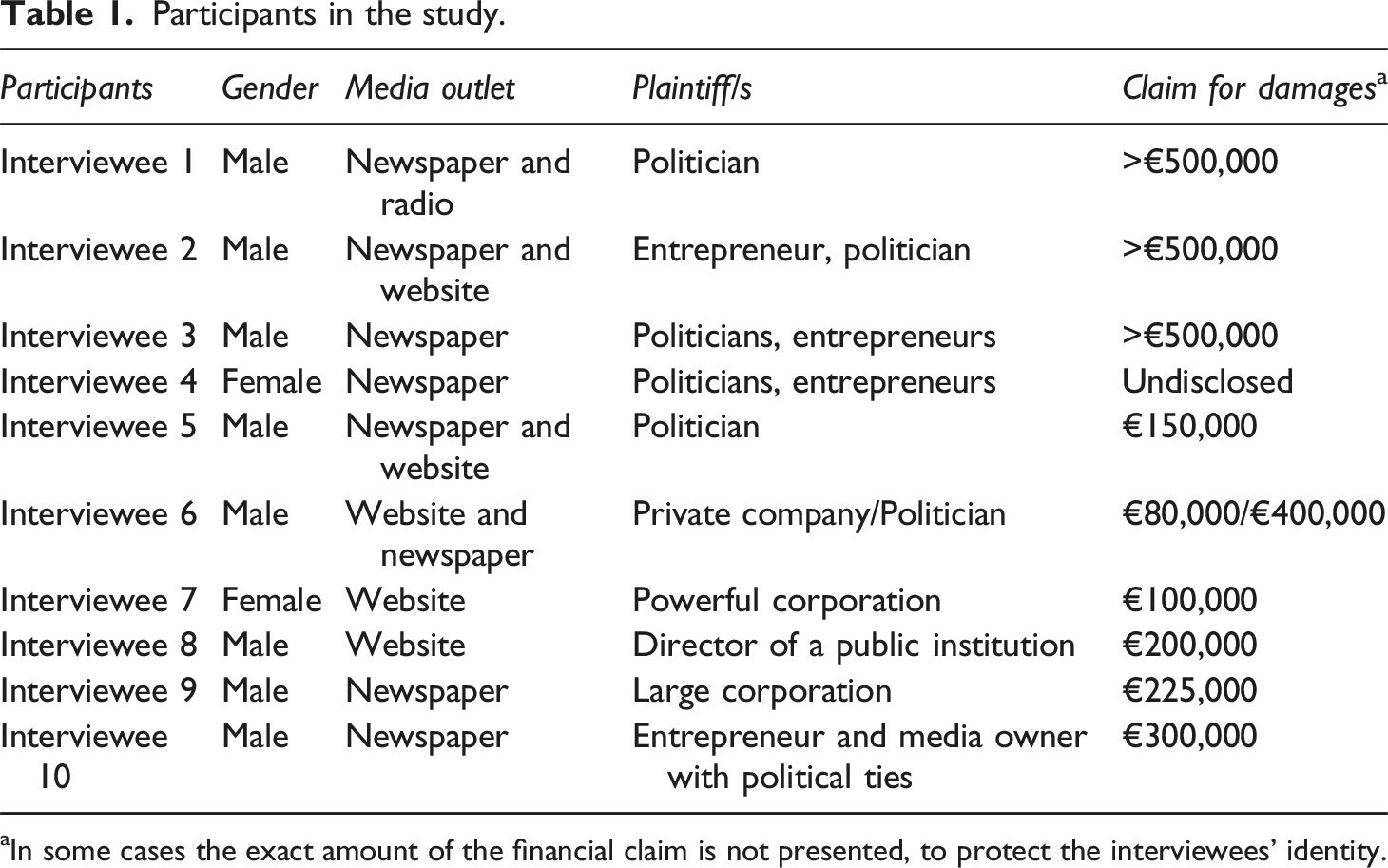
aIn some cases the exact amount of the financial claim is not presented, to protect the interviewees’ identity.
While most participants declared they were happy to be named, the researchers decided to anonymize all data as some of the cases were still on trial when this work was completed. Participants provided their consent after being informed about the aims of the project and the conditions of their participation. They all declared voluntary participation and researchers guaranteed their withdrawal from the project at any stage. Participants are identified as Interviewee one to Interviewee 4 (Cypriot journalists), and Interviewee five to Interviewee 10 (Greek journalists). Table 1 presents the participants in the study.
Findings were analyzed using thematic analysis, which is used in this work to identify and analyze patterns of themes within the data (Braun and Clarke, 2006). The sub-themes for the analysis emerged from the data itself in the context of the ways in which press freedom and investigative reporting are affected by SLAPPs. During the first stage, researchers worked separately to transcribe the interviews. After reading the interviews several times, researchers identified themes and sub-themes emerging from the data. In the final stage, researchers worked together to review, finalize and analyze the themes and sub-themes that emerged.
Findings and analysis
The main themes that emerged are centered around the shrinkage of investigative reporting, significant restrictions on press freedom, and negative effects on journalists’ professional and private life.
Shrinkage of investigative reporting
The rise of SLAPPs seems to have generated a series of effects for investigative reporting, its shrinkage being the most notable one. As some of the journalists explained, in most cases media owners and head editors essentially pressured for a shrinkage of investigative journalism as the financial burden of vexatious lawsuits was considered unbearable for the already struggling media outlets. “Media owners do not want investigative reporting any more in several media entities. They tend to prefer ‘simpler’ stories, the ones that everybody writes about and derive from news agencies or from formal sources.” (Int.9) “There is already a kind of self-censorship and a pressure on us from the newspaper on the basis of ‘be careful what you write about, we already have a lot of economic burdens.’ This was not a problem in the past.” (Int.1)
One of the participants, who at the time of the interview had already faced two SLAPPs with claims that exceeded 480,000euros in total, pointed out that he was fortunate to have the support of the Chief Editor. “However,” he explained, “in other media (Chief Editors) are afraid or do not want to go for a second or third time in court. This is why they ‘kill’ the stories. It is not because they do not trust the reporters; it is because they do not want to be in court…When journalists have to face such practices and editorial pressures, they end up determined to stay away (from investigative reporting) … In the end, you just avoid investigative stories.” (Int.6)
While all interviewees stated that their lawsuits did not affect their intention to further pursue investigative stories, in practice some of them noted that it had serious effects on the process of selecting future stories. Moreover, as they pointed out, the SLAPP made them more cautious regarding the way they presented the story. Most of them started advising the legal department or even presented their stories to the entity’s legal department for approval before publishing it. “We try, even more so now, to be more careful in the expressions we use, we try to be more cautious with some points that could possibly drag us in legal procedures.” (Int.8)
A journalist who was sued by one of Greece’s most powerful businessmen and media owners, explained that although he would not change anything in his story, with hindsight, he would have contacted his organization’s legal department before the publication of the story. “[If I had the chance to start over] I would write this story again. I would just feel obliged to seek the opinion of the legal department beforehand, and this is something that we didn’t normally do.” (Int.10)
However, most interviewees viewed the fact that they received a lawsuit as a sign that their work matters and, as controversial as this may sound, these attacks are what keeps them going. “For me, the SLAPP lawsuit was a confirmation that I am doing a good job. This is why I continue my work in the same way, meaning that I try to highlight issues that are not easily addressed in other media organizations.” (Int.9)
Another interviewee, working for a local website and facing a SLAPP for 200,000euros, felt that continuing their journalistic work and investigation into scandals in the face of these adversities is a duty. “We must keep on doing our job. It is our duty to bring back real journalism. At this point, we have reached a really low level of professional journalism. It is our duty to society to bring back investigative journalism.” (Int.8)
Significant restrictions on press freedom
One of the most notable findings of this work is that the rise of SLAPPS has led to significant restrictions on press freedom. All the participants stated that the rise of SLAPPs is directly connected to economic intimidation in an era when journalists are suffering significant pay cuts and job losses. For their employers, SLAPPs could mean having to pay significant amounts of money in compensation if they lose the court case, as in the case of Interviewee 1, a journalist faced with financial claims that exceed €500,000. “My biggest fear was the possibility of losing the case in court…I was afraid that my newspaper would have to pay the compensation fine, which would be a huge economic burden. And this could have serious effects for my colleagues in the newspaper, for our economic future…And this is why SLAPPs are filed…it is like (the plaintiffs) say ‘we know that what he wrote about was correct, he presents proof, but let’s file a lawsuit anyway so he will get scared and never write about this again’… this is a huge problem for press freedom around the world.” (Int.1) “These lawsuits are the worst hit on press freedom. Obviously, they are trying to silence the press. They suppress our potential to offer a voice to those who do not have the means to speak out…especially in the case of local media…There is a need to stop this, because SLAPPs are rising and press freedom is declining.” (Int.9)
Delving deeper into the thematic analysis, this study finds that the rise of SLAPPs leads to self-censorship, as several participants, faced with economic claims that exceed €500,000, admitted. “The worst part is that all these lead to self-censorship. We suppress our own freedom because we have to think about the consequences.” (Int.2) “Journalists tend to become more self-censored because we are afraid of the consequences. Even if we were just doing our job. We are afraid that maybe the media owner won’t be so supportive, and this tendency is growing since the economic crisis. For example, sometimes there is an argument in the newspaper like, ‘ok, why did you have to write about this?’ and this directly affects press freedom…” (Int.1)
Although others denied that these lawsuits had any serious impact on their journalistic freedom, they admitted that SLAPPs, or the fear of them, have altered even subconsciously the way that they work. Some of them argued that even though they personally did not resort to self-censorship, some of their colleagues did after finding out about their experience. “It [the lawsuit] didn’t lead me to self-censorship, nor to a more responsible journalism as I was responsible even before this case. I think that you just think more about what you write and the kind of repercussions that a story may have, whereas in the past you were freer with regards to these issues.” (Int.7) “With regards to my colleagues who could also cover the issue that led to my SLAPP case, I do believe that it [the SLAPP lawsuit] could deter them from writing about it. I mean, they would think to themselves, “what am I about to do? Why should I get myself in such trouble?” (Int.9)
Effects on journalists’ professional life
SLAPPs bring a series of negative effects on journalists’ professional life. All journalists in this study stated that one of their first thoughts was the fear of losing their jobs or of not being able to find a new one as the lawsuit would essentially follow them for all their professional lives. “I did feel worried about what would happen if I lost my job; if I would be able to find an open door in another media outlet now that I would be carrying this weight.” (Int.1) “Going through this experience, I have thought about the fact that this [the SLAPP lawsuit] could possibly deter a future media owner from hiring a person that has covered this issue.” (Int.7)
Moreover, as some of them pointed out, these cases had an impact on their professional credibility. In some cases, even their co-workers didn’t really believe that they were falsely accused. “The public in our country does not really understand the meaning of a lawsuit against a journalist. Often, when they read that a journalist has had a suit brought against them, they think that he/she has made a terrible mistake. This causes a lot of damage to our professional credibility.” (Int.1) “I was a target of several anonymous blog comments against me… I don’t know if I can call this bullying…but they sure tried to make fun of me, of my name and integrity.” (Int.7)
Another interesting point that arose during the interviews was the lack of support from employers and in some cases even from colleagues working in other media entities. The following journalists are working at independent and cooperatively owned media and they talked about the lack of support they experienced from fellow colleagues working at privately owned media outlets and also from their union. “I believe that journalistic unions should take greater initiatives to protect journalists against SLAPPs. [..]SLAPPs were quite an unknown phenomenon in the country two years ago and perhaps this partially explains their slow response.” (Int.7) “With some exceptions, my colleagues in other media entities didn’t support me. This has to do with the fact that they are working in organizations that are in the hands of a few powerful businessmen and as result they are being censored or self-censored.” (Int.9)
It was the international press freedom organizations that came to their rescue in terms of practical support, covering the legal expenses of their trials. For most of them, however, it was the expressions of solidarity from their readers that helped them believe in themselves and continue the fight. “Some people started taking initiatives and issuing support statements [..] and in many cases these statements were very touching. They were mentioning, for example, that in the world we live in, we want the kind of journalist that [his name] is practicing. In a way, just like when I start writing about an issue, I always try to come back to it and don’t let it be forgotten, I felt that these people did the same for me; they didn’t let me be forgotten.” (Int.9) “One would think that the financial dimension is the important part in this procedure. However, the psychological and ethical parts are equally important. If I had to choose between having the support of public opinion or having the money to cope with the SLAPP, I would definitely choose the first one. I could find the money with crowdfunding or another way, but I would never want to lose my credibility.” (Int.6)
In addition, all of them verified the lack of an adequate legal framework in both Greece and Cyprus (as well as elsewhere in Europe) regarding SLAPPs, which is an issue that has long been documented in the literature (e.g., MacCurdy, 2022): “Legislation itself creates problems for the media…The media are constantly alert to provide proof against defamation.” (Int.4) “Since SLAPPs tend to increase, the first thing I would expect from journalistic unions is to organize an information campaign, for example, in the form of paid ads, which could explain what SLAPPs are and the dangers journalists may face. I would expect that legal support for all our colleagues that face SLAPPs would be taken for granted. Additionally, I would expect all board union members to be present in court when SLAPPs are examined. At the moment, none of these is happening.” (Int.9) “Legislation in our country is problematic. It is old and has not been updated recently. This means that it is completely outdated. As such, journalists cannot rely on the existing legal framework but only on two dimensions: a) adjudicated cases, and b) the judge’s judgement…The law is problematic…and there is a chance that you may find yourself in trouble because of the lack of adequate legislation”. (Int.1)
Effects on journalists’ private life
Finally, all participants in the study underlined the fact that dealing with SLAPPs had an important and multilevel impact on their private lives. Initially most of them talked about the significant amount of time they had to spend in preparing for their trial and the way that this affected their families and personal relationships. “Obviously I would not want to spend my free time like this, but with my family and my friends, doing things that interest me, as we are people after all. All these were lost all the years I was dealing with the SLAPP case.” (Int.8) “I have been a journalist for 30 years…all these years I have had to deal with several SLAPPs…my family is used to it…but what scares me the most is that the plaintiffs are going after me personally, not only after the newspaper…It is possible that I may have to face the consequences alone in the future and this means that my family will be affected.” (Int.2)
A journalist who was sued over a simple retweet of an investigative report, in a startling example of vexatious litigation, explained the impact that this case had on his family. “My family had to suffer during this experience with the SLAPP case, they had ‘lost’ me for a long period of time, although they were very understanding and supportive.” (Int.5)
All journalists emphasized the psychological toll that these cases had on their wellbeing while dealing with legal procedures. “SLAPPs create these negative feelings that make you not want to deal with a specific story anymore. You don’t want to relive the experience. Not because you are afraid but for instance because someone has a child and wants to go to the playground with his child and spend time together. And this is totally acceptable.” (Int.6). “I felt furious because someone with economic and social power was able to drag me into such an ordeal, which proved to be exhausting both psychologically and financially.” (Int.7)
When asked about the way(s) they dealt with the psychological toll brought by these cases, most journalists explained that they faced it alone, without receiving any professional help or support. For some of them, this was a conscious choice as they preferred to share this experience only with their families. For others, this choice was dictated by the lack of support systems in their country and/or by their lack of awareness about relative initiatives by international NGOs (e.g., ECPMF’s practical and legal assistance). “The psychological dimension of the SLAPP was something I had to deal with on my own, with just the support of my family and friends, people that I trust… This psychological burden weighed a lot on me…that was the worst part.” (Int.10) “There was no kind of organized psychological support [..] we need to stop fear and understand that fear will only make things worse and lead to more attacks.” (Int.7)
Conclusions and limitations
SLAPPs are increasingly becoming the weapon of choice for various powerful actors globally aiming to silence investigative reporting, deter criticism or scrutiny over their actions and hinder journalists from fulfilling their watchdog role.
This study sought to illuminate the impact of these vexatious and frivolous lawsuits on investigative journalism and press freedom by turning to journalists who have been on the receiving end of these threats. Additionally, by documenting their personal experiences, this work sheds light on the hidden professional and personal cost of investigating and revealing scandals and documents the differences in the kind of consequences experienced by journalists facing SLAPPs.
A general finding that stands out is that investigative journalism and press freedom constitute SLAPPs’ first collateral victims. As various participants in this study described, many media organizations were forced to cut down on work revealing scandals as the lengthy and costly procedures that SLAPPs entail posed a threat to their own, already frail, existence. Although the majority of the journalists pointed out that SLAPPs did not deter them personally from continuing their investigative work, they admitted that these lawsuits forced them to alter the way they practiced journalism. Some spoke of becoming more obsessed with every little detail, others described consulting the legal department numerous times while a few spoke directly about self-censoring. Additionally, as some of them noted, SLAPPs exerted a stifling or silencing effect on their colleagues, who were even afraid of expressing solidarity in fear of retaliation from the plaintiffs and becoming their next targets.
Another interesting finding that is missing from the relevant literature concerns the multilevel impact of SLAPPs on journalists’ professional and personal lives. Most of the participants in this study described a deep concern regarding their future employment, as they feared that the lawsuits would deter a future media owner from hiring them. Another common theme that emerged concerned the significant amount of time that they had to spend to prepare for their defense; time stolen not only from their next investigative story but from their families and personal relationships. This finding is of great significance as it depicts the subtle ways in which SLAPPs exhaust journalists, as they effectively hinder them from pursuing other stories and at the same time create upheavals in their personal lives. Another relevant finding is that when these excessive, complex, and costly lawsuits are aimed at specific media entities, they can pose a serious threat to the economic basis of the news medium in question, hence having a strong stifling effect on media pluralism far beyond the decision not to publish an individual publication.
The participants talked about the economic impact that SLAPPs could have on journalists and media outlets alike but they did not express significant concerns regarding actually covering the costly legal proceedings.
Their reactions could be associated with their specific circumstances (e.g. working with satisfactory working conditions) and also with the fact that they were in touch with international press freedom organizations that offered them legal and economic help. Some of them appeared reassured that these lawsuits would most probably fail in the courtrooms and this understanding could have possibly added to their lack of concern regarding the SLAPPs’ financial costs.
Finally, as pointed out, there is a great need to address the psychological dimension of SLAPPs on journalists as interviewees described feelings of loneliness and injustice while fighting against powerful and wealthy individuals. While some of them found comfort and strength in their readers’ support and trust, others pointed to the scarce support mechanisms and highlighted the need for effective and widespread institutional support.
Participants made some highly relevant suggestions to press unions and legislators that are also worth discussing. As both countries lack an anti-SLAPP framework, all participants pointed out the need for robust legislative reforms that would aim to tackle SLAPPs and protect media professionals. With regards to press unions, there was a consensus that they must step up and stand by targeted journalists not only by providing much needed economic, legal and psychological support but also by raising awareness among their colleagues and the wider audience regarding SLAPPs, their aims and their impact on press freedom.
This could also diminish the climate of distrust towards those targeted, since the lack of awareness of colleagues and superiors of the unsubstantiated accusations in a SLAPP could lead to a ‘where there is smoke, there is fire’ response.
As depicted in this study, SLAPPs constitute a more subtle and refined type of threat as they combine various characteristics: they are fluid, evolving and can be manifested in various forms taking advantage of various legislations; they can be tailored and adapted each time to better target the journalist and/or media in question; and they can be hidden in legal jargon expressed by expensive law firms that provide a cloak of legitimacy to the intimidations. Moreover, as they divert precious resources that could be spent on investigating scandals and corruption, they impose a kind of censorship on journalism as important revelations may never get published. They threaten both the targeted journalist and their media outlet, which can often not afford costly legal action. They exert not only economic but also psychological pressure on journalists as they ‘bury’ them in legal filings that are costly and time consuming to address, thus affecting their personal lives. Despite their lack of merit, they may still succeed in creating a climate of wider distrust towards those targeted due to the public’s lack of awareness of the unsubstantiated accusations. Even in the case, however, that they take place hidden from public view, the results are still devastating for press freedom as the public will not learn that a critical voice was stifled. As such, SLAPPs succeed in their goal to shield those in power from scrutiny without even being put into action, as just the threat of these lawsuits can sometimes be enough to deter journalists and media outlets from publishing an article. Finally -and most importantly-even if they are won by the defendant, as they do in many cases due to their lack of merit, they still discourage future scrutiny as the litigation process itself is enough to succeed in intimidating and exerting undue pressure on the targeted journalist and media outlet.
Ultimately, as underscored by the findings of this study, SLAPPs constitute a more seemingly legitimate and refined form of limiting press freedom and victims of these vexatious lawsuits experience additional and graver consequences. SLAPPs may not be as blunt and explicit as murders or imprisonments, but it is exactly their subtle nature that makes them extremely effective and equally, if not more, dangerous for press freedom.
This finding is further supported in the case of Daphne Caruana Galizia’s assassination. After her brutal murder, news portals in Malta that reproduced her revelations regarding Pilatus Bank removed all relative news reports, not due to a sense of becoming the next victims, but because of the continuous threats of litigations against them from lawyers acting for the bank (Della, 2017).
The weaponization of the law by powerful individuals, in combination with the lack of specific anti-SLAPP legislation in various democratic countries, constitutes an extremely worrying and pervasive trend that could lead to a new wave of press freedom suppression globally.
A basic limitation of this work derives from the limited number of participants in the study. This is mainly due to the fact that not all SLAPPs are officially recorded – a significant number of these cases are settled out of court, in which case the journalists involved have to sign confidentiality agreements. In addition, several SLAPPs are currently under trial and the journalists involved are not always eager to offer information about their case before it is finalized. However, we consider our findings solid as they come from journalists based in two different countries and are all in agreement as regards the impact these cases had on their professional and personal lives.
Furthermore, notwithstanding similar themes identified in other studies, a final limitation derives from the fact that as the study is country-specific, experiences may differ in their detail depending on the legal system and journalistic culture in which they are experienced. In future, the introduction of relevant legislation may offer the opportunity to academic researchers to expand this sample and delve deeper into effects of the phenomenon under study.
Footnotes
Declaration of conflicting interests
The author(s) declared no potential conflicts of interest with respect to the research, authorship, and/or publication of this article.
Funding
The author(s) received no financial support for the research, authorship, and/or publication of this article.
