






Abstract
Media plays an important role in representing cultural beliefs about aging, and the influence of cultural and societal factors on the portrayal of aging is well documented. Malaysia, with its diverse demographics of different ethnicities, religions, and languages, provides a unique context for investigating how aging is represented. This study employed framing as the theoretical framework and qualitative content analysis as the research method to compare the portrayal of aging in Malaysian newspapers published in Malay, Chinese, and English. In addition, a popular online-only newspaper in the country was included in the analysis. The findings showed an emphasis on the well-being/welfare of older people in Malaysian newspapers; however, the discourse reflected elements of paternalism and ageism, with the voices of older adults having limited representation. The implications of these findings were discussed in relation to the media’s role in reporting the aging process.
Introduction
Aging is a global trend driven by an increase in life expectancy resulting from improved healthcare services and living standards, along with a decline in the fertility rate. According to the World Health Organization (WHO), the rate of population aging is accelerating at a faster pace. Projections indicate the world will witness a historic demographic shift by 2050, when the population of people who are 65 years old or older will surpass the population of younger people for the first time ever (WHO, 2021). This growth may not be reversible.
According to a report by the World Bank, Malaysia entered the category of an aging country in 2020, as the population aged 65 years and above exceeded 7%, meeting the international definition of an aging society (The World Bank, 2020). The report projects that by 2044, 14% of the Malaysian population will be aged 65 years and above, officially classifying the country as an aged society. The publication also highlights that Malaysia will become a super-aged society by 2056, when more than one-fifth of its population will be 65 years old or older.
On one hand, the aging trend in Malaysia presents various challenges in areas such as employment, health and aged care, family composition, living arrangements, housing, and more. On the other hand, addressing the needs and demands of older adults brings the opportunity of a “silver economy”, wherein aged care becomes a new economic driver (Eisend, 2022). Moreover, some older consumers wield stronger buying power compared to younger generations (Xu, 2022). However, discrimination based on age, commonly known as ageism, significantly impacts the quality of life of the older people. This widespread issue, is evident across various media platforms and necessitates urgent action. The media is important in countering ageism by enhancing recognition of the older adults’ contributions to families, communities, and society at large, while also dispelling negative stereotypes of the older individuals.
The media plays a crucial role in shaping and reflecting cultural beliefs about aging (Morgan et al., 2021; Xu, 2022), with their influence manifesting in three ways. Firstly, media messages serve as information sources for older persons seeking to understand the process of aging. Older adults internalize these messages, shaping their self-perception and attitudes towards other older people. Notably, maintaining a positive self-perception contributes to reduced fear of aging, better health, and increased life satisfaction (Bai, 2013). Secondly, the attitudes, beliefs, and actions of younger people towards the older persons are influenced by the media. Consequently, this influence affects intergenerational solidarity, as well as the societal treatment and care of older individuals. Thirdly, media holds considerable power in shaping the public agenda for both the general public and policy-makers. This influence can contribute to the adoption of various policies in areas such as the economy, healthcare, employment, housing or social spheres, all geared towards the wellbeing of older persons. It is important to recognize that ageism, on both individual or societal levels, can impede the overall engagement of older adults in social and economic activities (Zelalem et al., 2023).
Research on aging in Malaysia is ample, but there is a lack of scholarly references and empirical evidence on ageism within the country, especially in Malaysian newspapers. Limited research exists on ageism and stereotypes, perpetuating negative perceptions of older adults particularly concerning their quality of life (Idris and Sudbury-Riley, 2016; Mohd Yunus, 2021). Further studies are needed to understand and address ageism within the Malaysian context, particularly in the media.
According to scholars (e.g., Morgan et al., 2021; Reul et al., 2022), despite older persons being under-represented in media, they are often subject to various stereotypes. The negative stereotypes commonly show them as frail, ill, dependent, lonely, helpless, incompetent, unproductive, rigid in their ideas, and senile. On the other hand, positive representations show older people as sources of wisdom, experience, and integrity as well as being resilient, brave, loving, perfect grandparents, and as loyal and reliable employees (Oostlander, 2022; Skoss et al., 2022). Notably, aging research in Malaysia primarily focuses on areas such as health, aged care, psychology, economy, technology, and the environment (Ahmad et al., 2022; Elsawahli, 2017; Yunus, 2022). However, existing studies on media and aging in Malaysia is relatively sparse (Abdullah and Wolbring, 2013; Imran, 2022a, 2022b; Imran and Bowd, 2023; Imran and Budarick, 2023). This research gap suggests a need for more investigation and understanding of the dynamics between media representations and aging in the Malaysian context.
It is well-documented that cultural and societal factors play a significant role in shaping the portrayal of aging (Oostlander, 2022; Xu, 2022). Malaysia provides a unique context for studying the representation of aging due to its status as a multi-ethnic, multi-religious, and multi-lingual country. According to the fourth quarter 2022 statistics, Malaysia’s population is 33 million, comprising 57.8% Malays, 12.2% other Bumiputra, 22.7% Chinese, 6.6% Indians, and 0.7% others (Department of Statistics Official Portal, 2023). Each of these ethnic groups maintains its own strong ethnic identity, with its own cultural customs, practices, language, values and traditional beliefs. The majority of Malays are Muslims; most Indians follow Hinduism (with a minority of Christians and Muslims); and the majority of Chinese practice a combination of Taoism and Buddhism (with a minority of Christian) and follow the values of Confucianism (Abu Bakar, 2018). Other Bumpiputra is used to categorize the indigenous peoples of Peninsular Malaysia, also known as orang asli, and the indigenous peoples of Sabah and Sarawak. They are Muslims, Christians or atheists.
Considering the nation’s diverse population, newspapers in Malaysia are published in multiple languages to address the needs of the major ethnic groups. Vernacular newspapers are distinctive in their approaches to issues, reflecting the diverse cultures, religious practices, and traditions of different ethnic groups in Malaysia. Additionally, these ethnic groups are commonly perceived as having different living standards and economic statuses Yang (2021).
Research objective and research questions
Recognizing the complexity of aging and the influence of cultural and societal factors on its portrayal, this study aims to investigate how aging is reported in Malaysian newspapers published in Malay, Chinese, and English. The study also includes an analysis of an online-only newspaper in Malaysia, which is published mainly in English. Specifically, it addresses the following research questions: RQ1: What is the volume of reporting on aging published by Malaysian newspapers? RQ2: What news sources do Malaysian newspapers use in reporting on aging? RQ3: What news frames are employed by Malaysian newspapers in reporting on aging?
Framing
Framing is employed as the theoretical framework for this study as it offers a way to look into the attributes of aging highlighted by the different newspapers. According to Tewksbury and Scheufele (2009), framing research can be categorized into two main groups: studies of framing as the dependent variable and studies of framing as the independent variable. Studies focusing on framing as the dependent variable delve into frame building, emphasizing the creation and social negotiation of frames in discourse. These studies also explore how various frames compete for adoption by societal elites and journalists. In this context, Entman (1993, p. 52) defined framing as a process “to select some aspects of a perceived reality and make them more salient in a communicating text, in such a way as to promote a particular problem definition, causal interpretation, moral evaluation, and/or treatment recommendation for the item described”.
The studies focusing on framing as the independent variable are concerned with frame setting, which examines the framing effects on the audience. Goffman (1974, p. 21) described frames as “schemata of interpretation that enable individuals to understand certain events and to locate, perceive, identify, and label occurrences”. Furthermore, Scheufele (2004) outlined four framing effects: 1) Audience schemas can be activated when they consider these schemas applicable to their pre-existing cognitive frames (activation or applicability effect). 2) Audience schemas can be modified by media framing (transformation effect). 3) If there is no schema available, cumulative and consonant media framing can establish such a schema (establishing effect). 4) Media framing can alter audience attitudes or opinions (attitudinal effect).
Scholars (e.g., Entman, 2018; Ryu et al., 2023; Scheufele and Scheufele, 2018) discussed that one way to approach news framing analysis is by understanding journalistic routines, values, and practices. This understanding helps explain why certain frames are favored over others and enables the identification of cultural notions behind frame building. According to Reese (2018), framing is closely related to media sociology, connecting media production and content. Additionally, Van Gorp (2018) mentioned that organizational factors, external conditions, and journalistic sources may influence the selection of a frame.
Van Gorp (2018) found that inductive framing analysis is helpful for identifying potential frames relevant to the topic being studied. The author asserted that a degree of subjectivity is unavoidable in inductive framing analysis because the central framing idea, located within a broader cultural context, requires interpretation by the researcher. Notably, Reese (2018) stated that framing analysis contextualizes topics, unveiling social, historical, cultural, and political themes with great implications for understanding framing effects.
Method
This study utilized qualitative content analysis to investigate the reporting of aging by Malaysian newspapers. The selected dailies were Harian Metro (Malay), Sin Chew Daily (Chinese), The Star (English), and Malaysiakini (online-only). The first three are legacy newspapers, enjoying the highest circulation within their respective language streams (adQrate, 2020). According to statistics released by adQrate, the 2020 daily circulation of the legacy newspapers was 149,253 (Harian Metro), 338,568 (Sin Chew Daily), and 248,559 (The Star). Although the legacy newspapers also have an online presence, their digital content is almost identical to the print version.
Malaysiakini is one of the most respected and successful online news portals in the country (Murudi and Ting, 2019). According to SimilarWeb (2020), Malaysiakini attracts 2.5 million daily readers on both desktop and mobile devices. The largest age groups of readers are
This study utilized purposive sampling, selecting articles from the time frame of June 1, 2022, to May 31, 2023. This was the endemic phase of the Covid-19 crisis. Malaysia was recovering from the pandemic, which had a devastating impact on the world’s economies and societies, especially the older people. The keywords employed for searching the newspapers’ online archives included “aging”, “older person”, “older adult”, “older people”, “senior” “elderly”, “silver population”, “golden age” and variations of these terms (e.g., “ageing”, “senior citizen”, “golden ager”, etc.), as found within the headlines or body text of the articles.
Coding procedure
This study employed the inductive approach. Firstly, the researchers formed loosely defined preconceptions of categories during the early stages of data analysis. Themes then emerged through careful examination and constant comparison. The final coding categories and operational definitions are shown in Appendix A.
The unit of analysis was the article, encompassing straight news, editorials, column articles, feature articles, letters, and advice columns. The volume of reporting was studied from two angles: 1) the number of articles, and 2) the types of articles. This study divided the types of articles to 6 categories according to their styles:1) straight news, 2) editorial, 3) column articles, 4) feature articles, 5) letters, and 6) advice columns (refer to Appendix A).
Additionally, eight categories were developed inductively for coding news sources: 1) older persons; 2) the general public; 3) experts and professionals; 4) government officials/members of parliament; 5) NGOs; 6) media; and 7) others (refer to Appendix A). The coding process aimed to capture all sources cited in articles without prioritizing individual voices. The focus was on documenting a range of perspectives and providing a thorough analysis by recording all cited sources.
This study also developed eight coding categories for news frames: 1) welfare for older persons; 2) health and science; 3) advice for older persons; 4) promoting filial piety; 5) human-interest stories; 6) aging society; 7) challenges facing older persons; and 8) others (refer to Appendix A).
Inter-coder reliability
The 319 articles collected from the four newspapers were analyzed using Excel. Descriptive statistics, such as frequencies and percentages, were employed to summarize the data. To ensure the reliability of this study, a communication graduate was selected as the second coder. During the training session, the first author (also the first coder) and the second coder coded 50 randomly chosen articles from the sample. Disagreements were analyzed, and additional explanations were incorporated into the coding instructions in the codebook. Wimmer and Dominick (2014) recommended testing between 10% and 25% of the body of content for inter-coder reliability. Accordingly, this study randomly selected 10% of the news items, equivalent to 32 articles, for calculating inter-coder reliability. Using Cohen’s kappa, the inter-coder reliability was 1.00 for types of articles, 0.92 for types of sources, and 0.89 for news frames.
Findings
Volume of reporting
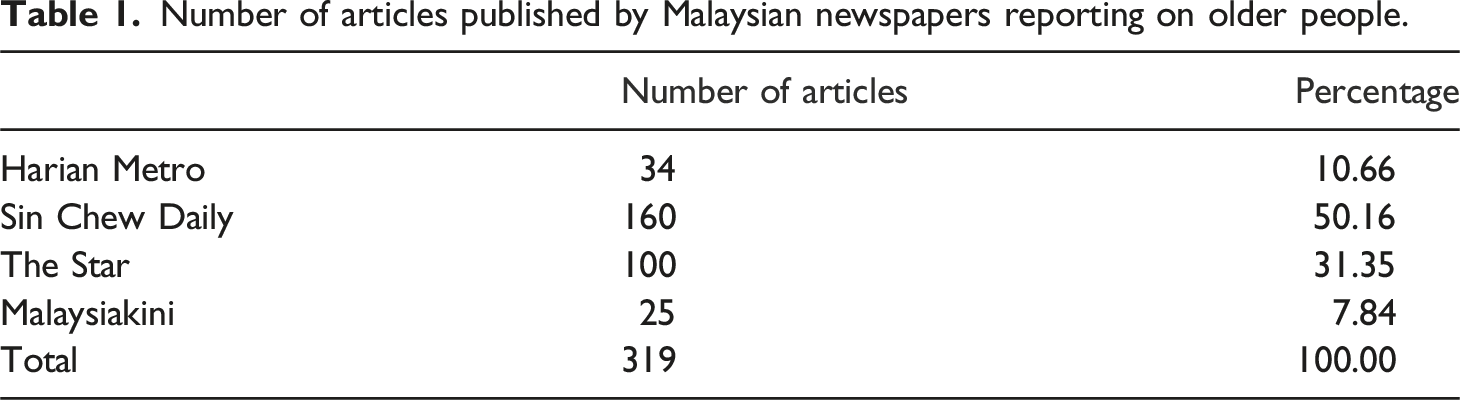
Number of articles published by Malaysian newspapers reporting on older people.
Types of articles
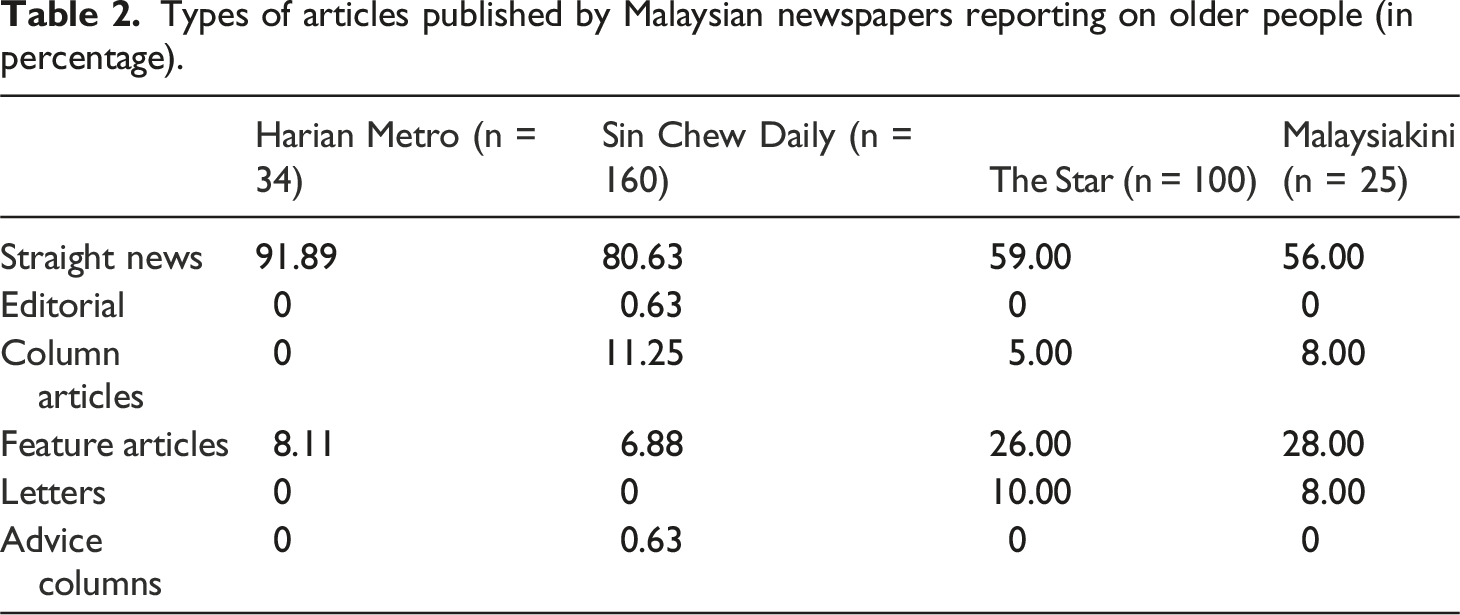
Types of articles published by Malaysian newspapers reporting on older people (in percentage).
Types of news sources
Types of news sources quoted by Malaysian newspapers reporting on older people (in percentage).
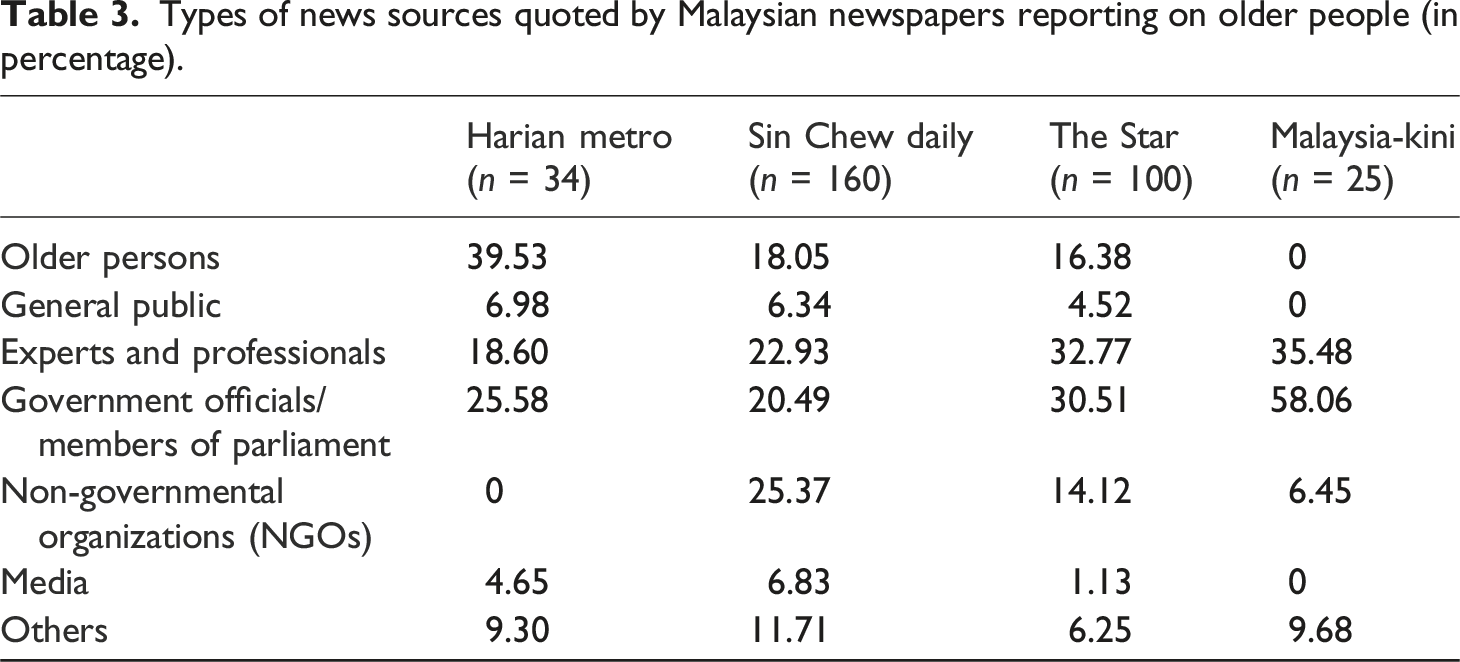
The government officials/members of parliament cited by the newspapers include the Prime Minister, Health Minister, Finance Minister, Women, Family and Community Development Minister, chief ministers, city mayors, as well as spokespersons from the Department of Statistics Malaysia, the Employees Provident Department, the Social Welfare Department, etc.
The NGOs quoted by the newspapers include the National Council of Senior Citizens Organizations, Malaysian Coalition on Ageing, Malaysian Healthy Ageing Society, Family Wellness Club, Association for Residential Aged Care Operator, Alzheimer’s Disease Foundation Malaysia, etc. Sin Chew also cited many Chinese clan associations, such as the Associated Eng Choon Societies of Malaysia, Hainan Association, Hokkien Association, Hakka Association, Federation of Chinese Associations Malaysia, etc.
The expert and professional news sources included gerontologist, orthopedic and arthroplasty surgeon, public health medicine specialist, psychologist, psychiatrist, professor of health science, professor of economics, medical researcher, lawyer, financial experts, etc.
Types of news frames
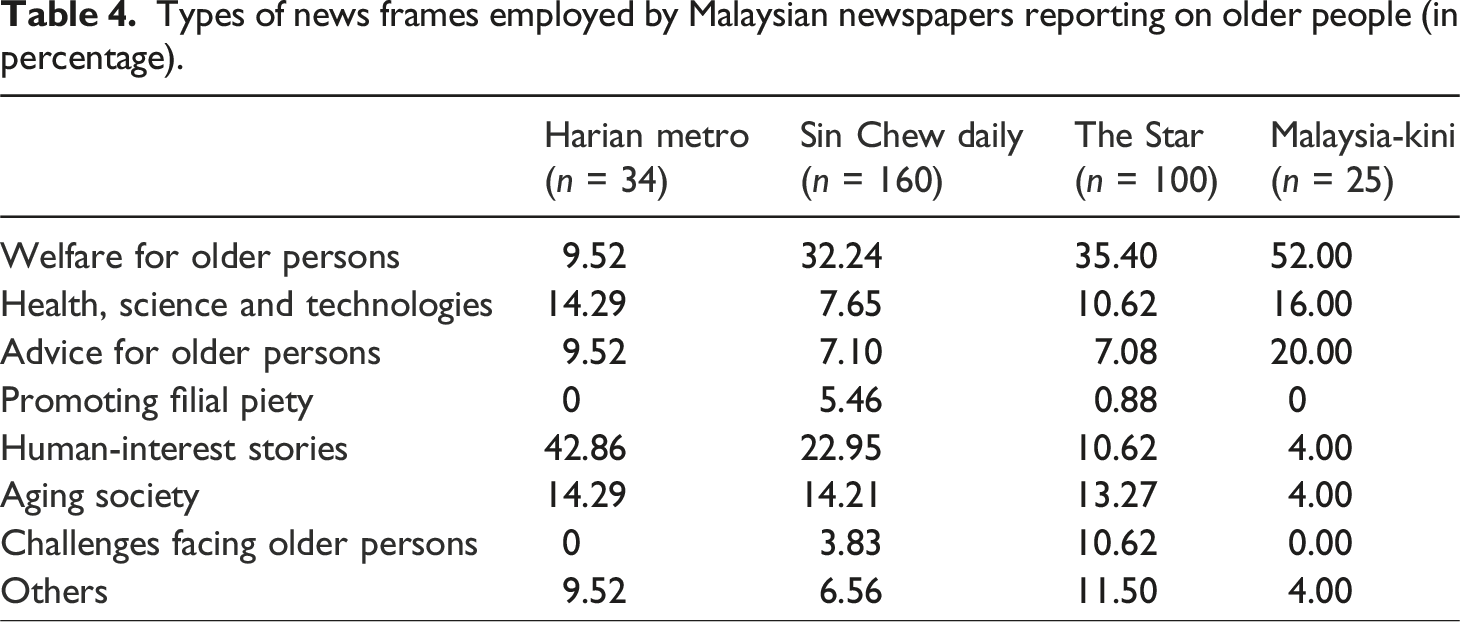
Types of news frames employed by Malaysian newspapers reporting on older people (in percentage).
Welfare for older persons
This frame focuses on reporting governmental and NGO activities, services, and policies for older person, underlining the collaborative roles of various sectors in addressing aging issues. Sin Chew’s extensive coverage of aged care highlighted issues such as the lack of caregiver training and the problems associated with the hiring of foreign helpers. The report emphasised the need for Malaysia to train younger and middle-aged people in professional nursing and aged care as a career choice (Senior Care, 2023).
Malaysiakini also reported views from Shahrul Bahyah Kamaruzzaman, President of the Malaysian Healthy Ageing Society, and gerontologist Lily Fu who argued against punitive measures as a way to encourage filial piety in adult children. They believed that education is a more effective approach, considering that the root cause of the lack of filial piety is multi-factorial. Among the suggested ideas are providing knowledge on healthy aging and financial literacy from a young age to better prepare for later years. Additionally, they proposed that the government find solutions that involve both public and private participation. Relying solely on the Employees’ Provident Fund (EPF) may present limitations and insufficiencies during retirement, making investment plans with insurance companies and wealth management programs a more attractive option for healthy aging (Tong, 2023).
Health, science and technologies
This frame reports on various health issues affecting older persons including symptoms, diagnosis, prevention, and intervention. It also explores new scientific findings related to aging or anti-aging, discussing methods and strategies to prevent or slow down the aging process. Additionally, the frame reports on emerging technologies created to assist older adults.
For example, The Star reported the application of smart home technologies, incorporating cameras, robots, motion sensors, and AI-based speakers, to support the care of older individuals. As the country with the highest number of older individuals, Japan invests in research on elder care robots, including robotic dogs and seals, to address a shortage of caregivers. These robots can monitor users, engage in conversation, and assist in movement. With the world’s highest proportion of people with dementia, Japan has also installed WiFi sensors in some towns to track seniors with the condition (Chandran, 2023).
Advice for older persons
This frame provides advice to older adults on how to take care of their health or exercise. It offers suggestions on aging with dignity and grace, including advice on financial planning, retirement planning, spending time after retirement, and developing a supportive social circle, among other topics.
In April 2020, the Malaysian government allowed people to withdraw their Employees’ Provident Fund (EPF) savings to navigate the financial difficulties brought about by the Covid-19 pandemic, resulting in job losses, an increase in the cost of living, and inflation. A total of 6.3 million people qualified for the scheme, allowing a minimum withdrawal of RM50 (approximately US$11) and a maximum of RM10,000 (approximately US$2150) (Nagotra, 2023). The frame of advice for older persons warns about the insufficiency of retirement savings for those who withdraw their EPF savings.
Malaysiakini published a feature article with an interactive calculator to help readers understand the impact of early withdrawal from EPF accounts. The online newspaper also highlighted that individuals should consider the gradual decline in health during their older years, noting that chronic diseases like hypertension and diabetes are common among Malaysian adults. It also criticized the government for its inability to fulfil its obligations in protecting the people, after decades of allowing the fiscal deficit and government debt to balloon (Nagotra, 2023).
Significantly, Malaysiakini reported that the then Finance Minister, Tengku Zafrul Abdul Aziz, had been vocal about the financial implications of early EPF savings withdrawal. He claimed that the EPF had to dispose of its overseas investments amid uncertain market conditions in light of the Russia-Ukraine crisis and halt domestic investments. This could potentially have adverse effects on domestic equity and bond markets. Zafrul also questioned the fairness of EPF members who have never withdrawn their savings through previous early withdrawal schemes receiving a lower return on their savings. He added that an additional withdrawal may result in members retiring below the poverty line, potentially causing higher homelessness rates and poor living standards among older persons in the future (Nagotra, 2023).
Promoting filial piety
This frame shows the importance of encouraging younger generations to treat older adults with love, kindness, patience, and respect. Sin Chew, a Chinese newspaper, placed the greatest emphasis on this frame, highlighting that while the meaning of filial piety remains unchanged, its forms must evolve with the times (Li, 2023).
In a feature article, Sin Chew debunked the misconception that sending older adults to nursing homes equates to abandonment. Instead, it argued that given the better care in nursing homes, the quality of life for older people can improve. The article also explained that providing care for older persons requires not only knowledge, but skills to prevent causing injuries to them or the caregivers. Further, Sin Chew discussed societal assumptions that females are better caregivers. Considering the traditional Chinese preference for sons, older people often feel guilty about their sons taking on the responsibility of caring for them. Therefore, it is common that the burden of caring for older adults falls on daughters or daughters-in-law (Li, 2023).
Human-interest stories
This frame reports stories of individuals who are staying active, healthy, and engaging in life. Harian Metro reported that in Japan, there is a growing number of seniors pushing the boundaries of active living. For example, the former Japanese national soccer player, Mutsuhiko Nomura, is a member of the over-80 division of Tokyo’s Soccer for Life league. Interestingly, the most mature player in his team is Shingo Shipzawa, who was 93 years old at the time. Nomura credited soccer with motivating him to quit smoking and helping to speed his recovery after treatment for spinal stenosis (Yahya, 2022).
Aging society
This frame highlights the growing trend of aging and presents various statistics related to the aging population. It also reports the economic consequences of an aging society, including the slow growth of gross domestic product; rising costs of support for older working adults; pressure on government budgets for healthcare, pension, and long-term care; and discussions about extending the retirement age, among other factors.
In a feature article published by The Star, Malaysian Employers Federation President Syed Hussain Syed Husman claimed that raising the minimum retirement age would hamper efforts to reinvigorate Malaysia’s labor market and overall economy. He added that the previous revision of the retirement age from 55 to 60 was made in July 2013, and this move has led to a loss of about a million job opportunities for fresh graduates. Although he acknowledged that allowing a later retirement gives older workers a longer stream of income in an aging society, it will likely push up employers’ medical costs, especially when many insurance companies are not keen to provide coverage to older workers (Yuen and Pfordten, 2023).
Challenges facing the older persons
This frame laments problems facing older persons, such as loneliness, abandonment, abuse, sickness, lack of proficiency in using digital devices, falling victim to scams, etc. It also emphasizes the possibility that poverty and vulnerability increase with age, while noting that the growing dependency associated with old age could burden families as they struggle to cope with caregiving needs.
Harian Metro reported that an 81-year-old man who lived alone with his disabled wife became exhausted after taking care of her for 40 years. In an unfortunate incident, the man pushed his 79-year-old wheelchair-using wife into the sea. Harian Metro also reported that following the incident, social media users in Japan accused the government of ignoring the abuse faced by the older adults in the country. It was reported that in Japan, there were 17,281 incidents of older adults being physically attacked by family members in 2020, resulting in 25 deaths (Elderly Man, 2022).
Discussion
This study found an imbalance in the coverage of aging issues among four Malaysian newspapers, with Harian Metro and Malaysiakini providing limited coverage of aging-related topics. The reliance on straight news reporting in these newspapers may restrict readers’ access to comprehensive understanding and diverse perspectives on aging issues. Opinion pieces, offering diverse interpretations and in-depth analyses, are seen as more educative but are lacking in the coverage of aging by these newspapers. This imbalance suggests that aging may not be prioritized on the agenda of certain newspapers, limiting public discourse and awareness on aging-related matters.
The limited coverage of various aging topics in Harian Metro and Malaysiakini could also be attributed to the specific focus of these newspapers. Harian Metro, was established to cater to the expanding audience of young readers in urban areas, prioritizes entertainment, shopping news, lifestyle features, and current events. Additionally, Malaysiakini tends to concentrate on the development of freedom of speech, social justice, and democracy in Malaysia. The news published in Malaysiakini are mainly focusing on the political, economy, structural or policy areas, and these are also reflected on the examples of frames presented in the Findings section.
Sin Chew not only published the greatest number of articles on aging but was also the sole newspaper that released an editorial article on the topic. As Marques (2020) pointed out, the editorial serves as the voice of the newspaper, playing a crucial role in shaping public opinions. Marques (2020) also emphasized that an editorial stance reflects historical and cultural influences. Due to the Chinese culture of treasuring older persons and filial piety, it is not surprising that Sin Chew also had the highest percentage of articles promoting filial piety. Additionally, the high percentage of opinion pieces published by The Star and Malaysiakini could help enhance the diversity of perspectives, offering readers a better understanding of the topic, or even encouraging discussion or debate.
Hence, the media plays a crucial role in deepening public understanding of various topics through comprehensive coverage and analysis. Thomas (2019) highlights that opinion articles primarily advocate for underrepresented groups, introduce fresh ideas to spark discussions and contextualize news events. Publications like The Star and Malaysiakini, with their extensive opinion sections, can broaden the conversation on aging with varied perspectives. Despite their subjective nature, Young (2022) acknowledges that these articles significantly shape public opinion and political engagement.
Similar to previous research (e.g., Imran, 2022b; Xu, 2022), this study found that elite sources, such as experts, professionals, government officials/members of parliament, and NGOs were dominant across the four newspapers. Healthcare professionals and the government were positioned as the main actors in the welfare and wellbeing of older individuals. While Entman (1993) argued that news sources determine the story to some extent, Wichgers et al. (2021) highlighted the influence of news sources or frame sponsors, who are non-media actors advocating a particular opinion/frame package. This is because news sources are given the privilege by the press to act as opinion leaders to define aging; to interpret various problems due to aging by focusing on some aspects while downplaying or ignoring others; and to transfer responsibility of aged care to certain people.
Notably, Kaufman (1994) also observed that medicalization is one of the conceptual frameworks applied in healthcare delivery to older persons. It refers to a process in which personal and social problems and behaviors are viewed as diseases or disorders that demand medical attention. The author observed that older adults and their families perceive the healthcare system as the locus of expertise and resolution as they attempt to cope with the chronic diseases, functional limitations, and disabilities caused by aging.
Additionally, Reese (2018) saw frames as expressions and outcomes of power, unequally distributed with public opinion dominated and enlisted accordingly. This study found that older adults were portrayed as ‘‘being advocated for’’ and ‘‘being looked after”, as found in the study by scholars (e.g. Imran, 2022a; Imran and Budarick, 2023; Koskinen et al., 2014). These portrayals reflect paternalism and ageism because they undermine older persons’ agency to articulate their identity, capabilities, dispositions, desires, experience, health, well-being and social needs (Amundsen, 2022; Morgan, 2021).
Articles featuring direct quotes from older individuals mostly center around human-interest stories. These older adults are often portrayed with a positive life attitude, showcasing active aging through participation in sports, social activities, community volunteering, continued work or pursuit of higher education, and acquiring new skills. Loos and Ivan (2018) noted that the positive outcomes of promoting successful and active aging discourse could include adopting an active lifestyle, maintaining functional health, and enhancing capacities such as individual responsibility and civic engagement. These outcomes might contribute to a reduction in older individuals’ dependency on public system provisions.
However, this study also uncovered the absence of voices from less active older persons, particularly the older-old, as well as those facing health, mental, financial, or other challenges. This finding agrees with the study of Imran and Bowd (2023), where a significant disparity in the proportion of voices of older persons and other actors in news articles discussing issues related to older people was identified. Koskinen et al. (2014) argued that by marginalizing older persons who do not conform to a narrow definition of successful aging, negative stereotypes about older adults are perpetuated. Loos and Ivan (2018) criticized the successful aging model, pointing out that it tends to place the responsibility for success or failure solely on individuals and within their control. However, the authors argued that models of successful aging or active aging overlook economic opportunities and constraints, as well as power differentials and inequalities in resource access. Furthermore, Martinez-Maldonado et al. (2016) highlighted that aging is an individualized process occurring within a specific culture, involving economic, political, and psychosocial factors, in addition to biological factors inherent to the individual. However, there is a tendency to misrepresent older persons as a homogeneous group. Significantly, Imran (2023) also argued that the exclusion of older people’s views in the reporting of aged care in Malaysia strengthened the dominance of government-led narratives, which is to limit the burden of care on government by encouraging traditional familial care.
In 1991, the United Nations rejected the use of “elderly” in favor of the term “older persons” through the adoption of the UN Principles for Older Persons (Amundsen, 2022). This change was implemented because the term “elderly” is disposed to stereotyping, often leading to generalizations based on incorrect assumptions about older adults as a homogeneous group. Nevertheless, this study found that the term was widely used by The Star, an English-language newspaper in Malaysia. Entman (2018) pointed out that cumulative and consonant media framing will modify audience’s mental model to be in consistent with the predominant framing. The paternalism and ageism framing mentioned earlier, together with the excessive use of the word “elderly” by The Star might not be helpful in destigmatization of older persons.
Through the frame of welfare for older persons, the newspapers in this study reported on aged care for older adults. Yunus et al. (2022) highlighted that despite the rapid demographic transition and a rise in dependency in daily living activities among older adults in Malaysia, formal support and long-term care services (LTC) have not been adequately developed. The authors mentioned that LTC facilities serve only less than 1% of the older population in the country. Although Malaysia has a tax-funded healthcare system that is highly affordable and relatively efficient, it does not cover LTC services. Importantly, the authors also found that most Malaysian working adults have low levels of awareness and financial literacy regarding LTC. They are unaware that the existing social security benefits are far from sufficient for them to retire or use LTC services in the later stages. Therefore, Yunus et al. (2022) highly recommended that both the government and citizens should start early to plan for LTC provision and financing.
The Chinese newspaper, Sin Chew advocated the most for respect towards older persons, but at the same time, also emphasised the need for filial piety to adapt to contemporary times. There is a traditional Chinese proverb that goes, “Among hundreds of virtues, filial piety is the most important one”. Canda (2013) observed that due to the strong emphasis on filial piety in Chinese culture, the discrepancy may lead to feelings of shame and guilt for adult children, who might be blamed by both their parents and the community. While the Chinese also generally subscribe to the perspective of “raising children to ensure old-age support”, Canda (2013) remarked that urbanization, a reduction in family size, the separation of households between elder parents and adult children, geographic mobility, and conflicting work and family obligations pose challenges to adult children in looking after their parents. Notably, Xu (2012) found that along with modernization, the social construction and expectations for practicing filial piety have shifted from material and day-to-day practical assistance to emotional support.
Through examining older residents’ perspectives on filial piety and institutionalization in Shanghai, Chen (2011) recorded that almost all participants expressed their understanding of the evolving concept of filial piety. The author found that filial piety is the most significant reason for children to object to institutionalization. Most participants mentioned negotiations among their children or between themselves and their children about institutionalization. Their children were afraid of being criticized for not being loyal to their parents or experiencing social pressure from other people, such as neighbors and colleagues. Nevertheless, Canda (2013) claimed that filial piety is sometimes used by policymakers to rationalize insufficient funding to support in-home and out-of-home supplements and alternatives for elder care, thus leaving the responsibility to overburdened families.
Malaysia is deeply rooted in a family-oriented culture, and it is a normative duty for adult children of all ethnic groups to care for their parents (Yunus et al., 2022). From an Islamic perspective, there is a strong injunction on family members to provide welfare for those who are old, sick, weak, or vulnerable (Ramli et al., 2021). Yunus et al. (2022) also highlighted that cultural beliefs, values, and religion have a dominant role in various aspects of Malay life, including family and kinship systems. Tan (2018) found that having a close emotional relationship with grandparents is a valuable resource for support among Malaysian adolescents, regardless of their ethnic background, particularly for mitigating the potential impact from accumulative risk factors on the psychological functioning of adolescents. Additionally, Imran (2022b) recorded that the majority of Malaysian newspapers portray older people as elderly parents, focusing on their role in the family. Furthermore, the language used by Malaysian journalists instils a sense of guilt for people who do not provide financial support to their parents and who send them to nursing homes.
With the rise in the aging population, the Malaysian government faces increasing expenditure on the welfare of older individuals, even to ensure basic levels of protection. Consequently, political leaders have urged families and communities to take on more responsibility for caring for older persons, considering the economic impact on the government (Imran, 2022b). Notably, Imran and Budarick (2023) observed a shift from macro-level issues to micro-level responsibilities. Through a critical discourse analysis of Malaysian newspapers, the authors found that Malaysian newspapers often portrayed older people as victims of family neglect. Senior citizens abandoned by their families were frequently linked back to familial responsibility, transferring accountability to family members rather than authorities responsible for the welfare of older adults.
Acknowledging the influence of social, cultural, and religious factors on Malaysian press coverage on aged care, Imran (2022b) highlighted the significance of political factors. Firstly, many newspapers in Malaysia are owned and influenced by politicians with close ties to the government. Secondly, many media laws exist to restrict press freedom, leading to self-censorship driven by fear. Thirdly, the Malaysian media hold fast to the principle of development journalism, whereby they are expected to collaborate with the government rather than adopting an adversarial watchdog role.
Conclusion
Media representations are cultural products that perpetuate specific beliefs by consistently presenting particular perspectives, cultural values, social norms, political and economic influences, as well as and role expectations. This, in turn, shapes self-identity, societal perceptions, and general attitudes. This study shows that Malaysian newspapers mainly focus on the wellbeing of older persons in their coverage of aging. However, the collective discourse produced reflects paternalism and ageism, often neglecting the voices of older adults.
Media representations of aging can significantly impact public perceptions, social policies, and the well-being of older adults. Negative portrayals may fuel age discrimination and neglect of older workers' potential contributions, while perpetuating misconceptions about their health and capabilities. Conversely, positive representations can destigmatize aging-related health issues, improve access to healthcare, and support policies promoting financial security and workforce participation for older adults. Recognizing the influence of media, policymakers should promote positive representations through regulations and collaborations with media organizations, advocacy groups, and researchers, encouraging intergenerational understanding and challenging ageist stereotypes.
Researchers can further advance understanding of the complex relationship between media representations of aging and societal attitudes, ultimately contributing to the promotion of age-inclusive media content and policies. They can carry out longitudinal studies to examine the evolving portrayals of aging in media and their influence on attitudes towards older adults.
The findings of this study offer suggestions for addressing aging within the Malaysian context. They include presenting a positive image of older persons, avoiding ageist language, educating on healthy aging and financial literacy from a young age, avoiding using ageist language, policies, and practices. Additionally, the media could encourage inclusivity by including more diverse voices and opinions of older persons, keeping in mind factors like age range, gender, physical or mental condition, socio-economic status, and cultural background.
Future studies could look into factors affecting media’s framing of aging. Researchers may examine journalists’ perception of their role in reporting aging, as well as journalistic routines, values, and practices. Furthermore, researchers may also look into how the structures of editorial work, such as decision-making hierarchy and quality control, influence reporting on aging. Finally, it would be beneficial to conduct a public opinion survey to examine how, why, and to what extent reporting on aging influences the audience’s perceptions.
Supplemental Material
Supplemental Material - A comparative study of multi-ethnic perspectives on aging in Malaysian newspapers
Supplemental Material for A comparative study of multi-ethnic perspectives on aging in Malaysian newspapers by Lai Fong Yang, Prasana Rosaline Fernandez and Linda Poh Gaik Tan in Journalism
Footnotes
Declaration of conflicting interests
The author(s) declared no potential conflicts of interest with respect to the research, authorship, and/or publication of this article.
Funding
The author(s) disclosed receipt of the following financial support for the research, authorship, and/or publication of this article: This work was supported by the Xiamen University Malaysia (Grant No.: XMUMRF/2023-C11/IART/0016).

Supplemental Material
Supplemental material for this article is available online.
Author biographies
References
Supplementary Material
Please find the following supplemental material available below.
For Open Access articles published under a Creative Commons License, all supplemental material carries the same license as the article it is associated with.
For non-Open Access articles published, all supplemental material carries a non-exclusive license, and permission requests for re-use of supplemental material or any part of supplemental material shall be sent directly to the copyright owner as specified in the copyright notice associated with the article.
