







Abstract
Journalistic reporting has increasingly adopted a more human-centered approach, often aiming to evoke empathy in the audience. This is because empathy is expected to bridge the gap between ‘us’ and ‘them,’ thereby fostering social cohesion. However, previous assessments of empathy-inducing journalism tend to fall short in two ways: first, they often rely on broad definitions of empathy, while current models suggest a dual-process model involving emotional and cognitive empathy. Second, they frequently overlook the motivated nature of empathy, meaning that whether individuals are motivated to empathize with others’ feelings may depend on the perceived norms of their ideological peers. This could potentially exacerbate, rather than reduce, societal divides in the form of polarization. In an online experiment (N = 933), we examine how an empathy frame (vs a non-empathy frame) on the topic of Afghan refugees influences emotional and cognitive empathy, whether these responses are moderated by social group norms, and how they relate to polarization of affect, human rights attitudes, and policy support. We found no norm-driven polarization of emotional empathy after reading the stimulus. Instead, we observed a small positive direct effect of the empathy-frame on affect toward Afghan refugees, highlighting the benefits of using empathy inducing frames, even when communicating polarized issues.
Keywords
Introduction
Over the past decade, a growing body of research has documented a trend towards increasing ideological and affective polarization (Dalton, 2006; Iyengar et al., 2019; Jungkunz and Helbling, 2024). Among other things, such polarization contributes to negative feelings towards outgroups (Renström et al., 2022), diverging human rights attitudes (Galli and Modesto, 2025), divided policy support (Johnson and Schwadel, 2019), weakened support for democratic norms (Kingzette et al., 2021), and may contribute to democratic erosion (McCoy et al., 2018).
In response to concerns about polarization, different journalistic formats have emerged with the aim of reducing societal divides. One common strategy is promoting empathy for distant others by using different frames, such as episodic framing (Gross, 2008; Kim and Grabe, 2024), victim framing (Pandir, 2019), and personalization (Grabe et al., 2017). There are also entire genres, such as immersive journalism, which use virtual technologies with the aim of fostering empathy (Sánchez Laws, 2020). This potential of journalism to evoke empathy is often viewed as a societal good (Roberts, 2021; Schudson, 2001). Studies also suggest that experiencing empathy can have beneficial consequences such as increasing prosocial behaviors (Batson et al., 2002; Prot et al., 2014) and greater support for inclusive policies (Schmuck et al., 2023). It can also reduce prejudice and improve attitudes toward stigmatized groups (Oliver et al., 2012).
However, findings from political psychology suggest that empathy might not always have the intended effect of bringing people together. To begin with, in contexts characterized by polarization, emotionally empathetic communication has actually been shown to intensify polarization rather than reduce it (Klimecki et al., 2020). Importantly, the effects might depend on whether mediated empathy refers to emotional empathy, which involves automatic, affective resonance with another’s emotional state, or cognitive empathy, which requires conscious perspective-taking and mental state attribution (Martingano et al., 2021; Martingano and Konrath, 2022). For example, research suggests that emotional empathy may exacerbate affective polarization, while cognitive empathy may reduce it (Brophy and Mullinix, 2023). At the same time, emotional empathy seems to be more easily triggered by media than cognitive empathy (Famulari and Hatley Major, 2025; Martingano et al., 2021). Important in this context is that the experience of empathy is at least partly motivated and regulated by individuals themselves (Zaki, 2014). Specifically, individuals may actively resist empathizing with others when doing so is normatively discouraged (Klimecki et al., 2020) or emotionally costly (Cameron et al., 2016) which is typically the case in highly polarized contexts with strong out-group dynamics (Rathbone et al., 2023).
A key problem in this context is, however, that research on the effects of empathy-inducing journalism has not considered the different forms of elicited empathy, that empathy is partly motivated, and might in a highly polarized context be influenced by social norms. To address this, this study investigates whether the assumed benefits of journalistically mediated empathy are applicable in politically polarized contexts, or whether empathy, particularly emotional empathy, may exacerbate polarization. Focusing on media coverage of Afghan refugees in Austria and using a pre-registered experiment, we examine how empathetic framing (vs neutral framing) influences audience reactions regarding (a) affect, (b) support for human rights, and (c) policy preferences. The topic of Afghan refugees is chosen, as this is a topic that is often portrayed using empathy-inducing techniques such as victimization frames (Pandir, 2019), while the public sentiment towards Afghan refugees in Austria is largely polarized along the political left-right spectrum (Gallup, 2021). Additionally, a strong out-group dynamic is evident in the relationship between Austrians and Afghan refugees, in which Afghan refugees are met with overall negative sentiment, which is largely based on religious and ethnic perceptions (Iordache and Blanchard, 2024). Drawing on the dual-process model of empathy, we hypothesize that mediated emotional and cognitive empathy toward Afghan refugees operate distinctly and are moderated by one’s perceptions of peer group norms.
Polarization: A trend towards more division
Polarization is a phenomenon that describes the situation and process of widening societal divisions. In the literature, three types of polarization are discussed: ideological, affective, and factual belief polarization (Rekker and Harteveld, 2024; Schedler, 2023; Wagner, 2021). In short, ideological polarization refers to a growing divide in attitudes between citizens toward topics or policies; often, this divide occurs along ideological lines (West and Iyengar, 2022). For example, there is an increasing gap in attitudes toward migrants and refugees, where political orientation plays a crucial role: while people on the right of the political spectrum tend to hold more negative attitudes toward migrants, those on the left tend to have more positive attitudes (Albada et al., 2021). Affective polarization refers to an identity-based emotional distance from groups perceived as out-groups, such as political opponents (Iyengar et al., 2019; Renström et al., 2022; Wagner, 2021). Affective polarization can be targeted toward members of opposing parties, but also at other out-groups (Renström et al., 2022). For instance, a study found that individuals on the left have more positive feelings toward migrants than those on the right (Renström et al., 2022). Factual belief polarization occurs when citizens have differing perceptions of reality. For example, in many countries people hold varying perceptions of the severity and existence of issues, and the divisions again occur along political orientation (Rekker and Harteveld, 2024).
Important in this context is that all three types of polarization (political, affective, epistemic) can have negative consequences for democracy. Among other things, polarization decreases the system’s ability to identify public concerns and find solutions for them (Benson, 2024), and is a key driver behind a declining trust of citizens in democratic institutions like the European parliament (Bauer and Morisi, 2023) or journalism (Lewis, 2019), an erosion of democratic norms (Kingzette et al., 2021), and democratic backsliding (Orhan, 2022).
An empathy turn in journalism?
Given the consequences of polarization for democratic stability, it is unsurprising that journalistic formats have emerged with the aim of depolarizing society. Such formats entail frames, such as episodic framing (Gross, 2008; Kim and Grabe, 2024), victim framing (Pandir, 2019), and personalization (Grabe et al., 2017). These frames often center the personal and emotional experiences of their protagonists, often marginalized groups (Pandir, 2019; Varma, 2020). Additionally, entire genres, such as peace journalism (Lynch and Mcgoldrick, 2012), and branches of constructive journalism (Midberry and Dahmen, 2020) are produced to encourage empathetic engagement. In constructive journalism, for instance, visuals are selected to elicit empathy and humanize individuals, making their experiences more relatable to audiences. This can entail choosing visuals in which an individual, rather than a group of people is portrayed (Midberry and Dahmen, 2020). Another prominent example that underscores the importance of mediated empathy from a journalist’s perspective is immersive journalism, which was, from the outset, designed to elicit empathy for distant others (Sánchez Laws, 2020).
Importantly, these empathy-targeting formats are applied to specific topics with specific goals. Empathy requires the presence of another living being with whom individuals can empathize. This means that rather than merely reporting statistics, empathy-targeting involves personalization to illustrate how a news event affects individuals (Kim and Grabe, 2024; Oliver et al., 2012). Empathy-eliciting frames are often used to portray the experiences of low-status and marginalized groups, such as unhoused individuals (Varma, 2020), out-groups in specific contexts such as Muslims in the USA (Kim and Grabe, 2024). These topics have in common that they are often related to highly politicized or salient issues, such as the issue of migration (Renström et al., 2022). In doing so, empathy-inducing frames often have two goals: first, through eliciting empathy, they aim to close the perceived gap between “us” and “them”, thus resulting in a more cohesive rather than divided society. Second, eliciting empathy is often used as a mechanism that is targeted at a secondary outcome, such as more support of human rights of that group (Galli and Modesto, 2025), more pro-social behaviors, such as donations (Prot et al., 2014), or policy support of outgroup members (Schmuck et al., 2023).
Empathy: Dual and motivated
Empathy is often evaluated as a positive outcome of news coverage because it is thought to benefit society. For instance, Schudson (2001) highlights “social empathy” as a crucial role of journalism in a democracy, by sharing stories that connect readers with the lives of people from different backgrounds. This kind of empathetic engagement is believed to promote understanding, moral concern, and more inclusive decision-making (Roberts, 2021).
However, while it may seem intuitive that empathy is the driving force behind societal cohesion, some cognitive psychologists have argued that empathy is an imperfect vehicle to facilitate societal cohesion, as it often results in biased and subjective decision-making (Bloom, 2017). In a related vein, research in political psychology reveals a complex reality. According to this body of research, empathy may be linked to an increase, rather than a decrease, in polarization in already polarized contexts (Allamong and Peterson, 2021). For example, studies have found that greater predisposition for emotional empathy is associated with affective polarization (Allamong and Peterson, 2021; Simas et al., 2020). Furthermore, while the emotional empathy trait predicts polarization among partisans, the disposition toward perspective-taking does not influence affective polarization (Simas et al., 2020). Fido and Harper (2018) even find that pre-dispositional cognitive empathy was predictive of lower levels of outgroup polarization in a survey, while pre-dispositional emotional empathy did not influence outgroup polarization in a highly polarized context.
Based on this literature, we identify two research gaps that have not been addressed in prior studies on the impact of empathy in journalism. First, previous research typically base their assessments on broad, non-specific definitions of empathy (Cuff et al., 2016; Martingano et al., 2021). Second, they have not taken into account that the experience of empathy is partially motivated and can depend on one’s perceived peer norms (Allamong and Peterson, 2021; Zaki, 2014).
A dual-process model approach to defining empathy
Empathy is a multifaceted concept that has been defined in various ways. In this study, we primarily draw on the comprehensive definition by Cuff et al. (2016), who describe empathy as an emotional response triggered by both individual traits (trait empathy) and situational cues (state empathy). This response is partly automatic but also influenced by top-down control processes and can entail an understanding of another’s state (i.e., cognitive empathy) while maintaining a clear distinction between self and others (Cuff et al., 2016). Importantly, related yet distinct emotions, such as sympathy and compassion, are not covered under this definition of empathy. While empathy involves “feeling as” the other, sympathy means “feeling for” the other (Escalas and Stern, 2003). In this study, we focus on empathy as a state that can be triggered by media, while also considering top-down processes that influence the empathetic experience.
To capture the mechanisms by which empathy unfolds in response to journalistic stimuli, we draw on the dual-process model of empathy (Martingano et al., 2021). This model encompasses cognitive empathy, i.e., the effortful act of envisioning another’s mental state (Davis, 1983), and emotional empathy, i.e., the more automatic and intuitive process that allows one to experience another’s feelings (Martingano et al., 2021; Martingano and Konrath, 2022). While cognitive and emotional empathy can be interconnected, they represent distinct concepts that can activate different processes (Smith, 2006). These divergent patterns are particularly relevant to study the effect of empathy-inducing journalistic frames, given that emotional and cognitive empathy might be triggered by different stimuli and have distinct consequences. For example, studies on the empathy-inducing effect of different journalistic frames suggest that emotional empathy seems to be more readily activated by media frames than cognitive empathy (Famulari and Hatley Major, 2025; Martingano et al., 2021) and is more strongly linked to positive affect (Aarøe, 2011; Gross, 2008), support for policies (Aarøe, 2011; Wald et al., 2021) and attitudinal change (Oliver et al., 2012). However, a large part of the literature on the effects of empathy in journalism focuses on “feeling for” (sympathy, compassion, or pity), rather than “feeling as” another (emotional empathy) (Aarøe, 2011; Gross, 2008; Kim and Grabe, 2024; Wald et al., 2021); or they manipulate empathy in their stimulus without testing the effect on actual experienced empathy (Wojcieszak and Kim, 2016).
That said, overall research suggests that empathetic frames seem to have a positive direct effect on emotions, attitudes, and policy support. Inconsistencies in prior research on the benefits of empathy in journalism may stem, at least in part, from a lack of clarity about which type of empathy is being elicited in audiences. This distinction is however essential for furthering our understanding of both the mechanisms and outcomes of empathetic framing, with emotional empathy typically being more prone to being both influenced by frames and related to intended outcomes. Therefore, we assume:
An emotional empathy frame leads to higher levels of (a) positive affect, (b) policy support, and (c) pro-human rights attitudes toward Afghan refugees compared to a no-empathy frame.
The effects of H1 are mediated by emotional but not cognitive empathy.
Empathy is (partially) motivated by social group norms
One crucial explanation for polarization is social identity theory and, relatedly, social norms. Social identity theory posits that a part of an individual’s identity is connected to one’s perceived group membership and that one’s perceived in-group is evaluated as more favorable than out-groups (Greene, 2004). Group membership also occurs in political contexts where individuals identify with a particular party, which in turn makes them more likely to evaluate party members more favorable than party opponents (Greene, 2004).
Social identity theory furthermore posits that social group norms, meaning a shared understanding of acceptable behavior within a group (Görges and Nosenzo, 2020), are essential in guiding collective behavior. There are two types of norms: descriptive and injunctive norms (Deutchman et al., 2025). Descriptive norms refer to what individuals perceive others to do or think. Injunctive norms refer to what individuals perceive others to disapprove or approve of, thereby including a clear normative statement (Deutchman et al., 2025).
Social group norms guide collective behavior in a society, as they are informal rules that help individuals identify which attitudes or behaviors are acceptable. For instance, if an individual knows that most people tip a certain amount (descriptive norm) and they also think that people should tip (injunctive norm), the individual tends to adhere to these unwritten rules (Debo and Snitkovsky, 2025). Such social norms can also alleviate or exacerbate polarization. As for alleviation, communicating the social norm of open-mindedness and linking it to the in-group was found to reduce affective polarization among Democrats and Republicans in the US (Wojcieszak et al., 2020). Similarly, individuals are more likely to engage in intergroup contact when they perceive the social norm to be that intergroup contact is common or encouraged (Ata et al., 2009). In contrast, social norms can also drive polarization. This can be the case when social norms to engage in intergroup contact are uncommon or discouraged (Meleady, 2021).
Transferring these findings to journalism suggests that social norms are likely to influence how individuals respond to an empathy-inducing article. This is due to empathy being motivated: individuals generally tend to avoid empathizing with others’ suffering by down-regulating their empathetic response because empathizing is cognitively and emotionally costly (Cameron et al., 2016). Among other things, whether individuals are willing to empathize can depend on the norms of their ideological peers, i.e. their social group norm (Nook et al., 2016). This was observed in a study from Switzerland on migration, where individuals with left-leaning political views were more motivated to respond with empathy, which resulted in more positive attitudes toward immigration compared to those with right-leaning views (Klimecki et al., 2020). If the social norm is not to empathize, however, individuals can also downregulate their empathy in response to an empathetic stimulus, and therefore even dehumanize outgroups (Cameron et al., 2016). The reliance on social norms is particularly prevalent when one’s social group norm is salient, which is the case when a society is polarized on a topic (Webster and Abramowitz, 2017).
All of this becomes problematic when considering the context in which empathy frames are applied in journalism. For example, journalistic stories on refugees are often presented empathetically by highlighting their hardship and using a victimization frame (Joris et al., 2020) with the aim of bridging the gap between ‘us’ and ‘them’. A study on the impact of humanitarian compared to threat framing on immigration attitudes indicated that opposition to the restriction of immigration is primarily driven by empathy, in that highly-empathetic individuals oppose the restriction, while the frame does not influence policy opinions of those with lower empathic traits (Newman et al., 2015). This means that portraying a polarized issue like refugees in an emotionally empathetic way might mainly evoke empathy from those already inclined to feel it, specifically those who see their social norms as guiding such actions, while those with low social norms to empathize could even downregulate their empathetic response, and thus increase polarization. To investigate whether this indeed is the case, and the role of perceived group norms, we hypothesize (see Figure 1): Parallel moderated mediation model.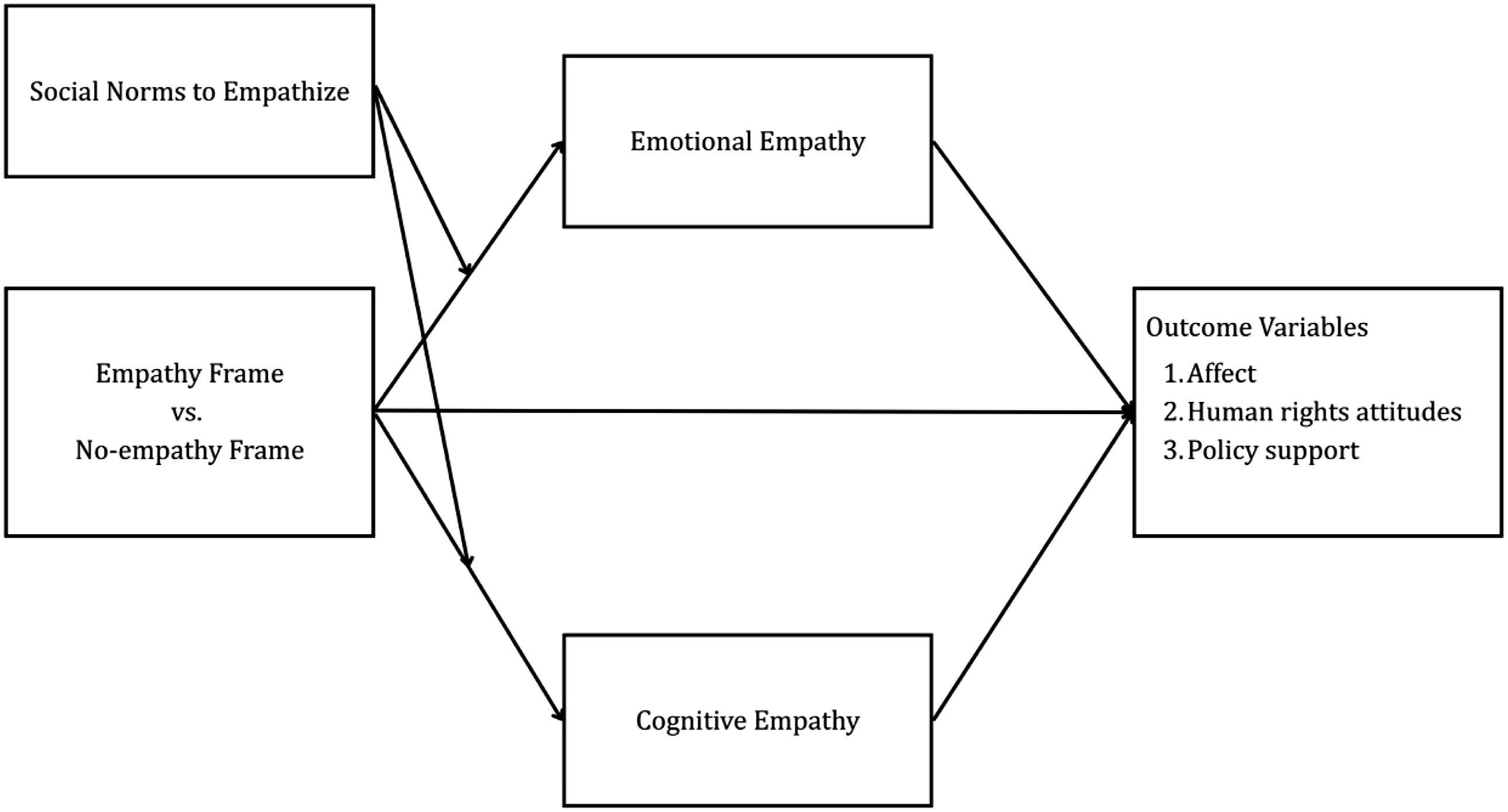
The effects in H2 are moderated by social group norms. Strong social group norms to empathize lead to greater emotional, but not cognitive empathy, while opposing norms reduce emotional, but not cognitive empathy, resulting in polarization in (a) affect, (b) policy support, and (c) human rights attitudes toward Afghan refugees.
Polarization between groups (H3) is more pronounced for those experiencing emotional empathy in contrast to cognitive empathy.
Method
To test our hypothesized moderated mediation model, we conducted a pre-registered online experiment comparing the impact of an empathy frame versus a no-empathy frame from 23.01.2025 to 05.02.2025 in Austria. The complete survey, power analysis, data, and R-scripts are made available for replication on https://osf.io/cg897/overview?view_only=6ac349d06b38464a95fc5b4db768d1d0. For the stimulus material, we chose the then-current, polarizing topic of Afghan women automatically receiving asylum in Austria (Gallup, 2021). Studies from 2021, after the Taliban’s takeover in summer 2021, reveal a polarized sentiment in Austria, with 42% believing refugees with negative asylum decisions should remain, while 38% think Afghan refugees with such decisions should be deported. These differences are likely informed by ideological divides on a left-right spectrum (Gallup, 2021).
In this study, we want to test the effect of empathy-inducing journalism. To do so, we constructed two experimental conditions: one empathy frame and one neutral frame. The empathy frame is built on literature indicating that personalization (Kim and Grabe, 2024; Oliver et al., 2012), emotionalization (Kim and Grabe, 2024), and personalized visuals (Famulari and Hatley Major, 2025) can induce empathy. As a baseline, we combined two pre-existing articles on Afghan women: one about a new EU law granting automatic asylum to female Afghans, and another featuring a testimonial from a 15-year-old girl still living in Afghanistan. The empathy frame included the baseline story, the Afghan woman’s testimony, and a visual of an Afghan woman wearing a hijab, looking directly into the camera. Additionally, we included more emotional language (Kim and Grabe, 2024), and an explicit call for empathy by an NGO expert, which explicitly stated “imagine how the Afghan women who are still in the country must feel like” thereby using a phrase used in psychological studies to induce empathy (Batson et al., 2002). The non-empathy frame used the same baseline story. The content of the testimonial account was rewritten in a neutral tone, without the perspective of an individual person, but rather focusing on the lives of women in Afghanistan. The visual included a group of Afghan women wearing a hijab. The explicit call to empathy was replaced by a general statement that the European Union should not lose sight of the situation of Afghan women in Afghanistan.
A pre-test of the stimulus material was conducted with a student sample to determine whether participants could distinguish between the empathy and no-empathy frames. The manipulation check was successful for both textual and visual elements across 4 of 5 measures (see Appendix B).
Measures
All measures, if not indicated otherwise, were measured on a scale from 1 – do not agree at all, to 7 – fully agree.
Mediators
Emotional empathy
To measure emotional empathy, we use an adjusted version of the multidimensional emotional empathy scale (Alloway et al., 2016). The three relevant sub-dimensions targeted at state empathy resulted in an overall 6-item measure, which is assessed directly after reading the stimulus. An example includes “I got very upset when I read about the Afghan women being treated meanly“ (M = 4.56, SD = 1.45; CA = .868).
Cognitive empathy
Cognitive empathy was measured following the Davis (1983) 4-item perspective-taking scale, which is widely used and reliable (Corte et al., 2007). An item is, “I tried to understand Afghan women better by imagining how things look from their perspective.“ (M = 4.71, SD = 1.32, CA = .723).
Moderator
Social group norm
To assess whether people assume their social peers would empathize with the target group (i.e., second-order moral judgment), participants were instructed to evaluate three vignettes for injunctive and descriptive norms (Deutchman et al., 2025). The three vignettes include brief descriptions of an encounter with a female, Middle Eastern refugee. The encounter is structured along an everyday routine in which people encounter each other: a doctor’s waiting room. In the first description, the person meeting the refugee is described as feeling the emotions of the refugee; in the second description, as taking on the refugee’s perspective; and in the third description, as feeling compassionate towards the refugee. Each vignette is evaluated along the injunctive normativity of close peers, “In general, would the people you care about approve of X?” (approval), as well as “To what extent would the people you care about think you should X” (should do) (M = 4.71, SD = 1.48; CA = .945).
Dependent variables
Affective polarization
To measure affective polarization, we use the feeling thermometer (Wagner, 2021). We ask: “What feelings do you have for women from Afghanistan after reading the newspaper article?”, where participants can indicate as feeling either cold (−50) or warm (50). (M = 8.14, SD = 25.35).
Policy support
Adapting a previously used scale (Cosby et al., 2013), we measure the extent to which participants support the deportation or remain of Afghan refugees in Austria (i.e., the issue discussed in the article). Specifically, participants were asked, “In your opinion, which action should be taken in the handling of Afghan women in Austria? Please indicate your agreement to the following statements”. Participants could indicate whether they would support the deportation to Afghanistan (R), allow them to stay temporarily on subsidiary protection
Pro-human rights attitudes
Pro-human rights attitudes are measured with 10 items covering basic human rights (Cohrs et al., 2007). An example is “Every person who is accused of a severe crime, including refugees, should be considered innocent until proven guilty in a fair trial.“ (M = 4.43, SD = .98, CA = .701).
Controls and covariates
Sociodemographic variables
We measured age (M = 45.15, SD = 17.09), gender (50.5% female), and whether participants believe in a religion (50.6% are religious; of those, 86% catholic, 11% Muslim, .2% Jewish, 1.9% Eastern Religion, and 1% other). In addition, we assessed whether participants (3.5%), or a close person had a refugee experience (7.8%; 87% no refugee experience, 1.3% no response). The most common education level is “Apprenticeship, vocational school,” with 34.1%. This is followed by “Polytechnic“ at 14.5%, and “High school” at 13.8%. Other notable categories include “Vocational middle school” at 10.2%, and “Master’s degree/Engineering degree/University of Applied Sciences” at 7.6%. The percentages for “Bachelor’s degree” and “Middle school or junior high” are at 6.2% and 6.0%.
In addition, participants provided their own
Randomization check was successful for all control variables: age (F (1, 931) = 0.019, p = 0.892), gender (X2 = 3.903, df = 3, p = 0.2721), education (X2 = 8.06, df = 10, p = 0.622), religion (X2 = 1.251, df = 2, p = 0.535), party preference (X2 = 4.75, df = 6, p = 0.576), personal refugee experience (X2 = 1.448, df = 3, p = 0.694), ideology (F (1, 931) = 0.232, p = 0.630), refugee attitudes (F (1, 931) = 0.006, p = 0.936), norms to empathize with refugees (F (1, 931) = 0.105, p = 0.746) and media trust ((F (1, 931) = 0.631, p = 0.427).
As a manipulation check, we asked to what extent participants agreed that the text explicitly called for feeling empathy (Batson et al., 2002)(empathy-frame: M = 5.09, SD = 1.61; non-empathy frame: M = 4.77, SD = 1.70). Results show a significant difference, indicating that the manipulation was successful (F (1, 931) = 8.742, p = 0.003). In addition, we asked to what extent participants agreed that there was no particular protagonist in the story (empathy-frame: M = 3.75, SD = 2.09; non-empathy frame: M = 5.35, SD = 1.76), testing for personalization (Grabe et al., 2017). Again, the manipulation check was successful (F (1, 931) = 158.7, p < .001).
The sample size was determined a-priori using a Monte-Carlo simulation-based power analysis for moderated mediation (Xu et al., 2024). The estimated effect sizes for each path are based on prior literature and pre-test data (https://osf.io/cg897/overview?view_only=6ac349d06b38464a95fc5b4db768d1d0). Assuming small effect sizes, 450 participants per experimental condition are required to achieve a power of .92 for the moderated mediation. To allow for data cleaning, we oversampled slightly, resulting in Ntotal = 1048.
As pre-registered, participants were excluded from analysis for two reasons: first, those who were extreme outliers in survey completion time (above Q3+3xIQR or below Q1-3xIQR); second, participants who failed both the attention check (indicating a 7 on a 1–7 scale; N = 213) and the quality check (knowledge question, N = 223), resulting in a total N = 933.
To test H1, we use OLS-based regression models. To test H2, we use Hayes (2022) PROCESS Macro model 4, with emotional empathy and cognitive empathy as mediators. To test H3 and H4, we use Hayes (2022) PROCESS Macro model 7, with social group norms as a moderator, and emotional and cognitive empathy as mediators and covariates (Full Tables: Appendix A).
Results
Turning to the results, our first hypothesis (H1) predicted that the empathy frame, in contrast to the non-empathy frame, would lead to more positive feelings towards Afghan refugees, support for policies that benefit Afghan refugees, and more pro-human rights attitudes. As can be read from Table 1 (Model 1), the analysis indicates that, indeed, the feelings towards female Afghan refugees are more positive for the people who read the empathy (M = 10.29, SD = 24.83) in contrast to the non-empathy frame (M = 6.02, SD = 25.70; b = 4.27, p = .009). Boxplot for empathy frame (1) versus non-empathy frame (0) for (a) positive affect, (b) policy support, (d) pro-human rights attitudes (H1) (scaled from 0-1).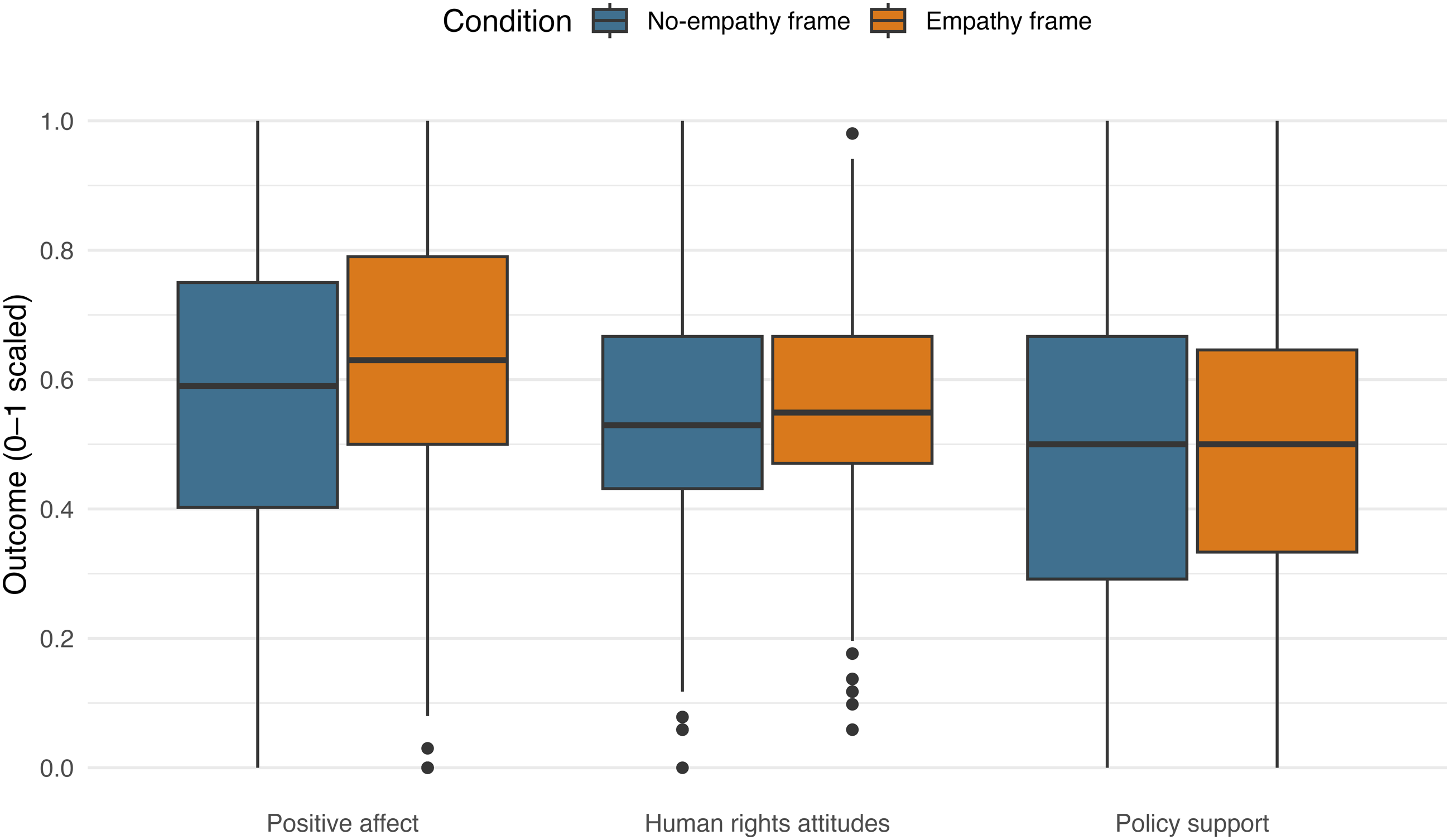
Secondly, H2 predicted that the effects are mediated by emotional but not cognitive empathy. For the mediation to hold, the independent variable must significantly predict the mediator (a-path), and the mediator in turn must be significantly correlated with the outcome variable (b-path). However, which article participants read had no direct effect on emotional empathy (b = .172, p = .069, Table 2, Model 1), nor on cognitive empathy (b = .129, p = .14, Table 2, Model 4). Therefore, neither emotional nor cognitive empathy mediates the relationship to positive affect, policy support, and pro-human rights attitudes.
H3 predicted that the effect of the assumed mediation in H2 is moderated by perceived social group norms. The assumption was that people who believe their peer group would be more approving of experiencing empathy after reading the text are, in turn, more likely to experience empathy themselves because of reading the text. We find no support for the moderated a-path; additionally, mediation analyses indicate no significant moderated mediation. Specifically, the direct effect between the experimental condition and emotional empathy (b = .093, p = .079, Table 4, Model 3) – but not cognitive empathy (b = −.032, p = .515, Table 4, Model 6) – minimally and marginally depends on the perceived group norms of one’s peers. Participants who perceived their peers as approving of empathizing with Middle Eastern refugees had a slight tendency to experience greater emotional empathy in the empathy condition than in the non-empathy condition. However, this effect is small, and we only find it at the marginally significant level (p = .079) after including sociodemographic and attitudinal control variables (see Table 4). To determine whether there is a significantly moderated mediation model, we ran a parallel mediation model in PROCESS Macro. Again, there is no significant moderated-mediation for positive affect (emotional empathy: Index: 0.682, SE = 0.425, CI [−0.1407, 1.5835]; cognitive empathy: Index = −0.083, SE = 0.164, CI [−0.4253, 0.2374]), policy support (emotional empathy: Index = 0.035, SE = 0.022, CI [−0.0065, 0.0811]; cognitive empathy: Index: −0.005, SE = 0.009, CI [−0.0236, 0.0129]) and pro-human rights attitudes (emotional empathy: Index: 0.017, SE = 0.034, CI [−0.0040, 0.0483]; cognitive empathy: Index:-0.005, SE = 0.009, CI [−0.0243, 0.0135]).
Similarly, H4, predicting that the magnitude of the polarization on attitudes along social group norms is stronger for those experiencing emotional rather than cognitive empathy as a result of the text, can be rejected since no significant interaction and therefore polarization can be detected.
In addition to these analyses, we conducted exploratory analyses to test other potential moderators: party preference, ideology, and media trust. The results show that none of these significantly moderates the relationship (Appendix C).
Discussion
This preregistered study aimed to investigate whether empathetic frames can have an unintended backfiring effect, increasing rather than decreasing polarization towards refugees. Overall, our results do not confirm this assumption: the empathy frame, which combines personalization, emotionalization, and visuals, was not more likely to elicit cognitive or emotional empathy than a neutral frame. Additionally, this relationship was not moderated by social norms, party preferences, media trust, or ideology. However, we found a small positive main effect of the empathy frame on feelings toward Afghan refugees, indicating an overall positive effect. Our results have three larger implications.
First, our findings highlight results from political psychology on out-groups, such as political opponents, may not translate to intergroup relationships that are guided by one’s group norms. Studies in political psychology focus on party identification and whether personality traits (Allamong and Peterson, 2021; Simas et al., 2020) or empathy-induction via media stimuli (Klimecki et al., 2020) lead to more polarized attitudes toward the political opponent. However, this presents a less realistic scenario for journalism, where political opponents are often portrayed through a conflict frame (Zoizner et al., 2021). Rather, low-status out-group members are portrayed through empathy-eliciting frames (Chouliaraki and Zaborowski, 2017). Therefore, this study aimed to investigate whether the polarizing effect of empathy would be observed in intergroup relationships guided by one’s group norm, namely, Afghan refugees, toward whom attitudes in Austria are also polarized along party lines. Our findings suggest that the polarizing effect of empathy frames does not extend to indirect out-group members, such as refugees; however, we cannot say whether this would also hold for direct political opponents.
Second, the empathy frame, in contrast to the neutral frame, had a direct and positive effect on the feelings towards Afghan individuals. This is especially relevant in the polarized context in which this study took place. This suggests that beneficial, albeit small, effects of empathy-inducing frames can occur even in unlikely environments where individuals have already formed their opinions about an issue. This finding could also suggest that empathy frames in a polarized environment overall produce a net benefit, i.e., even if empathy frames can be polarizing, they may ultimately do more good than harm.
Third, in line with prior work (Bloom, 2017) our significant effects on positive affect towards Afghan refugees, combined with our lack of significant findings regarding emotional empathy, highlight the theoretical importance of conceptually distinguishing between “feeling for”, that is, sympathy, and “feeling like”, that is, emotional empathy. Many studies focusing on the effects of different frames on empathy measured sympathy rather than emotional empathy. However, this distinction is essential, as the underlying mechanism and the associated consequences differ from one another. Based on our findings and prior literature (Cuff et al., 2016), it seems that sympathy is the more automatic process; while “feeling like” the other, such as mimicking their emotions, requires more effort. This is because emotional empathy requires identifying, and then feeling the other person’s emotions, whereas positive affect does not necessitate this step. Furthermore, the literature suggests that sympathy, rather than emotional empathy, may be more directly linked to altruistic behavior (Malbois, 2023). To shed more light on this distinction and its consequences, we call for future studies to include measures for both sympathy and emotional empathy and clearly outline their respective consequences.
These contributions to research notwithstanding, some limitations should be noted. First, our experiment employs a single-message, single-country design; therefore, we have limited scope to generalize these findings beyond the topic of refugees in Austria. Second, robust measures for personality traits should be included in the future to account for the confounding of the mediator-outcome relationship (see Appendix D).
Nonetheless, our study provides important insights for journalism studies and practice, indicating that the potentially polarizing effect of empathy frames does not translate to indirect out-groups, i.e., other out-groups, such as refugees. Even more so, the small positive effect of the empathy frames on positive affect indicates that using empathy-inducing frames may be more beneficial for societal cohesion than excluding them. Overall, we find no evidence that the use of empathy frames in journalism has detrimental consequences on societal cohesion, even in a polarized environment. For proponents of more empathy-inducing journalism, this should be good news.
Supplemental material
Supplemental material - The shadow side of empathy? Eliciting empathy in journalism and its potentially unintended side-effects on polarization
Supplemental material for The shadow side of empathy? Eliciting empathy in journalism and its potentially unintended side-effects on polarization by Hannah Greber, Jesper Strömbäck, Sophie Lecheler in Journalism
Footnotes

Funding
The authors received no financial support for the research, authorship, and/or publication of this article.
Declaration of conflicting interests
The authors declared no potential conflicts of interest with respect to the research, authorship, and/or publication of this article.
Supplemental material
Supplemental material for this article is available online.
Author biographies
References
Supplementary Material
Please find the following supplemental material available below.
For Open Access articles published under a Creative Commons License, all supplemental material carries the same license as the article it is associated with.
For non-Open Access articles published, all supplemental material carries a non-exclusive license, and permission requests for re-use of supplemental material or any part of supplemental material shall be sent directly to the copyright owner as specified in the copyright notice associated with the article.
