







Abstract
Recent research has argued that constructive journalism, which presents negative news by focusing on positive values and solutions, may reduce audiences’ tendency to avoid news without sacrificing perceived news credibility. This study uses a between-subjects experimental design (N = 1011) to examine in greater nuance the psychological outcomes of constructive narratives highlighting the protagonist’s hope in face of adversity. Our respondents reported more positive emotions in the hopeful protagonist condition (compared with the despairing protagonist), but they also perceived the government as less responsible for the situation and reported lower levels of support for necessary policy changes. They also gained less information from the story. We consider the implications of these findings for the watchdog role of journalism.
News coverage tends to focus on negative occurrences such as natural disasters and wars (Overgaard, 2023). This focus is necessary due to journalists’ social responsibility of informing the public about hazards and providing them with contextualized information that they need to make informed decisions (McIntyre et al., 2018). However, exposure to such news is associated with negative emotions such as anger and fear (Boukes and Vliegenthart, 2017). 1 Such emotions can be adaptive, motivating individuals to act to improve their circumstances (Nabi, 1999); but they can also be debilitating, fostering maladaptive responses and hindering individuals’ psychological well-being (Kellerman et al., 2022). To address concerns over such potential unintended consequences of negative news, there has been a recent flourishing of constructive journalism (Lough and McIntyre, 2023). This genre of journalism applies the principles of positive psychology to newsmaking and “actively looks for positive values and emotions when gathering and telling the news, (…) in doing so bringing affirmative, inspiring (…) narratives” (Mast et al., 2019: 494). One positive emotion which may be highlighted in constructive journalism is hope, which enables even news about negative events to offer the possibility of change.
Yet hopeful narratives may also have some unintended consequences. First, audiences might view them as journalists failing their watchdog role. Second, readers may pay less attention to information, resulting in poorer retention and learning (Schäfer et al., 2024). Recently, Schäfer et al. (2024) examined these assertions, comparing the effects of traditional, negatively framed news (hereafter referred to as negative news) 2 with those of constructive journalism. Their findings show that constructive journalism leads to more positive emotions and more endorsements of articles. They found no evidence for detrimental effects of constructive journalism on media users’ cognitive elaboration, and the constructive article was even evaluated more highly than negative news.
In this study, we extend Schäfer et al.’s (2024) work, focusing on one specific instantiation of constructive journalism – narratives emphasizing hope. We consider a broader set of outcomes than Schäfer et al.’s study, examining how highlighting the protagonist’s hope affects media users’ learning from news, shapes attribution of responsibility for the problem described in the article, fosters support for related social policies, and promotes intention to engage in civic action to address the issue. This extension provides an additional perspective on how different forms of news may be in tension with one another regarding different journalistic functions, leading to a multiplicity of intended and unintended effects. Furthermore, the study identifies the psychological mechanisms underlying the effects of hopeful narratives and compares three potential explanatory pathways: emotions, cognitions, and identification. The current study follows Fitzgerald et al. (2020a) and considers emotional experiences and cognitive appraisal (i.e., evaluations of story quality) not only as the result of news exposure (Schafer et al., 2024), but as psychological processes that can lead to cognitive and behavioral consequences. Moreover, guided by theories of narrative persuasion (Tukachinsky and Tokunaga, 2013), we examine the role of identification with the story’s protagonist on these outcomes, which some see as promoting the societal functions of journalism.
The functions of journalism
In democratic societies, media are expected to identify information that is relevant to the public, contextualize it, and disseminate it to facilitate citizens’ understanding of events (McIntyre and Gyldensted, 2017). The normative approach to journalism thus highlights media’s role of surveillance over society, particularly when events pose a danger and media attention helps avert disaster. Specifically, media serve as a watchdog over government, “unveiling wrongdoing and scrutinizing elites with the purpose of holding them accountable” (Márquez-Ramírez et al., 2020: 54). Journalistic practices associated with this function include monitoring government performance, examining what public officials say and do, and demanding public accountability from policymakers.
The current study investigates how different journalistic styles can promote these journalistic functions – fostering news consumers’ understanding, promoting a critical view of government, and galvanizing to take social action – as a function of how news stories are told; specifically, whether the protagonist at their heart is presented as being hopeful or not.
Journalistic storytelling and its effects
Similar events can be framed as news stories that are outraging or moving, devastating or inspiring. A problem can be cast as a systemic failing or a problem resulting from individuals’ actions. Theories of framing (Iyengar, 1991) and emotions in persuasion (Nabi, 1999) suggest that focusing on different aspects of the story and emotional appraisals play a crucial role in how consumers engage with the message, process information, retain it, and ultimately, how likely they are to act. The present study considers two forms of journalism and their effects on media consumers: (1) negative news focusing on a hopeless protagonist; (2) constructive news focusing on a hopeful protagonist.
Negative news and its consequences
Much research has demonstrated the journalistic tendency to frame news negatively (Overgaard, 2023; Soroka et al., 2019). Negativity has been recognized as a basic news value (Harcup & O’Neill, 2017), which can have significant psychological consequences, sometimes adversely affecting mental well-being and evoking feelings of anger, sadness, and powerlessness (Boukes and Vliegenthart, 2017).
According to the limited capacity information processing model (LCM; Lang et al., 1996), mental resources required for processing information are finite, resulting in competition between different stimuli that individuals attend to, process, and retain. The LCM maintains that both automatic and controlled cognitive processes lead to various outcomes. Since it is evolutionary advantageous to pay attention to threats, media users are predisposed to automatically allocate greater cognitive resources to negative information signaling potential threats. This does not mean that negative information will be uniformly more impactful, however. For instance, allocation of too many resources to negative information might create cognitive overload and impede processing. Moreover, motivation to attend to positive news could conceivably override the effect of automatic negativity bias. Yet overall, LCM suggests that negative news should trigger allocation of greater cognitive resources, which could result in better information retention. These predictions are also consistent with functional theories of emotion and media processing, which posit that negative emotions (presumably elicited by negative news) signal that something in the environment must be rectified, leading to more systematic message processing (Nabi, 1999, 2002).
Overall, research supports these propositions. People pay more attention to – and are influenced more by – negative information, compared to positive information (Overgaard, 2023; Soroka et al., 2019). Negative news elicits negative emotions (Boukes and Vliegenthart, 2017; Swijtink et al., 2023) such as anger, fear, and sadness, but also tends to be more arousing, memorable, and generate more issue-related thoughts (Grabe and Kamhawi, 2006). For instance, Kleemans et al. (2019) found that children better recalled general information about the tsunami when it was embedded in a negatively framed news story than in a constructive story (although they better recalled specific, unique positive information in the constructive story). Similarly, Swijtink et al. (2023) found that individuals better recalled facts in a negative (vs constructive) news story, particularly when the story discussed a personally relevant issue – the housing market – rather than a distant environmental threat.
High-arousal negative emotions also involve an approach motivation, calling to strike back the offender (Harmon-Jones et al., 2003). Bessarabova et al. (2024) found that intensity of anger increased intention to act. The effect was partially mediated by systematic message processing. In line with the notion “if it bleeds it leads,” some studies find that individuals are also more likely to share negative online news, and that this effect is driven by sadness and anger (De León and Trilling, 2021). However, others argue that emotionality more generally – positive or negative – leads to greater news sharing (Berger and Milkman, 2013), and several studies found that individuals tend to share restorative narratives (Ray et al., 2019) even more than negative ones (Fitzgerald et al., 2020b).
In sum, much research literature documents the effects of negative news: it elicits negative emotions, but is more memorable, perceived as more important, and shared more by the audience.
Constructive journalism and its consequences
Constructive journalism attempts to maintain the profession’s dedication to accuracy, balance, and critique, while also highlighting empowering elements based on insights from positive psychology (Gyldensted, 2015; McIntyre et al., 2018). Constructive journalism is closely related to other news genres, including solutions journalism, which focuses on how people work towards solving reported social problems (Walth et al., 2019), and restorative narratives, which focus on how communities move forward following tragic events (Dahmen, 2019; Fitzgerald et al., 2020a). A recent systematic review of literature on constructive journalism has demonstrated that this term often serves as an umbrella concept encapsulating different approaches sharing a socially responsible motivation and a commitment to balance the obligation to tell the truth with a wide-angle lens that includes recuperation and progress (Lough and McIntyre, 2023). In its various forms, constructive journalism thus tries to reduce audiences’ avoidance of news due to its often-depressing nature (McIntyre and Sobel, 2018).
While stories depicting tragic events may lead to negative emotions, the focus on resilience can also promote hope and meaningfulness (Oliver and Raney, 2011). Indeed, when asked to reflect on media content that felt meaningful, audiences typically recounted media depictions of struggle and loss, social justice, and overcoming hardships (Watts, 2022). In turn, eudaimonic – or meaningful – media have been shown to lead to pro-social outcomes (Chen et al., 2022). It has also been theorized that eudaimonic content stimulates more central elaboration (Moyer-Gusé and Wilson, 2024). Finally, traditional theories of emotion and persuasion suggest that individuals may be more likely to act if they experience positive emotions. Several theories, such as the anger activism model (Turner, 2007) and Extended Parallel Process Model, postulate that self-efficacy regarding the ability to rectify the situation is a necessary condition for negative emotions such as fear or anger to mobilize action.
However, there is less clarity about the impact of constructive journalism on news consumers’ perceptions of journalism. Schäfer et al. (2024) found that readers evaluated constructive news stories as possessing better quality (including the perceived credibility of the story, but also assessments of how well it was presented). Conversely, some studies found a negative association between constructive journalism and credibility/quality (Rusch et al., 2022), possibly because people consider negative information as more trustworthy (Lindgren et al., 2022). Alternatively, audiences may be accustomed to negative news, and constructive journalism’s violation of such expectations may result in suspicion towards more positively-slanted news (Rusch et al., 2022).
Another potential unintended consequence of constructive journalism is that it might underplay government accountability, since the focus on positive outcomes might turn attention away from authorities’ responsibilities. Indeed, in a recent study, Moore et al. (2021) found that an inspirational narrative focused on individuals helping each other led to more attribution of responsibility to individuals, compared to a story focusing on government responsibility. Such effects demonstrate how different forms of journalism, each with its own underlying motivations, may sometimes be at odds regarding the multiple functions of news.
Human interest news stories and identification with their protagonist
Both constructive and negative news often include narratives focusing on specific individuals, emphasizing their viewpoints and emotions. Such personalization has been criticized for framing structural problems as individual plight and depoliticizing them (Iyengar, 1991). However, it has also been viewed as part of the “emotional turn” in journalism (Wahl-Jorgensen and Pantti, 2021), with journalists appealing to shared personal feelings to elicit compassion and identification, without sacrificing broader political awareness.
From a media psychology perspective, during narrative exposure (fictional or true), people identify with characters, sharing their feelings and aspirations (Tal-Or and Cohen, 2010). This process often leads to changes in attitudes and behaviors in line with those of media characters (e.g., Hoeken et al., 2016). Thus, we expect that identification with a character in a news article will lead to changes in attitudes and behavioral intentions that correspond to the character’s.
Both negative news and constructive journalism can feature narratives about a particular character by either focusing on the protagonist’s helplessness or their hope and optimism. Existing literature does not provide a clear answer regarding which narratives are more likely to foster identification, for while people identify with others who suffer (McAuliffe et al., 2020), they also identify with characters with positive characteristics (Tal-Or and Cohen, 2010). Since optimism is perceived as a positive trait (Armor et al., 2008), hopefulness might enhance identification.
Although identification has not been examined in relation to constructive journalism, a related concept, transportation – referring to absorption into the narrative world (Green and Brock, 2000) – has been studied in this context. Research on solutions-focused journalism and transportation has yielded mixed results (Dahmen et al., 2021; Thier et al., 2021). Consequently, it remains unclear whether audiences are more engaged with the narrative and its characters in constructive compared to negative news. Regardless of whether readers identify more with hopeful or despairing protagonists, identification is expected to lead to changes in attitudes and behavioral intentions that correspond to the protagonist’s perspective.
Research hypotheses and questions
We examine the effects of constructive journalism vs. negative news by focusing on the central aspect of hopefulness. First, we ask about the effects these types of journalism have on emotional and cognitive responses. Based on previous studies (Fitzgerald et al., 2020a; Schäfer et al., 2024), we predict:
Constructive journalism will lead to more positive and less negative emotions compared with negative news.
Since previous research does not lead to a certain conclusion regarding the effects of journalism type on identification and perceptions of news quality (defined, following Schäfer et al., 2024, as a combination of credibility and informational value), we ask:
Is there a difference in levels of news quality judgments, and character identification, between negative news and constructive journalism?
Next, we consider the effects of these experiences while reading the news story on subsequent outcomes. Based on previous research demonstrating that identification with media characters influences attitudes and related behaviors in ways that align with these characters (Hoeken et al., 2016), we hypothesize:
Identification will be positively correlated with attribution of responsibility to government, support for related social policies, intention to act, and planned engagement with media content.
Since past research demonstrates that perceived credibility fosters acceptance of story-consistent attitudes (Debrael et al., 2022), and given that credibility is a central component of journalistic quality, we assume that perceptions of new quality will foster the news’ effects.
News story quality perceptions will be positively correlated with attribution of responsibility to government, support for related social policies, intention to act, and planned engagement with media content.
Since both positive and negative affect were related in previous research to attitudes, behavioral intentions, and cognitive elaboration, we pose a non-directional research question:
How are positive and negative affect related to attribution of responsibility to government, support for related social policies, intention to act, planned engagement with media content, and learning from the article?
Lastly, we ask about mediated effects:
Do identification, positive/negative emotions, and credibility judgments mediate the effect of news story type (constructive/negative) on the attribution of responsibility to government, support for related social policies, intention to act, planned engagement with media content, and learning from the article?
Method
This study aims to generalize Schäfer et al.’s (2024) study to alternative manipulations, measures, and possible outcomes. Being among the first to examine these questions, Schäfer et al. took a broad-stroke approach to operationalizing constructive journalism, focusing on restorative narratives highlighting recovery and resilience. They manipulated news article type by changing three variables simultaneously: the valence of emotion, whether the problem had a solution, and whether coping with the problem was positive or negative. In contrast, we manipulated with greater specificity only the valence of emotions presented by the protagonist: hope or despair. 3 We focused on hope since it is a central aspect in the construct of resilience, which is itself a focal component of positive psychology that underlies constructive journalism.
We also changed measures of article endorsement and cognitive elaboration. Whereas Schäfer et al. (2024) measured endorsement as use of “likes” and positive emojis, which are more appropriate to constructive journalism, we captured both positive and negative emojis, as the latter are also appropriate to express appreciation for negative news. Finally, Schäfer et al. asked participants to self-report how thoroughly they read the article. To reduce social desirability bias, we used direct measures of recall and learning from the article.
Participants
Participants were recruited via a local online survey company in Israel. We excluded incomplete and inattentive respondents [see preregistered exclusion criteria online]. 4 The final sample included 1011 participants: 94.2% Jews, 5.1% Israeli Arabs, and 0.7% “other”. Participants’ ages ranged from 18 to 71 (M = 41.96, SD = 14.37); 53.0% were female and 46.9% male. Six respondents had elementary school education (.6%), 35.1% had high school education, 45.7% had a bachelor’s degree, and 16.0% had a graduate/professional degree. On a 1 (very right-wing) to 7 (very left-wing) political ideology scale, the mean response was M = 3.24 (SD = 1.41).
Design and procedure
Respondents were randomly assigned to read one of nine versions of a fabricated news story. 5 Next, participants were asked to answer questions measuring the mediators and dependent variables described below and in Appendix D. Finally, we asked four multiple-choice questions to evaluate respondents’ knowledge of story information.
Stimulus materials
The fabricated news story (adapted from Kim et al., 2020) told the story of Sunan, a Thai migrant worker in Israel who was injured at work. Due to his employer’s neglect, Sunan lacked medical insurance, exposing him to financial and deportation threats. We manipulated the emotional tone expressed by the protagonist, depicting him as either hopeful (constructive journalism condition) or desperate (negative news condition). In the control condition, neither hope nor desperation was mentioned.
We manipulated hope or despair in the headline (“Exploited, Injured, But Not Losing Hope While Waiting for Deportation” vs ”Exploited, Injured, Hopeless and Desperate While Waiting for Deportation”); in the opening paragraph, inside the story, and in a direct quote in the concluding paragraph (“Despite the difficult situation, I am hopeful that justice will prevail. I believe that people are inherently good, and in the end I will get what I deserve” vs “There is no justice. I feel frustrated and exploited. They knew very well how to use me. But now I am going to lose everything”). The control condition did not contain any reference to whether Sunan was hopeful or desperate (e.g., the headline was “Exploited, Injured and Waiting for Deportation”). Appendix B provides the full text of all story versions, and Appendix C reports results of the manipulation checks of the different versions.
Measures
Items were measured on a 7-point scale and averaged so that higher scores indicate stronger agreement. See Appendix D for a complete list of all items, EFA results, and omitted items.
Identification with the protagonist
Identification was measured using six items from Cohen (2001) and Tal-Or and Cohen (2010), e.g., “I think I understand Sunan well” (Cronbach’s α = .87, M = 5.17, SD = 1.20).
Affective responses
Participants were asked how they felt after reading the story, rating a list of emotions and feelings (Oliver and Raney, 2011). The study reports results for negative (angry, irritated, aggravated, frustrated, gloomy, depressed, and sad; Cronbach’s α = .94, M = 4.52, SD = 1.56) and positive (cheerful, happy, upbeat, optimistic, elevated, awe; Cronbach’s α = .88, M = 1.98, SD = 1.10) emotions.
Perceptions of news quality
We followed Schäfer et al. (2024), who used items indicating the extent to which the news item was perceived as credible, accurate, important, informative, authentic, clear, interesting, boring (reverse coded), and representative (Cronbach’s α = .92, M = 5.24, SD = 1.21).
Attribution of responsibility
Based on EFA results, we created variables tapping perceptions of government responsibility (the government is responsible for the creation of the problem, the government is responsible for the solution to the problem; r = .74, p < .001; M = 5.87, SD = 1.13).
Policy positions
Respondents were asked how much they agreed or disagreed with five statements about policy changes to improve foreign workers’ conditions (e.g., “The government should improve the way it takes care of the rights of foreign workers”; Cronbach’s α = .81; M = 5.60, SD = 1.14).
Intentions to act
Respondents were asked five questions about the extent to which they would act in support of workers like Sunan (e.g., “If I get the chance, I’ll sign a petition to protect the rights of foreign workers,” I would be happy to donate money to Sunan or to workers in his situation”; Cronbach’s α = 87; M = 3.67, SD = 1.61).
Online message engagement
Like Schäfer et al. (2024), we asked respondents how likely they were to react to the story if they encountered it online (e.g., “I would share it on my social media account or via email”; Cronbach’s α = .77; M = 3.89, SD = 1.56).
Learning from the story
The questionnaire included true/false questions related to general policy issues involving foreign workers and their condition (e.g., “Many employers neglect foreign workers’ social security payments”). We calculated the knowledge score using Item Response Theory modeling, which corrects for the difficulty of questions and the probability of guessing. After excluding two items (see Appendix D), the final scale was comprised of five items, with the standardized model-estimated knowledge scores varying between −2.10 and .52 (M = .00; SD = .66).
Construct validation
As there may be concerns about the discriminant validity of some of the dependent variables, we also conducted a Confirmatory Factor Analysis model depicting policy positions, intentions to get involved, attribution of responsibility to Sunan, attribution of responsibility to government, and online reactions as correlated latent constructs. This model had a good fit to the data (GFI = .967; NFI = .966; CFI = .976; RMSEA = .047), supporting the measurement structure we utilized.
Results
Preliminary analyses
The experimental groups did not significantly differ in terms of age, religiosity, nationality, educational level, and political ideology. Only gender was significantly associated with the experimental condition (χ2 (2) = 6.098, p = .047) and was thus used as a covariate in all models below (Female = 1, Male and others = 0). 6
Main analyses
To examine H1, we ran a MANOVA testing the effect of the constructive journalism manipulation on all dependent variables. The help manipulation and its interaction with the constructive journalism manipulation was included in the model. This analysis revealed a multivariate significant effect of the help manipulation, Roy’s Largest Root = .42, F (10, 993) = 4.18, p < .001, η2 = .04. The effects of the constructive journalism manipulation on identification [F (2, 1001) = 3.75, p = .024; partial η2 = .007], on quality perceptions [F (2, 1001) = 3.36, p = .035; partial η2 = .007], and on positive [F (2, 1001) = 9.04, p < .001; partial η2 = .018] and negative [F (2, 1001) = 3.58, p = .024; partial η2 = .018] emotions were significant.
As predicted by H1, participants reported higher levels of positive emotions (M = 2.18; SD = 1.15) and lower levels of negative emotions (M = 4.34; SD = 1.52) in the hope condition compared to the despair (positive emotions: M = 1.87; SD = 1.07; negative emotions: M = 4.64; SD = 1.57) and control conditions (positive emotions: M = 1.88; SD = 1.02; negative emotions: M = 4.58; SD = 1.59).
RQ1 examined the effect of the constructive journalism manipulation on quality perceptions. Evaluation of story quality was lower in the hope condition (M = 5.10; SD = 1.26) than the despair (M = 5.30; SD = 1.21) and control conditions (M = 5.31; SD = 1.15). Contrast comparisons demonstrated that differences between the hope condition and the other two conditions were statistically significant, whereas differences between the despair condition and control condition were not.
Interestingly, participants identified more with the protagonist when he was desperate (M = 5.29; SD = 1.21) rather than hopeful (M = 5.04; SD = 1.22), with the identification level in the control group in-between (M = 5.17; SD = 1.65). The difference between the hope and despair conditions was significant, but comparisons between the control condition and the hope and despair conditions were insignificant.
Effects of the constructive journalism manipulation on the DVs with identification, positive and negative emotions, and quality perceptions as mediators (N = 1011).
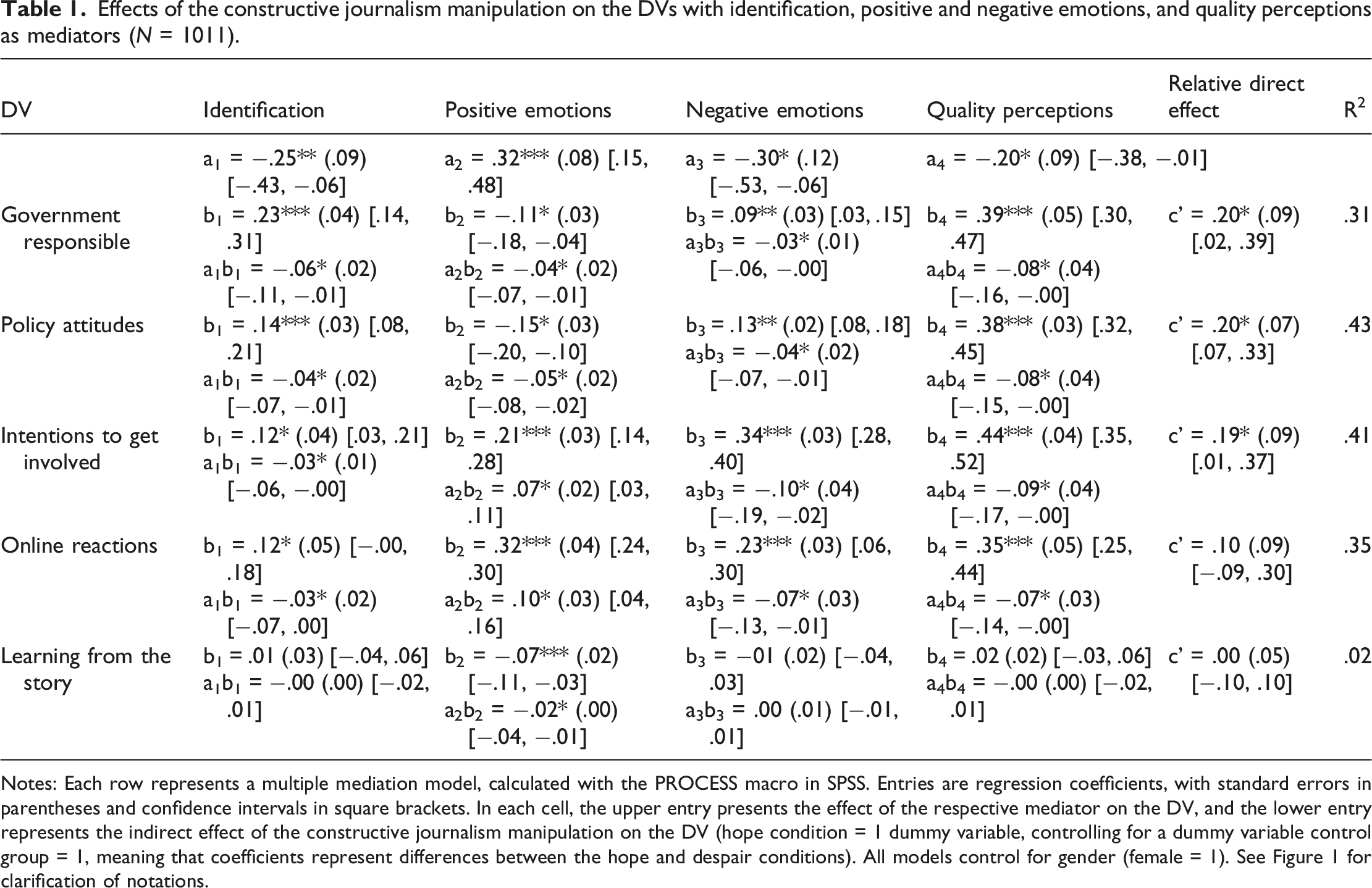
Notes: Each row represents a multiple mediation model, calculated with the PROCESS macro in SPSS. Entries are regression coefficients, with standard errors in parentheses and confidence intervals in square brackets. In each cell, the upper entry presents the effect of the respective mediator on the DV, and the lower entry represents the indirect effect of the constructive journalism manipulation on the DV (hope condition = 1 dummy variable, controlling for a dummy variable control group = 1, meaning that coefficients represent differences between the hope and despair conditions). All models control for gender (female = 1). See Figure 1 for clarification of notations.
In line with H2, identification with the protagonist was associated with perceiving government as responsible for the problem (b = .23, SE = .09, p < .001) and with policy attitudes supporting governmental policies solving the plight of foreign workers (b = .14, SE = .03, p < .001). The more participants identified with the protagonist, the more they reported intentions to react to the story online (b = .12, SE = .05, p < .05). Identifying with the protagonist was also positively associated with behavioral intentions to get involved with the issue (b = .09, SE = .05), although this was only borderline significant (p = .06).
In line with H3, quality perceptions were positively associated with perceptions that government is responsible for the problem (b = .39, SE = .05, p < .001). In line with the hypothesis and with research on credibility, the more participants perceived the story as credible, the more they supported policies intended to alleviate the problem (b = .38, SE = .03, p < .001), intended to get personally involved (b = .36, SE = .04, p < .001), and intended to react to the story online (b = .35, SE = .05, p < .001).
RQ2 inquired about the association between negative and positive emotional responses to the story and the dependent variables. Positive emotions were negatively associated with perceiving government as responsible for the problem (b = −.11, SE = .03, p < .05), while negative emotions were positively associated with this variable (b = .09, SE = .03, p < .01). Negative emotions were associated with supporting policies to alleviate the problem (b = .13, SE = .02, p < .01), which was negatively associated with positive emotions (b = .15, SE = .03, p < .05). Interestingly, both positive and negative emotions increased personal behavioral intentions (positive emotions: b = .21, SE = .03, p < .001; negative emotions: b = .34, SE = .03, p < .001), and intentions to react online (positive emotions: b = .32, SE = .04, p < .001; negative emotions: b = .23, SE = .03, p < .001). Positive emotions decreased learning from the story (b = −.07, SE = .02, p < .001), which was not significantly associated with negative emotions.
Mediation analyses
To examine RQ3, for each dependent variable we estimated a separate multiple mediation model using the PROCESS macro (Model 4). The manipulation variable was again modeled as a multi-categorical variable with three conditions [two dummy variables, one for “hope” (=1) and one for “control” (=1)]. All models again controlled for gender and the help manipulation. A scheme of the tested models is presented in Figure 1, and results are presented in Table 1. Each row in the table presents results for a separate multiple mediation, and each column presents the direct effect of the mediator on the DV followed by the indirect effect of the manipulation through the respective mediator. Mediation models testing RQ2 – The effect of the constructive journalism manipulation on the dependent variables through identification, positive and negative emotions, and quality perceptions.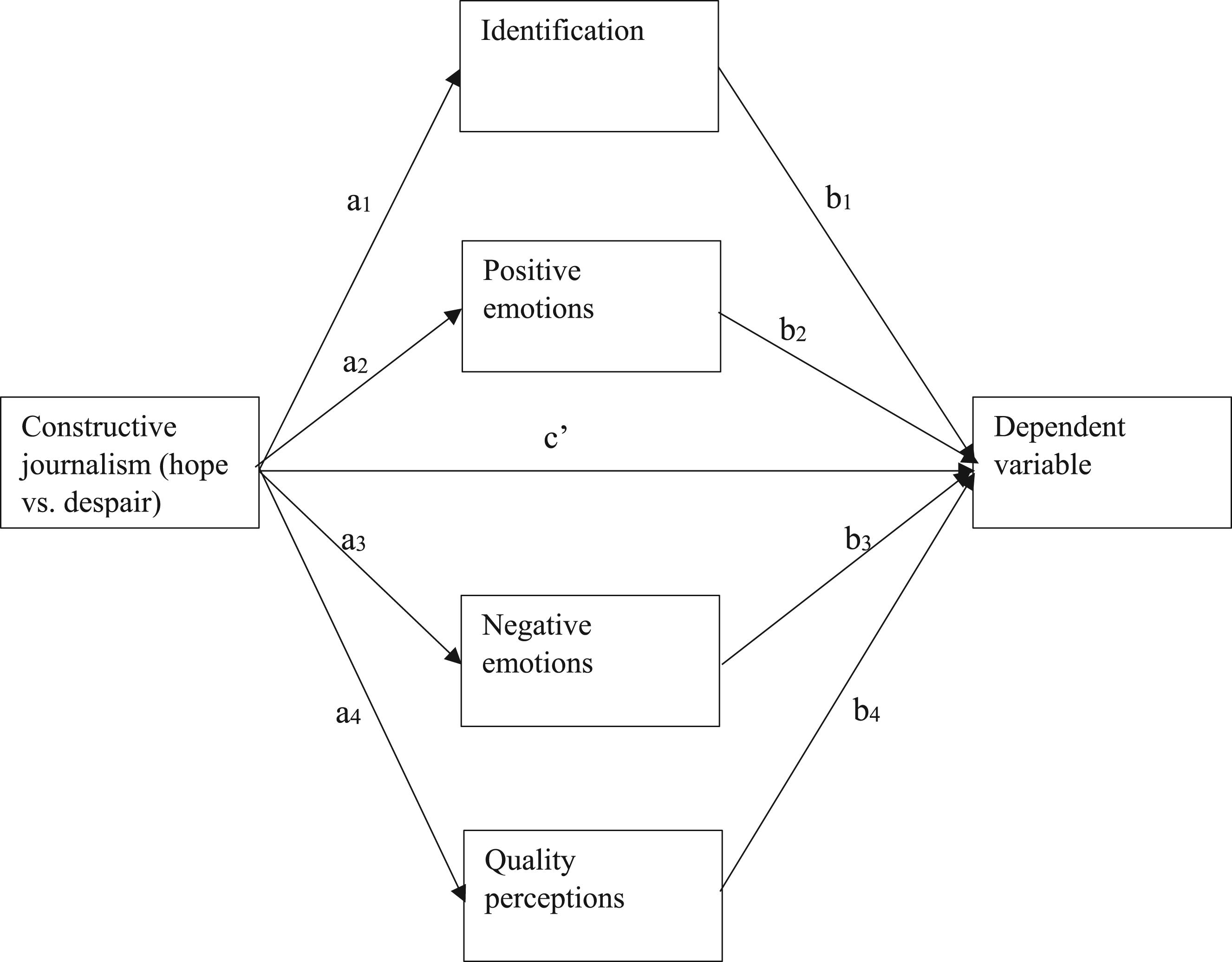
Reading the story with a hopeful protagonist indirectly lowered perceptions of government as responsible for the creation and solution of the problem through identification with the protagonist (indirect effect = −.06, SE = .02, p < .01), both positive (indirect effect = −.04, SE = .02, p < .01) and negative (indirect effect = −.03, SE = .01, p < .05) emotions and through quality perceptions (indirect effect = −.08, SE = .04, p < .05).
Reading the story with the hopeful protagonist was indirectly associated with decreased support for policies aimed at solving the problem (indirect effect through identification = −.04, SE = .02, p < .01; through positive emotions = −.05, SE = .02, p < .01; through negative emotions = −.04, SE = .01, p < .05; through quality perceptions = −.08, SE = .04, p < .05).
Effects for the other dependent variables were mixed in their direction. Reading the story with a hopeful protagonist indirectly increased intentions to get involved and online reactions through positive emotions (indirect effect for online reactions = .10, SE = .03, p < .01; for intentions = .07, SE = .02, p < .01), but decreased these variables through negative emotions (indirect effect on intentions = −.10, SE = .04, p < .05; on reactions = −.07, SE = .03, p < .05) and quality perceptions (indirect effect for online reactions = −.07, SE = .03, p < .05; for intentions = −.09, SE = .04, p < .05). The hope manipulation was also indirectly negatively associated with online reactions and intentions to get involved through identification (indirect effect for online reactions = −.03, SE = .02, p < .05; through identification = .03, SE = .01, p < .05). Lastly, reading the story with the hopeful protagonist indirectly decreased learning substantive knowledge from the story, only through positive emotions (indirect effect through positive emotions = −.02, SE = .00, p < .01). Other mediated effects in this case were not significant.
Discussion
This study examined the psychological effects of several journalistic aspects of news coverage on outcomes germane to the functions of news in democracies. It compared the effects of the same story framed in either a hopeful (constructive) or despairing (negative) manner, confirming Schäfer et al.’s (2024) finding that constructive journalistic narratives elicit more positive audience emotions. This is, in fact, one of the main goals of such narratives. However, our findings suggest that such framing may simultaneously run contrary to journalism’s crucial public democratic role of holding those in power accountable (Márquez-Ramírez et al., 2020). Specifically, emphasizing individuals’ resilience in the face of structural problems indirectly reduced audiences’ tendency to attribute responsibility for social wrongs to government and lowered their support for policy changes aimed at addressing these wrongs. Thus, key social issues were to some extent depoliticized, apparently decreasing expectations for government accountability for problems generated by mismanagement.
The effects of journalism type on attitudes were mediated by emotions, character identification, and perceived news article quality. To delve deeper into these effects, we first examine the impact of journalism type on the mediators, and then the influence of the mediators on dependent variables.
Effects of journalism type
While the effects of journalism type on emotions were predictable, its effects on identification with the protagonist and perceived article quality were less straightforward. The focus on a hopeful protagonist led to less identification with the protagonist, compared with the desperate protagonist. This effect might be the result of people’s tendency to feel empathy towards suffering others (McAuliffe et al., 2020). The protagonist’s expression of hope might have reduced perceived suffering and resulted in less empathy. This effect may also be attributed to the negativity bias, which involves heightened attention to, and deeper cognitive elaboration of, negative information (e.g., Taylor, 1991). This increased engagement might have facilitated stronger identification with the protagonist who expressed negative emotions.
The hopeful aspect of constructive journalism also led to perceiving the article as being of lower quality than negative news. Participants may have perceived the positive story as lower in quality because of a tendency to associate information negativity with trustworthiness (Lindgren et al., 2022), and perhaps thought it unlikely that the protagonist would remain hopeful despite his plight. Another possibility is that people are used to negative news, or that they have an intuitive feeling that news is supposed to be critical, and constructive journalism is perceived as not fulfilling this role.
Mechanisms of journalism type effects
All four mediators were related to the dependent variables. In line with previous research (Debrael et al., 2022), perceiving a text as credible led to accepting the attitudes portrayed in it. Similarly, in line with literature on narrative persuasion (Tukachinsky and Tokunaga, 2013), identification led to accepting story-consistent attitudes and relevant behavioral intentions.
Notably, positive emotions were related to less responsibility being attributed to government, and the opposite pattern was found for negative emotions. It seems that the positive emotions associated with the protagonist’s hope led to perceiving him as more capable and responsible for his situation, while negative emotions associated with his despair led to looking for external agents as accountable. Importantly, positive emotions were negatively correlated with learning from the story, in line with feeling as information theory (Petty and Briñol, 2015), according to which positive emotions make us feel safe, and thus we do not feel the need to carefully examine messages we receive. Conversely, negative emotions signal that something is wrong, triggering deeper cognitive processing of information. Negative feelings also heighten attentiveness, especially toward the information that triggered that emotion (Taylor, 1991). These findings are also consistent with the hedonic contingency view (Wegener and Petty, 1994), stipulating that to maintain a happy affective state, people put effort into processing positive but not negative information. Since the constructive article contained, besides the protagonist’s hope, mainly negative information, the happy readers might have refrained from processing it.
Interestingly, while positive and negative emotions had contrasting effects on attitudes, they had the same effect on readers’ behavioral intentions regarding helping foreign workers and online engagement with the article. These findings are in line with the argument that both positive and negative emotions play a part in transforming “apathy into movement” (Thomas et al., 2009). They argue that both sympathy and outrage lead to actions by advantaged groups to make society more equal. Similarly, there is support to the notion that both negative and positive reactions lead to engagement with online news content (Berger and Milkman, 2013).
While this study takes an important step towards deepening our understanding of the psychology of constructive journalism, additional research is needed to generalize these results beyond the context of a single stimulus, sample, and setting. Trust in government, the politics of migration, and media’s role of criticizing government are highly polarizing issues in contemporary Israel. While this is not unique to Israel, future research should examine whether similar effects can be found in the context of other issues, nations exhibiting different news norms, or when manipulating additional components of constructive journalism besides hope.
We also acknowledge statistical limitations. First, our investigation yielded small effect sizes (partial η2s .007–.018 for the main direct effects of the hope manipulation) – somewhat lower than the .0196 average effect size across media effects meta-analyses (Valkenburg et al., 2016). However, even small effects may be meaningful when scaled up after repetitive exposure to stories conveying hope. Second, although we report 45 statistical tests, they should have yielded only 2-3 false positives by chance, in the absence of real effects. Yet, the number of significant effects was considerably larger (Table 1), and remain significant even when employing a strict Bonferroni correction (with a p-value of .05/45 = .0011; most of the direct effects in the study were significant at p < .001).
Finally, the current research does not imply that constructive journalism may never be beneficial. In many contexts such narratives achieve desired goals (Fitzgerald et al., 2020a). Rather, our study demonstrates the complex and sometimes contradictory ways in which different intended and unintended outcomes may be associated with different journalistic forms, each of which prioritizes different journalistic norms and goals. Our findings suggest that constructive, negative, and mixed forms of journalism may be differently suited for different events based on their specific characteristics and the degree to which a focus on government accountability is considered necessary and effective. Carefully assessing the pros and cons of different approaches under different circumstances may be beneficial for achieving the multifaceted goals of contemporary journalism. Our current exploration of some implications of the possible unintended effects of constructive journalism could assist in making such evaluations.
Supplemental material
Supplemental Material - The power and pitfalls of constructive journalism: The effects of hopeful narratives in the news on attitudes, engagement and knowledge
Supplemental Material for The power and pitfalls of constructive journalism: The effects of hopeful narratives in the news on attitudes, engagement and knowledge by Oren Livio, Riva Tukachinsky Forster, Liran Peretz, Yael Ella-Hay, Yariv Tsfati, Nurit Tal-Or in Journalism
Supplemental material
Supplemental Material - The power and pitfalls of constructive journalism: The effects of hopeful narratives in the news on attitudes, engagement and knowledge
Supplemental Material for The power and pitfalls of constructive journalism: The effects of hopeful narratives in the news on attitudes, engagement and knowledge by Oren Livio, Riva Tukachinsky Forster, Liran Peretz, Yael Ella-Hay, Yariv Tsfati, Nurit Tal-Or in Journalism
Supplemental material
Supplemental Material - The power and pitfalls of constructive journalism: The effects of hopeful narratives in the news on attitudes, engagement and knowledge
Supplemental Material for The power and pitfalls of constructive journalism: The effects of hopeful narratives in the news on attitudes, engagement and knowledge by Oren Livio, Riva Tukachinsky Forster, Liran Peretz, Yael Ella-Hay, Yariv Tsfati, Nurit Tal-Or in Journalism
Supplemental material
Supplemental Material - The power and pitfalls of constructive journalism: The effects of hopeful narratives in the news on attitudes, engagement and knowledge
Supplemental Material for The power and pitfalls of constructive journalism: The effects of hopeful narratives in the news on attitudes, engagement and knowledge by Oren Livio, Riva Tukachinsky Forster, Liran Peretz, Yael Ella-Hay, Yariv Tsfati, Nurit Tal-Or in Journalism
Footnotes

Ethical considerations
This study was approved by the University of Haifa Faculty of Social Sciences Research Ethics Committee (approvals no. 186/23 and 444/24).
Consent to participate
All respondents gave written consent before completing questionnaires.
Funding
The authors disclosed receipt of the following financial support for the research, authorship, and/or publication of this article: This work was supported by the Israel Science Foundation [grant number 840/20].
Declaration of conflicting interests
The authors declared no potential conflicts of interest with respect to the research, authorship, and/or publication of this article.
Data Availability Statement
The datasets generated during and/or analyzed during the current study are available from the corresponding author on reasonable request.
Supplemental material
Supplemental material for this article is available online.
Notes
Author biographies
References
Supplementary Material
Please find the following supplemental material available below.
For Open Access articles published under a Creative Commons License, all supplemental material carries the same license as the article it is associated with.
For non-Open Access articles published, all supplemental material carries a non-exclusive license, and permission requests for re-use of supplemental material or any part of supplemental material shall be sent directly to the copyright owner as specified in the copyright notice associated with the article.
