







Abstract
Scholarship on the adoption of Generative Artificial Intelligence (GenAI) in higher education has raised questions about its pedagogical value, ethical implications, and institutional integration. While this is the case, most of this scholarship is concentrated in the Global North, limiting scholarly comprehension of its impacts in the South. To fill this gap, we draw on the Unified Theory of Acceptance and Use of Technology (UTAUT) and 15 semi-structured interviews with Kenyan journalism educators to examine how they perceive the integration of GenAI into journalism curricula and professional practice (i.e., research and teaching workflows). Our findings show that journalism educators adopt GenAI for pedagogical utility and professional relevance while navigating significant ethical concerns regarding verification, assessment validity, and academic integrity. Professional norms and regulatory expectations in journalism strongly shape adoption, often outweighing institutional influence. The implications of these findings are discussed.
Keywords
Introduction
Since ChatGPT’s viral sensation in November 2022, Generative Artificial Intelligence (GenAI) has become integral to everyday life (Shin et al., 2025). Its impact has reshaped professional and academic sectors, particularly education (Belkina et al., 2025). For instance, several American universities, including Ohio State University and the University of Pennsylvania, are integrating GenAI into their operations (Henry, 2025). In Kenya, the government launched an initiative to provide students access to AI tools such as Google Gemini Pro (MICDE, 2025). Similarly, other African countries (e.g., Botswana, Namibia, South Africa, and Zimbabwe) are continuously integrating AI into their journalism syllabi (Bingbing et al., 2026; Ncube et al., 2025). However, tensions remain between rapid technological adoption and institutional curricula and pedagogical traditions, common in the Global South.
AI is a tool that performs tasks typically requiring human intelligence, often through machine learning (Sarısakaloğlu, 2025). Yet, despite its widespread benefits, AI adoption in education has introduced several ethical concerns, including plagiarism, over-reliance, hallucinations, and data privacy (Cabellos et al., 2024; Chege, 2024). These concerns stem from global unpreparedness, insufficient policies for appropriate adoption, and uneven technology access, affecting large numbers of people (Denmar and Neff, 2023). This poses a major concern for the African context, where educators consistently use GenAI in their research and teaching activities (Wainaina and Sun, 2025), despite its contextual limitations, ethical concerns, and data sovereignty issues. As such, the key question lingers: how are journalism educators conceptualizing this integration, its varied modes of adoption, and the discipline-specific contexts that may either facilitate or hinder its use?
To answer these questions and address immediate empirical gaps, this study employs the Unified Theory of Acceptance and Use of Technology (UTAUT) proposed by Venkatesh and his colleagues in 2003. Their theory posits that actual technology use is influenced by performance expectancy, effort expectancy, social influence, and facilitating conditions (Venkatesh et al., 2003). We use it specifically to understand how journalism educators in Kenya perceive the integration of GenAI into journalism curricula and professional practice (i.e., research and teaching workflows). Professors in Kenya are situated at the intersection of a rapidly evolving profession and a transitioning, new, curriculum-based educational system (see Akala, 2021). Additionally, in the Global South, Kenya has emerged as a leader in GenAI engagement, surpassing the United States, United Kingdom, and China, particularly among youth (largely the students professors teach) who use it for a diverse range of functional roles (Mwangi, 2025). By enriching the experiences of educators from the Global South, this study advances scholarly understanding of how GenAI adoption in resource-constrained contexts intersects with rapid digital growth, facilitating future comparative research with Global North models.
Literature review
Theoretical framework
This study draws on the Unified Theory of Acceptance and Use of Technology (UTAUT), proposed by Venkatesh et al. (2003), which posits that an individual’s use of technology is influenced by behavioral intention. The desired outcomes are shaped by four main variables: performance expectancy (perceived usefulness), effort expectancy (perceived ease of use), social influence, and facilitating conditions (Venkatesh et al., 2003).
UTAUT has been widely used to explain academics’ adoption of new technologies such as cloud computing, learning management systems, and artificial intelligence (Adigun et al., 2025; Jaradat et al., 2020). Prior studies have identified performance expectancy as one of the most salient factors shaping academics’ intention to use new technology to enhance teaching and research productivity and reduce workload (Attuquayefio and Addo, 2014; Khlaif et al., 2024). Regarding the usage of GenAI in higher education, perceived usefulness and peer testimony emerge as major drivers of adoption where institutional support is limited (Pitpit and Obenza, 2025; Zhang and Wareewanich, 2024). Yet, the geographical distribution of UTAUT-related studies reveals a disproportionate concentration in the Global North and Asia.
A systematic review of UTAUT found that the model is most commonly used in studies conducted in higher education contexts in Asia (e.g., China, Saudi Arabia, Malaysia) and North America (e.g., the United States), while Africa remains underrepresented (Xue et al., 2024). The few studies engaging in the African context present useful insights. For instance, research on Ghanaian university students’ use of video conferencing tools during the COVID-19 lockdown to attend virtual sessions reflected the four key UTAUT factors (Edumadze et al., 2023). Similarly, Nigerian university students found that students’ use of e-learning platforms (e.g., Canvas) was driven by perceived ease of use (effort expectancy) and expectancy to enhance their academic performance (performance expectancy) (Yakubu and Dasuki 2019). These studies, however, focus on students.
Xue et al. (2024) found that 140 of 162 UTAUT-based studies recruited students as participants, with only 22 focusing on faculty members. Even more critically, little is known about students’ or educators’ behavioral intent regarding the use of GenAI in specialized fields such as journalism education. By applying the UTAUT to examine the factors influencing the adoption of GenAI in journalism education among Kenyan educators, this study advances understanding of the infrastructural and technical constraints that shape technology adoption in Kenyan journalism education.
GenAI adoption in higher education
Scholarship on GenAI in higher education globally shows adoption at both institutional and personalized levels (Belkina et al., 2025; Francis et al., 2025). AI tools support teachers to design flexible lesson plans that cater to the unique needs of their students and foster classroom engagement (Bhutoria, 2022). Agyapong et al. (2022) note that teachers have found GenAI particularly useful for reducing their workload by enabling them to undertake off-classroom duties, such as preparing examination questions. However, professors are cautiously optimistic about integrating GenAI into teaching and learning practices (Pantazatos et al., 2024), raising concerns about the erosion of student creativity and about academic dishonesty when students use GenAI to generate answers to examination questions (Tan et al., 2024).
However, the perceptions and the levels of adoption and integration across contexts are uneven. For instance, Cabellos et al. (2024) found that teachers who had never engaged with GenAI were more pessimistic about it than those who had. Similarly, STEM teachers, compared with non-STEM teachers, show more positive attitudes towards AI and stronger intentions to teach AI (Ayanwale and Sanusi, 2023). These disciplinary variations are significant, particularly for professionally oriented fields such as journalism, where their primary output: text, audio, and visuals, are similar to materials produced by most GenAIs. Most institutions of higher learning are yet to formally integrate GenAI into their curriculum due to heightened uncertainty about the technology (Korseberg and Elken, 2025).
Consequently, the perception and adoption of GenAI remains largely at the individual level. According to Shata and Hartley (2025) and Kim and Kim (2022), individual faculty members’ adoption of GenAI is shaped by their perceptions of the technology’s ease of use and social reinforcement from peers, such as in Europe (Titko et al., 2023), the US (Petricini et al., 2024), and Australia (Lee et al., 2024). However, research in the African context is limited, despite Africa presenting a unique case for scholarship due to substantial technical and infrastructural limitations, such as unreliable internet access, that differ from those in most Western countries (Knez, 2023; Yu et al., 2023).
GenAI adoption in journalism education
GenAI is reimagining journalism practice, sparking interest in its impact on journalism training (Broussard et al., 2019; Pavlik, 2023; Simon, 2024). Wenger and Imre (2026) found that allowing students to use AI tools in video journalism enhances their production efficiency by improving their performance on tasks such as color correction, scene detection, and editing recommendations. In addition to video journalism, incorporating AI into data journalism courses enables students to generate compelling data-driven stories (Gómez-Diago, 2022; Nielsen et al., 2019). In Tajikistan, GenAI, particularly ChatGPT, increases the productivity of journalism students by refining their writing and helping them brainstorm ideas (Irfan, 2023). Despite these benefits, Wenger et al. (2025) found that, in the US, journalism professors were slow to adopt GenAI for teaching. They are struggling to draw a fine line between teaching students how to use AI in real-world journalism and preventing its misuse in academic work (Gotfredsen, 2023). Okela (2025) found that journalism educators in Egypt hold a positive view of integrating AI into teaching; however, they emphasize the need for enabling conditions, including access to resources, training, and curriculum revisions.
Research on how journalism educators are responding to GenAI in their curricula across Botswana, Namibia, South Africa, and Zimbabwe revealed a similar tendency: educators are not overtly resistant or pessimistic toward the uptake of AI in journalism education, however, they are concerned about the issues such as skills, and digital infrastructure that must be addressed before adopting AI into their curricula (Ncube et al., 2025). This study seeks to deepen this interrogation in Kenya by examining how journalism educators adopt GenAI in their teaching and research practices (RQ1).
Concerns of GenAI adoption in journalism education
Alongside the benefits, prior scholarship has raised concerns associated with the adoption of GenAI in journalism education. These concerns include increased opportunities for cheating, challenges to academic integrity, users’ overreliance on AI-generated materials, and the amplification of disinformation and prejudice (Demmar and Neff, 2023). The lack of the required expertise among teachers, the absence of a comprehensive plan for AI instruction in journalism, and uncertainty about effective ways to integrate AI into journalism contribute to these concerns (Wenger et al., 2025). For instance, in video journalism, concerns remain about the potential for manipulating real footage or generating synthetic news scenes (Wenger and Imre, 2026).
While concerns among journalism educators in the US are well documented, far less attention has been paid to those in African contexts, particularly in Kenya. In analyzing 17 in-depth interviews with journalism educators from universities across Botswana, Namibia, South Africa, and Zimbabwe, Ncube et al. (2025) identified concerns, including that GenAI adoption leads to student laziness and hinders their intellectual development. They also expressed concerns that AI technologies lack robust accountability structures and are not designed to serve indigenous language journalism and culture (Wenger et al., 2025). These concerns are heightened amidst the proliferation of AI-generated disinformation. Kenya, positioned as a leading technology hub in Africa, has developed a national AI strategy that frames the technology primarily as a tool for skills and productivity (Gikunda et al., 2025). Within this framework, fields such as agriculture, finance, and healthcare are highlighted (Chege, 2024), leaving journalism education to navigate ethical concerns related to integrity, accuracy, and disinformation.
Yet studies have found that concerns about promoting plagiarism, generating inaccurate information, stifling critical thinking, and undermining academic integrity contribute to the limited use of AI among Kenyan educators (Obura and Emoit, 2024; Ogalo and Mtenzi, 2025; Shikokoti and Reuben, 2024). Although these studies examined educators’ concerns across Kenya’s education sector, they did not focus specifically on journalism education. This focus is important for journalism studies, as journalists’ outputs directly influence public perception and trust, making the ethical use of Gen AI significantly consequential compared to other academic fields. Hence, this study aims to understand journalism educators’ concerns about GenAI in teaching and research practices in Kenya (RQ2).
Method
Following approval from the University of IOWA Institutional Review Board, we conducted 15 semi-structured, in-depth interviews with journalism educators in Kenya to address our two research questions. Kenya is one of the few African countries with a digitally proactive higher education environment and ongoing national discussions to promote AI across sectors (Gikunda et al., 2025). The interviews were conducted between May 27 and July 7, 2025. Examining journalism educators’ perceptions of GenAI adoption in journalism training is essential, as their views on its integration could influence how future journalists use this technology ethically. In addition, their perceptions of integration and concerns are inevitable for designing the journalism curriculum that incorporates AI in Kenyan institutions.
Sampling
While this project included six stakeholders (Number of News Audience = 17; NInformation Technology Experts = 15; Number of Journalists = 21; Number of Educators = 15, Number of Influencers = 16, and Number of Policymakers = 10), the present study focuses solely on journalism educators because of their specialty in this area and because these unique questions were directed at them. We defined an educator as someone who teaches journalism or mass communication, or conducts research, at a public or private university in Kenya. We used purposive and snowball sampling to recruit participants. First, we contacted 39 journalism educators at universities in Kenya; 24 declined the invitation. Of the 15 who accepted, nine were from private universities and six from public universities. By the time we reached 15, we had attained saturation and decided to end the interviews. All interviews were conducted via Zoom due to the geographical challenges. With their consent, each interview was audio-recorded. The interviews were primarily in English. However, some of them switched to Swahili, Kenya’s second national language. Ultimately, our sample comprised 10 males and five females aged 38 to 59, and most (87%) lived in urban areas (see Table 1). We use pseudonyms throughout the study to protect participants’ identities. After completing the interview, participants received an incentive of 1,000 Kenya Shillings (approximately $8 USD).
Interview guide
For this study, we used a set of unique questions to examine journalism educators’ perceptions of integrating GenAI into teaching and research. The first part provided a brief introduction to the participants and their professions, followed by warm-up questions about their general understanding of GenAI (e.g., in your own words, how would you define or describe GenAI?). The following section generated insights into their concerns about GenAI in teaching and research in Kenya, and into how they adopt GenAI in their teaching and research practices.
Analysis
The average interview length for educators was 64 minutes (Min = 42; Max = 90). The interviews were transcribed into English by individuals proficient in both Swahili and English, as participants alternated between the two languages. A thematic analysis was conducted using NVivo, guided by a codebook that identified nine main themes, such as “GenAI awareness” and “GenAI in journalism and newsrooms,” and 67 subthemes, including under “GenAI in journalism and newsrooms,” the subtheme “adaptation of journalism curricula to GenAI.” The codebook was developed through inductive and deductive approaches over five rounds. Initially, we used interview guides and previous codebooks from misinformation research in Kenya and Senegal. Subsequent rounds incorporated summaries of emerging interview insights, relevant literature, and frameworks (Bontcheva et al., 2020), as well as patterns identified from initial transcript coding, leading to code refinement and consolidation. Table 2 illustrates the themes. The final codebook, shaped by these iterative processes, was applied to code all 94 interviews, 15 of which were from educators, with input from all authors.
Findings
Perceived Adoption of GenAI in Teaching and Research (RQ1)
Most educators described GenAI as a reality in today’s life. They not only interact with the tools in their personal capacities but are also aware that students use them. They acknowledge that engaging with the tools constructively maximizes their potential. This section describes three key themes that emerged from the interviews: placement within the curriculum and examination processes, use for teaching and learning, and research and scholarly use.
Placement within the curriculum and examination processes. Our analysis shows a two-sided tension in how journalism educators incorporate AI into university curricula, depending on whether they are at private or public institutions. Many educators stated that private universities are ahead in integrating GenAI into curricula and policy frameworks. E11 stated that a private university with an AI policy in place teaches students to use AI in their assignments and requires them to declare the percentage of their work that is original and the percentage that is AI-generated. For instance, E03, who teaches at a private university, said, “So, one of the things we are currently doing is reviewing our curriculum; we have reviewed two curricula so far. One of them was called Bachelor of Communication, and it will now be called Bachelor of Multimedia Journalism. And here, multimedia is where you’re incorporating AI and other digital platforms.”
Some educators noted that public universities remain uncertain about GenAI integration. They must wait for directions from the Ministry of Education, although E02 advised that educators should be free to incorporate GenAI without explicitly mentioning it. Still others suggested short courses, such as master classes, since curricula may not teach specific AI tools and instead focus on broader principles. In Kenya, the government, through the Commission for Higher Education, regulates curriculum development and changes, but allows institutions to change up to 30% of the curriculum if they deem it necessary, without seeking the Commission’s approval. Furthermore, these processes involve international bodies, especially UNESCO, and this takes time.
A recurring theme is educators’ use of GenAI in the examination setup. Educators said they use the tools to create examination questions. “If I’m using the tool to generate examination questions from a set of notes I’ve provided, I evaluate the questions generated from those materials. Can this tool create the kinds of questions I want? If it can’t do that, I’ll try another one. I’ve seen valid results. So, depending on the task I want to involve the tool in, that is basically what determines the kind of tool I'm going to use,” stated E9, illustrating active experimentation with various GenAI tools.
Use for Teaching and learning processes. Many educators also use GenAI tools such as Copilot, ChatGPT, and Canva to prepare teaching materials and presentations. They also use AI to support online teaching (e.g., note-taking and summarizing). E11 and E08 said the use is meant to ensure the content is “qualitatively rich, especially from different authors and platforms.” In addition, E11 uses them to make online classes interactive through questions, games, and polls, using tools such as Mentimeter and Kahoot. They further use AI to support teaching examples (E02), structure lessons (E06), and teach reporting techniques (E10). Furthermore, some Universities hold symposiums every semester to learn technological developments, which E04 and E02 noted as essential even when the curriculum does not mention AI. This aligns with E03, who said the tools have come to save time and increase productivity. Saving time and increasing productivity are part of the performance expectancy construct in UTAUT, specifically because they are perceived as providing a relative advantage (Venkatesh et al., 2003).
However, E15 noted that even as they adopt them in teaching, they also emphasize the tools’ limitations that students should be aware of. For instance, E06 said they do not trust the results and verify them before adding them to their presentations. Indeed, E02 has used AI tools to create examples illustrating how they can be used to produce disinformation and misinformation, an issue raised by E01 and E07 regarding the risk that students may believe the results AI provides. To address these limitations, educators are also encouraging students to enroll in free GenAI courses. Indeed, for E11, their students need to start owning YouTube, blogs, and social media platforms and become active in publishing and publicizing content. E13 said they see these tools as complementing the Kiswahili language skills that journalists need to practice alongside English in Kenya.
Research and scholarly use. Research is another way educators engage with GenAI. Educators E13, E05, and E10 use AI tools to refine research ideas and identify relevant literature. E09 and E13 use them to transcribe qualitative data with tools such as TurboScribe and to conduct data analysis with tools such as julius.ai. E09 said they find Julius.ai more reliable than ChatGPT for producing valid results and high-quality graphics. They also compare quantitative study results with SPSS. “I’ve been experimenting with numerous tools for that purpose, and particularly, how we can use them, for instance, in my area of public health communication, and in development communication, which are usually very elaborate areas that always give us a lot of qualitative data,” said E05.
Educators use AI tools such as Gemini, Google Notebook, and GenAI assistive features within MaxQDA and NVivo for research. E05 added that the experience they gain from these tools also shapes how they advise students on which AI tools are better, thereby entrenching ethical use. They justified this use by reducing the time needed to research and write academic papers while also teaching each semester.
In summary, Kenyan educators are integrating GenAI into their curriculum and examination processes to directly support teaching and learning, as well as their research and scholarly work. In these ways, educators are actively using GenAI to support student learning, perceiving the tools as making their work easier and more efficient, thereby saving time.
Concerns about GenAI in teaching and research (RQ2)
Educators also shared concerns about the impact of GenAI on journalism teaching and research practices in Kenya. For many, journalism is a craft that requires time, diligence, patience, and verification of every detail before publishing. They also reflect on the institutional realities they teach and whether universities can fully support the adoption of GenAI. Specifically, the data illustrate three main concerns: institutional capacity and constraints, assessment validity, and ethical concerns.
Institutional capacity and constraints. Most educators noted that making curriculum changes takes time, five years, and these processes require resources. As a result, some journalism programs may not be able to keep their curricula up to date with technological advancements. E01 was pessimistic that such changes could even last 10 years due to limited resources and the school leadership’s inability to embrace them. E01 added that as a result, it will negatively impact students. “It’s not just in GenAI; all issues related to heavy technological investments are a considerable burden in Africa due to limited resources. Obviously, for the reasons we know, things like corruption and nepotism all come into play and water down academic standards in Kenya and across Africa.”
Most educators stated that it is vital for universities to first train journalism professors in these AI tools so they can pass this knowledge on to students. E09 said they are aware that schools already offer these trainings and encourage faculty to embrace and integrate them into their curricula. E10 added that this is crucial so that professors train students to integrate AI tools into their reporting and journalistic work before they start practicing journalism. Moreover, some educators, such as E09, argued that a professor’s teaching experience and age can inform their adaptability to these changes. Indeed, age and experience are included in the effort expectancy construct in UTAUT (Venkatesh et al., 2003), as older adults are perceived as having difficulty with new technologies.
Assessment validity concerns. Despite adopting new student assessment approaches, educators remain concerned about the validity of these assessments in evaluating student learning. Educators are devising new ways to assess students’ learning, considering the use of GenAI to impart more practical skills. For instance, E13 said their university uses a “problem-based learning” methodology, in which students are introduced to a concept and expected to research and explore it using AI tools. In these assignments, they are also expected to bring out their creativity in media production. “I allow students to go and explore and find out which other tools are there for writing, for transcribing, or for scripting, for video and audio editing. They do this, and what is remarkable is that it’s problem-based learning: they come to the classroom, give their presentations, and from there, even as a facilitator, you learn new things from the students”, E13 noted.
Many educators assign practical work that involves going into the field, shooting video, editing it, and publishing the content. They also ask them to write AI-generated scripts and compare them with scripts that have a human touch to show how AI-generated scripts lack the emotion critical to storytelling. They further use AI tools for editing. In addition, other educators actively encourage students to use AI tools to obtain relevant documents more quickly, analyze them, and compare knowledge in class. Indeed, some educators perceive GenAI’s entry as pushing them to create better, more authentic assessments for learners. E04 expounded on this idea, saying that they must now create contextual assignments within the university’s neighborhoods to reduce AI’s ability to understand local dynamics and to generate accurate insights for students.
Ethical concerns. Most educators noted that there are no guidelines for what constitutes ethical standards; hence, it is left to the professors' discretion. For instance, E10 said they ask students to attribute sources, including the AI tools they use, as this is not only ethical but also helps ground them in responsible journalism. For E15, since the students also take media law and ethics classes, they challenge them to apply the same principles, such as fair use, when using AI. E14 described an ethical concern when students present their work yet do not produce it, noting that, upon examination, some information is missing, indicating the student did not read it before submitting. E04 said, “Sorry for the analogy, but the thief has become smarter. So, the policeman must be taught new ways to catch the thief. That it’s no longer actually waiting with your handcuffs at the corner and waiting for them to run, and then you chase them and uncuff them. But they have learned a better way to remotely steal without even being there. So, the policeman must be taught a better way to really manage or arrest this using technology.”
Most educators raised three main ethical concerns regarding the use of GenAI in journalism education. First is authorship and academic misrepresentation, where they worry that AI can be used to generate false information in assignments, which can percolate into the industry (E02). Secondly is transparency, accountability, and disclosure. They explained that the profession requires journalists to be transparent about the sources of their stories and that when they fail to disclose or misrepresent sources, they are held accountable. E13 added that since many of these students also get accreditation from the media regulator, the Media Council of Kenya, the new guidelines contained in the code of ethics for the practice of journalism contain AI ethical provisions that require journalists to disclose whether they used AI to generate their stories, either in whole or in part. The third ethical issue relates to truth, accuracy, and verification. Educators discussed truth, accuracy, and verification in terms of the outputs generated by the tools. For instance, E09, who uses data analysis tools, finds that julius.ai is more reliable than ChatGPT. But they must always verify this with other tools, such as SPSS, when conducting quantitative studies. In addition, E08 said, “But now we must be cautious with the content. We must not lose track of our journalistic ideals of credibility, gatekeeping, and truthfulness, so that the content that we create is trustworthy and credible. And we have edited it so that it is not subject to any misleading or manipulative practices.” Indeed, E09, E12, and E13 added that the tools have biases; hence, the results need time to be verified to avoid amplifying the falsehoods and biases.
In Kenya, journalism content is regulated by a quasi-self-regulatory body, the Media Council of Kenya (MCK). MCK must accredit all practicing journalists. Journalism students can also seek accreditation, as many universities have broadcast and print outlets where they interact with sources to file stories for their school media houses. The students’ media houses have a legal mandate to broadcast within a five-kilometer radius, ensuring that both students and the surrounding communities receive this information. However, a few educators, such as E03, E05, and E06, are proactive in having this conversation with students, advising them on how to use AI ethically and what they should not use it for. To help curb and guide the use of AI, respondent E03 stated that their university has partnered with an American University to help them identify students who use AI tools in their work. They explained that they deploy AI tools to review students’ theses before the professors do.
In summary, Kenyan educators are concerned about the erosion of ethics, their university’s institutional capacity and resources to formally adopt GenAI and issue policy directives, and the validity of assessment methods for testing student learning. Their ethical concerns center on the potential erosion of professional norms of verification, accountability, and disclosure when they practice journalism after their studies. They stated that many universities are cash-strapped and unable to fully support the formal entrenchment of GenAI, including staff training.
Discussion
We conducted 15 semi-structured in-depth interviews to examine journalism educators’ perceptions of the use of GenAI in teaching and learning in Kenya. Journalism education, particularly educators’ sentiments, has yet to be extensively examined using UTAUT (Xue et al., 2024). However, UTAUT can be considered an effective guide to new technological integrations, clarifying strengths and limitations based on prior literature (Adigun et al., 2025; Jaradat et al., 2020; Pitpit and Obenza, 2025; Zhang and Wareewanich, 2024). Our findings show GenAI adoption in journalism is uneven and shaped by individual, institutional, and ethical factors. Educators use GenAI tools to support teaching, content creation, and classroom management. But they are also concerned about the ethical obligations of truth, accuracy, and verification that the profession demands of its practitioners, and the fear that, if not addressed in schools, these obligations will, in practice, harm the public. They therefore value disclosure, transparency, and accountability.
Indeed, these findings show that journalism educators in Kenya, in their teaching and research, worry that students may believe the outputs they receive, and this not only threatens academic integrity but can also percolate into their journalism practice. A previous study in Kenya found that educators acknowledge that integrating GenAI enhances creativity and critical thinking (Wainaina and Sun, 2025), but it did not provide insights into educators’ industry-specific perceptions. Kenyan journalism educators see the direct impact of the blanket use of GenAI, with future journalists potentially misleading the public if they rely on these tools without verifying the authenticity of the information they generate.
This study employs UTAUT to understand how Kenyan educators adopt GenAI in their teaching and research. It finds that GenAI influences perceptions of professional norms, institutional governance, and ethics in journalism education. Performance expectancy is seen as providing pedagogical utility and professional relevance. Educators frequently adopt GenAI because it supports research efficiency, enhances lesson preparation and presentation, saves time, increases productivity, and helps align teaching with newsroom realities, consistent with previous studies (Agyapong et al., 2022; Belkina et al., 2025; Bhutoria, 2022; Francis et al., 2025). Performance is tied to journalistic practices of storytelling, verification, and newsroom workflows, thereby offering professional utility and professional relevance. Indeed, they evaluate GenAI based on whether it enhances learning quality and professional preparedness by teaching verification through AI-generated misinformation and newsroom simulations (Venkatesh et al., 2003).
Second, ethical considerations, such as emphasizing constant verification, monitoring for student misuse, redesigning assessments, and learning to use multiple tools, illustrate effort expectancy. It shows that while more experienced educators were slightly reluctant, they emphasized that the tools are here to stay and that guidelines should be developed to support adoption. The cautious attitude, however, is not unique to journalism educators (Pantazatos et al., 2024). These experienced educators express concern about the limitations of GenAI tools for learning and the negative consequences they can have. The ethical concerns stem both within academia and fears that this will be transferred in the future when students practice journalism. Previous studies have raised concerns that the misuse of GenAI in academia is more serious than traditional plagiarism because it is much harder to detect (Shaw, 2025). Shaw asserts, “GenAI actually poses a greater threat to academic and intellectual integrity precisely because it does not constitute stealing content in the same way as plagiarism; in turn, the relative attractiveness of cheating using AI rather than plagiarism risks changing the very nature of university courses in a way that disadvantages not only the cheat, but all students (and staff)” (p. 5319). Hence, even educators who are skeptical of integrating AI into journalism education still find value in students learning from them. They are calling for conversations in classes and beyond, as students and educators already use them in their personal and professional capacities.
Third, in journalism education, social influence is not derived from peers and institutional mandates but from professional norms and regulatory expectations. Journalistic ethical and professional norms actively shape how GenAI is adopted, constrained, and resisted in higher education. The moderating imperatives of disclosure, truth, verification, gatekeeping, and, in Kenya, MCK regulation differentiate journalism from other disciplines (MCK, 2025). Indeed, journalism education was not featured in the systematic review of the adoption of UTAUT in higher education research (Xue et al., 2024), an intervention that this study makes in an underexplored geographical region. It therefore shows that UTAUT’s social influence is discipline-bound rather than generic.
The last construct in UTAUT, facilitating conditions, illustrates the realities of higher education in the Global South, highlighting gaps in institutional capacity and governance. Private universities have a head start over public universities due to the bureaucracy in public institutions and the profit-driven approach of private institutions. The lack of integration in the curriculum has also been noted previously (Korseberg and Elken, 2025), including in American journalism education (Wenger et al., 2025), and has influenced individual adoption of usage (Shata and Hartley, 2025). Resources constrain adoption; it takes three to five years to make curriculum changes, there is reliance on individual discretion, and partnerships like UNESCO help fill governance gaps. Facilitating conditions in journalism education are therefore structural and political, not only technical.
Furthermore, most Kenyan journalism educators are structuring GenAI in their individual capacities in the absence of institutional guidelines. Hence, journalism educators are having constant conversations with students about ethically acceptable use and making individual decisions about how to use them in their teaching and learning. Consistent with previous studies (Kim and Kim, 2022; Shata and Hartley, 2025; Wenger et al., 2025), their insights are essential in understanding and evaluating the effectiveness of these technologies. Our study illustrates that GenAI influences higher education practice, pushing educators towards more contextual, authentic, and place-based assessment practices. As we can see, Kenyan journalism educators are adopting GenAI for problem-based learning, conducting fieldwork assignments, and generating examination questions. The study shows that access to GenAI does not automatically translate into curriculum integration. Implicitly, educators are translators mediating policy, technology, and professional norms.
Conclusion
This study examined the perceptions of Kenyan journalism educators regarding the integration of GenAI into teaching and learning and found that they are already integrating it informally and unevenly, even as institutional frameworks are lagging, particularly in public higher education institutions. The Kenyan case suggests that UTAUT should be interpreted as a context-sensitive framework rather than a universal one. This is because its core constructs take on discipline-specific meanings in journalism education, where ethical accountability and verification are central to professional identity. The findings underscore the central role that educators play as mediators in the adoption of GenAI in higher education, shaping how these technologies are applied and constrained within pedagogical, professional, and institutional contexts. Educators exercise agency through pragmatic experimentation, professional development, and application of ethical standards grounded in journalistic practices. This is particularly nuanced in Kenya, where there is a codified code of conduct for journalism as part of the media laws that regulate the sector.
The study makes several contributions to scholarship on GenAI in higher education. It makes contextual contributions to GenAI in journalism education, drawing on empirical evidence from Kenya and expanding knowledge beyond Global-North-centric studies. It makes a disciplinary contribution to UTAUT by revealing that in journalism education, technology adoption is shaped not only by individual perceptions of usefulness and ease of use, but also by profession-specific norms, ethical obligations, and regulatory expectations. In this context, social influence and facilitating conditions are better understood as institutional and occupational forces rather than generic organizational supports. Hence, UTAUT can be understood as accounting for occupational ethics and regulatory culture, especially in fields such as journalism, where technology adoption is inseparable from questions of truth, verification, and accountability. Methodologically, the study employs semi-structured interviews to reveal how journalism educators in Kenya interpret GenAI through the lens of professional ethics, curricular constraints, and institutional realities. What is distinctive here is not interviews alone, but the combination of an interpretive qualitative design with UTAUT in a profession-specific, Global South context.
The study has some limitations. It was limited to Kenyan educators and their teaching and learning practices. There is room for future studies that employ UTAUT and other theories to comparatively examine these questions in other countries in Africa and in the Global South. Future studies could also explore comparative insights between students and educators and conduct longitudinal studies that track both groups using mixed-methods approaches. As institutions of higher learning promote and adopt GenAI, this study underscores the importance of context-sensitive, discipline-specific approaches to AI governance as a best practice. The study underscores that educators are implementers of technology and critical actors shaping its pedagogical and ethical implications in journalism education.
Footnotes

Funding
The authors disclosed receipt of the following financial support for the research, authorship, and/or publication of this article: This project is supported by the Benjamin Bankson Fellowship in Multimedia Journalism and the Old Gold Summer Fellowship from the School of Journalism and Mass Communication at the University of Iowa and the Summer Research Fellowships from the International Programs at the University of Iowa.
Declaration of conflicting interests
The authors declared no potential conflicts of interest with respect to the research, authorship, and/or publication of this article.
Author biographies
Appendix
Participants’ information. aAliases.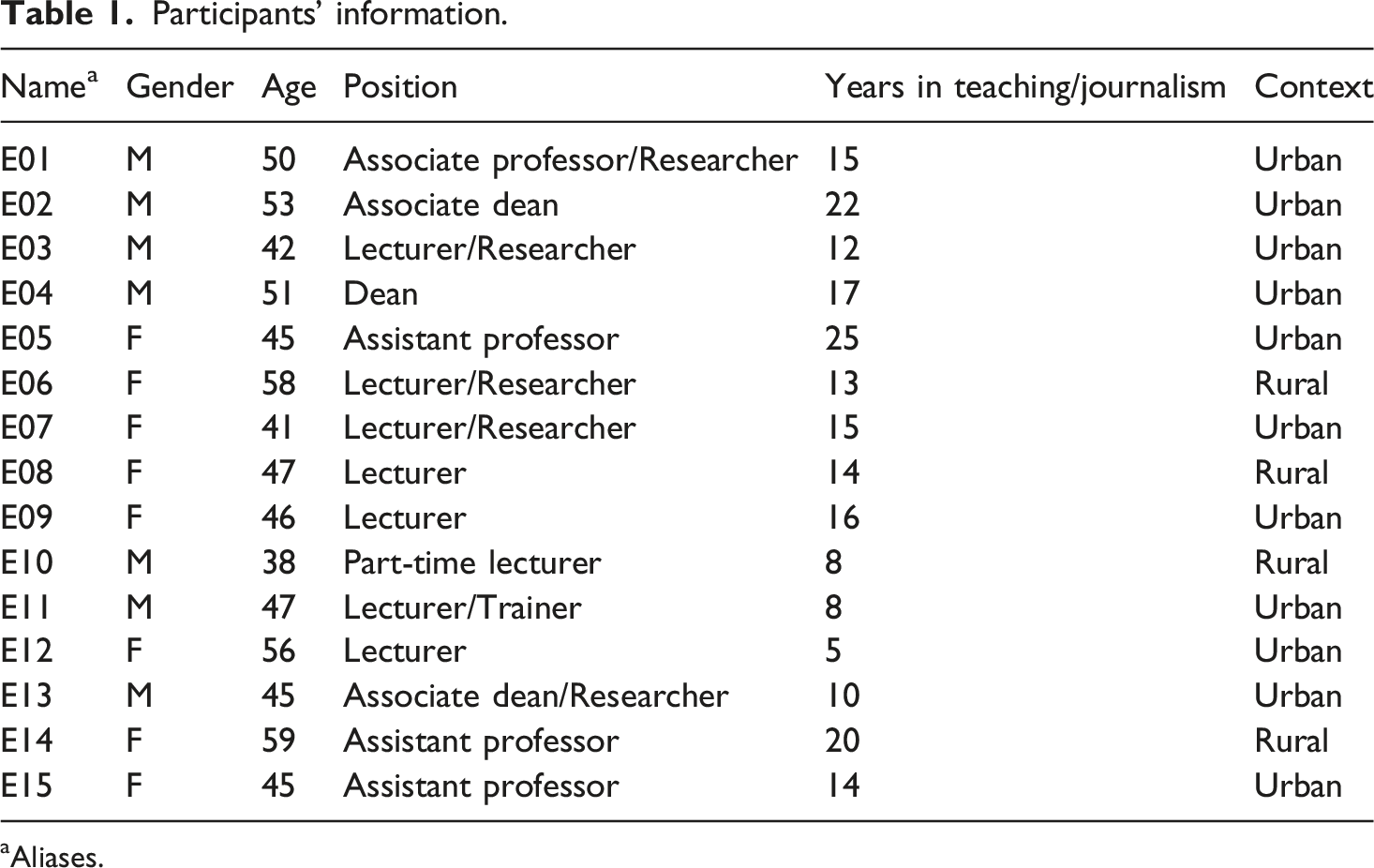
Name
a
Gender
Age
Position
Years in teaching/journalism
Context
E01
M
50
Associate professor/Researcher
15
Urban
E02
M
53
Associate dean
22
Urban
E03
M
42
Lecturer/Researcher
12
Urban
E04
M
51
Dean
17
Urban
E05
F
45
Assistant professor
25
Urban
E06
F
58
Lecturer/Researcher
13
Rural
E07
F
41
Lecturer/Researcher
15
Urban
E08
F
47
Lecturer
14
Rural
E09
F
46
Lecturer
16
Urban
E10
M
38
Part-time lecturer
8
Rural
E11
M
47
Lecturer/Trainer
8
Urban
E12
F
56
Lecturer
5
Urban
E13
M
45
Associate dean/Researcher
10
Urban
E14
F
59
Assistant professor
20
Rural
E15
F
45
Assistant professor
14
Urban
Emerging themes and sub-themes.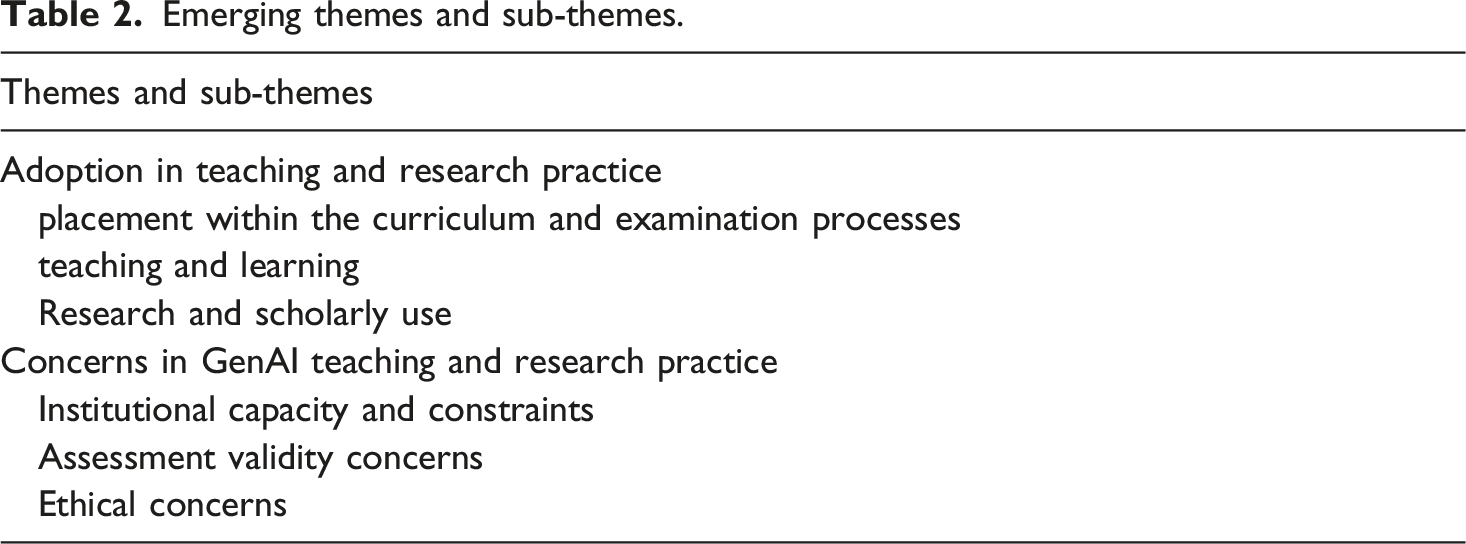
Themes and sub-themes
Adoption in teaching and research practice
placement within the curriculum and examination processes
teaching and learning
Research and scholarly use
Concerns in GenAI teaching and research practice
Institutional capacity and constraints
Assessment validity concerns
Ethical concerns