






Abstract
Despite the prevalent view that advertising in news outlets potentially impacts news content about advertisers, empirical evidence of this effect is theoretically and empirically ambiguous. We therefore investigate the relationship between advertising revenues of newspapers and the favorability of the news coverage of their advertisers. To measure advertiser bias, we extend pre-existing generic news frames to the genre of business news, supplement them with valenced sub-frames, and use them to code the favorability of business news articles from the UK. We combine this coding data with data on corporate newspaper advertising to study the relationship between the favorability of news frames and the importance of an advertiser to a newspaper. We find that one tabloid is more likely to use favorable frames for more important advertisers, while no significant relationship was found across UK daily newspapers. These findings relativize previous assumptions about advertiser bias and caution against making unfounded assumptions about newspaper-advertiser relationships that could erode trust in mainstream media even further.
Introduction
Newspaper advertising has traditionally kept newspapers afloat and has made state-independent news media possible in the first place (Nielsen, 2020; Petrova, 2011). However, advertising revenues have been declining over the past decade due to the digital transformation of the media industry. Companies which traditionally bought advertising space in newspapers have turned to algorithm-driven advertising on digital platforms in order to reach larger audiences in a more targeted manner at lower cost. In response, newspapers make their advertising space more attractive by tracking and profiling readers in their online channels to offer targeted advertising opportunities similar to digital platforms (Lischka and Siegert, 2022). Due to the increased competition for advertisers, advertising revenues are no longer the primary income for legacy newspapers, forcing them to prioritize subscription models to attract more paying readers, even if these revenues cannot compensate for the overall loss in advertising revenues (Olsen et al., 2024).
Scholarship on the role of media in society commonly hints at the potential influence of newspaper advertisers on news content, arguing that the economic dependence of newspapers on advertisers may threaten their editorial independence (e.g. Croteau and Hoynes, 2001; Curran and Redden, 2024; De Marquo, 2025; Hamilton et al., 2016; Kuhn, 2017; Lauerer, 2019; Painter-Morland and Deslandes, 2017; Spence et al., 2011; Sterling, 2009; Tsetsura and Kruckeberg, 2017). This view is grounded in the conceptualization of news as a two-sided market, where newspapers seek to attract both readers and advertisers (e.g. Gal-Or et al., 2012; Germano and Meier, 2013; Guo and Lai, 2014). However, the transformation of the media industry and its changing revenue structure have created a more complex multi-sided market of readers, advertisers, and digital platforms (Lischka and Siegert, 2022). Any evidence of advertiser bias in previous research is therefore ambiguous, as it mostly stems from a time before the digitization of the news industry. In addition, previous research has only studied the effect of advertising on the news volumes of advertisers rather than on the favorability of their news coverage (e.g. Choi and Park, 2011; Gambaro and Puglisi, 2015; Lischka et al., 2017), which provides insufficient evidence as to whether advertising leads to biased news. This calls for a deeper exploration of the alleged influence of advertising on news content. Building on pre-existing generic news frames, we conduct a framing analysis of UK business news to explore whether newspapers favor more important advertisers through more favorable framing.
Theoretical framework
Advertiser influence on business news
Advertisers have generally little incentive to advertise in media outlets that provide them with critical coverage, as such coverage would hurt the effectiveness of their advertising (Anderson and Gabszewicz, 2006; Guo and Lai, 2014). Powerful advertisers may therefore put pressure on news outlets to get favorable coverage, or news outlets may engage in proactive self-censorship for fear of losing advertising revenues (Baker, 1992; Jenkins, 2015). Simultaneously, newspapers need to be careful to publish news that provides readers with utility, as a growing and loyal readership makes their advertising space more valuable (Ellman and Germano, 2009). While newspapers have traditionally committed themselves to a separation of editorial and advertising staff (e.g. Drew and Thomas, 2018), the decline in advertising has arguably softened these boundaries (Coddington, 2015; Cornia et al., 2020; Duffy and Cheng, 2022). Practices such as entrepreneurial journalism (Coddington, 2015), topic suggestions by advertising departments to attract advertising clients, and journalists fitting content around ad bundles (Atal, 2018) suggest that the editorial staff may at least be aware of the newspaper’s advertising clients.
These dynamics point to potential tensions between editorial independence and commercial interests, which is reflected in anecdotal evidence in news reporting, suggesting that advertisers have received ‘softer’ news coverage after a scandal (e.g. Jenkins, 2015) or have withdrawn ads after negative stories (e.g. Clark, 2010). In previous research, advertising executives and editors have reported advertisers’ attempts to influence news coverage and have to some extent admitted to the effectiveness of such attempts (An and Bergen, 2007; Nyilasy and Reid, 2011). Further, journalists for lifestyle magazines have problematized conflicts between journalism and commercial pressures (e.g. Atal, 2018; Cheng and Tandoc Jr, 2023; Hanusch et al., 2017; Viererbl, 2023). Previous studies on news about important advertisers of newspapers have found that important advertisers have a higher chance of getting their press releases published as news (Choi and Park, 2011; Lischka et al., 2017). There is also evidence that advertisers receive less news coverage for product recalls in the U.S. (Beattie et al., 2021). Further, studies from Italy have shown that more important advertisers receive higher news volumes in newspapers and magazines (Gambaro and Puglisi, 2015; Rinallo et al., 2013). A study from South Korea concluded that newspapers prioritize corporate stories of potential or current advertisers at the expense of economic news, which would be of higher public relevance (Lee and Baek, 2018). Aside from traditional business news, studies have indicated that product reviews in car magazines (Dewenter and Heimeshoff, 2014) and finance magazines (Reuter and Zitzewitz, 2006) are more favorable, when they concern advertisers.
While previous research suggests that more important advertisers receive higher news volumes and more favorable product reviews, it is unclear whether advertiser bias also extends to news content. Higher news volumes for important advertisers do not automatically mean more favorable content. Conversely, important advertisers might receive the same volume of news as non-advertisers or infrequent advertisers, but may receive more favorable coverage. Favorable news is even more valuable to advertisers than pure news volumes, since it can make desirable attributes of advertisers more salient and less desirable attributes less salient (Carroll and McCombs, 2003; Jonkman et al., 2020). In view of the inconclusive evidence about advertiser bias provided by previous research and the ongoing threats to newspapers’ revenue structures, this study examines the favorability of news content covering important advertisers. It pursues the following research question: Is there a relationship between advertisers’ importance to newspapers and the favorability of the news coverage they receive from these newspapers (RQ1)?
Newspapers with different market positionings might exhibit different levels of advertiser bias, as they differ in terms of their journalistic professionalism and their underlying business models. While tabloids cover news with an emphasis on simplification, drama and negativity (e.g. Kroon and Van der Meer, 2018), quality newspapers often have a focus on political news (Lefkowitz, 2018) and target a more professional audience in the case of business newspapers (Pollach and Hansen, 2021). These differences may have implications for how advertiser bias unfolds across media types. We therefore pose the following research question: Are there differences regarding the favorability of the news coverage of important advertisers between newspapers with different market positionings (RQ2)?
Conceptualizing media bias in business news
To study how advertisers’ power may translate into news favorability, it is necessary to conceptualize media bias in the context of business news. The study of media bias has a long tradition in political news, where scholars have sought to measure partisan bias in news reporting (D'Alessio and Allen, 2000; Lichter, 2017), defined as “the systematic differential treatment of one candidate, one party, one side of an issue over an extended period of time” (Stevenson and Greene, 1980: 16). By contrast, previous research on media bias in business news is rather limited, typically confined to political bias in financial or economic news (e.g. Larcinese et al., 2011; Piotroski et al., 2017; Rees and Twedt, 2022) or concrete events, such as corporate wrongdoing (Clemente et al., 2016) or mergers (Xu, 2024).
In political news, it is unclear whether bias is a supply-side factor, driven by the political values and beliefs of newspaper owners and editors, or a demand-side factor, reflecting newspapers’ attempts to cater to the political preferences of their readers (e.g. Baron, 2006; Gentzkow et al., 2015; Groeling, 2013; Lichter, 2017; Mullainathan and Shleifer, 2005). Meanwhile, in business news, there is no a priori, systematic bias of newspapers towards specific companies, although newspapers may prefer to report about large companies due to their elite status and economic significance. Similarly, readers of business news cannot be assumed to have preferences for the favorable treatment of specific companies. Thus, any bias towards particular companies is a supply-side factor, driven by newspaper interests tied to those companies.
To account for the complexity of conceptualizing media bias, scholars have proposed typologies of biases found at different stages in the news production. D'Alessio and Allen (2000) distinguish between bias in news selection (gatekeeping bias), news volumes (coverage bias), and news content (statement bias). Similarly, Groeling (2013) differentiates between selection bias and presentation bias, the latter of which manifests itself in the tone, framing, ordering or length of an article (Groeling, 2013). Further, Entman (2007) identifies biases as falsifying reality (distortion bias), favorable framing (content bias), and journalistic belief systems (decision-making bias). In previous research on business news, advertiser bias has only been found in relation to higher news volumes (i.e. coverage/selection bias) for important advertisers (Choi and Park, 2011; Gambaro and Puglisi, 2015; Lischka et al., 2017). This study investigates advertiser bias in the form of news content favorability, referred to above as statement, presentation, or content bias. Drawing on Stevenson and Greene (1980), we define advertiser bias as the systematic favorability in news content about important advertisers, which does not include episodic instances of favorability, e.g. a one-time positive spin a journalist may embed in a story to reward a source for providing exclusive information.
News framing as a mechanism of advertiser bias
News frames are a journalistic “tool of power” that can lead to bias, if employed systematically to privilege certain interests (Entman, 2007, 2010). Frames have been defined as a “central organizing idea for news content that supplies a context and suggests what the issue is through the use of selection, emphasis, exclusion and elaboration” (Tankard et al., 1991: 3). Generally, frame selection is the result of a complex interplay of different hierarchical layers of socio-cultural, institutional, organizational, newsroom, and individual factors that shape journalistic news production (Brüggemann, 2014; Shoemaker and Reese, 1996), such as journalistic self-understanding, the polarization of an issue in a given country (Brüggemann, 2014; Trussler and Soroka, 2014), or novelty seeking by journalists (Lecheler and De Vreese, 2011). If framing choices systematically benefit a particular entity, this can lead to presentation bias (Groeling, 2013) or content bias (Entman, 2007), for example when journalists succumb to commercial pressures from advertisers (Viererbl, 2023). Framing thus provides a link between the varying pressures journalists face and the news favorability they provide to those entities covered in the news. We therefore conceptualize advertiser bias as a form of media bias that manifests itself in the favorability of news framing.
To operationalize news frames, scholars have classified frames into generic and issue-specific frames. Generic frames are context-transcendent ways of representing news, while issue-specific frames capture the specific ways in which particular issues are framed (e.g. De Vreese, 2005). In this study, we draw on generic frames, since we are interested in how news about different companies is framed, irrespective of specific news events, which may run the gamut from financial results to product launches, CEO dismissals or job cuts. We adopt the five generic news frames developed by Semetko and Valkenburg (2000) in their seminal study of political news, which have become the most widely used set of generic frames. They include ‘Conflict’, ‘Human interest’, ‘Economic consequences’, ‘Morality’, and ‘Responsibility’. Gronemeyer et al. (2020) later extended the above generic frames for political news by adding the frames ‘Defense’ and ‘Informative’. While these frames have been applied to a variety of social and political issues, e.g. immigration (Kim and Wanta, 2018) or climate change (Robbins, 2020), they have not yet been applied to corporate or business-related news, which this study addresses. This paper therefore makes a methodological contribution by adapting these generic news frames to the genre of business news.
Furthermore, the generic news frames are not associated with any positive or negative valence, even though scholars have explored this connection in political news coverage. De Vreese and Boomgaarden (2003) investigated the valence of the ‘Economic consequences’ frame in political news and found that consequences were framed disadvantageously in more than half of all news stories. Guenduez et al. (2016) supplemented generic frames with a separate coding of positive, neutral, or negative tone for each article and found a strong association with negative tone for the ‘Conflict’ and the ‘Responsibility’ frame. Since there is no established way of measuring news favorability via generic frames, this paper makes a second methodological contribution by extending generic frames with valence in order to be able to measure news favorability.
Methods
We conduct a manual content analysis (Krippendorff, 2004) of business news in daily newspapers based on valenced generic news frames. This approach enables us to link news favorability to advertising expenditure to study whether newspapers apply certain frames systematically to provide more favorable coverage to more important advertisers.
Data collection
The study focuses on the United Kingdom and its nine daily newspapers, including quality papers (Times, The Guardian, Financial Times) and tabloids (Daily Express, Daily Mail, Daily Mirror, Daily Star, The Sun, Evening Standard) (Esser, 1999; Kroon and Van der Meer, 2018). The empirical basis for this study is news articles about companies from the years 2018 and 2019 1 in the nine newspapers, combined with data about how much advertising these companies bought in these newspapers. In the following, the sampling procedures are described, which ensure a balanced sample of news articles from different newspapers, covering a variety of companies that differ in how much advertising they buy from these newspapers.
Company and advertiser selection
An advertising dataset was purchased from the media bureau KantarMedia, which specifies which companies bought advertising in which print newspaper on which day and for what estimated value. Print advertising data is more reliable than digital advertising data in view of the constantly evolving advertising technology, programmatic bidding for ad space, uncertainties about ad placement and viewability, ‘bot’ viewership, ad adaptivity to user profiles, and ad blockers (Lee and Cho, 2020; McGowan et al., 2024; McGuigan, 2019; Samuel et al., 2021). Print advertising is thus a more robust and historically stable empirical basis for studying advertiser-newspaper relationships. As higher advertising volumes make a company a more powerful advertiser, we first selected the top 10 advertisers of each newspaper according to their annual advertising expenditure for this newspaper. Some of these companies were top advertisers for multiple newspapers. Removing public organizations, companies without news coverage, and companies buying advertising on behalf of other companies resulted in a list of 29 top advertisers. To arrive at 50 companies in total, we supplemented this list with the top advertisers overall according to their decreasing aggregate advertising expenditure in all nine newspapers. This selection procedure ensures that the sample contains companies that are important advertisers for some newspapers and less important or non-advertisers for other newspapers. These advertisers are not only large companies but also homogenous in that they have the resources to buy advertising in daily newspapers, and their target groups can be assumed to be readers of these newspapers. Each of the 50 companies bought at least some advertising in 2019 in an average of 6.36 newspapers (SD = 2.13).
The relative importance of each advertiser to each newspaper – referred to as advertiser importance ratio – was calculated by dividing the company’s annual advertising expenditure dedicated to a newspaper in a given year by the newspaper’s total ad revenues in the same year. We conducted an interview with an advertising professional with 20 years of experience in the UK market, who reported that newspaper advertising by large advertisers tends to be stable over time. Our dataset confirms this consistency: 91.56% of the advertiser-newspaper pairings were the same in 2018 and 2019. Advertiser importance (AdI) ratios for 2018 and 2019 were also strongly correlated (r = .828***), confirming that advertisers keep their annual advertising expenditure for a given newspaper constant. We used the AdI ratios for the years of the news coverage, but for robustness also calculated AdI ratios for the averages of each year combined with the preceding calendar year (i.e. 2019 and 2018; 2018 and 2017). Since these two measurements of AdI were strongly correlated (r = 0.982***), we conducted our analysis with the AdI ratios of the year in which an article was published. An overview of all advertisers, the newspapers they advertised in, and advertiser importance ratios can be found in Appendix 1.
News article selection
We used the news database Factiva to collect news articles from 2018 to 2019 about these 50 companies in the nine print newspapers, irrespective of which newspapers the companies had advertised in. A sampling criterion was that the companies had to be mentioned in the headline or lead paragraph of an article to ensure that all articles have the companies as the main focus. Articles that dealt with multiple companies in the headline or lead paragraph were therefore not collected, as they do not allow for the assessment of favorability toward a specific company. This criterion makes it challenging to provide an exact measure of the total number of suitable articles per company, as this would require a qualitative assessment of each article. Since the pure article counts per company varied enormously, ranging from one article to over 800 per year (approx. 43,000 in total), we set up reduction rules that gradually reduced the number of articles per company in accordance with the total number of articles available (see Appendix 2). These rules specify systematically selected months for which all articles with the company in focus were collected, since a possible systematic favorability towards advertisers would not be contingent on specific months. These reduction rules take into account the variation in news coverage that different companies receive, without overrepresenting companies with higher levels of coverage. The final sample 2 consists of 816 articles, including 357 from quality newspapers and 459 from tabloids (see Appendix 3 for details). The newspapers have an average of 35.33 advertisers (SD = 9.21; min. 13, max. 44) and cover an average of 19.44 companies (SD = 6.13; min. 9, max. 28).
Modification of generic news frames
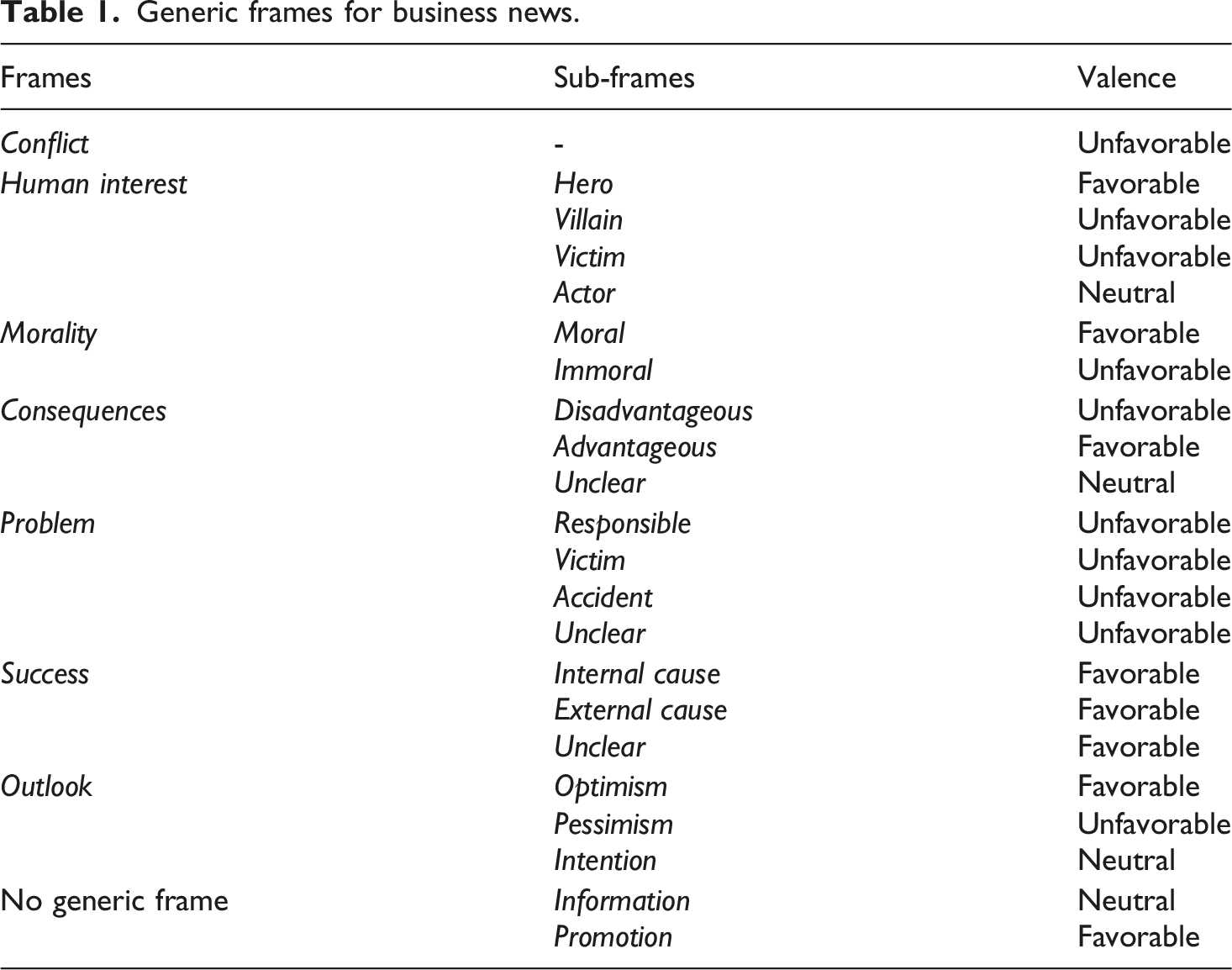
To study news (un)favorability, we developed a typology of generic news frames for business news, to which we added favorability, neutrality and unfavourability via inductively developed sub-frames. Henceforth, the term ‘favorability’ is used to refer to the favorable, neutral or unfavorable valence of news frames. The anchoring of favorability in generic frames makes it traceable why a news story is coded as (un)favorable and ensures that the favorability of a news story is embedded in the favorability of a frame chosen by a journalist rather than the positivity or negativity inherent in a news event. When developing the generic frames and sub-frames, we combined deductive and inductive approaches to mitigate the risk of overlooking new frames.
Deductively derived codes and modifications
We first tested the applicability of Semetko and Valkenburg’s (2000) five generic frames to business news on a sample of 125 articles (15%). In this pilot test, it became evident that the definitions of ‘Conflict’, ‘Human interest’ and ‘Morality’ frames could be adopted with only minor modifications. We modified the ‘Economic consequences’ frame into a ‘Consequences’ frame, as business news is inextricably linked to an economic frame. We extended the ‘Responsibility’ frame into a ‘Problem’ frame, as it turned out that business news can be framed as a problem for which the company is not made responsible.
In order to be able to use the generic frames for the measurement of advertiser bias, we split the generic frames into sub-frames, where applicable, and assigned a favorable, neutral, or unfavorable valence to each sub-frame. While the generic frame ‘Conflict’ is inherently unfavorable (Guenduez et al., 2016), other valences were derived from the data. For example, we split the ‘Morality’ frame into the sub-frames ‘Moral’ (favorable) and ‘Immoral’ (unfavorable) to capture whether the company was praised for good deeds or criticized for bad deeds. The modified frames and sub-frames were operationalized based on the questions and definitions in the codebook (see Appendix 4). Following Valenzuela et al. (2017), we only chose the most central question from the block of guiding questions originally developed by Semetko and Valkenburg (2000) in order to capture the essence of each frame.
Inductively derived codes
Generic frames for business news.
Coding procedure
We limited our coding to the headline and the first two paragraphs of each article in order to maintain a consistent unit of analysis across all articles (cf. Eberl et al., 2018). Only one frame was assigned per article, including a sub-frame. This decision is supported by Valenzuela et al. (2017), who found that 69% of their articles used either one or none of the generic frames. If more than one generic frame was present in the headline and the first two paragraphs, generic frames occurring in headlines were given priority over other generic frames found in the lead paragraphs, as the former are visually most salient, most likely to be read first, and often the only part of an article that is read (e.g. Sala, 2024; Sun and Cheung, 2022).
Inter-coder reliability
Two authors shared the coding of the articles. Inter-coder reliability tests were conducted on 85 articles (>10% of the sample), using Krippendorff’s alpha (α = 0.73 for frames; α = 0.64 for sub-frames; α = 0.86 for valence). The variable ‘valence’, which is the core variable in the analysis, is reliable (≥0.80). The variable ‘frames’ is above the minimum threshold of 0.667, while the variable ‘sub-frames’ is slightly below this threshold (e.g. Krippendorff, 2004; Lacy et al., 2015). The moderate agreement of the contextualizing variable ‘sub-frames’ could be the result of its skewed representation in our sample (see Appendix 5) (Krippendorff, 2013). In fact, four sub-frames were not present in our inter-coder reliability test, as the test sample was a good representation of the total sample (r = .934 for frames; r = .869 for sub-frames) with some very small categories. Most importantly, a closer look at the coder disagreements for the frames and sub-frames revealed that most disagreements occurred in articles in which two or more (sub)frames were present in the headline and lead paragraph. According to our coding rules, the coders had to select the dominant (sub)frame, but differed in which one they evaluated as the dominant one. Since the divergent sub-frames identified by the coders typically also had the same valence, the coders’ disagreement in ‘sub-frames’ as the contextualization of valence did not impact the validity of our results.
Findings
Descriptive statistics
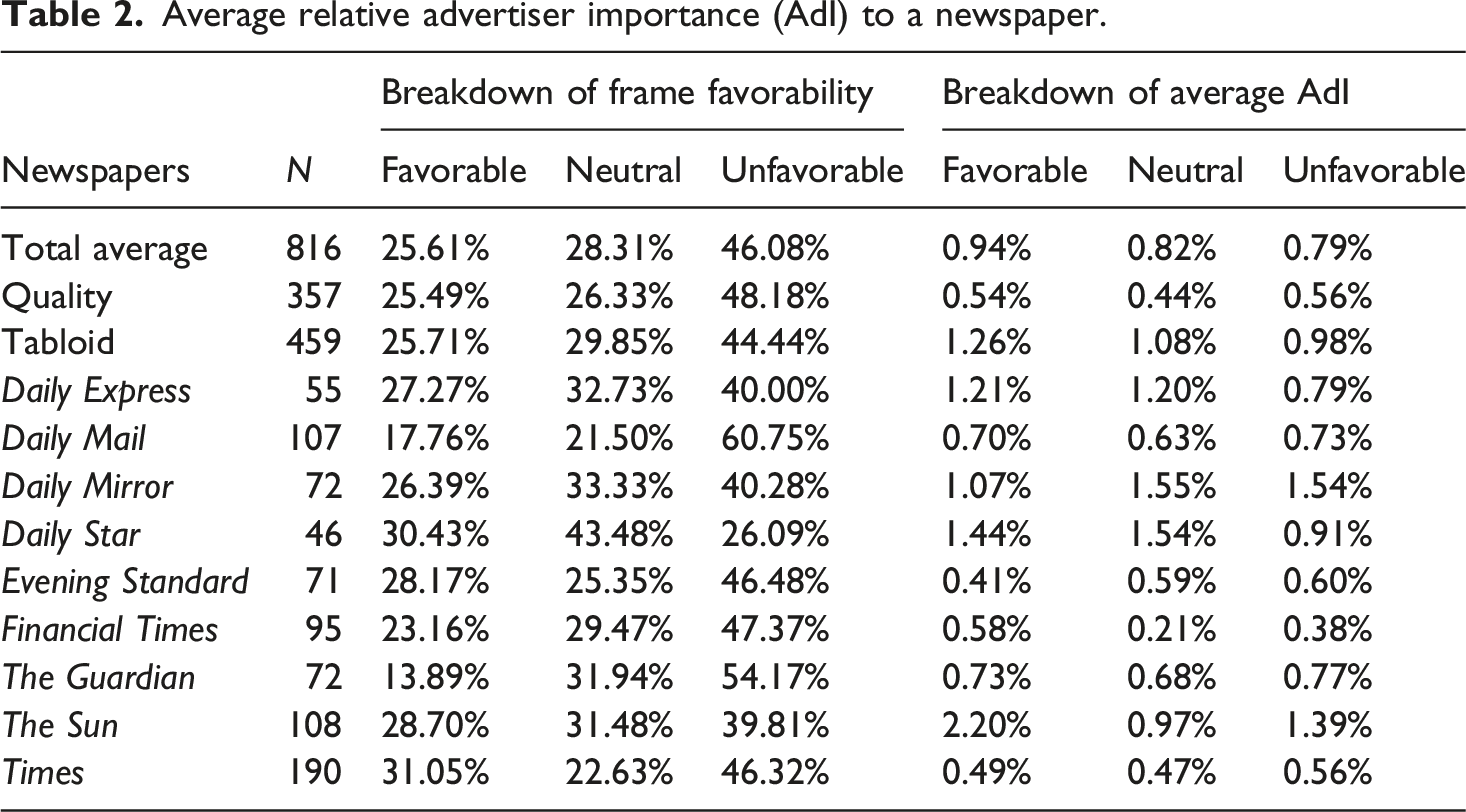
Average relative advertiser importance (AdI) to a newspaper.
The role of advertiser importance
To answer RQ1 and RQ2, the connection between advertiser importance to a newspaper (AdI) and news favorability was explored. The AdI ratio indicates the advertiser’s share of the newspaper’s total ad revenues in the same year and ranged from 0 (for companies that are non-advertisers) to 9.52% for a company that contributes almost 10% of one newspaper’s annual advertising revenues (see Appendix 1). Each article in the sample was assigned the AdI ratio of the company covered in the article and the newspaper publishing the article. To illustrate the potential connection between the AdI of an article and its frame favorability, Table 2 (right-hand side) shows the average AdI ratios for all articles of a newspaper with favorable, neutral, and unfavorable frames. For example, an average AdI of 1.21% for Daily Express and ‘Favorable’ means that those companies covered in Daily Express articles with a favorable frame had an average advertiser importance of 1.21% to Daily Express. These averages are generally rather low, as they also include the AdI of 0 for those companies that are covered in the articles but are non-advertisers of the newspaper. The Table suggests that favorable frames are, on average, connected to higher advertiser importance in the entire sample (0.94% AdI for favorable frames) as well as for the tabloid sub-sample (1.26% AdI for favorable frames). Quality newspapers, meanwhile, have their highest AdI for articles that are framed unfavorably, suggesting that more important advertisers receive, on average, less favorable coverage. When looking at each newspaper individually, the picture is mixed, as the highest average AdI is connected to favorably framed articles for some newspapers (Daily Express, The Sun, Financial Times), while it is connected to neutral articles for others (Daily Star, Daily Mirror), and to negatively framed articles for the remaining ones (Evening Standard, Daily Mail, The Guardian, Times).
Kruskal-Wallis tests.
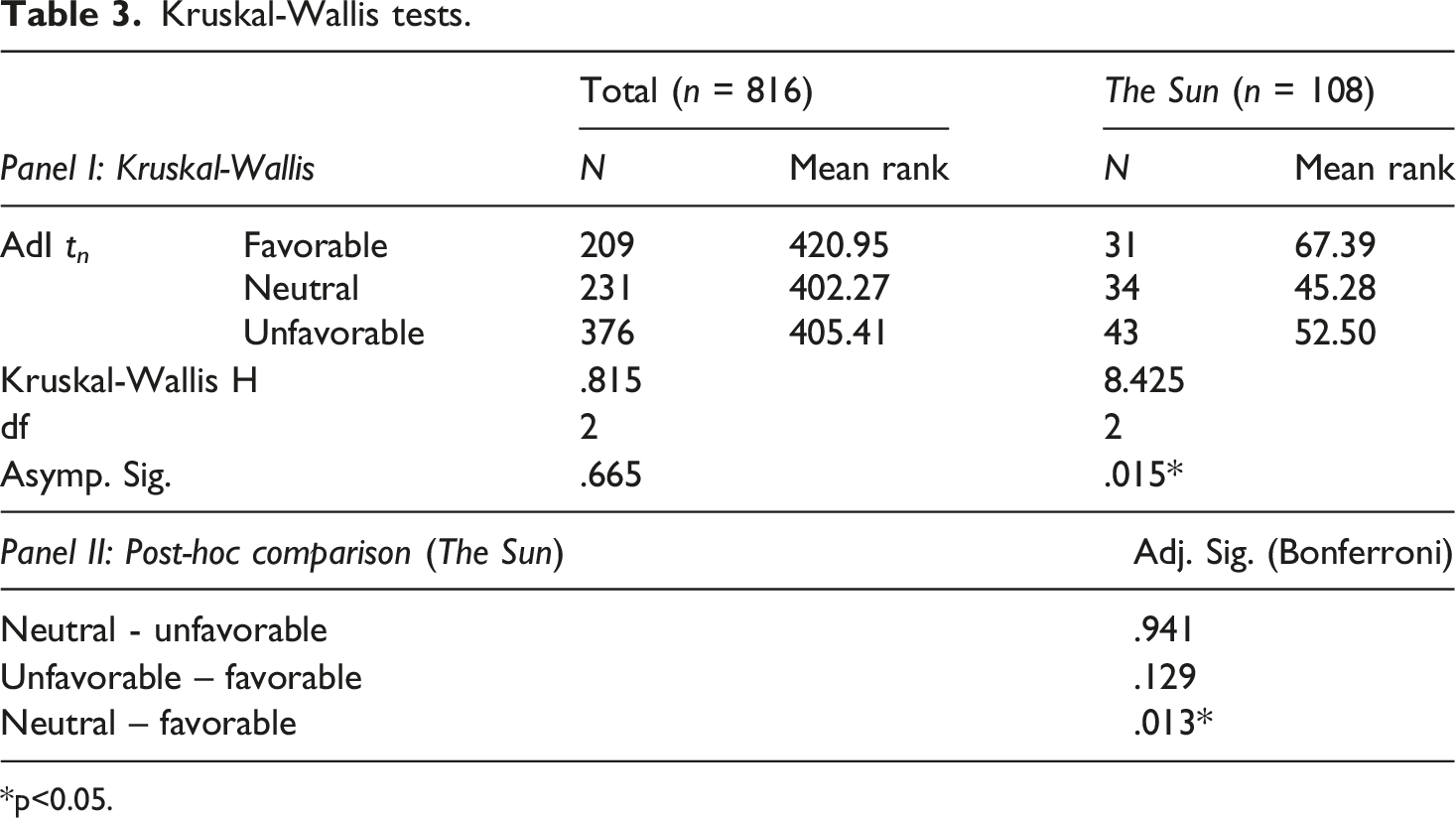
p<0.05.
Discussion
This study has investigated the relationship between the advertiser importance to a particular newspaper and the newspaper’s coverage of the advertiser in terms of frame favorability. Our main finding is that a systematic relationship between advertiser importance and news favorability cannot be identified across the UK print news industry, neither among quality newspapers nor among tabloids. However, a relationship between advertiser importance and news favorability was found for one specific tabloid newspaper. It should be noted that our study does not seek to confirm or refute unethical or illegal activities of individual news outlets. These findings, which answer RQ1 and RQ2, relativize previous conclusions about advertiser bias based on news volumes (Gambaro and Puglisi, 2015; Rinallo and Basuroy, 2009; Rinallo et al., 2013), as receiving more news coverage as an important advertiser does in most cases not equal more favorable framing. In fact, in some newspapers in our sample, more important advertisers are, on average, more likely to be covered with negative frames. While we do not find evidence of a systematic bias in favor of advertisers, this does certainly not rule out the untraceable presence of episodic frame favorability, possibly given to some advertisers at certain times under certain circumstances. Thus, even though advertising still contributes a sizable portion of newspaper revenues (e.g. Oliver Wyman, 2022), it does not systematically shape news quality in the UK with frames biased in favor of advertisers. Our study therefore suggests that making assumptions about advertising impacting news content should be considered very carefully in future scholarship, as such arguments can further undermine trust in mainstream media.
Our findings may also reflect the ongoing shift to digital advertising and the strategic importance of securing loyal audiences willing to pay for news, which may not have been present to the same extent at the time previous studies on advertiser bias had been conducted. This may mean that those tabloid newspapers for which no advertiser bias was identified might seek to strengthen their market positioning by satisfying audience demand for negative news to attract readers (e.g. Bastos, 2017) rather than please advertisers. Similarly, quality newspapers might seek to fortify their market positioning by reporting about companies with a critical distance, thus satisfying the demands of a financially literate audience and safeguarding the newspapers’ reputation for quality reporting (e.g. Kalogeropoulos et al., 2015; Strauß, 2019). With the ongoing transformation of the media industry towards a “readers-first paradigm” (e.g. Bakke and Barland, 2022), it is reasonable to expect that journalists and editors are attentive to taking a distance from advertiser-friendly reporting in order to satisfy audience demands and safeguard the legitimacy and reputation of their news outlets.
Furthermore, our study makes a methodological contribution by operationalizing generic news frames for the measurement of (advertiser) bias. We modified and adapted generic news frames to the genre of business news, adding two essential frames: a future lens and success. Especially in times in which the news industry is being criticized for foregrounding conflicts, catastrophes and negative content in general (e.g. Ahva and Hautakangas, 2018), it is important not to overlook that success is a frequent frame in business news. Even though our novel frames were derived from business news, their high level of abstraction makes them transferable to other news domains, in particular politics or sports. To be able to link generic frames to bias, we supplemented the generic frames with valenced sub-frames, which capture the variety of valences that can be subsumed under the same generic frame. The generic frames developed in this study are therefore a versatile research instrument for future research on media bias, enabling researchers to study frame-evoked biases independently of specific contexts or topics.
This study is not without limitations. One limitation is the study’s focus on the headline and lead paragraph of news articles. Even though both elements are core elements of the framing of a newspaper article (Valenzuela et al., 2017), we cannot rule out that advertiser bias may manifest itself in the article body. Second, the reliability of our sub-frames is slightly below the commonly accepted threshold, which we attribute to our coding rule of assigning the dominant frame despite the potential presence of multiple frames. This does not impact the reliability of our findings, as they are based on the valence variable, which has been assessed as reliable. For the future use of these generic (sub)frames in studies without a specific interest in favorability, we recommend allowing the coding of multiple sub-frames, if they appear equally dominant to the coders. Lastly, a limitation is the exclusion of visuals in our study, as media bias can be constituted by both verbal and visual information (Entman, 2007). Our study does not take into account images or article placement, even though they might contribute to the favorability of a news article.
Future research should test the applicability of our valenced sub-frames to other news genres beyond business news. This could also include examining a smaller set of articles with a focus on full articles instead of headlines and lead paragraphs to identify potentially more subtle forms of bias. Similarly, future research should also test the proposed typology of frames on alternative news formats, as previous research has suggested differences in the framing of TV and print news (Semetko and Valkenburg, 2000) as well as online and print news (Tagle, 2021). More research is also needed to understand the various motives for advertiser bias, which might be shaped by the strategic priorities of a newspaper as well as by social relations between journalists, advertising executives and corporate press officers.
Supplemental material
Supplemental material - Advertiser bias in business news: A framing perspective
Supplemental material for Advertiser bias in business news: A framing perspective by Annika Kristin Zepke and Irene Pollach in Journalism
Footnotes

Funding
The authors disclosed receipt of the following financial support for the research, authorship, and/or publication of this article: The research received funding from Independent Research Fund Denmark (Danmarks Frie Forskningsfond) under Grant Agreement No. 1028-00130B and from Carlsberg Foundation (Carlsbergfondet) under Grant Agreement No. CF20-0321.
Declaration of conflicting interests
The authors declared no potential conflicts of interest with respect to the research, authorship, and/or publication of this article.
Supplemental material
Supplemental material for this article is available online.
Notes
Author biographies
References
Supplementary Material
Please find the following supplemental material available below.
For Open Access articles published under a Creative Commons License, all supplemental material carries the same license as the article it is associated with.
For non-Open Access articles published, all supplemental material carries a non-exclusive license, and permission requests for re-use of supplemental material or any part of supplemental material shall be sent directly to the copyright owner as specified in the copyright notice associated with the article.
