







Abstract
This study examines how Bangladesh’s intelligence agencies interfered with editorial decision-making in private television newsrooms during the Awami League regime (2009–2024). Drawing on in-depth interviews with senior gatekeepers from five major 24/7 TV channels, it reveals how extralegal interventions—from direct editorial directives to surveillance and intimidation—created a parallel system of media control. Framed within the Hierarchy of Influences model, the study argues that intelligence agencies operated as a dominant extramedia influence, creating a condition of media capture. By controlling the terminal gate of newsrooms, these agencies became de facto news gatekeepers, undermining journalistic autonomy. This study thus expands the definition of ‘extramedia’ influences. The findings deepen understanding of media-state relations in authoritarian and hybrid regimes and provide a foundation for evaluating journalist resilience in compromised democracies.
Keywords
Press freedom in Bangladesh, the world’s eighth most populous nation, has suffered a marked decline over the past decade and a half. When the Awami League (AL) government assumed power in 2009, Bangladesh ranked 121st out of 180 countries in the World Press Freedom Index (RSF, 2009). By the end of the regime in August 2024, this ranking had plummeted to 165th (RSF, 2024), a decline of 44 places, reflecting deepening constraints on media independence.
Scholars have largely attributed this deterioration to a combination of restrictive legal frameworks and persistent judicial harassment under what has been described as a “hybrid regime” 1 (Hasan and Wadud, 2020; Riaz and Zaman, 2022). USAID (2022: 7) found the government of Bangladesh “proactively uses legal tools to impose its control over media outlets and individual journalists.” Studies have also suggested the use of extralegal measures, such as clandestine threats and agency culture, to control the media (Hasan, 2019; Rahman et al., 2024; Riaz and Parvez, 2021). In fact, “unofficial and informal control has been taking a more severe shape than formal control,” such as licensing, advertising, laws, and ownership structures (Chowdhury, 2024: 78). Studies have indicated that intelligence agencies have intervened to influence news gatekeepers in Bangladesh (Ahsan, 2018; Chowdhury, 2024; Riaz and Zaman, 2022); however, the extent and methods of this interference remain largely unexamined.
This study argues that, in addition to legal measures, extralegal actions—such as interference by intelligence agencies—significantly curtailed press freedom in Bangladesh during the AL regime from 2009 to 2024. Such interventions constitute a powerful extramedia influence that has resulted in a condition of media capture, which in turn compromised the professional autonomy of journalists, hindering their ability to make independent decisions about selecting and publishing news stories. Consequently, the press has failed to fulfill its essential roles, such as acting as a “watchdog” and providing checks and balances on government operations in Bangladesh (Rahman et al., 2024: 13). Bhowmik and Fisher (2024: 11) found that Bangladeshi journalists resorted to “defensive journalism” and “self-censorship” to protect themselves. Researchers emphasize the necessity of interference-free media to uphold and support democracy (Gajardo and Mellado, 2024; Waisbord, 2013), where journalists can perform their duties “without fear or favor” (Singer, 2008: 126).
Bangladesh, with a population exceeding 170 million, has a significant media market, where television is the predominant medium for news consumption (USAID, 2022). The country’s only state-owned broadcaster, Bangladesh Television (BTV), has consistently lost viewership and is often referred to as a “mouthpiece of the ruling party” (Riaz and Rahman, 2021, p. 3). This lack of trust is evident, as only 7.5 percent of viewers express confidence in BTV’s news coverage (USAID, 2022). Consequently, despite ongoing concerns about a “politico-commercial nexus,” a substantial 80 percent of the national audience turns to private television channels (USAID, 2022). Due to their extensive reach and popularity, intelligence agencies often attempt to exert control over private TV channels (Ahsan, 2018; Riaz and Zaman, 2022).
Building on this context, this study focuses on “terminal” gatekeepers of private TV channels in Bangladesh—those responsible for final editorial decisions. Utilizing in-depth qualitative interviews and framed within the “Hierarchy of Influences” model, this research investigates the nature, frequency, and consequences of intelligence agency interference in the newsrooms. By illuminating the covert dynamics and exploring how editors navigated the environment, this study offers critical insights into the nature of state-media relations and the mechanisms of media capture.
Theoretical framework
The study is structured around three theoretical steps. First, it examines intelligence agencies as extramedia actors through the lens of the Hierarchy of Influences model. Second, it explores how these actors “capture” media through the framework of media capture theory. Finally, it analyzes the agency and resistance of gatekeepers by utilizing the concept of journalistic autonomy.
Hierarchy of influences model
Editors have traditionally acted as gatekeepers in journalism, determining which stories reach the public (White, 1950). However, news production is influenced by a variety of internal and external factors and involves multiple actors and gates, rather than just the personal judgment of the editors (Bennett, 2004; Vos and Heinderyckx, 2015). The Hierarchy of Influences model developed by Shoemaker and Reese (1996) categorizes the forces that shape media content into five interrelated levels: the individual, media routines, organization, extramedia level, and ideological level.
The extramedia level refers to “everything outside of media organizational boundary” that represents the “interplay of economic, political, and cultural factors” (Reese and Shoemaker, 2016). Among these, “direct regulation and other constraints placed on media by the state” is particularly prominent (Shoemaker and Reese, 2014: 121). Other theorists consistently identify these extramedia factors as an important level of influence on editorial outcomes (Voakes, 1997; Whitney et al., 2004).
A key gap in the existing literature is the oversight of intelligence agencies as critical extramedia factors, particularly in Western contexts (Hallin and Mancini, 2004; Hanitzsch and Mellado, 2011; Preston, 2009). While some studies in non-Western contexts have addressed the issue, specific focus on intelligence agencies remains rare (Jamil and Sohal, 2021).
The Hierarchy of Influences framework is well-established for analyzing external forces in journalism across various parts of the world (e.g., Dirbaba & O’Donnell, 2016; Ittefaq et al., 2021; Relly et al., 2015). In the context of Bangladesh, Bhatti et al. (2021) applied this framework and identified the military establishment as part of the external media influences. This study specifically focuses on intelligence agencies as extramedia actors.
Media capture theory
To thoroughly investigate the systemic effects of extramedia pressure from intelligence agencies on media, this study also utilizes media capture theory. Media capture refers to a situation where media outlets lose their “editorial independence under pressures” (Dragomir, 2024: 163) from governments or other powerful actors, and the media “have not succeeded in becoming autonomous in manifesting a will of their own” (Mungiu-Pippidi, 2008: 73). Barnehl and Schumacher operationalize media capture as the process by which a media outlet’s “editorial choices are forcibly substituted by the regime’s editorial preferences” using legal, economic, and physical measures (2024: 1541). A key element is that “an outlet has to be coerced by an external actor to alter its editorial choices in his or her favour” (Barnehl and Schumacher, 2024: 1539), which aligns well with the focus of this study.
While there are various strategies for capturing media, this research specifically highlights “intimidation and the criminalization of journalists” (Coşkun, 2020: 637) because these tactics correspond to the coercive pressures applied by state-linked agencies. This combined framework enables the identification of influence (through Hierarchy of Influences) and the characterization of outcomes (through Media Capture) when external actors undermine editorial processes.
Journalistic autonomy
Any discussion about the influence of extramedia factors on media raises concerns regarding journalistic autonomy, which is a vital aspect of the journalism profession (Hanitzsch and Mellado, 2011). Autonomy enables journalists “to make their own decisions and to take their own actions” (Merrill, 2004: 8) without external pressure from the state (Gajardo and Mellado, 2024). Autonomy ensures that editorial decisions are guided by “journalistic standards” and remain “uncontaminated by external powers” (Waisbord, 2013: 59).
This freedom from external influence is especially crucial at the final gatekeeping level, which White (1950: 390) referred to as the “terminal gate” and Hanitzsch and Mellado (2011: 410) described as the “highest level of editorial hierarchy.” When extramedia actors successfully exert influence at this final stage, they directly compromise the essential ethical and professional mandates of journalism. This research, therefore, builds on Vos and Heinderyckx’s (2015: 161) concept of “gatekeeping the gatekeepers,” positioning intelligence agencies as entities that seek to control the very individuals responsible for making the ultimate editorial decisions in TV newsrooms.
Literature review
Political context and media freedom in Bangladesh
The degree of press freedom in any country is closely linked to its political regime, as media systems are inherently shaped by their broader social and political contexts (Hallin and Mancini, 2004; Stier, 2015). Bangladesh, constitutionally a parliamentary democracy since gaining independence in 1971, experienced a turbulent political journey, marked by military coups and authoritarian interludes until democratic restoration in 1991 (Riaz, 2021). This transition gave rise to a two-party system dominated by the AL and the Bangladesh Nationalist Party (BNP).
However, the AL’s return to office in 2009 marked a decisive turn in the country’s political direction (Jackman and Maitrot, 2022), ushering in a period of democratic backsliding (Riaz, 2021). Over time, Bangladesh has been reclassified from an electoral democracy to a “hybrid regime” (Economist Intelligence Unit, 2023), a “moderate autocracy” (Bertelsmann Stiftung, 2024), and an “electoral autocracy” (V-Dem, 2024). Prime Minister Sheikh Hasina, who remained in power until mass protests ended her 15-year rule in August 2024, was increasingly portrayed by international media as a “dictator” (Economist, 2024), “authoritarian” (CNN, 2024), and an “autocrat” (BBC, 2024). This authoritarian turn, reinforced by documented human rights abuses (Ahasan, 2023), created a repressive climate for the media.
Although Article 39(1) of Bangladesh’s Constitution guarantees press freedom, media practitioners experienced increasing restrictions under AL governance. The country’s media expanded numerically, boasting over 1,300 newspapers, dozens of FM and community radio stations, and more than 40 private TV channels (PID, 2023), yet journalistic conditions deteriorated. Ahmed (2018) described this pattern as a paradox, where the proliferation of outlets created a façade of freedom, masking a decline in journalistic autonomy.
Hybrid regimes such as Bangladesh’s have been found to target journalists to manipulate public opinion and elections (Hughes and Vorobyeva, 2021; Miaji and Islam, 2023; Riaz and Parvez, 2021). The AL government frequently employed legal tools, particularly the Digital Security Act of2018 2 , to silence critics in the media (Riaz, 2021; Ruud and Hasan, 2024). However, legal tools were only one part of a broader strategy; they were often accompanied by extralegal tactics (Ahmed, 2018; Hasan, 2019; Kuttig and Sharif, 2022). The combined effects of legal and extralegal measures fostered a climate variously described as “strategic silencing” (Riaz, 2021: 185), “climate of apprehension” (Chowdhury, 2024: 104), “compliant media” (Ahmed, 2020: 263), and “compromised media system” (Rahman et al., 2024: 1).
Journalism can only contribute meaningfully to the democratic process when it operates free from external interference (Merrill, 2004; Waisbord, 2013). In Bangladesh, however, this ideal is undermined by conditions that erode newsroom managers’ decision-making authority. The government positioned itself as what Hallin (2000) describes as the “primary definer” of news. As Ahmed (2020: 264) observes, traditional news management became obsolete in Bangladesh, where “news is manufactured and dictated by the state.” Intelligence agencies played a central role in enabling and reinforcing this state control over the media.
Interference by intelligence agencies
Intelligence agencies, by their very nature, operate in secrecy, limiting external oversight (Hillebrand, 2012). Research into their influence on media is scarce (Bakir, 2015), and the topic is even considered taboo in many countries (Wirtz, 2007). Where explored, findings reveal that intelligence bodies often manipulate media narratives (Dover and Goodman, 2009; Hillebrand, 2012).
In nations with weak democratic institutions, intelligence agencies use tactics like physical and digital surveillance, informal pressure, and even espionage to intimidate journalists (Akhtar, 2019; Jamil, 2021; Lucas, 2022; Tong, 2019). Even liberal democracies recorded such interferences, such as FBI monitoring of journalists during the McCarthy era in the United States (Alwood, 2007) or media collaborations with the CIA (Blinder, 2024; Jones, 2015). In Israel, intelligence agencies planted stories to shape public discourse (Magen, 2015). These tactics are often described as “indirect methods of intimidation” (Dirbaba & O’Donnell, 2016: 924) or “extralegal measures” (Riaz, 2021: 189).
In Bangladesh, the AL government heavily relied on state security agencies, particularly the Directorate General of Forces Intelligence (DGFI), the military’s intelligence branch, to consolidate power (Jackman and Maitrot, 2022). News reports have accused the DGFI of engaging in covert activities, including enforced disappearances, extrajudicial killings, coercive takeovers of financial institutions, and intimidating the judiciary (Mashal and Walid, 2024; Reed, 2024; Sarkar, 2024; Secret Prisoners, 2022).
A United Nations fact-finding report documented how the DGFI pressured media outlets and demanded alterations to their reporting (OHCHR, 2025). A U.S. human rights report similarly noted harassment and intimidation of journalists by intelligence agencies (U.S. Department of State, 2023). Human Rights Watch (2020) reported that a newspaper editor censored 80–90% of available news due to external pressures. Intelligence-led editorial manipulation in Bangladesh has also been validated by academic studies (Chowdhury, 2024; Muhammad, 2023; Riaz and Zaman, 2022).
Bangladesh has 15 intelligence bodies with distinct mandates (Ashraf, 2014), with the DGFI most frequently linked to media coercion (Chowdhury, 2024). Their tactics include pressuring advertisers, surveillance, phone monitoring, threats, and even torture (Ahmed, 2018; Bergman, 2015; Hasan, 2019; Hasan and Wadud, 2020). Informal “advisory calls” directing editorial choices and restricting TV talk show guests were common tools of control (Ahmed, 2012; Bhatti et al., 2021; Islam and Rahman, 2021; Riaz and Zaman, 2022). Chowdhury (2024: 78) encapsulates the situation: “unofficial and undeclared censorship by unseen sources.”
Although prior studies have noted intelligence agency involvement in Bangladeshi media, such discussions have largely been incidental, emerging as peripheral findings within broader research. A clear gap remains in examining the institutional interventions by intelligence services aimed at influencing the media. This study addresses that gap by expanding the scope of investigation from episodic instances to sustained patterns of interference and exploring how newsroom gatekeepers navigate such interferences. Here, “interference” refers to any formal or informal action by intelligence agencies to influence editorial decisions of television newsrooms. To deepen the existing literature, the study poses the following research questions:
What is the nature of the interference by intelligence agencies in news-making decisions in Bangladesh?
What strategies do newsroom gatekeepers in Bangladesh employ to manage interference from intelligence agencies?
Methods
Given the sensitivity of the issue and the scarcity of prior research, this study adopted a qualitative approach using in-depth interviews. This method allows for “more accurate responses on sensitive issues. The rapport between respondent and interviewer makes it easier to approach certain topics that might be taboo in other approaches” (Wimmer and Dominick, 2014:142). In-depth interviewing has been used to study journalistic threats and state intervention in various countries, including Turkey (Pukallus et al., 2020), Ethiopia (Workneh, 2022), and Pakistan (Jamil, 2021). In Bangladesh, similar methods have explored journalists’ security concerns and extramedia interference (Chowdhury, 2024; Hasan and Wadud, 2020; Riaz and Zaman, 2022).
Since the goal of this study is to explore the issue in depth, semi-structured, open-ended questionnaires were used for interviews. The interview guide comprised two thematic sections aligned with the research questions: (1) experiences of interference by intelligence agencies, and (2) strategies to manage the interference. The questions were designed to elicit detailed narratives while allowing flexibility for probing and follow-up. A pilot interview with a senior journalist (excluded from the final sample) helped assess clarity and refine the guide.
While interference may occur at various stages of news production, this study focuses on the final stage. Bangladeshi television channels differ in how they designate their final decision-maker (e.g., executive director, head of news, chief news editor). Regardless of the designation, this study considers each news channel’s highest-ranking journalist responsible for content as the gatekeeper. At the time of data collection, nine private television channels 3 in Bangladesh operated as 24/7 news outlets. To ensure representation from this target population, a non-probabilistic purposive sampling method was employed.
The researcher interviewed five final gatekeepers, who collectively represent more than half of the nine 24/7 news channels in Bangladesh. Contact information for these gatekeepers was obtained through personal connections and official websites. The researcher reached out to six gatekeepers for interview requests and successfully secured agreements from five of them. As the researcher was residing in the USA, interviews were conducted via Zoom, a video conferencing platform, in April 2025. All five interviewees were male, each with over 20 years of experience in news gatekeeping at private television channels.
While purposive sampling allowed access to the final gatekeepers, there is a possibility of selection bias. However, efforts were made to ensure diverse viewpoints by including participants from five different television channels, each with distinct editorial policies, institutional contexts, and ownership structures. The study also observed that key themes repeatedly emerged across interviews, indicating a reasonable level of thematic saturation.
The interviews lasted between 67 to 85 minutes, with an average duration of 76 minutes. While the interviews were conducted in English, Bengali was occasionally used to clarify terms and elicit richer information. Each interview was audio-recorded, transcribed verbatim, and anonymized. Given the exploratory nature of the research questions, the researcher employed reflexive thematic analysis, as described by Braun and Clarke (2021), to analyze the interviews. This process utilized the iterative principles of abductive analysis (Timmermans and Tavory, 2012).
Findings and discussion
Thematic analysis of interviews with senior news gatekeepers reveals that the media landscape in Bangladesh is tightly controlled by extramedia forces. Intelligence agencies, primarily the DGFI, and, to a lesser extent, the National Security Intelligence (NSI), act as shadow regulators, exercising pervasive authority over journalistic practices. This systemic interference has transformed these agencies into significant extramedia actors within the Hierarchy of Influences model. Their methods-coercion, surveillance, manipulation-undermine journalistic autonomy at the terminal gate, leading to a state of media capture.
Summary of key themes.
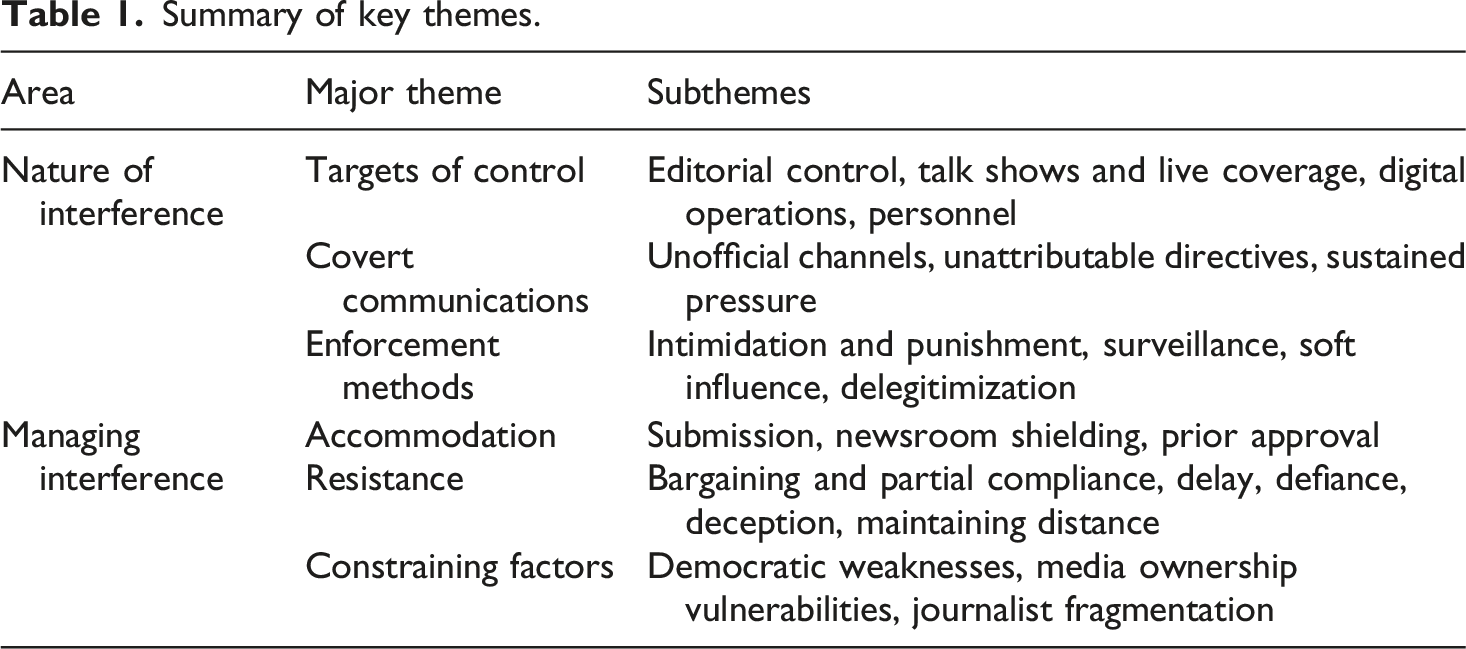
Nature of interference
Findings provide an empirical dissection of the extramedia level of influence, illustrating the strategies of media capture by intelligence agencies. Their interventions are not episodic or mere political pressure; rather, they represent a systemic capture of editorial command, what respondents described as “de facto authority.”
Targets of control
The DGFI’s control extends across multiple layers of news production—from program content to digital operations, and even personnel management. This comprehensive oversight confirms its operation as the preeminent extramedia actor, often displacing the traditional editor from the terminal gate and eroding the media’s watchdog role.
Editorial control
Agencies exerted granular control, instructing gatekeepers to halt, modify, or remove news to align with their agendas. One gatekeeper highlighted their unchecked power: “Sometimes, they would instantly call and say, ‘Stop the news now.’ Sometimes, they provide prior advice regarding coverage.” Agencies scrutinized every aspect of news—language, visuals, headlines—with one gatekeeper noting, “They had opinions about everything, ‘Why is the coverage so big, or why is it so small?’” Gatekeepers were sometimes forced to distort facts: “Suppose there was sunshine, but I had to say there were clouds.”
Interference was particularly intense in coverage of the prime minister. One gatekeeper said, “Prime Minister’s activities had to be the top story. Once I put her news lower in the rundown, and they asked why I didn’t treat it with the respect it deserved.” Another gatekeeper recalled, “Before every national election (2014, 2018, 2024), the DGFI met senior journalists, saying, ‘What is the alternative to prime minister Sheikh Hasina?’” This sensitivity extended beyond just political figures. One gatekeeper stated, “The list of untouchables was so extensive I once asked, ‘Who is left to report on?’”
The DGFI often dictated how events should be framed, advising on what the government desired. At times, the agencies supplied leaked phone records or ready-made materials. This practice aligns with media capture in autocracies, where the state seeks to control “agenda, framing, and tone” of news (Barnehl and Schumacher, 2024: 1536).
Talk shows and live coverage
Agencies paid special attention to controlling talk show guests and topics. One gatekeeper said, “We could not invite anyone outside their list or choice. They would object instantly.” Hosts also faced scrutiny, ensuring that talk shows reinforce state narratives. Gatekeepers claim that the scrutiny over topics, guests, and narratives forced some hosts to leave their shows. This interference transformed platforms meant for discussion into “state-sanctioned echo chambers.”
Similarly, live coverage was subject to immediate control. Agencies frequently restricted live coverage of sensitive events, issuing directives on duration or outright bans. One gatekeeper explained, “As news channels, live telecasting any event is our priority. But they are very sensitive to this. Before major opposition events, they sent instructions on live coverage. In most cases, they would suddenly call to halt the live telecast.”
Digital operations
With growing audiences online, digital platforms of the TV channels faced even tighter scrutiny. One gatekeeper explained, “Once something airs on TV, there’s no permanent record, but digital content remains accessible.” Agencies demanded changes to posts on social media pages: “We often had to alter the headlines or language of the story. On many occasions, we had to remove entire posts from our YouTube and Facebook pages.”
Personnel
Agency interference was not limited to content; they also targeted individuals. Gatekeepers recounted how intelligence officers demanded dismissal of “non-compliant” reporters. “They gave names,” one editor explained. “They said, ‘He’s working against the government.’” Coşkun (2020) found that dismissing journalists was used as a method of media capture.
Covert communications
Almost all the communication from the agencies was unofficial and undocumented. Studies found that the lack of formal records exacerbates challenges for the media, fueling self-censorship and psychological strain among journalists (Ahmed, 2020; Hiltunen, 2017). This communication routine reinforces the coercive nature of the agencies’ extramedia influence.
Unofficial channels
Agency communication was informal, persistent, and unaccountable, typically via WhatsApp to top gatekeepers or owners. One gatekeeper said, “I never received an official memo or formal communication from the agency.” The reliance on unofficial channels created a system where directives remained untraceable and deniable.
Unattributable directives
The agencies did not have a practice of providing explanations or reasoning behind their directives. “Their only answer would be that it's from high-ups. However, ‘high-ups’ is always a vague term. You never know who the high-ups are,” explained one gatekeeper.
Sustained pressure
Gatekeepers described the communication from intelligence agencies as “a daily routine.” One gatekeeper described: “It almost became part of my job. In some cases, they contacted me several times a day.” This sustained pressure confirms that the agencies’ interference was not occasional censorship, but rather a routine narrative management.
Interference peaked during elections and major events. One gatekeeper noted, “They wouldn’t contact for a few days post-election, like a honeymoon period, then they’d become active again.”
Enforcement methods
Agencies employed a “360-degree approach” combining coercive and persuasive tactics to ensure media compliance, forcing gatekeepers to align with agency agendas, often at the expense of their journalistic autonomy. Many of the tactics are similar to the media capture strategies outlined by previous studies (Barnehl and Schumacher, 2024; Coşkun, 2020).
Intimidation and punishment
Explicit warnings and covert retaliation became trademarks of the DGFI. Gatekeepers reported instances when the transmission of certain TV channels was disrupted by the DGFI without any explanation. The agency’s covert nature amplifies fear: “Their methods of punishment are such that you can't even seek help from anyone. It could be a car accident; no one would know who was behind it. We had to consider the instances of journalists being disappeared.”
Summoning gatekeepers to the DGFI offices was a common method of punishment. “I had to go to their headquarters several times and sit for long hours,” said one journalist. Non-compliance also led to punishment through the owners. One gatekeeper termed this method “telephone justice,” explaining, “I was sent on forced leave three times. No explanation, just a call from the agency to the owner.” Such methods and threats erode journalistic autonomy by placing economic and physical security above professional ethics.
Surveillance
Agencies monitored broadcasts and digital platforms with advanced technology, including AI-driven keyword tracking. One gatekeeper said, “They seemed to know about our stories even before I knew. The monitoring was round the clock.” Surveillance extended to private lives: “They sent agents to my village to inquire about my political ideology. Many journalists faced this. The goal was to make you aware that everything is under surveillance.” This practice created a chilling effect that enforces compliance.
Soft influence
Agencies also engaged in relationship-building, offering gifts and invitations. One gatekeeper noted, “DGFI realized that we hate being ordered around. So, they adjusted their strategy.” Officers, trained in media relations, adopt PR-like approaches, but another gatekeeper warned, “It’s not friendship. It always has the risk of friendly fire. It doesn’t take long for them to turn a cordial relationship into a threat. It’s like living with crocodiles.”
Delegitimization
Agencies exploited Bangladesh’s polarized political climate and labelled non-compliant journalists as “anti-state” and “pro-opposition.” One gatekeeper described, “I was blacklisted and restricted from government offices. They didn’t like professional journalists because they wouldn’t follow their prescribed formula.” The phrase “disseminating propaganda” was commonly used in such “harassment”.
Managing interference
The interference from intelligence agencies prompted two distinct responses from the final gatekeepers in newsrooms: resistance and accommodation. Gatekeepers often sought to maintain their editorial autonomy through oppositional tactics. However, there were times when they felt “helpless in the face of the institutional leverage of the DGFI” and resorted to adaptive responses, highlighting the dominance of extramedia level over other levels of influence.
Accommodation
Gatekeepers mentioned a lot of instances when they had to accommodate the directives from DGFI. The form of accommodation was not a matter of preference, but was determined by the specific context. This response reveals the extent to which extramedia influence achieves media capture, where autonomy of the final gatekeepers is replaced by fearful compliance.
Submission
All the gatekeepers described moments of full compliance. One described, “Sometimes, their message was straightforward: just carry out the order. We wouldn’t even argue or ask for explanations.” One gatekeeper recounted an incident when he was forced to cut off a guest during a live program. “After the talk show started, I received a message to stop a particular guest. I had to act immediately and instructed the host to continue with other guests. The guest they objected to was not given a chance to talk.” This incident is evidence of the terminal gate’s authority being overridden by extramedia actor.
Newsroom shielding
Gatekeepers sometimes had to argue with their colleagues to accommodate the directives of DGFI. “Suppose my reporter was correct and had worked hard on the story. He would ask for explanations,” explained one. Gatekeepers usually tried to withhold information about the interference from their newsroom staff. However, concealing the source of interference wasn’t always effective: “The reality is many colleagues would likely understand why I asked to change the headline or stop the news.”
Prior approval
Some gatekeepers mentioned instances when they sought prior approval from the DGFI. One recounted, “I wanted clarity on what could be covered, and what my limits were. It’s better than having problem after working on an issue.” This incident shows how the decision-making became dependent on extramedia level.
Resistance
Findings indicate that the gatekeepers were not passive victims of the interference. They employed various oppositional tactics to resist or subvert agency directives, which illustrate their continuous struggle for journalistic autonomy in a constrained environment.
Bargaining and partial compliance
Gatekeepers stressed that skillful bargaining was an essential skill to maintain a minimum standard of journalism. They often negotiated with agencies to secure concessions, settling for partial compliance. One said, “I preserved a lot of news through bargaining, maybe presenting 25 percent instead of 100 percent. It was better than nothing.” The gatekeepers used tactics, including altering wording, reshaping stories, or using “as-live” rather than “live” coverage as negotiation tools.
However, some gatekeepers argue that partial compliance itself is a failure to uphold journalistic autonomy. One explained, “Maybe you can cover 80 percent, but that average 80 percent isn’t true journalism; it’s the remaining 20 percent that we can’t cover, defines journalism.”
Delay
Time manipulation was a common tactic for gatekeepers. “Sometimes I ignored their call until the bulletin aired,” said one. “TV is all about time, so a delayed response of five minutes would serve my purpose.” However, the strategy of avoiding phone calls often triggered repercussions like complaints to owners. “You can't avoid them for long because I have to deal with them every day,” explained one gatekeeper.
Defiance
Some gatekeepers refused ethically questionable directives. One said, “I never entertained leaked phone records they provided. Sometimes, we could use our editorial judgment on whether to follow them or not.” Defying “non-mandatory” instructions did not result in major or immediate consequences for the gatekeepers. “They would just note that I am not their guy, and I won’t be in their good books,” one explained.
Deception
Telling lies sometimes helped avoid compliance. One gatekeeper mentioned a case, “I'd say, 'My news editors are dealing with it; I'm not at office,' even when I was there.” Gatekeepers also used deception to protect colleagues. “I told them a reporter was fired when he wasn’t,” said one. However, the need to resort to deception underscores the level of pressure from extramedia level.
Maintaining distance
Some gatekeepers tried to keep agency contact limited to reduce leverage: “I didn’t communicate in advance. If I had, they would have taken advantage. They would demand less as they didn’t find me very enthusiastic.”
Constraining factors
This theme does not focus directly on the gatekeepers’ responses but rather on the broader conditions that shape them. Gatekeepers described how their attempts to uphold autonomy were constrained by various structural and contextual pressures.
Democratic weaknesses
The gatekeepers linked interference from agencies to the erosion of democracy. One explained, “When you become undemocratic, you lose the trust of people—then you lose the moral authority to deal with media. Agencies filled the gap with a simple formula: a phone call controls the media. This formula worked like antibiotics.” Gatekeepers claim that as the AL government became more authoritarian, the DGFI grew increasingly dominant.
Media ownership vulnerabilities
The economic structure of media organizations made the gatekeepers more vulnerable to DGFI interference. This structural weakness ensures that the organization prioritizes survival over journalistic autonomy. One gatekeeper explained, “Whenever an issue concerned my owner’s business, I had to stop. That was my Achilles’ heel. No owner wants to risk his entire business for a TV station.” This concern reflects the problem of ownership pattern in Bangladesh, where “media outlets are owned by big business groups with diverse financial interests” (Riaz and Rahman, 2021: 15).
Journalist fragmentation
The internal rivalries within the journalistic community facilitated and exacerbated the influence of intelligence agencies. One gatekeeper said, “When journalists complain about each other, agencies exploit that. Even if someone reports slightly differently, someone will bring that to attention. The 'fifth-columnist’ phenomenon is our biggest enemy.” Another noted, “Unfortunately, the number of those who complied was higher. Agencies would say, “Those channels aren't complaining; what's wrong with you?’”
Conclusion
This study finds that intelligence agencies in Bangladesh routinely and systematically interfere in the media, effectively functioning as shadow regulators. While many of the practices—censorship, propaganda, surveillance, blacklisting, selective leaks, cultivating media allies—are well-documented globally (e.g., Alwood, 2007; Boyd-Barrett, 2004; Lashmar, 2019; Spaulding, 2009; Sweeney and Washburn, 2014), prior research has largely focused on wartime or foreign affairs contexts (e.g., Lee and Devitt, 1991). In contrast, this study demonstrates how these tactics are consistently applied in domestic settings. It provides an in-depth account of the actors, mechanisms of control, areas of interference, and the strategies employed by media gatekeepers.
The findings reinforce the Hierarchy of Influences model, highlighting the importance of the “extramedia” level, specifically state control. They also expand this framework by demonstrating that intelligence agencies—often overlooked in Western-context studies—serve as powerful instruments of state intervention through editorial oversight, narrative management, and surveillance. Such comprehensive control stifles dissent, prevents corruption reporting, and subordinates the media to the power of the state. This outcome reflects the condition of media capture, where the media loses editorial independence under sustained pressure from external forces.
Although previous studies explored journalists’ perceived levels of influence on news production, there is no consensus on their relative importance (Hanitzsch and Mellado, 2011). This study argues that in contexts like Bangladesh, extramedia influence—particularly from intelligence agencies—dominates all other levels. The findings indicate that in certain situations, the extramedia forces become the primary shapers of news. While prior research identified intelligence agencies as “primary definers” mainly in security-related reporting (Lashmar, 2019), in Bangladesh, their influence extends across all news domains and can even disrupt media operations entirely. The systematic use of threats and surveillance documented in this study details a mechanism through which media capture is established and maintained. The structural vulnerability of media ownership is confirmed as a critical factor that facilitates this capture. Additionally, these findings position intelligence agencies as a form of capture that has not been addressed in previous literature. This intelligence-led form represents a planned, coercive and deniable mechanism of media capture distinct from purely economic, political or legislative forms.
The findings indicate that journalistic autonomy is frequently compromised due to interference from intelligence agencies, as newsroom gatekeepers have to accommodate and adjust. This forced accommodation is an observable effect of media capture on professional routines. These insights provide context for understanding press performance in Bangladesh, highlighting the challenges faced and the resilience required to function under persistent surveillance and pressure. When senior gatekeepers regularly encounter such interferences, it suggests a chilling effect on other levels of the newsroom hierarchy. The study also emphasizes systemic constraints that hinder journalists’ collective resistance efforts. The differences observed in the scope of extramedia factors and the hierarchy of influences offer a fresh perspective on the literature of gatekeeping, particularly in non-Western and authoritarian contexts.
Although this study focuses on Bangladesh, its findings have broader relevance for understanding media-state dynamics in other authoritarian or hybrid regimes. The demonstrated model of extramedia interference and capture highlights the need for institutional and policy reforms to dismantle the systemic influence of intelligence agencies. This underscores the need for future research to investigate similar patterns in different national settings and to identify strategies for safeguarding journalistic autonomy. Further research in Bangladesh is also needed to examine how interference evolves through political transitions and affects journalism quality.
A key limitation of this study is the small sample size—only five interviewees. However, they are among the few individuals who, due to their exclusive designations, dealt directly with such interference. Their key positions, seniority, and long-standing experience offer rare insights into a sensitive issue that few are willing to discuss. Given this context, the depth and richness of their testimonies help mitigate the limitation of the sample size. It is important to note that the sample’s male-only composition reflects the actual demographics of gatekeepers in Bangladesh’s private television sector, where women are significantly underrepresented in top decision-making roles. Therefore, this sample is generally representative of the population being studied. Future research would benefit from broader sampling across diverse media platforms.
Footnotes
Acknowledgments
The author thanks Professor Jatin Srivastava for his helpful feedback and guidance. An earlier version of this paper was presented at the 50th AEJMC Southeast Colloquium in 2025. The author extends gratitude to the attendees of the presentation for their valuable comments and suggestions.

Ethical considerations
The study received approval from the Institutional Review Board (IRB) of Ohio University (IRB-FY25-406) on March 21, 2025.
Consent to participate
Informed consent was obtained verbally before participation. The IRB of Ohio University (IRB-FY25-406) approved a waiver of the signature requirement for the consent form.
Funding
The author received no financial support for the research, authorship, and/or publication of this article.
Declaration of conflicting interests
The author declared no potential conflicts of interest with respect to the research, authorship, and/or publication of this article.
Data Availability Statement
As the subject matter is highly sensitive and the population is a specialized section of society, it is not possible to share the data of this study. All data were handled with strict confidentiality measures to protect participant journalists from potential risks.