






Abstract
Amidst a global decline in students’ interest in journalism careers, this study investigates the complex interplay of motivation, professional identity, and career aspirations among journalism students in China. Drawing on social identity theory, this study proposes and tests a mediation model where professional identity bridges initial motivations and career aspirations. Based on a survey of 502 students from leading Chinese universities, we employ a regression-based parallel mediation analysis. Our findings reveal that professional identity (operationalized as professional identification and journalistic role perceptions) channels motivation effects onto distinct career aspirations across sectors. Public service motivation is associated with state-aligned aspirations mainly through indirect pathways, especially through professional identification and the advocator role. Utilitarian motivation is linked to market-driven sectors, including platform-based media and the private sector, both directly and indirectly. While students strongly endorse the watchdog role, this role is unrelated to career aspirations. Our analysis shows that the pivotal career differentiation for Chinese journalism students is not simply between “journalism” and “non-journalism,” but between state-aligned (“political”) and market-driven (“non-political”) sectors. The study offers a theoretically grounded framework for understanding how students’ career aspirations are shaped within the politically salient media environment of a transitional society.
Keywords
Introduction
The global journalism landscape is undergoing profound transformation, marked by economic precarity and a widely reported decline in the professional workforce. This shift has also contributed to waning interest in journalism careers among students in many parts of the world (Hanusch et al., 2015). China provides an important case within this global trend. The country’s certified journalist workforce fell by nearly 25% from 258,000 in 2014 to 194,263 by the end of 2021 (All-China Journalists Association, 2015, 2022). Enrollment in journalism and communication programs, however, continues to expand (Hu and Leng, 2016; Li, 2020), partly because the Chinese media landscape presents journalism students with a wide range of career options, from state-run institutional media to market-driven digital platforms, and from governmental communication departments to private sector public relations. What mechanisms, at the micro-level, shape students’ choices among these options?
While existing scholarship has explored students’ motivations for studying journalism (Coleman et al., 2018; Jackson et al., 2020; Pjesivac, 2020), a critical gap remains in understanding how these motivations translate into specific career aspirations across the sectors available to journalism students. To address this gap, this study develops and tests a mediation model grounded in Social Identity Theory (SIT) (Tajfel and Turner, 2001). According to SIT, an individual’s desire to join and remain in a group is shaped by identification with that group’s values, status, and perceived future. Applied to our context, students’ initial motivations (e.g., for public service or utilitarian gain) influence how they understand and evaluate the journalistic profession, and this, in turn, shapes their aspirations toward particular sectors of the media landscape. We conceptualize professional identity as a two-dimensional construct: professional identification (the degree of personal connection and perceived importance of the profession) and journalistic role perceptions (normative beliefs about what journalism should do). This operationalization is intended to capture the normative and evaluative dimensions of professional identity, as these dimensions are more readily measurable.
On the one hand, professional identification shapes career choices and adaptive capacity (Raemy, 2021; Wiik, 2015), with stronger identification linked to pursuing journalism careers. On the other hand, journalistic role perceptions among students have some differences from those of professional journalists (Coleman et al., 2018), suggesting that role perceptions are associated with career aspirations. From a structural perspective, although the landscape of news culture varies across countries (Mellado et al., 2013), students aligning with the predominant perceptions of journalistic roles in their national journalism field are more inclined to favor journalism as an occupational direction (Sanders et al., 2008), while those who prioritize watchdog or developmental roles may gravitate toward sectors that better accommodate such orientations. Together, identification and role perceptions thus constitute key pathways through which initial motivations shape where students ultimately aspire to work.
This article therefore considers how professional identity might shape journalism students’ aspirations across multiple career sectors, both within and beyond journalism. Our primary contribution lies in integrating professional identification and journalistic role perceptions into “why journalism” question, offering deeper insights into how students navigate career choices in a changing landscape.
The Chinese media landscape presents a particular stark institutional context for examining these dynamics. Characterized by close alignment between media and political structures, yet simultaneously marked by burgeoning digital media platforms, it offers journalism students multiple pathways to choose between. Notably, only journalists employed by recognized media institutions are eligible for a press card, which is an official credential for news gathering and access to formal press events, but also places journalists more directly within administrative oversight. These features make China a uniquely suitable case for examining how journalism students develop career aspirations across sectors that differ in political proximity and market orientation. To this end, we conducted an online panel survey of journalism students enrolled in leading Chinese universities (N = 502) to investigate the influence of motivation, identification, and role perception on their career aspirations.
Literature review
Chinese media landscape and career aspirations
The restructuring of news organizations has prompted many journalists to move into adjacent fields such as public relations, advertising, or teaching (O’Donnell et al., 2015), raising questions about how journalistic professional identity persists across career transitions (Sherwood & O’Donnell, 2016). This industry precarity has similarly shaped career aspirations, as students weigh job market conditions when choosing majors (Mishra et al., 2017). Therefore, understanding students’ career aspirations first requires clarifying what sectors are available within and around the broader field of journalism and communication.
The Chinese press system is characterized by governmental ownership, with all media institutions accountable to different levels of the publicity department within the Communist Party of China (CPC). Following the initiative of reform and openness in the late 20th century, the previously centrally-controlled and politically-subsidized media became increasingly decentralized, marketized, and open to limited private investment (Stockmann, 2013). Over the past decades, digital transformation has further reshaped the political economy of Chinese journalism. As audiences and advertising revenues dispersed away from traditional outlets, institutional media grew increasingly dependent on government subsidies, intensifying the political control and administrative embeddedness (Wang and Sparks, 2019). Meanwhile, internet-based media platforms have proliferated, giving rise to diversified media genres, such as news aggregators (e.g., Toutiao, NetEase News), social media (e.g., Xiaohongshu, also known as Little Red Book) and short video platforms (e.g., Bilibili, and Douyin, the domestic version of TikTok). These companies provide journalism graduates with institutional employment opportunities, primarily in content production, editorial operations, and related communications roles, as distinct from the self-employed content creator on these platforms.
We argue that the distance between media organizations and the political regime is a useful way to understand both the media landscape and journalism students’ career aspirations in China. For students navigating career development, employment within or adjacent to the political system often offers greater job stability and institutional prestige, although these positions do not necessarily pay more than those in the private sector (Démurger et al., 2012). In the current scenario of China’s economic reform and the increasing number of young individuals seeking employment, there is a growing inclination towards seeking positions within or close to the political system (Fan et al., 2018; Li et al., 2024). Particularly in the field of journalism, this proximity to, or distance from, politics in career decisions further signifies a nuanced comprehension of the media-politics relation (Simons et al., 2017). Overseas media are also optional choices distant from Chinese political regime. Beyond journalism in the narrow sense, a similar distinction exists between governmental communication departments and private sector positions, the latter including public relations, advertising, and related work. Both are common choices among journalism students in China. Comparatively, the teaching and research position is centrally located between the two distance poles.
To capture the nuances of the Chinese context, this study moves beyond a simple “journalism versus non-journalism” dichotomy. Instead of treating career options as sequential trajectories of active journalists (Davidson and Meyers, 2016; Marchetti, 2002), we conceptualize them as distinct aspirations because our respondents are students who have yet to work in the field. These employment destinations are structured along a core theoretical dimension: political distance, or the degree of distance from and autonomy relative to the state apparatus (Simons et al., 2017). This continuum reflects the complex interplay of political and market logics, distinguishing sectors characterized by state-aligned stability and prestige from those offering greater commercial autonomy (Fan et al., 2018).
Drawing on the general employment landscape for Chinese journalism graduates (Hu and Leng, 2016), we identify six sectors that crosscut the journalism boundary, mapped by their political distance: (1) Institutional Media (within journalism; low political distance); (2) Governmental Communication Departments (beyond journalism; lowest political distance); (3) Teaching and Research (beyond journalism; moderate political distance); (4) Platform-based Media (within journalism; moderate political distance); (5) Private Sector Public Relations and Advertising (beyond journalism; high political distance); and (6) Overseas Media (within journalism; highest political distance). This framework allows a more granular analysis of how students translate different motivations into distinct career aspirations.
Motivations in journalism
Self-determination theory holds that motivation influences behavior not only in quantity but also in type, distinguishing intrinsic motivation (doing something for its inherent satisfaction) from extrinsic motivation, which is directed toward separable outcomes such as social welfare, recognition, or reward (Ryan and Deci, 2000).
In general, three primary motivations in journalism have been identified in existing studies. Public service motivation reflects an extrinsic drive to achieve social welfare through journalistic work (Bowe et al., 2023; Carpenter et al., 2016). Utilitarian motivation encompasses the pursuit of financial rewards and social prestige (Carpenter et al., 2016; Crawford et al., 2013). Self-realization, the intrinsic motive, is centered on creativity, personal fulfillment, and related values (Hanusch et al., 2016; Jackson et al., 2020). These motivations in journalism vary across cultures (Sanders et al., 2008). In developed countries, intrinsic motivation is more important than extrinsic motivation like the public service ideal for journalism careers (Coleman et al., 2018; Hanusch et al., 2016; Jackson et al., 2020). But in developing countries, the extrinsic motivation prevails over the intrinsic (Bowe et al., 2023; Calderón et al., 2021; Pjesivac, 2020).
In developing contexts like China, extrinsic motivations are thus expected to be particularly salient (Bowe et al., 2023). Public service motivation, rooted in an altruistic desire to contribute to society and national development, is likely to align with career sectors closely tied to the state. Conversely, utilitarian motivation, which prioritizes financial rewards and personal advancement, is expected to drive aspirations toward market-oriented sectors. This aligns with career choice theories suggesting that individuals seek congruence between their personal values and the reward structures of their chosen occupations (Démurger et al., 2012; Hodkinson and Sparkes, 1997). Intrinsic motivation, centered on self-expression and creativity, is hypothesized to be linked to core journalistic practices. Based on this, we propose our first set of hypotheses concerning the direct influence of motivations on career aspirations:
Motivations will predict ideologically consistent career aspirations.
1. H1a. Public service motivation will positively predict aspirations for state-aligned careers (institutional media, governmental communication departments, teaching and research). 2. H1b. Utilitarian motivation will positively predict aspirations for market-driven careers (platform-based media, private sector public relations and advertising, overseas media). 3. H1c. Intrinsic motivation will positively predict aspirations for careers within journalism (institutional media, platform-based media).
Professional identification and role perceptions
As our theoretical framework posits, motivations do not operate in a vacuum. Drawing on Social Identity Theory (SIT), we argue that their influence is mediated by professional identity and conceptualize it as a two-dimensional construct.
The first dimension, professional identification, captures individuals’ recognition of journalistic profession, particularly its perceived importance and prospect. As an internal factor, the importance individuals assign to their profession can significantly influence their career decisions (Hodkinson and Sparkes, 1997). As an external factor, the perceived prospect of the industry also shapes career choices, as individuals tend to gravitate towards fields with better outlooks. For instance, journalism students who prioritize job security are more inclined to opt for public relations over journalism (Mellado and Scherman, 2017). Since students with different motivations may hold varying views on the industry’s importance and prospects, we hypothesize a direct link between motivations and professional identification.
The second dimension, journalistic role perceptions, refers to the normative values that constitute professional identity across cultural, social, and political conditions (Nygren and Stigbrand, 2014). While numerous classifications exist (Hanitzsch, 2011; Weaver et al., 2007), they all reflect the identity and locus of journalism in society (Hanitzsch and Vos, 2017). Situating these roles within the Chinese context (Yang and Arant, 2014) is essential, given that commercialization since the 1990s has placed Chinese journalism in a complex space between Western traditions of independence and the party’s “mouthpiece” model (Hassid, 2012), with journalists navigating persistent tensions between market pressure and political control (Wang and Guo, 2021). Following Hanitzsch’s (2007) inclusive typology, we focus on three roles: the advocator role, emphasizing support for governance and national development through policy explanation, decision-making assistance, and government–public bridging; the watchdog role, emphasizing supervision of those in power, though institutionally constrained in China; and the consumer-oriented role, reflecting market logic through attention to audience preferences and entertainment. Students’ underlying motivations are expected to shape how they perceive these roles, leading to our second set of hypotheses:
Motivations will predict corresponding dimensions of professional identity.
1. H2a. Public service motivation will positively predict perceived importance of journalism. 2. H2b. Public service motivation will positively predict perceptions of public-good roles (advocator, watchdog). 3. H2c. Utilitarian motivation will positively predict perceived prospect of journalism industry. 4. H2d. Utilitarian motivation will positively predict perceptions of consumer-oriented role.
Professional identification and role perceptions, in turn, should shape career aspirations. Strong identification with journalism should logically sustain aspirations to work within journalism, while specific role perceptions should guide the choice of career sector. The advocator role, aligned with national development, maps onto state-run institutions; the consumer-oriented role maps onto market-driven sectors. The watchdog role, however, presents a theoretical puzzle here. While journalists in many developing countries show strong identification with the watchdog ideal (Hanitzsch, 2011), its practice in China is fraught with significant political and institutional constraints (Hassid, 2012), suggesting a disconnect between normative roles and practical career influence. This leads to our third set of hypotheses:
Professional identity will predict ideologically consistent career aspirations.
1. H3a. Professional identification (both importance and prospect) will positively predict aspirations for careers within journalism. 2. H3b. The advocator role will positively predict aspirations for state-aligned careers. 3. H3c. The consumer-oriented role will positively predict aspirations for market-driven careers. 4. H3d. The watchdog role will show no significant positive relationship with career aspirations.
Taken together, we propose the following mediation hypothesis:
Professional identification and role perceptions will mediate the relationship between motivations and career aspirations.
1. H4a. Professional identification (both importance and prospect) will mediate the relationship between motivations and career aspirations. 2. H4b. Role perceptions (advocator, watchdog, and consumer-oriented) will mediate the relationship between motivations and career aspirations.
Educational and societal factors
While journalism education is intended to prepare students for professional practice, its effects can be complex. Some studies find it foster a more critical or even disillusioned view of the industry (Jackson et al., 2020), while others point to its role in consolidating professional identity (Williams et al., 2018). Internships, as direct field exposure, are expected to have a more targeted influence, reinforcing aspirations for the specific sector in which experience was gained. Therefore, we hypothesize that:
Practical experience will have a targeted positive effect on career aspirations.
1. H5a. Internship experience in a specific field will positively predict the corresponding career aspiration.
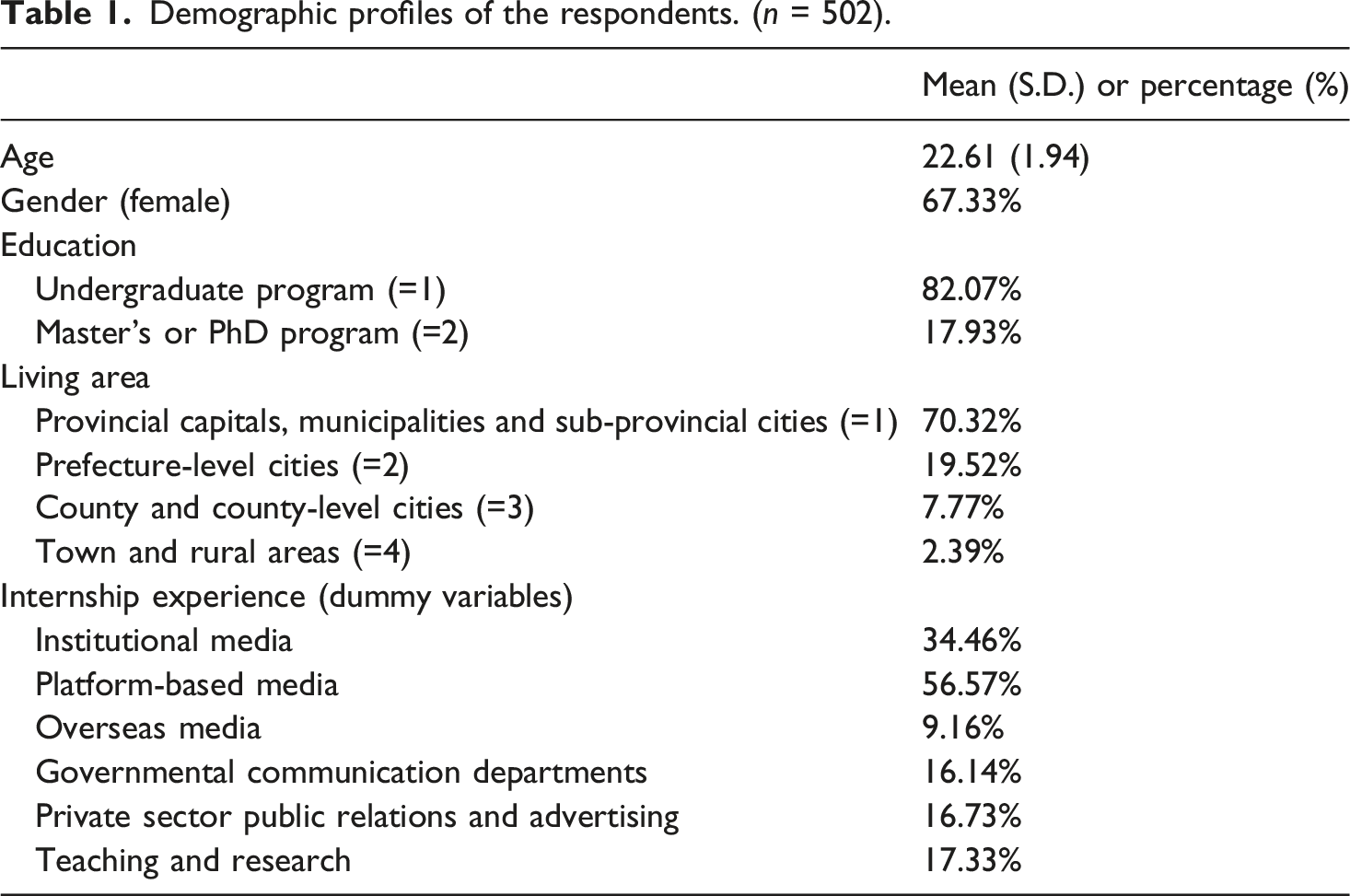
This study also controls for demographics such as gender, age, educational level (undergraduate or graduate), and living area, all of which have been shown to potentially influence career outcomes and professional views (Guo and Fang, 2023; Mellado and Scherman, 2017).
Our overall research framework is presented in Figure 1 as a mediation model linking motivations, professional identification, journalistic role perceptions, and career aspirations. The study aims to: (1) broaden research on the mechanisms shaping journalistic career aspirations by incorporating professional identity, (2) provide a possible operationalization of professional identity through the distinction between identification and journalistic roles, and (3) offer a detailed empirical portrait of Chinese journalism students’ identities and career aspirations. Research framework and hypotheses outline.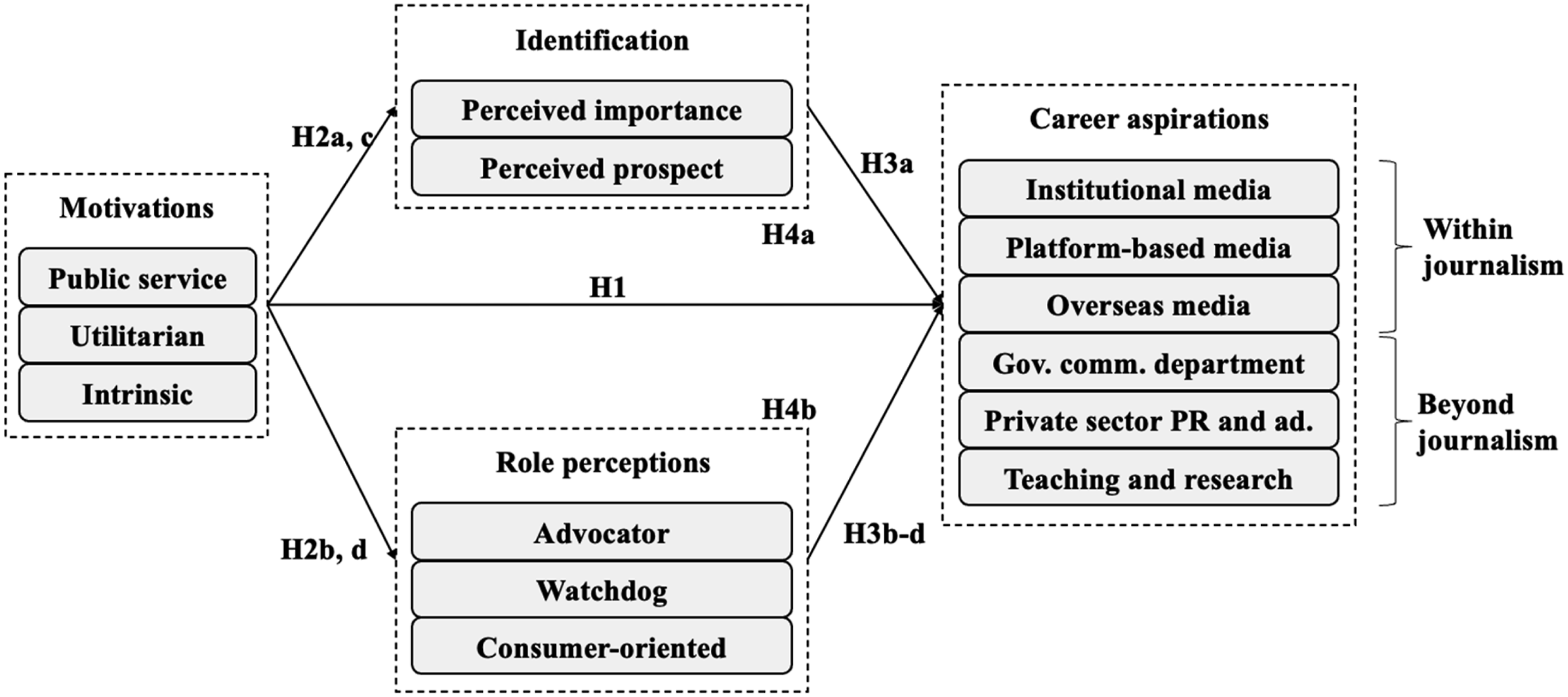
Methodology
Data collection
Demographic profiles of the respondents. (n = 502).
Measurement and descriptive statistics
Aspirations
Based on the previous studies on career aspirations (Jackson et al., 2020), this study asked the question: “If you could choose, which communication area would you like to work in for the rest of your professional career?” The specific answers are designed as five-point Likert-type scale, ranging from “1 = Strongly dislike” to “5 = Strongly like”.
The aspiration within journalism is composed of three variables: (1) institutional media (α = .668), consisting of three items including “People’s Daily, Xinhua News Agency, CCTV, and other central media”, “Southern Weekly, Beijing News, and other local media”, and “Renwu, Caixin, and other business media”. Although these media outlets vary in editorial focus and reporting style, they all function as separate, professional news institutions within China’s broader media system. Their degree of integration into the state’s publicity apparatus has grown more pronounced under state control, reinforced by declining advertising revenues and increasing dependence on government subsidies (Wang and Sparks, 2019). This article aims to explore students’ career aspirations, and these institutions offer a choice closest to the professional practice in journalism. (2) platform-based media (α = .682), consisting of three items including “News apps and websites (e.g., NetEase News, Toutiao)”, “Video media platform (e.g., Bilibili, Douyin)”, and “Social media platform, (e.g., WeChat official accounts, Weibo)”. (3) overseas media (α = .690), consisting of two items including “Hong Kong and Macau news media, such as South China Morning Post, Phoenix TV”, and “Foreign news media, such as CNN, The Times”.
The aspiration beyond journalism is also composed of three variables: (1) governmental communication departments, “News publicity departments of government and public institutions”, (2) private sector public relations and advertising, “Public relations, advertising, and corporate-related departments”, and (3) teaching and research, “Teaching and research units in the field of journalism and communication”. As depicted in Figure 2, the preference for institutional media and governmental communication departments ranks the highest, followed by teaching and research positions, as well as platform-based media. Nevertheless, careers in overseas media and private sector public relations and advertising are the least favored. Estimated means of journalism students’ aspirations in China.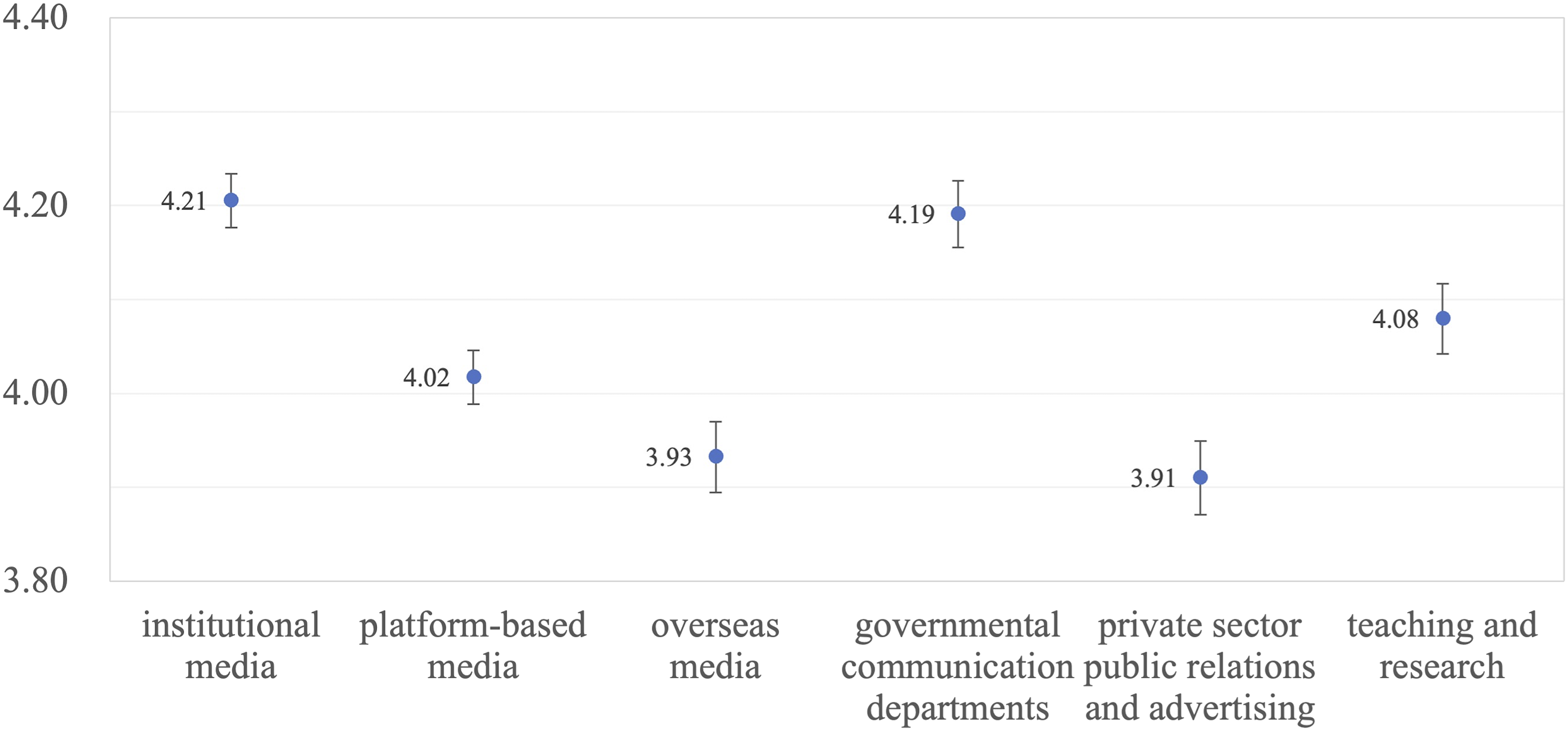
Motivations
Drawing upon the previous studies on motivations in journalism (Hanusch et al., 2016; Wang et al., 2019), this study expresses the question as “Please rate the following aspects in terms of the extent to which they motivated you to study in journalism”. Through factor analysis, three types of motivations are refined: (1) public service motivation (α = .824, M = 4.19, SD = .51), consisting of nine items, including “assisting national construction” and so on; (2) utilitarian motivation (α = .871, M = 3.74, SD = .70), consisting of eight items, including “fast personal promotion opportunities” and so on; and (3) intrinsic motivation (α = .775, M = 4.02, SD = .56), consisting of six items, including “expressing myself creatively” and so on. By comparing the means, we can observe that public service motivation has the highest score, followed by intrinsic motivation, and utilitarian motivation scores the lowest.
Professional identification
Drawing upon the scale of journalistic professional identity (Zhang and Chen, 2020), this study asked the respondents to score their agreement of the following statements. (1) Perceived importance (α = .688, M = 4.29, SD = .47) consists of five items, including “journalists are the lookouts of society”, “journalists record the transformations of society and the times”, and so on. (2) Perceived prospect (α = .841, M = 4.00, SD = .75) consists of four items, including “the news industry has a good outlook”, “I am confident in the future of the news industry”, and so on.
Role perceptions
Exploratory factor analysis of journalistic role perceptions.
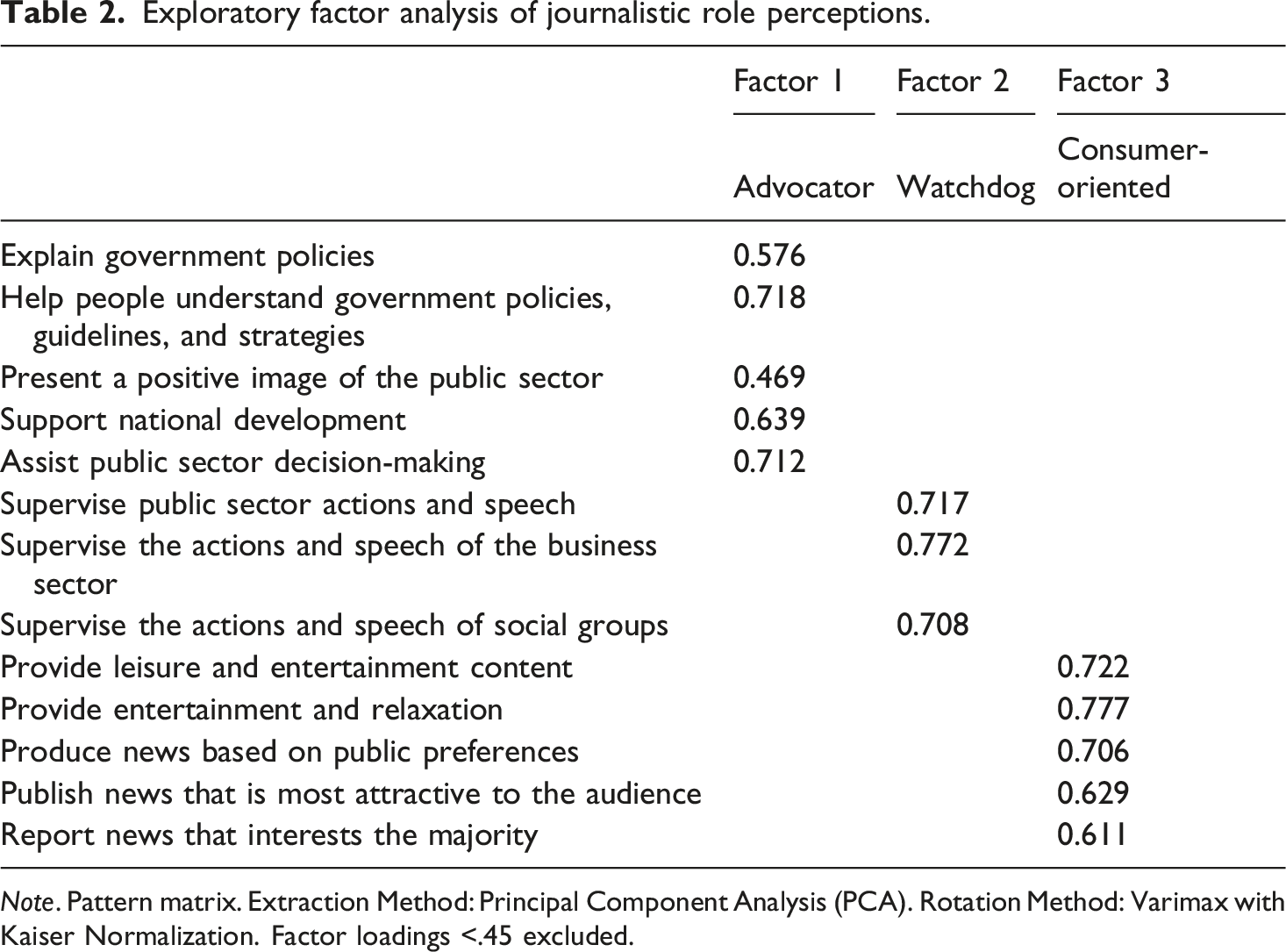
Note. Pattern matrix. Extraction Method: Principal Component Analysis (PCA). Rotation Method: Varimax with Kaiser Normalization. Factor loadings <.45 excluded.
After processing the data, we have summarized three types of journalistic roles. (1) The advocator (α = .697, M = 4.33, SD = .48) highlights the positive and supportive role of journalism in social development, in which media not only provide information from government, but also assist decision-making and bridge the government and the public. (2) The watchdog (α = .657, M = 4.32, SD = .53) role is mostly related to the supervision of the entire society, especially those who hold power. (3) The consumer-oriented role (α = .747, M = 3.93, SD = .60) mainly reflects on the market or mediatized logic of journalism, oriented toward public demand and entertainment.
Results show that on average, the participants consider the advocator role and watchdog role to be the most important, with the consumer-oriented role significantly lower. As is hypothesized, these three dimensions are aligned with the unified theory of journalistic roles (Hanitzsch, 2007), while not consistent with outcomes from specific countries, suggesting various journalistic roles in different cultures (Nygren and Stigbrand, 2014).
Analytical approach
To examine the relationships among motivations, professional identity, and career aspirations, this study proceeded in three stages.
First, we used multiple linear regressions to estimate how motivations predicted the two dimensions of professional identity, namely professional identification and journalistic role perceptions, while controlling for demographic variables and internship experience.
Second, we estimated another set of multiple linear regressions predicting career aspirations from motivations, professional identity, and corresponding internship experience.
Third, to examine the mediating role of professional identification and role perceptions more formally, we conducted a regression-based parallel mediation analysis following Hayes (2013). In these mediation models, motivations were treated as focal predictors, career aspirations as outcomes, and five variables—perceived importance, perceived prospect, advocator role, watchdog role, and consumer-oriented role—were treated as parallel mediators. Gender, age, education, living area, and the corresponding internship dummy were included as covariates. We used 5000 bootstrap resamples to estimate indirect effects and their confidence intervals.
Results
Motivation, identification, and role perception
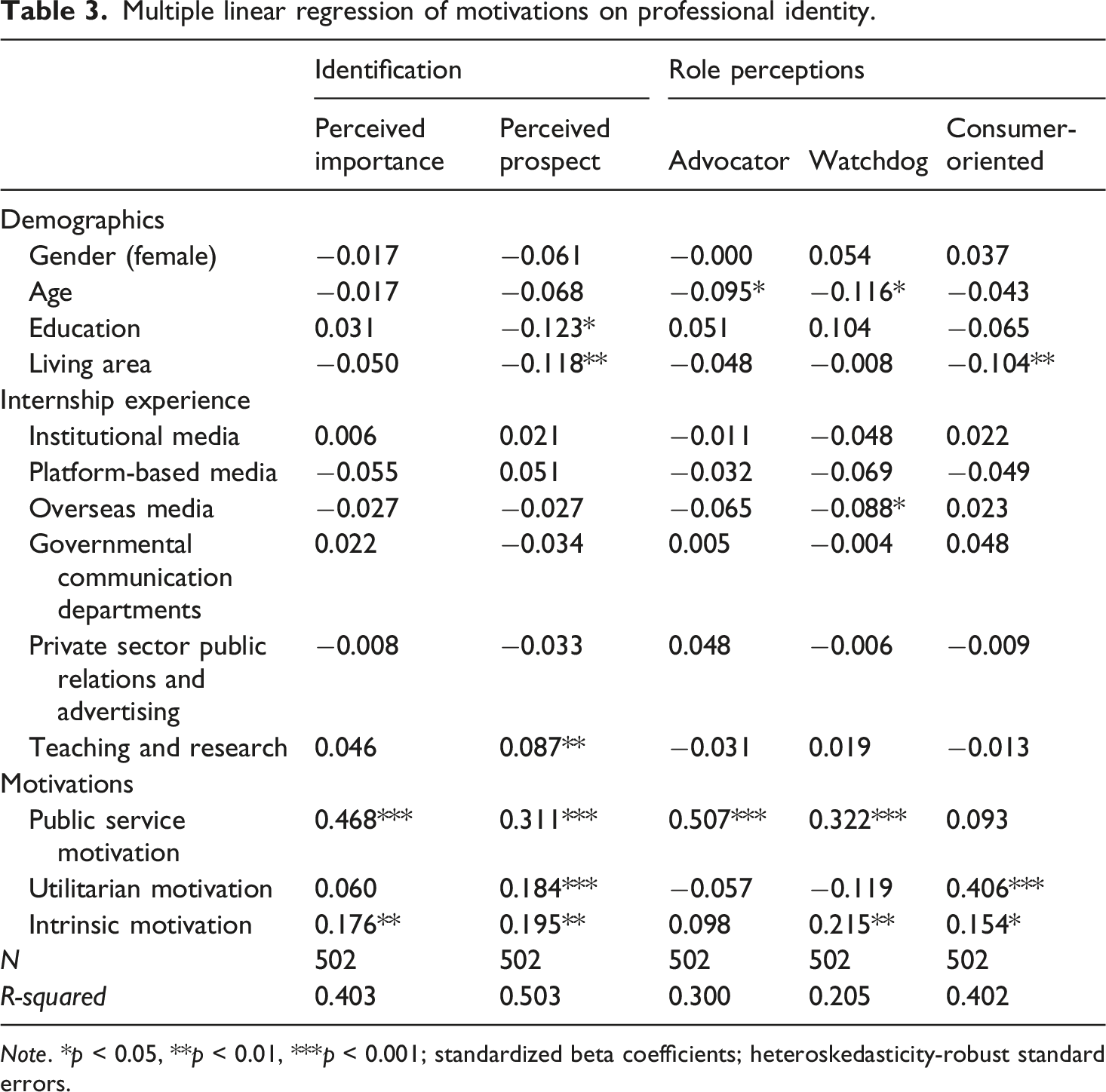
Multiple linear regression of motivations on professional identity.
Note. *p < 0.05, **p < 0.01, ***p < 0.001; standardized beta coefficients; heteroskedasticity-robust standard errors.
The findings largely support our hypotheses. Supporting H2a, public service motivation was a strong positive predictor of the perceived importance of journalism (β = .468, p < .001). Supporting H2b, it was also positively associated with both public-good roles, namely the advocator (β = .507, p < .001) and watchdog (β = .322, p < .001). Supporting H2c, utilitarian motivation significantly predicted the perceived prospect of journalism industry (β = .184, p < .001). Supporting H2d, it was also strongly associated with the consumer-oriented role (β = .406, p < .001). Beyond these hypothesized relationships, public service motivation was also positively associated with perceived prospect (β = .311, p < .001), while intrinsic motivation showed positive relationships with perceived importance (β = .176, p < .01), perceived prospect (β = .195, p < .01), the watchdog role (β = .215, p < .01), and the consumer-oriented role (β = .154, p < .05). These results confirm that students’ initial motivations are systematically linked to the specific ways they construct professional identity. Regarding the control variables, age and graduate-level education were associated with a lower perceived prospect and weaker perception of normative roles.
Factors of aspirations in media and beyond
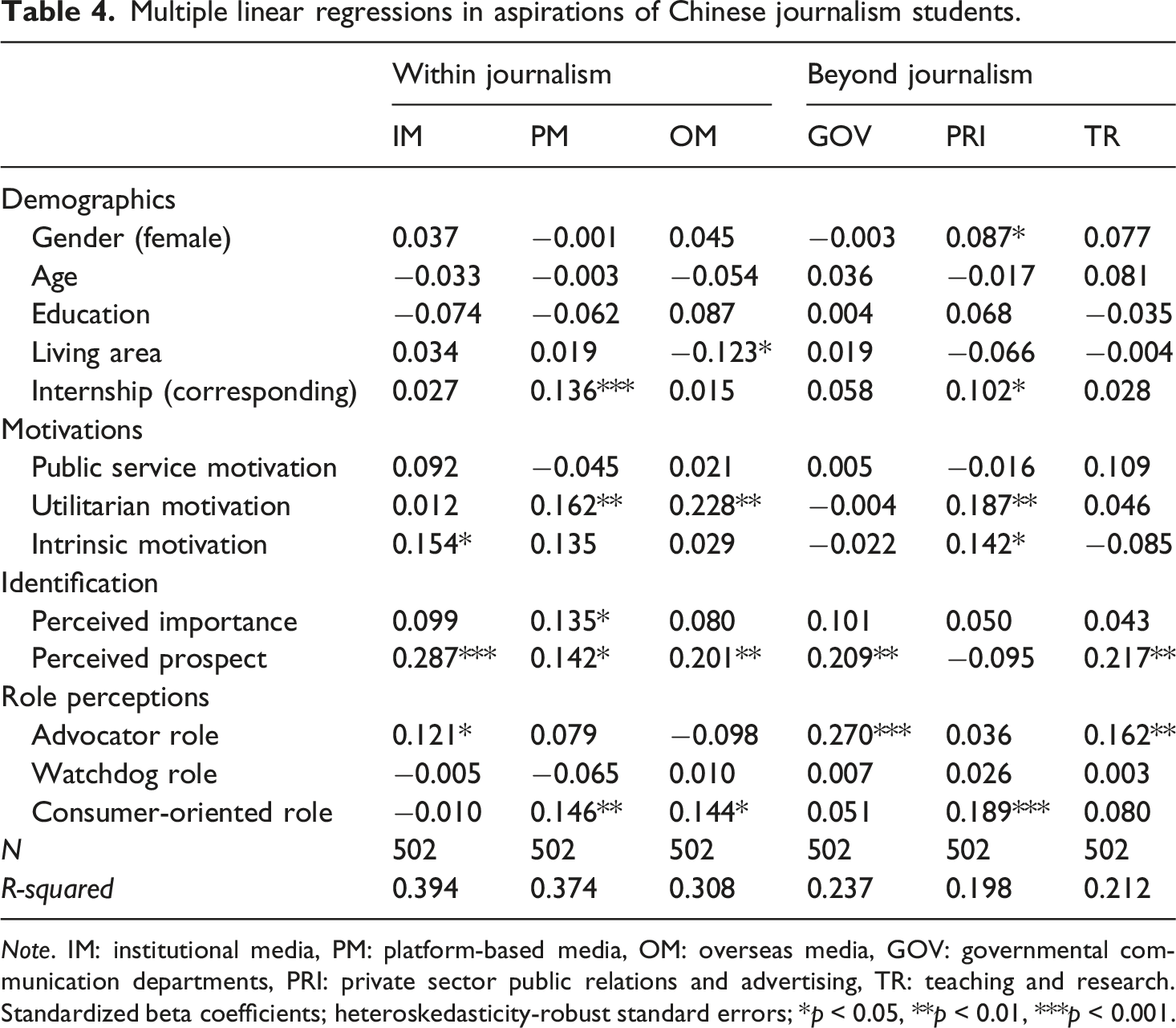
Multiple linear regressions in aspirations of Chinese journalism students.
Note. IM: institutional media, PM: platform-based media, OM: overseas media, GOV: governmental communication departments, PRI: private sector public relations and advertising, TR: teaching and research. Standardized beta coefficients; heteroskedasticity-robust standard errors; *p < 0.05, **p < 0.01, ***p < 0.001.
To enhance the intuitiveness of the results, Figure 3 displays the regression outcomes for the primary variables. Standardized coefficients of main factors on aspirations.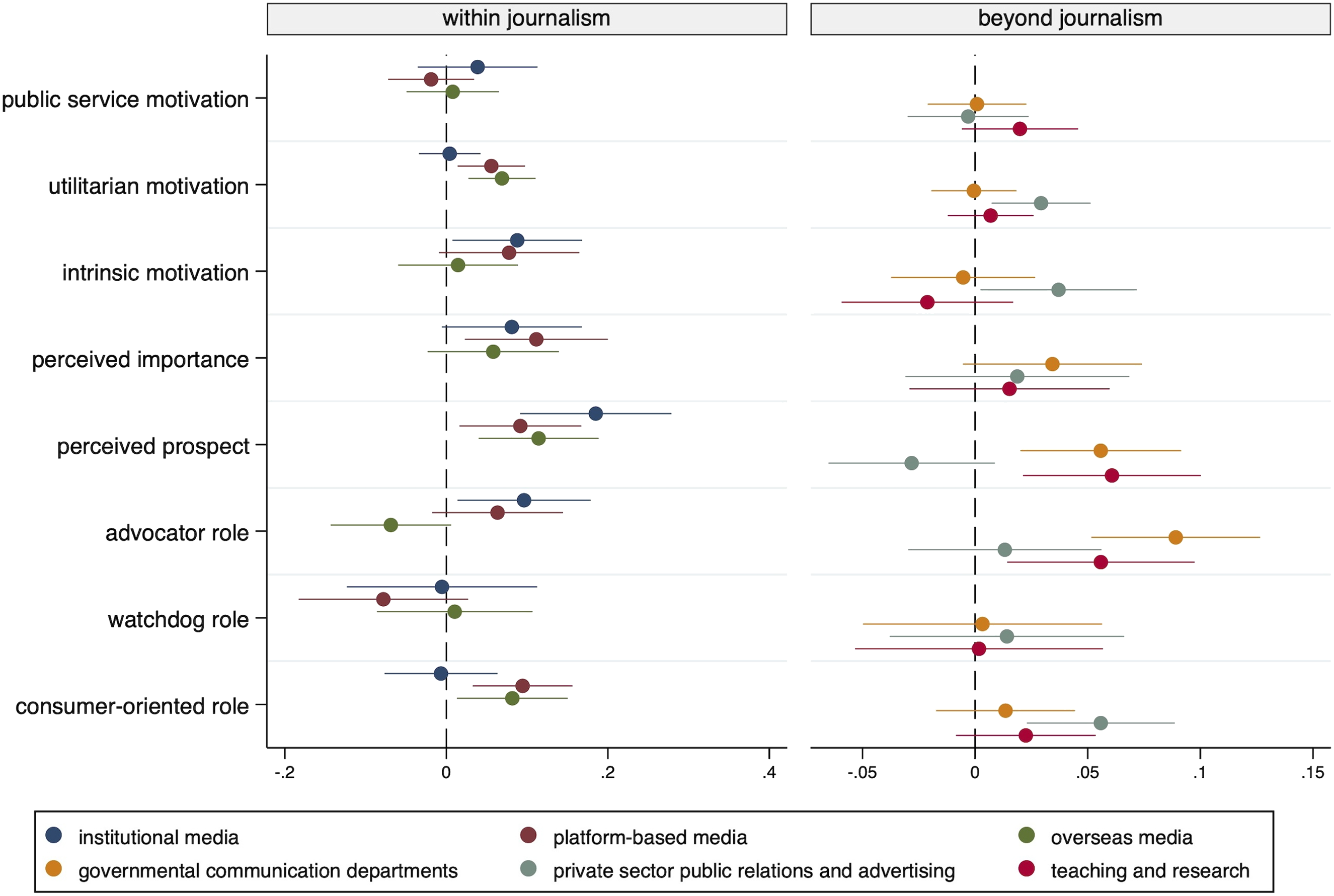
The results for H1 (direct effects of motivation) were mixed. Supporting H1b, utilitarian motivation significantly predicted aspirations for market-driven careers, including platform-based media (β = .162, p = .009), overseas media (β = .228, p = .001), and private sector public relations and advertising (β = .187, p = .009). Partially supporting H1c, intrinsic motivation positively predicted aspirations for institutional media (β = .154, p = .032). However, H1a was not supported, as public service motivation showed no significant direct effect on state-aligned career aspirations, suggesting its influence may be primarily indirect.
The influence of professional identification and role perceptions (H3) was strongly supported. In line with H3a, perceived prospect was a powerful predictor for almost all career sectors. Supporting H3b, the advocator role positively predicted aspirations for state-aligned careers like institutional media (β = .121, p = .022) and governmental communication departments (β = .270, p < .001). Aligning with H3c, the consumer-oriented role was a strong predictor for market-driven sectors. Crucially, in full support of our theorized “watchdog paradox” (H3d), the watchdog role exhibited no significant relationship with any career aspiration. Finally, we found partial but targeted support for H5a, as internship experience in platform-based media (β = .136, p < .001) and private sector public relations and advertising (β = .102, p = .015) positively predicted aspirations for those corresponding fields.
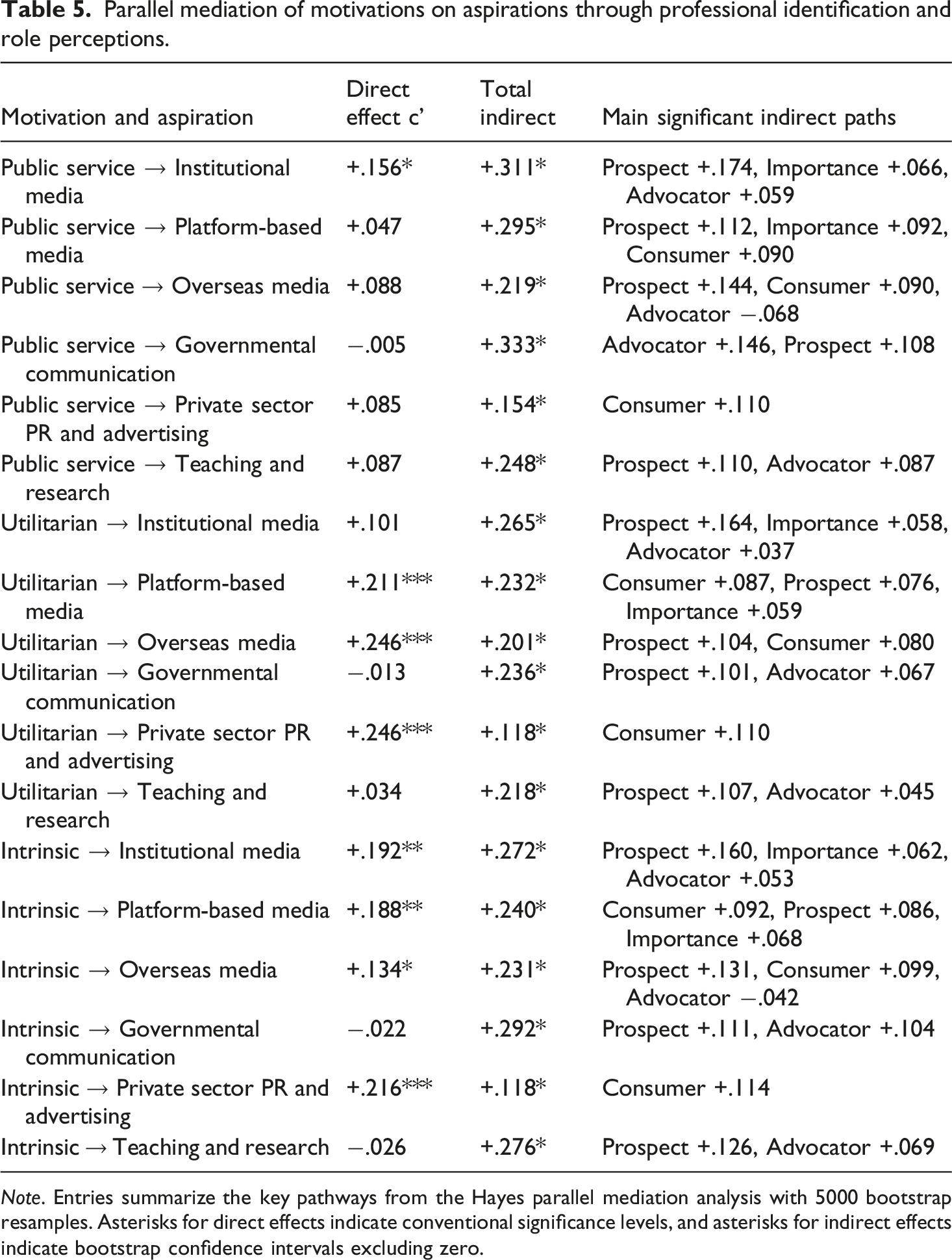
Parallel mediation of motivations on aspirations through professional identification and role perceptions.
Note. Entries summarize the key pathways from the Hayes parallel mediation analysis with 5000 bootstrap resamples. Asterisks for direct effects indicate conventional significance levels, and asterisks for indirect effects indicate bootstrap confidence intervals excluding zero.
Discussion
This study addresses a critical gap in understanding journalism students’ career aspirations by examining the relationship between motivation and professional identity within the Chinese context. Recognizing political distance as a key organizing principle, we moved beyond a simple “journalism versus non-journalism” dichotomy to analyze six distinct career sectors. Our findings offer several significant conclusions for the study of professional socialization in transitional media systems.
First, our study provides strong empirical support for professional identification and role perceptions as key mediating mechanisms, a finding theoretically grounded in Social Identity Theory. We demonstrated that motivations do not act on aspirations in a vacuum; rather, they are channeled through students’ identification with the profession and their normative role perceptions. The mediation analysis shows that public service motivation’s influence on state-aligned careers is primarily indirect, especially through perceived prospect and the advocator role. It suggests that students with this motivation construct an identity of national contributor, and choose sectors such as institutional media. This pattern of mediation is consistent with SIT’s core proposition that group belonging and normative values jointly channel behavioral intentions, students intend to choose these institutions as the most legitimate venues for enacting that identity. Furthermore, our finding that public service motivation is a stronger driver than intrinsic motivation aligns with previous research indicating that extrinsic, socially-oriented motivations are often more significant than intrinsic factors in developing countries (Calderón et al., 2021).
Second, our findings reveal that the primary axis of career differentiation for Chinese journalism students is not “journalism versus non-journalism,” but rather a strategic navigation between “political” (state-aligned) and “non-political” (market-driven) sectors. This is most starkly illustrated by the divergent paths predicted by the advocator and consumer-oriented roles. The advocator role, coupled with public service motivation, significantly predicted aspirations for the most politically proximate careers. Conversely, the consumer-oriented role and utilitarian motivation consistently predicted interest in market-driven paths. This bifurcation highlights the enduring tensions between political and commercial logics within the Chinese media system, a dynamic that has shaped the industry since the market reforms of the late 20th century (Stockmann, 2013). The “watchdog paradox”—where the role is normatively valued but has no predictive power for career choice—further underscores this reality. It suggests that students pragmatically recognize the political constraints on journalistic scrutiny and do not factor this ideal into their career calculus. In the Chinese context, the ideal of supervision retains normative legitimacy, but its practical exercise remains bounded by institutional constraints. This pattern may also be relevant beyond China, where democratic backsliding weakens institutional protections for investigative reporting (Bermeo, 2016; Levitsky and Way, 2025), journalism students may similarly learn to decouple normative ideals from practical career planning, producing a watchdog endorsement widespread in surveys yet absent from occupational choices.
Third, our results call for a more cautious interpretation of the role of journalism education and highlight the context-specific role of internships. Higher education level and age were associated with lower perceived prospects of the profession and weaker support for idealistic roles. This pattern may reflect disenchantment of the profession, but it may equally result from self-selection effect that students with more pessimistic outlooks may be more likely to continue their education. Our cross-sectional data do not permit a causal attribution, and this finding should therefore be interpreted cautiously. This both aligns with and qualifies prior work showing mixed effects of journalism education on career aspirations (Jackson et al., 2020; Pereira, 2025). Moreover, the limited impact of internships—significant only for the most commercialized paths—suggests that practical experience may be more effective at consolidating career choices in market sectors, where skills and outcomes are more tangible, than in state-aligned sectors, where careers are more bureaucratically and politically structured. Regarding gender, our finding that female students show a higher preference for private sector public relations and advertising is consistent with prior research (Mellado and Scherman, 2017).
These findings have important implications for research on the career decisions of journalism students, as well as the professional identity within Chinese journalism. However, this study has several limitations. First, our two-dimensional operationalization of professional identity, while empirically tractable, leaves aside its historical formation, symbolic negotiation, and micro-sociological dynamics (Raemy, 2021); richer qualitative or longitudinal measures would capture these dimensions. Second, our data, drawn from elite universities, may not be generalizable to the broader population of journalism students in China. The career considerations of students at provincial or vocational colleges may differ significantly. Third, this study is performed in China, and its findings are deeply embedded in a unique media system. While employing political distance as a metric offers novel insights, it also limits the direct applicability of the findings to other national contexts. Therefore, we urge future studies to look into the localized media landscape before analysis. Finally, this cross-sectional study captures a snapshot in time; a longitudinal study would be invaluable for tracking how students’ identities and aspirations evolve from their freshman year through to their early careers, providing a more dynamic picture of professional socialization.
Footnotes

Funding
The authors disclosed receipt of the following financial support for the research, authorship, and/or publication of this article: This work was supported by Humanities and Social Science Fund of Ministry of Education of China [Grant Number: 23JHQ083] and the Shenzhen University Social Science 2035 Program [Grant Number: ZYZD2406].
Declaration of conflicting interests
The authors declared no potential conflicts of interest with respect to the research, authorship, and/or publication of this article.