






Abstract
Artificial intelligence (AI) is not merely a technical tool in journalism; its use reflects and reshapes different journalistic cultures. Using corpus-assisted discourse studies (CADS), this comparative study examines 329 articles published between 2019 and 2025 in newspapers from the United States, France, and China about AI-in-journalism. Results show that utopian and dystopian sociotechnical imaginaries (SIs) of AI-in-journalism functioned as constitutive pairs. While the utopian imaginary travelled easily across all national contexts, articulations of dystopian imaginaries diverged along journalistic cultures, yielding three distinct SIs: precarious AI-exploited journalism (the United States), resistant human-guarded journalism (France), and disciplined AI-powered journalism (China). These imaginaries revealed how narratives of AI reflect and reconstitute anxieties in journalistic cultures, demonstrating the co-production of technological and social orders. Theoretically, the study makes two contributions. First, it inverts the SI lens of “desirable futures” to show how undesirable futures of AI-in-journalism reflect each journalistic culture’s own characteristics. Second, it puts the Worlds of Journalism Study in dialogue with the SI framework, suggesting that the cultural meanings of news production shape how the meaning of AI is being discursively constructed.
Keywords
Introduction
In February 2019, The New York Times cautiously commented on “the rise of robot reporters,” a trend boosting content output and reducing errors, even as newsrooms faced widespread layoffs (The New York Times, 5 February 2019). In March that year, China Daily celebrated the performance of the world’s first virtual news anchor Xin Xiaomeng while claiming that human reporters were still irreplaceable (China Daily, 13 March 2019). Around the same time, Le Monde warned that automation was deepening the media’s economic crisis and urged the European Union to support high quality journalism as a public good (Le Monde, 26 March 2019). On the surface, these stories report on the same phenomenon of AI-in-journalism; but in fact, they articulate distinct and culturally contingent visions of what the use of AI means for each journalistic culture.
From automated reporting to computational journalism, each technological wave has prompted journalism to renegotiate its professional identity (Raemy et al., 2024). AI is the latest, and arguably one of the most significant, iterations of that dynamic. Yet, as Suchman (2023) argues, AI operates as “a floating signifier”: its meaning is neither fixed nor inherent. What the use of AI means for journalism, therefore, is not given but is being constantly and discursively constituted. If “AI is not only a technology but also a story” (Coeckelbergh, 2021:63), then who better to tell, shape and contest such stories than journalists themselves? After all, journalists do not merely record reality, but actively drive and reframe it (Yan, 2020). In this sense, the way AI-in-journalism is framed in news stories as “cultural artifacts of journalistic practice” (Hanitzsch et al., 2019a: 34) reveals deeper meta-journalistic discourses (Carlson, 2016) that highlight the similarities and differences across journalistic cultures.
In this context, this study draws on the conceptual framework of sociotechnical imaginary (SI) to explore how newspapers discursively construct AI’s integration in journalism. Adopting corpus-assisted discourse studies (CADS), this study raises the following questions:
How do leading newspapers in the U.S., France and China discursively construct AI-in-journalism?
What SIs of AI-in-journalism emerge from these discursive constructions?
How do SIs of AI-in-journalism reflect and reconstitute each journalistic culture?
The study adopts a comparative design. Responding to Hanusch and Vos’ (2019) call for rigorous case selection in comparative journalism, this paper analyzes the U.S., France, and China. The productive tension among these three cases arises from the distinct positions they occupy within the Worlds of Journalism Study (WJS) typology, contrasted against their shared status as global leaders in AI development. According to WJS, American and French journalists tend to cluster around monitorial and accommodative roles (Hanitzsch et al., 2019b: 182). As such, bringing the American and French cases into comparison asks whether journalistic cultures sharing a similar typology in WJS nonetheless construct AI’s meaning for journalism differently. China is presented as an example from the Global South, one where a collaborative press creates fundamentally different challenges for AI integration. And yet, despite differences in journalistic cultures, the three countries are generally considered as leaders in AI innovation (Maslej et al., 2025). Building on these three countries’ relative consensus of the strategic stake in AI (Bareis and Katzenbach, 2021), the analysis focuses on how different journalistic cultures construct and are shaped by the SIs of AI-in-journalism.
Conceptual framework
Sociotechnical imaginary
SI refers to “collectively held, institutionally stabilized, and publicly performed visions of desirable futures, animated by shared understandings of forms of social life and social order attainable through, and supportive of, advances in science and technology” (Jasanoff, 2015: 4). The framework carries a particular interest in the role of language as a “crucially important medium for the construction of imaginaries” (Jasanoff and Kim, 2009), and has gained traction in recent years as scholarship moves toward an understanding of technology as a co-producer of societal futures (Hendriks et al., 2025). Accordingly, this study treats AI as a discursive object, one whose meaning, boundaries, and implications can vary across interpretive practices, co-produced at the intersection of technological and social orders (Jasanoff, 2004). Because imaginaries need to be sustained through public performances (Richter et al., 2023: 216), the empirical studies of SI have gravitated toward policy discourse (Bareis and Katzenbach, 2021; Chung, 2025) and market materials (Cowls and Ma, 2023; Lucia et al., 2023), venues where such performances are explicit and legible. Journalism, as a constitutive institution of public knowledge, remains a comparatively understudied site (Vicente and Dias-Trindade, 2021).
This study operationalizes the SI framework in two ways. First, it bounds the “collective” at a national scale (Kuchler and Stigson, 2024). Although imaginaries could travel transnationally, they stabilize and institutionalize within national frames(Wang and Downey, 2025)Wang et al., 2025), and journalistic cultures remain anchored in national role orientations (Hanitzsch et al., 2019b). These national boundaries define the “we” that collective visions of AI are built on. Second, the study extends the question of “desirability” of SIs, and acknowledges the existence of both utopian and dystopian imaginaries. In existing literature, scholars have asked whether visions of technology are ever purely desirable, suggesting instead that desirability should be understood as a scale (Cools et al., 2024), and that sociotechnical visions can be “more or less socially desirable” depending on the standpoint from which they are imagined (Wang et al., 2025). This contestation can be further observed empirically in AI coverages, which are often found to oscillate between optimistic portrayals of technology (Brennen et al., 2018), and critical discourses foregrounding risks and harm (Nguyen and Hekman, 2024). Based on the above, the paper defines utopian SIs of AI-in-journalism as nationally held visions of desirable futures for AI’s engagement in journalism; and dystopian SIs of AI-in-journalism are treated as a nationally held visions of futures for AI’s engagement in journalism that need to be averted or resisted.
Journalistic culture as the arena of SI performance
Journalism, like the framework of SI, is a discursive practice through which meanings are constructed (Zelizer, 2017). This approach to understanding journalism echoes SI’s premise that visions of technology need to be discursively constructed and publicly performed. Indeed, the affinity between the two fields has been latent in scholarship on journalistic engagements with technology. When discussing the impact of automated journalism, Carlson (2014) argues that “the question becomes not only how technological changes alter news practice, but more importantly how they alter the ways in which practice is imagined [emphasis added] by the actors involved.” That is, what technology destabilizes is not only journalistic practice per se, but more importantly, journalism’s boundaries: its meaning-making through how key actors negotiate and defend the limits of this profession (Carlson, 2015).
To understand the co-production of AI and the journalistic field through the linked lens of SI and journalism studies, this paper identifies a “collective” that holds a shared sociotechnical vision through the lens of journalistic cultures. Hanitzsch (2007) theorizes journalistic culture as a set of three dimensions: epistemological beliefs, institutional roles, and ethical ideologies, that operate across cognitive, evaluative, and performative levels within each dimension. This provides the internal logic that allows journalists in a national community to reach a “shared understanding” of sociotechnical orders, as described by SI. Thus, journalistic culture can act as the filter through which emerging technologies are understood (Hanusch and Vos, 2019).
This study employs this lens to study metajournalistic discourses, where news stories themselves are treated as artifacts that reveal the underlying journalistic culture (Hanitzsch et al., 2019a: 34); that is, how journalists verbalize and negotiate their roles (Standaert et al., 2019). Because journalistic culture is theorized as both the context and the result of negotiation (Raemy et al., 2024), journalists as an “interpretative community” (Zelizer, 1993) could use these public narratives to rationalize norms and redefine journalism in the face of technological shifts. By analyzing how journalists write about AI-in-journalism, “co-production” can be observed in real time: the narratives are constructing and performing a vision of the technology, while the technology is simultaneously being shaped by the journalistic field itself.
Literature review
The “AI turn” in journalism
Journalism’s relationship with technological change is neither new, nor straightforward. Technology is not only the future of journalism but also its past (Dodds et al., 2025). Digital technology has had an impact on journalism innovation for over four decades (Lindén, 2017; Pavlik, 2000), with successive waves of innovation in automated journalism (Carlson, 2014), computer-assisted reporting and computational journalism (Coddington, 2014), and algorithmic journalism (Dörr, 2015), among others. In this sense, as Usher (2025) cautions, new technologies are “always already new”: the discursive patterns that emerging technologies generate are always structurally familiar, belonging to a recurring set of negotiations over what technology means, and what purpose it should serve.
However, the scale and intensity of these negotiations since the rise of generative AI in 2022 mark a new threshold that is worth examining. The current “AI turn” (Dodds et al., 2025) represents a shift from tool-centric automation to the integration of AI positioned as a potentially “independent communicator” that unsettles traditional distinctions between human and machine roles in journalism (Lewis and Simon, 2022). It could also potentially encode and amplify existing sociotechnical challenges, such as organizational and economic asymmetries (Hayes, 2024; Moran and Shaikh, 2022). Therefore, this wave of technological transformation seems to not only reconfigure news workflows, but also the profession’s boundaries and self-understanding (Milosavljević and Vobič, 2021; Wu et al., 2019). Yet, journalists are not merely subject to this disruption. They are also among its most prominent narrators who are tasked to publicly explain what AI means for society at large (Nguyen and Hekman, 2024). This doubly entangled position of journalism as both the object of, and the discourse maker about AI-driven transformation, makes metajournalistic discourse a particularly productive site for examining how AI imaginaries are co-produced.
AI imaginaries in journalism
As mentioned above, journalism can serve as a primary discursive site where society negotiates the meaning of emerging technologies (Vicente and Dias-Trindade, 2021). Historically, this sense-making has swung between two extremes, either hyping technologies as utopian miracles, or criticizing them as dystopian catastrophes (Cools et al., 2024). With AI, however, much of the current reporting proceeds at a high level of abstraction of “AI-in-general” (Lammar et al., 2025), that is, vague reporting of AI without depiction of its specific deployment. When journalists report on AI as being embedded in newsroom practices, the gaze is shifted inward to a metajournalistic narrative. The tension between utopian and dystopian narratives could therefore be better contextualized: the utopian imaginary legitimates a “reinvention” of the craft through automated precision and of the audience as digital-savvy (Harbers, 2023), while the dystopian imaginary foregrounds the potential displacement of journalists’ epistemic authority and role as truth-seekers (Perreault et al., 2025; Perreault and Ohme, 2025).
Yet the current understanding of these competing imaginaries remains thin. Hanusch and Vos (2019) identified a structural imbalance in the literature where Western-centric work can mistake Anglophone journalistic professional anxieties for universal truths. Villagrán Sánchez and López Pan’s (2025) systematic review on metajournalistic discourse scholarship confirms this structural imbalance. Therefore, this paper addresses the necessity to shift the lens toward non-Anglophone journalistic communities by conducting a cross-lingual investigation of metajournalistic discourses at utopian and dystopian levels.
Methodology
Corpus-assisted discourse studies (CADS)
This study employed CADS, combining corpus linguistics (CL) and the discourse-historical approach (DHA) within critical discourse studies (CDS). This union has been thought of as “a useful methodological synergy” (Baker et al., 2008): as CL aims to identify broad patterns of the text through analyses on frequency, collocates, and diachronic changes, DHA helps locate key patterns in discursive strategies for closer examination. Mainly, DHA deals with the following aspects of the text: discourse topics, key actors, and the underlying power relations that are uncovered through employing discursive strategies (Reisigl and Wodak, 2009). Among the five discursive strategies, researchers often prioritize argumentation and the use of topoi for their ability to offer insights into underlying rhetorical themes (Yeo et al., 2025). A topos constitutes a conceptually flexible but often implicit argumentative anchor, as it leverages knowledge which is taken for granted culturally to warrant claims and reinforce dominant ideologies (Burroughs, 2014).
Given the shared interests of SI and DHA in viewing language as a “crucially important medium for the construction of imaginaries” (Jasanoff and Kim, 2009), DHA has been widely used among existing studies of similar conceptual interests (Cowls and Ma, 2023; Pentzold and Knorr, 2024; Sadowski and Bendor, 2018). In light of this, the use of CADS in this study not only aligns with established methodological practices, but also offers a fresh perspective with cross-lingual comparison in CADS to expand analytical depth and precision (Vessey, 2013).
Data and methods
Following the practice of CDS analysts to draw “critical discourse moments” from reiterative selection of specific narratives (Carvalho, 2008), this study drew on three self-compiled corpora: the American journalism corpus (U.S. corpus, n = 101), French journalism corpus (FR corpus, n = 138) and Chinese journalism corpus (CN corpus, n = 90). Each corpus included texts from two legacy media: The New York Times and The Washington Post for the U.S. corpus, Le Monde and Le Figaro for the FR corpus, China Daily and Global Times for the CN corpus. 1 Each pair of media outlets was selected based on two primary criteria: readership base and influence, and sustained coverage of AI (see Appendix 1). To maintain consistency, each outlet was sampled in its primary language of publication: French for the French corpus, 2 English for the U.S. and Chinese corpora.
Overview of selected news data (2019-2025).
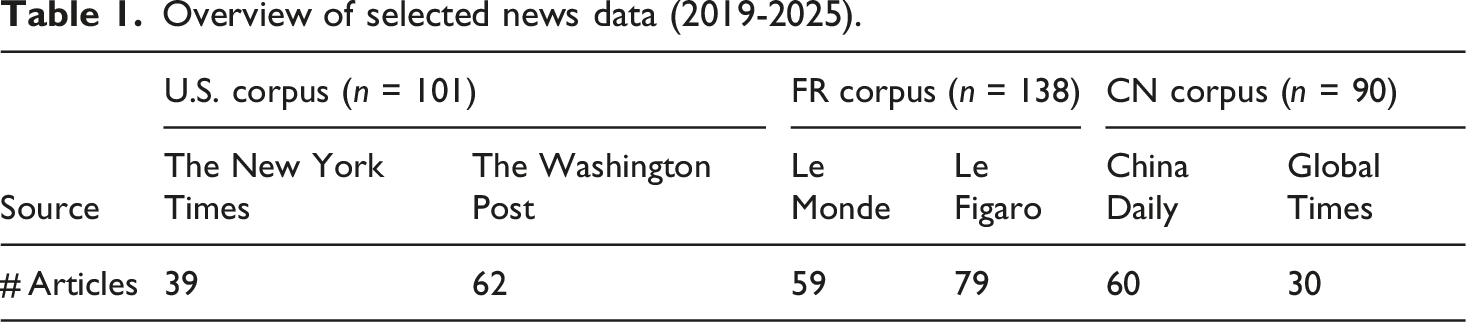
Following data collection, each corpus was divided by year into smaller subsets and processed in Excel to extract publication trends. Next, with the help of the CL software Sketch Engine, high frequency words (minimum frequency≥50, frequency per million ≥500, stop words excluded), keywords (enTenTen21 as English reference corpora and frTenTen23 as French reference corpora) and collocates (L5 to R5) of “journalism” and “journalist” were extracted and analyzed in each corpus. While these features help establish the corpus’s overall “aboutness” (Baker, 2006: 55), they risk losing nuance if taken alone. To address this, concordance lines and surrounding contexts were closely examined to complement quantitative patterns with deeper textual insight. From there, a mapping of discourse topics was conducted, capturing what the texts were about, and key actors emerged.
Next, drawing on their in-depth familiarity with the corpora, two co-authors collaboratively conducted manual annotation sessions to identify the use of topoi across texts. Following DHA’s abductive approach (Wodak and Meyer, 2015a:31), they first searched deductively using established DHA topoi as sensitizing concepts (Boukala, 2016; Rheindorf and Wodak, 2020; Wodak, 2015; Wodak and Boukala, 2015), then iteratively returned to the corpora to generate corpus-specific topoi inductively. This movement between theoretical categories and the multilingual data allowed the analysis to remain grounded in DHA, while staying responsive to the specific discursive features emerged from each corpus.
The identification of topoi was operationalized via the underlying warrant of conditional or causal paraphrases, such as “if x, then y” or “because x, y” (Wodak and Meyer, 2015b: 34). Through multiple rounds of discussions, the authors discarded topoi appearing only once across the corpora, and topoi with overlapping boundaries were merged into more distinct and analytically robust categories. This process yielded a final set of 14 topoi. Because certain topoi are direction-neutral in nature (Wodak, 2015), e.g., the topos of number could be used either to promote AI’s efficiency or to condemn the scale of AI-generated misinformation, the authors tracked the predominant argumentative direction in which each topos was deployed across corpora. Finally, the co-authors synthesized all prior findings, treating them as analytical building blocks and reached full consensus in the construction of SIs of AI-in-journalism.
Results
Publication trends
Publication trends revealed that news coverage of AI-in-journalism had grown noticeably over time [insert Figure 1]. After a brief period of decline between 2019 and 2021, the number of related articles began to rise steadily from 2022, reaching its highest point in 2024 across all three corpora. This trend persisted for the first five months of 2025 (end of study period), reflecting ongoing interest in the topic. The U.S. corpus had fewer articles initially, but its coverage increased sharply from 2023 onward. In contrast, the CN corpus led in article numbers in 2019, then mirrored similar growth trajectories as the other two corpora. Meanwhile, the FR corpus showed steady engagement throughout the period. The data suggested that over the seven years, the topic of AI-in-journalism had shifted from being a speculative or peripheral subject to becoming a more lasting and prominent theme in news coverage. Number of publications by outlet and year.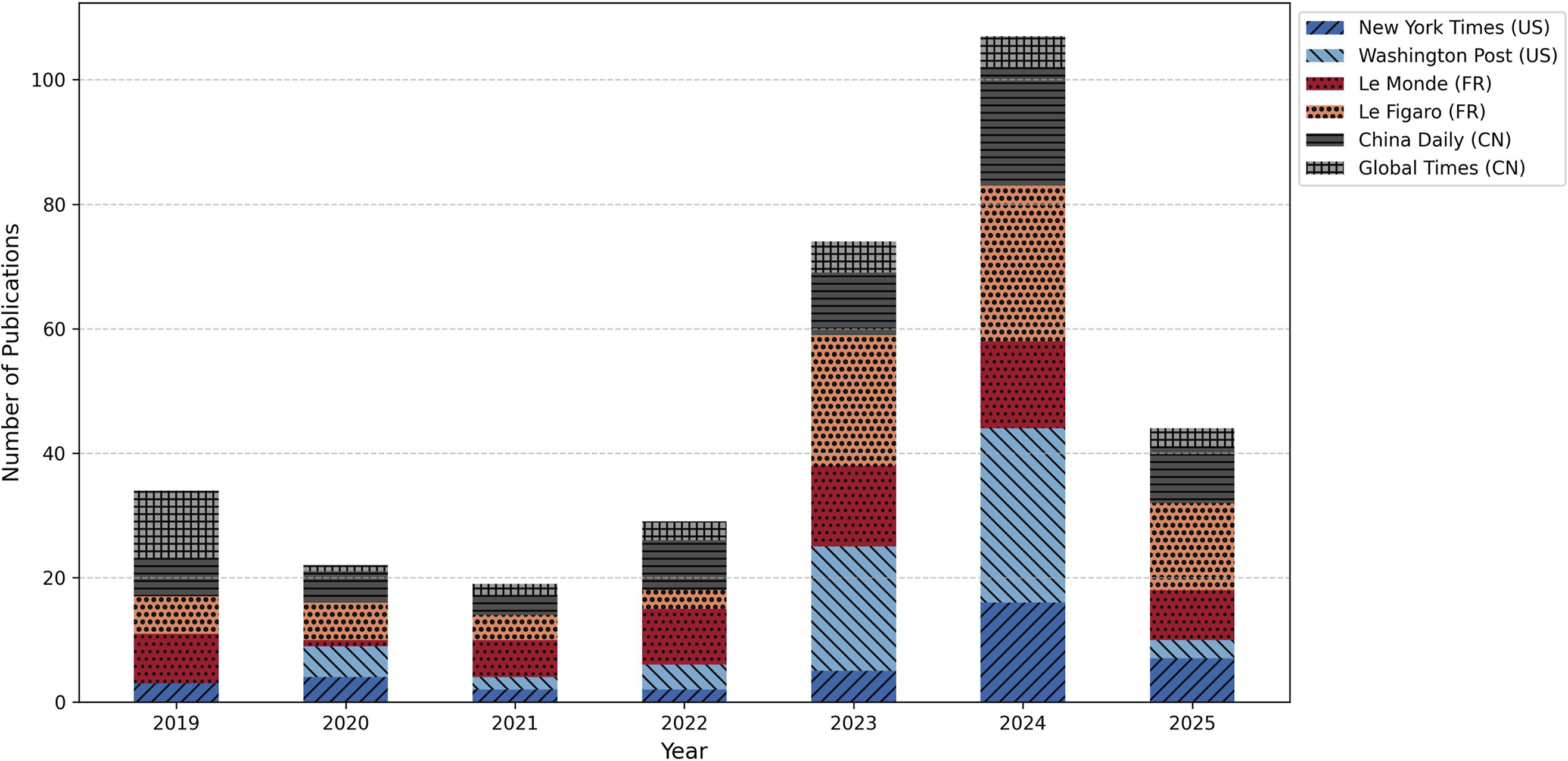
Discourse topics
The analysis of discourse topics (see Appendix 3) was methodologically grounded in the diachronic and synchronic dimensions central to the DHA (Wodak and Meyer, 2015a), revealing both shared and context-specific topical focuses.
A substantial set of topics converged across all three corpora. All three addressed AI’s impact on news-making routines, such as automated content generation and AI-assisted fact checking. Controversies were also discussed, such as shifts in human journalistic labor, the fluctuating power dynamics between journalistic outlets and platforms, and information disorder, such as AI-generated misinformation and disinformation amplified by bots.
At the same time, each corpus highlighted topics that reflected its own national context. In the U.S. corpus, attention was put on industry scandals, e.g., AI-fabricated articles at Sports Illustrated, undisclosed machine-written reviews at CNET, and mass layoffs at Gannett. There was also a strong focus on the on-and-off commercial partnerships and legal disputes between big tech and news outlets, e.g. The New York Times vs. OpenAI (2023), and Associated Press’ collaboration with OpenAI (2023). The FR corpus consistently emphasized regulatory developments, following a trajectory from early clashes with GAFA over media remuneration rights (2019) to more pragmatic negotiations aimed at regulatory consensus (2022). Meanwhile, the CN corpus spotlighted state-driven media integration as part of a broader digital transformation at national scale, presenting newsroom changes as institutional achievements. At the same time, it positioned key events such as AI-powered coverage of the 2022 Beijing Winter Olympics as examples of media innovation.
The convergences and divergences in discourse topics demonstrated that while discourses on AI’s integration into journalism constituted a shared global condition, the focuses of each nation remain distinct. The next section will address the question of who holds the discursive power that constructs these topics.
Actors in AI-in-journalism
Anchored in the frequency analysis, this paper identified key actors among five categories: Journalistic, Technological, Business, Governmental, and Societal (see Appendix 4).
All three corpora included strong involvement of actors from traditional journalism fields (journalist, editor, press, outlet) as well as technological actants (data, platform, algorithm). Regarding cross-cultural differences, unique terms in the U.S. corpus included early trials in machine-written news (sports) and the latest technological buzz (ai-generated, chatgpt). The FR corpus highlighted terms related to legacy press and traditional gatekeeping practices (éditeur [editor], presse [press], quotidien [daily], rédaction [editorial]), and AI’s everyday touchpoints with citizens (algorithmes [algorithms], compte [account]). The CN corpus focused on terms related to multi-modal content (photo, video), highlighting AI as a production tool for various media formats.
Terms in the remaining categories exhibited less overlap. The U.S. corpus constructed a market-oriented narrative concentrated with Business terms (business, industry, company) and consumer-focused vocabulary (story, user*). It devoted relatively little attention to the Governmental or Societal categories. In contrast, the FR corpus distributed terms more evenly across categories. It highlighted national identity (france, français [french]), legal frameworks (loi [law], droit [right]) and societal risks (désinformation [disinformation]). The CN corpus concentrated on the Governmental category, and uniquely favored keywords on economic development in the Business category (award*, cooperation, forum). Variances in key actors implied different discursive approaches to imagining AI-in-journalism, as each actor would speak from their own perspective.
Use of topoi in SI of AI-in-journalism
Fourteen topoi were identified in total. Four topoi (the topoi of numbers, opportunity, necessity, and purpose) appeared across all three corpora, while ten topoi were predominantly corpus-specific. These included the topoi of history, definition, and danger in the U.S. corpus; the topoi of humanitarianism, injustice, responsibility, and dilemma in the FR corpus; and the topoi of consequences, usefulness, and reality in the CN corpus (see Appendix 5).
Topoi in convergence
The topos of numbers was primarily invoked to substantiate AI’s promise as a productivity tool, its efficiency quantified through output metrics in all three contexts. The topoi of opportunity and necessity jointly framed adoption as both advantageous and inevitable for newsroom modernization. The topos of purpose primarily evoked AI’s strategic value in enhancing journalistic values and the benefits for the broader society. This showed that these four topoi constructed a cross-border utopian SI, framing AI in journalism as efficient, inevitable, and strategically purposeful.
Topoi in divergence
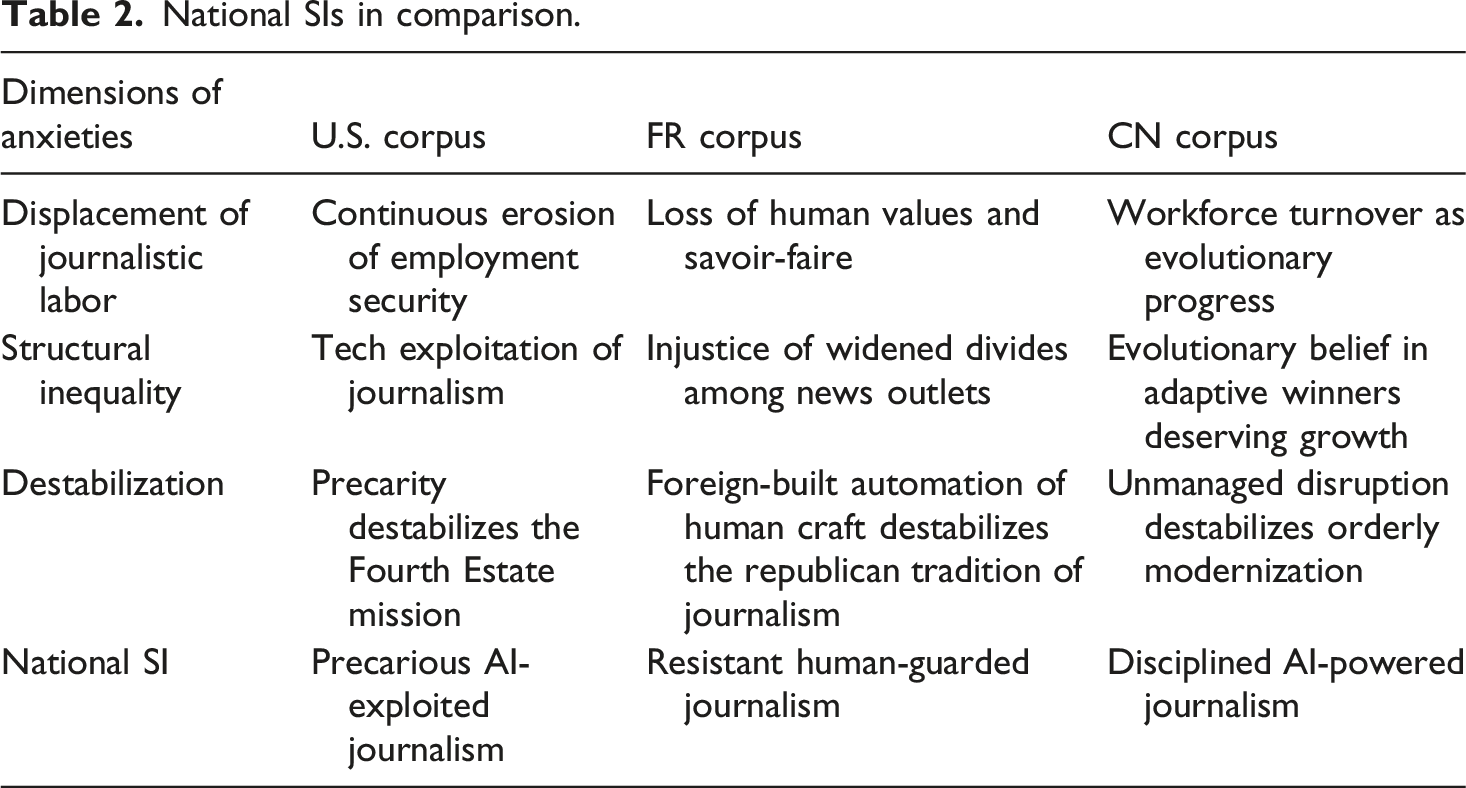
By contrast, the topoi sustaining dystopian imaginaries diverged along national lines. The U.S. corpus primarily used the topoi of history, definition, and danger. The topos of history situated AI-driven job displacement within a longer arc of employment insecurity in the journalism field; the topos of definition drew boundaries between “real” journalism and AI-generated content; and the topos of danger was evoked to express ideological threat posed by AI-powered foreign actors. For the U.S. corpus, AI was feared as an agent of erosion of stability, be it on the traditional journalistic roles, or on the building of public consensus. The FR corpus mainly focused on the topoi of humanitarianism, injustice, dilemma, and responsibility. The topos of humanitarianism defended the irreplaceable value of human journalists’ savoir-faire against automation; the topos of injustice highlighted how AI adoption widened resource inequalities between well-resourced and smaller outlets; the topos of dilemma framed French media as caught between institutional survival and dependence on foreign algorithmic infrastructures; the topos of responsibility urged the development of domestic alternatives to reduce dependence on foreign platforms. The French discourses feared that AI would be a challenge to human dignity, structural fairness, and national sovereignty. The CN corpus mobilized the topoi of consequences, usefulness, and reality. The topos of consequences reframed AI-related workforce turnovers as a necessary stage in the profession’s evolutionary modernization. The topos of usefulness praised AI-adept outlets as more productive and deserving of greater resources and support. The topos of reality urged regulatory measures to be put in place in response to information disorder. The Chinese discourses channeled AI disruption into managed transformation that absorbed AI anxieties through adaptation and governance.
The topoi analysis revealed two patterns. First, topoi appealing to efficiency, inevitability, and strategic value generated utopian imaginaries, and topoi organized around labor displacement, inequality, and destabilization generated dystopian ones. The utopian and dystopian SIs operated as constitutive pairs, where dystopian imaginaries marked the shadow side of utopian imaginaries. Second, the utopian imaginaries traveled easily across national borders, while the dystopian ones diverged, producing nationally distinct visions of the anxieties amplified by AI in each journalistic culture.
Discussion
The topoi analysis revealed a notable imbalance. While utopian SIs converged across the three corpora, dystopian SIs diverged along each journalistic culture. Four topoi sustained utopian imaginaries, and shared an economic nature that quantified outputs, invited change, and promised strategic advantages. These imaginaries are able to travel across cultural boundaries with minimal friction, because they resonate with the universal language of technological progress that drives the global AI race (Bareis and Katzenbach, 2021).
National SIs in comparison.
Precarious AI-exploited journalism
In the U.S., the dystopian elements of the national SI are rooted in the structural realities of a highly market-dependent journalism sector characterized by a prevailing sense of precarity. According to the WJS Wave 3 (2021-2025) survey results, a vast majority (88.6%) of American journalists work for commercial news organizations, over half (59.5%) report frequent stress, and a considerable population (20.5%) hold additional jobs outside journalism (Hanitzsch et al., 2025: 343). In addition, American journalists strongly believe in their duty to educate the public, fight disinformation, and monitor those in power (Hanitzsch et al., 2025: 344), yet their capacity to fulfill the watchdog role increasingly depends on the very platform ecosystem they are expected to scrutinize (Schaetz et al., 2024). Dystopian SIs refract these points of vulnerability and tension. AI in American journalism becomes the catalyst in a cumulative crisis narrative that extends a long arc of institutional decline (Kuai, 2024), one that threatens the American journalistic tradition of the accommodative-monitorial model (Hanusch and Hanitzsch, 2019:291) by exacerbating existing structural imbalances and undermining the promise of the Fourth Estate.
Resistant human-guarded journalism
In contrast, French journalistic culture traditionally views journalists as socially engaged intellectuals, whose authority is based on depth, interpretation, and civic responsibility (Benson et al., 2012; Vera-Zambrano and Powers, 2021). Compared to their American counterparts, French journalists are less exposed to direct market pressures, and benefit from stronger labor protection (Powers and Vera-Zambrano, 2017). This structural buffering has historically helped French newsrooms in absorbing technological shocks. Just as relative institutional stability shielded French newsrooms from the commercializing forces of the early Internet (Benson et al., 2012), and later from metric-driven innovations (Powers and Vera-Zambrano, 2017), it now provides the ideological grounding for AI resistance. French national SIs thus function as rhetorical defenses of the human craft of journalism, upholding the profession’s century-old republican ideals of citoyenneté (Renaud, 2023) against automated standardization. Crucially, this professional defense also doubles as an assertion of sovereignty. Because most AI tools entering French newsrooms are U.S.-developed instead of domestically built, resisting these technologies aligns with France’s long-standing tradition of linking technological achievement to national identity and pride (Hecht, 2009), as well as with contemporary broader European efforts to guard against over-reliance on foreign technologies (Falkner et al., 2024).
Disciplined AI-powered journalism
The Chinese national SIs reflect a journalistic culture that is undergoing a rapidly shifting digital landscape (Wang, 2023). This environment fosters a professional identity that is inextricably linked to public service, policy advocacy, and policy education (Yu and Wang, 2024). Indeed, WJS Wave 3 data show that a vast majority of Chinese journalists consider supporting national development and government policy to be highly important (Hanitzsch et al., 2025: 109). Consequently, just as Chinese journalists’ algorithmic imaginaries tend to reinforce state objectives (Jia et al., 2024), technological anxieties regarding AI are also refracted through the lens of social stability, and are expressed as concern over unmanaged disruption that might obstruct an otherwise orderly modernization. Such anxieties are neutralized and absorbed into pragmatic narratives of state-led modernization (Kuai, 2026). Within this framework, the “idealized journalist” is seen as one who is technologically adept (Creech and Mendelson, 2015), working in equally high-tech multimedia newsrooms that represent the culmination of decade-long efforts in media convergence (Peng and Cao, 2024), harnessing algorithmic efficiency in the service of social order.
Conclusion
AI will keep knocking on newsroom doors worldwide, yet whether those knocks sound like opportunity or threat, and how they are interpreted, depends on the culture that hears them. This paper shows that metajournalistic discourses of AI-in-journalism become a channel for journalistic cultures to renegotiate their own meanings. In these discourses, both utopian and dystopian imaginaries appear to depict the aspirations and the anxieties surrounding AI-in-journalism. Utopian SIs depict AI as a modernizing engine that promises better, faster, and more; the forward-looking nature makes it travel more easily across borders. Yet, dystopian SIs are diagnostic of the anxieties in each journalistic culture, grounded in local contexts.
Theoretically, the findings contribute to both the SI framework and the comparative study of journalistic cultures. First, this paper demonstrates that one way to interpret SIs as “collectively held […] visions of desirable futures” (Jasanoff, 2015:4), is to invert the lens: examining how undesirable futures, i.e. dystopian imaginaries, act as unique refractive lenses that crystallize each collective’s own structural anxieties. Second, by comparing contexts within and beyond the monitorial model, this study helps deepen the understanding of the plurality within “Western models” (Hanitzsch et al., 2019a: 24), and moreover, provides much-needed “context” to comparative journalism studies (Kuai 2026; Powers and Vera-Zambrano, 2018). The dystopian SI functions as a vital tool to contextualize AI-in-journalism within the local values and historical trajectories of each journalistic culture, such nuances could often be buried within broader categories of journalistic roles.
This study has several limitations. First, the corpus is restricted to legacy news outlets. Although legacy newspapers still occupy prominent positions in the journalistic field, their relationship with the technology sector (Dandurand et al., 2023) can be different from other actors in the journalistic field. Future research could enlarge the scope by incorporating a more diverse range of outlets, to enable comparison of potentially contested SIs shaped by ownership structures and editorial styles. Second, the Chinese corpus draws on two English-language outlets selected for linguistic comparability. This publication context shapes the ways in which AI imaginaries are depicted that may differ from Chinese-language coverage. Future research incorporating Chinese-language outlets would offer a fuller account of how AI imaginaries circulate across domestic and transnational discursive arenas. Third, while the 2019 to 2025 window captures the period of generative AI’s rapid public emergence, it misses earlier phases of AI integration in newsrooms. Future research could expand and trace how imaginaries first crystallized and have shifted over longer periods.
Supplemental material
Supplemental material - Shared Utopias, distinct anxieties: Sociotechnical imaginaries of AI-in-journalism in American, French and Chinese newspapers (2019-2025)
Supplemental material for Shared Utopias, distinct anxieties: Sociotechnical imaginaries of AI-in-journalism in American, French and Chinese newspapers (2019-2025) by Zijun Wang, John Downey, Zhuang Xi in Journalism
Footnotes
Acknowledgements
We deeply thank the anonymous reviewer(s) for their thoughtful critique and generous suggestions.

Ethical considerations
This article does not contain any studies with human or animal participants.
Consent to participate
There are no human participants in this article and informed consent is not required.
Author contributions
Authors contributed equally to this work.
Funding
The authors received no financial support for the research, authorship, and/or publication of this article.
Declaration of conflicting interests
The authors declared no potential conflicts of interest with respect to the research, authorship, and/or publication of this article.
Data Availability Statement
The data that support the findings of this study are available from the author upon reasonable request.
Supplemental material
Supplemental material for this article is available online.
Notes
Author biographies
References
Supplementary Material
Please find the following supplemental material available below.
For Open Access articles published under a Creative Commons License, all supplemental material carries the same license as the article it is associated with.
For non-Open Access articles published, all supplemental material carries a non-exclusive license, and permission requests for re-use of supplemental material or any part of supplemental material shall be sent directly to the copyright owner as specified in the copyright notice associated with the article.
