






Abstract
This research examines digital repression as a gradual process rather than isolated events, laws, or mechanisms to create a blueprint of digital repression. It analyses changes in political contexts and the capture of digital media through digital repression mechanisms despite differences in regime trajectories. The aim of this research is to establish a processual blueprint, depicting stages and tools used by governments operating in various regimes. It uses a qualitative comparative case study methodology through structured, theory-guided document analysis on two distinct national contexts Russia and Turkey to analyse both common patterns and context-specific dynamics in the transition toward digital repression. The findings show that ambiguous legal frameworks often function as flexible instruments of control rather than fixed regulatory systems. The results of this study also suggest that political crises act as accelerators within an already existing trajectory of regulatory and infrastructural control. In this sense, political crises should be understood as a stage rather than the sole cause of digital restrictions. Both cases also show an evolving shift from content regulation towards broader internet control. Despite being at different stages of the blueprint and political regime, they show similar tendencies through data localisation requirements and increasing state influence over platform governance. The article offers a regime-adaptive processual blueprint of digital repression to understand digital repression mechanisms across various regimes as an evolving phenomenon starting from democracy and ending in an authoritarian regime.
Keywords
Introduction
Over the past two decades, digital platforms have gained popularity by amplifying the voices of censored people. Digital journalism, especially watchdog journalism, which focuses on investigating scandals and holding those in power accountable, has also come under threat as it exposes elites in real-time, outside state-controlled channels (Papadopoulou and Maniou, 2025). The temptation is strong for governments to seek to transform the media’s role from that of a watchdog to a lapdog by making the work of independent journalists and publications illegal or impossible (Callamard, 2010). Although every country has some constitutional provision for media freedom, many countries have provisions that restrict the media (Bjørnskov and Voigt, 2021). This legal contradiction allows countries to maintain a democratic image while applying selective repression, blurring the boundaries of democratic practices.
Digital repression, as defined by Feldstein (2021), is the use of information and communications technology to surveil, coerce, or manipulate individuals or groups to deter specific activities or beliefs that challenge the state. Although there is research analysing different digital repression mechanisms in specific countries and authoritarian regimes (Akser and Baybars, 2024; Al-Rawi et al., 2024; AlAshry, 2023; Sanovich, 2018), there is a lack of studies when it comes to how digital repression operates as a gradual process across different regime types. For analytical clarity, this study uses Levitsky and Way’s (2010) explanation of regime typologies to categorise governance systems: • • •
The digital repression phenomenon is not only relevant to authoritarian states; hybrid regimes and even established democracies can experience it (Bjørnskov and Voigt, 2021; Nilsson and Örnebring, 2016). Following this argument, the study analyses digital repression as a processual phenomenon, comparatively examining Russia’s transition from post-Soviet hybrid regime to authoritarian, and Turkey, which was once democratic but is now a hybrid regime.
This article’s original contribution is the processual blueprint of digital repression, a staged model showing how digital repression emerges, escalates, and becomes institutionalised across different regime contexts. Rather than treating digital repression as a static phenomenon like previous studies, this article analyses a sequence of evolving stages, mechanisms, and effects that unfold differently depending on regime characteristics. It offers a transferable framework for identifying early warning signs of digital repression before they become fully institutionalised. This makes the blueprint relevant for researchers, policymakers, and press freedom advocates working in diverse political contexts.
Research will answer the following questions: 1. What digital repression mechanisms are employed by governments to silence dissent on digital media? 2. What triggers the shift from democratic practices to authoritarianism, and how do digital repression tools play a role in this process?
Theoretical framework
Drawing on Digital Authoritarianism and Digital Repression theories, the study conducts an in-depth analysis of the tools and rationales behind digital repression mechanisms across regimes. Digital authoritarianism was conceptualised by Howard et al. (2011) in their academic paper titled “When Do States Disconnect Their Digital Networks? Regime Responses to the Political Uses of Social Media.”
Howard and his colleagues identify two broad categories of state control: protecting political authority and preserving the public good. They divide protecting authorities into these subcategories: National security, eliminating propaganda, mitigating dissidence, and election crisis. For preserving the public good, they define the following subcategories: Preserving cultural and religious morals, cultural preservation, preservation of racial harmony, dissuading the public from criminal activity, protecting children, and protecting individuals’ privacy. The authors note that in some cases governments do not give clear information on their intervention, they call this subcategory other/unknown. When countries deny their intervention by covering it as a technical issue, they call that subcategory censorship denied and alleged system failure.
This framework has limitations, as it explains state motivations at a single point in time instead of showing the evolution of those motivations across different political regime types. It also does not address the legal mechanisms used by the states to justify and institutionalise their interventions over time. These gaps urge the study to add additional theoretical perspectives.
While digital authoritarianism theory explains the motivations and reasons behind digital repression mechanisms used by the states, digital repression theory provides a framework for identifying the tools used.
In his book titled “The Rise of Digital Repression: How Technology is Reshaping Power, Politics, and Resistance,” Feldstein (2021) argues that digital repression is a more accurate and neutral description than the term “digital authoritarianism.” According to him, unlike digital authoritarianism, digital repression does not imply a bias toward a particular form of government. His study captures that democratic governments also use digital repression techniques for various reasons, without necessarily intending to transform their political systems into authoritarian models.
Feldstein (2021) identifies key tools of digital repression, including surveillance; internet filtering or censorship; social manipulation and disinformation related to government or leading party; internet and social media shutdowns; and targeted persecution of online users or arrests for posting online political content. In our study, these categories are used as a framework to determine tools employed across the regimes. In the same book, Feldstein (2021) explains “digital lawfare” which is governments using broadly worded or ambiguous laws to justify, legalise and institutionalise selective targeting of the dissenting voices and journalists. Beside the categories of the digital repression tools in the book, “digital lawfare” concept is central to analysing how both Russia and Turkey built their legal foundations for digital repression.
Feldstein’s (2021) study explains the categorisation of the tools extensively and states that these tools are used across various regimes. However, it does not fully show the political conditions that enable repression to deepen, nor does it explain repression following staged patterns across different regime types.
Although digital authoritarianism explains why states intervene, and digital repression explains which mechanisms states use, neither framework fully accounts for how these mechanisms interact or develop as a process, nor how digital repression evolves over time. By combining these theories, the analysis provides the conceptual basis for a processual model that addresses these limitations. The justifications of the digital authoritarianism theory addresses
Methodology
This research uses a qualitative comparative case study methodology. Yin’s (2018) approach to multiple-case studies serves as a guideline for this research, which emphasises in-depth contextual analysis, replication logic, and cross-case synthesis.
The countries were selected using a maximum variation sampling strategy (Patton, 2015, p. 283), ensuring diverse political environments while allowing comparison across similar repression-enabling mechanisms. The approach reflects the most different systems design (MDSD), comparing different regime types to explore similar tendencies toward restricting media freedom (Anckar, 2008).
Case selection
Turkey and Russia were chosen as case studies, as they not only show two different types of regimes but also the analytically comparable transformation of digital media control. Turkey’s case illustrates democratic backsliding. The country’s democratic system has gradually shifted into a hybrid regime. Russia’s case, in contrast, is an example of authoritarian consolidation. Following a post-Soviet hybrid system, Russia’s digital media environment transformed into a highly centralised authoritarian regime and is moving towards a more isolated internet infrastructure.
The main reason for comparing these cases lies in their use of similar legal and digital repression mechanisms despite being in different stages of digital repression and regime trajectories. The comparison allows us to analyse digital repression as a process rather than as static regime typologies. The study traces how such mechanisms evolve from democratic backsliding in Turkey to authoritarian consolidation in Russia.
Data collection
This study applies structured, theory-guided document analysis (Bowen, 2009). The analytical process was deductive. To carry out systematic analysis, a coding plan was created based on the types of mechanisms identified by Feldstein (2021) and the rationales for repression by Howard et al. (2011).
The researcher coded the events and policies according to the repression mechanisms and justifications for those mechanisms. Through this process, coded instances were compared to identify recurring patterns. These stage-by-stage coded observations enabled the construction of a stage-based model proven with empirical evidence.
The full coding scheme for manual coding is included in Appendix 1. The relevant documents and sources were analysed and coded according to this scheme using thematic markers to identify common patterns aligning with the conceptual categories of the framework across the cases (Nowell et al., 2017). Coding decisions were based on an explicit codebook, and every coded event was reviewed across the two countries to minimise interpretive bias. Where relevant, multiple codes were applied to capture overlapping strategies. Categorised results were used for the creation of the processual “Digital Repression Blueprint.”
Ethical considerations
Given the sensitive nature of this topic, the study avoids primary data collection and only relies on verified secondary sources and interprets state actions within appropriate socio-political contexts. The chosen documents for the analysis are the combination of legal texts from official governmental pages, well-known global NGO reports (e.g., Human Rights Watch, Freedom House, ARTICLE 19, etc.), credible journalistic reports (Bloomberg, The Moscow Times, etc.), and peer-reviewed academic literature. The triangulation method is used to verify facts from various sources, acknowledging the possible biases coming from state-controlled media. Priority was given to the sources that provide verifiable evidence of state action, especially when multiple sources confirm the same event or policy.
Generalisability
From the analytical aspect, the findings of the study are generalisable based on Yin’s (2013) model of analytic generalisation. The processual model was developed to offer transferable insight rather than universal rules. Generalisability is achieved through using replication logic across the two cases to test whether similar patterns happen in varied contexts. While the exact process of digital repression will differ in other countries, the identified patterns, stages and logic of repression may be transferable.
Findings
Case 1 digital repression in Russia
Legal foundation
After the capture of the traditional media, online dissent moved to the blogosphere, where people shared their criticisms of the government online (Sanovich, 2018). In response, Putin passed a set of laws restricting online dissent between 2012 and 2015.
In 2012 the government enacted the “Foreign Agents Law”, which required NGOs (and later individuals/media) receiving foreign funding to register and report as “foreign agents”. NGOs are classified as foreign agents if they engage in political activity (Freedom House, 2012). Zavyalova (2025) explains that the definition of “political activity” was ambiguous, and the enforcement tactics that would be used against foreign agent NGOs by the government were not clear. It was considered nominally regulatory, but the law’s vague definition of foreign agents laid the groundwork for targeted prosecution and for conflating investigative journalism with subversion.
In 2013, the “Blacklist Law” was introduced, allowing the state to block websites without a court order for “extremist content”. No judicial approval was required to place a website on the blacklist, and many websites with legitimate content were also blocked in the process (Freedom House, 2013; Milashina, 2013). Although, it was promoted as a law to protect children and prevent hate speech; the law gave Roskomnadzor the power to restrict access to online platforms single-handedly.
In 2014, the “Bloggers Law” required bloggers with more than 3000 daily visitors online to register with Roskomnadzor, the state body for media oversight. Once registered, bloggers were subject to the same legal constraints and responsibilities as mass media outlets, including verifying information for accuracy, indicating age restriction for users, protecting information pertaining to people’s privacy, and being subject to restrictions on propaganda in support of electoral candidates. Failure by bloggers to register with Roskomnadzor or to provide contact information was punishable by administrative fines (Human Rights Watch, 2014).
Bykov and his colleagues (2019) mentioned that only 2208 bloggers were registered by the Roskomnadzor over a 3-year period, which undermined the government’s ability to effectively regulate the internet. Thus, 3 years after its adoption, the “Bloggers Law” was declared ineffective due to the legal insecurity of its application.
Collectively, these laws served as a point of pressure, showing that online speech could not operate beyond state control. By enacting them, the government tried to equate surveillance of individuals and online presence of opposing media organisations without providing them with protection from selective enforcement. The enacted legislation created an environment for legal suppression mechanisms under the guise of national security and cultural preservation (Feldstein, 2021; Howard et al., 2011).
Centralisation
Building on the legal foundation, the suppression mechanisms and laws adopted by Russia in centralisation stage align with the digital surveillance mechanisms disguised under the pretext of national security. This approach pushes suppression to a more extreme end, as mentioned by both core theories, where surveillance infrastructure is deeply embedded in legal and technological systems (Feldstein, 2021; Howard et al., 2011).
The government started an attempt to centralise digital media under the sovereign internet ideology. Under state pressure, the founder of the most popular social media in Russia, Vkontakte, was forced to sell his share in the social networking site because of a conflict with the Federal Security Service (FSB) over data protection and the privacy of its users in Ukraine (Monaghan, 2014). This marked the beginning of centralisation in Russia. By seizing control of the largest social media platform in Russia, the government demonstrated its control over domestic platforms. It also signalled to other platforms operating in Russia about the possible end of their presence in the country if they did not cooperate with the government requests.
In 2015, the “Data Localisation Law” required foreign companies to store Russian users’ data within Russia, thereby facilitating state surveillance (Kurochkin et al., 2015). Nocetti (2015) explains that the law on data localisation reflects Russian authorities’ desire to circumvent the “https” protocol. The Russian law enforcement agencies’ system for monitoring the internet cannot break in due to the encryption used. The impossibility of breaking into foreign web platforms for greater surveillance led the government to pursue the isolation of the domestic internet infrastructure from the globe. The justification of national protection was given, while enabling large-scale data collection for surveillance and targeted prosecution of dissenters, platform users and journalists.
The 2016 “Yarovaya Law” forced internet and telecom companies to store data in Russian territory and provide access to the FSB. The companies were required to disclose communications and metadata, as well as “all other information necessary,” to authorities, on request and without a court order (Human Rights Watch, 2016). This law allowed the government to expand surveillance by giving total control to FSB and limiting online users’ right to challenge FSB’s requirement of data handling legally by applying to the courts. Once again, the government provided neither protection to users and companies nor any possibility of legally challenging misconduct.
In 2017, the expansion of the “Foreign Agent Law” to include media organisations was passed. If media outlets such as Radio Liberty, BBC, and Voice of America receive funding from abroad, they could be considered foreign agents (Safety of Journalism Platform, 2024). The adoption of the law demonstrated that the government built on earlier delegitimisation tactics used against individuals and applied the same tools against whole newsrooms.
The centralisation stage was completed by the “Sovereign Internet Law” (officially Federal Law No. 90-FZ). This law created a centralised control system for internet traffic. All internet traffic in Russia must pass through special choke points controlled by the Roskomnadzor (Russia’s communications regulator), and the creation of a national Domain Name System (DNS) allowed Russian authorities to disconnect the Russian internet (Runet) from the global internet in case of “external threats” or “cybersecurity concerns”. Lastly, Internet service providers (ISPs) are required to install state-provided equipment capable of deep packet inspection, which allows the government to monitor internet traffic (Human Rights Watch, 2020). As Litvinenko explains (2021), the control over the content of data flows lies at the core of the Russian approach to internet sovereignty, and control over the infrastructure is seen as a tool to achieve this goal.
Taken together, building on previously enacted legislation in the foundation stage, the centralisation stage transforms digital repression from a set of legal tools into a systemic and infrastructural model of control. As the state enforces the capacity of repression on a bigger scale, government control extends over both platforms and data flows. Independent media face increasingly heightened risks of surveillance, posing the threat to individual journalists’ integrity, possibility to share concerns online, and ultimately leading to self-censorship to avoid prosecution or physical and emotional harassment.
Platform and content domination (political crisis)
This stage in Russia’s case aligns with mitigating dissidence through internet or social media shutdowns and to prevent opposition narratives and crowd mobilization (Feldstein, 2021; Howard et al., 2011).
In Russia’s case, it became obvious with Alexei Navalny’s return to Russia and massive protests supporting him. During that period, social media channels were pressured by the government to delete protest-related topics, and LiveJournal, Facebook, and Vkontakte blocked Navalny’s content from the platform (Woolley and Howard, 2019). This shows that the government used platforms and content moderation to protect regime stability and suppress dissent.
The control intensified in 2022, after the invasion of Ukraine. Russia banned foreign media and foreign social media such as Facebook and Instagram, which can now be accessed in Russia only by using a VPN. Russia added U.S. tech giant Meta to its list of “terrorist and extremist” organisations in October 2022 after accusing the company of tolerating “Russophobia” and spreading unreliable information (The Moscow Times, 2025).
Overall, in Russia the crisis enabled the application of such extreme measures under the guise of national security and securitization logic. It should be noted that earlier stages left a loophole allowing the government to frame independent platforms as existential threats in this stage.
Moving to greater digital repression
At this stage, passed laws in a broader perspective are justified by the government as a protection of national security, children, and individual privacy while using the internet and social media shutdown mechanism (Feldstein, 2021; Howard et al., 2011).
Since 2022, Russia has created a digital environment where state propaganda flourishes, and independent journalism is nearly extinct. Authorities pressured foreign and domestic platforms to store data locally and remove “undesirable content” by adopting “Landing Law” (ARTICLE 19, 2022). Platforms refusing to comply like Google, Facebook, and Twitter face fines, throttling, or total blocks (Dave, 2022). The layered control mechanism shows that Russia innovates its digital repression model in response to the threat of the increasing dissemination of dissent. Currently, the government combines the surveillance architecture of closed regimes with flexible discursive strategies tailored to geopolitical crises.
Russia advanced its control over the internet in March 2024 by blocking websites from posting information about circumvention tools, including VPNs, or advertising for VPNs. Shortly after, the country’s telecommunications regulator blocked 30 webpages, most of which provided instructions on how to access banned social media platforms (Freedom House, 2024). The escalation in repression patterns shows the government’s commitment to full-spectrum digital authoritarianism. By strengthening digital repression, the government tries to close all loopholes in information control to establish a sovereign digital sphere, or Runet, that operates in isolation from global democratic norms.
Blueprint of Putin’s digital repression (hybrid – authoritarianism).
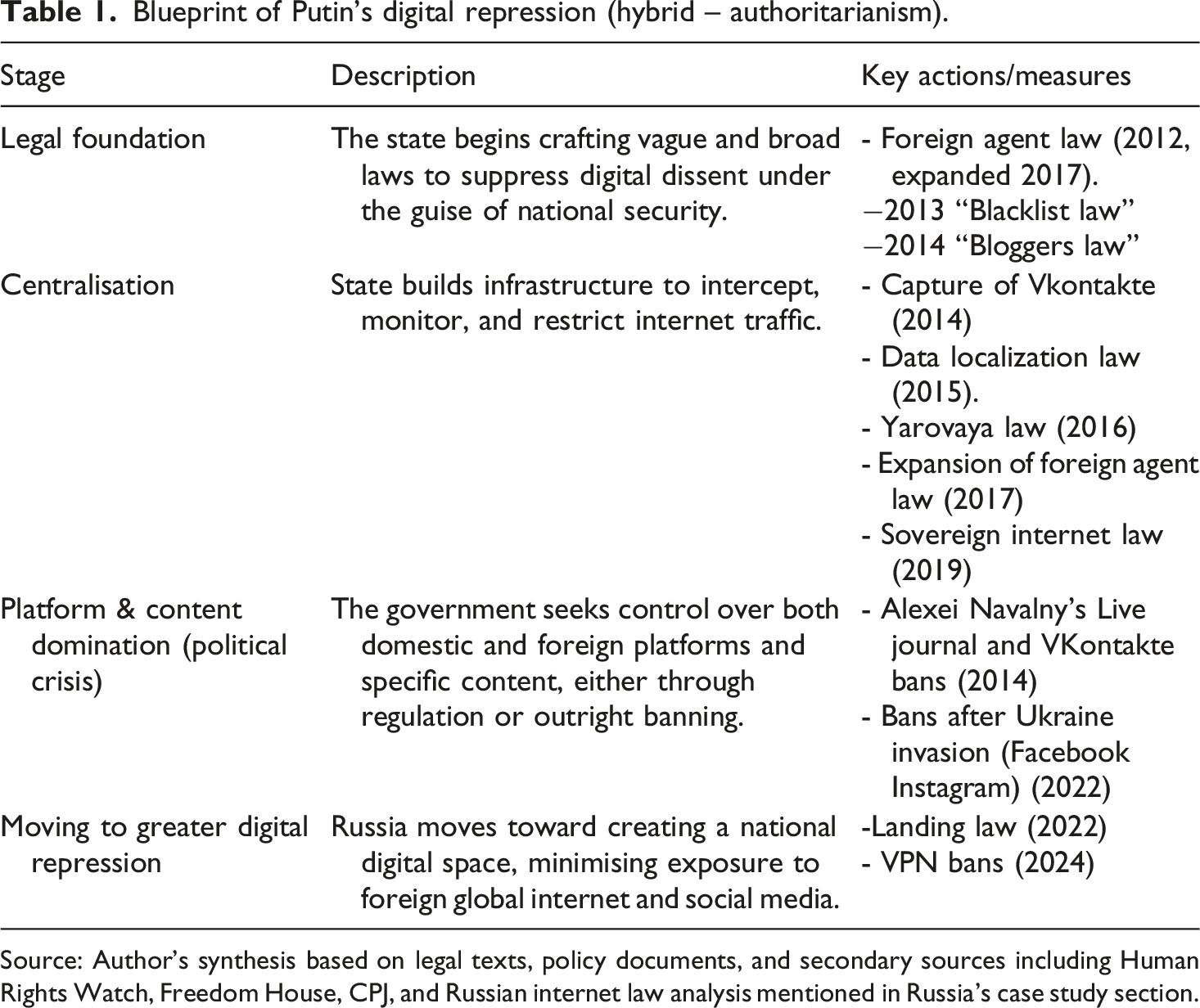
Source: Author’s synthesis based on legal texts, policy documents, and secondary sources including Human Rights Watch, Freedom House, CPJ, and Russian internet law analysis mentioned in Russia’s case study section.
Case 2 digital repression in Turkey
Legal foundation
As in Russia, in Turkey dissenters and journalists were pushed to online platforms to inform the public about the misconduct by the government and its allies.
The legal foundation of digital repression intensified with the “Gezi Park movement”. The protests in the early summer of 2013 united hundreds of thousands of people across the country against the increasingly authoritarian style of Erdoğan’s government and the Islamic conservative “Justice and Development Party” (AKP). The journalists who supported the protesters, along with the entire NTV History Journal’s editorial team, were fired. The NTV History Journal was permanently shut down, after publishing a special issue on Gezi Park, criticising the government (Akser M., 2018). This event prompted the government to consider legal restrictions on online media, as most of the protests were coordinated via social media or online outlets. This is similar to Russia’s approach, but Turkey’s repression is more crisis-driven, while Russia’s repression is more pre-emptive.
In 2014, Law No. 5651 was amended to block websites without court orders for privacy and national security. This law aligns with Feldstein’s (2021) definition of social media and platform blocking mechanisms. The Presidency of Telecommunication and Communication (TIB) issued a ban on Twitter, explaining that some comments posted raised concerns of privacy, safety, and national security. The main reason for this amendment was widespread criticism of the government, its allies, and Erdoğan on Twitter (Akser M., 2018). Later, Turkish Constitutional Court declared unconstitutional for TIB to block Twitter, and the ban was lifted (Global Freedom of Expression Columbia University, 2014). This event highlights a key distinction from a more consolidated authoritarian context in Russia. In Turkey, legal contestation is possible due to Turkey’s hybrid regime. Still, this type of mechanism has a chilling effect on journalists as they remain uncertain about the limits of freedom of speech.
In 2015, “Insulting the President” (Article 299) became heavily enforced. Human Rights Watch’s report (2018) indicates that with the application of this article, court cases have risen dramatically from 132 in 2014 to more than 6000 in 2017. Through the application of this article, the government used targeted prosecution of journalists while keeping a democratic façade in Turkey. However, in comparison to the extremism law in Russia, the prosecutions applied under this law are selective. Turkey still relies on more informal methods of intimidation online, whereas in Russia, it is institutionalised with government surveillance, state-controlled media, and an increasingly centralized judiciary working together to maintain total control over the narrative.
In 2016, after the failed coup attempt, the government shut down media outlets, seized assets, and detained journalists. Based on the three decree orders, a total of 178 media companies had been shut down, and more than 700 journalists’ credentials had been revoked within 6 months of the failed coup (RSF, 2016). In the first half of 2016, Twitter received almost 2500 requests from the Turkish authorities to remove content, by far the largest number of such requests from a single country (Yanardağoğlu, 2021). Some critics argued that from 2016 onwards, coercive media capture was almost complete and that the media had become a key vector for legitimising authoritarian continuity (Yesil, 2018).
This period is a transition into a more institutionalised model of repression, where media capture and digital regulation laws operate to silence dissent. The government applied reactive measures that evolved into a permanent system of control. The strict repression after the failed coup attempt marked a transition to targeted repression and institutionalised surveillance, like Russia’s post-2012 tightening. However, Turkey applied repression mechanisms within a hybrid system that maintained democratic facades.
Centralisation
The suppression mechanisms and laws adopted by Turkey in this stage align with the digital surveillance mechanisms disguised under the pretext of national security. This approach paved the way for more extreme legal and technological surveillance (Feldstein, 2021; Howard et al., 2011).
After a failed coup attempt in 2016, BTK (Information and Communication Technologies Authority) was allowed to block access to content, websites or specific URLs without a court order in urgent cases if they posed a threat to national security. ISPs became legally responsible for compliance with the directives issued by BTK (Freedom House, 2021). This law mirrors Russia’s data localisation and landing laws, but the difference is Turkey’s hybrid system. Turkey still lacks the mechanisms to create complete techno-sovereignty like Russia’s “ru.net” system to execute complete isolation.
Similarly to Russia’s “Sovereign Internet” law, Turkey amended its “Social Media Law” in 2020. This law requires social media users with more than one million followers to appoint legal representatives in Turkey, to respond to authorities’ content removal requests and to store the data of Turkish users in Turkey. If they refuse to comply depending on the case, they are fined, barred from ad revenue, and access to those platforms could be slowed down to 90% or made unusable (Human Rights Watch, 2022; ARTICLE 19, 2021).
This stage shows the government’s legal interventions toward more structured and permanent forms of control. These types of interventions later allow governments to apply extremely repressive measures during periods of political crisis. More permanent and structured government control over the platforms changes the way journalists work. Journalists face risks of content removal and must adapt to a more restrictive, regulatory digital environment.
Platform and content domination (political crisis)
To mitigate dissent, Turkey used an internet or social media shutdown mechanism to prevent opposing narratives and crowd mobilisation (Feldstein, 2021; Howard et al., 2011). The difference between Turkey and Russia at this stage is Turkey experienced several political crises, which could be explained by Howells and Henry’s (2021) theory that every change towards digital repression causes protests in demand of voting out the current government in democratic or once democratic countries. As Turkey operates in a hybrid regime, people still have a chance to vote out the current government.
Platform blocking mechanisms intensified in 2025 with the recent threat to the Turkish government (Freedom House, 2014, 2016, 2023). Similarly to Navalny’s case in Russia, Ekrem İmamoğlu had achieved electoral victories against Turkish President Recep Tayyip Erdoğan’s allies and his party secured control of most major Turkish cities. He and 106 opposing party members were arrested for corruption and aiding terrorist groups in 2025.
This caused widespread protests in major cities, which led to a social media crackdown. Law enforcement had identified 261 “suspect account managers” who allegedly shared content “inciting the public to hatred and hostility” and “incitement to commit a crime.” Authorities detained thirty-seven individuals in connection with these allegations (Ebrahim, 2025; Wither and Luckhurst, 2025). BTK issued hundreds of blocking orders for social media accounts of journalists, media organisations, civil society organisations, and human rights defenders, based on Article 8/A of Law No. 5651. Despite the platform’s initial refusal statements, X (formerly Twitter) complied with government orders to suspend approximately 700 accounts, including those of journalists, activists, and opposition figures (Gkritsi, 2025).
Analytically, this stage shows the alignment between the Turkish government and platform companies for the state’s influence over content and digital communication channels. In contrast to Russia, Turkey does not require full platform or systemic control leading to permanent shutdowns. Unlike Russia, Turkey applied temporary event-driven shutdowns, which shows that legal institutions still exist, so the government tries to apply a more tactical and responsive strategy depending on political threats.
Moving to greater digital repression
Although the country passed through similar stages as Russia, Turkey’s current government has not reached a level of authoritarianism necessary to create a fully separate local media space. Similarly to Russia, it blocks or slows down certain websites, encouraging users to rely on VPNs; but there are still independent outlets online. This means that Turkey is in a transitional phase from a hybrid to a more severe level of digital repression, remaining in an intermediate stage of the model, where repression coexists with diverse power centres and the ability to challenge decisions legally.
Turkey is a shifting model increasingly reshaped by an authoritarian government that used media capture and other tools at their disposal, such as state subsidy of private media (Akser and Baybars, 2024). For journalism, this results in difficulties in information distribution in a fragmented and an increasingly restrictive professional environment.
Blueprint of Erdogan’s digital repression (hybrid– authoritarianism).
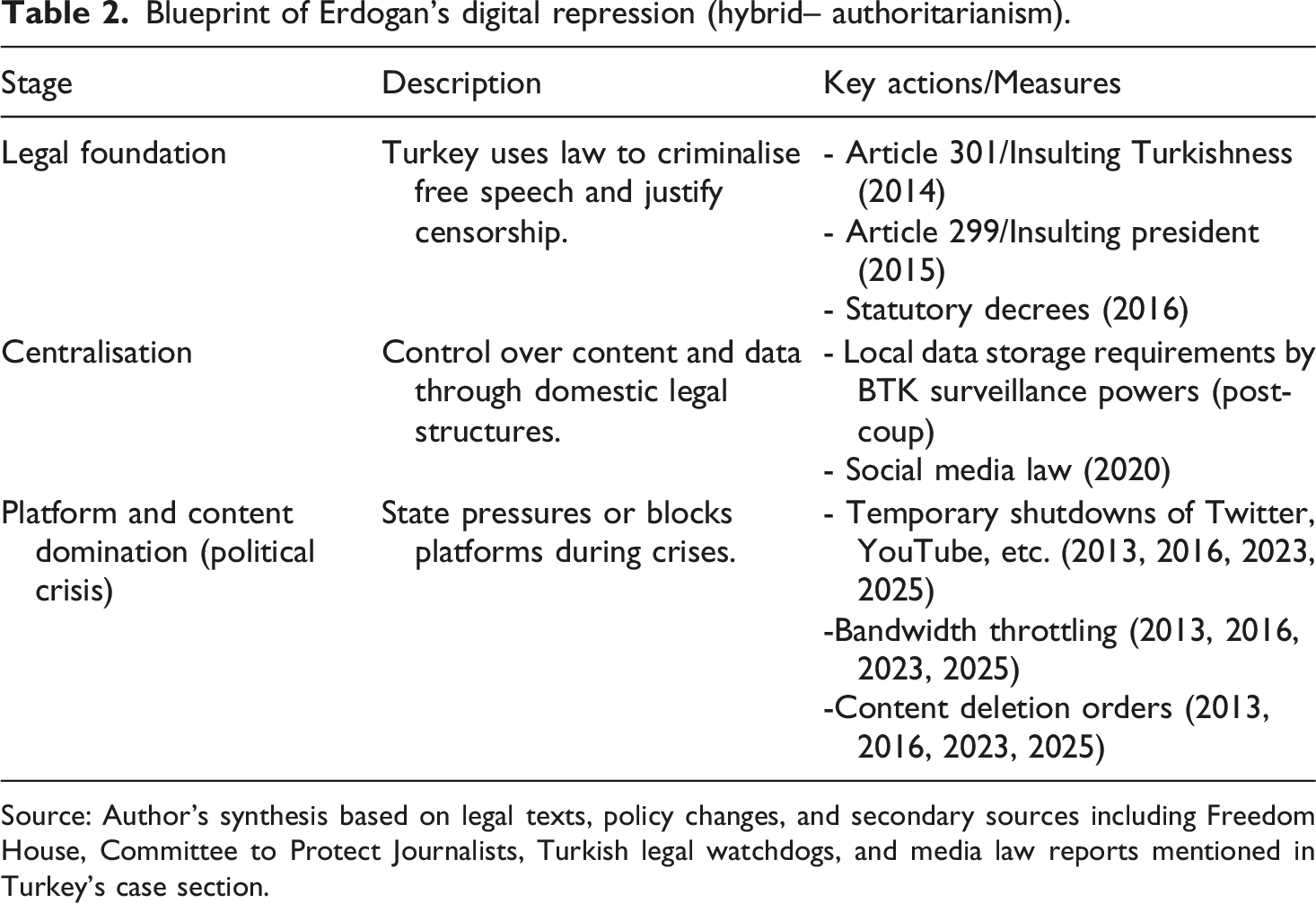
Source: Author’s synthesis based on legal texts, policy changes, and secondary sources including Freedom House, Committee to Protect Journalists, Turkish legal watchdogs, and media law reports mentioned in Turkey’s case section.
Cross-comparative analysis of digital repression in Russia and Turkey
The cases align with Feldstein’s (2021) emphasis that repression is not limited to autocracies; democracies also carry out repressive policies. The difference is the severity of it; autocracies repress more harshly than democracies.
Russia illustrates harsher repression than the hybrid regime observed in Turkey. Notably, in both cases, the shift from democratic practices started with the capture of local traditional media, pushing dissent to digital platforms, and the governments use digital repression tools against online critics. In this situation, digital repression tools help governments and political figures to prevent mass mobilisation and limit the spread of information about their mismanagement and public criticism online.
Aligning with Feldstein’s (2021) explanations, at the legal foundation stage, both countries show that newly passed rules are overly broad or vaguely define what constitutes a crime to justify censorship and surveillance under the pretext of national security or prevention of crime. Countries have changed their legal infrastructures to facilitate the media capture process. However, while in Russia’s case laws allowed state control over digital media, in Turkey they primarily expanded surveillance over digital platforms.
Following the amendment of new laws, governing authorities seeking greater control over the media introduced centralisation measures to increase surveillance and pressure on independent media organisations. At the centralisation stage, Turkey and Russia pursue centralisation but the depth of it differs. In Russia, centralisation is deeper and state-driven, leading to surveillance and infrastructural control. In contrast, Turkey’s centralisation is more selective and legally contested, showing the constraints of its hybrid regime. This could be explained by citizens retaining the right to remove the government through election or protest, as observed in Turkey’s case (Howells and Henry, 2021).
At the political crisis times, both Russia and Turkey tend to use platform and content domination techniques. In Russia’s case, more targeted, sustained and permanent measures were applied to block the specific platforms during the Navalny protests and the war in Ukraine (Kuznetsova, 2024; Woolley and Howard, 2019). In contrast, Turkey applied temporary and event-driven measures on several occasions, short-term platform blocking and throttling were implemented, especially in the Gezi Park protests, the 2016 coup attempt, the 2023 earthquake and the 2025 İmamoğlu protests (Gkritsi, 2025; Freedom House, 2014, 2016, 2023).
Generelised blueprint and mechanisms supporting repression across phases in Russia and Turkey.
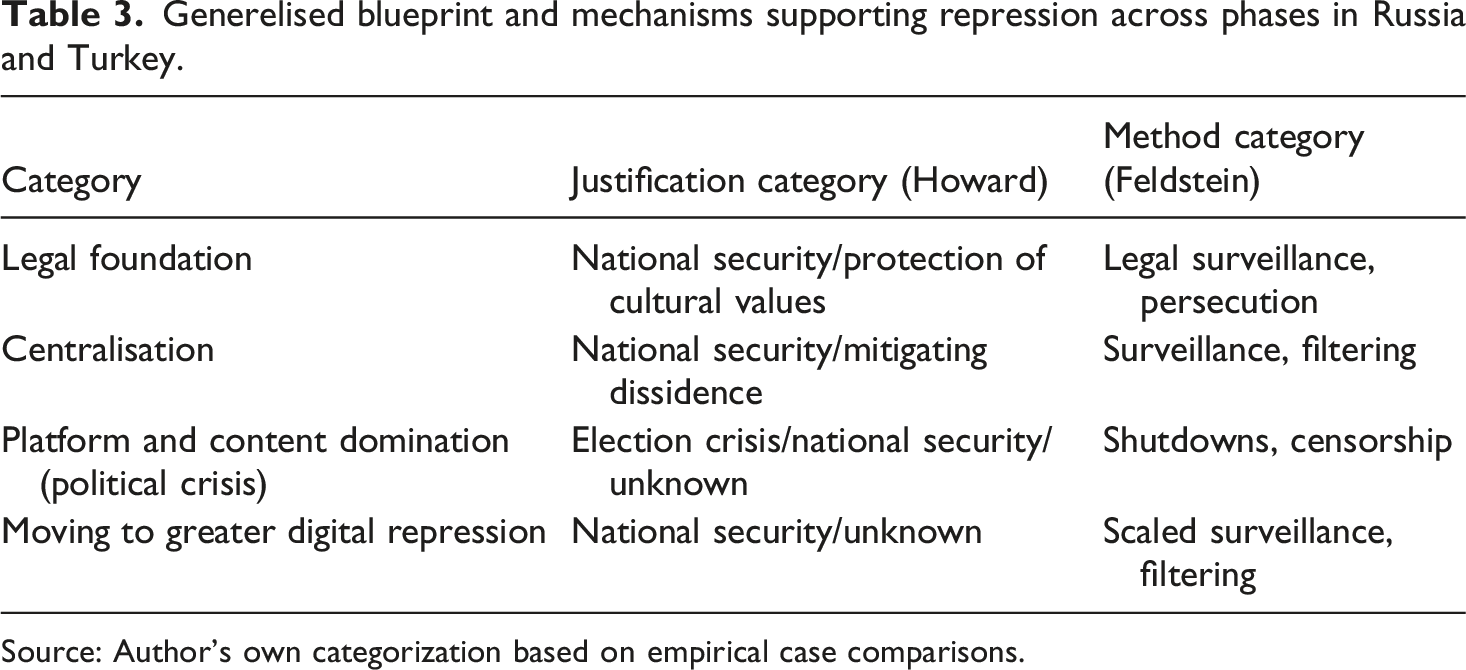
Source: Author’s own categorization based on empirical case comparisons.
Overall, analytical comparison highlights that regime types do not define the presence of repression mechanisms, but their intensity, consistency, and degree of institutional interference.
Discussion
The study proposes that the ambiguous laws with overly broad interpretations cause selective enforcement against dissenting voices and journalists, supporting Feldstein’s (2021) argument that contemporary digital repression often operates through “lawfare.”
To answer the RQ1, the analysis identifies that governments use three main mechanisms, legal suppression through ambiguous legislation, surveillance and infrastructural control, and platform and content blocking to silence dissent on digital media. Regardless of the tools used across all three mechanism categories, “national security” is the dominant justification used by both governments. This reveals that national security narratives function as a legitimising framework for repression across all stages.
Regarding the RQ2, the study finds that the shift is not triggered by a single crisis, but a combination of the stages presented earlier in the blueprint. The initial trigger is the media capture of the government that moves dissenting voices online, leading government to extend their control into the digital media. On the same note, most studies show political crises tend to accelerate the digital repression. In this study, this pattern is evident in the Gezi Park protests and the post-2016 coup attempt in Turkey, and comparatively in the Navalny protests and the 2022 Ukraine invasion in Russia. These periods of political turmoil were associated with intensified platform restrictions and content suppression. This finding is broadly consistent with Howard et al. (2011), who argue that governments often justify digital restrictions through narratives of stability and security during periods of unrest. However, the results of this study also suggest that political crises are not isolated triggers of digital repression; rather, they act as accelerators within an already existing trajectory of regulatory and infrastructural control. In this sense, political unrest should be understood as a stage rather than the sole cause of digital restrictions.
Following this, to further answer the RQ2 the study also notes that digital repression tools do not merely respond to the shift they actively enable it through a staged process. Over time, these digital repression tools transform from the reactive censorship during political crisis into a permanent, institutionalised system of control, gradually closing space for independent journalism and democratic contestation.
Conclusion
The broader significance of this article lies in the transferability of its processual blueprint. The staged model developed here, starting from legal foundation through infrastructural centralisation to crisis-driven platform and content domination offers journalism studies and press freedom research a replicable framework for detecting early warning signs of digital repression, which often emerge within hybrid and democratic regimes, before they become fully institutionalised.
The study contributes to the discourse on media rights, journalism, freedom of expression, and the intersection of digital technology and political control. Ultimately, the research underlines the importance of strong protection for independent media and digital rights.
Future studies should explore more countries to discover unique tools, patterns, and stages of digital repression. This can help civil society and policymakers detect additional repression mechanisms, their triggers, and contexts to prevent them at earlier stages.
Footnotes

Funding
The author received no financial support for the research, authorship, and/or publication of this article.
Declaration of conflicting interests
The author declared no potential conflicts of interest with respect to the research, authorship, and/or publication of this article.
Data Availability Statement
The data supporting the findings of this study consist of publicly available legal documents, policy materials, and secondary sources cited within the article.
Author biography
Appendix
Following tables will outline each legal and policy development in three countries through two main theoretical lenses: the official justification categories identified by Howard et al. (2011), and the actual tool proposed by Feldstein (2021).