






Abstract
This study examines whether different levels of professional socialization shape young adults’ perceptions of journalists’ professional ethics in the contemporary Chinese media environment. Drawing on theories of professional socialization and implicit cognition, a mixed-methods design was employed, combining a Single-Category Implicit Association Test (SC-IAT) with semi-structured interviews. In Study 1, participants with journalism internship experience (JIE), journalism and communication majors without internship experience (MJC), and non-journalism students (NN) completed an SC-IAT to measure implicit evaluative associations toward journalists’ professional ethics. No significant differences were found across the three groups. To contextualize these findings, Study 2 conducted interviews with students, professional journalists, and journalism educators. The qualitative findings revealed a consistent distinction between normative understandings of what journalists should do and perceptions of what journalists actually do. Across groups, participants generally recognized the ethical ideals associated with journalism while expressing similar perceptions of the profession as increasingly constrained by platformization, commercialization, and changing media environments. Drawing on the convergence of quantitative and qualitative evidence, the study tentatively proposes a process of de-differentiation in perceptions of journalists’ ethical status quo and identifies three potential mechanisms that may contribute to this pattern: tensions between normative and experiential narratives within professional socialization, the influence of non-professional information channels, and broader structural transformations in the media environment. The findings suggest that professional socialization may be effective in transmitting normative knowledge but more limited in shaping perceptions of actual professional practice.
Keywords
Journalism professionalism and ethical legitimacy
Across all professions, professional ethics serve as a foundational benchmark of social responsibility and integrity. During the rise of mass communication, journalists were celebrated as “uncrowned kings,” a title reflecting their profound sense of mission and a high level of social responsibility. Seib (2002) characterized journalism as a “moral enterprise,” emphasizing the central role of ethical norms in defining the journalistic profession and shaping its societal function. Journalists’ professional ethics not only serve as an important basis for public trust in journalism but also directly influence the credibility and societal impact of journalism—making ethics an indispensable element of the media industry. For journalists, the standards of professional ethics constitute the core of professional integrity and the foundation of career development. For the public, they ensure information transparency and form the bedrock of social trust.
Traditionally, journalism professionalism has been understood as a system of occupational norms and institutional practices through which journalism establish professional authority, social legitimacy, and public trust. Central elements of journalistic professionalism include ethical responsibility, objectivity, autonomy, public service, and the gatekeeping function of news production (Deuze, 2005; Hanitzsch, 2007). In this sense, professional ethics are not merely the moral principles of journalists, but constitute a foundational mechanism through which journalism differentiates itself from nonprofessional forms of information production.
The journalism profession, once widely respected for its role as a societal watchdog and its strong ethical foundations, is undergoing profound transformation under the pressures of digital disruption. In many countries, public trust in journalism has declined, with the United States experiencing one of the most significant decreases (Hanitzsch et al., 2018). During the COVID-19 pandemic, for example, a report by Pew Research Center found that Americans expressed more negative evaluations toward journalists than toward the pandemic coverage itself (Greenwood, 2020). Correspondingly, similar trends have emerged within the Chinese journalism industry. Wang and Meng (2023) found that, amid the rapid expansion of digital media, Chinese journalistic texts have increasingly moved away from traditional standards of journalistic professionalism. Specifically, three indicators of professional journalism—brevity, immediacy, and plurality of sources—have shown significant decline, while adherence to conventional news structure, objectivity, and public orientation have also partially declined.
These transformations in journalistic professionalism and public trust (Carlson, 2018; Hanusch and Vos, 2020) are closely associated with several structural shifts in contemporary digital media environments, particularly the platformization of news production, the commercialization of digital communication, and the rapid advancement of artificial intelligence technologies. First, platformization has contributed to a decline in news quality and a weakening of journalistic authority. The contemporary Internet-based media ecosystem is characterized by openness and participation (Singer, 2007), within which journalists are no longer the sole “gatekeepers” of information dissemination. Instead, ordinary users can now actively participate in the production and circulation of content through social media and other digital platforms, partially replacing journalists’ traditional role in environmental surveillance (Wright, 1960). These transformations have further fragmented the gatekeeping function traditionally exercised by journalists and blurred the boundaries between professional and amateur journalism (Müller and Wiik, 2023).
Second, the commercialization of digital platforms and news organizations has increasingly reshaped journalists’ professional values and ethical orientations. Although citizen journalism has expanded participatory communication and redistributed communicative power, it has also been criticized for problems related to questionable authenticity, uneven quality, and limited objectivity. Moreover, within online media environments, the proliferation of fake news, sensationalized or misleading headlines, commercially motivated news practices, and privacy-violating reporting—all of which violate widely recognized standards of professional ethics—may further undermine public trust in both the media and journalists, while also generating broader social consequences (Ognyanova et al., 2020; Wen, 2021).
Third, AI-driven transformations have posed profound challenges to journalism as a profession and to journalists themselves. As traditional news audiences decline and AI technologies continue to advance, news organizations are increasingly relying on algorithmic systems for content generation (Diakopoulos, 2019; Surjatmodjo et al., 2024), further weakening journalists’ professional distinctiveness and reinforcing perceptions that journalists are replaceable (Jamil, 2021). Moreover, the accessibility and affordability of AI and deepfake technologies (Hameleers, 2024) have enabled ordinary users to rapidly generate large volumes of false or misleading content. Consequently, challenges related to news authenticity, accountability, algorithmic bias, and the amplification of emotional or value-driven content (Porlezza and Schapals, 2024; Sonni et al., 2024) are increasingly reshaping the ethical foundations of journalism and challenging established norms of journalistic professionalism. Taken together, these structural transformations have accelerated the deprofessionalization of journalism by weakening journalists’ traditional gatekeeping authority, blurring the boundaries between professional and nonprofessional news production, and destabilizing established norms of journalistic practice. Against this background, professional ethics, as a core foundation of journalistic authority and public trust, has become more important than ever before.
These transformations are particularly significant within the contemporary Chinese media environment, where rapid platformization, algorithmic communication, and intensified market competition have profoundly reshaped journalistic practices and professional boundaries (Weiner et al., 2018; Xu and Jin, 2017; Ye and Sun, 2024).As younger generations grow up within highly digitalized and platformized media environments (Zhao et al., 2025), journalism students and other potential future media practitioners are increasingly exposed to hybrid and competing understandings of journalism, professionalism, and media environments. Examining how aspiring media journalists perceive and internalize professional ethics is therefore essential for understanding the development of journalistic professionalism in contemporary China.
Professional socialization and implicit ethical cognition
As a core foundation of journalistic legitimacy and professional authority, journalists’ professional ethics must be internalized by journalists in order to meaningfully shape their ethical cognition, professional identity, and normative understandings of journalism (Deuze, 2005; Hanitzsch, 2007). In this sense, professional ethics of journalists are not merely external codes of conduct, but become embedded through processes of professional socialization that transmit occupational values, norms, and role expectations (Deuze, 2005) to future journalists. Professional socialization refers to the process through which individuals acquire the norms, values, identities, and behavioral expectations associated with a particular profession (Merton et al., 1957; Weidman et al., 2001). Within journalism, professional socialization occurs through journalism education, newsroom culture, internships, and interactions with professional communities, all of which contribute to the internalization of journalistic norms and ethical standards (Deuze, 2005; Hanitzsch and Vos, 2017).
Given that professional socialization shapes the internalization of occupational norms and ethical values, variations in individuals’ exposure to journalism education and professional practice may lead to differences in their ethical cognition, professional identity, and normative understandings of journalism (Deuze, 2005; Grint and Nixon, 2025). In the context of journalism education, students with different levels of professional socialization—such as journalism majors, students with internship experience, and those without journalism-related training—may therefore exhibit different implicit attitudes toward journalists’ professional ethics.
Existing research on journalists’ professional ethics has relied predominantly on explicit self-report approaches (Riedl and Eberl, 2022; Sun et al., 2024; etc.). However, given that professional ethics are closely associated with socially desirable norms and professional expectations, participants may consciously regulate their responses in questionnaire-based studies to align with perceived social standards (Paulhus, 1991; Tourangeau and Yan, 2007). To address these limitations, scholars have emphasized the importance of implicit cognition in the study of socially sensitive attitudes and professional values (Iyengar and Westwood, 2015). Implicit attitudes refer to automatic evaluative associations that may operate beyond conscious awareness or deliberate self-presentation. Compared with explicit self-report measures, implicit measures are considered less susceptible to social desirability bias and normative self-regulation (Banaji, 2001). Among the most widely used approaches for measuring implicit attitudes is the Implicit Association Test (IAT), which assesses automatic associations between target concepts and evaluative attributes through reaction-time categorization tasks (Greenwald et al., 1998). Because the present study focuses on attitudes toward a single target category—professional ethics of journalists—rather than contrasts between two competing categories, the Single-Category Implicit Association Test (SC-IAT) is particularly suitable for examining implicit evaluations of journalists’ professional ethics (Karpinski and Steinman, 2006).
To date, relatively little research has examined how different levels of professional socialization shape younger people’s implicit evaluative associations toward journalists’ professional ethics, particularly within the Chinese context (Burgh and Zeng, 2012; Weiner et al., 2018; Xu and Jin, 2017; Ye and Sun, 2024; Zhang, 2009). Therefore, the present study combines implicit attitude measurement with qualitative inquiry to examine how young adults with varying levels of professional socialization perceive professional ethics within the contemporary Chinese media environment. Specifically, Study 1 employs the Single-Category Implicit Association Test (SC-IAT) to examine implicit evaluative associations toward journalists’ professional ethics across participants with different levels of journalism-related education and professional experience: those with journalism internship experience (JIE), those majoring in journalism and communication (MJC), and those neither majoring in journalism and communication nor having internship experience (NN). Study 2 uses qualitative interviews to further explore how young adults, experienced journalists and journalism educators understand and interpret professional ethics and values in contemporary digital media environments.
Based on the literature on professional socialization and ethical internalization, the present study proposes the following hypotheses:
Participants with journalism-related education or internship experience will demonstrate more positive implicit evaluations associated with journalists’ professional ethics of journalists than those without such training.
Participants with journalism internship experience will demonstrate stronger positive implicit evaluative associations toward journalists’ professional ethics than journalism majors without internship experience.
Study 1
Method
The SC-IAT was designed to assess participants’ implicit evaluations associated with journalists’ professional ethics rather than professional ethics itself. Journalist-related concept words were paired with positive and negative ethics-related attribute words, and D-scores reflected the relative strength of these automatic evaluative associations.
The present study aims to investigate how participants with different educational and internship backgrounds exhibit implicit attitudinal preferences toward journalists in an IAT experiment. Specifically, it examines participants’ response times when pairing the concept of “journalist” with positive or negative words related to journalists’ professional ethics, in order to determine which type of association elicits faster reactions.
Participants
An a priori power analysis was conducted using G*Power 3.1 (Faul et al., 2007) to determine the minimum sample size required for detecting group differences in a three-group one-way ANOVA. The analysis indicated that at least 42 participants would be needed to detect a medium-to-large effect with a statistical power of .80 at the .05 significance level.
A total of 68 university students in Beijing participated in the study. One participant was excluded from the final analyses due to a technical malfunction during the experimental procedure, resulting in a final sample of 67 participants (55 females, M = 22.64, SD = 3.65). Participants were categorized into three mutually exclusive groups based on their levels and forms of journalism-related professional socialization: JIE (n = 21), MJC, (n = 25), and NN (n = 21). Participants received either course credit or monetary compensation for their participation.
Materials
The SC-IAT materials consisted of journalist-related concept words and evaluative attribute words. An initial pool of 24 candidate evaluative words associated with journalists was collected by the researchers, including 12 positive and 12 negative terms. During the material evaluation stage, three professors/associate professors with prior professional journalism experience were invited to evaluate the relevance and representativeness of the stimulus words. Based on their evaluations, six positive words and six negative words most strongly associated with journalists were selected as attribute stimuli for the SC-IAT task.
The positive attribute words included 客观公正, 关爱社会, 胸怀天下, 揭露真相, 伸张正义, and 针砭时弊, whereas the negative attribute words included 有偿不闻, 抄袭剽窃, 暗访偷拍, 捏造新闻, 煽情标题, and 媒体暴力. The journalist-related concept words included 媒体人士, 报社职员, 新闻采编, 现场新闻, 追踪新闻, and 人物采访. All stimuli were presented in simplified Chinese characters.
Procedure
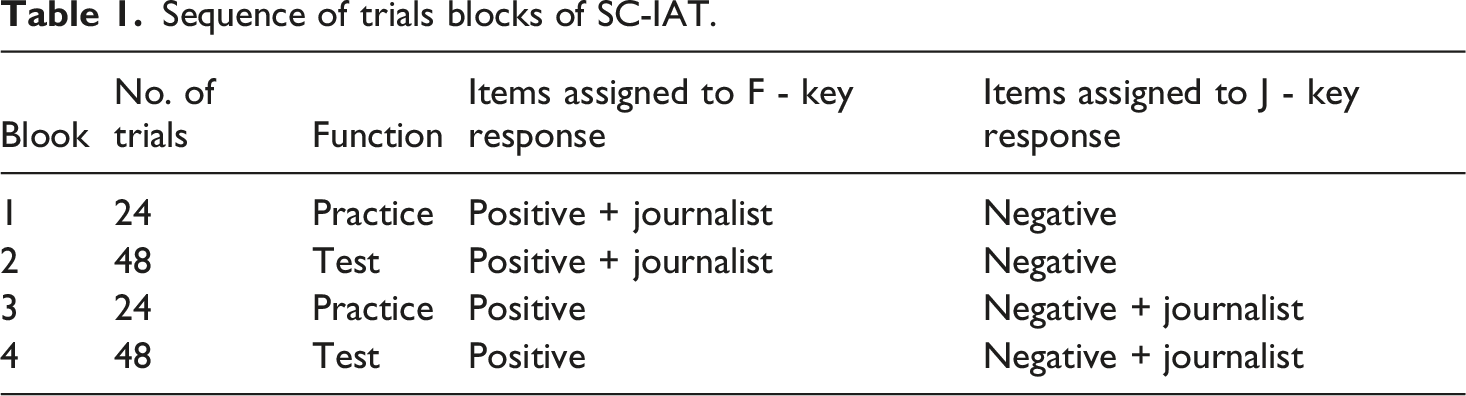
Sequence of trials blocks of SC-IAT.
Each trial began with a fixation cross (“+”) displayed at the center of the screen for 800 ms, followed by a target stimulus presented for up to 2000 ms. Participants were instructed to categorize the stimulus as quickly and accurately as possible by pressing the corresponding response key. After each response, a blank screen was presented for 1500 ms before the onset of the next trial. During the practice blocks, participants received immediate feedback on response accuracy. Correct responses were followed by a green “✔”, whereas incorrect responses were followed by a red “×”, each displayed for 1500 ms. No feedback was provided during the formal test blocks. The detailed structure of each trial is presented in Figure 1. The procedure of behavior experiment.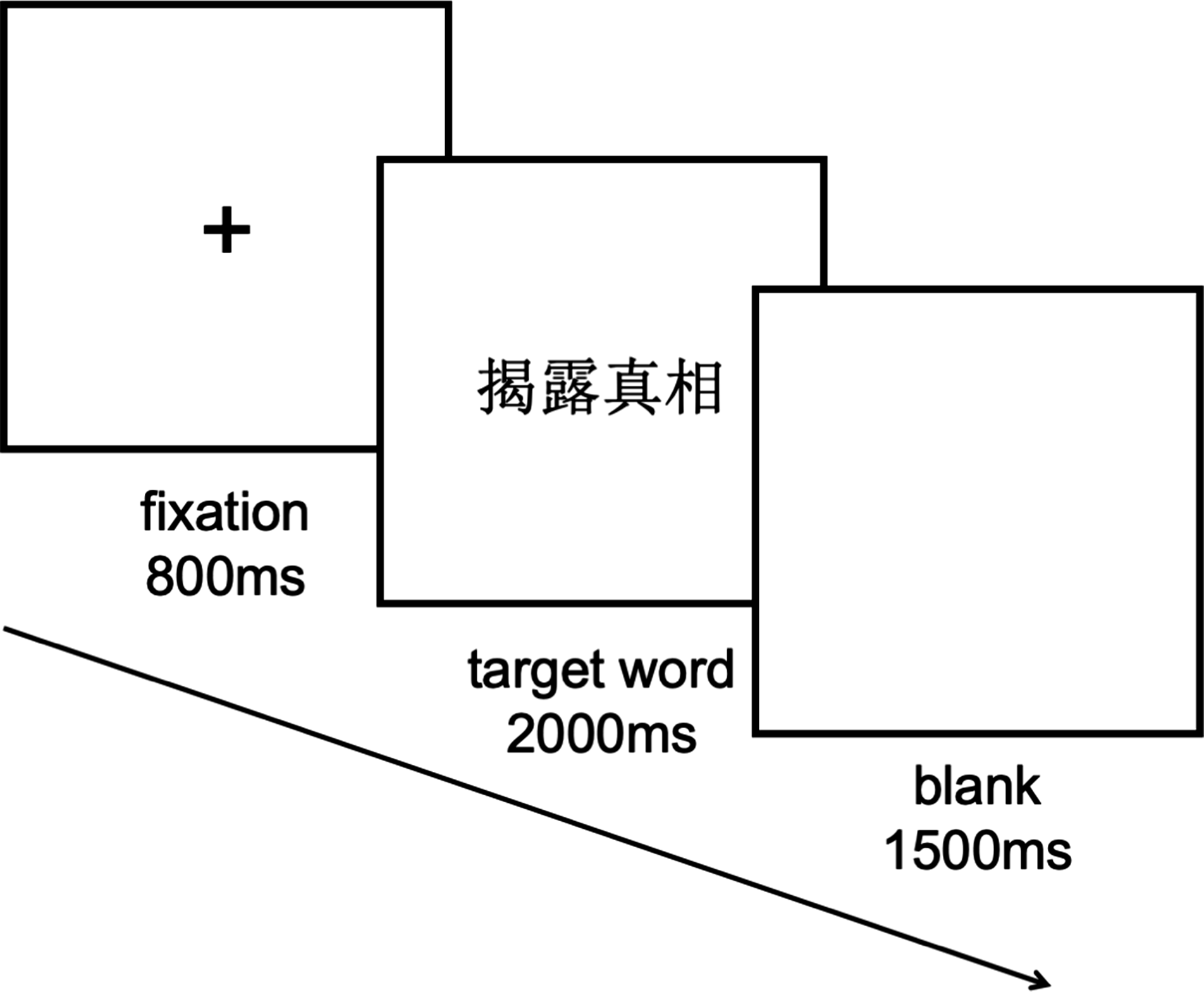
Results
SC-IAT data processing
Following the SC-IAT scoring procedures proposed by Karpinski and Steinman (2006), only data from the test blocks (Blocks 2 and 4) were included in the analyses, whereas practice blocks were excluded. Trials with response latencies below 350 ms or missing responses were removed. Error trials were replaced with the block mean plus a 400-ms penalty. D-scores were then calculated by subtracting the mean response latency of Block 2 from that of Block 4 and dividing the difference by the pooled standard deviation across correct trials. Higher D-scores indicated stronger positive implicit evaluations of journalists’ professional ethics.
Behavioral data
Calculate the D score respectively. The mean D-scores for the JIE, MJC, and NN groups were 0.203, 0.082, and 0.179, respectively. A one-way ANOVA revealed no significant differences in D-scores among the three groups, F (2, 64) = 0.176, P > .05. This result did not support either H1 or H2.
Discussion
Contrary to our initial expectations, the findings revealed no statistically significant differences in implicit evaluations associated with journalists’ professional ethics across participants with different levels of journalism-related education and professional experience.
While these null findings may tentatively indicate that, in highly platformized and hybrid media environments, professional socialization may have a weakened influence on the differentiation of implicit ethical perceptions among young adults. JIE, MJC, and NN students are all exposed to overlapping news production, self-media content, and algorithmically curated information. Consequently, the boundaries between professional journalism and everyday digital communication may be increasingly blurred, potentially reducing the distinctiveness of journalists’ ethical cognition.
To contextualize these quantitative findings, Study 2 employed qualitative interviews with students, professional journalists, and journalism educators. The aim of Study 2 was conducted to provide contextual insight into the quantitative pattern.
Study 2
Because implicit attitudes cannot be directly inferred from interview data, Study 2 was designed to contextualize rather than validate the SC-IAT findings. While Study 1 revealed participants’ implicit evaluative associations with journalists’ professional ethics, it could not capture how participants explicitly understood and interpreted journalists’ professional ethics in contemporary media environments.
To provide contextual understanding of the quantitative findings, we conducted a qualitative follow-up study. Semi-structured interviews were carried out with student participants from Study 1, professional journalists, and journalism educators to explore their explicit perceptions, experiences, and interpretations of journalists’ professional ethics and the changing boundaries of journalism in increasingly platformized and algorithmically mediated media environments.
Method
Participants
The interview sample consisted of three groups. First, 15 students were recruited from the participants of Study 1 (5 JIE, 5 MJC, and 5 NN; 13 females; mean age = 22.7 years). To provide additional professional perspectives and help interpret the quantitative findings, 11 professional journalists (2 females; mean age = 31.8 years; mean professional experience = 6.4 years) and 6 journalism educators (4 females; mean age = 43.3 years; mean teaching experience = 14.7 years) from different regions of China were recruited through purposive sampling based on their professional experience and expertise in journalism practice, journalists’ professional education, and professional ethics of journalists in new media.
Procedure
Semi-structured one-to-one interviews were conducted with all participants. Before interview, participants provided informed consent for audio recording and anonymized data use. Interviews lasted approximately 30 minutes and were conducted in Mandarin. Data collection continued until thematic saturation was reached, with no substantial new topic emerging in subsequent interviews. All interviews were audio-recorded and transcribed verbatim. Quotations reported in this article were translated into English and cross-checked by bilingual researchers to ensure semantic equivalence with the original transcripts.
Interview guide
A semi-structured interview guide was developed around four broad themes: journalists’ professional ethics, journalistic professionalism, digital media environments, and the changing boundaries of journalism. The interview protocol was adapted for different participant groups. Student interviews focused primarily on professional ethics, perceptions of journalism, and experiences with digital media, whereas interviews with professional journalists and journalism educators additionally explored platformization, technological change, and their implications for journalistic practice. Follow-up questions were used flexibly to probe participants’ experiences, reflections, and interpretations in greater depth.
Data analysis
All transcripts were initially coded inductively by one author in research team. The emerging codes and themes were then reviewed within the research team, and discrepancies were resolved through iterative discussion to reach consensus. The interview data were analyzed using thematic analysis following Braun and Clarke’s (2006) six-step approach. Coding was conducted separately across the three participant groups (students, professional journalists, and journalism educators) to preserve group-specific contextual meanings. Preliminary themes were identified based on recurring patterns in the data and were subsequently refined through repeated review and team discussions until a coherent thematic structure was established. All interview transcripts were analyzed in their original Chinese language. Selected excerpts were translated into English by the researchers and cross-checked by the research team to ensure semantic equivalence.
Results
Findings from the semi-structured interviews are organized by participant group to show how participants with different levels of professional experience and socialization perceive journalists’ professional ethics and transformations in contemporary digital journalism.
Three types of students
Fragmented perceptions of journalists’ professional ethics
Participants across all student groups expressed diverse and fragmented understandings of journalists’ professional ethics. Many interviewees with journalism internship experience described journalists as plain professionals rather than morally exceptional figures, arguing that journalists’ ethical standards are “no higher than those in other professions” (JIE-13). Participants also perceived that journalists working in different types of news exhibited varying ethical standards. Investigative journalists were associated with stronger professional competence and a sense of public responsibility, whereas commercial and entertainment journalists were perceived as more susceptible to traffic-driven pressures (JIE-15). Journalism students noted tensions between the normative ideals emphasized in their education and the ethical challenges they observed in real-world media practice (MJC-22). Similar perspectives emerged among non-journalism participants, many of whom associated official media journalists with relatively higher ethical standards, while self-media and entertainment-oriented journalists were linked to greater commercial pressures and higher risks of factual distortion (MJC-24, MJC-25, NN-32).
The ideal–reality gap in journalism
Across all groups, participants demonstrated a contrast between idealism reality. Interviewees with internship experience would described newsroom labor as repetitive and restrictive. Some participants emphasized that investigative and in-depth reporting still provided a sense of professional value and fulfillment (JIE-15). While several participants referred to themselves as “heartless writing machines” or “tools” after entering newsroom practice (JIE-11; JIE-13). Some MJC group students associated journalism with “pressure” (MJC-21) and low income (MJC-22). Non-journalism participants focused more on the profession’s pressure, demanding skills, and emotional burden (NN-31, NN-34).
Ambivalent career orientations toward journalism
Participants across the three groups expressed uncertainty about becoming a journalist. One participant stated that she would consider the profession only “if I could work in an investigative or in-depth reporting department” (JIE-15), while another expressed willingness to enter journalism only under conditions of greater professional prestige and creative autonomy, such as working for a leading media organization like CCTV (MJC-25). However, many participants viewed journalism as a profession characterized by low pay, heavy workloads, and limited autonomy, leading them to reject it as a future career (JIE-12). NN participants often attributed their reluctance to disciplinary mismatch or unfamiliarity with journalism, although some remained open to working as journalists on a short-term basis (NN-34).
Professional journalism
Generational differences in understandings of journalists’ professional ethics
Professional journalists exhibit clear generational differences in their perceptions of the professional ethics and responsibility. Senior journalists frequently associated journalists’ professional ethics with ideals of public mission, truth-telling, and social responsibility. One experienced journalist stated that “a journalist is someone who conveys the truth, “ recalling colleagues who “risked their lives investigating the source of medicine” as examples of professional ethics in practice (journalist-4). In contrast, younger journalists tended to adopt a more pragmatic understanding of journalists’ professional ethics, framing them as professional norms necessary for completing work appropriately rather than as heroic ideals. One participant argued that “being a journalist is just a job” and criticized overly idealized understandings of journalists as “unprofessional” (journalist-3).
Platformization and the weakening of professional boundaries
Participants mentioned that platformized media environments have weakened traditional gatekeeping mechanisms and blurred the boundaries between professional and nonprofessional journalism. One participant characterized the new media environment as “chaotic,” arguing that information circulating online is often difficult to verify due to the absence of effective editorial gatekeeping (journalist-1). Another participant criticized the growing presence of “non-professionals who care only about Internet marketing rather than content itself” (journalist-3). However, rather than viewing platformization solely as professional decline, some participants regarded interdisciplinary expertise as a potential source of new journalistic value in digital environments. One interviewee referred to a journalist with a biology background who became influential during the COVID-19 pandemic by interpreting scientific papers and producing specialized reports for broader audiences (journalist-9). These accounts suggested that although journalists perceived ongoing deprofessionalization, some also recognized emerging forms of “reprofessionalization. “.
Tensions between institutional authority and platform flexibility
Another prominent theme concerned perceived differences between traditional media organizations and emerging digital media platforms. Participants described traditional media organizations as retaining relatively stronger professional authority and credibility while simultaneously facing shrinking resources and institutional pressures (journalist-6). In contrast, digital and platform media demonstrate greater flexibility, faster responsiveness, and stronger capacity for economic expansion. However, one participant described content produced by some new media organizations as largely repetitive or derivative (journalist-5), while another emphasized that online media organizations often possess greater freedom to engage with socially dynamic topics than traditional media institutions (journalist-3).
The marginalization of in-depth reporting
Several journalists described in-depth reporting as increasingly marginalized within contemporary digital media environments. One participant argued that many audiences “no longer enjoy reading text-based content” and increasingly prefer entertainment-oriented digital formats (journalist-1). This participant also noted that media organizations face substantial resource and audience traffic pressures, making it difficult to devote sufficient resources to in-depth reporting. One journalist explained that relatively few reporters currently engage in in-depth reporting because newsroom resources must be concentrated in areas prioritized by media organizations (Participant 6). Despite these constraints, several participants continued to regard in-depth reporting as socially valuable and professionally meaningful. One interviewee suggested that the prevalence of investigative reporting may reflect broader social conditions, arguing that “the fewer in-depth reports there are, the healthier the society is” (participant 5).
Journalism educators in university
Media ecological transformation and the decline of professional authority
Journalism educators viewed platformization and digital communication technologies as weakening journalism’s traditional professional authority. Participants argued that journalists have shifted from “uncrowned kings” to “ordinary craftsmen” (participant 21), reflecting concerns regarding the erosion of journalism’s symbolic prestige. As one interviewee noted, “everyone can pick up a mobile phone and act as a journalist” (participant 23), thereby blurring the boundaries between professional journalism and everyday content production.
Tensions between normative ethics and professional practice
Journalism educators described journalists’ professional ethics as increasingly complex, fluid, and context-dependent in the digital media era. One educator characterized the professional ethics as “dynamic” or even “liquid” (participant 21), suggesting that the meaning and application of ethical standards are constantly being renegotiated across changing media and social contexts. Although participants continued to emphasize principles such as truthfulness and factual reporting, many also noted contradictions between publicly endorsed ethical ideals and actual newsroom practices. One participant observed that “everyone knows one set of principles but practices another” (participant 22), reflecting concerns about the gap between ethical discourse and newsroom realities.
Core ethical values in the AI era
Although journalism educators frequently discussed the transformation of media environments and the weakening of traditional professional authority, they simultaneously emphasized the enduring stability of journalism’s core ethical values. As one educator stated, “from the perspective of values, they should not change with the times; otherwise, they can no longer be considered genuine value pursuits” (participant 22). Similarly, another participant stressed that “news cannot lie” (participant 12), reflecting the continued centrality of authenticity and truth verification within participants’ understandings of journalists’ professional ethics. One participant explained that “certain terms are losing their effectiveness and new vocabularies are needed, “ (participant 21). He also argued, professional ethics of journalists must now incorporate additional “bottom-line constraints” in response to risks associated with artificial intelligence and deepfake production (participant 21). At the same time, participants acknowledged that AI-driven media environments have introduced new ethical challenges, including deepfakes, misinformation, and algorithmic communication.
The erosion of Journalism’s public mission
Many journalism educators expressed concern about the decline in the sense of public mission among younger generations of journalists. One educator explained that students are often introduced to the profession through ideals of “bearing moral responsibility for society” (participant 23), reflecting longstanding professional narratives about journalists’ public functions. One participant argued that earlier generations of journalists possessed a much stronger “sense of mission and historical responsibility,” whereas contemporary journalists have become increasingly pragmatic (participant 11). Another educator noted that many students now view becoming a journalist primarily as an occupational pathway, without identifying strongly with the broader social responsibilities historically associated with the profession (participant 23).
General discussion
This study combined the SC-IAT with semi-structured interviews to examine how young people with different levels of professional socialization perceive the status quo of journalists’ professional ethics. The SC-IAT results revealed no significant differences in implicit attitudes across groups. Qualitative interviews suggested that, regardless of journalism education or internship experience, the three groups of participants perceived journalists’ actual ethical standards similarly: journalists were seen not as a morally superior profession but as an ordinary one. These tentative findings offer a preliminary challenge to classical professional socialization theory and point to a phenomenon that might be termed “de-differentiation” in how young people perceive journalists’ professional ethics in the digital media environment.
The limitations of professional socialization
Classical professional socialization theory (Deuze, 2005; Hanitzsch, 2007; Weidman et al., 2001) assumes that journalism education and internship should cultivate a professional identity distinct from the general public. However, the SC-IAT results revealed no significant differences in implicit attitudes toward journalists’ professional ethics among three groups of participants (JIE, MJC, and NN). Qualitative interviews provided additional context for interpreting the quantitative pattern by examining participants’ explicit understandings and experiences related to journalists’ professional ethics: while all three groups could articulate classroom-taught ethical ideals such as “social watchdogs,” “objectivity and fairness,” and “exposing the truth,” they simultaneously believed that journalists are not morally superior to other professions in practice.
Professional socialization does exert some effect—it successfully transmits normative knowledge of what journalists “should” do. But it does not shape a differentiated perception of what journalists “actually” do. Across all three groups, students demonstrated a consistent pragmatic attitude: journalists are ordinary people whose ethical standards are no higher than those in other professions.
The key to understanding this tension lies in distinguishing between normative beliefs (what journalists should do) and status quo perceptions (what journalists actually do). Much of the existing research on journalists’ professional ethics relies on explicit self-report measures that primarily capture normative beliefs and are susceptible to social desirability bias. By combining the SC-IAT with in-depth interviews, this study sought to partially address this limitation. The findings suggest that professional socialization is effective in transmitting normative knowledge but less effective in shaping perceptions of actual professional practice. Although students generally recognized journalistic ideals, many simultaneously perceived a gap between these ideals and journalistic practice. This “knowing–perceiving” gap may help explain ongoing challenges in journalism education and professional identity formation.
The professional socialization literature offers the concept of “reality shock,” referring to the disappointment and disillusionment that novice practitioners may experience when ideals do not align with workplace realities (Kramer, 1974). This study suggests that, in the current media ecology, such experiences may not emerge only upon entry into the profession but may also begin to develop during the socialization process itself. JIE students explicitly reported experiences consistent with this form of shock, including statements such as “My chosen topics were rejected time and again” and “I felt like an emotionless writing machine.” Although MJC students had limited direct newsroom exposure, they appeared to develop similar perceptions—such as “low salaries” and “limited career prospects”—through observing senior students’ career trajectories and attending professional lectures. NN students, who primarily encountered journalism through self-media content and platform-based information, also tended to characterize journalism as a high-pressure, low-reward, and increasingly unattractive career. This finding suggests a potential boundary of professional socialization, whereby status quo perceptions may be shaped more by direct or indirect exposure to industry realities than by institutional education. When discrepancies arise between idealized educational narratives and observed practice, a knowing–perceiving gap is likely to emerge, particularly in the current digital media environment.
Drawing on both the SC-IAT and interview data, this study suggests that participants from different socialization backgrounds held broadly similar perceptions of journalists’ professional ethics. The findings point to a possible shift from normative understandings of journalism toward more pragmatic perceptions of journalistic practice and suggest that, while professional socialization may effectively transmit normative knowledge, status quo perceptions are likely shaped more by broader structural and informational environments.
Study 2 complemented the SC-IAT findings by examining participants’ explicit understandings of journalists’ professional ethics. The interviews identified a “knowing–perceiving” gap and provided contextual insight into the quantitative findings. Together, the two studies suggest a broadly consistent pattern, while capturing different dimensions of journalists’ professional ethics.
Potential mechanisms underlying de-differentiation
To explore possible reasons for the convergent perceptions of journalists’ professional ethics among young people from different backgrounds, this study identifies three interrelated mechanisms that may help account for this convergence.
The first mechanism may operate within the professional socialization pathway. Journalism students and interns are exposed to two competing narrative systems during their education and training. One is a normative narrative, transmitted through classroom teaching and textbooks, which emphasizes journalists as “kings without crowns” and “social watchdogs.” The first provision of the Code of Professional Ethics for Chinese Journalists (2019 revision)—“Serve the people wholeheartedly”—serves as an example of this framing. The other is an experiential narrative, conveyed through internships, industry lectures, and career sharing by senior students, which highlights traffic pressure, resource contraction, and economic insecurity. One journalism student (MJC-22) described this contrast as: The classroom teaches ideals, but internships teach traffic. The coexistence of these narratives may contribute to a perceived tension in students’ cognitive orientation, involving awareness of what “should” be done while questioning whether it is fully enacted in practice.
The second mechanism involves the non-professional socialization pathway. Although non-journalism students have not received systematic journalism education, they develop perceptions of the profession through everyday media consumption and social media use. These non-professional channels tend to emphasize more experiential rather than normative portrayals of journalism. When young people encounter journalists discussing work pressure on social media or engage with short videos commenting on journalistic work, they gain experiential impressions of what journalists may encounter. One non-journalism participant (NN-32) noted: I mainly learn about the media industry through public accounts and Weibo; I feel that journalists have it pretty tough—low income, lots of pressure. This experiential framing appears broadly consistent with the experiential narrative within the professional socialization pathway. Across groups, perceptions of journalism’s status quo may thus share certain similarities regardless of formal educational exposure.
The third mechanism points to macro-structural factors. Both professional and non-professional pathways operate within a shared media environment shaped by platformization, commercialization, algorithmic recommendation, and traffic logic. A systematic review by Hastuti et al. (2025) suggests that algorithmic gatekeeping prioritizes engagement over in-depth reporting, potentially reconfiguring news values around “shareworthiness” while weakening traditional gatekeeping functions. These structural conditions constitute a shared “background of cognition.” One journalism educator observed: Journalists have gradually descended from the former “kings without crowns” to an “ordinary profession” (participant 21) in the digital era. When structural forces operate continuously across contexts, they may contribute to the emergence of more convergent status quo perceptions.
The three mechanisms may reinforce one another and operate in combination. Their interaction can contribute to a relatively persistent pattern of de-differentiation. Several boundary conditions should be noted. De-differentiation appears to occur primarily at the level of status quo perceptions rather than normative knowledge, and tends to be more pronounced among younger participants than among veteran journalists. As this study is situated in the Chinese context, different institutional environments (e.g., varying proportions of market-driven vs public media) may further shape the degree and pace of this process.
Artificial intelligence accelerating de-professionalization and catalyzing re-professionalization
De-differentiation appears to characterize an important pattern in younger generations’ perceptions of journalists’ professional ethics. However, the rise of artificial intelligence introduces a new dynamic that may simultaneously contribute to de-professionalization and create conditions for re-professionalization.
In terms of de-professionalization, AI may lower the technical and knowledge barriers to news production. Thäsler-Kordonouri and Koliska (2025) suggest that AI integration into the news value chain may recalibrate divisions of labor and reshape professional routines, potentially redistributing editorial authority and altering power dynamics in news production. Natural language generation and AIGC tools enable individuals without formal journalistic training to produce news-like content. As one educator in this study noted, “AI-generated misinformation and deepfakes are challenging the bottom line of fact-checking.” When practices such as “everyone can write” and “machines can generate content” become more widespread, the boundaries between professional and amateur production may become increasingly blurred. From the perspective of this study, AI may contribute to accelerating de-differentiation by enhancing the capacity of non-professional actors to produce content at scale.
However, AI may also prompt journalism to reconsider and reconfigure its professional boundaries. AI systems can efficiently perform routine tasks such as data processing and transcription, while human journalists’ comparative advantages are often discussed in terms of in-depth verification, value communication, and what Van Dalen (2024) describes as “humanness”—a set of capacities including news judgment, critical thinking, and ethical reasoning, which are widely regarded as more human-centered qualities. This appears to align with a form of re-professionalization observed in this study, emphasizing the differentiated roles of human journalists in meaning-making and judgment.
Correspondingly, professional ethics of journalists in the AI era may require reconsideration. While traditional frameworks centered on individual professional virtue remain relevant, ethical considerations may increasingly extend to human–machine collaboration, including questions of accountability in algorithmic participation, transparency in mixed human–AI content production, and responsibility in algorithmic recommendation systems. Journalists’ professional ethics in the AI era may thus carry a dual connotation: maintaining the role of journalists in verification and interpretation, while also addressing emerging governance challenges in human–machine collaboration.
Theoretical contributions and practical implications
The theoretical contributions of this study are threefold. First, it offers a potential refinement of professional socialization theory in the context of digital journalism. The findings suggest that professional socialization is effective in transmitting normative knowledge but may be less influential in shaping status quo perceptions. This points to a potentially underexplored dimension of professional socialization—status quo perception formation—and suggests that future research may benefit from distinguishing between different levels of socialization. Second, the study introduces the notion of “de-differentiation in the perception of ethical status quo” as a possible framework for understanding convergent perceptions across socialization backgrounds, and identifies three mechanisms that may contribute to this process. Third, methodologically, it demonstrates the value of combining the SC-IAT with interviews to distinguish normative beliefs from perceptions of actual practice and to partially mitigate social desirability bias.
At the practical level, the findings suggest that journalism education may benefit from complementing normative instruction with critical engagement with professional realities. Rather than emphasizing idealized narratives alone, educational programs may help students reflect on the tensions between professional ideals and real-world constraints. In addition, one possible strategy for rebuilding professional boundaries in journalism may be to focus less on excluding non-professional actors and more on strengthening verifiable forms of professional competence in areas such as in-depth investigation, fact-checking, and public dialogue. Finally, ethical frameworks in the AI era may increasingly need to extend beyond individual professional virtue to address accountability and transparency in human–machine collaboration, while preserving the distinctive human contributions to verification, interpretation, and meaning-making.
Limitations and future directions
This study has several limitations. First, the sample in Study 1 was confined to university students in Beijing, and the use of convenience sampling may limit the generalizability of the findings. Second, although the sample size exceeded the requirements of the a priori power analysis, it may have limited the study’s ability to detect small effect sizes. It should be noted, however, that the qualitative findings were broadly consistent with the SC-IAT results, providing complementary support for the observed pattern of limited differences across groups. Future research could employ larger and more geographically diverse samples and incorporate longitudinal designs to examine changes in ethical perceptions over time. In addition, investigating the moderating role of different institutional environments (e.g., market-driven media vs party media) and exploring how the actual use of AI tools may shape journalists’ ethical perceptions may provide fruitful avenues for future research.
Footnotes
Acknowledgements
We gratefully acknowledge Haixin Fu from Beijing Normal University for his valuable contribution to this research. We also extend our sincere appreciation to all participating students, journalists and teachers for their time and insights during the experiments and interviews.

Ethical considerations
This study involving human participants was reviewed and approved by the Ethics Committee of School of Journalism and Communication at Beijing Normal University (Approval No. BNUJ&C20230315002).
Consent to participate
Informed consent was obtained from all participants prior to their involvement in the study.
Author contributions
Jingyi Guo, Experiment design and execution, data analysis, manuscript writing
Xinghui Niu, Material organization, manuscript writing
Di Wu, Material organization, manuscript writing
Ya Yang, management, supervision and support
Guoming Yu, management, supervision and support.
Funding
The authors disclosed receipt of the following financial support for the research, authorship, and/or publication of this article: This work was supported by National Social Science Foundation of China (24BXW041).
Declaration of conflicting interests
The authors declared no potential conflicts of interest with respect to the research, authorship, and/or publication of this article.