






Abstract
In the era of generative artificial intelligence (GenAI), the impact of news on audiences may depend not only on stance and source diversity but also on whether the news is generated by AI.This study employed a 2 × 2 × 2 between-subjects factorial experiment, manipulating news writer (GenAI vs human) and actor diversity (single vs multiple), while news stance (pro vs con) was combined with participants’ prior attitudes to calculate stance congruence between media and audience. The experiment examined two issue contexts, abortion and genetically modified food, and produced 608 valid responses. Results reaffirm the hostile media effect (HME): audiences perceived greater bias when news stances conflicted with their own and less bias when stances aligned. Moreover, under stand-incongruent conditions, human journalists were more likely than AI journalists to elicit stronger hostile perceptions. This study extends HME research in the Chinese context, showing that audience stance outweighs formal news characteristics such as writer identity and actor diversity. It highlights stance congruence between media and audience as the core mechanism of HME and suggests that AI journalists may help mitigate audience hostility in highly contentious issues.
Keywords
Introduction
The hostile media effect (HME), first proposed by Vallone et al. (1985), has remained a central topic in communication research. It refers to the tendency of audiences to perceive news coverage as hostile or biased when it conflicts with their own attitudes. Over the past four decades, numerous studies have examined the HME across a wide range of contentious issues, including war and conflict (Giner-Sorolla and Chaiken, 1994), political elections (Matthes et al., 2019), abortion (Hartmann and Tanis, 2013), genetically modified food (Gunther and Liebhart, 2007; Gunther and Schmitt, 2004), immigration (Tsang, 2018), gun control (Hong et al., 2025) and so on.
Extensive studies have demonstrated the robustness and generalizability of the HME in Western contexts. However, most studies have focused on partisan divisions and perceptions of media bias (Feldman, 2011; Kim and Hwang, 2019; Lee et al., 2021). Meanwhile, empirical research in one-party systems such as China remains limited (Cao et al., 2014; Liu and Li, 2023). One possible reason is that China does not have a media environment shaped by adversarial party competition, nor does it exhibit the kind of partisan polarization between political parties and news outlets that is common in Western contexts (Tai, 2014; Zhou and Yang, 2026). Yet this does not mean that Chinese society is devoid of highly contentious public issues. In fact, debates over genetically modified (GM) foods, abortion, the death penalty, and other issues have long been central to social justice concerns in China (Liu and Liang, 2019; Nie, 2005).
On the one hand, Chinese law and policy permit GM foods, abortion, and capital punishment (Cao, 2015; Ding, 2016). On the other hand, public opinion remains sharply divided on these issues, with ongoing debates shaped by technological risk perceptions, ethical values, and social policy considerations (Adamczyk, 2025; Cao, 2015; Ding, 2016; Johnson et al., 2018). For example, although China has pursued the commercialization of GM foods for years, progress has been repeatedly delayed in part due to low public trust and strong opposition (Asian Society, 2024).
In these highly contentious public issues, perceptions of media bias may influence public opinion and policy outcomes, underscoring the need to further examine the HME in the Chinese context. By 2023, the use of GenAI in news writing had become widespread, driven by tools like DALL-E, Midjourney, ChatGPT, and Bard (Cools and Diakopoulos, 2024), thereby raising scholarly attention to how“AI journalists” versus human journalists influence perceptions of bias and the HME (Cloudy et al., 2023; Nah et al., 2024). Some studies suggest that, compared with human journalists, AI journalists may be perceived as more objective and thus reduce hostile media perceptions (HMP; Cloudy et al., 2023). Meanwhile, actor diversity, widely regarded as a core indicator of journalistic professionalism and fairness, also plays an important role in reducing perceptions of media bias (Masini and Van Aelst, 2017). News coverage that incorporates voices from elites, experts, citizens, and grassroots actors is generally considered more balanced and objective (Beckers, 2025; Beckers et al., 2019).
In China, a large number of GenAI platforms have emerged and rapidly developed, including Doubao and DeepSeek. Since Doubao’s launch in August 2023, its user base has grown rapidly, reaching 157 million monthly active users by the third quarter of 2025 (Guancha, 2025). Similarly, DeepSeek, which was launched on January 15, 2025, experienced remarkable growth, surpassing ChatGPT in March with 525 million monthly visits. Its market share rose by 6.58%, ranking third globally, with over 136 million users (Xinlang, 2025). At the same time, Chinese media organizations have increasingly adopted AI in news production. Even prior to the rise of GenAI, China had emphasized the application of AI across various stages of journalism (CAC, 2019). More recently, major outlets such as People’s Daily, Xinhua News Agency, and China Central Television have integrated generative AI into the news workflow, including content creation and distribution (People.com, 2024). Against this backdrop, GenAI is increasingly involved in news production, which may influence audience trust in the media and their HMP (Hong et al., 2025; Luo, 2025).
Therefore, this research designed a 2 (writer identity: GenAI vs human) × 2 (news stance: pro vs con) × 2 (actor diversity: single vs multiple) factorial experiment to systematically examine how these variables influence HMP. This experimental design enables a systematic assessment of these factors and highlights both the theoretical and practical significance of examining the HME in the age of GenAI and within the Chinese media context.
Literature review
The HME, stance congruence and research in the Chinese context
Early experimental research found that both pro-Israeli and pro-Arab students perceived the same television coverage of the 1982 Beirut massacre as biased against their own side (Vallone et al., 1985). This classic study demonstrated that, even when media content is identical, audiences with differing viewpoints interpret information differently based on their own attitudes, thereby giving rise to the HME. Building upon this foundation, a substantial body of early research followed this paradigm, focusing primarily on the role of content, particularly the influence of issue partisanship, in shaping HME (e.g., Giner-Sorolla and Chaiken, 1994; Perloff, 1989). Such studies typically controlled for the news source, presenting neutral or balanced coverage to audiences holding divergent views. The results consistently indicated that audiences interpreted the information in a biased manner, guided largely by their prior attitudes (Choi et al., 2009; Hansen and Kim, 2011).
As media polarization has intensified, scholars have increasingly examined how media source cues shape HME (e.g., Arpan and Raney, 2003; Craig and Choi, 2024; Turner, 2007). Predominantly conducted in Western contexts characterized by partisan competition and media polarization (e.g., Levendusky, 2013; Matthes et al., 2019), this line of research highlights the incongruence between an audience’s own stance and their perception of the media source’s stance serves as a key driver of HME (Arceneaux et al., 2012; Feldman, 2011). More specifically, audiences categorize media sources as ingroups or outgroups based on perceived identity and ideological stances, and evaluate identical content differently depending on this categorization (Hartmann and Tanis, 2013). Even when the content is relatively neutral, perceiving the source as an outgroup can be sufficient to trigger HME (Reid, 2012).
In recent years, some studies have examined the joint influence of media sources and message content on HME. Using a U.S. sample, Gunther et al. (2017) showed that both source and content cues shape HMP. Similarly, Lee and Kim (2025), in the context of South Korean partisan politics, found that source cues and content slants influence HMP separately, with content producing larger differences in HMP than source cues. These findings indicate that news content may play an especially important role in shaping HMP.
However, most research on HMP, whether focused on news content or media sources, has been conducted in Western contexts. These contexts are typically characterized by strong partisan competition, ideological polarization, and readily identifiable media alignments (Turner, 2007). Therefore, audiences often cannot fully separate their interpretations of news content from their prior perceptions of the source. In practice, source and content cues are frequently intertwined, jointly shaping perceptions of media bias (Gunther et al., 2017).
In contrast, the Chinese media environment differs from its Western counterparts in ways that provide a useful setting for examining the content-driven pathway of HMP. Under the leadership of the Chinese Communist Party, the media system is embedded within the broader governance structure and serves both political and public communication functions (Stockmann and Gallagher, 2011). Even commercial outlets operate within a unified framework of ideological management (Wang and Sparks, 2019; Zhou and Yang, 2025). As a result, media organizations generally do not exhibit stable and clearly defined partisan divisions, and audiences are less likely to rely on partisan labels to infer the stance or bias of news coverage (Waight et al., 2025).
This structural context gives rise to two theoretical expectations. On the one hand, if HMP depends primarily on source cues (Hartmann and Tanis, 2013; Reid, 2012), then weaker source cues in the Chinese context may attenuate HMP. On the other hand, if HME is driven by incongruity between news content and audience attitudes, then HMP may still arise even in the absence of salient source cues (Gunther et al., 2017; Perloff, 2018; Schmitt et al., 2004).
This study favors the latter explanation, arguing that it is plausible in the Chinese context. Although China’s media system is not structured around partisan competition, substantial opinion divisions persist on controversial issues such as GM foods, abortion, and the death penalty (Cao, 2015; Ding, 2016; Liu and Liang, 2019). This suggests that audiences can form strong and conflicting attitudes and may perceive hostile bias in reports that are inconsistent with their own views. Importantly, this expectation does not imply that HME operates identically across Chinese and Western contexts. Rather, where source cues are less salient, the role of content-based processing becomes more clearly observable. This distinction provides the focus for the present study. Therefore, we propose the following hypothesis:
People perceive stronger hostile media bias when the news stance conflicts with their own views, and weaker bias when the two are aligned.
The effect of writer type (human vs GenAI) on HME
In general, when people perceive an information source as biased, they are more likely to reject unfavorable messages, thereby reducing potential cognitive dissonance (Carpenter, 2019). With the growing application of AI in journalism, scholars have increasingly examined how AI-generated news differs from human-written news in shaping audience perceptions of bias.
Findings regarding general evaluations of AI-authored news, such as credibility and perceived bias, are not entirely consistent. A meta-analysis by Graefe and Bohlken (2020) found no overall credibility advantage for automated journalism, while Waddell (2019, 2025) similarly showed that AI attribution does not necessarily reduce perceived bias and may even lower credibility. More recent research in the GenAI context further complicates this picture. For example, Toff and Simon (2025) Gunther found that labeling news as AI-generated reduces perceived trustworthiness, but does not increase perceptions of unfairness. These findings suggest that audience responses to AI authorship are not uniformly positive.
At the same time, other studies suggest that AI-authored content may be perceived as more objective. Early research indicates that, compared with human authors, machine-written news is often associated with lower perceived bias (Hong et al., 2025; Liu and Wei, 2018, 2019). This pattern has also been observed within the framework of HMP. For example, Cloudy et al. (2023) found that AI journalists activated the “machine heuristic,” a mental shortcut through which audiences associate machines with greater objectivity, thereby reducing HMP. Similarly, Craig and Choi (2024) using a 2 (human vs AI) × 3 (CNN vs USA Today vs Fox News) experimental design (N = 434), showed that AI cues significantly reduced hostile media bias. Together, these findings suggest that AI authorship may reduce HMP, although its effects depend on how audiences interpret AI as an authorship cue.
Importantly, most prior studies have focused on earlier forms of automated journalism. In contemporary media environments, GenAI differs from earlier forms of AI in several important ways. It enables the production of contextually adaptive and human-like content (Ferrara, 2024; Van Dalen, 2026), and GenAI labels have become increasingly salient cues that audiences use to evaluate authenticity and attribute sources (Burrus et al., 2024; Simon et al., 2025). In addition, users are more likely to recognize and interpret AI involvement in GenAI contexts, making such cues more cognitively engaging and more likely to be incorporated into evaluative judgments (Jia et al., 2024).
Prior research suggests that audience involvement plays a critical role in shaping HMP, as individuals who are more engaged with an issue or message are more likely to process information in a motivated and evaluative manner (Perloff, 2018). In this sense, the increased salience and recognizability of GenAI labels may make audiences more attentive to authorship cues when evaluating news content (Jia et al., 2024). Because AI is often perceived as more objective and less intentionally biased, such cues may lead audiences to perceive GenAI-authored news as less hostile than human-written news (Cloudy et al., 2023; Craig and Choi, 2024). Therefore, this study proposes the following hypothesis:
People perceive lower HMP in news articles written by GenAI authors than in those written by human authors.
The effect of writer type on HME through stance congruence between media and audiences
Moreover, existing research shows that audience perceptions of news bias primarily depend on the distance between media stance and their own stance (Gunther and Chia, 2001). Hong et al. (2025) further demonstrated that this HME occurs in both AI- and human-authored news: even when the news is written by AI, audience judgments of credibility and evaluations of news writers are shaped by their stance rather than author type. However, this does not imply that the identity of the news writer is irrelevant. As AI becomes increasingly human-like, audiences may not only attribute greater credibility to AI-generated news but also perceive it as less biased (Lee et al., 2025). Building on these, it is important to examine whether author type conditions the impact of stance congruence on HMP. To address this, this study poses the following research question:
How does news author type (human vs GenAI) shape the relationship between stance congruence and HMP?
The effect of actor diversity on HME
Actor diversity is one of the key elements that constitute news diversity (Hendrickx et al., 2022). It refers to the inclusion of actors with different affiliations or statuses, such as political elites, civil society representatives, or grassroots groups (Beckers, 2025; Beckers et al., 2019). Actor diversity is a dimension of content diversity, which Van Cuilenburg (1999: 188) defines as the “heterogeneity of media content in terms of one or more specified characteristics,” and is considered essential for fairness in reporting.
Masini and Van Aelst (2017) argue that when news reports cite a broader range of social actors, including weaker or marginalized groups, they are more likely to be perceived as fair and to mitigate audience perceptions of bias. In other words, if reports include not only political elites but also citizens, social organizations, and disadvantaged groups, audiences may find the coverage more balanced, which in turn could reduce HMP. Based on this reasoning, the study proposes the following hypothesis:
Compared with reports featuring a single actor, those incorporating greater actor diversity are more likely to reduce HMP.
Actor diversity is also closely linked to media stance. Comparing different types of news outlets in Belgium, Buyens and Van Aelst (2022) showed that right-wing alternative media emphasized right-wing politicians and parties, whereas left-wing alternative media gave more attention to civil society actors and ordinary citizens. This suggests that even when outlets cite actors from different social positions, those aligned with the outlet’s ideology are more likely to be highlighted, which does not necessarily promote viewpoint diversity and may reinforce partisan bias. Consistently, Beckers, 2025 conducted an experiment with 987 participants in the Flemish context and found that simply adding more actors did not enhance perceptions of news credibility; instead, people primarily considered opinions consistent with their pre-existing views.
These findings suggest that actor diversity alone may not directly enhance perceptions of balance or credibility. However, it remains unclear whether actor diversity plays a conditional role in shaping how audiences perceive stance congruence in news coverage. To address this gap, this research proposes the following question:
How does actor diversity shape the relationship between stance congruence and HMP?
Interaction of news author, stance congruence, and actor diversity on HME
Within the framework of the HME, stance congruence plays a central role. When the stance of news coverage aligns with audience attitudes, reporting is more likely to be perceived as fair or neutral, whereas incongruent stances intensify hostile perceptions (Vallone et al., 1985; Gunther and Schmitt, 2004; Perloff, 2018). Much of the existing research on sources and HME has focused on partisan outlets, demonstrating that the perceived ideological distance between outlet stance and audience orientation significantly shapes hostility (Gunther et al., 2017; Kim and Pasadeos, 2007; Zheng and Zhou, 2024).
More recently, the rise of AI-driven news writing has drawn scholarly attention to whether audiences respond differently to stories authored by AI or by human journalists, sometimes in interaction with stance distance (Cloudy et al., 2023; Hong et al., 2025; Nah et al., 2024).
Beyond authorship, news diversity, including both content diversity and source diversity, is a key factor shaping audience trust and perceptions of bias (Masini and Van Aelst, 2017; Voakes et al., 1996; Zhou and Yang, 2025). Content diversity encompasses actor diversity and viewpoint diversity, which are closely related and regarded as core indicators of pluralistic news (Masini et al., 2018). The inclusion of multiple actors and viewpoints can enhance perceptions of objectivity and representativeness and may also reduce audience bias (Masini and Van Aelst, 2017). Actor diversity, in particular, has been shown to influence perceptions of bias (Masini and Van Aelst, 2017) and interact with political orientation in shaping credibility judgments (Beckers, 2025).
As Feldman (2011) emphasizes, news effects rarely result from a single factor; instead, they emerge from the interplay of multiple dimensions. Formal cues such as author identity, content features such as actor diversity, and attitudinal dynamics such as stance congruence may jointly shape audiences’HMP. In real media environments, these cues are encountered simultaneously. Examining these dimensions in combination is therefore crucial for understanding how HMP are triggered.
Therefore, this study proposes the following research question:
How do stance congruence, news author, and actor diversity interact to influence HMP?
Methods
This study adopted a 2 (news author: AI vs human) × 2 (news stance: pro vs con) × 2 (actor diversity: single vs multiple) factorial experiment with a between-subject design. This yielded 8 experimental conditions. To further test the robustness of the findings, the experiment was implemented across two issue contexts (abortion vs GM foods), resulting in 16 experimental groups in total. Participants were randomly assigned to one of these groups, read the corresponding news article, and subsequently evaluated the article. The studies were approved by the Academic Ethics Committee of the University, and all participants provided written informed consent prior to participation.
Participants
The experiment was conducted from July 1 to July 25, 2025. Working with the data collection platform Credamo (https://www.credamo.com/), which has over 3,000,000 subscribers across 31 Chinese provinces and maintains one of the largest online panels in China, we conducted an experimental survey. Participants voluntarily joined the study via the platform’s paid recruitment service. Upon entering the survey, participants were randomly assigned to experimental conditions.
To ensure data quality, the questionnaire included an attention-check item requiring respondents to identify the author of the news article based on the byline (e.g., participants in the AI condition selected “AI,” while those in the human journalist condition selected “human”). This item was used to encourage attention to the authorship information and was not used as an exclusion criterion in the final sample. In addition, during data processing, responses that were internally inconsistent or indicated inattentive answering (e.g., contradictory responses or patterned responding) were removed. After data cleaning, the final sample consisted of 608 participants.
An a priori power analysis (α = .05, power = .90) for a three-way between-subjects factorial ANOVA (2 × 2 × 2 design) indicated that approximately 200 participants would be sufficient to detect a medium effect size (f = 0.25) (Faul et al., 2007). In addition, the present study was conducted across two different issue contexts (abortion and GM foods) as a robustness check; thus, we aimed for at least 200 participants per issue, resulting in a total target sample size of approximately 400. After data cleaning, the final sample (N = 608) remained approximately evenly distributed across experimental conditions, with cell sizes ranging from 35 to 42 participants. The final sample included participants from multiple Chinese provinces, reflecting a diverse pool of respondents.
The final sample consisted of 50.5% female and 49.5% male respondents, aged 18–56 years (29.6% aged 18–24, 50.7% aged 25–34, 19.7% aged 35 or above). In terms of education, 72.5% held a bachelor’s degree or higher.Participants were recruited from 34 provincial-level regions across mainland China, as well as from Hong Kong and Macao, ensuring broad geographic diversity.
Pilot tests
To ensure the effective elicitation of the HME, the study focused on selecting experimental stimuli from highly controversial issues that provoke divergent public attitudes. A search of the WiseSearch Database (mainland China) using keywords such as “death penalty,” “ethnicity,” “religion,” “GM,” and “COVID-19 pandemic” was conducted. The search identified six highly discussed issues based on their high frequency in media coverage and online discussions across forums, blogs, and social media: quarantine policies during the pandemic, China’s three-child policy, legal abortion, environmental protection, genetically modified food, and the abolition of the death penalty.
To identify the most controversial topics for the main experiment, 161 participants were recruited via the Credamo platform and asked to rate their attitudes toward each of the six candidate issues on a 7-point Likert scale. A repeated-measures ANOVA confirmed a significant effect of issue on attitudes, F (5, 800) = 20.00, p < .001, partial η
2
= .23, indicating that the six issues elicited heterogeneous responses and were suitable as candidate stimuli. Moreover, descriptive statistics revealed that abortion (M = 5.39, SD = 1.61) and GM foods (M = 3.39, SD = 1.61) generated the widest attitudinal variance, and Bonferroni post-hoc comparisons further showed a significant difference between the two, t (160) = 8.46, p < .001, with a mean difference of 2.00 (95% CI [1.30, 2.70]). Based on these results, abortion and GM foods were selected as the focal issues for the formal experiment (see Figure 1 for sample news stimuli). Example of an AI-generated news article with a pro stance and low actor diversity (single actor condition) from the abortion issue context. The original stimuli were in Chinese; English translations of representative examples are provided in Appendix A.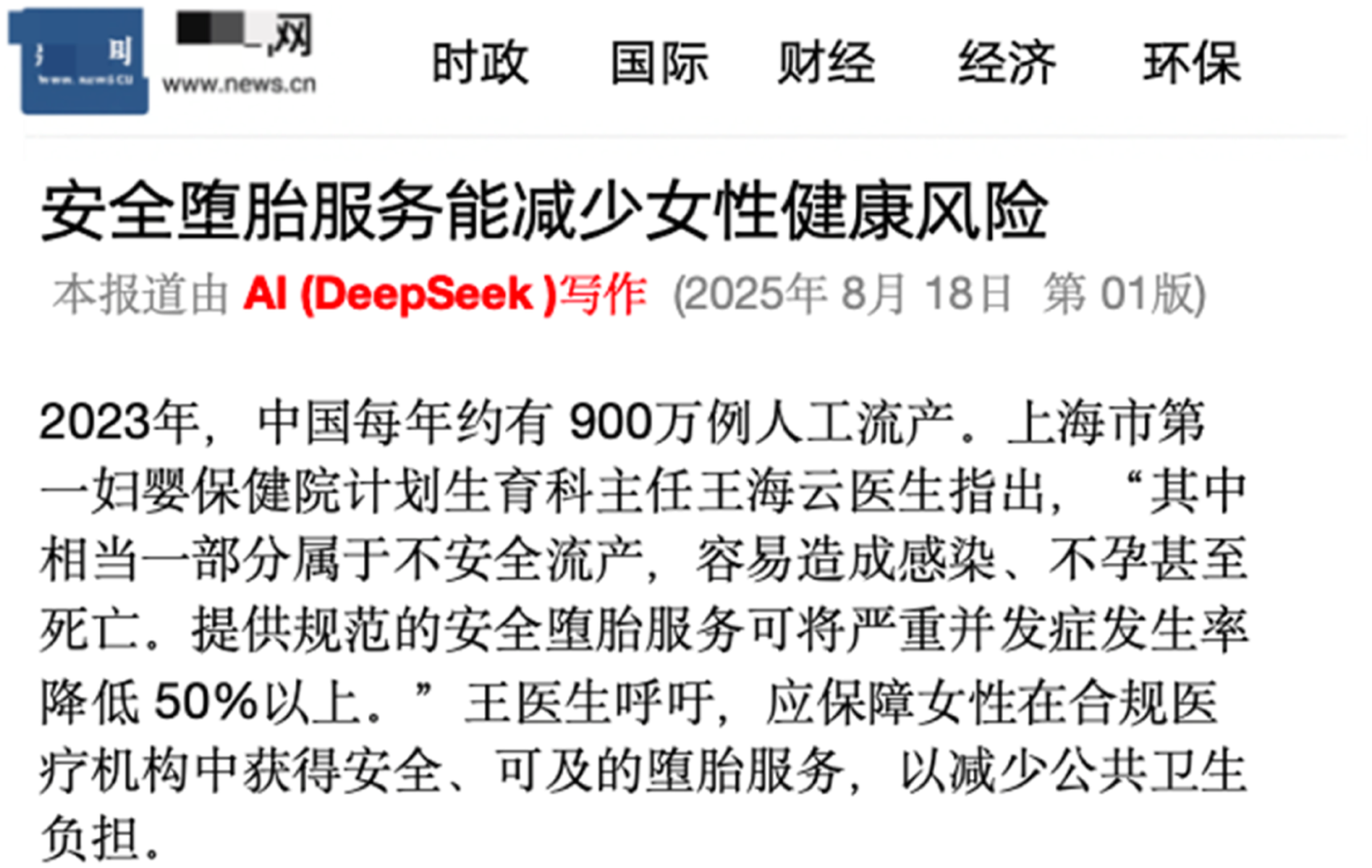
Main study
After finalizing the experimental stimuli, an online survey experiment was conducted with the main sample. Upon signing informed consent, participants were first randomly assigned to one of two issue contexts (abortion or GM foods). Within the assigned issue, they first reported their pre-existing attitudes toward the topic (pretest), and were then assigned to read a news article, followed by the questionnaire. The post-exposure questionnaire included manipulation check measures used solely to verify the effectiveness of the experimental manipulations. These measures were not used as exclusion criteria. The design and manipulation of the experimental stimuli are described below.
Stimuli and manipulations
The experimental stimuli were developed based on existing news reports on the selected issues (abortion and GM foods). The original materials were adapted and systematically modified to fit the experimental design. Across conditions, the core factual content and overall structure of the articles were held constant, while specific elements were selectively manipulated to reflect the experimental factors (i.e., authorship, stance, and actor diversity). This approach ensured that differences between conditions reflected the intended manipulations rather than content variation.
Authorship manipulation
News authorship was manipulated by indicating in the article’s byline whether the news was written by a human journalist or generated by GenAI (DeepSeek). This information was explicitly presented on a separate line directly below the headline, in bold, enlarged, and red font to ensure clear recognition.
Stance manipulation
News stance was manipulated by presenting the issue from either a supportive or opposing perspective. The factual content of the news was held constant, while evaluative framing and argument direction were adjusted to reflect either a pro or con position.
Actor diversity manipulation
Actor diversity was operationalized as the diversity of social actor types represented in the news article, rather than merely the number of individuals mentioned (Masini and Van Aelst, 2017). It was manipulated by varying whether the article included a single actor (low diversity) or multiple actors from distinct social roles (high diversity), such as experts, government officials, industry representatives, NGOs, and members of the public.
Actors were presented as identifiable sources, each introduced with a role label and accompanied by attributed or paraphrased statements expressing their viewpoints. This ensured that actor diversity captured not only the number of actors but also the heterogeneity of perspectives associated with different social positions (Beckers, 2025).
Representative English translations of the stimulus materials are provided in Appendix A.
Measures
Hostile media perceptions (HMP)
HMP was measured using three items. The theoretical foundation of the construct is grounded in prior research on the hostile media effect, which conceptualizes HMP as the tendency to perceive news coverage as biased against one’s own position (Gunther and Liebhart, 2007; Vallone et al., 1985). The specific measurement items were adapted from prior empirical studies that directly assess HMP (e.g. Arpan and Raney, 2003; Eveland and Shah, 2003; Tsfati, 2007; Gearhart et al., 2020). Participants indicated their agreement with statements about the news report on a 7-point Likert scale (1 = strongly disagree, 7 = strongly agree): (1) “The report favors the opposing stance,” (2) “The report is biased against my viewpoint,” and (3) “The report makes me feel that my opinion is unfairly dismissed.” The scale showed acceptable reliability in both the abortion condition (Cronbach’s α = .74; M = 3.91, SD = 1.14) and the GM foods condition (Cronbach’s α = .67; M = 3.73, SD = 1.00).
Issue stance congruence
Stance congruence was not directly measured but computed based on participants’ self-reported pretest attitudes and the manipulated news stance. Congruence was coded as 1 when a participant’s attitude direction aligned with the news stance, and 0 when it did not. This operationalization captures whether audience and media stances were congruent or conflicting, and has been widely used in prior HME research (e.g., Giner-Sorolla and Chaiken, 1994; Vallone et al., 1985).
Manipulation check
Two manipulation check items were included to verify the effectiveness of the news stance and actor diversity conditions. The manipulation of news authorship was implemented through an explicit label presented in the lead paragraph of each article (i.e., AI-generated vs human-written), making the authorship information highly salient to participants.
To test the effectiveness of the news stance manipulation, participants’ perceived stance ratings were compared across the support and oppose conditions. Perceptions of news stance were significantly higher in the support condition (M = 5.32, SD = 1.53) than in the oppose condition (M = 2.74, SD = 1.79), F (1, 606) = 365.13, p < .001, partial η2 = .38, confirming that participants accurately perceived the intended stance manipulation.
Similarly, a manipulation check for actor diversity showed that participants in the diverse condition reported significantly higher ratings (M = 5.30, SD = 1.73) than those in the single-source condition (M = 4.64, SD = 1.73), F (1, 606) = 28.05, p < .001, partial η2 = .044. This represents a small-to-medium effect size (Cohen, 2013), demonstrating that participants clearly recognized the manipulation of information source diversity. These results provide strong evidence for the validity of the experimental manipulations.
Results
Randomization checks indicated that participants were generally balanced across experimental conditions. In the writer manipulation, neither gender (χ2 (1) = 0.16, p = .69) nor age (AI: M = 1.90, SD = 0.67; Human: M = 1.90, SD = 0.72), F (1, 606) = 0.01, p = .91, differed significantly. Similarly, for the source diversity manipulation, no significant differences were observed in gender (χ2 (1) = 3.18, p = .075) or age (Single expert: M = 1.88, SD = 0.69; Diverse actors: M = 1.92, SD = 0.71), F (1, 606) = 0.38, p = .54.
However, a significant gender imbalance was detected for the stance manipulation (χ2 (1) = 7.59, p = .006), with male participants more likely to be in the support (pro-statement) condition and female participants more likely to be in the oppose (con-statement) condition. This imbalance was primarily observed in the stance conditions rather than in other experimental factors, and was not driven by issue type (χ2 (1) = 2.37, p = .124). To examine whether this imbalance affected the validity of the stance manipulation, we conducted an ANCOVA with age, gender, education, and issue as covariates. The interaction between stance and gender was not significant, F (1,598) = 0.42, p = .518, partial η2 < .001, suggesting that the effect of the stance manipulation did not differ between male and female participants.
Age remained comparable across the support (M = 1.92, SD = 0.69) and oppose conditions (M = 1.88, SD = 0.70), F (1, 606) = 0.57, p = .45. To address the gender imbalance and account for potential confounds, gender, age, and education were included as control variables in subsequent analyses. A three-way ANCOVA was conducted to examine the effects of writer (GenAI vs human), congruence (congruent vs incongruent), and source diversity (single vs multiple) on participants’ HMP, controlling for issue, gender, age, and education. The overall model was significant, F (13, 594) = 2.84, p < .001, partial η2 = .059.
Regarding the main effects, congruence was significant. Participants who received incongruent news reports perceived higher HMP (M = 4.04, SD = 1.13) than those who received congruent news reports (M = 3.62, SD = 1.00), F (1, 594) = 18.00, p < .001, partial η2 = .029. Thus, H1 was supported. The main effect of writer was not significant, F (1, 594) = 0.05, p = .826, partial η 2 < .001, and therefore H2 was not supported. Similarly, the main effect of diversity was nonsignificant, F (1, 594) = 0.45, p = .504, partial η2 < .001, and thus H3 was not supported.
Author × congruence × diversity factorial ANCOVA for HMP.
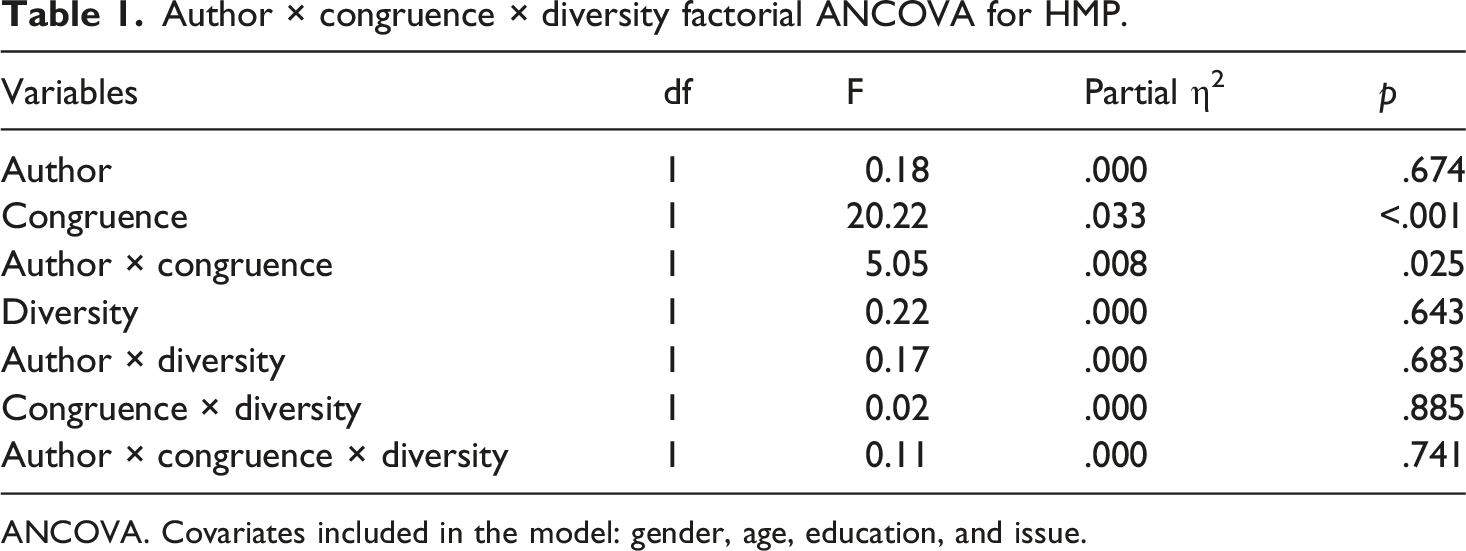
ANCOVA. Covariates included in the model: gender, age, education, and issue.
Means (SDs) of HMP by writer, congruence, and actor diversity.
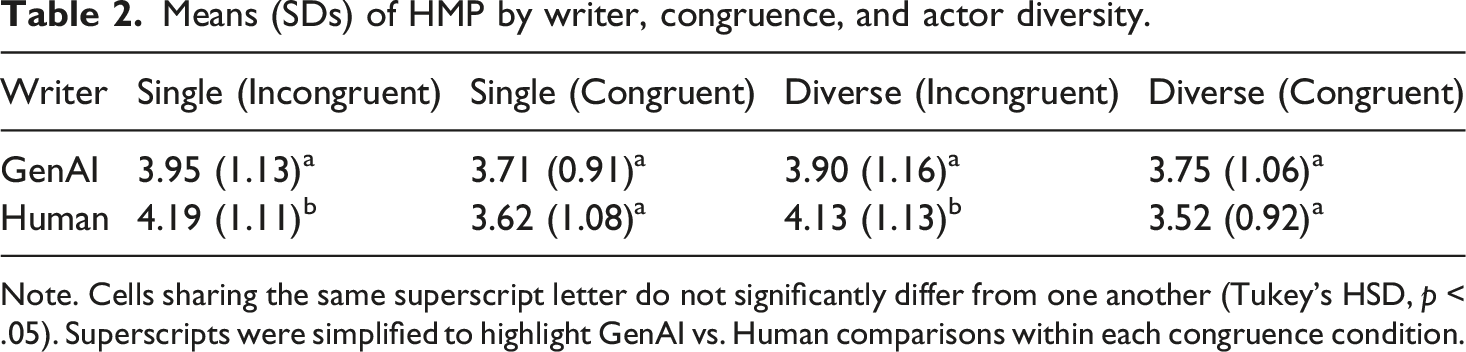
Note. Cells sharing the same superscript letter do not significantly differ from one another (Tukey’s HSD, p < .05). Superscripts were simplified to highlight GenAI vs. Human comparisons within each congruence condition.
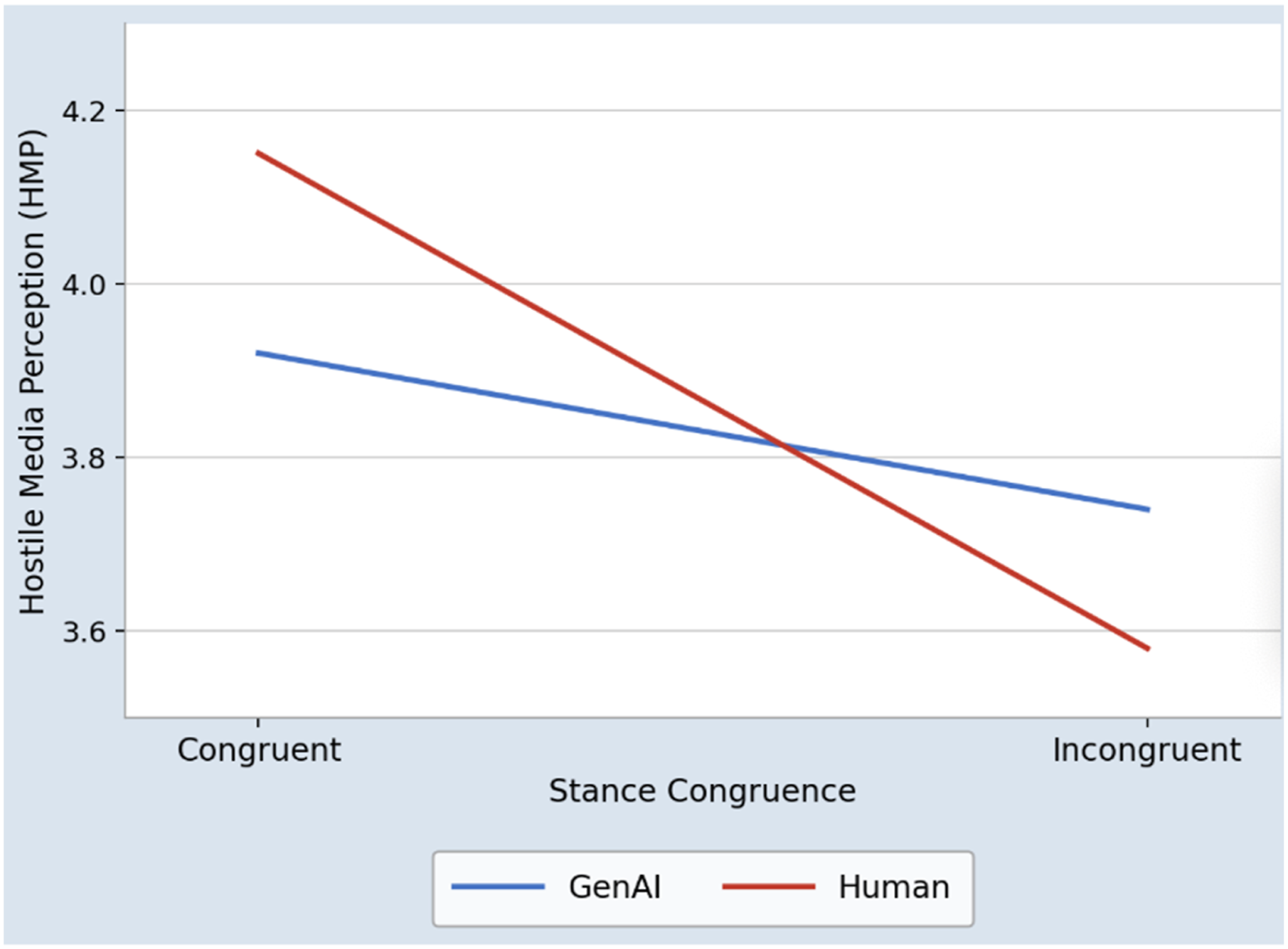
Interaction effect of news author and stand congruence on HMP.
The interaction effect between diversity and congruence was not significant, F (1, 594) = 0.02, p = .895, partial η 2 < .001; therefore, RQ2 was not supported. The three-way interaction among writer, congruence, and diversity was also nonsignificant, F (1, 594) = 0.01, p = .907, partial η2 < .001; thus, RQ3 was not supported.
Among the control variables, gender had a significant effect, F (1, 594) = 4.33, p = .038, partial η2 = .007, indicating systematic differences in HMP across gender groups. The effect of issue was not significant, F (1, 594) = 2.89, p = .089, partial η2 = .005. Age (F (2, 594) = 0.11, p = .892, partial η2 < .001) and education (F (2, 594) = 1.54, p = .216, partial η2 = .005) were also nonsignificant. Importantly, the main effects and interaction patterns of the manipulations were consistent across both topics, abortion and GM foods, suggesting that the findings are robust and not dependent on a specific issue context.
Discussion
This study examines whether audience perceptions of media hostility toward controversial issues are influenced by stance, actor diversity, and the nature of a story’s author (human vs GenAI). By manipulating news stance, news writer and source diversity, the study tested the mechanisms underlying the HME and its potential moderators. The results provided further evidence for HME: when the news stance was incongruent with participants’ own attitudes, they were more likely to perceive bias and hostility, whereas congruent coverage significantly reduced hostile perceptions. This finding echoes the classic work of Vallone et al. (1985), which first conceptualized the HME, and has been further substantiated in subsequent studies across different contexts (Gunther, 1992; Perloff, 2018). Building on this line of research, this study shows in the Chinese context that hostility arises primarily from discrepancies between audience attitudes and media stance.
This interpretation is supported by the distribution of audience attitudes in the pretest for the two issue contexts. In the abortion condition, 67.2% of participants supported abortion, while 21.8% opposed it. In the GM foods condition, 56.0% supported genetically modified food, whereas 31.0% opposed it. A chi-square goodness-of-fit test comparing supportive and opposing responses (excluding neutral responses) shows that both distributions significantly deviate from an equal split (abortion: χ2 (1) = 71.54, p < .001; GM foods: χ 2 (1) = 21.52, p < .001), indicating a substantial imbalance in audience attitudes. Such patterns likely reflect broader influences, including cultural traditions, ideology, risk perceptions, and generational value shifts, rather than news content alone (Cui and Shoemaker, 2018; Huang, 2015; Nie, 2005; Strömbäck et al., 2025).
This study also revealed that author type significantly moderated the relationship between stance congruence and HMP. When participants’ attitudes aligned with the news stance, there was little difference between GenAI-written and human-written reports in eliciting hostility. However, in incongruent conditions, the human journalist label was more salient, amplifying HMP. This suggests that in conflict-laden issues, human journalists are more readily perceived as subjective and biased, thereby triggering HME, whereas GenAI authorship may attenuate such bias perceptions (Cloudy et al., 2023; Liu and Wei, 2019). Taken together, these findings indicate that author type is not a neutral feature, but exerts a conditional effect that emerges primarily under conditions of stance conflict.
This result can be understood in light of the cognitive mechanism underlying the HME. HMP is driven not simply by evaluations of content, but by the tendency to attribute incongruent information to media bias or hostile intent (Gunther et al., 2017; Vallone et al., 1985). When news content is congruent with audiences’ prior attitudes, audiences are less likely to engage in hostile bias attribution processes (Cloudy et al., 2023). By contrast, under stance incongruity, audiences are more likely to engage in bias attribution processes, making authorship cues more influential in shaping HMP. In this context, machine heuristics provide a plausible explanation for why GenAI authorship reduces HMP under stance incongruity (see Cloudy et al., 2023; see also Craig and Choi, 2024). Prior research suggests that audiences may perceive AI as more objective and less intentionally biased than human journalists (Molina and Sundar, 2022; Sundar and Kim, 2019). At the same time, negative machine heuristics suggest that AI may be viewed as lacking human subjectivity and intentionality (Yang and Sundar, 2024). Although the present study does not directly measure these heuristics, both perspectives imply reduced attribution of hostile intent, thereby attenuating HMP when audiences encounter attitude-incongruent news.
In sum, the effect of AI authorship on HMP is clearly context-dependent rather than a stable main effect. This pattern may also reflect a basement effect. As suggested by Cloudy et al. (2023), when baseline levels of HMP are relatively low, there is limited leeway for further attitudinal shifts, leaving little room for source cues to reduce perceived bias. In the present study, perceived bias is relatively low under stance-congruent conditions, constraining the effect of author type; under stance-incongruent conditions, however, higher baseline levels of perceived bias allow differences in author type to emerge more clearly. Similarly, actor diversity had no significant main effect on HME. A possible explanation is that, although the number of actor may increase, their stances often remain uniform; consequently, actor diversity does not reduce perceived bias, and audiences continue to rely on their own predispositions when interpreting news content (Beckers, 2025).
This study makes two main theoretical contributions. First, this study provides new empirical evidence for understanding the boundary conditions of the HME by offering a clearer test of content-based (particularly issue partisans) and source-based explanations. Prior research has examined both the role of content and media sources in shaping HME (Cloudy et al., 2023; Feldman, 2011; Feldman et al., 2017; Schmitt et al., 2004; Turner, 2007). However, these two factors are often structurally intertwined in the real world, particularly in Western contexts characterized by partisan media and ideological polarization. As a result, it is difficult to determine whether HMP are driven by what is being said or who is speaking (Gunther et al., 2017).
While many studies attempt to isolate content effects by controlling for media source cues, such efforts may not fully capture the complexity of real-world communication, where content positions and media source identities are often closely aligned (e.g., Giner-Sorolla and Chaiken, 1994; Perloff, 1989). In this regard, the Chinese media context, where institutionalized partisan competition is limited and overtly opposing media positions are less common (Stockmann and Gallagher, 2011), provides a comparatively cleaner setting to examine the content-based pathway of HME. The findings show that even in the relative absence of strong media source cues, stance congruence between audiences and news content significantly shapes HMP. This finding suggests that content-based mechanisms underlying HME may extend beyond highly partisan media systems and retain explanatory power across different media environments. Even when source cues are weak, the alignment between news content and audience attitudes remains a key driver of HME.
Second, this study extends prior research on automated journalism by examining the role of AI authorship in shaping HMP. The results indicate that HMP is not determined by author type alone, but is jointly shaped by the interaction between authorship and stance congruence. While prior studies suggest that AI-authored news may be perceived as more objective and thus reduce perceived bias (e.g., Cloudy et al., 2023; Craig and Choi, 2024), the present findings further demonstrate that this mitigating effect is conditional rather than universal. Specifically, it emerges primarily when audience attitudes conflict with the stance of the content. Moreover, in response to studies suggesting that AI authorship has limited influence on HME (Hong et al., 2025), this study shows that the effect of AI is not absent but contingent, and may be obscured in aggregate analyses unless stance conflict is taken into account.
Practically, audience responses to GenAI depend on contextual factors, particularly issue polarization and audience–message congruence. In conflict-laden contexts, GenAI may be perceived as more neutral and thus dampen hostility, whereas in consensual issues differences between GenAI and human journalists are negligible. For media organizations, this implies that GenAI’s value lies not in replacing human journalists but in its strategic use for conflict-laden issues, while human–AI collaboration remains preferable in neutral domains to foster credibility and effective communication. At the same time, perceived neutrality should not be conflated with actual fairness or the absence of bias. GenAI systems may still reproduce biases embedded in training data, design choices, or prompting processes. Therefore, any newsroom adoption of GenAI should be accompanied by transparent disclosure, editorial oversight, and clear accountability mechanisms. Ethically, news organizations should avoid deploying AI labels merely to capitalize on audiences’ assumptions of neutrality, and instead ensure that technological use genuinely serves accuracy, fairness, and public trust.
This study has several limitations. First, it examined only two controversial issues, abortion and GM foods, so the generalizability of the findings remains limited. Future research could extend the analysis to other contested topics, such as the abolition of the death penalty or population policies, to assess whether issue type shapes the effect. Second, the study focused primarily on author identity, actor diversity, stance, and their interactions, without considering individual-level psychological traits such as political efficacy or GenAI literacy. Incorporating such variables in future work would help build a more comprehensive model of HMP. Third, although a gender imbalance was observed across stance conditions, additional analyses showed no significant interaction between stance and gender (p = .518), suggesting no systematic bias. Future research may use stratified randomization on key demographic variables (e.g., gender) to ensure more balanced group compositions.
Footnotes

Funding
The author disclosed receipt of the following financial support for the research, authorship, and/or publication of this article: Supported by the Fundamental Research Funds for the Central Universities (Communication University of China), Grant No. CUC26XT32.
Declaration of conflicting interests
The author declared no potential conflicts of interest with respect to the research, authorship, and/or publication of this article.
Author biography
Representative stimulus materials for the genetically modified foods conditions
Note. Representative examples are presented below to illustrate the manipulations of authorship, message stance, and actor diversity across experimental conditions.