







Abstract
This article assesses how South Korea, an emerging donor, is mainstreaming climate change considerations into its official development assistance (ODA) activities. We find that Korea’s climate mainstreaming remains in the incipient stage, with a lack of consistent political commitment at the macro level, misalignment with the recipient’s development plans at the meso level and insufficient institutional capacity at the micro level. In addition to the governance systems that fall short of incentivizing the mainstreaming of climate change, this research identifies a number of characteristics accounting for Korea’s progress with climate mainstreaming that may be unique to emerging donors, like under-reporting of climate ODA and the absence of mainstreaming fatigue.
Introduction
Official development assistance (ODA) is one of the major financing tools in international development cooperation and, more increasingly, in climate change mitigation and adaptation (Shine & Campillo, 2016; Warren, 2019). Despite its relatively small volume, public financing like ODA has attracted the attention of climate change researchers and practitioners because it can be channelled into geographies and technologies that are perceived to be too risky for private investments. 1 Because of its nature of not having to generate a return, ODA can be transferred to developing countries where the investment environment for climate projects may not be favourable. For example, private investors are often hesitant to invest in renewable energy projects in developing countries due to a number of factors, such as the volatility of currencies, the risks of policy and political change, the reliability of renewable energy buyers and the lack of scale of investments (Tonkonogy et al., 2018). ODA can also target adaptation projects and the deployment of innovative climate technologies in developing countries, both of which receive far less capital and attention from investors compared to mitigation projects (Convergence, 2021; CPI, 2021). ODA may further be utilized to improve the investment’s risk-return profile, making projects with climate impact commercially investable and crowding-in additional private investments (Boyd et al., 2009; Choi and Seiger, 2020; Harmeling and Kaloga, 2011; Mawdsley, 2018; Shine & Campillo, 2016; Warren, 2019).
With the steady increase in ODA volumes and the growing prevalence of climate change-related impacts, particularly of acute impacts in developing countries, academic communities began to pay a closer attention to whether and in what ways climate change can be mainstreamed into ODA. Previous research on mainstreaming of climate change into ODA, however, has focused mostly on established donors, like European countries (Gigli and Agrawala, 2007; Klein et al., 2007; Persson, 2008), paying little attention to emerging donors. This knowledge gap is problematic because the emerging donors’ contributions more than doubled between 2010 and 2019 while others in the Organization for Economic Co-operation and Development’s Development Assistance Committee (OECD DAC), a club of the world’s major ODA donors, grew by just 32% during the same period (OECD, 2020). With the ODA volume of emerging donors expected to continuously increase, it is critical to understand the rationale and strategies of emerging donors for mainstreaming climate change into their ODA, particularly in the light of increasing the overall effectiveness of climate finance and the urgency of deploying and utilizing climate finance in developing countries.
Against this backdrop, this research aims to assess the mainstreaming of climate change into ODA by one of the fast-growing emerging donors: South Korea. South Korea serves as an interesting case for those studying international development cooperation and climate change. The country’s rapid economic growth in recent decades was powered by capital- and carbon-intensive industries, such as steel, cement and petrochemicals, also resulting in Korea becoming one of the biggest greenhouse gasses (GHG) emitters in the world (Jones and Yoo, 2011). In the meantime, the country has transformed itself from a recipient of ODA to a donor, and in 2010, it became a member of the OECD’s DAC. Korea’s ODA expanded a whopping 500 times from US$3.81 million in 1988 to US$1.9 billion in 2018, while OECD DAC members slightly more than doubled their ODA altogether during the same period (OECD, 2020). Korea has thus succeeded in establishing itself as an important emerging donor that plays a key role in bridging developed and developing countries in the global aid community, especially in issues like enhancing aid effectiveness (OECD, 2018).
Having enjoyed relatively stable energy prices and high export competitiveness for decades, Korea has historically refrained from advocating for the reduction of fossil fuel consumption, which would inevitably hurt its economic growth prospects. The economic recession of 2008–2009, combined with spikes in international energy prices, however, prompted the Korean government to seek an alternative growth path rooted in the belief that economic growth and environmental sustainability could go hand in hand (Kim and Thurbon, 2015). Climate change strategies have since then become industrial upgrading strategies, framed around the promotion of key technologies and industries that are viewed as providing the growth engine for the next stage of Korea’s development, as export platforms and means to reduce carbon emissions (Choi and In, 2021).
This study investigates these developments in Korea’s ODA and pays particular attention to the alignment between these developments and its climate change strategy. While Korea’s ODA and climate change-related ODA do exhibit similar characteristics with those of more established donors, Korea as a new donor also has characteristics that are unique to its status as an emerging donor (Kang et al., 2011; Kim and Oh, 2012; Watson, 2011). Our analysis considers the role played by these characteristics of Korea’s ODA, which may be shared with other emerging donors. This article aims to contribute to the existing literature by focusing on the mainstreaming activities of an emerging donor country with a considerable carbon footprint and pave the way for further research on the mainstreaming climate change of other emerging donors, particularly the new DAC members. 2 The next section presents previous research on climate change mainstreaming into ODA, followed by methodologies and research framework adopted in this research. The subsequent sections present an analysis and discussion of Korean mainstreaming at various governance levels, followed by a conclusion.
The Evolution of Climate Mainstreaming into Official Development Assistance
This section explores the literatures in international development and climate finance to situate the article within current trends and relevant literature. It highlights the debates on mainstreaming climate change into ODA, the difference between climate aid and climate mainstreaming, the tensions arising from the intersection between climate aid and development assistance, and ways to mainstream climate change at various governance levels.
For the international development community, the notion of integrating or mainstreaming of climate change dates back to the late 1980s. The concept of ‘environmental policy integration’ emerged as a response to widespread policy demand for interlinking environmental policy with other traditional policies (Jordan and Lenschow, 2010), prompted by the Brundtland Report by the World Commission on Environment and Development in 1987 (WCED, 1987). The World Summit on Sustainable Development in Johannesburg in 2002 further propelled the discourse supporting the mainstreaming of climate change into ODA by emphasizing the close linkage between climate change and development (Klein et al., 2007; United Nations, 2002). Since then, the concept of mainstreaming of climate change into development became gradually accepted with more academically refined definitions (Brouwer et al., 2013; Kabisch et al., 2017; Klein, 2010; Klein et al., 2005; Swart and Raes, 2007; Wamsler, 2015), gaining stronger theoretical and practical footholds.
The overall aid flows with climate change considerations have steadily increased. The OECD DAC members’ aid flows with either their primary, or ‘principal,’ objective being climate change-related actions or their secondary, or ‘significant’, objective being climate-change related actions, have increased from less than US$25 billion in 2010 to more than US$40 billion in 2019 (OECD, 2020). The former can be considered as climate aid, while the latter can be determined as aid which mainstreams climate change—the focus of this research. 3 Observing the increase in the volume of the aid, which mainstreams climate change, United Nations Environment Programme—UNEP (2021) concluded, with a bit of caution, that the efforts by donors to integrate climate change into development activities might have finally come to fruition in actual development practices (UNEP, 2021: 32–33).
Some viewed the calls for climate mainstreaming, however, ‘with suspicion’ (Klein, 2010). For example, there were concerns that a significant portion of the traditional ODA volume, which has always been insufficient for poverty reduction, may get diverted to climate change under the pretext of being global public goods (Brown et al., 2010; Michaelowa and Michaelowa, 2007). The concerns about the diversion, in large part, stems from the currently prevailing practice where climate change-related financing and technical assistance are mainly channelled through development mechanisms (Scoville-Simonds et al., 2020; UNEP, 2014: 27–28; Weiler et al., 2018) despite the potential conflict of priorities between development and climate change policies (Michaelowa and Michaelowa, 2007). Multiple studies, therefore, claim that the diversion may result in lower effectiveness, not only in response to climate change (Scoville-Simonds et al., 2020) but also in the development domain (Brown et al., 2010; Michaelowa and Michaelowa, 2007), while also failing to satisfy one of the core principles of the Paris Agreement like mobilizing ‘new and additional’ funding (UNFCCC, 2009: 7; 2010: 17) for the fight against climate change in the developing world.
Yet, others continue to voice the case for mainstreaming (Huq et al., 2004; Rahman and Alam, 2003; Swart and Raes, 2007) by claiming that development processes cannot achieve the intended outcome without addressing climate change because of the close interlinkages between climate change and poverty reduction (Huq et al., 2004; Sietz et al., 2011). In the meantime, the international development financial institutions, some of the staunchest supporters of climate mainstreaming (Scoville-Simonds et al., 2020), continuously integrated climate change into their development activities in the past two decades (Calleja, 2021: 25–29).
Various studies have made progress in identifying different elements of climate change mainstreaming, such as the key determinants for mainstreaming, the degree of mainstreaming and the main characteristics of mainstreaming at different governance levels. The first line of research focuses on identifying the determinants, often termed as ‘enablers and barriers’. The research on the barriers on donor’s side, for instance, identified various factors such as sectoral departmentalization or specialization (Hertin and Berkhout, 2001; Peters, 1998), absence of policy assessment processes (Nilsson and Persson, 2003), lack of political commitment and low levels of awareness (Dessai et al., 2009; Lorenzoni et al., 2007). Though such studies have largely succeeded in identifying and categorizing these factors, they have been less successful in explaining the hidden dynamics of policy integration (Russel et al., 2018), like why certain barriers hinder mainstreaming (Eisenack et al., 2014) and what mechanism leads to effective mainstreaming (Biesbroek et al., 2015).
The second line of research categorizes multiple levels of mainstreaming by identifying how deeply climate change is embedded or ‘prioritized’ in development activities (De Roeck et al., 2018; Lafferty and Hovden, 2003; Persson et al., 2018; Runhaar et al., 2014). For example, Lafferty and Hovden (2003) proposed, and Widmer (2018) refined, the concepts of ‘coordination,’ through which inter-policy contradictions are removed; ‘harmonization,’ through which inter-policy synergies are realized; and ‘prioritization,’ where climate change-related objectives are favoured over other policy objectives. Similarly, Ranger et al. (2014) have suggested five categories of mainstreaming at the project level and characterized the key elements of each category. They include Level 1, where no consideration is made to climate change to Level 5, where climate change-related risks are integrated into the project design process. While these studies identified and explored various degrees of mainstreaming, they fall short of answering critical questions regarding measurability and comparability like ‘what is the clear distinction between coordination and harmonization?’ or ‘how can we differentiate coordination from harmonization?’
The third line of research presents various characteristics of mainstreaming at different governance levels. For example, Persson (2004, 2008) presented three different ‘approaches’ to mainstreaming: (a) normative, (b) organizational and (c) procedural. A normative approach involves high-level political commitment or changes (Adelle and Russel, 2013) or integration of climate change into broader national-level policies (Biesbroek et al., 2010). An organizational approach advocates for structural changes in government or in ODA agencies (Biesbroek et al., 2010) or policy coordination platforms (Widmer, 2018), while a procedural approach focuses on changes in decision-making and implementation procedures (Candel and Biesbroek, 2016). Gupta (2010) further improves this differentiation of approaches by proposing several quantitative indicators at different governance levels like ‘donor’s ODA budget’ and ‘changes in project design’.
Using the aforementioned analytical framework, multiple studies have analysed mainstreaming on the recipient side from various angles such as developing countries in general (Mertz et al., 2009), the least developed countries (Huq et al., 2004) or environmentally vulnerable recipients like Bangladesh (Ayers et al., 2014; Pouliotte et al., 2009; Rahman and Alam, 2003; Saito, 2013). However, the research on climate mainstreaming by donors into pre-existing policies, like ODA policy or other sectoral policies, has more or less been confined to a small number of developed countries, predominantly, the European donors, such as the European Union (EU), Norway, Germany, Switzerland and the UK. In its 2007 stock-taking report, for example, the OECD examined multilateral development banks (MDBs) and European bilateral ODA agencies, reporting somewhat ambivalent results highlighting strong political commitment to climate change accompanied by weak implementation at most of the agencies (Gigli and Agrawala, 2007). Other research on climate mainstreaming into sectoral policies other than ODA also concerns climate mainstreaming at the EU level (Russel et al., 2018), the UK and Sweden (Jordan, 2002; Nilsson and Persson, 2003) and Switzerland (Widmer, 2018).
In short, studies on mainstreaming have progressed from identifying the ‘determinants’ of mainstreaming (Hertin and Berkhout, 2001; Nilsson and Persson, 2003; Peters, 1998) to categorizing different ‘degrees’ of mainstreaming (Lafferty and Hovden, 2003) to measuring the progress of mainstreaming (Gupta, 2010). The previously mentioned studies on mainstreaming by donor countries, however, have not paid sufficient attention to the emerging donors like Korea. This study, among others, aims to examine how much progress Korea has achieved in mainstreaming climate into its ODA at different governance levels by utilizing various indicators proposed by Gupta (2010). Particular attention is paid not only to how much change was made but also to what has been driving those changes (or lack thereof). Also, this study seeks to identify the ‘enablers and barriers’ in Korea’s mainstreaming, which may or may not be the same as those already found in previous research on other ‘developed donors’ like barriers of understaffing and ‘mainstreaming fatigue’ (De Roeck et al., 2018; Persson, 2008; Persson and Klein, 2008) and enablers including institutional factors like empowerment (Jordan, 2002; Nilsson and Persson, 2003) and the utilization of soft coordinative methods (Bauer et al., 2012).
Methodologies and Research Framework
The integration of emerging policy issues, like climate change, into already established policies, like development policy, has attracted less academic attention than it should have (Russel et al., 2018). The small body of research on this topic, however, has produced some meaningful results by utilizing in-depth document analysis and/or interviews with key stakeholders, like government officials and ODA personnel (De Roeck et al., 2018; Gigli and Agrawala, 2007; Russel et al., 2018; Widmer, 2018). Building on the success of these methods, this study has adopted the two-pronged methodological approach of qualitative document analysis and semi-structured interviews with ODA experts.
The study analyses Korea’s ODA from 2010, when the country became an OECD DAC member, to 2021. For document analysis, we analysed key documents from the OECD DAC, the Korean government and its two implementing agencies, the Economic Development Cooperation Fund (EDCF) and the Korea International Cooperation Agency (KOICA). EDCF extends ODA loans in social and economic infrastructure, sectors and KOICA provides grants and technical assistances mainly for humanitarian and capacity-building purposes. Korea extends its ODA based on its annual ODA plans that follow the 5-year mid-term strategy which, in turn, is contingent upon the Framework Act on International Development Cooperation (the Framework Act). The Country Partnership Strategy (CPS), which stipulates multi-year country strategy, guides Korea’s ODA plans for 24 major recipients. This research investigates those major documents that form the backbone of Korea’s ODA planning and implementation at different governance levels. Document analysis pays special attention to how Korea recognized and incorporated climate change into its ODA planning and implementation. The documents analysed are listed in Table A.1.
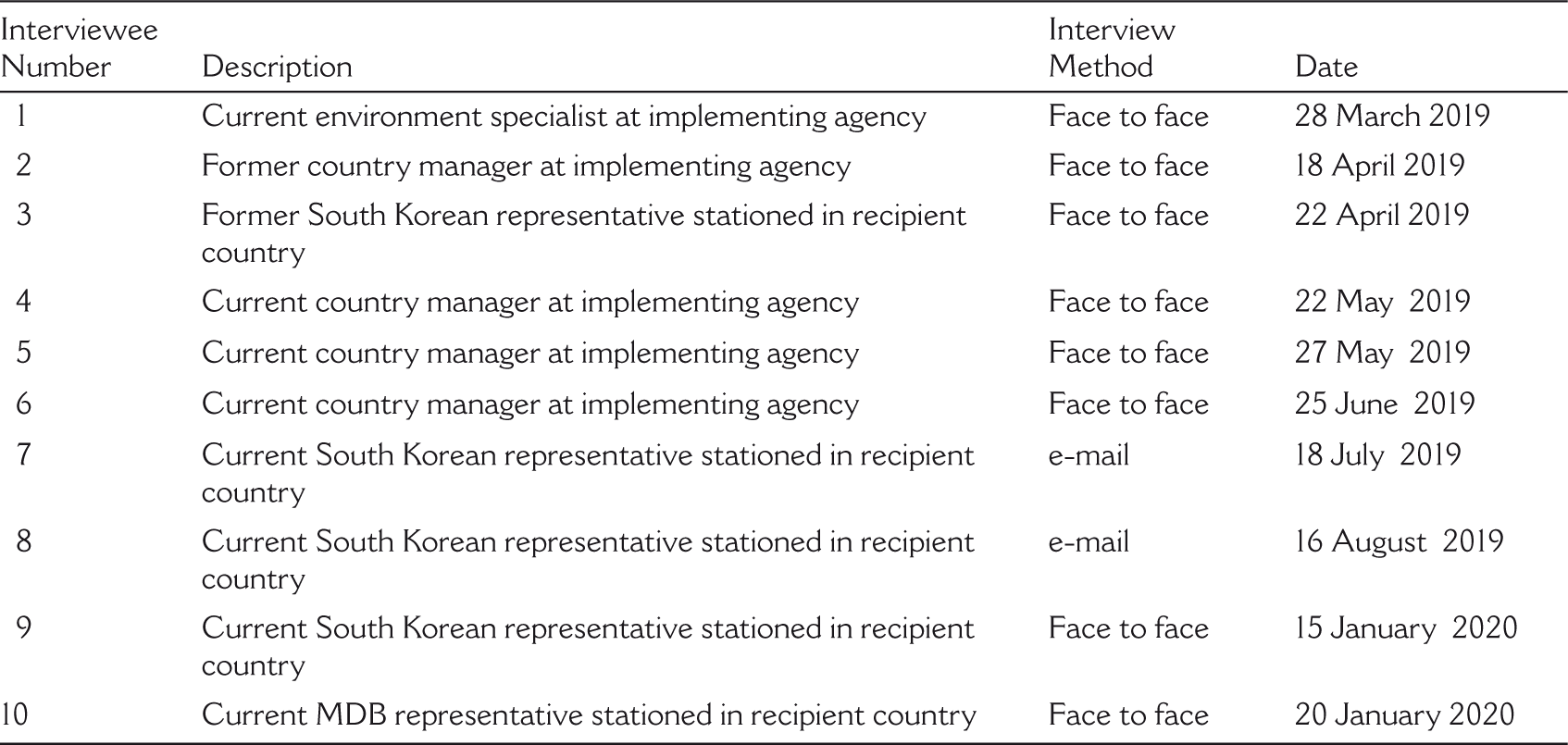
Most of the interviewees were Korean ODA experts who are, either currently or formerly, working with Asian recipient countries that comprise approximately three-fourths of Korea’s ODA recipients. The questionnaire included, but was not limited to, questions on (a) barriers to climate change mainstreaming in Korea’s ODA policies, (b) how mainstreaming is negotiated with recipient governments and (c) how successfully, if at all, mainstreaming has been achieved at different governance levels. The interviewees, most of whom are ODA experts from Korea’s ODA agencies, have retained anonymity by being identified only by an ‘interviewee number’ in order to maximize their willingness to share information. The interviewees are listed in Table A.2. There exists, however, a possibility of under-representation in the interviewee pool since the interviews did not include experts specialized in sectors or regions that receive relatively small amounts of Korea’s ODA, like small-scale technical assistance or Latin America.
For the research framework, this study utilizes Gupta’s (2010) trichotomy analysis. Her framework categorizes the different levels of governance and defines how mainstreaming can be measured at each level on the basis of policy implementation: (a) micro-level mainstreaming (project level), (b) meso-level (sector or country level) mainstreaming and (c) macro-level (modification of donor’s ODA priorities) mainstreaming. As presented in Figure 1, mainstreaming climate change at the micro level involves changes in the design of specific projects. Modification by the donor of country programmes or sectoral policies, on the other hand, becomes possible when meso-level mainstreaming is realized. When climate change is fully integrated at the macro level, donor countries modify their ODA priorities and rearrange their overall ODA budget by placing climate change on top of policy agendas (Gupta, 2010).
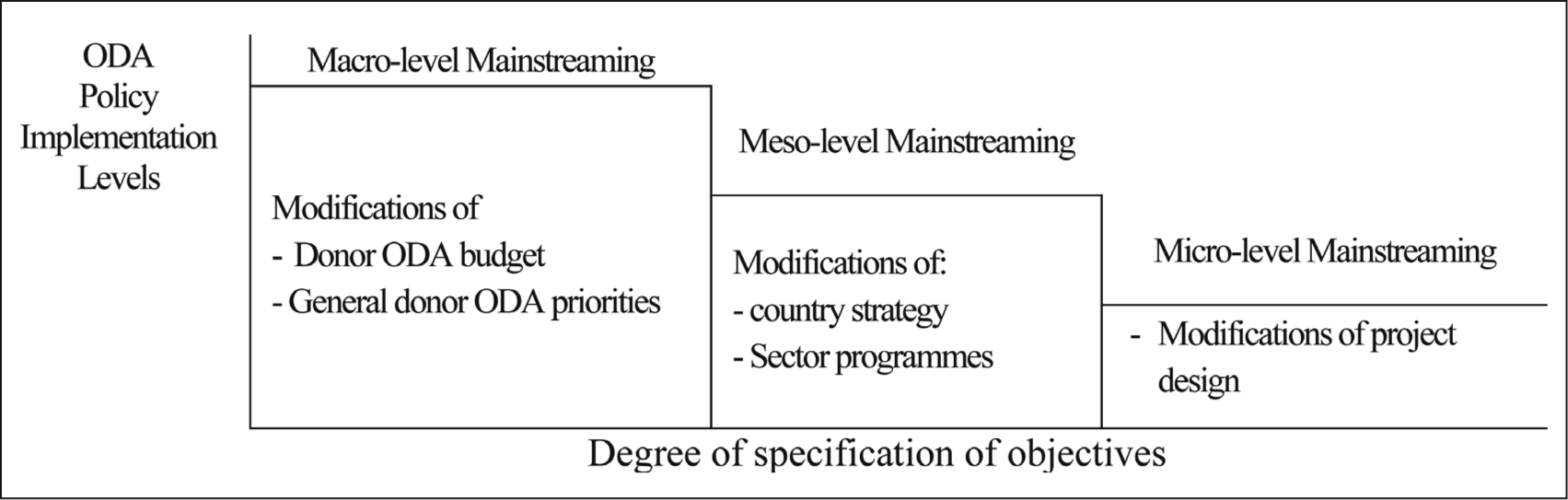
Gupta’s framework offers a couple of comparative advantages over other frameworks for the purpose of this research. First, her framework presents clearly demarcated distinctions between and among the three different governance levels such as macro, meso and micro levels. This differentiates her framework from those of Lafferty and Hovden (2003) or Ranger et al. (2014), both of which have divided the outcome of mainstreaming activities into, for example, ‘coordination’ or ‘harmonization,’ without recognizing the unique characteristics and challenges faced at different governance levels. In consideration of the state-driven nature of Korea’s climate policy (Han, 2015) combined with the hierarchical ‘developmental state’ mentality (Kalinowski, 2020; Kim and Thurbon, 2015), Korea’s climate change mainstreaming could be best analysed with this framework that clearly divides governance levels. Second, the indicators suggested in her framework such as ‘donor’s ODA budget’ or ‘changes in project design’ offer scope to measure and compare across timeline for a specific donor country. Unlike Persson’s framework (Persson, 2004, 2008) that provides rather loosely defined qualitative indicators, Gupta’s framework achieves more enhanced comparability between different points in time. The third and potential advantage, which is closely related to the second, is cross-country comparability. For example, comparison of ODA mainstreaming between different emerging donors might be more easily performed with measurable and comparable indicators.
This section analyses Korea’s progress in achieving mainstreaming on three different levels. Adopting Gupta’s (2010) framework, the macro-level analysis concentrates on how much change Korea has made with regard to ODA priorities and ODA budget allocation. The meso-level analysis focuses on the alignment between the recipient’s development plans and Korea’s geographical and sectoral strategies. The micro-level analysis investigates whether, and to what extent, Korea modified its ODA project design to accommodate climate change.
Utilizing one of Gupta’s macro-level indicators, ‘changes in ODA budgets’, one can quantitively observe a heavily fluctuating pattern in Korea’s climate-mainstreamed ODA in the past decade. In Figures 2.1 and 2.2, climate-mainstreamed aid, which can be proxied by the aid whose secondary or ‘significant’ objective is either climate change mitigation or adaptation, is depicted by the two solid blocks (Figure 2.1 for Korea & 2.2 for DAC member countries). Korea’s pattern (in Figure 2.1) neither corresponds to the continued increase in Korea’s overall ODA nor follows the relatively steady pattern exhibited by other DAC members (Figure 2.2).
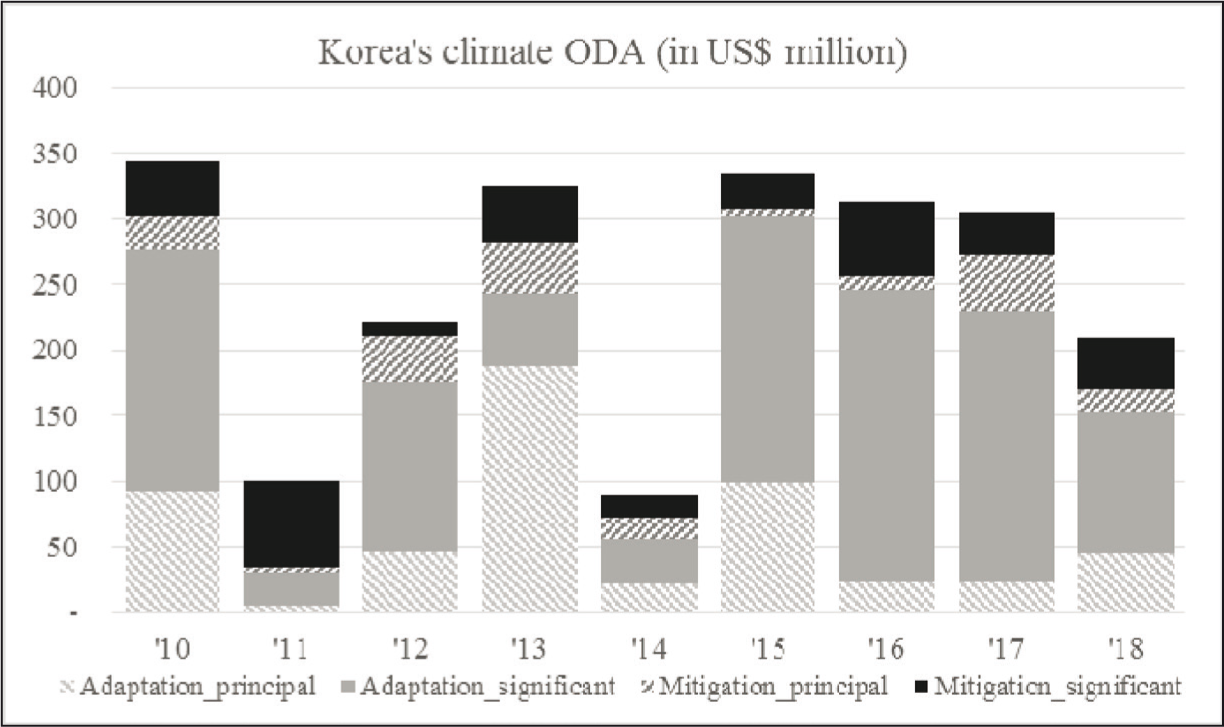
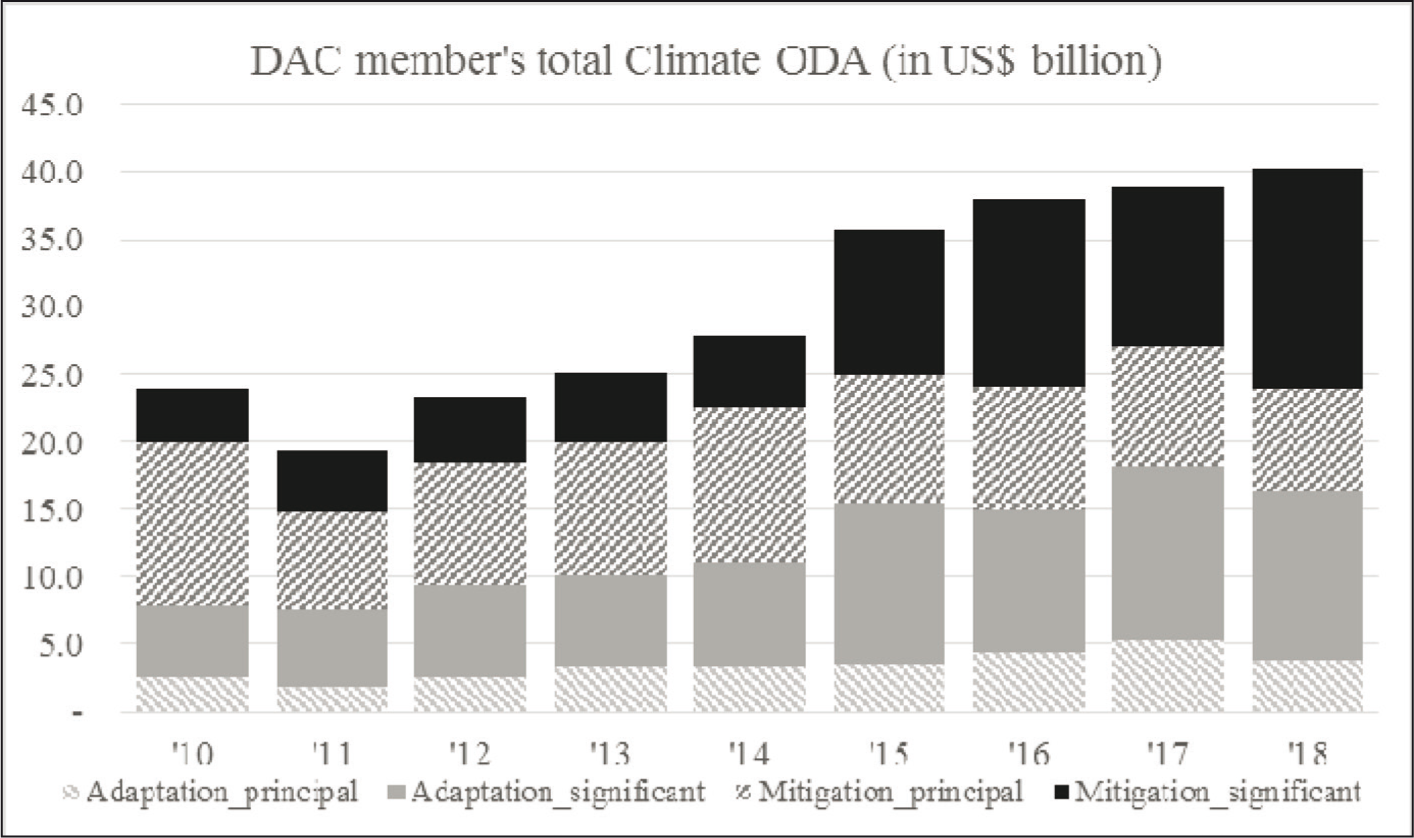
Our macro-level analysis finds this non-linear pattern not only in Korea’s ODA budget allocation but also in its ODA priorities. Korea’s high-level political commitments to climate change drastically changed their tone as the 5-year single-term presidency changed hands in 2008, 2013 and 2017. Faced with economic recession of 2008–2009, the Lee Myung-bak administration (2008–2013) adopted green growth as a new growth engine for the nation’s economy (Kim and Thurbon, 2015). The Lee administration set up the legal, procedural and institutional governance schemes for green growth such as the Presidential Committee on Green Growth (PCGG) and the National Strategy for Green Growth (2009–2050) (Kalinowski, 2020). In the subsequent Park Geun-hye administration (2013–2017), however, the high-level interests in climate change-related action subsided (Chung, 2020). This can largely be characterized by her administration’s decision to demote the PCGG to the prime minister’s level, to weaken Korea’s GHG emission target, and the country’s acutely prominent non-presence during the Paris Agreement negotiation (Kalinowski, 2020; Kim, 2016). During the first half of the Moon Jae-in’s presidency (2017–present), climate change issues were upstaged by other environmental issues like air quality and the phasing out of nuclear power plants (Chung & Kim, 2018; Kalinowski, 2020). Only after making very limited progress with these two issues did the Moon administration begin to turn its policy interests to climate change. As such, presidency-initiated political slogans and policies have taken centre stage in Korea’s climate change-related ODA priorities rather than following the previously agreed-upon or institutionalized long-term commitments.
In addition to these fluctuations, it is difficult, in Korea’s case, to find a strong linkage between the high-level political commitments (‘ODA priorities’ in Gupta’s terminology) and the actual ODA disbursement practices (‘ODA budget’ in Gupta’s terminology). In other words, the changes in Korea’s climate change-related ODA volumes are seemingly unrelated to the political commitments, or lack thereof, of the three different presidencies during the past 10 years. As is found in Figure 2.1, Korea’s total climate change-related ODA exhibits generally declining trends, and climate-mainstreamed ODA exhibits fluctuations during the Lee administration (2008–2013), which prioritized green growth as well as the succeeding administration (2013–2017), which placed relatively less emphasis on climate change.
There are several factors that contribute to this phenomenon. During our interviews with ODA experts, multiple barriers to climate mainstreaming into Korea’s ODA were identified, with most of the barriers mirroring ones already identified in the previous research on the established donors. They include lack of a longer-term vision for climate change, lack of human and financial resources, limited interest and ability of high-level decision-making bodies and poor linkages between top-level policies and agency-level practices (Interviewees 1, 2, 4 and 5).
In addition to these, we identify some interesting characteristics specific to Korea. First, previous research reported ambivalent results about whether and how far climate change has been mainstreamed into the development processes of the established donor countries and major MDBs. Research conducted on mainstreaming in the Swedish energy sector by Nilsson and Persson (2003) found that the commitment for mainstreaming was weakened by political considerations when the issues were handed from the agency level to ministry level. On the other hand, Gigli and Agrawala (2007) reported that significant high-level endorsement for mainstreaming was present not only at the agency level but also at the ministry level among the selected bilateral donors and major MDBs. This research on Korea, however, identifies such a lack of long-term vision at both ministry and agency levels. During the interviews, none of the interviewees reported they identified commitments for mainstreaming either at the ministry level or agency level. Personnel, both in the government and the agencies, are too preoccupied with their day-to-day tasks to consider ‘distant future issues’ like climate change (Interviewee 2).
The second characteristic specific to Korea concerns ‘mainstreaming fatigue’. This is generally defined as the situation where multiple cross-sectional issues such as environment, climate change, human rights and gender equality compete with one another for a limited amount of human and financial resources (Persson, 2008; Persson and Klein 2008). This might, in some worst cases, lead to the loss of interest by the general public (Capstick et al., 2015). This phenomenon has been repeatedly reported in research on the traditional Western donors (Agrawala and van Aalst, 2008; Capstick et al., 2015; De Roeck et al., 2018). This study, on the other hand, finds that ‘mainstreaming fatigue’ is almost non-existent in the case of climate change mainstreaming in Korea. Neither our interviews nor our document analyses identify the existence of such a ‘fatigue’ in Korea. The absence of ‘mainstreaming fatigue’ is believed to have stemmed, at least partially, from the fact that Korea’s mainstreaming of climate change hovers at such an incipient stage that the ODA experts in Korea have not yet experienced competition from different cross-sectional issues.
Meso-level Mainstreaming
In 2005, donor countries endorsed the Paris Declaration on Aid Effectiveness, which recommends the alignment of donor country’s aid policies with recipient’s development strategies (OECD, 2005). More than 100 countries agreed that the effectiveness of ODA could be enhanced by closely aligning the policies of donors and recipients. The concept of aid alignment is employed for analysis of meso-level mainstreaming, which, if realized, can be manifested in changes in donor’s country strategies and/or sectoral programmes (Gupta, 2010). Korea’s CPS, formulated by a prime ministerial-level entity named the Office for Government Policy Coordination, contains the analysis of the recipient country’s development plans, areas for bilateral cooperation and the implementation plans for 3–4 years (Office for Government Policy Coordination of Korea, n.d.). The Korean embassies stationed in the recipient country are responsible for the consultation with the recipient government, and the consultation takes place usually once or twice during the whole CPS formulation process. As of December 2021, the Korean government has formulated CPSs for 24 key partners that receive approximately 70% of Korea’s total ODA. Our meso-level analysis mainly focuses on these.
Our meso-level analysis investigates how much and in what ways Korea has achieved climate mainstreaming in its country strategies. Most of the current CPSs were formulated during the period of 2016–2020. This study examined whether or not climate change was recognized by the recipient countries as one of their major challenges in development path and then whether or not Korea acknowledged the issue in its CPS for the recipient. Table 1 presents the summary of the findings.
Meso-level Mainstreaming of Climate Change into Korea’s ODA
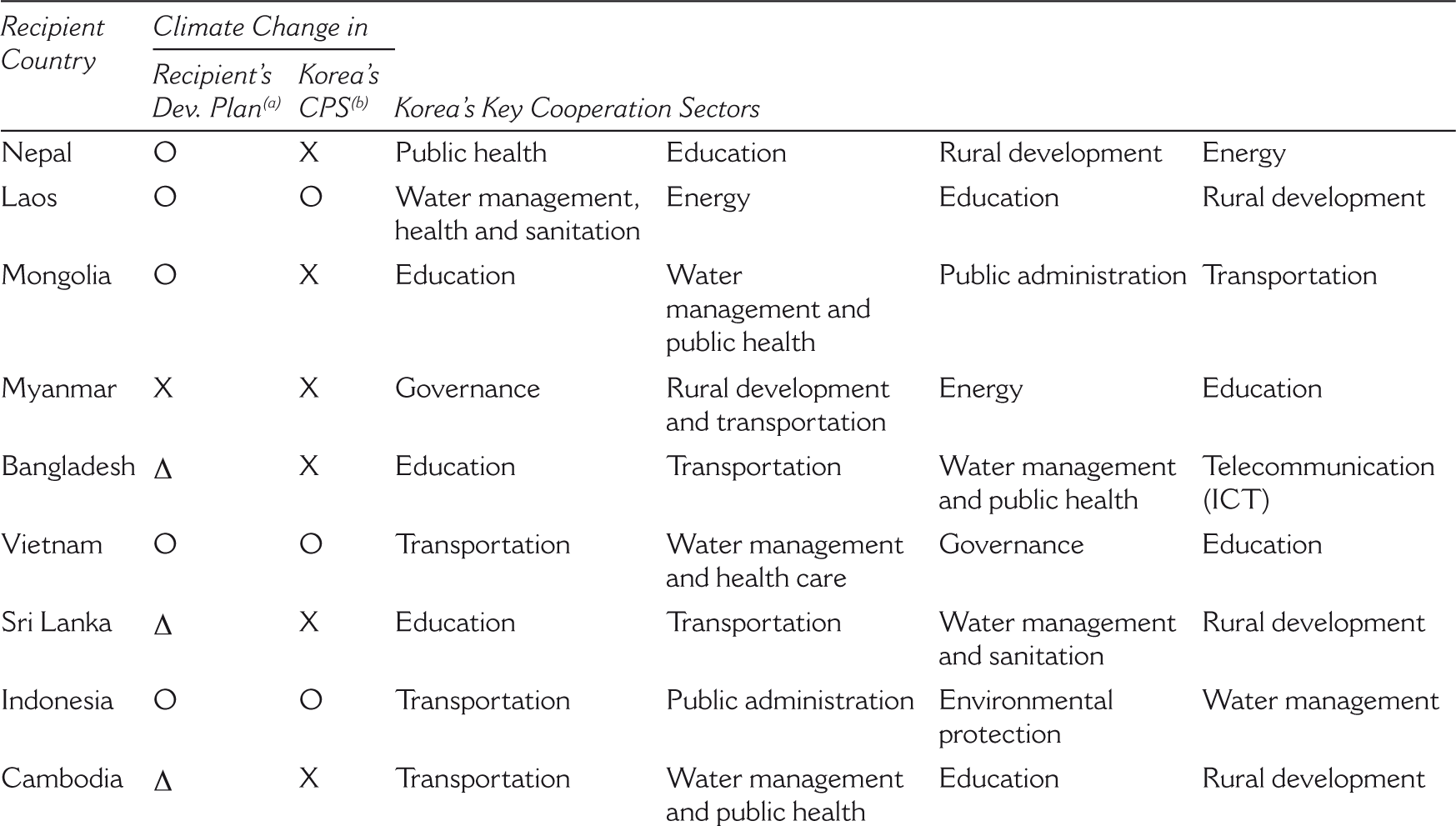
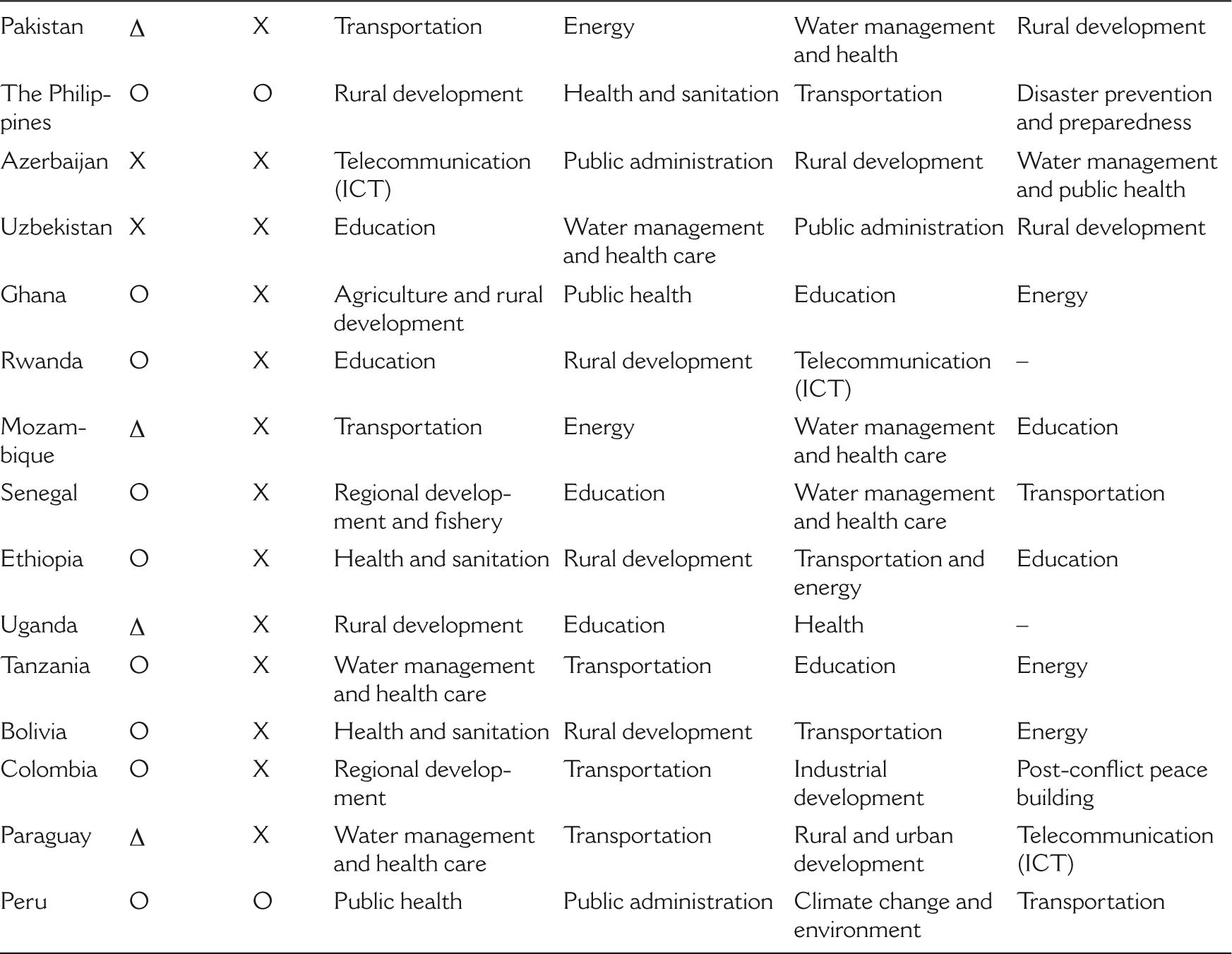
Δ: Climate change is included in the recipient’s development plan but not identified by the Korean government.
X: Climate change is not included in the recipient’s development plan.
(b) O: Korea incorporates climate change prevention in its key cooperation sectors.
X: Korea does not incorporate climate change prevention in its key cooperation sectors.
First, even though most of the recipients recognize the significance of climate change in their development plans, Korea often failed to recognize the issue, and even if it did recognize it, it did not take the issue into account when formulating the CPSs. More specifically, at least seven key partners, including the most vulnerable countries like Bangladesh and Sri Lanka, recognized climate change as a major development objective. Korea, however, did not recognize climate change as the recipients’ key development area (see column 2 of Table 1). In some cases where Korea did recognize climate change in the development strategies of its key partners, Korea either overlooked aligning its own ODA policies with development plan of the recipient (column 3) or opted to stay away from selecting climate change as a key cooperation sector (from columns 4 to 7).
The lack of alignment between Korea’s CPS and the recipients’ development plan with regard to climate mainstreaming remains evident in the most recent CPS that we analysed. In January 2020, for example, the Korean government revised CPS for five recipients, including Azerbaijan, Uzbekistan, Myanmar, Cambodia and the Philippines, in order to reflect changes in their development plans. However, no significant changes have been made for those five countries except for the new inclusion of ‘rural development’ and ‘education’ for Uzbekistan and Myanmar, respectively. However, one notable change is Korea’s declaration of intent to identify and develop disaster prevention projects, which are closely related to climate change adaptation in the Philippines.
Second, Korea shows very limited progress not only with its country policies, Gupta (2010)’s first meso-level indicator, but also in its sectoral policies, her second indicator. Neither the Korean government nor its implementing agencies has publicly announced an overarching sectoral policy regarding climate change. One notable exception would be Korea’s decision on overseas coal power plants. As of 2021, Korea and Japan were the only OECD countries that still provided ‘public financing’ to the construction of overseas coal power plants. As soon as Japan announced that it would consider the discontinuation of public financing for overseas coal power plant projects, the Korean government, in April 2021, announced its discontinuation of public financing, including export credit and ODA, towards overseas coal power projects. Even before this official announcement, Korea’s implementing agencies were voluntarily excluding from policy dialogues with recipient governments those projects expected to emit GHG, like construction of coal power plants, because they anticipated this decision. Consequently, those projects have been slowly phased out from a list of pipeline projects during the past 2 or 3 years (Interviewee 4).
Micro-level Mainstreaming
According to Korea’s national ODA plan, 41 entities that include central government ministries, local governments and implementing agencies, like EDCF and KOICA, planned to provide approximately US$2.6 billion (KRW 3.1 trillion) to the recipients in 2020. The micro-level analysis is mainly focused on EDCF and KOICA, the two implementing agencies that collectively represented about 65% of Korea’s ODA since the country’s induction into the OECD DAC in 2010. This analysis examines the climate change-related policies and guidelines of these two agencies, together with their ODA activities at the project level over this period.
In 2008, KOICA introduced prototype ‘Environment Guidelines’ that defined the procedures for screening, preliminary environmental investigation and environmental evaluation and assessment of ODA projects. A pilot ‘Country Environmental Analysis’ was performed on a few selected recipient countries in 2009, including Mongolia and Ethiopia, and the first ‘Strategic Environmental Assessment’ was performed in 2010. KOICA adopted its first ‘Environment Integration Guidelines’ in 2012 and, as of September 2020, Korea’s ‘Mid-Term Sectoral Strategy 2016–2020’ included KOICA’s climate change strategy as one of its 10 major sectors. In comparison, ECDF is somewhat lagging behind in its climate change strategy, according to one interviewee. The ‘EDCF Safeguard Policy’ was formally adopted and made public only in February 2016 after 2 years of internal discussion (Interviewee 1).
The most prominent observation at the micro-level analysis is the lack of awareness. Main concerns at the project level still remain at the concept of ‘environmental protection’, not ‘the mainstreaming of climate change’ (Interviewees 1, 2 and 5). For example, climate change is explicitly absent in both the EDCF Safeguard Policy as well as the EDCF environmental social impact assessment. Current and former Korean representatives stationed in the recipient country responded that they thought Korea’s engagement with the recipient country needed to focus primarily on environmental protection during the project cycle rather than on cross-cutting issues like climate change. They ‘presumed’ that the latter has been delegated to MDBs or UN agencies (Interviewees 3, 7, 8 and 9).
Low-level awareness at the project level can be found in the agencies’ implementation phases as well. For instance, one of the initial steps in mainstreaming is to conduct ‘portfolio screening’ in order to look retrospectively at mainstreaming of the already implemented projects. Korea’s ODA agencies, however, have neither undertaken a full-fledged screening process nor adopted agency-level guidelines on portfolio screening. The situation is almost the same for the projects currently under discussion or in design phases. According to another interviewee, the Korean agencies rarely considered cross-cutting issues like climate change to be mandatorily discussed during policy dialogues with recipient countries in the initial phase of ODA activities (Interviewee 4).
Furthermore, this study finds a general lack of institutional capacity and procedural governance with respect to climate mainstreaming. Climate change-related decision-making at the project level is heavily influenced by the levels of awareness and knowledge of individual staff members, and not by institutionalized guidelines or policies (Interviewees 4 and 5). Multiple interviewees at the EDCF described how this dependence on the capacity of individual staff members plays a role in various phases of ODA processes. During the project design and approval process, for example, individual country managers within the EDCF can arbitrarily decide whether a particular project requires climate change proofing or not (Interviewees 4 and 5). Furthermore, if a specific country manager, with or without sufficient information or knowledge, decides not to take into account the issue of climate change at the very first stage of project development, then the issue continues to remain out of the purview for dialogue or appraisal with little possibility for its inclusion during the entire process of approval, implementation and monitoring (Interviewee 5).
This research aimed at analysing the progress of climate change mainstreaming into Korea’s ODA at three governance levels. The results show that Korea, despite its series of recent pledges and commitments to green growth, climate change and net-zero emissions, stands at the incipient stage of mainstreaming at the micro-, meso- and macro levels.
At the macro level, the analysis focused on investigating why certain barriers hinder mainstreaming and what mechanisms lead to effective mainstreaming. In Korea, the root causes behind the slow progress in mainstreaming and the prevalence of barriers are intricately intertwined. A lack of continued high-level commitment and guidance cascades down to the lower levels resulting in the absence of relevant agency-level policies and low incentives to pursue climate change issues. Although unintended, the lack of high-level commitment is likely to create an environment where insufficient awareness and interest in climate change is prevalent in governments and ODA agencies. The macro-level analysis also identifies that the governance systems like the reward system and the human resources (HR) management system at ministerial and agency levels fall short of preventing the lack of high-level commitment from affecting lower governance levels. For example, the reward system at government and agency levels disproportionately favours ‘approval of ODA projects’ over other cross-cutting elements like climate change. Under this circumstance, it is not easy for individual staff to direct their attention, let alone the attention of their institution, to issues like climate change mainstreaming because this may hinder the attainment of prominent evaluation indicators, like a speedy approval of projects.
Frequent changes in key decision-makers at government and agencies alike also work against long-term institutional capacity building and accumulation of knowledge and experience. Key personnel at the government ministries and the implementing agencies are frequently, in some cases within a year or two, being transferred to and from other posts irrelevant to ODA activities. None of the interviewees reported that they have ever been incentivized by reward systems or HR systems to pay close attention to either mainstreaming or to climate change. The short-term postings of personnel with relatively little work experience, combined with the annual assessment system rooted on the ‘approval-comes-first’ philosophy, disincentivize longer-term initiatives and strategies. In fact, this incentivizes the decision-makers to adopt ‘path dependency,’ in which they make most decisions by imitating the past ones.
Although there have been no significant changes in the reward system and the HR system, our study found some notable developments in Korea’s mainstreaming at the macro level in recent years. First, the Moon administration placed newly found policy interest in climate change only after achieving little progress in air quality and nuclear power plants, the issues that dominated the first half of the presidency. The Coronavirus Disease 2019 (COVID-19) pandemic and the resultant economic difficulties in 2020 led the Moon administration to introduce one of the biggest economic stimulus packages named the ‘Korean New Deal’, consisting of the Green New Deal, the Digital Green New Deal and the strengthening of the social safety net (Kim, 2020). Based on the increased political commitments at the highest level, the Korean government decided to recommend the implementing agencies to take appropriate measures to raise awareness for climate change issues in its 2020 annual ODA plan. The Korean government has also decided to include climate change-related activities in assessing the performances of implementing agencies, with the details yet to be publicized. Furthermore, in Korea’s yearly ODA plan for 2021, the country reiterated its resolution to expand the country’s international cooperation in the field of climate change action.
At the meso level, Korea’s slow progress in mainstreaming stems from multiple issues. First, the lack of interlinkages between high-level decision-making and meso-level strategy is prevalent. For instance, the highest-level policy documents at the prime ministerial level contain the allocation of ODA budget for the 17 Sustainable Development Goals (SDGs). However, there is no coherent linkage that connects this allocation with the meso level (i.e., country and sectoral policies) or with the implementing agencies’ annual plans (interviewee 5). Second, the absence of the most basic quantitative indicators to measure progress adds to the difficulties with mainstreaming. There are no quantitative targets about how much GHG emissions Korea’s ODA intends to reduce or how this would be measured in monitoring and evaluation. Very basic concepts, like CO2 footprints, are yet to be introduced to project processes, and practitioners at both implementing agencies do not fully understand these concepts (Interviewee 5).
Multiple interviewees explained that the lack of linkage between the governance levels and the lack of awareness are best exemplified by the peculiar way of formulating Korea’s CPS. In most cases, pipeline projects are first identified and only later the CPSs are retrospectively drawn up by rationalizing the reason for selecting those projects (Interviewees 1 and 3). In addition, Korean CPSs are formulated in a hurried and mechanical manner without leaving sufficient time for the Korean government to closely engage with the recipients and pay attention to various cross-cutting issues. As a result, climate change and its mainstreaming into ODA was one of the topics that was least addressed during the policy dialogue with the African recipients (Interviewee 6) as well as during policy dialogue with some of the most environmentally vulnerable countries, like India (Interviewees 9 and 10).
However, Korea’s climate policy, especially at the meso level, was not entirely unresponsive to developments in the international community. Korea’s ODA, at least anecdotally, became more responsive to the major changes in the international community. The Korean government did not publicize its ODA budget allocations to thematic issues, like climate change, until 2015. Before then, the government disclosed its ODA spending in terms of geographical and sectoral allocations, with a marked tendency for continuity from 1 year to the next. This changed in 2015 when the SDGs were adopted in September and the Paris Agreement was adopted in December (UNFCCC, 2015), and in 2017, the allocation plan for 17 SDG goals appeared for the first time in Korea’s annual ODA budget. 4
In the past 3 years, a couple of notable improvements have occurred at the agency level as well. Both EDCF and KOICA, the two main implementing agencies, have officially and publicly acknowledged climate change response as a ‘priority goal’ and have vowed to devote more resources to combating the issue. In addition, the EDCF has begun to offer more preferential terms and conditions for climate change-related projects. The Korean government, during the rolling-basis updating process of the CPSs for its 24 key partners, has started to put extra effort into aligning the development plans of recipients with its own CPS and has decided to enhance its engagement with more vulnerable countries, like Mongolia (Interviewee 6). Recent efforts to identify the needs of the recipient country with respect to climate change and to concentrate Korea’s aid towards those issues, though small in number, are starting to make a difference. For example, Korea is co-financing with other MDBs’ climate change aid to Vietnam (in 2015) and is helping to promote air quality in Mongolia (in 2017). 5
At the micro level, the combination of low-level awareness and lack of institutional capacity at both the staff and agency level collectively creates a situation very specific to Korea. Previous studies on established donors consistently note the ‘over-reporting’ of climate change-related ODA projects (Donner et al., 2016; Michaelowa and Michaelowa, 2011; Roberts and Weikmans, 2017). This over-reporting is rooted in the influence that the political preferences of the donor government, and the general public, exerts upon the agencies of the OECD DAC donors (Michaelowa and Michaelowa, 2011) and significantly compromises the reliability of self-reported data on donors’ climate change-related spending (Roberts and Weikmans, 2017). In contrast, a number of ‘false-negative’ cases have been found in the Korean ODA agencies where several eligible climate change-related projects have remained unreported to the OECD. Because of the different levels of awareness among staff members, some were not aware that specific projects were eligible to be categorized as mitigation or adaptation projects and ‘unintentionally left the Rio markers un-ticked’ (Interviewees 1 and 3). In December 2018, the EDCF acknowledged the problem of under-reporting in the agency and issued an in-house letter encouraging thorough examination, which the agency hoped would lead to more accurate reporting of Rio markers to the OECD (Interviewee 1).
Conclusion
The assessment of climate mainstreaming of Korea’s ODA at three governance levels demonstrates that emerging donors like Korea behave differently from more established donors. At the macro level, political commitments to climate change progressed in an intermittent and non-linear fashion, and, combined with the poorly designed reward and HR systems, they fell short of incentivizing the mainstreaming of climate change at lower levels. With internal governance schemes that do not provide the right signals and incentives, it is difficult to expect agencies to voluntarily put efforts on mainstreaming climate change. The lack of long-term vision at both ministry and agency levels in Korea indicates that it is critical to have a lasting and predictable high-level commitment, and only with the proper establishment and institutionalization of that commitment can mainstreaming cascade down to the lower governance levels and the implementers.
The meso-level analysis uncovers a lack of alignment between the development and climate priorities of recipient countries and Korea’s ODA plans. The manner in which Korea’s CPSs are designed and implemented prevents the country plans from reflecting the recipient countries’ priorities, which often include climate change. Forming strong linkages between macro-level commitments and meso-level strategies and establishing quantitative indicators to measure progress would be critical to remove barriers and institute enablers to climate mainstreaming.
At the micro level, a lack of institutional capacity was found to heavily influence major decision-making processes at various stages of the implementation process. In addition to the barriers previously found in the studies on developed country donors, like lack of political commitment and low awareness, this study identifies characteristics specific to Korea like ‘under-reporting’ of climate change-related ODA and the absence of ‘mainstream fatigue’. Increasing institutional and staff capacity with respect to climate change can address the under-reporting issue.
An emerging donor like Korea, which possesses somewhat contradictory characteristics, including continued reliance on industries with heavy carbon footprints for its economic growth, recently embracing green growth and the Green New Deal, and a low level of awareness for climate mainstreaming, serves as an interesting case for research. Systematic follow-up research on Korea regarding the future progress or the dynamics of mainstreaming (Biesbroek et al., 2015; Eisenack et al., 2014; Russel et al., 2018) might be desirable.
Multiple emerging donors have joined the OECD DAC after Korea’s induction in 2010, and their total ODA volume and the climate change-related ODA, though small in volume as of now, is growing faster than the rest of the DAC member countries. Comparative research on the mainstreaming activities of other new emerging donors, with similarly heavy dependence on carbon-intensive industries, may also be an interesting topic for future research. Findings from this research may serve as a reference point for further research on the mainstreaming activities by other emerging donors that share similar characteristics with Korea.
Footnotes
Declaration of Conflicting Interests
The authors declared no potential conflicts of interest with respect to the research, authorship and/or publication of this article.
Funding
This research is supported by the ‘Korea University Grant’ from Korea University.
Appendix
List of Interviewees
| Interviewee Number |
Description | Interview Method | Date |
| 1 | Current environment specialist at implementing agency | Face to face | 28 March 2019 |
| 2 | Former country manager at implementing agency | Face to face | 18 April 2019 |
| 3 | Former South Korean representative stationed in recipient country | Face to face | 22 April 2019 |
| 4 | Current country manager at implementing agency | Face to face | 22 May 2019 |
| 5 | Current country manager at implementing agency | Face to face | 27 May 2019 |
| 6 | Current country manager at implementing agency | Face to face | 25 June 2019 |
| 7 | Current South Korean representative stationed in recipient country | 18 July 2019 | |
| 8 | Current South Korean representative stationed in recipient country | 16 August 2019 | |
| 9 | Current South Korean representative stationed in recipient country | Face to face | 15 January 2020 |
| 10 | Current MDB representative stationed in recipient country | Face to face | 20 January 2020 |