







Abstract
Recent scholarship has emphasized the importance of concepts rooted in social identity for understanding citizen attitudes towards the European Union (EU). This article builds upon prior research by developing an argument that authoritarians are more likely to oppose the EU and to hold exclusionary social identity attitudes. Authoritarians, who have a predisposition towards order and conformity, are likely to oppose the EU as it threatens the established social and political order of the sovereign state and the dominant national culture. In addition, authoritarians are more likely to express exclusionary social identities. Analysis of survey data finds support for these claims and demonstrates that authoritarianism decreases support for the EU directly and indirectly through various indicators of social identity attitudes.
Introduction
Mass opposition to the European Union (EU) has increased in recent years since the ratification of the Maastricht Treaty. As public opinion on the EU has grown more sharply divided, mass politics increasingly acts as a ‘constraining dissensus’ (Hooghe and Marks, 2009) that blocks further integration pushed by elites, who have tended to be more enthusiastic about European integration (Hooghe, 2003; Mattila and Raunio, 2006). In recent years, this growing public division has manifested itself in the form of negative votes on European referendums (Hobolt, 2008) and voting on the basis of preferences for European integration (De Vries, 2007; Tillman, 2004). In short, European integration increasingly depends on public support, but this mass support has been waning over the past two decades.
Given these dynamics, scholars have sought to understand the sources of growing public opposition to the EU. Recent studies have emphasized the role of social identity attitudes. Citizens who identify strongly with their nation (Carey, 2002; Hooghe and Marks, 2005), who perceive a threat from foreign cultures (Elgün and Tillman, 2007; McLaren, 2002), who oppose immigration (De Vreese and Boomgaarden, 2005), or who are intolerant of outside religions (Hobolt et al., 2011) are more likely to oppose the EU. The evidence from these studies suggests that exclusionary socio-cultural attitudes present an obstacle to further citizen support for European integration.
These explanatory factors—national identity, cultural threat, and religious intolerance—appear to be closely related, as each reflects a desire for group cohesion and distrust towards outsiders. Indeed, one would imagine that each of the variables strongly predicts the other two as well. For example, hostility towards immigration is likely related to hostility towards foreign religions. However, the literature on EU attitudes has largely advanced by testing these variables in isolation from one another, and it has not yet developed a common causal thread linking these explanatory factors together.
I propose that authoritarianism provides a theoretical link that ties these factors together while clarifying our understanding of the dynamics of mass EU attitudes. Authoritarianism refers to an individual predisposition towards order and group cohesion, intolerance of ambiguity and non-conformity, and reliance upon established authorities to provide that order (Adorno et al., 1950; Altemeyer, 1996; Hetherington and Weiler, 2009). Authoritarians display a strong desire for social cohesion and a greater willingness to coerce others in order to defend the social order against threats (Feldman, 2003; Stenner, 2005). This underlying predisposition results in authoritarians being likely to oppose further European integration. In addition, authoritarianism partially predicts the exclusionary social identity variables advanced in the literature as predictors of opposition to European integration. Adopting this perspective provides a fuller and more theoretically grounded explanation of mass EU attitudes.
I develop this argument and present analyses that test these claims in the remainder of the article. The following section reviews existing explanations of EU attitudes rooted in social identity and develops the argument that authoritarianism predicts opposition to the EU. The analyses test three related claims: first, that authoritarianism decreases EU support; second, that authoritarianism also predicts exclusionary views of social identity; and, third, that it has a further indirect effect on EU attitudes through these social identity variables. Analysis of data from the 2008 European Values Study supports the article’s hypotheses. These findings have several implications for the study of EU politics and comparative mass behavior. The arguments advanced in this article should challenge scholars to reconsider the fundamental dynamics driving public support for the EU and its relationship to attitudes rooted in social identity.
Social identity and EU attitudes
The past 20 years have seen the development of a large literature on the sources of citizen attitudes about the EU, motivated by the growing public disagreement over European integration. As acceptance of the ‘permissive consensus’ argument (Lindberg and Scheingold, 1970) has decreased, scholars have attempted to understand what determines citizen opinion towards the EU. An important area of this scholarship has focused on the effects of social identity attitudes on citizen support for the EU. 1
Theory and evidence supports the link between social identity and opposition to European integration. Social identity refers to ‘that part of an individual’s self-concept which derives from his knowledge of his membership of a social group (or groups), together with the value and emotional significance attached to that membership’ (Tajfel, 1978: 63). One holds positive attachments to an in-group combined with a distinction between those who belong and do not belong to the in-group and some amount of hostility towards members of out-groups. Individuals vary both in terms of how they define the relevant in-groups and out-groups as well as the degree of attachment or hostility they feel towards each respective set of groups. Some individuals hold more exclusionary attitudes in that they identify closely with certain groups while expressing greater hostility towards outside groups. In the European context, one can identify with various groups, including the region or nation, one’s religious community, and, at a broader level, Europe.
Why does social identity affect support for the EU? In recent years the EU has pursued closer integration among its member-states (‘deepening’) while enlarging its membership (‘widening’). Each of these has implications for the relationship between social identity and support for the EU. Deeper integration shifts policy authority away from the nation-state to the supranational level. However, many Europeans view the state as the highest legitimate community to which they belong and only view political decisions made by a government operating at that level as authoritative (Carey, 2002). Only those who are open to holding a European identity will accept the legitimacy of European policy-making authority, while those who identify exclusively with the nation will believe that the EU is encroaching upon the legitimate authority of the state. As Europe has become more deeply integrated with authority transferred from the national to supranational level, opposition to the EU has increased. In addition, the creation of EU symbols such as the flag or anthem reinforces the symbolic threat to the state. Finally, European integration allows for the free movement of goods and citizens throughout the EU. EU member-states must open state borders to intra-EU migration, threatening the cohesiveness of the dominant national group by allowing foreign nationals or adherents of outside religions.
Enlargement of the EU also generates opposition to the EU among those with exclusionary social identities. Each wave of enlargement increases the size and diversity of the EU population. In addition, a state’s ability to act within EU institutions to protect its interests is weakened as power is shared among more member states. Moreover, the most recent enlargement countries and the current and potential candidate countries are increasingly at the periphery of Europe, and they share fewer cultural or religious similarities with citizens in existing member states. Current applicants for EU membership (Iceland excluded) are also poorer than the EU average, increasing fears about their citizens migrating to West European countries. Viewed in this light, it is not surprising that Turkey has become the most controversial candidate country, as it has a predominantly Muslim and relatively poor population that is situated in geographical Asia.
Several studies have found evidence that social identity predicts EU attitudes. First, there is a strong negative relationship between national identity and support for EU membership. Individuals with exclusive national identities are less supportive of EU membership than those who accept a European identity (Carey, 2002; Christin and Trechsel, 2002; Hooghe and Marks, 2005), and they oppose the transfer of specific policy making powers to the EU (Luedtke, 2005). Second, perceptions of cultural threat drive negative evaluations of EU membership, leading to the conclusion that ‘attitudes toward the European Union tend to be based in great part on a general hostility toward other cultures’ (McLaren, 2002: 564) in EU member states and in candidate countries (Elgün and Tillman, 2007). Hostility towards immigrants increases Euroskepticism (De Vreese and Boomgaarden, 2005). Finally, religious intolerance also reduces support for European integration and enlargement, as both general intolerance towards outside religions and more specific intolerance towards Islam predict opposition to the EU and to Turkish accession (Azrout et al., 2011; De Vreese et al., 2012; Hobolt et al., 2011). Taken together, these studies marshal compelling evidence that attitudes rooted in social identity influence EU attitudes: individuals with exclusionary attitudes towards nationality, culture, or religion are less likely to support European integration.
Authoritarianism, social identity, and opposition to European integration
Although the study of authoritarianism dates to the immediate postwar years and has generated a substantial literature, there is no single agreed-upon definition. In part, this lack of a cohesive definition is due to criticisms of the conceptualization and measurement of authoritarianism in the earliest studies (e.g. Adorno et al., 1950). A recent resurgence of interest in the concept has led to the development of more sophisticated theorizing and measurement strategies. This study builds upon recent work in political psychology to apply a definition of authoritarianism that emphasizes the need for order in the face of ambiguity.
Definitions of authoritarianism by different scholars emphasize several related characteristics. While the original conceptualization highlighted nine distinct dimensions (Adorno et al., 1950), subsequent work has narrowed the key elements of authoritarianism to two or three main dimensions. Altemeyer (1996) argues that authoritarians display three key characteristics: conventionalism (a strong tendency to adhere to traditional social norms), authoritarian submission (a tendency to accept the judgments or demands of established authorities), and authoritarian aggression (a willingness to use coercion against those who deviate from traditional norms or laws). The combination of these traits leads authoritarians to identify strongly with and to obey established religious and political authorities and to display hostility towards those who do not comply. Another perspective defines authoritarianism in terms of a spectrum concerning the tradeoff between social cohesion and individual autonomy (Duckitt, 1989; Feldman, 2003; Feldman and Stenner, 1997; Stenner, 2005). In this view, authoritarians are characterized by a desire to maintain social cohesion at the expense of individual autonomy.
A recent study conceives of authoritarianism in terms of the need for order (Hetherington and Weiler, 2009). Authoritarianism provides a method of coping with the uncertainty and anxiety caused by ambiguity and confusion in life. Authoritarians display a strong need for order, which leads them ‘to rely upon established authorities’ for answers (Hetherington and Weiler, 2009: 34). Similarly, authoritarians tend to see the world in ‘black and white’ terms in which problems have simple ‘right or wrong’ answers. This worldview extends to perceptions of society, resulting in a greater propensity to draw sharp distinctions between members of in-groups and out-groups. This predisposition may result in greater reliance on emotion and instinct in decision making (Kemmelmeier, 2010) and in a greater preference for maintaining consistency rather than seeking accuracy when obtaining information (Lavine et al., 2005). In short, the need for order leads authoritarians to develop a worldview and decision making style that maintains a sense of order.
While these authors conceptualize authoritarianism in slightly different terms, they point to a common underlying predisposition. Authoritarians look to established, traditional sources of authority in order to provide a sense of order and to reduce the need for complex judgments. To that end, authoritarians are willing to submit to the judgments of that established authority while expressing unease at challenges towards that authority. This desire for order and clear boundaries manifests itself in the social realm as well. Authoritarians tend to identify strongly with established in-groups to which they belong and their values while simultaneously expressing distrust or hostility towards members of out-groups or anything else that would threaten the cohesion of the in-group (Stenner, 2005).
Far less has been written about the non-authoritarians 2 at the other end of the scale, as most scholars have focused on describing and analyzing authoritarians. Nonetheless, a clear description still emerges. The most important, and agreed-upon, characteristic is a greater concern for individual autonomy over group cohesion (Feldman, 2003; Hetherington and Weiler, 2009; Stenner, 2005). In addition, non-authoritarians are more willing to tolerate ambiguity and to accept non-traditional sources of authority. Additionally, non-authoritarians appear to place more emphasis on accuracy above consistency in the selection of information (Lavine et al., 2005), which presumably reflects a greater willingness to challenge established authorities in order to obtain accurate information. Finally, non-authoritarians display an aversion to ethnocentrism (Hetherington and Weiler, 2009: 46), drawing weaker boundaries between in-groups and out-groups. In short, non-authoritarians have a fundamentally different outlook towards society and politics than authoritarians.
It is important to note that authoritarianism is not the same thing as political conservatism. Although authoritarians may often support right-wing positions, it is only insofar as these positions commonly appeal to concerns about order or in-group cohesion (Stenner, 2005). However, authoritarianism does not logically imply support for right-wing economic policies. In this sense, the term ‘Right-Wing Authoritarianism’ (RWA), as employed by Altemeyer (1996), potentially misleads. In the final years of the Soviet Union, authoritarians were more likely to oppose free market and pro-democracy reforms in a context where these reforms challenged the established authority (McFarland et al., 1992). Notably, this study argues that authoritarians oppose the EU despite its promotion of the common market. 3
How does authoritarianism influence attitudes towards the EU? I argue that authoritarians are likely to perceive European integration as a threat to their conception of the appropriate social and political order. European integration undermines the established authority and cohesion of the traditional nation-state or religious in-group by eroding the sovereignty of its member states and transferring political power to the European level. These effects have been magnified in the post-Maastricht era as the supranational powers of the EU have increased and its membership has expanded to 27 states. In addition, efforts by the EU to create European symbols (such as the flag or anthem) should generate a negative response among authoritarians. In addition, the EU threatens social cohesion by promoting intra-EU migration. For these reasons, authoritarians should be more likely to express negative opinions of the EU and to oppose efforts at further integration or enlargement. By contrast, non-authoritarians are less likely to oppose these developments as they do not challenge important values. Non-authoritarians will not necessarily support the EU, but they will be more likely to support and less likely to oppose European integration.
A key element of this definition is that authoritarianism is a predisposition that can be considered causally prior to political attitudes. Some studies have described authoritarianism as a personality dimension or trait (e.g. Adorno et al., 1950; Altemeyer, 1996), while others have conceived of it as a predisposition (Feldman, 2003; Hetherington and Weiler, 2009; Stenner, 2005). I follow these most recent studies in describing authoritarianism as a predisposition. Authoritarianism leads to the formation of a particular worldview about politics and society in general and the appropriate boundaries and behaviors. Authoritarians should exhibit common patterns of attitudes across contexts (e.g. exclusive views of social identity), but its manifestation in specific issue positions or attitudes depends upon the situation. Authoritarians may always be inclined towards prejudice towards ‘out-groups’, but there must be a threat towards the cohesion or stability of society to generate that hostility (Altemeyer, 1996: 8; Feldman, 2003: 52; Stenner, 2005). In this sense, authoritarianism is situational, and the degree of hostility directed towards a particular target may vary greatly from time to time as its perceived level of threat changes.
Evidence from prior research supports the assertion that authoritarianism operates as a predisposition that is causally prior to various measures of social identity. In the United States, authoritarians display higher resentment towards racial minorities and adherents of minority religions (Sniderman and Piazza, 1993; Hetherington and Weiler, 2009; Stenner, 2005) and opposition to immigration and gay marriage (Barker and Tinnick, 2006; Kinder and Kam, 2009). Authoritarianism predicts national pride, hostility towards other races, and intolerance towards homosexuality in the United States and Europe (Stenner, 2005: 95–116). In addition, various studies have suggested that personality traits or predispositional factors such as authoritarianism are at least partially inherited (McCourt et al., 1999). Finally, I follow recent studies (e.g. Hetherington and Weiler, 2009; Stenner, 2005) by measuring authoritarianism with questions about child-rearing values that tap into fundamental attitudes (Kohn, 1977), which should be causally prior to attitudes about national identity, immigration, or religious hostility.
This conception of authoritarianism as a predisposition suggests that social identity variables identified by previous studies as influencing EU attitudes are themselves at least partially endogenous to authoritarianism. If authoritarianism correctly describes a general predisposition, then it should predict a broad range of attitudes related to social identity including national identity, opposition to immigration, and perceptions of cultural threat in addition to EU attitudes. The core element to these social identity attitudes is that they are part of a broader authoritarian worldview that seeks to maintain order, group cohesion, and traditional authority in the face of external threats. In this authoritarian worldview, the EU, immigration, and religious diversity all represent threats to this group cohesion and political authority. Authoritarianism should predict an important part of these exclusionary attitudes towards social identity.
The preceding discussion generates three hypotheses. The first is that there is a negative relationship between authoritarianism and attitudes towards the EU. The second hypothesis predicts that authoritarianism also affects attitudes related to social identity. Specifically, authoritarians should be more likely to express pride in their nationality, opposition to immigration, hostility towards foreign religions, and resistance towards the adoption of a European identity. The third hypothesis predicts that authoritarianism should operate through these social identity variables to predict EU attitudes, indicating that these social identity variables are partially endogenous to authoritarianism. Thus, authoritarianism has both a direct effect and an indirect effect (through these social identity attitudes) on EU attitudes. H1: Individuals scoring higher on measures of authoritarianism should be more likely to express negative evaluations of the EU. H2: Individuals scoring higher on measures of authoritarianism should be more likely to express pride in their nationality, opposition to immigration, hostility towards outside religions, and less likely to hold a European identity. H3: Authoritarianism has a negative indirect effect on EU support through the social identity variables.
Data and variables
Most existing data sets do not include measures of authoritarianism and attitudes towards the EU, ruling out their use in this study. The 2008 wave of the European Values Survey (EVS) contains an appropriate set of questions to measure both concepts and relevant control variables. In addition, this survey includes data from respondents in all 27 EU member states, making it an appropriate data source for this analysis.
EU attitudes and social identity
The study includes measures of attitudes towards European integration and the EU as dependent variables. A series of five questions ask respondents whether they have ‘fears about the building of the European Union’. For each of these questions, respondents can place themselves on a scale where 1 indicates ‘very much afraid’ and 10 means ‘not at all afraid’. The five questions ask about: ‘the loss of social security’, ‘the loss of national identity and culture’, ‘our country paying more and more to the EU’, ‘a loss of power in the world for [COUNTRY]’, and ‘the loss of jobs in [COUNTRY]’. This battery of questions taps into various evaluations of the EU. The questions relating to the loss of social security, increased payments to the EU, and the loss of jobs indicate (at least in part) economic concerns about EU membership. The questions asking about the ‘loss of national identity and culture’ and about ‘a loss of power for [COUNTRY]’ reflect concerns about national pride and sovereignty. Thus, this battery of five questions probes citizen attitudes about the EU in light of various potential concerns. Combining the answers to these questions, I generate an index of EU Support that reflects the mean answer of each respondent to the five questions ranging from 1 (‘very much afraid’ of the EU) to 10 (‘not at all afraid’ of the EU). 4 This measure is the primary dependent variable. 5
I include several variables that measure social identity attitudes. These variables are analyzed both as independent and dependent variables in the subsequent analyses. National pride is scored 1 if the respondent indicates being ‘very proud’ of his/her nationality and 0 if he/she indicates some or no pride. European identity is a dummy variable that is coded 1 if the respondent identifies with Europe as a first or second choice and 0 otherwise. These two variables are intended to capture the effect of national identity on EU attitudes (Carey, 2002; Hooghe and Marks, 2005). Because the survey questions do not allow for the possibility of indicating an exclusive national identity, I use measures of European identity. National identity has its most important effect when it is exclusive (Hooghe and Marks, 2005); individuals who indicate identification with a European identity would not hold an exclusively national identity. I predict that European identity has a positive effect on evaluations of the EU. 6 National pride should similarly reflect strong feelings of attachment to one’s nationality; those who are very proud of their nationality should be less likely to support the EU. I expect authoritarians to be more likely to be ‘very proud’ of their nation and to be less likely to identify as European.
I measure attitudes towards immigration using a question asking respondents to indicate their preferences about admitting immigrants from ‘less developed countries’. Respondents can choose (1) ‘prohibit people coming here from other countries’, (2) ‘put strict limits’ on immigration, (3) allow immigration ‘as long as there are jobs available’, or (4) ‘let anyone come who wants to’. I label this variable Immigration, and I expect it to be negatively related to support for the EU. Authoritarians will be more likely to prefer strict restrictions on immigration.
I include a variable measuring hostility towards members of other religions. The EVS presents respondents with a list of different groups of people and asks whether the respondent would prefer not to have such people as neighbors. Of this list, two are minority religious groups within Europe: Muslims and Jews. I score each mention of a preference not to have members of either group as neighbors as 0.5. Adding these two scores together produces the variable Religious hostility, which has values of 0 (no hostility towards either group), 0.5 (hostility towards one of the two groups), or 1 (hostility towards both groups). Notably, this variable measures attitudes towards members of one religion (Muslims) that might appear threatening to respondents at the time of the survey given concerns over Islamic terrorism, but it also includes another (Jews) who are not associated with contemporary security threats in most European societies. Authoritarians should be more likely to express a preference not to have members of these groups as neighbors and this in turn should predict greater opposition to the EU.
Measuring authoritarianism
The major challenge is to measure authoritarian predispositions without simultaneously measuring the political attitudes that authoritarianism is theorized to predict. Previous measurement schemes such as the ‘F-scale’ (Adorno et al., 1950) or the RWA scale (Altemeyer, 1996), which rely on attitudinal questions about politics and society, cannot be used for this reason. A recent and promising approach that avoids these difficulties asks respondents questions about desirable traits that should be encouraged in children (Feldman and Stenner, 1997; Hetherington and Weiler, 2009; Stenner, 2005). These ‘child-rearing’ questions measure whether respondents prefer conformity and deference or autonomy and self-expression as preferable characteristics in children. Respondents should select traits in children that they consider ideal for individuals in general (Kohn, 1977; Martin, 1964). Authoritarians are more likely to express a preference for conformity and deference, while non-authoritarians should prefer autonomy and self-expression. Prior studies have found that this child-rearing measure correlates well with existing measures of authoritarianism such as the RWA scale and other attitudes that should be predicted by authoritarianism, suggesting that it is a valid measure of authoritarianism that avoids the problems of earlier schemes (Feldman, 2003; Hetherington and Weiler, 2009: 52–58).
The EVS includes a question asking respondents to name up to five characteristics (from a list of 11) that are desirable in children. Three of those characteristics—good manners, obedience, and religious faith—reflect authoritarian values, while three others—independence, imagination, and ‘tolerance and respect for other people’—indicate non-authoritarian values. Each authoritarian response is coded as 1, while each non-authoritarian response is coded as –1. In addition, there are five other possible choices—hard work, feeling of responsibility, thrift, determination, and unselfishness—which do not reflect either an authoritarian or non-authoritarian predisposition, so those responses are coded as 0. 7 Thus, the score can range from –3 (non-authoritarian) to 3 (authoritarian). The pattern of responses resembles a normal distribution, with about 31% of respondents scoring 0 (the midpoint) and approximately 28% and 19% scoring −1 and 1, respectively. Hypothesis 1 and Hypothesis 3 predict that authoritarianism should increase opposition to European integration directly and indirectly, meaning that Authoritarianism should have a negative coefficient in the models of EU support. Hypothesis 2 suggests that authoritarianism should increase feelings of social identity. Thus, Authoritarianism should have a positive coefficient in the models predicting national pride, religious hostility, and hostility towards immigrants, while it should have a negative coefficient in the model predicting European identity.
Despite the fact that studies employing other data sets have found that the child-rearing questions are valid and reliable measures of authoritarianism (Hetherington and Weiler, 2009; Stenner, 2005), it is important to establish their appropriateness in this setting. To do so, I identify four indicators relating to social and political attitudes that authoritarianism should predict that are unrelated to child-rearing attitudes. If the child-rearing measure used in this study predicts differences in these attitudes, then this would increase confidence in the validity of this measure of authoritarianism. The first question asks respondents whether they believe it would be a good thing if there were to be more respect for authority in the coming years. Those scoring high on the authoritarianism scale should indicate that more respect for authority would be ‘a good thing’. The second question presents four statements about religious authority and asks the respondent to choose the statement closest to his or her own view. These statements read: (1) ‘There is only one true religion’, (2) ‘There is only one true religion, but other religions do contain some basic truths as well’, (3) ‘There is not one true religion, but all great world religions contain some basic truths’, and (4) ‘None of the great religions have any truths to offer’. Authoritarians should be more likely to agree with the first statement that there is only one true religion. The third statement probes attitudes about appropriate behavior within the social order, asking respondents about attending lawful demonstrations. Respondents could indicate that they had done so before, that they might do so, or that they would never do so. I expect authoritarians to be more likely to indicate that they would never attend a lawful demonstration. A final question asks respondents whether they agree or disagree that homosexual couples should be allowed to adopt children. One would expect that authoritarians would be unwilling to embrace a family arrangement that deviates from tradition and established religious teachings, so they should be more likely to disagree with the statement than non-authoritarians.
Figure 1 presents the relationships between these four questions and the authoritarianism scale based on the child-rearing questions. For the sake of presentation, I show the relevant percentage of respondents at the two ends and midpoint of the authoritarianism scale. The results indicate clear differences in the attitudes of authoritarians and non-authoritarians. Authoritarians are much more likely to prefer more respect for authority. While just over one-third of non-authoritarians believe it would be a good thing if there were more respect for authority, greater than two-thirds of authoritarians agree with the sentiment. On the question of whether there is only one true religion, there is a gap of nearly 70 percentage points between non-authoritarians (just over 17% agree) and authoritarians (86% agree). Similarly, there is a substantial gap between authoritarians and non-authoritarians on the question of attending lawful demonstrations. Despite the fact that the question poses these to be legal demonstrations, nearly 60% of those at the authoritarian end of the scale reject the possibility of ever doing so, compared to just 17% of those at the non-authoritarian end. Finally, there is a large gap of over 47 percentage points between non-authoritarians and authoritarians on whether homosexuals can adopt children. In short, these descriptive findings provide clear evidence of construct validity: those who believe it is more important to teach children good manners, obedience, and faith are more likely to provide authoritarian answers across various religious, social, and moral questions that are unrelated to child rearing.
Authoritarianism and socio-cultural attitudes.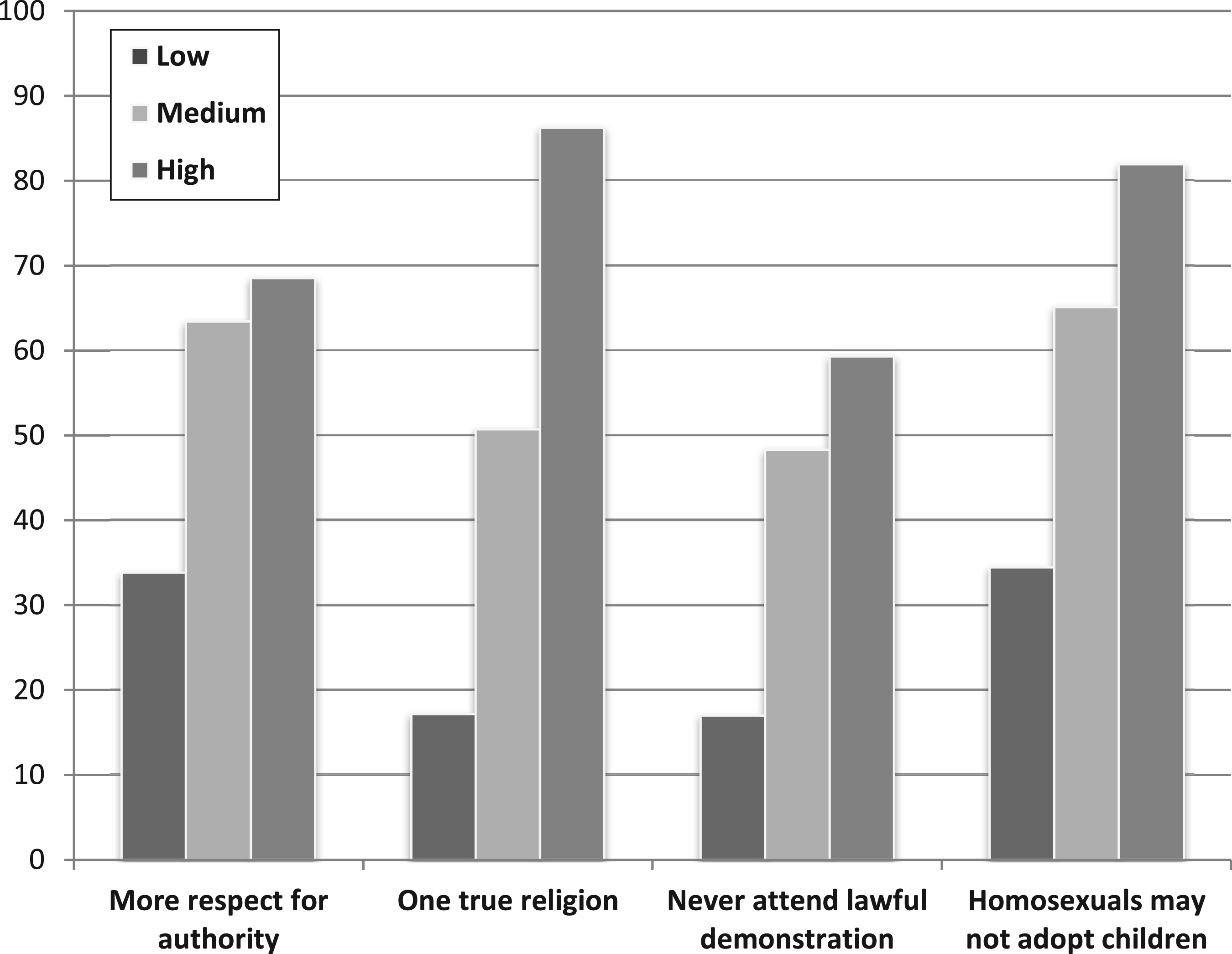
Control variables
A series of variables controls for factors that other studies have shown to influence support for the EU. First, I include two variables designed to control for cognitive mobilization, which has been argued to increase EU support (Inglehart, 1970; Janssen, 1991). Discuss politics records the respondent’s self-reported frequency of political discussions among friends and ranges from 1 (never) to 3 (frequently). Political interest measures the respondent’s self-reported interest in politics, ranging from 1 (not at all interested) to 4 (very interested). Both variables should have a positive effect on support for the EU. I include a series of variables to measure the respondent’s ability to benefit from European integration, which should increase support (Gabel, 1998). Manager is coded 1 for respondents in professional or managerial positions and 0 otherwise. This variable should have a positive effect. Skilled and Unskilled are coded 1, respectively, for skilled and unskilled manual laborers and 0 otherwise. Both variables should have a negative effect on EU support, although their effect may vary by economic development. Farmer is coded 1 for farmers and 0 otherwise. Retired, Unemployed, and Student each are coded 1 if the respondent is a member of that respective group and 0 otherwise. Retirees and the unemployed may be less likely to support the EU while students may be more supportive. Education is measured on a 4-point scale, with 1 indicating primary education and 4 indicating post-secondary educational attainment. Income is measured on a 15-point country-specific scale, with 15 indicating the highest income bracket and 1 the lowest. I expect that higher income and higher educational attainment should increase support for the EU. To control for the effect of religiosity and religious denomination on EU attitudes, I include three additional variables. Religiosity measures the self-reported frequency of religious attendance. Catholic and Protestant are dummy variables coded 1 if the respondent indicates being an adherent of that religious faith and 0 otherwise. Prior evidence on the effect of religion and religiosity on EU attitudes is mixed (Boomgaarden and Freire, 2009; Nelsen et al., 2002, 2011), but it is important to control for any potential effects. Finally, I include a variable called Democracy, which measures the respondent’s reported satisfaction with democracy in his or her country. This variable ranges from 1 (not at all satisfied) to 4 (very satisfied). Positive evaluations of domestic institutions may increase EU support (Anderson, 1998).
I add several additional attitudinal and demographic controls that are commonly included in studies of public opinion and which may influence support for the EU. Ideology measures the respondent’s self-placement on a standard left–right ideological scale where higher values indicate a more right-wing position. Economic attitudes is a scale formed by combining responses to six questions about economic values on a 10-point scale. Answers to each question are recoded so that 1 indicates a more pro-market (right-wing) position and 10 indicates a redistributionist (left-wing) view. Gender is coded 1 for female respondents and 0 for male respondents. Age is measured in six bands, with 1 indicating those under age 24 and 6 indicating those 65 and older. Locality shows the size of the town or city in which the respondent lives on an 8-point scale, with higher values indicating a larger community. The expected effects of these variables on support for the EU are less clear, but each merits control in this study.
Social identity and EU attitudes by authoritarianism
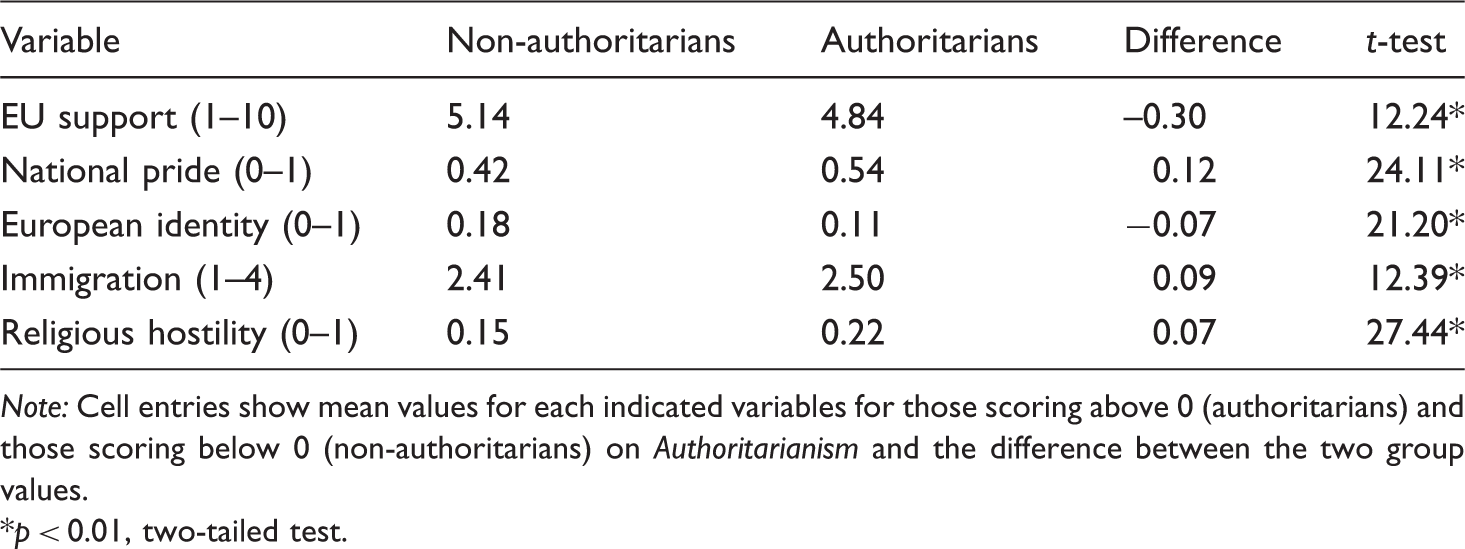
Note: Cell entries show mean values for each indicated variables for those scoring above 0 (authoritarians) and those scoring below 0 (non-authoritarians) on Authoritarianism and the difference between the two group values.
p < 0.01, two-tailed test.
Analysis
I start by considering whether there is any apparent relationship between authoritarianism, social identity, and EU attitudes. Table 1 presents mean values for EU support and the social identity variables for authoritarians (those scoring above 0 on Authoritarianism) and non-authoritarians (those scoring below 0). These descriptive statistics suggest a relationship. Across all variables, there is a significant difference in the mean values between authoritarians and non-authoritarians. Authoritarians are on average 0.3 points closer to the ‘very much afraid’ of the unifying Europe pole. Authoritarians also express a more exclusive social identity than non-authoritarians, with authoritarians being about 12 percentage points more likely to be very proud of their nationality and 7 percentage points less likely to hold a European identity. Additionally, authoritarians are more likely to oppose immigration and to express hostility towards members of foreign religions. These patterns suggest that authoritarianism is related to exclusive social identity and EU attitudes.
Authoritarianism, social identity, and Euroskepticism

Note: Cells show least-squares regression coefficients (standard errors in parentheses) for models with the dependent variable named at the top of the column.
p < 0.05, **p < 0.01, two-tailed test.
Authoritarianism is negative and significant, demonstrating that authoritarians are more likely to express fears about the EU than non-authoritarians. The coefficient of –0.32 suggests that moving an individual from a neutral position (0 score on Authoritarianism) to a fully authoritarian position (3) would reduce her score on EU support by close to 1 point on the 10-point scale. This result is consistent with Hypothesis 1. Authoritarianism has a significant and substantively interesting effect even in the presence of a large number of social identity and utilitarian predictors of EU attitudes.
Effect of authoritarianism on social identity and EU support
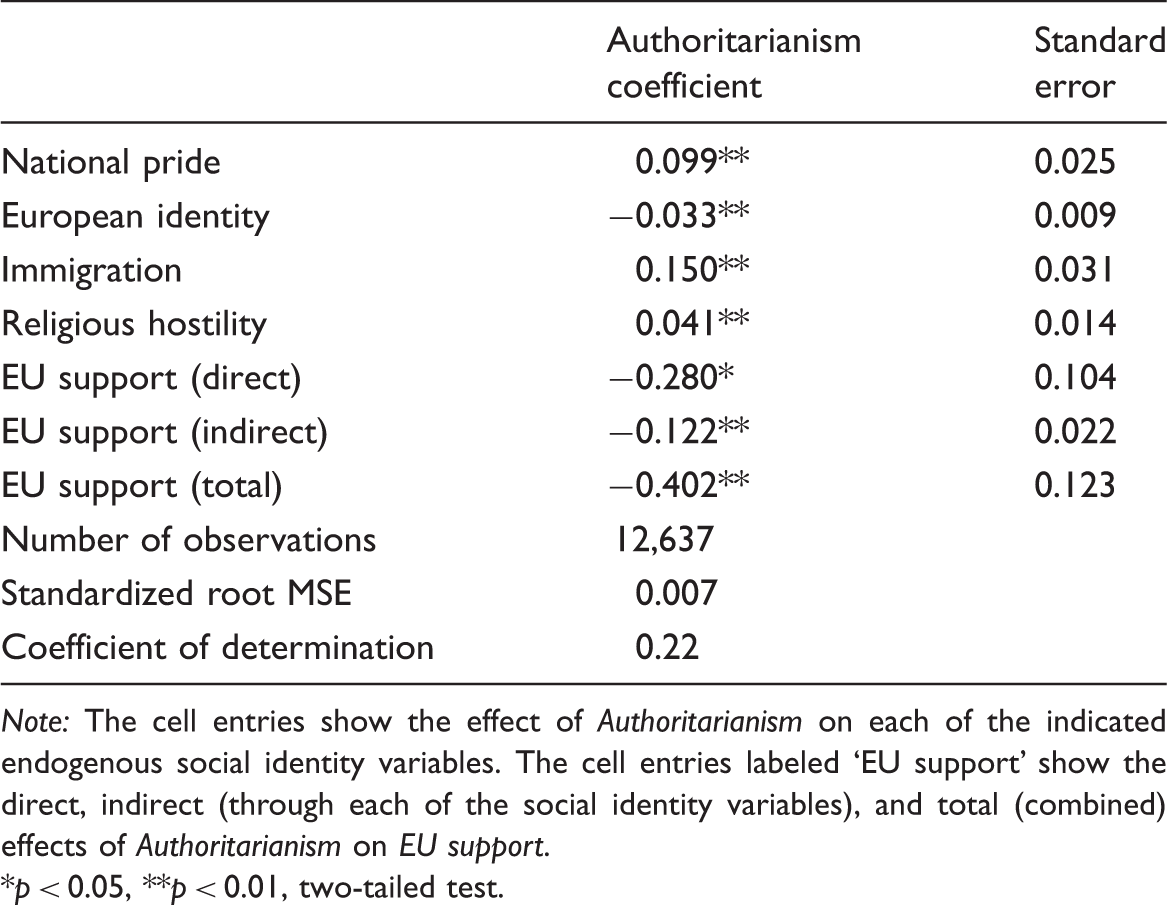
Note: The cell entries show the effect of Authoritarianism on each of the indicated endogenous social identity variables. The cell entries labeled ‘EU support’ show the direct, indirect (through each of the social identity variables), and total (combined) effects of Authoritarianism on EU support.
p < 0.05, **p < 0.01, two-tailed test.
The results presented so far indicate that authoritarianism has an effect on EU support and social identity attitudes, suggesting that authoritarianism may have both a direct effect on EU support as well as an indirect effect through the social identity variables. Standard regression models cannot test for the presence of indirect effects, so I estimate a path analysis using the structural equation modeling (SEM) approach. The path analysis allows the analyst to specify and test the effects of variables operating through multiple paths instead of assuming each explanatory variable to have an independent and simultaneous effect as in standard regression models. In particular, SEMs allow for the analyst to specify whether independent variables are exogenous (as in a standard regression model) or endogenous to other independent variables included in the model. I expect Authoritarianism to be exogenous (along with the control variables) and to exert a direct effect upon EU support and the four social identity variables. 9 I also expect Authoritarianism to have an indirect effect on EU support through the social identity variables, meaning that the effect of the social identity variables on EU support is endogenous to authoritarianism. 10 These indirect effects represent the effect of Authoritarianism running through each of the social identity variables, and they are independent of the direct effect estimated in the model.
Figure 2 presents a graphical representation of the path analysis estimates. The coefficient next to each solid line represents a direct effect between those two variables in the indicated direction. By following the paths going through the social identity variables, one can observe the indirect effects of Authoritarianism on EU support. The path analysis results are consistent with the findings presented in Table 2, in that Authoritarianism has a direct and significant effect on each variable. Crucially, its direct effect on EU support remains significant even when indirect effects through the social identity variables are included in the analysis. More importantly, Authoritarianism also has an indirect effect through these various social identity variables. These indirect effects are the product of the direct effect of Authoritarianism on the social identity variable and that social identity variable’s direct effect on EU support. For example, the coefficient on the line from Authoritarianism to Immigration is 0.150, and the coefficient on the line from Immigration to EU support is −0.489. Thus, authoritarianism has an indirect effect of −0.07 on EU support through its direct effect on Immigration. This pattern repeats for Religious hostility and European ID, although National pride no longer has a significant direct effect on EU support in the path analysis.
Path analysis of authoritarianism, social identity, and Euroskepticism.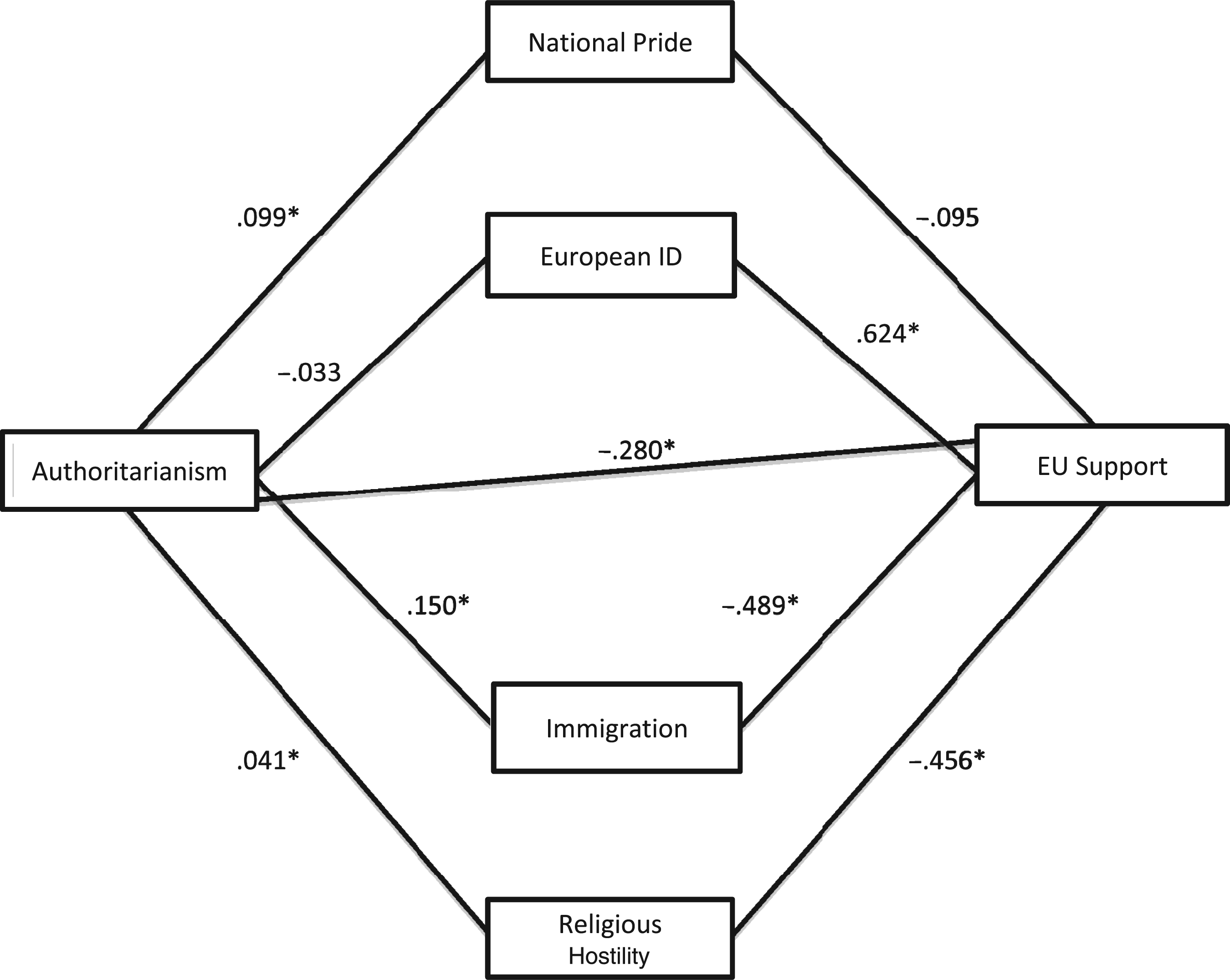
One can determine the overall indirect effect of authoritarianism on EU support through all of the social identity variables by summing the products from each combination of arrows. To highlight the total effect (direct and indirect), I present summary results of the direct and indirect effects of Authoritarianism on each variable in Table 3. The first five coefficients show the direct effect of Authoritarianism on the social identity variables and EU support, repeating those shown in Figure 2. The subsequent column shows the indirect effect of Authoritarianism on EU support operating through the social identity variables. This coefficient of −0.122 indicates that an authoritarian predisposition further decreases support for the EU through its influence on attitudes related to social identity. In other words, authoritarianism increases exclusionary feelings of social identity, which in turn increase opposition to the EU. This indirect effect is distinct from the direct effect, meaning that the combined total effect of Authoritarianism, as shown by the coefficient of −0.402, on EU support is larger than would appear in a standard regression model because it operates in part through the social identity variables.
The results of the analyses confirm expectations and provide support of this article’s three hypotheses. First, authoritarianism has an independent and negative effect on EU attitudes. Second, authoritarianism predicts responses to social identity variables commonly used in previous studies explaining EU opposition. Finally, authoritarianism’s effect upon these variables creates a further indirect effect on EU support, showing that these social identity variables are partially endogenous to authoritarianism.
Discussion
This article develops the argument that authoritarianism—an individual predisposition towards order, group cohesion, and conformity—shapes attitudes towards the EU as well as several social identity variables used as explanatory variables in previous studies of EU support. Analyses of survey data find support for both claims. Authoritarians are more likely to oppose European integration than non-authoritarians. In addition, authoritarians are more likely to express high levels of national pride, opposition towards immigration, hostility towards members of outside religions, and reject any sense of a European identity—all of which have been identified as predictors of EU opposition in previous studies (e.g. Carey, 2002; De Vreese and Boomgaarden, 2005; Hobolt et al., 2011; McLaren, 2002). Further analysis shows that authoritarianism has an indirect effect on EU attitudes through these social identity variables. These results suggest that authoritarianism is an important and previously overlooked predictor of EU attitudes, which should lead scholars to reconsider the relationship between social identity and EU attitudes in light of these findings.
Future work should examine how the political context conditions the effects of authoritarianism on EU attitudes. Mass opposition to European integration has increased as the EU has become more powerful and visible in the post-Maastricht era and as increasing elite conflict has provided more opportunity for citizens to receive negative message about the EU. However, party conflict over the EU varies across national political systems. To what extent has the level and structure of party conflict over Europe moderated the effect of authoritarianism on EU attitudes? Scholars should consider the effects of authoritarianism and party conflict on EU issue voting (De Vries, 2007; Tillman, 2004).
An important finding to emerge from this article is the relationship between authoritarianism, social identity attitudes, and EU attitudes. While some part of the effect of social identity variables is due to authoritarianism, these variables still have an independent effect on EU attitudes. Future research should seek to develop a fuller understanding of the sources of perceptions of social identity and to understand their effects on EU attitudes independently and in combination with personality traits such as authoritarianism.
Finally, the analysis adds cross-national evidence that authoritarianism influences political attitudes in a different political context than the United States, which has been the focus of most recent studies (e.g. Feldman and Stenner, 1997; Hetherington and Weiler, 2009; Lavine et al., 2005; Stenner, 2005). My findings suggest the broad applicability of the concept in shaping citizen attitudes. Moreover, European integration is a relatively new and remote political issue that presumably does not generate the same perceived level of threat as terrorism or longstanding contentious domestic political issues such as racial integration in the United States (Hetherington and Weiler, 2009). The finding that authoritarianism affects EU attitudes is indicative of its importance in structuring political attitude and should motivate continuing research into its effects across different political contexts.
Footnotes
Acknowledgements
The author is grateful for the financial support of the Faculty Research and Development Program, funded by the College of Liberal Arts and Social Sciences at DePaul University.
Notes
References
Supplementary Material
Please find the following supplemental material available below.
For Open Access articles published under a Creative Commons License, all supplemental material carries the same license as the article it is associated with.
For non-Open Access articles published, all supplemental material carries a non-exclusive license, and permission requests for re-use of supplemental material or any part of supplemental material shall be sent directly to the copyright owner as specified in the copyright notice associated with the article.
