







Abstract
Political regimes draw legitimacy from diffuse political support. How diffuse is support for the European Union? By focusing on cross-sectional data, the extant literature fails to demonstrate that support for the European Union displays the key defining characteristic of diffuse support: individual-level stability over a time of crisis. I use a six-wave panel data set from the Netherlands to study stability in support for the European Parliament during the 2008 economic crisis. I argue that public support for the European Parliament is highly diffuse. Using three analytical techniques, I find that individual-level support for the European Parliament remained highly stable from 2007 to 2012. These results suggest that in times of crisis, the European Union can draw on mass public support as a source of resilience.
Introduction
In 2008, the European Union (EU) entered a severe economic recession. A serious crisis in the Eurozone followed less than two years later. These events put the EU under great pressure. They even threatened to break up one of the major achievements of European integration – the common European currency. As the economic and monetary crisis unfolded, more and more voices questioning membership in the EU emerged across Europe. These voices were echoed by a growing popularity of Eurosceptic political parties (Duff, 2013; Usherwood and Startin, 2013). These developments have raised concerns about the resilience of the supranational political regime in Europe. Is the EU resilient enough to weather a major economic crisis? Mass public political support is an important source of resilience for political regimes. One particular type of support – diffuse support – contributes to regime stability during difficult times such as economic crises (Easton, 1965; Norris, 2011). I therefore address the concerns about EU’s resilience to crises by investigating the following question: How ‘diffuse’ is support for the EU?
The question about diffuse support for the EU relates to a theoretical distinction between the two types of political support: specific and diffuse. While specific support is a ‘running-tally’ type of attitude that fluctuates according to the political regime’s performance, diffuse support is an affective attitude. Diffuse support persists even in times when citizens become dissatisfied with the regime’s policies (Easton, 1965; Harteveld et al., 2013; Norris, 1999). 1
The theoretical distinction between specific and diffuse support is important in assessing the resilience of political regimes (Dalton, 2004; Easton, 1965; Norris, 2011). If political support for a regime is largely specific, then an event such as an economic crisis threatens the very survival of the regime. As the economic crisis brings hardships, citizens express negative evaluations of the regime’s performance and these, in turn, decrease political support. If, on the other hand, a regime enjoys diffuse support, it can use this stable reservoir of support to weather the crisis. An EU that commands diffuse political support is therefore much more resilient to crises than a Union that depends on specific support.
Although the scholarly literature shows a growing consensus that support for the EU has diffuse characteristics (Beaudonnet and Franklin, 2014; Hooghe and Marks, 2004; Serricchio et al., 2013; Torcal et al., 2012a), the empirical foundation for this consensus is rather limited. Virtually all evidence of diffuse support for the EU in the existing literature is based on cross-sectional comparative data. Diffuse support, however, is fundamentally a longitudinal phenomenon. It is defined as an individual’s attachment to a political regime that persists through a crisis. The longitudinal dimension is therefore crucial in the study of diffuse support.
Even though the existing research devotes some attention to the over-time properties of support for the EU, it does so only at the aggregate level of analysis (Beaudonnet and Franklin, 2014; Serricchio et al., 2013). Aggregate-level studies, however, do not necessarily demonstrate the presence of diffuse support. Over-time stability at the aggregate level may mask instability at the individual level. We therefore need to demonstrate longitudinal stability at the individual level in order to provide evidence of diffuse support for the EU. Due to the focus on cross-sectional data, however, the existing literature fails to provide such evidence. It is the goal of the present paper to fill this gap.
I use a six-wave panel survey from the Netherlands to study over-time stability of support for the EU during the 2008 economic crisis. I focus on political support for one of the EU’s institutions – the European Parliament. I find that although the economic crisis caused some variability in public support for the EU, levels of support at the individual level displayed a high level of stability throughout the period of the economic crisis. This level of stability even approached the level of stability in support for democracy, which is regarded as one of the most diffuse dimensions of political support (Dalton, 2004; Norris, 1999, 2011). Given that this high level of stability was observed during a major economic crisis, I argue that public support for the EU is highly diffuse. The results from my analysis suggest that in times of crisis, the EU can draw on mass public support as a source of resilience.
Literature review, theory, and hypotheses
Before proceeding with a review of the literature on political support for the EU, it is important to explain what is meant by political support. Most broadly, political support (or mass public support) is defined as individuals’ favorable or unfavorable orientations toward an object that represents the political system. The objects of citizens’ support include the community of the political nation, the principles and institutions of the political regime, and the officeholders who represent these institutions (Easton, 1965; Norris, 1999). This paper focuses on support for the political regime of the EU. 2 Political support is therefore defined as support for EU institutions.
Empirical studies of attitudes toward the EU show that support for the EU takes both specific and diffuse forms. Some studies suggest that support for the EU has a specific component. Macroeconomic indicators such as the level of inflation or gross domestic product (GDP) influence support for the EU (Eichenberg and Dalton, 2007). At the individual level, support for the EU correlates with citizens’ perception of personal benefits from EU integration (Gabel and Palmer, 1995; Mau, 2005; Torcal et al., 2012b) and with perceptions of the national economy (Hooghe and Marks, 2004; Klingeren et al., 2013). In addition, citizens whose occupations gain more from European integration express more support for the EU (Gabel, 1998; Hooghe and Marks, 2004).
Another branch of research suggests that support for the EU has a diffuse component as well. Multiple studies find that individuals’ feelings of European identity are a good predictor of support for the EU (Hooghe and Marks, 2004; Serricchio et al., 2013; Torcal et al., 2012a). Since identity is an affective feeling (Sanders et al., 2012), this evidence suggests that support for the EU is at least partly diffuse.
This article takes a new approach to distinguishing between diffuse and specific support. While the existing literature either takes a cross-sectional view of political support (e.g., Gabel, 1998; Hooghe and Marks, 2004) or an aggregate-level longitudinal view (Armingeon and Ceka, 2014; Beaudonnet and Franklin, 2014; Serricchio et al., 2013), this article explores longitudinal stability at the individual level.
There are distinct theoretical expectations regarding the level of over-time stability in each of the two types of political support. Specific support depends on current regime performance. Specific support therefore fluctuates in accordance with changes in evaluations of regime performance. Diffuse support, on the other hand, remains stable even if there is a drop in satisfaction with the regime’s performance. These differences in over-time stability become easier to observe during times such as an economic crisis. As citizens’ satisfaction with the regime’s performance goes down due to the crisis, researchers can observe whether political support is immune to a decrease in performance evaluations. If political support is diffuse, it remains stable over time; despite the difficulties the regime is experiencing.
The 2008 recession brought a substantial stress on the EU, providing an opportunity to observe how stable public support for the EU is during a very difficult time. Over the first few years of the crisis, the EU experienced a considerable drop in its GDP. While in 2007, the EU enjoyed a GDP growth of about 2.7%, in 2008, when the economic crisis began, GDP growth dropped into negative figures. The state of the economy became even worse in 2009 when GDP contracted by 4.8%. Although 2009 was followed by few years of weak GDP growth, year 2012 brought negative figures as well.
A bleak situation in the EU economy, however, does not necessarily imply a drop in specific support. An economic crisis may be severe, yet citizens may still evaluate the regime as performing well. Citizens may also assign responsibility for the economic situation to the national government, without assigning any responsibility to the EU. Another possibility is that citizens are uninformed about the economic situation and that the worsening of the economic situation does not affect their perceptions of EU’s performance. Although these are all valid possibilities, public opinion data show that the 2008 recession brought a significant drop in citizens’ evaluations of the EU. There was a decrease in the percentage of citizens who thought that their country had ‘benefited from being a member of the European Union’ (from 58% in 2007 to 50% in 2010). In addition, as the economic crisis progressed, fewer and fewer citizens believed that the EU is dealing effectively with the crisis (45% in 2010 and 34% in 2012). If we look beyond the economic domain and consider a comprehensive measure of satisfaction with EU’s performance, we find a significant drop as well. While in 2007, 40% of Europeans thought that ‘things are going in the right direction in the European Union’, by 2012, the number dropped by almost one half (to 22%). 3
These statistics show citizens’ perceptions of the EU’s performance worsened considerably over the course of the 2008 recession. Such a drop in performance evaluations provides a great opportunity to learn about the nature of support for the EU. If public support for the EU is specific, this support will not be stable during the 2008 recession. If, on the other hand, citizens’ support for the EU is diffuse, it will stay largely stable, despite the severe drop in performance evaluations. I expect support for the EU to be diffuse. I therefore hypothesize that support for the EU will be stable over the 2008 economic crisis.
In the following sections, I examine over-time stability of support for the EU. The next section introduces data and variables. Then, I explore over-time stability in political support using the following three analytical tools: an aggregate-level analysis, a ‘Wiley and Wiley’ model (Wiley and Wiley, 1970), and a dynamic panel data model. While the aggregate-level analysis provides a basic assessment of over-time stability, the ‘Wiley and Wiley’ model evaluates continuity in individual-level attitudes over time while controlling for possible unreliability in measurement. The dynamic panel data model then complements the analysis by exploring whether individuals have a long-term level of support that they return to, after reporting an unusually high or low level of support.
Data and variables
I use data from the Longitudinal Internet Studies for the Social Sciences (LISS) Panel, which is an Internet-based survey collected in the Netherlands. The LISS Panel is a representative sample of Dutch individuals who participate in regular online surveys. The panel is based on a true probability sample of Dutch households (Scherpenzeel and Das, 2010). 4 Every year between 2007 and 2012, the LISS Panel collected data on political attitudes, including attitudes toward the EU. Around 6000 individuals were interviewed in each wave of the panel. A total of 2657 individuals completed all six panel waves (approximately 39% of the original sample).
The LISS Panel is one of the rare resources that provide multiwave, nationally representative panel data on attitudes toward the EU. Importantly for this study, the LISS Panel allows researchers to explore stability of attitudes throughout the Great Recession, as it spans from 2007 to 2012. The LISS Panel is thus the only available source of data suitable for the present study.
Mass public political support for the EU is the main concept of interest. I focus on one dimension of political support – support for regime institutions. This choice is influenced by data availability. Support for EU institutions is the only item on the LISS Panel that is suitable for this study. In the literature on political support, confidence in regime institutions is well established as a valid measure of regime support (Dalton, 2004; Easton, 1965; Norris, 1999; Torcal et al., 2012b). This study defines support for EU institutions as confidence in the European Parliament. 5 Variable confidence in the European Parliament ranges from 0 to 100, with higher values indicating greater support.
Aggregate political support
This section provides an aggregate-level analysis of stability in political support. First, I examine the trend in the mean of support for the European Parliament (Figure 1). Support for the European Parliament appears fairly stable throughout the period of the LISS Panel. Even when the economic crisis arrived in 2008, support did not experience any major drop. As Figure 1 shows, the mean ranges between 40 and 50. The trend suggests that political support for the EU is to a considerable degree resistant to a decrease in performance evaluations. While data from the Eurobarometer show that performance evaluations dropped by 10–50%,
6
support for the EU dropped only by 8%.
Mean values of support for the EU over time.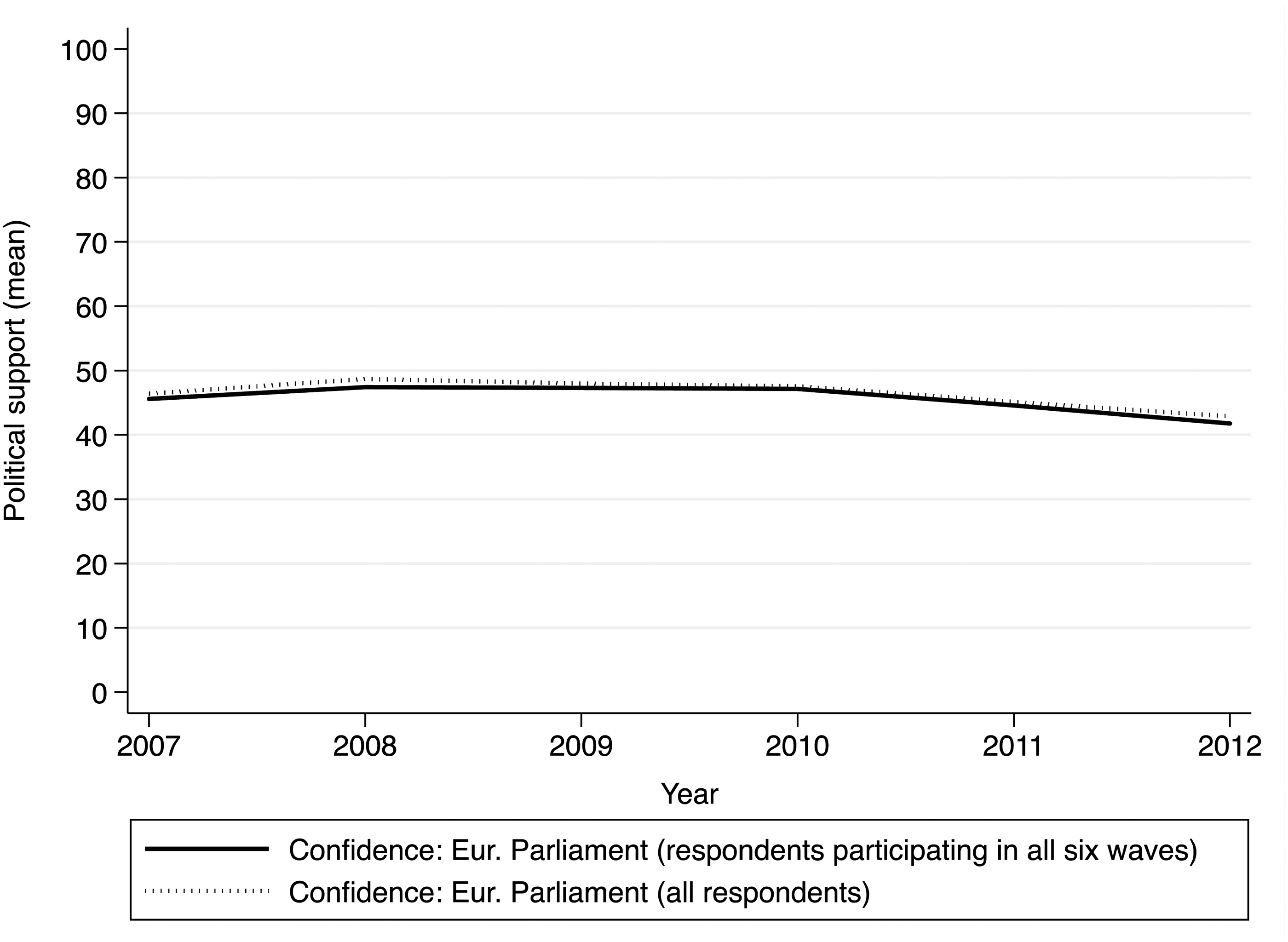
Figure 1 further conveys important information about the quality of the LISS Panel data. The figure shows that the mean values for respondents who completed all six waves of the panel do not significantly differ from the mean values of respondents who participated only in some of the panel waves. This suggests that respondents who regularly participated in the panel do not differ from those who only participated in some of the waves.
Looking at the over-time stability in mean values is not the only way to gauge stability at the macro level. An analysis of the percentage of respondents who in later waves of the panel report the same level of support as they did in the first wave provides another option (Prior, 2010). According to this measure, political support for the EU does not seem very stable (see Figure 2(a)). Only around 27% of respondents keep the same level of support throughout the six years of the panel study.
Percentage of respondents (a) who give the same response as in the first wave of the panel and (b) changing by 20 points or less compared to the first wave of the panel.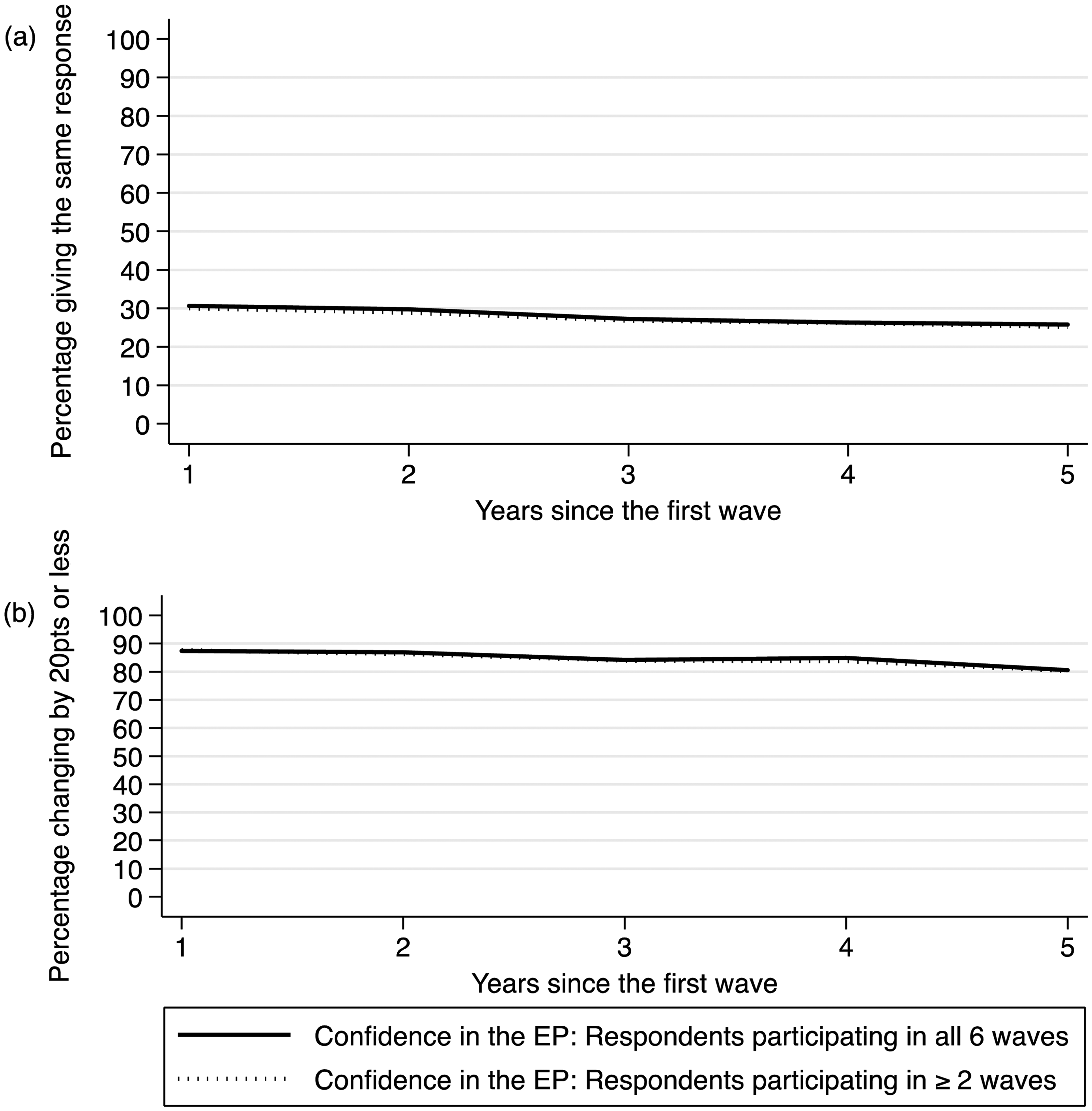
Analyzing how many respondents give the exact same answer may, however, be an overly strict measure of stability. The measure may be biased downward due to measurement error (Prior, 2010). In order to explore this possibility, I analyze the percentage of respondents who since the first wave of the panel change their answer by 20 points or less (Figure 2(b)). When this measure is used, support appears significantly more stable. Between 80% and 90% of respondents keep their level of support within 20 points of their response in the first wave.
Figure 2(a) and (b) further show that the levels of over-time stability are comparable for respondents who participated in at least two waves of the panel and for respondents who participated in all six waves. The fact that these two groups of respondents display comparable levels of stability suggests that panel effects should not be a problem for the present analysis.
When judging whether political support is diffuse or specific, researchers face a problem. The problem stems from the relative nature of diffuse support. Neither our theoretical view of political support nor the existing empirical research suggests that political support should be either fully diffuse or fully specific. Political support is a mix of diffuse and specific components and the ‘diffusiveness’ of political support is a matter of degree (Norris, 2011). Some dimensions of political support (such as support for democracy) are highly diffuse; other dimensions (such as support for incumbents) are more specific.
As the diffuse component of political support is characterized by stability over a time of crisis, the relative nature of diffuse support translates into a problem with interpretation of the empirical data on over-time stability. Can political support still be called diffuse if it drops by six percentage points over six years? How stable does the attitude have to be in order to be called ‘diffuse’? It is difficult to judge the level of over-time stability in political support without any reference points. I use two dimensions of political support at the national level as such reference points. Support for democracy provides a benchmark for a diffuse type of political support (Dalton, 2004; Norris, 2011). Democracy represents the abstract principles of the political regime. Support for these principles has been shown to be fairly resistant to fluctuations due to changes in regime performance (Dalton, 2004; Norris, 2011). The level of stability in support for democracy will therefore indicate the level of stability typical for a highly diffuse dimension of political support.
Support for the Dutch national government serves as a benchmark for a more specific type of political support. The national government is an institution that is closely connected to designing and implementing policies. This, in turn, makes support for the government more susceptible to shifts in performance evaluations. In addition, supporters of the opposition are usually less in favor of the policies of the incumbent government. This results in a shift in individuals’ support for the government whenever there is a change in government. In 2010, right in the middle of the LISS Panel, a new governing coalition took over in the Netherlands. The LISS Panel therefore provides a good opportunity to observe the specific nature of support for the national government in the Netherlands (for details, see the online appendix). The level of stability in support for the Dutch government will mark the level of stability typical for a more specific type of political support.
How does stability in support for the European Parliament compare to the over-time stability in benchmarks of diffuse and specific support? In the aggregate trend, support for the European Parliament displays slightly more over-time variation than support for democracy and less over-time variation than support for the Dutch government (for more details, see the online appendix). Comparing the percentage of respondents who in the later waves of the panel provided the same answer as in the first wave of the panel gives similar results. Support for the European Parliament is more stable than support for the Dutch government and less stable than support for democracy (see the online appendix for more details).
The measure focusing on the percentage of respondents whose level of support remains within 20 points from the level of support reported in the first wave provides an even clearer picture of how over-time stability in support for the European Parliament differs from stability typical for specific type of support. The benchmark of specific support (trust in the Dutch government) experiences much greater fluctuations than support for the European Parliament (see the online appendix). For example, between 2009 and 2010, the percentage of respondents who kept their level of support for the Dutch government close to their answer in the first wave dropped by 12 percentage points, while the highest drop in the case of support for the European Parliament is 4.4 percentage points.
In sum, diffuse support is the type of support that remains stable even in times such as an economic crisis. The aggregate-level analysis provides some evidence of diffuse support for the EU. Despite the arrival of the financial crisis in fall 2008, the mean of political support remained relatively stable between 2007 and 2012. The level of stability was close to the level of stability typical for a highly diffuse type of support. The low percentage of respondents who kept the exact same level of support throughout the six years of the panel study, however, does not provide very persuasive evidence of diffuse support. Nevertheless, the fact that an overwhelming majority of respondents kept their level of support within 20 points from their original level of support suggests that small amounts of measurement error may cause the attitudes appear less stable than they really are. The next section addresses this problem and takes a look at over-time stability of political support while controlling for measurement error.
Individual-level analysis: Wiley and Wiley model
The Wiley and Wiley model is a type of structural equation model that allows us to study over-time stability in attitudes and control for measurement error (Wiley and Wiley, 1970). In a Wiley and Wiley model, political support is viewed as a latent concept. A latent concept cannot be measured directly and it is therefore measured by observable indicators. In the present case, in each wave of the panel study, the latent variable confidence in the European Parliament is measured by an observed indicator of confidence in the European Parliament. The Wiley and Wiley model then estimates how much error there is in the measurement of the latent concept as well as how stable the latent concept is over time.
The Wiley and Wiley model defines the observed variable x at time t as a function of the latent variable

Figure 3 illustrates the logic of the Wiley and Wiley model. The circles represent the latent variable Wiley and Wiley model.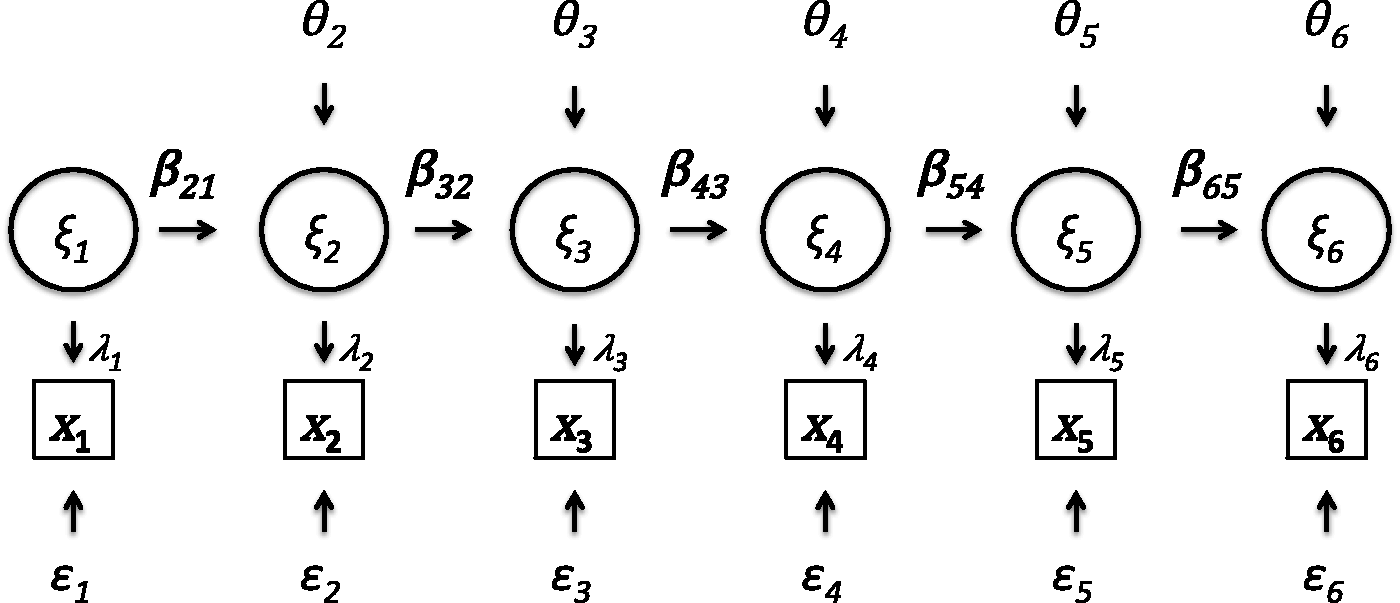
By contrast, if
Although in the study of attitude stability,
Wiley and Wiley model.
Note: CFI, comparative fit index; RMSEA, root mean square error of approximation.
Dependent variable: political support. Wiley and Wiley (1970) model (estimated using Stata 12 sem command).
Standard errors in parentheses. *p < 0.01.
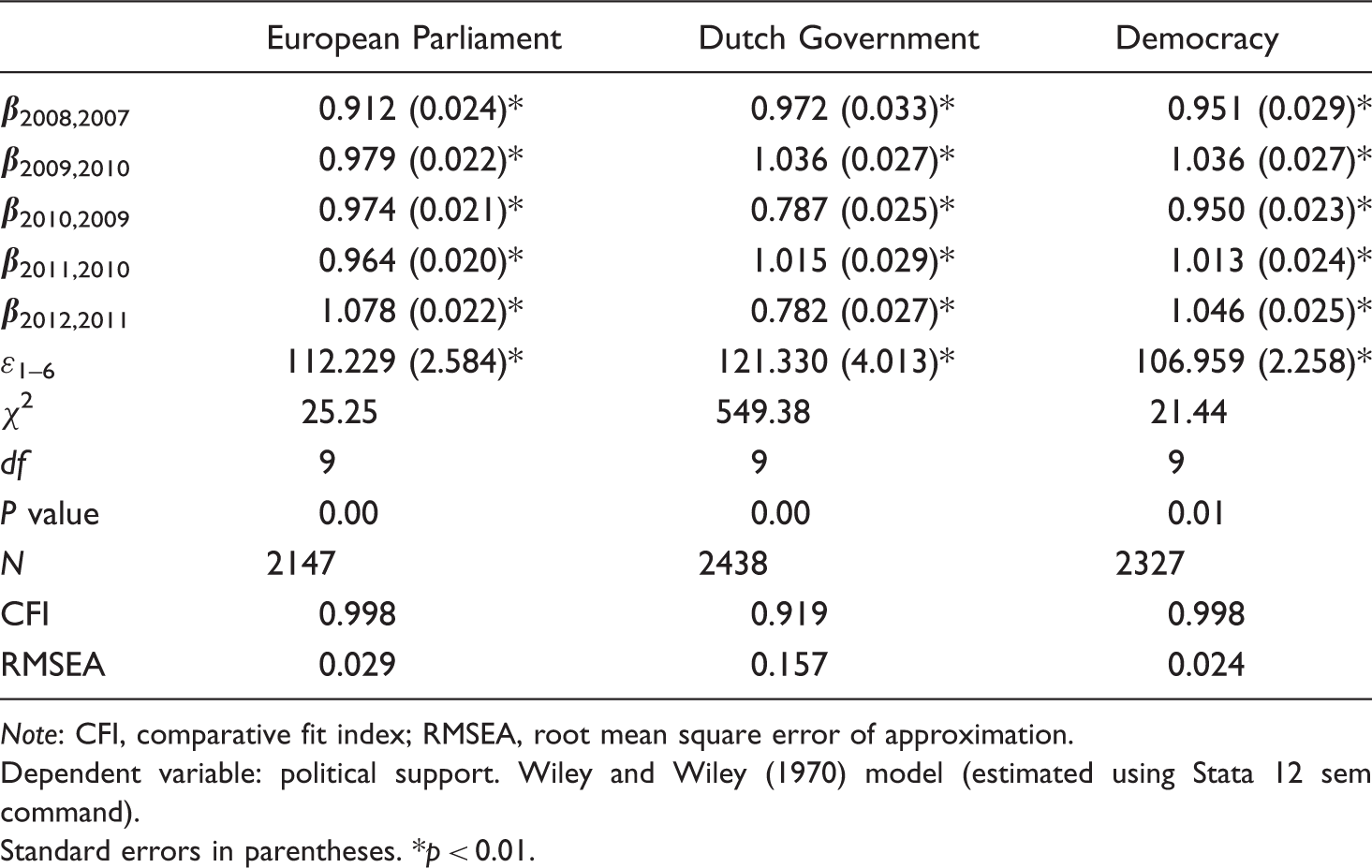
How diffuse is the support for the European Parliament in comparison to the benchmarks of specific and diffuse support? Results reported in column 2 in Table 1 allow us to compare support for the European Parliament to the benchmark for a specific type of support (support for the Dutch government). The results show that during the 2008 economic crisis, support for the European Parliament was more stable than support for the Dutch government. For example, in its least stable point, the distribution of support for the European Parliament replicates itself up to about 91% (β of .91). The distribution of support for the Dutch government in its least stable point replicates itself only up to 78% (β of .78). This means that our predictions of the respondents’ position within the distribution of attitudes would be much more precise in the case of support for the European Parliament. In addition, support for the Dutch government has less over-time stability in its mean. A lower stability in the mean, combined with approximately 13 percentage points lower stability of the distribution implies that support for the Dutch government is significantly less stable at the individual level than support for the European Parliament.
As expected, our benchmark for diffuse support (support for democracy) shows a high level of over-time stability (column 3 in Table 1). The confidence intervals for its coefficients almost always include 1. Stability in support for the EU fares well in comparison to the benchmark of diffuse support. Support for the European Parliament is only slightly less stable than support for democracy.
Overall, the Wiley and Wiley model shows that individuals have a stable level of support for the European Parliament. This level of stability is clearly higher than the level of stability typical for a specific type of support. Indeed, over-time stability in support for the EU approaches the level of stability in one of the most diffuse dimensions of support – support for democracy. The results of the Wiley and Wiley model therefore suggest that support for the EU is more of the diffuse rather than of the specific type.
Although the Wiley and Wiley model provides useful insights into over-time stability, it only gives a specific view of stability: the stability of distribution in the short run, from one year of the panel to the next. Another way to look at stability is to examine stability from a more long-term point of view. 8 Do individuals have a long-term level of political support? When individuals deviate from their long-term level of support, do they quickly return to this long-term level? The following section uses a dynamic panel data model to answer these questions about long-term stability of political support.
Individual-level analysis: Dynamics of political support
Dynamic panel data models are useful estimation tools for data with a large number of observations and a small number of time periods. These models focus on individual-level over-time changes. In particular, they model how rapidly momentary variations in an underlying disposition fade over time.
Dynamic panel data models are part of the family of lagged dependent variable models (Cameron and Triverdi, 2010). The basic set up for a lagged dependent variable model is

The lagged dependent variable model is designed to address the problem of autocorrelation in the model’s errors – a problem that often appears in analysis of panel data. The problem of autocorrelation in errors arises as observations are clustered within individuals (as we repeatedly measure each individual’s attitudes over time). Since most conventional statistical models assume no autocorrelation in the error term, the presence of this autocorrelation threatens the consistency of the model’s estimates (Roodman, 2009).
Although the simple lagged dependent variable regression described in equation (2) is often useful in panel data analysis, it is not appropriate for the type of panel data examined in this study – data with a large number of cases and low number of time periods. The simple lagged dependent variable model gives inconsistent estimates for this type of data because there is still correlation between the lagged dependent variable and the disturbance term (Cameron and Triverdi, 2010). A step toward getting around this problem is to estimate the model using first differences

Taking first differences, however, does not eliminate the unwanted correlation between lagged dependent variable
When using the Arellano–Bond estimator to assess over-time stability of attitudes, the coefficient for the lagged dependent variable (γ) is the coefficient of interest. The γ coefficient indicates how quickly momentary deviations from the individual’s long-term level of political support dissipate over time. γ close to zero means that deviations from the long-term level of support do not persist into the following time period and that the individual’s political support immediately returns to its long-term value. In other words, if an individual reports an unusually high political support in one year, she will again report her long-term average value of political support in the subsequent year (Green et al., 2002; Prior, 2010). However, the further γ moves from zero toward 1, the longer it takes for the respondent to return to her long-term mean value. If γ becomes 1, any deviation from the long-term average persists into the future and the respondent does not return to her long-term mean at all. A γ coefficient close to 1 will therefore indicate that individuals do not have a stable long-term level of political support and that support for the EU is more specific, rather than diffuse. On the other hand, γ close to zero will mean that momentary disturbances do not have a lasting influence and that individuals’ support has a stable long-term value. Since diffuse support is defined as support that remains stable over a time of crisis, γ close to zero will indicate diffuse support.
Dynamic panel data model.
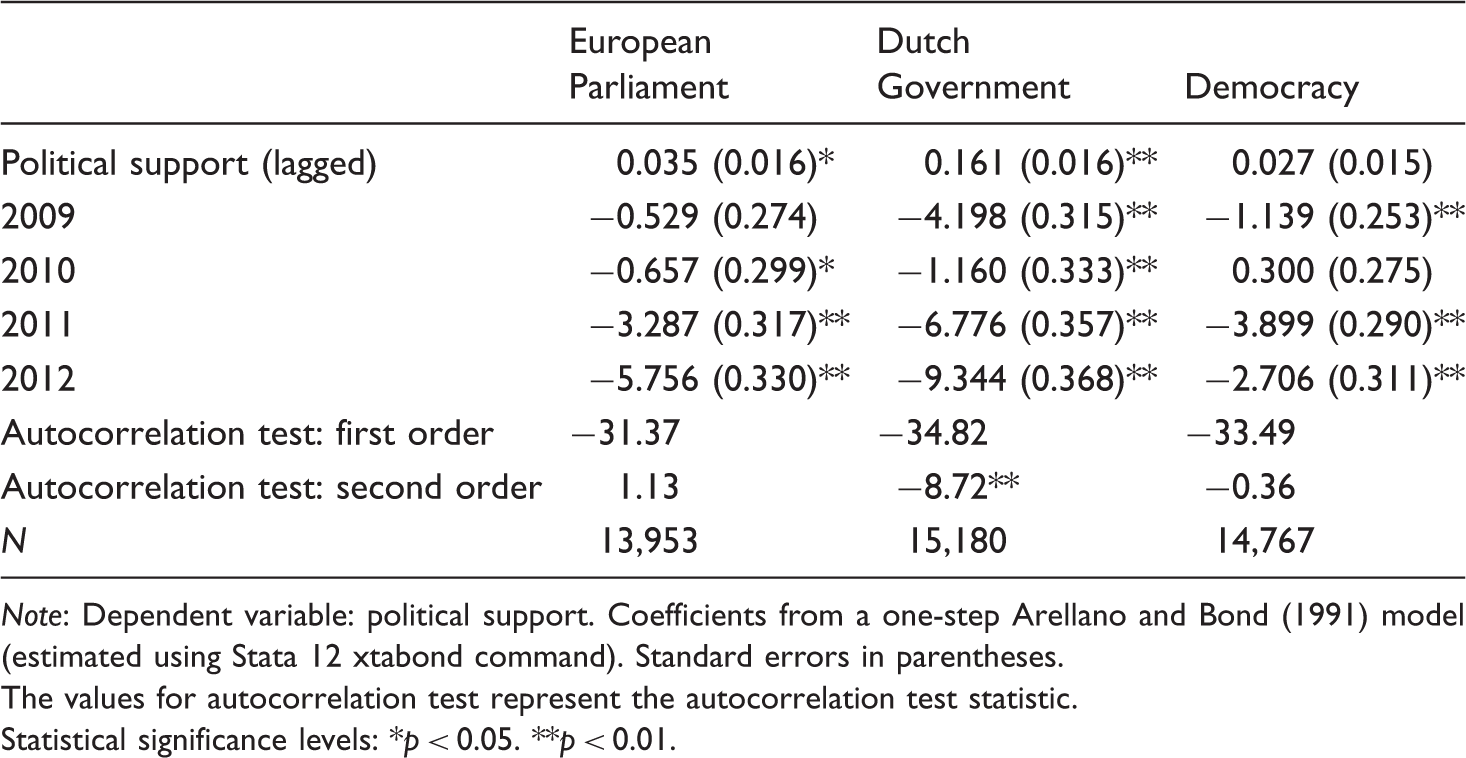
Note: Dependent variable: political support. Coefficients from a one-step Arellano and Bond (1991) model (estimated using Stata 12 xtabond command). Standard errors in parentheses.
The values for autocorrelation test represent the autocorrelation test statistic.
Statistical significance levels: *p < 0.05. **p < 0.01.
How does the long-term stability in political support for the EU compare to stability in the two dimensions of political support that serve as benchmarks of specific and diffuse support? The second and third columns in Table 2 report dynamic panel data models of support for the Dutch government and support for democracy. Confidence in the national government has a lower level of stability. Its coefficient for the lagged dependent variable is further from zero than it was in the case of support for the European Parliament. Support for democracy, on the other hand, appears highly stable. Its estimate of the coefficient for the lagged dependent variable is indistinguishable from zero. Overall, the conclusions for this comparison are similar to the conclusions drawn from the Wiley and Wiley model: Political support for the European Parliament shows more over-time stability than support for the national government and slightly less stability than support for democracy.
In sum, the dynamic panel data model demonstrates that individuals have a stable level of support for the European Parliament. If at one point in time individuals deviate from their long-term level of support, they quickly return back to it in the next time period. The stability in support for the EU is somewhat lower than stability in support for democracy and significantly higher than stability in support for the Dutch national government. These conclusions are consistent with the conclusions derived from the aggregate-level analysis and from the Wiley and Wiley models. Overall, my analysis shows that throughout the period of the Great Recession, individuals maintained a substantial level of stability in their support for the EU. I therefore argue that support for the European Parliament among Dutch citizens is highly diffuse.
Concluding remarks
Diffuse political support gives political regimes legitimacy during times of crisis. This paper explored whether mass public support for the EU is a diffuse type of support. Although the existing literature provides some evidence suggesting that support for the EU is diffuse (Beaudonnet and Franklin, 2014; Hooghe and Marks, 2004; Serricchio et al., 2013; Torcal et al., 2012a), this evidence is limited. All existing research demonstrating diffuse support for the EU is based on cross-sectional data. Diffuse support, however, is an attitude defined by its longitudinal characteristics at the individual level of measurement. In this paper, I addressed this gap in the literature by focusing on individual-level over-time stability in political support for the European Parliament during the 2008 economic crisis. The analysis showed that despite a considerable drop in citizens’ evaluations of EU’s performance, public support for the EU maintained a high level of stability throughout the economic crisis. The over-time stability in support for the EU even approached the level of stability in one of the most diffuse dimensions of political support – support for democracy. Based on this evidence, I argue that public support for the EU is largely diffuse.
The high stability of support for the EU throughout the 2008 recession implies that in times of crisis, the EU can draw on mass public support as a source of resilience. The results in this study therefore suggest that mobilization appeals challenging the supranational political regime in Europe may be limited in its ability to gain traction within the wider audience in the EU.
The conclusions from this study warrant a few caveats though. My analysis is based on data from only one EU member country – the Netherlands. The generalizability of my results to the entire EU may therefore be limited, as there are studies suggesting that there are important cross-country differences in citizens’ attitudes toward the EU (Díez Medrano, 2003; Duchesne et al., 2013). Nevertheless, data from the Eurobarometer surveys show that the over-time trend in support for the European Parliament in the Netherlands is parallel to the trend in the EU as a whole (for details, see the online appendix). This comparison suggests that the over-time dynamics in support for the European Parliament in the Netherlands are not radically different from dynamics of political support in the EU as a whole.
By analyzing citizens’ trust in the European Parliament, this study examines citizens’ political support for the EU as a political regime. Due to data limitations, other dimensions of political support such as support for the political community or support for incumbents lie outside the scope of the present analysis. Nevertheless, support for the political regime is an important dimension of political support and citizens’ trust in a regime institution such as a parliament is a valid and well-established measure of public support for a political regime (Dalton, 2004; Easton, 1965; Norris, 1999; Torcal et al., 2012b). Existing research on political support finds that support for political community is more diffuse than support for a political regime. We would therefore expect public support for the political community of the EU to be more diffuse than the dimension of support examined in the present study (Norris, 1999, 2011). Support for regime incumbents, on the other hand, has been found to be less diffuse than support for the political regime. We would therefore expect public support for politicians at the European level to be tied to performance indicators to a greater degree than support for the political regime.
This study provides the first step in our understanding of individual-level dynamics of support for the EU. Future research can build up on this study by exploring the dynamics of other dimensions of support for the EU, such as support for other EU institutions or support for the political community of the EU. Further longitudinal analysis of attitudes toward the EU has the potential to enrich our understanding of public opinion in the EU in other areas as well. Panel data analysis can provide new insights into determinants of attitudes toward the EU as well as into relationships between attitudes and political behavior. Such data provide a greater leverage in the study of causal relationships than cross-sectional studies do. Existing panel survey data sets as well as possible new longitudinal data collection efforts are a promising opportunity to gain new insights into the sources and consequences of political attitudes in the EU.
Footnotes
Acknowledgments
I owe my thanks to Jay McCann, Naomi Levy, Evelyn Bytzek, Joanne Miller, and the three anonymous reviewers for their excellent feedback on the earlier drafts of the manuscript. Many thanks also belong to Aaron Hoffman and participants at the 2014 Paper to Publication seminar at Purdue University for their support and helpful feedback. I thank participants at the 2014 MPSA Annual Conference in Chicago for their comments and the Purdue Research Foundation for supporting this project.
Notes
References
Supplementary Material
Please find the following supplemental material available below.
For Open Access articles published under a Creative Commons License, all supplemental material carries the same license as the article it is associated with.
For non-Open Access articles published, all supplemental material carries a non-exclusive license, and permission requests for re-use of supplemental material or any part of supplemental material shall be sent directly to the copyright owner as specified in the copyright notice associated with the article.
