







Abstract
Research shows that affective style (i.e. our individual ways of responding to emotions) matters for social behaviour. This article explores how affective style, as a new key predictor, explains attitudes towards the European Union, encompassing the feeling of internal efficacy towards the EU and trust in the EU. The study relies on survey data from Denmark (2014). The article concludes that the affective styles of tolerating, concealing and adjusting all significantly predict EU attitudes, albeit in different ways. Adjusting is positively associated with EU attitudes, while tolerating and concealing are negatively related to EU attitudes. Mediation analysis shows that most of personality's effect is not mediated by affective style. Hence, most of the effect of affective style is not merely a transmission of prior personality effect.
Introduction
Few disagree that emotions matter in politics (e.g. Marcus et al., 2000). Emotions mobilize individuals to become politically active (Valentino et al., 2011), impact voting behaviour (Garry, 2014) and predict party choices (Inbar et al., 2009). Yet, despite advances in the measurement of affect (e.g. Davidson et al., 2009), we have little insight into how and to what extent emotions matter in European Union (EU) politics. This article explores how affective style (i.e. the individual difference that refers to tendencies of regulating emotions) influences EU attitude formation. 1 Furthermore, it examines if affective style mediates the relationship between personality and EU attitudes. Thus, this article adds to the pioneering work on the inclusion of psychological explanations of EU attitude formation. Most previous studies of EU attitude formation have offered ‘rational’ or cognitive explanations of EU support (e.g. McLaren, 2006). Here, I show that affective style plays a salient role.
Psychological neuroscience recently demonstrated that affective style influences how people perceive the world and shape decision-making (e.g. Davidson and Begley, 2013). 2 The literature identifies three affective style strategies: tolerating, concealing and adjusting. Tolerating refers to a strategy of accepting emotions. Concealing is a strategy of suppressing emotions, while adjusting indicates successful adaptation to situational demands (Hofmann and Kashdan, 2010: 255). To my knowledge, no political study has, so far, explored how affective style influences politics. Hence, this study moves beyond the well-established literature on how particular emotions influence politics to explore how individual strategies of handling emotions relate to EU attitudes in conjunction with personality traits.
Here personality traits are measured by the commonly used Big Five personality inventories (henceforth B5), including extraversion, agreeableness, conscientiousness, neuroticism and openness (e.g. Mondak, 2010). EU attitudes as a dependent variable consist of three dimensions: EU support, EU trust and EU internal efficacy. All variables are previously used to explore EU attitude formation.
While EU attitudes are intensively researched (e.g. Nielsen and Franklin, 2017), only recently has attention focused on how political psychology may affect the formation of people's opinions on European integration (Manners, 2014). This includes studies of the influence of personality on EU attitude formation (e.g. Bakker and De Vreese, 2016). This work nevertheless fails to include the more complex psychological framework of the individual predispositions that are at play when people make decisions. This article adds to this research, analysing how affective style predicts EU attitude formation as a direct effect and as a mediator in the relationship between personality and EU attitude formation.
Towards an integrated political theory of affect and cognition
Emotion in politics is not a new research field. Yet, the understanding of emotion's role in politics has changed dramatically. For centuries, emotions have been interpreted as disturbing the formation of rational opinions (e.g. Damasio, 1994). However, recent insights from neuroscience highlight that the brain uses emotions to evaluate the consequences of actions. Damasio (1994) shows that emotions improve decision-making capacity, providing ‘feedback’ to brain systems and encouraging reward-seeking or danger-averting behaviour. People rely on emotions to see how well they are doing, scanning for signs of threats (Marcus et al., 2000: 10, 11). In this way, emotions trigger specific actions, and are therefore essential to rational thinking as well as our motivations and the goals we pursue (Levenson, 1994). Once we had evidence of how emotions serve us, we entered a paradigm in which affect and reason are perceived as two complementary mental states and not competitors in a zero-sum game.
Including emotions as an important explanatory factor for behaviour and attitude formation generated room for new theories. Two central theories are the Affective Intelligence Theory (AIT) and the Cognitive Appraisal Theory (CAT). Here, I focus on CAT to build the hypotheses for how affective style might influence EU attitudes. However, briefly accounting for AIT is important, as this theory provides us with salient insights about the impact of emotions in politics. Recent years have produced much AIT-based research at the expense of complementary affective theories. It is this bias this study seeks to remedy. AIT posits that emotions help govern individuals' reliance on political habits and their attention to political information, emphasizing that all individuals have a dispositional system, which incorporates their normal feelings, and a surveillance system that manages attention. AIT-based research particularly focuses on the effect of anxiety and enthusiasm on political behaviour as these are engaged by different circumstances: reward and punishment (e.g. Marcus et al., 2000, 2011). This way, one of the few studies of emotions in EU politics concludes that angry individuals tend to rely on second-order election factors related to domestic politics in a context of the EU referendum, while anxious individuals rely on substantive EU content (Garry, 2014).
Yet, the distinctive focus on particular emotions runs the risk of overlooking other affective dimensions, and how they relate to political decision-making. At least one such connection is underexplored. While we know that anxiety relates to, for example, enhanced information-seeking (Valentino et al., 2008), most of us also know – from real-life experience – that although individuals experience similar emotions, they have individual ways of processing them. Some are conscious of their emotions, while others are not. Some conceal their emotions, others tolerate their emotions, while some adjust their behaviour to their emotions. In brief, we should not assume any generalizability of response systems on the basis of particular emotions (Davidson, 1998: 309). Affective style is thus a salient component to explore when attempting to understand how emotions affect decision-making. I discuss CAT theory as an introduction to affective style in subsequent text. It is a complementary analysis to AIT, focusing on a different aspect of the role of emotions.
CAT focuses on the affective process, including individual responses to emotions. The fundamental tenet in CAT is that individuals evaluate events in terms of the perceived relevance to their current needs and goals, including considerations of their ability to cope with consequences (Scherer, 2009). Here, we find the mechanisms of coping, which refers to cognitive and behavioural efforts to manage internal and external demands in stressful encounters (e.g. Folkman and Lazarus, 1980). Coping options include, for example, changing the situation, accepting it, seeking more information or holding back from acting impulsively (Folkman et al., 1986a, 1986b: 572). These multiple ways of coping result in very different individual responses based on the same emotion, depending on what is at stake and alternative options.
Research focuses on coping as either a personality trait or as a process to manage stress that (may) change over time (Lazarus, 1993). Coping as a personality trait closely relates to affective style. Where coping refers to actions based on emotions, affective style refers to a set of individual categorizations of particular ‘coping styles’ build on these different patterns of emotional responses. In his pioneering research on affective style, Davidson (1994: 53) identifies affective style as ‘the entire domain of individual differences that modulate a person's reactivity to emotional events’. He emphasizes several parameters of affective style: ‘(a) the threshold to respond; (b) the magnitude of the response; (c) the rise time to the peak of the response; (d) the recovery function of the response; (e) the duration of the response’ (Davidson, 2003: 322). In sum, affective style refers to the degree to which we experience and react to emotions, depending on our appraisal and our emotional reactivity (Fox, 2008: 71).
Davidson (2003:323) shows that affective style ranks high enough on internal consistency and reliability to consider it a trait-like construct. This article uses the well-tested affective style questionnaire created by Hofmann and Kashdan (2010), which builds on the more extensive work conducted by Davidson on affective style (Davidson and Begley, 2013). Hofmann and Kashdan's (2010) model of affective style consists of three emotional strategies: tolerating, concealing and adjusting. While it is desirable to explicitly include the dimensions identified by Davidson (2003) to thoroughly conceptualize affective style, no methodological framework has been developed that enables me to do so. To my knowledge, the only well-tested questionnaire capturing affective style is the survey items by Hofmann and Kashdan (2010). Their survey has been replicated in different contexts (e.g. Ito and Hofmann, 2014; Szasz et al., 2011, 2012). Because the aim here is to test affective style's relationship with EU attitudes, I prefer to rely on the well-tested questionnaire to capture the effect of affective style.
Tolerating refers to individuals who accept affective comfort/discomfort by assuming non-defensiveness in response to arousing emotions. Concealing refers to emotional suppression, seeking to avoid emotions after they arise. Last, adjusting refers to an emotional strategy of adapting successfully to contextual demands by balancing emotional responses to a situation (Hofmann and Kashdan, 2010). These strategies refer to the handling of both positive and negative emotions.
Previous conclusions on the role of affective style exist in the psychological literature. Using the Hofmann and Kashdan (2010) questionnaire, one experiment finds that subjects who were instructed to reappraise their emotions (i.e. adjusting) worked harder and more effectively on a frustrating anger-imposing task than those instructed to suppress or accept their emotions (Szasz et al., 2011). Similarly, in a ‘stop-smoking’ experiment, adjusting subjects were more effective than tolerating or concealing subjects (Szasz et al., 2012). Last, we know that, when giving an impromptu speech, concealing individuals show a greater increase in heart rate than other individuals. Adjusting individuals here moderated the feeling of anxiety better than concealing or tolerating individuals (Hofmann et al., 2009). Nevertheless, these studies do not address political attitude formation in the way that we are exploring it here.
Direct effects: How affective style affects EU attitudes
Here, I briefly present the state-of-the-art of the EU attitude literature. Anderson (1998) shows that opinions are largely formed based on domestic politics. Economic calculations also play a role in EU support (e.g. Karp et al., 2003), while others argue that community identity is salient explaining EU attitudes (e.g. McLaren, 2007). Others highlight the strength of the partisan context (e.g. Hooghe and Marks, 2005) or find democratic concerns and feelings of a lack of representation impact EU support (Gabel and Hix, 2005). Further explorations highlight five dimensions of EU attitude formation: performance, identity, affection, utilitarianism and strengthening of EU cooperation (Boomgaarden et al., 2011). It would be desirable to include more explanatory factors on EU attitudes in the current study. However, I am limited by the data already generated for this purpose.
Although these studies contribute to our understanding of what shapes EU attitudes, most of them offer a ‘rational’ explanation of support for European integration. What I explore is the extent to which affective style plays a vital role in generating EU attitudes. My findings add to existing work on the role of psychology in EU politics, encompassing personality's impact on EU attitude formation (Bakker and De Vreese, 2016; Nielsen, 2016).
To operationalize the dependent variable, EU attitude, I rely on three measurements: EU support, EU trust and EU internal efficacy. While EU support directly captures whether individuals are for or against more EU integration, trust in the EU measures their level of confidence in the EU (e.g. Harteveld et al., 2013). Internal efficacy relates to the individual feeling of being capable of navigating EU politics in a competent way (e.g. Morrell, 2003). In the methodological section, I elaborate on the measurement of the dependent variables. While these dependent variables differ, they all consist of a similar positive and negative scale of EU attitudes. For example, individuals supporting the EU can also be expected to trust the EU and espouse higher levels of EU internal efficacy, while the opposite is likely to be true for individuals who espouse less EU support. Hence, I expect the affective styles to influence the dependent variables in the same ways. Consequently, I state only one hypothesis for each affective style for all the dependent variables, which are referred to as ‘EU attitudes’.
Importantly, the study takes place during the Eurozone Crisis, which became the epicentre for the global Financial Crisis (e.g. Genovese et al., 2016). The crisis caused EU support to drop in many countries, including Denmark, where the study takes place (Nielsen, 2018). Context is salient when testing the role of affective style (Davidson et al., 2000), and theories of personality and emotions should always take into account the situational parameter (Emmons and Diener, 1986: 382). We know from the psychological literature that individuals with different temperaments may actually create different environments and stressors for themselves when responding to the same context (Depue and Monroe, 1986). Hence, when deducing the hypotheses below, the political context plays a role.
Tolerating and EU attitudes: Tolerating individuals are challenged by cravings and attentional biases when exposed to experimental tasks (Szasz et al., 2011, 2012). While tolerating individuals do not actively suppress their emotions, they nevertheless do not change their behaviour or actively seek, for example, alternative information in challenging situations (Hofmann and Kashdan, 2010). During the Eurozone Crisis, we can expect tolerating individuals to show less ability to ‘re-adjust’ their emotions towards European politics than, for example, highly adjusting individuals. While tolerating and adjusting individuals more successfully moderate physiological arousal in anxiety-provoking situations, tolerating individuals are less effective than adjusting ones (Hofmann et al., 2009). Since the EU crisis has been ongoing for years, I expect that the depressive state of attention is prolonged for tolerating individuals, at the expense of the more positive aspects of EU integration. H1: Highly tolerating individuals have less positive EU attitudes. H2: Highly concealing individuals have less positive EU attitudes. H3: Highly adjusting individuals have more positive EU attitudes.
Indirect effects: The relationship between personality and affective style on EU attitudes
Affective style is not the same as personality. Personality refers to an individual's enduring and multifaceted psychological tendencies (Mondak et al., 2010). It is one of the broadest subareas of psychology, including the B5 trait approach (Goldsmith and Davidson, 2009). Affective style, more narrowly, refers to differences in patterns of affective reactivity, including processes of emotional regulation (Krohne, 2009). Thus, affective style more directly addresses individual differences in responses to emotions and how individuals regulate these responses (Fox, 2008: 71). Nevertheless, affective style and personality are closely interrelated (Davidson, 2003). I reiterate the conclusions about the role of personality in politics with particular focus on EU attitude formation in the subsequent text. I then state why current literature leads us to expect that affective style may be a mediator between personality and EU attitude formation.
The pioneering work by Mondak (2010) places personality on the map of salient predictors of political attitudes. He shows that personality significantly predicts political knowledge, discussion-eagerness, ideology and participation. Other researchers later concluded that personality relates to political discussion patterns (Hibbing et al., 2011), and it affects attitude formation about specific policies such as foreign policy (Schoen, 2007) or immigration (e.g. Dinesen et al., 2014). Furthermore, personality predicts ideological preferences (Sibley and Duckitt, 2009).
The study of personality also influenced EU studies. Bakker and De Vreese (2016) conclude that ranking high on openness, agreeableness and neuroticism correlate with a positive attitude towards widening the EU. Furthermore, neurotic individuals show significantly more negative feelings towards the EU. Curtis (2016) shows that personality helps explain who generates a superordinate identity and EU support, concluding that openness and extraversion increase EU identification. The impact of personality on EU support travels through mechanisms such as risk aversion, knowledge and ideology (Curtis, 2016: 441–447). Last, Nielsen (2016) shows that personality is an important moderator of the media framing effects on EU attitudes. She finds that extraversion and openness positively predict EU attitudes, while neurotic individuals support the EU less.
But how is personality and affective style more precisely related? There are reasons to suspect that affective style mediates at least some of the impact of personality. First, we know that personality traits increase the likelihood of experiencing particular emotions. Personality is understood to be a baseline for individual differences in emotional expressions (Marcus, 2000: 236). Paulson and Leuty (2016) highlight that personality traits capture individuals' predispositions to think, feel and behave in a consistent manner. For example, highly neurotic individuals experience conflictual feelings more often (Bolger and Zuckerman, 1995; Paulson and Leuty, 2016: 521, 522). Furthermore, Costa and McCrae (1980) show that personality influences positive and negative affect and feelings of satisfaction or dissatisfaction. Importantly, they conclude that personality antedates and predicts differences in, for example, feelings of happiness. Later studies support these findings, showing that personality traits relate to the experience of specific emotions. For example, extraversion is positively associated with the experience of joy (Emmons and Diener, 1986). Hence, personality traits antedate and predispose individuals to negative and positive affect (Gross et al., 1998: 279).
In addition, we know that external objective factors, for example, wealth and age, only account little for the variance in positive and negative emotional states, while personality seems to have a strong impact (e.g. Gross et al., 1998). Where personality filters emotions and partially determines their strength, affective style more precisely categorizes individual replies to the actual emotion when the emotion is already present. Because affective style captures an individual's ways of handling emotional stimuli, there are reasons to believe affective style is a mediator for the influence of personality. H4: Personality determines the impact of affective style, which then affects the level of EU support.
Methods, case and data
I rely on survey data (N = 1048) from Denmark obtained via a web survey by YouGov (2014). The data are stratified on age (M = 45 years), gender and education level. Furthermore, self-placement on a political left–right scale is balanced (M = 5.3) on a 10-point scale. Respondents are well-distributed across educational levels. The response rate is 53% (see the Online Appendix for descriptive statistics).
Denmark is the case study. While there is no reason to predict that Denmark reveals an extraordinary effect of affective style on EU attitudes, the country nevertheless has some important features that may influence the generalizability of the findings. Denmark is a soft case of Euroscepticism (Nielsen and Franklin, 2017). The Danes have rejected further European integration on numerous occasions, and the country maintains three opt-outs of salient EU areas such as the Euro. Denmark has one of the world's highest levels of social and political trust, and voter turnout in elections remains high. For example, 83% of respondents in the survey used here stated that they voted in the last European Parliament election. Furthermore, the Danes have one of the highest levels of EU knowledge and EU internal efficacy among all EU members (Nielsen and Franklin, 2017). These characteristics may affect the generalizability of the results. Denmark is, however, a good representative of the soft Euroscepticism that currently exists in most European countries. The Danes have a more balanced emotional attachment to the EU without being overly enthusiastic or negative about the Union, making it a good baseline case study for examining the role of affective style and personality.
To measure affective style, I rely on the 20-item self-placement affective style questionnaire (Hofmann and Kashdan, 2010; see the Online Appendix). To avoid sequential influences, the items were randomized. Each of the items is included in an additive index. All affective styles form a satisfactory reliable index (α = 0.8345 for concealing; α = 0.7424 for tolerating; and α = 0.7644 for adjusting; see the Online Appendix). Factor analysis of the entire item pool reveals three factors with an Eigenvalue > 1, replicating the three distinct affective styles: tolerating, concealing and adjusting. However, item 8 (adjusting) consistently failed to produce a high score (see the Online Appendix). Consequently, it is not included in the affective style index. It is reasonable to expect minor differences from sample to sample, and we should not be too concerned about leaving item 8 out. Both Cronbach's α and the factor analysis robustly replicated the findings of Hofmann and Kashdan (2010).
Personality is captured using the B5 instrument, which encompasses five personality traits: extraversion, openness, agreeableness, consciousness and neuroticism (e.g. Costa and McCrae, 2009). I use the 10-item survey battery developed by (Gosling et al., 2003). Each personality trait consists of four concepts divided into two items representing each end of a bipolar scale. The mean and standard deviation of each item are found in the Online Appendix.
The study includes three dependent variables: EU support, EU trust and EU internal efficacy. EU support is measured by the standard item, which measures EU support on an interval scale: ‘Some say European unification should go further. Others say it has already gone too far. On a scale from 0 to 10 where 0 represents ‘integration has gone too far’ and 10 ‘integration should go further’ (M = 3.9, sd = 3.1). Internal efficacy refers to individuals’ perceived ability to understand and participate in politics. Here, I generate an index with four commonly used survey items: (1) I consider myself well-qualified in participating in EU politics; (2) I have a good understanding of the most important questions regarding the EU; (3) I can do just as good work as a Member of the European Parliament as most other people; and (4) I feel I am better informed about European politics than other people. The correlation between these items is included in the Online Appendix. The items correlate strongly with a satisfactory reliability of α = 0.8484 (M = 5.81, sd = 4.01). Last, EU trust is measured by a one-item question: ‘How much trust do you have in the EU? 0 indicates: ‘no trust at all’, while 10 indicates ‘full trust’ (M = 3.5, sd 2.7). In conclusion, none of the dependent variables are severely biased towards either a pro-European or anti-European stance. Their descriptive statistics can be found in the Online Appendix.
Additionally, the study includes a set of control variables, including gender, age and the extent to which the respondents find politics salient, measured on a five-point Likert scale. Furthermore, the study includes the respondent's self-placement on a left–right ideological scale (0 = left; 10 = right). Furthermore, categorical socio-demographic variables such as educational level (Education), geographical region of residence (Region) and whether the respondents live in urban or rural areas (Urban) are included (for descriptive statistics, see the Online Appendix). These control variables are salient in previous work on EU attitude formation.
Result 1: Does affective style affect EU attitudes?
Determinants of EU support, EU trust and EU internal efficacy, including affective style.
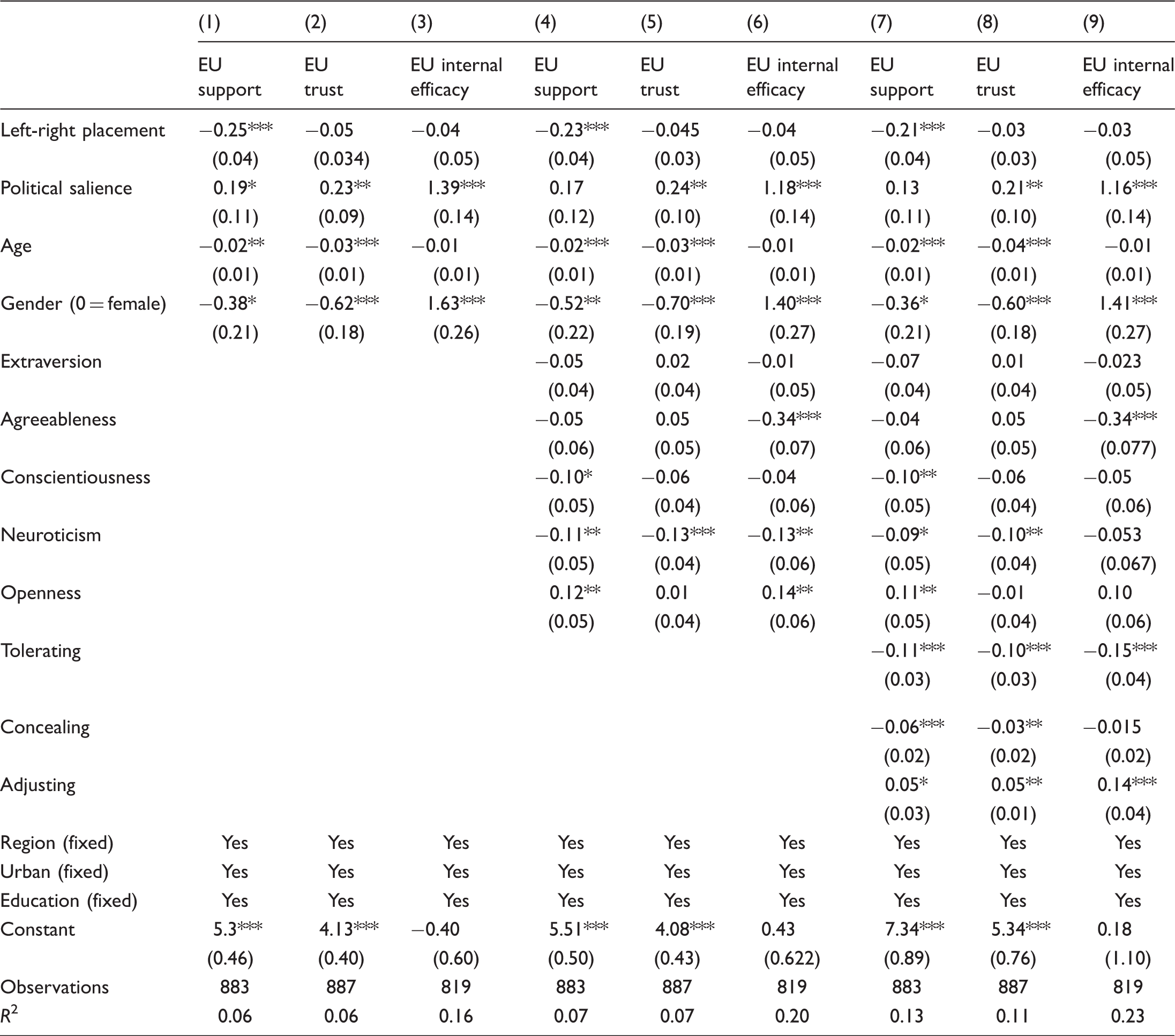
Note: Standard errors in parentheses. Unstandardized coefficients. Age centred around the mean.
***p < .01. **p < .05. *p < .1.
The findings in the basic model (models 1–3) are not surprising. Respondents who identify themselves with the ideological right are more against the EU (model 1), while finding politics salient plays an important positive role in trusting the EU (model 2) and EU internal efficacy (models 3). Age plays a significant role with older respondents less likely to trust and support the EU.
Models 4–6 present the results when including B5. As seen, neuroticism significantly influences EU support and EU internal efficacy negatively (p < 0.05) as well as EU trust (p < 0.01). Openness positively predicts EU support and EU internal efficacy (p < 0.05). Conscientiousness negatively predicts EU support (p < 0.1), and agreeableness negatively influences EU internal efficacy (p < 0.01). These findings, to a certain extent, replicate previous findings regarding B5's role on EU attitudes. As seen in Nielsen (2016) and Bakker and De Vreese (2016), highly neurotic individuals tend to be less supportive of the EU or possess negative feelings about the Union. The predictive power of personality on EU attitudes without any added variables is in the Online Appendix.
Last, models 7–9 add affective style to the equation. As predicted in H1, tolerating is indeed negatively associated with EU support, EU trust and EU internal efficacy (p < 0.01). Concealing is indeed negatively associated with EU support (p < 0.01), EU trust (p < 0.05) and EU internal efficacy as predicted in H2, albeit the latter relationship is not significant. Last, adjusting, as predicted in H3, is positively and significantly associated with EU support (p < 0.1), EU trust (p < 0.05) and EU internal efficacy (p < 0.01). Some of the significant findings of B5 from models 4–6 disappear when affective style is included, leading us to suspect that affective style mediates the relationship between personality and EU attitudes. This is particularly the case of the effect of neuroticism and openness on EU internal efficacy. The negative and significant effect of agreeableness on EU internal efficacy is intact (model 9), while the negative effect of conscientiousness on EU support is (surprisingly) becoming slightly more significant when adding affective style.
Affective style adds to the total substantive explanatory power of the models. Model 1 shows the results for EU support. While the simple model 1 provides a humble Adj-R2 of 6%, adding B5 on the same model (model 4) modestly enhances the Adj-R2 to 7%. Yet, adding affective style to the equation almost doubles the explanatory power and leaves it at 13% (model 7). Similarly, the model's explanatory power on EU trust goes from 6% in model 2 to 7% (model 5). While, again, adding in affective style provides a substantive elevation of the explanatory power on EU trust to 11% (model 8). Last, the explanatory power of EU internal efficacy goes from 16% in the simple baseline model 3 to 20% when adding in B5 (model 6). Affective style here adds 3% to the explanatory power on EU internal efficacy and ends at 23% (model 9). In sum, while affective style differs in its impact on explaining the three different variables of EU attitude formation, it nevertheless provides a consistently strong additive explanatory power on all three dependent variables. Thus, adding in affective style substantively enhances our ability to explain the variation in EU attitude formation on all three dependent variables also when controlling for B5.
Result 2: Does affective style mediate the relationship between personality and EU attitudes?
To explore if affective style mediates the relationship between personality and EU support, I turn to mediation analysis. We find mediation when the relationship between the independent variable (i.e. personality) and dependent variable (i.e. EU attitudes) is weaker or even insignificant when including the mediating variable (i.e. affective style). In the previous section, we saw that particularly the relationship between neuroticism and openness on internal efficacy changed when adding in affective style. The question is: To what extent does affective style mediate the relationship between these variables?
Traditional mediation analysis consists of regressing the dependent variable, the independent variable and the mediation variables on each other independently, while concluding with a full model consisting of all three variables (Baron and Kenny, 1986). However, recently more advanced nonparametric identification strategies decompose the effect of the independent variable, the potential mediator variable and the dependent variable (Imai et al., 2010). These approaches explore the robustness of the correlation between personality and EU attitudes by analyzing how sensitive it is to violation of the sequential ignorability assumption (SI). The SI assumes exogeneity and unconfoundedness of the tested relationship (Hicks and Tingley, 2011: 607). Due to the interval nature of the variables, I use a continuous mediator and outcome variable models. Following the previous work on EU identity formation using mediation analysis (e.g. Curtis, 2016), I use the Hicks and Tingley's (2011) mediation package for Stata.
The key quantity of interest when conducting mediation analysis is how much of the effect of personality on EU attitudes that is transmitted through affective style. The SI cannot be tested directly, so instead I estimate the correlation between the errors (ρ) of the last six models in Table 1. We are interested in the so-called average of the causal mediation effect (ACME). Because the Hicks and Tingley (2011) mediation package cannot accommodate multiple mediators simultaneously, I test each of the three affective styles separately for each B5 trait, while controlling for the other personality traits and a set of socio-demographic characteristics.
One of the limitations of the mediation analysis here applied is that it assumes causal independence between the mediators (Imai and Yamamoto, 2013). Table A10 in the Online Appendix detects some correlation between the three affective styles. While the correlation between tolerating and concealing is weak (0.10), it remains 0.45 between adjusting and tolerating, and 0.37 between concealing and adjusting. As I emphasize later, psychological features like B5 and affective styles are complex and in some ways intertwined. While their correlation is weak, they still do not consist of mutually exclusive categories. Just like affective styles, the five personality traits show a similar correlational pattern (see the Online Appendix). For example, the correlation between openness and extraversion is 0.35. While this is not a strong correlation, it nevertheless indicates that personality traits, along with affective styles, do not consist of mutually exclusive categories. Importantly, the aim here is not to explore the interrelationship between affective styles or B5. Rather, I explore if each of the three affective styles individually mediates the relationship between each of the B5 traits individually on the dependent variables. For this purpose, the mediation package by Hicks and Tingley is suitable.
Personality as predictor for affective style.
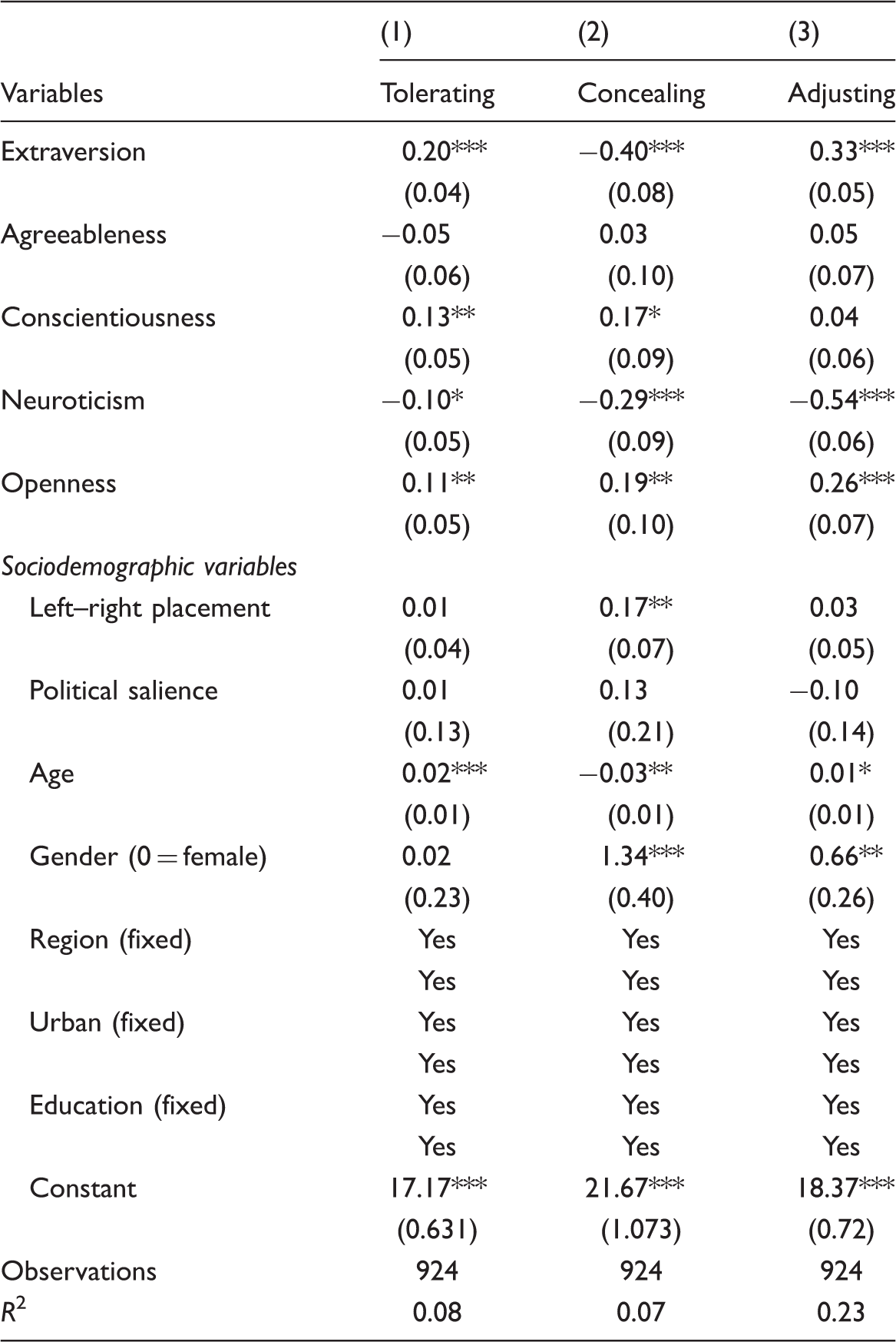
Note: Standard errors in parentheses. Unstandardized coefficients. Age centred around the mean.
***p < 0.01. **p < 0.05. *p < 0.1.
Summary of significant mediation effects for neuroticism and openness.
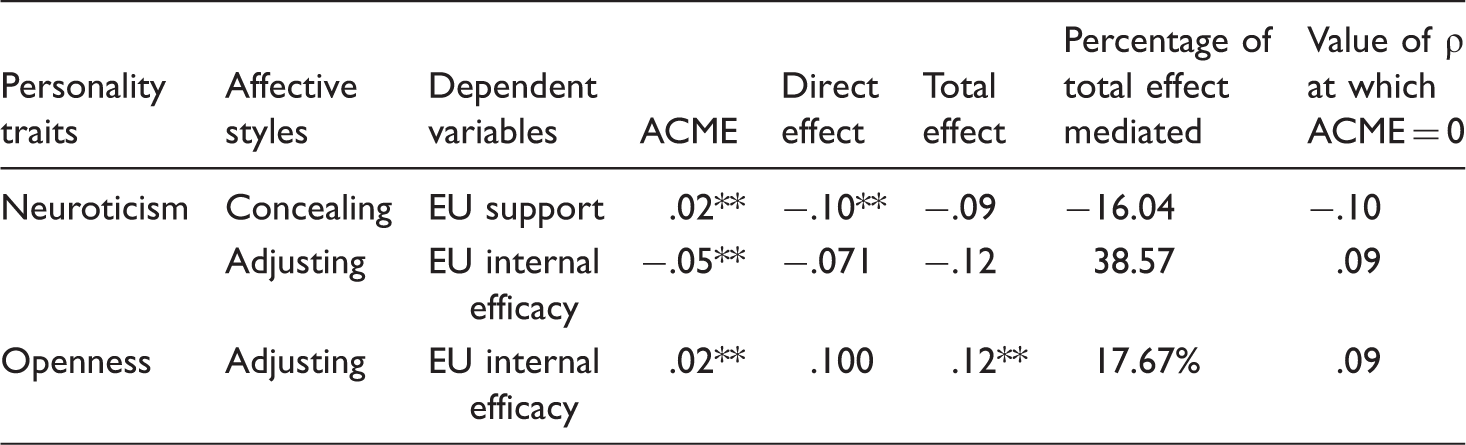
ACME: average causal mediation effect.
**p < .05.
Table 3 provides us with the percentage of the total mediated effect of the tested relationship. For example, 16.04% of neuroticism's association with EU support goes through the affective style of concealing. In addition, Table 3 reports the correlation between the errors (ρ) to explore how robust the results are to the violation of the SI. Table 3 shows that for the point estimate of the ACME to be zero, ρ must be approximately −0.10 for the relationship between neuroticism on EU support mediated by concealing.
Mediation analysis indicates a causal order of the treatment variable on the dependent variable through a mediation variable (e.g. Kosuke et al., 2010). The above analysis shows that particularly the effect of neuroticism and openness on EU attitudes runs through the intermediary variables of concealing and adjusting. To test the robustness of the causal order, I reversed the order between the treatment and the mediator. The results confirmed the complexity of the relationship between affective style and personality. Reversing the causal order, I find a few ACMEs to be significant. For example, a significant amount of the influence of tolerance on EU support goes through conscientiousness (−0.01). However, this finding is not surprising as we did identify that the explanatory power of conscientiousness on EU support (Table 1, model 4) was, as the only relationship in the models, boosted when adding in affective style (Table 1, model 7).
As emphasized earlier, the relationship between B5 and affective style is complex. While H4 was developed based on earlier work suggesting affective style mediates the relationship between personality and EU attitudes, we also know from the work on emotions and cognition that the models explaining the interconnectedness between personality and affective style are only in their infancy (e.g. Davidson, 2003). Multiple channel theories of emotions presume that affective reactions derive from multiple evaluative processes and result in multiple affective dimensions (Marcus, 2000: 237), while some researchers emphasize that the cognition–emotion relationship is bidirectional and that emotional processing is distributed according to various individual differences (Derryberry and Reed, 2009).
In sum, the results highlight two aspects. First, most of the personality effect is not mediated by affective style. Second, most of the affective style outcome is not merely transmission of a prior personality impact. These points are indeed noteworthy because they imply that both B5 and affective style bring new explanatory power to the table on what constitutes attitudes towards the EU.
Discussion and conclusion: Affective style as a novel predictor of EU attitudes
The pioneer of affective style, Davidson (1998: 307), emphasizes that ‘Among the most striking features of human emotion is the variability that is apparent across individuals in the quality and intensity of dispositional mood and emotional reactions to similar incentives and challenges’. With this in mind, it is unclear why the study of affective style in politics is almost non-existent.
This article provides two salient insights into the role of affective style on EU attitude formation. First, personality effects are not mediated by affective style to an extensive degree. I only find that adjusting significantly mediate the relationship between neuroticism and openness on EU internal efficacy, while concealing mediates the relationship between neuroticism and EU support. Rather, the results suggest that affective style provides a substantive and significant additional explanatory power on EU support, EU trust and EU internal efficacy (i.e. EU attitudes) when also controlling for personality. Tolerating and concealing affective strategies are negatively associated with EU attitudes, albeit only the effects of the later are statistically significant. The affective style of adjusting is significantly positively associated with all dependent variables. These points are indeed noteworthy because they imply that both B5 and affective style bring new explanatory power to the table on what constitutes attitudes towards the EU.
These findings provide a novel salient contribution to the study of EU attitude formation. So far, the role of emotions has been largely ignored, while studies focus more on the ‘rational’ explanations of EU support. Recognizing affective style as a significantly strong predictor of EU attitudes, we now possess a more comprehensive picture of the psychological explanations associated with EU attitude formation.
This research should not be viewed in isolation but as a contribution to the more conventional research on EU attitudes. For example, that EU attitudes are formed based on egocentric utilitarianism or identity-considerations (e.g. Karp et al., 2003; McLaren, 2007), the importance of the partisan context (Hooghe and Marks, 2005), the feelings of democratic representation (Gabel and Hix, 2005) or simply the importance of national politics (e.g. Anderson, 1998). These findings on affective style add to the flourishing work on the role of personality's influence on EU attitude formation (Bakker and De Vreese, 2016; Curtis, 2016; Nielsen, 2016), providing insights into the psychological mediators that might impact personality and its association with EU attitude formation.
While this article is not the first to explore the influence of emotions in politics (e.g. Marcus, 2000, 2003; Marcus et al., 2000) or the role of affective style (e.g. Davidson, 2003; Szasz et al., 2011), it is the first to scrutinize the impact of affective style in the process of political attitude formation. Importantly, further analysis is necessary to determine the complex patterns of causality between personality, affective style and attitude formation. This article provides new insights into the role of affective style in politics. Although it is difficult to grade experimental affective stimuli based on intensity (Davidson, 1998: 309), future studies should explore individual dose-response mechanisms to see how different degrees of feelings might predict the individual's affective style. Here, it would be desirable to learn about differences in emotional recovery time, encompassing differences in rise time to peak, as we know very little about these aspects of affective style (Davidson, 1998: 309 and 310). Relatedly, some argue that cross-sectional survey data on emotions cannot crisply test the short-term impact of emotions on individual attention and habits (Ladd and Lenz, 2008; Marcus et al., 2011) and call for experiments to expand affective research further. Experiments could include a methodological operationalization of Davidson's parameters of emotional style (Davidson and Begley, 2013). In this way, we would be provided with more insights into the different dimensions of affective style and thus more details on how it may affect political decision-making.
Footnotes
Acknowledgements
I thank three anonymous reviewers and Gerald Schneider for excellent and insightful comments that have greatly improved the manuscript. Furthermore, I thank Jacob Gerner Hariri, Catarina Kinnvall and Ian Manners as well as participants in the workshop ‘The Political Psychology of European Integration: Being Mindful of Europe’ at Lund University, held on 10–11 June 2016, for fruitful comments on an earlier draft of this article. All errors that may be found are my sole responsibility.
Funding
The author(s) disclosed receipt of the following financial support for the research, authorship, and/or publication of this article: The author thanks the Danish Research Council for Independent Research for generously funding the research, which benefits from Individual post doc grant number 12-132185.
Supplemental material
Supplementary material is available for this article online.
Notes
References
Supplementary Material
Please find the following supplemental material available below.
For Open Access articles published under a Creative Commons License, all supplemental material carries the same license as the article it is associated with.
For non-Open Access articles published, all supplemental material carries a non-exclusive license, and permission requests for re-use of supplemental material or any part of supplemental material shall be sent directly to the copyright owner as specified in the copyright notice associated with the article.
