







Abstract
This article analyzes the link between trust in national institutions and trust in European Union-level institutions among national public officials. Previous research has mainly looked at citizens; in contrast, little is known about the views national officials actually hold towards European Union-level institutions or how much confidence they place in them. Our study draws on a unique survey of 670 officials in 17 European Union member states who are involved in civil protection, a policy area which has recently emerged as one of the most important in the Union. Three mechanisms are explored: a ‘transference’ mechanism; a ‘trust syndrome’ mechanism and a ‘rational evaluation’ mechanism. Our findings confirm the existence of all three mechanisms and show that if European Union institutions are to be trusted to manage European Union-wide crises, then national institutions must be trusted too. This has far-reaching implications for the prospects of enhanced cooperation among civil-protection institutions in the European Union.
Introduction
A vast amount of research has pointed to a relationship between trust in national and in European-level institutions. Scholars do not agree, however, on the direction of this relationship. Some argue there is a positive relationship, whereby the more citizens tend to trust their national institutions, the more likely they are to trust European-level institutions as well; this is generally referred to as the ‘congruence’ hypothesis (Muñoz et al., 2011) or the ‘equal assessments’ model (Anderson, 1998; Kritzinger, 2003). Other researchers suggest that, conversely, the less citizens tend to trust their national institutions, the more likely they are to trust European-level ones; this is generally known as the ‘compensation’ hypothesis (Muñoz et al., 2011) or the ‘different assessments’ model (Kritzinger, 2003; Sánchez-Cuenca, 2000).
Empirical evidence on the nature of this relationship seems to point in both directions (for a review, see Muños, 2017: 77). However, most studies thus far have explored this relationship among citizens only; few investigate how much national public officials trust the European Union (EU) institutions with which they are required to cooperate. Despite the fact that European integration is generally considered to be an elite-led project (Haller, 2008; Hix and Goetz, 2000) in which it is assumed that elites are more willing to cede national authority and sovereignty in certain areas than citizens in general (Hooghe, 2003), surprisingly little is known about the views national officials actually hold towards EU-level institutions or how much confidence they place in them. At the same time, research has established that trustworthy institutions can facilitate cooperation (Levi and Stoker, 2000) and that they are crucial for effective governance and a well-functioning democracy (Levi, 1998; Putnam, 1993; Rothstein, 2011).
Admittedly, there are several studies that investigate how political elites and citizens take cues from one another in forming their opinions on European integration (see e.g. Armingeon and Ceka, 2013; Best et al., 2012; Hooghe and Marks, 2005; Sanders and Toka, 2013; Steenbergen et al., 2007). In addition, a number of studies explore how national officials may shift their loyalty from the national to the EU level, and how role perceptions and identities are conditioned by officials’ domestic embeddedness (Beyers and Trondal, 2004; Egeberg, 2011; Trondal, 2011). It is less common, however, to find in-depth analyses of the factors that foster trust in EU governance among national officials. In this article, we seek to fill this lacuna by examining how trust in EU institutions is linked to trust in national institutions. What are the mechanisms behind confidence in EU governance among national officials?
The field of civil protection, we believe, can serve as a crucial case for examining this issue. After all, a high degree of trust in crisis-management systems is generally deemed essential for their proper functioning (Christensen et al., 2016a; Nohrstedt et al., 2018; Parker et al., 2018). Moreover, the field of civil protection has recently emerged as one of the most important policy areas in the EU. Recent crises – terrorist attacks, natural hazard events, the migration crisis – have put civil-protection systems in Europe to the test. In response to these crises, many with a transboundary dimension, the Union has increased its efforts in the area of civil protection to provide aid to countries in need of assistance and to bolster its capacity to conduct joint operations (Backman and Rhinard, 2018; Boin et al., 2013, 2014; Kuipers et al., 2015; Widmalm et al. 2019). Due to the transboundary nature of many crises, such as floods or wildfires, there is an obvious need for EU members to be able to work together across borders and within a European framework. For this reason one might expect this to be an issue area in which the attitudes national officials hold about national and European-level institutions would be closely aligned. Little is known, however, about how much trust national officials in this area actually have in the EU’s ability to provide assistance when it is needed or to help solve joint problems.
Opinion polls have shown that a large majority of European citizens support a joint civil-protection policy among the member states. There is a strong consensus that coordinated EU action is needed to respond to disasters (European Commission, 2017a). Studies have furthermore shown that, in countries where citizens are treated fairly and impartially by their own national institutions of public administration, people are less likely to support EU-coordinated civil-protection efforts. By contrast, in countries where citizens perceive their government’s treatment of them to be biased and unfair, citizens tend to support EU-coordinated civil protection (Persson et al., 2017). This finding is associated with the ‘compensation’ model, according to which people hailing from countries with institutions that inspire little trust – where they are seen as corrupt and low performing – will be more inclined to support EU-level solutions. We contend, however, that the relationship may well go in the opposite direction when it comes to the willingness of public officials to grant more power to the EU. This would be more in line with the ‘congruence’ model.
In this article, we explore how trust in EU institutions is linked to politics at the national level. In addition, we suggest three mechanisms that can account for the relationship. First, in line with previous studies that have pointed to a strong connection between how citizens evaluate the EU-level system and how they view the functioning of their own national system (e.g. Anderson, 1998; Kritzinger, 2003; Muñoz et al., 2011), we suggest a simple ‘transference’ mechanism, which can be either positive (‘congruence’) or negative (‘compensation’). Second, the link between trust in national systems and in the Union may reflect some kind of underlying generalized trust, rather than trust in specific national institutions; we refer to this as the ‘trust syndrome’ mechanism (Harteveld et al., 2013: 20). Third, institutional trust may derive from a ‘rational calculation’ mechanism based on the procedures and perceived performance of institutions at both levels (Harteveld et al., 2013; Muños, 2017: 77).
Theory and hypotheses
We understand trust in institutions as an attitude relating to, on the one hand, an existing set of political institutions, such as parliament, government, courts, or, in our case, civil-protection agencies; and, on the other hand, legislators, political office holders, judges and public officials (cf. Norris, 2017; van der Meer and Zmerli, 2017: 4). Institutional trust thus relates to a specific set of objects (institutions and actors within those institutions), and not to more abstract concepts like society more generally or its ideals and principles. It thus refers to what Newton and Norris (2000: 53) argue is ‘the central indicator of the underlying feeling of the general public about its polity’ (although the focus in our case is on public officials rather than the general public).
We are thus examining the extent to which officials working in national civil-protection institutions tend to trust their own institutions on the one hand, and EU-level institutions on the other. Institutional trust should moreover be distinguished from interpersonal trust, which refers to the particular trust that individuals may feel for specific people or groups, and more generalized trust, which individuals may feel for people in general, even if they do not know them personally (Newton and Zmerli, 2011: 170–171). Furthermore, we are only able to examine trust relations on a single occasion, which means that we cannot determine the causal order of trust with certainty: i.e. whether generalized trust promotes trust in institutions, as suggested by Putnam (1993), or whether the converse is true, as Rothstein and Stolle claim (2008). Notwithstanding this, however, we hold with those who argue that generalized trust is an underlying factor that can generate trust in institutions, as explained below.
Previous research has shown that trust in and support for the EU derive above all from evaluations of national politics and policy (Armingeon and Ceka, 2013). We can therefore expect to find a ‘logic of extrapolation’, whereby ‘citizens’ trust in the EU can be predicted by their trust in national institutions (Harteveld et al., 2013: 20). Thus, we side with those who contend that ‘the main spillover effect is from the “first-order” national institutions towards the rest of the multilevel structure’ (Muños, 2017: 76), and not the other way around. Findings by Anderson (1998: 567) indicate that citizens are better informed about politics at the national level, and that their knowledge of EU politics is limited; accordingly, they use their attitudes towards national institutions as a proxy on which to form their attitudes towards EU institutions. Although we cannot fully prove the causal order, we view this type of extrapolation as a process whereby actors apply cues from the national level of politics to the supranational.
This transference logic suggests that trust can travel beyond the national level to the supranational level. For example, past research has posited that the transference logic affects both general attitudes towards the EU (see e.g. Armingeon and Ceka, 2013; Harteveld et al., 2013) and more specific attitudes towards particular institutions at the EU level, such as the European Commission and the European Parliament (see e.g. Muñoz et al., 2011; Sánchez-Cuenca, 2000). Citizens who trust their national institutions will, according to this logic, tend to trust EU institutions and vice versa; we refer to this as the ‘congruence’ mechanism. Because public officials possess more and better information about how well operations work at the national level, they should make similar assessments as citizens regarding this relationship. H1a: There is a positive relationship between trust in national civil-protection institutions and trust in EU civil-protection institutions.
Empirical evidence furthermore indicates that countries in which citizens trust the EU more than their national institutions are usually countries with low-performing, less trusted, and more corrupt institutions (Harteveld et al., 2013; Muños, 2017: 75; see also Závecz, 2017). Hence, a lack of institutional trust at the national level may tend to increase institutional trust at the EU level. The worse the political system works at home, the smaller the risk involved in transferring national sovereignty to the supranational level (Desmet et al., 2012; Sánchez-Cuenca, 2000). According to this compensation logic, public officials would be expected to make similar assessments as citizens regarding this relationship, based primarily on their knowledge of how well operations work at the national level. H1b: There is a negative relationship between trust in national civil-protection institutions and trust in EU civil-protection institutions.
However, we must be cautious about the causal order here, since there is a close connection between different types of trust. Is generalized trust generated by experiences with others, thus forming the foundation for trust in societal institutions (Putnam, 1993)? Or is the causal sequence rather reverse, i.e. well-functioning societal institutions promote generalized trust (Rothstein, 2011; Rothstein and Stolle, 2008)? This is a contested question. Nevertheless, we will follow Newton and Zmerli (2011: 193), who argue that there is ‘a significant and positive relationship between general social trust and political trust’. Similarly, Harteveld et al. (2013: 20) contend that trust in national institutions and trust in EU institutions originate in the same source, even if ‘further research is needed to shed a light on the mechanisms that connect this syndrome to its concrete manifestations’. This ‘trust syndrome’ mechanism can be assumed to apply to officials working in civil-protection agencies as well. H2: There is a positive relationship between generalized trust and trust in EU civil-protection institutions. H3: There is a positive relationship between evaluations of institutional procedures and performance, and trust in EU civil-protection institutions.
The EU’s role as crisis manager: A note on case selection
Over time, the EU has increasingly committed itself to the protection of its citizens. The concrete manifestation of this goal is the solidarity clause (Article 222) of the Treaty on the Functioning of the EU (TFEU), which establishes a legal obligation for the EU and its member states to assist each other when a member state is the object of a terrorist attack or a natural or man-made disaster. To this end, the Union has created a civil-protection mechanism, as well as an accompanying operational hub in the form of the Emergency Response Coordination Centre (ERCC), which is responsible for coordinating the response of the participating countries in the event of a crisis (Backman and Rhinard, 2018; Boin et al., 2013, 2014; Parker et al., 2018).
In addition to the solidarity clause and the requirement that the EU and its member states come to the aid of fellow members in need, the TFEU calls on the Union to support and to coordinate the civil-protection systems of its member states (Article 196). For this purpose, various arrangements have been put in place for coordinating crisis-management capabilities and enabling the EU and its member states to respond to overwhelming natural and man-made disasters. The EU Civil Protection Mechanism, established in 2001 and revised in December 2013, is one of the main components of the effort to enhance cooperation among national civil-protection authorities across Europe, and to bring together the various resources needed for a comprehensive disaster-management policy covering disaster prevention, disaster preparedness and disaster response (European Commission, 2013).
The operational heart of the mechanism is the ERCC, set up in May 2013, which coordinates the response of the participating countries when a crisis occurs. The ERCC offers 24/7 real-time monitoring and it can instantly respond to disaster events by bringing together available resources and offering assistance to the impacted country. If the solidarity clause is triggered, the ERCC will act as the main contact point for managing the EU’s response. Thirty-three countries have approved the Civil Protection Mechanism and are taking part in its arrangements: 28 EU member states, together with Iceland, Norway, Montenegro, the Republic of Macedonia and Serbia.
Other steps towards improved civil protection in Europe include the enhanced European Emergency Response Capacity (EERC), which creates a ‘voluntary pool’ that enables participating states to pre-commit response capacities, such as relief teams, experts and equipment; the Common Emergency and Communication System (CECIS) and the Integrated Political Crisis Response (IPCR), which was endorsed by the Council in order to provide political coordination in the event of a major crisis. Hence, although civil protection largely remains a regulatory and operational competence of the member states, the Union has set out increasingly ambitious policy goals, backed up by formal and legal institutionalization (Bossong and Hegemann, 2015).
Taken together, these joint measures illustrate the ambitions for increased EU-level cooperation in the field of civil protection and crisis management. Recent transboundary crises, such as the refugee crisis, terrorist attacks and natural hazard events, have also put civil-protection systems in Europe to the test. However, it is far from clear how much people working in national civil-protection agencies trust such cooperative EU arrangements. We therefore consider this field a crucial case for testing how trust in EU governance is fostered among public officials, and how it is related to confidence in national civil-protection and crisis-management systems. Although the findings are hard to generalize to other areas, the mechanisms that this research uncovers are of general relevance.
Data and measures
As indicated above, our goal is to assess the relationship between trust in national institutions and the confidence that national public officials put in EU-level institutions. Our study is based on a large-scale online survey that targeted 670 officials working in the leading national organizations in the area of civil protection in 17 member states of the EU. 1 These agencies bear the primary responsibility for coordinating national civil protection, and they serve as the national contact points for the EU Civil Protection Mechanism. Moreover, we sought broad representation in our sample for different models in EU member states for the organization of civil protection and crisis management (Bossong and Hegemann, 2015: 36; Christensen et al., 2016b; Kuipers et al., 2015). Many of our selected organizations have similar functions and carry out similar tasks of civil protection. However, there are also a number of differences between the organizations included in our study, for instance, in terms of their histories and their experiences with major crises, emergencies and accidents. The organizations also exhibit considerable diversity in their organizational set-ups, institutional arrangements and administrative traditions and cultures. This ensures that we have individuals with varying experiences from different national contexts in our sample.
The study was conducted in two stages. To begin with, the principal investigators visited all authorities willing to take part, and conducted interviews with heads of departments and senior officials in order to learn more about the activities of the agency in question (see the Online appendix). In a second stage, an online survey was distributed to a wider selection of employees, mostly high-ranking officials working in management or in analytical units or strategic positions, and in some cases operational units. We did not choose our respondents randomly, but rather targeted them strategically; and we therefore cannot be entirely sure of the representativeness of the selected participants. To mitigate this problem, the survey asked respondents to report what type of job they held and included a set of questions related to experience of working with civil protection issues. This provided us with some ability to ensure that our sample drew from an appropriate population and allows us some confidence about the strategic selection of the employees that took part in our survey. Still, due to this uncertainty, we interpret the results cautiously. Nevertheless, our survey contributes unique information on the perceptions of a large number of officials working in European civil-protection authorities. 2 To the best of our knowledge, this is the most comprehensive study conducted in the field.
In this section, we present how variables are operationalized and which data are used for the assessment. We review the results of our statistical models (ordinary least squares regression with country fixed effects excluded and included) in the next section (for descriptive statistics of all variables used in the analysis, see the Online appendix). 3 We have refrained from multilevel analysis mainly because our goal here is to investigate individual variation and not differences between countries (Steenbergen and Jones, 2002: 234–235).
Variables
Our dependent variable, Trust in EU-level institutions, is based on the following survey question: ‘The crisis management and/or civil protection institutions at the EU level (for example the ERCC) can: 0 (not be trusted at all) to 6 (be completely trusted)’. With this question, we seek to capture the respondent’s attitude towards the existing set of civil-protection institutions at the EU level.
Our first independent variable, Trust in national institutions, measures institutional trust at the national level, by means of the following question: ‘The crisis management and/or civil protection institution where I work can: 0 (not be trusted at all) to 6 (be completely trusted)’. This formulation, which resembles the one used for measuring the dependent variable, is meant to capture the respondent’s attitude towards existing civil-protection institutions at the national level.
Our second independent variable, Generalized trust, seeks to capture respondents’ trust in people in general with the following survey question: ‘In general, people can: 0 (not be trusted at all) to 6 (be completely trusted)’. With regard to the interpretation of what this question elicits about generalized trust, we side with Uslaner (2002), who argues that people’s answers about whether they think most other people can be trusted indicates their evaluation of the moral level of the society in which they live.
In an effort to tap the rational-calculation mechanism, we introduce three independent variables about the procedures and performance of EU-level institutions. These relate to three different aspects of how public officials evaluate the quality of institutions: the responsiveness of institutions and their own ability to influence them (input); the openness and transparency of said institutions’ working processes (throughput) and the efficiency and performance of the institutions in question (output) (Schmidt, 2012). We measure these assessments through the following three questions: 4
Input: ‘To what extent would you say that public sector employees in crisis management and/or civil protection institutions at the EU level (for example the ERCC) are allowed to use their own professional judgment in their working situation? 0 (not at all) to 6 (to a very large extent)’; Throughput: ‘Generally speaking, would you say that the activities and decisions of crisis management and/or civil protection institutions at the EU level (for example the ERCC) are open to scrutiny by the public? 0 (not at all) to 6 (to a very large extent)’; Output: ‘Generally speaking, would you say that crisis management and/or civil protection institutions at the EU level (for example the ERCC) are good at achieving their main objectives? 0 (not at all) to 6 (to a very large extent)’.
Additional variables are included in the analysis in order to control for both individual-specific factors – e.g. experience, education, gender—and more country-specific factors (for more information, see the Online appendix).
Results
In the following, we attempt to shed light on the relationship between trust in national civil-protection institutions, and trust in their counterparts at the level of the Union. The first model in Table 1 shows a simple bivariate regression, with trust in EU civil-protection institutions as the dependent variable and trust in national civil-protection institutions as the independent variable. As can be seen in Model 1, there is a positive relationship on the individual level between trust in national civil-protection institutions and trust in EU civil-protection institutions, which is significant at the 0.001 level. These results indicate that, in countries where officials tend to trust their own institutions, they are also more likely to trust EU-level civil protection. A one-unit increase in trust in national institutions increases confidence in EU-level institutions by .53 units, on a scale running from 0 to 6. Moreover, we see that trust in national civil-protection institutions accounts for 27% of the overall variance in officials’ confidence in the corresponding institutions at the EU level. Taken together, these results furnish fairly strong support for the transference logic and the congruence mechanism.
Determinants of trust in European Union (EU)-level institutions.
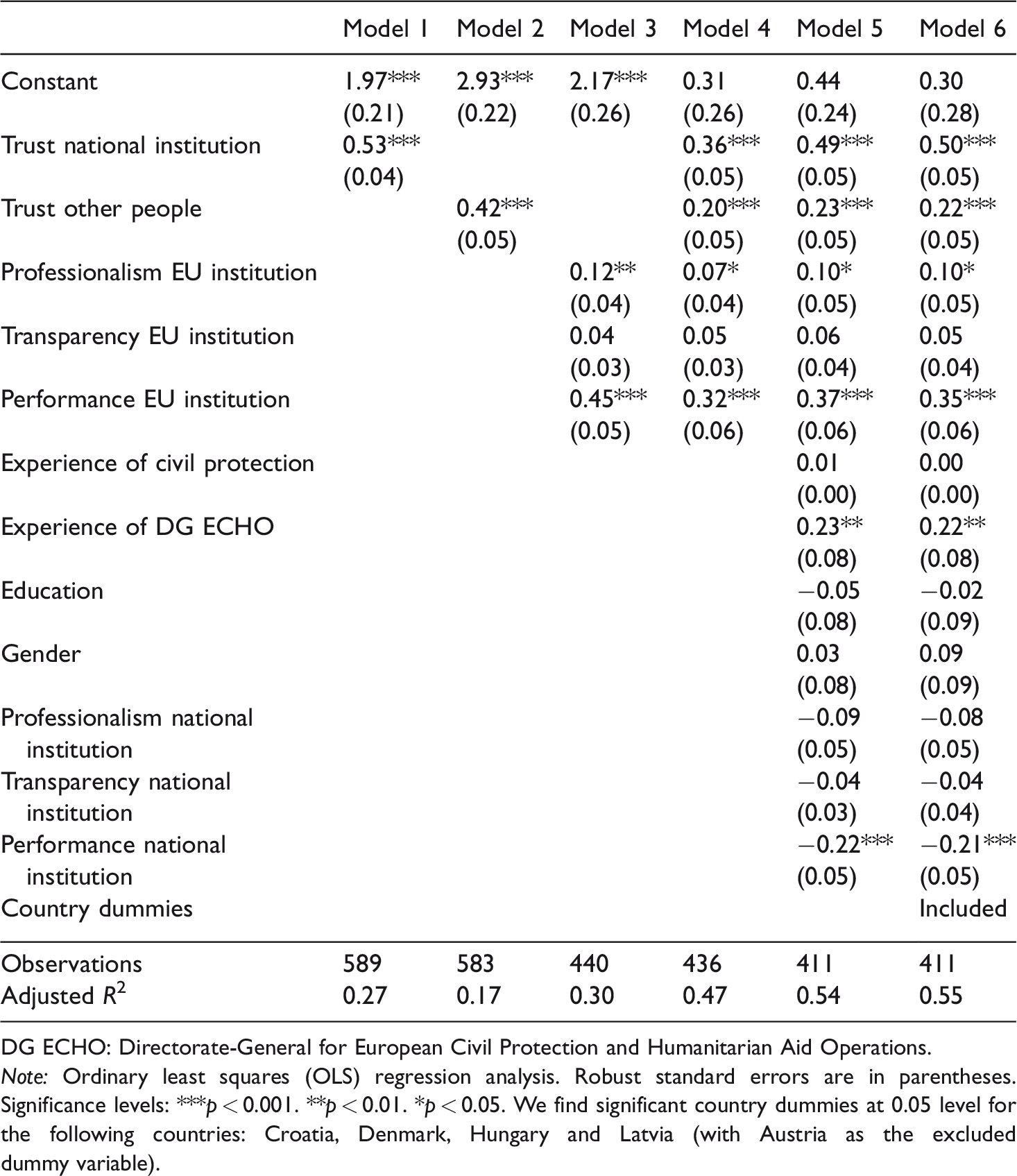
DG ECHO: Directorate-General for European Civil Protection and Humanitarian Aid Operations.
Note: Ordinary least squares (OLS) regression analysis. Robust standard errors are in parentheses. Significance levels: ***p < 0.001. **p < 0.01. *p < 0.05. We find significant country dummies at 0.05 level for the following countries: Croatia, Denmark, Hungary and Latvia (with Austria as the excluded dummy variable).
In Model 2, we introduce instead a measure of the extent to which officials trust people in general, and we test the impact thereof on confidence in EU civil-protection institutions. As can be seen from Model 2 in Table 1, generalized trust has a positive impact on confidence in EU-level institutions. The relationship is slightly weaker than in the first model (the b-coefficient falls from 0.53 to 0.44); however, the effect is significant at the 0.001 level. Generalized trust explains 17% of the overall variance in officials’ confidence in civil-protection institutions at the EU level. When combined, these results lend support to the trust-syndrome mechanism.
Turning now to the third mechanism, which involves the rational evaluation of EU institutions, we find that all three measures display a positive relationship. Only two of these, perceived professionalism and performance, are significant. Hence, as can be seen from Model 3 in Table 1, there is a positive effect of perceived professionalism on the part of EU institutions (input) and perceived performance of EU institutions (output) on the confidence that officials place in EU-level institutions; whereas the perceived transparency (throughput) of EU institutions is insignificant. The performance indicator displays a strong relationship (b-coefficient 0.45), while the professionalism indicator is somewhat weaker (b-coefficient 0.12). Furthermore, the effects are significant at the 0.001 and 0.01 levels, respectively; altogether, this model explains 44% of the overall variance in officials’ confidence in EU civil-protection institutions. This is higher than in both previous models. Collectively, these results lend at least partial support to the rational-evaluation mechanism.
Before jumping to conclusions, however, we need to consider these relationships in more detail. Since all but one of our independent variables has explanatory power, we need to assess the relative importance of these variables in a multivariate regression analysis. In Model 4 in Table 1, we display the effects of all five independent variables. As can be seen from Model 4, all variables that were significant in the bivariate models remain significant in this multivariate regression model: i.e. trust in national institutions, generalized trust, professionalism and the performance indicators; while the transparency indicator is still insignificant. Moreover, the overall explained variance in the sample increases to 48%.
In order to test the robustness of our explanatory factors further, we add a number of control variables. More specifically, we add one control variable to account for the general level of experience among officials, measured as the number of years working with civil protection. In addition, we control for officials’ experience with EU civil-protection institutions, measured as a dummy variable. Furthermore, we control for gender and educational level. Finally, we add three control variables containing rational-evaluation indicators – now targeting the national institutions – in order to ensure that the assessments made at different levels are independent of each other.
In Model 5, we find, interestingly enough, that when the above-mentioned factors are controlled for, all of the variables that were significant in Model 4 remain significant. In fact, the effects are strengthened. Hence, the positive impact of these variables on officials’ trust in EU-level civil-protection institutions appears to be fairly robust. Moreover, this extended model explains about 54% of the variation in the dependent variable. In addition, we find a significant effect of experience with EU civil-protection institutions, suggesting that this has a positive impact on the confidence that public officials place in EU-level institutions. As we might expect, officials who have direct experience of working with the EU Civil Protection Mechanism, or together with EU crisis-management organizations, tend to value these institutions more highly.
Furthermore, we find negative effects of perceived performance on the part of national institutions, indicating that, the worse officials consider their national institutions to perform, the more likely they are to trust EU-level institutions. This finding cuts in the opposite direction from the transference mechanism, demonstrating that rational assessments of institutions can follow a different logic (compensation) from the more unreflected extrapolation of institutional trust from the national to the EU level (congruence). Both of these mechanisms appear to be in operation at the same time. At first glance, this may seem counterintuitive. However, what these findings ultimately suggest is that assessments of the trustworthiness of institutions and assessments of the procedures and performance of institutions are different things. Officials that ascribe the poor performance of their national institutions to a lack of capacity or resources are likely to look to the EU as a way to enhance national capabilities and, if needed, to compensate for what the national level cannot deliver. In other words, one can put faith in the good will and trustworthiness of an institution, but recognize the existence of capacity deficits and performance shortcomings that may be ameliorated with assistance.
Finally, and in addition to the control variables from the previous model, we include country dummies in Model 6 to account for country-specific contextual factors. The results remain unaltered, giving further evidence of the robustness of our results. 5 In Figure 1, we display partial regression plots for this final model. The plots show the relationship between confidence in EU civil-protection institutions and the following variables: (a) trust in national institutions, (b) generalized trust, (c) professionalism, (d) transparency and (e) performance indicators, once the effects of all control variables including the country dummies have been taken into account. As Figure 1(a) indicates, there is a positive relationship between confidence in EU civil-protection institutions and trust in national institutions, controlling for all other variables. Similarly, Figure 1(b) demonstrates a positive relationship between EU civil-protection institutions and generalized trust, while Figures 1(c) and 1(e) show positive associations between EU civil-protection institutions and the professionalism and performance indicators respectively. As shown in Figure 1(d), there is no relationship between confidence in EU civil-protection institutions and the transparency indicator.
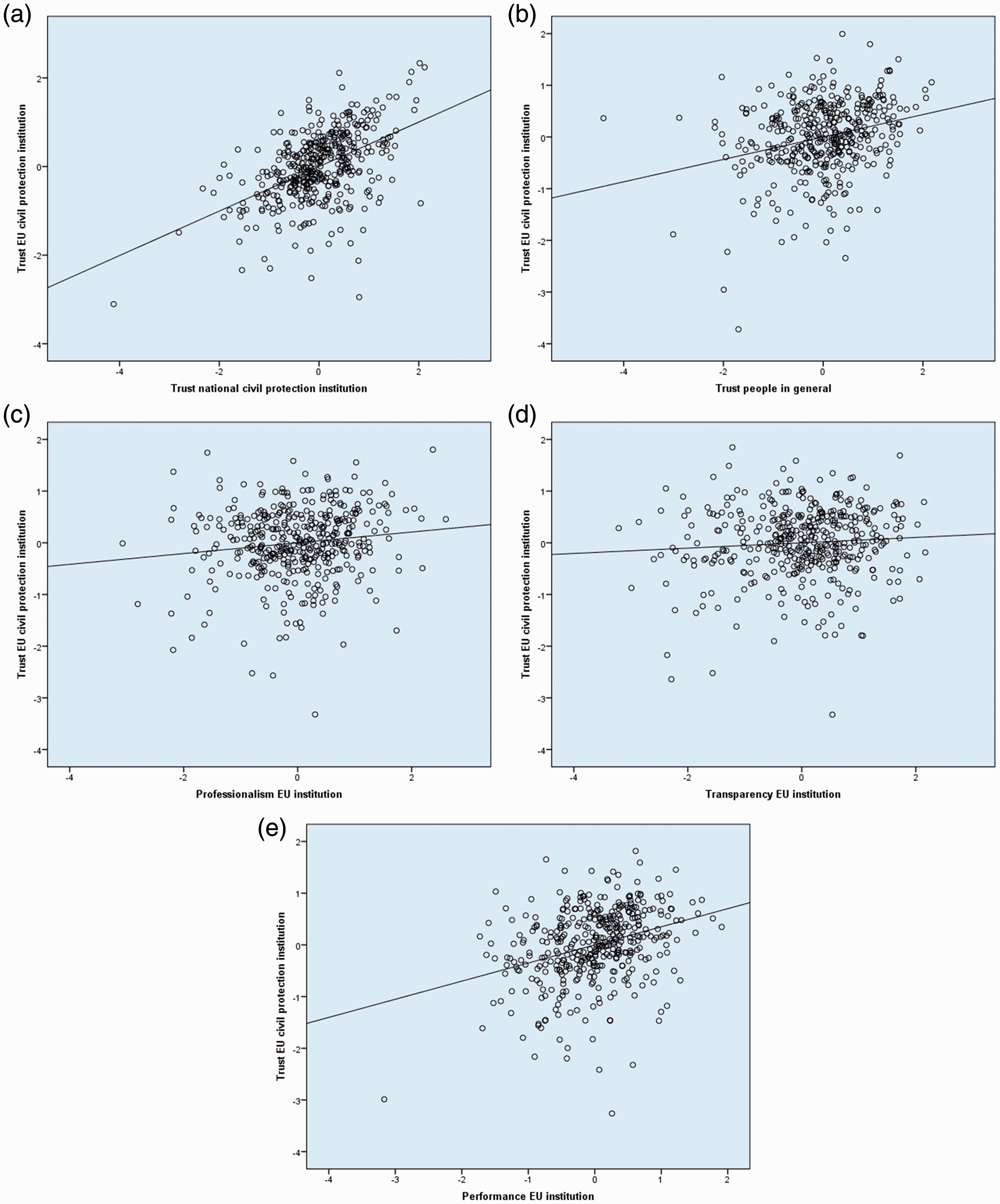
(a–e) Partial regression plots of the relationship between trust in EU-level civil-protection institutions and different independent variables, controlling for all other variables. (a) Note: Coefficient = 0.502099, standard error = 0.044944, t = 11.171648. (b) Note: Coefficient = 0.216754, standard error = 0.040233, t = 5.387481. (c) Note: Coefficient = 0.104135, standard error =0.040497, t = 2.571445. (d) Note: Coefficient = 0.051573, standard error = 0.035475, t = 1.453810. (e) Note: Coefficient = 0.350528, standard error = 0.052412, t = 6.687863.
Despite the caution that is warranted regarding the conclusions that can be drawn from our survey, the evidence provided may have far-reaching implications for the prospects of the EU Civil Protection Mechanism to serve as a useful expression of European solidarity. We discuss this question further in our concluding section.
Conclusion
Our main aim in this article has been to examine how trust in EU institutions is linked to trust in national institutions, and to explore the mechanisms behind confidence in EU governance among national officials working with civil protection and crisis management. This relationship is particularly interesting to consider in the context of the EU’s political system, since the Union has become increasingly involved in crisis management, and it has developed a range of capacities to assist in managing different types of crises. It is crucial for the effectiveness of EU civil-protection institutions that they enjoy the trust of people working together with them. Previous research has shown that the legitimacy of crisis-management systems is crucial for their ability to carry out their tasks (Christensen et al., 2016a; Parker et al. 2018).
Our analysis shows that officials who trust their national civil-protection institutions also tend to trust EU-coordinated civil protection. Correspondingly, officials who perceive their national civil-protection institutions to be less trustworthy are also more likely to distrust EU-coordinated civil-protection efforts. This finding of congruence between trust in institutions at the national and at the supranational level is contrary to the views of citizens, where people with little trust in national institutions are more inclined to support EU-level solutions while those who were pleased with their national institutions did not desire EU involvement (Persson et al., 2017). With regards to generalized trust, we have hypothesized that officials with high levels of trust are likely not only to have confidence in their national institutions, but also to be willing to extend greater powers to the EU in matters relating to crisis management and civil protection. Our study demonstrates the existence of a significant correlation between the general level of trust in other people and confidence in EU civil-protection authorities. Or, put differently, we find support for a ‘syndrome of trust’, where trust in institutions at both levels originates in a common source (Harteveld et al., 2013: 20).
What explains the different evaluations that citizens and practitioners have about the relationship between national and EU-level institutions? In our view, professional networks, first-hand knowledge and incentives are possible explanations for this discrepancy. Citizens that express trust in their national institutions and are happy with them, appear to be disinclined to look to EU-level involvement as they see no need for it and may even fear negative consequences due to their unfamiliarity with the EU. In contrast, national officials have had the opportunity to build trust in the EU level through their professional contacts with EU colleagues, first-hand experience of working with the EU and knowledge of what capabilities are available through the EU and are therefore more likely to perceive EU-level cooperation as a complementary enhancement to what they are doing nationally.
Moreover, institutional trust also derives from rational calculations based on the procedures and performance of institutions. That is, the more officials consider EU-level institutions to allow professional judgement and to perform efficiently, the more highly they regard them. In fact, according to our survey, these types of calculations have the greatest impact on officials’ confidence in EU governance. Notwithstanding this, however, officials seem to make the same compensatory evaluation as citizens do when assessing the procedures and performance of national institutions: i.e. the worse their national institutions perform, the more willing they are to trust EU-level institutions. This finding – that people hailing from countries with low-performing institutions are more willing to place confidence in the EU – is in line with the findings of previous research (e.g. Muños, 2017; Závecz, 2017).
Taken together, our findings are consistent with those of previous studies, suggesting that institutional trust is associated both with generalized trust and with evaluations of the functioning of institutions (Grönlund and Setälä, 2012; Widmalm et al. 2019; see also Dellmuth and Tallberg, 2015, for a similar conclusion regarding international organizations). After controlling for various individual traits and country-specific measures, the degree of trust placed by national officials in EU-level cooperation (as compared with national solutions) has a significant correlation with the way in which national civil-protection institutions work. However, we should refrain from making hasty conclusions because there is some uncertainty about the representativeness of our survey sample. Major imbalances in the number of participants from different agencies make it urgent to further examine country variation in trust, and also explore the causal relationships within this problématique. In future research, it will be important to ascertain whether these results are also valid in areas other than civil protection and crisis management, and when considering other potential factors that may foster trust (see e.g. Foster and Frieden, 2017). It may be that the relationship we found here will not be confirmed in other policy areas, such as those dealing more directly with sensitive redistribution issues in social affairs or employment, where national solutions are more likely to be valued. We therefore refrain from generalizing the results from this study to other areas.
One interpretation of these findings would be that trust in EU governance starts at the national level: i.e. if there is no confidence in national institutions, then trust in cooperation at the EU level will be hard to establish. Moreover, it may be even more crucial – if the Union is to inspire confidence as a crisis manager – that people involved in civil-protection work be inclined to trust other people. The evidence furnished thus far has far-reaching implications for the prospects that the EU Civil Protection Mechanism will be able to serve as a useful expression of European cooperation and solidarity. If EU institutions are to be trusted to manage EU-wide crises, then national institutions must be trusted too. After all, civil protection and crisis management largely remain a competence of the member states.
However, it is well known from research that trust is hard to build. Therefore, another fruitful way forward – as suggested by the findings of our study – would be to develop EU-level cooperation in this field further. In 2017, the European Commission (2017b) announced a new proposal, rescEU, to accomplish this aim. While the rescEU plan proposes to provide the EU with its own independent response capacity by creating a reserve of assets, such as firefighting aircrafts, water pumps and field hospitals, which would be managed by the Directorate-General for European Civil Protection and Humanitarian Aid Operations (DG ECHO) and the ERCC, a major part of the plan is aimed at improving the national capacities of the member states. The plan calls for the Commission to help member states strengthen their national capacities by funding the adaptation, repair, transport and operation costs of their existing resources (European Commission, 2017b: 4–5).
As our findings strongly suggest, fortifying the weakest links among the member states by improving the national capacities of these states is crucial to enhancing the confidence in and effectiveness of EU civil protection. To conclude, a revised EU civil protection system should be able to offer added value to national civil-protection institutions as long as it provides sufficient space for professional decision making (input legitimacy) and as long as it performs well in helping better manage national and transboundary crises (output legitimacy). Such efforts may also bridge the large gaps between different civil-protection and crisis-management systems, thereby contributing to a safer Europe.
Supplemental Material
Supplemental material for How trust in EU institutions is linked to trust in national institutions: Explaining confidence in EU governance among national-level public officials
Supplemental Material for How trust in EU institutions is linked to trust in national institutions: Explaining confidence in EU governance among national-level public officials by Thomas Persson, Charles F Parker and Sten Widmalm in European Union Politics
Footnotes
Acknowledgements
We are very grateful to the three anonymous reviewers and the editor at EUP for their constructive comments on earlier drafts of this article.
Funding
The author(s) disclosed receipt of the following financial support for the research, authorship, and/or publication of this article: The authors would like to express their gratitude to the Swedish Civil Contingencies Agency (MSB) for its generous financial support.
Supplemental material
Supplemental material for this article is available online.
Notes
References
Supplementary Material
Please find the following supplemental material available below.
For Open Access articles published under a Creative Commons License, all supplemental material carries the same license as the article it is associated with.
For non-Open Access articles published, all supplemental material carries a non-exclusive license, and permission requests for re-use of supplemental material or any part of supplemental material shall be sent directly to the copyright owner as specified in the copyright notice associated with the article.
