







Abstract
The European Union’s deepening of international economic integration might be expected to correspondingly increase interest in policy (and news) related to trade partners. The United Kingdom’s withdrawal from the organization through invocation of Article 50 offers a particularly clear case for such potential effects, since it directly implicates the relevant economic ties. Yet, evidence from Google searches shows no such effect: European regions that particularly rely on trade with the United Kingdom devote no greater share of their search requests to Brexit-related topics, whether because the public is unaware of local trade linkages or uninterested in the other parties involved.
The European Union (EU) has aspired to use trade to foster connections and fellow feeling across international boundaries, thereby reducing conflict through reshaping of residents’ attitudes and identities (Fligstein, 2008; Freund and Ornelas, 2010). But does trade really have these intended political effects? The United Kingdom’s protracted attempts to depart the organization provide new information, since different regions of the EU vary in their trade exposure to the United Kingdom. A cross-channel divorce then has starker economic implications for European areas reliant on trade with the United Kingdom, where concern about British policy should concentrate. Indeed, if international economic integration cemented general cross-border bonds, interest in British goings-on in such places might increase even among those lacking personal cross-channel economic links, as exposure to British goods and traders increased broader feelings of social connection.
To test the hypothesis, I rely on data from Google search results, an organic measure of real-world public issue attention widely used in the social sciences (Mellon, 2013; Reyes et al., 2018; Swearingen, 2019). This letter thereby builds on literatures about public attention to European trade policymaking (e.g. Beyers and Kerremans, 2007; Kanthak and Spies, 2018; Steiner, 2018; Wasserfallen et al., 2019) and about European attitudes to Brexit (Crescenzi et al., 2018; Jacobs, 2018). The results suggest that local trade with the United Kingdom fails to increase public interest in Brexit. These results cast doubt on the idea that the pocketbook implications of the single market in goods build transnational popular interest in EU affairs.
Trade dependence and public interest
The hypothesis’s key independent variable involves local trade with the United Kingdom. Chen et al. (2018) provide two alternative measures of this for European regions at the second level of the European Union’s Classification of Territorial Units for Statistics (NUTS2). One measure estimates the share of regions’ labor income deriving from such trade; the other estimates United Kingdom trade as a share of total output in terms of gross domestic product (GDP). 1 Chen et al. (2018) prefer the former measure, since labor income connects more meaningfully to its official geographic location (whereas statistics may credit capital income to corporations’ headquarters rather than shareholder locations), but both are retained here as alternative specifications, each transformed with a logarithm to reduce the variables’ inherent skew. These variables’ cross-sectional nature makes the region, not the region-year, the unit of analysis.
The dependent variable, intensity of interest in Britain’s potential exit from the EU, comprises Google Trends data on searches relating to the topic of “Brexit” in 2017 and 2018: 2 such topic-based queries capture Google Trends’ attempts to aggregate thematically relevant searches and misspellings from across several languages rather than rigidly counting specific search keywords. This measure captures the bulk of European online searches: recent estimates assign around 90% of the European Internet search market to Google (Iacobucci and Ducci, 2019), and although not everyone has Internet access, even lower-access groups such as the elderly use Google widely (König et al., 2018).
Google Trends provides aggregated regional data rather than individual-level search requests such that ecological-inference problems prevent deductions about the effects of individual-level characteristics: the hypothesis tests here only assess how regions’ average Brexit interest varies based on regional characteristics rather than personal demographics. The regional aggregation varies by country. In several countries, Google provides search data by NUTS2, although sometimes by older editions of NUTS2 misaligned with recent revisions. In other cases, searches are aggregated to NUTS3 or to geographical units (such as Portugal’s traditional districts) unaligned with NUTS2 units and therefore precluding reconciliation with the available trade figures. Figure 1 maps the regions where the geography of Google search data corresponds to available trade and other statistics, with darker regions having higher Google Trends interest in Brexit. Austria, Belgium, France, Italy, the Netherlands, Poland, and Spain are included, as are substantial fractions of Denmark and Germany along with scattered regions elsewhere.
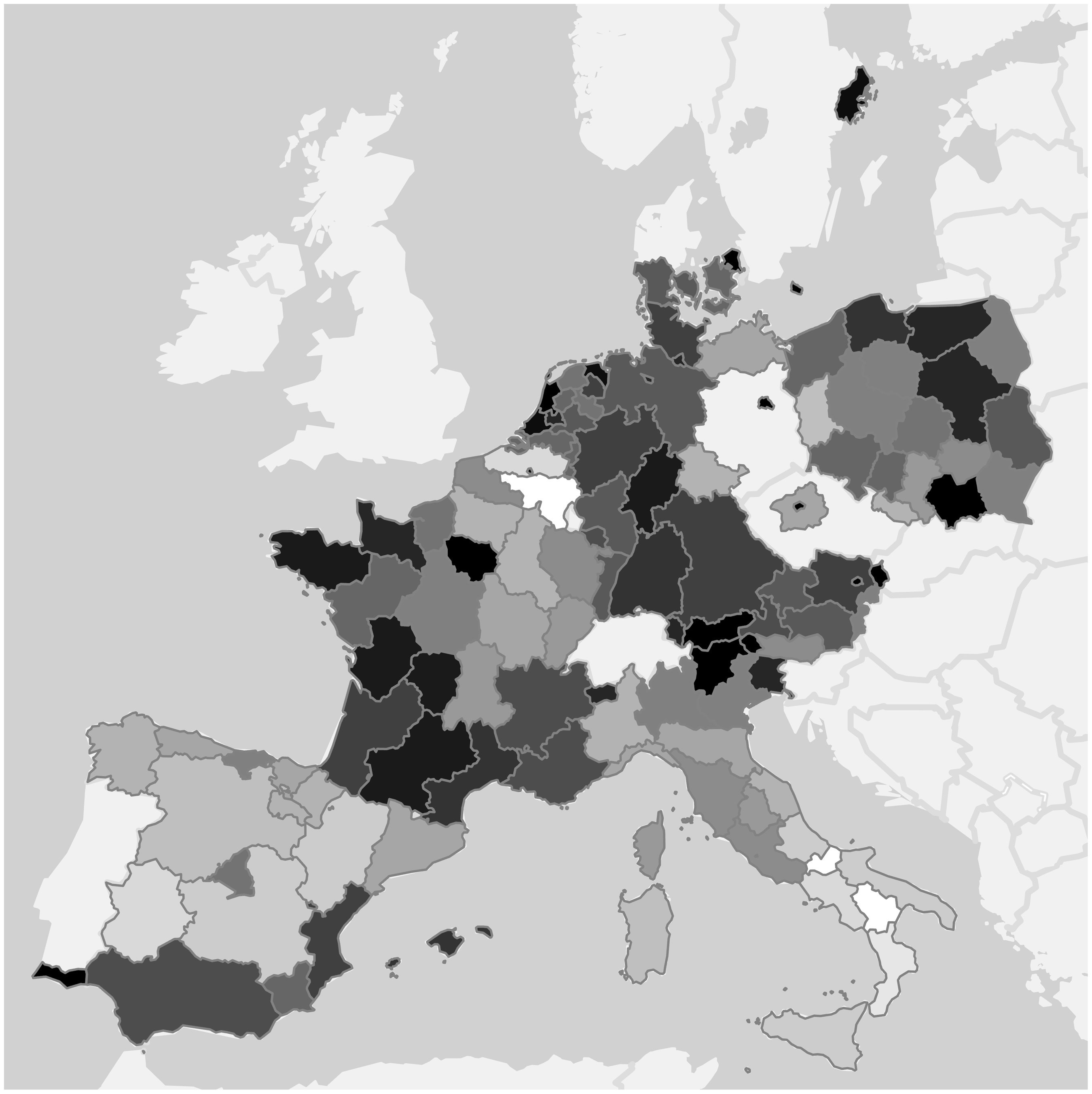
Regional interest in Brexit, as measured in Google search data; darker colors indicate relatively higher proportions of searches relating to Brexit.
Google withholds, as proprietary information, the absolute number of searches involved. Instead, Google Trends scales the measure so that, within each country, the region showing the most interest in Brexit (that is, where the proportion of the region’s searches related to Brexit was highest) has a value of 100; other regions’ Brexit-interest scores are proportions thereof. For instance, if five of every million Google searches related to Brexit in a country’s most Brexit-interested region, another region within the same country, where three of every million Google searches related to Brexit, would have a score of 60. Since each country has its own baseline of 100 in this scoring, all models include country fixed effects.
Table 1 presents ordinary least squares models predicting the Brexit-interest score based on these variables. It also shows additional models adding several control variables potentially relevant to the hypothesis. Non-trade connections with Britain via international tourism, for example, may be particularly crucial (Santana-Gallego et al., 2016): places attracting foreign tourists may include Britons who follow British politics while overseas; those dependent on international-tourism income may keep tabs on news influencing the cost of foreigners’ travel, as Brexit would by affecting exchange rates; and, even without economic incentives, exposure to foreigners in places abounding with international tourists may increase curiosity about major international news (or to United Kingdom happenings in particular, if many tourists come from there). Eurostat data on (logarithm of) regions’ number of annual overnight stays by foreign tourists per regional resident measure this international-travel exposure. Physical distance also matters for economic and social connection to the United Kingdom (Lewer and van den Berg, 2008), so models control for geographical distance (in kilometers) from the region’s centroid to London. Other factors potentially contributing to local cosmopolitanism and interest in British or EU news include the status of a national capital, the local level of educational attainment (measured here by the proportions of the population that has only primary (International Standard Classification of Education (ISCED) categories 0 to 2) or secondary education (ISCED categories 3 or 4); tertiary education is the omitted, baseline category), national income (percent of the EU average in purchasing-power-parity terms), and urbanness (logarithm of population density per square kilometer). See the Online appendix for variables’ descriptive statistics.
Relative public interest in Brexit among European regions, 2017–2018.
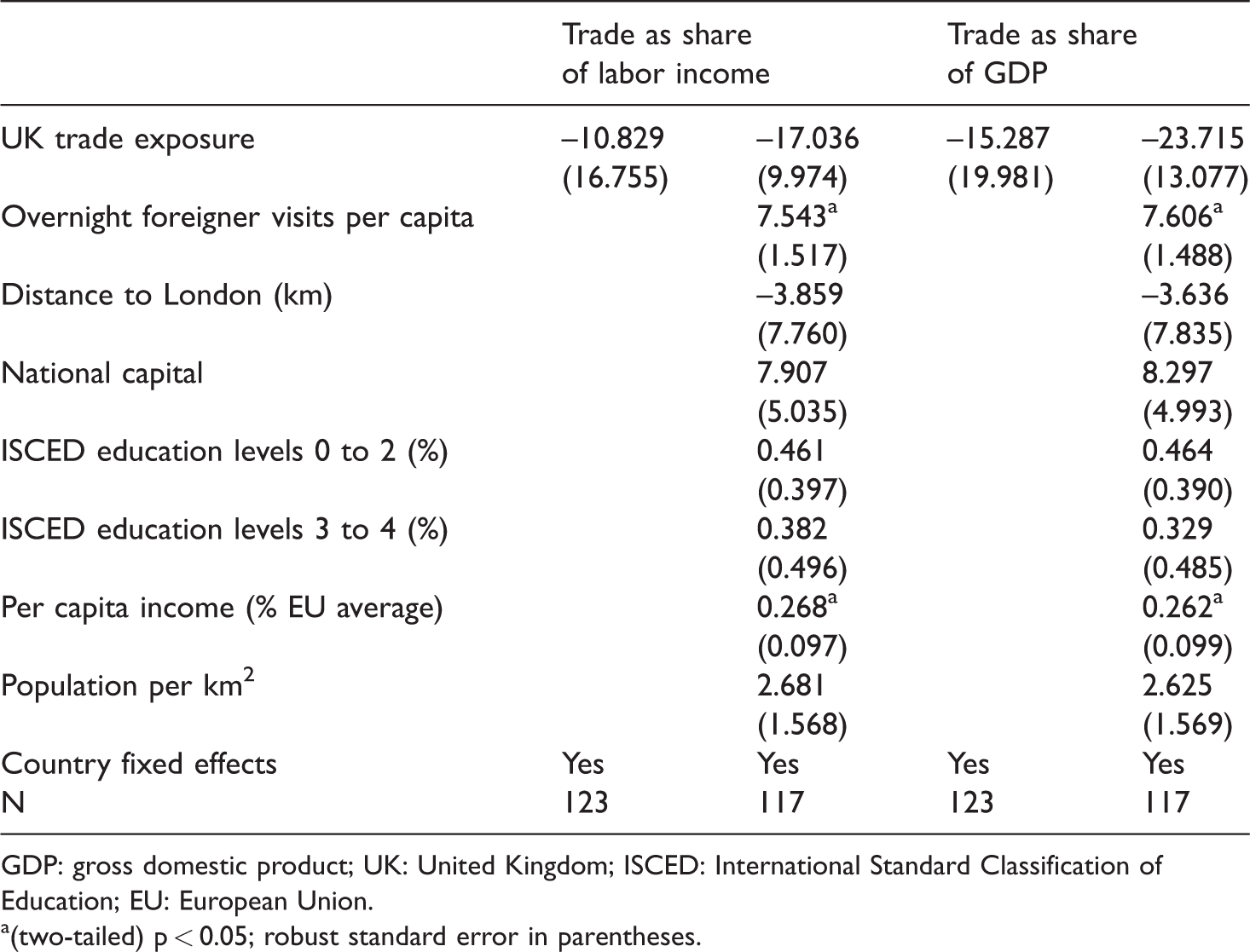
GDP: gross domestic product; UK: United Kingdom; ISCED: International Standard Classification of Education; EU: European Union.a(two-tailed) p < 0.05; robust standard error in parentheses.
In no model does greater economic dependence on British trade associate with increased local interest in Brexit—indeed, the estimates, although statistically insignificant in reported models, consistently point in the opposite direction. As the Online appendix shows, this is also true when including variables interacting with dependence on British trade with local educational attainment. Instead, international-tourist-dependent regions, and wealthier ones, more eagerly seek Brexit-related information.
Conclusion
One political reason for supporting economic interdependence is that mercantile links forge a common interest or even a shared sense of community, increasing peace and stability. That logic may apply in some contexts (e.g. Lee et al., 2016), but the contemporary EU might not be among them. At least, the evidence presented here suggests that European regions having greater trade dependency on the United Kingdom express no particular interest in Britain’s potential exit from the EU. This is despite Brexit’s particularly pertinent economic consequences for trade partners, which makes Brexit something of a critical case for the EU’s (and by extension other international organizations’) ability to use trade to create interest in cross-national matters. If local exchange with a country does not promote interest in that country’s possibly chaotic ejection from a customs union, few contexts are likely to see trade linkages promote cross-national interest, let alone community spirit. Instead, the results here echo findings that most individuals’ knowledge of trade dependence is too limited to affect preferences or interest in partner regions (Tanaka et al., 2017).
This need not mean that institutions such as the EU are irrelevant for promoting cosmopolitan interest. It could be that trade affects elites’ behavior more than the general public’s, or that other cross-border connections fostered by the EU—such as tourism—more effectively shape public attitudes. It is also notable that Britain’s leaving the EU has consequences for many domains outside of trade. These less trade-reliant implications might cloud the connection between trade and attention to something like Brexit: a more specifically trade-focused agreement might see a stronger link between trade dependency and public interest. Still, these results suggest circumspection about the benefits that economic interconnection might have for popular transnational engagement.
Supplemental Material
Supplemental material for Trade connections’ effect on European regions’ interest in Brexit
Supplemental Material for Trade connections’ effect on European regions’ interest in Brexit by Robert Urbatsch in European Union Politics
Footnotes
Acknowledgements
I thank Gerald Schneider and the anonymous reviewers for very helpful feedback.
Funding
The author(s) received no financial support for the research, authorship, and/or publication of this article.
Supplemental Material
Supplemental Material for this article is available online.
Notes
References
Supplementary Material
Please find the following supplemental material available below.
For Open Access articles published under a Creative Commons License, all supplemental material carries the same license as the article it is associated with.
For non-Open Access articles published, all supplemental material carries a non-exclusive license, and permission requests for re-use of supplemental material or any part of supplemental material shall be sent directly to the copyright owner as specified in the copyright notice associated with the article.
