







Abstract
Regulating migration is currently one of the most salient issues in Europe. So far, research has overlooked how this politicisation affects attitudes towards migration regimes. This article links the literatures on public opinion and framing effects from a comparative European perspective and presents original data from representative EU-wide vignette experiments conducted in mid-December 2017 (N = 10.827). I show that framing Schengen as a threat to public security or national identity weakens support for the status quo inside Schengen and reaffirms it amongst Schengen outsiders. Regarding Freedom of Movement only negative frames, particularly those referring to labour market risks, have a significant impact. Given the weak public support in several EU member states, these findings have important implications for the future of European migration regimes.
Introduction
Border controls amongst member states and restrictions to the Freedom of Movement seemed like a relict from the past during the last two decades of European politics, surely to be dismantled as integration progressed. Yet, the refugee crisis and Brexit have brought the issue to the centre of current debates about European integration. Whilst the number of people migrating from one member state to another grew at a similar pace as in previous years and the number of non-EU citizens entering the European Union (EU) even declined over the last months, the corresponding public discourse in many member states seems more salient and polarised than in previous decades of European politics. These developments cannot be mainly attributed to ‘objective pressures’ but are driven by a logic of political competition (Grande et al., 2019). A case in point is a state like Hungary where the government of a member state with low immigration rates applied a strongly Eurosceptic framing against EU migration regimes. Recent evidence from the United Kingdom (UK) also suggests that frames could have made a difference in the popular vote on Brexit (Goodwin et al., 2018). Given that the UK is not a member of the Schengen area 1 it is hard to generalise from this single-country study. So far, we do not know to what extent the ongoing framing contests over migration regimes in other EU member states affect public support for the liberal intra-EU border and labour migration regimes.
In light of the persistent asymmetry between objective migration patterns and public discourse, this vignette study answers the question how policy frames affect the evaluation of two of the EU’s core migration regimes: the Schengen area and the Freedom of Movement. The analysis builds on the assumption that the ongoing contestation of the current institutional framework can be best understood as a framing contest. Currently, we have surprisingly little systematic understanding of how particular frames affect public attitudes towards highly contested EU institutions. So far, research has mainly focused on the impact of frames on attitudes towards migrants and the specific impact of the asylum crisis in 2015 (Harteveld et al., 2018; McLaren et al., 2018). This, however, overlooks the crucial institutional dimension, which provides the legal and political framework for intra-EU migration and is the subject of this study. Also, a recent systematic literature review of public opinion towards European migration finds that only 9 out of 78 studies cover more than two European countries (Eberl et al., 2018: 213). The article therefore responds to the question whether and which particular frames are able to shape public opinion on the Schengen area and the Freedom of Movement and to what extent the responsiveness to frames is moderated by Europeans’ individual characteristics. The response is based on an analysis of the original survey experiments from December 2017, which exposed a population-representative sample of the EU’s working age population (14–65 years) to prominent frames and measured its impact on the support for liberal migration regimes.
Two main findings can be summarised. Both EU member states inside and outside the Schengen area are internally divided about their border regime towards EU neighbours resulting in a narrow support for the current status. The results from the experimental study about the effectiveness of different frames applied to the open border regime are therefore particularly insightful and relevant for policy makers. Europeans are overall responsive to both negative security- and culture-based frames. Receptiveness is weakened for Europeans with a personal or family migration history, but it is not significantly constrained by other factors derived from earlier studies, such as their identification with the nation-state, their income level or their educational background. A threat-based framing of integration is therefore likely to tilt the balance of public opinion outside the Schengen area towards a stronger support of the status quo, whilst Schengen insiders become increasingly skeptical if they are exposed to frames referring to security threats and cultural alienation. The public framing contests about Freedom of Movement were not similarly negatively valenced. However, positive frames stressing the efficiency and welfare enhancing effects of liberal labour market regimes did not strengthen support. Negative frames stressing the welfare state costs or the increased labour market competition exerted a highly significant and sizeable negative impact on public attitudes.
The public discourse on Schengen and the Freedom of Movement
Interviewed in the summer of 2016, the online chief editor of Austria’s main tabloid Krone Zeitung confessed that the public discourse on the impact of migration, in which the media outlet itself played an important role, had spun out of control. He claimed that however real a threat was, the feeling of security would suffer from the public debates (Huber, 2016). Building on this idea of a momentum, one can reconceptualise the public discourse about the Schengen regime and the Freedom of Movement as a ‘framing contest’. Ryan (1991) defines it as competition amongst existing interpretations of facts. In the public discourse, political actors try to shape the way their causes are covered by applying competing frames. Their aim is to increase public support for their political objectives. This must not necessarily mean that these frames express entirely opposite positions towards an issue. They can also be only competitive in their emphasis of the justification. In a systematic study of the political discourse on migration for the period since the mid-1970s, Grande et al. (2019) show that politicisation of immigration issues has surged in Europe. This cannot be attributed to socioeconomic fundamentals, like unemployment or immigration rates. Instead, increased party competition by challenger parties seems to be a strong determinant of higher salience and polarisation. Earlier analyses of the public discourse on European integration (Grande and Hutter, 2016) have shown that about a third of all frames used in integration debates were cultural, whilst 70% relied on a utilitarian logic. Helbling et al. (2010) find that left-wing parties portray European integration as a threat to their welfare states. Right-wing parties rely more frequently and populist radical right parties almost exclusively on cultural nationalist frames. Moreover, media attention for immigration has significantly increased and negatively valenced frames have become dominant in EU member states during the last two decades (Jacobs et al., 2016; McLaren et al., 2018; Schlueter and Davidov, 2013; Van der Brug et al., 2015; Vliegenthart and Roggeband, 2007). Cross-country data for Western Europe suggests that frames referring to borders have become more salient (Caviedes, 2015). In the decade after 2006, the populist radical right but also the radical left has been remarkably successful setting the agenda of the public discourse. Focusing on restrictive migration policies, Van der Brug et al. (2015) find that public proposals for restrictive migration policies inflate the number of negative claims. Generally, immigration appears to be increasingly framed in terms of a cultural-identitarian dimension, whilst socio-economic frames still tend to play a role.
An important but rarely studied dimension of public discourse on migration is the institutional framework for migration within the EU. Over the past five years, political actors have applied issue-specific frames in order to criticise or justify the Freedom of Movement and the Schengen area. The EU’s chief Brexit negotiator Michel Barnier reaffirmed in 2017 that ‘[s]tudies show the positive impact of openness on national growth and prosperity’ and that ‘free movement of EU citizens makes labour markets more efficient’ (European Commission, 2017). National political and technocratic elites, like the back-then French presidential candidate Emmanuel Macron and the head of the UK Office for Budget Responsibility equally stressed the economic benefits. 2 By contrast, actors on the left and the right fringes of the political spectre have attacked the current liberal labour market regime by using frames linking the openness to wage pressures, as well as to fiscal burdens for the national welfare state. Macron’s opponents, Marine Le Pen and Jean-Luc Melanchon for example, 3 have referred to the negative labour market effects of an EU-wide labour market. Austria’s Vice Chancellor Heinz-Christian Strache referred to a ‘process of replacement’ because of immigration from other EU member states (Sueddeutsche Zeitung, 2018), whilst the Bavarian conservative party, the Christian Social Union, stressed the risk of ‘poverty immigration’ from EU labour migrants (Der Spiegel, 2014a).
The Schengen regime has been equally publicly contested since the ‘refugee crisis’ in 2015. Various negative frames dominated, whilst positive frames supporting an open border fell short of similar discursive support as Freedom of Movement. Critics of the status quo stressed the higher risks of criminality and terrorism resulting from a membership of the Schengen area. For example, Matteo Salvini, the leader of Italy’s far-right Northern League, attacked the Schengen regime in the aftermath of the terrorist attack in Berlin and the perpetrator’s subsequent escape from Germany via France to Italy in late 2016. 4 The German Interior Minister, Horst Seehofer, reinvigorated the debate about permanent border controls towards Schengen neighbors in March 2018 stressing that a more restrictive regime would allow for better ‘protecting the population’ (Tagesschau, 2018). On the other hand, important political actors in the UK supported the current restrictive border regime. The Leave Campaigners explicitly referred to the fact that ending the EU membership in Britain would mean ‘taking back control of our borders’ as repeatedly expressed by the United Kingdom Independence Party (UKIP) (2016). The Commission and many politicians from government parties remained silent about Schengen or showed approval of an at least temporary more restrictive border regime. The Commission Vice-President Frans Timmermans himself repeatedly recommended a continuation of the internal border controls for reasons of security (European Commission, 2016). Another frequently invoked negative framing of immigration depicts migrants as a potential ‘cultural threat’ to the social order of local communities (Eberl et al., 2018). For example, in his campaign for the Dutch parliamentary elections in February 2017 the far-right opposition leader Geert Wilders repeatedly claimed that ‘Dutch values are based on Christianity, on Judaism, on humanism [,whilst] Islam and freedom are not compatible’ (USA Today, 2017). During and particularly in the aftermath of the ‘refugee crisis’, these cultural threat frames were directly and indirectly linked to the reintroduction of border controls. Across the Schengen area, right-wing politicians asked for a reintroduction of border controls in order to prevent ‘foreign infiltration’ and to ‘protect local and national values’.
Overall, the framing contest on the Freedom of Movement seems to be constituted by negative and positive frames referring to the Freedom of Movement’s impact on the labour market, as well as its impact on the national social systems. Positive frames about the Schengen regime appeared relatively muted, whilst higher risks of criminality and terrorism as well as rising cultural heterogeneity have been used as negative frames against a continued membership of the Schengen area or in support of an already existing opt-out from it.
Linking public discourse and attitudes towards European migration regimes
Theorising the link within European public discourse and attitude formation towards the EU brings together the literatures on framing effects and on European public opinion. In public opinion, research attitudes are conceptualised as the sum of various weighted evaluations of the object (cf. Ajzen and Fishbein, 1980; Nelson et al., 1997). For example, EU citizens typically hold positive and negative evaluations towards Freedom of Movement. The integrated labour market provides for foreign workers who pay into the welfare system (welfare dimension), but the immigration of foreign labour might be also regarded as increasing competition resulting in an increased labour market risk for oneself or for other nationals. One can assume that citizens regard a sustainable welfare system as positive and increased labour market competition as negative. The overall attitude towards the Freedom of Movement then depends on how positive or negative the individual evaluations are and how much each of the dimensions counts. The goal of framing is to make people think about particular aspects of European integration by highlighting a particular dimension and emphasising a particular evaluation. Framing is commonly defined as selecting certain aspects of a perceived reality and increasing their salience. The goal is ‘to promote a particular problem definition, causal interpretation, moral evaluation, and/or treatment recommendation’ (Entman, 1993: 52). Druckman has stressed that ‘[a] framing effect occurs when, in describing an issue or event, a speaker’s emphasis on a subset of potentially relevant considerations causes individuals to focus on these considerations when forming their opinions’ (Druckman, 2001: 1042).
Chong and Druckman (2007b: 111) have argued that ‘[f]raming can work on all three levels, by making new beliefs available about an issue, making certain available beliefs accessible, or making beliefs applicable or “strong” in people’s evaluations’. This can mean that a public is willing to change its beliefs in response to new information. Yet, framing effects can also just increase the accessibility and applicability of existing beliefs rather than creating new ones (Chong, 2013: 118). In practice, the two effects cannot be completely separated. The vignettes used in the survey experiments are, however, far from original or new, and therefore better suited to study framing rather than information effects. EU citizens can understand the frames based on the available beliefs stored in memory. A strong frame does not only refer to an already existing and accessible evaluation. Its strength also depends on how EU citizens evaluate the applicability of the accessible evaluations. The more motivated to engage with the frame, the more cognitively skilled an individual, and the more competitive the framing context, the higher becomes the applicability of the frame to a particular situation.
In the European public opinion literature, attitudes towards European integration have been theorised based on a set of interest- and identity-based beliefs. Building on social identity theory (Tajfel, 1981) European integration has been described as a perceived threat to Europeans’ national in-group and their national identity (McLaren, 2002). A correlation within anti-immigration sentiment and negative attitudes towards the EU has been corroborated for earlier periods of integration (De Vreese and Boomgaarden, 2005; Lubbers and Scheepers, 2007) and the Brexit (Goodwin and Milazzo, 2017; Kaufmann, 2016; Owen and Walter, 2017). The literature has also provided evidence that immigration constitutes mainly a ‘symbolic’ threat to Europeans (Hobolt et al., 2011; Kaufmann, 2016; Luedtke, 2005; Sides and Citrin, 2007). Citizens regard the absence of border controls as a threat to the workings of the national ‘way of life’, to which customs, traditions and morals are linked. Sniderman et al. (2004: 47) found for the Netherlands that the feeling that the Dutch culture is under threat constitutes ‘the dominant factor in generating a negative reaction to immigrant minorities’. Applying identity-based frames relating to subjective threats from out-group members should lead to an adaption of attitudes towards the border regime. As pointed out above, one may distinguish a negative frame relating to internal security and one relating to a threat to cultural homogeneity. The former makes the belief of out-group members as potential criminals and terrorists more applicable to the Schengen regime. The second frame increases the applicability of the belief that out-group members have a negative impact on the dominant values and social order of the local community. H1: Support for Schengen membership (Schengen outsider status) declines (increases) if individuals are exposed to frames linking a potential deterioration of their security to an open border. H2: Support for Schengen membership (Schengen outsider status) declines (increases) if individuals are exposed to frames linking increasing levels of cultural heterogeneity with an open border regime. H3: Support for the Freedom of Movement declines if individuals are exposed to frames linking higher labour market risk (higher welfare costs) to the open regime. H4: Support for the Freedom of Movement increases if individuals are exposed to frames linking higher levels of labour market efficiency (higher welfare benefits) to the open regime.
In addition to the national identification, the migration background can be expected to moderate the impact of frames. If a frame links immigration to negative domestic outcomes, such as rising labour market competition or crime, people without a conscious personal or family link to immigration should be more at ease with an externalisation of these threats. Negative frames about the impact of open migration regimes should therefore resonate the most amongst these self-identified autochthonous people. On the contrary, exposed to migration-critical frames people conscious of their migration background face a problem similar to that of inclusive Europeans. Their in-group’s status is likely to deteriorate if they apply the migration-critical frame and update their attitudes. As a result, the perceptual screening bias should reduce the applicability of negative frames amongst Europeans with a migration background. H5: The attitudes of Europeans with an inclusive identity are less affected by negative frames than those of Europeans with an exclusively national identity. H6: The attitudes of Europeans indicating a migration background are less affected by negative frames than those of autochthonous Europeans. H7: Europeans with lower income and/or education levels react more strongly to negative frames of liberal migration regimes.
Survey design and data collection
The survey design brings into balance the need for externally valid frames and representativeness of the data collection. The above discourse analysis indicates that Freedom of Movement has been framed both positively and negatively in economic terms. By contrast, there was little salient support for Schengen. The negative culture and security-based frames dominated the discourse. To maximise the ecological validity, the experiment focusing on Schengen does not include hypothetical positive frames. Given that the dependent variable differs for Schengen insiders and outsiders, this also allows for sufficiently large treatment and control groups. For the Schengen experiment, participants were divided into three equally sized groups within each member state and exposed to two frames, whilst a third served as a control group. In the experiment focusing on Freedom of Movement, a quarter of the participants from each member state received one of the four frame treatments. Each group received a text resembling a tweet (see the Online appendix) between the first and the second measurement of the dependent variables. The wording of the vignettes was designed to generate a high credibility of the statement and to prevent cueing effects. This was achieved by avoiding direct reference to actual political or societal actors. Instead the vignettes refer, without any further specification, to ‘studies’ which ‘show’ the positive or negative links between the migration regimes and public security, cultural heterogeneity, job market dynamics and welfare effects.
The dependent variables (support for border regime and support for labour migration regime) were each measured before and after the treatment, which allows for a comparison between groups and within subjects over time. The measurement of the border regime support differs for Schengen insiders and outsiders as it refers to the status quo and not to a hypothetical (non-)membership. Self-identification was measured with a recoded ‘Moreno question’ distinguishing exclusively national and at least partly European self-identification. Respondents indicated whether they personally, their grand-parents or parents have immigrated into the member state. Utilitarian factors were measured with self-declared monthly income, employment status and education background (see the Online appendix). Data have been collected in all 28 member states by means of an online survey representative of the EU working-age population (Eurostat census for age groups 14–65) with 10,827 completed responses in December 2017. National samples are also representative for the populations in the six largest member states (see the Online appendix). These national samples range from 1033 to 1565 completed surveys. 5 This is slightly higher than the corresponding subsamples of Standard Eurobarometers (European Commission, 2019). Comparisons between respondents’ demographics from this panel and existing nationally-representative panels find little difference (De Vries, 2018: 66). So far, several other studies have used this panel for studies on the overall EU and individual member states (De Vries and Hoffmann, 2019, 2016; Walter, 2018).
Results
The experimental design allows for hypothesis tests with group means after treatment and within-subject variation over time for each of the treatment groups. In line with hypotheses 1 and 2, Europeans inside the Schengen area become more critical towards the current status without border controls towards Schengen neighbours, whilst support for the status outside Schengen becomes more robust (Figure 1(a)). Figure 2(a) depicts the attitudes towards the current migration regime measured before and after treatment. For Schengen insiders, the change of attitudes is in line with hypotheses 1 and 2 (F-Value: F In - Schengen = 6.46, degrees of freedom: df = 2, p-value: p = 0.00). Support for the current intra-EU border regime becomes significantly weaker amongst individuals who are exposed to frames suggesting that open borders lead to an increase in crime rates and terrorism. The negative security framing of the Schengen regime exerts a significant average treatment effect (ATE), which reduces public support (Mean: M ATE = -0.43, Standard Error: SE = 0.11, on a 0–10 point scale). Survey participants who are exposed to the security frame become on average indifferent towards the existence of the Schengen regime (M In - SchengenSecurity = 5.02, SE = 0.11). The impact of the cultural threat treatment (M ATE = −0.37, SE = 0.10) is also highly significant and leaves Schengen insiders on average with only marginal support in favour of the status quo (M In - SchengenCulture = 5.12, SE = 0.11). However, the impacts of the two treatments appear to result in a quite similar outcome. On average, respondents exposed to a security or a cultural threat frame do not express significantly different views from each other, but they become more critical inside the Schengen area.
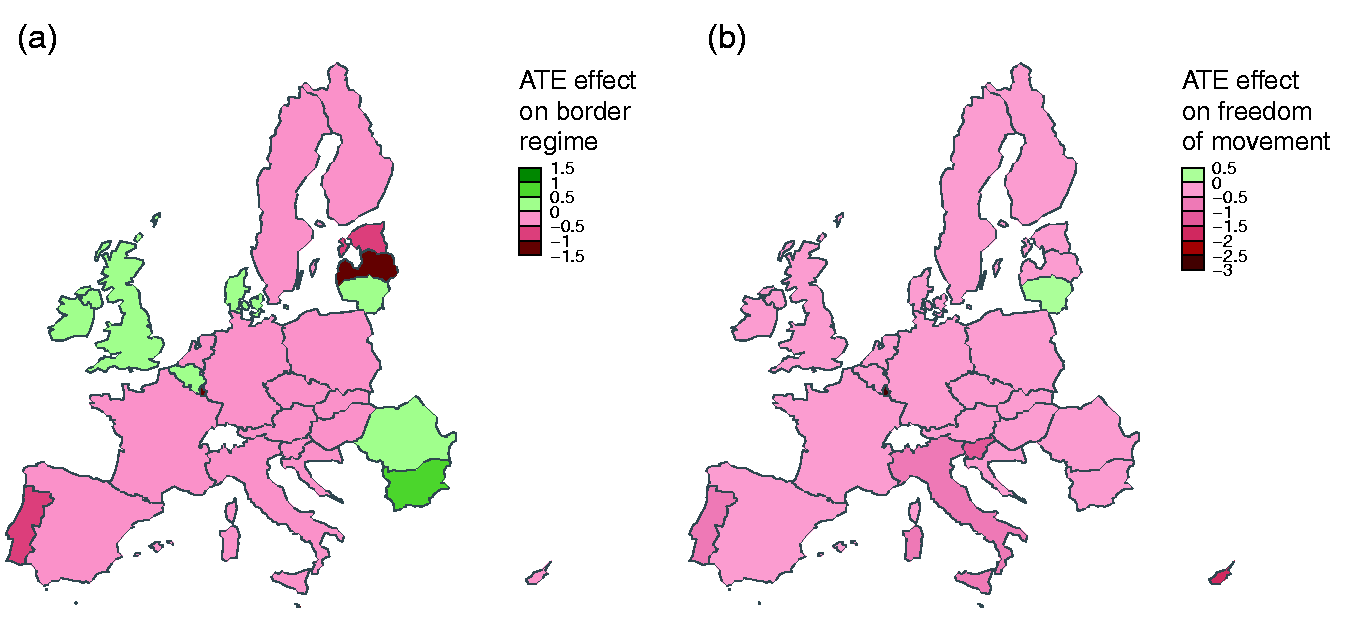
Average treatment effects (ATE) by country (representative of the populations in France, Germany, Italy, Spain, Poland and the UK). (a) ATE on support for current border regime towards Schengen neighbours; (b) ATE on support for Freedom of Movement.
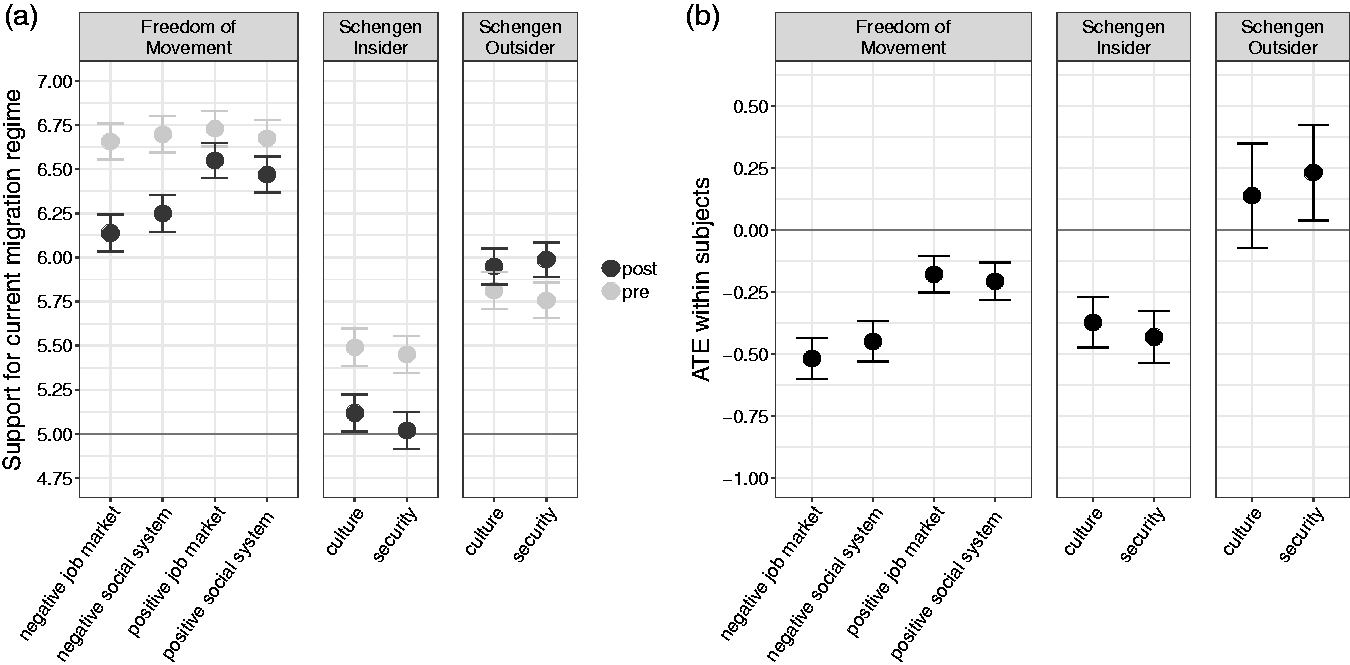
Attitudes and within-subjects treatment effects. (a) Attitude towards migration regimes before (pre) and after (post) treatment (0.95 CI); (b) ATE (0.95 CI) of vignettes for Freedom of Movement and Schengen insiders and outsiders.
Amongst Schengen outsiders the negative security treatment leads to an increase in support for their current regime with border controls (M ATE = +0.23. SE = 0.19), which increases their already moderate support for the status quo (M In - SchengenSecurity = 5.98, SE = 0.10). The cultural threat treatment has also a positive but smaller impact on support (M ATE = +0.13, SE = 0.21; M Out - SchengenCulture = 5.95, SE = 0.10). Without controls the treatment effects remain, however, statistically insignificant (F Out - Schengen = 1.92, df = 2, p = 0.14).
After controlling for country-level effects with a random intercept model, vignette treatments become significant on an individual level. 6 Interestingly enough, there is no significant difference in the ATE of the culture- and the security-related vignettes (p In - Schengen = 0.67, p Out - Schengen = 0.80). Overall, this indicates that both vignettes exert a significant effect amongst Schengen insiders and outsiders. The treatments lead to a change in the directions as anticipated in hypothesis 1 and 2. Frames linking a potential deterioration of public security or increasing levels of cultural heterogeneity with an open border regime decrease support for the status quo inside Schengen and increase support for the outsider status in the six other EU member states.
In order to test hypothesis 3, the respondents have been exposed to negative vignettes linking either labour market risks (‘negative job market’) or welfare state costs (‘negative social system’) with the current liberal labour migration regime. Hypothesis 4, which predicts increasing support after exposure with positive vignettes, has been tested with corresponding positive vignettes (‘positive job market’ and ‘positive social system’). A comparison of the treatment effects indicates highly significant differences between the four vignettes (F Freedom = 18.64, df = 3, p = 0.00). Mean support across the EU before and after treatment drops after treatment with the ‘negative job market’ vignette (M Freedom - Job = 6.14, SE = 0.10) and the ‘negative social system’ vignette (M Freedom - System = 6.25, SE = 0.11). The ATEs for the negative vignettes related to the labour market regime are stronger (‘negative job market’: ME = −0.80, SE = 0.11 and ‘negative social system’: ME = −0.59, SE = 0.11) than those referring to the border regime (Figure 2(b)). Contrary to hypothesis 4, positive frames do not exert a symmetrically positive effect. The ATEs do not differ significantly from zero (‘positive job market’: ME = −0.03, SE = 0.10 and ‘positive social system’: ME = −0.144, SE = 0.09) and support levels remain at the pre-treatment level. This finding is supported by highly significant results after controlling for country-level effects in a linear mixed model (see the Online appendix). It is also visible in Figure 1(b), which presents a relatively homogenous negative impact of the treatment mix across the EU member states. In sum, hypothesis 3 can be corroborated, whilst hypothesis 4 fails to pass the test.
The literature suggests a moderating effect of individual identity (hypothesis 5) and migration background (hypothesis 6) as well as their socioeconomic situation (hypothesis 7). In order to assess whether the impact of the treatment is dependent on Europeans’ individual characteristics, several models with interaction effects for the border regime as well as the labour market regime have been estimated. Interacting exposure to vignettes and respondents’ self-identification with the nation-state or Europe does not provide significant results. 7 Whilst national identification remains insignificant as a moderator, the treatment seems to be conditioned by the respondent’s migration background. First generation migrants’ support for migration regimes is, on average, identical before and after vignette exposure. By contrast, respondents with a long-term family history in their nation-state and third generation migrants are significantly more receptive to the negative treatments (Figure 3(b)). The two negative treatments are for most subgroups either both significant or insignificant. Only amongst respondents with a second-generation migration background inside Schengen, the two vignettes exert a different effect. The security vignette results in a significant reduction of support for Schengen membership, whilst the impact of the cultural threat vignette remains insignificant. A similar interaction effect cannot be corroborated for the respondents’ socioeconomic background. Neither higher educational levels nor rising income levels moderate the impact of the vignettes in the expected direction. European university graduates are on average not less responsive to the negative vignettes or more responsive to positive ones. Adding the left–right orientation as another potential moderator supports these findings. Whilst being political left, center or right has a levelling effect on the support, it does not condition the framing effect. 8 In sum, the expected moderating effects can only be corroborated for Europeans' migration background, but their national identity or their socioeconomic and educational background do not become significant moderators.
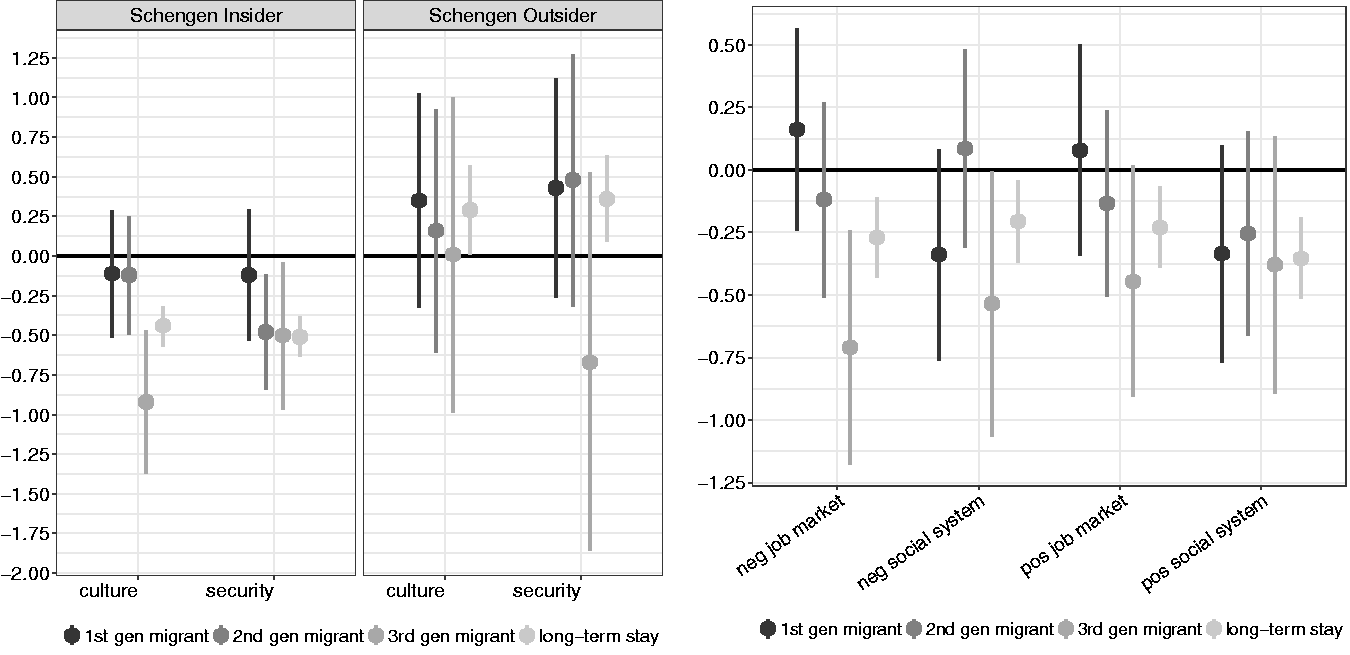
Marginal effects of the interaction between migration background and vignette exposure. (a) Marginal effect of the interaction between migration background and border regime vignettes; (b) Marginal effect of the interaction between migration background and labour migration regime vignettes.
Discussion
Implications for future research
Previous studies have mainly looked at the impact of discourses on public attitudes towards migration. They have restricted themselves to individual member states, or focused on Europeans’ individual characteristics, like employment status and identification with the nation-state. This study closes these research gaps by linking the literature on public opinion towards European integration and the communications literature focusing on framing effects from an EU-wide comparative perspective. The results rest on an experimental design with high internal validity drawing on both within-subject and between-group comparisons as well as manipulation checks and controls for order biases. Frames connecting Schengen membership with a deterioration of public security as well as increasing cultural heterogeneity weaken public support for the status quo within Schengen member states and strengthen support for the status quo amongst Schengen outsiders. Amongst Schengen insiders, the security-related frames are not more effective than the cultural threat frames. Overall, the nexus between open borders and security does not bear more weight than the nexus with cultural heterogeneity in the process of attitude formation. A similarly undermining effect can be identified for the negative frames regarding Freedom of Movement, whilst positive frames do not result in a symmetrical strengthening of support. Linking the EU’s liberal labour market regime to higher labour market risks is particularly effective in undermining support for Freedom of Movement.
This finding is in line with recent single country studies focusing on framing effects on attitudes towards migration (Bos et al., 2016; McLaren et al., 2018) and support for EU enlargement (Azrout et al., 2012). Further tests investigating Europeans’ identity and socioeconomic background as potential moderators of the treatment effect are generally consistent with the finding that non-material factors matter (Bechtel et al., 2014; Chalmers and Dellmuth, 2015; Kuhn et al., 2018; Mitchell, 2014). Contrary to the existing literature on European public opinion and framing effects, neither identification with the nation-state, income level, occupational status nor education moderate the impact of frames. This is particularly striking in the case of Freedom of Movement. Higher education, full-time employment as well as high income should limit the applicability of negative wage-related frames. Theory also suggests that unemployed and low income individuals react more strongly to negative frames. This hypothesis about a socioeconomic conditioning cannot be corroborated for frames about European migration regimes. Moreover, the existing literature argues that identity-based factors play an even more important role in the domain of European public opinion. The analyses have shown that identity, indeed, exerts a strong direct impact. Yet, the impact of frames does not differ for people self-identifying exclusively with their nation-state and those with a more cosmopolitan identity. Even though integration of migration regimes touches upon core aspects of national sovereignty and the question who belongs to the in- and out-group, Europeans’ collective identity appears not to limit or enhance the applicability of particular frames, as suggested by the literature. The ‘perceptual screen mechanism’ (Hameleers et al., 2017: 876) cannot be corroborated for European identity (operationalised as self-identification as a national only or also as European). Given that this self-identification taps into only one dimension of European collective identities (Cram, 2012), further research needs to shed light on what Europeans identify with when they self-identify with the nation-state and Europe. Based on the Moreno question used for this study, it remains open whether a civic or ethnic understanding of identity underlies this collective identity dimension (cf. Bruter, 2008). Importantly, Europeans’ personal migration background exerts a strong conditioning effect. First-generation migrants do not react significantly to frames. This mechanism seems to be, however, conditioned by the respondent’s migration memory. Europeans whose grandparents, but not their parents, have experienced migration, react more strongly to frames. Those Europeans indicating that their families have lived in the EU member state for at least three generations are the ones most responsive to the treatments. Amongst the Schengen insiders with a second-generation migration background, only the security frame appears to work, whilst the cultural threat frame possibly remains inapplicable for those with a recent migration history. This result reaffirms the relevance of transnational experiences for attitude formation towards the EU (Kuhn, 2015) and highlights its particular importance for European migration regimes.
Contextualising the effect sizes
The question remains to what extent these findings are not just significant but also relevant in terms of effect sizes. Based on the reference values for Cohen’s d and η2 part (Ellis, 2010: 41) the treatment effect sizes 9 must be considered to be small. A comparison with existing literature (Bos et al., 2016; Grigorieff et al., 2016; Rolfe et al., 2018; Schemer, 2012), however, shows that the effects are neither extraordinarily strong nor weak for a vignette study. Thanks to the high external validity of the representative data, the findings can be also contextualised in the comprehensive observational literature on public attitudes towards the EU. Most of the studies on European public opinion have stressed the importance of individual level material characteristics and identity as well as the national macroeconomic context (Gabel, 1998; McLaren, 2002). The impact of public discourse has been, however, often omitted in these EU-wide models. Yet, in a comprehensive model, treatment effects remain significant for Schengen vignettes inside the Schengen area (Figure 4(a)) and for the Freedom of Movement vignettes (Figure 4(b)) across the EU. 10 Consider a Schengen insider who identifies exclusively as European. Exposing her to a negative security-related frame will cause, on average, a drop in her support for the current border regime to the level of someone with mixed national-European identity. Moreover, exposing a university graduate to a frame, which links labour market risks to the Freedom of Movement will make her ceteris paribus as critical as a less-educated high-school graduate. By adding public discourse as an additional relevant driver and widening the focus on the domestic borders within the EU my findings complement recent research (Vasilopoulou and Talving, 2019) on attitude formation towards Freedom of Movement. The results also add to our insights on the particular nature of framing intra-EU migration. Earlier research finds that Europeans link different migration groups to distinct economic, security and cultural threats (Hellwig and Sinno, 2017). Negative framing of immigration during the refugee crisis had only an impact on attitudes if it referred to symbolic cultural threats. Economic frames proved ineffective and less educated respondents have been found to be particularly responsive to these cultural frames (Schmuck and Matthes, 2017). This appears to be different for the intra-EU migration. Here, both negative economic and cultural frames seem to be effective. This could be due to the highly regionally integrated labour market whose outcomes should be more salient to Europeans than labour migration in other world regions. The ineffectiveness of positive frames remains puzzling. Positive frames should make beliefs about the integrated labour market more accessible for the evaluation of Freedom of Movement. Yet, for Europeans, they might be less applicable than negative frames to the current situation or they might be weighed less than negative frames already present in the public discourse. In addition, the formulation of the positive vignettes, which are more defensive than the negative frame, could further undermine their effectiveness. Moreover, the moderating effect of education on the impact of frames cannot be replicated for intra-EU migration. Another reason for this difference to the existing literature on immigration attitudes could be the content of the frame. Focusing on regimes rather than groups of humans might be able to reduce biases and increase the openness to often socially undesired negative frames. Future studies should build on this insight and try to further analyse the differences in attitudes towards particular migration regimes and migrant groups in the European context.
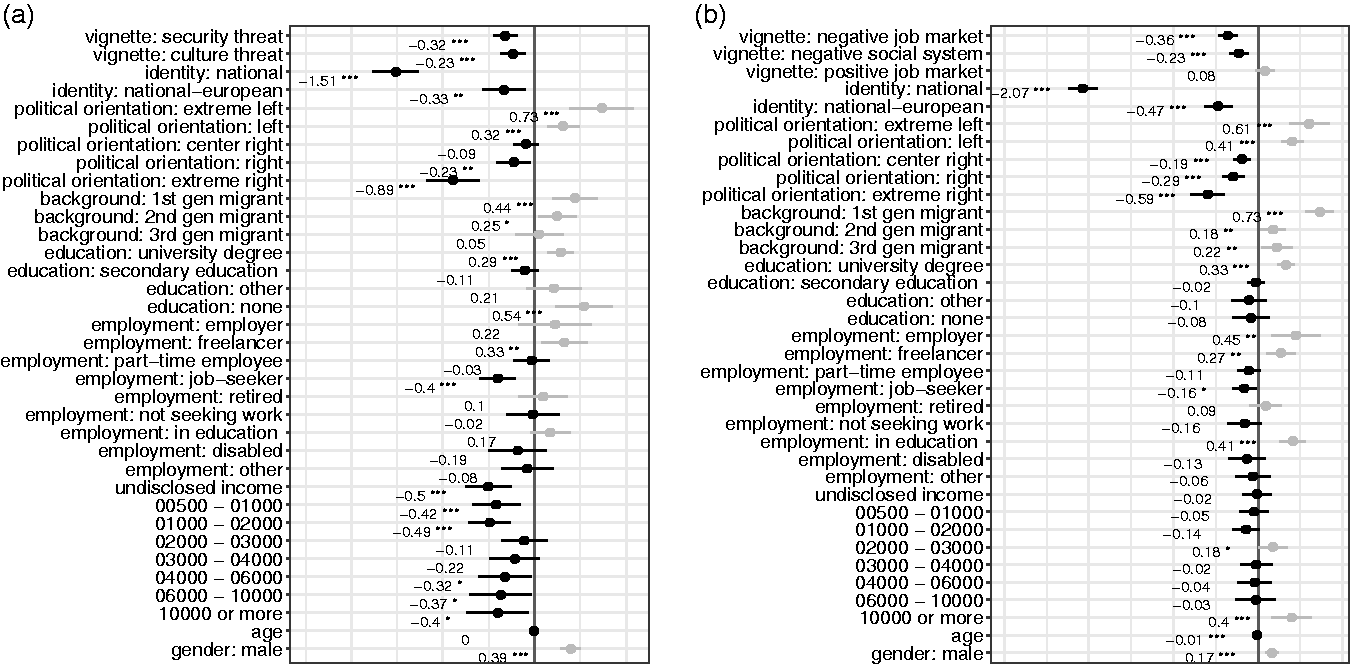
Effect sizes in comprehensive models (controlling for country-fixed effects). (a) Support for current border regime inside Schengen: effect sizes in comparison; (b) support for Freedom of Movement: effect sizes in comparison.
Similar to many experimental studies of European public opinion, the findings and the implications drawn thereof are subject to limitations: The ecological validity of the exposure to frames might be improved in future studies by relying on a presentation with different media beyond a tweet, for example by embedding the framing into a newspaper article. Moreover, future studies should specify to what extent the treatment persists over a longer period and how competition alters the impact of the different frames, e.g. by inducing more deliberate evaluations (Chong and Druckman, 2007a). Lastly, further research must investigate why the positive frames proved so ineffective compared to the Eurosceptic ones. A possible avenue for this are focus groups. A recent study in the UK shows that negative frames dominate deliberations on migration and sources in support of a liberal migration regime were perceived with mistrust (Rolfe et al., 2018), which seems to complement my results, but awaits further corroboration beyond a single-country context.
Supplemental Material
Supplemental material for How public discourse affects attitudes towards Freedom of Movement and Schengen
Supplemental Material for How public discourse affects attitudes towards Freedom of Movement and Schengen by Felix Karstens in European Union Politics
Footnotes
Acknowledgements
The author thanks three anonymous reviewers as well as Catherine De Vries, Tina Freyburg, Theresa Kuhn, Frank Schimmelfennig, Stefanie Walter and members of the ETH European Politics Group for their helpful comments.
Funding
The author(s) disclosed receipt of the following financial support for the research, authorship, and/or publication of this article: The author gratefully acknowledges support from the Swiss National Science Foundation (grant no. 175147).
Supplemental Material
Supplemental material for this article is available online.
Notes
References
Supplementary Material
Please find the following supplemental material available below.
For Open Access articles published under a Creative Commons License, all supplemental material carries the same license as the article it is associated with.
For non-Open Access articles published, all supplemental material carries a non-exclusive license, and permission requests for re-use of supplemental material or any part of supplemental material shall be sent directly to the copyright owner as specified in the copyright notice associated with the article.
