







Abstract
Conventional wisdom holds that interest group access to the European Commission is biased in favor of specific interests and against diffuse interests. Yet, patterns of access vary between policy areas. In this article, I map and explain the relative access of specific and diffuse interests to the European Commission’s expert groups. I find that specific interests gain more access in general, but there are considerable variations across issues. I argue that variations in access across expert groups are explained by the relative ability of specific and diffuse interests to contest policies in different policy areas. This argument gains support by statistical analyses using a novel dataset comprising all expert groups with interest group participants. The findings suggest that a political logic helps explain variations in specific and diffuse interest access to the Commission.
Introduction
In the last few decades, the European Union (EU) has gone through what is sometimes described as a participatory turn, centered on an increasing involvement of interest groups in the decision-making processes of its institutions (Kohler-Koch and Quittkat, 2013; Saurugger, 2010). The European Commission, in particular, is viewed as having adopted a civil society discourse (Saurugger, 2010: 471; Smismans, 2003), expressed in a multitude of advisory committees, high level groups, and other consultative arrangements where interest groups 1 like business associations, labor unions, and non-governmental organizations (NGOs) participate.
While such interactions between decision makers and civil society are generally seen as an important feature of democratic polities, scholars and NGOs frequently highlight that interest group access to the European Commission is biased in favor of specific interests (see e.g. ALTER-EU, 2013, 2014; Beyers, 2004; Rasmussen and Gross, 2015), i.e. groups with a limited and well-defined constituency, such as producers in a particular economic sector. So-called diffuse interests, on the other hand, are seen as being disadvantaged. Diffuse interests are represented by groups whose constituencies are larger and less well defined, with weaker socio-economic ties among the constituents—a classic example being environmental groups. The theoretical rationale behind this specific interest dominance is distinctly functional. The Commission demands technical information to initiate effective policy, and specific interests are comparatively well endowed with technical information. They gain this information as part of their everyday activities, and face less severe collective action problems than their diffuse interest counterparts, which makes their collection and provision of information comparatively efficient (e.g. Bouwen, 2002; Dür and Mateo, 2016; Rasmussen and Gross, 2015). 2 As a result, the Commission grants privileged access to specific interests.
However, while specific interests gain more access to the European Commission on average, there are numerous indications that the representation of interests may vary considerably between different types of issues (Beyers and Kerremans, 2004; Rasmussen and Gross, 2015: 361). Given expectations about specific interests being more effective than diffuse interests in collecting and providing technical information, what accounts for these differences in access?
This article seeks to gain traction on this question by mapping and explaining the relative access of specific and diffuse interests to the European Commission. I conceive of relative access as the balance of interest groups representing specific and diffuse interests in a venue with interest group access. Understanding when and why different types of interest groups gain differential access to the Commission is central to the theory and practice of EU politics in three respects. First, it speaks to the question of interest group influence on EU political outcomes. While access does not necessarily imply influence, it is generally conceived of as a superior interest group strategy to exercise influence, compared to the use of outside strategies like public campaigns (Dellmuth and Tallberg, 2017). If patterns of access consistently privilege some interests over others, this may be reflected in political outcomes. This should be particularly true for interest group access to the Commission, since the shape of policy is more fluid at earlier stages of the policy process (Eising, 2007: 333; Mazey and Richardson, 2006: 249). Second, it speaks to questions of interest representation in the EU. Skewed access patterns could be criticized not only because they risk producing biased outcomes, but also because they do not allow all relevant stakeholders to voice their concerns. Third, it speaks to central theoretical questions about the role of the European Commission. Most importantly, is the Commission best characterized as a technocratic bureaucracy or do patterns of interest group access suggest a Commission motivated by concerns for political support?
Theoretically, I argue that a political logic can explain variations in the relative access of specific and diffuse interests to the European Commission. To ensure that policies are in line with the preferences of relevant constituencies, the Commission gives privileged access to interest groups whose constituencies are likely to contest unfavorable policies. Specific interests have a general advantage in this respect, owing to their constituencies’ relative ability to overcome collective action problems. Yet, diffuse interest constituencies are more likely to contest unfavorable policies in distributive policy areas, and in policy areas that are publically salient. I posit that these differences stem from the comparative visibility of the distribution of gains from distributive policies, and the way that salient policy areas incentivize contestation. The argument breaks with previous scholarship on interest group access to the Commission through a combination of two features. First, it unpacks the functional logic often used to explain aggregate specific and diffuse interest access to the European Commission by suggesting that a political logic helps explain variations in access within the Commission. Second, it does not assume that specific and diffuse interests are inherently and systematically well endowed with different types of information. I contrast this argument with two alternative explanations. One emphasizes functional demand for technical information and one suggests that the Commission’s consultation regime is marked by path dependence.
Empirically, I map and explain the relative access of specific and diffuse interest groups to the European Commission’s expert groups. Expert groups are a form of standing advisory committees comprising different combinations of member state representatives, scientists, and interest groups selected by the Commission through public calls for application. They provide expertise to the Commission throughout the policy process and across nearly all policy areas. Beyond the centrality of expert groups to the EU’s policy-making process, they also present a hard case to the theoretical argument. Given their focus on selective expert-oriented deliberation, where the Commission constitutes a gatekeeper to interest group access, they are a setting where the risk of political opposition should be particularly unlikely to influence the Commission’s relations with interest groups. The analyses build on novel cross-sectional data comprising all European Commission expert groups with interest group participants. In contrast to previous research, the data are based on a new version of the Commission’s register on expert groups, following a revision undertaken in 2016 to increase the reliability of its information.
The analyses generate two principal findings. First, specific interests gain more access to expert groups, but there are considerable variations across policy areas. In particular, expert groups addressing civil rights issues, social policy, and regional policy provide a comparatively high degree of diffuse interest access. Second, the theoretical argument gains strong support regarding the positive correlation between distributive policies and diffuse interest access, while the effect of salience is limited. In addition, the alternative explanation proposing that expert groups managed by newer Directorates-General (DGs) grant more access to diffuse interests than expert groups managed by older DGs gains support by the analyses. The findings suggest that, even in the Commission’s expert groups, diffuse interests are granted more access in policy areas that are prone to public opposition. Further, there may be significant path dependencies in interest group access to the Commission.
Explaining the relative access of specific and diffuse interests
The argument: Information exchange, contestation, and issue characteristics
The theoretical argument of this article rests on three components. First, I conceptualize the relationship between interest groups and the European Commission as an exchange of information for access (Bouwen, 2002). Interest groups provide the Commission with policy relevant information, and gain access in return. In determining the composition of specific and diffuse interest groups that gain access, the Commission seeks to minimize political opposition by privileging interest groups whose constituencies are most likely to contest policies that are not in line with their preferences. Second, by virtue of their small constituencies with large individual stakes in policy, specific interest constituencies have an overall advantage over diffuse interest constituencies in overcoming collective action problems. On average, their constituencies are therefore comparatively likely to contest policies that go against their preferences (cf. Lohmann, 1998). Third, I do not expect the advantage of specific interests to be equally large in all policy areas. Each policy area constitutes a distinct incentive structure, with which the likelihood of contestation on the part of diffuse interest constituencies varies. Concretely, diffuse interest constituencies will be comparatively likely to assign blame for unfavorable policies when the effects of policies are easily discerned, and when policies are considered salient. Together, these three components generate expectations about variations in the relative access of specific and diffuse interests to the Commission’s expert groups across policy areas.
To start the argument, I posit that interest groups gain access to the Commission by providing policy relevant information (Bouwen, 2002). This includes technical, as well as political, information. In other words, information about the impact of policies, as well as the political consequences of making a particular decision. While the Commission has an internal capacity to produce such information, not all of it can be produced in-house. The Commission’s staff is, as is often pointed out, small in relation to its tasks (Spence and Stevens, 2006), and some information is inherently difficult to produce internally. As a consequence, the Commission must retrieve information from external sources, such as interest groups.
Unlike some previous research (e.g. Coen and Katsaitis, 2013; Dür and Mateo, 2016; see also Bouwen, 2002), I do not assume that the Commission privileges specific interests when it demands technical information, and diffuse interests when it demands political information. Recent empirical findings cast doubts on the assumption that specific and diffuse interests are inherently and systematically well endowed with different types of information (Chalmers, 2013; de Bruycker, 2016). Instead, I expect the Commission’s choice between specific and diffuse interests to be a political one. To counter claims of a democratic deficit, ensure that proposals can win majorities in the European Parliament and the Council (Bouwen, 2002: 379–380, 2009: 22–23; Klüver, 2010: 179), and accommodate the views of the general public amidst increasing politicization of the EU (Rauh, 2019; see also Hooghe and Marks, 2009), the Commission must secure support from relevant societal constituencies. Therefore, a forward-looking Commission should privilege specific or diffuse interests depending on their constituencies’ ability to assign blame and mobilize opposition in the event that policy is not in line with their preferences.
Note that this does not exclude the possibility that the selection of individual interest groups is based on a technical logic. The interest groups represented in expert groups may well hold significant technical knowledge. However, if specific and diffuse interests do not systematically hold different types of information, systematic variations in their relative access to expert groups must reflect some other difference between them. I posit that this difference is their relative ability to impose political costs on the Commission in different policy areas.
In this respect, I expect specific interests to have a general advantage over diffuse interests, mainly because of their constituencies’ ability to overcome collective action problems (Lohmann, 1998; Olson, 1971). The constituencies of specific interests have a ‘clear-cut stake in the production process’ and share a socio-economic situation as, for example, an employer, an employee, or a business enterprise (Beyers, 2004: 216). The concentrated costs and benefits that specific interest constituencies enjoy from policy incentivizes them to stay well informed about legislative developments in their area of interest. They are therefore comparatively good at evaluating the impact of policy, and assigning blame for policies that are not in line with their preferences (Dür and de Bièvre, 2007; Lohmann, 1998). Diffuse interests, by contrast, lack socio-economic ties among their constituents, representing broad societal constituencies that usually stretch beyond their members (Beyers, 2004: 216). Examples include environmental organizations and organizations representing the interests of consumers. While diffuse interest groups represent constituencies that usually encompass large parts of the general public, pursue broadly accepted goals, and enjoy considerable public support (Beyers and Kerremans, 2004: 1140–1142; Dür and Mateo, 2016), they should face comparatively severe collective action problems. Compared to specific interests, the costs and benefits of policy for diffuse interest constituencies are spread out among a large number of constituents, giving them weaker individual incentives to monitor the actions of policy makers, calculate the impact of policy, and assign blame for unfavorable decisions (Dür and de Bièvre, 2007; Lohmann, 2003: 307). On average, specific interests should therefore gain more access to policy makers than diffuse interests.
Yet, while specific interest constituencies are more likely to contest unfavorable policy in general, I expect some policy areas to provide incentive structures that increase the likelihood that diffuse interest constituencies do so (cf. Beyers and Kerremans, 2004: 1140–1142). Specifically, the likelihood that they contest policy should increase when the effects of policy are discernible to the general public, and when policies are publically salient. Because their constituencies are comparatively likely to contest unfavorable policies in policy areas that exhibit these characteristics, diffuse interests should also gain a comparatively high degree of access. Concretely, I expect the relative access of diffuse interests to vary with two issue characteristics.
First, I expect the extent to which policy effects are easily discernible to vary with the policy type. In other words, the ease with which diffuse interest constituencies can evaluate the impact of policies and assign blame for unfavorable decisions should be different in regulatory and distributive policy areas. Regulatory policies regulate the behavior of actors by limiting or specifying the actions they are allowed to take, while distributive policies concern the direct distribution of resources among groups (Lowi, 1964, 1972). Like distributive policies, regulatory policies have distributive effects, but for explaining the relative access of diffuse interests, the theoretically important difference between them is the relative visibility of direct transfers compared to regulatory policies. Because the distribution of gains resulting from direct transfers are comparatively transparent (Coate and Morris, 1995; Lohmann, 1998: 811), distributive policies are potentially contentious. This is not to say that distributive policy is necessarily salient, but it provides fertile ground for the mobilization of citizens should policy not reflect public preferences. It is typically seen as prone to politicization, incentivizing different types of diffuse interests to lobby the Commission (Coen and Katsaitis, 2013; Rasmussen and Carroll, 2014). I expect similar patterns to be present in interest group access to expert groups, since the Commission has stronger incentives to ensure that policies enjoy support from the general public in these contentious policy areas. Diffuse interests should therefore gain a higher degree of access to expert groups in distributive policy areas. H1: Expert groups working in distributive policy areas will be more likely to have a larger share of diffuse interests than will those working in regulatory areas.
3
H2: Expert groups working in policy areas with a higher public salience will be more likely to have a larger share of diffuse interests.
Alternative explanations: Functional demand and DG age
The argument outlined above posits that the relative access of specific and diffuse interests to expert groups is a function of the political nature of issues. However, previous research suggests that the Commission’s relations with interest groups may be shaped by other factors.
First, in line with a functionalist view of the Commission’s relations with interest groups, variations in the relative access of specific and diffuse interests to expert groups may be determined by the Commission’s demand for technical information. According to this argument, specific interests gain more access to the Commission than diffuse interests because they possess the technical information the Commission demands (e.g. Bouwen, 2002; Dür and Mateo, 2016; Rasmussen and Gross, 2015). Extending the argument to variations within the Commission, the demand for technical information should be particularly high in expert groups addressing technically complex issues. Consequently, the relative access of specific interests should increase with the technical complexity of the matters addressed by an expert group. H3: Expert groups working on technically complex issues will be more likely to have a larger share of specific interests. H4: Expert groups in newer DGs will be more likely to have a larger share of diffuse interests.
Research design
To map and explain the relative access of interest groups to the European Commission’s expert groups, I use a new dataset covering 223 expert groups with interest group participants. Expert groups are advisory bodies that provide expertise to the Commission throughout the policy process. They include different combinations of experts, member state representatives, public authorities, and stakeholders. As a general rule, all expert group participants except member state representatives and public authorities are selected through public calls for application, taking into account ‘as far as possible, a high level of expertise, a geographical balance, as well as a balanced representation of relevant know how and areas of interest’ (European Commission, 2016: 7–8). Some expert groups also include observers, who may provide expertise, but who may not vote or participate in the formulation of recommendations.
I gathered the data from the European Commission’s expert group register (European Commission, 2017), which contains information about the participants, tasks, and DGs responsible for all expert groups. The data do not represent the entire population of expert groups (N = 731), but only those groups that include interest group participants. Further, they do not include sub-groups to expert groups, which can be set up temporarily to examine specific questions. Yet, the data should be a valid cross-section of active expert groups with interest group participants at the time of collection in October 2017, especially since the expert group register was revised in 2016 to increase its reliability.
The register divides expert group participants into five categories: Individual expert appointed in his/her personal capacity, individual expert appointed as representative of a common interest, organization, member state authority, and other public entity. I count the mentioning of an interest group among participants classified by the Commission as ‘organizations’ or ‘individual expert appointed as representative of a common interest’ as participation (cf. Chalmers, 2014: 984). In other words, the counted unit is interest groups, rather than the number of persons attending an expert group on behalf of an interest group. I also include observers in the data, given the understanding that information is the currency of EU interest group politics.
Turning to the coding of the dependent variable, I assign all participants one of three codes—'specific interests’, ‘diffuse interests’, or ‘other’—based on self-descriptions from each organization’s web page and entry in the EU’s Transparency register. 5 The ‘other’ category covers organizations that fall outside a strict operationalization of the interest group definition, and hence are excluded from the analyses. This category includes groups such as public authorities, that are part of the formal political framework of states, and research institutes, that do not try to influence policy on behalf of a particular constituency, but rather disseminate scientific knowledge. 6 I code organizations that represent a constituency with a clear role in the production process as specific interests. Examples include business associations like Businesseurope and the European Dairy Association, but also a few individual firms like Siemens. Organizations with a constituency that does not have a clear role in the production process, or representing a particular cause that is not explicitly tied to the self-interest of their members, are coded as diffuse interests. Examples include the European Consumers’ Organisation and Eurogroup for Animals. To evaluate the reliability of the coding, I compared the coding of the 100 organizations with the highest amount of expert group seats with the INTEREURO project’s interest group population data (Berkhout et al., 2015). Out of these 100 interest groups, 78 feature in both datasets. The coding of these 78 groups was the same in 74 instances, indicating an overlap of approximately 95%. 7 This illustrates the reliability of the data for a particularly important part of the population of interest groups, namely those that have access to many expert groups.
I construct the main dependent variable, share of diffuse interests, by dividing the amount of diffuse interests by the total amount of specific and diffuse interest groups in an expert group. A value of 1 thus represents an expert group with only diffuse interests, while a value of 0 indicates that all interest groups in the expert group represent specific interests.
Figure 1 visualizes the distribution of the dependent variable. It exhibits a highly positive skew with a large number of observations gathered around the minimum value of 0. Substantively, this means that most expert groups are composed primarily of specific interests, an observation in line with theoretical expectations of a general specific interest overrepresentation.
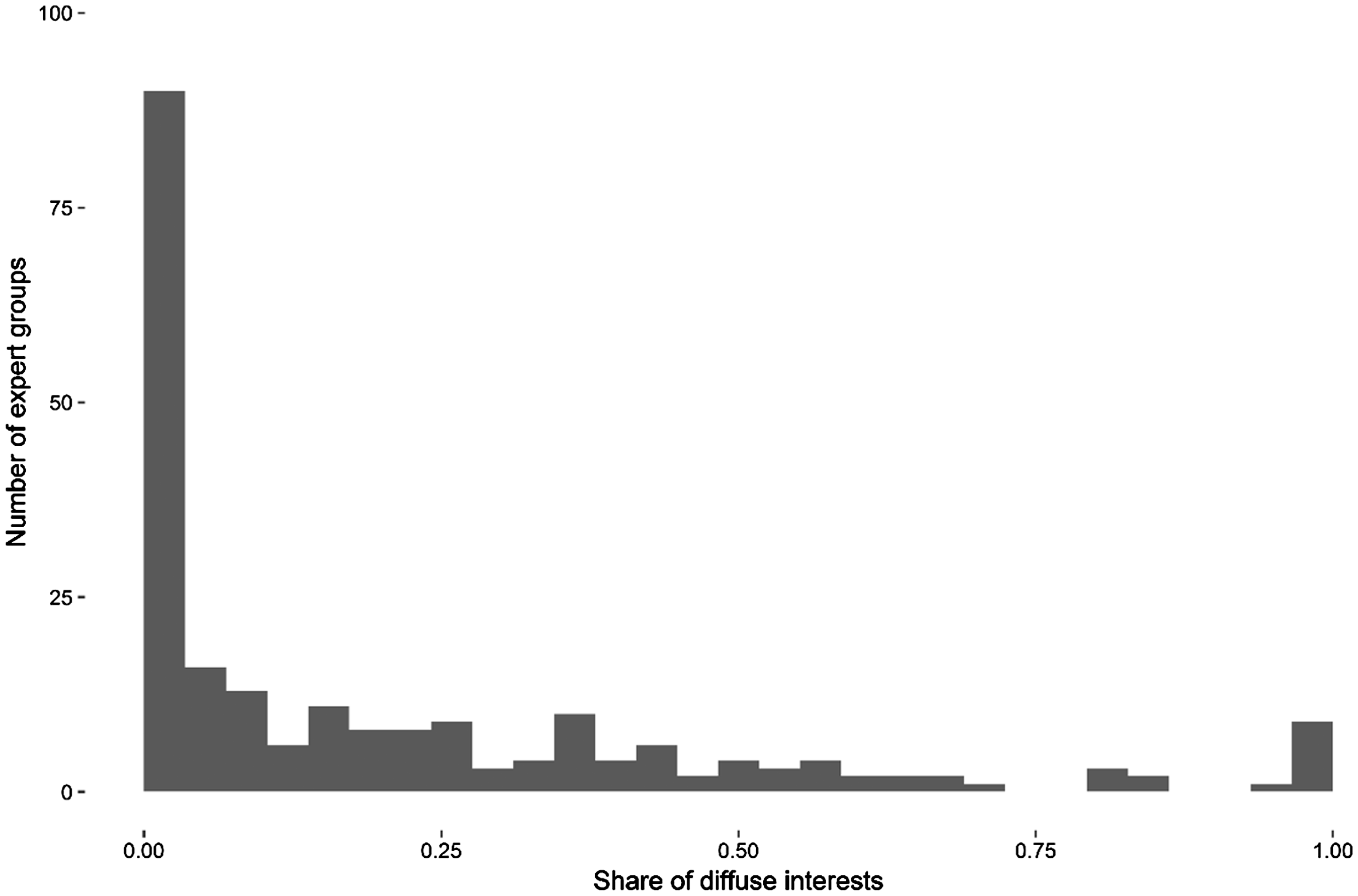
Distribution of the dependent variable.
While specific interests clearly gain more access to expert groups in general, the relative access of specific and diffuse interests exhibits considerable variations across policy areas (Figure 2). Diffuse interests are numerically overrepresented in expert groups addressing civil rights, regional policy, and social policy. Specific interests have a particularly strong presence in policy areas with a clear economic profile, but also in less usual suspects, like law and crime, immigration, and EU governance. However, several policy areas have very few expert groups with interest group participants. For example, the data include no expert groups with interest group participants in defence policy, and the policy areas with a numerical overrepresentation of diffuse interests only include one or two expert groups per policy area (see the Online appendix). The overall descriptive patterns are therefore informing, but the results for single policy areas should not be overemphasized.
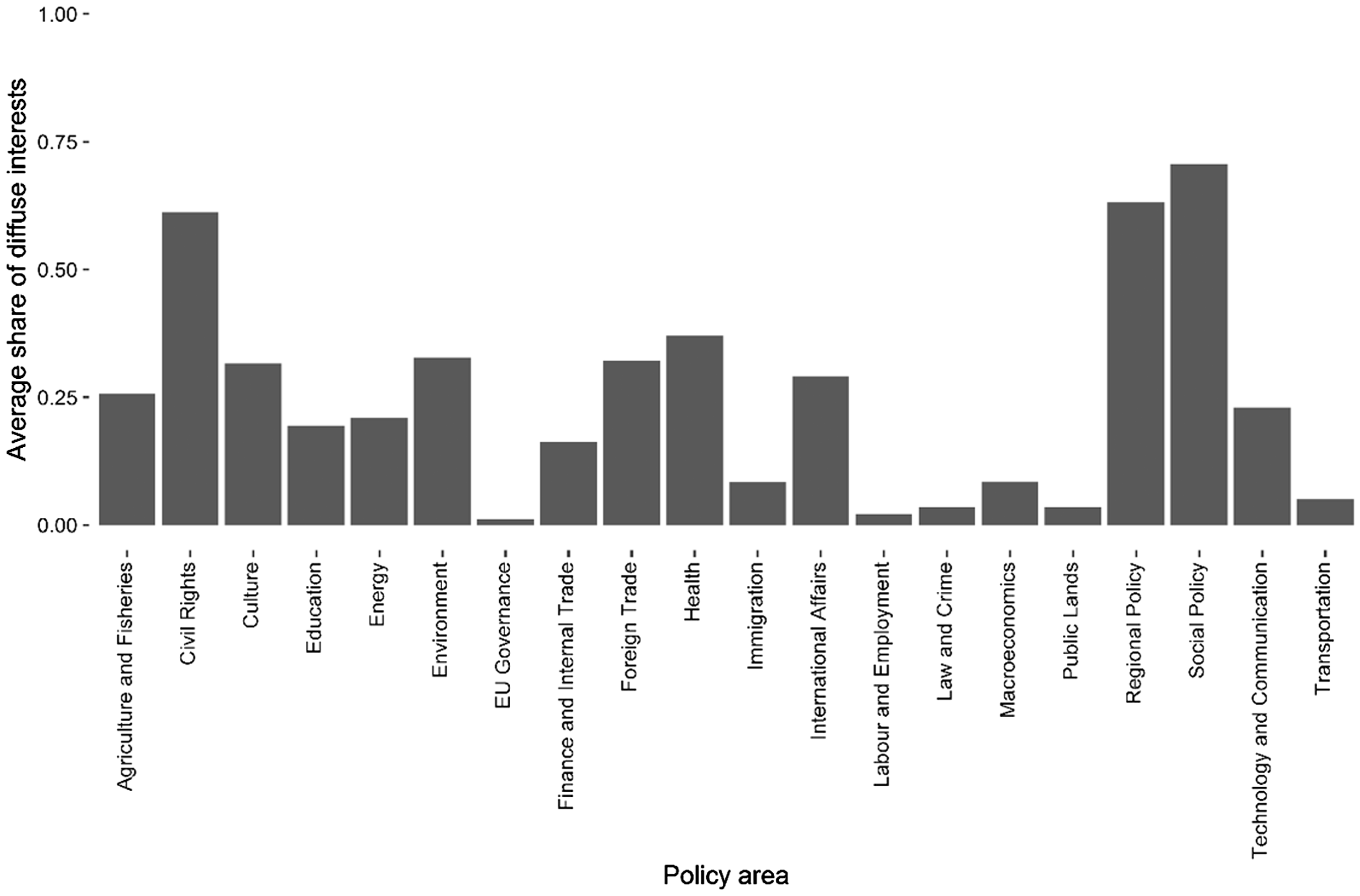
Average share of diffuse interests in expert groups across policy areas (abbreviated policy area categories from Comparative Agendas Project).
Independent variables
Turning to the coding of independent variables, I measure the effect of the difference between regulatory and distributive policies (H1) with the policy type variable. It is notoriously difficult to distinguish empirically between regulatory and distributive policies. That expert groups are not policies, but rather entities working in particular policy areas, further complicates the coding. Some previous research has coded policy type on the basis of the main tasks of a DG (Broscheid and Coen, 2007; Coen and Katsaitis, 2013; Gornitzka and Sverdrup, 2015), but this is a relatively imprecise indicator, given that many DGs engage in both regulation and spending. I choose to code expert groups explicitly described as working with the Common Agricultural Policy (CAP) or cohesion policy as working in a distributive policy area, whereas other expert groups are coded as regulatory. While this is a rough distinction, it follows from the theoretical argument’s focus on the discernibility of the distribution of gains. The EU is often described as serving mainly regulatory purposes (e.g. Majone, 1994; Pollack, 2000), with a few redistributive or distributive exceptions in the shape of, mainly, cohesion measures and the CAP (Buonnano and Nugent, 2013: 16–17). These two also account for the lion’s share of EU spending, and since they contain significant redistributive components (Pollack, 1994), they can easily be framed in terms of net beneficiaries and net contributors in public debates. While the EU engages in distribution in several other instances, the distributive consequences of cohesion measures and CAP are likely to be particularly discernible.
A small number of expert groups (six among the 223 expert groups with interest group participants) address internal administrative matters of the EU, such as staff regulations. I code these expert groups as administrative. Since administrative matters are unlikely to impact political outcomes to any greater extent, and involve no or small costs for societal interests (Rasmussen and Carroll, 2014: 453), I do not associate them with any particular effect on the relative access of specific or diffuse interests.
In line with recent research (Beyers et al., 2017; de Bruycker, 2017), I measure the salience of a policy area (H2) using data from the European Elections Studies’ (EES) survey question asking the respondent to select the most important issue facing his/her country at the moment. I rely on responses from the survey conducted in connection with the 2014 elections for the European Parliament (Popa et al., 2015; Schmitt et al., 2015), code expert groups and survey responses using the European Union Policy Agendas Project codebook (Alexandrova et al., 2015) (see the Online appendix), multiply each respondent with the extrapolation weight provided in the EES 2014, and calculate the amount of respondents in the EU-level population who consider a particular policy area most important. Since the data are skewed, and since the marginal effect of salience is likely to be decreasing, I operate with a logarithmized indicator. 8
For the variables relating to the alternative explanations, I code an expert group as technical (H3) if it includes participants classified as ‘[i]ndividual expert appointed in his/her personal capacity’. These participants are to act independently and in the public interest (European Commission, 2016: 5). In practice, this often means that they are scientists or researchers in a field of relevance to the expert group. The variable is treated as binary, since there are no strong arguments in favor of assuming that more scientists necessarily imply a greater degree of technical complexity.
A potentially problematic feature of this indicator is that the technical information provided by specific interests may be completely interchangeable with the technical information provided by scientific experts, so that the inclusion of scientific experts would render inclusion of specific interests unnecessary or vice versa. However, even if it might be broadly classified as technical information, the information they provide is unlikely to be a perfect substitute. Furthermore, previous studies have shown that for the expert group system as a whole, there is a statistically significant positive correlation between the inclusion of scientists and the inclusion of every type of societal interest, except consumer organizations (Gornitzka and Sverdrup, 2015: 158). Taken together, this suggests that the presence of experts appointed in a personal capacity can serve as a viable indicator for the technical complexity of an expert group.
I code the DG age variable (H4) based on data on portfolio age used by Broscheid and Coen (2007). The indicator approximates the age of Commission DGs and services in 2017. Since there have been changes in the composition and responsibilities of DGs and services, I complement these data by consulting portfolio age data from Franchino (2009), and the web pages of new DGs and services.
Furthermore, I control for the relative supply of diffuse interests in each policy area. If the pool of active interest groups in a policy area consists of a large number of small sectoral business groups, but few, large, diffuse interest groups, a numerical overrepresentation of specific interests in an expert group may simply reflect the larger number of groups representing specific interests in the EU interest group population in that policy area. I measure the relative supply as the proportion of organizations in the EU’s Transparency Register (European Union, 2017) that identify as ‘Non-governmental organisations’, relative to the total amount of ‘Non-governmental organisations’ and ‘In-house lobbyists and trade/business/professional associations’, and have registered that they have an interest in the policy area in question. The policy area categories used in the Transparency Register correspond almost completely with a categorization employed by the Commission to indicate the policy areas in which expert groups are active. This allows me to match the amount of registered interest groups in a policy area with the policy area of each expert group (see the Online appendix). While the Transparency Register relies on self-reporting, there are a number of incentives that may compel interest groups to register. For instance, being registered is a requirement for being able to hold meetings with Commissioners, Cabinet members, and Directors-General, as well as holding membership in an expert group. In addition, organizations must register in order to gain accreditation to the European Parliament (European Union, 2019). The data represent the population of registered interest groups in June 2017.
A potential problem with the indicator is that interest groups registered as ‘Non-governmental organisations’ in the register do not correspond completely to the population of diffuse interests. For example, some business groups may have registered as non-governmental organizations for legitimacy reasons. However, there is little a priori reason to expect this type of misregistration to be more prominent in some policy areas than in others. As I am interested in differences between policy areas, the reasonable assumption that false registrations are randomly scattered across policy areas suggests that the indicator should be a viable proxy of the relative amount of groups active in different policy areas.
Empirical analysis
I estimate a series of fractional logit regression models explaining the share of diffuse interests relative to the total number of interest groups in an expert group. Fractional logit regression is appropriate because the dependent variable is a proportion. Proportional variables can only take on values equal to or between zero and one, meaning that it is unlikely that the effect of an independent variable on the dependent variable remains the same across values of x (Papke and Wooldridge, 1996). Fractional models are designed to accommodate these peculiarities, including non-linearity and a large amount of observations at the extremes (Gallani et al., 2015: 5–6). To simplify the interpretation of coefficients, I calculate average marginal effects for all variables.
I estimate four regression models, shown in Table 1. Model 1 includes the variables associated with the main theoretical argument, which suggests that access is driven by a political logic. Model 2 includes the variables associated with the alternative explanations, focusing on a functional logic, and path dependence. Model 3 combines these two, and model 4 is the full model, also including a control for the relative supply of diffuse interests.
Fractional logit regression explaining the share of diffuse interests in expert groups.
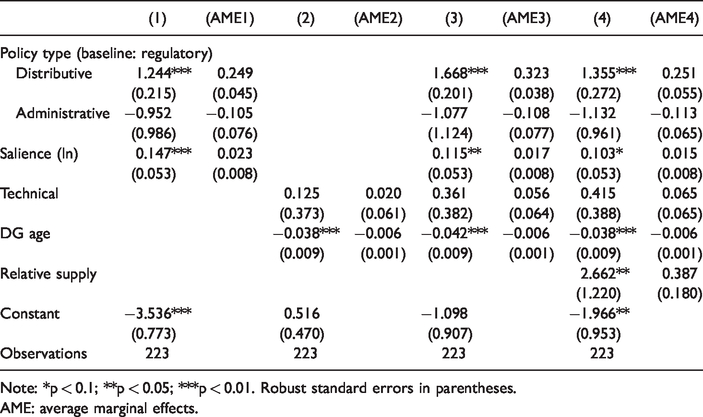
Note: *p < 0.1; **p < 0.05; ***p < 0.01. Robust standard errors in parentheses.
AME: average marginal effects.
The results lend support to the argument that the relative access of specific and diffuse interests to expert groups is driven by a political logic. The policy type variable (H1) shows a statistically significant positive relationship between distributive policy and the representation of diffuse interests. On average, expert groups in distributive policy areas have a 25 percentage point higher share of diffuse interests than expert groups in regulatory policy areas. This supports the theoretical expectation that diffuse interests gain a higher relative access to expert groups in distributive policy areas. The finding contrasts with previous research on expert groups, which has shown that expert groups under distributive DGs are more likely to include industry representatives, but less likely to include NGOs (Gornitzka and Sverdrup, 2015). However, the findings are not necessarily contradictory. Rather, they illustrate the distinction between the discrete exclusion or inclusion of different interest groups, and the resulting composition of the expert group, as empirical phenomena.
The results for salience (H2) lend some additional support to the theoretical argument. In two of the three models in which it features, the results are positive and statistically significant. According to the full model, a 10% increase in the number of persons that consider a policy area most important is associated with an average 0.15 percentage point increase in the share of diffuse interests in an expert group. In substantive terms, however, this effect is only moderate, and the coefficient is below the threshold for statistical significance at the 95% level. Taken together, the regression results therefore suggest that the public salience of a policy area may be one source of variation in the share of diffuse interests in expert groups, but that its effect is limited both in substantive and statistical terms.
Unlike the main argument, the alternative explanation highlighting the demand for technical information as an explanatory factor gains little support by the statistical analyses. The results for the technical variable (H3) run contrary to the hypothesized relationship and are not statistically significant. This suggests that the demand for technical information is not one of the main determinants of the relative access of specific and diffuse interests to expert groups. The results for the DG age variable (H4), however, indicate a negative and statistically significant relationship between a DG’s age and the share of diffuse interests in its expert groups. This is in line with the relationship proposed by H4, suggesting that consultation patterns that privileged specific interests over diffuse interests may have persisted in older DGs.
In sum, the results are in line with the argument that the relative access of specific and diffuse interests to the Commission’s expert groups is a function of the political nature of issues. The effect of policy type is particularly pronounced, whereas that of public salience is limited. Furthermore, the age of a DG may be one source of variation in the relative access of specific and diffuse interests to its expert groups, suggesting that interest group access to the Commission may be subject to path dependence. By contrast, the alternative explanation highlighting technical complexity gains no support.
Robustness checks
I conducted a series of analyses with alternative specifications to assess the robustness of the findings. First, I tested the effects of the decision to operate with a fractional logit model by estimating an ordinary least squares (OLS) model (see the Online appendix). The key results are similar to the main model in terms of sign and significance, although the effect of salience is now statistically significant.
Second, I controlled for alternative operationalizations of the dependent variable (see the Online appendix). 9 Since the distinction between specific and diffuse interests is central to the theoretical argument, it is crucial that this coding is robust to slight alterations. I first controlled for the effects of the decision to categorize trade unions as specific interests. Trade unions are an interest group type around which the literature exhibits some disagreement. They are sometimes classified as diffuse interests (Bailey, 2001), sometimes as specific interests (Beyers, 2004), and sometimes considered to occupy a middle ground between business associations and citizen groups in terms of their ability to provide different types of information (Dür and Mateo, 2016). While I acknowledge that such nuances exist among interest groups, my operationalization places trade unions in the specific interest category. Given their role in the production process and the well-delineated character of their constituencies, it is reasonable to assume that their constituents enjoy more concentrated costs and benefits from policy, compared to, for example, consumer groups. For the robustness check, however, I recoded trade unions as diffuse interests. The key results are similar in terms of sign and significance, although the effect of salience is significant in the full model.
I then controlled for the effects of categorizing cross-sectoral business associations and trade unions as specific interests. Given their size, they could be considered to approximate diffuse, rather than specific, interests, and I therefore recode them as diffuse interests. The key results remain robust to these changes, and the coefficient for salience is statistically significant in the full model.
Third, and finally, I controlled for the possibility that the results were driven by a few outlier expert groups with full, or close to full, representation of diffuse interests (see the Online appendix). I reran the main regression model for all expert groups with less than 75% diffuse interest participants. The results for policy type and DG age were similar in terms of sign and significance.
In sum, the effect of policy type and DG age remain robust across all regression models with alternative specifications, whereas the effect of salience is significant in five out of six alternative models. Taken together, this supports the interpretation of the main regression results regarding the effect of both policy type and DG age, but also illustrates the sensitivity of the salience indicator to alternative specifications.
Conclusion
Interest group access to the European Commission has attracted the attention of scholars and NGOs alike. The scholarly consensus has been that specific interests gain more access to the Commission than diffuse interests, since specific interests possess technical information corresponding to the Commission’s demands. Yet, there are indications that patterns of access vary across policy areas, implying a more complex consultation regime than the canonical description suggests. In this article, I have mapped variations in specific and diffuse interest access to the European Commission’s expert groups and assessed their determinants in a statistical analysis. The analyses have generated two principal findings.
First, in the expert group system as a whole, specific interests gain more access than diffuse interests do, but there are distinct differences between policy areas. An empirical assessment suggests that diffuse interests have a higher degree of access in regional policy, civil rights, and social policy. Second, the explanatory analyses support the notion that the access of specific and diffuse interests to expert groups is driven by a political logic. Specifically, distributive policy areas are associated with a higher degree of diffuse interest access than regulatory policy areas. In addition, the results suggest that the relative access of specific and diffuse interests may be subject to path dependencies.
The findings carry implications for empirical and normative studies of interest group access to policy makers in the EU and beyond. First, while students of interest group access in the EU have a good understanding of how access varies between interest groups (Chalmers, 2014; Mahoney, 2004; Rasmussen and Gross, 2015), and EU institutions (Beyers, 2004; Bouwen, 2004; Dür and Mateo, 2016), the amount of literature assessing variations in access between policy areas is surprisingly small. 10 This may hide variations within the Commission, as suggested by studies analyzing the Commission’s register of interest representatives (Coen and Katsaitis, 2013), and participants in the Commission’s online consultations (Rasmussen and Carroll, 2014). This article nuances the functionalistic view of the Commission’s relations with interest groups by demonstrating how the relative access of specific and diffuse interests varies with the political nature of issues, even in expertise-oriented advisory committees.
Second, a burgeoning literature on interest group participation in global governance has mapped and explained the participation of interest groups in international organizations and conferences (Hanegraaff, 2015; Hanegraaff et al., 2011; Uhre, 2014). So far, the mappings have relied on largely descriptive schemes for categorizing interest groups. This article distinguishes between interest groups based on theoretically relevant features of their constituencies, a distinction that could be fruitfully utilized to explain patterns of access across policy areas in international organizations beyond the EU. This should be particularly viable if a trend of increasing politicization is true not just for the EU (Hooghe and Marks, 2009), but for other international organizations as well (Zürn et al., 2012).
Third, the findings feed into normative debates about the democratic merits of the European Commission’s consultation regime. In this regard, the results convey a contradictory picture. While the descriptive patterns show that most policy areas privilege specific interests, the relative access of diffuse interests increases, albeit moderately, with the public salience of issues, meaning that diffuse interests gain more access in policy areas that are considered important by the public. These patterns can serve as a starting point for assessing whether the current system is just, and if not, how changes in that direction can come about.
Supplemental Material
EUP886365 Supplementary material1 - Supplemental material for Explaining interest group access to the European Commission’s expert groups
Supplemental material, EUP886365 Supplementary material1 for Explaining interest group access to the European Commission’s expert groups by Carl Vikberg in European Union Politics
Supplemental Material
EUP886365 Supplementary material2 - Supplemental material for Explaining interest group access to the European Commission’s expert groups
Supplemental material, EUP886365 Supplementary material2 for Explaining interest group access to the European Commission’s expert groups by Carl Vikberg in European Union Politics
Footnotes
Acknowledgements
For helpful comments, the author is particularly grateful to Lisa Dellmuth, Joakim Kreutz, Matilda Petersson, Thomas Sommerer, Jonas Tallberg, participants in the Global and Regional Governance seminars and the ‘Interest groups, international organizations, and global problem-solving capacity’ workshop at Stockholm University, and to two anonymous reviewers of EUP.
Funding
The author(s) received no financial support for the research, authorship, and/or publication of this article.
Supplemental material
Supplemental material for this article is available online.
Notes
References
Supplementary Material
Please find the following supplemental material available below.
For Open Access articles published under a Creative Commons License, all supplemental material carries the same license as the article it is associated with.
For non-Open Access articles published, all supplemental material carries a non-exclusive license, and permission requests for re-use of supplemental material or any part of supplemental material shall be sent directly to the copyright owner as specified in the copyright notice associated with the article.
