






Abstract
Despite decades of efforts to harmonize asylum procedures, large unexplained differences in asylum outcomes persist across European Union member states. Unfortunately, relatively little empirical literature has examined the causes of disparities in asylum recognition rates. In this paper, I suggest that domestic politics impact how asylum claims are adjudicated. I analyze origin-specific asylum recognition rates in 27 European Union member states from 2000-2018. The findings show that right-wing parties in government are associated with lower asylum recognition rates. This effect is strongest for far-right parties. When far-right parties gain legislative seats and cabinet positions, there is a substantive reduction in recognized asylum claims.
Introduction
In 2015, Germany admitted over one million asylum-seekers as part of its “open-door” policy led by Chancellor Angela Merkel. The large influx of migrants was controversial, raising public concern about Germany’s ability to absorb newcomers. At the same time, opposition was growing within the government. Growing support for the far-right Alternative for Deutschland (AfD) was widely attributed to public reaction against migration (e.g. Chase, 2018; Fisher and Katrin, 2018). By 2018, Merkel’s government seemed to be in real danger from the AfD; the Interior Minister was in open-rebellion against the open-door policy as the far-right continued to gain ground among his conservative base. Ultimately, the government announced plans to tighten the German border and increase deportations of rejected asylum-seekers.
This illustrates the inherently political nature of asylum decisions in Europe. Despite over two decades of attempts to create a common set of policies and practices, large national differences in asylum outcomes persist within the European Union (Bovens et al., 2011; Toshkov and de Haan, 2013; Trauner, 2016; Vink and Meijerink, 2003). Yet, little scholarly attention has addressed how domestic political contexts shape asylum decisions. This question has important humanitarian and academic implications. From a normative perspective, there should be an active interest in assuring that asylum processes are fair and accessible for anyone who may need them, regardless of the country in which a claim is lodged. The consequences of deporting someone with a legitimate claim of asylum are dire. However, there is also the academic question of how domestic politics impact the application of international laws and treaties. Asylum is defined under United Nations (UN) statute and the European Union (EU) has created additional procedures for the adjudication of asylum claims. The fact that inequalities in asylum recognition rates continue across EU member states is indicative of the importance of considering how domestic conditions shape compliance with international standards.
Literature review
Any discussion of asylum policy must acknowledge the definition of asylum found in the 1951 Convention relating to the Status of Refugees and its 1967 Protocol. These treaties establish asylum as a right, stipulating that individuals should not be penalized for entering a country irregularly in order to seek asylum. However, there is no explicit language concerning how states should assess asylum claims. Moreover, there exists no independent agency to systemically monitor domestic asylum policies and no international enforcement mechanisms. The UN or other international organizations (IOs) may engage in naming and shaming in the case of particularly egregious or well-known violations, but asylum policy remains within the purview of the state. By recognizing an asylum claim, a state is acknowledging that an individual has a legitimate fear of persecution in her home country and grants her special protections under the law. While asylum-seekers fall under the umbrella term of forced migration, the distinction between asylum-seekers and refugees is important. Refugees have already been granted protected status by the UN or the government of the country in which they reside whereas asylum-seekers are in the process of seeking these protections, although a final determination of their rights has yet to be made. While international law establishes a definition of refugees, there is no established procedure for how to adjudicate asylum claims. Each state is responsible for determining its own set of rules and procedures for deciding if individuals meet the criteria of refugee. Notwithstanding, states are expected to respect the principle of non-refoulement—or not sending people to a country where they will face persecution. Likewise, EU countries have established a set of common definitions and procedures for asylum processes.
Within the EU, the 1951 Convention and its 1967 Protocol remain the foundation for asylum law. However, with the Treaty of Amsterdam in 1997 the EU gained the ability to create binding rules concerning asylum, laying the groundwork for subsequent harmonization of EU asylum policy (Hatton, 2005). Although asylum is defined under UN statute and the Tampere agreement and Dublin Regulations provide additional EU-specific procedures and oversight to the asylum process, EU efforts to harmonize asylum policy have not produced equal outcomes (Hatton, 2005; Schittenhelm, 2019; Trauner, 2016).
Asylum recognition and its determinants
Asylum decisions are generally understood to be the function of both origin- and destination-country characteristics. Rosenblum and Salehyan (2004) find that United States (US) asylum recognition rates are influenced by strategic considerations involving military and trade relationships with origin countries and domestic concerns of security and immigration. Likewise, Salehyan and Rosenblum (2008) suggest that US asylum recognition is impacted by domestic political contexts such as media attention. These results suggest that asylum decisions are vulnerable to political considerations rather than a strict application of written law. Similarly, Gudbrandsen (2010) finds that the number of refugees—including asylum-seekers—given residence permits decreases when the Conservative party holds government power in Norway.
Other studies show that European asylum decisions are vulnerable to security and economic concerns. Avdan (2014) shows that European countries respond to transnational terror incidences by reducing asylum recognition rates. Likewise, Micinski (2018) discusses increases in security screenings for Iraqi asylum-seekers in Sweden and the United States, suggesting that security and fears of terrorism influence asylum-decisions.
Additionally, Neumayer (2005) argues that countries’ economic situations influence their propensity to accept asylum claims, with wealthier countries being more capable of accommodating asylum-seekers and, therefore, more likely to accept their claims. However, the empirical findings are mixed; gross domestic product (GDP) rates are significant in some models but insignificant in others, while unemployment rate is insignificant. Avdan (2014), on the other hand, finds unemployment rate to be significant. Nevertheless, both Avdan (2014) and Neumayer (2005) find that humanitarian conditions in the origin-country are highly predictive of asylum-recognition, regardless of the economy in the destination-country.
Neumayer’s (2005) study is also unique because it accounts for the percentage of votes going to far-right parties (FRPs). Although it fails to find statistical significance for the variable, there are a number of reasons to revisit this topic. Firstly, Neumayer’s (2005) model overall fails to gain statistical significance on variables shown to be significant in Avdan (2014), such as unemployment rate and past asylum applications, suggesting that the standard errors may be inflated or that specification issues may obscure real relationships. Secondly, Neumayer (2005) covers the period of 1980-1999. This presents some potential challenges. The third-wave of far-right political activity began in the 1980s; thus, the timespan covered only captures the beginning of a period that has seen growing influence of the far-right. Many major FRPs had not yet formed. Moreover, this also includes a period of major integration within Europe, culminating in the Maastricht Treaty which became effective in 1993 and established the EU as it is known today. Additionally, 1999 marks the beginning of a large effort to harmonize European asylum policy (Hatton, 2005). These events may have had major confounding effects that are not accounted for, and persistence in differences after common rules are established are especially interesting.
Finally, there is evidence that increased asylum applications have a negative relationship to asylum-recognition rate (Toshkov, 2014; Valenta, 2014). While the substantive effect of this observed relationship appears to be rather small, it suggests that states apply stricter conditions when asylum applications increase. It is not clear, however, if this relationship is due to a question of economic capacity, infrastructure, political concerns relating to asylum, or a combination of these factors.
Although cross-national differences have typically been examined at the national-level, subnational inequalities exist in asylum recognition rates as well. Schneider et al. (2020) show considerable state-level differences in asylum recognition rates in Germany. This analysis suggests that socio-economic and political considerations play a role in influencing asylum acceptance rates. Similarly, analyses of asylum recognition rates in Swiss cantons also show subnational inequalities (Holzer et al., 2000). These subnational studies provide further evidence of the role that political considerations are likely to play in asylum inequalities despite common frameworks for how to address asylum claims.
Immigration politics in Europe
Because the empirical literature dealing directly with asylum decisions is limited, it is also useful to consider the literature which examines states’ approaches to asylum policy and immigration policy more broadly. While asylum is a type of migration, it differs from regular migration in two important ways. First, there is a humanitarian aspect to the right to seek asylum. International humanitarian law explicitly protects the rights of asylum-seekers, setting minimum standards for the treatment of asylum-seekers. Secondly, asylum-seeking is based on irregular migration. That is to say, the majority of asylum-seekers enter a country without prior authorization in order to claim asylum. Whereas states are normally able to choose who they will and will not allow to immigrate prior to those persons entering the territory, asylum-seekers typically must arrive in the territory in order to make a claim to asylum. Influxes of people via irregular methods may aggravate security concerns related to migration.
Nevertheless, Facchini and Mayda (2008) consider asylum policy as an extension of immigration policy. They observe that voters favor more restrictive immigration policies and conjecture that more open policies are the result of interest group influence. This finding on public opinion is consistent with other scholarship relating to immigration in Europe (e.g. Blinder, 2015; Mudde, 2010). However, this perspective fails to consider the humanitarian aspect of asylum-based migration. There is evidence that the public adopts sympathetic views to migration in light of certain humanitarian crises (Salehyan and Rosenblum, 2008).
Public opinion notwithstanding, Schuster’s (2000) analysis of seven European countries finds that all sampled countries attempt to reduce the number of asylum-seekers entering their territory in the first place. However, the article does not immediately address the primary grounds on which states object to asylum admissions. While security concerns likely play a role, international protections for asylum-seekers are also important to consider. The principle of non-refoulement and international laws and norms make it more difficult for states to expel those who claim asylum. States may view asylum-seeking as a threat to sovereignty as it places burdens on the state’s ability to control who enters its territory. Additionally, asylum-seekers, who are often entitled to some form of public assistance, may also be viewed as economic burdens. It remains unclear to what extent each of these factors influence states’ behaviors in forming and implementing asylum policies. Nevertheless, the literature shows that asylum decisions are complex phenomena influenced by legitimate humanitarian concerns as well as strategic, political, and economic considerations on the part of the destination country. The task for analysts is to produce a more complete picture of how these aspects interact and impact asylum policies.
Asylum-seeking in practice
Not only is asylum-seeking established as a right according to international convention, but the EU has developed its own sets of policies governing asylum-seeking and asylum policies for member states. The Dublin Convention, adopted in 1990 (and subsequently updated), provides a set of rules for asylum adjudication procedures and establishes a system for assigning asylum claims to states. Typically, the first EU state that a person enters is considered responsible for processing a claim of asylum, regardless of where the claim is lodged. In 1999, a common system of asylum for the EU was outlined at the European Council in Tampere, leading to a series of directives stipulating evaluation protocols, minimum standards of housing and care, and additional protections for those fleeing generalized violence. There have also been considerable efforts to coordinate cooperation between EU states concerning asylum-seeking which have produced a common database for biometric data and some financial solidarity, although efforts toward the latter have been less successful.
Notwithstanding, states continue to practice a wide degree of discretion in application of asylum policy, even within the EU. The procedure for applying for asylum varies across states, with each having its own institutions for evaluating claims. Some, such as Spain and Hungary, have offices devoted to asylum-seekers while others, such as Belgium and France, process asylum claims as part of general immigration offices. Likewise, the process of evaluation varies across countries. For instance, in Italy, Territorial Commissions for the Recognition of International Protection process claims and decisions are undertaken by teams that include one representative from the Ministry of Interior, one representative from the United Nations High Commissioner for Refugees (UNHCR), and at least two qualified administrators, one of whom has conducted a personal interview with the applicant. Language interpreters must be provided whenever needed. In Sweden claims are processed through the Migration Agency which is also responsible for making decisions on issues such as work permits, citizenship, and family reunification. Personal interviews are conducted by an asylum case officer, after an initial screening interview by the reception officer. The asylum-seeker has the right to request an interpreter, but the Migration Agency is not legally required to provide one. Nevertheless, procedure can typically be summarized as follows: an applicant arrives in the country and lodges a claim, the responsible agency evaluates the claim, the responsible agency makes a decision that either grants protection or does not. Applicants are allowed to appeal these decisions, a process that is generally overseen by the courts.
Theory
While previous research provides substantial evidence that both origin-country and destination-country factors influence recognition rates, it has not considered how the parties in government may influence the decision-making process. Although asylum decisions should theoretically depend solely on the validity of a claim, the continued unexplained differences in outcomes between countries suggest that this is not the case. Moreover, asylum decisions are generally made by civil servants working most often under the direction of the Interior Ministry or Justice Ministry. The degree of oversight and expertise in the adjudication of asylum claims varies from country to country. Changes in asylum policies are often procedural rather than legislative. As such, it is essential to consider how parties within government may influence this process.
Asylum forms a convenient political target for parties opposed to immigration and internationalism. Because asylum is an internationally recognized right and is partially governed by international treaties and EU procedures, Eurosceptic, anti-global parties may see asylum as a convenient issue to oppose. Asylum-seekers are a vulnerable group without the power to vote which may make targeting asylum a useful political tactic. Likewise, while there is a legal difference between asylum-seekers, voluntary immigrants, and other irregular migrants, voters who think of asylum-seekers when thinking of immigration tend to also hold more anti-immigrant attitudes (Blinder, 2015). Thus, more restrictive asylum practices could be used to appeal to these voters.
The left/right divide is a useful starting point for evaluating party influence on asylum decisions. Traditionally, an ideological emphasis on rights and equality has been associated with the left, while the right is associated with hierarchy and law and order. Thus, right-leaning parties have often been assumed to be less friendly toward asylum. Schuster (2000) notes this assumption but finds little evidence of substantive policy change when left parties gain power. However, Schuster’s study is mainly descriptive in nature. While the findings are important to the overall understanding of how asylum policy has developed in Europe and the ways parties act, it is also limited by a rather small sampling of countries. On the other hand, Frid-Nielsen (2018) shows that left-right orientation is indicative of the party’s position on asylum in the European Parliament. As parties move further left, they take more pro-asylum stances. In other words, traditional values of right-wing parties and stated preferences of the right-end of the political spectrum suggest that right-wing parties overall may be less friendly toward asylum. Similarly, Gudbrandsen’s (2010) observes that in Norway the Conservative Party takes the harshest stance against refugees, while the Centre and Labour Parties take more positive stances.
Thus, I form my first two hypotheses. As right-wing parties gain more power in government, understood as both seats in the legislature and cabinet posts, the asylum recognition rate is expected to decrease. Conversely, an increase in left-wing parties in government is expected to be associated with an increase in asylum recognition rate. H1: An increase in right-wing parties in the legislature is associated with a decrease in asylum recognition. H2: An increase in left-wing parties in the legislature is associated with an increase in asylum recognition.
The role of far-right politics
In addition to left-right government composition, there is one particular party family that is of interest in this study: far-rights parties. Although there has been some disagreement among scholars about the appropriate definition for FRPs, ideology is the best indicator of membership in this party family. While many definitions of FRPs exist (see Golder, 2016), I favor Mudde’s (2007) conception of FRPs as characterized by nativist, authoritarian, and populist ideologies. This definition has an important distinction from the broader term of anti-immigrant parties or even right-wing anti-immigrant parties because it specifies nativism as a characteristic feature of FRPs. Nativism holds that the nation should be formed by natives and that non-native elements are inherently threatening. This ideological position, unlike other immigration-skeptic positions, is incompatible with asylum-based migration. Anti-immigrant policies meant to protect native workers or promote national security can be reconciled to asylum-based migration which represents an extreme case and overriding humanitarian principles. Nativism, however, cannot make exceptions for humanitarian interest in creating immigration policy because, regardless of the situation in her origin-country, any immigrant is viewed as a threat to the nation. This places FRPs in a unique position vis-à-vis asylum-based migration. Not only is nativist ideology irreconcilable with granting asylum to refugees, but the notion of international human rights law itself may be viewed as illegitimate because it is a non-native influence.
It is unsurprising, therefore, that FRPs target asylum-seeking in their rhetoric, using language that conflates asylum-based migration with illegal activity and questions the legitimacy of asylum-seekers claims. For instance, a poster for the French FRP Rassemblement National (RN) depicts the arrival of boats on the Mediterranean coast with the caption “No illegals on our shores. Stop human trafficking”. This despite the fact that many of those making the dangerous journey across the Mediterranean to France are seeking asylum. Likewise, a more detailed call-to-action from the same party concerning “Asylum/Immigration” refers to “irregular” immigrants as a security threat whose “illegal” arrival demonstrates a lack of respect for laws (Le Pen et al., 2018). This is a clear example of how FRPs target asylum and conflate it with other types of immigration and illegal activity. While some may call into question whether the anti-asylum positions of the far-right are sincere or instrumental, this does not change the stated policy and rhetoric of the party. When FRPs use anti-asylum rhetoric, they shift the national conversation and set the expectation to promote policies in accordance with their stated positions. Given this, it is essential to consider the ways in which FRPs may influence asylum decisions.
First, returning to the German example, FRPs can have major effects even with little to no share in governance. There are several reasons that this can occur. By entering the system, FRPs contribute to the political agenda. When an FRP is active in a system, it brings issues of immigration and asylum to the forefront. As a result, these issues become more salient, forcing other parties in the system to act. Likewise, FRPs represent a threat to ruling parties as they gain electorally. Both left- and right-wing parties are shown to try to respond to or even co-opt FRP positions (see Schain, 2006). Parties may begin to take a more restrictive stance toward asylum-migration in an effort to maintain their voting base.
Finally, when FRPs gain electorally, it likely indicates a situation where immigration is a more salient national issue and anti-immigrant messages are more commonly heard. There remains a level of discretion on the part of the decision-maker for asylum cases. When FRPs become electorally successful and begin promoting anti-asylum campaigns, these messages may influence how asylum decisions-makers perceive asylum-seekers. Even if these individuals are not themselves supporters of these parties, they may be influenced to some degree by the overall message. This would lead to more cases being rejected as decision-makers doubt the veracity of the claims lodged.
Therefore, I posit that: H3: As FRPs gain more electoral vote share, asylum recognition rates will decrease. H4: As the far-right seat-share in the legislature increases, asylum recognition rates will decrease. H5: When FRPs join the cabinet, asylum recognition rates will decrease.
Research design
This study examines the asylum recognition rate in 26 EU member states from 2000-2018. The unit of analysis is asylum-origin dyad, where asylum country is the asylum-granting country and origin country refers to the origin of the asylum-seeker. The dependent variable is the origin-specific asylum recognition rate. This is operationalized as the total number of asylum claims that are recognized (including those recognized under supplementary protection) divided by the total number of asylum decisions made using information from UNHCR Population Statistics. For this analysis, only first-instance government decisions are used because the different processes for appeals may produce different outcomes (see Schneider et al., 2020). Austria and Germany are excluded from the analysis because first decisions are not reported separately for these countries. Countries that joined the EU during the period of 2000-2018 are included beginning the year after a full year of membership. A complete list of countries with their active FRPs can be found in the Online appendix.
Information on the left-right composition of government is taken from the Comparative Political Data Set (CPDS) (Armingeon et al., 2019). I employ two operationalizations of right- and left-wing parties’ participation in government: seat share in the legislature and in the cabinet. Both measures are weighted by the total number of days in office. For far-right-specific variables, I employ both the total vote share received by the far-right in the most recent election and far-right seat share in the legislature. These data are taken from the Political Data Yearbook. Far-right coalition membership is a dichotomous variable that takes on a value of 1 when an FRP joins the governing coalition.
In order to avoid omitted variable bias, I also control for a number of other variables from both the asylum and origin countries. Electoral factors are accounted for by including the effective number of legislative parties (ENP) and the disproportionality index. The ENP is calculated according to Laakso and Taagepera’s (1979) formula. Disproportionality is calculated using Gallagher’s (1991) formula. Past work has also suggested that economic factors drive asylum decisions (i.e. Neumayer, 2005). Thus, I include real GDP growth and unemployment to account for economic performance. All of these variables are taken from the CPDS.
I also consider that the overall national asylum situation may influence decisions. States with a high number of asylum claims may adopt more restrictive evaluation measures due to large demand (Toshkov, 2014; Valenta, 2014). For this reason, I include a variable representing the total number of applications received per capita in the previous year. Further, to account for endogeneity, I include the total asylum recognition rate of the previous year. Total asylum recognition rate refers to the number of asylum claims recognized (either under UN mandate or other protection) divided by the number of asylum decisions made for all countries.
Other control variables indicate how conditions in the origin country may impact the asylum country’s judgement on the legitimacy of a claim. The asylum adjudication process is meant to decide whether an individual has a legitimate fear of persecution or violence if they return to their home country. While individual data on the specifics of someone’s claim are unavailable, I use general information about political violence and humanitarian conditions in a country to proxy the likelihood that someone can present a legitimate claim for asylum. In order to assess the level of protection of human rights in the origin country, I include the Political Terror Scale (PTS) score. Likewise, past studies show that higher levels of democracy are associated with fewer human rights abuses (e.g. Davenport and Armstrong, 2004; Fein, 1995); thus, I include the liberal democracy score from Varieties of Democracy (VDem). Because lack of political rights or abuses may be limited to certain groups, I also use VDem’s group equality measure to account for potential discrimination of specific groups within a country.
Political violence is another common reason why individuals seek asylum. Thus, I include a categorical variable estimating the level of inter- and intra-national violence on a 1–10 scale. This measure comes from the Major Episodes of Political Violence dataset from the Center for Systemic Peace.
There is also the potential that racial and/or religious bias influences asylum-decisions. Therefore, I include a dummy variable for all countries with a majority of Muslims. While this does not guarantee that individual applicants were Muslim, it increases the probability that they were either Muslim or, otherwise, that decision-makers associated them with Islam. Further, I include a regional variable denoting the world region of the origin country.
These data have a unique structure because they include both origin- and destination-specific variables. Destination-specific variables will not vary in the same asylum country in a given year while origin-specific variables will not vary for origin countries in a given year. While there are multiple possible ways to account for the data structure, I opt for a mixed-effects generalized linear model with random intercepts for asylum country and origin country. This model specification implies a hierarchical structure to the data. Random intercepts are specified for origin country and asylum country. There are two ways to conceive of this structure. First, origin-countries can be understood as nested within asylum countries. Second, asylum-countries can be understood as nested within origin-countries. I report the coefficients for models estimated according to the former specification. However, additional models reported in the Online appendix specify asylum countries nested within origin countries without substantive changes to the results.
Results
Table 1 provides descriptive statistics for the overall asylum recognition rates in surveyed countries from 2000-2018. This rate indicates the quotient of the number of recognized asylum claims and total number of asylum decisions in a given year. Countries vary greatly in their mean and the range of yearly asylum recognition rates. However, these descriptive statistics do not show how countries compare at the same point in time. Thus, Figure 1 demonstrates the acceptance rates from 2000-2018 for the 10 countries who made over 10,000 asylum decisions in 2018. The graph shows that there is a great deal of variability in the permissiveness of asylum decisions across time and space, although Greece tends to remain one of the most restrictive longitudinally.
Minimum, maximum, and mean recognition rates in EU states, 2000–2018.
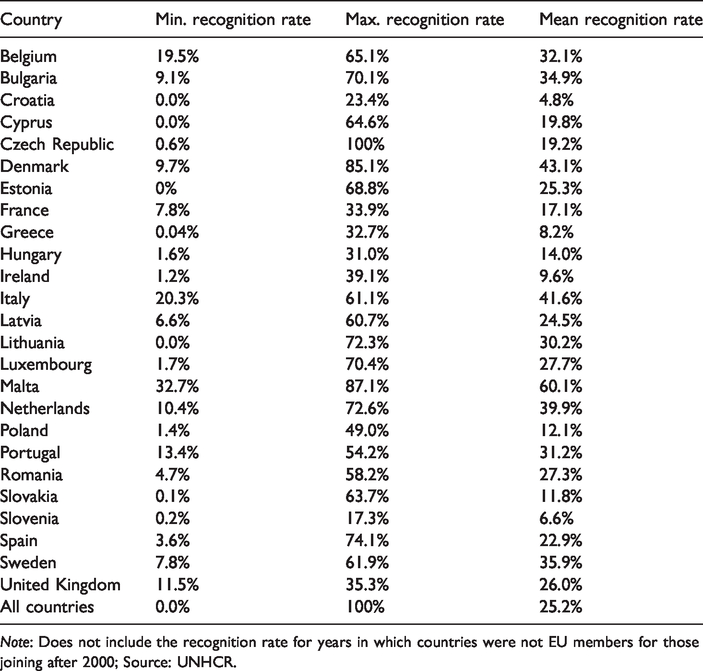
Note: Does not include the recognition rate for years in which countries were not EU members for those joining after 2000; Source: UNHCR.

Overall asylum recognition rates, 2000–2018.
Nevertheless, these figures obscure potential differences in the types of asylum-seekers a country receives. It is possible that there are systemic differences in the origins of asylum-seekers that could influence overall recognition rate. This is why the use of origin-specific recognition rates is essential. Figure 2 summarizes the recognition rate for Syrian asylum-seekers in the same seven countries. One would not expect that Syrian asylum-seekers arriving in Belgium vary systemically from those arriving in France in ways that are likely to affect the legitimacy of their asylum claims. Yet, the figure demonstrates cross-national variability in the recognition rate. While there is a general upward trend in recognition rates beginning in 2012, as the humanitarian situation in Syria worsened, there remains remarkable national variability in asylum rate both before and after violence broke out in Syria.

Recognition rate of asylum claims coming from Syria.
Table 2 summarizes the impact of right- and left-wing parties in government on asylum recognition rates. Models 1 and 2 demonstrate the effect of right-wing parties’ cabinet post share and legislative seat share, respectively. The negative, significant coefficient on both cabinet posts and legislative seats for right-wing parties indicates that as right-wing share in government increases, the asylum recognition rate decreases. This provides support for H1. On the other hand, the left-wing parties’ share in government shown in Models 3 and 4 does not have any apparent impact on asylum recognition rates. In other words, while higher levels of right-wing participation in government is associated with lower asylum recognition rates, there is no observable relationship between left-wing parties in governance and asylum recognition rate. This lack-of-relationship may be due to a lack of specification on the type of left-wing party and its agenda. For instance, pro-worker parties may be less prone to migrant-friendly policies. Further investigation of the relationship between the political left and asylum policy should further investigate how left-wing parties react to asylum.
The impact of partisanship on asylum recognition rates in EU states, 2000–2018.
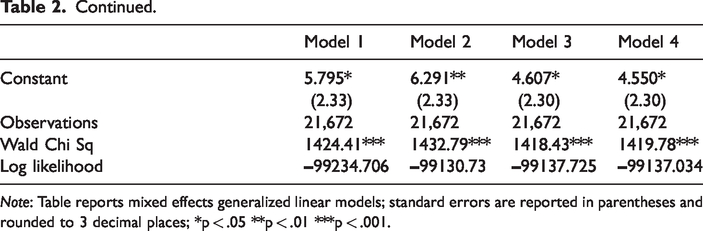
Note: Table reports mixed effects generalized linear models; standard errors are reported in parentheses and rounded to 3 decimal places; *p < .05 **p < .01 ***p < .001.
Although right-wing parties in government have a statistically significant relationship with asylum recognition rates, the substantive significance of the coefficient is rather modest. When all other values are held at their means, a one standard deviation increase in legislative seat share for right-wing parties from its mean is associated with a decrease in recognition rate from an estimated 17.60 with a standard error of 1.433 to 16.93 with a standard error of 1.445. This represents a reduction of about .669 total points. While these figures appear small, it is perhaps more useful to put this change in terms of people affected, rather than the expected change in recognition rate. For instance, Sweden made 58,355 asylum decisions in 2018. A decrease in the asylum recognition rate of 0.669 points in this case would be associated with 390 more rejections. In the 28 EU states, a total of 1,252,467 asylum decisions were made in 2017. A global increase of right-wing parties in legislatures by one standard deviation would thus be associated with over 8,379 additional asylum rejections. Given the potential life-and-death consequences of asylum decisions, even such a modest change in recognition rate is worth noting.
In addition to the primary variables of interest, the control variables warrant brief discussion. The effective number of legislative parties does not have a statistical relationship with asylum recognition rate (the supplemental specifications found in the Online appendix show a significant relationship, but this finding is not robust to alternate specifications). However, system disproportionality does appear to matter with a positive, significant coefficient in Models 2-4. When disproportionality increases, asylum recognition rates also increase. This may be due to the fact that traditional parties may feel less threatened by anti-immigrant populist movements in more disproportional systems. This finding has interesting implications for future research examining responsiveness to public opinion in migration policy.
Countries with higher GDP growth also accept asylum claims at higher rates, suggesting that economic factors are also important. Interestingly, unemployment rate also has a positive, significant coefficient, suggesting that higher unemployment is associated with higher acceptance rates. While this is surprising, a lengthy investigation of the economic implications of asylum-based migration is beyond the scope of this article. Nevertheless, it would be a valuable avenue for future research. Additionally, yearly application rates and the lagged recognition rate are also significant, suggesting that states respond to the volume of applications they receive and that there is some continuity in acceptance rates within states.
At the origin-country level, the control variables indicate that humanitarian conditions play a major role in asylum outcomes. Higher political terror and political violence scores are associated with higher acceptance rates, with these variables having positive and significant coefficients across all models. Likewise, the coefficients for liberal democracy and group equality are negative and significant, meaning that asylum claims originating from more democratic and egalitarian states are accepted at lower rates. This is consistent with the expectation that asylum claims should be recognized for individuals coming from abusive or violent countries.
The coefficient for Muslim majority countries fails to reach statistical significance, indicating no evidence for a bias against claims coming from Muslims (although this should not be taken as evidence that such bias does not exist). On the other hand, there appears to be some bias against claims lodged from Latin American and Caribbean countries and South Asian countries. One reason for this finding may be due to geography; these regions are further from Europe, and individuals who manage to come to Europe from these areas may have done so via means such as flying rather than land or sea crossings. It is possible that those who are able to reach Europe from these areas tend to have better access to material resources and that this casts suspicion on their claim. Of course, without more detailed information on asylum claims, this is impossible to determine.
Table 3 includes variables measuring far-right vote share, seat share and cabinet membership, while maintaining right-wing share in the legislature as a control. Because vote share, seat share, and cabinet posts are highly collinear, they are each included in separate models. Models 5-7 estimate the relationship between each of these variables and asylum recognition rate, specifying random intercepts for asylum countries and origin countries nested within asylum countries. Model 8 estimates the relationship between FRP vote share and asylum recognition rate, with random intercepts specified for the asylum-origin dyad and standard errors clustered on the dyad. Additional specifications are also used and produce consistent results. These are reported in the Online appendix.
Impact of FRPs on asylum recognition, rate 2000–2018.
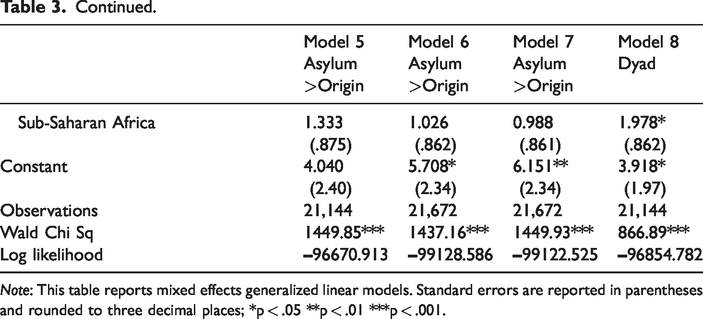
Note: This table reports mixed effects generalized linear models. Standard errors are reported in parentheses and rounded to three decimal places; *p < .05 **p < .01 ***p < .001.
Overall, the results indicate that as FRPs become more successful, the asylum recognition rate decreases. This provides support for H3-5. When FRPs gain votes, legislative seats, and cabinet posts, the expected asylum recognition rate will decrease. This translates to a higher number of rejected asylum claims. The results for each coefficient are negative and statistically significant.
These results are robust to several specifications, as well. In the Online appendix, I report additional models calculated with fixed effects at the asylum country, origin country, and asylum-origin dyad levels. Similarly, I also check for potential temporal effects by running a series of models with dummy variables for five-year periods as well as a post-migrant crisis dummy variable. Across all of these additional models, the FRP variables remain negative and statistically significant, suggesting that the estimates are not due to unobserved country-specific or dyad-specific factors. While some of the time variables are statistically significant, the results do not change the interpretation of the effect of FRP success. This provides further evidence that there is a true relationship between FRPs and asylum recognition rates.
Substantively, the impact of FRPs is more pronounced than right-wing parties. For all other values held at their means, a one standard deviation increase from the mean of far-right vote share is associated with a decrease in asylum recognition from 17.85 with a standard error of 1.456 to 16.87 with a standard error of 1.478. For seat share, this number is 0.628. This represents an expected decrease of asylum recognition rate of about .973 percentage points according to the point estimators. To recall the example of Sweden in 2018, a decrease of 0.973 in the recognition rate would represent an additional 568 rejected asylum claims. I have included complete tables of the marginal probabilities, including the 95% confidence intervals for the point estimators in the Online appendix.
Models 5 and 8 in Table 3 show that a higher vote share going to FRPs is associated with lower asylum recognition rates. The reported models do not include vote share and seat share in the same estimation because of the high degree of collinearity between these two measures. Models 6 and 7 use FRP seat share and cabinet membership, respectively. These measures may be described as better indicators of the formal power afforded to the far-right. Unsurprisingly, these variables also have negative, significant coefficients, indicating more formal power in government for FRPs is associated with lower asylum recognition rates.
Because there is high collinearity between vote share, seat share, and cabinet membership, it is not appropriate to include these variables in the same model. However, this presents a problem relating to how FRPs might influence asylum recognition rates. As discussed earlier, FRPs may exert influence not only by gaining legislative power and directly affecting policy, but also by acting without the system in ways that change incentives for other parties. Thus, I re-estimate the relationship between FRP vote share and recognition rate for a subset of dyads where FRPs won no legislative seats. The results of these models are reported in Table 4.
Subsample of countries with no FRP legislative seats.
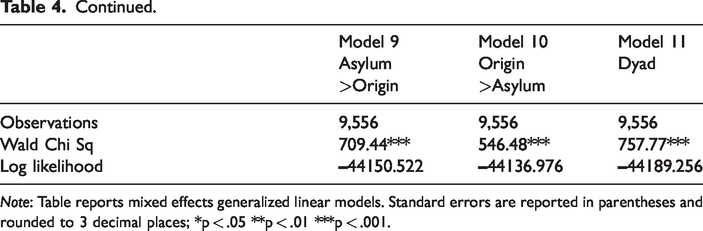
Note: Table reports mixed effects generalized linear models. Standard errors are reported in parentheses and rounded to 3 decimal places; *p < .05 **p < .01 ***p < .001.
Models 9–11 show a positive, significant coefficient for FRP vote share. In other words, in countries where the far-right has won no legislative seats, an increase in voting for the far-right is associated with higher asylum recognition rates. This strongly suggests that FRP’s presence in government results in the observed reduction in asylum rates. One potential reason for this could be that FRPs are drawing supporters from the mainstream right parties, and splitting the right-wing vote, allowing left-wing parties to gain more legislative seats. These left-wing parties, in turn, may seek to differentiate themselves from the right by taking more positive stances toward immigration or may simply feel more electorally secure to do so. However, further research is necessary to understand what may be driving this relationship.
Regardless, the results of the analyses demonstrate a strong association between parties and asylum recognition rates. In particular, FRPs have the strongest link to recognition rates when they gain formal power in government via legislative seats and cabinet posts. Left-wing parties, on the other hand, have no observable relationship with asylum-recognition rates.
Discussion
This article examines the effect of parties on asylum recognition rates in EU member states, finding that right-wing and far-right parties are associated with lower asylum recognition rates. While this finding is robust to various statistical specifications, the implications of this finding warrant further discussion. I have presented evidence that FRPs and, to a lesser degree, right-wing parties push systems to be more restrictive towards asylum. The anti-asylum rhetoric espoused by parties of the right and far-right make this a convincing interpretation.
Nevertheless, there are some limitations to this research. First, despite accounting for overall application rates and previous recognition rates, endogeneity cannot be completely eliminated from the models. While there is some debate as to the relationship between asylum-seekers and FRP support (see Amengay and Stockemer, 2019; Spies, 2013; Van der Brug, 2005), it is possible that high numbers of asylum applications in previous years stoke anti-asylum sentiments that lead to the electoral success of FRPs as well as reduced asylum-recognition rates. While the lagged asylum applications per capita should capture some of this effect, it may not capture a cumulative effect. However, it is unlikely that this is entirely driving the finding. While there may be an increase in demand for parties of the far-right coinciding with anti-asylum sentiment due to exogenous factors not accounted for, the fact remains that FRPs tend to be relatively minor parties. If anti-asylum sentiment were somehow endemic in a system, we would likely see much higher rates of support for the far-right. Further, this would not explain the findings presented in Table 4, suggesting that FRP electoral success is only associated with lower recognition rates when it is translated into legislative seats. Rather, this suggests that it is FRPs acting within the political institutions that drives asylum recognition rates down when FRP support grows.
Another limitation is the difference between border EU states and internal states in terms of the number of applications received. Some states, such as Greece and Italy, receive large numbers of arrivals from the Mediterranean, particularly as the situation in Syria has deteriorated. In such cases, states exceed their capacity to accommodate individuals and process claims. Such a situation is likely to lead to reduced recognition rates as decision-makers become overwhelmed and desensitized. However, much of this effect should be captured by controlling for asylum-applications per capita and the use of country-level fixed effects. While future research may wish to take a more in-depth look into the role of geography in determining asylum claims in its own right, a lengthy discussion would be outside the scope of this study.
Another potential avenue for future research is to further examine within-state differences in asylum recognition rates. While these data can be more difficult to obtain, they would also allow for a more detailed examination of the decision-making process. It may lend further insight into the process by which domestic political conditions shape decision-makers. As it stands, it is difficult to ascertain the extent to which changes are the result of subtle changes in the perceptions of decision-makers fueled by the overall political climate or due to official changes to policies, personnel, and procedures. Additional research should examine the rule of law and how violations of international human rights laws are treated in order to better understand the mechanism that may be driving this relationship.
Conclusion
Parties on the right, particularly FRPs, have a strong link to lower asylum-recognition rates. This finding demonstrates the importance of domestic politics and political parties in determining asylum outcomes. Even within the EU, where a common set of rules and procedures have been established for adjudicating asylum claims, the domestic political situation seems to affect the likelihood that asylum claims will be recognized. For FRPs, electoral success translates to reduced recognition rates.
This research has implications for the understanding of how FRPs influence substantive policy outcomes as well as the understanding of how asylum claims are adjudicated. This article adds to growing evidence that asylum-decisions are not based solely on the legitimacy of the claim but that political considerations also affect the outcome. This is particularly concerning because denying a legitimate claim to asylum can lead to dire consequences for asylum-seekers. This highlights the importance of continuing scrutiny of asylum processes and efforts to ensure that the right to asylum is fair and accessible for all who may need it.
Supplemental Material
sj-pdf-1-eup-10.1177_1465116520977005 - Supplemental material for The far-right and asylum outcomes: Assessing the impact of far-right politics on asylum decisions in Europe
Supplemental material, sj-pdf-1-eup-10.1177_1465116520977005 for The far-right and asylum outcomes: Assessing the impact of far-right politics on asylum decisions in Europe by Meredith Winn in European Union Politics
Supplemental Material
sj-zip-2-eup-10.1177_1465116520977005 - Supplemental material for The far-right and asylum outcomes: Assessing the impact of far-right politics on asylum decisions in Europe
Supplemental material, sj-zip-2-eup-10.1177_1465116520977005 for The far-right and asylum outcomes: Assessing the impact of far-right politics on asylum decisions in Europe by Meredith Winn in European Union Politics
Footnotes
Acknowledgements
I would like to thank John Ishiyama, Idean Salehyan, Walker Lee, Marijke Breuning, Jacqueline Demeritt, and Christopher Williams for their encouragement and feedback during the writing and revision of this article. I would also like to thank the anonymous reviewers and the editors for their comments.
Funding
The author(s) received no financial support for the research, authorship, and/or publication of this article.

Supplemental material
Supplemental material for this article is available online.
References
Supplementary Material
Please find the following supplemental material available below.
For Open Access articles published under a Creative Commons License, all supplemental material carries the same license as the article it is associated with.
For non-Open Access articles published, all supplemental material carries a non-exclusive license, and permission requests for re-use of supplemental material or any part of supplemental material shall be sent directly to the copyright owner as specified in the copyright notice associated with the article.
