






Abstract
This article investigates whether public preferences for European solidarity are associated with vote choices in the 2019 European elections. After multiple crises, the politicisation of European Union affairs has increased, polarising voters and parties between those favouring the redistribution of risks across member states and those prioritising national responsibility in coping with the consequences of the crises. We expect pro-solidarity voters to be more prone to vote for green and radical-left parties and less prone to vote for conservative and radical-right parties. Testing these hypotheses in 10 European Union countries with original survey data, we find that green and radical-left parties profited from European solidarity voting only in some countries, while being pro-solidarity reduced the likelihood of voting for both moderate and radical-right parties in each sample country.
Introduction
European elections were held in May 2019 following an unprecedented number of complex and interrelated crises that the European Union (EU) experienced after 2008: the Great Recession, the European sovereign debt crisis, the refugee crisis and Brexit. A vast amount of literature shows that the politicisation of the EU increased during this testing period (Hutter and Kriesi, 2019; Van der Brug et al., 2022). European public opinions polarise not only along the integration–demarcation divide but also concerning whether the EU should or should not implement policies to share the burden of the crises across EU member states and citizens (Gerhards et al., 2020).
The growing saliency of the social dimension of the EU has also been observed in the manifestos of all European political groups, in which the number of policy proposals strengthening European solidarity increased in the 2019 election campaign compared with 2014. Furthermore, parties were polarised between those standing for a form of economic integration that prioritises fiscal stability, without any interference from the EU in national social security systems, and those advocating for a ‘social Europe’, the priorities of which should be to correct the imbalances of the market and ensure a high level of social protection for European citizens (Pagano and Regazzoni, 2019). This conflict reflects the longstanding debate on the type of European integration desired, distinguishing analytically between ‘negative’ and ‘positive’ integration (Scharpf, 1999, 2010), and the question of whether the EU should be more than just a regulatory state (Majone, 1996). Against this background, this study aims to investigate whether voters' preferences for European solidarity – a concept that refers to the individual willingness to share (economic) risks across the EU (Ciornei and Recchi, 2017: 470) – affected their voting behaviour in the 2019 European elections.
According to the second-order theory, voters usually interpreted European elections as less relevant than national contestations and mainly used them to signal their dissatisfaction with the government parties by voting for challengers (Hix and Marsh, 2011; Marsh, 1998; Reif and Schmitt, 1980). Nevertheless, more recent studies provide evidence that, in European as well as in national elections, parties also compete over EU-related issues and voters may cast their vote based on proposals concerning the future of the EU (Hix and Marsh, 2007; Hobolt et al., 2009; Hobolt and Wittrock, 2011; Van Spanje and De Vreese, 2011). In particular, Hobolt (2015) and Hobolt and De Vries (2016) demonstrate that citizens' preferences for intra-EU financial redistribution and their evaluation of the EU's performance in coping with the Eurozone crisis were associated with voting for Eurosceptic parties located on both the far left and the far right in the 2014 European elections.
Grounded in the EU issue voting literature, this article provides two main contributions. First, we unpack support for the EU by investigating the preferences for a specific type of Europe, namely ‘social Europe’, which implies a proactive policy-making role in the social dimension (Ferrera, 2017; Vandenbroucke et al., 2017). Differently from Hobolt (2015) and Hobolt and De Vries (2016), we refer to multiple crises and consider forms of solidarity that imply not only financial help for other countries but also EU-level social policies, the freedom of movement of European citizens and a common policy on refugee management. Second, we do not simply consider the distinction between mainstream and Eurosceptic parties but investigate the party-specific effects of European solidarity voting.
Although reliable sources that systematically estimate parties' positions on the issue of European solidarity do not exist, we expect to find precise directionality in the association between public attitudes towards European solidarity and party choices. Voters who support European solidarity should reward especially green parties, which, more than others, campaigned for a deepening of the integration process even in policy areas that are currently prerogatives of member states, and radical-left parties, which strongly opposed fiscal austerity and voiced their support for the redistribution of resources between member states. In contrast, we expect negative attitudes towards European solidarity to be associated with a higher propensity to vote not only for hard-Eurosceptic radical-right parties, which believe that the EU should be abandoned, but also for mainstream right-wing parties (mainly the European People's Party (EPP)), which support the current economic governance but tend to oppose further integration in the social policy domain.
We test our expectations by means of original survey data collected in 10 EU member states just after the 2019 European elections (Donati et al., 2021). The empirical results provide evidence that individual attitudes towards European solidarity were significantly associated with vote choices in the 2019 European elections. While right-wing parties were penalised by pro-solidarity voters in almost all the sample countries, radical-left and especially green parties were rewarded only in some of the sample countries. In Northern Europe, pro-solidarity voters were more likely to vote for social democratic parties (SDPs).
The multiple crises and the conflict over European solidarity
Since the approval of the Maastricht Treaty in 1992, the increasingly intrusive policy-making role played by the EU has contributed to reshaping political competition across the member states (Hooghe and Marks, 2018; Kriesi et al., 2012). The increasing relevance of the EU has become clear in the aftermath of the multiple crises that Europe has experienced in the last decade, with harsh consequences for political relations among member states and for European citizens' everyday life. The sovereign debt crisis set the stage for the implementation of new mechanisms for giving financial assistance to debt-ridden member states. High unemployment rates in Southern Europe increased the number of EU citizens who exercised their cross-border social rights, putting the national welfare states of Northern European countries under stress and highlighting the potential benefits of EU-level measures targeting citizens in need. In addition, the migrant crisis-induced some national governments to ask for a redistribution of refugees and asylum seekers among all the member states. Thus, whether (and how) the burden of these multiple crises should be shared among European member states and citizens or instead should be a responsibility of single national governments became an increasingly salient and polarising issue among both voters and parties (Gerhards et al., 2020).
The development of EU-level policies to cope with the economic and social consequences of the crises prompted discussions about which principles and ideas of solidarity ought to apply among EU member states and European citizens (Ferrera, 2017; Vandenbroucke et al., 2017). This concept is not easy to grasp because solidarity has been conceptualised historically in national terms and institutionalised through the development of welfare states. However, the deepening and widening of the integration process over the last 60 years generated tensions between the ‘logic of closure’, typical of national welfare states, and the ‘logic of openness’, which characterised the EU, and forced institutions and citizens to reframe the concept of solidarity in European terms (Ferrera, 2005, 2017).
In line with the extant literature, we distinguish between three analytically distinct, though strongly interrelated, dimensions of European solidarity (Baute et al., 2018; Ciornei and Recchi, 2017: 470; Gerhards et al., 2020). Cross-national solidarity refers to obligations and risk sharing among EU member states. The structural and cohesion funds, the European Stability Mechanism and the Next Generation EU (NGEU), issued in July 2020 to help member states recover from the coronavirus disease 2019 (COVID-19) pandemic (European Commission, 2020a), are examples of policy instruments built to strengthen solidarity among EU member states through a logic of redistribution from the richest countries to the less-developed ones. The other two dimensions of solidarity entail sharing social and economic risks among European citizens. European social citizenship is a cornerstone of the integration process and refers to European citizens' right to exercise the free movement principle and entitlement to cross-border welfare rights. Finally, interpersonal solidarity points to those EU-level redistribution mechanisms that target needy European citizens as such, irrespective of their country of origin or residence. The instrument for temporary Support to Mitigate Unemployment Risks in an Emergency (SURE), recently proposed by the European Commission to face the detrimental consequences of the COVID-19 pandemic, is moving exactly in this direction (European Commission, 2020b).
The recent literature advances and empirically tests a variety of theoretical approaches to explain public attitudes towards European solidarity. Among them, we can find utilitarian calculations, cosmopolitan attitudes and feelings of European identity, and transnational practices (Ciornei and Recchi, 2017; Gerhards et al., 2020; Kuhn et al., 2017; Verhaegen, 2018). At the aggregate level, whether and how much different countries have been hit by the different crises affect individual preferences for European solidarity. Baute et al. (2019) show that public attitudes towards European solidarity are not simply driven by the general support for EU integration but are affected by the very idea of Europe, in terms of policy priorities, that citizens prefer. While prioritising economic policies is negatively associated with preferences for European solidarity, citizens who prioritise a social agenda are more likely to support intra-EU redistribution mechanisms. In the next section, we take a further step by explaining how preferences for social Europe contributed to shaping party choices in the 2019 European elections.
Linking attitudes and votes for a social Europe
While, for a long time, European elections have been interpreted merely as second-order elections, scholarship increasingly emphasises the importance of EU issue voting. The increase in the electoral turnout in 2019 and the substantial gains for parties – such as the green, liberal, and radical-right forces – with clear-cut stances on the EU suggests that EU issue voting is gaining prominence.
However, the aggregate picture does not allow us to shed light on the very nature of EU issue voting. The consolidated literature tends to interpret the contestation of European integration as being structured along a single pro-/anti-integration dimension orthogonal to the traditional economic left/right dimension (Kriesi et al., 2012). Accordingly, electoral gains for Eurosceptic parties can mainly be explained by public opposition to European integration, while the fate of mainstream parties is among others a consequence of voters' Europhile attitudes. A variety of theoretical models disentangles the multiple dimensions composing individuals' EU attitudes (utilitarianism, identity, performance, affect and strengthening) and test their impact on voting behaviour in European elections (Boomgaarden et al., 2011; Van Spanje and De Vreese, 2011). Other studies focus on the differences between Euroscepticism at the radical left and Euroscepticism at the radical right by determining which ideological motivations prompt public opposition to the EU in national and European elections (Van Elsas et al., 2016; Van Elsas and Van Der Brug, 2015). However, these contributions do not engage explicitly with the more recent debate on social integration and European solidarity and do not consider the different nuances that may characterise public support for European integration.
To understand fully the impact of EU issue voting after the multiple crises that have hit Europe in the last decade, we believe that scholars should not only focus on the traditional juxtaposition between pro- and anti-EU orientations but also consider ‘what kind’ of European integration those political actors with positive EU stances would prefer. On the one hand, the Eurozone and refugee crises have exacerbated the integration–demarcation divide by fostering a mounting public rejection of the entire EU project, as shown by the Brexit referendum. On the other hand, they have increased the polarisation among those who support EU membership and integration regarding whether the burden of the crises should be shared (or not) among EU member states and citizens (Ferrera, 2017). Thus, some Europhile voters and parties harshly criticise the enlargement of EU prerogatives in the social sphere and oppose the adoption of policies aiming to ensure a decent standard of living for all European citizens, financial help for member states facing severe economic difficulties and mechanisms to redistribute refugees (Ferrera, 2017; Scharpf, 2010).
Hence, we contribute to the literature that analyses voting behaviour in European elections by focusing on the role played by public support for European solidarity. Being a positional issue, we do not simply expect a higher propensity to vote for parties that put the EU at the centre of their political agenda; we expect clear directionality of the relationship between attitudes and vote choices based on parties' positions on the EU policy priorities. Unfortunately, while commonly used sources, such as the Manifesto Project and the Chapel Hill Expert Survey, provide measures of parties' general support for the EU, they do not allow us to estimate their positions on European solidarity. Given this gap in the data, we could not employ a research design aiming to explore voters' likelihood of voting for parties that are closer to their preferences regarding European solidarity (see Goldberg et al., 2020 on diffuse support for the EU).
However, an increase in scholarship's attention to specific aspects of European integration is apparent in times of crisis (Hutter and Kriesi, 2019). Some recent studies conducted during the 2019 European election campaign offer interesting insights into parties' positions on EU-related issues by analysing their public statements in both traditional and new media (EEMC, 2019; Haßler et al., 2021). To our knowledge, only Pagano and Regazzoni (2019) focus explicitly on the social dimension of European integration by undertaking a quantitative content analysis of the manifestos presented by European parties during the 2019 campaign. Although this study does not disentangle the different dimensions of European solidarity presented above, it shows that parties' preferences regarding social Europe are mostly aligned along the traditional left–right dimension. Overall, left-wing parties tend to express greater support for policies strengthening the redistribution of risks and resources among EU member states and citizens than their right-wing counterparts, even though major cross-national differences intertwine with variations along the ideological spectrum.
Hypothesis 1: Voters with positive preferences for European solidarity are more likely to vote for green and radical left-wing parties.
Hypothesis 2: Voters with positive preferences for European solidarity are less likely to vote for both moderate and radical right-wing parties.
Green parties, which increased their consensus in the last European Parliament (EP) elections are the ‘usual suspects' when we think about European solidarity. The European Greens (Greens) are the unique transnational party in the EU political landscape and openly campaigned for more integration, even in policy areas that are not explicitly covered by EU policy making, such as fiscal, social and environmental policies. 1 Radical-left anti-austerity parties, such as Syriza in Greece and Unidas-Podemos (UP) in Spain, or their functional equivalents, like Movimento 5 Stelle (M5S) in Italy, focus their political agenda on the implementation of EU-level policies aimed at protecting European citizens from unemployment and poverty (Della Porta et al., 2017). 2 Furthermore, both green and radical-left parties favour the opening of the EU external borders to migration flows and propose new rules that set the stage for automatic mechanisms of redistribution of migrants and asylum seekers among EU member states.
Mainstream right-wing parties, most of them belonging to the EPP and some others to Renew Europe (Renew EU), have been the pivotal actors in the integration process, supporting the market-making orientation that historically characterised the EU project. In line with this view, they mostly believe that nation states should be responsible for their own social security systems while always keeping their budget under control. 3 During the Eurozone crisis, popular parties, especially in the ‘frugal’ countries of Northern Europe, such as Austria, Germany, the Netherlands and Finland, strongly supported a conditionality approach according to which financial help can be provided only in exchange for fiscal austerity measures and structural reforms implemented by the governments of the recipient countries. Radical-right parties are openly averse to the deepening of EU integration, campaigning to abandon the EU. They strongly oppose international redistribution and bailout mechanisms, the fiscal union and the redistribution of migrants, and even question the freedom of movement of EU citizens. Neither the European Conservatives and Reformists (ECR) nor the newly formed Identity and Democracy (ID), which groups hard Eurosceptic radical-right parties, presented a manifesto for the 2019 European elections. However, both their political platforms emphasise the issues of identity and sovereignty, the respect of national specificities and the safeguarding of European borders. 4
Instead, we remain agnostic about a potential association between positive attitudes towards European solidarity and support for SDPs. On the one hand, compared with previous elections, the 2019 manifesto of the Progressive Alliance of Socialists and Democrats (S&D) takes more clear-cut stances in favour of the implementation of European social policies aiming to protect citizens from market failures (Pagano and Regazzoni, 2019). On the other hand, on several occasions during the Eurozone crisis – and during the preparation of the NGEU – the S&D appeared internally divided, with SDPs of Northern Europe being reluctant to support openly mechanisms aimed at sharing liabilities among EU member states.
We tested our hypotheses by exploring the association between public preferences for European solidarity and vote choices for the most important party families represented in the EP: the EPP, the S&D, Renew EU, ECR, the Greens, the Confederal Group of the European United Left/Nordic Green Left (GUE/NGL) and ID.
However, we deemed it to be important to consider not only cross-partisan but also cross-country differences in the way in which European solidarity may affect party choices. Otjes and Katsanidou (2017) demonstrate that, while, in Southern European member states, which were strongly hit by the Eurozone crisis, the contestation over European integration tends to merge with economic issues, in Northern European countries, public attitudes towards the EU are grounded in a broader cultural dimension. Accordingly, Hutter et al. (2018) show that, although anti-austerity movements have been the major driving forces contributing to reshaping partisan competition in Southern Europe, this role has been played by radical-right parties in Northern Europe. Against this background, we also tested our hypotheses in each sample country by investigating the impact of preferences for European solidarity on vote choices for national parties that contested the 2019 EP elections.
Given that we cannot rely on appropriate estimations of parties' positions on the three forms of European solidarity considered, we have advanced general expectations concerning all of them. However, we believe that it is important to keep the three dimensions analytically distinct. Recent studies show that individual-level factors that are associated with support for cross-national solidarity are not necessarily related to support for interpersonal solidarity (Baute et al., 2019; Ciornei and Recchi, 2017; Gerhards et al., 2020). Whether the three analytical dimensions of solidarity had similar or different consequences for voting behaviour in the 2019 European elections is a matter of empirical investigation.
Data and methods
Our analyses employed original survey data collected just after the 2019 European elections in the framework of the ‘Reconciling Economic and Social Europe: The Role of Values, Ideas and Politics' (REScEU) research project. The survey was administered in 10 countries – Finland, France, Germany, Greece, Hungary, Italy, the Netherlands, Poland, Spain and Sweden – via the computer-aided web interviewing (CAWI) methodology on national samples of adult respondents stratified by gender, age, education and region of residence (N = 15,149). 5 The selection of countries aimed to maximise the variation across geographic and cultural areas, the extent to which they have been affected by the crises and the different positions taken by national parties and governments on European solidarity.
Our dependent variable is represented by individual vote choices in the 2019 European elections. We first grouped national parties that contested elections in sample countries into the seven-party groups represented in the EP: EPP, S&D, Renew EU, ECR, Greens, GUE/NGL and ID. In addition, we recoded all the party choices for non-affiliated or smaller parties that are not represented in the EP into two categories based on their left–right ideological stances: ‘Other-Left’ and ‘Other-Right’ (see the Online appendix). This operationalisation allowed us to test our hypotheses by pooling all the sample countries. Then, we ran the empirical models separately for each country, considering the vote choices for different parties as the dependent variable (see the Online appendix). 6
The main independent variables measure individual attitudes towards European solidarity. To analyse the concept of European solidarity across countries exhaustively, we designed 10 agree/disagree items – listed in the Online appendix – to measure citizens' support for policy programmes referring to the three analytical dimensions of the concept: cross-national solidarity, interpersonal solidarity and European social citizenship. Four questions measure citizens' attitudes towards cross-national solidarity. The first one evaluates individual willingness to provide financial help to any EU member state facing economic and financial difficulties in times of crisis. The second and third questions evaluate respondents' preferences regarding whether the EU should support public investments in weaker member states and provide financial help to people living in poorer regions. For all these three questions, the wording includes an element of cost to reduce the social desirability bias affecting questions on redistributive policies. The final item on cross-national solidarity regards the redistribution of asylum seekers among member states regardless of their country of first entry, a divisive topic that was still particularly salient at the end of 2019 and that evaluates a non-financial dimension of member state solidarity.
The second set of items instead gauges citizens' preferences regarding interpersonal solidarity. The three questions are specified in the same fashion, asking respondents whether the EU should introduce schemes to provide financial help for all poor people, for all the unemployed or for all disadvantaged children around the EU and irrespective of their country of origin or residence. To reduce the social desirability bias, an element of cost was introduced, stating that the country of origin of the respondent, as well as all the other member states, would have to pay more money into the EU budget to finance these schemes.
Finally, the last set of questions measures citizens' attitudes towards European social citizenship. The first question asks citizens whether they agree with the idea that EU citizens should receive the same social security benefits as the nationals of the country where they reside. The second asks whether nationals should have priority access to social security benefits. The third question asks whether all foreigners, regardless of their country of origin, should have access to the same social benefits as nationals.
Responses were given by citizens to all 10 questions using 4-point Likert scales (1 – strongly agree, 2 – somewhat agree, 3 – somewhat disagree and 4 – strongly disagree). To allow a straightforward interpretation of the results, we harmonised the original scales so that lower values indicate weaker support for policies strengthening European solidarity and higher values mean stronger support.
To analyse the overall structure of voters' attitudes towards European solidarity, we ran confirmatory factor analyses (CFAs) with parameters fitted using the asymptotic distribution-free procedure on the 10 items listed in the Online appendix. This method makes no normality assumption and is a form of weighted least squares that is asymptotically equivalent to maximum likelihood in a sufficiently large sample. This method fits well with the ordinal nature of our measures and with the size of our samples. Following previous works in the literature (Baute et al., 2018), we specified two models: the first determines whether there is a single latent European solidarity dimension capturing all 10 items; the second is instead a first-order model with three latent correlated factors.
The results of the CFA (see the Online appendix) show that in all sample countries a unidimensional model of European solidarity is not adequate to explain citizens' attitudes towards the 10 measures of solidarity. In line with Baute et al.’s (2018) findings on the Belgian case, the model fit indices improved significantly when we moved to a first-order model with three latent constructs that are correlated with each other. This configuration returned significant coefficients for all items in each country, with the exception of one item in Poland. The overall results suggest that these three dimensions of European solidarity constitute separate but interrelated constructs in the minds of individuals across all 10 countries investigated. The levels of correlation between the three dimensions of European solidarity in the 10 sample countries range between 0.48 and 0.95, with an average value equal to 0.77 (see the Online appendix). This result indicates that the three latent constructs are interrelated in the minds of European voters, but the correlation is far from perfect. Not surprisingly, the association between cross-national and interpersonal solidarity, which both represent the willingness to support active policies implemented by the EU, is generally strong. The correlation between both these dimensions and the third one, European social citizenship, which refers to support for free movement, is instead weaker.
Thus, to measure citizens' attitudes towards European solidarity, we predicted respondents' position on each of these three latent constructs. The factor scores were standardised around their mean, with low (high) scores indicating low (high) support for European solidarity. Before turning to the individual-level analysis, we briefly illustrate the aggregate-level differences in the support for European solidarity. Figure 1 plots, for each sample country, three bars displaying the average level of public support for the three dimensions of solidarity. Not surprisingly, the average level of support for policies strengthening European solidarity is higher in the Southern European member states – Greece, Italy and Spain – which were strongly hit by both the economic and the migrant crisis. Therefore, in these three countries, cross-national solidarity is the dimension that receives a higher level of support. Greece, Italy and Spain are followed by Hungary and Poland. In Hungary, the interpersonal form of European solidarity receives a high level of support. Finally, in the Northern European countries – the Netherlands, Finland, France, Germany and Sweden – citizens are less supportive of European solidarity with differences according to the dimension of the concept considered.

Cross-country differences in the support for European solidarity.
We controlled for the impact of preferences for European solidarity on vote choices by including alternative explanatory factors in the empirical models. Here, we provide a list of the control variables, referring to the Online appendix for a detailed description of the coding rules. To assess the importance of European solidarity in relation to other policy issues, we controlled for respondents' self-placement on scales from zero to 10, measuring their preferences for left–right, economic redistribution, immigration, same-sex marriage, and law and order. To control for alternative EU issue voting explanations, we included attitudes towards a country's membership of the EU (utilitarian approach) and exclusive national identity (identity approach). The second-order model perspective was controlled for by considering respondents' trust in the national government and the retrospective evaluation of the national economy. Finally, we controlled for socio-demographic characteristics: gender, age, education, unemployment status and intertemporal material deprivation, which indicates whether respondents, at the time of the survey, felt their socio-economic status to be improved or worsened compared with their status five years earlier. 7
The empirical analyses that follow employed multinomial regression models in which respondents' vote choice in the 2019 European elections was regressed on the main independent variables and controls. 8 Due to their high level of correlation, to disentangle the net effects of each single dimension of European solidarity on the vote choice, the three indicators were included in separate models. As a robustness check, to capture the net impact of European solidarity attitudes, we also run empirical models controlling only for socio-demographic variables and excluding subjective attitudes and orientations towards political issues that are proximate to solidarity attitudes.
Empirical results
The empirical analyses demonstrate that, in the 2019 European elections, preferences for European solidarity were significantly associated with vote choices. Overall, the extent of European solidarity voting was in line with our expectations but varied across national party systems.
We first present the results at the level of EP and then discuss the cross-country differences in the impact of European solidarity voting on different national parties. Figure 2 shows a graph plotting the change in the predicted probability of voting for different party groups in the EP resulting from a one-standard-deviation change in the three independent variables – cross-national solidarity, interpersonal solidarity and European social citizenship – controlling for the impact of all the control variables. Positive values, above the horizontal zero line, indicate that greater support for European solidarity increases respondents' propensity to vote for a specific party, while negative values, below the horizontal zero line, indicate that more positive preferences for European solidarity decrease respondents' propensity to vote for a specific party. The figure displays the 95% confidence intervals. Readers who are interested in the multinomial regression coefficients should refer to the Online appendix, which provides full estimates of the vote choice for different European party groups at changing values of all the covariates included in the model.
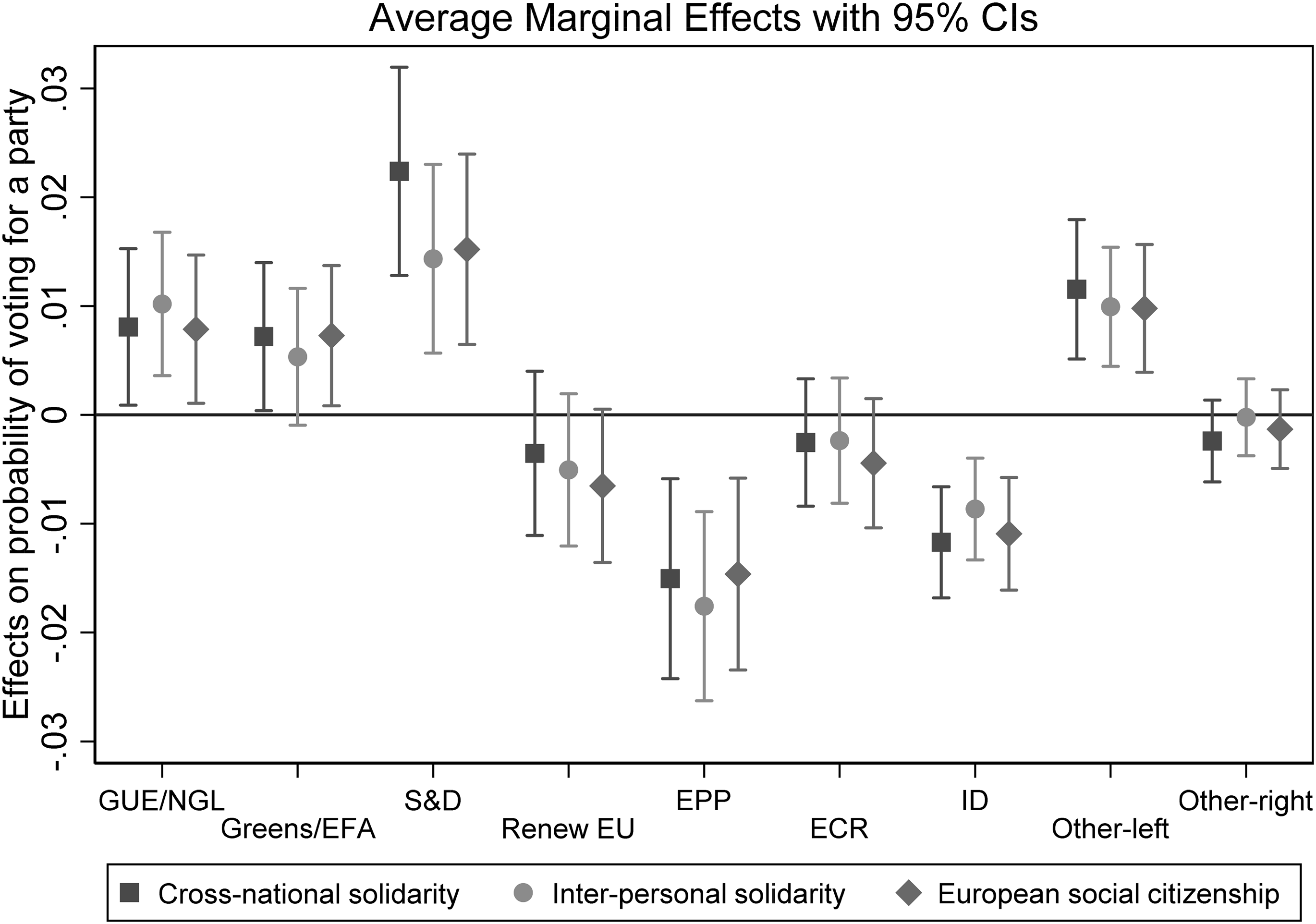
Marginal effects of European solidarity on party choice in the European Parliament.
Figure 2 shows that our empirical results confirm both Hypotheses 1 and 2. Hypothesis 1 postulates that voters in favour of European solidarity are more likely to vote for radical-left parties and non-mainstream pro-EU parties, such as the Greens. All three European solidarity dimensions are positively and significantly associated with a higher predicted probability of voting for a party belonging to GUE/NGL or the Greens. Moreover, lending support to our expectation, a one-standard-deviation increase in the value of European solidarity is significantly associated with a higher propensity to vote for a party with radical-left stances but not affiliated with any of the party groups composing the EP. Compared with the effects displayed on GUE/NGL and the Greens, the impact of European solidarity voting on parties grouped in the category ‘Other-Left’ is even larger in magnitude and significance. Although we did not express clear expectations regarding the association between preferences for European solidarity and voting for SDPs, Figure 2 clearly shows that S&D is the group that benefited more than all the others from European solidarity voting in the 2019 European elections. The impact is large in magnitude and highly significant, especially concerning cross-national solidarity. This result can partially be explained by the fact that the S&D manifesto relies more on specific proposals and detailed policies, while the GUE/NGL manifesto is more concerned with generic ideas and values (Pagano and Regazzoni, 2019).
Our findings also lend support to Hypothesis 2, which postulates that positive preferences for European solidarity are negatively associated with the electoral support for moderate right-wing pro-EU parties and hard-Eurosceptic radical-right parties. An increase of one standard deviation in voters' support for each of the three different forms of European solidarity is inversely and significantly associated with the predicted probability of voting for parties belonging to the EPP and parties affiliated with the newly formed ID group. Thus, our results confirm our expectation that even political parties that support the integration process were punished by voters with preferences for a specific kind of integration: the strengthening of EU social prerogatives. We did not detect, however, a significant relationship between preferences for European solidarity and votes for either Renew EU or ECR. Parties belonging to the former are highly supportive of European integration but often ambivalent concerning social Europe. ECR includes both soft- and hard-Eurosceptic parties with different positions on several aspects of the integration process, one among which is social integration. Finally, different from radical-left non-affiliated parties, our findings display no significant impact on non-affiliated parties with radical-right stances.
There are only a few differences in the impact displayed by the three forms of European solidarity, confirming that these dimensions are analytically distinct but highly interrelated. Voters who were interested in strengthening interpersonal solidarity were more likely to vote for GUE/NGL, which proposed a substantially more ambitious budget and Eurobonds to achieve full employment and social justice, whereas they were less likely to support the EPP, which pointed instead to the defence of the national welfare systems' specificities. Voters who were more interested in cross-national solidarity and European social citizenship were instead more likely to reward S&D and the Greens, the party with the strongest cosmopolitan stances, and to punish ID, which opposed extra-EU immigration and the redistribution of migrants.
Looking at the electoral impact of attitudes towards European solidarity on party groups in the EP may cover interesting cross-country variations due to peculiarities of national party systems. Therefore, we estimated the regression results separately for the 10 countries included in our sample. For ease of presentation, Table 1 summarises the findings for each country by showing which parties the respondents supporting European solidarity were more (third column) and less (fourth column) likely to choose. The right-most column instead reports those parties that were not associated with voters' opinions about European solidarity. The Online appendix shows for each country one graph plotting changes in the predicted probability of voting for national parties with a one-standard-deviation increase in the three measures of European solidarity. Moreover, it includes full estimates of vote choice for different national parties at changing values of all the covariates included in the model.
Summary of the effects of European solidarity on party choices across countries.
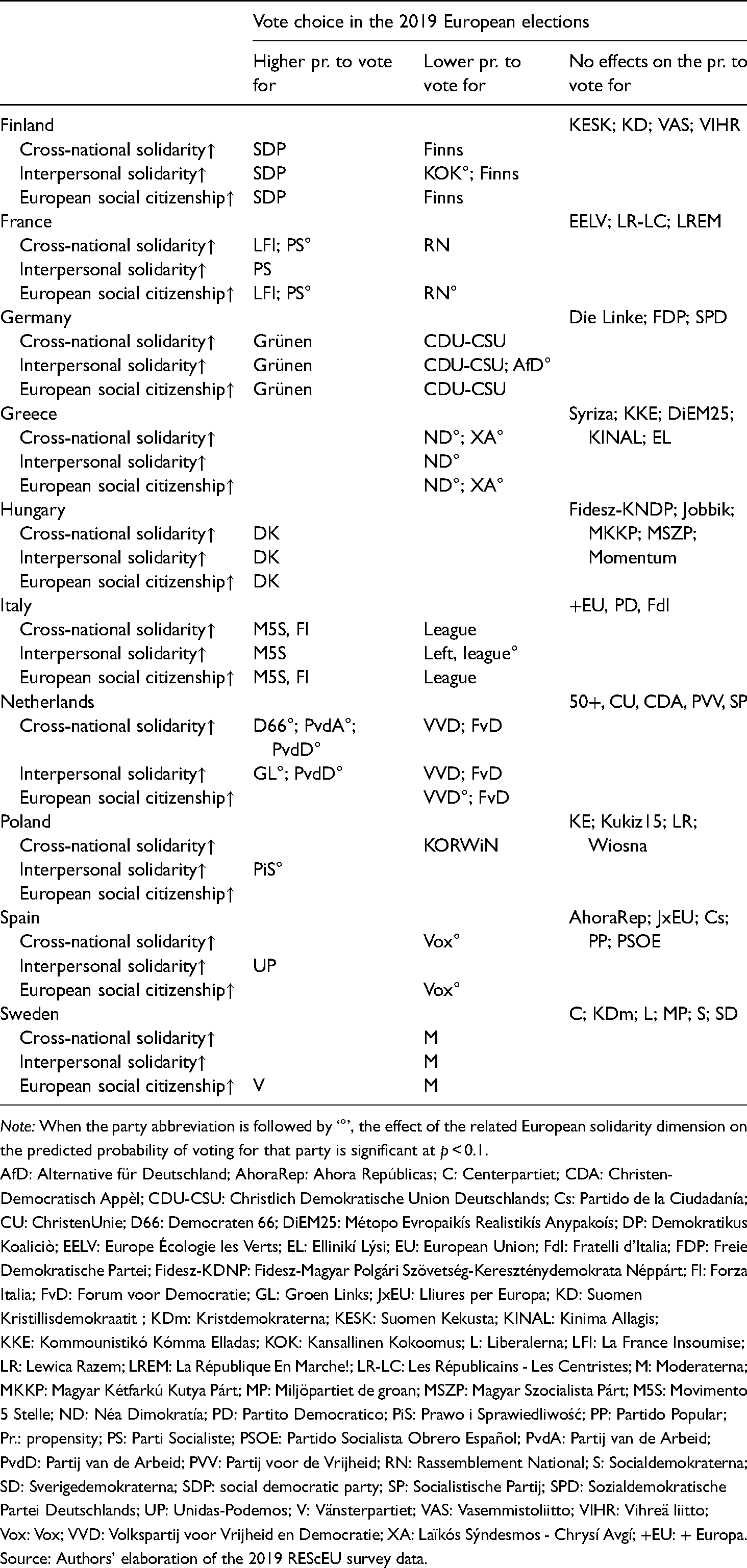
Note: When the party abbreviation is followed by ‘°’, the effect of the related European solidarity dimension on the predicted probability of voting for that party is significant at p < 0.1. AfD: Alternative für Deutschland; AhoraRep: Ahora Repúblicas; C: Centerpartiet; CDA: Christen-Democratisch Appèl; CDU-CSU: Christlich Demokratische Union Deutschlands; Cs: Partido de la Ciudadanía; CU: ChristenUnie; D66: Democraten 66; DiEM25: Métopo Evropaikís Realistikís Anypakoís; DP: Demokratikus Koaliciò; EELV: Europe Écologie les Verts; EL: Ellinikí Lýsi; EU: European Union; FdI: Fratelli d'Italia; FDP: Freie Demokratische Partei; Fidesz-KDNP: Fidesz-Magyar Polgári Szövetség-Kereszténydemokrata Néppárt; FI: Forza Italia; FvD: Forum voor Democratie; GL: Groen Links; JxEU: Lliures per Europa; KD: Suomen Kristillisdemokraatit ; KDm: Kristdemokraterna; KESK: Suomen Kekusta; KINAL: Kinima Allagis; KKE: Kommounistikó Kómma Elladas; KOK: Kansallinen Kokoomus; L: Liberalerna; LFI: La France Insoumise; LR: Lewica Razem; LREM: La République En Marche!; LR-LC: Les Républicains - Les Centristes; M: Moderaterna; MKKP: Magyar Kétfarkú Kutya Párt; MP: Miljöpartiet de groan; MSZP: Magyar Szocialista Párt; M5S: Movimento 5 Stelle; ND: Néa Dimokratía; PD: Partito Democratico; PiS: Prawo i Sprawiedliwość; PP: Partido Popular; Pr.: propensity; PS: Parti Socialiste; PSOE: Partido Socialista Obrero Español; PvdA: Partij van de Arbeid; PvdD: Partij van de Arbeid; PVV: Partij voor de Vrijheid; RN: Rassemblement National; S: Socialdemokraterna; SD: Sverigedemokraterna; SDP: social democratic party; SP: Socialistische Partij; SPD: Sozialdemokratische Partei Deutschlands; UP: Unidas-Podemos; V: Vänsterpartiet; VAS: Vasemmistoliitto; VIHR: Vihreä liitto; Vox: Vox; VVD: Volkspartij voor Vrijheid en Democratie; XA: Laïkós Sýndesmos - Chrysí Avgí; +EU: + Europa.
Source: Authors' elaboration of the 2019 REScEU survey data.
As expected, we detected interesting cross-country variations that are worth discussing. We found a significant positive association between the support for European solidarity and the propensity to vote for green and radical-left parties, as postulated in Hypothesis 1, in 6 out of 10 countries. Voters who are in favour of policies fostering social Europe were more likely to vote for a green party in Germany, and in the Netherlands, where voters who support cross-national and interpersonal solidarity were more likely to vote for Groen Links (GL) and Partij voor de Dieren (PvdD). In the Netherlands, however, these associations are significant only at the 10% level. Green parties did not profit from European solidarity voting either in Finland or in Sweden, even though they made electoral gains in the 2019 European elections.
Considering the different electoral competition dynamics that characterise contestation over European integration in Southern Europe (Hutter et al., 2018), in Greece, Italy and Spain, we expected the issue of European solidarity to be prioritised by radical-left ‘movement parties’ rather than green parties (Della Porta et al., 2017). However, in Greece – the country that was worst affected by the Euro crisis and by the economic and fiscal adjustment programmes of the Troika – neither Syriza nor Democracy in Europe Movement 2025 – the transnational anti-austerity movement led by Yannis Varoufakis – benefited from European solidarity voting. Presumably, Syriza was penalised due to its participation in the governments that led Greece out of the crisis between 2015 and 2019 at the expense of high social costs for the population.
In Spain, only voters who advocated for more interpersonal solidarity were more likely to vote for UP, while preferences for cross-national solidarity and European social citizenship were not significantly associated with any of the Spanish political parties. In Italy, individual preferences in support of the three forms of European solidarity were positively and significantly associated with the populist M5S party which obtained strong electoral consent in the Italian national election held in March 2018. Although M5S has been characterised by strong ambiguity over EU issues, on several public occasions, its representatives have emphasised the necessity to ‘return to the principles of solidarity and community’ in the EU (Della Porta et al., 2017: 132). Another possible explanation for this result could be that M5S capitalised on the adoption of a new welfare instrument, the reddito di cittadinanza (citizenship income), a monetary benefit targeting poor households conditional on participation in job-searching activities. Contrary to Syriza, M5S was not penalised for its government experience in terms of European solidarity voting while losing about 15% of votes compared with the 2018 national elections.
We also uncovered a systematic relationship between the support for European solidarity and a greater propensity to vote for a radical-left party in France and Sweden. In France, voters who expressed a position in favour of cross-national solidarity and cross-border welfare rights were more likely to vote for La France Insoumise, another party that harshly criticised EU governance from a radical-left position. In Sweden, voters who expressed support for European social citizenship were more prone to vote for Vänsterpartiet, whereas the preferences for the other two forms of European solidarity were not significantly associated with any party. Furthermore, as already detected at the EP level, in some countries, preferences for European solidarity were significantly associated with votes for moderate left-wing parties. This was the case in Finland (SDP), Hungary (Demokratikus Koaliciò) and, with a lower level of significance, France (Socialist Party) and the Netherlands (Democraten 66 and Partij van de Arbeid). Finally, and surprisingly, in Italy, voters with positive preferences for cross-national solidarity and European social citizenship were more likely to vote for FI, the moderate right-wing party led by Silvio Berlusconi, and, in Poland, voters who supported interpersonal solidarity were more prone to vote for PiS, the government party affiliated with ECR. At least for FI, this result can partially be explained by previous findings showing that, in countries that were strongly hit by the euro crisis, popular parties became more in favour of Keynesian anti-crisis measures despite their right-wing economic stance (Maatsch, 2014).
We now turn to the second hypothesis, which postulates an inverse relationship between support for European solidarity and votes for both moderate and radical-right parties. Compared with the first theoretical expectation, the results for this conjecture are more straightforward, showing that, in all the sample countries but Hungary, moderate right-wing and/or radical right-wing parties were penalised by supporters of European solidarity. Not surprisingly, pro-solidarity voters tended to punish moderate right-wing parties, especially in the ‘frugal’ northern countries, such as Germany, the Netherlands and Sweden, where the CDU-CSU, Volkspartij voor Vrijheid en Democratie and Moderaterna, respectively, strongly opposed European solidarity, instead of supporting national responsibility and fiscal austerity. Although at a lower significance level, preferences for European solidarity were also inversely associated with electoral support for Kansallinen Kokoomus (KOK) 9 in Finland and ND in Greece.
In all the sample countries except Hungary and Sweden, we found some evidence that pro-solidarity individuals were less likely to vote for hard-Eurosceptic radical-right parties. This negative association received strong empirical support in Finland, Italy, and the Netherlands, where the preferences for all three dimensions of European solidarity were significantly and negatively associated with the probability of voting for Perussomalaiset (Finns), Lega (League) and Forum voor Democratie (FvD). In France, Greece, Poland, and Spain, moreover, voters with attitudes in favour of cross-national solidarity and European social citizenship were less likely to vote for Rassemblement National, Chrysί Avgί, KORWiN and Vox, respectively. 10 Only in Germany, we detected a negative association between the preferences for interpersonal solidarity and the probability of voting for Alternative für Deutschland. However, in Greece, Germany, Spain and partially France, the negative associations between attitudes towards European solidarity and the probability of voting for a hard-Eurosceptic radical-right party were significant only at the 10% level. A plausible explanation for why, in most countries, a lower probability of voting for a radical-right party was associated only with attitudes towards cross-national solidarity and European social citizenship is that, in recent years, immigration has become one of the most important concerns on the agenda of these parties. While European social citizenship includes survey items that tap attitudes towards the inclusion of foreigners from both other EU member states and third countries in domestic social security systems, cross-national solidarity aggregates items referring to financial help for member states in crisis but also to the redistribution of asylum seekers across the EU.
Not surprisingly, controlling only for respondents' socio-demographic traits, the effects of preferences for European solidarity on party choice are even more pronounced, running along the traditional left–right divide (see the Online appendix). This result confirms that European solidarity attitudes, though partially captured by preferences for other policy issues as well as diffuse support for the EU, were still relevant in shaping voters' electoral behaviour.
Conclusions
The present article investigated whether voters' attitudes towards European solidarity – the individual willingness to share risks across the EU – were associated with their vote choices in the 2019 European elections.
We found that even some years after the peak of the multiple crises that hit Europe, the issue of European solidarity was still salient and polarising the political and public debate across Europe. Controlling for ideology, attitudes towards relevant policy issues, public support for the EU and retrospective evaluation of government performance, preferences for a social Europe significantly affected vote choices in the 2019 European elections. Voters supporting European solidarity were more likely to vote for green and radical-left parties, as well as for social democrats, while they were less likely to vote for radical-right forces as well as popular parties.
We believe that our results provide the scholarship on EU support and party politics with relevant implications. First, we have shown that, after the recent multiple crises, to understand fully the relevance of EU issue voting in European elections, we need to disentangle the support for EU integration by considering ‘what kind’ of Europe voters prefer in terms of policy priorities. Second, the political conflict over European solidarity made explicit the idea that scholars also need to unpack party choices by focusing not only on Eurosceptic parties but also on pro-EU parties, which regained electoral consent in the last EP elections. Finally, our findings stress the relevance of cross-country variation. The extent to which specific party families profited or not from EU issue voting rests on the national political supply and on whether parties took explicit stances on the policy priorities of the EU. Furthermore, this study has relevant political implications. The recent economic and social crises triggered by the COVID-19 pandemic have dramatically revived the issue of European solidarity, showing that it still polarizes voters and parties, and that the adoption of intra-EU financial help and redistribution policies is necessary for the long-term political sustainability and legitimacy of the EU project (Katsanidou et al., 2022).
We conclude by describing how further research can improve our results. First, given the shortage of data estimating parties' positions on European solidarity, while this study detected an association between voters' preferences and their party choices, it could not assess whether political elites respond to the changing preferences of their electorates or whether instead parties cue the mass public through a process of information and persuasion (Steenbergen et al., 2007). However, our findings hold even when controlling for party attachment, which seems to indicate that vote choices are shaped by party preferences and not (only) by party labels (see the Online appendix). Second, testing our hypotheses in national elections would allow scholars to understand whether European solidarity also affects electoral behaviour in national arenas. Finally, further studies could investigate whether specific features of parties, such as their internal cohesion on the issue of social Europe, moderate the relationship between preferences for this policy issue and voting choices.
Supplemental Material
sj-docx-1-eup-10.1177_14651165211035054 - Supplemental material for Voting for a social Europe? European solidarity and voting behaviour in the 2019 European elections
Supplemental material, sj-docx-1-eup-10.1177_14651165211035054 for Voting for a social Europe? European solidarity and voting behaviour in the 2019 European elections by Alessandro Pellegata and Francesco Visconti in European Union Politics
Supplemental Material
sj-zip-2-eup-10.1177_14651165211035054 - Supplemental material for Voting for a social Europe? European solidarity and voting behaviour in the 2019 European elections
Supplemental material, sj-zip-2-eup-10.1177_14651165211035054 for Voting for a social Europe? European solidarity and voting behaviour in the 2019 European elections by Alessandro Pellegata and Francesco Visconti in European Union Politics
Footnotes
Acknowledgements
A draft of this study was presented at the Workshop on 2019 European Elections organised at the Amsterdam Centre for European Studies (ACES) on 30–31 January 2020. The authors are grateful to the workshop’s organisers and participants, as well as to the anonymous reviewers, for their precious comments and suggestions on previous versions of the study.
Declaration of conflicting interests
The authors declared no potential conflicts of interest with respect to the research, authorship and/or publication of this article.
Funding
The authors disclosed receipt of the following financial support for the research, authorship and/or publication of this article: This work was supported by the research project titled ‘Reconciling Economic and Social Europe: The Role of Values, Ideas and Politics' (REScEU), funded by an Advanced Grant of the European Research Council (Grant No. 340534, P.I. Maurizio Ferrera).

Supplemental Material
Supplemental material for this article is available online.
Notes
References
Supplementary Material
Please find the following supplemental material available below.
For Open Access articles published under a Creative Commons License, all supplemental material carries the same license as the article it is associated with.
For non-Open Access articles published, all supplemental material carries a non-exclusive license, and permission requests for re-use of supplemental material or any part of supplemental material shall be sent directly to the copyright owner as specified in the copyright notice associated with the article.
