







Abstract
During the last 20 years, the European Union has been mired in crisis after crisis. At the same time, the number of infringement procedures, the formal requests from the European Commission to member states for compliance, decreased dramatically, despite the addition of 10 member states in 2004. Yet, the link between crises and Commission enforcement activity has not been systematically examined. In this article, I theorize about the role of time, and demonstrate that crises limit the Commission's ability to act as guardian of the treaties. However, crises are not deterministic in nature – the European Parliament and European Union citizens can alter the costs of Commission enforcement. I find that as Euroscepticism increases, the Commission's demand for compliance decreases, in part due to the steep reputational costs to the Commission when member states refuse compliance, especially after sanctions. The number of infringements is also positively correlated with European Parliament action, suggesting that even without formal sanctioning power, the European Parliament plays a role in European Union law enforcement.
Introduction
One of the origin narratives about the European Union (EU) is the ‘crisis as opportunity’ (Dinan et al., 2017: 9) story. Founding member Jean Monnet famously wrote that ‘Europe will be forged in crises and will be the sum of the solutions adopted for those crises’ (Erlanger, 2023). Some scholars accordingly argue that EU integration has historically been pushed forward by crises (Ladi and Tsarouhas, 2020; Müller, 2016; Tosun et al., 2014). The corollary that follows is that today's crises may similarly accelerate EU integration. However, Dinan (2017) warns that the ‘crisis as opportunity’ story was never that clear-cut to begin with, and that the modern string of crises, including the Eurozone crisis, the migration crisis, and the Brexit crisis, seriously threaten the European project.
The effects of what some scholars now call a poly-crisis have not been entirely ameliorated. The disparities in economic growth, magnified by the Eurozone crisis, continue, with southern countries lagging behind their northern counterparts. EU migration policies, pushed to their limits during the Syrian migration crisis, remain unclear or unenforced (Zeitlin et al., 2019). Even as the effects of earlier crises linger, new crises abound. Since 2020, the EU has faced a global pandemic, reckoned with Russia's invasion of Ukraine, struggled to rein in inflation, deal with climate change, and manage a growing authoritarian presence in Eastern Europe. The persistence and depth of these crises have no doubt had a profound effect on EU governance.
I contend here that crises have limited the Commission's ability to monitor and enforce EU law. To test the statistical link between crises and infringements, I develop an original measurement of Commission time. Structural topic models built from the Commission's weekly meeting notes from 2005 to 2020 first reveal latent crisis topics discussed in each meeting, and second, quantify the percent of each meeting spent on a crisis. The hypothesis is that during crises, the number of infringements will decline because the Commission is occupied. The quantitative results support this conclusion. The number of infringements started by the Commission decreased significantly during all recent crises, except during the Covid-19 crisis.
However, other relevant actors, including the European Parliament (EP) and EU citizens, can overcome these constraints by changing the costs of compliance. Demanding compliance can be costly for the Commission. As Euroscepticism increases, the electoral cost of complying with politically unpopular EU directives may become too great for national governments, some of which may refuse compliance, even after sanctions. If the Commission believes a member state is unlikely to comply, they will not want to pursue a potentially costly infringement. The EP can also lower enforcement costs by demanding Commission action. To measure the effect of parliamentary demand on enforcement, I collected over 130,000 written questions from the EP to the Commission from 2005 to 2020. I find that the number of infringements does in fact increase when there are more questions from the EP. While statistics cannot tell us which mechanism is doing the work, it is likely that letters from the EP either inform the Commission about previously unknown noncompliance, or signal EP preference for action.
Background and literature review
In September 2022, the EP resolved that Hungary could no longer be considered a democracy, and demanded that the Commission take swift and decisive action (European Parliament, 2022). In November 2022, the Commission recommended holding back 65% of the cohesion funds allocated to Hungary (European Commission, 2022). This was approved by the EU Council in December 2022 (European Council, 2022), only three months after the EP's resolution. However, the Commission has not always been so quick to respond to member state noncompliance, especially in the midst of a crisis.
In March 2020, Hungary's government declared a ‘state of danger’, claiming that the Covid-19 pandemic necessitated emergency measures (Lazar, 2020). Less than two weeks later, the EP issued a statement asking the EU Commission to investigate whether Hungary's ‘enabling act’ violated EU law. The Council of Europe sent Prime Minister Orbán a letter in late March 2020, writing that the emergency measures ‘restrict[ed] a number of individual rights and liberties enshrined in constitutions and in the European Convention on Human Rights’ (Burić, 2020). Despite the condemnation of the law by two branches of the EU, on 20 March 2020, the Hungarian parliament approved an indefinite extension of the ‘state of danger’ powers (Lazar, 2020; Wahl, 2020). In mid-April, the EP approved a resolution declaring that the Hungarian ‘state of danger’ extension was ‘totally incompatible with European values’ (European Parliament, 2020) and suggested that all ‘available EU tools and sanctions’ (Wahl, 2020) be used. However, it was many months before the Commission took any action.
As the executive bureaucratic branch of the EU, the everyday work of the Commission involves managing EU finances, proposing and re-writing laws, then monitoring and enforcing them (Kassim, 2013; Nugent and Rhinhard, 2015). But during crises, their workload increases. With their highly technocratic staff, the Commission is charged with developing proposals to help manage crises (Dinan et al., 2017). However, their other day-to-day responsibilities, including enforcing EU law, do not stop.
The EU has two main procedural ways to deal with member state noncompliance: the Article 7 procedure, and the infringement procedure. Under Article 7, the EU can first officially warn a noncompliant state, and second, suspend state voting rights (European Parliament, 2023). Because launching the sanctioning arm of Article 7 requires unanimity, having an authoritarian head of state all but guarantees it will never be used. This is, in fact, the current state of affairs. Hungary and Poland, both with increasingly authoritarian governments, will likely vote against the suspension of the other (De Búrca, 2022). The preventative arm of Article 7, which does not require unanimity, has been used twice. In December 2017, the Commission formally warned Poland about violating EU judicial independence laws (European Commission, 2017). One year later, Article 7 was triggered against Hungary for human rights violations and attacks on democratic institutions (European Parliament, 2018). These were, however, largely considered symbolic moves, as there were no concrete consequences associated with their activation (De Búrca, 2022).
The second accountability mechanism is the infringement procedure, a multi-stage formal process where the EU Commission asks member states to comply with EU law (European Commission, 2023d). In the first stage, the Commission sends a formal notice requesting a plan for better compliance. If the state does not respond, or provides insufficient information, the Commission may then send a reasoned opinion. If the issue does not get resolved at this point, it could be sent to the European Court of Justice (ECJ). As other scholars have noted, the number of infringements at all stages have declined significantly since 2004, as shown in Figure 1 (Hofmann, 2018; Kelemen and Pavone, 2023). Waning infringement counts are not driven by any one state or region, but have dropped in all EU countries (please see Figure A1 in the Online appendix). It is important to note here that I do not assume infringements measure actual member state noncompliance. In this paper, infringements measure Commission enforcement activity.
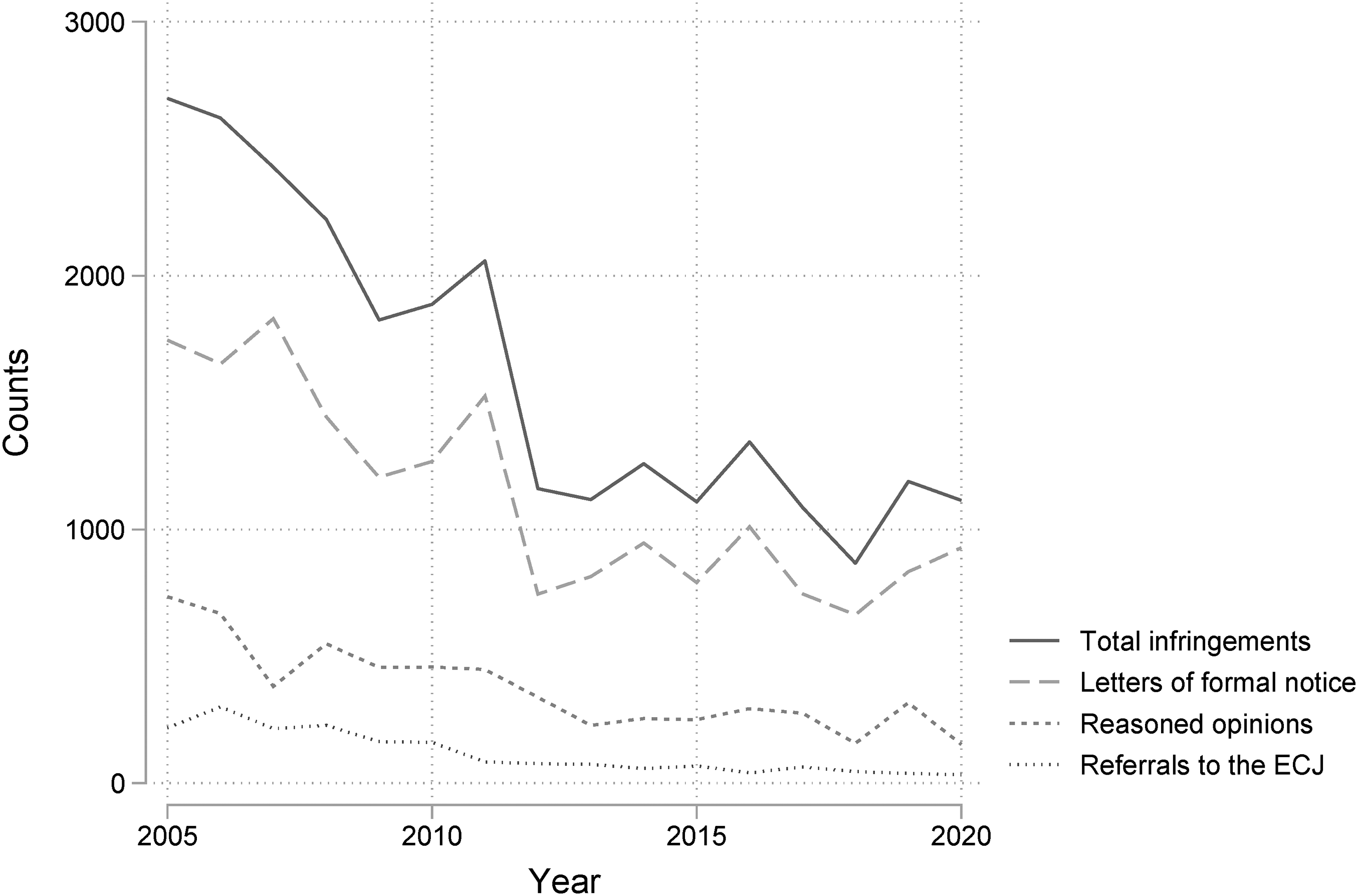
Infringement totals from 2005 to 2020.
While the number of infringements dropped, the EU faced one crisis after another. Compliance literature, however, largely side-stepped the issue of crises and enforcement, and instead ascribed declining infringements to either structural or strategic causes (Börzel, 2021; Cheruvu and Fjelstul, 2022; Cheruvu, 2022; Closa, 2019; Fjelstul and Carrubba, 2018; Hofmann, 2018; Kelemen and Pavone, 2023).
In the structural camp, Börzel and Sedelmeier (2017) argue that infringements are down because of the stringent accession process used for states joining in 2004 and later. The structural constraints that pushed countries to adopt EU law before officially becoming members resulted in countries violating fewer laws than states who joined before (Börzel and Sedelmeier, 2017). An alternative structural-based explanation is that the Commission is simply legislating less, giving states fewer opportunities to violate law (Börzel, 2021: 105–106).
Hofmann (2018) makes a structural argument when suggesting that there are less infringements because enforcement has been outsourced to national courts. Because the ECJ ruled that EU law takes primacy over national law (Falkner, 2018; Wilman, 2015), citizens, businesses, and groups can appeal for EU rights directly in national courts. Others suggest that enforcement shifted to other programs, like the EU Pilot system, a more informal channel (Cheruvu and Fjelstul, 2022; Smith, 2015). However, even the number of pilot cases has plummeted since the mid-2010s (Hofmann, 2018; Kelemen and Pavone, 2023). An implicit assumption behind most structural theories is that when there is member state noncompliance, the Commission will respond.
A second strand of enforcement literature argues that such an assumption is simply not true. Noncompliance does not always lead to sanctions because the Commission uses infringements strategically (Cheruvu, 2022; Fjelstul and Carrubba, 2018; Kelemen and Pavone, 2023). Fjelstul and Carrubba (2018) contend that the Commission and member states evaluate the costs of (non)action or continued (non)compliance. Kelemen and Pavone (2023) assert that fewer infringements are a strategic bid to shore up support for Commission policy goals in the Council, a strategy they call purposeful forbearance. Under President Barroso's 2004 tenure, the Commission worked to prevent further ire from national governments, and the number of infringements consequently dropped. According to this theory, at times the Commission prioritizes policy goals and Council support over monitoring and enforcement.
Strategic concerns extend to member states too. Cheruvu (2022) proposes that the Commission is more likely to pursue infringements if they believe a more pro-EU government will win the next domestic election. Using the timing of national elections and the ideological preferences of new potential governments, Cheruvu (2022) finds that if the Commission expects an upcoming national election to make the government more pro-EU, they are more likely to advance infringements. His theory is that the Commission prefers advancing infringements in member states with national governments who are more likely to comply.
According to Closa (2019), the Commission is also concerned about general public EU support. He points out that the Commission ‘anticipates the possible negative domestic effects of a decision against an offending government: a sanctioning decision can backfire by provoking a “rally-around-the-flag” effect’ (Closa, 2019: 697). Here, the possible effects of sanctioning (or not) are not limited to specific concerns about specific noncompliance, which is of course an issue, but a general worsening of public Eurosceptic sentiment. Highly Eurosceptic citizens may make it harder for the Commission to achieve policy goals, especially if national governments are displeased with the EU, and government heads of state in the Council become recalcitrant.
Building on the existing compliance literature, I argue that both structural and strategic reasons matter. On the structural supply-side, crises may make it difficult for the Commission to monitor and enforce EU law. However, crises do not have to be deterministic. Commission demand for compliance is also sensitive to the evolving costs of (non)compliance and (non)enforcement. Demanding compliance can be costly for the Commission. They risk losing support from other EU institutions, like the Council and EP, making it harder to attain political goals. Demanding compliance from unwilling states may also backfire if sanctions have no effect.
Theory: Supplying enforcement
Organizations responsible for supplying enforcement can only act if three main contextual conditions are met: they must have the institutional responsibility to enforce law, there must be mechanisms available to sanction law-breaking, and they must have sufficient bureaucratic capacity for action, including an adequate staff and budget. I define these conditions as supply-side factors because they supply the necessary structural context for enforcement. In the EU, several of these structural factors have largely remained constant over time, and therefore cannot explain the change in enforcement activity.
For example, under Article 258 of the Treaty on the Functioning of the European Union (TFEU), the Commission is legally responsible to hold misbehaving states accountable (Kochenov and Pech, 2015). Deemed the guardian of the treaties, this duty has not changed over time, or been relegated to other institutions. Additionally, the mechanisms designed to encourage compliance in the EU have seen little change over the years (Smith, 2015). As previously discussed, Article 7 and the infringement procedure are the main enforcement mechanisms, and while new instruments of enforcement have recently been initiated, like the Rule of Law Framework, they have not yet been used extensively, and many question their effectiveness (Kochenov and Pech, 2015).
In addition, unlike bureaucracies in other institutions, which are notoriously prone to growth over time, the bureaucratic capacity of the EU Commission has generally been static and relatively limited. The number of people working at the Commission is small – it only has about 33,000 employees (Nugent and Rhinard, 2019), compared to the city of Paris, which employs 50,000 (Szapiro, 2013). Moreover, the number of employees working for the Commission has not grown markedly in recent years. In fact, the number of authorized staff actually shrank by 4.3% from 2000 to 2010. Furthermore, the EU budget is tight, at around 1% of total EU Gross Domestic Product (GDP), with only 5% of that used for administration. Like staff size, the budget size has been relatively stable (Szapiro, 2013). Thus, while the Commission has the legal authority to sanction member states, and the necessary mechanisms to do so, the limited number of staff and budget may very well constrain its ability to act as enforcer.
Another bureaucratic resource may help explain why the Commission does, or does not, start infringement proceedings: clock time (or lack thereof). EU compliance literature has hinted at the Commission's limited resources and its effect on infringements (Blauberger and Kelemen, 2017; Börzel et al., 2012; Falkner, 2018; Jensen, 2007; Tallberg, 2000), but the relationship between time, crises, and infringements has not been examined systematically. Because the Commission has technical expertise and executive authority, their time is directly impacted by crises – it is often tasked with creating and advancing proposals to mediate the effects of crises (Dinan et al., 2017).
I therefore hypothesize that during crises, the Commission will start fewer infringements, not because states are more compliant, but because their resources, specifically time, are constrained. This lack of time may help explain why the Commission did not immediately respond to Hungary's ‘state of danger law.’ The Commission was subsumed with the emerging Covid-19 pandemic.
Notably, the Commission does not have the independent power to increase its budget or hire more staff, which could theoretically increase their supply of time. As Kassim (2013: 294) points out, the Commission is, ‘to a large extent, a dependent institution […] the resources allocated to it are decided elsewhere by other bodies or other actors’. The Council of Ministers and the EP regulate Commission staff and finances (Kassim, 2008), and ‘have always been concerned with maintaining budgetary discipline, and accordingly have been reluctant to release the staffing resources the Commission has claimed it needs’ (Nugent and Rhinard, 2019: 204). Without the means to increase other bureaucratic or structural resources, the Commission's ability to enforce law likely decreases during crises.
Theory: Demanding compliance
A theory of Commission enforcement limited to structural factors like time is incomplete. While time (and crises) structure opportunities for enforcement, the Commission also has political agency. Indeed, Steunenberg (2010) argues that the Commission does not always start infringements against misbehaving states because the Commission has its own preferences too. Like most institutions, the Commission wants to maintain or even expand its competencies. This means that, ‘it is not in the Commission's interests to antagonize unnecessarily EU actors with which it must work and on which it is, especially in the case of national governments, highly dependent’ (Nugent and Rhinhard, 2015: 337). The Commission therefore has to make strategic decisions about what noncompliance to pursue, and these decisions are affected by the potential costs of demanding compliance. These costs, defined here as demand-side factors, are largely dependent on the choices of other actors, including the EP and EU citizens. If the costs of demanding compliance become too high, the Commission may be less likely to act.
Generally speaking, EU scholarship posits that the EP has seen its institutional power grow over the last two decades, especially vis-à-vis the Commission (Hix and Høyland, 2013; Kreppel and Webb, 2019). The most obvious way to lower Commission enforcement costs is for EP to report member state noncompliance, and/or ask the Commission to follow up on it. Resisting compliance demands from two EU institutions starts to become costly for a rebellious member state.
One major means of parliamentary influence is its power over the Commission's political direction. At the beginning of each new legislative period, the EP must confirm the new Commission president, along with all Commissioners. They cannot pick and choose which Commissioners they do not like; if they feel strongly enough about the unsuitability of any one Commissioner, they can only vote down the entire group (European Union, 2023). In 2014, the EP threatened to vote down the incoming Commission over Hungary's EU Commissioner delegate – Tibor Navracsics, a member of Fidesz. He was nominated for the Commissioner over education, culture, youth and citizenship. Several Members of the European Parliament (MEPs) were opposed to giving him that specific portfolio. In the end, the citizenship part of the portfolio was given to a different Commissioner (Steinhauser, 2014).
The 2014 selection of Commission President Juncker was also heavily influenced by the EP. The EP argued that under Article 17 of the Treaty of the European Union, the political party with the most EP seats had the right to select the new Commission president. Members of the EPs are somewhat uniquely situated in the European Union, being the only directly elected officials. As such, they insisted that they carried the mandate of European voters (Kassim and Laffan, 2019) and their choice, Jean-Claude Juncker, was seated in 2014. 1 This provides strong evidence that the EP can and will use its powers to influence and shape the Commission.
Furthermore, while not used frequently, the EP can investigate Commission activity, write up reports, and even censure and dismiss the Commission. By so doing, the EP can significantly impact Commission behaviour. For example, in July 1996, the EP investigated the Commission's (mis)handling of an outbreak of Bovine Spongiform Encepholopathy (BSE) in Great Britain, and warned the Commission that they would be censured unless swift action was taken. The Commission quickly made the requested changes (Nugent and Rhinhard, 2015). In March 1999, the Santer Commission resigned after the release of a damning report from the EP, but before the (likely successful) vote of censure. Many took the resignation as a sign of increased EP power (Dinan, 2017).
Moreover, the Commission needs support from the EP to pass new laws. This has not always been the case. Starting with the 1987 Single European Act, successive treaty revisions gave the EP increased legislative control, and even co-equal decision making with the Council over the EU's annual budget. The EP therefore has some control over Commission budget and staff size (Hix and Høyland, 2013). The EP can also call Commissioners in to defend and justify Commission action. Ultimately, it is in the Commission's strategic best interest to have a good working relationship with the EP.
The Commission's costs of demanding compliance can also be changed by EU citizens. Euroscepticism may increase the costs of demanding compliance because it affects how national governments handle politically divisive policies from the EU. If citizens have a largely positive view of the EU, it will be easier for national governments to comply with EU law. If, however, citizens are anti-EU, the domestic costs of EU compliance increase. National governments will likely be concerned about the electoral consequences of complying with unpopular EU policies. Citizens may even vote out a sitting government if they believe that the ‘Brussels bureaucrats’ are infringing on state sovereignty.
This means that member states with highly Eurosceptic citizens are more likely to refuse compliance, even if facing EU sanctions (Cheruvu, 2022; Fjelstul and Carrubba, 2018). The legitimacy of the Commission (and the whole EU) is threatened if member states refuse to comply with EU law, and is even more so if sanctions are ignored. The Commission is therefore incentivized not to start infringements when public support for the EU is low. There is even evidence that backlash against the EU and their demands lead to greater public support for authoritarian leaders (Closa, 2019; Grauvogel and Von Soest, 2014).
Overall, I hypothesize that EU Commission enforcement activity depends on a combination of supply- and demand-side factors. If time is limited because of crises, the Commission is less likely to sanction noncompliance. If the costs of demanding compliance are high, infringements are also less likely. The EP and EU citizens affect how much enforcement the Commission is willing to demand by changing the costs of compliance.
Empirical analysis
Dependent variable: Infringement counts
To measure Commission enforcement activity, I use a count of country-year infringements from 2005 to 2020. The 43,717 observations include letters of formal notice, reasoned opinions, referrals to the European Court of Justice and notices of case closures. The dependent variables are the aggregate observations per infringement stage by country and year. Ultimately, the data set has 436 observations, one per country-year.
Infringements are broken down by stage because crises may impact some infringement stages more than others. Sending a formal notice to a member state should be less costly to the Commission than sending an infringement to the ECJ. The Commission does not have to follow-up on formal notices immediately, even if noncompliance continues. Cases sent to the ECJ, on the other hand, could chip away at the Commission's authority. If a member state continues to break EU law even after a ruling against them, other states may be emboldened to ignore EU law like their neighbours. Additionally, while unlikely, the ECJ may even rule against the Commission. Because the costs of enforcement are much greater, I expect that, controlling for other factors, the Commission is less likely to make a referral to the Court than send a formal notice.
Infringements can also be broken down by type instead of stage. Non-communication infringements are started when a member state does not update the Commission about progress with new directives. The state may even already be in compliance, and just needs to inform the Commission. Cheruvu (2022) argues that formal notices for non-communication infringements are more-or-less automatic, which means they should be less sensitive to crises. Non-conformity infringements, however, occur when member states violate EU law for all other reasons. Models will use non-communication and non-conformity infringements in robustness tests.
Measuring supply: Structural topic models
Supply-side factors are the structural conditions that make Commission enforcement possible. They supply the opportunity for action. Because the Commission has many responsibilities outside of monitoring and enforcing EU law, crises may force the Commission to prioritize other tasks over infringements.
To measure the effect of crises on enforcement, I use the text of Commission meeting notes (European Commission, 2023f). Attendance at these meetings is mandatory for all Commissioners (Nugent and Rhinhard, 2015), and meeting agendas include discussions of ‘documents with major political implications/politically sensitive files’ (Szapiro, 2013: 195). Commission meeting notes can tell us about what the Commission is doing. For example, in a December 2022 meeting, the Commission discussed providing aide to Ukraine, a proposal on how to speed up use of renewable energy, and an action plan on military mobility. 2
But, how can we measure how much time a crisis takes? Simply including a dummy variable for each crisis cannot provide much nuance. In addition, the temporal space of a crisis is often fuzzy – different sources may argue different start and end dates. To more systematically measure time spent discussing crises, I use structural topic models built from 671 sets of Commission meeting minutes, all from 2005 to 2020. These models first reveal latent crisis topics, and second, quantify the amount of time spent on each topic. In this way, topic models measure how the Commission spends its political attention.
Topic models assume that each document in a data set contains a mixture of topics, and that each document has its own proportion of each topic. Documents in a collection will have varying topic proportions, however, all share the same set of topics. The words in the document are the observed variables; topic models use these variables to find the latent topic structure within documents (Blei, 2012). Topics are defined by which features (specific words) are assigned to a specific topic. For example, words related to the topic Covid-19 might include pandemic, vaccine, and health. When these words appear in the text, they are classified as belonging to the topic Covid-19. When words like climate, emissions, and greenhouse appear, they are assigned to a different topic, in this case, climate change. Because of the assumption that each document is a mixture of topics, one document can include words from both the Covid-19 and climate change topic. For each document, the sum of topic proportions is equal to one. The sum of word probabilities for each topic is also equal to one (Roberts et al., 2019). Topical prevalence is the per cent of a document associated with each particular topic. Topical content are the specific words within the topic.
Topic prevalence and top words per topic are shown in Table 1. Expected proportions are the estimated proportion of each document per topic. The most prevalent topic is topic 29, which includes common parliamentary language like committee and follow. Several topics capture the six crises faced by the EU from 2005 to 2020: the Eurozone crisis, the migrant crisis, the Crimea crisis, Brexit, the rule of law crisis, and the Covid-19 pandemic.
Topics ordered by prevalence with top terms.
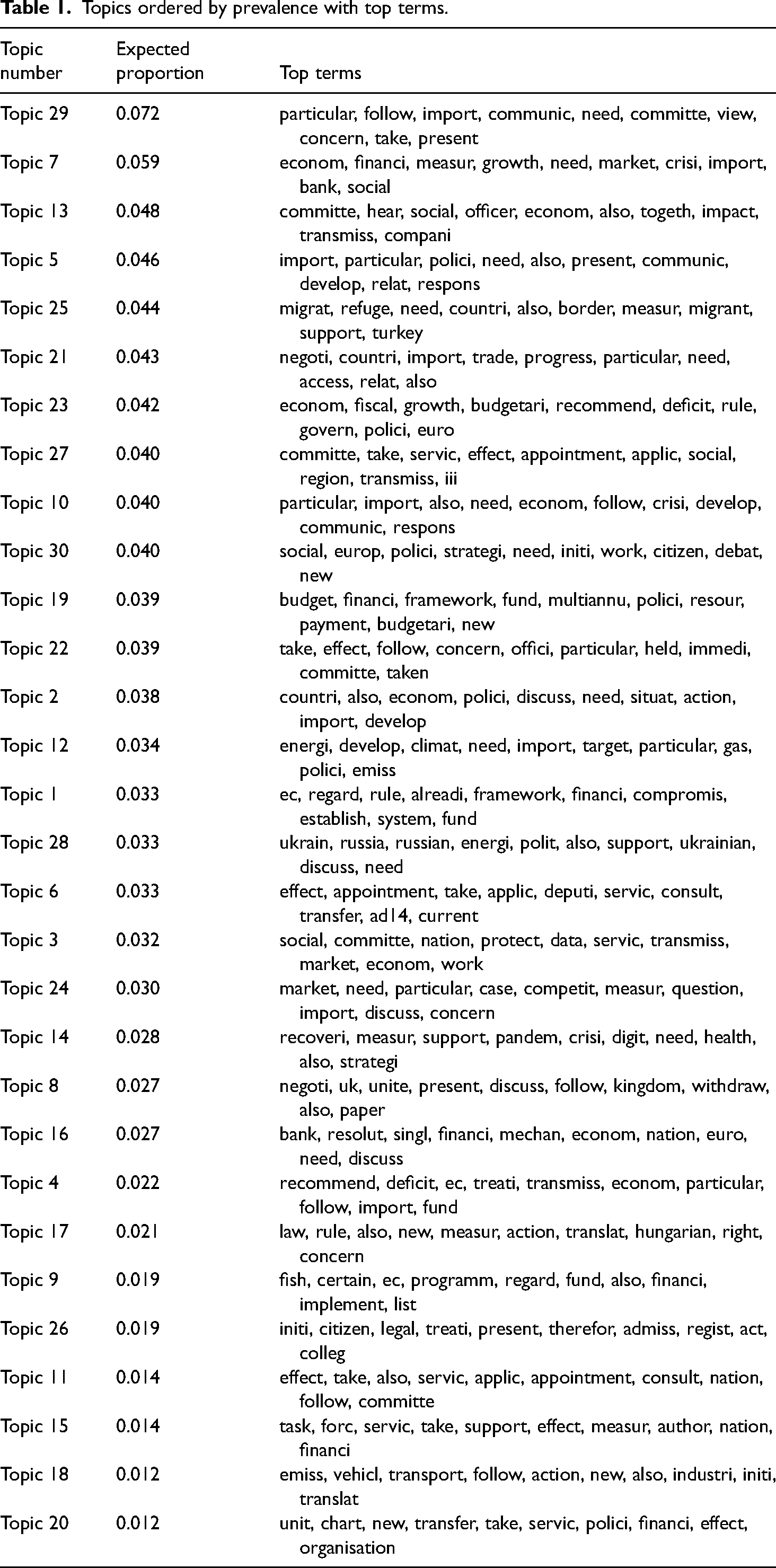
Figure 2 illustrates the estimated prevalence of eight crisis topics over time (shown with 95% confidence intervals). It shows how the predicted amount of time spent on each topic varies. When topic prevalence increases, the Commission is discussing that topic more frequently, leaving less time for other duties. Examining the top words in Table 1, combined with the time periods when the topics spike, provides face validity – the words and time periods are what we would expect.
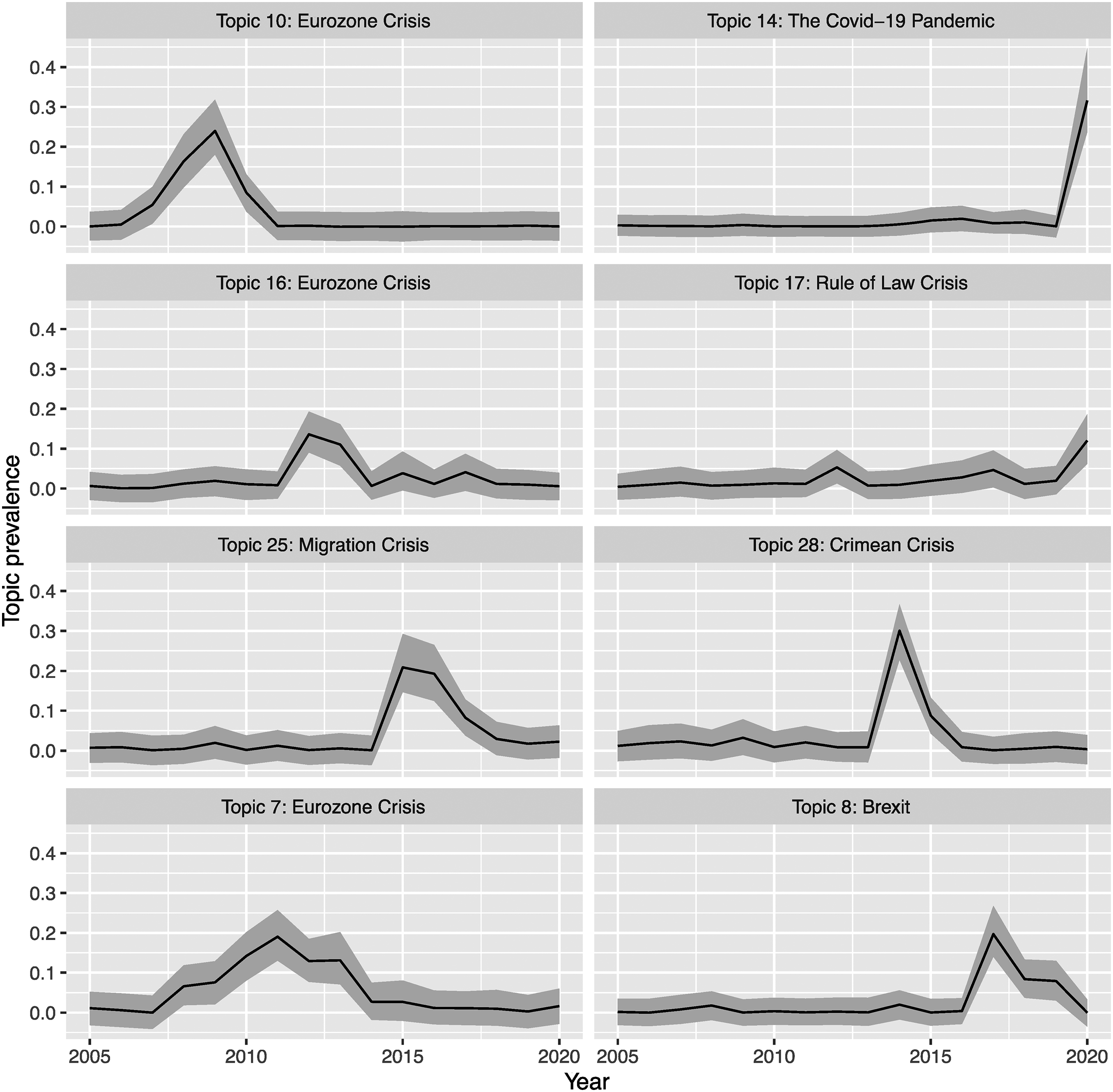
Crises topic prevalence over time.
As seen in Table 1, the Eurozone crisis was largely covered by three topics: topic 10, 16, and 7. Top terms associated with these topics include economy, crisis, market, and growth. The timing and peaks of the crisis clearly correspond with the sovereign debt crisis. Problems started to bubble up and appear in Commission meetings around 2008. In 2009, it became clear that Greece would default on their debt payments, setting off a domino default effect – Portugal, Spain, Italy, and Ireland all faced debt crises of their own in 2010. The crisis continued to affect the EU until the mid-2010s, only ending after several countries were bailed out by the International Monetary Fund and the EU. 3
Two other topics from Figure 2 include the Covid-19 and Brexit topics. Words in the Brexit topic include negotiate, British, withdraw. In 2016, this topic becomes very prevalent, very quickly, as it was the year Great Britain voted to leave the Union. Its prevalence then slowly decreased, with a steep drop at the end, as negotiations became less newsworthy. Notice, however, that as the Brexit topic declines, a new topic surges to replace it: the Covid-19 topic. Covid-19 words include pandemic, vaccine, Wuhan, lockdown, and even disinfectant. The figure shows that the pandemic was still taking up a significant amount of Commission time at the end of 2020. It is also noteworthy that the pandemic topic has the most sudden, most steep peak, with higher prevalence than any other crisis. This mirrors the suddenness, and all-consuming effect of the rapidly spreading global pandemic.
Topic 25 corresponds with the refugee crisis, triggered by a civil war in Syria. The figure shows that political attention to the crisis peaked in 2015 and 2016, aligning with the crisis timeline. Almost one million refugees fled to Europe during 2015, the peak year for this topic. Top words from this topic include migrant, refugee, border, and asylum.
It is important to note that there are other text-as-data methods that could be used to measure crises. For example, keyword dictionaries could have been created for each crisis, which could then have been used to search and count the number of times defined terms were used in Commission meetings. However, this has a major limitation - the only topics you get from dictionaries are the topics you expect to see beforehand. Structural topic models can reveal topics not initially on your radar.
Literature discussing EU crises usually include the Eurozone crisis, the migration crisis, and Brexit (Dinan et al., 2017). However, the topic model here finds two other crisis topics: Russia's invasion of Crimea in 2014, and a rule of law crisis, which is still ongoing. The Crimea crisis includes the words Ukraine, Russia, Crimea and support. Crimea is likely not included in crisis lists because it did not occur in Europe, but next to it. In light of the current war, it is an important crisis topic.
Topic 17 coincides with a rule of law crisis in the EU, which is still going on today. Top words include Hungary, rule of law, Roma, infringement, Polish, women and racism. There is a bump in prevalence after 2010, perhaps reflecting Fidesz's undemocratic law changes. The prevalence of the rule of law crisis was on the rise at the end of 2020, reflecting challenges the EU is still facing in regards to democratic backsliding in Hungary and Poland. The steep slope of this latest surge may suggest that the Commission, and other EU institutions, are starting to take the rule of law crisis seriously. It is becoming clear that the crisis is not an ephemeral issue, but a long-term threat to the EU.
These topic prevalence scores are used as measures of EU Commission time. When the topic prevalence of a crisis is high, the Commission is spending more time discussing the crisis. This means there is less time to respond to democratic backsliding and other state non-compliance. 4
Measuring demand: The costs of compliance
The second part of my theory argues that the Commission's political will to sanction misbehaving member states is affected by the preferences of other actors, and specifically how those choices change the cost of demanding compliance. This article looks at two main actors: the EP and EU citizens.
To measure the effects of Eurosceptism on infringements, I use a survey question from the Eurobarometer (European Commission, 2023e). 5 I expect as Euroscepticism increases, the number of infringements will decrease because the costs of demanding compliance are higher.
A count of all written questions from the EP to the Commission from 2005 to 2020 is used to measure EP preferences. The Commission is required by law to respond to all of EP's written questions. While future work will scrutinize the content of these questions, here a logged count of questions submitted each year is used. The number of questions is unlikely to have a linear relationship with the number of infringements – once the number of questions reaches a certain threshold, the effect on infringements is likely to decrease. Commissioners cannot spend unlimited time responding to questions. Theoretically, as the number of logged written questions increases, so does the number of infringements.
MEPs use written letters both to report member state noncompliance, and ask for further investigation on important issues. The possibility of a link between written letters and the number of infringements comes from the literature. Jensen et al. (2013) reports that in a sample of infringements, one in 20 infringements were started from written questions. In their written responses, the Commission frequently tells the EP that they will monitor and investigate reported situations, and will take action if necessary. Several written responses from 2019 inform the EP that Commission investigations were conducted, but that they found no breeches. Other letters from 2019, however, were linked to infringements, including one about violations of the Working Time Directive. Future work needs to examine this connection more comprehensively, however, there is evidence that suggests EP letters lead to Commission action.
Controls and model selection
Several control variables from the compliance literature are included. The first two are proxy measures for power: economic power, measured as (the log of) GDP, and state power, which is (the log of) population, both from the World Bank (World Bank, 2023a). The potential costs to the Commission of demanding compliance from a powerful state who may then refuse is much higher when compared to less powerful state resistance. The anticipated effect is that member states with larger GDPs or populations will have fewer infringements.
Governance effectiveness, also from the World Bank (World Bank, 2023b), is included as a measure of government capacity. Theoretically, if infringements measure noncompliance, then states with higher government effectiveness should have fewer infringements because they are better at mobilizing necessary resources. However, it is also possible that states with higher government effectiveness will actually have more infringements, because the Commission expects they will quickly comply.
Also included is a measure of intra-EU trade. Member states which benefit from intra-EU trade are incentivized to resolve infringements because they want to maintain these benefits. The expectation here is that higher intra-EU trade will be associated with more infringements. If the Commission believes a state wants to comply, it is more likely to demand compliance. Data about the percentage of total trade for both intra-EU exports and intra-EU imports are added together; numbers here come from Eurostat (Eurostat, 2023).
EU membership length is an additional control. While the supply/demand theory of Commission enforcement presented here is ambivalent about the effect of membership length, it is nevertheless included as a standard compliance control. Following Perkins and Neumayer (2007) and others, the models use the log of EU membership years.
Finally, any model of Commission enforcement activity must account for member state noncompliance. If noncompliance increases, we might expect more infringements. Here the number of citizen complaints lodged with the Commission is a proxy measure of state noncompliance. Any EU citizen can submit complaints directly to the Commission ‘about any measure (law, regulation or administrative action), absence of measure or practice by a country of the European Union that you think is against Union law’ (European Commission, 2023c). While these are almost certainly an under-count of all noncompliance, they nevertheless should be strongly correlated with actual member state noncompliance. The number of complaints comes from the Commission's Annual Report on monitoring the application of EU law.
Given that the dependent variables are counts, I use Poisson models, which assume a non-negative distribution of the outcome variable. Panel analysis often includes two-way fixed effects, one to correct for unit-level differences, and one for unobserved temporal effects. To account for unit-based heterogeneity in the data, I use a conditional fixed effects model, which includes country-level fixed effects. State based clustered standard errors are also used to adjust for any bias caused by temporal correlation within member states.
Because my theory is about the role of time and crises, models do not include time fixed effects. The within state variation in crises and year covariates are exactly the same in each member state. For example, the topic proportion of the migration crisis in 2015 was 0.21 across all member states, dropping to 0.18 in 2016. Furthermore, the variable year increases by the same amount for all member states. Because of these confounding effects, we cannot include both crises measures and time fixed effects (Rabe-Hesketh and Skrondal, 2022). Since the variables of interest are crises, they are included in the model. The effects of time, however, should be included in the crises estimates.
Poisson models assume that the mean and variance are equal, but that is often not true, especially with panel data. Many statistics books suggest using a negative binomial distribution to correct for this. However, Wooldridge (1999) shows that conditional fixed effects Poisson regression is fully robust to overdispersion if used with robust standard errors. Main results therefore come from the Poisson model, and negative binomial regression is used to check robustness.
Results
The coefficient plot in Figure 3 summarizes the effect of crises on infringements (please see the Online appendix for full regression results and incident-rate ratios). While not ideal for showing the substantive effects of non-linear models, the plot illustrates both the direction of crises effects, and whether they reach statistical significance. 6
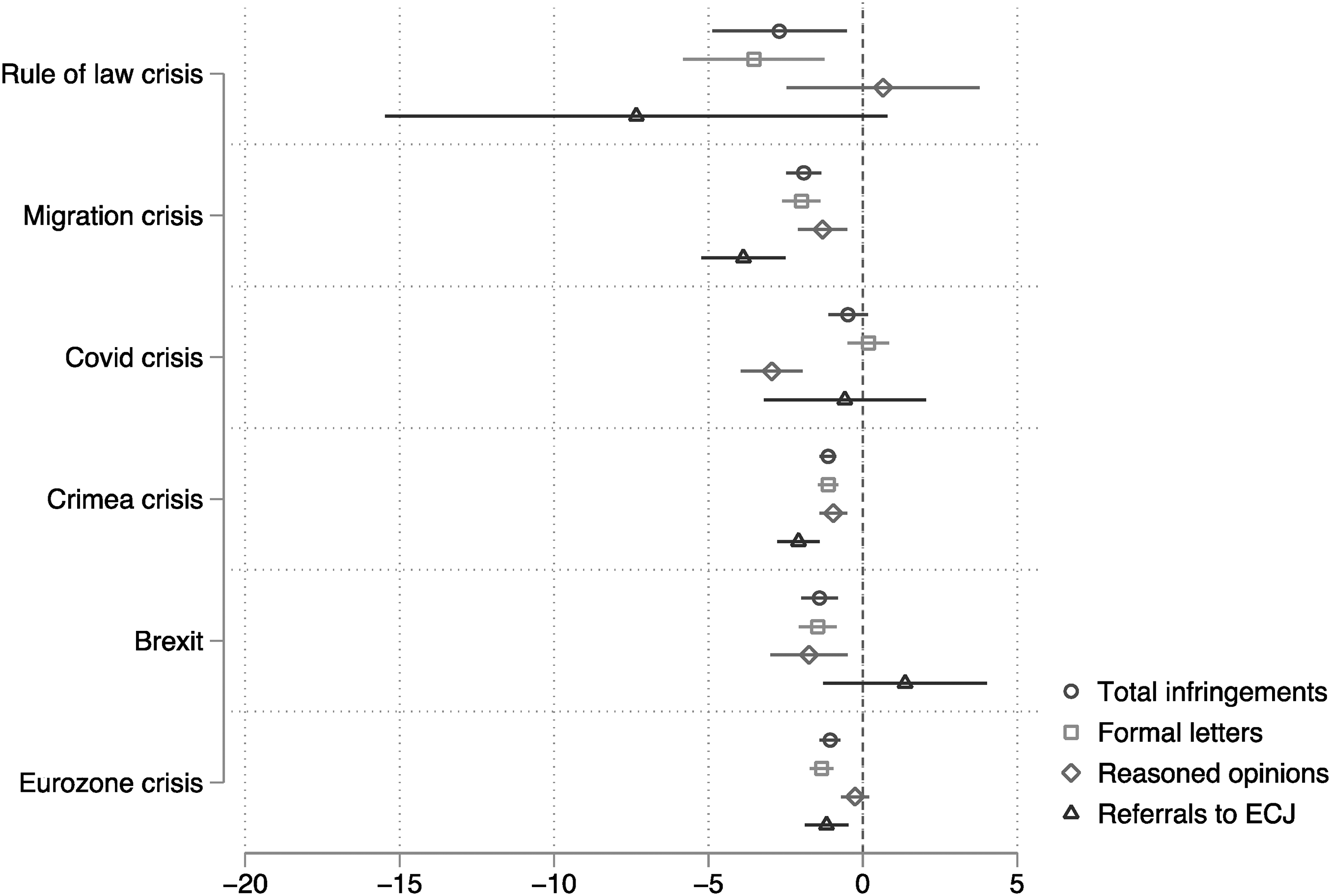
Coefficient plot of the effect of crises on infringement counts from 2005 to 2020 (from full conditional fixed effects Poisson model with controls).
Generally speaking, when there is a crisis, the Commission starts fewer infringements. The models show a statistically significant dampening effect when the Commission spends time on crises at all infringement stages, with a few exceptions. The Covid-19 crisis does not have a statistically significant effect on most infringements, only reasoned opinions. The effect is also not statistically significant for reasoned opinions during the rule of law crisis and the Eurozone crisis, nor for referrals to the ECJ during the Brexit crisis and the rule of law crisis.
The sizes of the effects are substantial. To estimate the marginal effects of crises, I use a generalized linear model with a Poisson distribution, log link function, country-level dummies, and standard errors clustered by state (please see the Online appendix for full regression results). 7 The marginal effects of the six crises can see be seen in Figure 4. Please note that the x-axes ranges are determined by the range of crises topic proportions from Commission meeting notes.
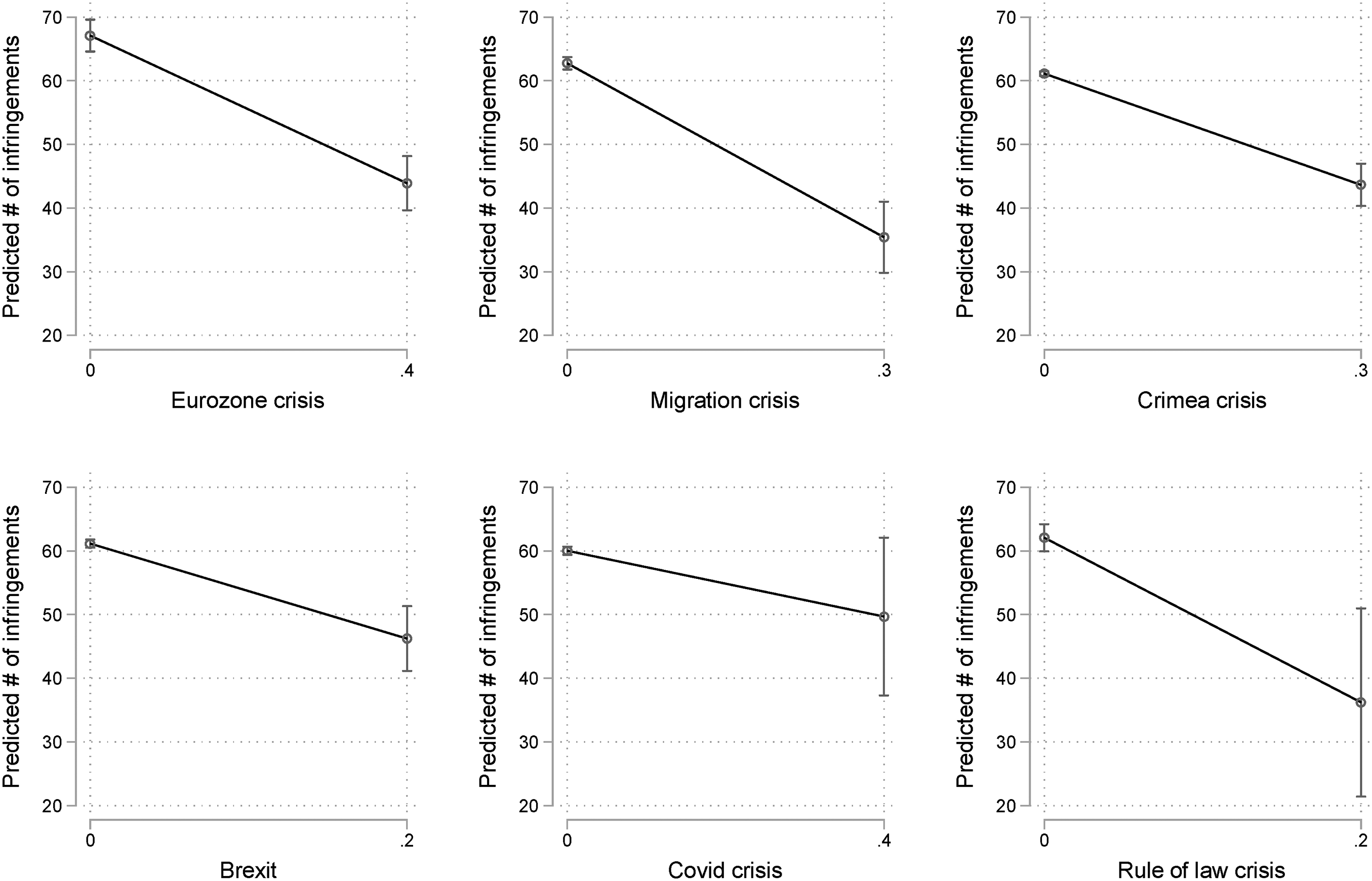
Predicted marginal effects of crises on infringement counts from 2005 to 2020.
Holding all other variables constant, the predicted effect of the Eurozone crisis on the number of infringements is an estimated decrease from 67.12 (when the Eurozone topic proportion was zero), to 47.28 (when the Eurozone topic proportion peaked at 0.33). This is a significant curtailment, equal to 19.84 infringements per country-year.
The effects of the other crises have similar magnitudes. The migration crisis has an expected decline from 62.77 to 42.28 infringements, a reduction of 20.49. During the Crimea crisis, infringements were projected to drop from 61.15 to 43.66, a difference of 17.49 infringements. Following the Brexit crisis, the associated number of infringements decreased from 61.15 to 46.77, a contraction of 14.38 infringements. The model also shows that the Covid-19 crisis changed infringement counts from 60.04 to 51.41, which corresponds to 8.63 fewer infringements (however, this is not statistically significant). The estimated marginal effect of the rule of law crisis was 14.81 fewer infringements, declining from 62.08 to 42.27. Overall, the model predicts a meaningful and statistically significant scaling down of infringements during most crises. This should be concerning to the Commission. The EU is currently dealing with several crises at once, and the analysis here suggests that crises limit the Commission's ability to fulfil all its legal obligations, including monitoring and enforcing law.
Demand-side coefficients can be seen in Figure 5 (please see the Online appendix for the full regression table and incident-rate ratios). The number of EP questions has a statistically significant positive relationship for all infringements, except reasoned opinions. 8 Public support for the EU also has a positive and consequential correlation with all infringement stages except reasoned opinions.
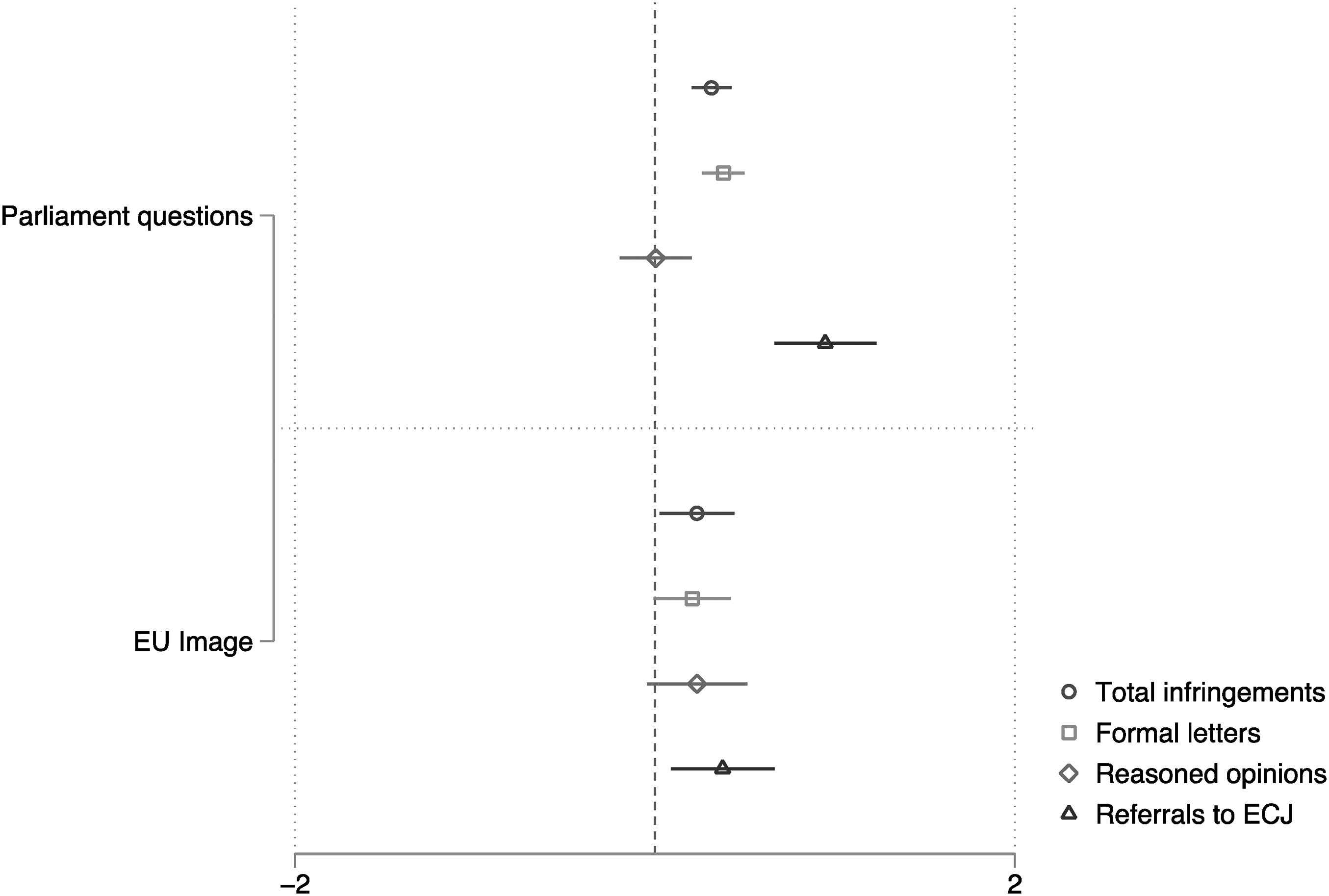
Coefficient plot of the effects of demand on infringement counts from 2005 to 2020 (from full conditional fixed effects Poisson model with controls).
The predicted marginal effects indicate that demand-side effects are considerable (see Figure 6). At the lowest public opinion value of 2.37, the expected number of infringements is 48.70. On the other end of the scale, with the maximum score of 3.94, the estimated number of infringements is 70.27. The difference of 21.57 infringements means that the effect of public opinion is stronger than the effect of any crisis. Furthermore, states with the fewest logged EP questions are projected to have 49.96 infringements, and those with the most 75.66 infringements. This is an increase of 25.7 infringements, making EP questions the variable with the greatest effect.
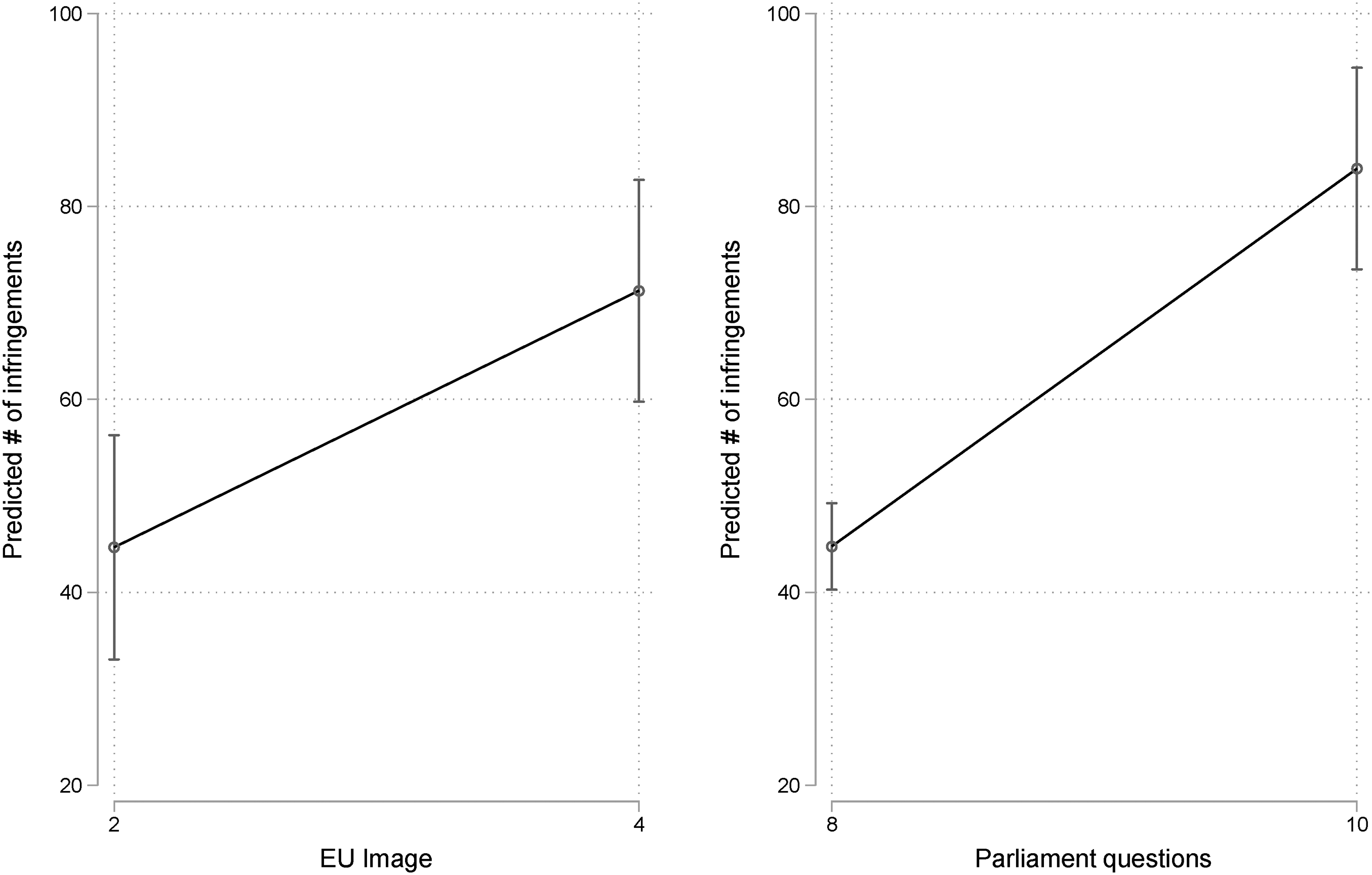
Predicted marginal effects of demand on infringement counts from 2005 to 2020.
The correlations between control variables and their effects are mixed (see Figure 7). While many have the expected sign, most are not statistically significant. The effects of both the log of population size and GDP are negative, as hypothesized, but the effects are not statistically significant. Governance effectiveness is positive for reasoned opinions and referrals to the Court, taking the expected sign, but is not significant. It is negative for formal counts, and both negative and significant for reasoned opinions. The positive effect of intra-EU trade on infringements is as predicted, and is statistically significant for reasoned opinions and referrals to the Court. The log of EU years is also positive in all models, however, it is only significant for reasoned opinions. Interestingly, the effects of complaints are negative and statistically significant in all models, suggesting that even when member state noncompliance increases, the number of infringements does not. However, the size of this effect is negligible at best, and warrants further study.
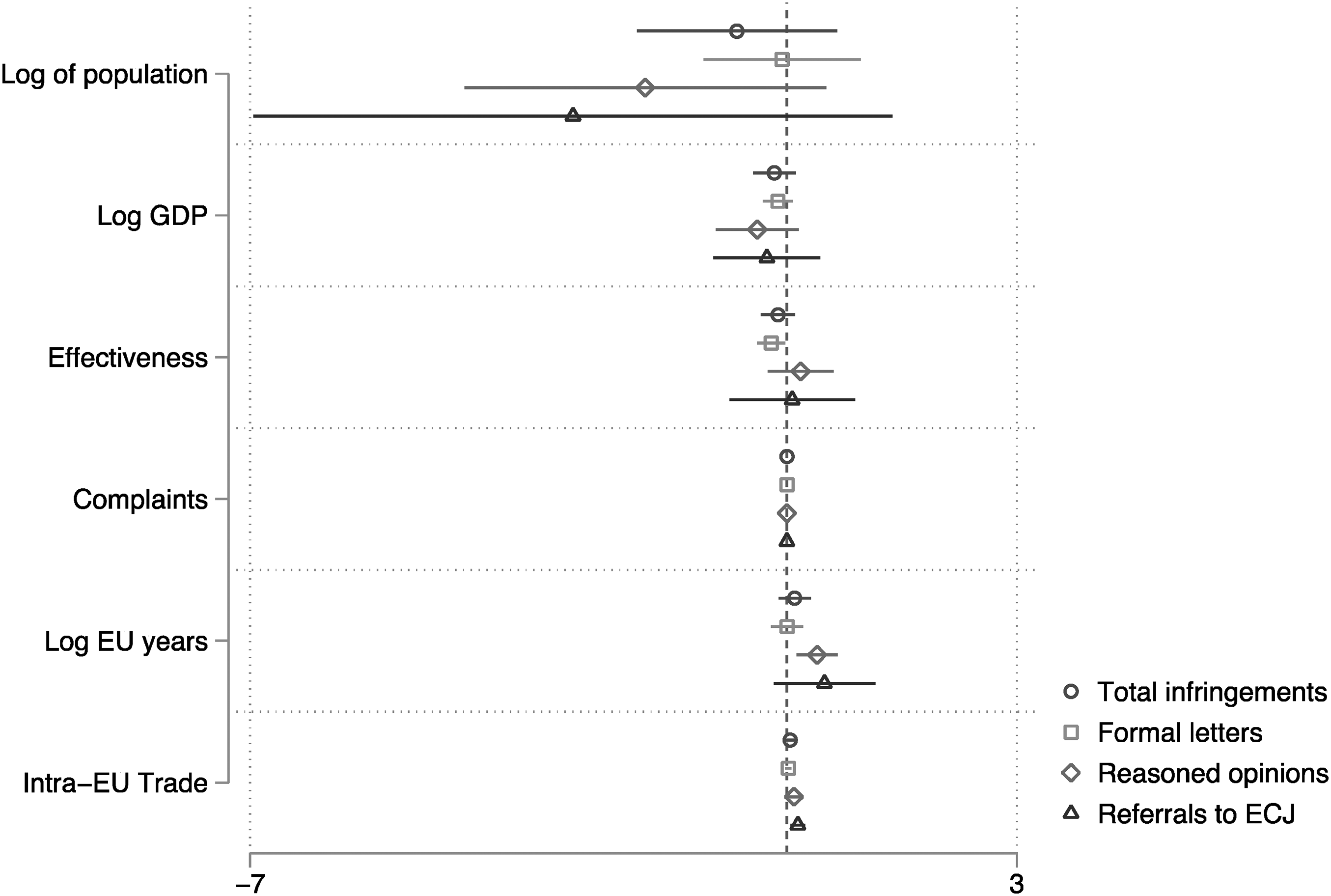
Coefficient plot of the effects of controls on infringement counts from 2005 to 2020 (from full conditional fixed effects Poisson model with controls).
Results are robust to using a conditional fixed effects negative binomial model, with and without bootstrapped standard errors (please see the Online appendix). In the negative binomial models, the effect of public EU support is attenuated, and is not statistically significant. But while other effects are also weaker, they remain statistically significant with the expected signs.
Results are also checked for robustness by controlling for the effects of non-communication and non-conformity infringements (please see the Online appendix). We would expect non-communication infringements, which are automatically activated when states do not report compliance with new directives, to be affected less by crises than non-conformity infringements. With the exception of the rule of law crisis, that is exactly what we find. While the effects of crises are still negative, or very close to zero, when controlling for non-communication infringements, they are not always significant.
Discussion and conclusion
Questions about the Commission's ability or willingness to enforce EU law during crises have become imperative. The EU has been burdened by a seemingly unrelenting string of crises since 2008. After the Eurozone crisis, the Commission faced a migration crisis, two crises in Ukraine after Russian invasions, the Brexit crisis, and a global pandemic. The growing number of Rule of Law violations in Hungary and Poland signal that the EU may also be facing a crisis of democracy.
This article adds to the enforcement literature by demonstrating that the (lack of) Commission enforcement is associated with crises. In line with theoretical expectations, all six crises were correlated with fewer infringements, except for the Covid-19 crisis. These results have important implications for the EU. Crises make it harder for the Commission to do its job. This is particularly critical given the ongoing threat of democratic backsliding in the EU, as crises may provide ideal opportunities for illiberal executives to strengthen their control over state governments.
However, other actors can overcome the constraints of crises by changing the costs of demanding compliance. Countries where Euroscepticism is higher are associated with fewer infringements. I contend that public opinion can change the cost of demanding compliance. Euroscepticism may cause national governments to think twice before complying with politically unpopular EU directives, worried about potential electoral costs. Ultimately, the Commission may strategically choose not to advance an infringement if it believes the member state is unlikely to comply. Lack of compliance after sanctioning is costly for the Commission as it undermines the legitimacy of the institution. The Commission, therefore, only wants to advance infringements if they believe a member state will comply.
The number of infringements also has a positive and statistically significant relationship with questions from the EP. This effect is likely caused by one of two mechanisms. First, questions from the EP may directly inform the Commission about noncompliance. Alternatively, letters may signal EP preferences for Commission action, or, occasionally, do both. For example, in January 2019, the EP sent a letter about work hours in Greece after the government allowed some businesses to stay open on Sunday. MEP Papadakis argued that this was yet another instance of the government abandoning workers. He wanted the Commission to ensure a healthy work-life balance under the Working Time Directive, not just in Greece, but in Austria and Hungary as well (Papadakis, 2019). The Commission replied in April, explaining that opening and closing hours were a member state competency, but that the Commission would nevertheless continue to monitor the discussions between workers and employers in Greece (Thyssen, 2019). Interestingly, on 25 July 2019, the Commission sent Hungary a reasoned opinion about infractions under the Working Time Directive, and called on Hungary's government to comply and thereby protect their workers (European Commission, 2019). But before the Commission can send a reasoned opinion, they first have to send a formal notice. The formal notice demanding compliance with the directive had first been sent to Hungary on 26 February 2016, three years earlier (European Commission, 2023b). While the Commission can follow-up with countries two months after a formal notice, they did not act until prompted by the EP. In this situation, the EP signalled their concerns about the Working Time Directive, while also reporting non-compliant labour in Hungary, Greece and Austria. Of course, this is only one example. An in-depth qualitative study of EP questions, Commission responses, and infringements is needed to unpack the causal story behind the correlation between written questions and Commission sanctions.
Future work should also more directly test the supply/demand model of infringements with alternative explanations. Furthermore, this theory may be generalizable to other monitoring and enforcement institutions, including domestic and international courts, as well as regulatory agencies. Like the Commission, these institutions may also be sensitive to the effects of crises or inter-institutional pressure.
This article illuminates the possibilities and limits of Commission response to noncompliance during crises. There is evidence that time constrains the Commission, and that it affects their ability to act as guardian of the treaties. However, other political actors, including EU citizens and the EP, may be able to overcome these constraints. I demonstrate here that while addressing member state noncompliance is a matter of time, demanding more from our institutions may be a way forward.
Supplemental Material
sj-pdf-1-eup-10.1177_14651165231212762 - Supplemental material for The EU Commission: Supplying enforcement and demanding compliance
Supplemental material, sj-pdf-1-eup-10.1177_14651165231212762 for The EU Commission: Supplying enforcement and demanding compliance by Kari Waters in European Union Politics
Supplemental Material
sj-do-2-eup-10.1177_14651165231212762 - Supplemental material for The EU Commission: Supplying enforcement and demanding compliance
Supplemental material, sj-do-2-eup-10.1177_14651165231212762 for The EU Commission: Supplying enforcement and demanding compliance by Kari Waters in European Union Politics
Supplemental Material
sj-dta-3-eup-10.1177_14651165231212762 - Supplemental material for The EU Commission: Supplying enforcement and demanding compliance
Supplemental material, sj-dta-3-eup-10.1177_14651165231212762 for The EU Commission: Supplying enforcement and demanding compliance by Kari Waters in European Union Politics
Supplemental Material
sj-do-4-eup-10.1177_14651165231212762 - Supplemental material for The EU Commission: Supplying enforcement and demanding compliance
Supplemental material, sj-do-4-eup-10.1177_14651165231212762 for The EU Commission: Supplying enforcement and demanding compliance by Kari Waters in European Union Politics
Supplemental Material
sj-dta-5-eup-10.1177_14651165231212762 - Supplemental material for The EU Commission: Supplying enforcement and demanding compliance
Supplemental material, sj-dta-5-eup-10.1177_14651165231212762 for The EU Commission: Supplying enforcement and demanding compliance by Kari Waters in European Union Politics
Footnotes
Acknowledgements
I thank Seth Jolly, Ryan Griffiths, Matt Cleary, Erin Hern, Simon Weschle, Samantha Call, the Syracuse University European politics working group and the political science research workshop, three anonymous reviewers, editor Gerald Schnieder, and participants at the American Political Science Association Conference, and the European Union Studies Association Conference for their helpful feedback on this project.
Declaration of Conflicting Interests
The author declared no potential conflicts of interest with respect to the research, authorship, and/or publication of this article.
Funding
The author received no financial support for the research, authorship, and/or publication of this article.

Data Availability Statement
The datasets generated during and/or analyzed during the current study are available in the Harvard Dataverse repository, https://doi.org/10.7910/DVN/VH129W.
Supplemental material
Supplemental material for this article is available online.
Notes
References
Supplementary Material
Please find the following supplemental material available below.
For Open Access articles published under a Creative Commons License, all supplemental material carries the same license as the article it is associated with.
For non-Open Access articles published, all supplemental material carries a non-exclusive license, and permission requests for re-use of supplemental material or any part of supplemental material shall be sent directly to the copyright owner as specified in the copyright notice associated with the article.
