







Abstract
How does large scale emigration affect politics in the peripheral states of the European Union? While a large literature looks at the political consequences of immigration in the more affluent member states, comparatively few scholars have taken up the mantle of examining the political effects of large-scale emigration in Central and Eastern Europe. From a political economy perspective, high levels of emigration, which is concentrated in the younger, more progressive parts of society, changes the makeup of both the labor force and the electorate. This article investigates how emigration and its associated economic and political consequences affect policy making and politics in Central and Eastern European countries. Evidence is provided from a difference-in-difference estimator and supplementary analyses of government and individual level data. The findings suggest that European Union membership leads to fundamental demographic changes, which affect the dominant forms of programmatic competition, and that governments reacting to this extend their stay in government.
Introduction
The European Union (EU) fundamentally changed the economic and political trajectories of its new member states when they joined between 2004 and 2013. Access to the Common Market enabled economic growth in the new member states, while the Copenhagen Criteria led them to pursue institutional reform. Among the most important changes for these countries were the consequences of intra-European migration flows (Head and Mayer, 2021; Marques, 2010; Rojas-Romagosa and Bollen, 2018). While individual citizens benefited from mobility and access to high-wage labor markets, the free movement of people has had a less positive aggregate effect on new member states. Estimates suggest that some states lost a quarter of their entire population to emigration in the immediate post-accession period (Kyriazi and Visconti, 2025: p.6). Given these magnitudes, it should be no surprise that citizens living in the new member states generally rank emigration as a greater concern than immigration (Kyriazi et al., 2023: p.564). How has large scale emigration affected the political economy of the new member states of the EU?
I contribute to answering this question by looking at the effect of emigration on political economy in Central and Eastern Europe (CEE), providing robust evidence of a causal link between joining the EU and changes in the political demography of the new member states. Furthermore, I extend the existing literature by showing that changes in welfare attitudes and expenditures have increased government tenure length. My argument is that the freedom of movement provided by membership in the EU lowers the cost of exiting the polity, therefore making migration a comparatively more attractive strategy for individuals who might otherwise decide to challenge the incumbent government through the formal political process (Auer and Schaub, 2024; Hirschman, 1970; Kelemen, 2020; Peters and Miller, 2022; Sellars, 2019). My main research contribution is showing that these demographic changes lead to the formation of a new winning coalition based on the elderly dependent parts of the population, which are easily placated by targeted welfare spending. Large scale emigration can thus be leveraged by incumbent elites to strengthen their grip on power (Miller and Peters, 2020; Portes, 2010).
Part of this argument has been acknowledged by previous contributions to the literature on European politics and political economy. While demographic changes and aging populations are hardly unique to CEE (Western and Southern European and East Asian countries have faced similar shifts), what is of particular importance in this case is that these shifts are fundamentally political in origin through the role of emigration (Bruzelius, 2021; Hirschman, 1970; Lim, 2023; Roos, 2023). Furthermore, this shift has profound consequences for democratic competition in these countries (Auer and Schaub, 2024). While EU membership was seen for a long time as a positive for democratization and good governance reform, these contributions, as well as my own, problematize this truism. While previous studies have made a link between emigration and decreasing levels of democratic competition in CEE (e.g. Kelemen, 2020), this article adds causal estimates of the effect EU membership on changing demographics and public expenditures to move the discussion forward.
Leveraging the staggered accession to the EU of the new member states over the first two decades of the twenty-first century and using a difference-in-differences design that accounts for variation in treatment timing (Callaway and Sant’Anna, 2021), I show that accession to the Common Market has led to notable demographic changes in new member states. Specifically, I find that the elderly dependency ratio—the number of pensioners relative to the size of the active labor force—increased significantly for countries that joined the EU, but not for comparable countries that did not join. More importantly, these demographic shifts have subsequently changed the programmatic politics and expenditures of CEE governments. Because non-random emigration changes the public’s preferences over redistribution (Petrova and Sznajder Lee, 2024), incumbent governments have a strong incentive to retool the dominant types of redistribution.
After establishing that accession to the Single Market fundamentally changes labor markets, political demography, and targeted welfare spending, I next show that EU members from CEE countries that increase spending on the elderly dependent parts of the population stay in office longer. I do so using government level data for Czechia, Estonia, Hungary, Latvia, Lithuania, Poland, Slovakia, and Slovenia between 2003 and 2019, taken from the Comparative Political Data Set (Armingeon et al., 2023a, 2023b), using a negative binomial model to estimate their expected tenure length. The results provide support for the argument that welfare expenditure targeted at the elderly increases government survival, suggesting governments that react strategically to changed electorates are rewarded. I further substantiate my argument about government support by the elderly parts of the population using individual-level data for these same countries from the European Social Survey.
This study thus addresses an important gap in the literature recently identified by scholars of European integration and politics. It contributes to our understanding of the political economic consequences of emigration in the European Union (Auer and Schaub, 2024; Bruzelius, 2021; Dancygier et al., 2024; Kyriazi et al., 2023; Kyriazi and Visconti, 2025; Lim, 2023; Roos, 2023). The paper also speaks to the relationship between European and global economic integration and redistribution (Bremer and Bürgisser, 2023; Bruzelius, 2021; Margalit, 2011; Rodrik, 1997; Scharpf, 1997). While redistribution can be a purely benevolent way to compensate the losers of integration, its political implications can also be targeted to particular components of society to the interest of political elites. Despite well documented opposition to immigration in countries like Hungary and Poland, most citizens from these countries consider emigration a greater societal problem than immigration (Kyriazi et al., 2023: p.564). Therefore, providing a better understanding of how emigration affects the politics of welfare in these countries is important (Bruzelius, 2021; Roos, 2023). My findings suggest that breaking the illiberal coalition comes down to a greater engagement in politics of the younger, more highly educated, and more progressive parts of society, a suggestion that is anecdotally buttressed by the 2023 Polish election that unseated the PiS, where turnout among young voters increased by 18% points.
While the motivation of the paper regards the new CEE members of the EU, the theoretical framework is broadly applicable to other high emigration countries with aging populations. Any government could, in principle, react to changed electorates due to emigration in strategic ways to entrench their position (Miller and Peters, 2020; Portes, 2010), regardless of whether they are the new or old member states of the EU, or indeed any country. The choice to look at CEE is therefore mostly one of convenience, as the accession of the new member states makes for a strong research design to provide an initial test of the hypothesis (Auer and Schaub, 2024). Future research should unpack how these dynamics work out in other countries around the world.
The single market and emigration
The most famous and widely cited study of the nexus between the quality of government and emigration comes from A.O. Hirschman (1970), who argued that members of a political community can respond to decreases in government quality in two ways. They can “voice” their dissatisfaction through protesting, demonstrating, petitioning politicians, or, in democracies, voting. Alternatively, they can “exit” the polity altogether, which in the context of states would mean emigration. A third option, “loyalty,” implies that individuals accept the status quo as more desirable than either outside option. Whether any given individual opts for exit, voice, or loyalty depends on the expected costs and benefits of these three strategies relative to one another. That is to say, what are the relative opportunity costs of one’s outside options? As the cost of exercising voice rises, for example due to greater government repression, loyalty and exit become more likely. Conversely, if the cost of exit is lowered due to emigration becoming less costly by stripping away visa and work permit requirements abroad, exit becomes the more likely option compared to loyalty and voice. While there may be specific cases in which exit and voice overlap, rather than trade-off, such cases are generally uncommon, and require circumstances to align in very particular ways (Hirschman, 1993).
The EU’s freedom of movement principle greatly affects the cost of migration for citizens who consider exiting their country of origin. Under this principle, citizens of EU countries have the right to settle and work in any other EU member state without obtaining a visa or work permit. For those countries that are part of the Schengen Treaty, they are furthermore able to move across national borders without any sort of document check, further lowering the costs of exit. Indeed, it is well documented in the econometric literature that freedom of movement increased migration between both the old and new member states of the Union, even for those countries that did not join the Schengen area until later (Head and Mayer, 2021; Rojas-Romagosa and Bollen, 2018). This has had great ramifications, especially for those states where more people left. Estimates suggest that Bulgaria and the Baltic countries lost between 16% and 26% of their population in the immediate post-accession period, the majority of which was concentrated in the working age population (Kyriazi and Visconti, 2025). Estimates for the region as a whole suggest that 9% of the total CEE population migrated away permanently since 2004 (Auer and Schaub, 2024). Since those who leave are expected to be net contributors to the government’s budget, this put enormous pressure on labor markets and public finances.
In turn, employers have lobbied CEE government to implement policies that incentivize younger people to stay behind and start families, rather than move abroad in search of higher wages and better public goods (Petrova and Sznajder Lee, 2024). Such policies fit with the “traditional family values” which conservative parties in CEE countries have championed for some time. However, it is unclear if, or to what extent, such policies were successful. The majority of people migrating from Eastern member states to the more affluent EU-15 countries are younger than their compatriots, and tend to hold more progressive attitudes (Lim, 2023). It is not at all obvious that explicitly conservative policies would cause those individuals to stay, given their values. As a result, and as I will show empirically, EU membership has led to a “greying” of the population in CEE member states. As younger people emigrated, the elderly stayed behind, changing the interests of the median voter over matters of redistribution. This has occurred because both the makeup of the electorate and the attitudes of those who remained behind have changed (Lim, 2023).
Emigration, social spending, and electoral competition
The demographic changes brought about by joining the Single Market lead to subsequent changes in the labor market, which in turn affect fiscal politics and incentives for reelection seeking incumbent governments. It is well documented that those who leave the country tend to be higher educated and younger (Lim, 2023), as well as more progressive and supportive of liberal values (Auer and Schaub, 2024). Due to their education and their age, this group of people is expected to contribute strongly to the tax base, providing finances for the government’s coffers, and their loss puts governments under pressure to find either different sources of income, or cut into existing programs. By contrast, those who are least likely to exit the country through migration are the elderly and the infirm, who are net recipients of public finances. Demographic changes brought about by high levels of emigration and aging populations put significant strain on government budgets. As the Common Market facilitates emigration by lowering the cost of exit, I expect it to change a country’s demography, increasing the proportion of pensioners relative to the labor force, which is known in demographic research as the dependency ratio.
While joining the European Union gives CEE countries access to several different funds—most notably the five European Structural and Investment Funds (ESIFs)—these cannot be full substitutes for the loss of taxation income. These funds are earmarked in very specific ways, determined by the European institutions, and any attempt to use money from, for example, the Common Agricultural Policy to make up for changes in public finance are impossible. Out of the five ESIFs, the European Social Fund Plus would be most in line with the incentives faced by net emigration countries, but its goal is specifically to boost employment, not the well-being of the retired. Ultimately, and most importantly, we simply do not empirically observe a relation between use of the European Social Fund and public investment (Staehr and Urke, 2022). In line with these observations, European states faced with fiscal constraints have increasingly prioritized some forms of social spending over others in the post-Great Recession period (Bremer and Bürgisser, 2023). If European funds could substitute for other sources of public finance, such decisions would be unnecessary.
Therefore, CEE countries with dwindling labor forces and aging populations are faced with a need to comprehensively reform their pension and social security systems in order to keep public finances sustainable. While pension reforms are partially due to international peer dynamics and social emulation, domestic political considerations and financial pressures remain relevant (Brooks, 2005; Hennessy and Steinwand, 2014; Verbič and Spruk, 2019). Interestingly, however, emigration creates divergent economic and political pressures on the social security system of a country. On the one hand, emigration is concentrated among younger, more highly educated individuals with better paying jobs (Lim, 2023). As they leave the domestic labor market, governments lose out on substantial income tax revenues, which puts pressure on the public budget and could necessitate fiscal consolidation. In the post-Recession European context, such pressures are all the more acute, as the EU has pushed for austerity and “fiscal responsibility” in order to avoid further debt crises (Bremer and Bürgisser, 2023). CEE governments face the simultaneous pressures of aging populations, fewer tax paying citizens in the labor force, and top-down political constraints from the EU not to run large budget deficits. Therefore, emigration creates an economic incentive to keep social security spending sustainable by reforming or lowering pensions.
On the other hand, as the share of pensioners in the population increases, so does their political power. Old-age benefits are pure club goods, meaning that they are directly targeted to a particular part of the population, which enjoys its benefits while excluding other groups in society (Knutsen and Rasmussen, 2018). This makes them an ideal way to “buy off” the loyalty of a particular part of the electorate. The existing literature emphasizes the political origins of pension schemes, and their importance in causing citizen beneficiaries to provide support for incumbent regimes (Grünewald, 2021a, 2021b; Knutsen and Rasmussen, 2018; Mares, 2005). Previous research has established that emigration changes both the makeup and preferences of the domestic electorate (Lim, 2023). With many younger, more progressive citizens choosing to exit the polity through emigration, the marginal returns to exercising voice for those who remain behind increases, as there are fewer alternative demands to compete with them, and fewer voices who make mutually exclusive demands of the central government. The core insight here is that emigrants are not a random sample of the population economically, and thus in their political-economic demands. As a result, governments have a significant incentive to shift public expenditure to placate those who stay behind more, resulting in greater health and pension expenditures.
Of course, expatriates from CEE countries are not excluded from home country elections, and so they could remain a relevant part of the winning coalition for reelection oriented governments. However, while emigrants remain technically part of the electorate, expatriate voting turnout remains significantly lower in CEE countries than resident citizen turnout. The smallest gap in turnout among CEE EU states can be observed in Slovenia, and even there nationwide voter turnout is more than double that of external voter turnout. In the most extreme cases, such as Hungary, Lithuania, Poland, and Romania, overall turnout rates are stable above 50%, while external voter turnout stands between 0% and 5% (Kostelka, 2017: p.1074). A rational government concerned with finding the minimally costly winning coalition for reelection will therefore focus targeted expenditures on non-migrant citizens, rather than expatriates. In summary, emigration changes not only local labor markets, but local electorates as well. Since the electorate that stays behind skews more towards pensioners and the elderly, incumbent governments who are motivated by reelection will have to spend resources on this crucial part of the electorate if they want to stay in power.
European welfare state politics have increasingly revolved around cross-class and value-based coalitions, rather than traditional class structures (Gingrich and Häusermann, 2015; Häusermann, 2006). Furthermore, competition over the welfare statement has evolved to be more about trade-offs between different benefits, rather than the overall size of the welfare state (Bremer and Bürgisser, 2023; Häusermann et al., 2019). These changes in the dominant structure of party competition have problematized the traditional mode of welfare politics, where left-wing parties have typically advocated for greater public expenditures, and right-wing parties have advocated for greater fiscal austerity. Häusermann et al. (2019) find that far right voters are among the strongest opponents of pension cutbacks, suggesting that the cleavage structure of pension and welfare politics has fundamentally changed.
Prior to 2011, many CEE countries, both those that ended up joining the EU and those that did not, enacted sweeping privatization reforms in the public sector, regardless of the ideology of the governing parties (Appel and Orenstein, 2013). Some authors have interpreted the rise of populism in CEE as a reaction to this neoliberal consensus among established centre-left and -right parties (Orenstein and Bugaric, 2022), as populist regimes in the region have reversed many (though not all) of the pre-crisis cuts, for example through lowering the retirement age and offering drug benefits to the elderly (Ost, 2018: p.115). The choice to offer policies such as these depends greatly on the incentives faced by incumbent governments. My argument identifies one such incentive: the demographic makeup of the electorate in a context of high emigration.
As noted by Bremer and Bürgisser (2023: p.35), “social policies create their own support coalitions because citizens’ narrow self-interest shapes their social policy priorities: people react strongly to cuts in spending from which they benefit.” More so than many other political economy questions, distributive decisions about where to spend finite resources of social expenditure hit people directly in their personal financial circumstances. These are precisely the situations where people are most likely to mobilize politically around economic issues (Tilley et al., 2018). For most pensioners in CEE countries, public pension and retirement schemes remain the bulk of their livelihoods. Therefore, they are likely to react strongly to any change in government policy regarding pension schemes and government funded healthcare. This puts governments in a bind, as they need to balance pressures to maintain long-term sustainable social security programs without running budget deficits (the economic or fiscal sustainability dimension), and maintain public support for such policies (the political sustainability dimension). Given changes in the electorate, the cuts are more likely to fall upon other expenditures than those benefiting pensioners and the elderly. In sum, emigration creates a dilemma where policy makers must choose between the economic and political sustainability of their social safety nets and pension schemes (Vučković and Škuflić, 2021). I expect the political incentive to dominate the economic incentive due to changes in the effective electorate brought about by large scale emigration.
I expect this strategy to be an effective one to retain political power. While Klomp and De Haan (2013: p.261) find limited evidence for the existence of political business cycles among some new EU member states (Bulgaria, Cyprus, Czechia, and Romania), they find no evidence for aggregate election induced fiscal expenditures in Estonia, Hungary, Lithuania, Poland, or Slovakia. However, their main outcome variable is average government spending on health, education, and social security as share of GDP. Incumbents are strategic actors that seek to maximize reelection by rewarding key supporters, but neglect parts of the electorate outside of the minimum winning coalition (Bueno de Mesquita et al., 2002). After all, resources not spent on guaranteeing reelection are resources that the regime can consume for its own enjoyment. Thus, aggregate social spending could hide differential dynamics at play through different spending categories (e.g. spending on education aids mostly younger individuals, while spending on health and pension benefits aids older individuals). Furthermore, their data covers the period of 1975–2005. Given that some of these countries were not yet part of the Common Market when their panel ends, an extension for these countries would be appropriate.
The final link in the causal chain of my theory pertains to the consequences of increased welfare spending. In line with the political business cycle and political budget cycle literature (Brender and Drazen, 2005; Castro and Martins, 2018; Lohmann, 1998; Nordhaus, 1975; Potrafke, 2020; Schultz, 1995), I argue that increased spending on programs that benefit the elderly and pensioners will lead to lower rates of government turnover conditional on EU membership. This is because non-migrant elderly citizens benefit greatly from increased health and pension expenditures, and reward the incumbent government for their improved economic position (Tilley et al., 2018). This occurs irrespective of the long term fiscal sustainability of such policies, as voters have short time horizons. Therefore, I expect electorates of new member states to reward governments that target welfare spending at the elderly and pensioners, which have become more important components of the electorate due to the freedom of movement principle.
Difference-in-differences analysis
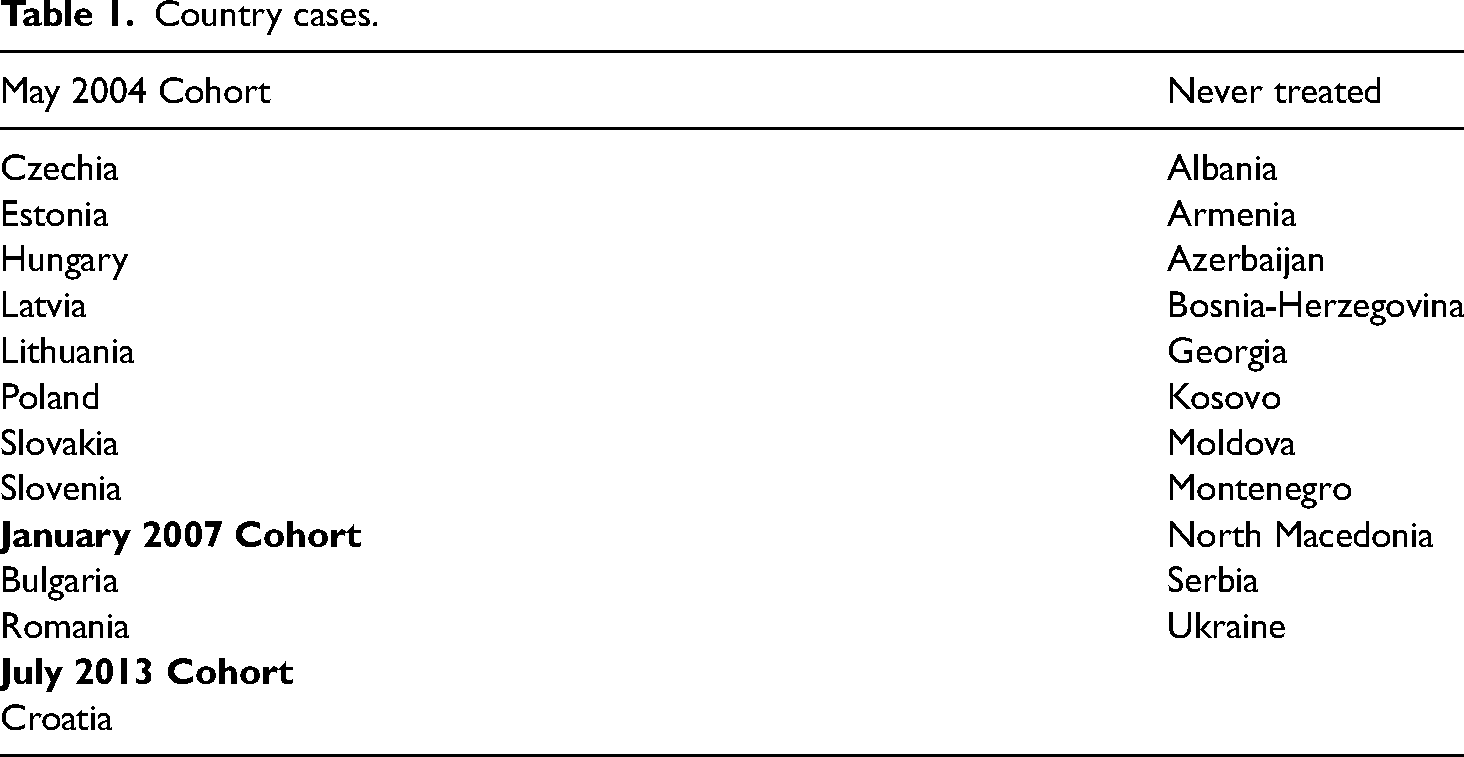
In order to test my hypotheses, I collect data from the World Development Indicators (World Bank, 2023), the advantage of which is that they cover both members and non-members of the EU. I look at CEE countries that join the EU between 2004 (the first former Communist cohort) and 2013 (Croatia, the last country to join the EU at time of writing), as well as other CEE countries that are at various stages of applying for EU membership during the time-frame, but never actually join the Single Market. The combined data covers 11 treated countries and 11 control countries, with observations spanning the time frame of 2001 through 2019.The existence of a comparison pool that never enters treatment is a prerequisite of using the staggered treatment adoption design with panel data (Callaway and Sant’Anna, 2021). While it could be argued that there are differences between these countries irrespective of EU member status during the study’s time-frame, such concerns are not expected to affect the analysis for two reasons.
First, my pool of never treated countries includes several countries that are considered for EU membership during the time-frame. These countries have pursued structural economic and political reforms similar to the EU members, with the one crucial difference being that they never join the Single Market. This makes my counterfactual pool of observations more appropriate than if I were to use a panel of the entire European neighborhood. Second, the identifying assumption of the difference-in-differences estimator is not that there are no baseline differences between treated and untreated units. Rather, the identifying assumption of difference-in-differences is the parallel trends assumption, which states that observations would have had the same trends over time in the absence of treatment. This could be violated due to either pre-treatment differences in trends, or due to compound treatment effects. I test for the former, and find no evidence for it in any of the comparisons (as shown the pre-treatment leads effects in Figures 1 and 2), except for the 2013 Cohort, which consists of only a single country: Croatia. The latter is by definition untestable, but the literature provides no reason to expect EU membership to have any effect on my outcomes of interest, except through its freedom of movement principle. An overview of all countries by treatment status is provided in Table 1.
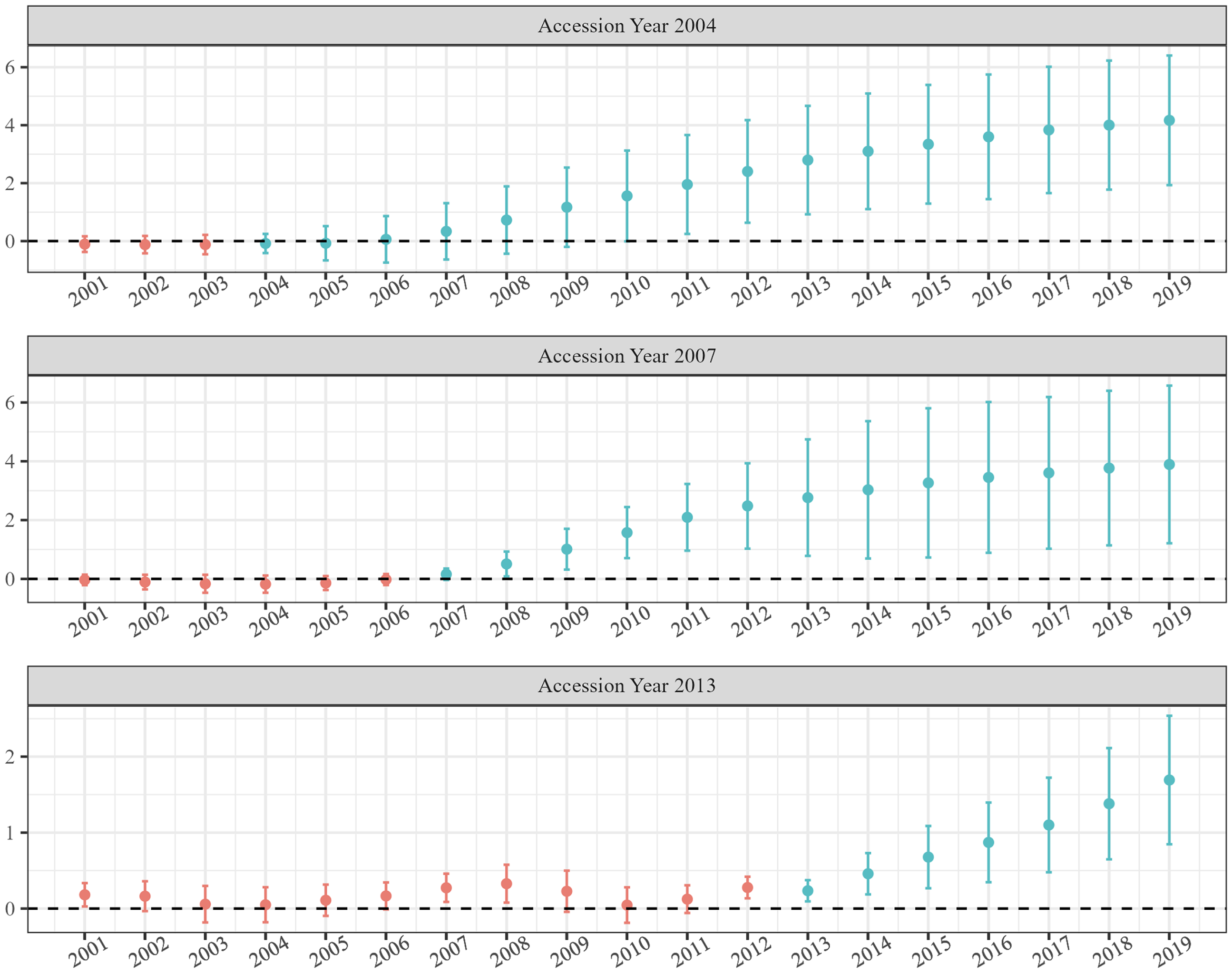
EU membership and dependency ratios for CEE countries.
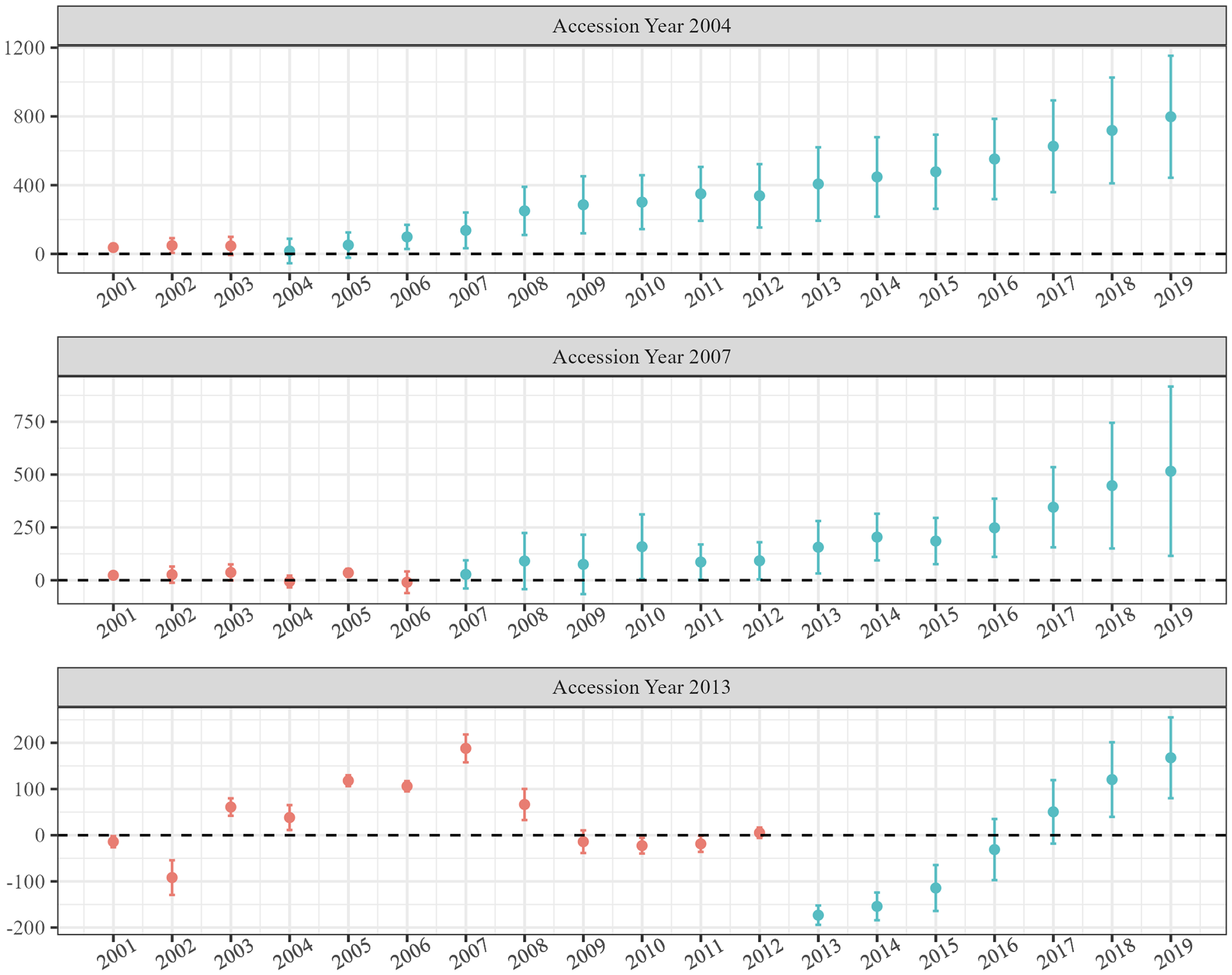
Government health expenditure.
Country cases.
Results
The effect of EU membership on dependency ratios for CEE countries using the Callaway and Sant’Anna estimator (2021) is shown in Figure 1. The estimand, which is shown on the
How have these demographic changes impacted public expenditures? Figure 2 shows that governments have increased spending on healthcare, benefiting more elderly parts of the population. Another public welfare expenditure that benefits the elderly disproportionally is of course pension and retirement funds. However, data coverage for this category is extremely lacking for countries in the control group especially. Therefore, I focus on health expenditure in my analysis. Health expenditure remains a valid component of social expenditure to include here, because the elderly are still a disproportionate beneficiary of healthcare spending, even if it is not fully a club good. Future studies should try to get better data on pension expenditures in the European periphery to facilitate further research.
Government healthcare expenditure is normalized per capita and purchasing power in these models. Effects for the 2004 and 2007 cohorts are clear, while the effect for Croatia is inconclusive due to the violation of the parallel trends assumption. One concern could be that Figure 2 is indicative of an increased wealth enabling greater spending, rather than a targeted form of redistribution in the political business cycle. If this were indeed the case, we should see not only government, but private health expenditure increase as well, as individuals have more money to spend on their own healthcare. Figure 3 shows the effect of EU membership on private healthcare expenditure. Here, the difference-in-differences estimator shows no significant effect of EU membership; if anything the point estimate suggests near null effects, indicating that the increase in government expenditure observed in Figure 2 is due to political decisions, rather than general economic circumstances. All results are robust to the incorporation of anticipation effects up to two years (in general, accession negotiations end two years before actual accession) as shown in the Online appendix.
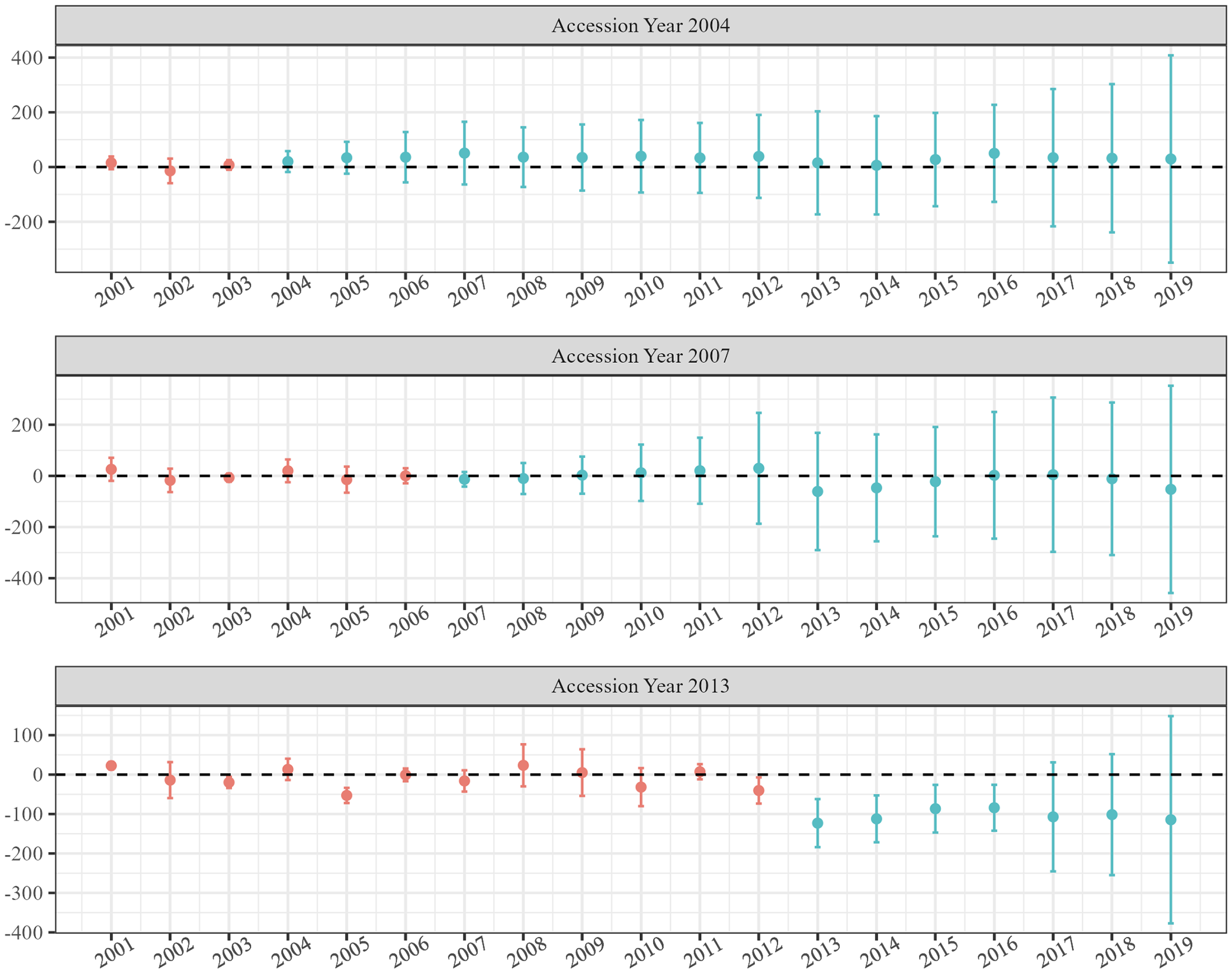
Private health expenditure.
Government tenure analysis
Having shown that joining the EU leads to fundamental changes in a country’s political demography and welfare expenditures, the next logical question would be to ask whether these expenditures are associated with a government’s political success. In order to test Hypothesis 3, I estimate several Cox semi-parametric proportional hazards model, using data from the Comparative Political Data Set (Armingeon et al., 2023a, 2023b) and World Bank. Using a survival model in this context is more sensible than directly relying on binary re-election indicators, as a survival model allows for the estimation of the risk of losing office at any point in the time series, rather than just at the point of election. This allows us to capture both elections, as well as alternative forms of losing office, such as popular protests. As election timing is often endogenous in the electoral systems of the countries under consideration, this is an important strength of survival models in this case. Furthermore, the effect of increased government expenditures may vary over the time of incumbency, being stronger later in the life cycle of incumbent governments (as election comes closer) and weaker earlier in its tenure. Survival models allow such over time differences to be visualized, and as Figure 4 shows, this is exactly what the paper finds. 1
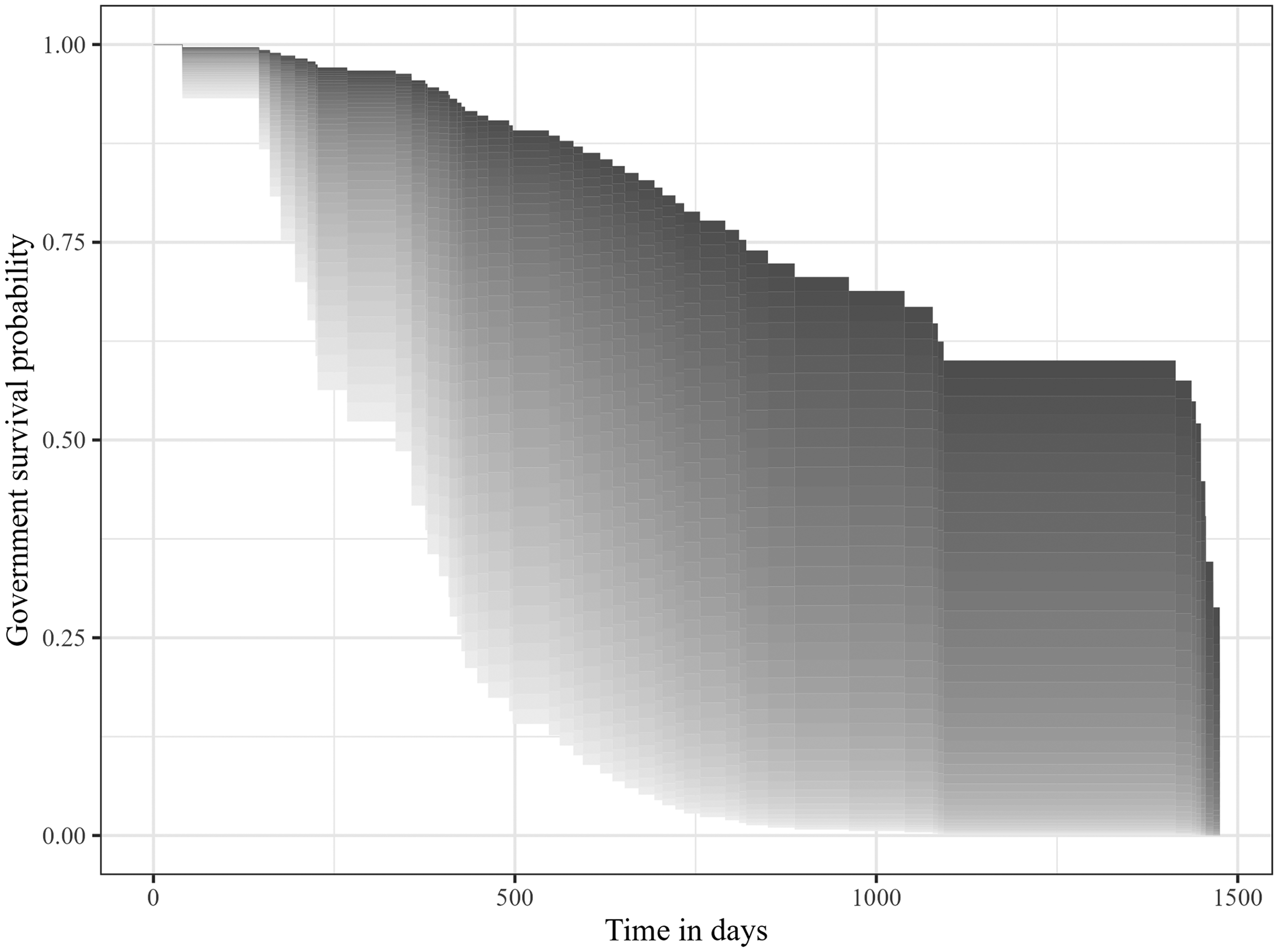
Health expenditure and government tenure (Model 6, Table 2).
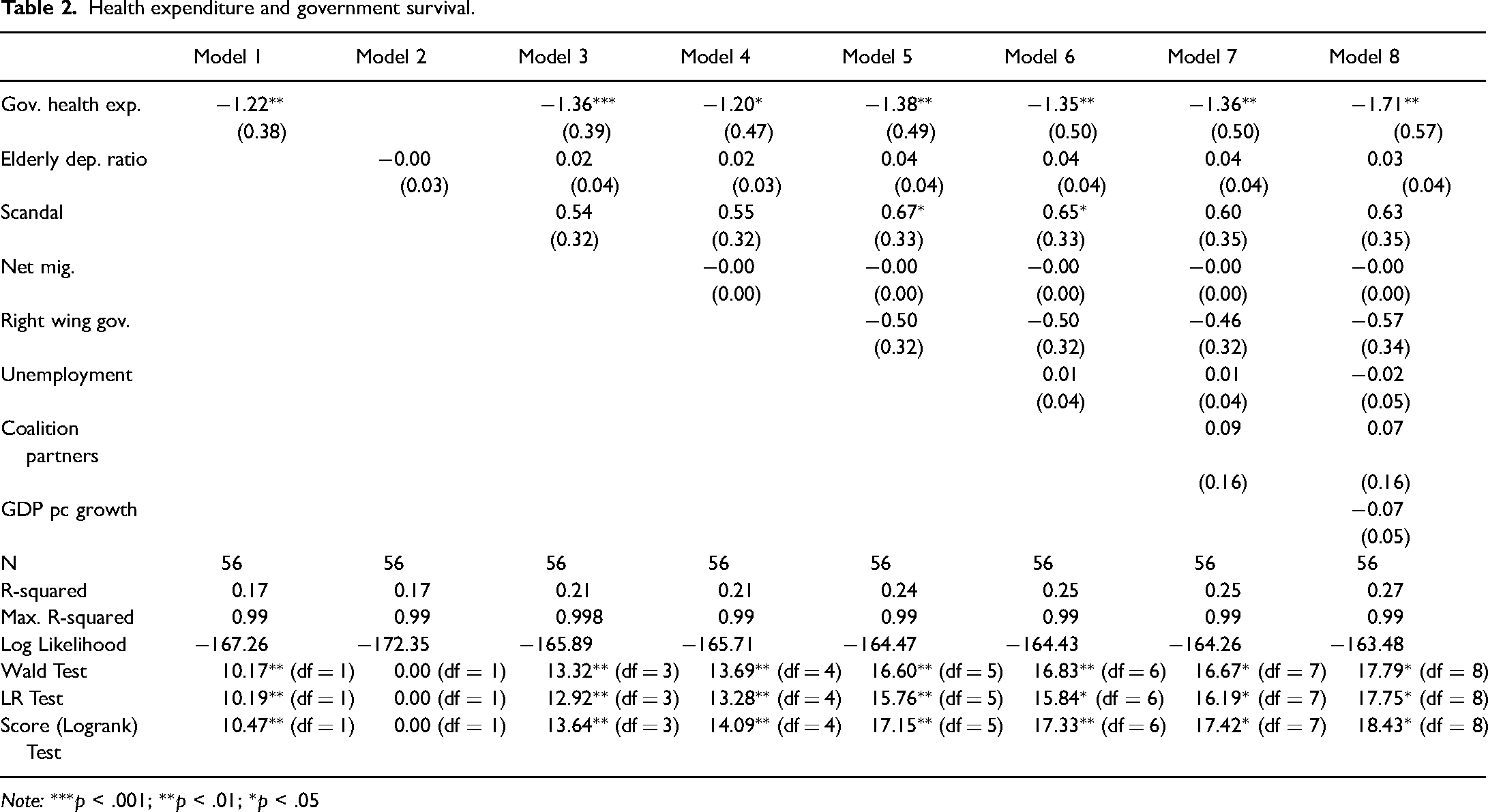
Health expenditure and government survival.
Note:
For the analysis, I focus exclusively on the countries that joined the EU in 2004 and are listed in Table 1, with the government serving as the unit of analysis. This results in a medium-
Results
Table 2 shows the results of my models. Across specifications, government health expenditure is positively associated with its expected survival in office, despite modest degrees of freedom. Note that the coefficient of survival models indicates the relationship to failure at any point in the survival curve: negative coefficients indicate lower probabilities of failure, that is a greater probability of continued survival. While the statement that government expenditure on the population is positively associated with its degree of popularity and stay in power is hardly controversial, it should be noted that previous estimations of the effect of political business cycles on government tenure in CEE countries reached mixed results (Klomp and De Haan, 2013). My results suggest that, rather than taking aggregate spending as the main explanatory variable, researchers should theorize which types of spending are those preferred by the government’s winning coalition, and base their estimations on those models (Bueno de Mesquita et al., 2002). Given that incumbent governments are not benevolent welfare maximizing agents, but rather seek reelection at the lowest possible cost, disaggregating welfare expenditure by recipient type makes substantive sense. Since EU accession shifts the average age of the electorate upward, one may reasonably expect that targeted welfare expenditure will move towards pensions and health care. The estimates presented in Table 2 substantiate these assertions. Note that controls are chosen to provide possible prior common causes of health care expenditure and government survival: only coefficients of the government health care expenditure variable are identified in these models and the coefficients of the controls should not be interpreted in a causal fashion (Keele et al., 2020).
In order to facilitate interpretation of the results, Figure 4 shows the survival probability in office across the range of the explanatory variable based on the last model of Table 2, where darker colors correspond to higher levels of government health expenditure. At the lowest expenditure level the predicted probability of surviving another day at 100 days in office is nearly 0%. By contrast, the highest expenditure level has a 65% to survive an additional day at this point. Of course, unlike the preceding difference-in-differences analysis, the models from Table 2 are not explicitly causally identified, and may suffer from endogeneity. For example, if a government in the data anticipated ex ante that it would be short-lived, and decreased its healthcare expenditure in response to that anticipation, it will induce some level of simultaneity in the results. However, the fact that nearly every government in the data ran on the same party platform in subsequent elections should provide some level of faith in the associative results presented here.
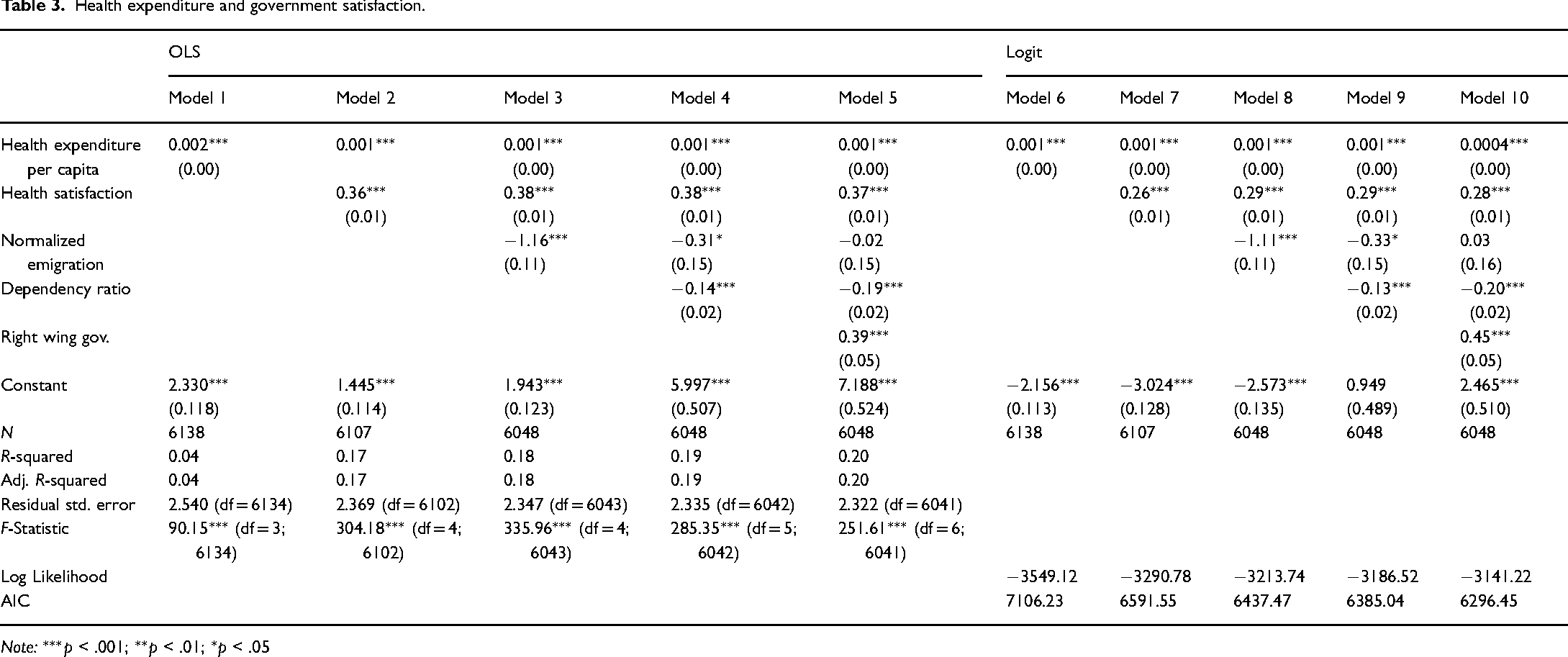
In order to further emphasize that it is the political behavior of the elderly that drives increased government tenure length, I analyze data from Wave 9 of the ESS, 2 combining aggregate country level and individual level covariates to predict satisfaction with the government. I restrict my effective sample to inhabitants of Bulgaria, Czechia, Estonia, Croatia, Hungary, Latvia, Lithuania, Poland, Slovenia, and Slovakia who are 60 years old or older. I predict their satisfaction with their governments using their personal satisfaction with public health, country-level health expenditure per capita, aggregate normalized emigration, the country’s old age dependency ratio, and the ideology of the incumbent government. I also include year fixed effects for the dates of the interviews. 3 Results are shown in Table 3, where I estimate both an OLS model and a logistic GLM. In the former, the outcome variable is satisfaction with the government on a 10-point scale, whereas the latter recodes the outcome variable to be 0 (a score of 5 or lower) or 1 (a score of 6 or higher). In both specifications, aggregate health expenditure is positively associated with government satisfaction, emphasizing the role of the elderly components of the electorate to keep the government incumbent. In the Online appendix, I show that this part of the population does not respond similarly to overall social spending: it is specifically targeted welfare spending that increases satisfaction with the incumbent government among the elderly part of the population.
Health expenditure and government satisfaction.
Note:
Conclusion
This article has shown that, by joining the Common Market with its Freedom of Movement principle, the new member states of Central and Eastern Europe have undergone fundamental transformations not only in terms of their economics and labor markets, but also their politics and targeted welfare spending. Joining the EU leads to significant out migration to higher wage countries, which strongly affects the size of the labor market and the dependency ratio. Furthermore, emigration is non-random with respect to both socio-economic and political characteristics of individuals (Lim, 2023). Consequently, incumbent governments shift targeted welfare expenditure towards the elderly, and become less likely to lose reelection. My contribution also adds causal estimates of some effects previously highlighted by the econometric literature (Petrova and Sznajder Lee, 2024).
The findings presented here provide further evidence that contemporary political conflict about the welfare state in Europe regard not its overall size, but rather relative spending on different priorities, such as pensions, education, or health (Bremer and Bürgisser, 2023). As such, it feeds into the ongoing debate of how countries with aging populations, both in Europe and beyond, are likely to respond to the economic and political pressures that such demographic changes generate. Where these are exacerbated by emigration, conflict over public finances are all the more likely to become bitter and hard fought, as governments have to balance greater demand for pension and health expenditures, with a lower supply of money to finance these demands. The struggle to balance the economic and political sustainability of welfare provides governments a strong incentive to systematically favor some parts of the electorate over others. In aging societies, this will mean greater provisions for the elderly, at the cost of other segments of the population. The more dominant a faction the elderly are in the minimum winning coalition, the stronger this effect will be. While the research design of this article was tailored to studying the effects of emigration on welfare politics and programmatic competition in Central and Eastern Europe, its theoretical framework could be generalized to other regions of the world with high levels of emigration and aging populations, including older member states such as Italy and Greece.
These findings represent only a small piece of the broader puzzle of programmatic competition and political economy within the European Union in general, and its Central and Eastern member states in particular. Most importantly, the October 2023 defeat of the PiS coalition in Poland provides an important caveat to the argument made here. Turnout of voters under 30 jumped over twenty percentage points: from 46% in 2019 to 64%, and support of the incumbent illiberal party decreased significantly among this group. The results shown in this study should therefore not be seen as an argument in favor of the inevitability of the rise of a consistently conservative electorate in the Eastern European member states. Future research should investigate the factors that led to the 2023 Polish electoral results and its marked increase in electoral turnout among younger voters, as well as other success stories of pro-democratic movements in CEE.
Supplemental Material
sj-pdf-1-eup-10.1177_14651165251340605 - Supplemental material for Emigration, welfare, and politics in central and Eastern Europe
Supplemental material, sj-pdf-1-eup-10.1177_14651165251340605 for Emigration, welfare, and politics in central and Eastern Europe by Melle Scholten in European Union Politics
Supplemental Material
sj-zip-2-eup-10.1177_14651165251340605 - Supplemental material for Emigration, welfare, and politics in central and Eastern Europe
Supplemental material, sj-zip-2-eup-10.1177_14651165251340605 for Emigration, welfare, and politics in central and Eastern Europe by Melle Scholten in European Union Politics
Footnotes
Acknowledgments
Previous versions of this article were presented at the European Center for Populism Studies Workshop, Politicologenetmaal 2024, the 2024 GSIPE APSA Pre-Conference Workshop, and Bocconi University. For their excellent feedback and thoughts on earlier versions of this manuscript, the author gratefully thank attendees at these places, as well as David Leblang, Junghyun Lim, Anne Meng, Nicola Nones, Sonal Pandya, Margaret Peters, Phuong Pham, Nicholas Ray, and the editors and anonymous reviewers of European Union Politics. Any and all mistakes that remain should be attributed to the author and to the author only.
Data availability statement
The datasets generated during and/or analyzed during the current study are available from the corresponding author on reasonable request.
Declaration of conflicting interests
The author declared no potential conflicts of interest with respect to the research, authorship, and/or publication of this article.
Funding
The author disclosed receipt of the following financial support for the research, authorship, and/or publication of this article: I humbly acknowledge funding received from the Bankard Fund for Political Economy, the Quantitative Collaborative of the University of Virginia, and the Institute for Humane Studies under Grant Number IHS017966.

Supplemental material
Supplemental material for this article is available online.
Notes
References
Supplementary Material
Please find the following supplemental material available below.
For Open Access articles published under a Creative Commons License, all supplemental material carries the same license as the article it is associated with.
For non-Open Access articles published, all supplemental material carries a non-exclusive license, and permission requests for re-use of supplemental material or any part of supplemental material shall be sent directly to the copyright owner as specified in the copyright notice associated with the article.
