







Abstract
Why do heavily biased media campaigns sometimes fail to achieve expected persuasive effects in electoral contexts? While compelling at the national level, the argument that pro-Leave media bias explains Brexit outcome struggles to account for places such as London and other urban areas, where majorities voted Remain despite exposure to Euroskeptic media. To shed light on this puzzle, this article applies the “filter hypothesis” to examine how interpersonal communication mediates media effects. We extend this framework by incorporating group pressure mechanisms simulating opinion conformity, and building an agent-based model that compares theoretical mechanisms: direct versus mediated media effects, varying conformity levels, and different thresholds for network homogeneity and opinion similarity perception. Our findings show that models incorporating both mediated effects and group pressure mechanisms best replicate observed voting patterns and improve explanatory power.
Introduction
In 2016, the United Kingdom (UK) became the first member state to leave the European Union (EU). The Brexit referendum marked a turning point in the politics of European integration—or disintegration—reflecting a broader shift from permissive consensus, in which elites could advance integration with little public scrutiny, to constraining dissensus, characterized by increasing public contestation (Hooghe and Marks, 2009). The referendum outcome revealed both the rising importance of public opinion in shaping EU integration (Bølstad, 2015) and the fragility of EU regime support (Hobolt and De Vries, 2016).
The Brexit vote had a lasting impact on the fate of the UK and the future of the EU. Consequently, extensive research has been conducted to explain the determinants of voting behavior in the referendum (Colantone and Stanig, 2018; Green and Pahontu, 2024; Henderson and Jones, 2021; Hobolt, 2016; Hobolt et al., 2021; Kaufmann, 2016; Norris and Inglehart, 2019). Explaining the Brexit vote is inherently challenging due to the many factors influencing this decision. However, this article does not aim to untangle the broader dynamics behind the vote. Instead, we focus on a specific argument frequently found in the literature: that Euroskeptic media significantly shaped public opinion in favor of Brexit.
Sympathetic media coverage can boost electoral success (DellaVigna and Kaplan, 2007; Enikolopov et al., 2011; Martin and Yurukoglu, 2017). When electoral outcomes align with media bias, the argument that biased coverage benefits the favored side appears straightforward. But what happens when heavily biased media campaigns fail to achieve expected persuasive effects? While compelling at the national level, the pro-Leave media explanation for Brexit struggles to account for places such as London and other urban areas, where majorities voted Remain despite exposure to the same biased media environment (Levy et al., 2016; Loughborough University, 2016). Such cases can illuminate the scope conditions and limitations of media influence (MI).
Understanding the mechanisms through which individuals accept or reject media messages requires viewing media not only as a source of information but also as a conversation starter. People often discuss the news with colleagues, friends, and family, creating spaces for socially negotiating and validating perceptions of reality (Shehata, 2021). These discussions carry evaluative content that shapes norms about what is socially acceptable, improves the quality of opinions (Huckfeldt et al., 2004; Kim et al., 1999), and encourages political participation (Fishkin and Laslett, 2003; Mcleod et al., 1999). Brexit, as a highly contentious issue, dominated conversations during the referendum campaign (Davies, 2019). A YouGov (2016) poll revealed that 20% of Londoners identified their friends and family as their primary influence during the EU referendum campaign, compared to only 8% who credited the media. Despite this, the role of personal relationships in shaping opinions has been largely overlooked in empirical studies of Brexit (Davies, 2022). We suggest that, despite the widespread prevalence of pro-Leave messages in the media (Levy et al., 2016; Loughborough University, 2016), discussion networks likely filtered out many of these messages; thereby reducing the impact of Euroskeptic media messages on public opinion.
The Brexit referendum compelled voters to take sides, creating strong identification with opinion-based groups. This gave rise to enduring Brexit identities, “Leavers” and “Remainers” (Hobolt et al., 2021). To understand how MI and group dynamics interact to shape opinion formation, we focus on London, which exemplifies the puzzle of divergence between media bias and electoral outcomes. Despite exposure to the same pro-Leave media environment that characterized the national campaign (Levy et al., 2016), London voted 59.9% Remain (BBC, 2016). London offers both comprehensive data to model pro-Leave and pro-Remain message reach, newspaper readership, and pre-campaign vote intentions (Fieldhouse et al., 2020; Levy et al., 2016)—and substantial variation across 33 boroughs that enables testing our theoretical framework across diverse opinion environments within a shared media landscape. Although our analysis focuses only on print newspapers due to data availability, it effectively captures the broader Euroskeptic bias present in the British media (Deacon et al., 2016; Deacon and Wring, 2016; Köker et al., 2020; Ponsford, 2016). Newspapers often set the agenda for other media platforms, including television (Banducci et al., 2018; Vliegenthart et al., 2008) and social media (Mair et al., 2017; Polonski, 2016), making press analysis a reliable indicator of broader MI patterns.
Understanding MI in this context requires examining interpersonal communication processes. Opinion formation is a dynamic and interactive process that can unfold through different pathways. Someone might read a news article and be convinced by its arguments. They might talk to friends and be swayed by what they hear. Or they might read the news and then discuss it with others, letting those conversations shape how they interpret what they read. The “filter hypothesis” (Katz et al., 1955; Schmitt-Beck, 2003) posits that media effects are conditional on the composition of discussion networks (homogeneous or heterogeneous) and the alignment of media content with group opinions (congruent or conflicting). When the group is homogeneous and the message aligns with their views, the group reinforces the message, creating strong MI. When messages conflict with group opinions, the network filters them out, weakening media impact. In heterogeneous networks where people hold diverse views, the media has a moderate influence regardless of the message content. However, we argue that this filtering mechanism captures just part of how social networks shape opinion formation. Beyond mediating how people interpret media messages, interpersonal communication can directly influence opinions through social pressure to conform to group norms (Toshkov et al., 2024; Wratil and Wäckerle, 2023). Therefore, we extend this framework by incorporating direct group conformity effects.
To better understand how media exposure and interpersonal communication interact to shape public opinion, our study employs agent-based modeling (ABM). ABM is a computational approach that simulates autonomous agents—simplified representations of people—who interact with each other and their environment over time (Smith and Conrey, 2007). These interactions generate emergent patterns that help us understand how individual behaviors scale up to create collective social outcomes. A key advantage of ABM for theory building is its ability to test “what–if” scenarios by systematically varying theoretical mechanisms to see which conditions reproduce observed voting patterns. We examine four dimensions of opinion formation: whether media content directly influences opinion or is mediated by interpersonal communication; whether social groups pressure individuals to conform and how strongly; how many people in someone’s discussion network need to share the same opinion before that person considers their group homogeneous; and how much agreement someone needs to feel aligned with their network. By varying one mechanism at a time between simulation rounds while keeping the others constant, we assess which combinations best account for opinion formation during the Brexit campaign, using referendum outcomes as the benchmark.
Our results show that models incorporating both mediated media effects and group pressure (GP) mechanisms significantly outperform direct media effects models. The improvements are largest in pro-Remain areas, moderate in contested areas, and smaller but consistent in pro-Leave areas. Simulations aligned most closely with real-world voting patterns when three conditions were met: (1) MI operated through interpersonal communication rather than directly (supporting the filter hypothesis); (2) GP dynamics were strong enough to allow stance shifts between Leave and Remain; and (3) people required relatively low thresholds—only 30%–40% of their discussion partners—to perceive their network as homogeneous or to feel aligned with their group. This geographic variation reveals important scope conditions for media effects. Where media messages aligned with local preferences (pro-Leave areas), direct influence models performed adequately. But where media conflicted with social context (pro-Remain and Contested areas), interpersonal communication became essential for replicating voting patterns.
This study makes four main contributions. First, we draw attention to cases where media bias diverges from electoral outcomes, such as London and other large urban areas during the Brexit referendum. We argue that such cases are crucial for identifying the scope conditions and limits of MI, which are often overlooked in dominant media-effects theories. Second, we simulate how discussion networks strengthen or filter Euroskeptic MI during the Brexit campaign. Building on the filter hypothesis, we show that interpersonal communication can significantly reduce biased media effectiveness when discussion networks conflict with media messages. Third, we extend this theory by incorporating direct group conformity mechanisms, acknowledging that political discussion can influence opinion formation through multiple pathways: by mediating how people interpret media messages and through direct social pressure to align with group norms. Fourth, we offer a methodological contribution by developing a dynamic ABM that simulates how MI interacts with interpersonal communication across different opinion composition networks and testing competing theories of MI. This approach allows us to better understand the intermediate mechanisms that link media exposure to opinion change. By testing various combinations of theoretical assumptions against observed voting patterns, we identify which social processes best explain how opinions formed during a high-stakes referendum campaign. Our results are consistent with recent work in political communication and opinion dynamics (Boomgaarden, 2014; Fieldhouse et al., 2015; Neiheisel and Niebler, 2015; Sobkowicz, 2016; Song and Boomgaarden, 2017) that highlights the importance of incorporating interpersonal communication in studies of media effects.
Critically, we find that the same theoretical mechanisms produce different outcomes depending on local opinion composition. In areas where media messages aligned with existing preferences, simpler direct influence models performed adequately. However, in contexts where media narratives conflicted with local opinion climates, incorporating social filtering and conformity mechanisms became essential for explaining observed patterns. This asymmetry helps clarify why Euroskeptic MI was limited in pro-Remain contexts and, more broadly, illuminates how opinion formation unfolds when citizens encounter competing messages in polarized environments. As political contexts increasingly feature heavily biased media campaigns combined with strong opinion-based group identities, these findings suggest that social networks may serve as crucial buffers against dominant media narratives, with important implications for understanding media campaign effectiveness in contemporary polarized democracies.
Mass media and interpersonal communication
Mass media and interpersonal communication are important sources of political information, but how and to what extent do they shape public opinion? Media outlets can act as “political actors” (Page, 1996), aiming to change the beliefs and political preferences of their audiences, which in turn can affect political decisions. Additionally, they act as “issue entrepreneurs” (De Vries and Hobolt, 2020; Hobolt and De Vries, 2016) by raising the salience of specific political issues while providing compelling frames that help citizens interpret these issues (Foos and Bischof, 2022). Yet, individuals do not just encounter this political information without a social context; they are embedded within social networks where political issues are discussed. Engaging in these political conversations creates a dynamic space where perceptions of reality are socially negotiated, validated, and constructed (Eveland, 2004; Gamson, 1992; Shehata, 2021). Interpersonal communication extends beyond merely sharing information; it includes evaluative content that informs individuals about what their group considers acceptable and unacceptable. This process not only enhances the quality of opinions (Huckfeldt et al., 2004; Kim et al., 1999), but also encourages political participation (Fishkin and Laslett, 2003; Mcleod et al., 1999).
While both sources of political information have been extensively studied, fewer efforts have been made to examine how the interaction between media and interpersonal communication influences public opinion (for exceptions, see Beck et al., 2002; Boomgaarden, 2014; De Vreese and Boomgaarden, 2006a; Katz et al., 1955; Lenart, 1994; Schmitt-Beck, 2003; Song and Boomgaarden, 2017). The media not only informs people about political issues, but also acts as a conversation starter, with people often discussing news content with others after consumption. Critically, individuals may only recognize the relevance of certain media messages after receiving evaluative cues from their social group about which messages are appropriate (Schmitt-Beck, 2003). This means that the conversation that takes place after receiving information from the media could moderate the potential effect of the media on public opinion.
This idea is known as the “filter hypothesis” of mass communication influence, first proposed by Katz et al. (1955). It suggests that discussing politics with others can reinforce or restrict media effects, based on the evaluative implications of the media information and on the opinion composition of discussion networks. Talking about politics has a “meta-communicative” function: telling individuals which messages are considered appropriate by their group and should therefore be accepted, as well as which messages are deemed inappropriate and should be rejected. Consequently, personal communication plays a functionally equivalent role to political predispositions by removing conflicting political information (Schmitt-Beck, 2003).
Beyond examining media content and its alignment with group opinions, the filter hypothesis emphasizes how the opinion composition of discussion networks shapes MI, that is, whether these networks have homogeneous or heterogeneous opinions. In homogeneous discussion networks, where the majority is overwhelmingly in a dominant position, exposure to political information that aligns with the group’s preferences reinforces both the media messages and the existing attitudes (Southwell and Yzer, 2007). Conversely, when individuals in homogeneous networks are exposed to conflicting media messages, the influence of the media is expected to diminish as the group tends to block or filter out dissonant information. In heterogeneous networks, where there is a diversity of opinions, MI is expected to have a moderate effect on opinions, regardless of the content or the direction of evaluation (Schmitt-Beck, 2003). In these networks, there is less resistance to conflicting political messages since different individuals support varying viewpoints (Neiheisel and Niebler, 2015). This reduced resistance occurs because diverse viewpoints prevent any single perspective from dominating the evaluative process. Such heterogeneity creates what Berelson et al. (1986) termed the “breakage effect,” where the social filtering mechanism breaks down, allowing media messages more direct access to individual opinion formation. Consequently, people within these networks are generally less resistant to challenging their beliefs (Song and Boomgaarden, 2017). However, while the media’s influence is stronger in heterogeneous networks than in homogeneous networks exposed to conflicting messages, it remains weaker than when homogeneous groups encounter reinforcing messages (Schmitt-Beck, 2003).
Figure 1 illustrates the expected strengths and directions of MI on opinion based on the filter hypothesis (Katz et al., 1955; Schmitt-Beck, 2003).
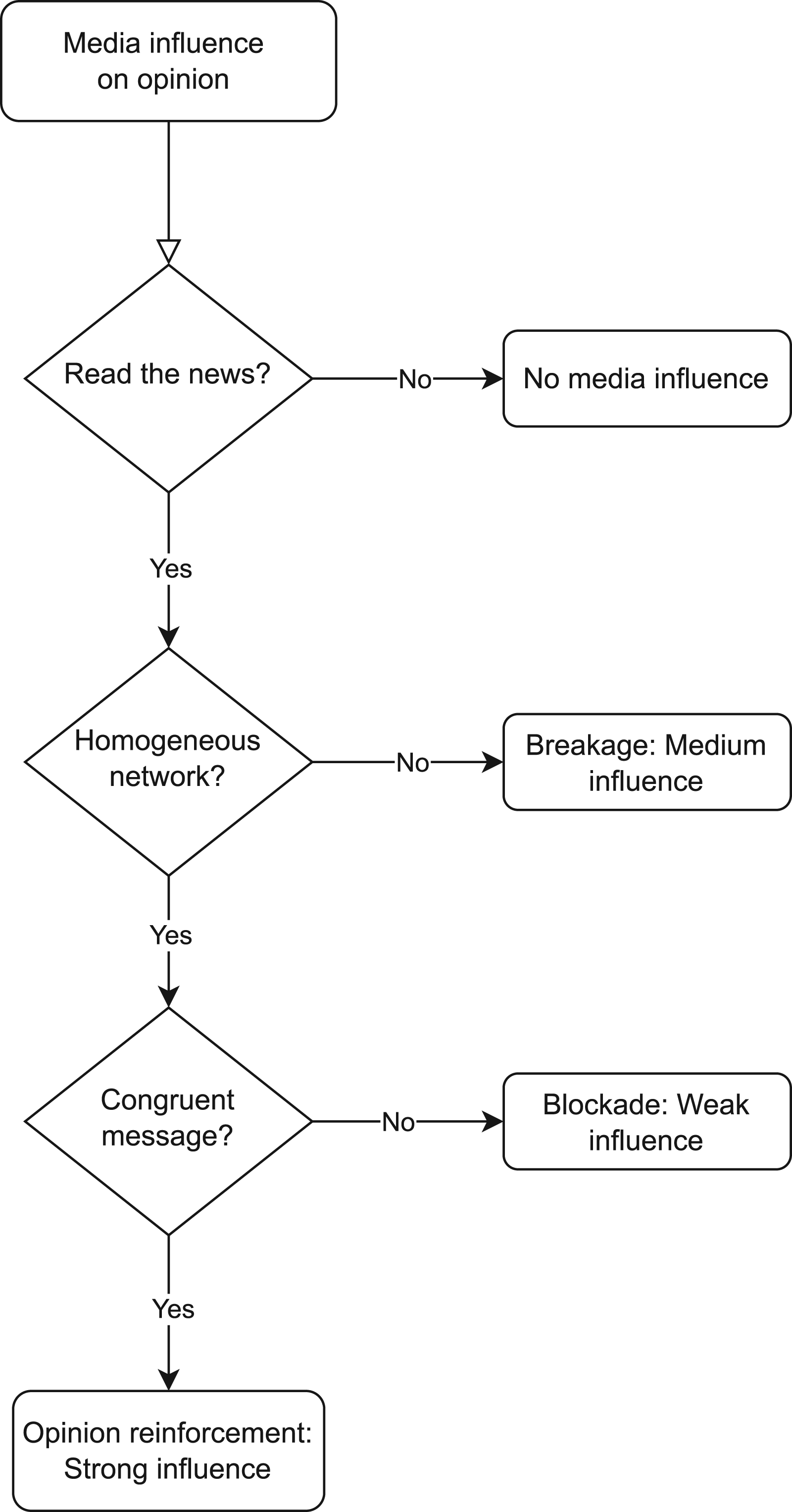
Model flowchart for media influence mechanism based on the filter hypothesis (source: authors).
The influence of interpersonal communication on public opinion may extend beyond moderating MI, as individuals tend to adjust their views to align with those they interact with. To capture this dynamic, we extend the filter hypothesis framework by incorporating the effect of group conformity. This is particularly relevant in the Brexit context, where the referendum compelled people to take sides and, as Hobolt et al. (2021) show, this salient inter-group comparison created new political identities—Leavers and Remainers—defined by shared political opinions. Similar to partisanship, these opinion-based groups foster emotional attachment to group membership and drive individuals to adjust their behavior to conform to group norms (Bartle and Bellucci, 2009; Klar, 2014). Figure 2 illustrates how we conceptualize this dynamic for our agent-based simulation. Given ongoing debates about the strength of group conformity, we model two variations of the effect. In one, GP is strong enough to shift an individual’s stance on Brexit (e.g. from Leaver to Remainer; Wratil and Wäckerle, 2023). In the other, GP reinforces prior beliefs when they align with the majority and weakens them slightly when they do not, without fundamentally altering an individual’s stance (Toshkov et al., 2024).
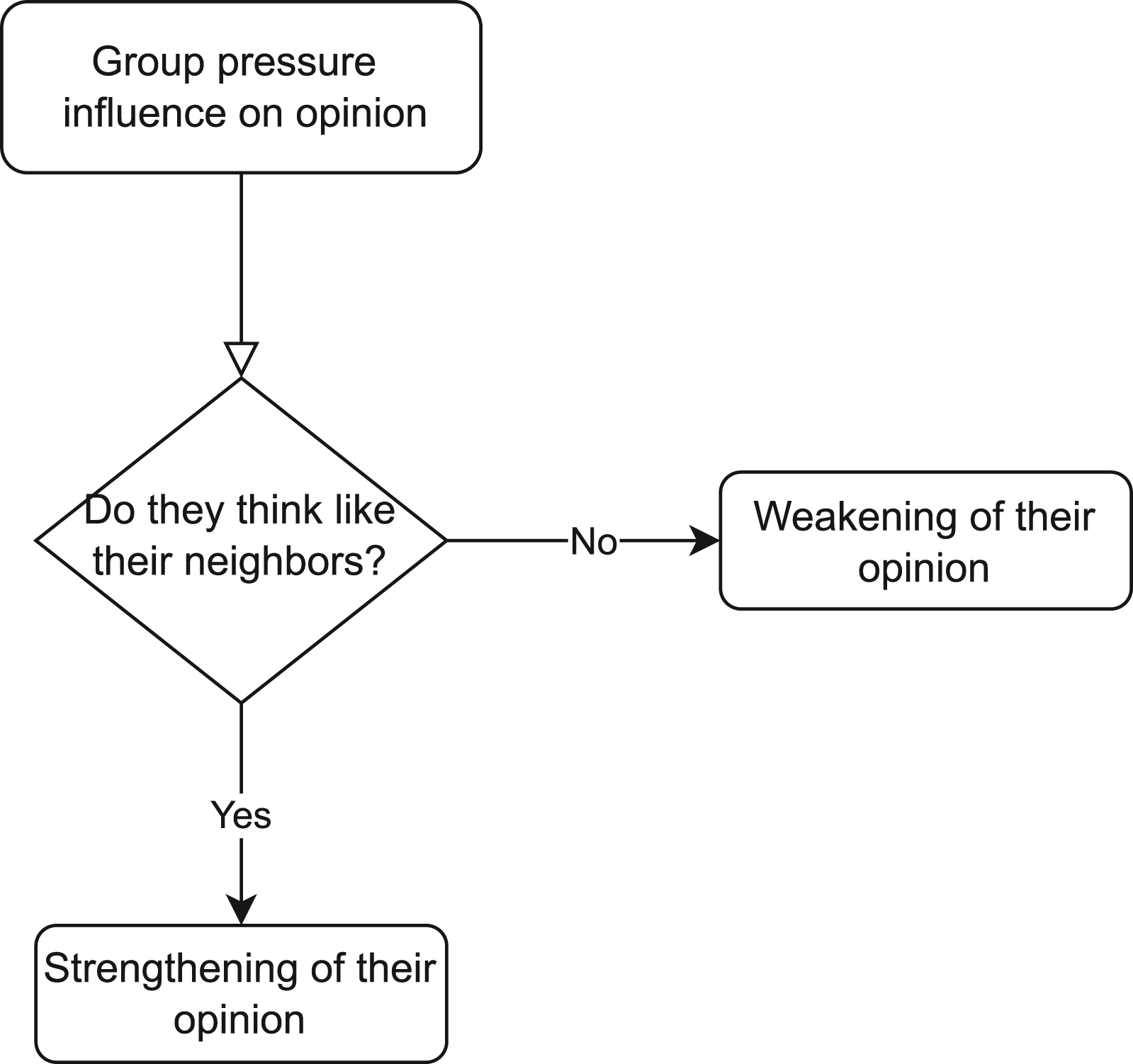
Model flowchart for group pressure mechanism (source: authors).
Understanding how interpersonal communication mediates media effects is particularly important for explaining contexts where heavily biased media campaigns fail to persuade the electorate. In major urban areas such as London, that voted Remain despite pervasive pro-Leave media coverage (Levy et al., 2016; Loughborough University, 2016), discussion networks might have played a crucial role in filtering out pro-Leave messages. If most individuals in these areas were embedded in pro-Remain networks, the social filtering mechanisms described by the filter hypothesis could help explain why Euroskeptic MI appeared constrained in these contexts.
Euroskeptic media in the UK
Many citizens perceive European integration as too complex and abstract, leading to a lack of interest, awareness, or emotional connection that would allow them to form well-informed opinions about the integration process (Anderson, 1998; Hobolt and De Vries, 2016; Wlezien, 1995). To overcome this information deficit, citizens often rely on domestic cues. This “cue-taking” approach emphasizes the importance of recommendations from political parties and media during campaigns as an explanation for how citizens form opinions about the EU. It is considered an important factor in explaining the outcome of Brexit (Hobolt, 2016).
Compared to other EU countries, the UK has an unusually Euroskeptic media landscape (Cole, 2001; Firmstone, 2008; Levy et al., 2016; Morgan, 1995). Prior to the referendum, UK media consumers had been exposed to at least 40 years of predominantly Euroskeptic coverage (Daddow, 2012; Foos and Bischof, 2022) characterized by a bombastic, nationalistic, and sometimes xenophobic tone (Daddow, 2015). The British media began advocating for a referendum long before the term “Brexit” was coined (Hinde, 2017), influencing large segments of the public to adopt Euroskeptic views even before the campaign officially started (Berry, 2016). As early as 1986, Dalton and Duval (1986) demonstrated a connection between the tone of the British press and public opinion on European integration at the aggregate level (De Vreese and Boomgaarden, 2006a). Euroskeptic outlets had been framing for decades the EU as a bureaucratic threat to national sovereignty and British identity (Daddow, 2015; Simpson and Startin, 2023), often focusing on issues such as cost, waste, and immigration, with coverage ranging from harsh criticism to ridicule, frequently including exaggerated or false claims (Hinde, 2017). This led the European Commission to establish a website called “Euromyths,” dedicated to refuting claims made by the British press (Levy et al., 2016).
This long-standing media environment created conditions for the referendum campaign to have substantial persuasive effects. Several studies have shown that most media coverage was heavily skewed in favor of Brexit. Research conducted by Loughborough University (2016) found that, when considering circulation, 80% of daily newspaper readers encountered headlines that supported British withdrawal from the EU. Similarly, Ponsford (2016) reported that 74% of national newspapers, also weighted by circulation, endorsed the Leave campaign, compared to only 24% supporting Remain.
The case: London
Arguments linking biased media coverage to electoral outcomes are most compelling when results align with media bias. However, to understand the scope conditions and limits of MI, it is important to examine the cases where heavily biased campaigns fail to produce expected outcomes. The Brexit referendum provides such variation: while extensive research demonstrates that Euroskeptic media significantly shaped public opinion in favor of Brexit (Berry, 2016; Carl et al., 2019; Hinde, 2017; Levy et al., 2016; Simpson and Startin, 2023; Smith et al., 2021; Van Der Zwet et al., 2020), major metropolitan areas consistently voted Remain despite exposure to the same pro-Leave media environment. We focus on London as a representative case of what Fieldhouse and Bailey (2023) describe as the “Remain-leaning metropolitan heartlands”—a pattern shared by other major English cities such as Manchester, Liverpool, Newcastle, and Leeds (BBC, 2016). This variation, where media bias and electoral outcomes diverge, provides insight into the intermediate process between media exposure and opinion formation.
London offers several analytical advantages for testing competing theories of media effects. First, we can draw on comprehensive data on newspaper content and audience exposure in London during the referendum campaign (Levy et al., 2016), which allows us to model the reach of pro-Leave and pro-Remain messages. Second, the British Election Study (BES) (Fieldhouse et al., 2020) provides data on newspaper readership patterns and pre-campaign vote intentions at the London borough level. Combining these sources, we can model potential media effects during the campaign period. Third, substantial borough-level variation within London’s 33 boroughs—ranging from 78.6% Remain in Lambeth to 30.3% in Havering—provides analytical leverage for testing our theoretical framework across diverse opinion composition networks within a shared media landscape. Finally, YouGov polling data (2016) document the relative weight of interpersonal versus MI among Londoners, with 20% citing friends and family as their primary source of influence compared to only 8% crediting the media, providing descriptive evidence consistent with the importance of discussion networks in opinion formation.
Media coverage in London mirrored the national trend of Euroskepticism. Levy et al. (2016) found a pronounced pro-Brexit bias in London newspaper coverage, with 48% of referendum-focused articles being pro-Leave and only 22% supporting Remain. Even newspapers that officially endorsed Remain published substantial pro-Leave content: The Times, despite its declared support for Remain, published more pro-Leave articles (36%) than pro-Remain content (22%). Similarly, readers of The Guardian and Financial Times were exposed to substantial pro-Leave messaging through news reporting, opinion pieces by guest contributors, and coverage of Leave campaign arguments. This divergence between editorial stance and article content underscores the structural imbalance in media messaging during the campaign, a problem that has long been criticized as detrimental to UK democracy (Anderson, 2004; Anderson and Weymouth, 1999).
Despite this media environment, London voted 59.90% Remain, contrasting sharply with both the national England result (46.60% Remain) and the UK overall (48.10% Remain) (BBC, 2016). Seven of the 10 areas with the highest Remain vote shares were in London, including Lambeth, Hackney, and Haringey, each recording over 75% support for staying in the EU. Figure 3 shows Brexit vote intentions among Londoners before the referendum campaign by borough, based on Wave 7 of the 2014–2023 BES Internet Panel (conducted during the 2016 pre-local election period) (Fieldhouse et al., 2020). The map shows the substantial variation across London’s boroughs, from strongly pro-Remain areas such as Lambeth (75.51% Remain vs. 19.05% Leave) to more contested boroughs such as Sutton (45.79% Remain vs. 45.79% Leave) and strong pro-Leave areas such as Barking & Dagenham (25.00% Remain vs. 68.33% Leave).
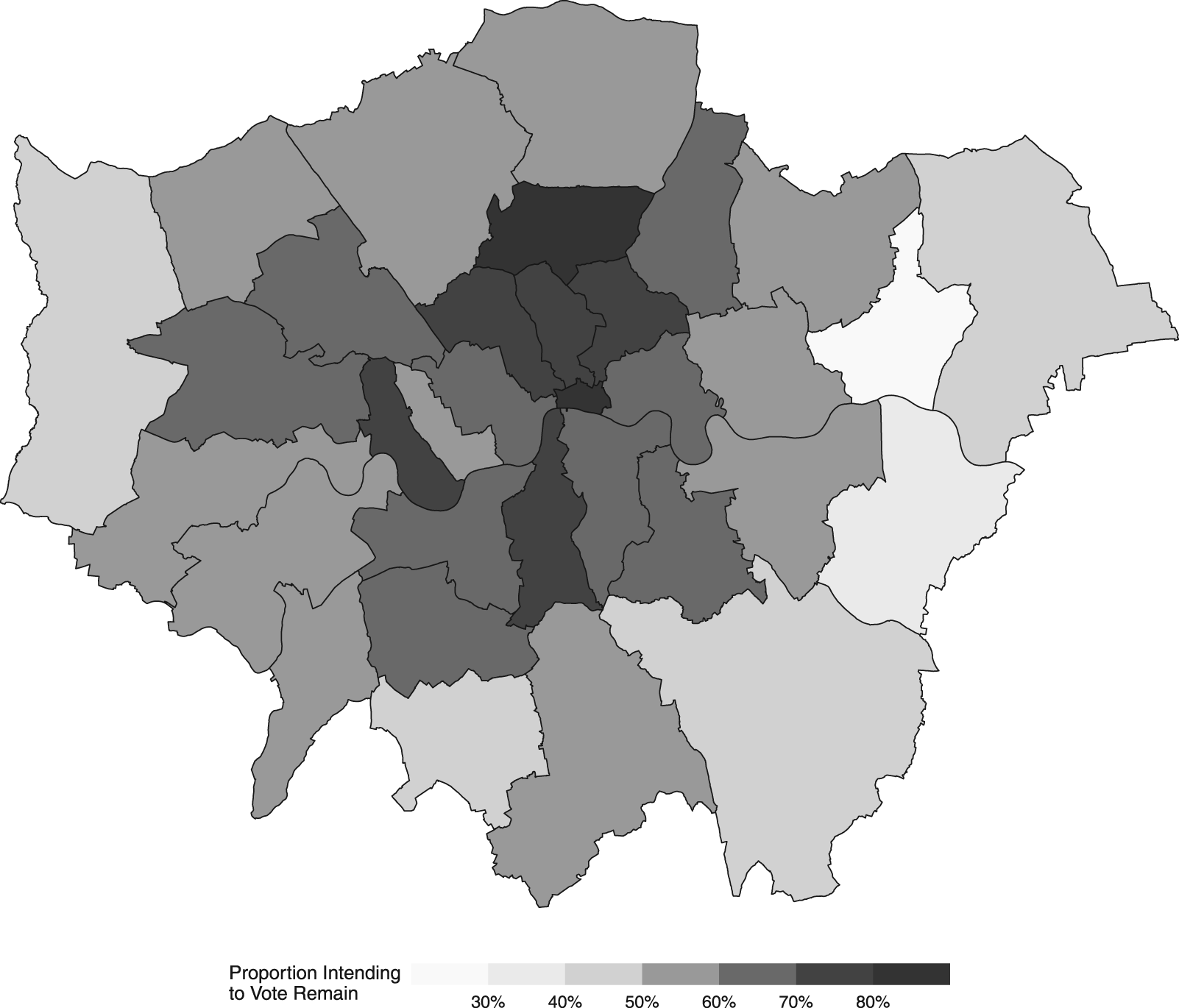
Pre-campaign Brexit vote intention by borough in London.
This spatial variation gives us leverage to test whether discussion networks mediate media effects, helping explain the tension between Euroskeptic media advocacy for Brexit and areas that ultimately resisted this influence. Drawing on the filter hypothesis, we propose the following mechanism operated across London’s boroughs: in predominantly pro-Remain areas, individuals encountering pro-Leave media content would discuss these messages with peers holding contrary views, leading to social filtering through counter-arguments, skepticism, and subtle social pressure that limited media persuasive reach. Conversely, in Leave-leaning areas, pro-Leave narratives would find reinforcement through interpersonal discussion, amplifying MI. Media messages gain power when echoed and reinforced by peers; when socially contested, their persuasive impact diminishes. Brexit became deeply embedded in everyday conversations. The referendum created what Davies and Carter (2024) describe as political discussions that infiltrated the everyday lives and relationships of people living in the UK. These conversations created spaces where media-derived arguments were socially tested (Shehata, 2021), with responses from family and friends signaling whether political messages would be accepted or filtered out. Understanding Brexit, therefore, requires viewing opinions as social practices shaped by relational dynamics and group norms rather than merely individual expressions (Davies, 2022).
Agent-based model
Most previous analyses of political opinion rely on observational data and regression-based methods. While effective for testing linear hypotheses, these approaches cannot capture the dynamic, iterative processes through which individuals encounter information, discuss it with others, and form opinions over time (De Vreese and Boomgaarden, 2006b). ABM uses a bottom-up approach, simulating autonomous agents that interact with each other and their environment according to rule-based behaviors. These interactions generate emergent patterns, enabling researchers to link individual behaviors to aggregate outcomes and map micro-to-macro processes (Bonabeau, 2002; Smith and Conrey, 2007). While ABM has been increasingly applied to political science research questions, its use remains limited in the discipline (Castellano et al., 2003; Chueca Del Cerro, 2023; Cox and Griffeath, 1986; De Marchi and Page, 2014; Fieldhouse et al., 2015; Kollman, 2003; Kollman et al., 1992; Martínez et al., 2015; Sobkowicz, 2016; Varela, 2009). By simulating key theoretical elements of social processes, this approach encourages researchers to formally and explicitly represent the factors and interactions believed to be part of social phenomena.
This approach proves particularly valuable for studying Brexit opinion formation, where qualitative research documents extensive political discussions within families and social networks (Davies, 2019, 2022, Davies and Carter, 2024), yet survey data lacks detailed information about discussion network composition and the interpersonal processes that might mediate media effects on opinion. Understanding how MI actually works requires examining what happens between reading the news article and being influenced by it. We examine four key theoretical dimensions: whether media content directly influences opinion or is mediated by interpersonal communication; whether social groups pressure individuals to conform and how strongly; how many people in someone’s discussion network need to share the same opinion before that person considers their group homogeneous; and how much agreement someone needs to feel aligned with their network.
Model design and mechanisms
To explore these questions, we construct a computational representation of London’s social and media environment during the Brexit referendum campaign. Our model consists of 2,500 agents connected through a small-world network 1 structure programmed using GAMA (Taillandier et al., 2019). Small-world networks, originally conceptualized by Watts and Strogatz (1998), capture a fundamental property of real social networks where most people are connected to others through relatively short chains of acquaintances while maintaining tight clusters of close relationships. This structure combines the local clustering of regular social circles with occasional long-distance connections that bridge different communities. In our simulation, each node represents a single person (an agent), and each link between two nodes indicates that those individuals engage in political discussions together. Following network terminology, an agent’s “neighbors” are the people directly connected to them in the network (Singh et al., 2018). In our simulation, an agent’s neighbors represent their personal discussion partners, such as family members, friends, or work colleagues. The “neighborhood” refers to this entire collection of discussion partners surrounding each agent. This network structure reflects how political information and influence spread through society, through conversations within tight social circles of people who know each other, combined with occasional bridging connections between different social groups, allowing both local reinforcement and broader diffusion of political attitudes across the population.
Each agent begins the simulation with an initial Brexit opinion, represented as a numerical value between 0.00 and 1.00, where values below 0.45 indicate pro-Remain positions, above 0.55 represent pro-Leave stances, and the middle range captures undecided voters. The initial opinion distributions match pre-campaign voting intentions from London borough data from the BES (Fieldhouse et al., 2020). The model simulates the official 70-day campaign period, with each day representing a discrete time step where agents read the news, discuss politics with their neighbors, and potentially adjust their opinions. Following data on newspaper readership by Fieldhouse et al.(2020), we model that each day 62% of agents read the news. Of these, 22% encounter pro-Remain information, 48% encounter pro-Leave information, 26% read articles with mixed messages, and 4% read neutral articles (Levy et al., 2016). The effect of reading these articles on the agents’ opinions differs depending on the message. Pro-Remain articles have a negative effect, decreasing an agent’s opinion value toward 0, while pro-Leave articles have a positive effect, increasing the value toward 1. Articles with mixed messages or neutral content have no effect on agents’ opinions.
Our first theoretical comparison examines two fundamentally different mechanisms of MI. Under the direct media mechanism, news articles immediately impact individual opinions without any social mediation—representing the traditional view of media as directly persuasive (Coppock et al., 2018; Özdoyran, 2020). Alternatively, under the mediated media mechanism, which follows the filter hypothesis, agents first assess their discussion network’s Brexit opinions before being influenced by news. In heterogeneous networks with diverse viewpoints, we expect moderate MI. In homogeneous networks, the effect is expected to depend on whether media content aligns with the dominant group opinion. When messages align with network consensus, the group reinforces the media effect, creating a strong influence. When messages conflict with group opinions, the network filters them out, resulting in weaker influence. For example, an agent reading a pro-Remain article while embedded in a homogeneous pro-Leave discussion network experiences minimal media effect due to social blockade (Schmitt-Beck, 2003), while the same article would have a strong impact in a pro-Remain network where the message receives social reinforcement.
The second theoretical comparison extends the filter hypothesis by incorporating how interpersonal communication directly shapes opinion formation through social conformity pressures. Beyond mediating how people interpret media messages, political conversations might also directly influence attitudes through social conformity pressures, individuals adjusting their opinions to align with the group (Axelrod, 1997; Flache et al., 2017). We model three variants: no GP (filter hypothesis assumptions only), “opinion resistance” mode with moderate pressure that affects how strongly people hold existing beliefs without changing their fundamental position (Toshkov et al., 2024), and “opinion change” mode with strong pressure that can push individuals across critical thresholds, potentially converting undecided voters or shifting supporters to the opposite side (Wratil and Wäckerle, 2023).
The final theoretical components involve how individuals perceive their discussion networks. The homogeneity threshold (H) determines what percentage of discussion partners must share the same Brexit stance before an agent perceives their network as having a dominant opinion: as homogeneous. The similarity threshold (S) determines what percentage of neighbors an agent must agree with before considering that they “think alike” within their network. The H defaults to 0.70 (Deffuant et al., 2000), stipulating that at least 70% of an agent’s neighbors must share the same opinion for the agent to perceive that they are in a homogeneous network. The similarity limit, set at 0.50 (Deffuant et al., 2005; Jager and Amblard, 2005), indicates that an agent needs to share the same opinion with at least half of their neighbors to consider that they think alike.
These mechanisms integrate into a daily sequence detailed in the Online appendix. Opinion change occurs through two primary pathways: media exposure and social pressure. Each day, agents designated as newspaper readers encounter media content according to established exposure patterns (Levy et al., 2016). In model variations without GP, only media exposure modifies opinions. With GP activated, agents who do not read newspapers can experience opinion change through social conformity, while newspaper readers may be influenced by both pathways simultaneously. For agents exposed to media, the influence pathway depends on whether the simulation tests direct or mediated mechanisms: direct influence adjusts opinion values immediately with no social mediation; mediated influence involves agents first evaluating their network composition using the H and S, then experiencing varying degrees of MI—moderate in heterogeneous networks, strong in homogeneous networks with aligned messages, or weak in homogeneous networks with conflicting messages. The rest of the model parameters are detailed in the Online appendix.
Data and model calibration
Our ABM integrates empirical data with theoretical mechanisms to represent the Brexit campaign environment. We calibrate the model using two primary datasets: the BES’s borough-level pre-campaign vote intentions and newspaper readership patterns (Fieldhouse et al., 2020), and the Reuters Institute’s comprehensive analysis of Brexit article reach and bias across London newspaper editions (Levy et al., 2016). This combination establishes both the initial political landscape and the media environment that shapes agent interactions during the campaign.
We rely on the Reuters Institute for the Study of Journalism in collaboration with PRIME Research’s study on UK press coverage of the EU Referendum (Levy et al., 2016) to model the reach of different message types: pro-Leave, pro-Remain, mixed, and neutral. This analysis of media coverage has been cited in multiple studies exploring Brexit media discourse, the influence of media on the EU Referendum vote, and public opinion (Abreu and Öner, 2020; Foos and Bischof, 2022; Henkel, 2021; Javadinejad, 2024; Walter, 2019). The study analyzed 2,378 articles from the London editions of nine national newspapers over the four-month referendum campaign. This study is particularly valuable because it measures not just article content but actual audience reach, combining newspapers’ readership, EU referendum article size and placement, and visual elements to calculate the percentage of each newspaper’s audience likely exposed to each article. We use this analysis to model the unequal reach of campaign messages.
A limitation of this analysis lies in its exclusive focus on print newspapers, which restricts our simulation scope to this medium. Nonetheless, this approach still captures broader MI patterns. The UK press has long been recognized as a key driver of public opinion and Euroskepticism (Anderson and Weymouth, 1999; Foos and Bischof, 2022; Smith et al., 2021). Newspapers set the agenda for other media, including television, which follows their lead during campaigns due to space constraints and neutrality regulations (Banducci et al., 2018; Vliegenthart et al., 2008), and social media, which frequently amplifies press biases rather than offering alternative perspectives. During the referendum, the Leave campaign dominated social platforms through emotionally resonant messaging (Levy et al., 2016; Mair et al., 2017; Polonski, 2016). Unlike television, which operates under strict impartiality rules, partisan newspapers have greater freedom to shape coverage, amplifying biases that influence public debate (Wring and Ward, 2010). Thus, press analysis can serve as a “typical case sample,” reflecting broader trends in mainstream media coverage of the referendum (Deacon et al., 2024; Deacon and Wring, 2016). Despite limitations, our model, which focused on printed newspapers, offers a reliable representation of the British media landscape, underscoring the Euroskeptic bias that shaped public discourse during the Brexit referendum (Deacon et al., 2016; Köker et al., 2020; Ponsford, 2016). London’s 33 boroughs showed considerable variation in pre-campaign Brexit preferences (Figure 3). Some areas leaned strongly toward Leave, others toward Remain, and some were contested. Rather than model each borough separately, which would be computationally expensive, or use a single aggregated model, which would hide important local differences, we created three prototype scenarios to capture London’s political landscape. We grouped boroughs with similar vote intentions into Leave-leaning (5 boroughs), Remain-leaning (19 boroughs), and Contested (9 boroughs) prototypes. Each prototype uses the average proportions of Leave supporters, Remain supporters, and Undecided voters from its constituent boroughs as starting values (Table 1). The three prototypes are identical in all other respects: same network structure, same theoretical mechanisms, and same media exposure patterns. Only the initial distribution of Brexit opinions differs. This design allows us to compare how the proposed mechanisms act depending on the local political starting point.
Initialization values for opinion distribution.
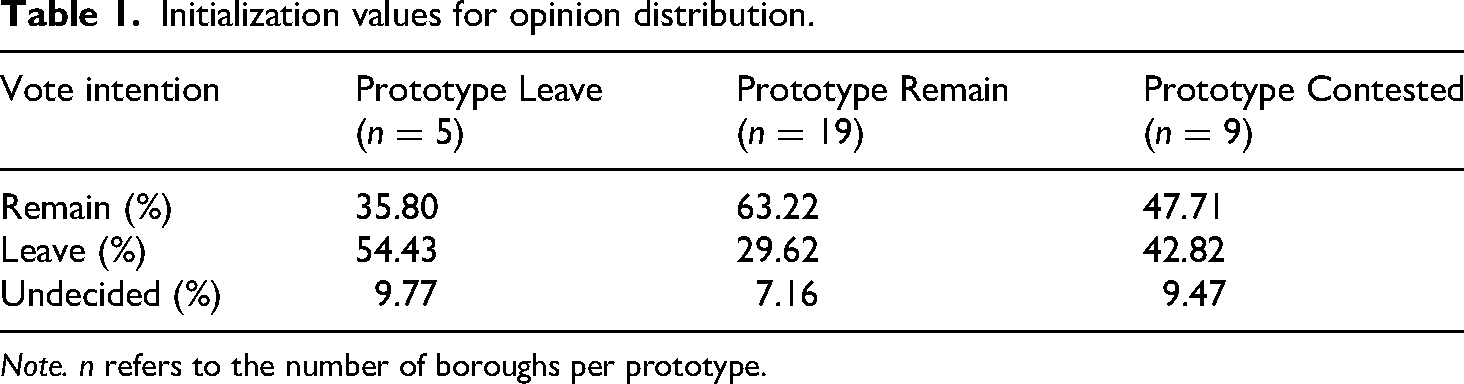
Note.
Results
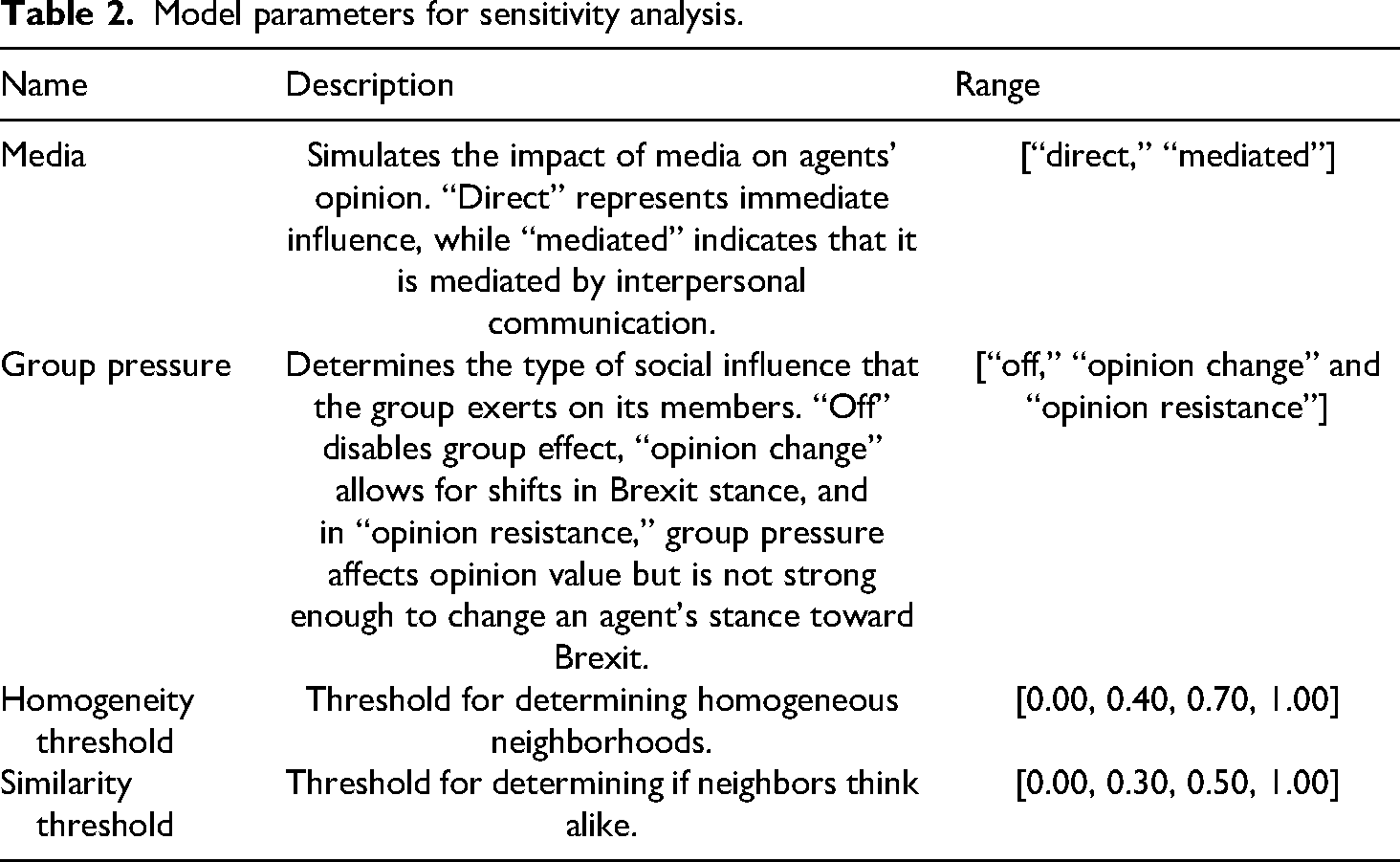
To evaluate the robustness and theoretical plausibility of our ABM, we performed two analyses: a convergence analysis and a sensitivity analysis. Convergence analysis is essential for verifying the internal stability of our simulation results. Without establishing convergence, our results could be unreliable due to excessive stochastic variation, compromising any theoretical conclusions drawn from the model output (Lee et al., 2015). Following convergence verification, we conducted a one-at-a-time (OAT) sensitivity analysis (Thiele et al., 2014) to assess how variations in key model parameters—MI, GP, H, and S—influence simulation outcomes. By systematically varying the parameters in Table 2, we generated 96 distinct model configurations per prototype, yielding 288 total model variants that tested competing theoretical mechanisms of media and interpersonal communication influence on opinion. For each model configuration, we compared the simulated opinion distribution to real-world Brexit referendum results in London. Using the mean squared error (MSE) between observed and simulated vote shares as a plausibility benchmark, we identified parameter settings that produce results closest to the real-world voting patterns.
Model parameters for sensitivity analysis.
Convergence analysis
For each model configuration, we conducted 30 independent simulation runs to ensure robust statistical inference (Lee et al., 2015). Since ABMs’ output distribution is typically unknown beforehand, we verified convergence by identifying the point at which sample means and variances stabilize across simulation runs.
Figure 4 shows, as an example, the convergence pattern for the Remain prototype with mediated media mechanism, “opinion change” GP, H of 0.70, and S of 0.50. Agents stop changing opinions by day 30, reaching a stable equilibrium. This stabilization pattern held true across all 288 model configurations.
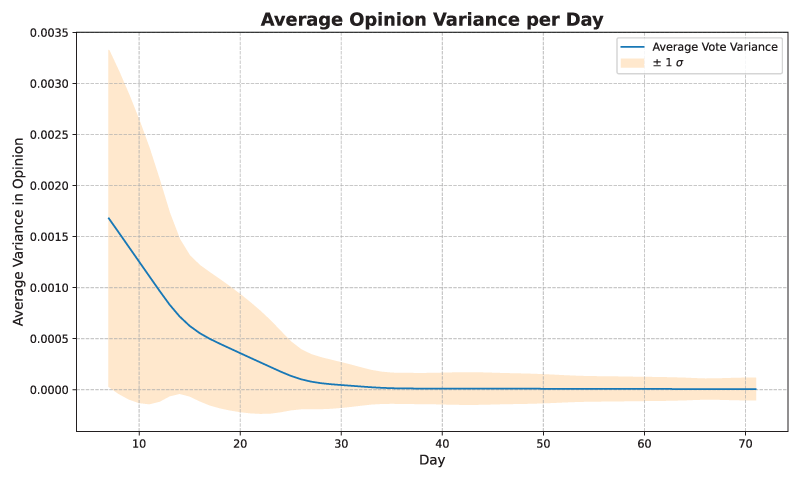
Average opinion variance per day for one model configuration.
We also verified that our simulation results are statistically reliable by examining variance stability across all model runs. Evaluating variance stability requires measuring the uncertainty associated with the variance itself (the variance of variance) (Lee et al., 2015). Figure 5 shows the mean average opinion variance across all model variations in the simulation. The steady decrease in variance over time, eventually stabilizing near zero, confirms that agents’ opinions converge to stable states before the simulation concludes.
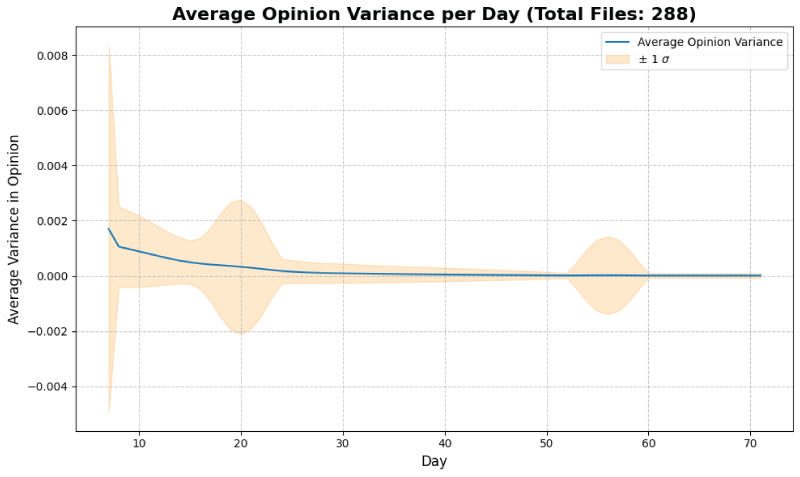
Average opinion variance per day of the 288 models.
Sensitivity analysis
After establishing that our model is stable, we proceeded with an OAT sensitivity analysis (Thiele et al., 2014) focusing on four key theoretical parameters: MI, GP, H, and S. We varied the value of each parameter individually while holding the others constant. By observing the effects of these marginal changes across multiple iterations, we ensured the robustness of our findings (Lee et al., 2015). For MI and GP parameters, we examined variations in how their mechanisms function (e.g. media having a direct effect on opinion vs. mediated by discussion networks), while for H and S , we varied the numerical values that define when an agent perceives their network shares an opinion and when they perceive they share the same opinion with their neighbors. While the model includes additional parameters (reported in the Online appendix), we limited the analysis to these four due to computational constraints. These were selected based on their theoretical relevance to media and interpersonal communication effects in opinion dynamics. To assess their impact, we analyzed outcomes from 96 parameter permutations and fit a linear regression model to estimate the error between the simulated results and the actual Brexit referendum outcomes in London. The resulting model coefficients provide a measure of how sensitive the ABM’s predictions are to changes in each parameter, helping us evaluate the relative influence of each mechanism.
The purpose is not to replicate reality precisely, but to assess which theoretical assumptions about opinion formation generate patterns more consistent with observed behavior. To do this, we assumed that agents’ final opinions translate directly into voting behavior and compared the simulated vote shares with actual Brexit referendum results across London boroughs, grouped by prototype (Table 3). For model calibration, we adopt the “best-fit” strategy, where the goal is to identify parameter configurations that minimize deviation between simulated and real-world outcomes (Thiele et al., 2014). We use MSE as our calibration metric; it quantifies the average squared difference between observed and simulated vote percentages, with lower values indicating closer alignment with observed outcomes and higher values suggesting greater divergence from real-world patterns.
Mean referendum vote shares for boroughs grouped by prototype.

We modeled MSE as a function of our four key parameters: MI, GP, H, and S. Since the model is composed of both categorical variables (MI and GP) and discrete numerical variables (H and S), we assigned specific regression coefficients to represent the different changes in categorical variables. For instance, when looking at GP, changing from “opinion change” to “opinion resistance” is represented by one coefficient (
Table 4 shows that deviating from mediated media and “opinion change” GP combination consistently worsens model performance across all prototypes. All MSE values below are reported in squared percentage points. Compared to mediated MI, direct MI increases MSE by 0.47 in the Leave prototype (marginally significant), 2.27 in the Remain prototype, and 1.44 in the Contested prototype (both highly significant). GP has an even stronger impact. Switching from “opinion change” to “opinion resistance” increases MSE by 0.71–1.44 across prototypes, while turning GP off entirely raises MSE by 2.57 (Leave), 13.80 (Remain), and 7.65 (Contested), and all are statistically significant. Both perception thresholds show positive coefficients, indicating that lower thresholds requiring fewer neighbors to trigger social influence produce better performance.
Linear regression coefficients.
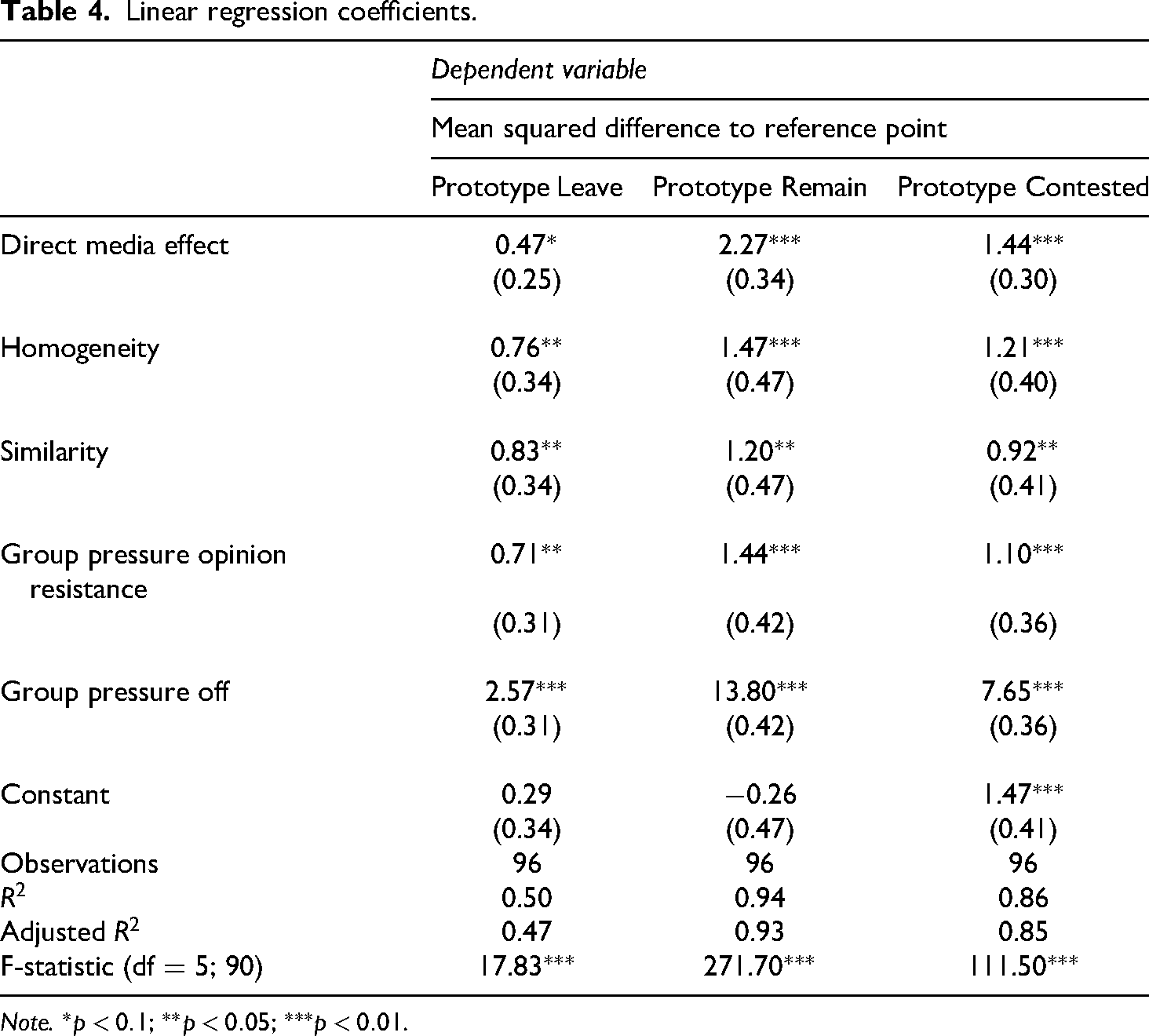
Note.
The regression models show substantial explanatory power, with
Figure 6 presents tornado plots that visualize our regression results and show how parameter changes affect MSE across the three prototypes. Tornado plots are a sensitivity analysis tool that varies each parameter while holding others constant, creating a visual representation of which theoretical mechanisms most strongly influence model performance (Carnell, 2024). These plots take each linear regression model as input and display the sensitivity of MSE predictions to changes in each parameter within their observed ranges.
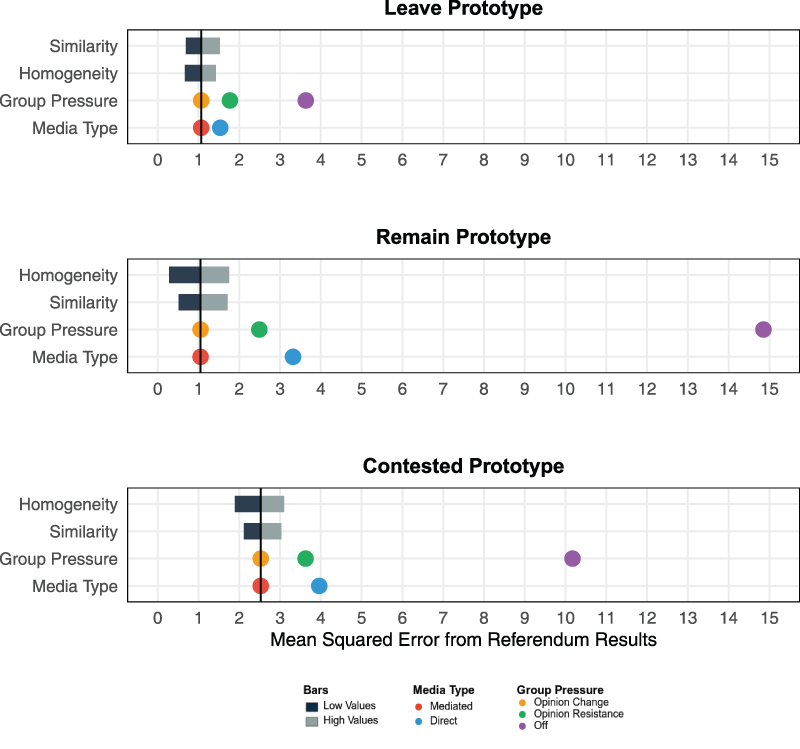
Tornado plots showing parameter effects on model performance across borough prototypes.
The visual structure conveys several key elements. Numerical parameters are ranked vertically by their impact magnitude, with the most influential variables at the top and the least influential at the bottom. This ranking reflects how much the MSE changes when each numerical parameter varies from its minimum to maximum observed value. For these numerical parameters such as H and S, horizontal bars extend symmetrically from a center point, with dark portions representing the effect of lower parameter values and light portions showing higher values. Categorical parameters such as media type and GP are displayed as colored dots positioned according to their predicted MSE values. The horizontal axis measures MSE from the referendum results (Table 3).
Note that tornado plot positions show MSE values from the referendum reference point, while the regression coefficients measure how much MSE increases or decreases when a parameter shifts away from the baseline configuration (mediated media and “opinion change” GP). For example, in the Remain prototype, the GP “off” configuration appears at nearly 15 squared percentage points on the tornado plot; that is, the actual model error from the referendum proportions under that configuration. The corresponding regression coefficient (13.80) reflects how much worse this configuration performs compared to the MSE models produce when GP is set to “opinion change.”
The plots reveal distinct patterns across prototypes. The Leave prototype shows S having a stronger impact than H, while Remain and Contested show the reverse pattern. This suggests that individual alignment with network opinions matters more in pro-Leave contexts, whereas perceptions of network consensus are more critical in pro-Remain areas. The shading of the bars shows that lower threshold values consistently outperform higher ones. This means models perform better when agents require less agreement to perceive their network as homogeneous or to feel that they “think alike” with their peers. For example, a H of 0.30 (where just 30% agreement is enough) yields lower MSE than a threshold of 0.70. Similarly, at low Ss, agents begin to feel they “think alike” with others even when only a minority of discussion partners share their views. This suggests that, in our simulation, social influence activates under relatively modest agreement, rather than requiring strong consensus. These dynamics align with theoretical work showing that committed minorities can drive opinion change. Galam and Jacobs (2007) demonstrate that inflexible minorities as small as 17% can guarantee victory in opinion competition, while Xie et al. (2011) show that committed minorities around 10% can rapidly shift entire populations. Our findings suggest that in Brexit contexts, even smaller local agreements were sufficient to activate social influence processes.
The categorical variables in Figure 6 reveal clear performance differences across parameter configurations. Models with mediated MI (red dots) consistently achieve lower MSE values than direct media models (blue dots), suggesting that assumptions aligned with the “filter hypothesis” (Katz et al., 1955; Schmitt-Beck, 2003) better approximate observed voting patterns. This difference is particularly pronounced in the Remain and Contested prototypes, where direct media configurations yield MSE values of 3.32 and 3.96, compared to their mediated baselines of 1.05 and 2.53. GP mechanisms show even larger effects on model performance. Configurations with “opinion change” GP (orange dots) achieve the lowest MSE values across all prototypes (1.07 Leave, 1.05 Remain, 2.53 Contested), while models without GP (purple dots) generate substantially higher errors (3.63 Leave, 14.85 Remain, 10.17 Contested). The magnitude of deterioration without GP indicates the importance of social conformity mechanisms within our model framework.
The performance patterns across London’s three borough prototypes show notable differences in modeling requirements to approximate observed Brexit voting patterns. Within our simulation framework, the Leave prototype maintained relatively consistent MSE values when parameters were changed: 1.07 under mediated media with GP, 1.53 under direct media, and 3.63 when GP was disabled. This suggests that our models could approximate voting outcomes in pro-Leave areas even when MI was modeled as a direct, simple mechanism without social filtering. By contrast, the Remain prototype showed substantial sensitivity to model specifications within our simulations, with MSE values of 1.05 for the baseline, 3.32 for direct media, and 14.85 when GP was disabled. These performance differences indicate that our models required simulating social filtering and interpersonal communication mechanisms to adequately approximate observed pro-Remain voting patterns in areas where local preferences diverged from dominant pro-Leave media coverage. The Contested prototype showed intermediate sensitivity to these mechanisms—still requiring social conformity and interpersonal mediation of MI for adequate performance, but with smaller absolute errors than in Remain areas. Baseline performance was 2.53, rising to 3.96 under direct MI and 10.17 with no GP. This gradient suggests that the necessity for modeling social influence processes scales with the degree of divergence between local opinion climates and dominant media narratives.
These modeling patterns reveal important scope conditions for MI mechanisms in political opinion formation. The substantial performance differences across borough prototypes—particularly the very high 14.85 MSE when social conformity mechanisms were removed from Remain area models—suggest that interpersonal communication and group conformity processes become critical modeling components when local opinion climates diverge from dominant media narratives. Our results indicate that direct MI models may adequately approximate outcomes in contexts where media messages align with local preferences. In turn, they require augmentation with social filtering and conformity mechanisms in areas where residents navigate conflicting signals between their social environments and broader media coverage.
Discussion and conclusion
The UK’s historic decision to become the first member state to leave the EU has had a lasting impact on both the UK and the EU, underscoring the importance of public opinion for EU integration (Hobolt and De Vries, 2016). Among the many factors studied to understand the Brexit referendum outcome, considerable attention has focused on Euroskeptic MI (Berry, 2016; Carl et al., 2019; Hinde, 2017; Simpson and Startin, 2023; Smith et al., 2021; Van Der Zwet et al., 2020). While the argument that biased media coverage drives electoral outcomes appears straightforward when results align with media preferences (DellaVigna and Kaplan, 2007; Enikolopov et al., 2011; Martin and Yurukoglu, 2017), we can gain deeper insights into media effects—and their limits—by examining cases where media bias failed to produce such outcomes. This is what we observed in London and other major urban areas, where despite pervasive pro-Leave media coverage (Levy et al., 2016), Remain prevailed (BBC, 2016).
By analyzing these cases where campaign media bias and electoral outcomes diverged, we sought to understand the mechanisms that constrain MI and identify the social processes that mediate between media exposure and opinion formation. We argue that interpersonal communication (Davies, 2022; YouGov, 2016) and opinion-based group dynamics (Hobolt et al., 2021) played a crucial role in shaping public opinion on Brexit. To understand MI, it is necessary to contextualize its broader role and to view media not merely as a source of information but also as a conversation starter. People often discuss news content with friends, family, and colleagues, and may only accept or reject media messages after receiving evaluative cues from their discussion networks about which messages are appropriate. This process forms the foundation of the “filter hypothesis” (Katz et al., 1955; Schmitt-Beck, 2003), which posits that media effects are conditional on both the opinion composition of discussion networks (homogeneous or heterogeneous) and the alignment of media content with group opinions (congruent or conflicting). Our theoretical contribution builds on this framework by incorporating direct GP mechanisms that simulate opinion conformity dynamics (Toshkov et al., 2024; Wratil and Wäckerle, 2023). This extension asserts that political discussion may influence opinion formation through two pathways: by mediating how people interpret media messages and through direct social pressure to conform to group norms.
While correlations between media exposure and opinion change are important, the questions remain: what processes happen in between? What social processes are taking place, and how does it influence the media’s effect on opinion? To explore these questions, we used ABM as a theory-testing framework to test different “what–if” scenarios: direct versus mediated media effects, varying group conformity mechanisms, and different thresholds for perceiving network homogeneity and opinion similarity. This approach allowed us to explore which combination of mechanisms best explained the patterns observed across London’s boroughs.
The simulation results showed that models incorporating both mediated media effects and GP mechanisms significantly improved explanatory power and outperformed direct media effects models in explaining London’s referendum outcomes. Specifically, the models that best replicated observed voting patterns were those with the “opinion change” mode of group conformity—which allows individuals to shift their Brexit stance when surrounded by different views—combined with mediated MI, best replicated observed voting patterns. This finding suggests that understanding Brexit referendum outcomes requires considering how media messages interact with interpersonal communication (Boomgaarden, 2014; De Vreese and Boomgaarden, 2006b; Neiheisel and Niebler, 2015; Southwell and Yzer, 2007). The results varied notably across our three borough prototypes. In Leave-leaning areas, where media messages aligned with local opinion climates, even simpler direct media models performed reasonably well. This suggests that when media content reinforces existing social preferences, the persuasive process operates more directly. However, in pro-Remain areas, models without interpersonal communication mechanisms performed substantially worse—with MSE increasing from 1.05 to 14.85 when GP was disabled—and to 3.32 under direct MI. This pattern suggests that within our simulation framework, simple direct media models were insufficient to approximate outcomes in areas where initial preferences diverged from media bias.
Our research represents an initial effort to use ABM to examine the Euroskeptic media argument in Brexit, and several areas offer opportunities for improvement. Our analysis focuses exclusively on print newspapers due to data constraints (Levy et al., 2016), though newspapers have historically influenced broader media narratives across television and social media platforms (Banducci et al., 2018; Deacon et al., 2016; Foos and Bischof, 2022; Mair et al., 2017; Polonski, 2016; Ponsford, 2016; Smith et al., 2021; Vliegenthart et al., 2008). Future research incorporating social media and television coverage could provide additional insights. Our model relies on theoretical assumptions from the filter hypothesis (Katz et al., 1955; Schmitt-Beck, 2003) and opinion conformity theories that would benefit from further empirical validation through survey data or controlled experiments. Additionally, integrating other theories such as the spiral of silence (Noelle-Neumann, 1974; Song and Boomgaarden, 2017) could help explain cases where individuals suppress opinions when perceiving themselves as minorities. The small-world network structure, while theoretically grounded, represents one approach to modeling social relationships, and future work could explore alternative network structures or use tools such as GAMA’s Gen* plug-in (Chapuis et al., 2022) to generate synthetic populations that better reflect London’s demographic diversity using census data. Incorporating weighted links could also account for varying the influence of different personal relationships (Barrat et al., 2004). Our London-focused case study, while theoretically valuable for examining divergent outcomes, limits generalizability, and testing these mechanisms across other polarized electoral contexts would help establish broader applicability. Despite these limitations, our computational approach demonstrates the value of ABM for examining the conditions under which MI operates and the social mechanisms that can constrain or amplify media effects in polarized environments.
This study makes several contributions to understanding the scope and limits of media bias campaigns on public opinion. First, we demonstrate the analytical value of examining cases where media bias fails to align with electoral outcomes. Second, we provide computational evidence for the filter hypothesis in a high-stakes electoral context, showing how interpersonal communication can reduce biased media effectiveness when discussion networks conflict with media messages. Third, we extend this framework by incorporating direct group conformity mechanisms, enabling more nuanced modeling of how social pressure influences both opinion intensity and direction. Fourth, we offer a methodological contribution through ABM that helps quantify when and how media effects are amplified or filtered by social networks.
Our findings offer insights for understanding media effects in contemporary democracies where heavily biased media campaigns combine with strong opinion-based group identities. Social networks may serve as important buffers against dominant media narratives, particularly in contexts where local opinion climates diverge from national media coverage. This suggests that media campaign effectiveness depends not only on message content and reach, but also on the social environment in which individuals encounter and discuss political information. Ultimately, the Brexit referendum outcome in London reminds us that public opinion emerges not simply from media exposure, but from the social processes through which citizens collectively make sense of political information in their everyday lives.
Supplemental Material
sj-pdf-1-eup-10.1177_14651165261424664 - Supplemental material for Filtering out Euroskepticism: Media influence and interpersonal communication in an agent-based model of Brexit opinion dynamics
Supplemental material, sj-pdf-1-eup-10.1177_14651165261424664 for Filtering out Euroskepticism: Media influence and interpersonal communication in an agent-based model of Brexit opinion dynamics by Isabela Zeberio, Theresa Kuhn and Iñaki Ucar in European Union Politics
Supplemental Material
sj-zip-2-eup-10.1177_14651165261424664 - Supplemental material for Filtering out Euroskepticism: Media influence and interpersonal communication in an agent-based model of Brexit opinion dynamics
Supplemental material, sj-zip-2-eup-10.1177_14651165261424664 for Filtering out Euroskepticism: Media influence and interpersonal communication in an agent-based model of Brexit opinion dynamics by Isabela Zeberio, Theresa Kuhn and Iñaki Ucar in European Union Politics
Supplemental Material
sj-zip-3-eup-10.1177_14651165261424664 - Supplemental material for Filtering out Euroskepticism: Media influence and interpersonal communication in an agent-based model of Brexit opinion dynamics
Supplemental material, sj-zip-3-eup-10.1177_14651165261424664 for Filtering out Euroskepticism: Media influence and interpersonal communication in an agent-based model of Brexit opinion dynamics by Isabela Zeberio, Theresa Kuhn and Iñaki Ucar in European Union Politics
Footnotes
Acknowledgements
The authors are grateful for the valuable feedback received from participants and discussants at the ODISSEI Conference for Social Science 2023, ECPR Standing Group on the European Union 2024, and EPSA 2024, as well as workshops held at the University of Amsterdam. We extend our gratitude to Adrián Menor de Oñate for insightful discussions throughout the development of this paper. The authors would like to thank Gerald Schneider and the anonymous reviewers for their very helpful comments, which significantly improved this paper.

Author contributions
IZ contributed to conceptualization, theoretical framework, methodology, formal analysis, data curation, visualization, and drafting of the original manuscript. TK contributed to conceptualization, theoretical framework, and revision of the original manuscript. IU contributed to the conceptual development and refinement of the methodology, and revision of the original manuscript. All authors gave final approval and agreed to be accountable for all aspects of the work.
Funding
The authors disclosed receipt of the following financial support for the research, authorship, and/or publication of this article: The authors gratefully acknowledge funding through a VIDI grant (award number VI.Vidi.201.157) of the Dutch Research Council (NWO).
Declarations of Conflicting Interests
The authors declared no potential conflicts of interest with respect to the research, authorship, and/or publication of this article.
Data availability
Supplemental material
Supplemental material for this article is available online.
Notes
References
Supplementary Material
Please find the following supplemental material available below.
For Open Access articles published under a Creative Commons License, all supplemental material carries the same license as the article it is associated with.
For non-Open Access articles published, all supplemental material carries a non-exclusive license, and permission requests for re-use of supplemental material or any part of supplemental material shall be sent directly to the copyright owner as specified in the copyright notice associated with the article.
