






Abstract
This article investigates how European Union (EU) accession affects the quality of national football teams. Using Bulgaria, Romania, and Croatia as late-accession cases, we exploit the staggered timing of their entry to estimate the causal impact of joining the European Union through a difference-in-differences framework applied to monthly ELO ratings (1997–2022). Results show that EU accession is associated with a sudden and persistent decline in national team performance, amounting to about 50 ELO points at entry and nearly 80 after 3 years. This deterioration coincides with a marked increase in the share of players employed abroad, suggesting that integration, while expanding individual opportunities, weakens collective quality. EU enlargement thus provides a useful institutional setting in which to examine how major regulatory changes can generate transitional costs in domains where coordination and identity matter, highlighting the dual nature of integration: efficiency gains at the individual level versus short-term losses in collective performance.
Introduction and theory
The integration of new member states into the European Union (EU) reshapes markets, institutions, and mobility patterns, and affects various aspects of everyday life for the public. Football, the sport known as soccer on the other side of the Atlantic, is no exception to this trend. Indeed, football is not only widely recognized as the most widely watched sport globally, with unparalleled international reach and audience size (e.g., the FIFA World Cup attracts billions of viewers worldwide, with the 2022 final alone reaching over one billion spectators: FIFA, 2023; Nielsen, 2022), but it is also Europe's most popular sport, and one of the most sensitive mirrors of the continent's broader political and economic transformations. Studies of fandom and identity show that football acts as a conduit for European identification and public sphere formation (Finger et al., 2024), and likewise can reflect how integration policies diffuse into popular culture (Biel, 2024).
When a country joins the EU, accession brings a far-reaching transformation that extends well beyond the economic sphere. New member states must align with the acquis communautaire, adopt EU competition and labor laws, and integrate into transnational markets for goods, services, and labor. The process triggers structural reforms in governance, regulation, and institutional capacity, often accompanied by inflows of European funds and increased foreign investment (Dimitrova, 2021). For the countries that joined most recently, such as Bulgaria, Romania, and Croatia, accession also entailed a profound reconfiguration of political and administrative systems, designed to meet EU standards of transparency, accountability, and market openness (Noutcheva, 2008). These transitions are not merely technical but social and cultural as well, influencing mobility patterns, expectations of opportunity, and the integration of citizens and workers into a broader European space.
Football, deeply intertwined with both cultural identity and economic globalization, has mirrored these transformations. Joining the EU has meant that domestic football systems suddenly have to operate within a continental labor market governed by EU law, particularly regarding the free movement of workers and competition principles (De Witte, 2022). Clubs in new member states have gained access to broader markets for talent, sponsorship, and broadcasting, while at the same time facing intensified competition from wealthier Western European clubs for the best players. Regulatory harmonization has required adaptation to UEFA's licensing standards, financial fair play mechanisms, and cross-border player mobility rules. This integration has opened new opportunities for players from Bulgaria, Romania, and Croatia to build careers in top European leagues, yet it has also resulted in a risk of talent drain, and a growing dependence on export-oriented youth development models. Despite the abundant literature on the economic and institutional consequences of EU accession, its implications for national football systems (and, in particular, for national team cohesion and performance) remain largely unexplored. Understanding these effects is crucial, since national teams act as condensed reflections of how institutional and market transformations translate into collective sports capacity and identity.
From a theoretical perspective, the mechanisms at play are neither unidirectional nor trivial. On the one hand, accession enlarges the range of opportunities for talented players, who can now transfer more easily to clubs in higher-quality leagues. This dynamic builds on the landmark Bosman ruling, in which the European Court of Justice, in the case of Union Royale Belge des Sociétés de Football Association ASBL v Jean-Marc Bosman (C-415/93), decided on 15 December 1995 to abolish restrictions that had previously limited the free movement of football players within the EU. Before the ruling, clubs could demand transfer fees even after a player's contract had expired, and national associations often imposed quotas on the number of foreign EU players permitted in domestic competitions. By declaring these practices incompatible with EU law on the free movement of workers, the ruling transformed the football labor market, giving players greater contractual freedom and encouraging cross-border mobility.
While the Bosman ruling established the legal foundation for free movement within the existing EU, accession extended that freedom to new territories, transforming potential into reality. For late joiners, entering the Union did not simply align domestic football with pre-existing rules: it intensified the effects of those rules. EU accession thus expanded the reach of contractual freedom and dismantled the remaining administrative barriers that had continued to limit cross-border transfers. The result was an abrupt increase in player mobility: national federations were suddenly faced with a continental labor market in full force, where foreign demand for talent met newly liberalized supply. In this sense, EU membership amplified the Bosman dynamics by translating legal openness into institutional access, turning what had been a theoretical right for nonmember-state players into a lived practice. The enlargement therefore intensified the very mechanisms of mobility and dispersion that, while enhancing individual opportunity, could undermine the collective cohesion of national teams. By opening labor markets, the ruling created incentives for clubs in smaller or less competitive leagues to invest in youth academies, with the expectation of exporting talent to wealthier markets (Niemann et al., 2011). Empirical evidence suggests that such integration has fostered professionalization in training and greater returns from youth development in several new member states (Molnár, 2006; Vincze et al., 2008).
On the other hand, one could argue that greater player mobility entails fragmentation. While national teams are composed of players drawn from multiple clubs and leagues, some coaches rely on partial clusters of players with prior shared experience, for instance at club level, to preserve tactical familiarity and coordination. Recent evidence suggests that such shared experience can improve on-field interactions, particularly in terms of passing success and positional coordination (Grund, 2016; Le Coz et al., 2025), although its impact on overall team performance remains debated (Ruigrok et al., 2011). Shared tactical systems, common training regimes, and a long-term experience of being teammates, all forms of team-specific human capital, are harder to build when players are dispersed across Europe. Indeed, a central factor in national team performance is the extent to which players share playing time and develop familiarity with one another. The literature highlights that cohesion, tactical continuity, and repeated interaction shape collective effectiveness, particularly under the pressure of international tournaments. Studies of fixture congestion and player workloads show that accumulated match participation consolidates technical fluency and tactical cohesion, enabling smoother offensive coordination (Chang et al., 2024). Conversely, excessive dispersion of players across different leagues and tactical systems may undermine these benefits, as shared routines and mutual understanding are difficult to replicate in short training camps. Empirical evidence on match spectacle and performance dynamics reinforces this point: greater workload and continuous joint play tend to sustain passing accuracy, possession patterns, and offensive creativity, whereas fragmentation or insufficient shared training and playing time erodes coordination (Collet, 2013; Njororai, 2014). Players who share prior experience, for instance through club-level interactions, tend to display higher levels of tactical understanding and more effective on-field coordination, particularly in passing networks and positional play (Grund, 2016; Le Coz et al., 2025). For this reason, some national team coaches seek to preserve elements of continuity or familiarity within the squad. At the same time, the empirical literature suggests that the aggregate impact of shared experience on match outcomes is not unambiguous once differences in team quality are taken into account (Ruigrok et al., 2011).
These findings suggest that beyond individual talent, national teams might rely on synergies formed through repeated collaboration, a mechanism directly relevant to assessing the impact of EU accession on the cohesion of late-joining member states’ squads. This concern has long been noted in the literature on team performance and coordination, which emphasizes the importance of repeated interactions for effective collaboration on the pitch (Szymanski, 2015). The mechanism we propose should therefore be interpreted as a plausible channel through which increased mobility may generate short-term adjustment costs, rather than as a deterministic relationship between club-level overlap and national team success.
A further and often overlooked mechanism contributing to this channel is logistical: when national team members are dispersed across clubs and continents, the cost of assembling the squad for each international fixture rises markedly. Players must travel long distances from different leagues, often across time zones, reducing recovery time, and limiting opportunities for joint training. This increases coordination costs and fatigue, especially for smaller football associations with fewer resources to manage travel and preparation schedules, thereby compounding the temporary performance loss that follows greater player mobility. This should be especially relevant for states that joined the EU in 2007, as these are located on the Union's outer border. Thus, while EU accession may upgrade individual talent, it may also erode collective synergy, potentially constraining national team results. Figure 1 summarizes the theoretical mechanisms we have illustrated.
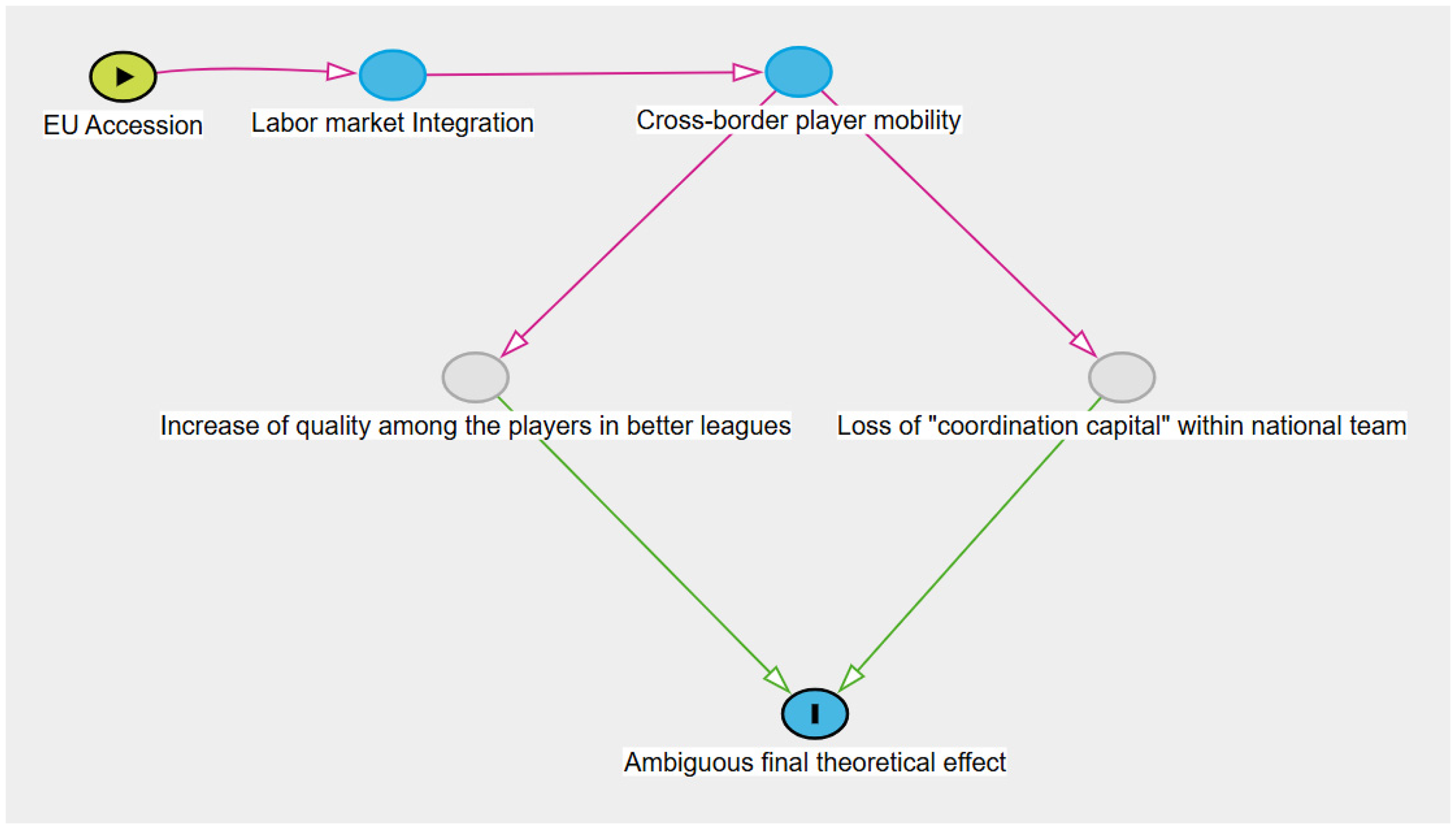
Theoretical mechanism.
To the best of our knowledge, the existing literature has examined related dynamics, though without explicitly addressing this tradeoff. Norbäck et al. (2021) highlight how European labor market liberalization encouraged clubs in less dominant football nations to prioritize youth development for export, linking this to some improvement in national teams but also to reduced competitiveness at club level. Studies on postcommunist football in Hungary underline the decisive role of broader political-economic transitions, with EU membership reinforcing but not solely driving patterns of migration and professionalization (Molnár, 2006; Vincze et al., 2008). Niemann et al. (2011) take a broader view, documenting how Europeanization has transformed national football systems by reshaping governance and competition, though without isolating the causal impact of accession. Finally, recent reports stress that EU integration has enabled infrastructural and financial upgrades, including investments in training facilities, academy structures, and coaching systems, although the direct attribution to EU programs remains contested (Ruberti, 2024; UEFA, 2021). What remains missing is a systematic empirical test of how these changes translate into national team performance, given the two possible sets of theoretical mechanisms, of opposite sign, we stated above.
This article addresses that gap by investigating the impact of EU membership on the quality of national football teams. We focus on three late-accession cases, namely Bulgaria and Romania, which joined the EU in 2007, and Croatia, which joined the EU in 2013. Their staggered entry provides a clearly dated institutional setting to assess how accession reshaped national football outcomes, compared to other UEFA teams, and compared to their own prior performance before joining. This focus is motivated by both empirical and conceptual considerations. The later enlargements provide sufficiently long pre-accession and postaccession windows within our data to allow for a clearer comparison of trends around the accession date. Moreover, for these countries, EU membership represents a relatively sharp institutional change in the football labor market. Earlier enlargements are examined separately as a robustness exercise, allowing us to assess whether the estimated effects generalize across accession cohorts. To this end, we employ an empirical analysis that exploits both standard difference-in-differences (DiD) and a staggered adoption DiD approach, contrasting national team performance before and after accession with suitable control groups. In doing so, we can assess whether the benefits outweigh the costs.
Although EU accession is not a random process, it constitutes a clearly dated institutional discontinuity that alters the regulatory and labor-mobility environment inhabited by professional football systems. Accession follows a long political process linked to institutional reforms, macroeconomic convergence, and governance improvements, all of which may affect football performance only gradually. By contrast, formal entry into the EU produces a discrete legal and regulatory change, especially with respect to labor mobility and market integration. Our empirical strategy therefore does not treat accession as being literally random; rather, it exploits the timing of this institutional break within a DiD framework, under the assumption that absent accession the treated countries would have followed comparable trends to the control group. In our main analysis, we focus on the later enlargements of 2007 and 2013, which provide clearly identifiable accession dates within the period covered by our football data and allow for long pretreatment and post-treatment windows. Earlier enlargements are considered in additional robustness exercises, allowing us to assess whether the estimated effect is specific to the later accession cohort or generalizes more broadly across enlargement waves.
EU accession is a major institutional and political change whose timing is largely external to the evolution of football quality within a country. The accession process is driven by macropolitical criteria, such as compliance with the Copenhagen standards regarding democracy, rule of law, and a market economy, rather than by sector-specific performance in sports or culture (Dimitrova, 2021). The timing of accession is negotiated at the supranational level, and depends on geopolitical considerations, administrative readiness, and treaty schedules, and not on conditions in national football systems. As such, the event of joining the EU can be treated as a discrete institutional break with respect to national team football performance. While accession may indirectly affect sport through the broader mechanisms we have highlighted, these channels operate after the treatment and not as determinants of its timing. Consequently, EU membership functions as a clearly dated institutional change that can be exploited (under the parallel-trends assumption), providing a useful source of identification for assessing changes in football quality through a regression analysis framework that compares trends before and after accession with those of other countries.
The empirical contribution of this article lies in evaluating which of the opposing mechanisms dominates after joining the EU, and under what conditions. In doing so, we seek to contribute to the literature on Europeanization, labor mobility, and the political economy of sport, while providing new insights into how institutional integration reshapes both the opportunities and constraints of national sports performance.
Data and methods
To empirically assess the impact of EU accession on national football performance, we will begin by formalizing the theoretical framework underpinning our analysis. The process of joining the EU can be conceptualized as an institutional shock that alters a country's economic, regulatory, and social environment (Alfano et al., 2021). From an economic perspective, accession leads to increased integration in goods, capital, and labor markets, as well as the harmonization of governance structures and legal systems. These changes, while primarily political and economic in nature, may indirectly influence the quality of national football by affecting talent mobility, club competitiveness, and investment incentives.
Let

where
The selection of control variables in the proposed modeling follows the established literature on the determinants of international football success (Gásquez and Royuela, 2016; Hoffmann et al., 2002). Economic development, proxied by GDP per capita, captures the availability of resources and infrastructure that support talent development, coaching quality, and sports facilities. Since the relationship between prosperity and performance may not be linear, the squared term of GDP per capita is also included to account for potential diminishing returns at higher income levels. Demographic factors, represented by the logarithm of the male population, reflect the size of the potential talent pool available for selection in men's national teams. Institutional maturity, measured through the number of years since a country's first official international match, controls for the historical depth of football culture and organizational capacity, which are key predictors of success in the long run. Finally, climatic conditions, operationalized as the squared deviation of a country's mean annual temperature from 14°C, that is, the optimal temperature for athletic performance identified by Hoffmann et al. (2002), are included to capture environmental constraints on player training and match performance. Together, these variables provide a comprehensive representation of the structural, economic, and environmental factors that may jointly influence national football quality.
Our empirical framework exploits the enlargement of the EU as a major institutional change to assess the impact of EU accession on national football performance. The underlying idea is that joining the EU constitutes a major institutional and economic transformation that, while not directly related to sports, can indirectly affect the national football ecosystem by reshaping labor markets, investment incentives, and governance standards. In particular, EU membership facilitates the mobility of players and coaches, grants access to common regulatory frameworks, and alters the competitive landscape of domestic clubs; all of which are mechanisms that may ultimately influence the performance of national teams. The key identifying assumption is that the timing of EU accession is orthogonal to short-run changes in football performance, conditional on country and time fixed effects and the included controls. Countries do not join the EU because of changes in football quality, but rather as a consequence of long-term political and economic integration processes largely orthogonal to sport. Hence, the event of joining the EU can be exploited as a clearly dated institutional discontinuity, making it suitable for an event-study interpretation in which member states are compared with nonmembers before and after accession.
To identify this effect, it seems natural to adopt a standard DiD approach, comparing changes in football quality before and after accession between treated and untreated countries. The treatment would be EU membership, and the outcome variable is the ELO rating of each national team, measured monthly, a proxy of football quality. The DiD estimator can be formally expressed as:
where

where the interaction term
While this conventional setup is a natural starting point, its validity relies on the assumption of a single, common treatment date for all treated units. This assumption, however, is not respected in our empirical context: the last three countries that joined the EU during the period under analysis (Bulgaria, Romania, and Croatia) did so at different times. Bulgaria and Romania joined in January 2007, whereas Croatia joined in July 2013. Previous joiners (the 2004 batch) are usually considered by the literature as different, and, as we will discuss below, there is less of a case for viewing them as a homogenous group. Treating Bulgaria, Romania, and Croatia as if they had been exposed to the policy change from 2007 onward, as implied by the common post-treatment specification, would misrepresent Croatia's pre-accession period (2007–2013) as post-treatment, and thereby introduce a timing error.
Such misclassification is not innocuous. As demonstrated by Goodman-Bacon (2021), when treatment adoption is staggered but a single postperiod is imposed for all treated units, the resulting DiD estimate becomes a weighted average of all possible two-by-two comparisons between early- and late-treated units, as well as between treated and untreated countries. This means that, in our context, Bulgaria and Romania (already treated from 2007 onward) would incorrectly serve as “controls” for Croatia in the years 2007–2013, when Croatia was still untreated. If treatment effects evolve over time (e.g., if the impact of EU accession on football quality unfolds gradually), as we might expect given the nature of the assumed mechanisms, this contamination generates negative or inconsistent weights in the overall DiD estimate. The final estimate may therefore no longer correspond to the true average treatment effect on the treated units (ATT), but rather to a biased composite of partially offsetting comparisons.
To address this problem, we adopt an alternative specification that explicitly accounts for the staggered nature of EU accession. Specifically, we define a treatment dummy

where
The use of country-specific treatment timing improves identification in several ways. First, it preserves the integrity of each country's pretreatment period, ensuring that the “before” and “after” comparisons are made consistently relative to the actual policy intervention. Second, it avoids conflating the postaccession dynamics of early joiners with the pre-accession trajectories of late joiners, which would otherwise attenuate the estimated impact toward zero. Third, by allowing variation in treatment timing, it exploits a richer source of identifying variation, both across countries and over time, thereby increasing efficiency without violating the parallel trends assumption.
From a substantive standpoint, the staggered specification also makes conceptual sense. EU accession is not a symbolic event but the culmination of a lengthy process of legal harmonization, administrative reform, and institutional alignment. The moment of formal entry marks a qualitative change in the incentives and opportunities available to domestic football actors: clubs, federations, and players alike. Bulgaria and Romania experienced this transformation in 2007, while Croatia did not benefit from it until six years later. Aggregating these events into a single “2007 shock” would thus conflate distinct institutional contexts and economic trajectories, masking potential differences in the immediate and medium-term effects of accession.
Our preferred specification therefore uses the country-specific accession dummy, which equals one starting from the actual month of entry for each treated country. This approach ensures that the treatment variable correctly captures the institutional discontinuity associated with EU membership and also that the resulting coefficient
Given the small number of treated units and the high-frequency nature of the data, formal pretrend tests would have limited power and be difficult to interpret; we therefore rely on graphical diagnostics, that complement the baseline regressions. Specifically, we present in Figure 2 the evolution of national team performance before the accession, with both data points (raw pre-accession ELO dynamics) and locally weighted scatterplot smoothing, allowing us to inspect pretreatment dynamics. The solid line represents a locally weighted scatterplot smoothing (LOWESS). At each value the curve is obtained by fitting a weighted local regression using nearby observations, with weights declining with distance. This procedure yields a flexible, nonparametric estimate of the conditional expectation that captures potential nonlinearities without imposing a global functional form.
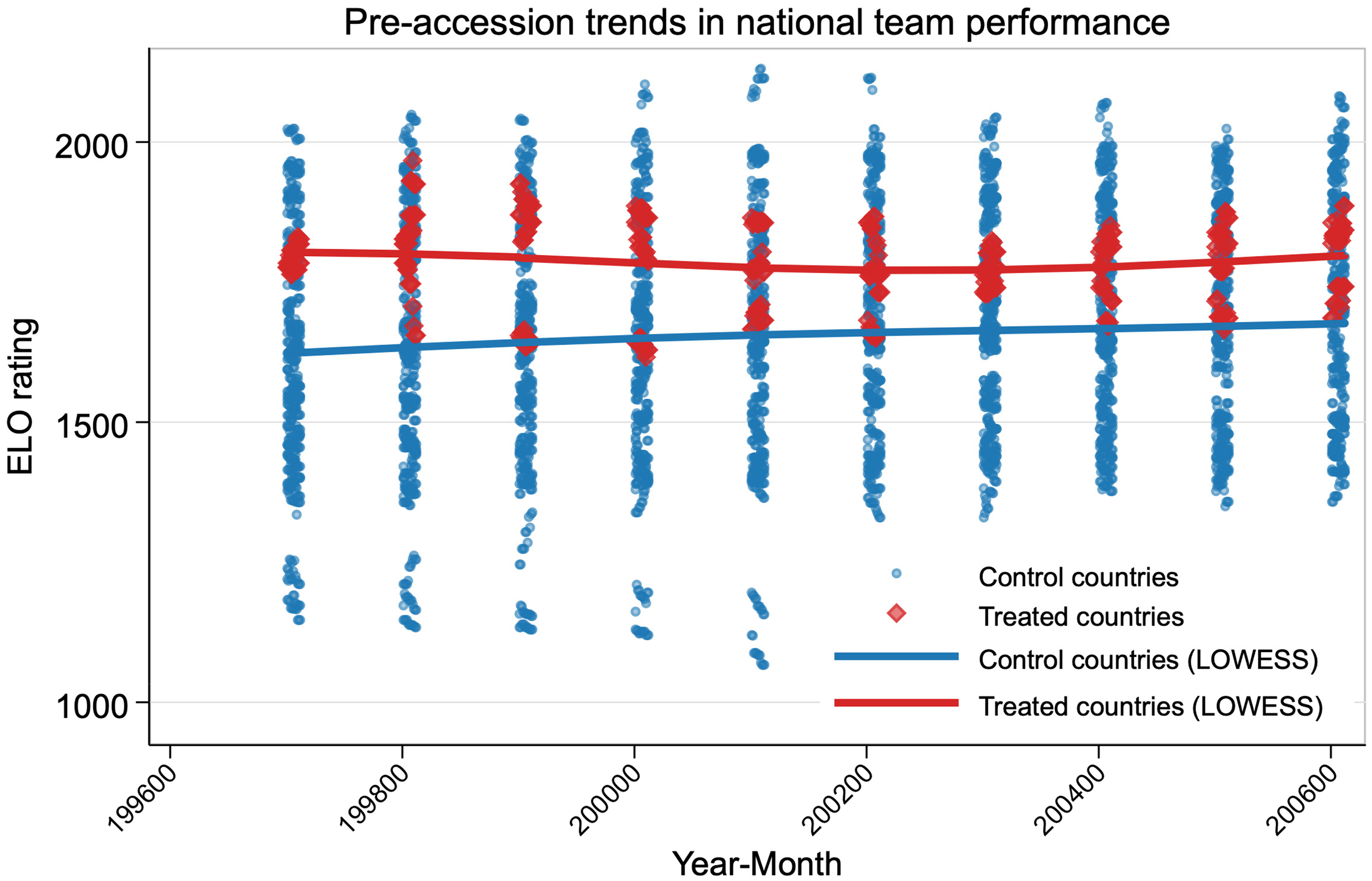
Pre-accession ELO dynamics: treated versus control countries.
Visual inspection of this figure does not reveal strong evidence of differential pretreatment trends between treated and control countries, lending support to the plausibility of the parallel-trends assumption. The absence of a gradual decline prior to accession in the figure suggests that the pretrend differences are not driving the main results. While these diagnostics do not eliminate all identification concerns, they help evaluate whether the data are consistent with the parallel-trends assumption underpinning the DiD design.
To complement the staggered DiD analysis and to further validate the interpretation of our results, we implement an event-study specification that allows the estimation of dynamic treatment effects around the time of EU accession. While the baseline DiD model captures the average impact of joining the EU, the event-study framework provides a more detailed view of how national football performance evolves in the years leading up to and following accession. This approach enables the analysis of the temporal pattern of the effect, distinguishing between short-term adjustment costs and longer-term benefits.
Formally, we estimate a dynamic specification of the following form:

where
To estimate equations (1), (2), and (3), and investigate the impact of EU accession on national football performance, we built an original panel dataset. First, we require an appropriate operationalization of football quality. Following previous literature (Gásquez and Royuela, 2016; Hoffmann et al., 2002; Leeds and Marikova Leeds, 2009), to operationalize football quality in a country we use the performance of national teams rather than club results. Club-level outcomes are strongly influenced by global transfers, ownership patterns, and the liberalization of the football labor market, especially after the Bosman ruling, which weakened the link between domestic conditions and club competitiveness. National teams, by contrast, offer a more reliable measure of a country's footballing capability, as their composition reflects the domestic player pool and national-level institutions.
Although FIFA's official ranking is widely used as an indicator of football performance, it presents several well-known limitations (Hoffmann et al., 2002; Stefani and Pollard, 2007). Its calculation method has been revised multiple times (in 1999, 2006, and 2018), reducing comparability across time, and its availability begins only in 1993, which restricts the scope of historical analysis. These changes introduce structural breaks that make it difficult to interpret variations in rankings as reflecting underlying performance dynamics.
To avoid these shortcomings, we adopt the ELO rating as a continuous measure of football quality, a system originally developed for chess and increasingly applied in football research (Gásquez and Royuela, 2016; Hvattum and Arntzen, 2010). The ELO rating updates a team's score after each official match according to the quality of its opponent, the match's result, goal difference, and competitive importance, thus allowing for consistent comparison across teams and periods.
In line with the methodology of Gásquez and Royuela (2016), we reconstructed monthly ELO ratings for all European national teams included in our sample. Starting from a country's first international game, each team was assigned an initial score of 1500 points at the time of its first official match, thereby avoiding arbitrary historical inequalities (which are instead embedded in some alternative models). The rating was then updated after every match using weights for match importance (20 for friendlies, 30 for minor tournaments, 40 for qualification matches, 50 for continental competitions, and 60 for the World Cup) combined with a goal difference multiplier. Since teams play an uneven number of matches each year, monthly aggregation was adopted to prevent biases due to differences in match frequency. The resulting variable, ELO, constitutes our dependent variable and serves as a standardized measure of national football quality.
The independent variables include a set of economic, demographic, institutional, and environmental controls widely used in the study of international football performance (Gásquez and Royuela, 2016; Hoffmann et al., 2002). Economic development is measured by GDP per capita (in constant 2015 US dollars), obtained from the World Bank's World Development Indicators. Demographic size is captured through the male population of each country, also sourced from the World Bank, representing the potential pool of eligible players for men's national teams. All these series are originally annual and were linearly interpolated to monthly frequency to match the temporal resolution of the dependent variable.
Climatic conditions are included as a fixed country-level variable. Following Hoffmann et al. (2002), we compute the squared deviation of the national average temperature from 14°C, which is held to be the optimal climate for sports performance, as already done in Alfano (2026). Temperature data come from the World Bank's Climate Knowledge Portal, based on the 1991–2020 climatological averages derived from the Climatic Research Unit database. Since this measure represents long-term climate, it does not vary over time within countries.
Football institutional maturity is proxied by the number of years since each national team's first official international match, following Houston and Wilson (2002), Gásquez and Royuela (2016), and Alfano (2026). This variable reflects the historical depth of football organization and accumulated experience within each country, under the assumption that longer institutional continuity fosters better sports structures, coaching systems, and youth development programs.
The key independent variable of interest is EU accession, treated as a major institutional change that modifies a country's regulatory and economic environment. Official EU documentation was used to code the exact month and year of entry: January 2007 for Bulgaria and Romania, and July 2013 for Croatia. For each of these countries, a dummy variable equals one from the date of accession onwards and zero otherwise. This formulation captures the within-country change in institutional context associated with EU integration, most notably the opening of the football labor market, the alignment with European regulatory frameworks, and the increased circulation of both talent and investment.
To ensure comparability, the sample is restricted to UEFA member countries. This restriction eliminates cross-continental heterogeneity in institutional, climatic, and competitive conditions, focusing the analysis on a group of countries operating under broadly similar football governance structures. The dataset covers the period from 1997 to 2022, starting after the dissolution of Yugoslavia to include all successor states for which consistent data are available. Very small football nations with irregular or incomplete historical data (Andorra, San Marino, the Faroe Islands, Liechtenstein, Kosovo, Montenegro, and Bosnia and Herzegovina) were excluded through listwise deletion, as their limited match activity or missing economic information would otherwise compromise the consistency of the panel. Supplemental appendix includes a list of the countries included in the analysis.
The resulting dataset comprises 13,029 monthly observations. Following Gásquez and Royuela (2016), all time-varying macroeconomic independent variables are lagged to mitigate simultaneity bias and to reflect a temporal gap between macroeconomic or institutional changes and their manifestation in football outcomes. To ensure findings are not sensitive to arbitrary choice, following Alfano (2026), we adopted a lag structure of 120, 20, 15, 10, and 5 periods. Descriptive statistics for the variables are presented in Table 1. Given the (slightly) unbalanced structure of the panel and the potential for heteroskedasticity and autocorrelation, the estimations are performed using F-GLS with country-clustered standard errors, an approach that efficiently accounts for serial correlation and cross-sectional dependence (Wooldridge, 2010).
Descriptive statistics.
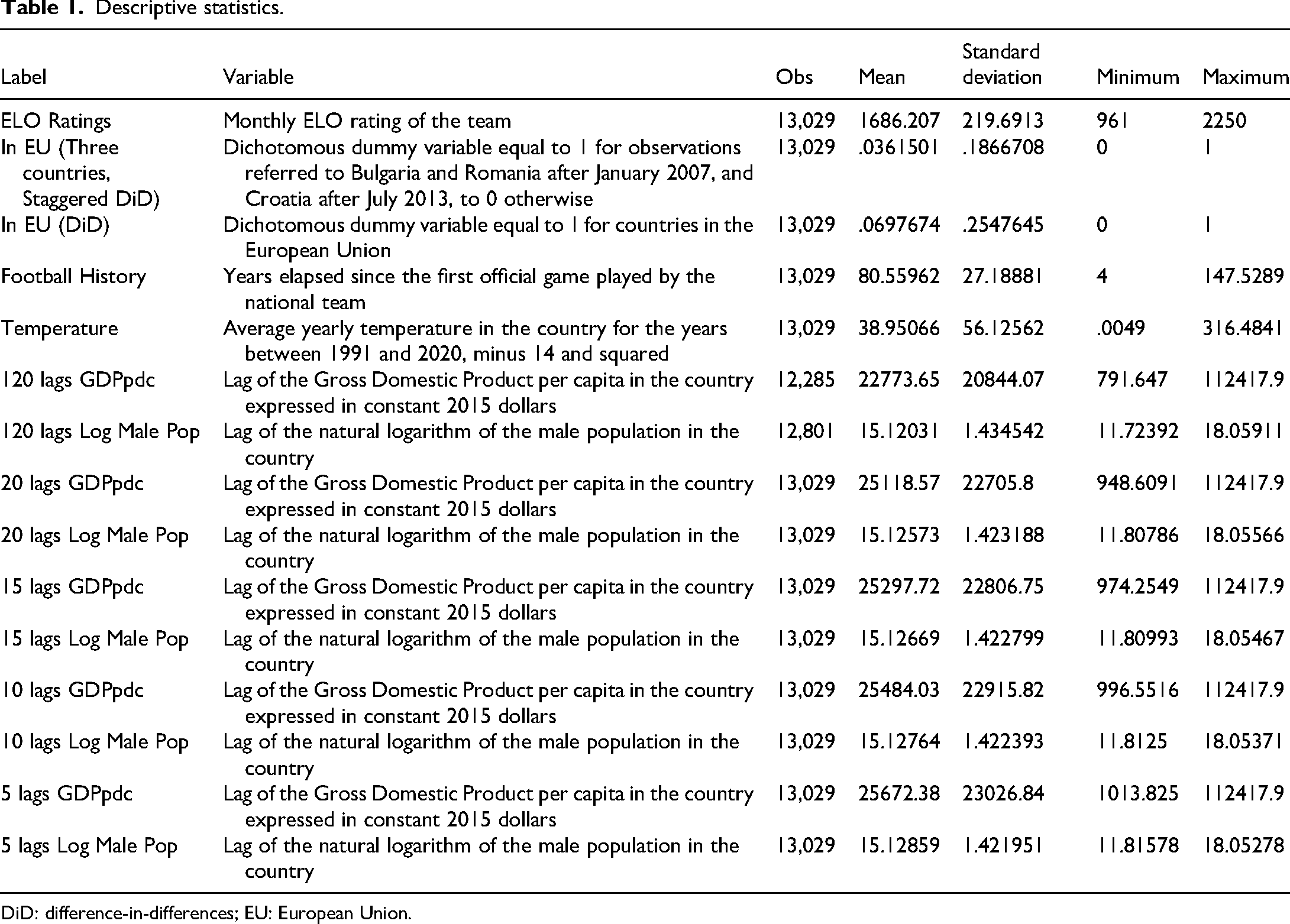
DiD: difference-in-differences; EU: European Union.
Results
Table 2 reports the results of our preferred specification: F-GLS staggered DiD with 20-month lags on the macro controls. We privilege the 20-month window because it is long enough to capture pre-accession macro conditions that shape football systems, while remaining close enough to the treatment window not to wash out relevant pretrends; in short, it balances proximity to treatment with insulation from contemporaneous shocks. The dependent variable is the ELO rating. In our sample, Football History is positive and highly significant across all specifications (about 3.6–3.7, suggesting this increase for each extra year of football history), confirming strong path dependence in performance. Temperature, GDP per capita (linear and squared), and log male population are statistically not significant, indicating that, conditional on historical football heritage, these covariates do not explain additional variation in ELO in our sample. The EU effect is immediate and negative: the In EU coefficient is about −52 ELO points on entry and becomes more negative over time, reaching roughly −79 ELO points 36 months after entry. Thus, in our sample the impact appears suddenly at the moment of accession and then worsens over the subsequent three years. These findings are robust to alternative lag structures for the macro controls (15, 10, 5, and 120 months). The results are reported in Supplemental appendix.
F-GLS-staggered DiD-ELO rating over determinants—20 lags.
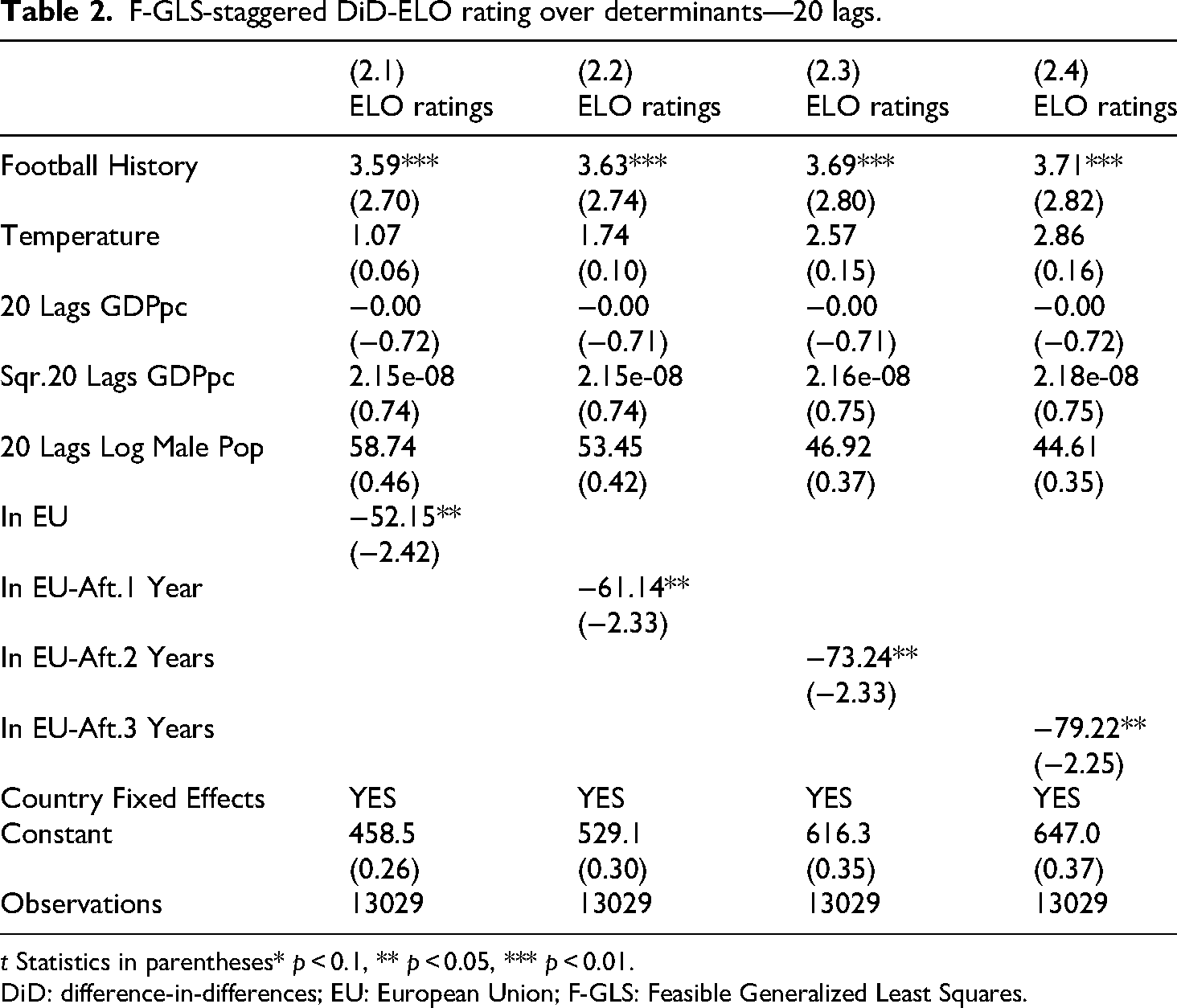
t Statistics in parentheses* p < 0.1, ** p < 0.05, *** p < 0.01.
DiD: difference-in-differences; EU: European Union; F-GLS: Feasible Generalized Least Squares.
To give a more practical idea of the results, a drop of 50 ELO points corresponds to a decrease of roughly seven percentage points in the expected probability of winning a match against the same opponent. This is equivalent to moving down about one competitive tier, such as from the level of Poland to that of Greece in recent UEFA rankings. The estimated 80-point decline observed 3 years after accession implies a further loss of around 10 percentage points in win probability, corresponding to a fall of approximately a dozen positions in global ranking terms. Such a magnitude indicates that the short-term performance costs of EU accession are not only statistically robust but also substantively meaningful in footballing terms.
The standard DiD estimates (excluding Croatia) are fully consistent with the staggered design: treatment–time interactions are consistently negative and highly significant across all lag structures, ranging from about −74 ELO points at accession to roughly −112 by month 36. Full results are reported in Supplemental appendix.
Taken together, the staggered and standard DiD results are tightly consistent across all lag structures. In our sample, EU accession is associated with a sudden negative shift in national team ELO on entry that becomes more adverse over the following 36 months. The magnitude and direction of this effect are robust to the temporal horizon used to summarize pretreatment macro conditions. Football history emerges as the main structural determinant of ELO in our sample, while contemporaneous macroeconomic and demographic factors add little explanatory power—except under the very long 120-month lag, where a mild nonlinear income pattern appears without altering the central conclusion regarding the EU effect.
The empirical evidence suggests that joining the EU is associated with a measurable short-term cost on national football performance, likely reflecting transitional dislocations within domestic football systems, before any potential long-term benefits of integration can materialize. But which of the mechanisms we assumed to be in place actually drive the reduction in football quality observed in our analysis?
To look more closely at one of the mechanisms underlying our main results, we computed the share of national team players employed in clubs outside their home country before and after EU accession. This indicator captures the degree of international mobility among top national players, providing a behavioral measure of how EU integration reshaped domestic football dynamics. We computed this for the years in our dataset when the FIFA World Cup was held, since outside the main competition it is harder to define a proper list for the national team, since this can change frequently during any given year.
As shown in Supplemental appendix, the overall share of players abroad increased after accession, indicating that EU membership facilitated cross-border movements in professional football. The removal of administrative barriers and the harmonization of contractual and transfer regulations contributed to easing mobility across national leagues. When examining individual countries (see Supplemental appendix), the pattern remains consistent: Bulgaria, Romania, and Croatia all display a higher proportion of players selected for their national team playing abroad in the postaccession period compared with the pre-accession phase. The direction of the effect is uniformly positive.
Further disaggregation by player role (see Supplemental appendix) shows that the increase in international mobility is concentrated among midfielders and defenders, while goalkeepers show a modest rise and forwards remain largely stable. EU integration did not affect all player types equally, but rather amplified the international circulation of positions in higher structural demand.
Overall, these results are consistent with the idea that EU accession expanded the effective labor market for footballers, fostering outward mobility, especially among certain roles, and offering a plausible channel through which EU membership influenced national team composition and football quality.
Robustness checks
To assess the robustness of our baseline design and address potential concerns about case selection, as a further result we extended the analysis to the 2004 enlargement cohort. Indeed, a natural question arising from the baseline analysis concerns the role of earlier enlargement waves, in particular the 2004 accession round. While the main results focus on the later entrants of 2007 and 2013, the 2004 enlargement represents the largest expansion of the EU within the period covered by our data and includes several countries present in our sample. Even if this shock is closer to the beginning of the series, and hence less ideal from an empirical point of view, assessing whether these countries display similar postaccession dynamics is important as a means to address potential concerns about case selection and evaluate the generality of the estimated effect.
From a theoretical perspective there are several reasons to expect that the impact of EU accession may differ across cohorts. In particular, countries that joined in 2004 were, on average, already more integrated into European economic and institutional structures prior to formal accession. This integration extended to football markets: players from these countries were already present in foreign leagues, and domestic systems had begun adapting to increasing international exposure well before EU membership. Logistic costs were on average lower, given that most of these countries are close to the geographic center of the Union. As a result, accession may have been a relatively gradual continuation of ongoing trends rather than a sharp institutional discontinuity. By contrast, for later entrants such as Bulgaria and Romania, EU membership appears to coincide with a more abrupt expansion of mobility opportunities and competitive pressures, potentially generating stronger short-term adjustments in domestic football systems, and higher logistical costs, given their locations on the edge of the EU.
The empirics are consistent with this theoretical difference. As reported in Supplemental appendix, the coefficients associated with the 2004 cohort are small and not statistically different from zero across all specifications. We do not detect any systematic decline in national team performance following EU accession for the earlier entrants, suggesting that the effect depends on the extent to which accession constitutes a discrete break in the underlying economic and institutional environment.
What drives this difference? One explanation concerns the degree of pre-accession integration. The countries that joined in 2004 had already undergone a long period of economic convergence and institutional harmonization during the accession negotiations of the late 1990s and early 2000s. As a result, many economic adjustments associated with EU integration occurred before formal accession. Studies of EU enlargement emphasize that substantial structural reforms and market integration were implemented during this pre-accession phase (D’Auria et al., 2008; Kahanec and Zimmermann, 2010). If football labor markets followed the same pattern, scouting networks, player transfers, and club-level integration with Western European leagues may have developed prior to 2004. In their case, accession itself would not produce a discrete shock to the migration opportunities of football players, and therefore the performance of national teams would not display a clear structural break.
A second possible mechanism relates to labor mobility and migration incentives. EU enlargement is widely interpreted as a natural experiment in the effects of labor market integration (Elsner, 2013). Economic theory predicts that reductions in mobility barriers increase the migration of skilled workers toward higher-wage labor markets. Empirical evidence confirms that the enlargements triggered substantial increases in East–West labor mobility (Kahanec and Zimmermann, 2010). In the context of professional football, this mechanism may translate into greater opportunities for talented players to move to richer leagues in Western Europe. If these migration opportunities increase more quickly than the domestic system's capacity to develop and replace talent, the domestic player pool may weaken. This effect may be particularly important for national teams, which rely on a sufficiently large and competitive pipeline of elite players.
A third possible mechanism concerns the institutional capacity of domestic leagues and clubs. The literature on sports economics emphasizes that player development depends on the organizational and financial structure of domestic competitions (Szymanski, 2003). Countries with stronger clubs and youth academies may be able to offset outward migration by reinvesting transfer revenues and maintaining high-quality training systems. By contrast, leagues with weaker governance or financial constraints may struggle to replace departing talent. If the football institutions of the 2007 entrants were less able to absorb the consequences of increased player mobility, outward migration could reduce the depth and competitiveness of domestic development environment.
A fourth possible explanation relates to wage differentials and selective migration. Migration models predict that larger wage gaps between origin and destination markets generate stronger incentives for skilled workers to relocate (Borjas, 1999). In the case of football, wage differentials between Eastern European leagues and Western European leagues are substantial. When these differentials are particularly large, the most productive players may be disproportionately likely to migrate, producing a form of selective talent outflow. Such selective migration can reduce the average quality of players remaining in domestic leagues and, in turn, affect the pool available for national team selection.
Finally, scale effects may amplify these dynamics. National football systems differ substantially in the size of their player base and in the number of clubs capable of producing elite talent. In smaller football systems, the departure of a relatively limited number of high-quality players can have a disproportionate effect on the competitive level of the domestic league and the depth of the national team roster. In larger systems, by contrast, the domestic talent pool may be sufficiently large to absorb outward mobility without measurable effects on national team performance.
Taken together, these mechanisms suggest that the same institutional shock, namely EU accession, can produce heterogeneous outcomes depending on the structure of the domestic economy and labor market. In the context examined here, the enlargement cohorts differed in terms of pre-accession integration, migration incentives, and domestic institutional capacity. These differences provide plausible channels through which EU accession may have had limited effects for the 2004 entrants but more pronounced consequences for the countries that joined in later rounds.
Conclusions
This article examined how EU accession, an institutional and political transformation largely exogenous to the world of sport, influenced the quality of national football teams. The question is of both academic and societal importance, as it connects the study of European integration with the political economy of football, a domain where institutions, markets, and cultural identity interact visibly. EU enlargement reshaped not only economic and administrative systems, but also the mobility of people and the allocation of talent, and football provides an illuminating setting in which these broader processes can be observed. While the literature has extensively addressed the economic, institutional, and political consequences of joining the EU, its implications for collective sports performance have remained largely unexplored. By combining a staggered DiD framework with an original monthly dataset of ELO ratings for UEFA countries, this article offered the first systematic attempt to estimate the impact of EU membership on national football quality.
The results reveal a consistent and robust pattern across all specifications and lag structures. In our sample, EU accession is associated with a sudden and substantial decline in national team ELO ratings (about −50 points at the time of entry and roughly −80 after three years). This negative effect emerges under both staggered and standard DiD models and persists when varying the temporal structure of macroeconomic controls. By contrast, football history appears as the main structural determinant of football performance, while economic, demographic, and climatic factors are statistically not significant in our sample. These findings suggest that institutional and historical legacies dominate over short-term macroeconomic conditions and that the effect of EU accession represents a distinct discontinuity in the evolution of national football quality.
The complementary analysis of player mobility provides a plausible and suggestive interpretation to explain this pattern at least in part. After joining the EU, the share of national team players employed abroad rises markedly, confirming that accession facilitates cross-border movements. This trend is especially visible among defenders and midfielders, whose roles are more directly integrated into tactical systems. The resulting dispersion of players, although beneficial for individual development, may reduce cohesion and shared experience at the national level. The evidence therefore points to a short-term cost of integration, in which the opening of labor markets expands opportunities for individuals but temporarily weakens the collective capacity of national teams.
At the same time, this channel should not be interpreted as exhaustive. EU accession may affect football performance through multiple mechanisms, including changes in domestic league competitiveness, institutional adaptation, and broader economic restructuring. These channels are not directly disentangled in the present analysis and remain an important avenue for future research.
Our findings have implications that extend beyond football. They highlight how large institutional transitions, even when beneficial in the long run, can generate sectoral disruptions in domains where cohesion, identity, and shared routines are essential. Football, often regarded as a reflection of national competence and unity, mirrors how economic and political integration can temporarily erode the very forms of social capital that underpin collective performance. In this sense, the results contribute to the literature on Europeanization by illustrating how integration unfolds through complex tradeoffs between efficiency and cohesion.
Nonetheless, several limitations must be acknowledged. The analysis focuses on the short- and medium-term aftermath of accession and cannot assess whether the observed decline is later reversed as federations and clubs adapt. Moreover, while national teams offer a meaningful lens to assess football quality, club-level dynamics, youth academies, and domestic league competitiveness remain outside the scope of this study. Although the timing of EU accession is plausibly external to short-run sports performance, unobserved factors correlated with both accession and football outcomes cannot be entirely excluded. The estimates should therefore be interpreted as evidence consistent with a causal effect under the parallel-trends assumption, rather than as the result of a fully randomized natural experiment. While incorporating player mobility directly into the regression framework would provide a more structural test of this mechanism, data limitations prevent the construction of a consistent measure at monthly frequency across all countries. We therefore interpret the evidence presented here as being descriptive and leave a more formal test to future research. Finally, ELO ratings, while consistent and continuous, capture only performance outcomes, not subtler aspects such as tactical sophistication, style, or symbolic value.
Future research could extend the findings of this article in several directions. A natural next step would be to explore the longer-term trajectory of postaccession performance, to determine whether early losses are offset by later gains as integration deepens. Further studies could also examine how EU-related funding, governance reforms, or institutional harmonization influence the development of domestic football infrastructure. Micro-level analyses using player-level data could clarify whether increased international mobility enhances skill accumulation or instead reduces cohesion within national squads. Finally, comparing the European experience with other regional integration processes may shed light on whether these dynamics are specific to the EU or reflect a more general pattern in liberalized sports labor markets.
In conclusion, this article shows that EU accession carries a measurable short-run cost for national football performance, potentially through the dispersion of players across foreign clubs and the consequent loss of collective synergy. Yet, as with economic integration more broadly, such transitional costs may coexist with longer-term benefits, once institutions and actors adjust to the new environment. Understanding this duality enriches both the study of European integration and the political economy of sport, revealing how institutional change reshapes not only economies and governance structures, but also the collective identities that find expression on the football field.
Supplemental Material
sj-zip-1-eup-10.1177_14651165261463623 - Supplemental material for Joining the club: European Union accession and the quality of national football teams
Supplemental material, sj-zip-1-eup-10.1177_14651165261463623 for Joining the club: European Union accession and the quality of national football teams by Vincenzo Alfano in European Union Politics
Supplemental Material
sj-zip-2-eup-10.1177_14651165261463623 - Supplemental material for Joining the club: European Union accession and the quality of national football teams
Supplemental material, sj-zip-2-eup-10.1177_14651165261463623 for Joining the club: European Union accession and the quality of national football teams by Vincenzo Alfano in European Union Politics
Supplemental Material
sj-docx-3-eup-10.1177_14651165261463623 - Supplemental material for Joining the club: European Union accession and the quality of national football teams
Supplemental material, sj-docx-3-eup-10.1177_14651165261463623 for Joining the club: European Union accession and the quality of national football teams by Vincenzo Alfano in European Union Politics
Footnotes
Acknowledgements
Vincenzo Alfano sincerely thanks Asso da Messina for his invaluable support and encouragement throughout the development of this research. Any remaining errors or shortcomings are solely the author's own responsibility. During the preparation of this work the author used ChatGPT 5.0 to improve readability and language. After using this tool, the author reviewed and edited the content as needed and takes full responsibility for the content of the article.

Funding
The author received no financial support for the research, authorship, and/or publication of this article.
Declaration of conflicting interests
The author declared no potential conflicts of interest with respect to the research, authorship, and publication of this article.
Data availability statement
The replication material (data and replication code) for this article is available as part of the supplemental material at the DOI of the article.
Supplemental material
Supplemental material for this article is available online.
References
Supplementary Material
Please find the following supplemental material available below.
For Open Access articles published under a Creative Commons License, all supplemental material carries the same license as the article it is associated with.
For non-Open Access articles published, all supplemental material carries a non-exclusive license, and permission requests for re-use of supplemental material or any part of supplemental material shall be sent directly to the copyright owner as specified in the copyright notice associated with the article.
