






Abstract
How do backsliding government parties defend democratic backsliding in the European Parliament? Analyzing manually and large language model-coded data, I find that the backsliders’ arguments do not strongly reflect their illiberalism. Instead, they rely on alleging bias and misconduct by opponents and the advocacy of sovereignty, complemented by situational arguments about election results, Russia, and other member states, among others. Regression analyses tentatively suggest that increasing conflict between the backsliders and other groups helps explain the choice of arguments. The results raise the possibility of an underappreciated mechanism—pushing backsliders into making detrimental arguments—of European Parliament influence on European Union decisions on backsliding. They also indicate that the choice of arguments by backsliding government parties might be less strategically apt and more reactive than sometimes assumed.
Introduction
For over a decade, the European Union (EU) has struggled with democratic backsliding. There is extensive research on the strategies of the governments of backsliding member states to prevent the EU from taking action against them (e.g., Closa and Hernández, 2025; Coman, 2024; Emmons and Pavone, 2021; Holesch and Portela, 2025; Kelemen, 2025). Yet, beyond this, the parties constituting backsliding governments also defend their actions argumentatively (Coman and Leconte, 2019; Emmons and Pavone, 2021; Fabbrini and Zgaga, 2024; Mos, 2020; Wunsch and Chiru, 2025). This effort has been most visible in the European Parliament (EP), where backsliding in Hungary and Poland has been the focus of over 40 debates since 2010 (Herman et al., 2021; Meijers and Van der Veer, 2019; Wunsch and Chiru, 2025). This study examines what arguments the backsliding government parties’ speakers in the EP make to defend democratic backsliding.
A common view is that debates over backsliding in the EP are part of a conflict between liberal and illiberal actors and that the backsliding government parties thus portray their actions as enactment of illiberal values and policies (e.g., Bohle et al., 2024). The literature also suggests other lines of argumentation that these parties might pursue. They are seen as advocates of sovereignty (Coman and Leconte, 2019; Fabbrini and Zgaga, 2024), and challengers of the biases and misconduct of mainstream opponents (e.g., De Vries and Hobolt, 2020). Situational opportunities such as the Russian war in Ukraine or actions by other countries could also feature in the backsliders’ defence against challenges. Yet, the evidence remains limited. The most pertinent study has a different focus and ends by 2019 (Wunsch and Chiru, 2025), before important changes in the politics of backsliding in the EU.
Drawing on new data on arguments made by the Hungarian and Polish government parties in all EP debates on backsliding in these countries, I find that characterizing these arguments as illiberal proves increasingly inaccurate. Allegations of partisan bias and misconduct, sovereignty arguments, and more situational arguments have recently come to outweigh references to illiberal values and policies by a large margin. These arguments are about illiberalism only insofar as the alleged biases and misconduct target “left” and “liberal” opponents, but the arguments do not mention illiberal policies or values, and they frequently extend beyond partisan opponents to encompass the EP, the EU, and its various institutions and actors. The backsliders’ defence of democratic backsliding now predominantly relies on attacks on partisan and other EU-level critics and on the advocacy of sovereignty.
In addition, this study offers a first analysis of how the choice of arguments by backsliding government parties relates to EU-level and domestic developments highlighted in the literature. It is commonly assumed that the arguments of parliamentary actors reflect their ideology. Thus, developments in the ideological profile of the backsliding government parties, described as radicalization in the literature (Bohle et al., 2024), could give rise to more illiberalism and sovereigntism in the arguments made by these parties. However, parliamentary arguments also reflect the challenges actors face from opponents. From this perspective, the growing conflict between backsliding government parties and the other parties in the EP could explain the choice of arguments. It might result in attacks on these and other mainstream actors and in demands to respect national sovereignty. The empirical pattern highlighted above and the results of a regression analysis prove more consistent with the second view, but there is some evidence in line with the first view as well.
As discussed in the conclusion, the results have implications for how we characterize the argumentative strategy of backsliding government parties in the EP and the EU more broadly. This strategy, while often thought to reflect illiberal policies and values, instead proves more narrowly focused on arguments about national sovereignty and allegations of bias and misconduct by critics. Considering research on other arenas (e.g., Emmons and Pavone, 2021), re-characterizing the argumentative strategy as such tentatively points toward an underappreciated mechanism by which the parliament could influence EU politics on democratic backsliding, namely, pushing backsliders into making arguments often thought to be unpopular with other EU institutions. More generally, it raises the question as to whether the backsliders’ choice of arguments is less suitable strategically and more reactive to EU-level conditions than often thought.
The contours of the backsliding government parties’ arguments
Research on democratic backsliding in the EU focuses on bargaining over financial penalties, court judgments, and other sanctions. This literature accordingly emphasizes the Commission and enforcement process and intergovernmental bargaining in the (European) Council (e.g., Blauberger and Kelemen, 2017; Closa and Hernández, 2025, 2026; Coman, 2024; Kleine and Schramm, 2025; Priebus, 2022; Winzen, 2025). In contrast, debate in the EP has received less attention, with initial studies focusing on Members of the European Parliament's (MEPs’) voting behavior instead. These studies show that the EP has consistently, and with large majorities, challenged the domestic actions of backsliding government parties, except for the radical right parties and the center-right European People's Party (EPP), which has seen some defections from votes on critical resolutions (Herman et al., 2021; Meijers and Van der Veer, 2019). This literature does not directly engage systematically with the arguments of backsliding government parties, however.
Nevertheless, there are starting points that help specify the arguments backsliding government parties are likely to make in response to challenges in the EP. First, these parties, like all government parties, might respond to criticism by highlighting their policy and ideological goals and achievements. In line with this, a prominent view in the literature is that backsliding government parties highlight their policies and values, especially illiberal policies and values, such as restrictive immigration policy or conservative family models (Böckmann, 2026; Bohle et al., 2024; Wunsch and Chiru, 2025). Backsliding government parties would be expected to reject the charge that they are engaged in democratic backsliding by arguing that their actions support illiberal policies and values or other important goals such as strengthening the economy. They would allege that critics are opposed to these policies and criticize them because of this. Since these arguments are, at the core, about backsliding governments stressing their policy goals, values, and achievements, I refer to them as “policies and values” arguments below.
Second, recent literature presents backsliding government parties, alongside other radical right parties, as exemplars of “sovereigntist” goals (Coman and Leconte, 2019; Fabbrini and Zgaga, 2024). Sovereigntist parties share a preference for less and narrower EU authority, especially regarding the national constitution and political institutions and the enforcement of democratic and rule of law norms. Sovereigntists do not simply reject EU competences or membership in the EU but demand the reform or reinterpretation of the competences and legal order of the EU to make it sovereignty friendly. For instance, we know from discourses around other EU arenas that backsliding governments and their constituent parties dispute the legality of EU challenges by highlighting the limits of EU competences or claiming primacy over EU law for the national constitution (Closa and Hernández, 2025; Emmons and Pavone, 2021). This literature suggests that, faced with challenges, backsliding government parties would question the authority of EU-level actors and institutions, assert national sovereignty, and claim that their actions are legal based on national law and the national constitution. As these arguments are united by a sovereigntist interpretation of the EU's authority and legal order, I summarize them as “sovereignty and legal order” arguments.
A third set of arguments derives from the conflictual relationship between the ideological family of the backsliding government parties, on one hand, and established or mainstream parties and actors, on the other. The backsliding government parties belong to the radical right family. In the previous decade, this classification was more ambiguous for the Hungarian Fidesz, which remained in the center-right EPP but diverged from its pro-EU and democratic commitments—though stances on other values and policies such immigration were closer (e.g., Abou-Chadi and Krause, 2020). I discuss implications of this relationship below. Here, I note that backsliding government parties share the radical right family's emphasis on illiberal policies, but also their conflictual relationship with mainstream actors. Radical right parties have positioned themselves as challenger parties, juxtaposing their orientation with what they describe as the “left” or “liberal” mainstream (De Vries and Hobolt, 2020). And they have extended this critique to their party opponents in the EP as well as to the other EU institutions and a wide range of critics (e.g., Meijers et al., 2025). For example, Bohle et al. (2024: 1788) notes the assertion of the Hungarian government party that the EU's “senior positions were occupied by ‘globalist-liberal forces’.” These attacks on mainstream actors can be partisan in that they allege left ideological biases and party interests as motivating critics. However, these attacks can also veer into broader anti-establishment and populist arguments by associating the actions of established political actors with significant misconduct and corruption. 1 There is an element of illiberalism in these attacks in that they sometimes refer to “liberal” actors, but the explicit targets are opponents and their conduct, not any well-specified policy or value. From this perspective, if parties in the EP challenge backsliding government parties for violating democratic norms, the response is likely to be that critics have a left, liberal, or mainstream bias against them and even that they conduct themselves questionably, such as by lying, abusing their power, and actual corruption. I refer to these arguments as “bias and misconduct” arguments.
The main empirical study, Wunsch and Chiru (2025), provides evidence for these categories of arguments. The authors map the arguments of all MEPs in debates on backsliding and the rule of law. They sort claims skeptical of backsliding into three categories: denial of backsliding and violations of the rule of law, challenges to the authority of the EU to act, and emphases of different values and policies. These categories subsume several arguments, with the main ones being the denial of backsliding based on references to partisan biases, rejection of EU authority by stressing national sovereignty, and a defence of their actions as pursuit of illiberal values. All three categories prove prominent in the debate. The authors further show that radical right parties, and parliamentarians from Hungary specifically, have increased their emphasis on illiberal values in the 8th (2014–2019) compared to the 7th EP. Polish parliamentarians cover the three categories more evenly. This study suggests that the arguments highlighted so far—policies and values, sovereignty and legal order, and bias and misconduct—have some validity, and that arguments referencing illiberal values might be increasing among Hungarian MEPs.
While the literature provides insights as to the contours of the arguments of backsliding government parties, it also raises questions. The variability and full range of the arguments remains unclear, especially over time. The studies discussed so far make few arguments about change over time. And while the evidence by Wunsch and Chiru (2025) suggests growing importance of arguments about illiberal values in the 2014–2019 parliament, the evidence ends thereafter and thus early in the most conflictual period in the EU's relations with the backsliding governments and their constituent parties. Finally, while the main arguments highlighted in theoretical work are plausible, we lack evidence to confirm that they actually are the most important ones. Empirical work has focused on a set of specific arguments leaving open how important these are relative to others that the backsliding government parties could conceivably make. Overall, the arguments of backsliding government parties and their development over time remain unclear, and the assessment that these arguments are (increasingly) illiberal in need of further study.
A second question is how the arguments of backsliding government parties relate to possible explanations situated in domestic and EU-level politics. There are ample changes and candidate explanations for possible variation. As discussed below, the literature highlights important developments, including the ideological radicalization of backsliding government parties dated approximately to 2015 (Hungary) and 2020 (Poland) (Bohle et al., 2024) as well as the intensification of EP demands for sanctions against backsliding governments over time. The Hungarian government party, Fidesz, was suspended and pressured to leave the parliamentary group of the center-right EPP in the 2019 EP (Kelemen, 2025). Yet, we lack systematic arguments and evidence on whether and how these developments might change the arguments of backsliding government parties in the EP.
Explaining variation in the arguments of backsliding government parties
My analysis of variation focuses on the three types of arguments highlighted in the literature: policies and values, sovereignty and legal order, and bias and misconduct arguments. However, the data collection leaves room for the possibility that other arguments might be important as well. I conceive of variation in the arguments of backsliding government parties in terms of the probability that backsliding government parties invoke them in EP debates, and I understand explanations for variation as conditions that increase or decrease this probability.
Against this backdrop, I distinguish two perspectives: The first is situated at the EP-level and focuses on the relationship between the backsliding government parties and their opponents there. Building on literature emphasizing the political conflict between backsliding government parties and established parties and actors (e.g., De Vries and Hobolt, 2020), this explanation focuses on variation and change in this conflict as the main explanation. The second explanation focuses on the domestic level and the increasing radicalization of the backsliding government parties’ ideology identified in recent work (Bohle et al., 2024). This explanation starts from the idea that parties’ arguments reflect their ideology and policy goals and achievements. It suggests that significant developments—such as ideological radicalization—might affect the choice of arguments.
Regarding the first explanation, situated at the EP-level, the relationship between the backsliding government parties and the other parties has varied in two ways. First, while the EP's majority has long criticized the backsliding government parties in debates and resolutions (Herman et al., 2021; Meijers and Van der Veer, 2019), this criticism has gradually intensified in the sense that the EP's debates have focused on demands for specific sanctions such as financial penalties and the suspension of voting rights under the Article 7 procedure. For example, 12 out of 13 EP debates focusing explicitly on such sanctions have been held since 2020. My first expectation is that EP debates on sanctions motivate backsliding government parties to defend themselves with attacks on the biases and conduct of their opponents and allegations that the EU violates their sovereignty and exceeds its competencies. Invoking national sovereignty is an intuitive response to demands that the EU interferes in domestic actions. Moreover, more intense challenges—such as threats to the backsliders’ resources and voting rights—are likely to trigger harsher reactions. These reactions are expected to take the form of attacks on the biases and misconduct of the opponents. H1: In EP debates on sanctions for the backsliding government parties, these parties are more likely to make bias and misconduct and sovereignty arguments than in other debates.
Furthermore, the mainstream groups and the EPP share broadly pro-EU views. Strongly sovereigntist arguments would thus run counter to the EPP's group line. None of this is to dispute that the means available to EP political groups to enforce a party line and strategy in direct opposition to national party priorities are limited, but the milder incentives and internal coordination mechanisms that they have might sometimes constrain national parties, including backsliding government parties (Hix, 2002). When parties stay outside or leave mainstream groups, these constraints disappear. Thus, I expect that, as part of mainstream groups, backsliding government parties will be less likely to make bias and misconduct and sovereignty arguments. Whether this also holds for illiberal policies and values arguments is less clear. It has been observed that, at the national level, center-right parties have adopted some key illiberal values and policies, such as on immigration policy, so that corresponding arguments might not be as far from the EPP's group line as strongly sovereigntist ones (Abou-Chadi and Krause, 2020). H2: Outside of a mainstream parliamentary group, backsliding government parties are more likely to make bias and misconduct and sovereignty arguments than in such a group.
In terms of expectations, following the onset of ideological radicalization, backsliding government parties would likely derive their arguments in the EP increasingly from their ideological commitments, justifying their domestic politics as enactment of their illiberal and sovereigntist agenda. This would suggest an increased probability for policies and values as well as sovereignty and legal order arguments in EP debates. I note, however, that the literature does not strongly distinguish ideological radicalization from attacks against the biases and conduct of established parties and actors in the EP, other EU institutions, and society more generally. An alternative expectation might thus be that radicalization increases policies and values, sovereignty as well as bias and misconduct arguments—although this combination is only possible if the backsliding government parties initially make other arguments than suggested in the literature and if these arguments then decline in favor of policy, sovereignty, and bias arguments. While I will consider this possibility, I focus on the idea that ideological radicalization will lead to policies and values and sovereignty arguments: H3: After the onset of ideological radicalization, the backsliding government parties are more likely to make arguments based on illiberal policies and values and sovereignty than before.
A potentially important alternative could be that parliamentarians speak in parliament to reach the public sphere, especially the media. Hence, they might make different arguments if they anticipate the opportunity to speak to the wider public. There is some plausibility to this argument. Backsliding government parties might be interested in speaking to the national public but might also see value in conveying their views to audiences in other member states, which could indirectly influence the views on democratic backsliding by the parties and governments from these member states. On the other hand, it is well-established that media coverage of EP debates remains limited (Gattermann, 2013; Koopmans, 2007). Moreover, having asserted considerable control over national media (Wonka et al., 2025), backsliding government parties hardly need the EP to speak to domestic audiences. Most importantly, though, it is not obvious what kind of change in arguments one might expect to see in debates in which parliamentarians expect media attention. Thus, reaching the public might be part of the backsliding government parties’ motivations to speak in the EP, but this motivation does not readily explain variation. However, I will consider empirically below whether backsliding government parties make certain arguments more or less in debates likely covered by the media and thus likely to reach the public spheres of their own and other member states.
Data and operationalization
I explain the operationalization of the expectations by describing new data on the arguments of backsliding government parties, employed here to operationalize the dependent variables of interest, before turning to the explanatory variables.
The arguments of backsliding government parties
The outcomes of interest are the arguments backsliding government parties make in the EP to defend democratic backsliding in the period of 2010–2023. I focus on the two undisputed cases of backsliding government parties, the governing parties of Hungary and Poland (from 2015). There is debate about whether other government parties might be engaged in backsliding, but none of these are considered clear cases (e.g., Bakke and Sitter, 2022; Haggard and Kaufman, 2021; Kelemen, 2020). Moreover, while the governments and parties of other member states have sometimes been the focus of EP debates, only Hungarian and Polish government parties have faced a long series of debates focused on their actions and thus pressure to offer a defence.
I rely on original data on the arguments of backsliding government parties in EP debates (see the Online appendix for an extended discussion of the data and coding process). I identified all 43 debates that focused on democratic backsliding and the rule of law in Hungary and Poland. The data encompass the population of relevant debates, roughly double the debates considered in recent work, and the years 2019–2023 not yet covered elsewhere (Herman et al., 2021; Meijers and Van der Veer, 2019; Wunsch and Chiru, 2025).
In these debates, I identified the speeches of backsliding government parties and divided them into claims, which are distinct points or views. The data encompasses 151 speeches (78 from Poland and 73 from Hungary) and 591 claims (320 Poland/271 Hungary) or 572 claims if we exclude 19 claims by the Polish backsliding government parties before they entered the government in 2015. 54 claims come from coalition partners (10 from the Christian Democratic People's Party, KDNP, in Hungary and 44 from Sovereign Poland, SP, in Poland), the rest from Fidesz and Law and Justice (PiS). The data includes speeches given by the Prime Ministers (PMs) of Hungary and Poland during seven guest appearances in the EP, but the analysis below shows results with and without these speeches.
The outcomes of interest are the arguments actors make. For each claim, I coded up to three arguments. 2 The arguments were coded manually and by a large language model (LLM). The manual coding started from an initial set of categories that was revised and consolidated into the set of eight arguments shown in Table 1. The Online appendix shows examples of claims and arguments coded. This partly inductive approach allowed for finding so far underappreciated arguments since it could not be assumed a priori that the parties would only make the anticipated arguments.
The arguments speakers made to support their claims.
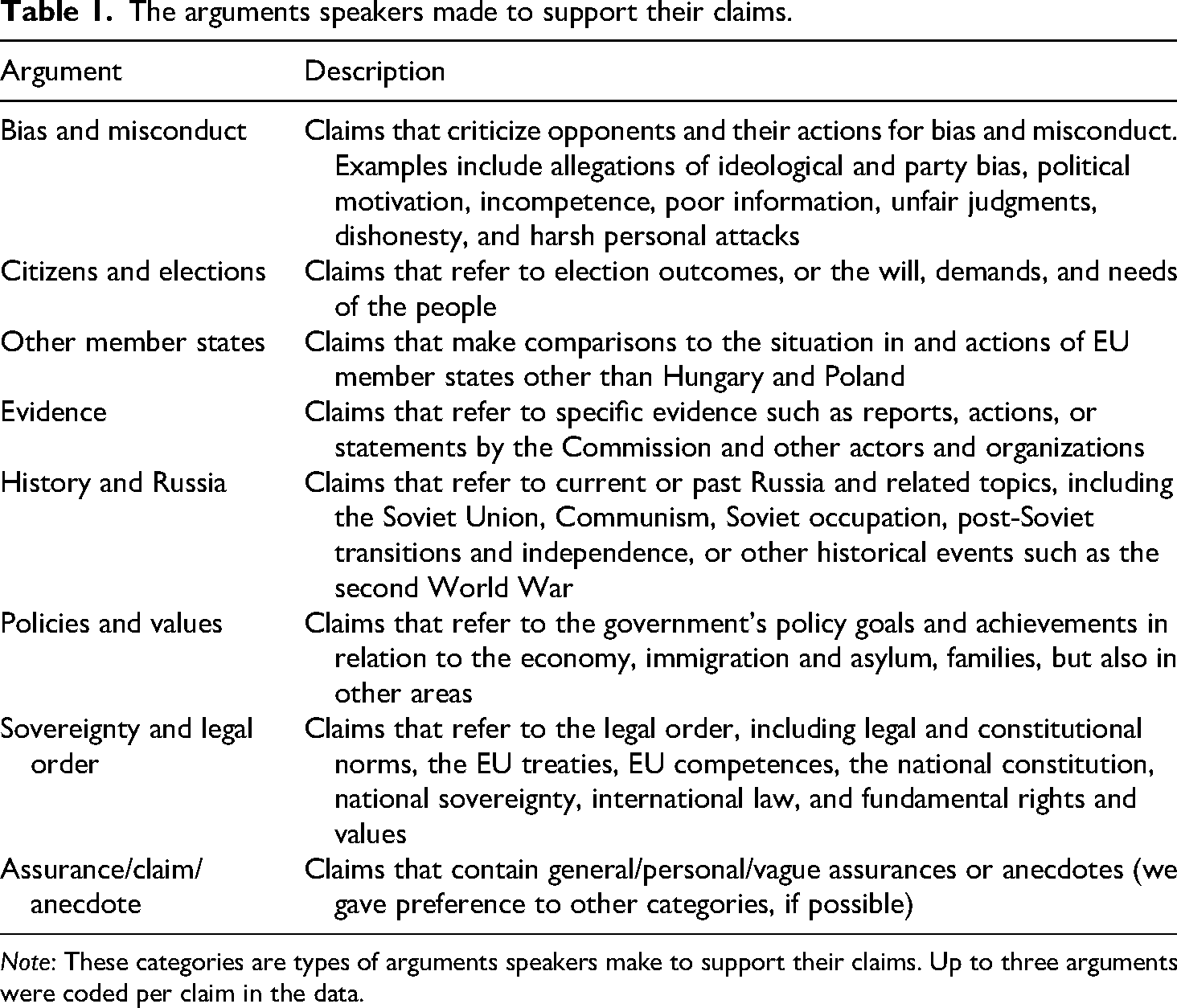
Note: These categories are types of arguments speakers make to support their claims. Up to three arguments were coded per claim in the data.
The main arguments of interest are policies and values arguments, sovereignty and legal order arguments, and bias and misconduct arguments. First, I coded policy and values arguments when speakers defended their actions with reference to their government's values, policy goals, and achievements. This category includes, for example, claims that backsliding government parties, instead of undermining democracy, strengthen the economy, limit immigration, promote certain family models, or improve rules for universities.
Second, I coded sovereignty and legal order arguments when speakers said that their actions were a matter of sovereignty and that the EU lacked the competences to interfere with these actions. This category includes sovereignty-friendly interpretations of the legal order of the EU. For instance, arguments about the limits of EU competences were often intertwined with the idea that the actions of backsliding government parties are legal under the national constitution (Fabbrini and Zgaga, 2024). Speakers rarely make broader references to fundamental legal rights and norms. As these arguments could be seen as legal order arguments, I included them as well.
Third, claims were coded as making bias and misconduct arguments when the speakers said that their critics were motivated by left or liberal ideology and partisan interests, or by opposition to right or conservative ideology and parties, were assessing the backsliding government parties’ actions through an ideological lens or based on political goals or double standards. The coding initially distinguished such claims from claims that allege biases and misconduct without specifically mentioning a party or ideology, but this proved ambiguous. To circumvent this ambiguity, the analysis relies on a broad category, which includes not only partisan and ideological biases but a wider range of misconduct claims, such as allegations of incompetence, poor information, dishonesty, and harsh personal attacks.
Note that the bias and misconduct category of arguments leaves open the identity of the opponents attacked by backsliding government parties. The opponents often are the other parties in the EP or the EP more broadly. Yet the backsliding government parties’ claims frequently conceive of the actors they speak to in broader terms, including the EU generally or other EU institutions. In rarer cases, Germany, or certain individuals, groups, or networks are also highlighted. As these claims share the underlying allegation of partisan bias and misconduct by opponents, I code them accordingly.
The coding was done manually and by an LLM and the analysis compares results for both. First, a research assistant and the author coded arguments for all claims independently. In this first coding, agreement was fair to moderate for most argument categories (based on typical thresholds for Cohen's kappa, where a kappa of 0.6 would be “substantial agreement”). We then discussed and consolidated the categories to the set shown here to reduce fuzzy category demarcations. Subsequently, I revised my coding comprehensively. In addition, the research assistant independently re-coded half of the data. The agreement between these two revised codings proved substantial across all categories, with Cohen's kappa ranging from 0.62 to 0.9. 3 The only exception was the “Other member states” category, where agreement was high (94%) but kappa rather low (0.44). I reviewed my coding of this category once more, but the analysis does not strongly depend on this category as it is not one of the dependent variables.
Second, the data were coded by an LLM, using the OpenAI GPT OSS 120B model and application programming interface (API) provided by Ki:connect. 4 As recommended in recent work (Alizadeh et al., 2024), claims were sent to the API in batches of one with instructions to assess the applicability of each of the argument categories and with the temperature set to zero (the Online appendix shows the coding instructions sent to the API). This was done five times to generate five LLM raters. Reliability proved high across all five raters. 5 I aggregated the five raters by coding an argument as present if four out of five raters agreed, consistent with a standard we followed in the manual coding that there had to be clear evidence for a category to code it. Comparing the LLM coding with the final manual coding, simple percent agreement is above 80% for all categories. Cohen's kappa is above .6 (typically considered substantial agreement) for most categories but just below for the comparison to other countries category (.58) and low for the evidence (.31) and assurance (.37) categories—these categories are not central to the analysis, however. 6
Explanatory variables and regression models
In addition to describing the contours of the backsliders’ arguments, this study provides a first analysis of possible explanations. H1 distinguishes EP debates on sanctions from other debates. I identified each debate that explicitly focuses on sanctions and penalties in the topic of the debate and refer to these debates as “EU action” debates (see the Online appendix). H2 highlights the (end of the) alliance of backsliding government parties and mainstream parliamentary groups. I coded this variable as “1” when parties had no such alliance—this is the case for the Hungarian Fidesz after the suspension from the EPP in 2019 and for Polish governing parties throughout the analysis period. Fidesz's coalition partner, the KDNP, has remained in the EPP and is coded accordingly. H3 focuses on the ideological radicalization phase of the backsliding government parties. In line with the periods highlighted in the literature, this phase is coded to start in 2015 for the Hungarian government parties and 2020 for the Polish government parties (Bohle et al., 2024).
As noted, I also consider whether backsliding government parties make different arguments in debates likely covered by the media. Such debates are hard to identify in a parliament that receives little media coverage. To obtain an approximation of this argument, I rely on the fact that the backsliding government parties are occasionally represented in debates by their PMs. The salience of these occasions is likely to generate widespread media attention in the home country as well as in other member states and in EU-level media. This does not definitively rule out that some other debates might attract media attention as well. Yet, if speakers react to the prospect of media exposure, debates with PMs should certainly result in such a reaction.
To assess the plausibility of this assumption, I identified whether debates with PMs were covered in major newspapers of France, Germany, and Austria, as well as the specialized EU-level news outlet Euractiv.com. This is not a full analysis of the determinants of media coverage, merely an assessment of plausibility. France and Germany are important decision-makers and Austria an important swing vote in the Council politics of democratic backsliding (Closa and Hernández, 2026). It is sufficiently obvious that PM debates would be covered in the national news of the backsliding member states so that I did not collect newspaper data from these countries (but see, e.g., Wonka et al., 2025). Table 2 underlines that debates with PM involvement indeed receive much more regular newspaper coverage. The difference between debates with and without PMs participating is especially striking in the national outlets, which hardly cover any debates without PM involvement.
Which EP debates get covered in the media?
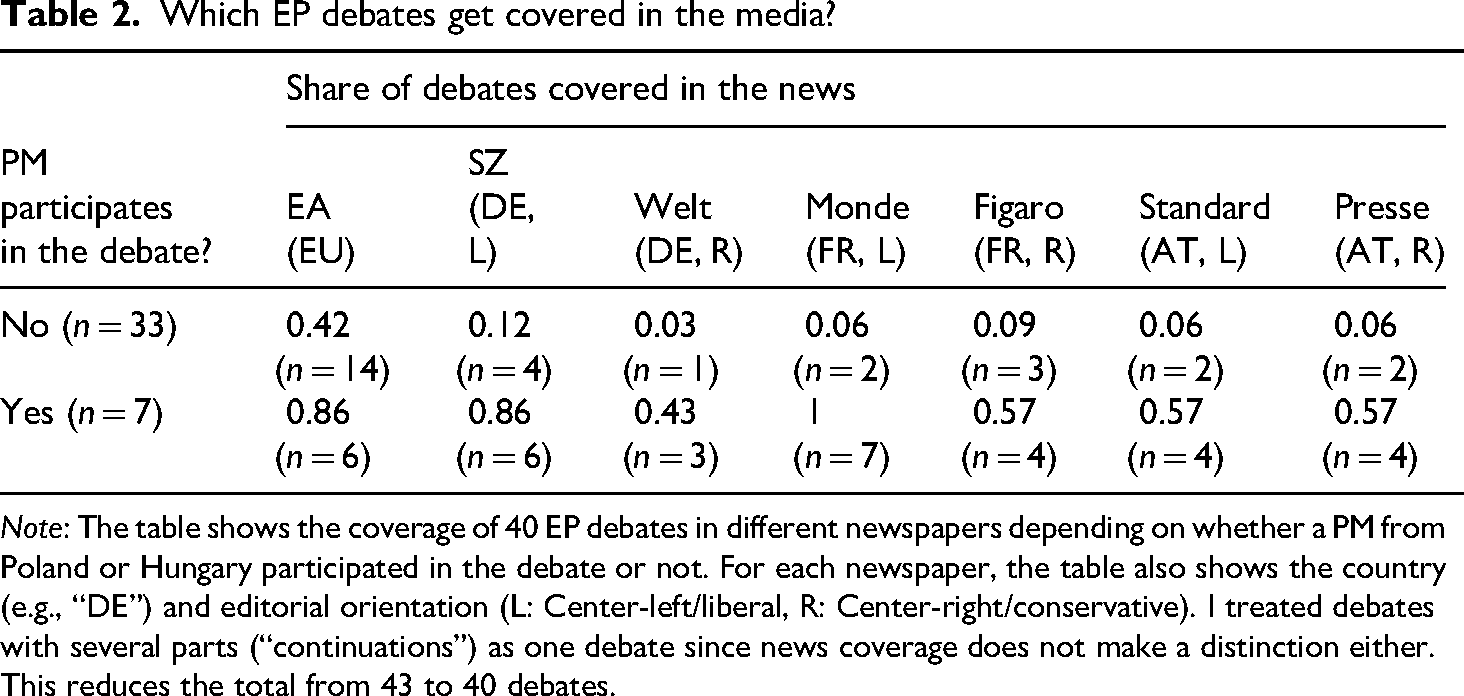
Note: The table shows the coverage of 40 EP debates in different newspapers depending on whether a PM from Poland or Hungary participated in the debate or not. For each newspaper, the table also shows the country (e.g., “DE”) and editorial orientation (L: Center-left/liberal, R: Center-right/conservative). I treated debates with several parts (“continuations”) as one debate since news coverage does not make a distinction either. This reduces the total from 43 to 40 debates.
The following first describes the arguments of backsliding government parties before analyzing the relationship between the choice of arguments and the explanatory variables. For this purpose, I estimated multilevel logistic regression models of the probability that a claim by a representative of a backsliding government party makes a certain argument. These models include random effects at different levels (speakers, debates, years, and countries) to account for variation at these levels. Obviously, while this analysis can show relationships between the choice of arguments and the explanatory variables, it is not direct evidence of causal relationships.
Describing the arguments of backsliding government parties
I begin by describing the arguments of backsliding government parties. Figure 1 shows the arguments made by these parties across the entire data. The bias and misconduct, sovereignty and legal order, and policies and values arguments often assumed to be most important feature prominently. Yet, the arguments are not equally relevant. Bias and misconduct arguments constitute the largest category. Sovereignty and legal order arguments also assume considerable importance. Policies and values arguments are the third largest category, but the difference to other categories of arguments is smaller, especially in the Polish case. This is remarkable considering that the available evidence suggested relatively even use of all three arguments by the Polish backsliding parties and increasing reliance on policies and values arguments by Hungarian government parties. The manually- and LLM-coded data have very similar patterns, with the main difference being that the sovereignty category is more frequent in the LLM-coded data—but this does not change the description of the general patterns. 7
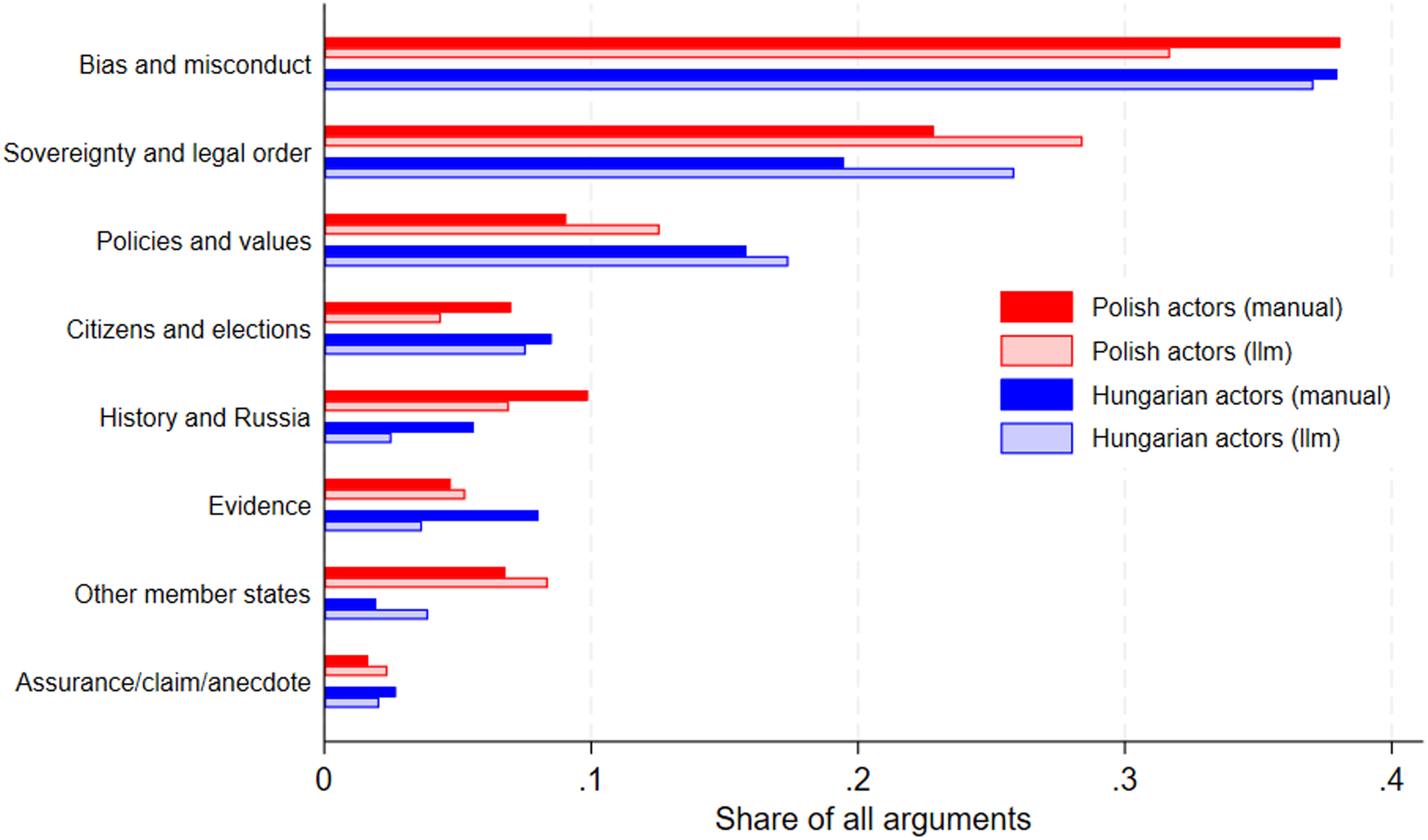
Arguments of backsliding governments.
Illustrating the typical tone of the most frequent type of arguments, the bias and misconduct category, Hungarian MEP Hidveghi argued
8
: The situation is that an agreement was reached between Hungary and the European Commission on the use of EU funds in fair negotiations. There is no professional or legal issue that has not been resolved, but it does not matter to you here what measures we implement, because you are carrying out a political mission, the purpose of which is - in your own words - to starve Hungary and every other government pursuing a conservative national policy. See the shameful attacks on Poland, or the outrageous message to the yet-to-be-formed Italian government.
The composition of the backsliding government parties’ arguments also changes over time. Figure 2 (panels a and b) shows this for the Hungarian government parties. Bias and misconduct arguments have been central to their repertoire from the start but have become especially frequent since the start of the 2019 parliament. Sovereignty arguments were briefly prominent in the beginning of backsliding, but have become more consistently widespread in more recent years, though with more variation than bias and misconduct arguments. In contrast, the Hungarian backsliding government parties relied on policies and values arguments mostly in the 2014–2019 parliament but not much before or after. These arguments have become marginal recently. This is in line with existing work that ends by 2019 (Wunsch and Chiru, 2025), but shows that the rise in illiberalism diagnosed in this work was already declining well before the end of that parliamentary term.
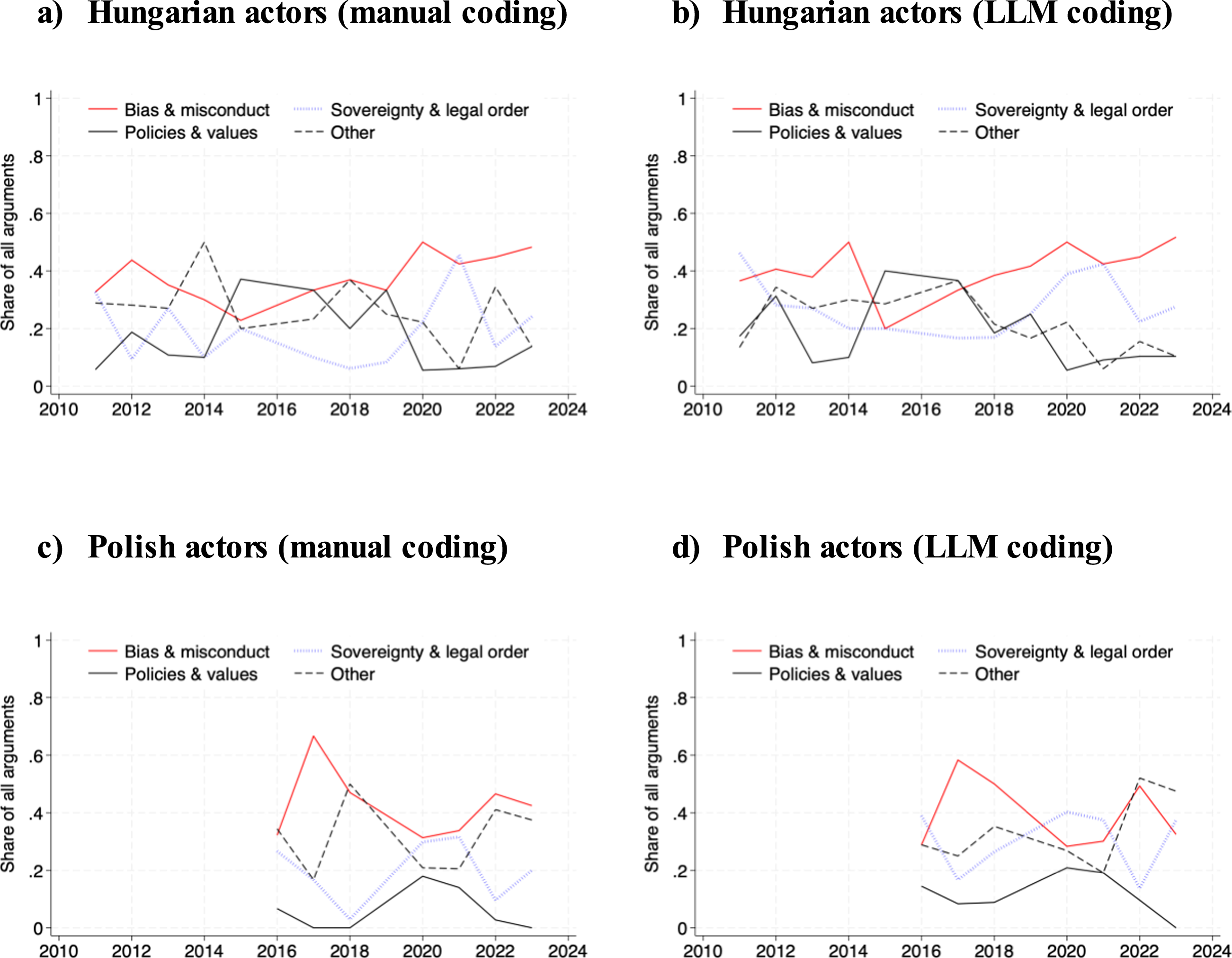
Bias and misconduct, sovereigntist and legal order, and policies and values arguments by Hungarian and Polish actors over time.
For the Polish backsliding government parties, we do not have as long of a time trend since backsliding only started in late 2015. Figure 2 (panels c and d) shows ample variation and the bias and misconduct category is most important. There are also signs of a rise of sovereignty and legal order arguments in the 2020s but the aggregate patterns are rather erratic. Policy and values arguments remain rare throughout all years.
The Online appendix reports these trends after excluding debate contributions by the PMs. This changes little in the assessment that policies and values arguments have become very rare in recent years after a temporary rise in the 2014–2019 EP, although that rise appears more pronounced. However, an important difference is that, among Hungarian MEPs, bias and misconduct arguments have been very widespread throughout the entire period of analysis with no strong or persistent change over time. The reason that Figure 2 shows lower shares of bias and misconduct arguments in earlier years is that the Hungarian PM regularly attended EP debates then, and made fewer such arguments than his party's MEPs, depressing the share. The PM did not attend debates between 2019 and 2023 so that this moderating impact disappeared and the more assertive stance—in terms of making bias and misconduct arguments—of the MEPs became clearer. In other words, the time trend in bias and misconduct arguments hinges on whether the PM sets a (somewhat) more moderate tone, not on changes in MEP behavior.
Overall, neither the Hungarian nor the Polish backsliders rely much on illiberal policies and values, except for a temporary focus on such arguments in the 2014–2019 parliament. Both frequently stress biases and misconduct of their opponents and invoke national sovereignty and limited EU competences. Both also make a range of situational arguments. For Hungarian backsliding government parties, speeches by the PM reduced the prominence of bias and misconduct arguments to some extent in earlier years. In the absence of the PM in EP debates since 2019, the share of these arguments has risen even more. This argumentative stance is what we would expect to see from sovereigntists and challengers of mainstream parties and actors in the EU (see De Vries and Hobolt, 2020; Fabbrini and Zgaga, 2024).
Analyzing variation in the arguments of backsliding government parties
To assess the relationships between the arguments of backsliding government parties and the explanatory variables, I estimated logistic regression models of the probability that a claim by a representative of a backsliding government party makes a bias and misconduct, policies and values, or sovereignty argument. The data is relatively sparse and nested in various ways and some key political developments tend to cluster toward the end of the data (e.g., Fidesz's EPP exit and an increase in debates for sanctions). Hence, these models should be treated with a degree of caution. Moreover, it is not advisable to estimate one model estimating the choice across the whole range of argument. I instead estimate three separate models, one for each of the three main arguments of interest. The models were estimated in a Bayesian framework with rather loose priors and random intercepts for the speaker, debate, year, and country of the speaker. These random intercepts offer some control for variation at these levels of the data. Overall, the models lend themselves to a first assessment of whether there are systematic empirical patterns in the data are consistent with the expectations, but they should not be seen as direct evidence of the causality of these relationships.
Figure 3 shows the results and Figure 4 predicted probabilities based on the results. While uncertainty is high, there are some noteworthy tendencies. H1 suggested that debates on EU action motivate bias and misconduct and sovereignty arguments. The EU action variable is indeed the only one relating positively to bias and misconduct arguments, more clearly so in the results with the LLM-coded dependent variable (DV). In the median, bias and misconduct arguments are 18 percentage points more likely in such debates compared to others (based on the model with the LLM-coded DV). I do not find any signs of a relationship to sovereignty arguments.
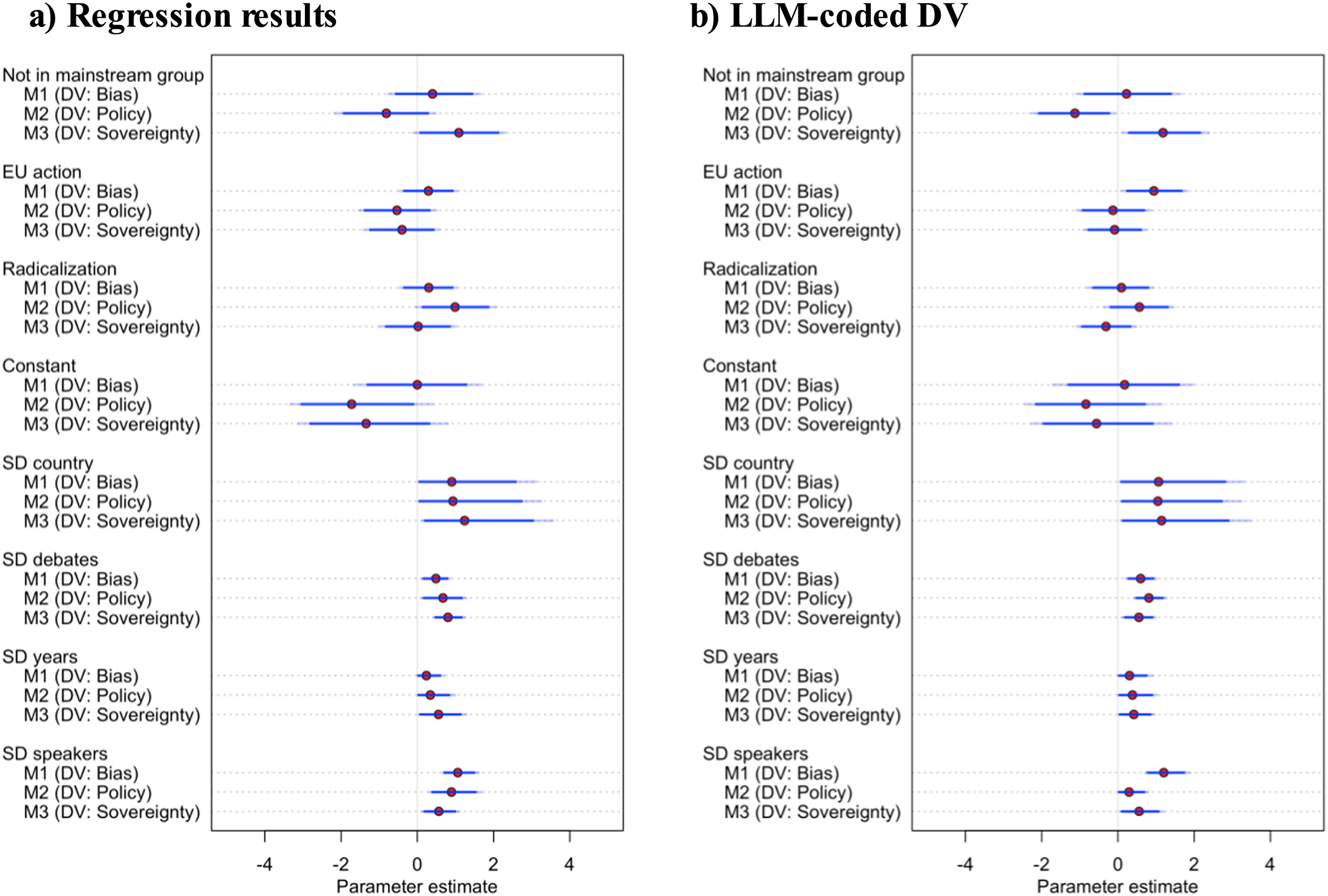
Regression models of the choice of arguments by backsliding government parties.
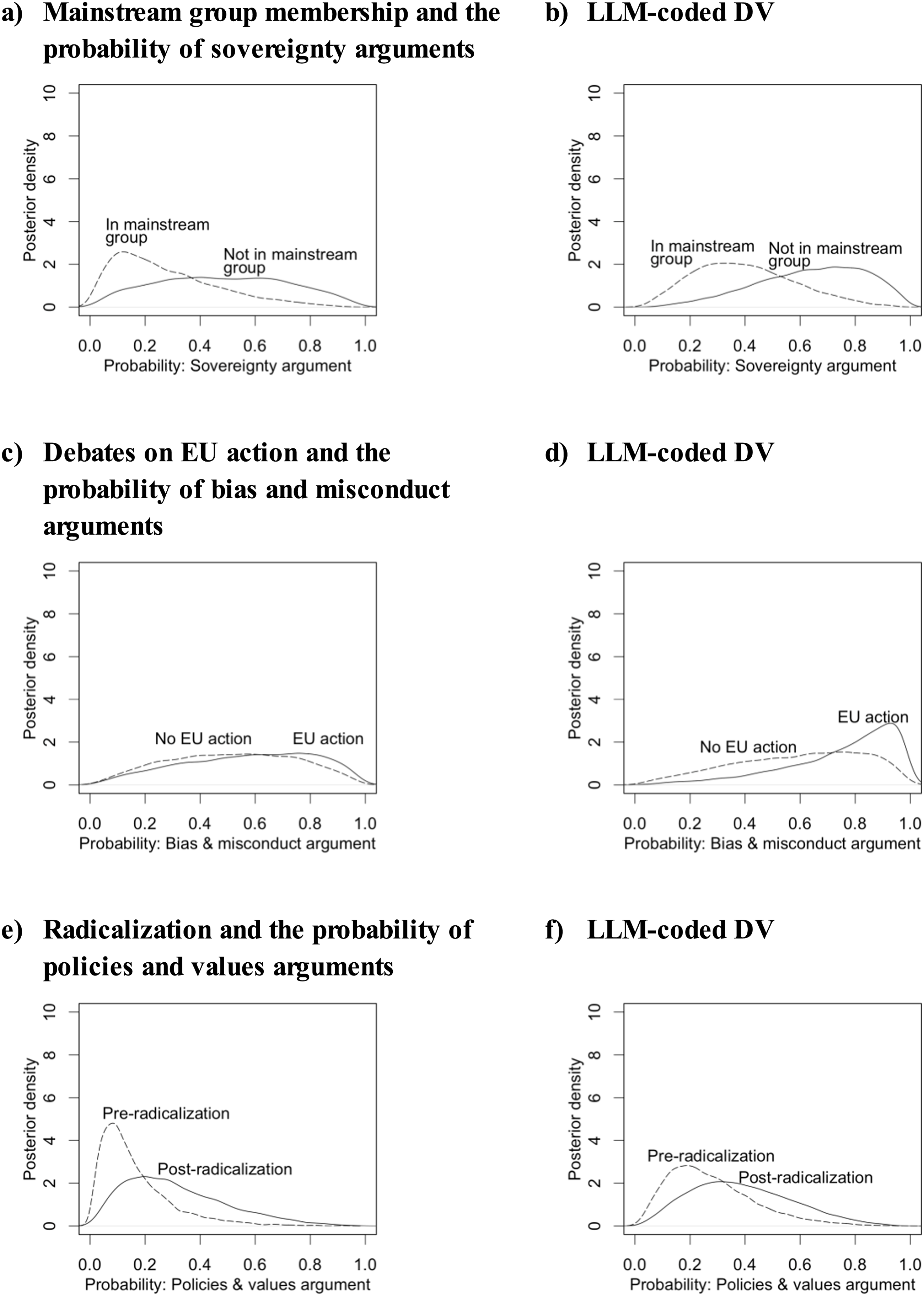
Predicted probabilities.
H2 suggested that backsliding government parties would be more likely to make bias and misconduct and sovereignty arguments outside of, or after leaving, mainstream parliamentary groups. The evidence is consistent with the second part, namely that being outside of a mainstream group relates positively to sovereignty arguments. This pattern becomes more certain still when re-running the results with data from Hungary only, in which the focus is more directly on the change from membership to non-membership (not shown here). In the median, sovereignty arguments are 27 percentage points more likely (based on the model with the LLM-coded DV) outside of a mainstream group. The relationship between being outside of a mainstream group with the other two argument categories is far more uncertain. If anything, outside of a mainstream group, backsliding government parties make fewer policies and values arguments. Possibly, these types of arguments are a better fit for mainstream (center-right) groups and thus more likely than other arguments, while the backsliding government parties are in these groups.
H3 held that the onset of the phases of ideological radicalization highlighted in the literature (Bohle et al., 2024) should increase the probability of policies and values, as well as sovereignty and legal order arguments. With respect to policies and values arguments, the results are tentatively consistent with the claim, more so in the models based on the manually coded DV. The magnitude of the relationship, about a 12 percentage points difference in the probability of policies and values arguments, is somewhat smaller than in the case of the other relationships. And, as panels e and f in Figure 4 show, the probability of these arguments remains low overall. I do not find signs that ideological radicalization relates to sovereignty arguments.
Backsliding government parties might make different arguments when PMs attend EP debates, due to the anticipation of public and media attention. One might also wonder how the results would look without including the debate contributions of the PMs themselves in the analysis. Figure 5 shows results of models with a variable identifying PM attendance added. These results furthermore exclude the contributions of the PMs themselves—including them makes only little difference but weakens most relationships somewhat (see the Online appendix). Turning to the results, PM attendance itself does not relate clearly to any choice of argument, suggesting that the anticipation of media attention does not result in MEPs making different arguments. Otherwise, the patterns discussed so far remain largely in place but tend to become stronger and clearer. Most notably the relationship between the onset of ideological radicalization and policies and values arguments (H3) becomes more pronounced, which could be due to the Hungarian MEPs turning to these arguments particularly strongly in the 2014–2019 parliament (see previous section). However, these arguments appear to be considerably less likely outside mainstream groups—i.e., among Polish backsliders’ and Hungarian backsliders’ after leaving the EPP. Then, in line with the other results, sovereignty arguments gain prominence and policy arguments decline.
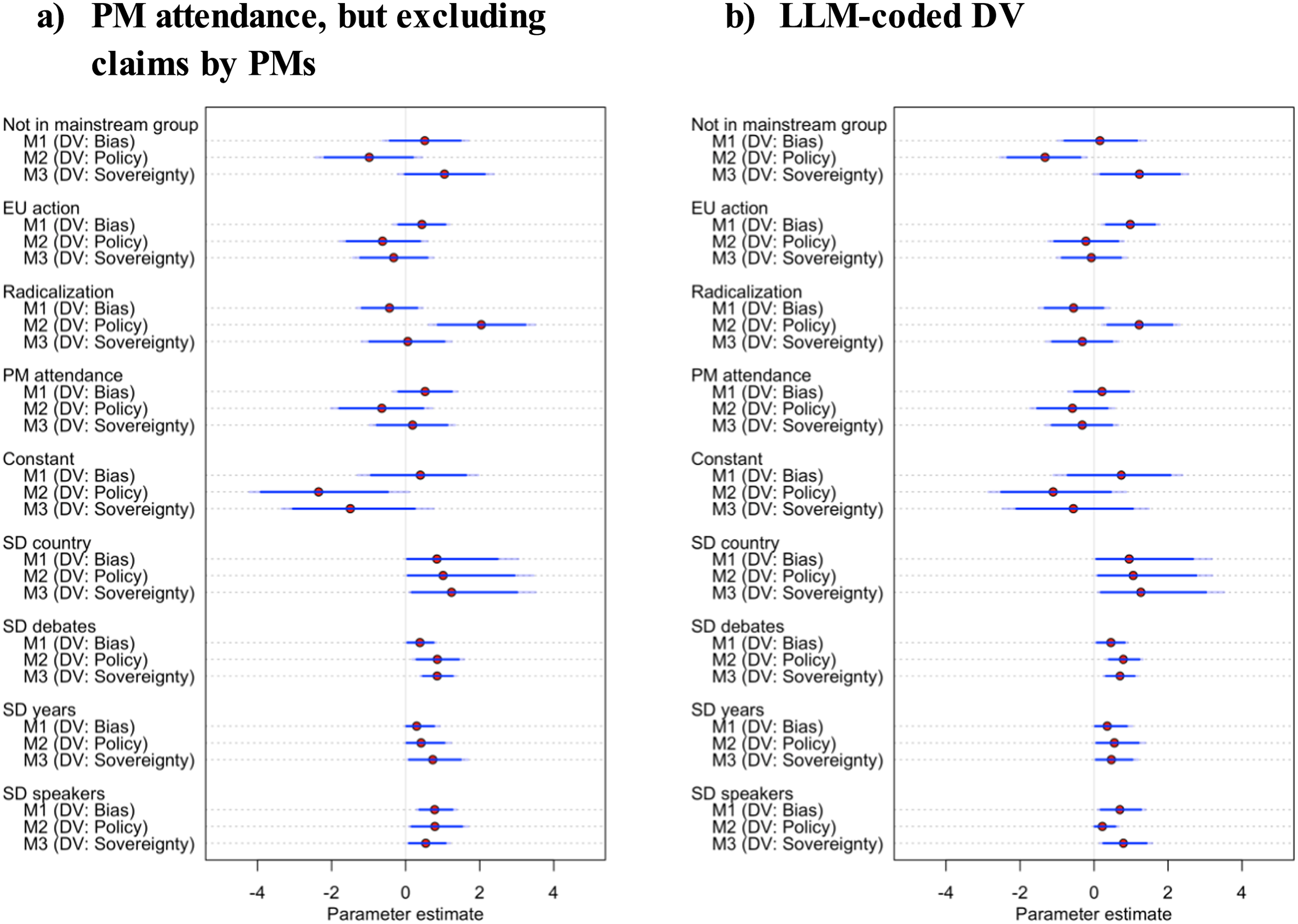
PM attendance, MEPs, and the probability of different arguments.
Summing up (see Table 3), I find tentative support for some, but not all, of the relationships highlighted in the hypotheses. These findings should be treated with caution as the relationships remain relatively uncertain, and the models cannot provide direct evidence of causal relationships. Nonetheless, there are signs that EP debates on sanctions for backsliding governments have led to more allegations by backsliding government parties of bias and misconduct of their critics but not of sovereignty and legal order arguments (H1). The onset of ideological radicalization seems to have raised the profile of policies and values arguments but not of sovereignty and legal order arguments and more so among MEPs than PMs (H3). And outside of mainstream groups (H2), the parties tend to defend themselves against charges of democratic backsliding more with arguments invoking national sovereignty. There is little evidence that being in or out of mainstream groups affects bias and misconduct arguments. It might even go together with fewer policies and values arguments.
Overview of results.
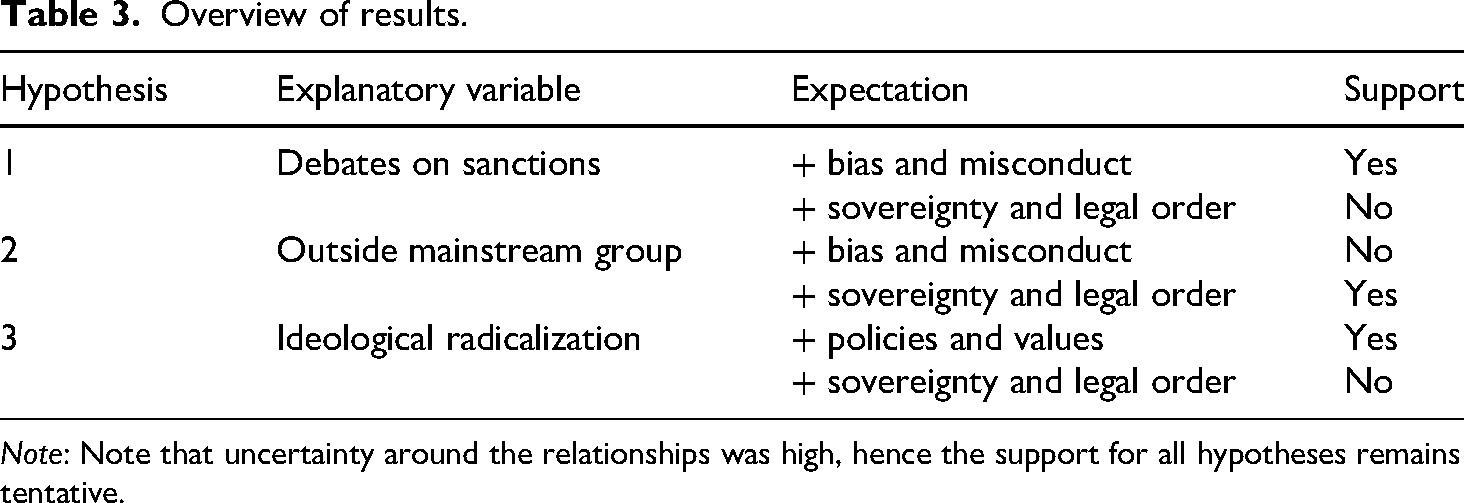
Note: Note that uncertainty around the relationships was high, hence the support for all hypotheses remains tentative.
Conclusion
This study set out to understand how backsliding government parties defend democratic backsliding in the EP. I found that the arguments of these parties focus predominantly on the biases and misconduct of their critics as well as on national sovereignty and the legal order of the EU. They also make a variety of situational arguments related, for example, to other member states and Russia. In contrast, even though the backsliding government parties are prominent proponents of illiberal policies and values, they now rarely refer to these policies and values in their defence of backsliding. They did so more during the 2014–2019 EP, as existing research suggests (Wunsch and Chiru, 2025), but have ceased doing so. To be sure, the attacks on the other parties and other mainstream EU actors retain elements of illiberalism. They often refer to “the left” or “the liberals.” However, substantive references to illiberal policies and values such as migration or family policies have become rare. Due to the emphasis on sovereignty and bias and misconduct by partisan opponents, but also a wider set of actors and institutions, the argumentative stance of the backsliding government parties is now more aptly characterized as sovereigntist (Fabbrini and Zgaga, 2024), partisan, and anti-(EU-)mainstream than illiberal. It is, in this sense, also narrower than often thought.
The results matter for the politics of democratic backsliding in the EU. Within the EP backsliding government parties and their radical right party family members have found it possible to establish common ground with some mainstream parties in other policy issues on the basis of some of their illiberal policy priorities (Kantola and Miller, 2021; Servent, 2019). Yet, in debates on backsliding, their arguments deviate from highlighting such issues in which common ground and potential support might lie. Beyond the EP, recent work suggests that other EU institutions, especially the (European) Council, are more likely to adopt sanctions if backsliding governments become too partisan and aggressive in their actions and arguments (Emmons and Pavone, 2021; Kelemen, 2025; Winzen, 2025). While the governments in the Council sympathize with calls for sovereignty and limited EU competences (Closa and Hernández, 2026), they might react negatively to allegations of bias and misconduct by EU actors and institutions. Of course, it is uncertain whether actors in other EU institutions react to arguments heard in the EP arena. However, some evidence shows that the Council and Commission notice debates outside of their own environments (Emmons and Pavone, 2021: 1624–1625). There is overlapping party membership across the institutions (Warntjen et al., 2008). And the Council presidency and a member of the Commission attend most EP debates—over 75 percent of the debates in the data here—and thus hear the arguments. This points to a role for the EP arena and an opportunity for the democratic parliamentary actors to push backsliding government parties into an unfavorable argumentative strategy. That the backsliders’ choice of arguments might be shaped, as tentatively found here, by EP debates on sanctions and by exclusion from mainstream groups suggests that the EP has levers suitable to continuing to pursue this strategy.
Yet, even if the debate in the EP had little direct bearing on EU decisions on democratic backsliding by the Council or Commission, the findings here would still raise questions about how strategically competent the choice of arguments of backsliding government parties in EU arenas is. The arguments observed here bear only limited resemblance to the illiberal “counterhegemonic project” attributed to these parties (Bohle et al., 2024), nor do they steer clear of allegations of partisan bias and misconduct that might alienate potential mainstream supporters. And, the evidence suggests at least tentatively, the backsliders’ arguments seem to be driven by the EP and the backsliders’ relations with mainstream parties. All of this suggests that these parties’ arguments might be chosen less strategically, or be strategically less of an appropriate choice, than commonly thought.
This study also suggests several avenues of further research. More evidence is needed on whether the relationships found in the regression analysis are causal, especially to ascertain whether actions by the EP, such as holding debates on sanctions, indeed cause changes in the arguments of backsliding government parties. Moreover, my focus has been on important changes highlighted in the literature, but I do not claim that these exhaustively explain variation in the choice of arguments so that additional explanations could be tested. Furthermore, there is room to deepen the analysis of the backsliders’ arguments. On one hand, my analysis focused on the main arguments expected from and made by these parties. However, I found that these arguments are complemented by a wider range of other arguments that have not yet received much systematic attention in the literature. On the other hand, we could assess more systematically the range of biases and misconduct, the nature of the sovereignty claims, or details of other argument categories. Finally, the systematic categorization of the arguments presented here would allow testing their impact on other actors’ assessment of the actions of backsliding government parties, such as assessments by citizens or other EU-level actors.
Supplemental Material
sj-zip-1-eup-10.1177_14651165261463883 - Supplemental material for How backsliding government parties defend democratic backsliding in the European Parliament
Supplemental material, sj-zip-1-eup-10.1177_14651165261463883 for How backsliding government parties defend democratic backsliding in the European Parliament by Thomas Winzen in European Union Politics
Supplemental Material
sj-zip-2-eup-10.1177_14651165261463883 - Supplemental material for How backsliding government parties defend democratic backsliding in the European Parliament
Supplemental material, sj-zip-2-eup-10.1177_14651165261463883 for How backsliding government parties defend democratic backsliding in the European Parliament by Thomas Winzen in European Union Politics
Supplemental Material
sj-docx-3-eup-10.1177_14651165261463883 - Supplemental material for How backsliding government parties defend democratic backsliding in the European Parliament
Supplemental material, sj-docx-3-eup-10.1177_14651165261463883 for How backsliding government parties defend democratic backsliding in the European Parliament by Thomas Winzen in European Union Politics
Footnotes
Acknowledgments
I am grateful for comments by Christian Freudlsperger, Gisela Hernández, Daniel Kelemen, Henri Koblischke, Lukas Lauener, Tommaso Pavone, Frank Schimmelfennig, Christopher Wratil and audiences at the 2024 APSA Annual Meeting (Philadelphia), the 2024 ECSA Switzerland Annual Meeting, the Research Seminar of the University of Vienna's Department of Government (Vienna, 27 April 2025), the EUSA Annual Conference (Philadelphia, 8–10 May 2025), the WZB Annual Conference on the Future of Democracy (Berlin, 9–10 October 2025), the SPSA Annual Congress (Zurich, 15–16 January 2026), and the ISA 2026 Convention (Columbus, OH, 22–25 March 2026). Luis Lohaus provided excellent research assistance for the coding of debate and media data, and Nina Hüls and Antonio de Mello for the media data.

Funding
This study benefited from funding by the German Research Foundation (DFG) under grant number 547672734.
Data availability
The data and analysis scripts used in this study are available at the DOI of this article and the author's Harvard Dataverse repository (Winzen, 2026).
Supplemental material
Supplemental material for this article is available online.
Notes
References
Supplementary Material
Please find the following supplemental material available below.
For Open Access articles published under a Creative Commons License, all supplemental material carries the same license as the article it is associated with.
For non-Open Access articles published, all supplemental material carries a non-exclusive license, and permission requests for re-use of supplemental material or any part of supplemental material shall be sent directly to the copyright owner as specified in the copyright notice associated with the article.
